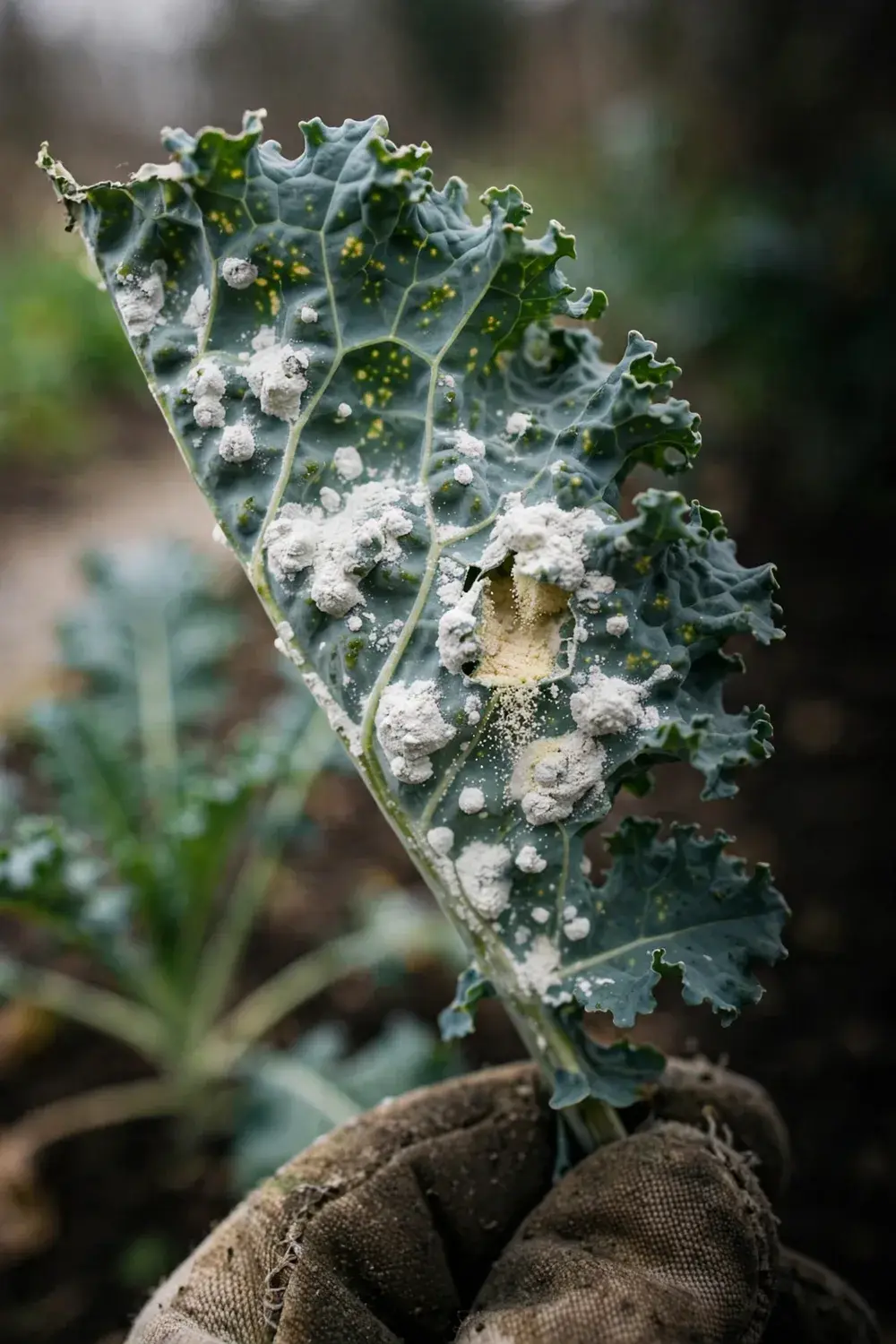

White rust on brassicas is a blister disease caused by the oomycete Albugo candida. The 9 strategies below carry a gardener from identification through prevention, starting with the cost-benefit call that decides whether treatment is worth the effort at all.
The signature is chalky white blisters on leaf undersides that rupture into powdery spore masses. Local leaf infection stays cosmetic in most home gardens. Systemic infection twists flower parts into sterile stagheads that set no seed.
The rest of this page runs the order a gardener should follow. Identify the blisters first, then separate white rust from downy mildew, then work the 9 steps from clean seed to last-resort fungicide. I have learned that pulling one spotted kale plant early saves more leaves than any spray saves later.
1. What White Rust Actually Is
White rust is an oomycete disease of brassicas. The pathogen is Albugo candida, a water mold relative that lives only inside living host tissue.
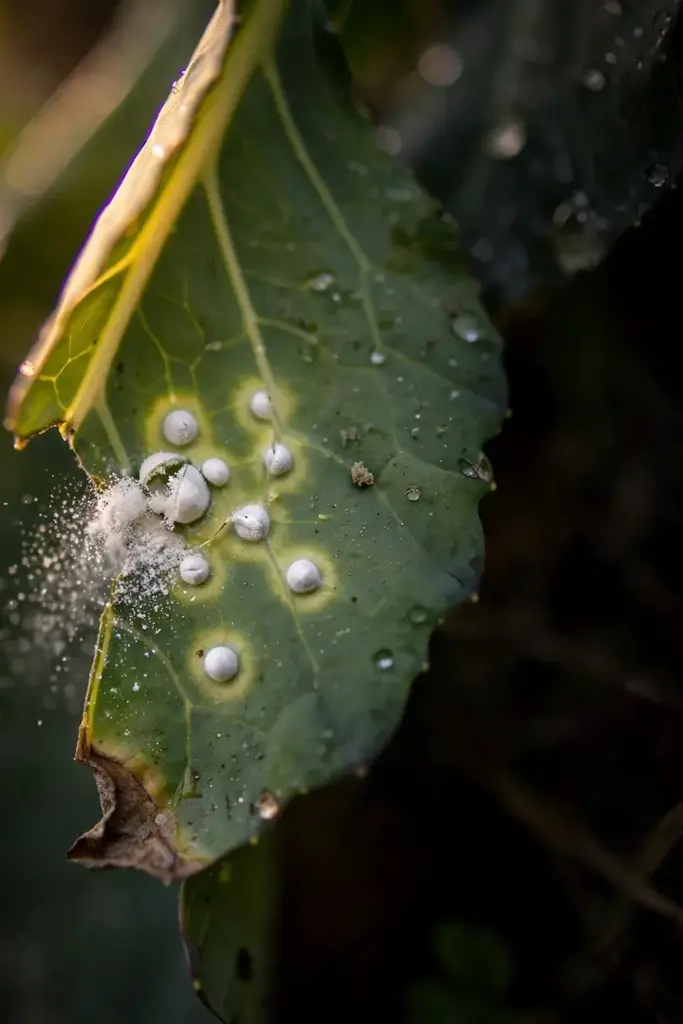
White rust belongs with the oomycetes. It is no true rust. True rusts are fungi in the Puccinia group that produce orange-brown pustules on many plant families. White rust is no true fungus either. Oomycetes sit in a separate lineage from fungi, and that split changes how the disease spreads and which sprays touch it.
Albugo candida is an obligate parasite. It feeds inside living brassica tissue and cannot grow on dead soil or compost alone. Infection takes two forms. Local infection makes blisters on leaves, stems, and flower parts. Systemic infection grows through the plant and distorts whole stems and flower heads.
The pathogen is a species complex, not one uniform strain. The University of Hawaii CTAHR profile of Albugo candida describes races of Albugo candida with different host ranges, and it lists pustules of approximately 1 to 2 mm in diameter that are white or creamy yellow. One race may attack mustard while leaving cabbage alone. A gardener who sees white rust on radish cannot assume the same race will jump to every brassica in the bed.
White rust stays inside the brassica family for home garden purposes. The same CTAHR profile lists field mustard, leaf mustard, black mustard, broccoli, cauliflower, Chinese cabbage, pak-choi, turnip, radish, and daikon among its hosts. Cabbage and Brussels sprouts host it outside Hawaii. Wild mustards and shepherd’s purse carry it too.
2. How to Identify White Rust on Leaves and Stems
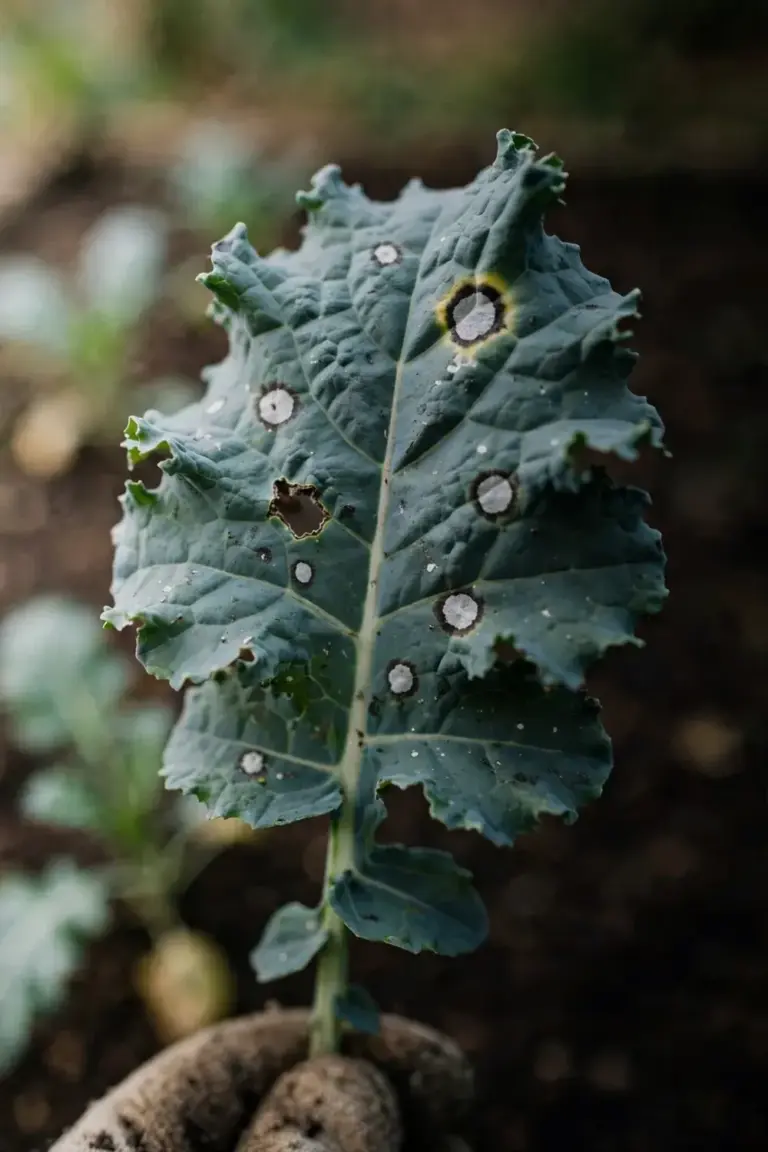
Flip the leaf over. Chalky white blisters on the underside, in a pattern that cannot be scraped off without tearing the leaf, point to white rust.
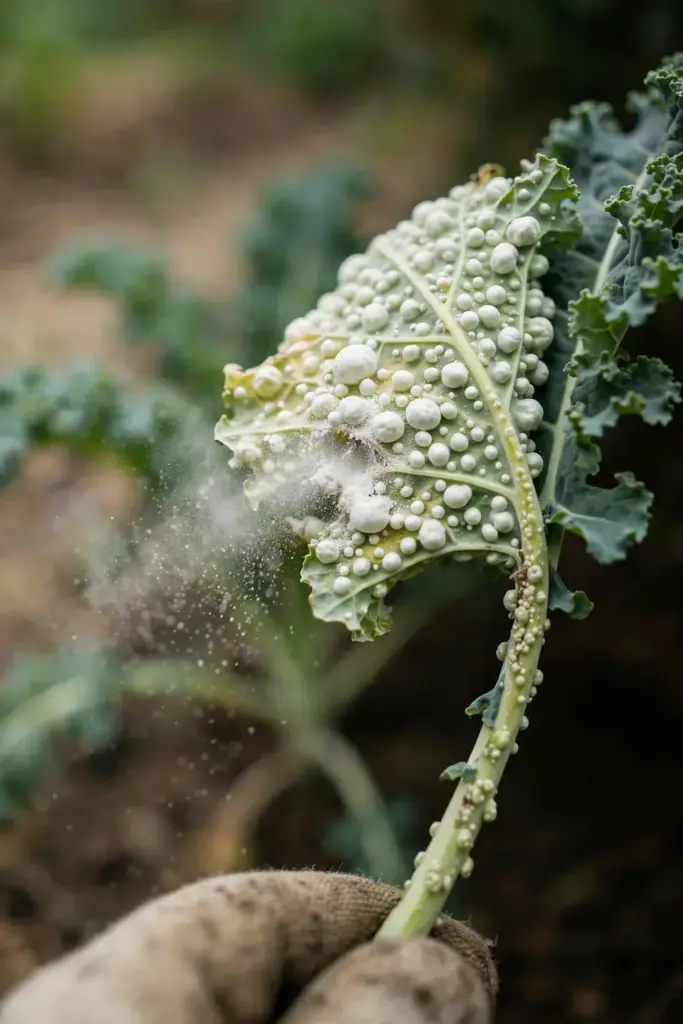
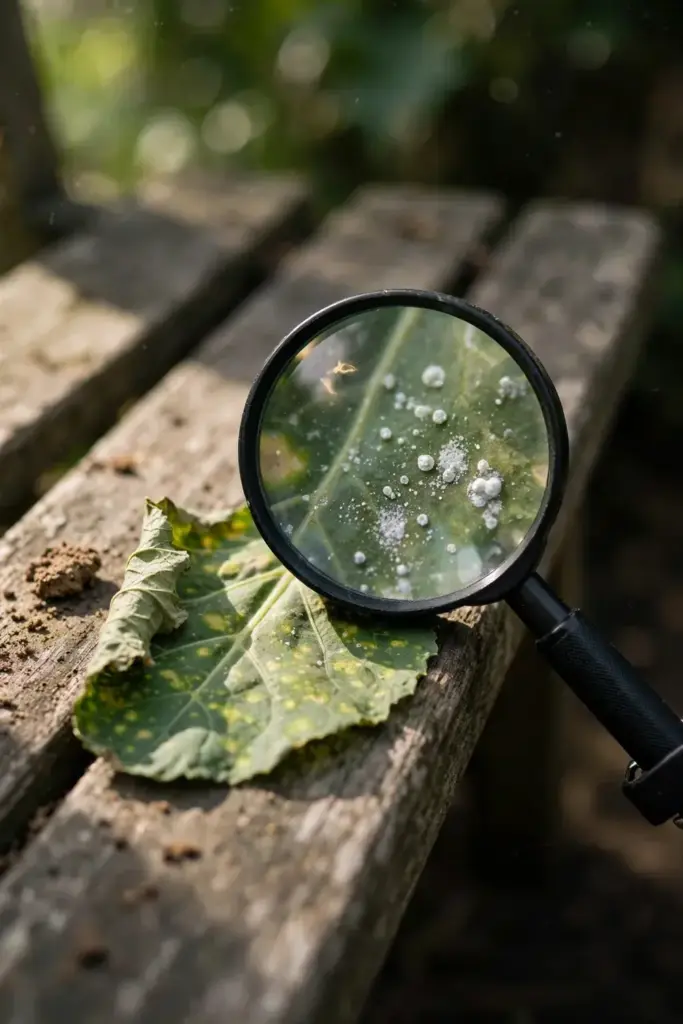
Local infection starts as small raised pustules under the leaf surface. Each pustule holds a mass of sporangia under a thin skin of leaf tissue. The skin splits. A powdery white mass of spores spills out. The pustules measure approximately 1 to 2 mm across, per the CTAHR profile linked above, and they merge into patches as infection advances.
The upper leaf surface tells the second half of the story. Yellow-green spots or pale blisters form above each underside pustule. The University of Delaware Weekly Crop Update on white rust of cole crops describes blister-like lesions on leaf undersides with chlorotic spots developing on the upper leaf surface, and it notes that the covering layer of leaf tissue eventually ruptures to release the spores.
Stems show the same blisters. Infected stems swell and twist. Leaves on a badly infected stem curl and distort. The plant keeps growing, and the damage stays local as long as infection stays out of the flower buds.
Scout after wet weather. Cool damp nights followed by warm days favor white rust, and the first pustules show on lower leaves where moisture lingers longest. Check the undersides, since the upper spots alone look like a dozen other problems.
3. How to Identify White Rust on Flowers and Seed Heads
Check the flower heads. Swollen, twisted flower parts that grow into antler-like stagheads mean systemic white rust.
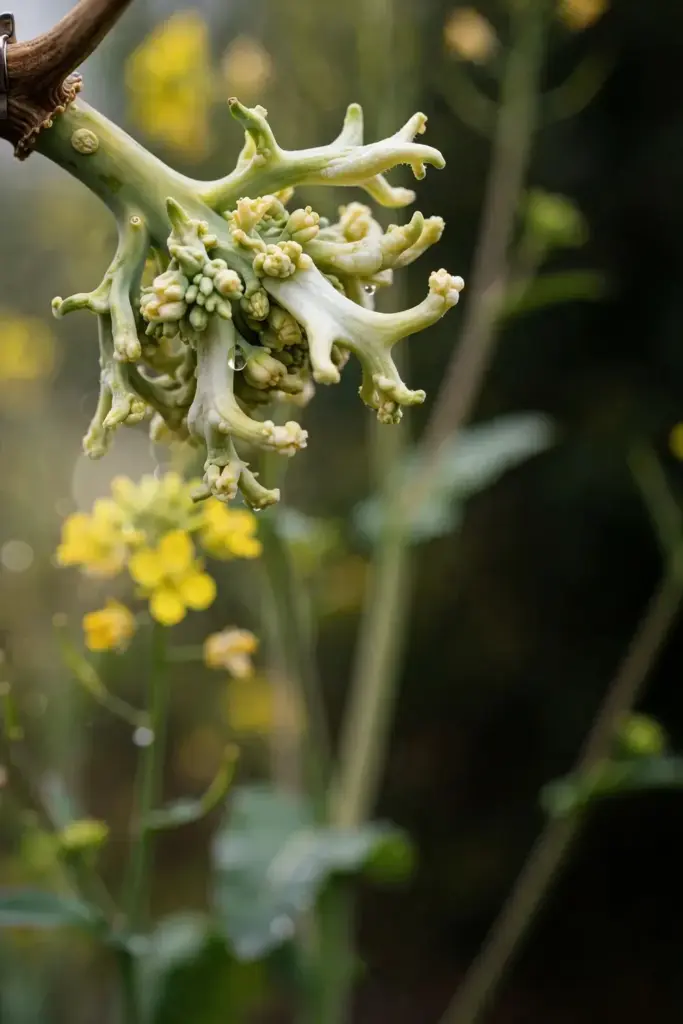
Systemic infection reaches the growing points and the flower buds. The pathogen grows inside the plant and forces flower parts to swell and distort. Sepals, petals, pistils, and anthers enlarge into a staghead, a sterile knot of twisted tissue that produces little to no seed. The staghead fills with thick-walled oospores, the resting spores that carry the pathogen forward.
Broccoli and cauliflower show the damage in the head. A head that should form tight buds comes out lumpy and deformed, with blisters across the surface. The Old Farmer’s Almanac guide to white rust on garden plants lists distorted heads on broccoli and cauliflower among the flower symptoms, and it notes that seed saved from infected plants comes out sterile.
Seed crops suffer the worst losses. A kale plant grown for leaves loses a few spotted leaves to white rust. A kale plant grown for seed loses the whole harvest when its flower heads turn to stagheads. Mustard, turnip, and radish grown for seed face the same risk. Home gardeners who save brassica seed should treat any staghead as the end of that plant’s seed crop.
Stagheads also serve as inoculum. Oospores inside staghead tissue survive in debris. Breaking a staghead open and dropping it in the bed spreads the resting spores where next year’s brassicas will grow. Bag stagheads and carry them out with the trash.
4. Which Brassicas Get Hit Hardest by White Rust
Seed crops take the hardest hit. Mustard, turnip, radish, and horseradish grown for seed lose flower heads to stagheads, while leaf crops lose only spotted leaves.
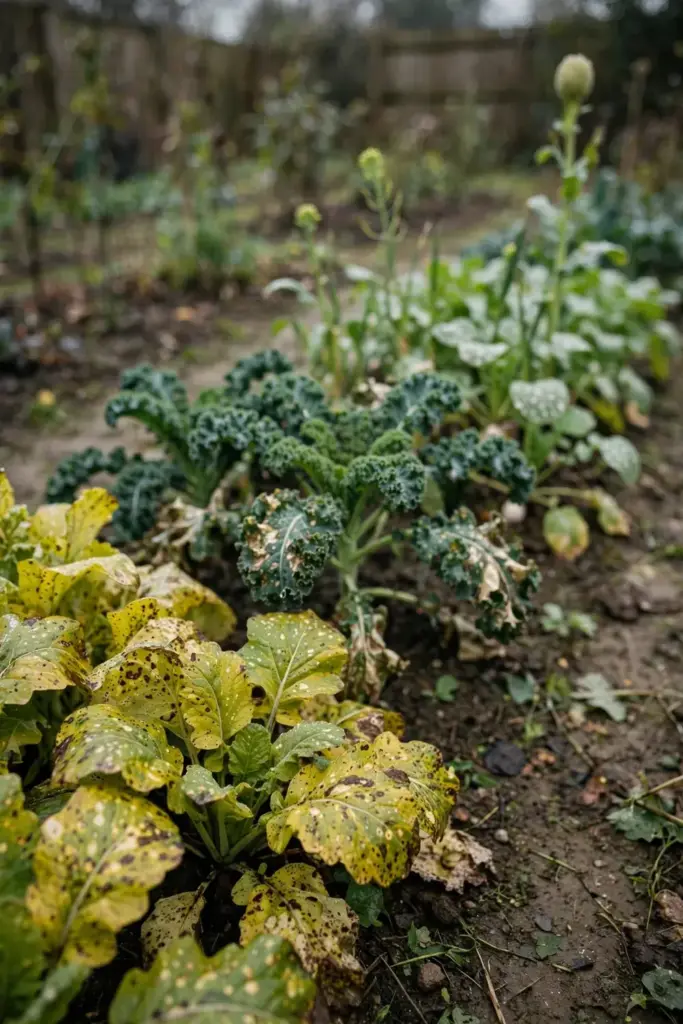
Mustard sits at the top of the risk list. Field mustard, leaf mustard, and black mustard all host Albugo candida, and mustard seed crops have carried the heaviest recorded losses. Turnip and radish follow close behind, since both are commonly grown for seed and both form stagheads readily. Horseradish carries systemic infection through its perennial crowns, which lets the pathogen persist from one season to the next.
Leaf and head crops face a milder threat. Broccoli and cauliflower lose head quality when blisters and distortion reach the curd. Kale and cabbage lose outer leaves to pustules and keep producing from the center. Collards and mustard greens lose lower leaves first, then keep growing. The plant survives. The harvest shrinks.
Mustard greens deserve a second look because they bolt fast. A mustard green plant that bolts into flower gives systemic infection a direct path to the flower buds. Harvest mustard greens young and pull bolted plants fast. Horseradish deserves the same attention for the opposite reason. Its perennial roots stay in the ground year after year, so an infected crown can carry the pathogen through winter.
Wild brassicas raise the risk for every crop above. Wild mustard, shepherd’s purse, and volunteer brassicas from last season’s seed hold the pathogen between crops. A clean bed beside a weedy fence line is no clean bed at all.
5. White Rust vs Downy Mildew on Brassicas
Check the underside first, then the upper side. White rust makes raised chalky pustules. Downy mildew makes flat fluffy growth under angular yellow patches.
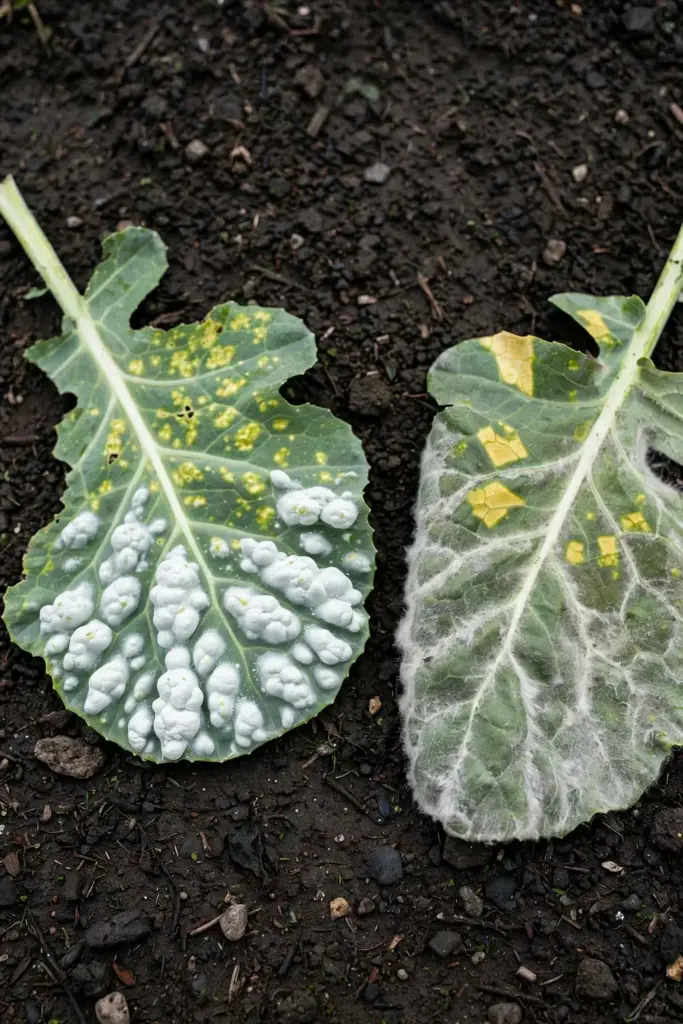
The two diseases share a family resemblance that fools gardeners. Both are oomycetes. Both attack brassicas in cool wet weather. Both show white growth on leaf undersides. The upper leaf surface separates them at a glance, and the flower symptoms settle any doubt that remains.
| Feature | White Rust (Albugo candida) | Downy Mildew (Hyaloperonospora parasitica) |
|---|---|---|
| Pathogen group | Oomycete, Albugo candida | Oomycete, Hyaloperonospora parasitica |
| Underside of leaf | Raised chalky white pustules, 1 to 2 mm, that rupture into powdery spore masses | Flat fluffy white to gray growth that never forms raised blisters |
| Upper side of leaf | Yellow-green spots or pale blisters above each pustule | Angular yellow patches that turn brown, bounded by veins |
| Texture | Chalky and dry, fixed to the leaf, cannot be scraped off without tearing tissue | Soft and downy, wipes away from the surface |
| Flowers and seed heads | Stagheads: swollen sterile antler-like flower parts full of oospores | Dark sunken spots on curds and heads, with secondary soft rot |
| Favorable weather | Cool damp nights with warm days, long leaf wetness | Cool wet weather, with relative humidity above 98 percent and temperatures between 46 and 60 degrees F |
| Co-infection | White rust infection opens the door to downy mildew on the same plant | Downy mildew often follows white rust on already weakened tissue |
White rust causes pustules on the upper leaf surface while downy mildew causes chlorotic lesions, per the Ohio State University Vegetable Disease Facts page on brassica downy mildew. The same page gives the downy mildew weather figures in the table above: relative humidity above 98 percent with temperatures between 46 and 60 degrees F.
Co-infection is common enough to plan for. The CTAHR profile of Albugo candida reports that the downy mildew pathogen stimulates gametangium formation in Albugo, which leads to oospore formation. A plant that carries white rust may soon carry downy mildew too. Treat the pair as one problem. Cultural steps that dry leaves and space plants help against both.
A hand lens settles borderline cases. Pustules look like tiny white blisters with a firm dome. Downy mildew looks like a fine white felt pressed flat against the leaf. When the two grow together, the felt spreads across tissue that already carries blisters.
6. Why White Rust Spreads So Fast in Wet Weather
Leaf wetness drives white rust. Sporangia release swimming zoospores that need free water to reach new infection sites.
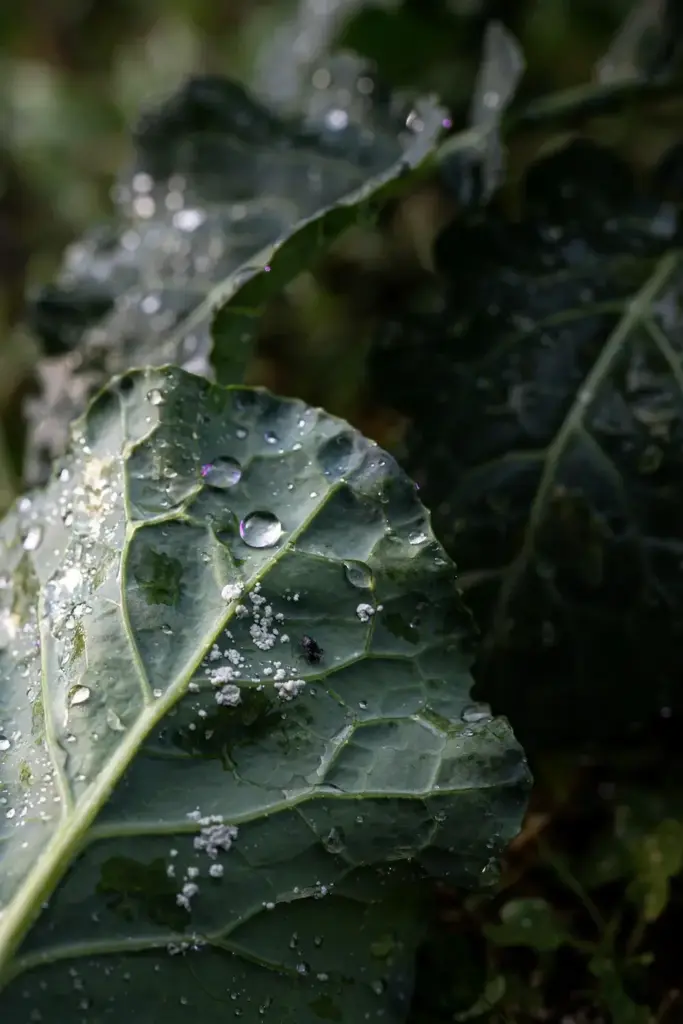
The cycle starts with a pustule. Sporangia pile up under the leaf epidermis until the skin splits. Wind and rain splash carry the sporangia to nearby leaves. Each sporangium releases several zoospores. Zoospores swim in the film of water on a wet leaf, then stop, germinate, and push into the tissue. A leaf that dries fast breaks the chain. A leaf that stays wet for hours completes it.
The Almanac guide linked above states that white rust spores require several hours of leaf wetness to germinate and get established. Morning watering, overhead sprinklers, and dense canopies all extend leaf wetness. Drip lines, wide spacing, and morning sun all shorten it.
Flower buds carry the highest infection rate. The CTAHR profile reports that laboratory inoculation of flower buds resulted in approximately 55 percent infection, against few stagheads from cotyledon and leaf inoculation. Buds stay wet longer than flat leaves, and systemic infection starts in buds. A wet week during flowering does more damage than a wet month during leaf growth.
Oospores carry the pathogen between seasons. They form inside stagheads and inside leaf and stem blisters, and they survive in debris and on seed. The CTAHR profile reports one study in which oospores could not be recovered from white rust infested fields six months after harvest. Old soil alone is a weak source. Debris, stagheads, and infested seed are the strong ones.
Seed moves white rust across distances that wind cannot. Oospore-contaminated seed carries the pathogen into a clean bed. That is why certified clean seed anchors the 9 steps below, and why saved seed from an infected plant is never worth the risk.
7. What Makes White Rust Worse in a Home Garden
Overhead watering tops the list. Splashing water spreads sporangia from leaf to leaf and keeps leaves wet long enough for zoospores to infect.
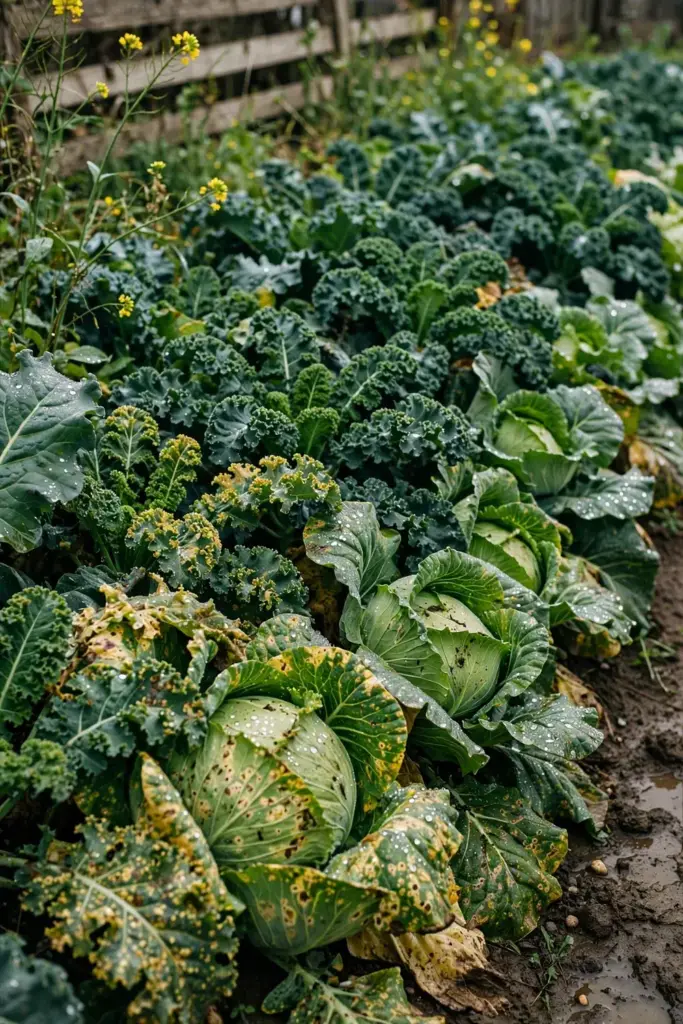
Dense planting runs second. Tight spacing traps humid air inside the canopy and shades lower leaves from drying sun. Leaves in the center of a crowded bed stay wet hours longer than leaves at the edge. Thin early. Space for airflow at planting time, when the fix costs nothing.
Cruciferous weeds feed the disease between crops. Wild mustard, shepherd’s purse, and volunteer brassicas host Albugo candida and hold it through winter. The CTAHR profile adds a useful limit: non-cruciferous weeds are not believed to serve as sources of inoculum. Weed control for white rust means cruciferous weeds specifically, plus volunteers from last season’s brassicas. A bed full of clover or grass weeds is no white rust reservoir.
Successive brassica crops stack the risk. Planting kale where cabbage grew last season, then mustard where kale grew, keeps a living host in the same soil year after year. Rotation breaks the chain by denying the obligate parasite its host.
Saved seed from an infected plant imports the pathogen. Oospores ride on seed coats into a bed that never saw white rust before. Certified seed and hot-water treatment remove that path.
Fall and spring carry the highest pressure. Cool nights, heavy dew, and slow drying match the disease’s needs exactly. Summer heat and dry air suppress it. A gardener in a cool maritime climate sees more white rust than a gardener in a hot dry one, and the same garden sees more of it in October than in July.
8. Step 1: Decide Whether Treatment Is Worth the Effort
Count the stagheads before reaching for any spray. Leaf spots alone rarely justify treatment, while stagheads on a seed crop justify action.
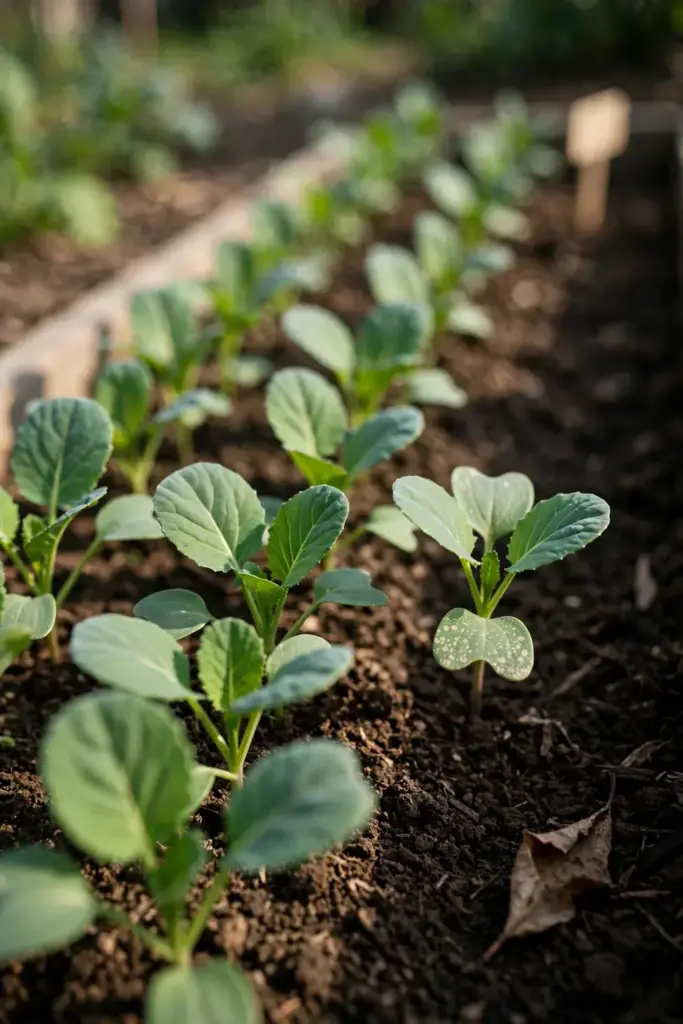
White rust is common and usually not serious as a leaf disease. The CTAHR profile calls it common but usually not serious, and that verdict fits most home gardens. A kale bed with pustules on lower leaves keeps producing clean new leaves. A cabbage with spots on outer leaves still heads. Pulling spotted leaves and letting the plant grow beats any spray program for a leaf crop near harvest.
Seed crops flip the math. A mustard plant with stagheads sets no viable seed on infected stems. A radish grown for seed loses the harvest. A broccoli head with blisters loses its market quality. When the crop’s value sits in flowers, heads, or seed, early action pays.
Young plants deserve faster action than old ones. Systemic infection starts in buds and growing points, so a seedling that shows pustules early may carry the pathogen into every flower it forms. An older plant with spots on lower leaves only, and clean growing tips, usually outgrows the problem.
Set a simple threshold. Treat when stagheads appear, when pustules reach the growing tips, or when the crop is grown for seed. Skip treatment when spots stay on lower leaves of a leaf crop within weeks of harvest. Rogue the worst plants either way.
9. Step 2: Start With Certified Clean Seed
Buy certified seed that is free of Albugo. Seed is the one infection path a gardener can close completely before planting.
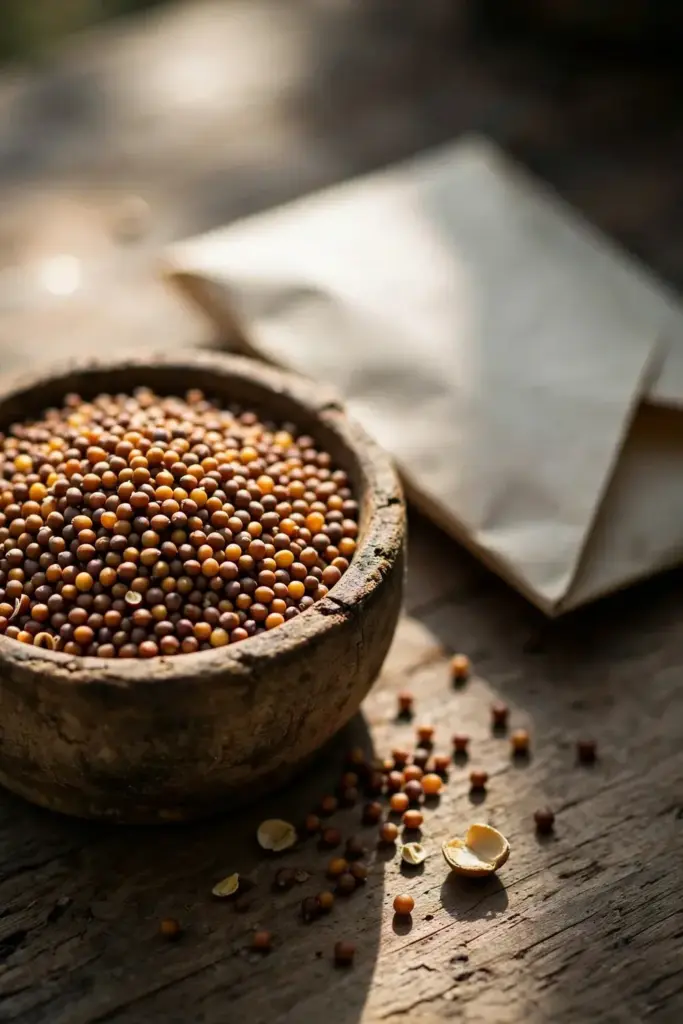
Oospores travel on seed coats. A packet of saved seed from an infected plant can seed a whole bed with white rust, even in soil that never grew a brassica. Certified seed removes that risk at the source. The University of Delaware guide linked above recommends seed treatment before planting, either with a fungicide or with hot-water seed treatment, to reduce inoculum from infested seed.
Hot-water treatment fits home gardeners who save seed. It uses hot water at a set temperature for a set time to kill pathogens on the seed coat, and it needs a thermometer and a timer to run safely. Follow a published hot-water protocol for the exact crop, since overheated seed loses viability. Seeds from a bed that showed white rust deserve treatment or disposal. Seeds from a clean bed need neither.
Never save seed from a plant that formed stagheads. Staghead tissue is sterile, and the oospores inside it ride on any seed harvested nearby. Buy fresh certified seed for that crop. Save seed only from plants that stayed clean all season in a bed that showed no white rust.
Label seed packets with the harvest year and the bed they came from. A packet marked with a clean bed and a clean year is trustworthy. A packet marked with nothing is a gamble.
10. Step 3: Rotate Brassicas to Fresh Ground
Move brassicas to ground that grew no brassica for at least two of the last three years. Rotation starves an obligate parasite that needs a living brassica host.
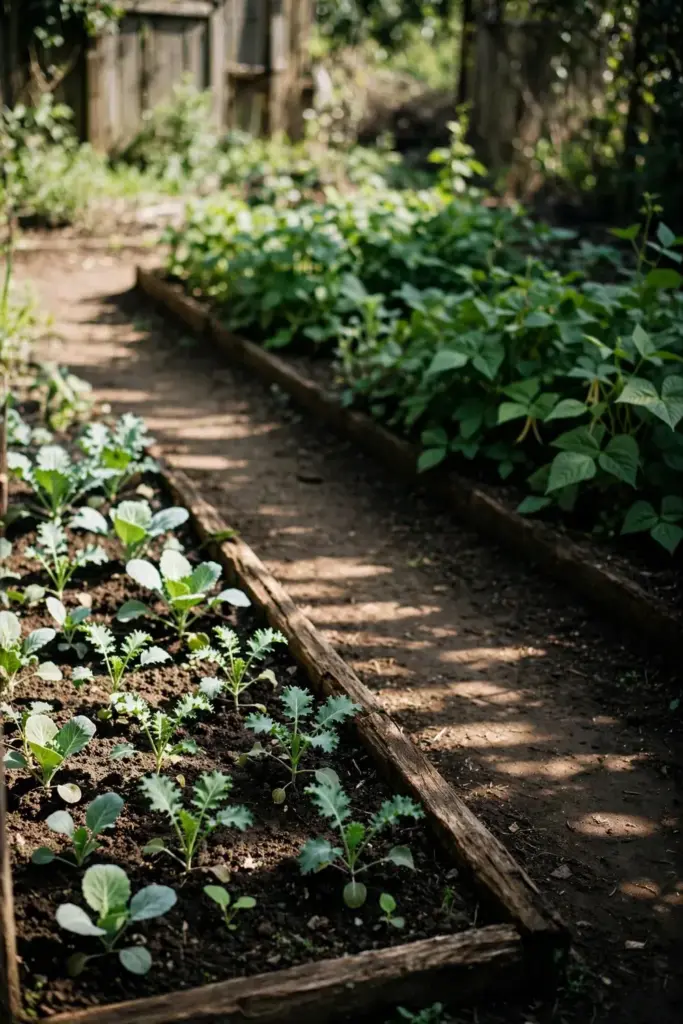
White rust cannot feed on dead soil. It needs living brassica tissue, and a gap with no brassica host breaks the cycle. The Ohio State brassica disease guidance recommends a rotation plan that excludes production of any type of cruciferous crop for at least 2 out of every 3 years.
Plan the rotation on paper before the season starts. Map each bed. Mark the year each bed last grew a brassica. A bed that grew kale last spring and cabbage last fall is no fresh ground, even if it looks empty now. A bed that grew beans, tomatoes, or squash is fresh ground.
Cover crops count as crops. A mustard cover crop is a brassica, and it hosts white rust like any other mustard. A clover or rye cover crop is no host. Read the cover crop label before sowing it into a rotation gap.
Small gardens rotate in containers when ground runs short. A large pot with fresh potting mix grows a clean kale plant while the beds rest. The pot needs fresh mix, since reused mix from an infected bed carries debris and oospores.
11. Step 4: Remove and Destroy Infected Plants and Debris
Pull infected plants early and destroy them. Do not compost them. Composting cannot be trusted to kill every oospore.
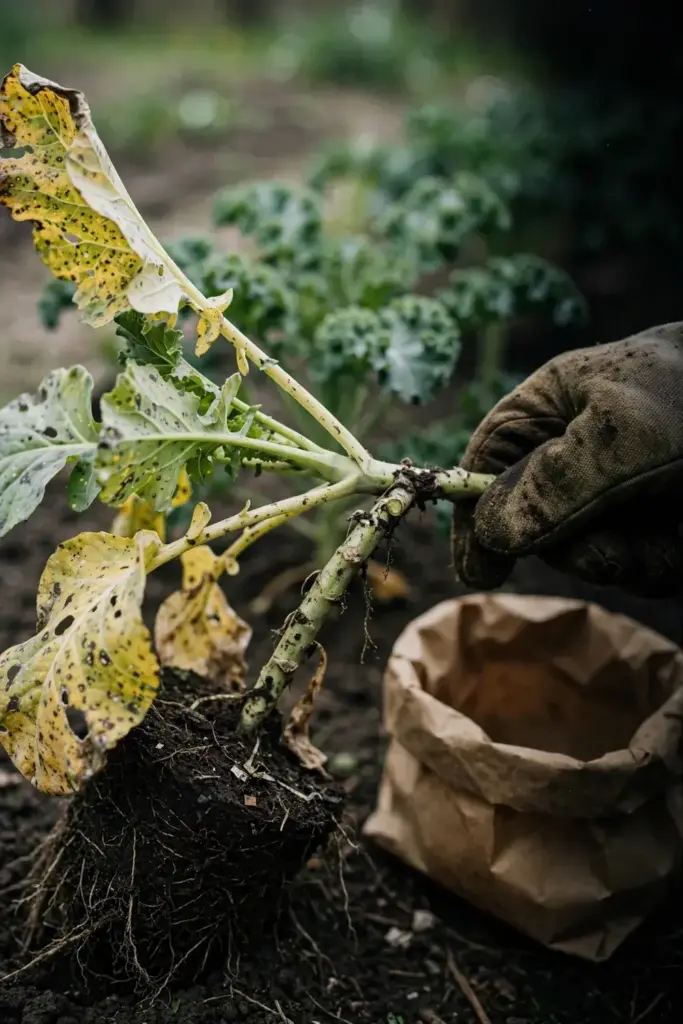
Sanitation removes the spore source. Every pustule left on a plant keeps releasing sporangia. Every staghead left in the bed keeps its oospores. Pulling a badly infected plant removes thousands of future infections in one motion. Pull on a dry day, when spores are less likely to splash onto neighbors.
Bag the debris. Carry it out in a bag or a covered bin. Dropping infected leaves on the path scatters sporangia across the garden. The Almanac guide linked above advises burying or burning infected leaves, and it states plainly that composting will not kill all the spores.
Clean up at season end. Remove all brassica vegetation from the bed once harvest ends, while leaves are still intact enough to gather. Waiting until foliage turns brown and crispy leaves fragments behind. Strip the bed, then till or fork the surface lightly to bury small debris where it breaks down faster.
Disinfect tools after working infected plants. Wipe blades and trowels with rubbing alcohol before moving to healthy plants. The step takes seconds, and it stops the gardener from becoming the disease vector.
12. Step 5: Starve the Disease of Wet Leaves
Water at the base and water in the morning. Dry leaves break the infection chain that swimming zoospores need.
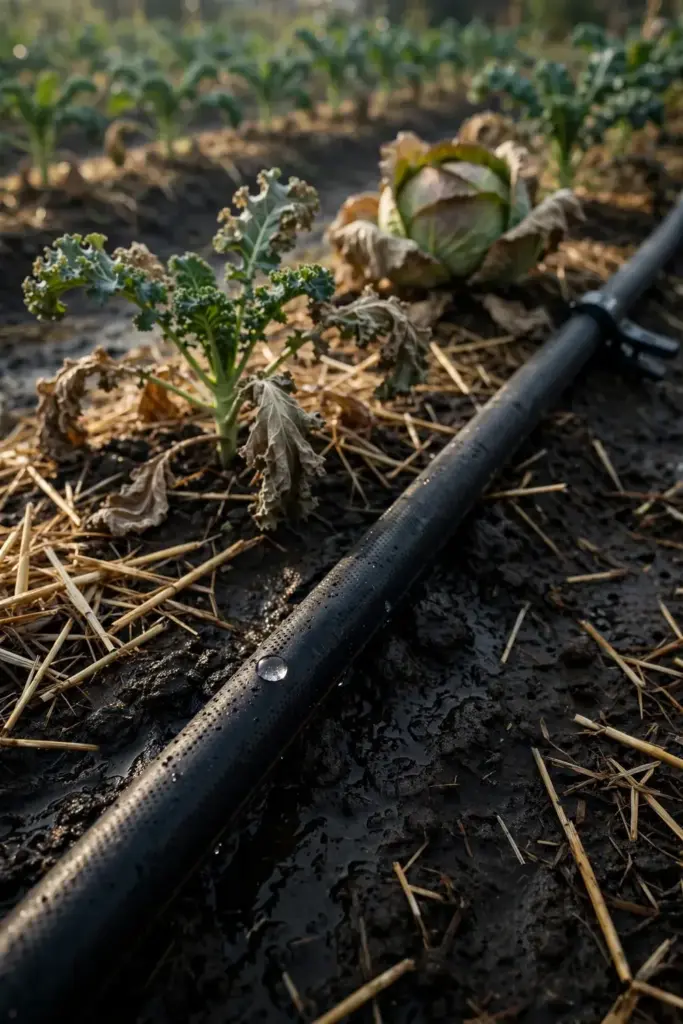
Overhead sprinklers wet the whole canopy and keep it wet. A soaker hose or drip line wets the soil and leaves the leaves dry. A watering can aimed at the base does the same job on a small bed. The Almanac guide linked above recommends watering from below with a hose, drip tape, or soaker hoses, and it adds that sprinkler watering belongs in the morning so leaf surfaces dry before the cooler evening.
Spacing dries leaves too. Wide rows let sun and wind reach the lower canopy. Plant in the direction of the prevailing wind so air moves through the rows. Thin seedlings on time. A crowded bed stays wet after a rain. A spaced bed dries within hours.
Mulch helps by cutting splash. A layer of straw or shredded leaves under brassicas stops soil splash from carrying sporangia onto lower leaves. Keep mulch pulled back a finger width from stems so stems stay dry.
Row covers cut rain splash as well, and they carry a trade-off. Covers keep leaves dry in a light rain, and they trap humidity in a long wet spell. Vent covers on dry days. Remove them once the canopy fills and airflow drops.
13. Step 6: Control Wild Mustards and Volunteer Brassicas
Pull wild mustards, shepherd’s purse, and volunteer brassicas from the bed and the border. These hosts carry white rust between crops.
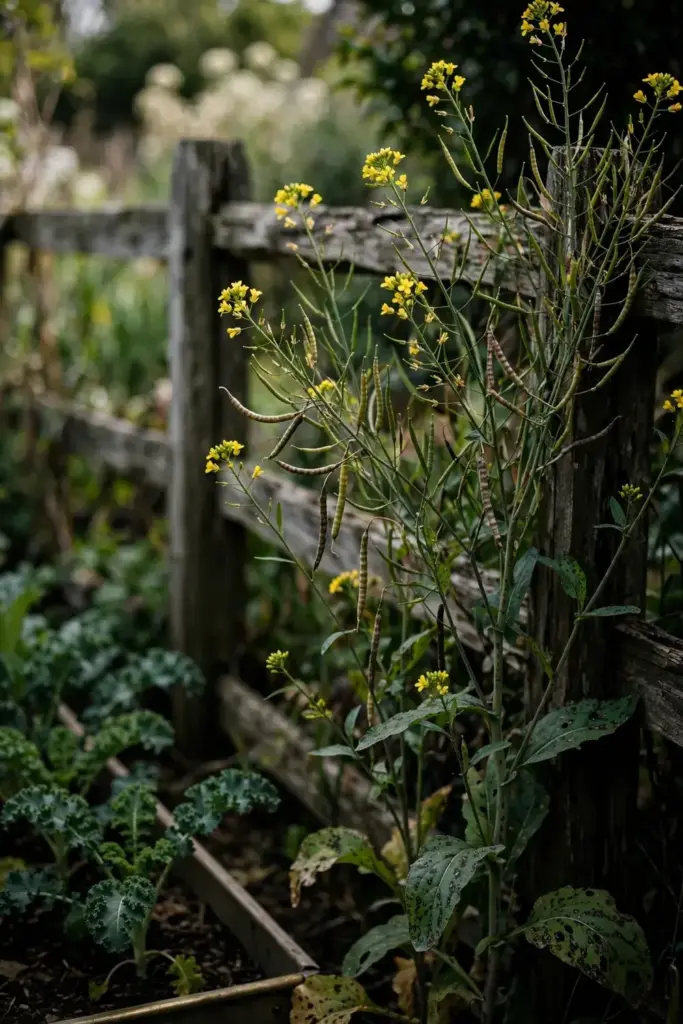
Scout the fence line and the paths, not just the beds. Wild mustard thrives on disturbed edges, shepherd’s purse grows in path cracks, and volunteer brassicas sprout where last season’s plants dropped seed. Each one holds the pathogen within splash distance of the crop.
Pull weeds before they flower. A wild mustard in flower can carry systemic infection into its buds and form stagheads of its own, so a weed pulled at the rosette stage never gets there. Check the border weekly during the brassica season.
Mow or cut the border when pulling cannot keep up, since cutting stops flowering and drops spore production even when roots stay behind. Pulling remains better. Roots regrow and flower again.
Leave non-cruciferous weeds alone when time runs short. The CTAHR profile notes that non-cruciferous weeds are not believed to serve as sources of inoculum, so a bed edge full of grass or clover is no white rust threat. Spend the weeding hour on the mustard family, where it counts.
14. Step 7: Scout Early and Rogue Infected Plants
Walk the brassica bed weekly from transplant day onward. Early detection turns a bed-wide problem into one pulled plant, and a weekly walk costs minutes. Start with the lower leaves, where pustules show first because moisture lingers.
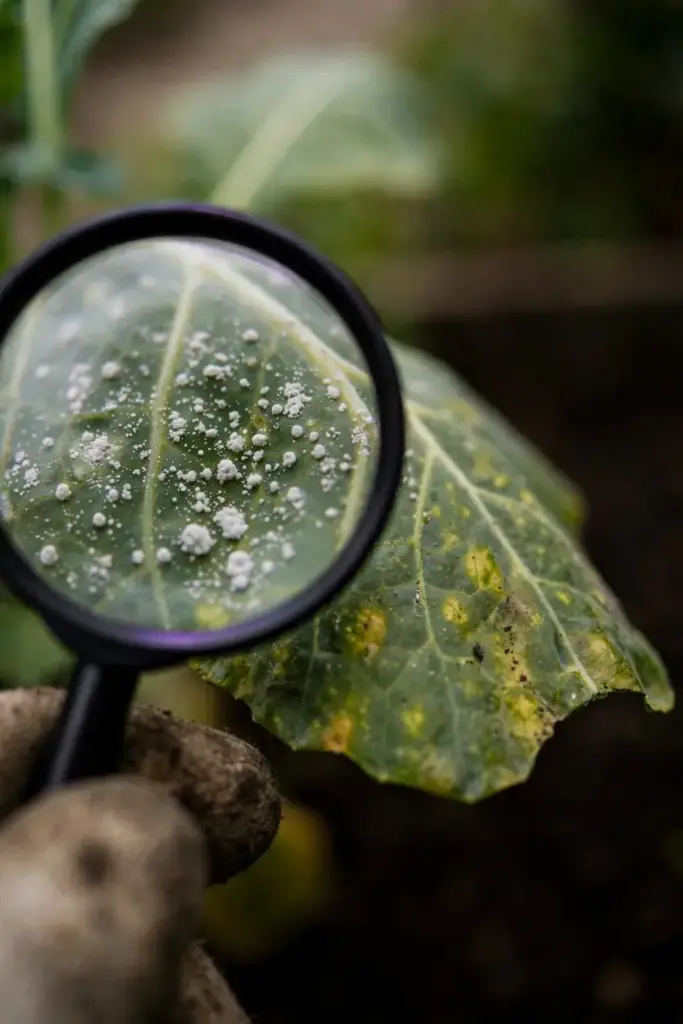
Start with the lower leaves, where pustules show first because moisture lingers. Flip five lower leaves per plant on a sample of plants across the bed. Check stems and growing tips next. Mark any plant with pustules on the growing tip for immediate removal, since tip infection signals systemic spread.
Rogue without mercy on seed crops. A mustard plant with stagheads spreads oospores and yields no seed. Pull it, bag it, and carry it out. A kale plant with a few spotted lower leaves can stay, with spotted leaves stripped and destroyed. The threshold from Step 1 applies at every walk.
Scout after every wet week. Rain and heavy dew trigger new infections, and the pustules show days later. A walk after a wet spell catches the new round early. A missed walk lets it build.
Record what was found. A notebook line with the date, the crop, and the count of pulled plants shows whether the disease is rising or falling. Rising counts mean the cultural steps need tightening. Falling counts mean the plan works.
15. Step 8: Choose Resistant Varieties With Eyes Open
Ask the seed supplier for resistant varieties, and expect a short list. Few resistant brassica varieties exist, and none covers every race.
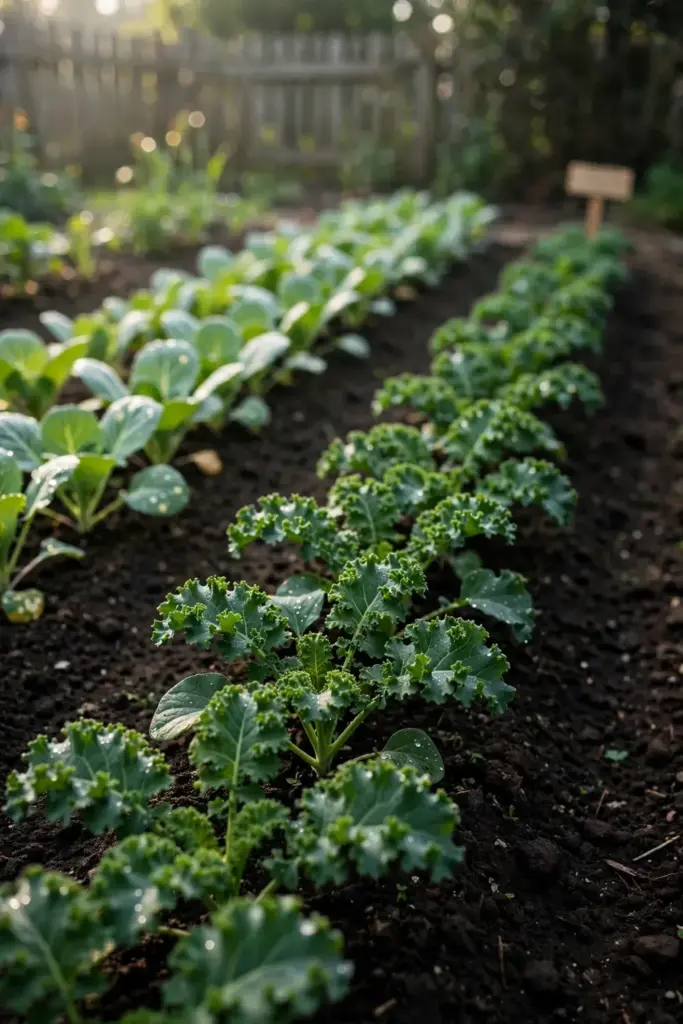
Resistance helps when it exists. The University of Delaware guide linked above states that a few resistant cultivars are available and should be used where possible. A resistant variety still needs the cultural steps, since resistance slows the disease rather than sealing the plant against it.
Races limit resistance. A variety that resists one Albugo candida race may fall to another. A variety bred for resistance in one region may face a different race in another. Trial a new variety on a small patch before committing the whole bed to it.
Seed catalogs sometimes oversell tolerance. Tolerance means the plant shows milder symptoms, not that it stays clean. Resistance means the plant blocks infection. Read the catalog wording with care, and favor suppliers that name the race or strain their variety resists.
Keep notes on what held up. A variety that stayed clean through a wet season in one garden earns a repeat order. A variety that spotted early earns a note to skip next year. Home garden records beat catalog claims.
16. Step 9: Use Fungicides Only as a Last Resort
Reach for fungicides only when cultural steps fail and the crop justifies the cost. Home gardens rarely need them for white rust.
Cultural control carries most gardens. Clean seed, rotation, sanitation, dry leaves, weed control, and roguing close every infection path that fungicides would target. A garden that runs all six rarely sees enough white rust to justify a spray.
When a spray is warranted, Extension sources name two groups. The University of Delaware guide linked above states that strobilurin fungicides can help reduce losses when foliage is infected. The CTAHR profile credits the systemic fungicide metalaxyl with limited curative activity and some control of systemic infection. Both sources describe commercial and Extension practice, and home gardeners should follow the product label for the exact crop and rate.
Rotate fungicide groups when spraying more than once. Repeated use of one group breeds resistant strains. Alternating a protectant with a systemic product slows that shift. A single spray rarely needs a rotation plan, and a repeated program always does.
Check local rules before buying. Product availability and label approvals vary by region, and some products carry restrictions for home gardens. A local Extension office names the products registered for home use on brassicas in that area. Follow the label. It carries the legal rate, the safety interval, and the protective gear requirement.
17. Living With White Rust Damage You Cannot Undo
Strip spotted leaves and keep the plant. A brassica with white rust on lower leaves still produces clean new growth from the center.
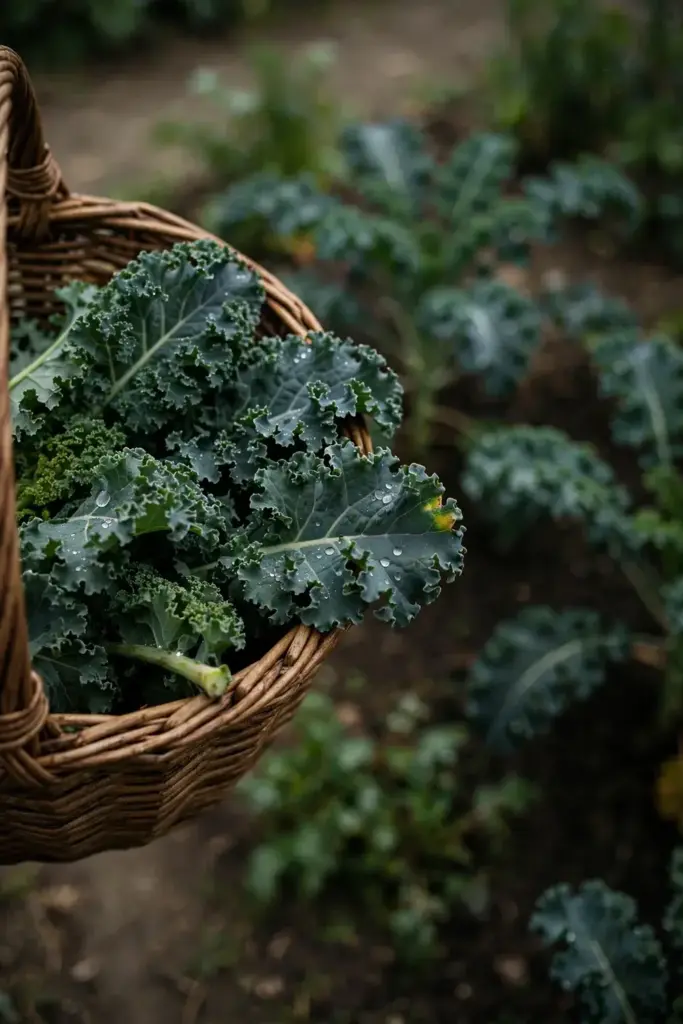
Start with the leaves. Pick off spotted lower leaves and destroy them. Wash hands and tools after. The plant keeps photosynthesizing from its clean leaves, and the harvest continues. A cabbage that lost outer leaves still heads. A kale plant that lost lower leaves still pushes new leaves from the growing tip.
Judge heads and curds on their own. A broccoli head with a few blisters still cooks, once the blistered parts are cut away. A cauliflower curd with dark sunken spots and soft rot has gone past saving, since secondary organisms invade damaged curd tissue. Cut away small blistered areas. Discard a head that has gone soft.
Seed crops get no reprieve. A plant that formed stagheads sets no viable seed on infected stems. Cut the whole plant and destroy it. Saving seed from nearby clean stems is still a gamble, since oospores ride on seed coats. Buy fresh certified seed for that crop next season.
Plan next season around the damage. Mark the bed that carried white rust. Rotate brassicas out of it for at least two of the next three years. Clean the border weeds. Order certified seed. A bed that carried white rust this year can grow clean brassicas again once the rotation gap and the sanitation steps do their work.
18. Frequently Asked Questions
White rust is neither. The pathogen is Albugo candida, an oomycete in a lineage separate from fungi. True rusts are fungi that make orange-brown pustules across many plant families. White rust makes chalky white blisters on brassicas only. The name describes the look, not the biology. Oomycete biology explains the swimming zoospores, the need for leaf wetness, and the limits of fungicides.
Strip the spotted leaves and cook the rest. White rust infects brassica plants, and it does not infect people. Wash the remaining leaves well, and cut away any blistered or distorted tissue before cooking. Heavily spotted leaves lose quality, so discard them. A plant with spots only on lower leaves still yields clean new leaves from the center, and those leaves cook as usual.
White rust returns when debris, stagheads, or infested seed carry it through winter. Oospores survive in staghead tissue and in crop debris, and infested seed moves the pathogen into clean ground. Rotation, fall cleanup, and certified seed break that carryover. A bed that grew no brassica for at least two of the last three years, with all debris removed, starts the next season with little inoculum left.
Do not compost them. Home compost piles do not heat evenly enough to kill every oospore. Bag infected plants and carry them out with the trash, or bury or burn them where local rules allow. The same rule covers stagheads, which hold the highest oospore load. Clean compost comes from healthy plants only, and a compost pile is no place for diseased brassica debris.
White rust on brassicas stays on brassicas. Albugo candida races attack members of the mustard family, and they do not infect tomatoes, beans, squash, or other garden vegetables. Wild mustards and volunteer brassicas are the hosts to worry about. A rotation bed planted with beans, tomatoes, or squash is safe ground, and those crops break the white rust cycle by denying the pathogen its host.
19. Where to Go From Here
Start with one walk around the brassica bed. Flip lower leaves, check flower heads for stagheads, and pull the worst plants the same day.
Order certified seed for the next planting. Map the rotation so brassicas leave the infected bed for at least two of the next three years. Set up drip lines or soaker hoses before the next wet spell. The bed that beats white rust is the bed with clean seed, dry leaves, and no wild mustard on its border.
One clean season resets the bed. Work the 9 steps in order, and next year’s cole crops start without white rust beside them.