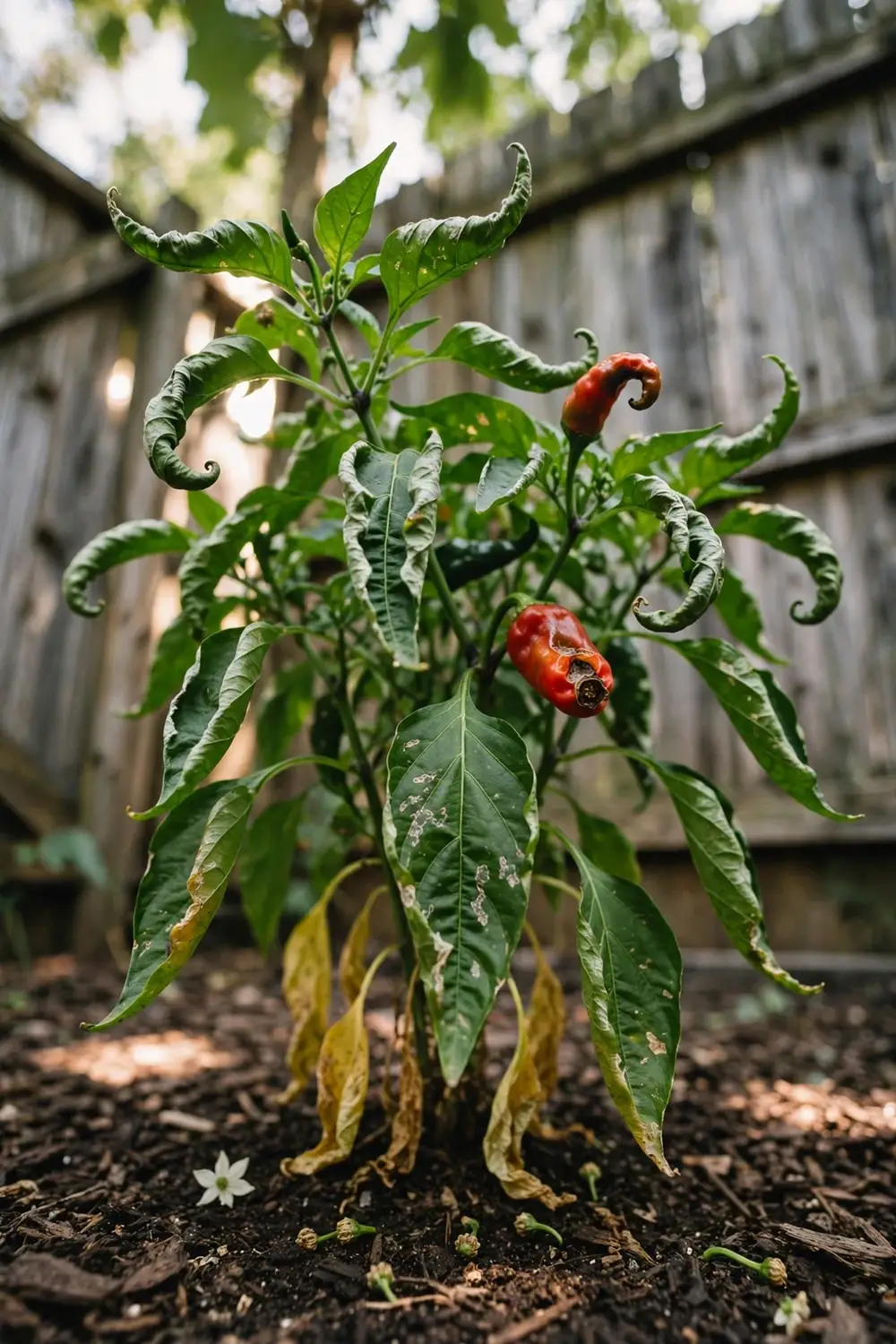

Your chili plant is telling you exactly what is wrong. If you are asking what’s wrong with my chili, match the symptom to one of the 11 problems below, and most home-garden chili failures trace back to just three of them: flowers dropping in heat, leaves curling from thrips or mites, and blossom-end rot from uneven watering.
Chili (chilli) means the same plant here, a Capsicum grown for its fruit, and “what is wrong” means a symptom you can see and match to a cause. The rest of this page walks through 11 problems in the order home growers meet them, then closes with a fix-first table you can pin to the shed wall. I squeeze a handful of soil before I reach for the fertilizer, because the ball test tells me whether the plant needs water, not food.
This is a diagnosis guide, not a growing guide. Each section names the symptom, identifies the cause, and gives the fix in that order, so you can jump straight to the H2 that matches your plant. Read the three lines in order. The symptom names what you see, the cause names the mechanism behind it, and the fix names the next move. That order keeps the diagnosis fast and keeps every fix matched to its cause. The figures come from university extension and Australian industry research, and every figure carries its source in the sentence. Most fixes need no purchase: water, timing, a hand lens, and a sharp pair of secateurs cover nearly everything below.
If the plant looks healthy and a bigger harvest is the goal, growing cayenne pepper is a different job, and that guide lives on the site’s Grow Cayenne Pepper: Vegetable Easy Tips for Spicy Success. This page stays on the sick plant: the symptom, the cause, and the fix.
1. Flowers Drop Before Any Fruit Sets
Flowers open, then fall off cleanly at the stem joint with no fruit forming. Heat is the usual trigger. The University of Minnesota Extension notes that high temperatures near 90 °F (32.2 °C) cause blossom and fruit drop in peppers, and drought stress makes the drop significantly worse, so a hot, dry week can strip every flower at once.
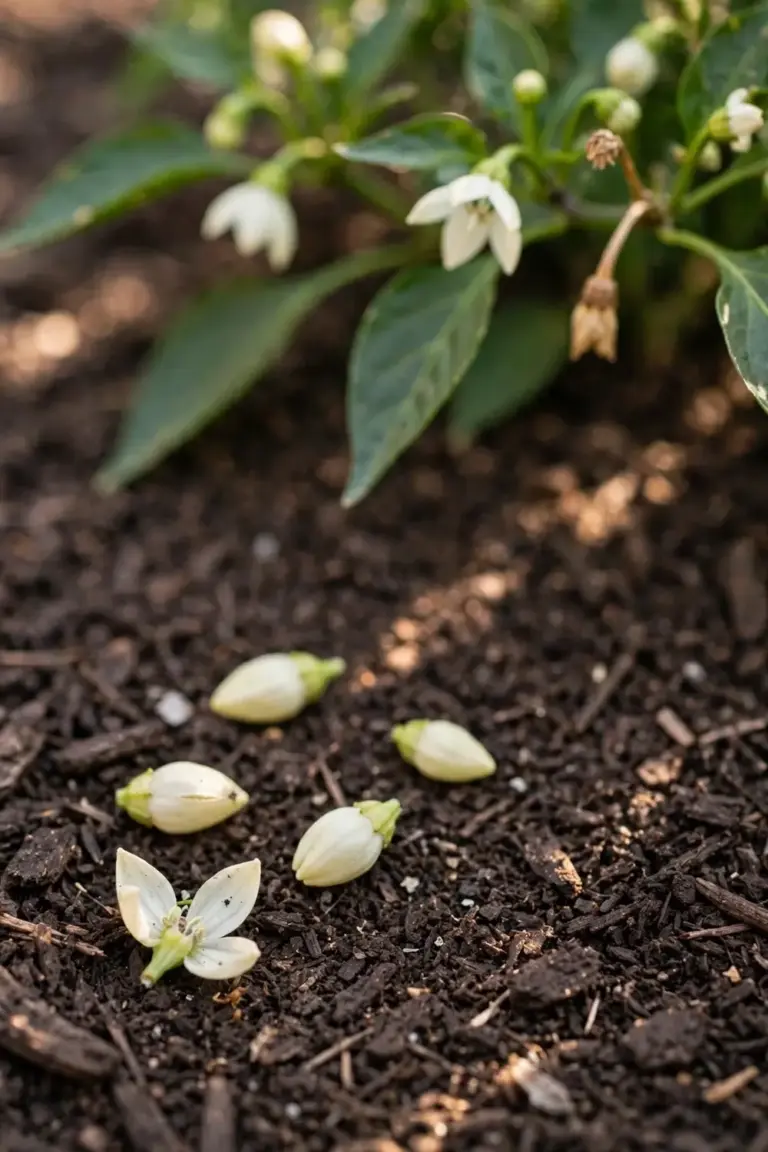
Cold does the same job from the other direction. Cool nights stall pollination, and flowers that never set fall cleanly. A plant carrying a heavy load of developing fruit will also shed later flowers because it cannot feed everything at once.
Water deeply in the morning so the plant enters the hottest part of the day fully hydrated. Mulch the soil to keep the root zone cooler, and give the plant a few days after a heat wave before judging it. Fruit set restarts when nights cool.
Tell heat drop from cold drop by the calendar. Heat drop hits in midsummer with healthy green growth and plenty of flowers. Cold drop hits early in the season on young transplants, often with slow growth overall. Either way the flower falls at the joint with no swelling behind it, which separates drop from a pollination failure where the flower stays and a tiny fruit forms. Check the calendar first when flowers fall. A midsummer shed after a hot week points to heat, and an early-season stall on a young transplant points to cold. The calendar narrows the cause before you change a single habit.
2. Leaves Curl Upward With Silvery Scars
Leaf edges roll upward and the surface shows silvery feeding scars along the veins. That is thrips damage. UC IPM’s pepper pest guidelines state that thrips feeding distorts foliage and causes leaves to curl and pucker, which is the field mark that separates thrips from mites.
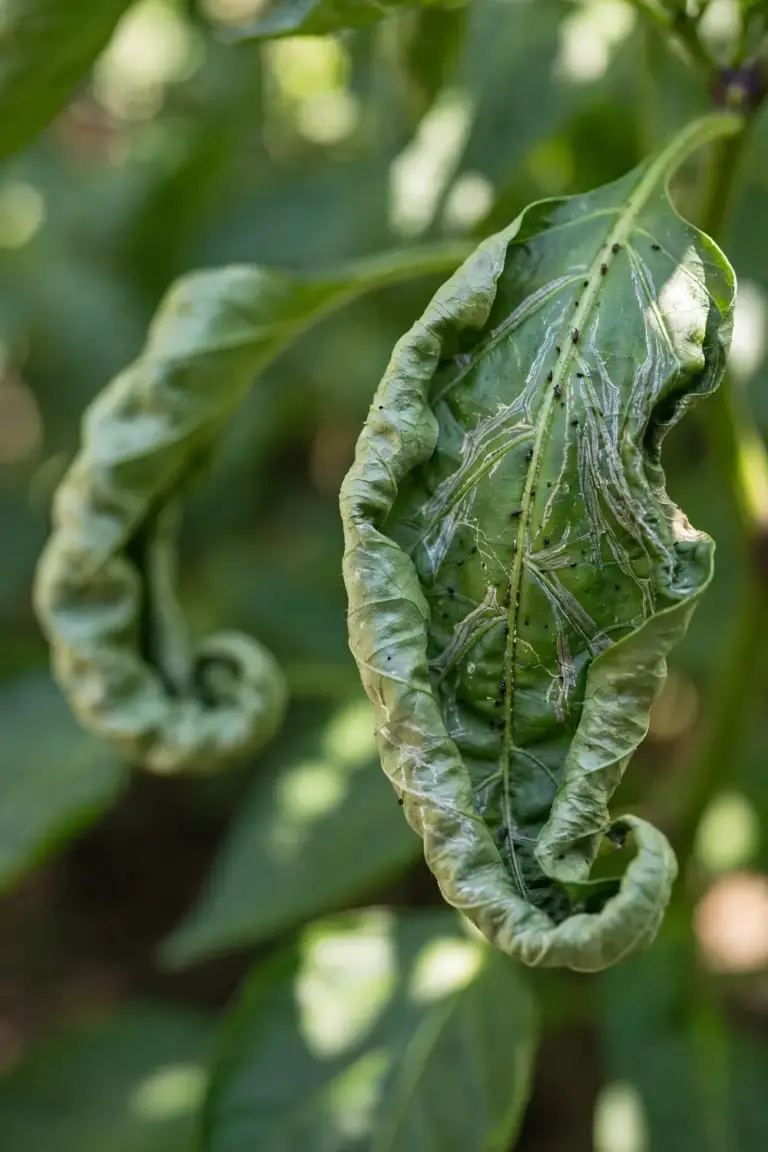
Thrips hide on the undersides of leaves and are hard to spot early. A severe infestation makes tender leaves and buds brittle, and the damage opens the door to viruses. Newly hatched nymphs are nearly invisible without a lens, which is why the spray schedule runs three rounds. Each round catches the generation the previous one missed.
Check the undersides of curled leaves first. Blast the plant with a strong jet of water to knock thrips off, then follow with insecticidal soap or neem oil, coating the undersides. Repeat every 5 to 7 days for three rounds to catch newly hatched thrips. The site’s chilli thrips management guide walks through 10 control options in detail.
Thrips matter beyond the curl. They transmit tospoviruses, and UC IPM’s pepper pest guidelines list Impatiens necrotic spot and tomato spotted wilt virus among pepper diseases, with fruit showing chlorotic spots, rings, and necrosis. A curling plant today can be a virus reservoir tomorrow, which is why the three-round spray schedule is worth finishing.
3. Leaves Curl Downward, Thick and Brittle
Leaves roll downward with margins tucking under, and the leaf feels thick and brittle between the fingers. Mites cause this pattern. A 10x hand lens on the underside of a curled leaf settles it in seconds: broad mites look like tiny translucent specks that move slowly, while spider mites are larger reddish or greenish dots, often with fine webbing and cast skins around them, per an Australian chilli-mite identification guide from BigHaat.
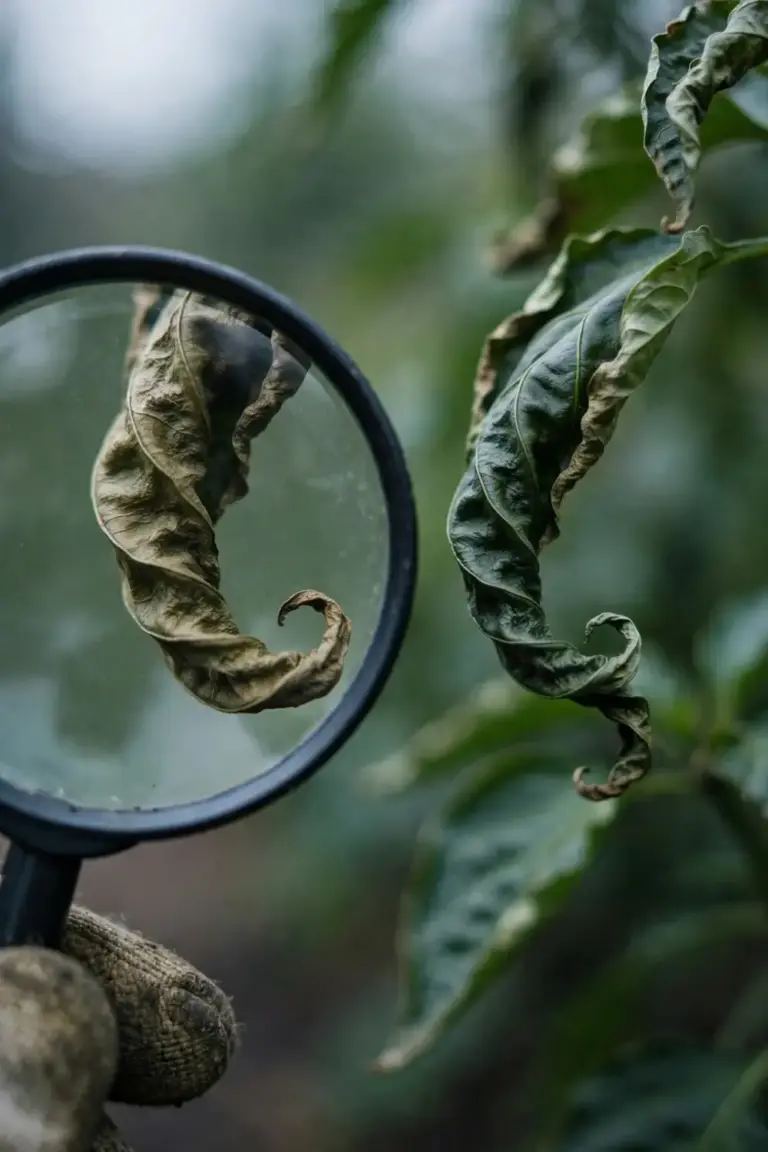
Direction matters. Mites curl the leaf downward. Thrips curl it upward. Where both are present at once, which happens in hot dry spells, the plant shows curling in both directions with hardened, distorted growth.
Scout twice a week from transplanting, checking growing tips and the undersides of young and older leaves, and step up checks during hot dry spells. Populations explode within days in that weather, so a clean field on Monday can be badly infested by the weekend. Spray the undersides where mites live, and never repeat the same chemical back to back. Mark two scouting days a week and keep them. A fixed rhythm catches the explosion before the damage shows on the leaf surface, while the mites are still few enough to control.
Separate the two common mites with the lens. Broad mites (yellow mites) appear as tiny translucent straw-colored specks that move slowly, with oval eggs studded with small white bumps. Spider mites are larger, easier to spot as moving reddish or greenish dots, often with fine webbing and cast skins around them, per the same Australian chilli-mite identification guide. Without a lens the diagnosis is guesswork.
4. Leaves Turn Yellow and Growth Stalls
Yellow leaves on a stalling plant usually mean water or food, not disease. Overwatered chili roots sit in airless soil and cannot take up nutrients, so the whole plant pales. Underfed plants yellow from the bottom up as the plant moves nitrogen to new growth.
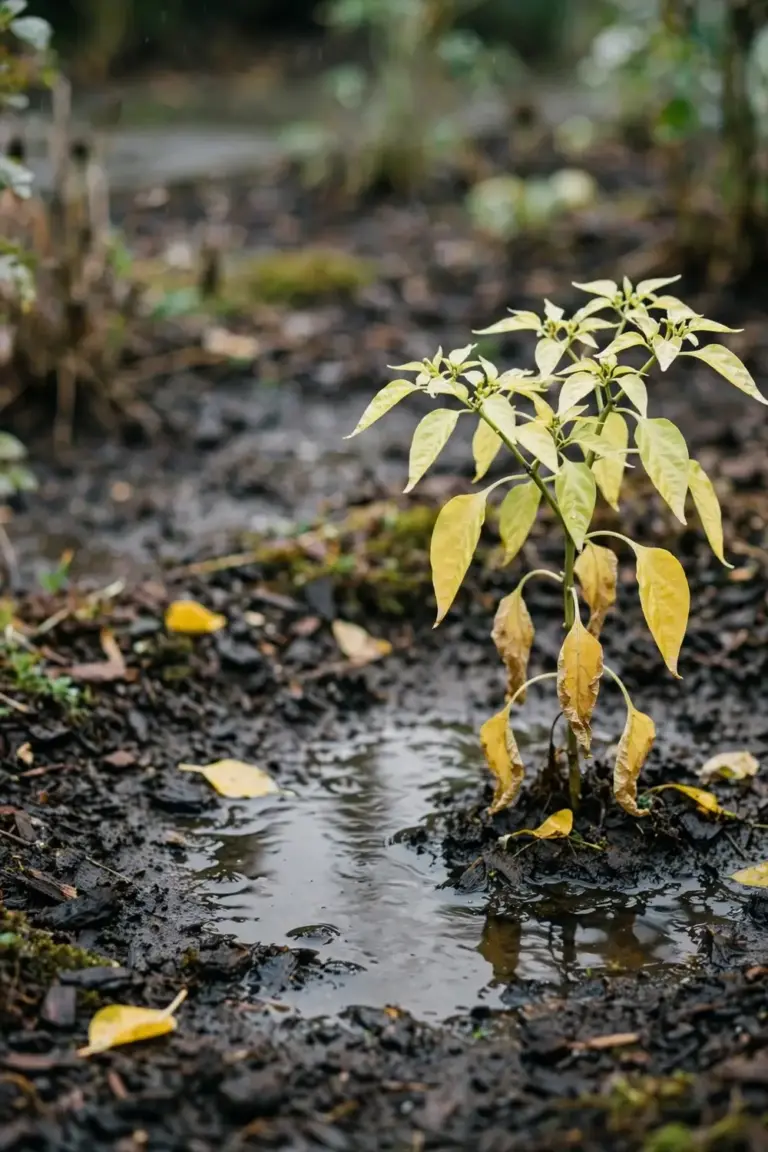
The University of Georgia Extension blossom-end rot guide reports that leaf N and K at early bloom should both sit between 4.0 and 6.0 percent, and levels above that range signal excess fertilizer rather than a shortage. More feed is rarely the answer to yellow leaves.
Check drainage first. Soil that stays soggy kills more chili plants than hunger does. Building soil health with compost and organic matter gives roots air and steadies nutrient uptake, which fixes more yellow-leaf cases than any bottle. Feed only after a soil test shows a real gap.
Read the pattern before acting. Whole-plant paling after heavy rain points to waterlogged roots. Yellowing that starts on the oldest leaves and moves up points to nitrogen the plant is remobilizing. One is a drainage job, the other a feeding job, and fertilizer fixes only the second.
Container plants yellow faster than in-ground ones. A pot holds a small soil volume that swings wet to dry in a day, and nutrients wash out with every watering. If a potted chili yellows while its in-ground sibling stays green, check the pot’s drainage holes and the watering rhythm before blaming the feed. Water runs straight through dry mix and carries feed with it. A pot that dries out daily leaches faster than a bed, so the feed gap shows up there first and the in-ground plant beside it stays green.
5. Fruit Rots at the Blossom End
A dark, sunken patch spreads from the blossom end of developing fruit while the stem end stays sound. That is blossom-end rot, a calcium delivery failure, not a disease. The University of Georgia Extension states that it appears only on the blossom end of developing fruit, is uniformly dark brown to black, and never starts at the stem end.
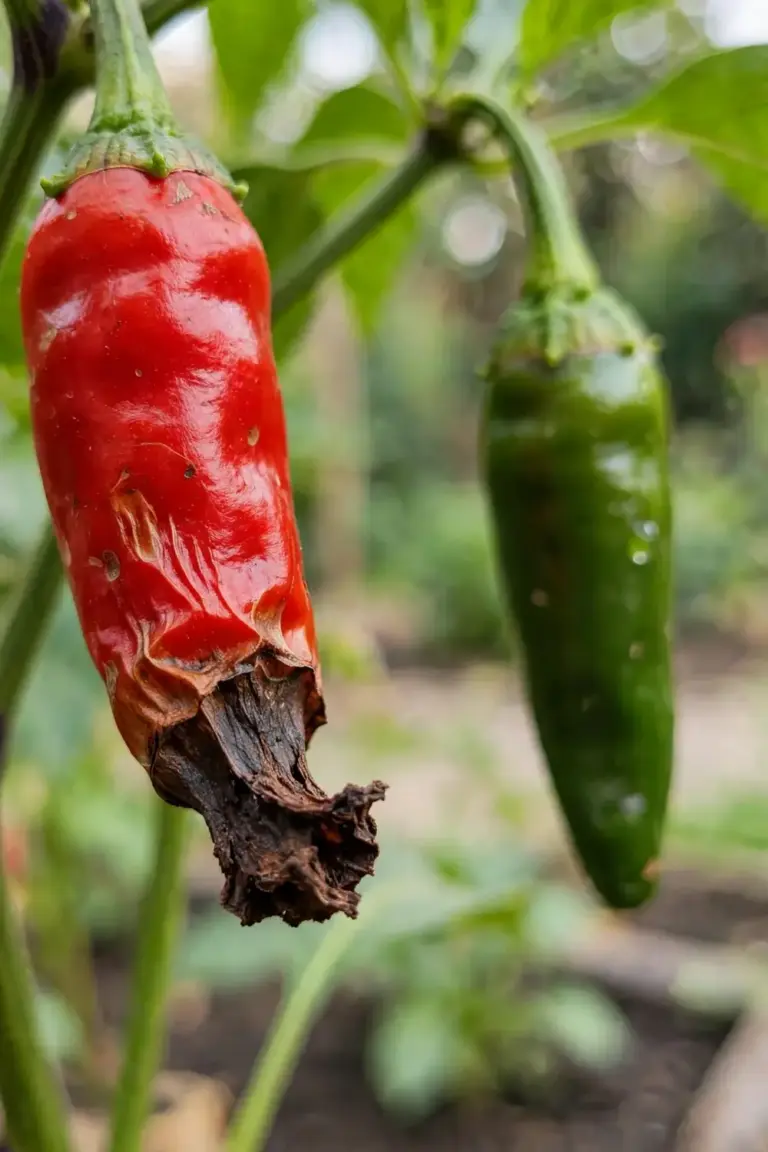
The soil usually holds enough calcium. The problem is delivery. Calcium moves only in the xylem with the transpiration stream, so drought stress, low daytime humidity, and fast fruit growth in heat all starve the fruit end of calcium while leaves take the lion’s share. University of Nebraska Extension adds that the rotted area can cover 30 to 50 percent of the fruit on peppers, where it looks tan, and that sunscald looks different: a white lesion on the sun-exposed side, not the blossom end.
Keep water steady. The University of Nebraska Extension recommends at least 1 inch (2.5 cm) of water per week, with more in sandy soil or very hot dry weather, and says the critical period runs from first bloom through fruit development to about golf ball size. Test soil with the ball method: soil along the row should form a ball in your hand and not break apart. Foliar calcium sprays do little, the University of Nebraska Extension notes, because calcium moves poorly from leaves to fruit. Mulch holds soil moisture between waterings, which keeps the transpiration stream steady and the calcium moving toward the fruit end where it is needed.
Rule out the lookalikes before treating. The University of Georgia Extension notes that anthracnose appears on the side walls of pepper fruit and sunscald shows as a pale patch on the sun-exposed sidewall, while blossom-end rot is dark brown to black and sits at the blossom end. Sidewall problem, think sun or fungus. Blossom-end problem, think water and calcium.
6. Dark Greasy Spots on Leaves and Stems
Small tan to black lesions with an angular shape spread across leaves, stems, and the calyx. Bacterial leaf spot is the likely cause. A Hort Innovation Australia factsheet confirms that Xanthomonas euvesicatoria infects capsicum and chilli in Australia, with lesions starting above 1 mm and growing to about 2 to 3 mm, often angular. A yellow halo around the spot suggests bacterial disease, though only lab testing confirms it.
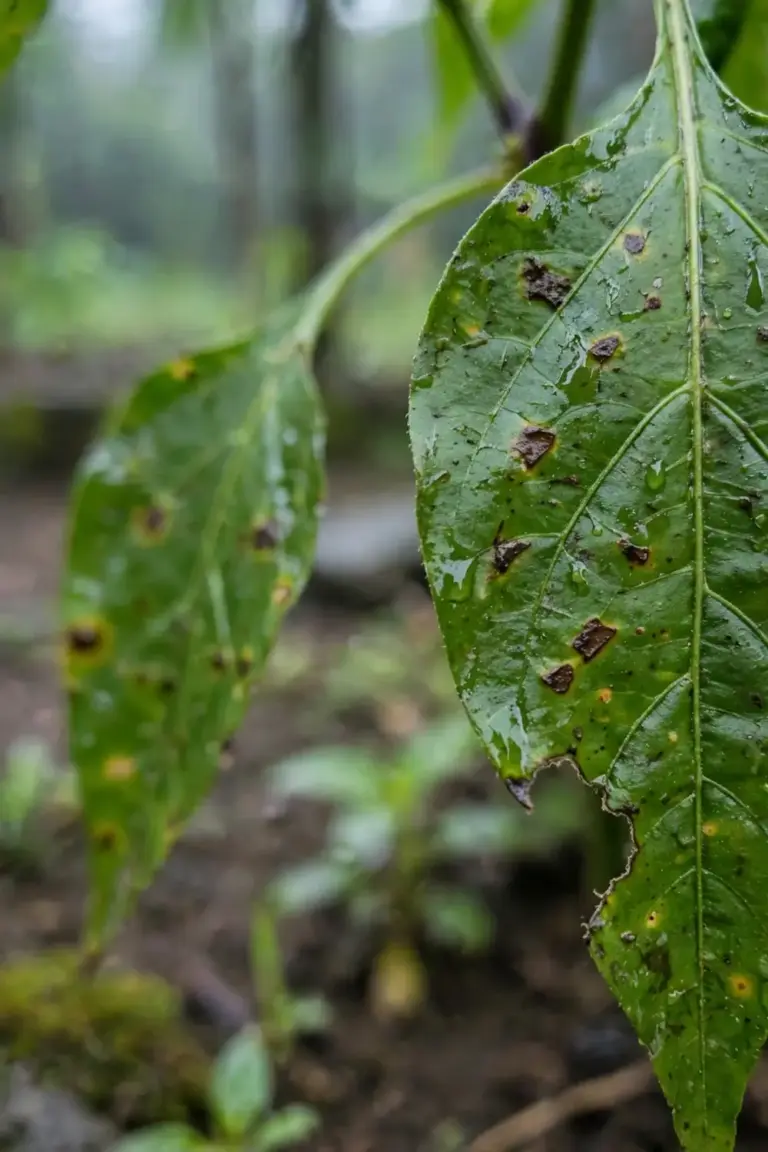
The disease favors warm, humid conditions and spreads by water and wind, persisting in volunteer plants and crop residue. It is seed transmissible. Severe infections can kill the whole plant and move through a bed fast.
In Australia the recommended strategy is copper bactericides combined with a mancozeb fungicide, which field studies show beats copper alone, though many Australian populations carry high copper tolerance. Clean seed breaks the cycle at the start, and dry leaves keep it from spreading in the middle. Rogue early and the bed stays clean instead of feeding the next infection.
The Australian picture has its own detail. The Hort Innovation factsheet reports that two specific races of Xanthomonas euvesicatoria, races 1 and 7, are confirmed in Australian crops, and up to ten races exist overseas, some of which can overcome most resistance genes currently available in Australia. That is why seed health and hygiene carry more weight here than resistant varieties alone.
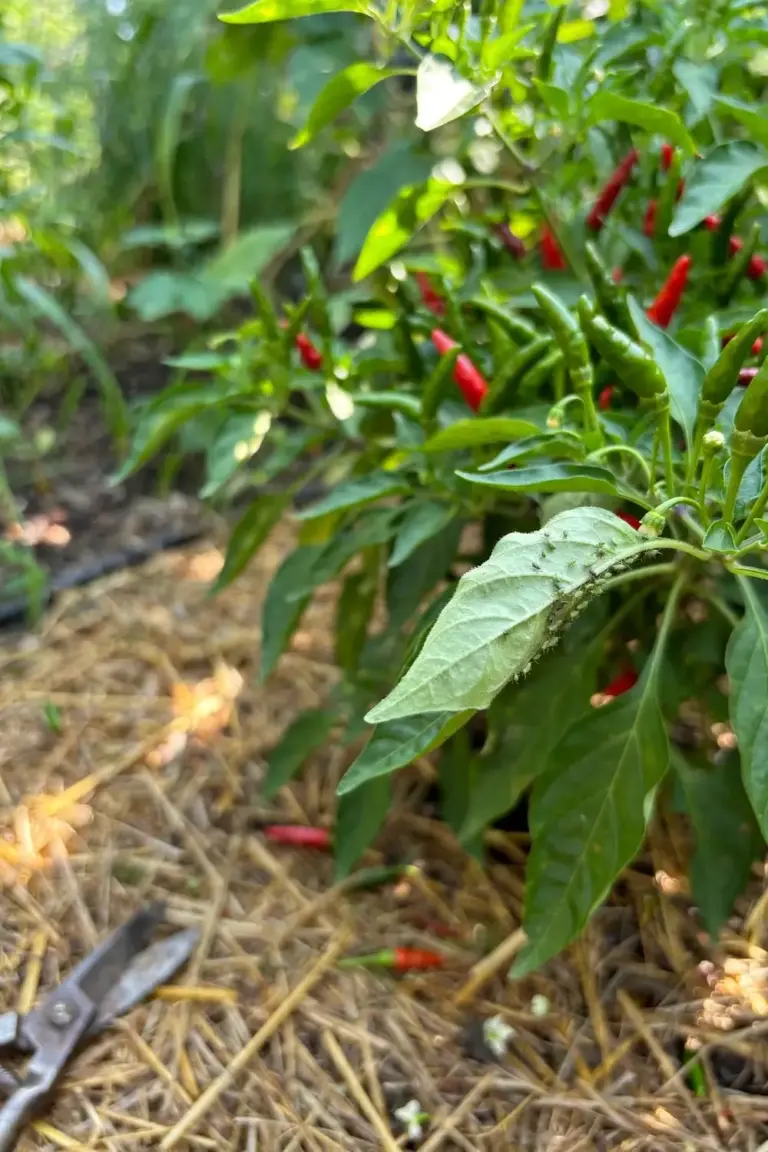
7. Clusters of Tiny Insects on New Growth
Pale green, soft-bodied insects cluster on shoot tips and the undersides of young leaves, sometimes with winged forms among them. Those are green peach aphids. UC IPM’s pepper pest guidelines describe them as generally pale green, with some pinkish individuals, in both winged and wingless forms.
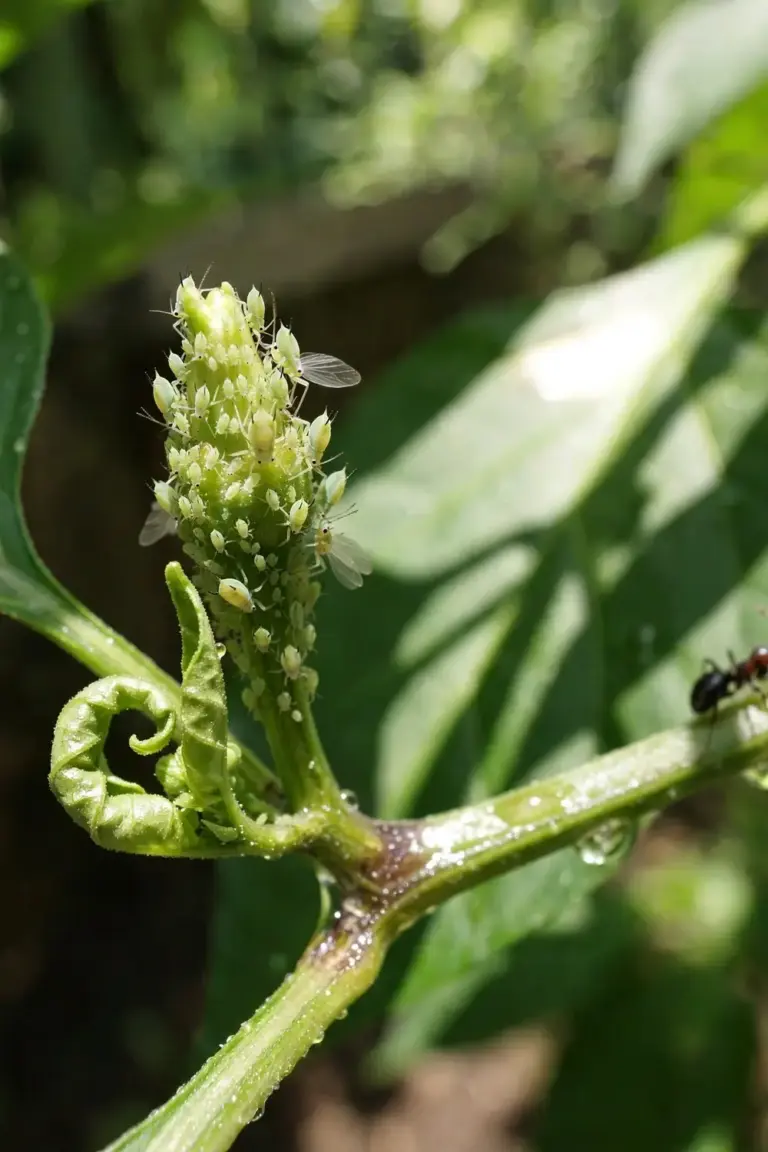
Aphids suck sap and excrete sticky honeydew, which grows black sooty mold that cuts photosynthesis. Worse, aphids spread viruses like cucumber mosaic virus and pepper veinal mottle virus, so a small colony is a disease risk, not just a nuisance.
A strong water jet dislodges light infestations. Encourage ladybirds and hoverflies by planting flowers nearby, and reserve insecticidal soap or neem oil for heavy colonies. Never spray broad-spectrum insecticides at the first sight of aphids: they kill the predators that would have finished the job. The jet works because aphids cling poorly to wet leaves. Repeat after rain, since rain resets the effect and the colony rebuilds from the survivors that held on.
Watch for ants running up the stems. Ants farm aphids for honeydew and will defend the colony from predators, so a persistent aphid problem often has an ant highway behind it. Sticky barriers on the stem break the partnership, and the aphid colony usually collapses once its bodyguards leave.
8. Stunted Plant With Rosette of Rolled Leaves
The plant stops growing, internodes shorten, and the top becomes a tight rosette of yellow or light-green leaves rolling upward. UC IPM’s pepper pest guidelines describe this as beet curly top: extremely stunted plants whose upper portion resembles a small flower bouquet.
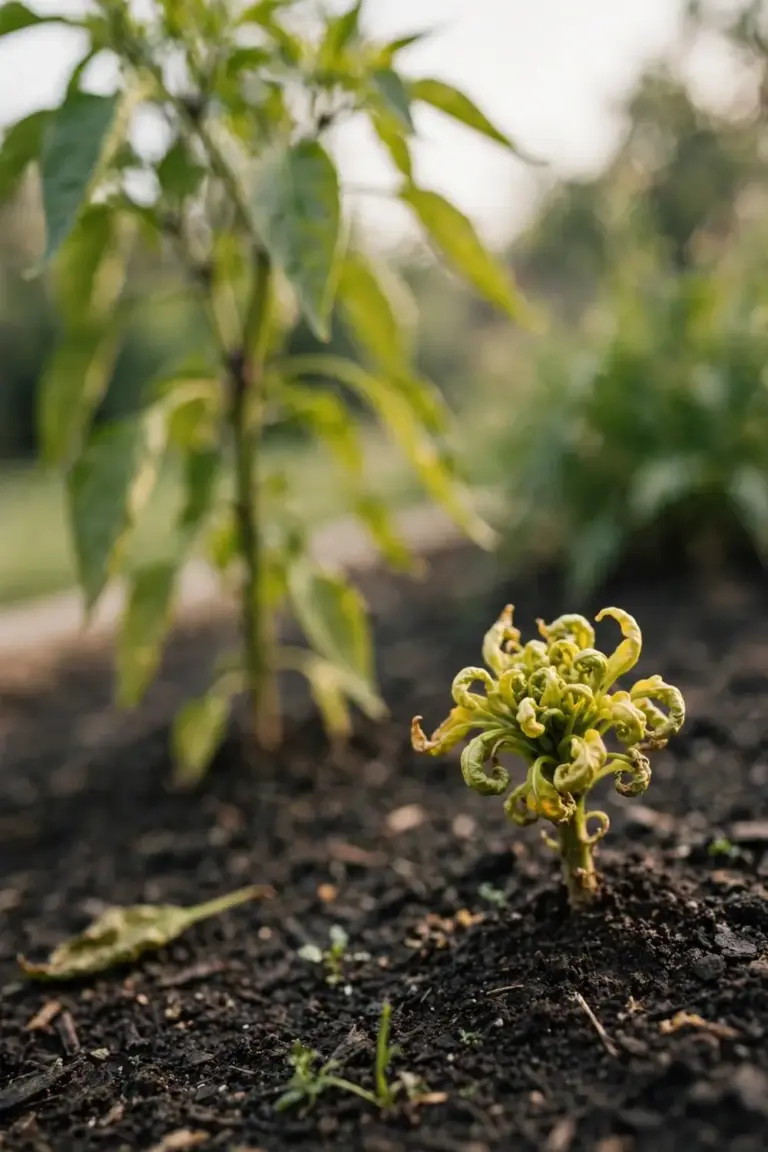
Viruses have no cure. An infected plant will never produce a worthwhile crop, and it serves as a reservoir for leafhoppers to spread the virus to neighboring plants. Pull it, bag it, and bin it. Do not compost it.
Prevention is the only strategy. Control weeds that host the virus and the leafhoppers that carry it. Use row covers on young transplants to block the insects. Buy certified virus-free transplants, and rogue any plant showing the rosette symptom the day you see it. Cover the transplant on day one, not after symptoms appear. Leafhoppers probe young leaves first, so the early cover buys the plant its strongest weeks before the pressure builds.
Do not wait to see whether a stunted plant “comes good.” Viruses do not reverse, and every week an infected plant stays in the bed is a week of new infections on its neighbors. The fastest rescue is the secateurs and the bin, followed by covers on the healthy plants while the vectors are active.
9. Fruit Comes Out Distorted and Bumpy
Chilies develop distorted, bumpy surfaces while the plant keeps growing. UC IPM’s pepper pest guidelines state that chilies infected with cucumber mosaic cucumovirus are distorted and have a bumpy surface, which separates virus damage from insect feeding.
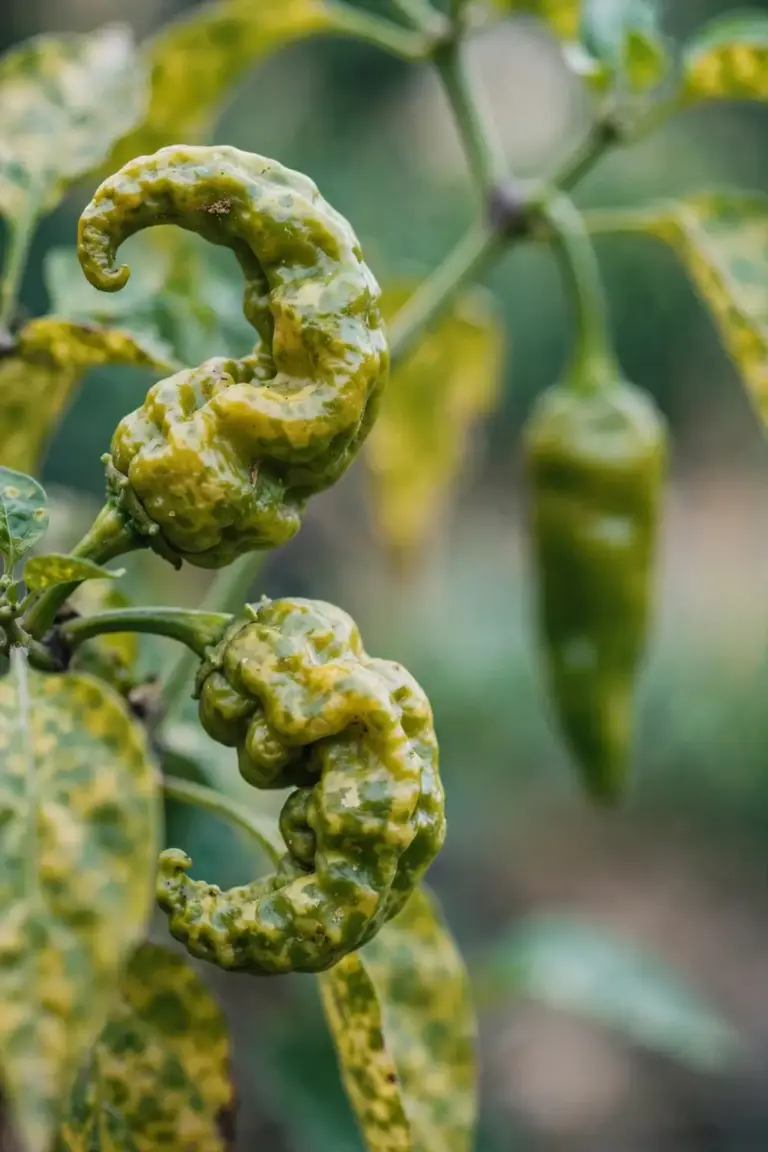
Aphids transmit this virus, which is why the aphid section above matters twice over. Fruit may also show mosaic patterns or spots with related viruses such as tomato spotted wilt virus.
Remove and destroy infected plants. Control the aphid and thrips vectors before fruit sets. Disinfect tools and hands after handling infected plants, since some related viruses spread on contact. Start clean: certified seed and clean transplants.
Variety choice helps at the margins. Some chili and pepper varieties carry resistance or tolerance to specific viruses, so check the seed packet or nursery label when buying. Resistance is never total, and it never replaces vector control, but a tolerant variety plus early aphid management is the combination that holds up in a bad virus year. A tolerant variety still shows mild symptoms in a bad year. The gain is a plant that keeps producing while a susceptible one collapses, which is the margin tolerance buys.
10. Seedlings Stall After Transplanting
Transplants sit in the ground for weeks without growing, sometimes turning purple. Cold soil is the usual cause. The University of Minnesota Extension advises waiting until soils reach 60 to 65 °F (15.6 to 18.3 °C) before transplanting peppers, and notes that ideal vegetative growth runs 77 to 80 °F (25 to 26.7 °C) by day and 64 to 68 °F (17.8 to 20 °C) at night. Peppers also resent over-hardening: harden transplants off for no more than 7 to 10 days.
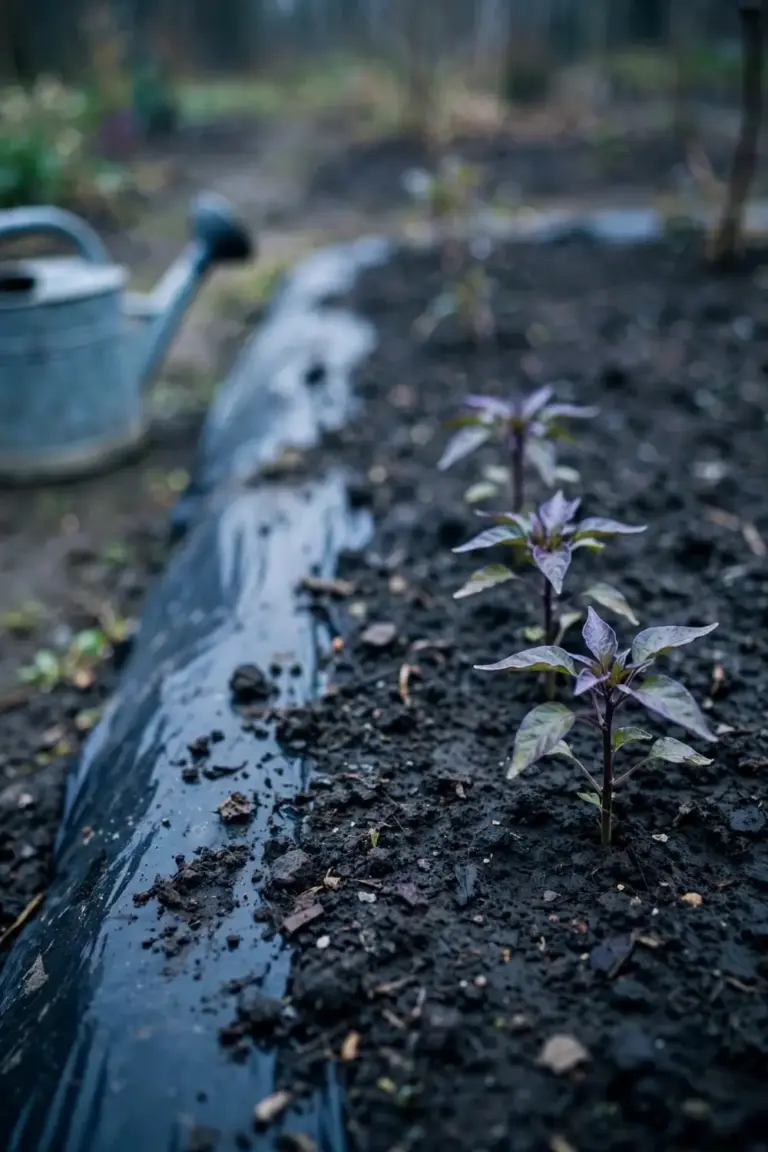
Purple leaves on a cold transplant usually mean phosphorus the plant cannot take up, not phosphorus missing from the soil. Phosphorus moves poorly in cool soil, and uptake resumes as the soil warms.
Wait for warm soil. Harden seedlings off gradually over a week, watching the forecast for cold fronts. Black plastic mulch warms the root zone early in the season. The seed starting steps guide covers timing transplants so they never sit shivering.
Do not feed a cold-stalled transplant to “push” it. Fertilizer in cold soil piles up unused, and the excess salts can burn roots that are already struggling. Warmth first, then water, then feed. The plant tells you it is ready when new growth appears and the purple fades on its own. The unused salts sit in the root zone and draw water out of the roots instead of feeding them. Warmth restarts uptake, and only then does feed help rather than harm.
11. Plant Wilts Despite Wet Soil
Leaves wilt on wet soil, or yellow and droop on a few branches while the rest looks fine. Root and crown problems are behind this. UC IPM’s pepper pest guidelines note that Phytophthora spores from crown and root rot splash onto fruit and cause water-soaked patches that dry into lesions, and that Verticillium wilt shows yellowing and drooping leaves with brown discoloration visible when roots and the lower stem are cut open.
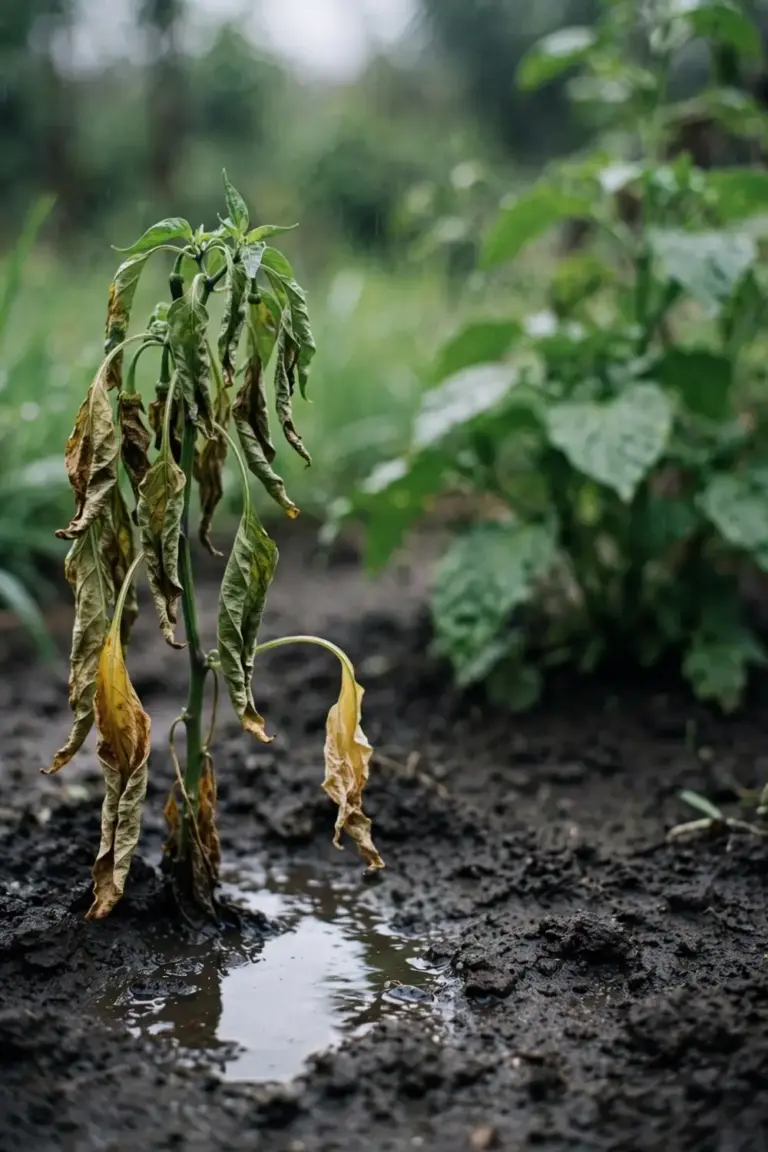
Overhead watering spreads both. Wet foliage and splashing soil are the delivery system.
Water at the base, never overhead. Improve drainage in heavy soil with raised beds and coarse organic matter. Rotate out of solanaceous crops for at least two years where wilt has struck. Pull and destroy plants with confirmed vascular browning: they will not recover, and they infect the soil. Raised beds shed excess water after heavy rain, which keeps the crown drier than flat ground. Dry crowns meet fewer of the spores that start the rot.
Pacific Northwest Extension guidance recommends at least a two-year rotation between solanaceous crops where bacterial spot has occurred, with three-year rotations better for managing other diseases. The principle holds for wilt too: starve the soil pathogen of its hosts and it declines. Mark the bed and keep a simple rotation record so you do not replant peppers, tomatoes, eggplants, or potatoes there too soon.
12. What’s Wrong Beyond Repair: When to Pull the Plant and Start Over
Some problems never reverse, and nursing a dead plant costs the rest of the bed. Pull the plant when you see virus symptoms: the stunted rosette of curly top, mosaic patterns, or distorted bumpy fruit from cucumber mosaic. Viruses have no cure, and an infected plant feeds new infections through its insect vectors every day it stays.
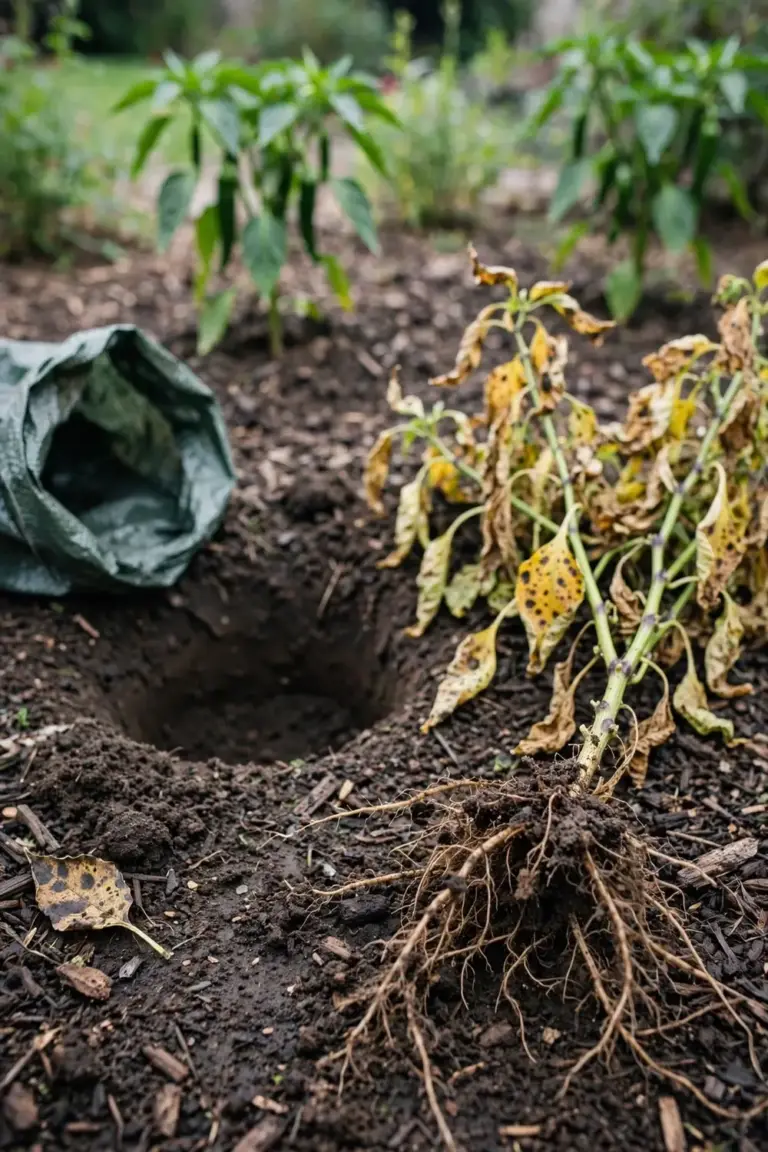
Pull it too when vascular browning shows in a cut stem, or when bacterial leaf spot has taken most of the foliage. A plant with no leaves left cannot photosynthesize its way back, and severe infections move through the bed fast. Bag the whole plant and bin it. Do not compost diseased material: home compost rarely gets hot enough to kill pathogens, and you will spread the problem with next season’s compost.
Then reset the bed. Remove fallen leaves and fruit, which harbor disease. Wash tools and hands with soapy water after handling diseased plants. Where wilt or bacterial spot struck, rotate away from solanaceous crops and give the soil the rest it needs. A fresh transplant in clean soil outgrows a rescued plant almost every time.
Fix-First Cheat Sheet: Problem, Cause, First Move
| Symptom | Likely Cause | First Move |
|---|---|---|
| Flowers drop, no fruit | Heat near 90 °F (32.2 °C), drought | Deep morning water, mulch, wait out the heat |
| Leaves curl up, silvery scars | Thrips | Water jet, then soap or neem on undersides, 3 rounds |
| Leaves curl down, thick, brittle | Mites | 10x lens check, spray undersides, scout twice weekly |
| Yellow leaves, stalled growth | Overwatering or excess feed | Fix drainage, soil test before feeding |
| Dark sunken patch at blossom end | Blossom-end rot, calcium delivery | Steady water, 1 inch (2.5 cm) per week, ball test |
| Angular tan-black leaf spots | Bacterial leaf spot | Disease-free seed, no overhead water, rogue early |
| Tiny pale insects on shoot tips | Aphids | Water jet, predators, soap only for heavy colonies |
| Stunted rosette, rolled leaves | Curly top virus | Pull and bin the plant, block vectors |
| Distorted bumpy fruit | Cucumber mosaic virus | Remove plant, control aphid vectors |
| Transplants sit, turn purple | Cold soil below 60 °F (15.6 °C) | Wait for warm soil, harden off 7 to 10 days |
| Wilts on wet soil | Root/crown rot or wilt | Water at base, raised beds, rotate crops |
Frequently Asked Questions
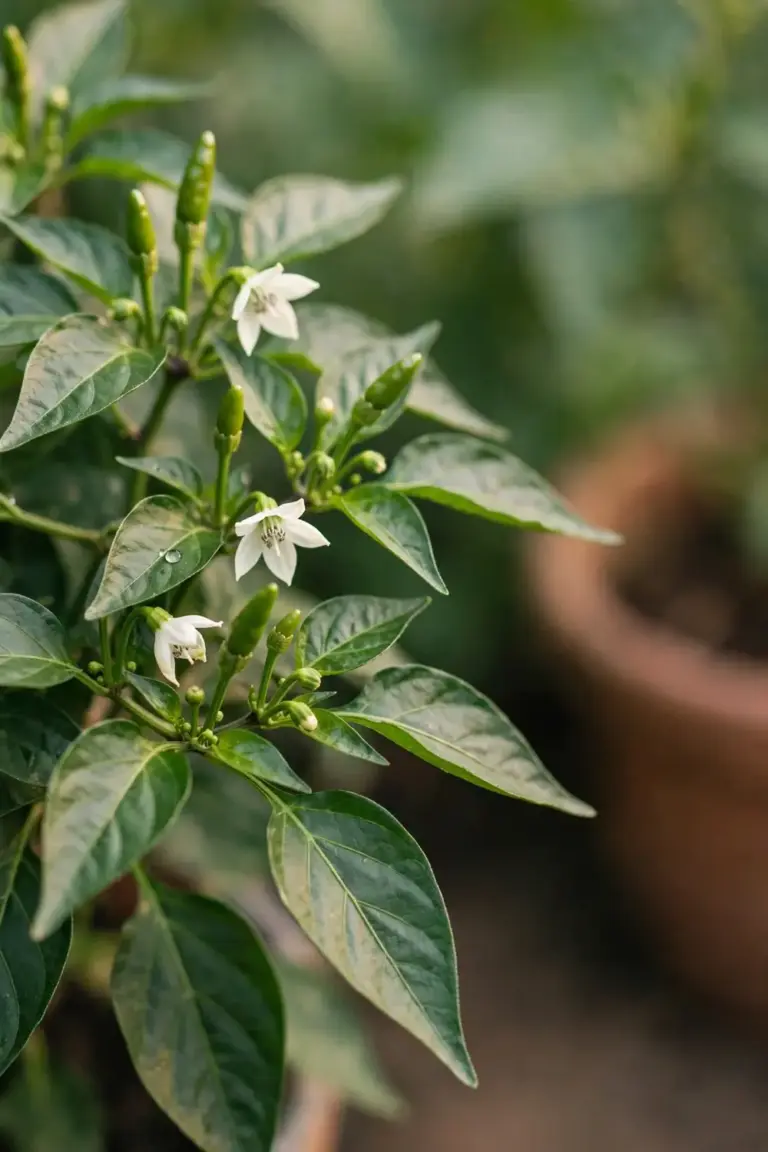
Heat near 90 °F (32.2 °C) makes pepper pollen fail, and drought stress makes the drop worse, so flowers fall cleanly at the joint. Cold nights do the same from the other side, and a plant overloaded with developing fruit sheds later flowers it cannot feed. Water deeply in the morning, mulch the root zone, and give the plant a few days after a heat wave before judging it. Fruit set restarts when nights cool back down.
Check the curl direction first, since direction alone decides the culprit in most gardens. Upward curling with silvery scars along the veins means thrips. Downward curling with thick, brittle leaves means mites. A 10x hand lens on the leaf underside settles it in seconds, showing slow straw-colored specks for broad mites or reddish dots with webbing for spider mites. Spray the undersides where both pests hide, repeat every 5 to 7 days for three rounds, and scout twice weekly.
The damaged fruit cannot be fixed, so pick it off. The plant itself recovers if you steady the water supply, because blossom-end rot is a calcium delivery failure, not a disease. Give at least 1 inch (2.5 cm) of water per week through bloom and fruit development to about golf ball size, mulch the bed, and test soil with the ball method. New fruit forming after the fix should stay clean.
Fruit from a plant with bacterial leaf spot is safe to eat once washed, since the bacteria infect the plant, not the eater. Pick fruit before spots reach it, and discard any fruit that is rotting or colonized by secondary molds. Wash your hands and tools after handling diseased plants, and keep diseased material out of the compost.
Chillies are warm-season plants that stall below about 55 °F (12.8 °C) at night, and cold soil below 60 °F (15.6 °C) stops transplants entirely. In most of Australia they are grown as warm-season annuals, sown after the last frost and pulled before winter. A plant sitting through winter barely grows until warmth returns. Start fresh seed in spring instead of nursing a stalled plant.
Walk the Plant Once a Week and Catch Trouble Early
Eleven problems sound like a lot. In practice, three checks cover nearly all of them. Look at the flowers: dropping means heat or cold stress. Flip a leaf: curl direction names the pest. Squeeze the soil: the ball test decides between water and fertilizer before you spend a cent. Run those three checks in that order and you will land on the right H2 above within a minute. Name the symptom first and the right section follows from it. The fix follows from the section. That chain is the whole method.
Most chili failures are environment, not disease. Water steady, plant warm, and scout the leaf undersides. The plant does the rest. When a real disease shows up, the cheat sheet above names it fast, and the fix is usually removal and hygiene rather than a spray. Next season, when a neighbor asks what’s wrong with my chili, you will have the answer before the second sentence.