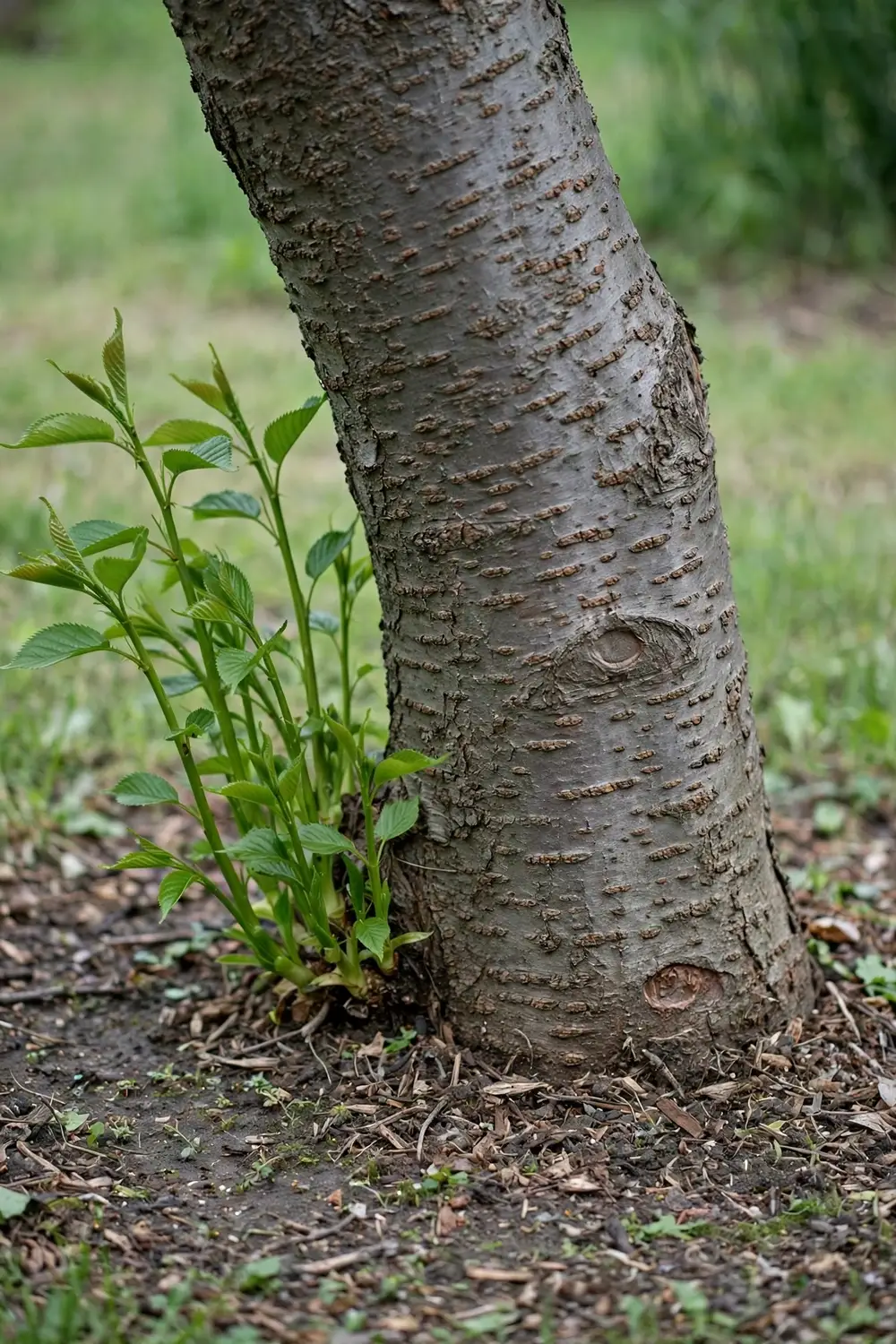

Pull suckers under 30.5 cm by hand and cut the woody ones flush with their point of origin, and a grafted cherry tree stays the variety you bought. That is the whole decision behind should you remove suckers growing from your cherry tree: a sucker is a shoot that grows from the rootstock or the roots, a watersprout is a vigorous upright shoot from above-ground wood, and whether your tree is grafted or own-root decides what each shoot becomes. The rest of this page is 7 moves, from naming the shoot in front of you to stopping the return cycle. Every step uses hand tools and dry weather, and the whole routine fits into the weeks after harvest when the tree is already in your hands.
The short answer for most backyard trees: yes, remove rootstock suckers the moment you see them, because they belong to the root system, not to the fruiting top. University of New Hampshire Extension states that suckers can be removed at any time during the growing season, so you never need to wait for a pruning season to pull a small one. Watersprouts are the slower decision, and grafted trees change the rules entirely, which is why this page works as a decision guide instead of a single yes or no.
General cherry growing, feeding, and harvest timing are a different job, and that lives on the site’s cherry growing guide. This page stays on the shoots: how to tell a sucker from a watersprout from grafted growth, which ones to remove, how to remove them, and when summer pruning keeps silver leaf out of the wounds.
1. Decide: Should You Remove Suckers Growing From Your Cherry Tree?
Decide from the shoot type, not from a rule you memorised. A rootstock sucker on a grafted cherry tree always comes out, because it is the root system’s variety, not the cherry variety you planted, and it will compete with the fruiting top for water and nutrients. A sucker on an own-root tree is a genuine cherry shoot, so you may remove it, keep it, or dig it up as a free plant. A watersprout is a third case: an upright shoot from the canopy that steals light and rarely fruits, and it gets thinned on its own schedule.
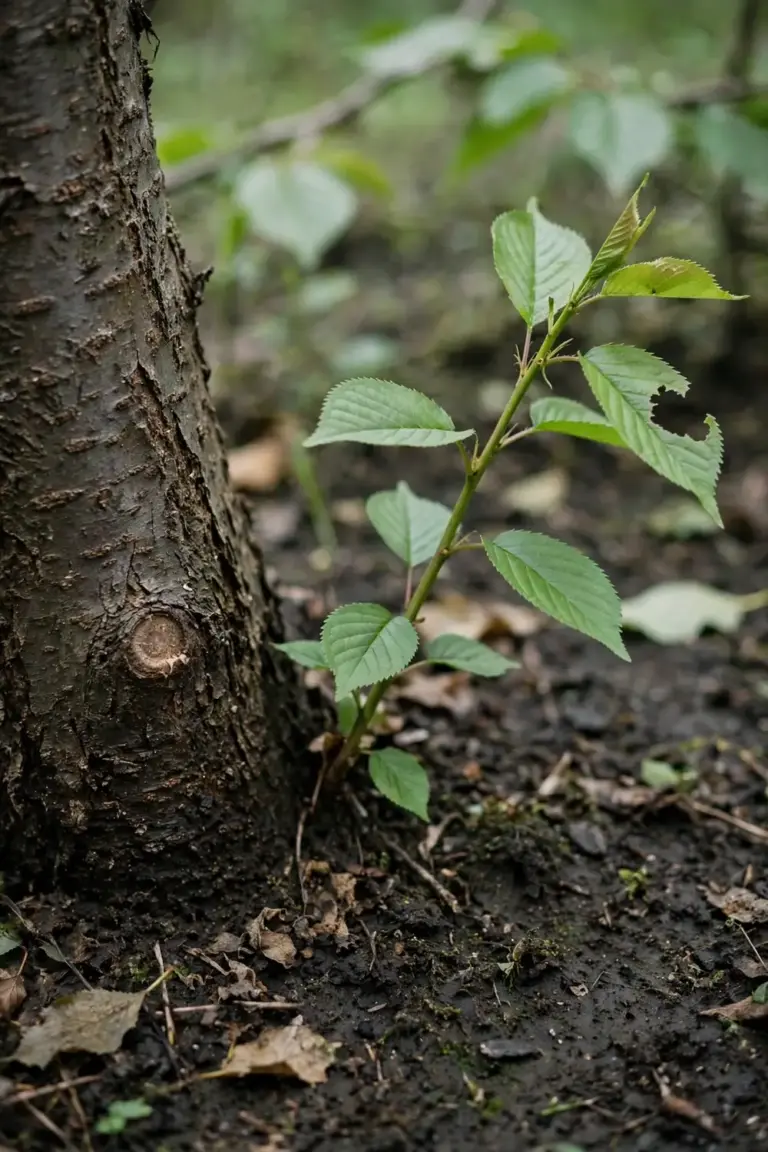
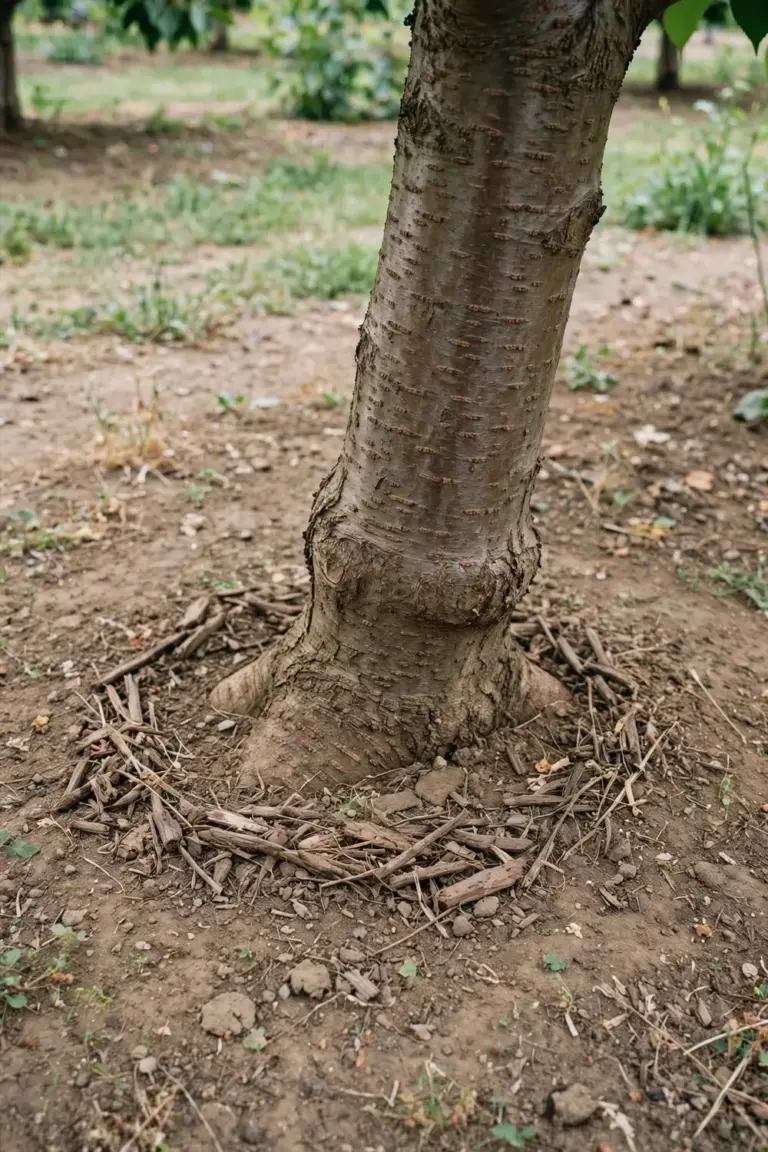
Find the graft union first. It sits near the base of the trunk as a bump, a crook, or a change in bark color, usually 5.1 to 10.2 cm above the soil, which is 2 to 4 inches in Green Thumb Nursery’s grafting guide. Any shoot growing from below that line is rootstock growth, and the same guide states the rule plainly: always remove suckers, the vigorous shoots that grow from the rootstock below the union, before they take over and revert the plant to the inferior rootstock variety. If you cannot find a graft union at all, your tree is probably own-root, and the fork below changes your answer.
The decision table below is the 30-second version. The rest of the page walks each row.
| Shoot type | Where it grows | Grafted tree | Own-root tree |
|---|---|---|---|
| Rootstock sucker | From roots or below the graft union | Remove promptly | Remove, keep, or transplant |
| Watersprout | Upright from trunk or branches | Thin selectively | Thin selectively |
| Grafted growth | From above the graft union | Keep | Not applicable |
Rootstock suckers often betray themselves before you find the union. Their leaves may run smaller, glossier, or a different shade of green than the canopy, and any fruit they set stays small and poor. If a shoot at the base looks like a different plant from the tree above it, trust your eyes: it is a different plant, joined at the graft. That visual mismatch is the fastest field clue on an old tree where the union has blurred into the bark.
2. Name the Shoot: Sucker, Watersprout, or Grafted Growth
Name the shoot before you touch the shears, because each one gets a different treatment. A sucker emerges from the roots or from the base of the trunk at or below soil level, grows fast and whip-like, and on a grafted tree often shows different bark or leaf character from the canopy above. A watersprout erupts from the trunk or a scaffold branch well above the ground, shoots straight up, and carries the tree’s normal foliage. Grafted growth is a normal branch above the union; if it looks like the rest of the canopy and starts above the graft line, it is the tree doing its job.
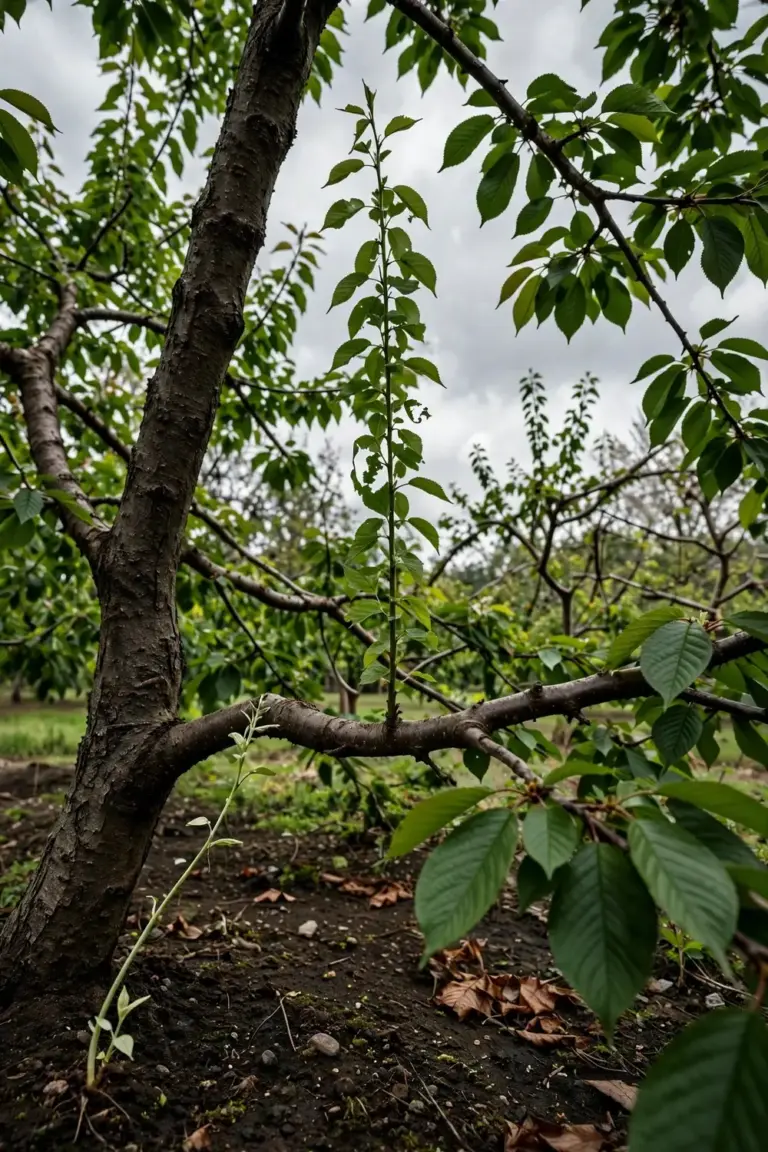
University of New Hampshire Extension gives the working definitions: suckers are sprouts from the base of the plant, and water sprouts are sprouts in the canopy. That same extension page warns that an excessive number of water sprouts can signal stress, such as over-pruning, root damage, or storm damage, so a canopy full of them is a symptom to investigate, not just a pruning chore. One or two watersprouts after a storm are normal. Dozens after a hard heading cut mean the tree is shouting.
Touch the shoot’s origin point with your finger. A sucker traces down into soil or into the root crown, and you can often wiggle it at the base. A watersprout sits on solid wood above ground with a visible branch collar. That 10-second touch test settles most arguments faster than a photo comparison, and it tells you which removal method the next sections prescribe.
Suckers also announce themselves by season. The spring flush pushes the fastest sucker growth of the year, when rising sap feeds every bud on the root system, so a sucker that was a stub in winter can surge upward by mid-spring. That is why the monthly summer patrol works: you are catching the spring flush early, while every shoot is still soft enough to pull. A sucker ignored through one full season lignifies, thickens, and graduates from a two-second pull to a ten-minute dig.
3. Run the Grafted-vs-Own-Root Fork
Run the fork, because it flips the answer. Almost every cherry tree sold in Australian nurseries is grafted: a named fruiting variety joined to a chosen root system, which is why nursery catalogues list rootstock names alongside the fruit names. The rootstock controls vigour and soil tolerance. The scion gives the fruit. A shoot from below the graft union is genetically the rootstock, so if you let it grow you are raising the rootstock’s fruit, not your cherry’s.
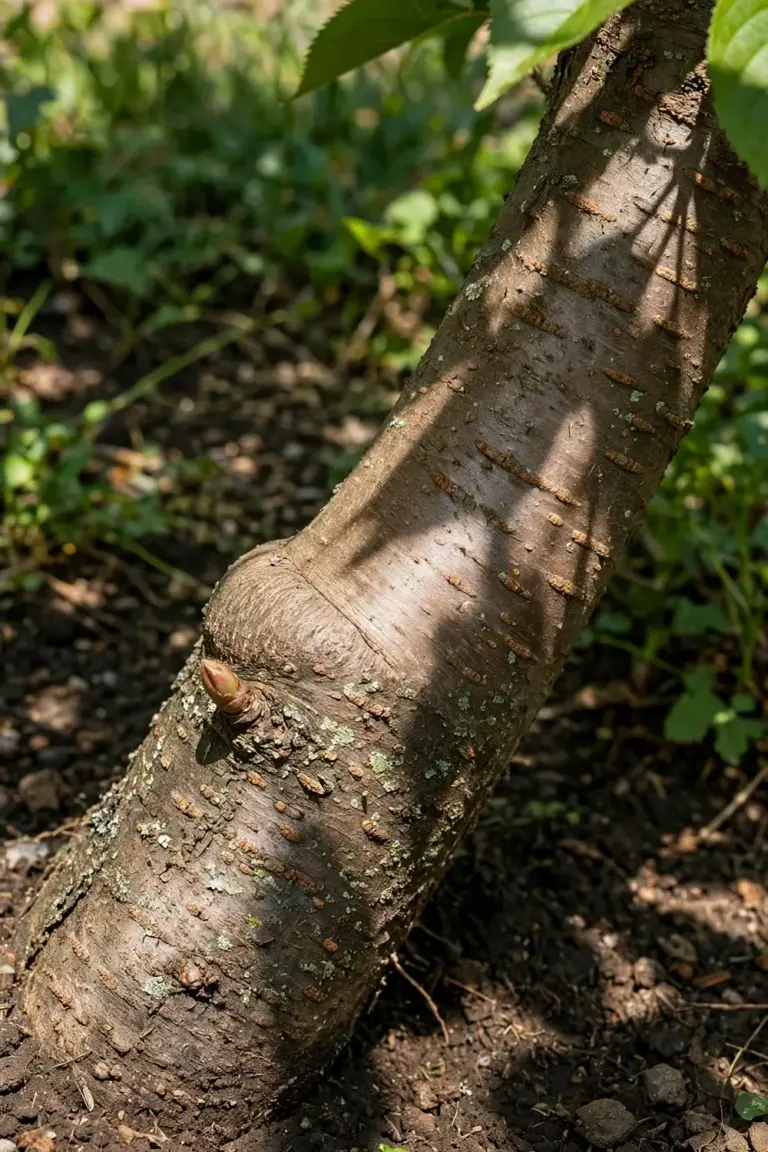
Green Thumb Nursery’s rootstock guide states that a rootstock can produce fruit, but it will be the rootstock’s own fruit, which is usually small and poor, not the variety you bought, which is why suckers below the graft union should be removed. The same nursery’s grafting guide adds the urgency: remove those shoots before they take over and revert the plant to the inferior rootstock variety. Fruit-tree writer Greg Alder puts it bluntly for home growers: a rootstock sucker left alone shoots up fast, shades out the scion branches, and eventually the tree morphs into one whose fruit is all mysterious.
Own-root trees skip this fork. Sour cherries and some ornamental cherries grow on their own roots, and every shoot is the true variety. On those trees a sucker is a propagation opportunity: sever it with roots attached in winter and pot it up. Maple Grove Nursery in Australia states the nursery-side version of the rule: remove all root suckers and any rootstock shoots that grow below your graft. The word below does the work. Above the graft, hands off.
Ignore a rootstock sucker for two seasons and you will see the takeover happen in real time. The sucker outgrows the scion because the rootstock is bred for vigour, its dense foliage shades the fruiting branches, and the shaded branches weaken and stop fruiting. By the third season the tree reads as a rootstock tree with a cherry branch dying inside it, and cutting the sucker back at that point leaves a lopsided, stressed tree. Early removal is not fussiness. It is the cheapest intervention in fruit growing.
Check the union’s height while you are down there. Nurseries graft 5.1 to 10.2 cm above the soil line so the scion never touches soil and roots on its own, which would bypass the rootstock entirely. If mulch or soil has buried the union, pull it back. A buried union invites the scion to root, and then the whole fork stops working.
If you planted the tree years ago and lost the label, the nursery that sold it can usually name the rootstock from their records, and that name tells you what the suckers will become. Vigorous seedling rootstocks throw the strongest suckers and the poorest fruit, which is exactly the combination that punishes neglect. Knowing the rootstock turns a vague chore into a specific one: you are not fighting shoots, you are defending the named variety on top.
4. Pull Small Suckers, Cut Big Ones Flush
Pull suckers while they are young and soft, and cut the woody ones flush at their origin. For a sucker under 30.5 cm tall, grip it low and pull it sideways and slightly upward with a steady tug. Dammann’s Garden Company advises pulling suckers under a foot tall by hand, noting that a clean pull removes the growth nodes that produce suckers, so the tree makes fewer of them over the years. I pull the small ones by hand while they are still soft, because a clean pull takes the growth node with it and leaves nothing for the tree to resprout from.
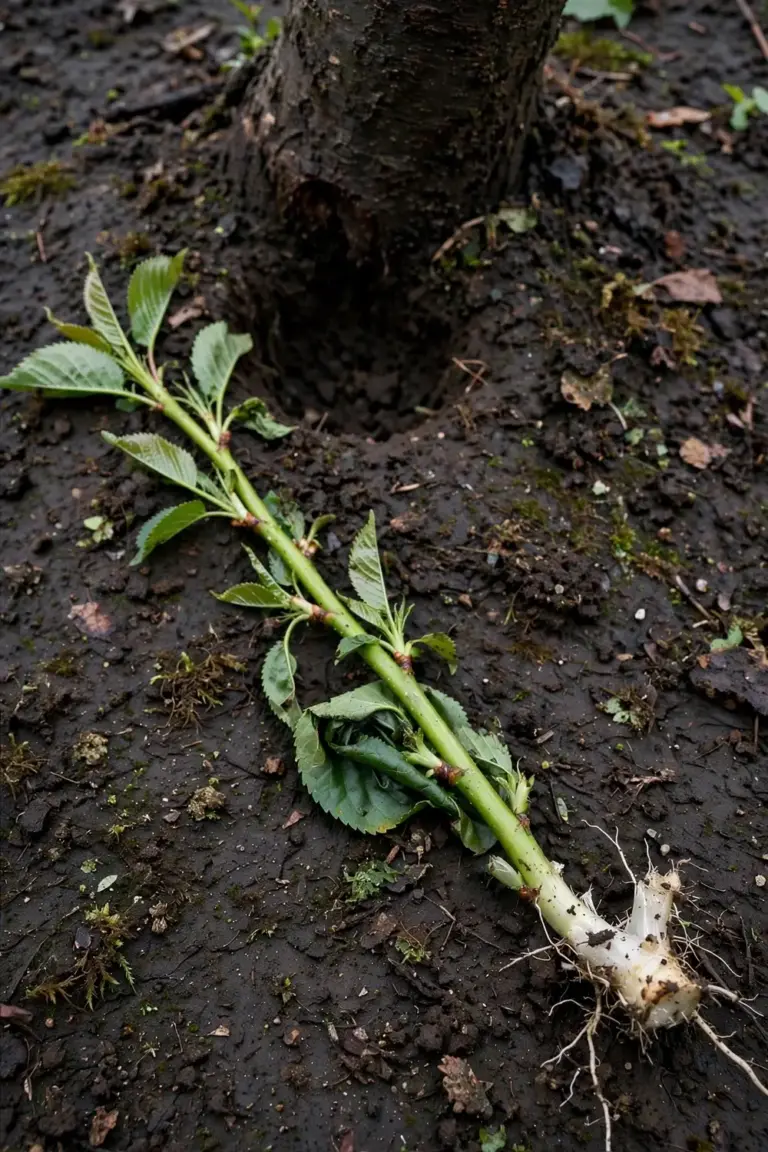
An extension expert answering home growers on Ask Extension gives the same method with a size limit: yank suckers less than 0.6 cm in diameter, which is a quarter inch, sideways to tear them off at the growing point. The tear sounds violent, but it removes the basal buds that a clean cut would leave behind. Never leave a stub. The same expert warns that new suckers grow from the bases of old stubs, which is the Greek hydra effect every gardener learns once.
For thick, woody suckers that have lignified over several seasons, digging beats pulling. Scrape soil away from the sucker until you find its point of emergence from the root or crown, then sever it with sharp bypass pruners or a saw as close to that junction as possible. Cut at a slight angle so water sheds off the wound. Disinfect the blade between trees if you have had canker or silver leaf anywhere on the property. One clean cut at the origin beats five trims at soil level, because every surface cut leaves the bud cluster intact and guarantees regrowth.
Bag the removed suckers rather than dropping them on the compost. Fresh sucker wood can carry the same pests and diseases as the parent tree, and a sucker left lying on damp soil sometimes roots where it falls, which restarts the problem you just solved. Push the soil back over the root crown after a deep cut, firm it gently, and water the tree in. A deep removal disturbs feeder roots, and a good drink settles the soil back around them.
Work in dry weather. Silver leaf spores ride on cool, wet air, and every sucker removal opens a wound. Summer mornings after the dew lifts are ideal, and the timing section below explains why summer is the cherry tree’s safe season.
5. Remove Watersprouts Without Triggering More
Remove watersprouts selectively, because wholesale removal backfires. University of New Hampshire Extension states that water sprouts typically need removal only once a year in the late dormant season, and adds the caution that removing a few over summer is fine but removing too many means they will likely grow back. Each watersprout you cut is a wound the tree reads as damage, and the tree answers damage with more watersprouts. Thin them. Do not clear-fell them.
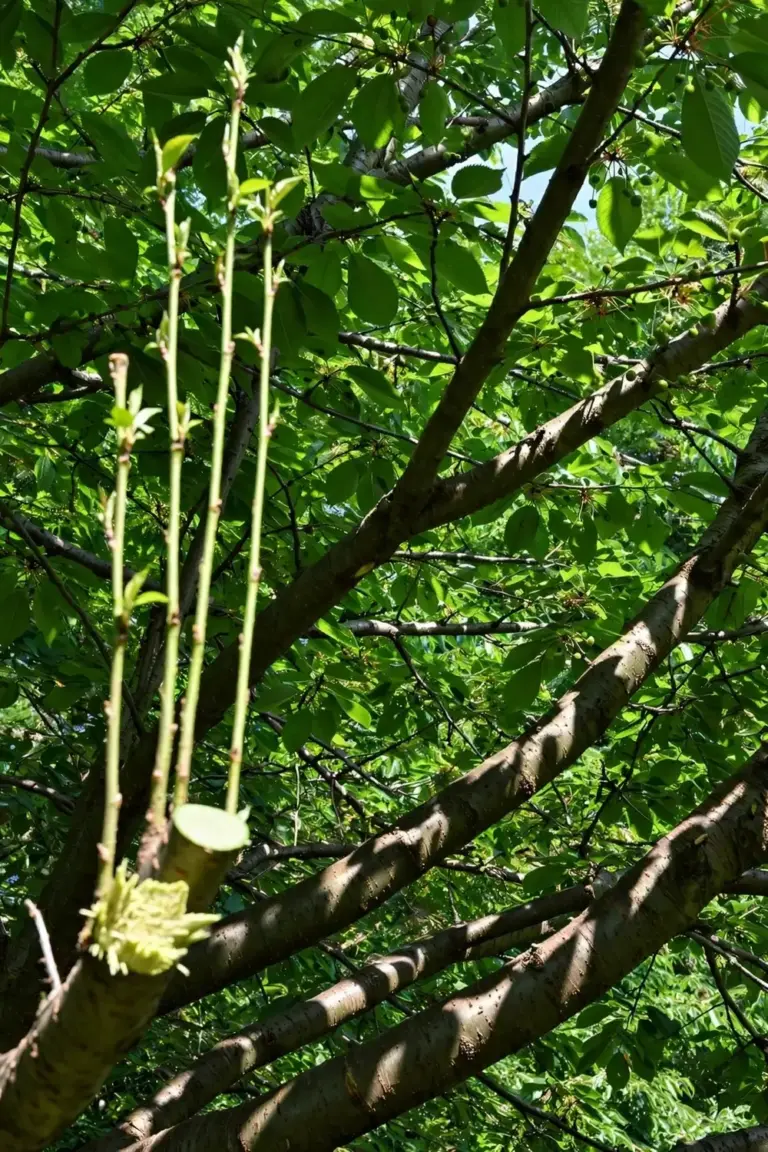
Start with the worst offenders: watersprouts crossing through the canopy center, rubbing against scaffold branches, or shading fruiting wood. Cut each one flush with the branch it grows from, just outside the branch collar, so the tree seals the wound quickly. Leave a few well-placed uprights if the canopy looks thin after storm damage; they can become replacement branches, and a watersprout left deliberately is a training decision, not neglect. To train one, shorten it by a third in summer to an outward-facing bud and let side shoots form over the following season. A trained watersprout will never match a proper scaffold branch for strength, but on an old tree with a gap in the canopy it beats bare wood. Green Thumb Nursery’s fruit-tree guide notes that watersprouts are weak, spindly growth that rarely develops into quality fruiting wood, which is why they are thinned rather than trained in most cases.
Never tear a watersprout. Unlike a soft sucker at the base, a watersprout grows from solid branch wood, and tearing rips bark and leaves a ragged wound that heals slowly. Sharp bypass pruners for thin ones, loppers for thick ones, a saw for the old ones. Make the cut perpendicular to the shoot where it meets the limb, and do not cut into the collar or the bark of the parent branch.
Count what you remove. If you are cutting more than a handful of watersprouts every year, look for the cause instead of the symptom: last year’s over-pruning, root damage from digging, or drought stress. The UNH extension list names over-pruning, root damage, and storm damage as the classic triggers. Fix the trigger and the watersprout crop shrinks on its own.
6. Time Removal for Summer: The Silver Leaf Reason
Time sucker and watersprout removal for summer, straight after harvest, because cherry trees carry a disease that punishes winter wounds. Silver leaf is a fungal disease that infects cherry, apricot, plum, and other stone fruits through fresh pruning wounds, and Washington State University’s silver leaf guide states that trees are least susceptible to infection in summer through fall in dry weather. The same guide recommends pruning out affected wood in summer to fall in dry weather. Summer is not just convenient. It is the low-spore season.
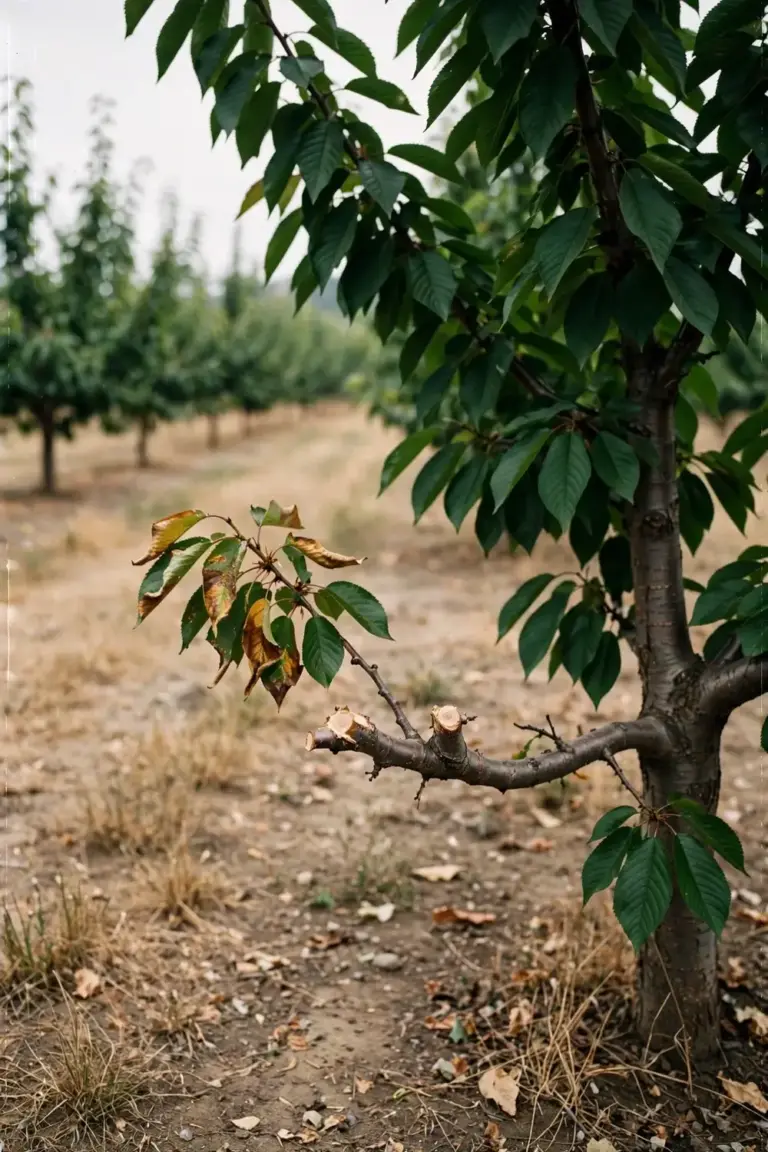
Yates, the garden brand Australian gardeners know best, states the southern-hemisphere version on its silver leaf page: stonefruit trees are lightly pruned in summer straight after harvest has finished, to lower the risk of the disease. The fungus produces most of its infectious spores in autumn and winter, and summer wounds heal faster in active sap flow, which closes the entry points before spore season. That is the whole reason cherries break the usual deciduous rule of winter pruning.
Translate that to an Australian calendar by harvest, not by month. Sweet cherries ripen from late spring into early summer across most growing regions, so sucker removal and watersprout thinning slot into the weeks right after the last pick. The spring pruning techniques guide covers the dormant-season side of the calendar for trees that tolerate winter cuts; cherries are the exception, and they get the summer slot instead. A sucker spotted in winter still gets pulled, since suckers can be removed at any time during the growing season and a small pull wound is minor, but save the saw work and the big canopy cuts for summer. Never do structural cherry pruning in cold, wet winter weather if you can avoid it.
Sterilise for the big cuts. Wipe blades with methylated spirits or a dilute bleach solution between trees, and between a diseased branch and a healthy one. Bacterial canker is the other stone-fruit disease that enters through winter wounds, so the same summer timing that starves silver leaf also shuts the door on canker. Burn or bin prunings from any branch showing silvered leaves or dark-stained wood rather than composting them, since the fungus fruits on dead wood. For routine sucker pulls on a healthy tree, clean sharp tools and dry weather are enough; the sterilising step matters most when disease is already on the property.
7. Stop the Return Cycle: Stress, Damage, and Rootstock Habit
Stop the return cycle by removing the cause, because suckers are a message. A cherry tree that throws suckers every month is usually answering one of three things: root damage, drought stress, or a rootstock with a suckering habit. Digging near the tree, trenching for pipes, or repeated whipper-snipper bark wounds all trigger root suckering. Lawnmower and whipper-snipper damage at the trunk base is the most common suburban cause, and a plastic guard around the trunk ends it. Fit the guard on planting day, not after the first wound: bark damage at the base invites both suckers and the canker pathogens that enter through wounds, so the guard pays for itself twice. Keep grass and weeds clear in a ring around the trunk so the whipper-snipper never needs to go near the bark.
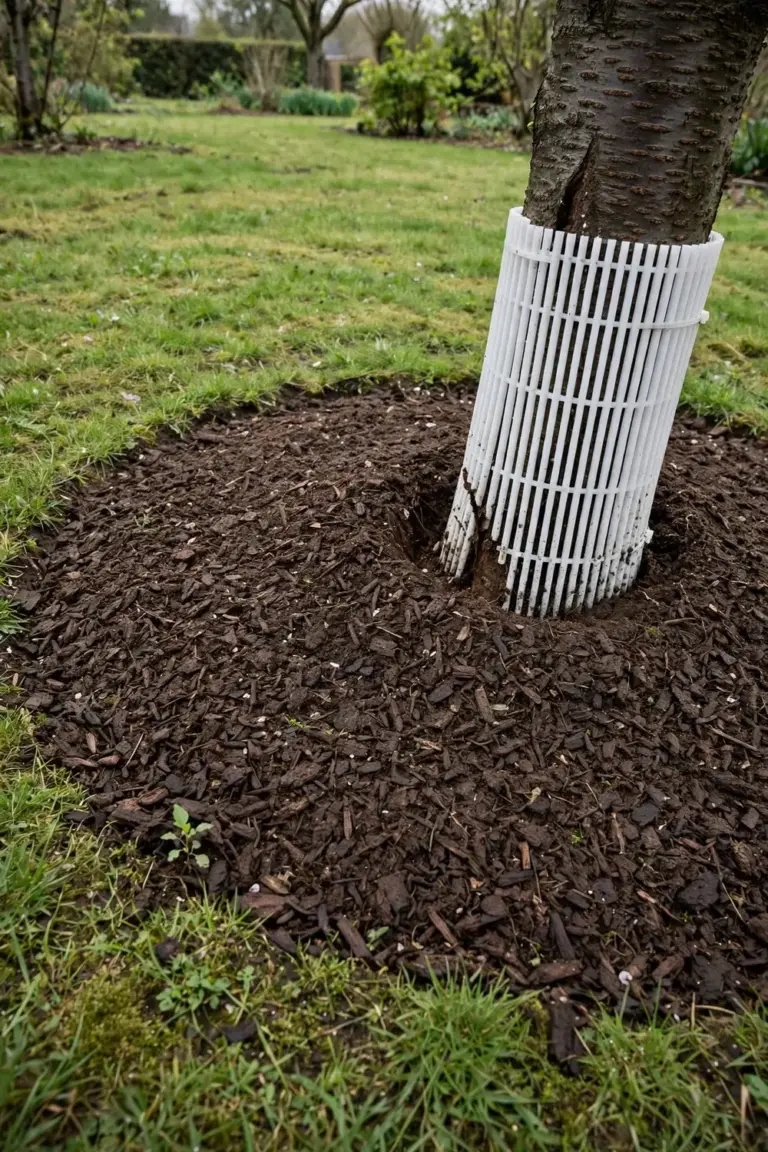
Water deeply and mulch wide. Drought stress pushes trees into survival sprouting, and a cherry tree on a stressed root system suckers harder. Keep a mulch ring out to the drip line, pulled back from the trunk itself. Steady soil moisture through summer does more to calm a suckering tree than any pruning schedule. Some rootstocks sucker by nature, and no amount of perfect care stops it entirely; those trees get a monthly sucker patrol as part of normal care, pulled young in summer, and life goes on.
Do not reach for herbicide on suckers. An extension expert warns that suckers stay connected to the main tree, so chemicals move from the sucker into the tree and can damage it. Painted-on or sprayed herbicide on a root sucker travels through the shared vascular system. The safe method stays mechanical: pull young, cut flush, repeat. For suckers popping up in lawn away from the trunk, regular mowing keeps them down, though it will not kill the root system feeding them.
Watch the graft union every year. Soil level creeps up, mulch migrates inward, and a union that was 5.1 cm clear can end up buried in two seasons. Pull mulch back each spring so the union stays visible. A visible union is a checkable union, and a checkable union is how you catch rootstock growth before it takes over the tree.
Build the patrol into an existing habit and it stops feeling like a chore. Check the base every time you pick fruit, water deeply, or walk past with the compost bucket in summer. Young suckers pull in seconds when they are part of a routine, and the tree rewards the attention with a clean trunk, a true variety, and fruiting wood that keeps all the water and nutrients for itself.
Frequently Asked Questions
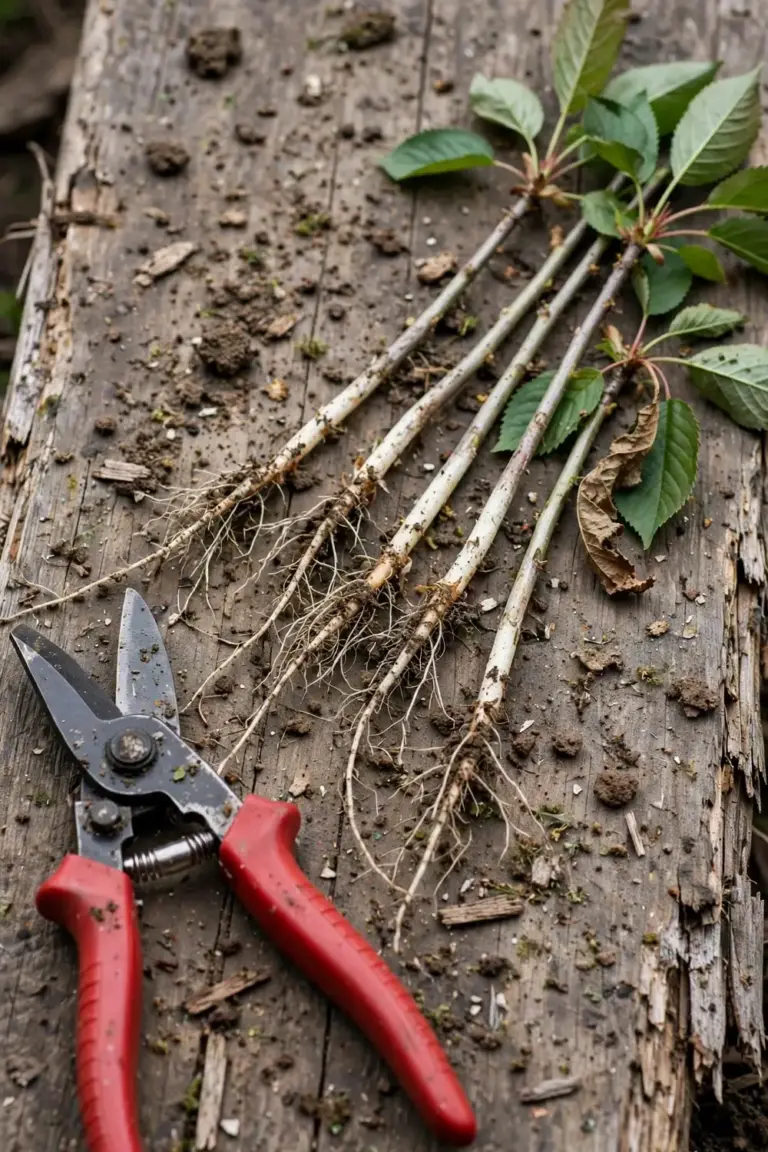
On an own-root tree, yes: sever a strong sucker with roots attached during winter dormancy and pot it up as a free plant, since every shoot is the true variety. On a grafted tree, no: a sucker below the graft union is the rootstock’s variety, and its fruit will be small and poor rather than the cherry you bought. Letting it grow risks the rootstock overtaking the scion entirely.
Not necessarily. Some rootstocks sucker by habit even on healthy trees, and a monthly pull is just maintenance. But a sudden flush of suckers or watersprouts after years of quiet growth signals stress, and University of New Hampshire Extension lists over-pruning, root damage, and storm damage as the classic triggers. Check for trunk wounds, recent digging, and water stress before blaming the tree’s age.
Pulling young, soft suckers does not damage the tree when you grip low and pull sideways to tear at the growing point, which also removes the basal buds. This method suits suckers under 30.5 cm tall and less than 0.6 cm thick. Never yank a thick, woody sucker: dig down to its origin and cut it flush with sharp pruners instead, because tearing old wood rips bark and leaves a slow-healing wound.
No. Suckers remain connected to the parent tree through the root system, so herbicide applied to a sucker travels into the tree itself and can cause serious damage. Extension experts advise against chemical control on root suckers for exactly this reason. The safe approach stays mechanical: pull young suckers by hand and cut woody ones flush at their origin. Mow lawn suckers regularly to keep them down.
Avoid structural pruning in cold, wet winter weather, when silver leaf spores are most active and wounds heal slowly. Washington State University extension notes trees are least susceptible from summer through fall in dry weather, and Yates advises pruning stonefruit in summer straight after harvest. Small sucker pulls can happen any time, but save saw work for dry summer days.
Walk the Base of Your Cherry Tree Every Summer
Walk the base of your cherry tree every summer and the sucker question answers itself. Below the graft union, pull or cut every shoot, because that wood is the rootstock’s, not your cherry’s. Above the union, thin watersprouts selectively and leave the canopy’s real branches alone. Time the bigger cuts for dry summer days after harvest, when silver leaf spores are scarce and wounds seal fast. A five-minute patrol each month beats a rescue operation every year, and the tree keeps the variety you planted. Start this summer and the habit is set for the life of the tree.