
Run 4 tests before you trust a label, a memory, or a flower color. The tests are foliage, flower head, nectary gland, and setting. That is wattle (Acacia) identification in Australia.
I have learned that the wattle I name from its gland and its flower head together beats the wattle I name from its color alone.
The rest of this page is 14 moves, from the 4-clue key to the photograph that locks the name. Work from the top if the plant stands in front of you. Check the foliage first. Photograph the clues before you name it.
1. Run the 4-Clue Wattle Key Before You Trust the Name
Run four tests in order: foliage, flower head, nectary gland, setting. A wattle passes all four, and the four together beat any single feature.
Australia holds 750 Acacia species, according to the Australian National Botanic Gardens introduction to wattles. No one memorises 750 species. The key below shrinks the field to a handful of candidates, then the species sections settle the name. Start with foliage, move to flower head, check the gland, and read the setting last.
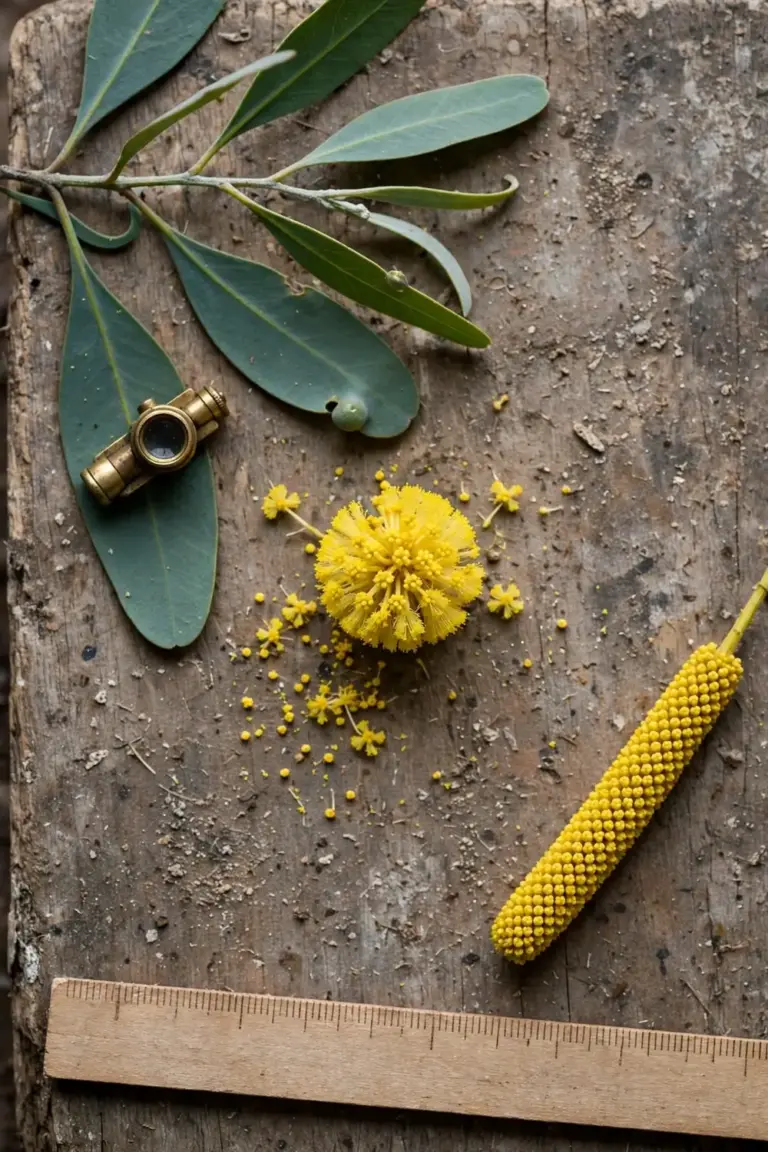
Carry a ruler and a hand lens, because the ruler sizes the phyllode and the lens finds the gland. A phone camera on macro mode works when no lens is handy.
| Species | Leaf | Flower | Gland | Habit |
|---|---|---|---|---|
| Golden wattle (Acacia pycnantha) | Phyllodes, 8 to 20 cm | Ball heads, 60 to 80 flowers | 1 gland near base, prominent | Shrub or tree to 8 m |
| Silver wattle (Acacia dealbata) | Bipinnate, silvery | Ball heads, 22 to 42 flowers | Gland at each pinna junction | Shrub or tree to 30 m |
| Blackwood (Acacia melanoxylon) | Phyllodes, 3 to 5 veins | Ball heads, 30 to 56 flowers | Gland on the phyllode edge | Tree to 45 m |
| Cootamundra wattle (Acacia baileyana) | Bipinnate, blue-gray | Ball heads, 11 to 20 flowers | Gland at base of upper pinnae | Shrub or tree to 10 m |
| Sydney golden wattle (Acacia longifolia) | Phyllodes, 8 to 22 cm | Spikes | Gland near base on one edge | Erect shrub 2 to 4 m |
| Black wattle (Acacia mearnsii) | Bipinnate, dark green | Ball heads, 20 to 40 flowers | Glands at pinna bases and between pairs | Shrub or tree to 16 m |
A table row is a starting guess, not a verdict. Each species section below carries the full test, with the numbers that separate it from its closest lookalike. When two rows match, the gland position and the flower count break the tie.
2. Split the Foliage First: Phyllodes or Bipinnate Leaves
Look at the foliage first. A mature wattle shows one foliage type: phyllodes or bipinnate leaves. Seedlings start bipinnate, then many species switch to phyllodes.
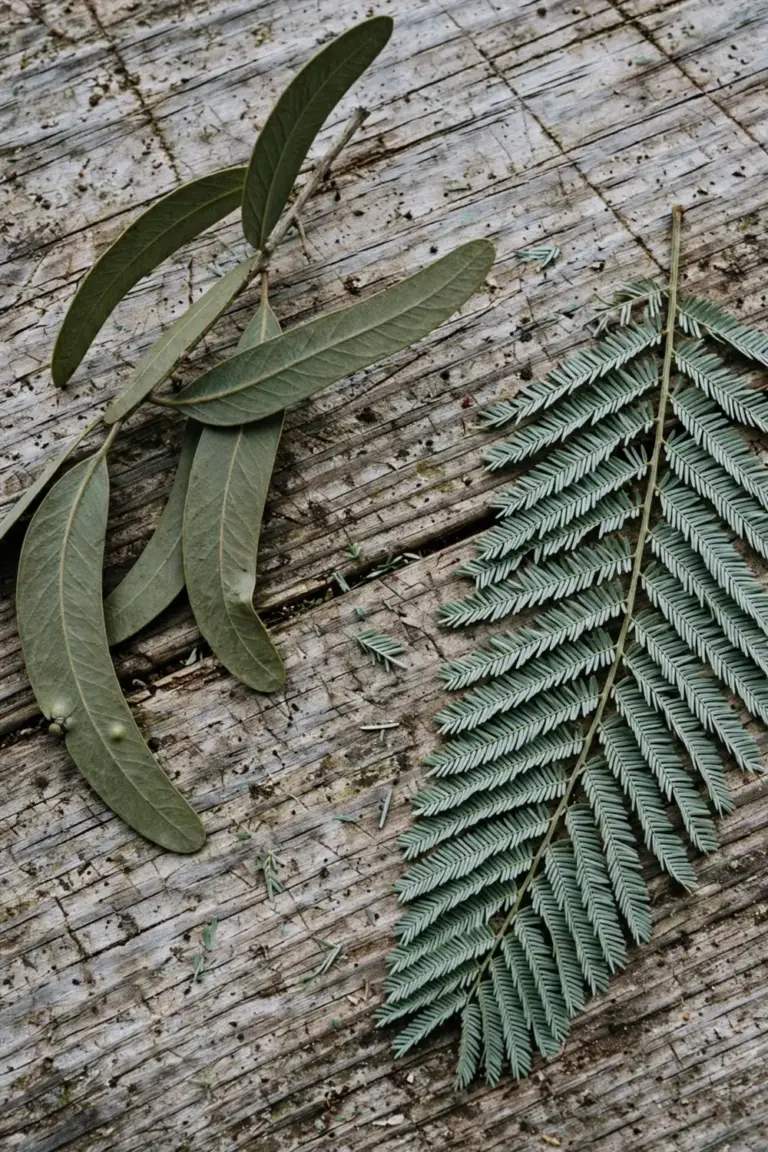
A phyllode is a flattened petiole or leaf rachis that works as a leaf. It carries no leaflets. Its veins run lengthwise, and the blade feels stiff and simple. A bipinnate leaf is twice divided: a central rachis carries pinnae, and each pinna carries pinnules, the small leaflets. The result looks fern-like and feathery.
The split sorts the six species in the key table into two groups of three. Phyllode species are golden wattle, blackwood, and Sydney golden wattle. Bipinnate species are silver wattle, Cootamundra wattle, and black wattle. Check the adult foliage, not the seedling tips. A young phyllode wattle still wears bipinnate leaves, and those first leaves say nothing about the adult form.
Count the veins on a phyllode. Golden wattle shows one strong central vein with fine side veins branching off it. Blackwood shows 3 to 5 raised main veins with a net of secondary veins between them. The vein count separates two phyllode species that share a similar shape.
3. Read the Flower Head: Ball or Spike
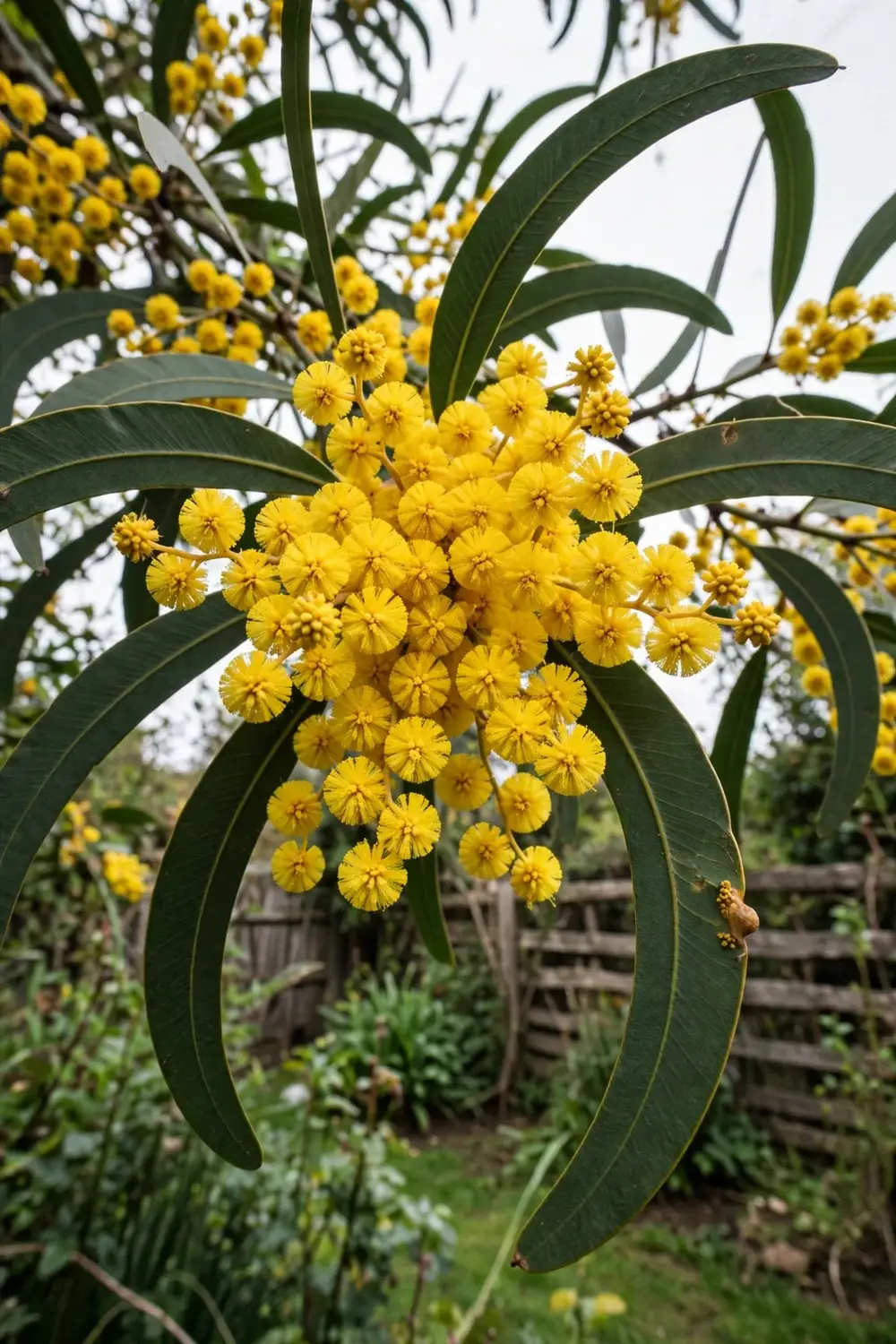
Read the flower head next. A wattle flower head is a ball or a spike. The shape splits the genus at a glance.
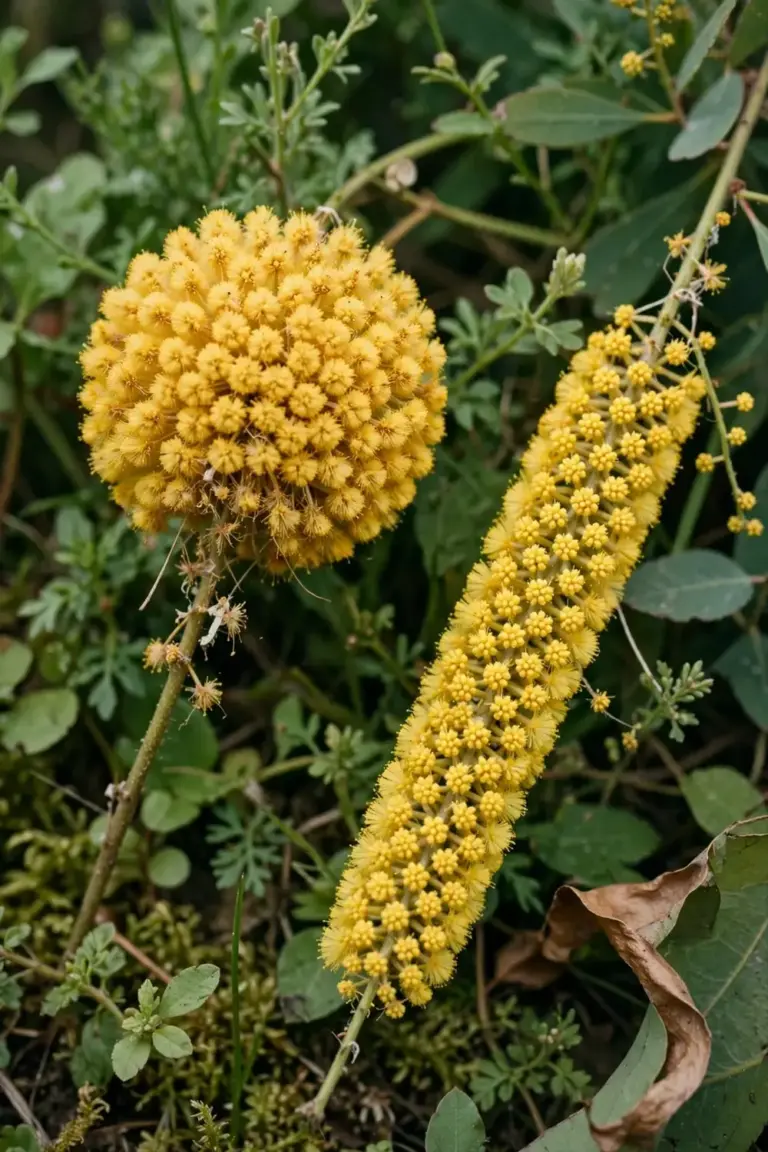
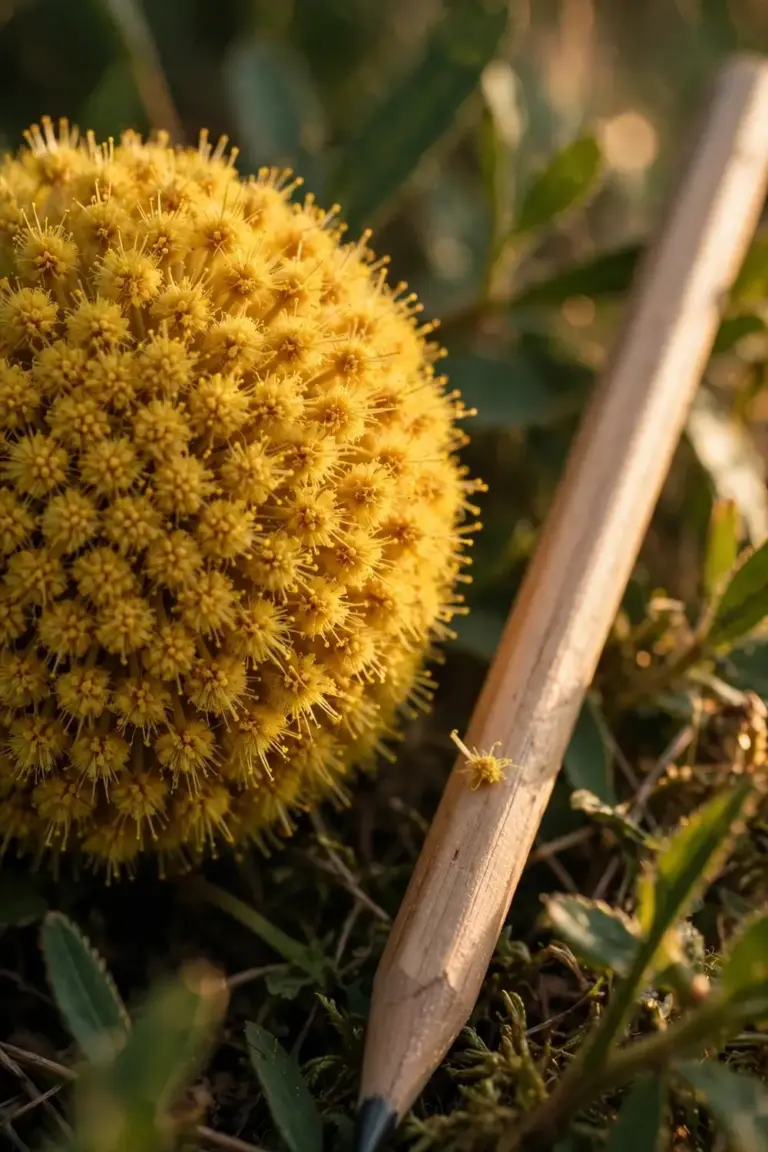
A ball head is a globular cluster of many tiny flowers packed into a sphere. A spike is a cylindrical or oblong rod of flowers arranged along a short axis. The Australian National Botanic Gardens notes that wattle flower heads are either spherical or cylindrical. Five of the six key species carry ball heads. Sydney golden wattle carries spikes, and that single difference separates it from golden wattle at a distance.
Color helps last, not first. Most wattle heads run cream to gold, and two gold species can share one color. One species breaks the rule entirely: Acacia purpureapetala carries purple flower heads, per the ANBG notes. A purple head still counts as a wattle head when the foliage and the gland agree. Count the flowers per head when the head sits open. The count separates close species, and the species sections below give the counts.
Check open flowers, not buds. A tight bud cluster can look like a spike before it opens. Wait for open flowers before you call the head shape. A bud cluster that later opens into balls has fooled more than one walker.
Heads sit in racemes, panicles, or clusters in the leaf axils. The arrangement varies, and the key table does not score it. Note it in the photo record, and let the head shape carry the call.
4. Find the Nectary Gland on the Phyllode Edge
Find the gland. A small raised or sunken nectary sits on the phyllode edge or on the leaf stalk. The gland is the clincher that separates Acacia from its lookalikes.
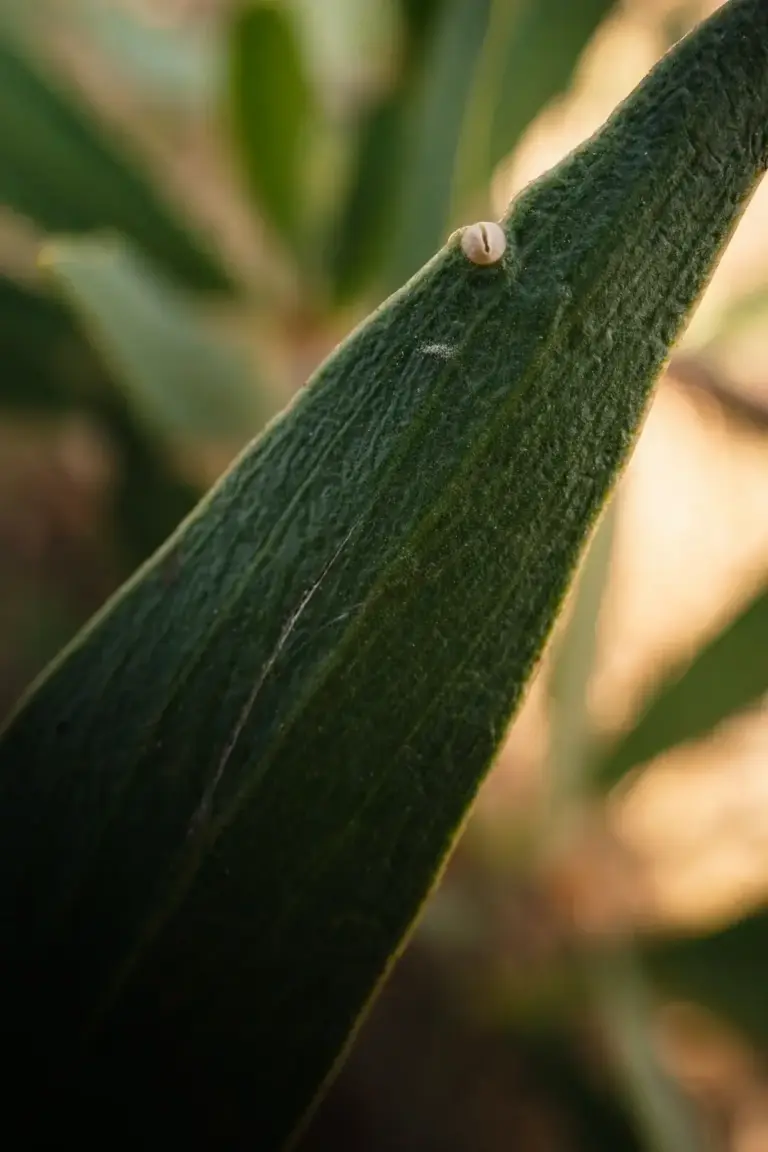
The PlantNET NSW Wattles guide to the Acacia plant places glands on the topside of the petiole. Jugary glands sit between the bases of a pair of pinnae. Interjugary glands sit along the rachis between two or more pairs of pinnae. Young glands often secrete nectar, and ants, bees, and other insects feed on it.
Run a fingertip along the upper edge of the phyllode. Look for a dot, a slit, or a raised bump near the base. On a bipinnate leaf, check the rachis at each pinna junction and between the pairs. The Sydney flora key states the rule plainly: Acacia phyllodes carry a raised or depressed extra-floral nectary on the adaxial edge. A missing gland never clears a plant. Golden wattle glands run from prominent to small or even absent, so use the other three clues when the gland hides.
Glands take several shapes. Some sit raised like a small bump. Some sit sunken like a dimple or a slit. Some run along the edge as a short ridge. The shape matters less than the presence: a bump, a dimple, or a slit in the right place all count as a gland.
5. Name the Golden Wattle: Acacia Pycnantha
Golden wattle shows broad sickle phyllodes, ball heads holding 60 to 80 flowers, and one prominent gland near the phyllode base. The three tests agree, and the name locks.
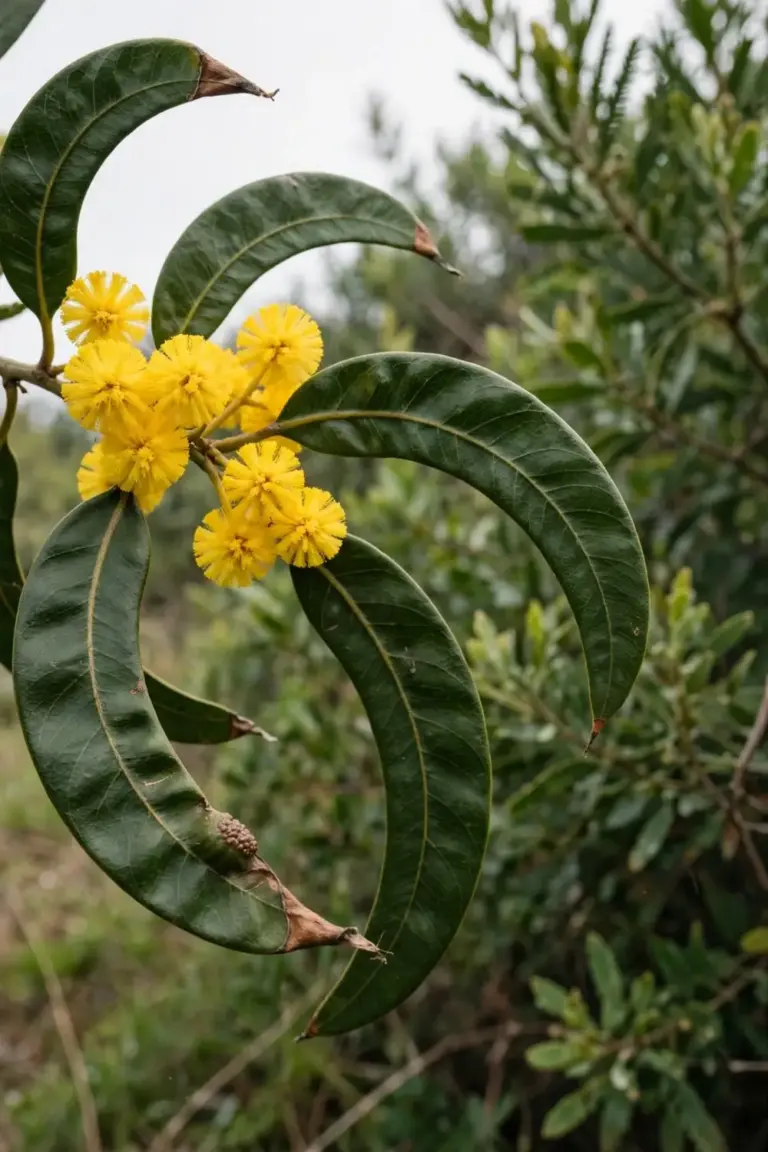
The Australian Plants Society notes on Acacia pycnantha give phyllodes 8 to 20 cm long and 10 to 50 mm wide, lanceolate-falcate to almost ovate, with a strong central vein and distinct penniveining. The glands vary: usually one below the halfway mark or very near the base, usually very prominent, sometimes quite small or even absent. The flowerheads run large and brilliant golden yellow, 60 to 80 flowers per head. The pod runs straight or slightly curved, 5 to 14 cm long and 5 to 8 mm wide. Flowering falls in spring.
Golden wattle is Australia’s national floral emblem, per the ANBG notes. The same notes record it naturalized in the NSW Tablelands and in Tasmania, outside its native range. The Sydney flora key places golden wattle as a shrub or tree to 8 m high, on the coast and adjacent plateaus. The trap sits one row down in the key table, wearing the same gold color. Sydney golden wattle shares the gold color but carries spikes. When the head shape says ball, the name is golden wattle, and the key table agrees. When the head shape says spike, move to the Sydney golden wattle section.
6. Name the Silver Wattle: Acacia Dealbata
Silver wattle shows silvery bipinnate foliage, ball heads, and a gland at every pinna junction. The foliage color gives the common name, and the pinna count gives the proof.
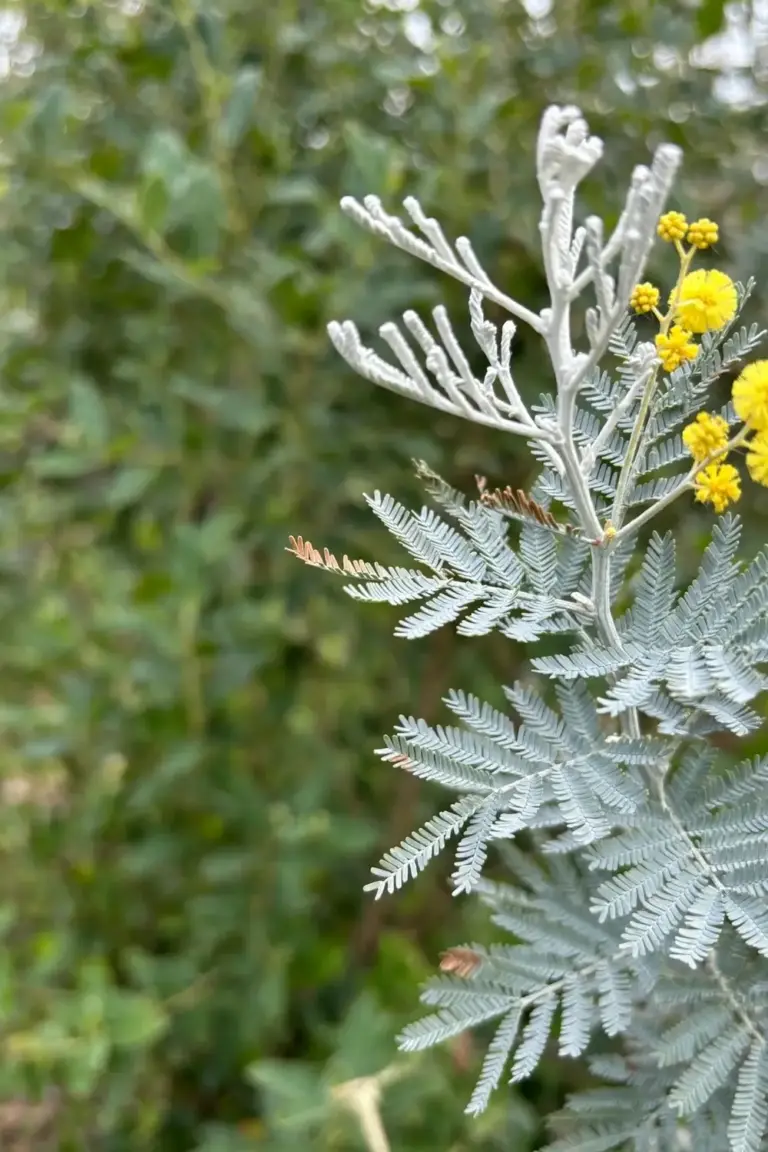
The Flora of Australia wattle treatment counts pinnae at 10 to 26 pairs, stretching to 30 pairs on large leaves, and each pinna carries 20 to 68 pairs of pinnules, each pinnule 1.5 to 5 mm long, stretching to 6 mm. The heads carry 22 to 42 yellow flowers. The foliage runs bluish-gray to silvery, and the whole leaf reaches about 12 cm long by 10 cm wide.
The clean split from Cootamundra wattle is pinna count: silver wattle carries 10 to 26 pairs of pinnae, while Cootamundra wattle carries 1 to 4 pairs, stretching to 6. Count the pairs on one full leaf. A silvery bipinnate wattle with more than 10 pairs of pinnae is silver wattle. A silvery bipinnate wattle with 6 or fewer pairs is Cootamundra wattle. The gland pattern backs the count: silver wattle shows a gland at the junction of each pair of pinnae and the rachis.
7. Name the Blackwood: Acacia Melanoxylon
Blackwood shows dark green phyllodes with 3 to 5 raised veins, pale cream ball heads, and twisted pods. The vein count is the fastest test on this species.
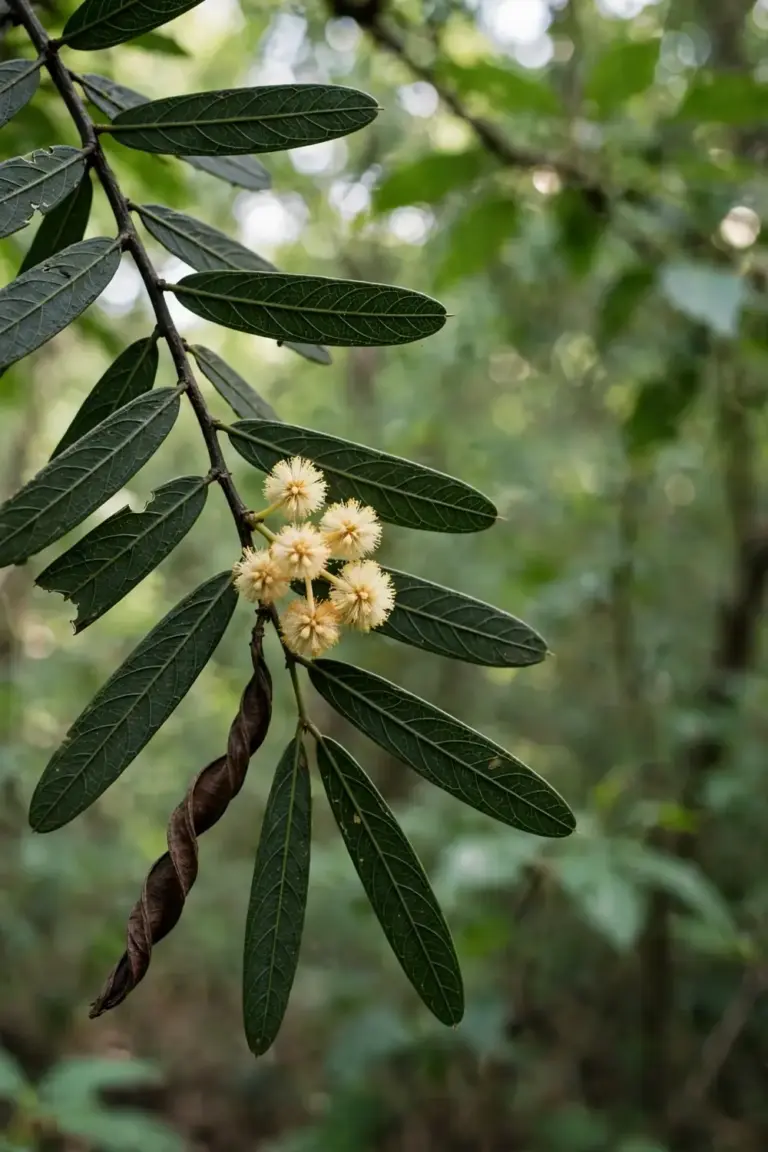
The VicFlora description of Acacia melanoxylon gives phyllodes 4 to 16 cm long and 6 to 25 mm wide, narrowly elliptic to lanceolate, straight to slightly curved, with 3 to 5 main veins raised above the surface and numerous secondary veins anastomosing between them. The heads run globular, about 6 mm across, 30 to 56-flowered, pale cream to pale golden. The pods run linear, to 15 cm long, coriaceous to woody, twisted, with seeds longitudinal and a fleshy funicle, pink to deep red, twice-encircling the seed loosely.
The close lookalike is hickory wattle, Acacia implexa. VicFlora separates the two on phyllode shape and size, the partly united petals, the white fleshy funicle that forms one loop over the apex of the seed, the glabrous rachis, and the later flowering time. When the funicle runs pink to red and loops twice, the name is blackwood. When the funicle runs white and loops once, the name is hickory wattle. Check a ripe pod, not a flower, for this split.
Young plants sometimes still carry bipinnate leaves at the apex of the phyllode, per the World Flora Online treatment. Do not let a few feathery tips overturn the phyllode call.
8. Name the Cootamundra Wattle: Acacia Baileyana
Cootamundra wattle shows blue-gray bipinnate foliage with few pinnae, ball heads, and glands at the base of the upper pinnae. The low pinna count is the mark that separates it from silver wattle.
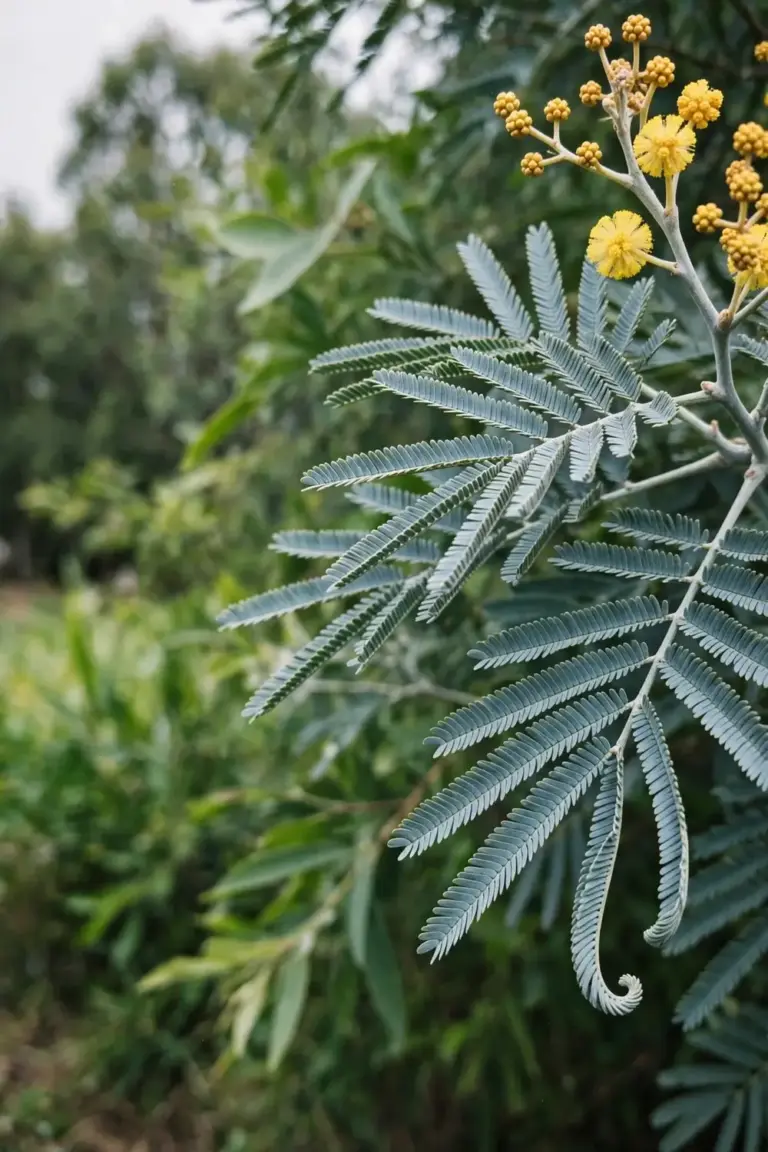
The Flora of Australia wattle treatment counts pinnae at 1 to 4 pairs, stretching to 6, each pinna 1 to 2.5 cm long, stretching to 3 cm. Each pinna carries 4 to 24 pairs of pinnules, each pinnule 5 to 8 mm long and 0.7 to 1.6 mm wide. The rachis carries one prominent orbicular or oblong gland at the base of the upper 1 to 3 pairs of pinnae, and interjugary glands are absent. The heads run globular, 11 to 20-flowered, golden. The pods run 3 to 10 cm long and 7.5 to 15 mm wide.
The Blue Mountains weeds guide warns that Cootamundra wattle is confused with similar local native bipinnate wattles, Acacia parramattensis in the lower Mountains and Acacia terminalis in the mid to upper Mountains. The confusion matters because Cootamundra wattle is not local in those places. Count the pinnae, check the gland at the upper pairs, and check the range note below before you plant one.
9. Name the Sydney Golden Wattle: Acacia Longifolia
Sydney golden wattle shows long phyllodes and dense yellow spikes, not balls. The spike head is the whole test.
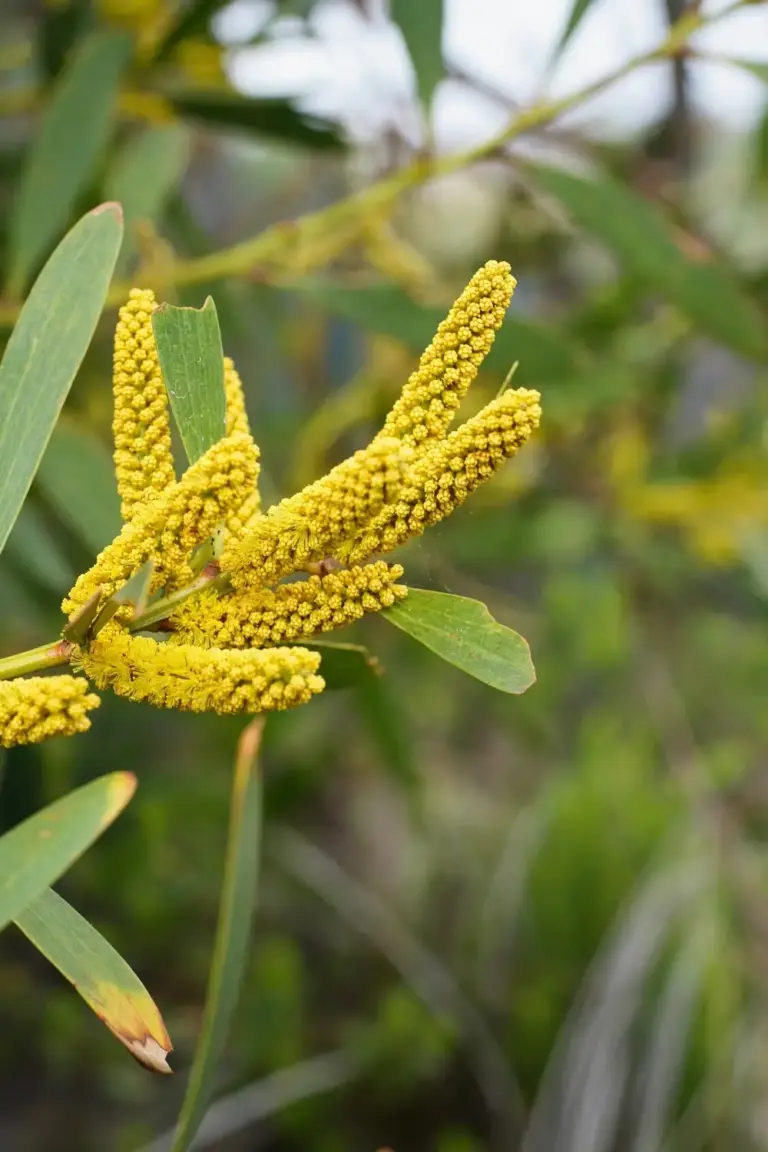
The Sydney flora key gives phyllodes 8 to 22 cm long and 6 to 20 mm wide, oblong to narrow-elliptic, on an erect shrub 2 to 4 m high. The flowers sit evenly and densely packed in the spike, yellow, flowering June to November. A gland sits near the base on one edge of the phyllode. The same key places the species as widespread, in many situations.
The trap is golden wattle. Both species wear gold flowers, and both occur around Sydney gardens. The head shape ends the argument: balls mean golden wattle, spikes mean Sydney golden wattle. The phyllode length backs the call. Sydney golden wattle phyllodes run 8 to 22 cm, longer and narrower in proportion than golden wattle phyllodes at 8 to 20 cm by 10 to 50 mm wide. When the head is a spike and the phyllode runs long and narrow, the name is Sydney golden wattle.
10. Name the Black Wattle: Acacia Mearnsii
Black wattle shows dark green bipinnate foliage, cream ball heads, and glands at the pinna bases and between the pairs. The dark foliage and the cream heads separate it from silver wattle.
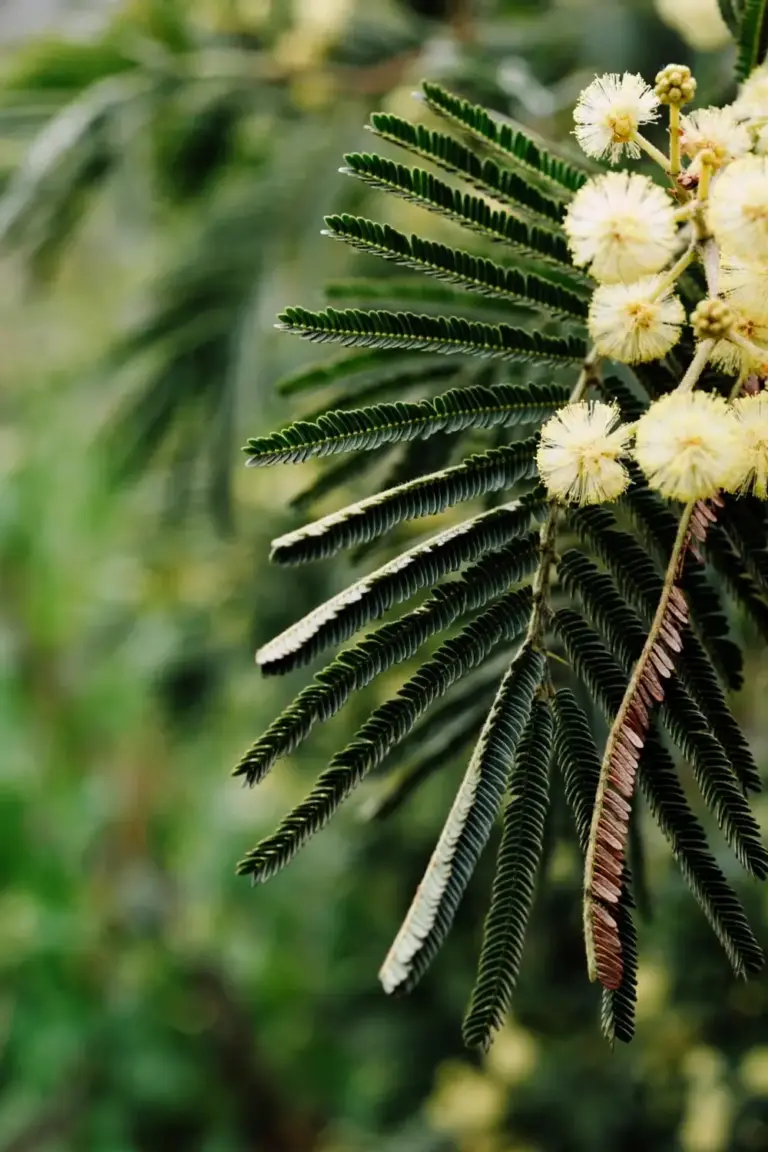
The Flora of Australia wattle treatment counts pinnae at 7 to 31 pairs, each pinna 1.5 to 6 cm long, and each pinna carries 16 to 78 pairs of pinnules, each pinnule 1 to 3.5 mm long, stretching to 4 mm, and 0.5 to 0.8 mm wide. The petiole carries an orbicular gland at the base of, or to 8 mm below, the lowest pair of pinnae. The rachis carries a similar gland near the base of each pair of pinnae, usually with 1 or 2 often confluent interjugary glands between some or all pairs. The heads run 20 to 40-flowered, pale yellow or cream colored. The pods run 3 to 15 cm long and 4.5 to 8 mm wide.
The name trap sits in the common names. Black wattle is Acacia mearnsii. Blackwood is Acacia melanoxylon. The names sound alike. The plants differ: black wattle wears bipinnate foliage for life, while blackwood wears phyllodes. When the foliage is bipinnate and the heads run cream, the name is black wattle. When the foliage is phyllodes with 3 to 5 veins, the name is blackwood.
11. Split Wattle From Hakea, Grevillea, and Eucalypt Seedlings
Run the gland test. Hakea, grevillea, and eucalypt seedlings carry no wattle nectary gland. The gland is the one test the lookalikes cannot pass.
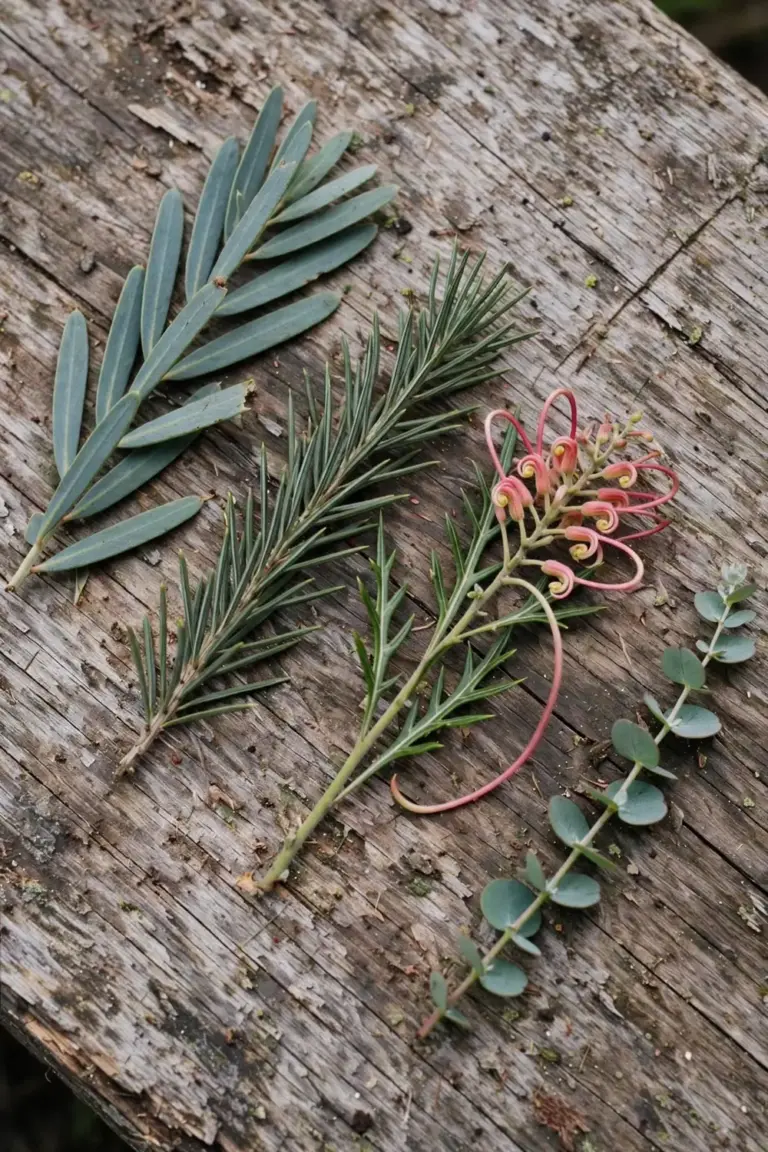
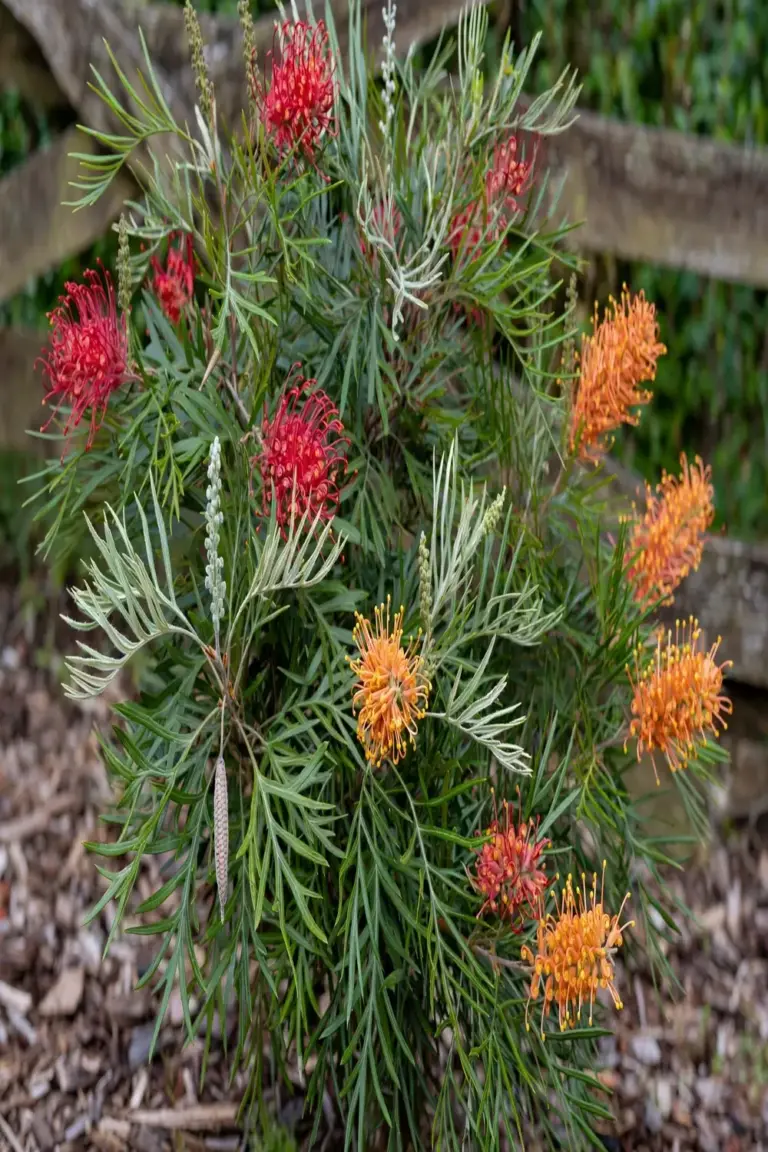
Hakea wears hard leaves, often needle-like or flat and leathery, and its fruit is a woody follicle that splits along one side. The flowers sit in clusters, never in wattle balls. Grevillea wears spider-like flowers with one long curved style that sticks out past the petals, and its leaves run deeply lobed or needle-like. Its fruit is a leathery follicle. Grevillea belongs to Proteaceae, not Fabaceae, and its flower shape alone ends the confusion.
Eucalypt seedlings fool more gardeners than the other two. The juvenile leaves sit opposite each other, round and stalkless, while wattle foliage always sits alternate to clustered, never opposite. Crush a eucalypt leaf and the oil smell gives it away. The seedling carries no nectary gland, no ball head, and no spike head. When the leaves sit opposite and the crushed leaf smells of eucalyptus oil, the plant is a eucalypt seedling, not a wattle.
The name mimosa causes its own confusion. In Australian nurseries, mimosa means silver wattle. Overseas, mimosa can mean Albizia or Mimosa pudica, the sensitive plant. Check the botanical name, not the common name.
Check the fruit when flowers are gone. Wattle fruit is a legume pod, flat and often slightly curved, splitting along one or both edges. Hakea and grevillea fruit is a woody or leathery follicle that splits along one side only. A pod that splits along both edges points back to the legume family.
12. Check Weed Risk by Region Before You Plant It
A wattle local to one region can be a weed in another, so check your local council listing before you plant one. Identification comes before planting, and a name on a label is not proof of origin.
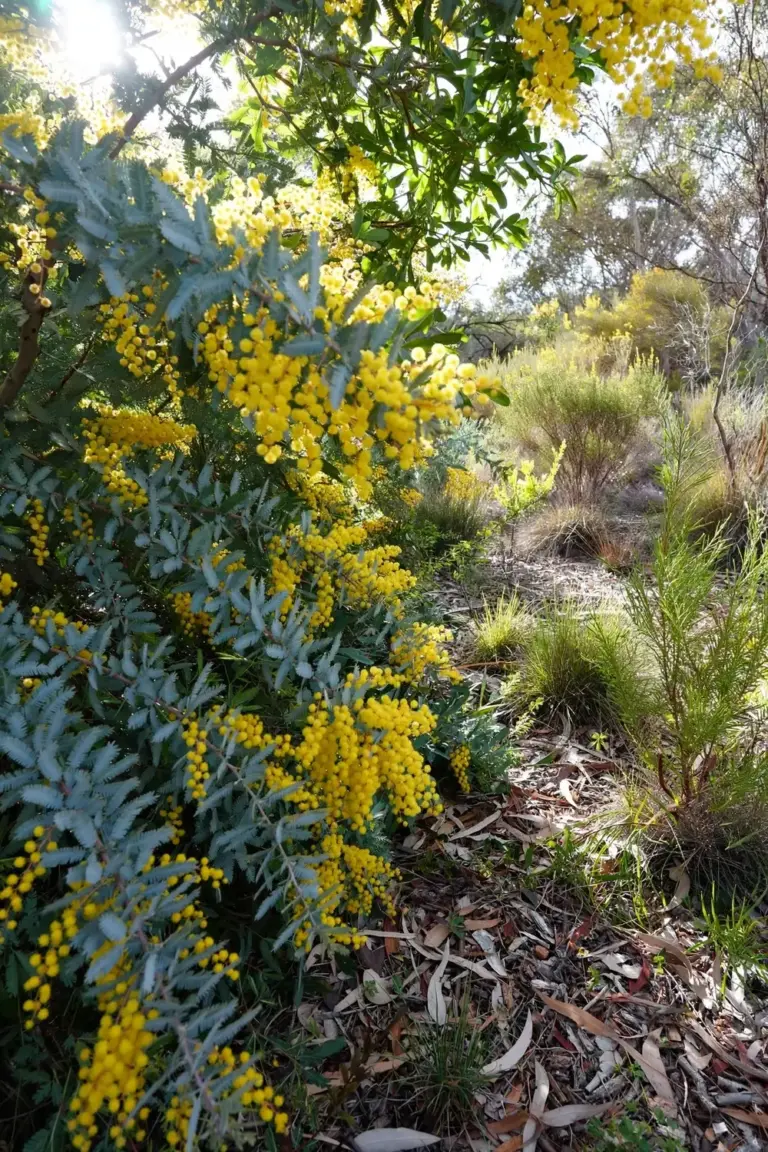
Weeds Australia records Cootamundra wattle as native only in the Cootamundra, Stockinbingal, and Temora district within the Western Slopes region of New South Wales. Outside that small district it naturalizes. The Blue Mountains weeds guide lists it as a local priority weed that moves into intact bushland and displaces local wattles. Golden wattle shows the same pattern on a smaller scale: the same ANPSa notes that describe its flowers record it naturalized in the NSW Tablelands and in Tasmania.
Native to Australia is not the same as local to your suburb. A species can be Australian and still be a weed two states away from home. Check the state flora distribution for your state, then the council list for your area. Nursery labels can mislead: a plant sold as a wattle may be a non-local species with a pretty flower. The label names the plant. The distribution tells you whether it belongs.
The rule is simple. A wattle belongs in the ground only inside its natural range, or where your council lists it as safe. If your council lists it, follow the council advice. Do not plant it outside its natural range. A correct name is the first step in a planting decision. The council listing is the second.
13. Confirm the Name With State Flora, PlantNET, and Lucid Keys
Confirm with a key, not a guess. State flora, PlantNET, and Lucid keys settle the close calls that the four clues leave open.
Start with the state flora for your state, whose PlantNET notes carry the full species descriptions, with the measurements this article quotes. Run your plant through the key one step at a time, and check each measurement against your specimen. Lucid keys walk the same tests in a clickable form, with photographs at each split. When the key and your plant disagree, trust the flora description over a quick guess, and re-check the gland and the head shape first.
When the key stalls, take the photo set to your state herbarium or a local native plant group. A pressed specimen with flowers and foliage settles names that photos cannot. Leave the plant standing. Photograph it, note the place, and ask.
A printed field guide for your state keeps the key in your pocket when the plant stands in front of you. An ID app checks your photographs against a database, and the Missouri Botanical Garden plant finder carries Acacia entries for cross-checking. Use all three as checks, never as verdicts. The flora description is the verdict.
14. Photograph the 4 Clues Before You Name It
Photograph four views before you name it: foliage, flower head, gland, and whole plant. A photo set with all four clues lets a flora key or a local expert settle the name.
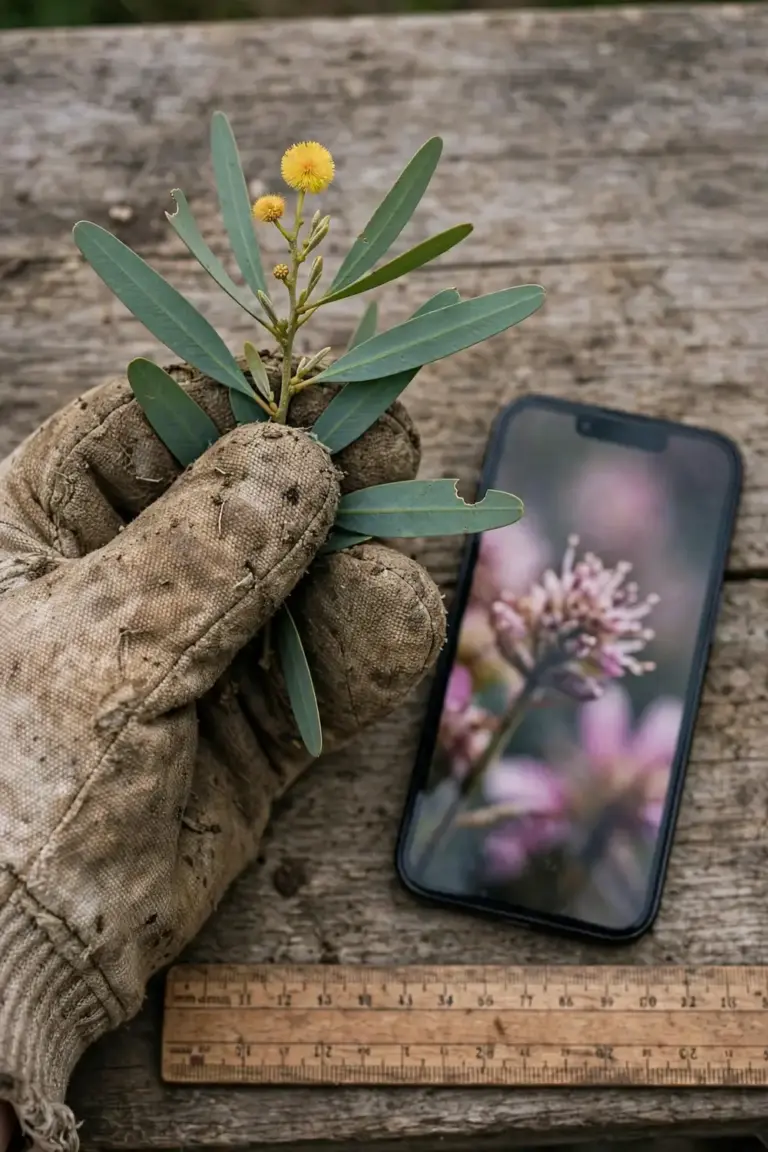
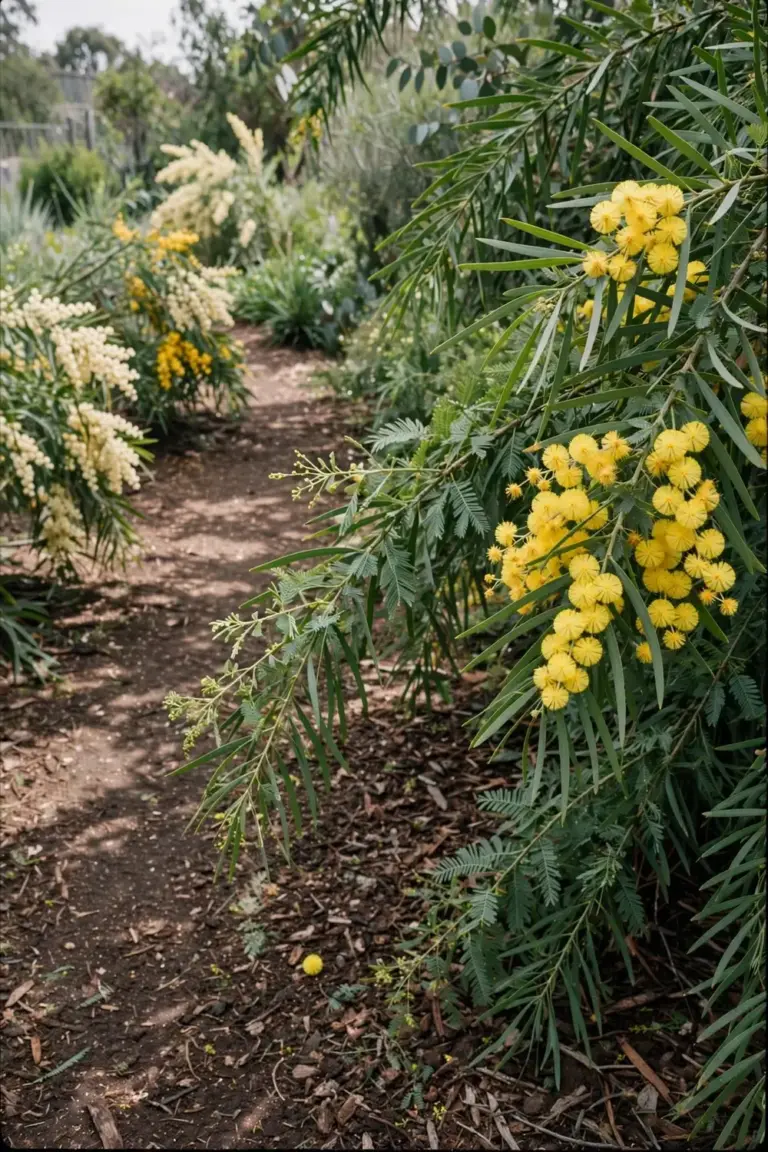
Shoot the foliage flat, with a ruler or a coin for scale, and include both the adult foliage and any seedling foliage on the same plant. Shoot the flower head close, with the ball or spike shape clear and the flowers open. Shoot the gland as a macro: the phyllode edge near the base, or the rachis at a pinna junction, with the dot or bump in sharp focus. Shoot the whole plant last, with the setting behind it: bush, garden bed, roadside, or creek line.
Note the location and the date on the photo record. A name without a place is hard to check. A photo set with all four clues, plus a place and a date, is the strongest identification a home gardener can make.
Shoot in soft daylight. Harsh midday sun blows out yellow heads and hides the gland shadow. Morning light or light overcast cloud gives truer color and sharper detail. Hold the ruler flat beside the phyllode, not across it, so the scale reads true.
Write down the setting in words. Note the soil, the slope, the nearest trees, and whether the plant stands alone or in a thicket. A setting note helps the key as much as a photograph, because several wattles sort by habitat.
Frequently Asked Questions
Yes, in Australia. Wattle is the common name for Acacia, and the genus holds 750 Australian species, per the ANBG notes. The name wattle never means a different genus here. Check the botanical name on any label. A plant sold as a wattle that is not an Acacia carries the wrong name.
No. Many wattles keep bipinnate leaves for life, including silver wattle, Cootamundra wattle, and black wattle. Seedlings of phyllode species start bipinnate, then switch to phyllodes as they mature. Check the adult foliage on the upper branches, not the seedling tips, before you call the foliage type.
A nectary gland is a small nectar-secreting structure on the phyllode edge or on the leaf stalk. Jugary glands sit between pinna bases, and interjugary glands sit along the rachis between pairs. The gland separates Acacia from lookalikes that lack it. Position varies by species, and a missing gland never clears a plant.
Outside its small native district, yes, in many places. Cootamundra wattle is native only to the Cootamundra, Stockinbingal, and Temora district. Councils list it as a local priority weed where it invades bushland and displaces local wattles. Check your council listing before you plant one, and do not plant it outside its natural range.
No. Color fools. Golden wattle and Sydney golden wattle share gold flowers, but golden wattle carries ball heads and Sydney golden wattle carries spikes. Run all four clues: foliage, flower head, gland, and setting. A name built on one clue fails on the next species. A name built on four clues holds.
Name It From the Clues, Not the Color
Color starts the search. The four clues finish it. Foliage splits the genus into two groups, flower head shape splits it again, the gland confirms the genus, and the setting confirms the range.
Photograph the four clues, run the key, and confirm the name with your state flora. A wattle named from its gland and its flower head together beats a wattle named from its color alone, every time.