
Name the tree in 4 steps: rule out plum, check the fruit, read the leaves, confirm the bark. That is cherry tree identification in Australia: a decision path across the four trees that carry the cherry name here. The rest of this page runs the plum test first, then names each of the 4 groups, then gives you a 5-field checklist to walk in order.
I check the petal tip first, because the small split at the end of a cherry petal settles the plum question in seconds.
A “cherry tree” here means any tree Australians call cherry. “Identification” means naming it by traits you can see: petals, buds, bark, leaves, and fruit. Four groups cover the lot: true cherry, ornamental cherry, cherry plum, and native cherry. None of the native “cherries” are Prunus at all. The tangle is Australian: true cherries fruit in the cool districts like Tasmania, the Adelaide Hills, and southern Victoria, while the native “cherries” grow wild in eastern bushland, so one garden can hold two unrelated trees with the same common name.
Bring your eyes and your nose. The petal split decides cherry versus plum in seconds, fragrance confirms it, and bark settles the winter months when no flower is open.
1. Run the 4-Way Cherry Test in Your Head
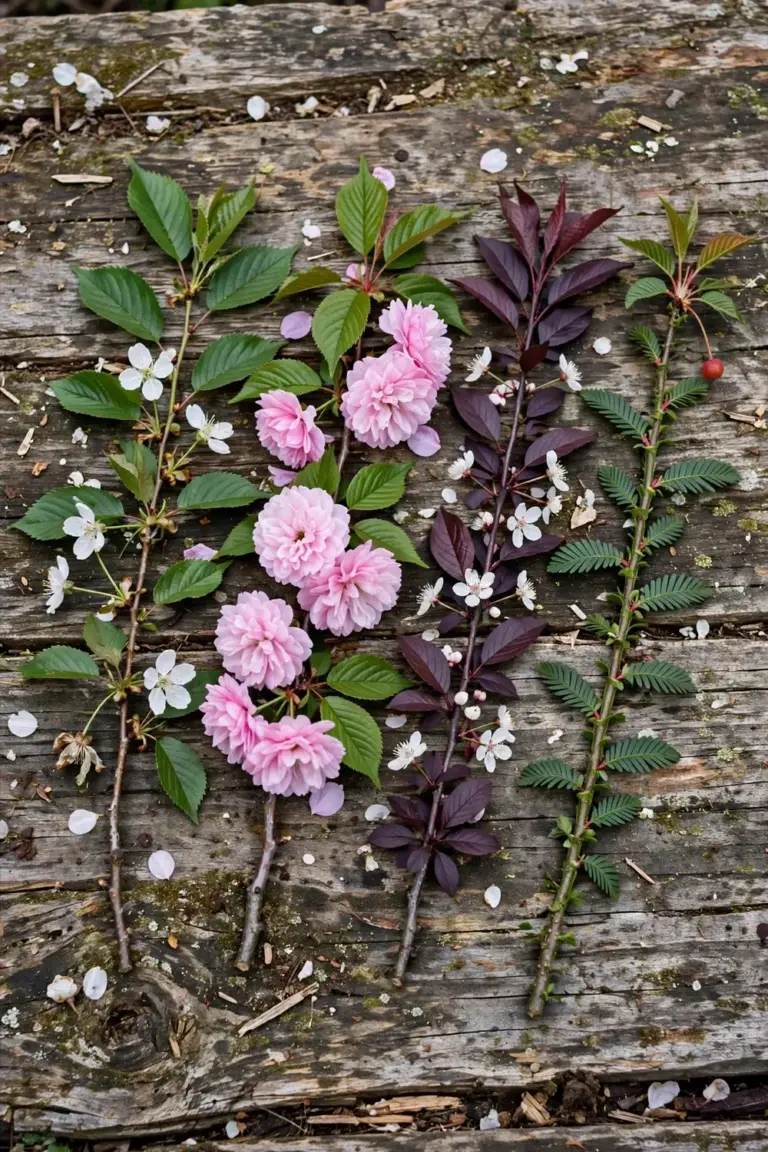
Start with the group, not the species. Four groups cover every tree called cherry in Australia, and each one fails a different field test.
| Group | Botanical Name | Leaf | Flower | Fruit | Bark or Branch |
|---|---|---|---|---|---|
| True cherry | Prunus avium | Alternate, serrated, 6 to 15 cm, red glands on the petiole | White, 5 petals, in clusters of 2 to 6 | Red to dark purple drupe, 15 to 25 mm, one hard stone | Smooth reddish-brown with horizontal lenticels |
| Ornamental cherry | Prunus serrulata | Alternate, serrated, 5.1 to 12.7 cm, bronze new growth | Double pink blossoms, often no fruit at all | Usually none; small black drupe on some | Gray, exfoliating, horizontal ridges |
| Cherry plum | Prunus cerasifera | Alternate, ovate, serrated; purple on cultivars | Small white, fragrant, 5 petals | Yellow or red, cherry-like, plum flesh | Twiggy, upright, brittle wood |
| Native cherry | Exocarpos cupressiformis | Scales 0.5 mm on green grooved branchlets | Tiny greenish-yellow, 1 to 2 mm | Red or yellow fleshy stalk 4 to 6 mm with a hard nut on top | Gray, fissured, tessellated |
Read the table left to right for the tree in front of you. The row that survives all five columns is your group. The sections below prove each row with the field marks that decide it.
Work the table as an elimination, not a match. Cross out the row that fails the first column you can check, then the next. Most trees in Australian streets die at the leaf column: opposite leaves kill all three Prunus rows at once, and scale leaves on green branchlets kill everything except native cherry.
Young saplings test harder because they carry no flowers or fruit. Fall back to the bark and leaf columns, which work year-round. A sapling with alternate serrated leaves and lenticel-banded bark is already a true cherry, even with no blossom in sight.
Photograph each column as you check it. One bark close-up, one leaf with its stalk, one flower or fruit close-up. Three photos let you re-run the table at the kitchen table, and they are the exact evidence a nursery needs when you ask for a second opinion.
2. Rule Out Plum First: the 5-Point Petal, Bud, and Bark Test
Run 5 checks and a plum fails at least 3 of them. This test comes before everything else because plum is the most common wrong answer.
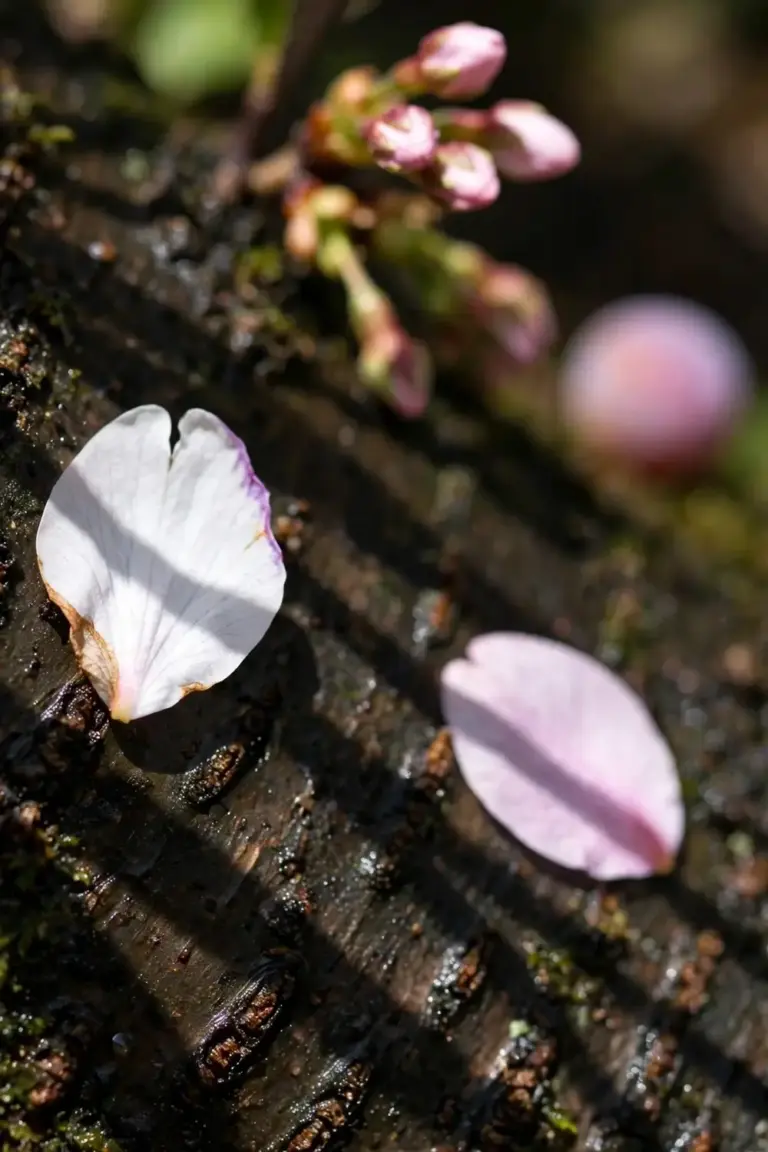
Pick one petal and look at its tip. Cherry petals carry a small split at the very end. Plum petals are oval with no split. That single mark is the fastest test on the tree, and the Vancouver Cherry Blossom Festival’s cherry-versus-plum guide lists it first among its field checks.
Check the bud shape next. Plum buds are round, and each one carries a single blossom on a short thin stem. Cherry buds are oval, and each one opens into a small cluster of blossoms. Count the blossoms coming out of one bud. One means plum. Several means cherry.
Smell the flowers. Plum blossoms carry a strong sweet fragrance you notice from a step away. Cherry blossoms smell faint or like nothing at all. Then read the trunk. Cherry bark is light gray with broken horizontal lines called lenticels. Plum bark is dark and rough with no horizontal lines.
Watch how the leaves arrive. Plum leaves unroll from a cigar shape alongside the flowers, and purple-leaf plums show their color immediately. Cherry leaves unfold like a billfold opening and usually arrive after the flowers, staying green or copper. The same festival guide records this leaf-timing split alongside the petal, bud, and bark marks.
Run the bark and bud checks in winter when no flower is open. Lenticels do not take a season off, and bud shape holds from leaf fall to bud burst. A leafless tree with gray lenticel-banded bark and oval clustered buds is still a cherry in July.
If the tree fails the cherry side of all 5 checks, it is a plum, and growing a plum tree from a fresh seed is a separate job from naming a cherry.
Do not name the tree by flower color alone. Pink flowers grow on ornamental cherries, cherry plums, and true plums, and white flowers grow on true cherries and cherry plums. Color is the weakest test on the tree. Petal shape, bud shape, and bark beat color every time.
3. Name a True Cherry by Bark, Petiole Glands, and Stone
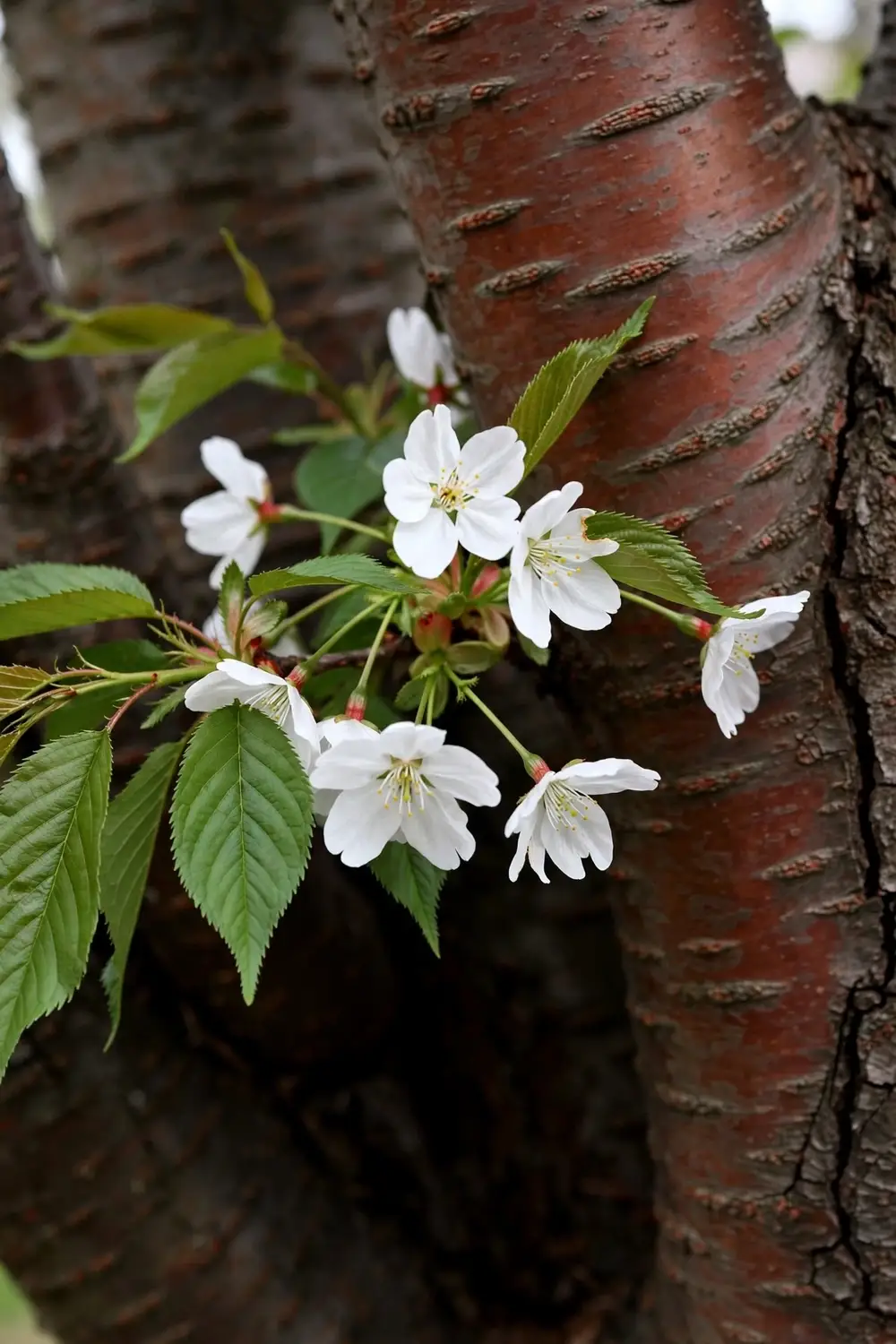
A true cherry is Prunus avium: horizontal lenticels on reddish-brown bark, 1 or 2 red glands on each leaf stalk, and a drupe with a single hard stone. Those three marks together close the case.
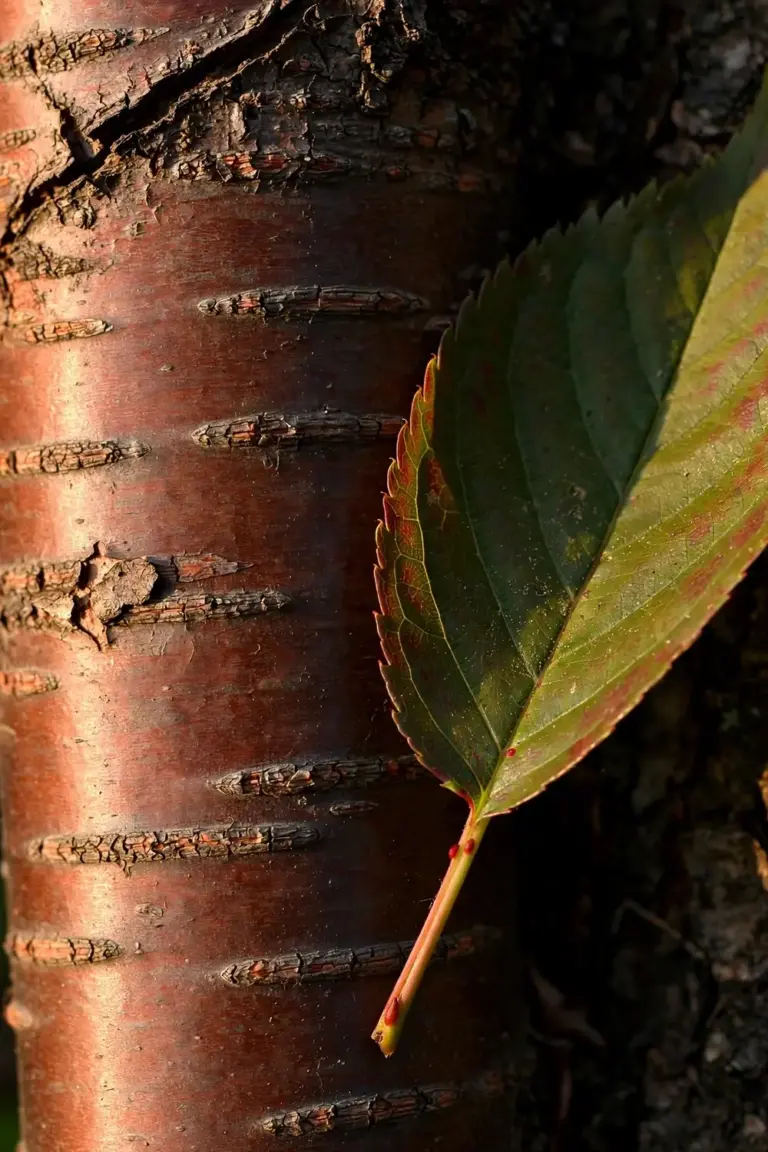
Read the bark on a young branch first. It runs smooth and reddish-brown with prominent horizontal gray-brown lenticels, and the University of British Columbia’s E-Flora BC atlas entry for sweet cherry describes exactly that bark. Old trunks turn dark and fissured, so run this check on wood under 10 years old.
Pull one leaf and turn the stalk toward the light. The petiole carries 1 or 2 conspicuous reddish glands near the top, and the leaf blade runs 6 to 15 cm long with a saw-toothed edge, according to the same E-Flora BC entry. No other cherry group puts red glands on the petiole. That mark alone separates true cherry from ornamental cherry at arm’s length.
Call the red dots by their proper name when you ask for help. Botanists term them extrafloral nectaries, and that phrase in a nursery question gets a faster answer than “the red bumps”. The glands sit on the petiole, not the blade, which is exactly where you should be looking.
Cut one ripe fruit open. The flesh wraps a single hard-shelled stone 8 to 12 mm long, and the fruit measures 15 to 25 mm across. Sweet cherry cultivars bred for the table grow larger than the wild 15 to 25 mm, so treat oversized fruit as a cultivar sign, not a different species.
Place the tree in its climate. True cherries need winter chill, which is why Australia’s commercial and backyard crops cluster in Tasmania, the Adelaide Hills, and the cooler parts of Victoria. A supposed true cherry fruiting heavily in subtropical Brisbane deserves a second look at the leaf arrangement, because the climate argues against it.
Measure three leaves, not one. Leaf size varies with shade, water, and position in the canopy, and a single small leaf proves nothing. Three leaves from sunlit outer branches, all landing in the 6 to 15 cm band with glands on every petiole, is a measurement. One leaf is an anecdote.
Do not taste the fruit to name the tree. Sweetness varies by cultivar, ripeness, and season, and unripe true cherries taste as sharp as any plum. The stone test needs a knife, not teeth. Cut, look for the single hard shell, and put the fruit down.
4. Name an Ornamental Cherry by Double Blossoms and Exfoliating Bark
An ornamental cherry is Prunus serrulata: a spring show of double pink blossoms on a tree that usually sets no fruit. If the flowers look like small roses and autumn brings no cherries, you are looking at an ornamental.
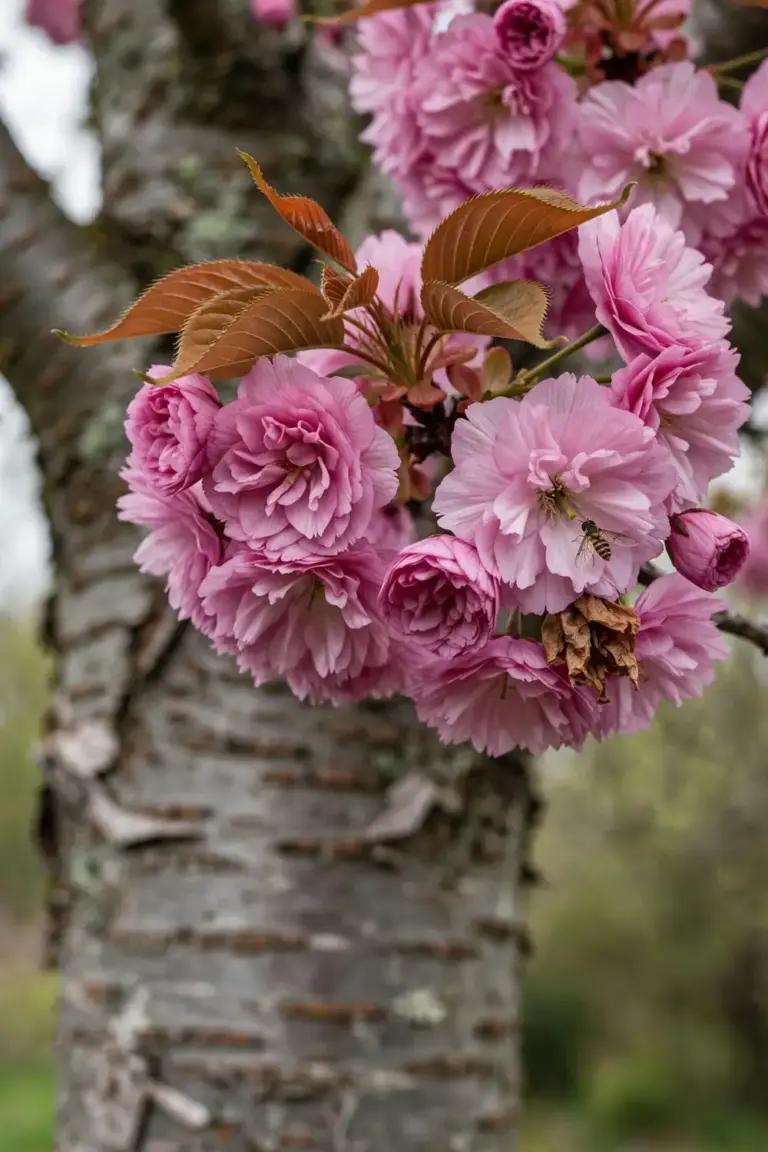
Count the petal layers. Wild-type flowers carry 5 petals, but the planted cultivars stack their petals in rose-like doubles, and the Washington University tree identification page for Japanese flowering cherry notes that the deep pink multi-layered bloom is the cultivar signature. ‘Kwanzan’ goes further: it is sterile and produces no fruit at all.
Read the bark and twigs. The bark runs gray and exfoliating with horizontal ridges, and the twigs shift from green to orange-red to light brown as the wood matures, per the same Washington University page. The buds sit dark red and many-scaled, with several terminal buds crowded at each twig tip.
Do not expect the wild species at the nursery. The Morton Arboretum notes that the actual Prunus serrulata species is seldom sold, and the trade deals in cultivars. Every double pink street tree you meet is a named cultivar, not the species. Name the cultivar only if the tag survived planting; the group name is enough for every decision that follows.
Check the leaves last. They run 2 to 5 inches long, which converts to 5.1 to 12.7 cm, with serrated margins, and the new leaves open bronze before settling to dark green. Leaves that open bronze plus double pink flowers plus no fruit is the ornamental cherry fingerprint.
Note the season of the show. The bloom lands in mid-spring and finishes fast, and the fall foliage turns bronzy-orange. A tree that flowers pink in spring, carries no summer fruit, and colors bronze-orange in autumn has told you its name three times.
Check the graft if the trunk looks odd. ‘Kwanzan’ is commonly grafted onto sweet cherry trunks at 1.2 to 1.8 m high, and the Boone County Arboretum notes that grafted height in its cultivar records. A straight trunk that suddenly bursts into double pink bloom at head height is a grafted ornamental, not a seedling with an identity crisis.
Expect these trees in streets and parks, not orchards. Councils plant ornamental cherries for the spring show, and the trees rarely receive the pruning or feeding a fruiting tree would get. A neglected street tree with double pink bloom and exfoliating bark is still an ornamental cherry. Neglect does not change the species.
5. Name a Cherry Plum by Purple Leaves and Plum-Like Fruit
A cherry plum is Prunus cerasifera: plum-like fruit on a tree with cherry-sized blossoms, and deep purple leaves on the cultivars everyone plants. Purple foliage plus small white spring flowers is the giveaway.
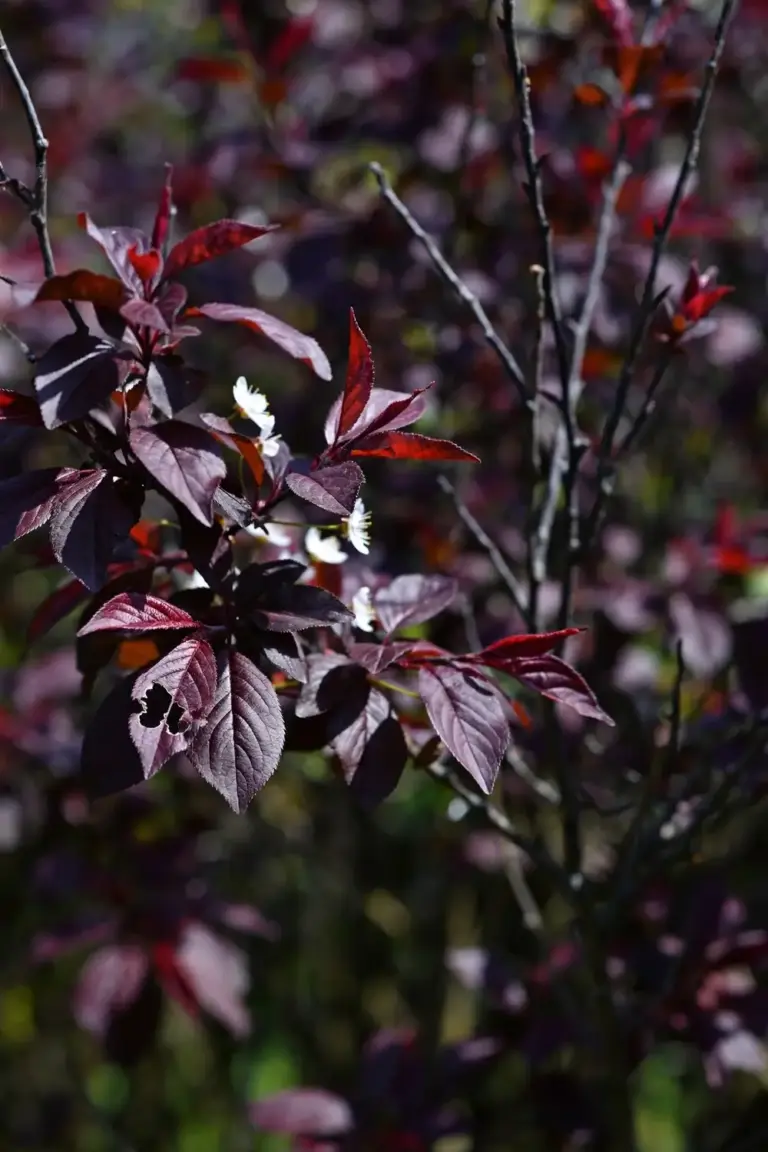
Watch the spring sequence. Small fragrant pure white 5-petaled flowers with numerous stamens open in spring as the leaves emerge, and the North Carolina Extension Gardener Plant Toolbox entry for cherry plum describes that exact timing. The fruit that follows looks cherry-like and ripens yellow or red.
Read the leaf color on the planted forms. The purple-leaf cultivars hold deep reddish-purple foliage until the leaves drop in fall, and their flowers run pale pink or lavender instead of white, per the same NC State entry. Green-leaf seedlings exist, but the purple forms dominate Australian street and garden plantings.
Expect a short-lived tree. The species grows upright and twiggy with brittle wood, and NC State calls it typically short-lived. Most ornamental years produce little or no fruit, so a fruitless purple-leaf tree in spring flower is still a cherry plum.
Measure the fruit when it sets. The RHS plant profile for cherry plum lists the fruit at about 2.5 cm long, ripening red, orange, or yellow. That plum-sized fruit on cherry-sized blossom wood is the proportion test: true cherry fruit never reaches 2.5 cm on wild-type wood, and ornamental cherries set none at all.
Learn the ‘Nigra’ look because it dominates plantings. The RHS describes ‘Nigra’ as a round-headed tree to 10 m with deep purple leaves that open red, dark twigs, and single pale pink flowers opening from deep pink buds before the leaves. Red young leaves plus dark twigs plus pink-before-leaf flowers is ‘Nigra’ from across the street.
Decode the nursery tag before you buy. Mirabelle, myrobalan, myrobalan plum, and purple-leaf plum are all names the trade uses for Prunus cerasifera forms, and NC State lists mirabelle and myrobalan among its common names for the species. One tree, four labels. Match the botanical name on the tag, not the marketing name above it.
Read the species name itself as a field clue. Cerasifera joins the Latin cerasus, meaning cherry tree, and ferre, meaning to bear, and NC State gives that etymology in its plant profile. The cherry-bearer. The name tells you the tree was named for fruit that looks like cherry on wood that behaves like plum.
6. Name the Native Cherry by Its Inside-Out Fruit
A native cherry is Exocarpos cupressiformis: green photosynthetic branchlets, scale leaves, and the edible red stalk with the hard nut sitting on top of it instead of inside. No Prunus does this. The fruit looks assembled backwards, and that is the whole identification.
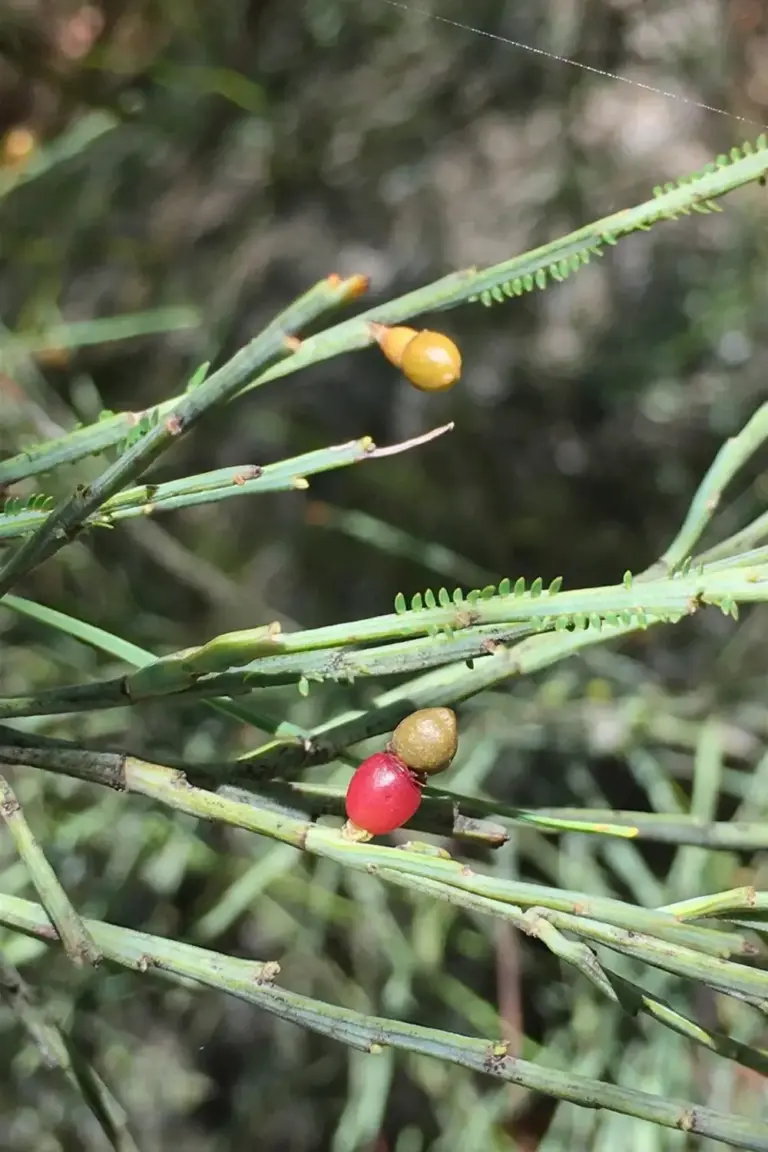
Look for leaves first and find almost none. The leaves are reduced to triangular scales about 0.5 mm long, or 0.2 to 0.5 cm on new growth, while the green grooved branchlets do the photosynthesizing, according to the Lucidcentral fact sheet for Exocarpos cupressiformis. The tree reads as a small cypress from a distance, which is why one of its common names is cypress cherry.
Know where to look. The Lucidcentral sheet records it as widespread in forest, woodland, and grassy areas across south-eastern Australia. A cypress-like small tree with scale leaves on a bush block edge in Victoria or southern NSW is a stronger native-cherry candidate than the same silhouette in a Perth garden bed.
Find the fruit in the warm months. The true fruit is a hard greenish nut 4 to 6 mm long, and the stalk beneath it swells into a fleshy yellow, orange, or red cherry-like body 4 to 6 mm long. The nut sits on top of the edible part. The University of Tasmania’s dicot key describes the conspicuous red edible fleshy section sitting below the “seed”, which is the inside-out arrangement in plain words.
Confirm with the flowers and the bark. The flowers are greenish-yellow, 1 to 2 mm across, packed in short dense spikes to 8 mm long, and flowering runs mainly October to May per the Lucidcentral sheet. The bark runs gray, fissured, and tessellated on a tree or shrub that reaches 10 m tall.
Learn its common names so the nursery tag makes sense. Cherry ballart, wild cherry, cypress cherry, and forest cherry all mean this same tree, and every one of them points at the cypress-like foliage rather than at any kinship with true cherries. The tree also runs semi-parasitic roots into host plants, notably eucalypts, which is why it establishes best in bushland rather than in an isolated lawn.
Check the ground under the tree in the warm months. Fallen fleshy stalks, red or orange and about the size of a pea, confirm the fruiting season without reaching for binoculars. No other tree in this key drops red pea-sized stalks with a hard nut riding on top.
7. Separate Brush Cherry and Beach Cherry From True Cherries
Brush cherry and beach cherry are Myrtaceae, not Prunus: opposite leaves and no stone fruit. Opposite leaves end the Prunus question by themselves, because every Prunus in this key carries alternate leaves.
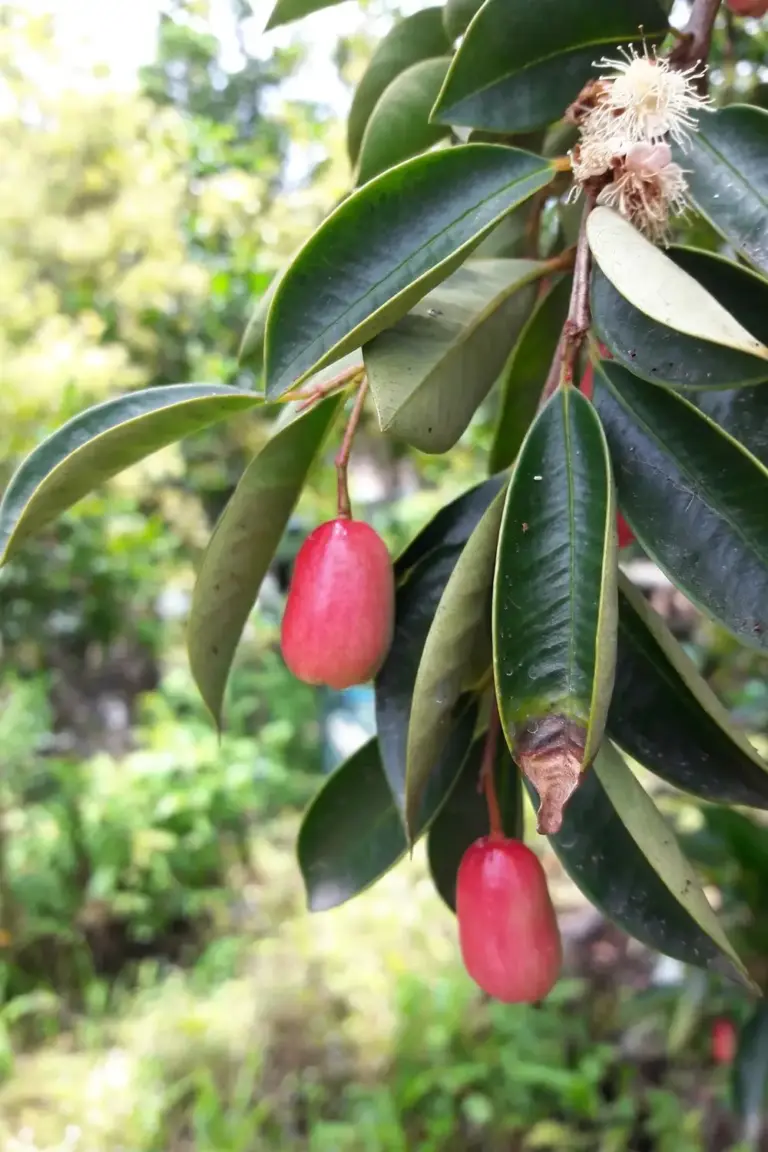
Brush cherry is Syzygium australe, a rainforest tree of eastern Australia. Its leaves sit opposite each other, 2.5 to 10 cm long and 10 to 32 mm wide, glossy with a paler underside, and the ripe fruit is a pink to red oval 15 to 25 mm long with no hard stone, per the Lucidcentral fact sheet for the species. White flowers with a brush of long stamens give the myrtle family away at bloom time.
Beach cherry is Eugenia reinwardtiana, a tropical Queensland coast tree. It carries the same opposite-leaf myrtle pattern with orange-red fruit, and Wikipedia’s species page records both the name and the fruit. Treat any tropical “cherry” with opposite leaves as a lilly-pilly relative first.
Run the family test when in doubt. Opposite leaves plus fleshy stoneless fruit means Myrtaceae. Alternate leaves plus a single hard stone means Prunus. That split never fails across the four groups.
Brush cherry has a close twin, and the twin is blue lilly pilly, Syzygium oleosum. Same genus, same opposite leaves, same white stamen-brush flowers. Separate them by the ripe fruit alone, the one trait the University of Sydney’s eFlora key uses: brush cherry ripens deep pink to red, while blue lilly pilly ripens bluish-purple to magenta. No fruit on the tree? Wait for the season to decide.
Read the flower structure when the tree blooms. Myrtle flowers lead with a dense brush of long white stamens, and the small white petals sit almost unnoticed beneath them. Stanford’s tree encyclopedia describes exactly that stamen-brush effect for brush cherry. A “cherry blossom” built of stamens instead of petals is a myrtle, never a Prunus.
8. Walk the 5-Field Cherry Tree Identification Checklist in Order
Walk the checks in this order and stop at the first one that names the tree. Each step eliminates at least one group.
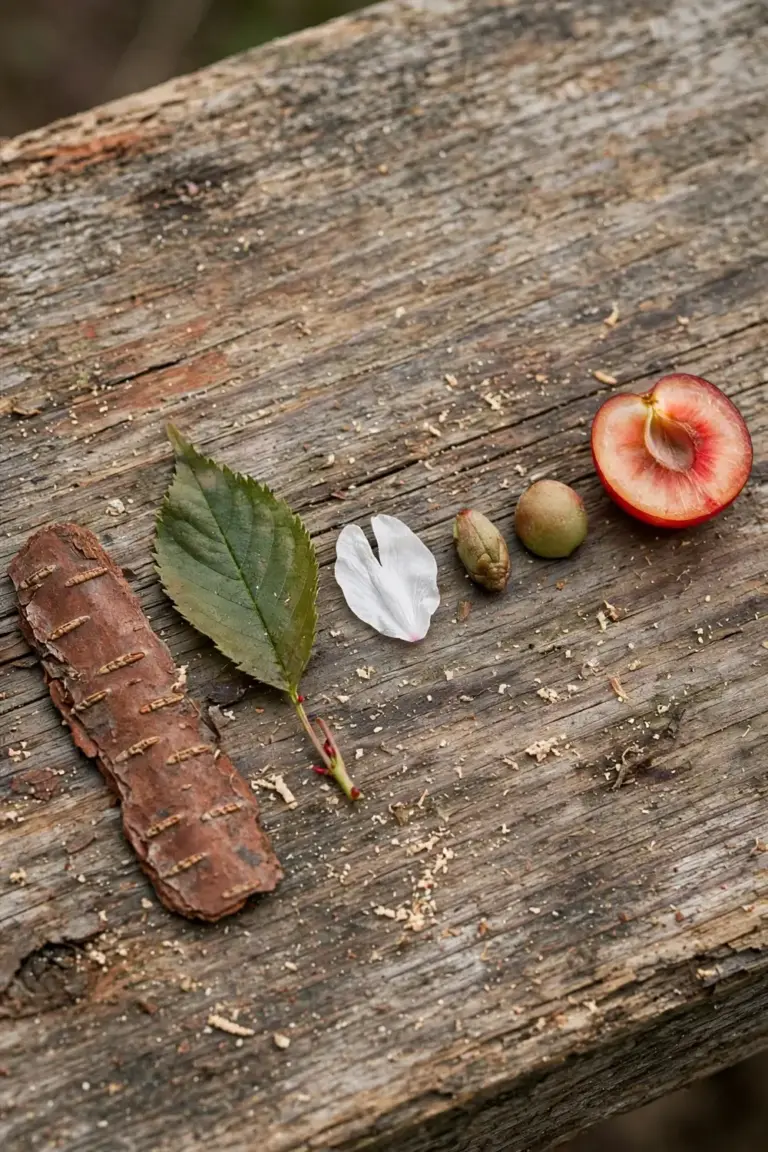
- Petal tip. A small split at the end of each petal means cherry. An oval petal with no split means plum. This one check kills the most common misidentification.
- Bud. One blossom per round bud on a short thin stem means plum. A cluster of blossoms from one oval bud means cherry.
- Bark. Light gray bark with horizontal lenticels means cherry. Dark rough bark with no lines means plum.
- Leaf arrangement. Opposite leaves mean a myrtle-family “cherry” like brush cherry or beach cherry. Alternate leaves keep you inside Prunus.
- Fruit. A single hard stone inside the flesh means Prunus. A fleshy stalk with the nut on top means native cherry. A fleshy stoneless berry means a myrtle cherry.
Write down which group survives all 5 steps before you look up varieties or care advice. A name written from the checklist beats a name guessed from the flowers.
When the checklist deadlocks, look for the graft. A tree with cherry bark below and double pink bloom above is two trees in one: a sweet cherry trunk carrying an ornamental top. Name the top, because the top is what flowers, fruits, and defines the tree you see. The rootstock’s name belongs in the planting notes, not on the tag.
Frequently Asked Questions
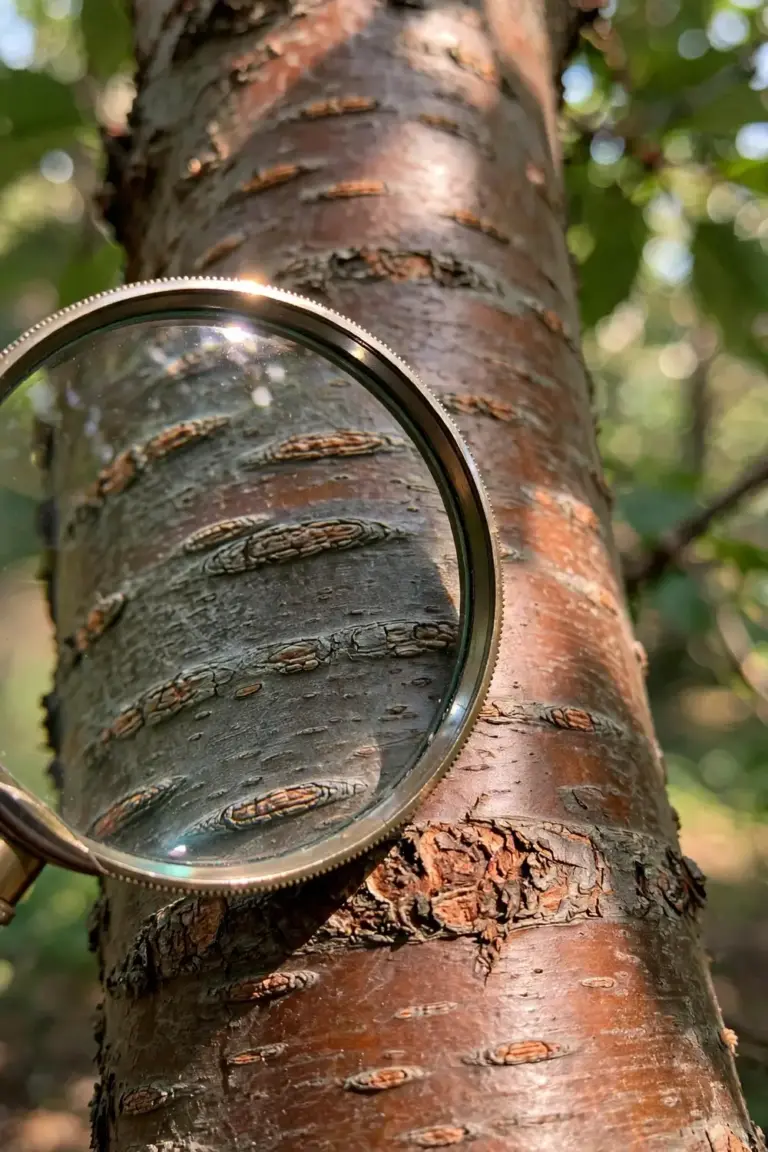
Run the petal test first. Cherry petals carry a small split at the tip and plum petals do not. Back it up with the bud check: one blossom per round bud means plum, while a cluster from one oval bud means cherry. Finish with the bark: light gray with horizontal lenticels is cherry, dark and rough with no lines is plum. Three agreements name the tree, and two out of three is enough when one trait is out of season.
Most planted ornamental cherries are sterile cultivars. ‘Kwanzan’, the most planted double-flowering form, produces no fruit at all, and Washington University’s identification page states that sterility directly. The tree spends its spring energy on layered petals instead of ovaries. No fruit on a double-blossom cherry is normal, not a pollination failure, so skip the hand-pollination experiments entirely.
The red fleshy stalk is the edible part. Lucidcentral’s fact sheet describes the swollen stalk as fleshy, yellow to red, 4 to 6 mm long, and edible. The hard nut perched on top is not food. Eat the stalk, skip the nut, and confirm the inside-out arrangement before tasting anything from a wild tree.
Yes, when the tree sets it. The fruit is plum-like and edible, ripening yellow, orange, or red depending on the form. Most purple-leaf street trees set little or no fruit in an average year, so edibility is rarely tested. Fruiting forms are the ones sold for eating, not the ornamental purple-leaf cultivars.
No. Purple leaves point to a cherry plum cultivar, not a true cherry. True cherry leaves stay green through summer and turn orange, pink, or red only in autumn. A tree holding deep purple foliage from spring to leaf fall is Prunus cerasifera in one of its purple-leaf forms. Check the fruit to confirm: cherry plum fruit runs plum-sized, while true cherry fruit stays cherry-sized.
Write the Name Down Before You Act
Write the group name on the tag before you do anything else. True cherry, ornamental cherry, cherry plum, and native cherry want different things, and the wrong name sends every later decision sideways. Once the name is certain, growing cherry fruit at home picks up where identification stops.
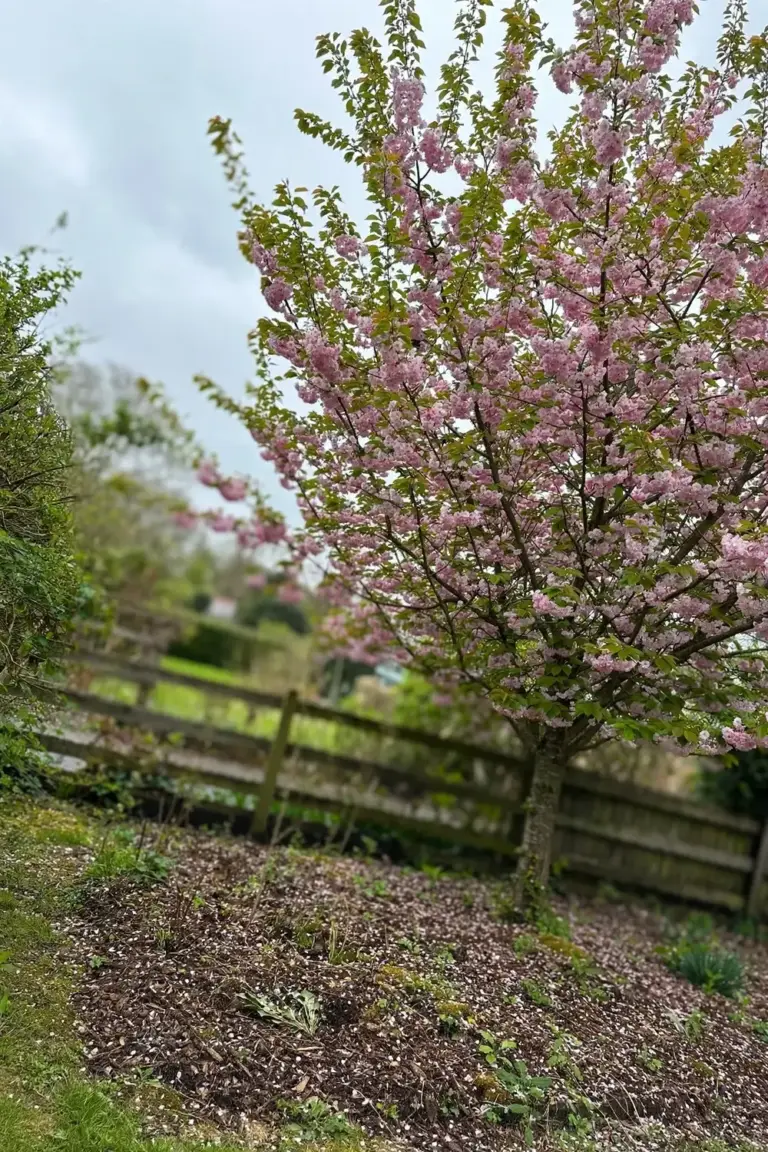
Photograph the evidence while you are there: one bark close-up, one leaf with its stalk, and one flower or fruit. Label each photo with the suburb and the month. Those three photos answer every follow-up question a nursery or forum will ask, and they let you re-run the checklist at the kitchen table.