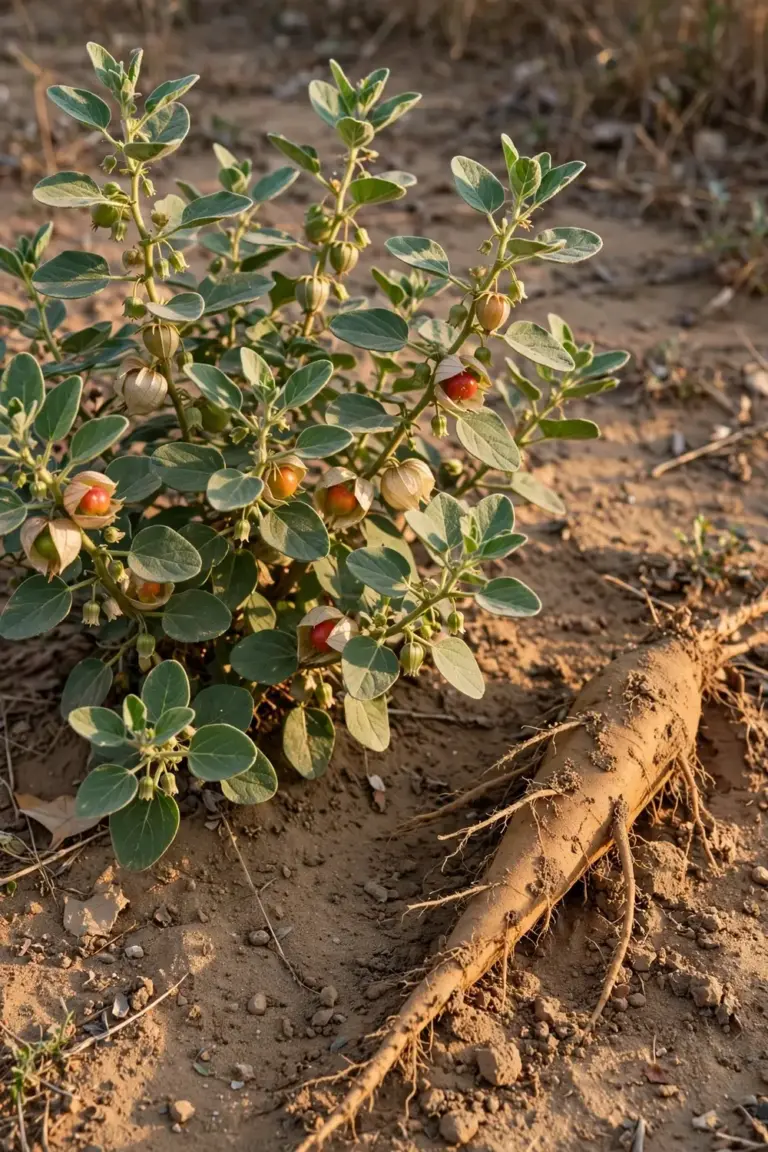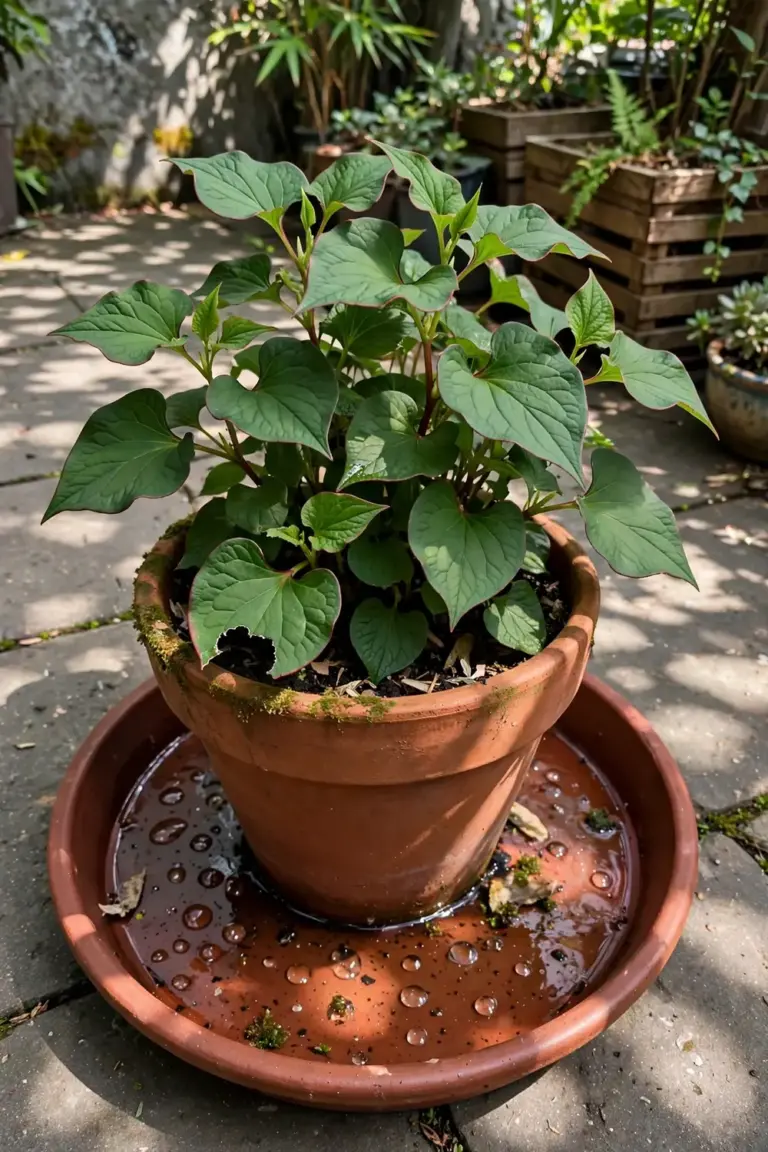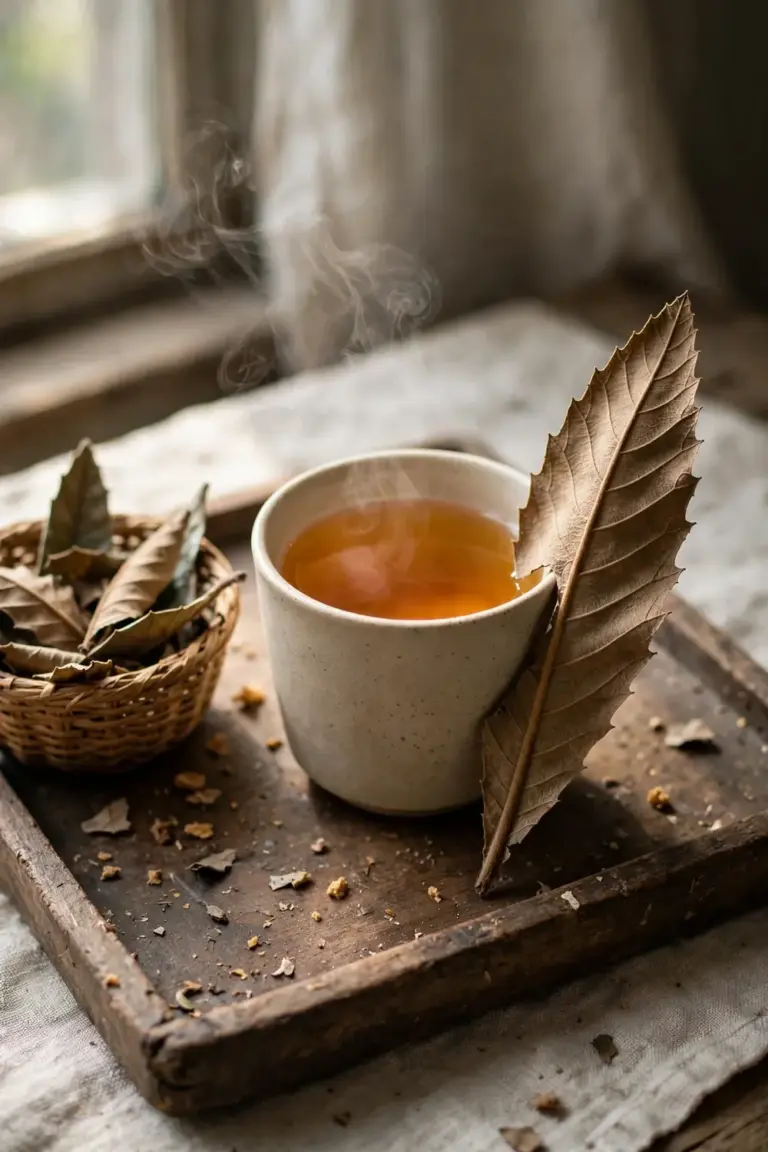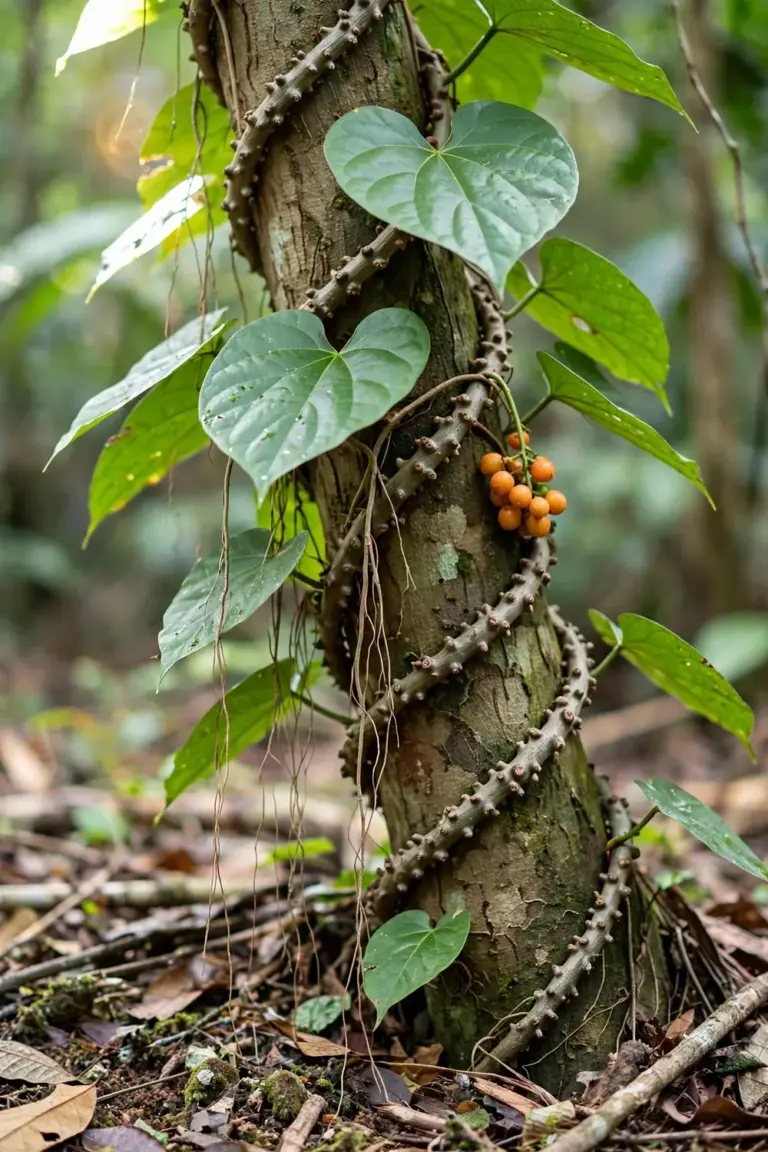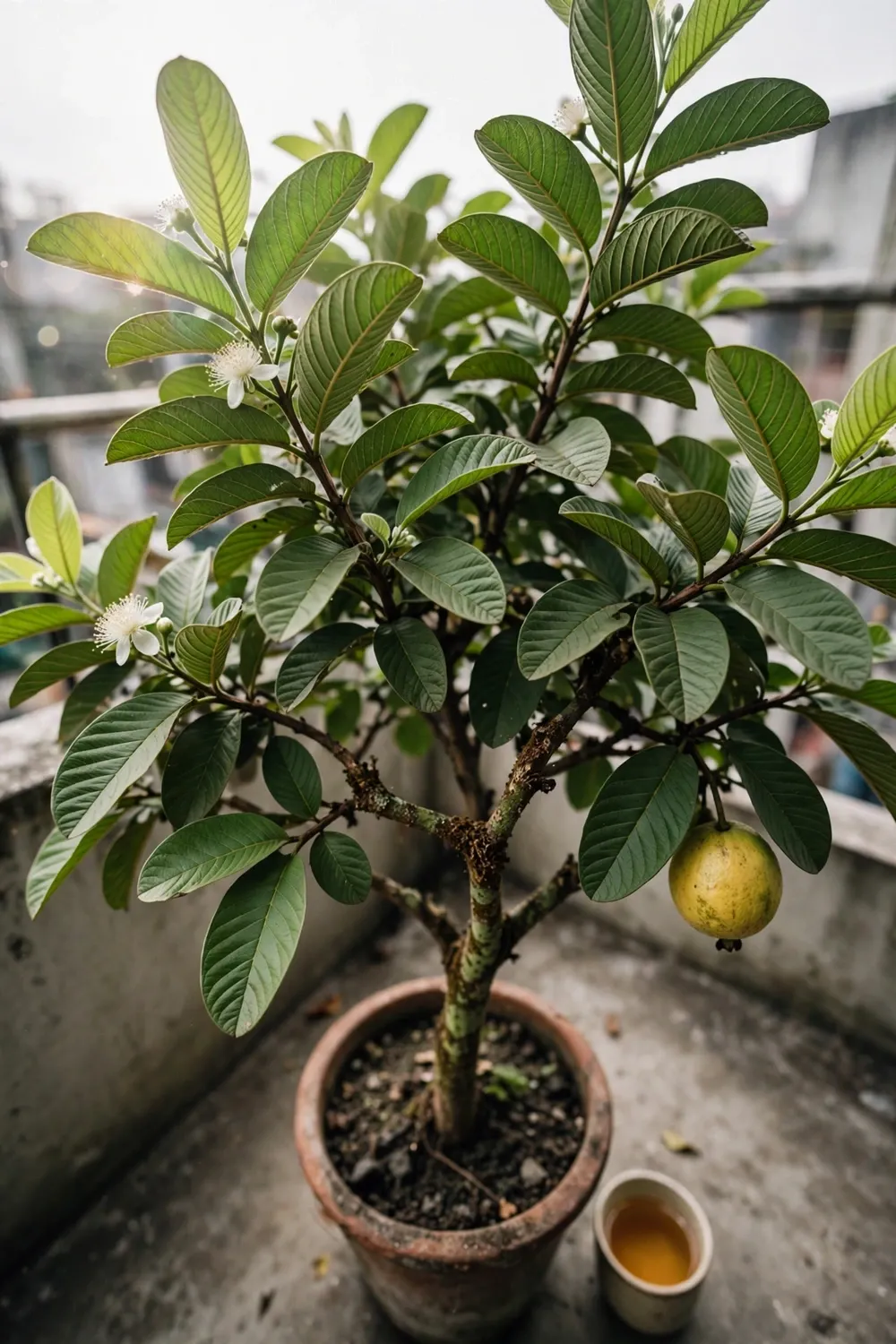

You can learn how to grow guava for leaf tea in a pot on a sunny balcony, and a healthy young tree gives you pickable leaves in its first full growing season. Keep the tree pruned low, harvest young leaves, and dry them for 2 to 5 days before brewing.
I have learned to judge a guava pot by its new leaf flush, not by its fruit. A tree pushing fresh shoots gives you tea leaves every few weeks through the warm months, while a tree left to grow tall gives you shade and a long wait.
The plan below grows guava for leaves first. Fruit stays a bonus, not the goal. If fruit is your main goal, growing guava for fruit follows a different plan, with a bigger tree and a longer wait for the first crop.
| Spec | Detail |
|---|---|
| Botanical name | Psidium guajava (Myrtaceae) |
| Indonesian name | Daun jambu biji means guava leaves |
| Plant type | Evergreen shrub or small tree, grown in a pot for leaves |
| Height in a pot | Held at 1 to 2 m by pruning |
| Height in the ground | To 6.1 m if left unpruned |
| Leaves | Opposite, oblong, 7.6 to 18 cm long, with prominent veins below |
| Flowers | White, about 2.5 cm across, borne singly or in small clusters |
| Fruit | A berry, 28 g to 1.4 kg, round, egg shaped, or pear shaped |
| Main propagation | Seed, stem cuttings, air layering, grafting, budding |
| Cold floor | Young trees die at minus 3 to minus 2 degrees Celsius |
| Pot size | 46 to 61 cm across and the same depth |
| Soil pH | 5 to 7 in a pot |
| Kitchen use | Fresh or dried leaves steeped as an herbal infusion |
| Native range | Indigenous to the American tropics, grown in Indonesia for leaf tea |
1. Learn How to Grow Guava for Leaf Tea in a Pot
Learning how to grow guava for leaf tea starts with a shift in purpose. You grow this tree for its leaves, not for a fruit harvest. A leaf tree stays small, stays pruned, and pushes the fresh shoots that carry the leaves you pick.
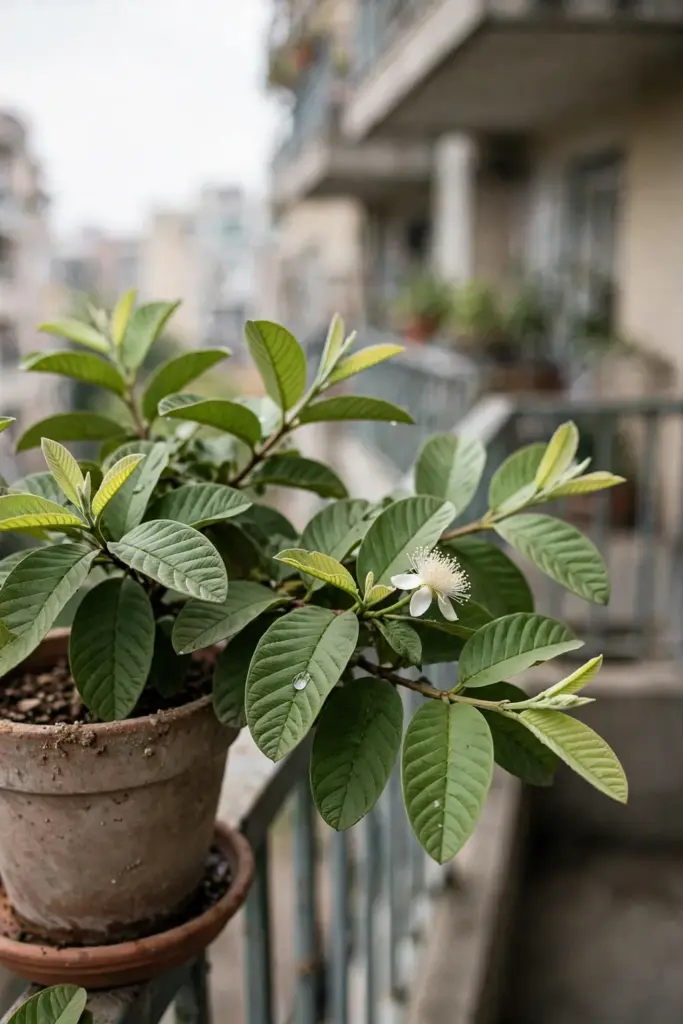
The pot makes the shift possible. A pot holds a tropical tree on a balcony, a patio, or a sunny doorstep in a temperate climate, and the pot rolls indoors before the first frost. Guava trees grow to 20 ft (6.1 m) in height with a broad canopy when left alone, according to the UF/IFAS guide Guava Growing in the Florida Home Landscape. Pruning holds that tree at pot scale.
The harvest rhythm follows the new growth. Guava flowers and fruit form on new succulent growth, according to the UF/IFAS guide Guava Growing in the Florida Home Landscape. The same new growth carries the leaves you pick. Every pruning cut that forces a fresh shoot also sets up the next leaf harvest.
2. Name the Tree Correctly Before You Buy Guava Plants
Check the botanical name before you buy a plant or follow any growing advice. Three different plants share the guava name, and only one of them gives you daun jambu biji.
| Name | What it is | Why it matters |
|---|---|---|
| Psidium guajava | Common guava, the leaf tea tree | The tree this article grows |
| Psidium cattleianum | Strawberry guava, a different species | Smaller, tarter fruit, a different tree |
| Feijoa sellowiana | Pineapple guava, a different genus | A different plant with different care |
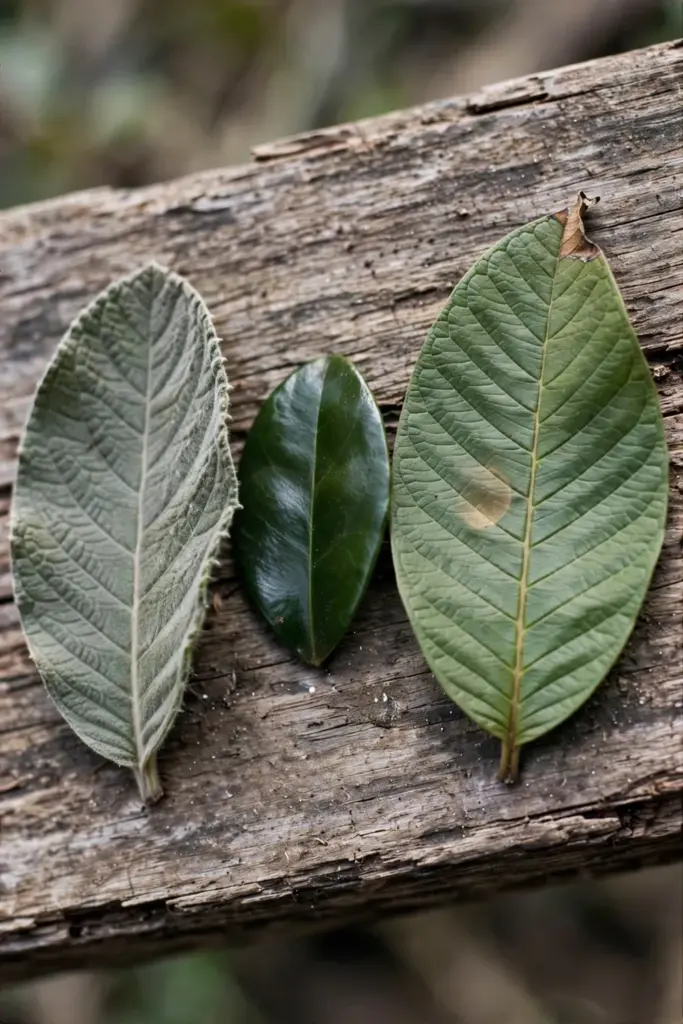
Psidium guajava carries opposite, oblong leaves 7 to 15 cm long and 3 to 5 cm wide, with 12 to 20 pairs of parallel lateral nerves prominent beneath, according to the Kew Plants of the World Online page for Psidium guajava. The leaves feel softly hairy below, most clearly on young leaves. A nursery plant with small, glossy, leathery leaves and no hair below is not common guava.
Strawberry guava and pineapple guava both appear in the related species list of the UF/IFAS guide Guava Growing in the Florida Home Landscape. Nurseries mix the names. Buy a plant labeled with the full botanical name Psidium guajava. A tag that says only guava proves nothing.
3. Match Guava to Warmth or Keep It in a Pot
Grow guava outdoors year round only where winters stay warm. Guava trees suit warm subtropical to tropical conditions, and ideal temperatures for growth and production range from 23 to 28 degrees Celsius, according to the UF/IFAS guide Guava Growing in the Florida Home Landscape. Temperatures below 16 degrees Celsius slow growth or stop it.
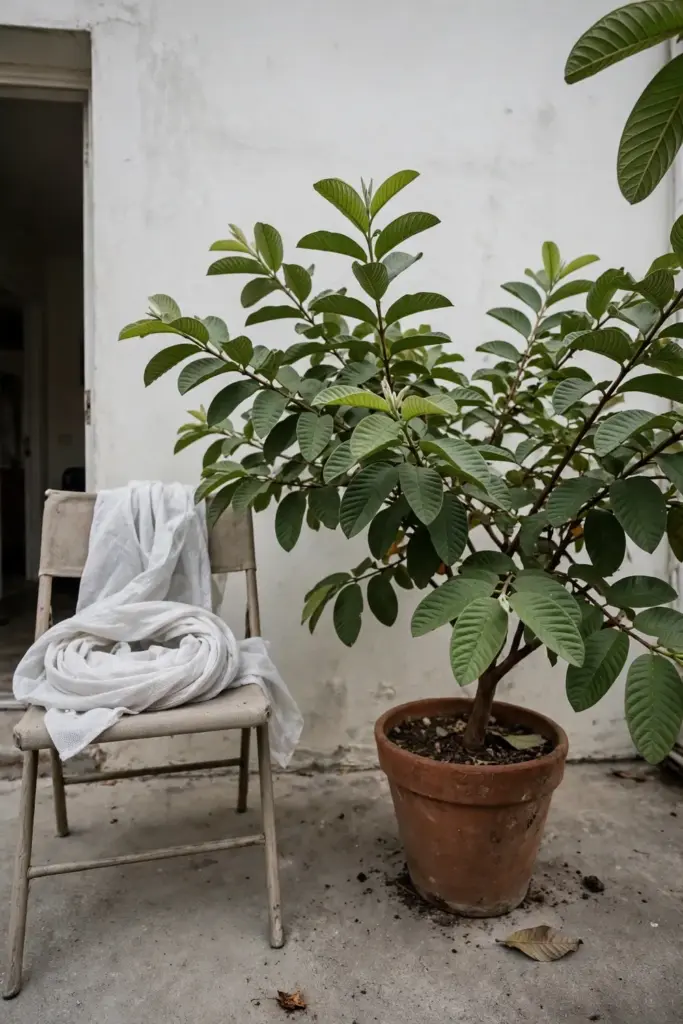
Frost decides the question. Young guava trees die at temperatures of minus 3 to minus 2 degrees Celsius, and mature trees withstand short periods of minus 4 to minus 3 degrees Celsius without much damage, according to the UF/IFAS guide Guava Growing in the Florida Home Landscape. A garden that sees hard frost in most winters has no outdoor path for this tree.
The pot is the temperate path. A potted tree spends the warm months outdoors and moves inside before the first frost. The move costs a sunny windowsill or a bright frost free room for winter. Growing mango from seed or grafted stock suits a wider range of warm gardens, and it still needs real heat. Guava in a pot asks less: one container, one sunny spot, and a winter roof.
4. Check the Invasive Warning Before You Plant Guava Outdoors
Check local rules before you plant guava in the ground in a warm climate. Guava has become naturalized in tropical and subtropical regions throughout the world, according to the UF/IFAS guide Guava Growing in the Florida Home Landscape. Birds and fallen fruit spread the seed, and seedlings take hold beyond the garden fence.
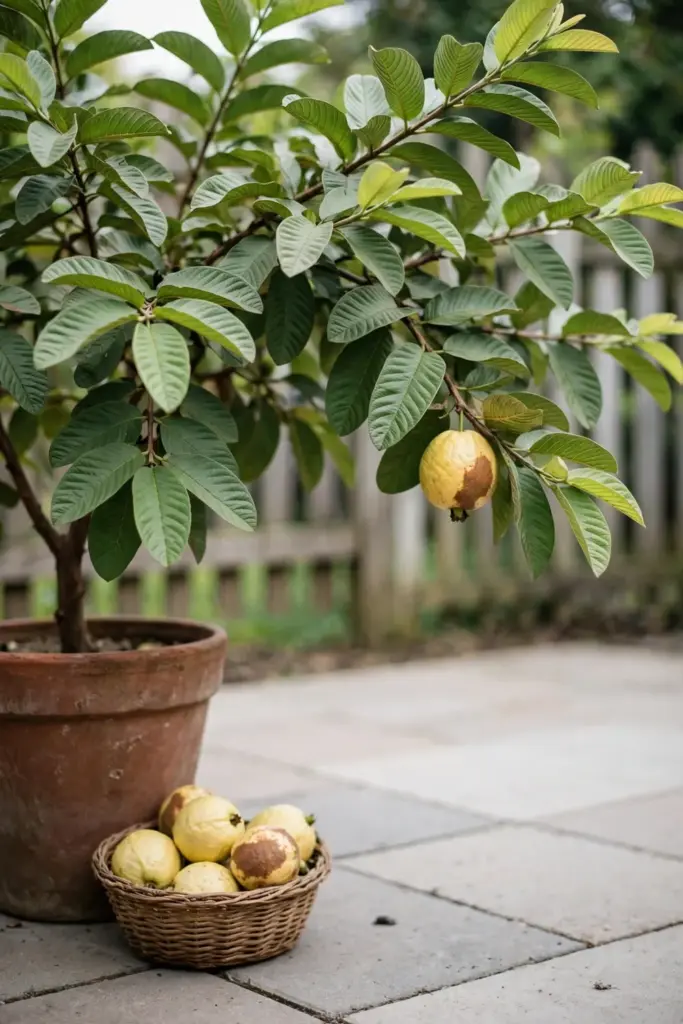
The Florida assessment is blunt. Guava has been assessed by the UF/IFAS Invasive Plants Working Group as invasive and not recommended for planting in south Florida, and guava may be planted in central Florida but should be managed to prevent escape, according to the UF/IFAS guide Guava Growing in the Florida Home Landscape. A warm climate garden outside Florida faces the same biology even where no local list names the tree.
The container answers the warning. A potted tree drops its fruit on a patio, not on open ground. You pick the fruit, bin the fallen ones, and no seedling escapes into a ditch or a neighbor lot. Plant in the ground only where local guidance allows it, and keep the tree pruned, picked, and watched for seedlings at the drip line.
5. Pick a Compact Guava Selection for a Pot
Ask the nursery for a compact selection, not a seedling of unknown size. Seedling guavas vary, and a seedling from a market fruit can grow into a large tree. A named selection with a compact habit plus steady pruning keeps the tree at pot scale.
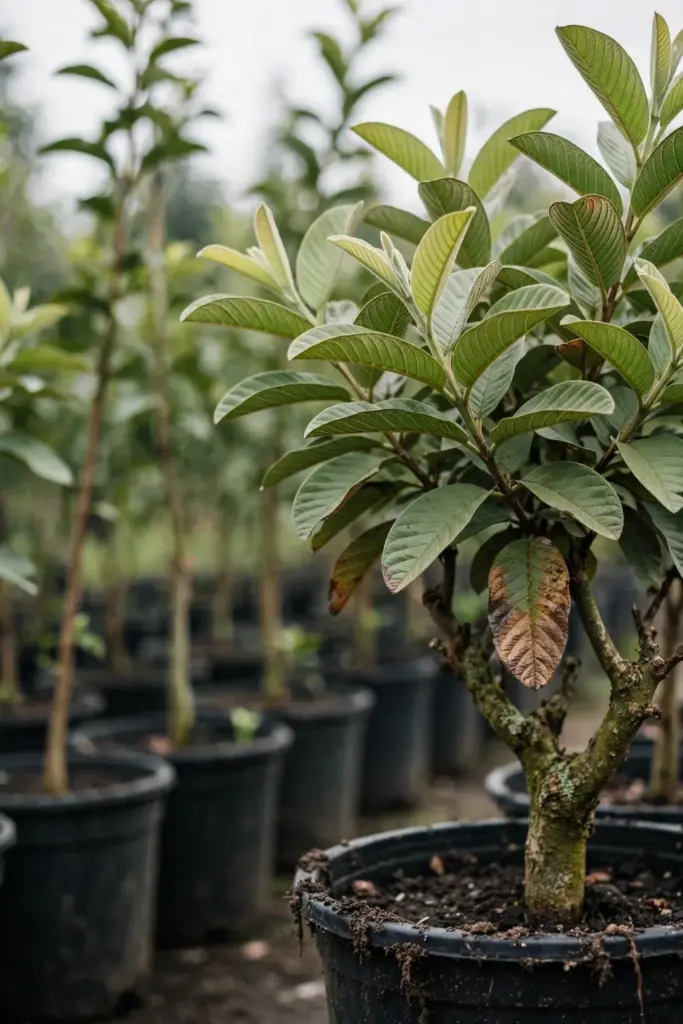
No separate dwarf species exists. Compact selections are guavas that stay smaller and fruit on a smaller frame, and pruning holds them there. The nursery should name the selection and describe its growth habit. A seller who cannot name the selection cannot promise a compact tree.
The Florida home planting list names several selections worth asking about. Pink types include Homestead, a cross of Ruby and Supreme, plus Hong Kong Pink and Patillo, and white types include Crystal, Lotus, and Asian White, according to the UF/IFAS guide Guava Growing in the Florida Home Landscape. White types get eaten immature and crunchy. Pink types get picked ripe. Either type gives tea leaves. Pick for leaf vigor and a compact habit, not for fruit color.
| Selection | Flesh | Note for a leaf tea pot |
|---|---|---|
| Homestead | Pink, sweet | A proven home planting choice |
| Hong Kong Pink | Pink, sweet | A proven home planting choice |
| Patillo | Pink, subacid, mild | A proven home planting choice |
| Crystal | White, mildly sweet, crunchy | Eaten immature, a compact habit helps |
| Lotus | White, mildly sweet, crunchy | Eaten immature, a compact habit helps |
| Asian White | White, mildly sweet, crunchy | Eaten immature, a compact habit helps |
6. Start From Seed, Cuttings, or a Grafted Tree
Start from the plant type that matches your timeline. Seed costs little and teaches patience. Cuttings and air layers copy a known tree. A grafted nursery tree fruits soonest and carries a known selection name.
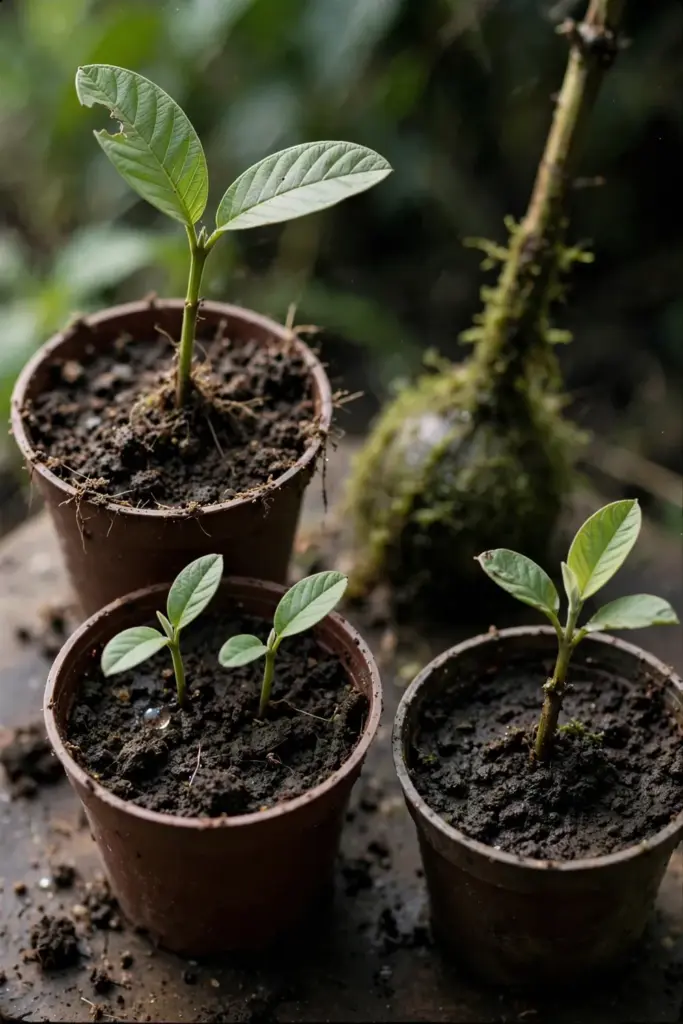
Seed is the slowest path. Guava trees grown from seed do not come true from seed, and fruit production may not begin for 3 to 8 years, according to the UF/IFAS guide Guava Growing in the Florida Home Landscape. Leaves arrive far sooner than fruit. A seedling still gives you tea leaves in its first full growing season, once it holds enough foliage to spare a few shoots.
Cuttings copy the parent tree. The best material for stem cutting propagation is recently matured terminal wood, and stem cuttings should be 15 to 20 cm long with 2 to 3 leaves, placed in sterile media in a mist bed, according to the UF/IFAS guide Guava Growing in the Florida Home Landscape. Bottom heat of 24 to 29 degrees Celsius, dipping cuttings in rooting hormone, or both, help rooting. Air layering, grafting, and budding also propagate named selections.
Leaves do not propagate this tree. A guava leaf stuck in soil will not root into a tree. Growers propagate guava by seed, cuttings, air layering, grafting, or budding, and leaves appear in none of those methods. Skip any advice that promises a tree from a leaf. For the seed path, seed starting steps cover clean sowing, moisture, and the move into individual pots.
7. Pot Guava in a 46 to 61 cm Container With Free Drainage
Set the tree in a pot at least 46 to 61 cm across and the same depth, with drainage holes in the base. Guava grows in sand, loam, and clay, but it prefers well draining soil, and the container must drain freely, according to the Gardening Know How guide to guava trees in containers. A pot without drainage holes drowns the shallow root system.
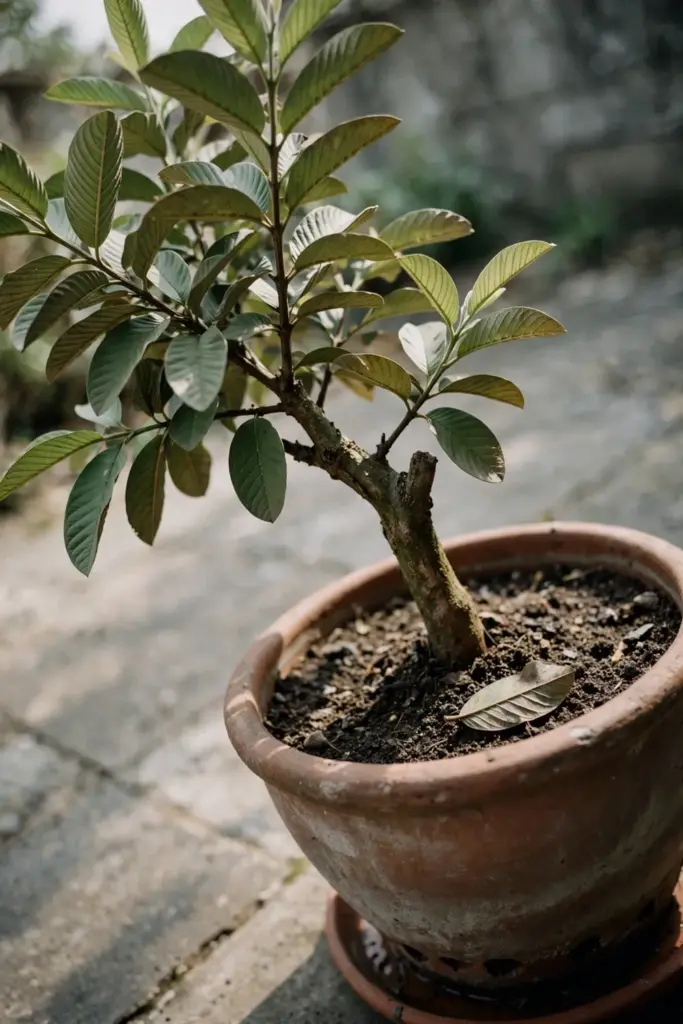
Pick a heavy pot. A clay or thick plastic pot resists tipping when the tree leafs out and catches wind. A pot on casters or a pot trolley moves indoors without a struggle. A saucer under an indoor pot catches drips, and you empty the saucer after watering so the roots never sit in water.
Repot as the tree grows. Start a young tree in a smaller pot and move it up one size each year or two, until it reaches the full 46 to 61 cm container. Check the base each spring. Roots circling the drainage holes mean the tree wants the next size up. A tree that stays in a small pot stalls, drops leaves, and gives you little tea.
8. Mix a Free-Draining Potting Soil at pH 5 to 7
Mix potting soil with organic compost in the pot, and aim for a soil pH between 5 and 7. Guava tolerates sand, loam, and clay, but it prefers well draining soil with a pH of between 5 and 7, according to the Gardening Know How guide to guava trees in containers. A soil pH of 4.5 to 7 is ideal in the ground, according to the UF/IFAS guide Guava Growing in the Florida Home Landscape. The pot mix sits inside both ranges.
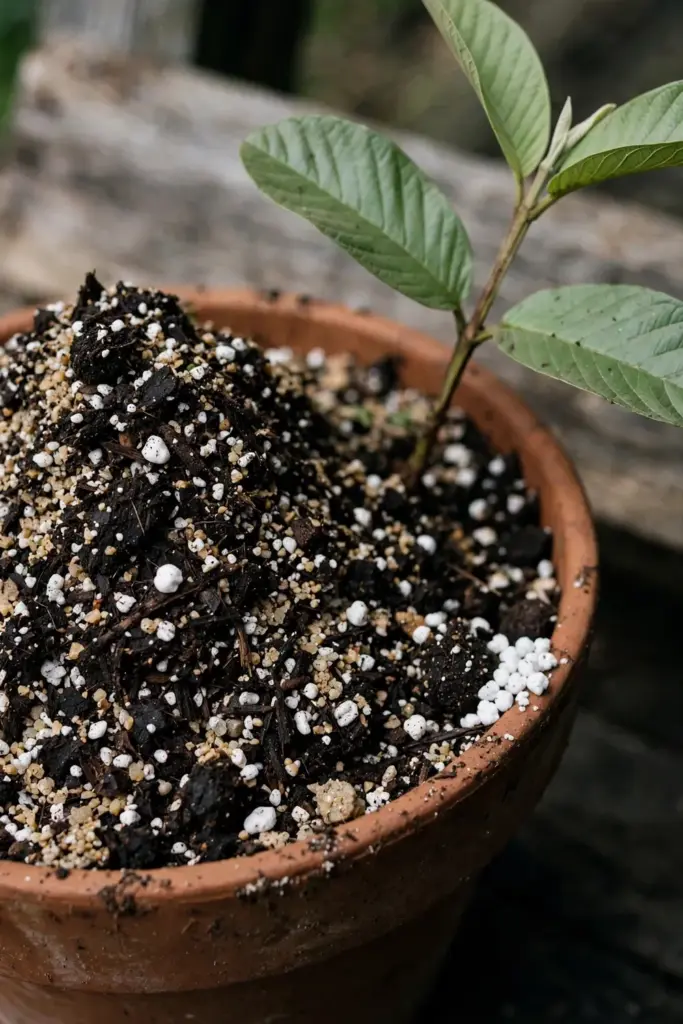
Build the mix from three parts. Use two parts good potting soil, one part mature compost, and one part perlite or coarse sand for drainage. The compost feeds the tree slowly. The perlite keeps air in the mix after watering. The soil holds moisture without turning to mud.
Watch the leaves for iron hunger in alkaline mixes. Guava trees growing in neutral to low pH soils may need iron, and iron deficiency shows in alkaline and high pH conditions, according to the UF/IFAS guide Guava Growing in the Florida Home Landscape. Yellow young leaves with green veins point at iron shortage. A soil test settles the question before you add anything. Compost, mulch, and slow feeding keep a potted tree steady.
9. Give Potted Guava Full Sun on a Warm Balcony
Set the pot where it gets full sun for best growth and fruit production. Guava trees should be planted in full sun for best growth and fruit production, according to the UF/IFAS guide Guava Growing in the Florida Home Landscape. A south facing balcony, a sunny patio, or a bright doorstep suits the tree. A shaded corner grows a leggy tree with thin leaves and little new growth.
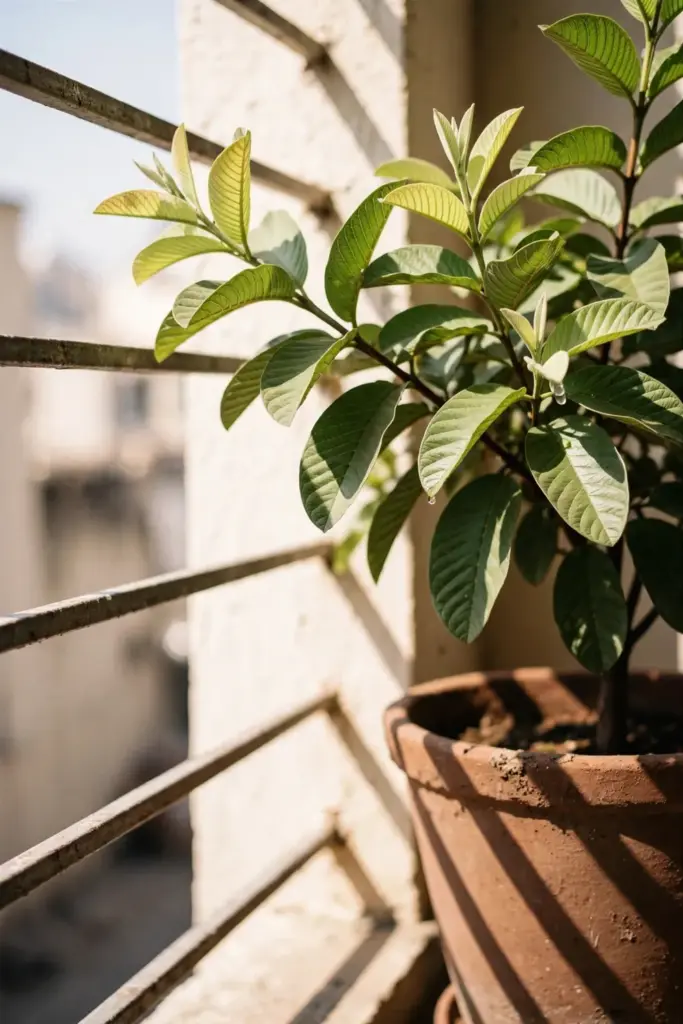
Shelter the pot from strong wind. Wind dries the leaves, snaps fresh shoots, and topples a tall pot. A low wall, a railing planter screen, or a corner that breaks the wind protects the tree without shading it. Guava trees tolerate windy conditions in the ground, and trees kept at 1.8 to 3.0 m usually remain standing after hurricane force winds, according to the UF/IFAS guide Guava Growing in the Florida Home Landscape. A pot lacks ground anchorage, so wind shelter matters more in a container.
Turn the pot a quarter turn each week in summer. The turn evens the light across the canopy and keeps one side from growing bare. A tree that leans hard toward the sun wants a brighter spot or a more frequent turn.
10. Water Potted Guava Deeply 2 to 3 Times a Month in Summer
Water guavas deeply 2 to 3 times per month during warm weather and the growing season. During the winter months, guavas are drought resistant, so water sparingly, according to the Gardening Know How guide to guava trees in containers. The pot dries faster than open ground, so check the mix with a finger before you water. Water when the top 3 to 5 cm feel dry.
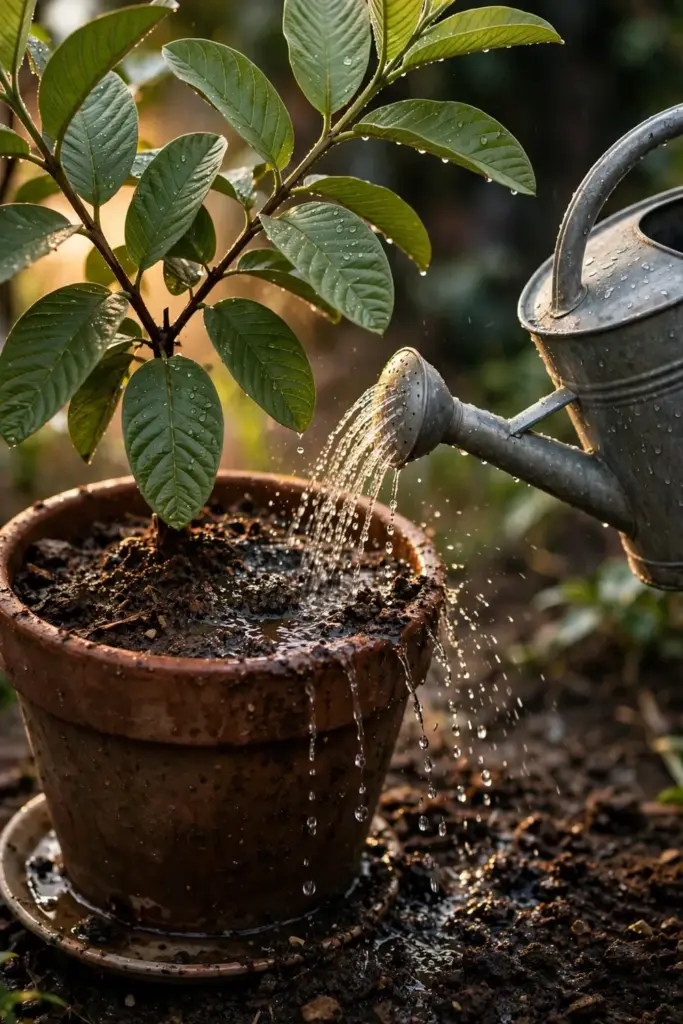
Soak the whole root ball at each watering. Pour slowly until water runs from the drainage holes, then stop. A quick splash wets the surface and leaves the lower roots dry. A full soak followed by a dry interval grows deep roots and keeps the leaves firm.
Pull back water in winter. An indoor tree in cool light grows slowly and drinks little. Wet mix in a cool room rots roots. Guava trees are tolerant of prolonged drought and stop active vegetative growth during dry spells, according to the UF/IFAS guide Guava Growing in the Florida Home Landscape. A dry interval in winter matches the tree’s own rhythm.
11. Feed Potted Guava Every 3 Months With an Organic Granular Fertilizer
Fertilize potted guava with an organic, granular fertilizer once every three months. Guavas have shallow roots that absorb water and nutrients rapidly, according to the Gardening Know How guide to guava trees in containers. Scatter the granules across the soil surface, keep them off the trunk, and water them in.
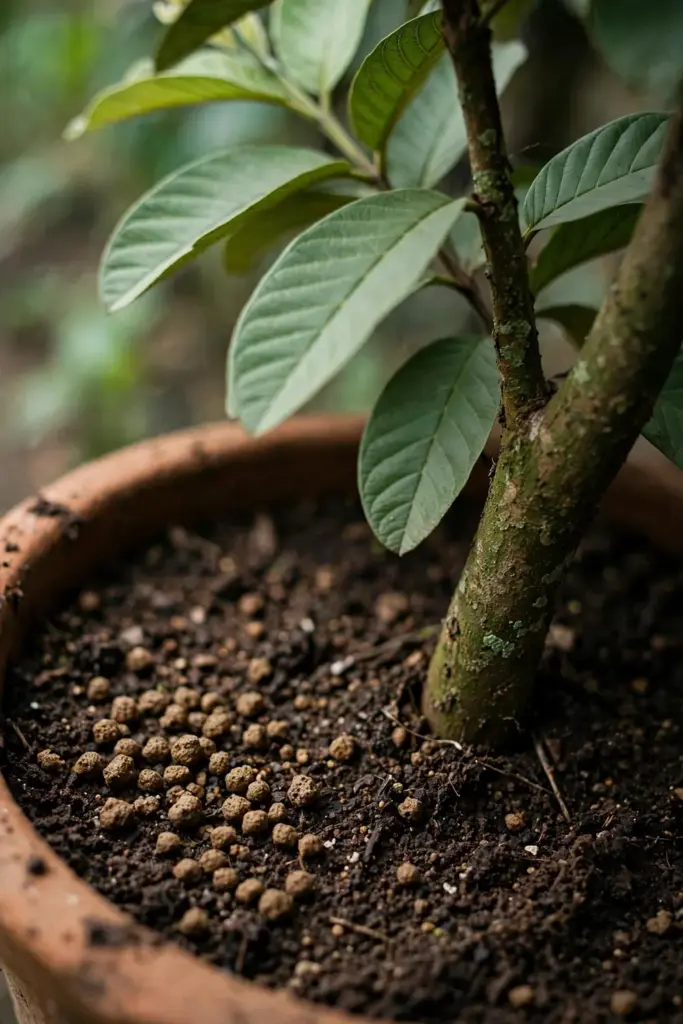
Scale the dose to the pot, not to a field rate. A container holds a small soil volume, and a field dose burns a potted tree. Start at half the label rate for the pot diameter, watch the new leaves for two weeks, and raise the dose only if growth stays pale and slow. A leaf tea tree wants steady leaf growth, not a forced fruit crop.
Young trees in the ground follow a heavier schedule. Young guava trees should be fertilized every 1 to 2 months during the first year, beginning with 114 g of fertilizer and increasing to 455 g per tree, and thereafter 3 or 4 applications per year suffice, according to the UF/IFAS guide Guava Growing in the Florida Home Landscape. A potted tree never takes the full ground rate. Keep the pot schedule light, and let the compost in the mix carry part of the feeding.
12. Prune Guava Low to Force the Leafy New Growth Tea Needs
Prune the tree low and often, because tea leaves grow on new shoots. Guava trees flower on new succulent, vigorous new growth arising from either lateral buds on older wood or at the ends of shoots, according to the UF/IFAS guide Guava Growing in the Florida Home Landscape. A pruning cut that forces a fresh shoot also grows the next tea harvest.
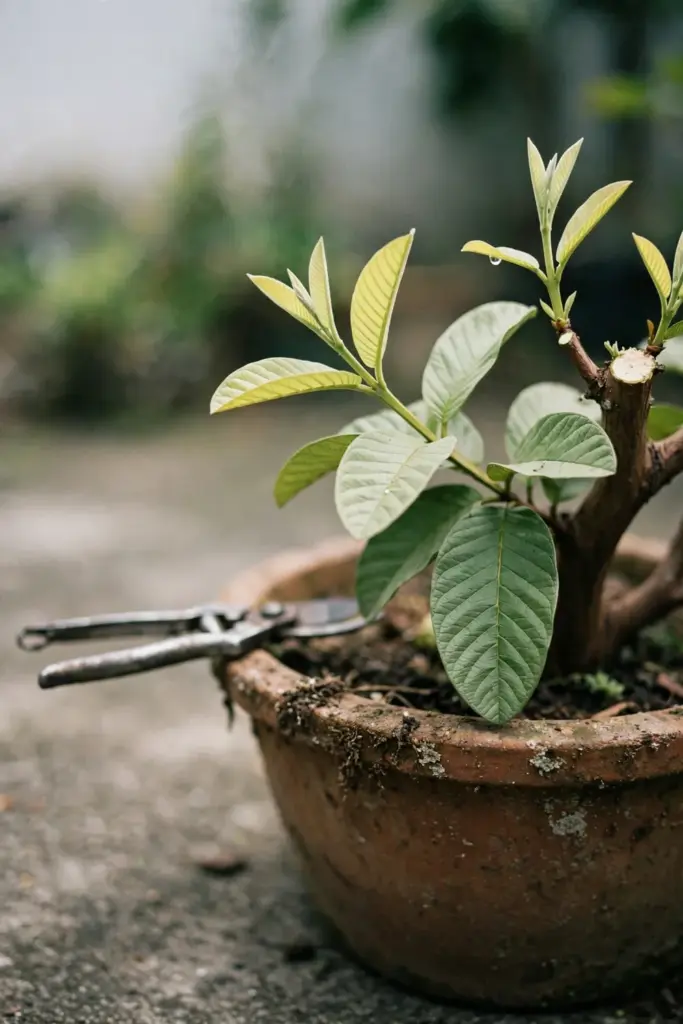
Train the young tree in its first year. Newly planted guava trees without lateral branches should be pruned at 30 to 61 cm to induce lateral branching, and during the first year 3 to 4 well distributed lateral branches should be selected and allowed to grow 61 to 91 cm and then tipped to induce further branching, according to the UF/IFAS guide Guava Growing in the Florida Home Landscape. A low, branched frame fits a pot and gives you shoots at picking height.
Keep the bearing tree small. Bearing trees may be kept small at 0.9 to 1.8 m through continuous selective pruning and tipping, and guava trees should not be allowed to grow higher than 3.0 m because toppling over due to strong winds is increased, according to the UF/IFAS guide Guava Growing in the Florida Home Landscape. A leaf tea pot stays at the low end of that range, near 1 to 2 m. Tip long shoots, cut crossing branches, and remove water sprouts that shoot straight up through the canopy.
13. Move Potted Guava Indoors Before the First Frost
Move the pot indoors before night temperatures approach freezing. Young guava trees die at minus 3 to minus 2 degrees Celsius, according to the UF/IFAS guide Guava Growing in the Florida Home Landscape. A single frosty night can end a young tree. Move the pot when night forecasts drop below 5 degrees Celsius, and leave a safety margin.
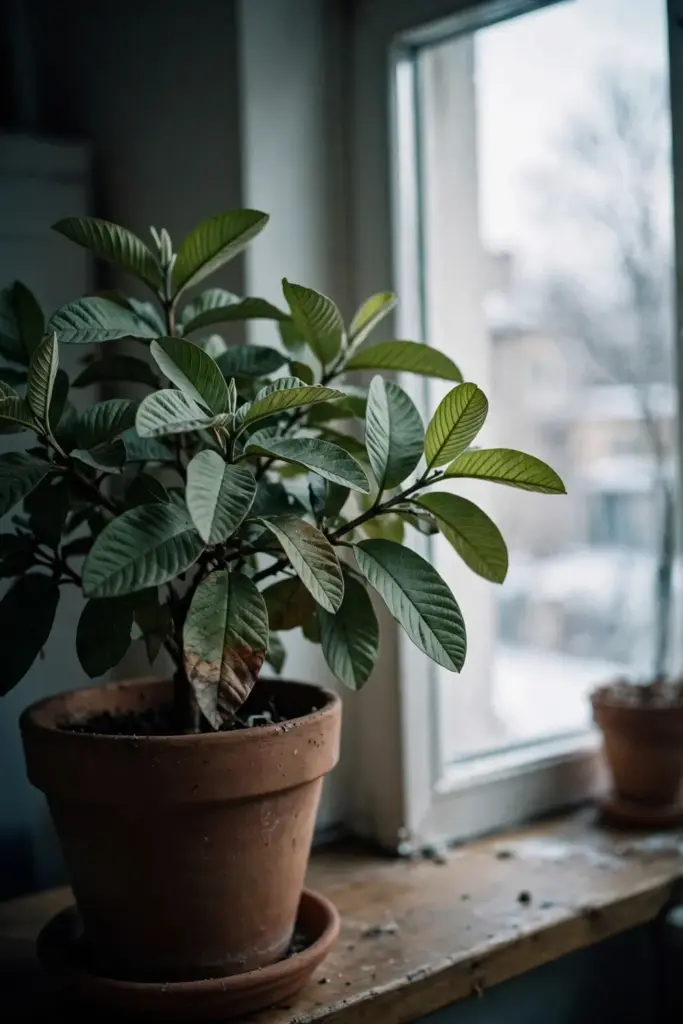
Give the indoor tree the brightest spot you own. A south facing window, a bright sunroom, or a greenhouse shelf keeps the leaves working through winter. Growth slows in cool indoor light, and that slowdown is normal. Water sparingly, skip fertilizer, and wait for spring.
Harden the tree off again in spring. Set the pot outside for a few hours of morning sun, then bring it in, and lengthen the outdoor hours over 7 to 10 days. A tree moved straight from a windowsill into full sun scorches its leaves. A tree moved out after the last frost date settles fast and pushes the spring flush that starts the tea season.
14. Harvest Young Leaves at Bud Formation and Spray Nothing
Harvest young, tender, unblemished leaves, and spray nothing on a tree you harvest for tea. The leaves go in the cup, so anything sprayed on the tree ends up in the cup. Pick leaves with clean color, no spots, no yellowing, and no pest damage.
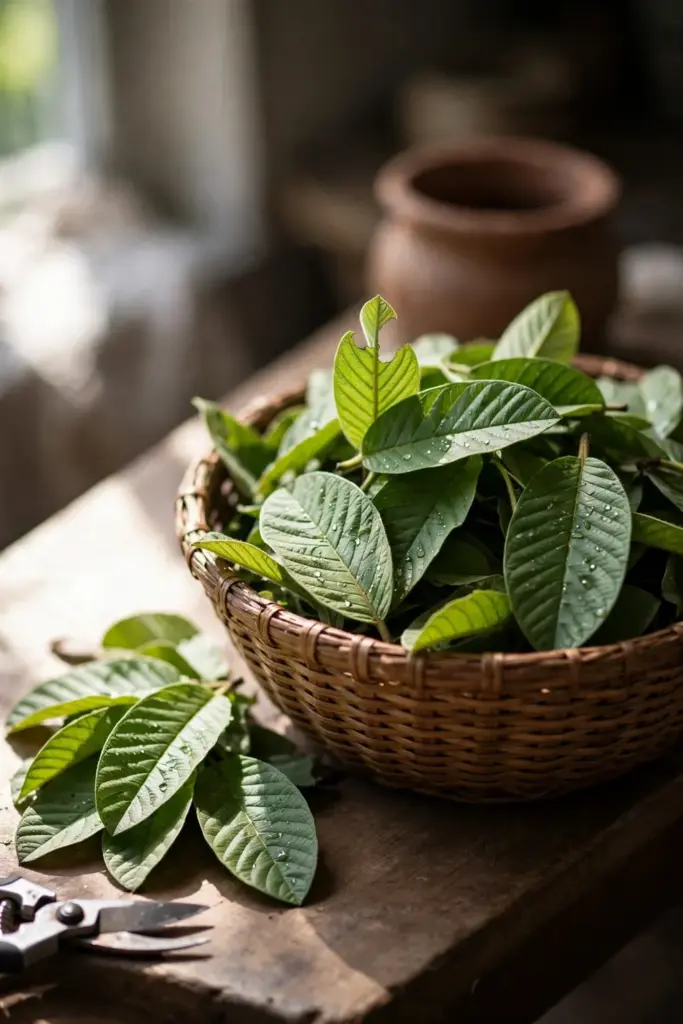
Pick at bud formation, when the tree starts to set buds on new shoots. Medium leaves at that stage carry full color and firm texture. Take a few leaves per shoot, never every leaf on a shoot. A shoot stripped bare cannot feed the tree. A shoot left with most of its leaves pushes the next flush within weeks.
Pick in the afternoon on a dry day, after dew has dried, because wet leaves carry surface moisture into the drying tray and slow the drying. Cut each leaf stem close to the shoot with sharp pruning shears. Rinse the picked leaves in cool water, shake off the water, and spread them for drying the same day.
15. Dry Guava Leaves in 2 to 5 Days Until They Crumble
Dry the leaves in a single layer in a ventilated spot away from direct sunlight. Spread the rinsed and dried leaves in a single layer on a drying screen, parchment paper, or a clean kitchen towel, and place them in a well ventilated area away from direct sunlight, according to the guava leaf tea brewing guide from TheRike. Turn the leaves once a day so both sides dry evenly.
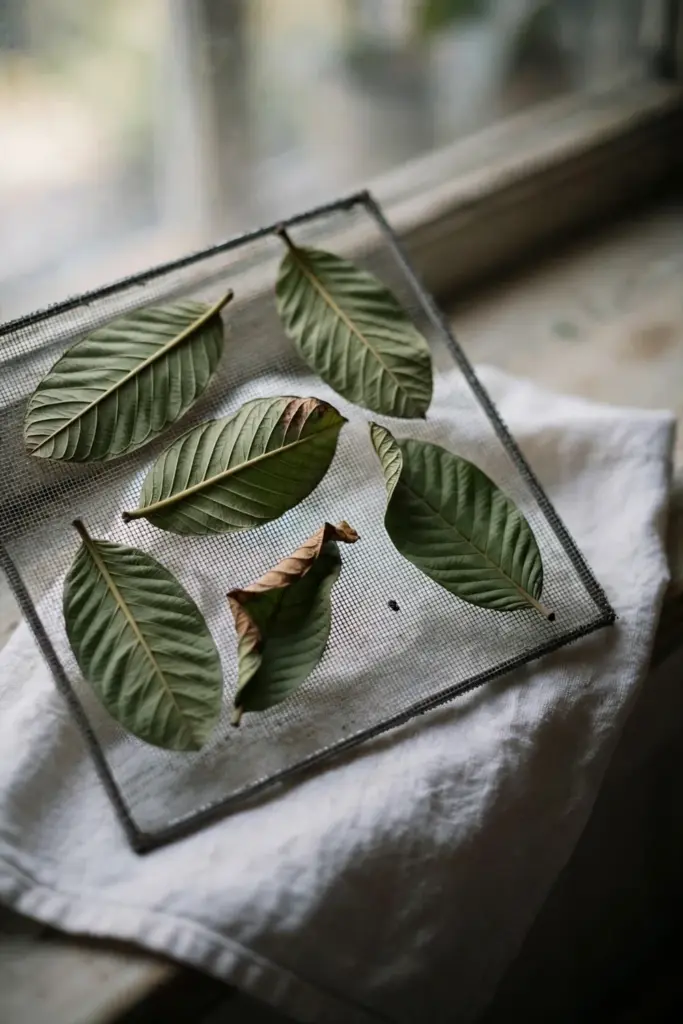
A dehydrator speeds the work. A dehydrator set to a low temperature of 38 to 46 degrees Celsius dries the leaves without cooking them, according to the guava leaf tea brewing guide from TheRike. The leaves are dry when they feel brittle and crumble easily. The process typically takes 2 to 5 days depending on humidity and temperature.
Store the dried leaves airtight, cool, and dark. Once fully dried, store the leaves in an airtight container, such as a glass jar or a resealable bag, and keep them in a cool, dark place, according to the guava leaf tea brewing guide from TheRike. Properly stored, dried guava leaves can retain their quality for up to a year. Label the jar with the harvest date, and use the oldest jar first.
16. Brew Guava Leaf Tea at 79 to 91 Degrees Celsius
Brew the tea with dried leaves and water just off the boil. Use approximately 1 to 2 teaspoons of dried guava leaves per 240 ml of water, and heat fresh, filtered water to 79 to 91 degrees Celsius, according to the guava leaf tea brewing guide from TheRike. Water at a rolling boil scalds the leaves and pulls harsh tannins into the cup.
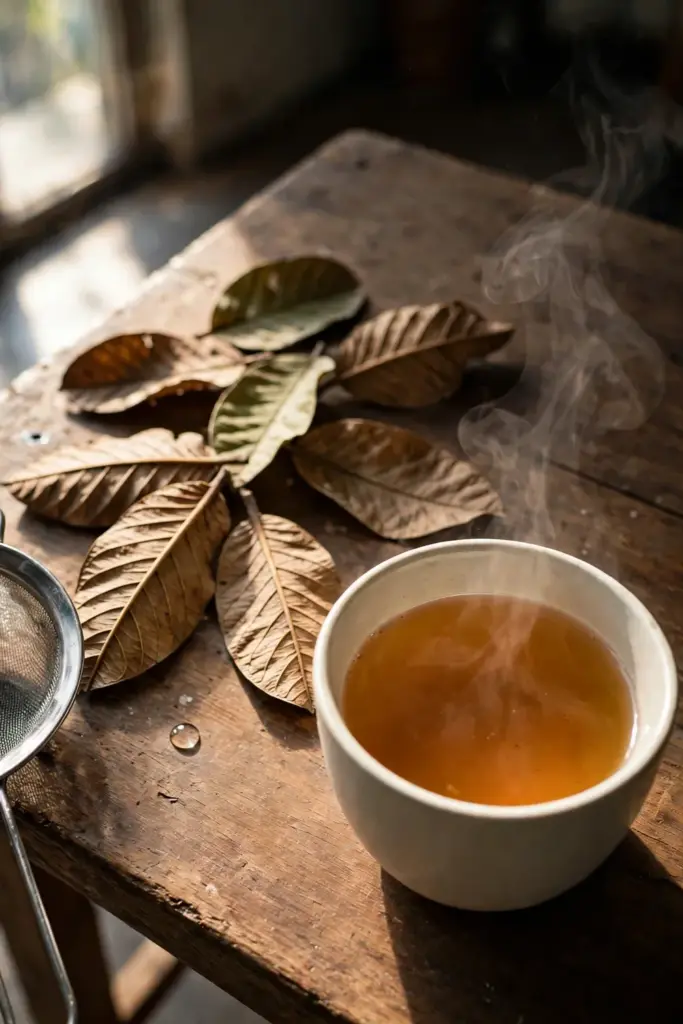
Steep the leaves for 5 to 7 minutes, then strain. A short steep gives a mild, earthy cup. A longer steep gives a darker, more astringent cup. Taste the first brew at 5 minutes and adjust the next cup to your palate. Fresh leaves work too: rinse a small handful, bruise them lightly, and steep them the same way.
Guava leaf tea is an herbal infusion, not true tea. It contains no leaf from the tea plant Camellia sinensis. This article gives growing information only. It gives no medical advice and no dosages. Talk to a clinician about any health question, and treat traditional uses as background, not as a prescription.
17. Watch for Fruit Fly, Whitefly, Thrips, and Anthracnose Without Spraying Tea Leaves
Inspect the tree weekly, and keep sprays off a tea tree. The pests below attack guava in warm climates, and the controls below use hands, pruning, and bags instead of sprays. A leaf with pest damage goes in the bin, not in the cup.
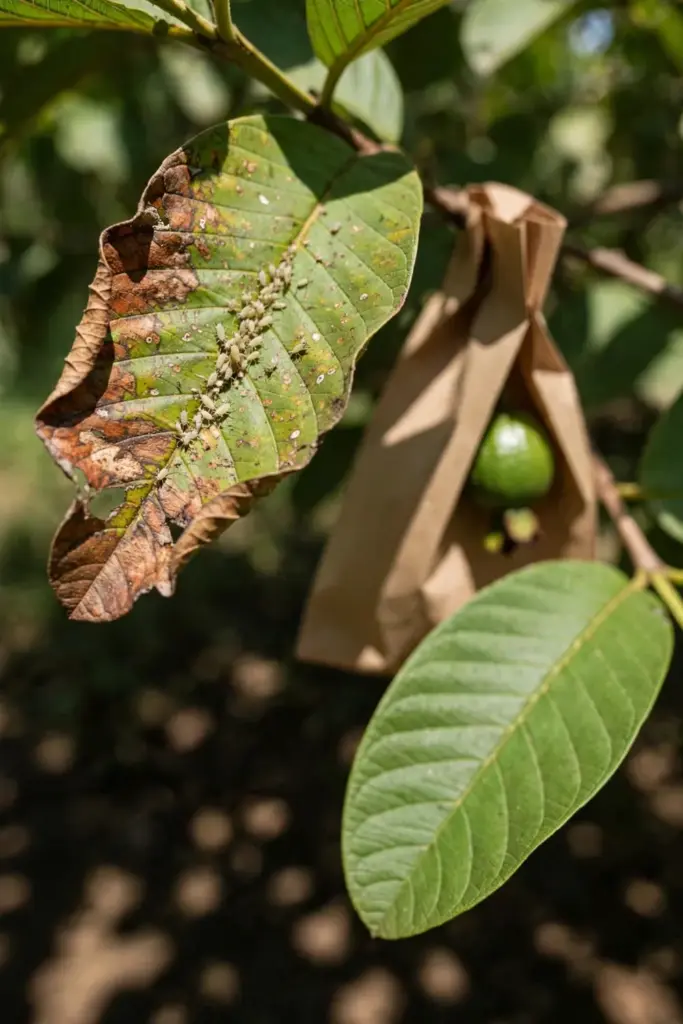
Caribbean fruit fly is the most important pest of guava in Florida, and fruit infested with fly larvae is usually unsuitable for eating, according to the UF/IFAS guide Guava Growing in the Florida Home Landscape. Covering the developing fruit when it reaches 2.5 cm in diameter with a paper bag will prevent fruit fly infestation. Bag the fruit you want to keep, and pick up fallen fruit daily.
The rest of the pest list needs eyes, not chemicals. Guava trees are attacked by the Caribbean fruit fly, guava whitefly, red-banded thrips, guava fruit moth, and scales, according to the UF/IFAS guide Guava Growing in the Florida Home Landscape. Whitefly feeds on the leaves. Red-banded thrips attack leaves and fruit, causing a browning of the peel. Guava moth larvae tunnel into the fruit and feed on the leaves. Wipe whitefly and scales off with a damp cloth, prune for airflow, and bin damaged fruit.
Diseases follow wet leaves. Anthracnose attacks fruit, leaves, and young stems and may cause stem dieback and leaf drop, and red alga causes reddish to purplish brown circular spots, according to the UF/IFAS guide Guava Growing in the Florida Home Landscape. Pruning trees to open them to increased light and air movement will decrease the severity of both diseases. Water at the soil line, keep mulch 20 to 30 cm from the trunk, and never let the canopy stay wet overnight.
18. Take Fruit as a Bonus in Year 3 to 4
Take fruit as a bonus, and expect it in year 3 to 4 after planting. Guava trees generally begin fruit production 3 to 4 years after planting, and yields range from 23 to 36 kg or more per tree per year, according to the UF/IFAS guide Guava Growing in the Florida Home Landscape. A potted tree yields less than a tree in open ground. A few dozen fruit from a pot is a good year.
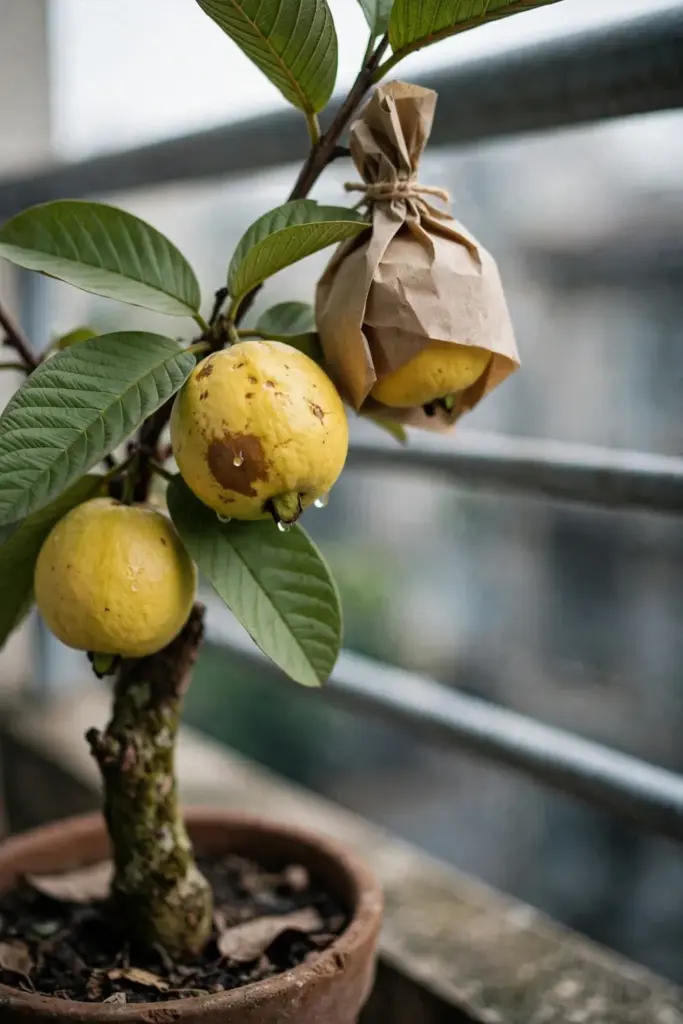
Pick pink types at the right color. Pink or red guava for fresh eating is generally picked when the peel turns light green to yellow, and fruit is then placed at room temperature and allowed to ripen before eating, according to the UF/IFAS guide Guava Growing in the Florida Home Landscape. White guava intended to be eaten fresh is usually picked when full sized and green to light green and eaten before becoming ripe. Both ripe and green guava may be stored in the refrigerator for 5 to 7 days before eating.
Prune after the fruit harvest, not before it. The post harvest prune forces the new growth that carries next season’s leaves and flowers. A tree pruned hard in spring loses the shoots that would have carried the summer crop. Growing papaya from seed in under a year gives you fruit while a guava pot is still building its frame. Guava pays back slowly, and leaves pay first.
Frequently Asked Questions
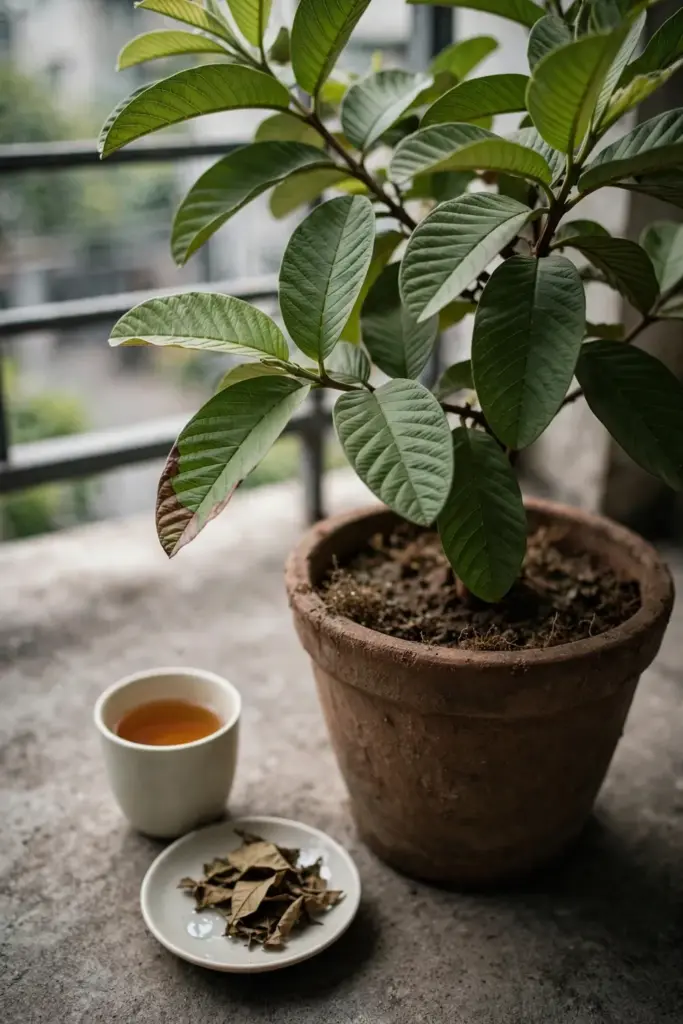
Yes, in a pot. A potted guava spends the warm months outdoors and moves inside before the first frost. Young trees die at minus 3 to minus 2 degrees Celsius, so move the pot indoors when night forecasts drop below 5 degrees Celsius. Give the indoor tree the brightest window you own, water sparingly, and move it out again after the last frost.
A healthy young tree gives pickable leaves in its first full growing season, once it holds enough foliage to spare a few shoots per branch. Fruit takes far longer, with production generally beginning 3 to 4 years after planting, according to the UF/IFAS guide Guava Growing in the Florida Home Landscape. Leaves pay first, and fruit follows years later. Prune for new shoots, since tea leaves grow on fresh growth.
No. A guava leaf stuck in soil will not root into a tree. Growers propagate guava by seed, stem cuttings, air layering, grafting, or budding, and leaves appear in none of those methods. Seed grown trees do not come true from seed, and fruit may not begin for 3 to 8 years. Cuttings and air layers copy a known parent tree.
Young, tender, unblemished leaves make the best tea. Pick medium leaves at bud formation, on a dry afternoon, after dew has dried. Skip yellowed, spotted, or pest damaged leaves. Spray nothing on a tree you harvest for tea. Rinse the picked leaves in cool water, dry them in a single layer until they crumble, and store them airtight.
No. Guava leaf tea is an herbal infusion made from Psidium guajava leaves, not from the tea plant Camellia sinensis. Brew dried leaves at 79 to 91 degrees Celsius, using 1 to 2 teaspoons per 240 ml of water, and steep for 5 to 7 minutes. This article gives growing information only, with no medical advice and no dosages.
Only where local guidance allows it. Guava has naturalized across tropical and subtropical regions worldwide, and Florida assesses it as invasive and not recommended for planting in the south of the state. A pot keeps fruit and seed off open ground. Plant in the ground only with local clearance, and keep the tree pruned, picked, and watched for seedlings.
Make the Honest Call on a Guava Leaf Tea Pot
Make the call on space, winter, and patience. A guava leaf tea pot earns its space on a sunny balcony with a bright indoor spot for winter. It gives leaves in its first season, fruit in year 3 to 4, and a small evergreen tree between harvests. Learning how to grow guava for leaf tea pays back in leaves first, and the fruit stays a bonus.
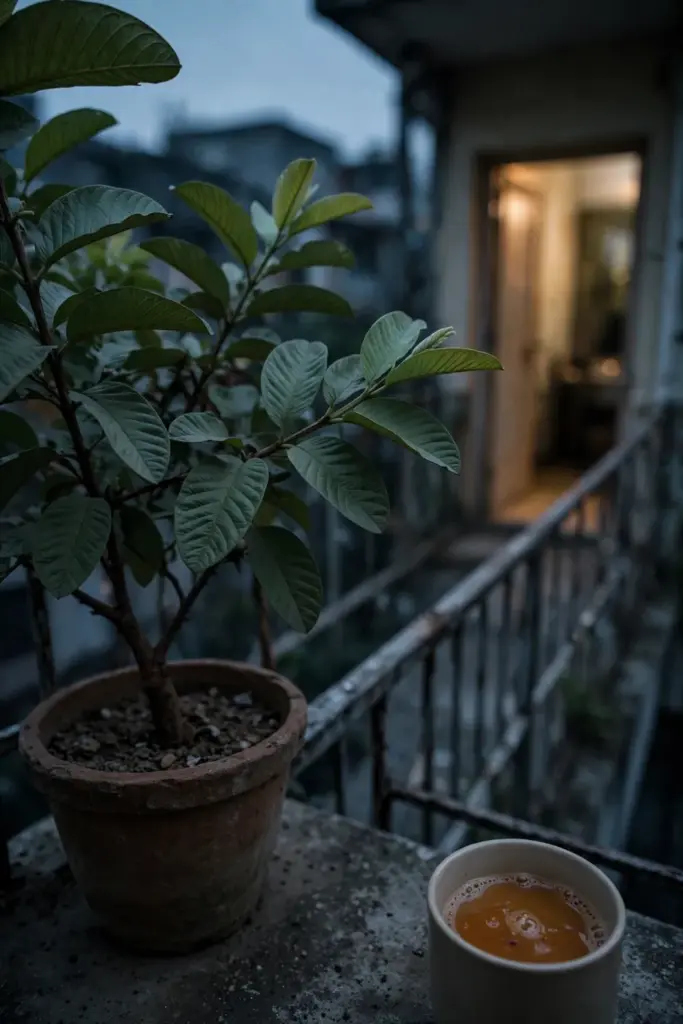
Skip the pot if winter has no bright indoor spot. A guava on a dark windowsill drops leaves, stalls, and gives you little tea. Skip in ground planting in a warm climate unless local guidance allows it. The container holds the tree, holds the fruit, and holds the risk. One pot, one sunny spot, and a winter roof carry this tree from leaf to cup.