
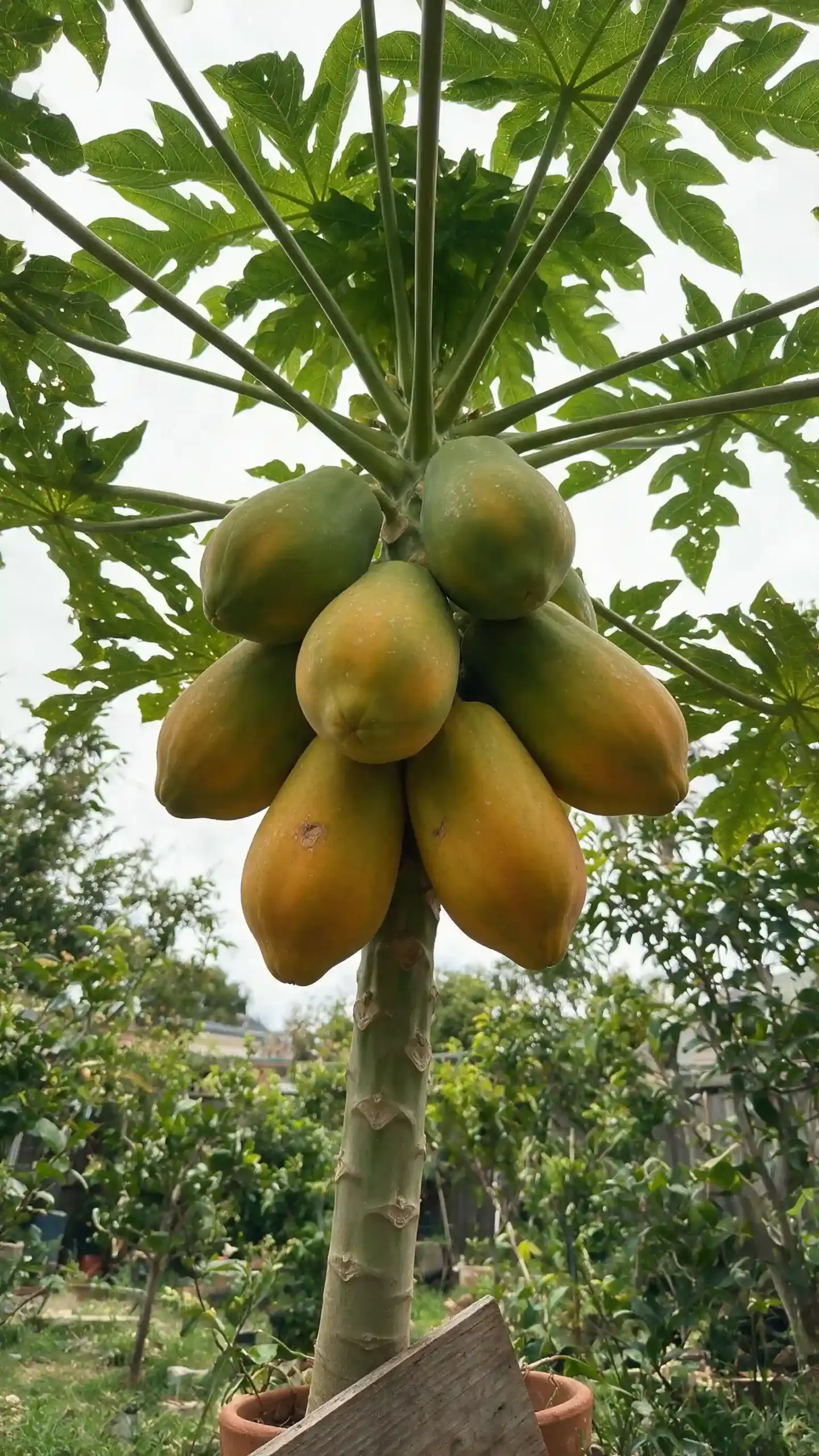

A papaya is not a tree. It is a giant soft stemmed herb that happens to grow taller than you do, and once you accept that, almost everything about how to grow papaya fruit starts to make sense. It sprints out of the ground, carries fruit inside a year, and then declines just as quickly. Gardeners who treat it like a mango stand around waiting for something that is never going to happen.
The second thing nobody warns beginners about is that a papaya seedling has a sex, and you cannot see which one until the first flowers open. A good share of what you sow may never set a single fruit. That sounds like bad news. It is actually the easiest problem on this whole page to solve, provided you plan for it before the seed goes in the ground.
I have grown papaya both in a bed against a north facing wall and in a large pot that I drag under cover every winter. The order below is the order I actually work in, and I have been honest about the steps where I still lose plants.
What Makes Papaya Different From Every Other Fruit Plant You Have Grown
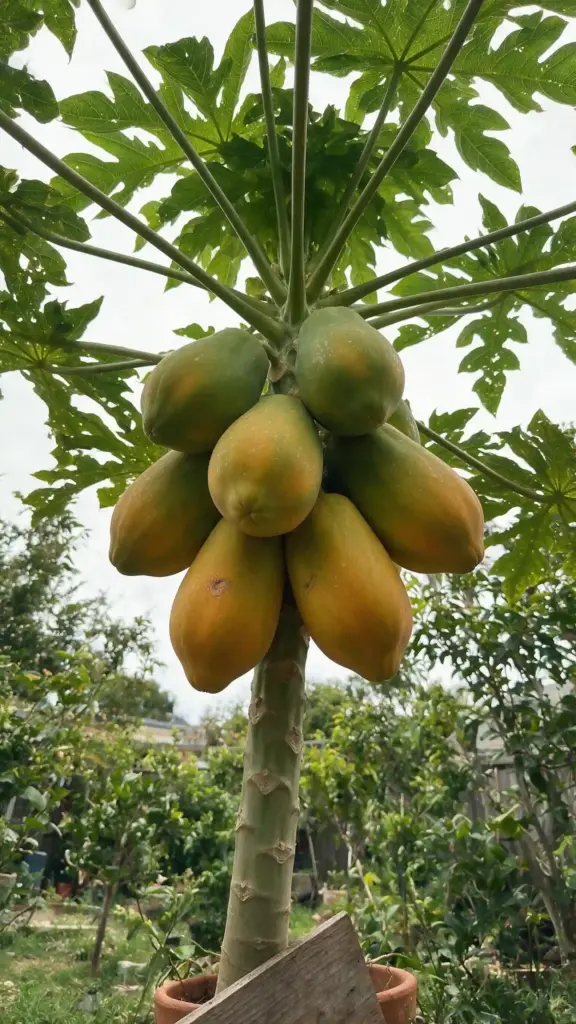
The trunk is hollow, soft, and has no bark worth the name. It does not branch unless something damages the growing tip. All the leaves sit in a crown at the very top on long hollow stalks, and the fruit forms on the trunk itself, in the scars where old leaves dropped off. So the plant is essentially a green column that keeps pushing leaves out of the top while fruit ripens further down. Nothing about pruning a fruit tree applies here.
Speed is the whole appeal. A seed sown in warm soil can be flowering in five or six months and carrying ripe fruit before its first birthday. That is faster than any other fruit you can start from seed in a home garden. The trade is a short working life. My plants are at their best in the first two fruiting years, get noticeably taller and less productive after that, and by year four the fruit is out of reach and the trunk is usually leaning. I start replacement seedlings every single year and I suggest you do the same from the beginning.
The last difference is the root system. It is shallow, brittle, and it hates being disturbed or sitting in water. Papaya does not die slowly from wet soil. It collapses. A plant that looked fine on Monday can be lying on the ground by Friday with a soft brown base, and there is nothing to be done at that point except pull it out and think about drainage.
Step 1: Start More Seeds Than You Think You Need
Seed is the only sensible way in. Papaya can be grafted and can be raised from cuttings, but neither is worth the trouble at home when seed germinates readily and gives you fruit inside a year anyway.
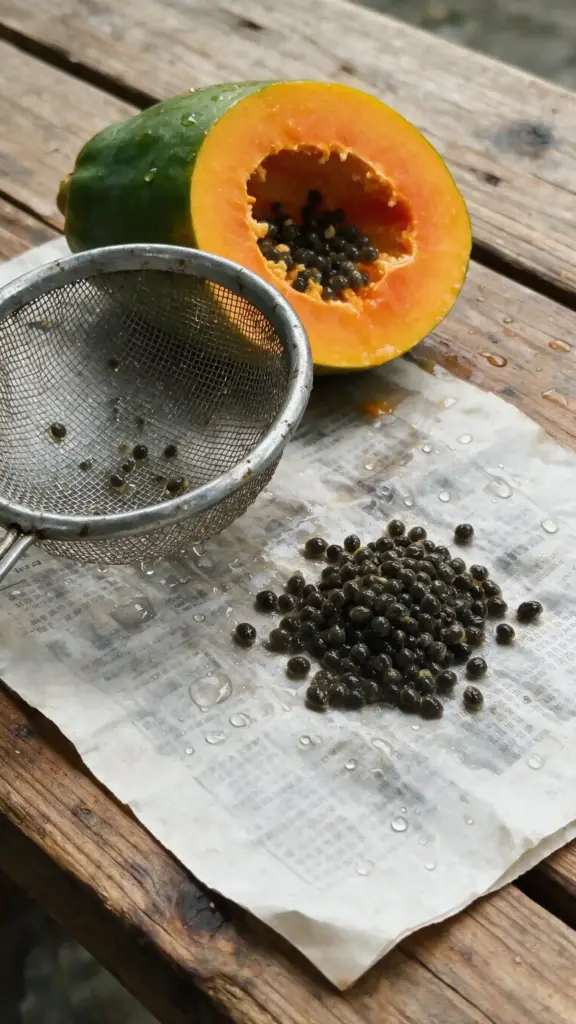
Scoop the seeds out of a fully ripe fruit, rub them in a sieve under running water to break off the slippery gel coat around each one, and spread them on paper for a day. That gel holds germination back, so getting it off matters more than anything else you do at this stage. I sow while they are still fresh. Old seed germinates, but slowly and unevenly.
Warmth does the rest. Sown into a bed or a deep pot in genuinely warm soil, my seed comes up in around three weeks, with stragglers still appearing a fortnight later. In cool soil it can sit and sulk for two months and then rot.
Here is the part that most guides bury at the bottom. Because you cannot tell a male seedling from a fruiting one until it flowers, you do not plant single seedlings. Texas A&M horticulture staff put it plainly: sex determination before flowering is practically impossible, so the standard home approach is to grow two to four seedlings together in one spot and remove the ones you do not want after the flowers tell you what you have. I sow five or six seeds per station, thin to the three strongest seedlings while they are still small, and leave those three growing shoulder to shoulder until flowering.
Sow where the plant will stay if you can. Papaya resents root disturbance, and a seedling moved from a shallow tray at the wrong moment often sits still for a month afterwards. If you must raise them in pots, use deep ones, and move them out while they are shorter than your knee.
Step 2: Wait for the First Flowers Before You Decide Which Plants Stay
This is the step that separates people who harvest papaya from people who grow a very handsome green column and nothing else.
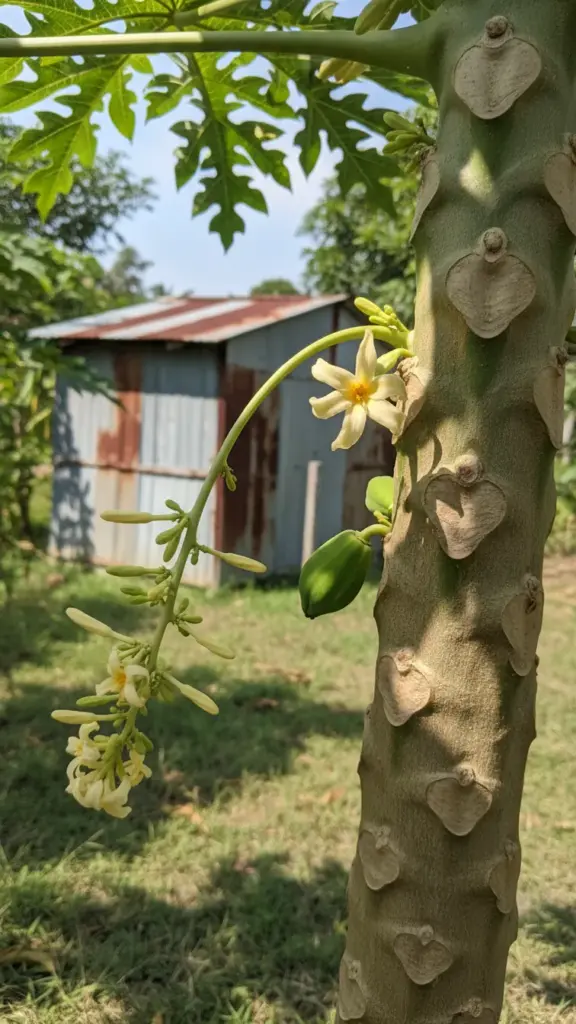
Papaya plants come in three sexual forms, male, female, and hermaphrodite, and the flower is where you read the difference. University of Hawaii extension staff describe the giveaway clearly in their guide to why some papaya plants fail to fruit: a male flower simply has no ovary inside it. No ovary, no fruit, no exceptions, no matter how well you feed it.
| Flower type | What you see | What you get |
| Male | Long thin branched sprays hanging away from the trunk, dozens of small trumpet shaped flowers on stalks | No fruit at all, pollen only |
| Female | Single flowers or small groups sitting tight against the trunk, a tiny green fruit shape already swelling at the base, petals separate | Fruit, but only if pollen reaches it, usually rounder fruit |
| Hermaphrodite | Looks like a female flower with a tiny fruit at the base, but stamens are visible inside the petal tube | Fruit without a partner, usually longer and more pear shaped |
What I do with a clump of three: as soon as one plant shows hermaphrodite flowers, that one stays and the other two get cut off at ground level. If none of the three is hermaphrodite and all are female, I keep the two best females and leave one male somewhere in the garden as a pollen source. If they all turn out male, the clump is a write off and I start again, which is exactly why I sow a spare station every year.
Cut, do not pull. Yanking a neighbouring seedling out tears the roots of the one you are keeping.
Step 3: Plant It Where Water Never Sits
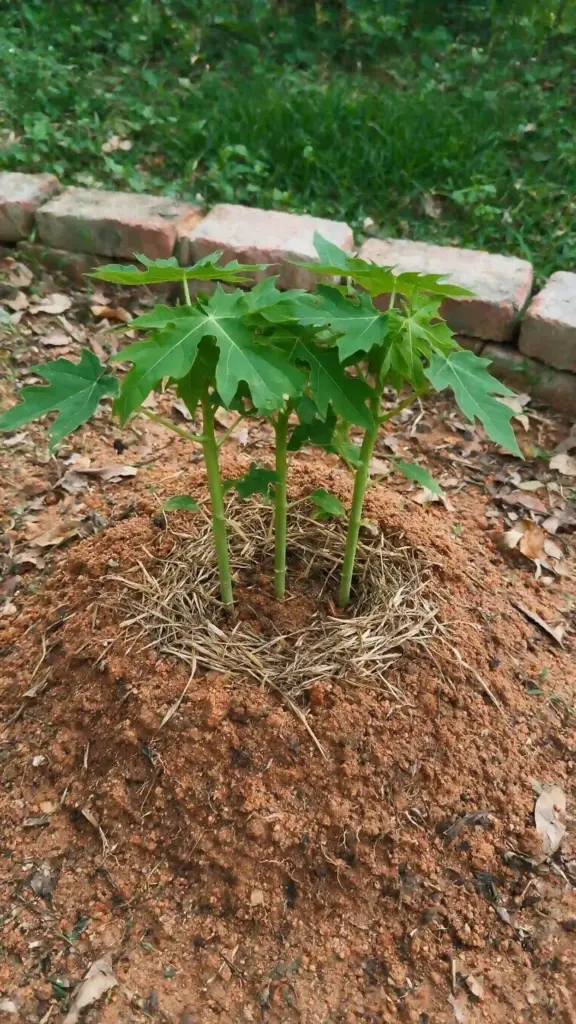
Full sun, all day, in the warmest and most sheltered corner you have. Papaya in shade grows tall, thin, and gives small bland fruit, and papaya in wind loses leaves constantly because those long hollow leaf stalks snap easily.
Drainage matters more than soil quality. I plant on a mound, not on flat ground, and I make the mound higher than feels necessary because it settles. Sandy soil that drains fast is ideal. Heavy clay is the one situation where I would give up on planting in the ground and go straight to a large container, because no amount of compost turns a wet clay pocket into somewhere a papaya root can survive a rainy week.
Give each planting station real space. The crown gets wide, the leaves are enormous, and plants crowded together shade each other and reach for the light. Keep them well away from a lawn irrigation zone as well. Sprinklers running on a timer keep the base permanently damp, which is the single most reliable way to lose a healthy plant.
If your soil is the kind that holds water for days, you have the same problem I have with growing mango at home, and the answer is the same one: build up rather than dig down.
Step 4: Water on a Rhythm, but Never Let the Crown Stay Wet
Papaya is thirsty and intolerant of wet feet at the same time, which sounds contradictory until you realise it wants water moving through the soil rather than sitting in it.
In the Ground
I water deeply two or three times a week in hot weather and let the top few centimetres dry between waterings. A drip line or a slow hose at the edge of the leaf spread works far better than a sprinkler, because it keeps the trunk base and the crown dry. During a wet season I water nothing at all and spend my time making sure the mound is still draining.
The signal to watch is the leaves in the late afternoon. Slight wilting at the hottest part of the day that recovers by evening is normal. Leaves still drooping the next morning means the roots are either dry or drowning, and a finger pushed into the soil at the edge of the mound tells you which within a second.
In a Container
Pots dry out fast and papaya roots fill them quickly, so in summer I water a large pot every day and sometimes twice. The difference is that a pot has to drain hard. I raise mine on feet so water runs straight out of the base rather than pooling in a saucer, and I never leave a full saucer under it, not even for an afternoon.
Step 5: Feed Little and Often Through the Whole Season
A papaya is producing leaves, flowers, and fruit at the same time for months on end, so it is a heavy feeder in the same way a banana clump is a heavy feeder. Small regular doses beat one big application.
I use a balanced fertiliser scattered around the edge of the leaf spread every few weeks through the warm season, plus a mulch of compost that I top up rather than pile against the trunk. Mulch touching the trunk causes exactly the soft rot at the base that you spent Step 3 trying to avoid, so I keep a bare gap the width of my hand all the way around.
Too much nitrogen and nothing else gives you a magnificent leafy plant with flowers that fall off. If your papaya is enormous and unproductive, look at what the lawn beside it is being fed.
Step 6: Support the Trunk Before the Column of Fruit Gets Heavy
A loaded papaya carries a stack of fruit on one side of a soft trunk, and after heavy rain that trunk can lean far enough that it never straightens again.
I drive a stake in on the side the plant is leaning towards, before it starts leaning, and tie loosely with soft cloth strip rather than string. Anything thin cuts into that soft stem within weeks. Check the tie every month through the fruiting season, because the trunk thickens fast enough to strangle itself against a tie you tightened in spring.
Step 7: Pick When the First Yellow Stripe Appears
Papaya does not sweeten after it leaves the plant, but it does soften, and the balance between those two facts is the entire harvest decision.
University of Florida horticulturists set out the working rule in their guide to papaya in the home landscape: fruit can be picked once yellow covers between a tenth and a third of the peel, but leaving more colour to develop on the plant increases the sugar in the fruit. Once picked, it should ripen at room temperature before it goes anywhere near a refrigerator, and ripe fruit keeps for four to seven days.
So the honest answer is that later is sweeter and riskier. Every extra day on the plant is more sugar and also more chance that a bird, a fruit fly, or a rain split gets there first. What I actually do:
- Pick at the first clear yellow stripe running along a rib if birds are working the garden.
- Leave fruit until it is a third yellow if nothing is bothering it.
- Cut the stalk with secateurs rather than twisting, because twisting tears the soft trunk.
- Handle it like an egg, since the skin bruises at this stage and the bruise turns into a rot spot within days.
Green fruit is not wasted, by the way. Fully mature but still green papaya is a vegetable in half of Southeast Asia, and thinning a crowded fruit column into a salad is a decent consolation prize.
Why Papaya Plants Fail to Fruit
Almost every failure I have seen traces back to one of five things.
The plant is male. This is the big one, and Step 2 is the whole answer to it.
The plant is female with no pollen anywhere nearby. Female flowers open, sit for a few days, and drop. If you have one lonely female plant in a neighbourhood with no other papaya, you need a male or a hermaphrodite within flying distance of an insect.
The plant is too young. Flowers on a very small seedling sometimes abort simply because the plant has not built enough leaf area to carry fruit yet. Feed it and wait a month.
The weather turned against it. Long spells of extreme heat and long cool spells both cause flower drop in my garden. I have no fix for this beyond siting the plant somewhere sheltered and accepting a gap in production. This is my own observation rather than a sourced claim, so treat it as one gardener’s pattern.
The roots are struggling. A plant fighting waterlogging or root damage drops flowers before it drops leaves. Flower drop is often the first warning that something is wrong below ground.
Cold, Wind, and the Two Things That Kill Papaya Fastest
Cold is the obvious limit. Papaya keeps growing while nights stay mild, slows to nothing when they turn cool, and dies outright in frost. Fruit that is still on the plant when temperatures drop often ripens with poor flavour, because the plant is no longer moving sugar into it.
Water sitting around the base is the less obvious killer, and in my experience it takes more plants than cold does. The pattern is always the same: several wet days, then a soft dark patch at ground level, then a plant on its side.
Wind is third. It rarely kills, but a plant that has lost most of its leaf stalks in a storm stops fruiting for weeks while it rebuilds a crown.
One point of confusion worth clearing up. In parts of the world papaya is called pawpaw, but the true pawpaw of North America is a completely different plant with a completely different climate range, and growing pawpaw from seed has nothing in common with what is on this page. If you are in a cold region and someone recommended pawpaw as a substitute, that is the plant they meant.
Papaya Ringspot Virus and the Other Problems I Watch For
Papaya ringspot virus is the disease that ends papaya growing in whole districts. Aphids move it from plant to plant, the leaves go mottled and distorted, the leaf stalks develop dark streaks, and the fruit shows the sunken rings that give the disease its name. Fruit from an infected plant tastes flat and watery. There is no cure. I pull infected plants out and burn them rather than compost them, and I start replacements as far from the old spot as the garden allows.
Spider mites turn up on the underside of the leaves in dry weather and give the leaf a dull stippled look. A strong spray of water on the undersides, repeated, is usually enough.
Fruit flies sting ripening fruit and the damage shows as a soft weeping spot. Bagging individual fruit works, though on a plant carrying thirty fruit at once it is a lot of bags.
Root rot has already had its warning above and it deserves the repetition, because it is the problem that will actually cost you the plant.
The Papaya Year at a Glance
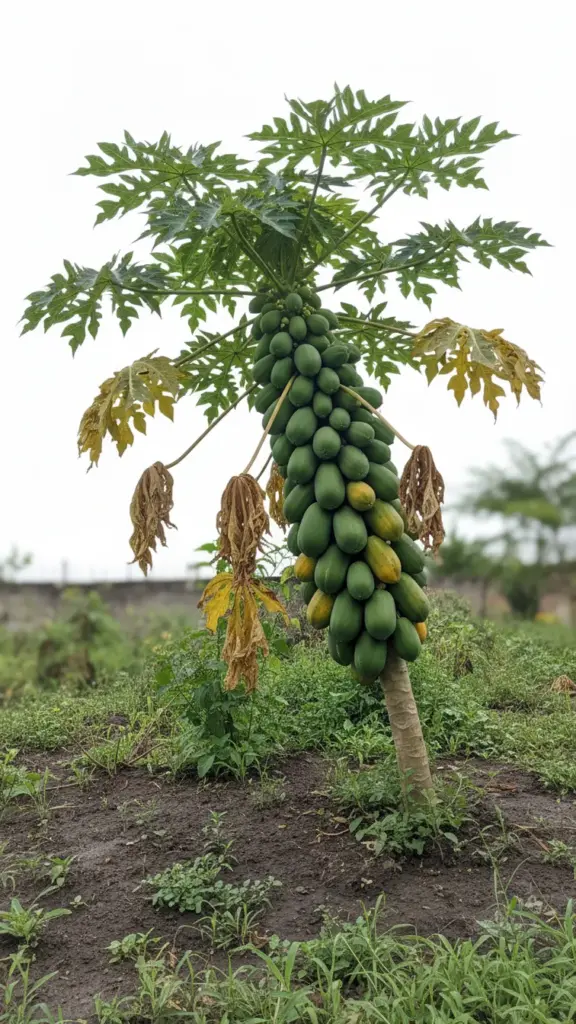
This is the rhythm in my own subtropical garden. Shift the whole table earlier or later to match your climate.
| Season | What the plant is doing | What I do |
| Early spring | Waking up, pushing new leaves | Sow this year’s replacement seed, start feeding |
| Late spring | Fast growth, first flower buds on young plants | Identify flower types, thin clumps to the keeper |
| Early summer | Heavy leaf production, flowering, first fruit set | Feed every few weeks, water deeply, stake if leaning |
| Midsummer | Fruit column building on the trunk | Watch for mites and aphids, keep mulch off the trunk |
| Late summer | First fruit reaching full size, colour starting | Begin harvest at colour break, keep feeding |
| Autumn | Ripening continues, growth slowing | Harvest steadily, reduce feeding as nights cool |
| Winter | Dormant or dying back in cool climates | Move containers under cover, stop feeding, water sparingly |
Growing Papaya in a Container
A container is the only way I would attempt papaya outside a reliably frost free climate, and it does work, with two conditions.
The pot has to be big. I use the largest I can still move on a trolley, filled with a free draining mix rather than a water retentive potting compost. Small pots produce a plant that flowers, sets two fruit, and stalls.
The second condition is that you commit to moving it. A papaya wintered in a bright frost free space, watered lightly and not fed at all, comes through and picks up again in spring. A papaya left outside through one frosty night is finished. Choose a compact variety if you can find one, because a standard type will hit the ceiling of most greenhouses inside two years.
Expect fewer fruit and smaller fruit than a plant in open ground. Expect to replace the plant more often as well. For me the trade is worth it, because a container plant sits beside the back door where I notice problems early.
Common Questions
How Long Does It Take to Grow Papaya Fruit From Seed
In a warm climate with no cold check, five to six months from sowing to first flowers and around nine to eleven months to the first ripe fruit. Every cool spell adds time. In a container in a marginal climate, plan on the second summer rather than the first.
Can I Grow Papaya From Supermarket Fruit
Yes, and most of my plants started that way. The catch is that a supermarket fruit is usually a named commercial variety, and seedlings from it will vary. Some will be excellent and some will be disappointing, which is another argument for raising several. If you want more predictable results, buy seed from a supplier, and the same basic checks apply that I use when buying any seed.
Do I Need Two Papaya Plants
Not if yours turns out to be hermaphrodite, since those flowers carry both parts and set fruit alone. You do need a pollen source if your plant is female. Since you cannot know which you have until flowering, growing several and thinning later is simply the safe route.
Why Are My Papaya Flowers Falling Off Without Setting Fruit
Work through the list in the fruiting section above in this order: male plant, no pollen source, plant too young, weather extreme, roots in trouble. In my garden the answer has been male plants more often than everything else combined.
Can Papaya Survive Winter Outside
Only where frost does not reach it. A light frost damages the leaves and the growing point, and a real freeze kills the trunk. There is no covering trick that reliably saves a three metre soft stemmed plant, which is why container growing exists.
Why Does My Papaya Taste Bland
Usually because it was picked too early, sometimes because it ripened during cool weather, occasionally because the plant is virus infected. Leaving fruit on the plant longer is the first thing to change, since sugar goes in while the fruit is still attached and never afterwards.
Where to Go From Here
If you take one thing from this page, make it Step 2. Everything else is ordinary gardening, but the flower check is the difference between a harvest and a very large green ornament.
Sow your first seeds this season and your replacement seeds next season, and keep that overlap going. A papaya patch works as a rolling relay rather than a permanent planting, and once you are a year ahead of yourself the short plant lifespan stops mattering.
If you are building a small tropical corner, papaya sits well beside plants on the same fast timetable. Guava is the one I would add next, since it tolerates far more neglect and covers the years when a papaya replacement is still finding its feet.








