
A mango tree with chewed flowers, black-coated leaves, or fruit that drops before it ripens usually has a pest problem you can name in one walk. Mango tree pests in Australia fall into a small set of repeat offenders, and each one leaves a distinct signature on fruit, flowers, leaves, or bark. This article starts with a symptom table that matches 8 symptoms to the most likely culprit, then gives one section per pest group with a concrete check, what the pest does, organic-first control, and when to act.
The pests below are the ones backyard growers meet most: fruit fly, mango seed weevil, mango leafhoppers, scale, mealybugs, aphids, sooty mold, mango beetles, thrips, and mites. Fruit spotting bug and mango flower beetle get their own sections because their damage is easy to mistake for disease or poor pollination. The last pest section covers the caterpillars you should report rather than treat, and the final sections cover ants, beneficial bugs, and a weekly check that catches the next outbreak early.
1. Match the Symptom to the Pest in One Walk
The table below is the whole diagnosis in one place. Walk the tree once, start at the fruit, then check flowers, new growth, leaf undersides, and bark. Match the row that fits best, then read that pest section for the confirm check and the control steps. When two rows fit, trust the one with the matching location: fruit fly damage sits in the fruit, sooty mold sits on leaves below sap feeders, and scale sits on stems and leaf undersides above the black coating.
| What you see | Where on the tree | Most likely culprit | First action |
|---|---|---|---|
| Small sting marks on ripening fruit, soft spots, maggots inside when cut open | Fruit | Fruit fly (Queensland fruit fly in most states, Mediterranean fruit fly in Western Australia) | Bag sound fruit, pick up every fallen fruit, destroy maggots by freezing, boiling, or solarising in a sealed bag in the sun |
| Fruit drops early with no sting marks; seed inside carries a grub or a tunnel | Fruit and seed | Mango seed weevil | Cut open one suspect fruit to confirm, destroy infested fruit, do not move infested fruit interstate |
| Flowers dry and fall, new shoots curl, sticky leaves below | Flowers and new growth | Mango leafhoppers | Shake a flower cluster over white paper and look for tiny jumping insects, then wash new growth with a firm water spray |
| Small bumps on stems and leaf undersides, sticky leaves, black coating below | Stems, leaf undersides, leaves below | Scale, mealybugs, or aphids | Wipe colonies off with a cloth, wash with water, and check for ants guarding the colony |
| Black, sooty coating that wipes off with a finger | Leaves and fruit below sap feeders | Sooty mold growing on honeydew | Treat the sap-feeding insects above the coating, not the mold itself |
| Fruit dimples, then drops, with no maggots inside | Fruit | Fruit spotting bug | Net or bag fruit, and check fruit early in the season before the dimples appear |
| Flowers chewed at night, petals ragged, few fruit set | Flowers | Mango flower beetle | Check flowers at dusk with a torch, hand-pick beetles into soapy water |
| Silvery scarring on leaves or fruit, distorted new growth | Leaves, new growth, young fruit | Thrips or mites | Hold white paper under a leaf and tap it, then look for moving specks with a hand lens |
2. Bag Fruit and Pick Up Fallen Fruit to Break the Fruit Fly Cycle
Fruit fly is the pest that ruins the most backyard mangoes, and hygiene beats spraying because the damage happens inside the fruit. The female fruit fly lays eggs under the skin of ripening fruit. The maggots feed inside, the fruit softens and drops, and the maggots leave the fruit to pupate in the soil. A Queensland fruit fly guide from Agriculture Victoria describes the field signs as sting marks on skins, and it recommends cutting fruit open to check inside for maggots. That cut-open check is the fastest way to separate fruit fly from seed weevil or fruit spotting bug, because only fruit fly leaves maggots in the flesh.
Most of Australia deals with Queensland fruit fly, Bactrocera tryoni. Western Australia deals with Mediterranean fruit fly, Ceratitis capitata, and state rules for both vary, so check your state agriculture department before moving fruit or applying any treatment. Mango fruit fly, Bactrocera frauenfeldi, occurs only in far-north Queensland, so most growers will never meet it. The control steps below work for all three because they break the same cycle: stop the female reaching the fruit, and destroy every maggot before it reaches the soil.
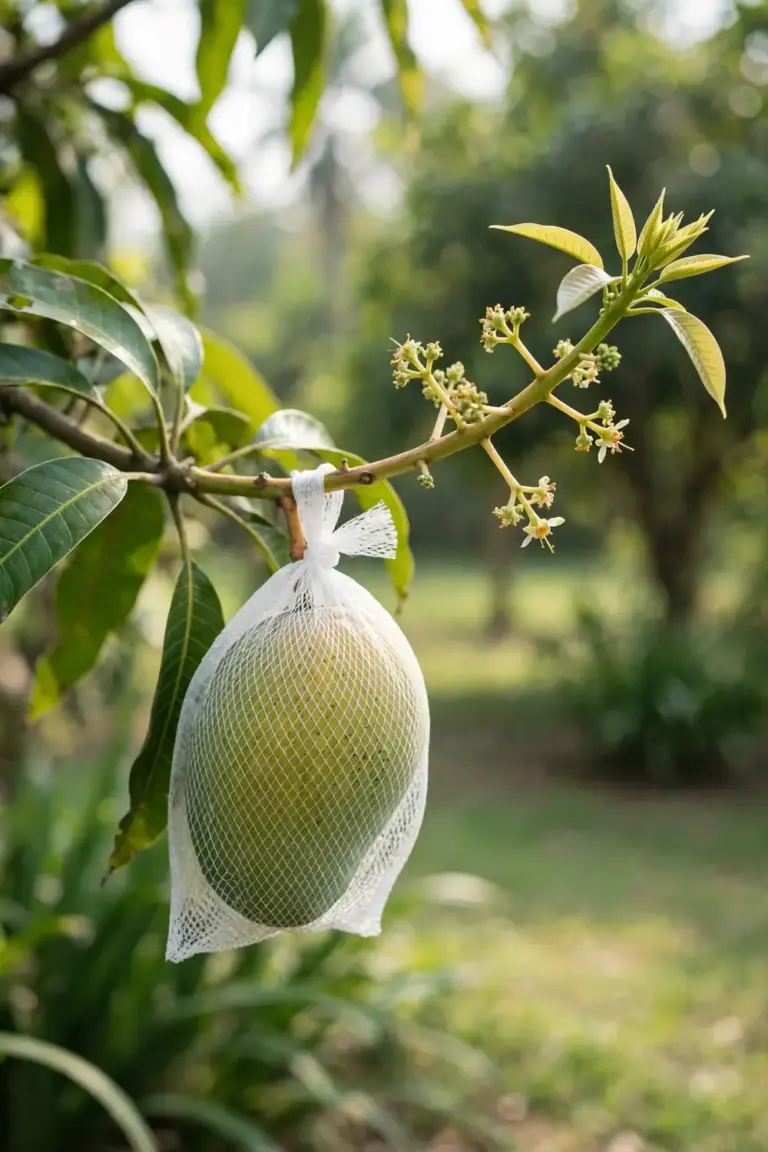
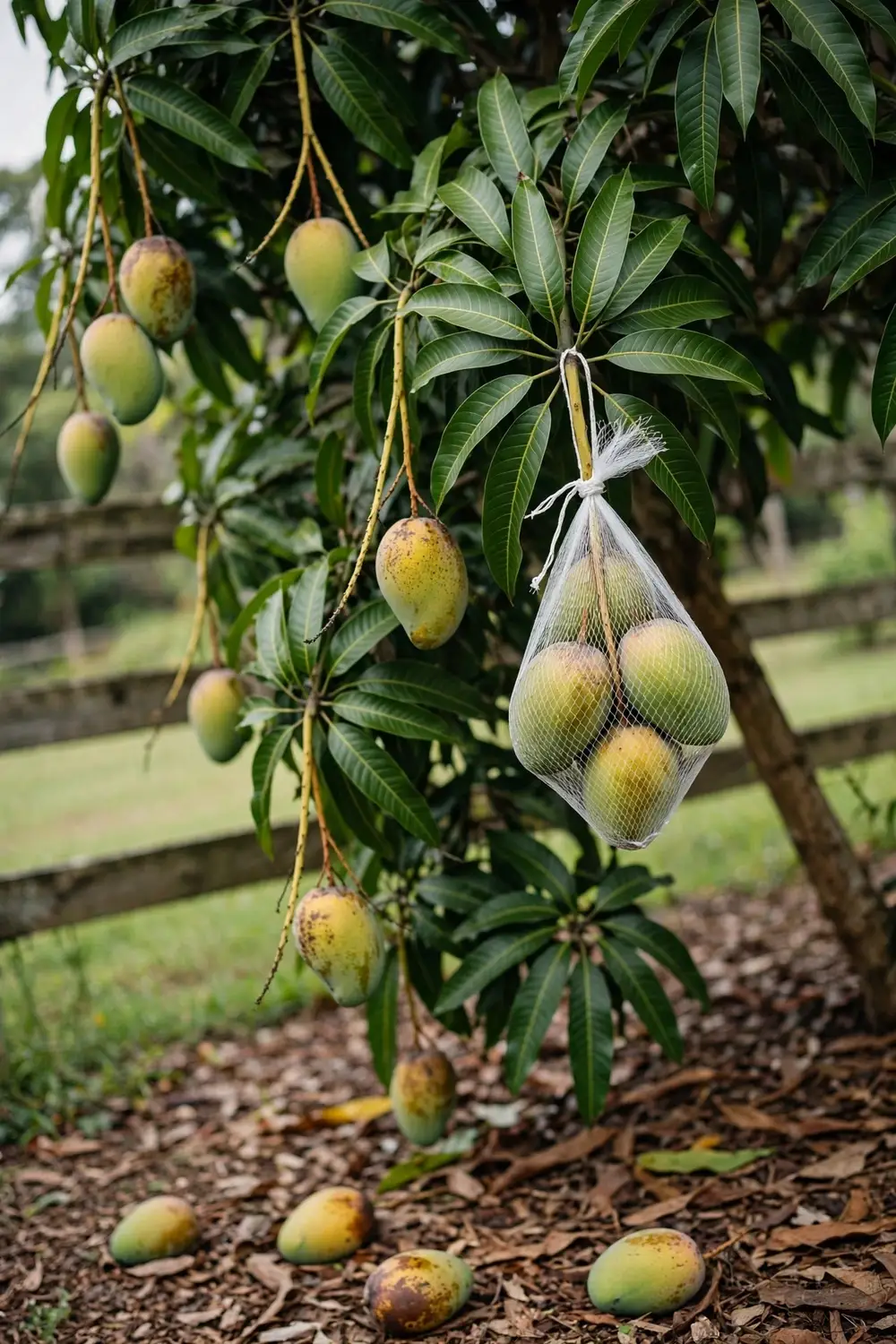
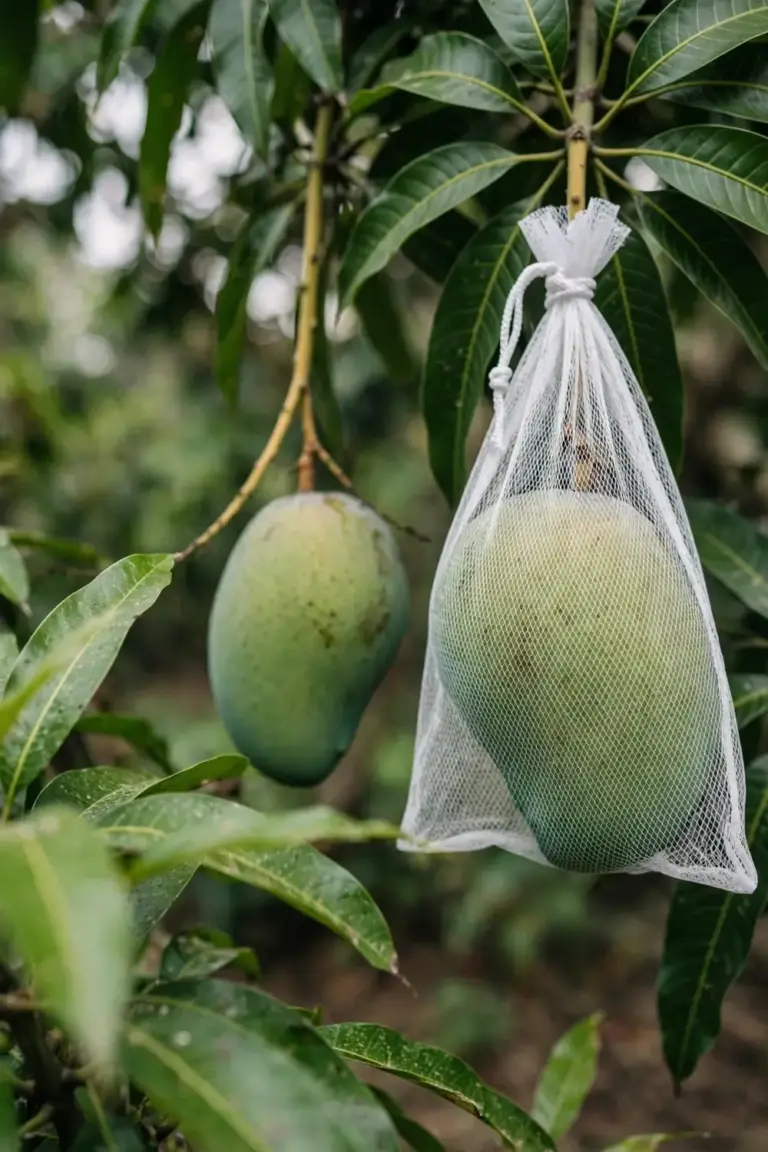
Bagging is the most reliable step for a backyard tree. Slip a fine-mesh fruit bag or a paper bag over each fruit soon after fruit set, and seal it around the stem so no fly can reach the skin. Bagging also protects against fruit spotting bug, which is why this article recommends it twice. Prune the tree to a height you can reach, because fruit you cannot reach becomes the breeding site for the next generation. The Agriculture Victoria guide makes the same point: keep the tree at a height that allows easy picking, netting, or spraying.
Pick up fallen fruit every day during the fruiting season, and destroy the maggots inside before you bin it. Freezing, microwaving, or boiling kills maggots. Solarising works too: seal the fruit inside a plastic bag and leave it in the sun for at least 14 days, then discard the bagged fruit in the general rubbish bin. Never put suspect fruit in compost, because compost will not reliably kill the maggots. Traps help you monitor numbers, but traps alone will not protect a crop, so treat them as an early warning, not a control method. If you use any spray product, follow the label exactly, keep pets and children off the treated area until it is dry, never spray in wind or rain, and never spray open flowers, because flowers feed pollinators and beneficial insects.
3. Cut Honeydew at the Source to Clear Sooty Mold
Sooty mold is the black coating that makes mango leaves look dusted with chimney soot. It is a group of dark fungi that grow on honeydew, the sugary liquid that sap-feeding insects excrete after feeding on plant sap. The fungi feed on the honeydew, and they do not attack the leaf directly. A heavy layer can block sunlight from the leaf, so the tree makes less food, but the mold itself is a symptom, not the disease. Treat the insects, and the mold dries up and flakes off with rain and time. A University of Georgia Extension report states the rule plainly: to control sooty mold, control the aphids, scales, or other pests that create the honeydew.
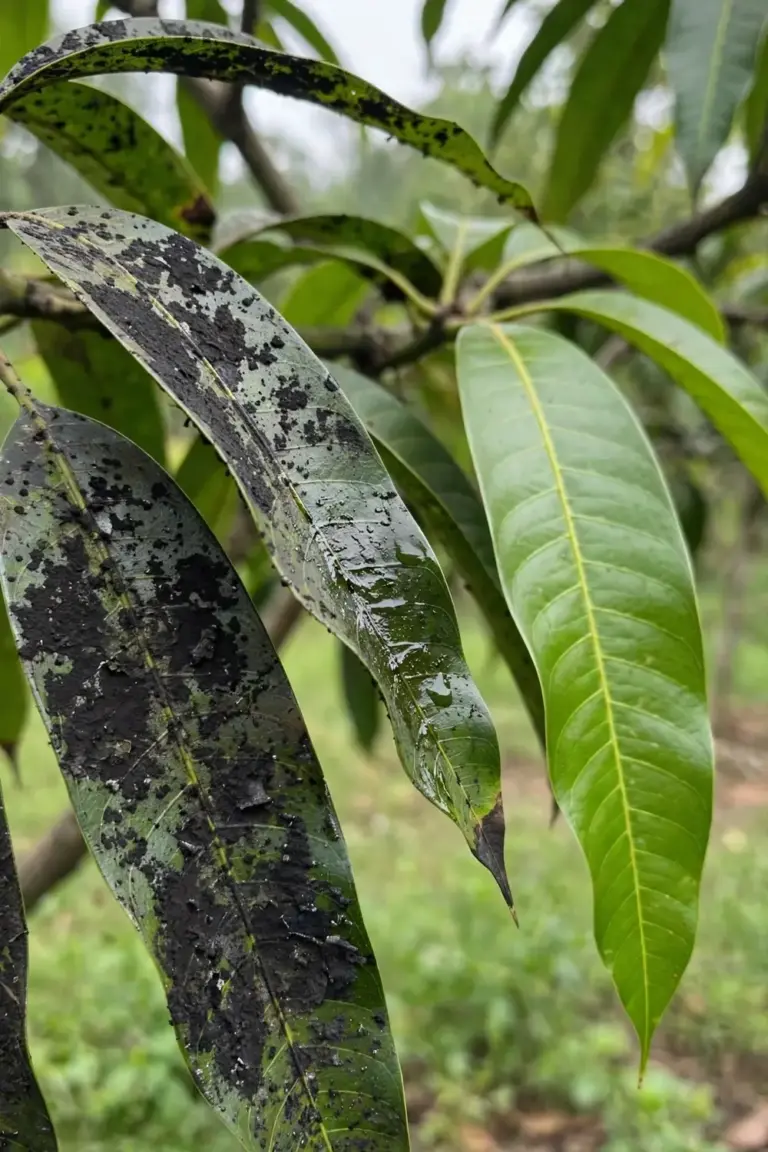
Find the source by looking above the blackest leaves. The sap feeders sit on stems, leaf undersides, or new growth directly above the coating. On mango, the usual sources are scale, mealybugs, and aphids, and the leafhopper section below also produces honeydew. Wash the coating off with a firm water spray to see what sits underneath, then treat the colony you find. Washing alone will not solve the problem, because the insects will keep producing honeydew until you remove them.
Black spots on fruit that sink into the flesh and spread in wet weather may be anthracnose, a fungal disease, not a pest. This article does not cover disease treatment, so if the fruit spots match that pattern, look for a mango disease guide rather than a pest treatment. Sooty mold sits on the surface and wipes off with a finger. Anthracnose does not. That wipe test separates the two in seconds.
4. Wipe Scale and Mealybug Colonies Before They Coat the Tree
Scale insects look like small bumps fixed to stems, leaf undersides, and fruit stalks. Mealybugs look like clusters of white, waxy cotton in leaf joints and on new growth. Aphids cluster on soft new growth and flower stems. All three feed on sap, all three excrete honeydew, and all three invite sooty mold. The first sign is often the sticky leaf or the black coating, not the insects themselves, because colonies start small and sit where you rarely look.
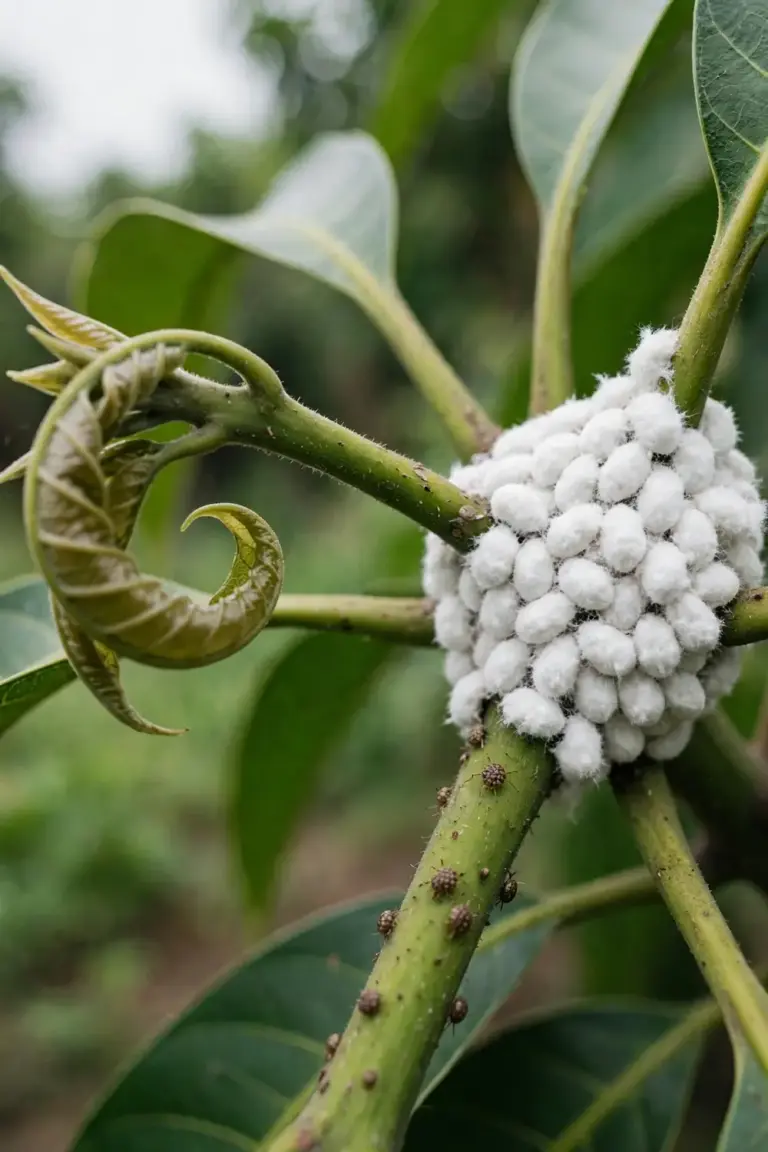
The confirm check is a wipe test. Rub a leaf underside or a stem with a fingertip. A sticky residue means sap feeders are active above or nearby. Then turn the leaf over and look for the bumps or the white clusters. Mealybug colonies hide in the joints where leaves meet stems, and scale colonies line up along stems and midribs. Check new growth first, because soft growth feeds the fastest colony growth, and check the tree after rain, because warm humid weather speeds colony spread.
Control starts with removal. Wipe small colonies off with a damp cloth, or wash them off with a firm jet of water. Prune out the most heavily coated twigs and bin them, because a twig coated in scale will reinfest the tree faster than you can wipe it. For colonies that keep returning, horticultural oil applied exactly per the label smothers scale and mealybugs by coating them, and it is gentler on beneficial insects than broad-spectrum sprays. Oil needs full coverage: spray every surface, including leaf undersides, or the insects on the missed surfaces survive. Never spray oil in hot weather above the label limit, and never mix oil with sulfur. Follow the label for every product, keep pets and children off until dry, never spray in wind or rain, and never spray open flowers.
The colony check also tells you whether ants are part of the problem. If ants run up and down the trunk in steady lines, they are farming the colony for honeydew, and they will defend it from the predators that would otherwise eat it. The ant section near the end of this guide covers how to break that alliance.
5. Spot Fruit Spotting Bug Damage Before Fruit Drops
Fruit spotting bug, Amblypelta, is the pest behind the most confusing mango symptom: fruit that dimples, yellows, and drops with no maggots inside and no sting marks on the skin. The bug feeds with piercing mouthparts, and the feeding sites dimple as the fruit grows. Young fruit often drops after feeding, and older fruit carries sunken spots that invite rot. Because the damage looks like a disease or a nutrition problem, growers often treat the wrong cause for a whole season.
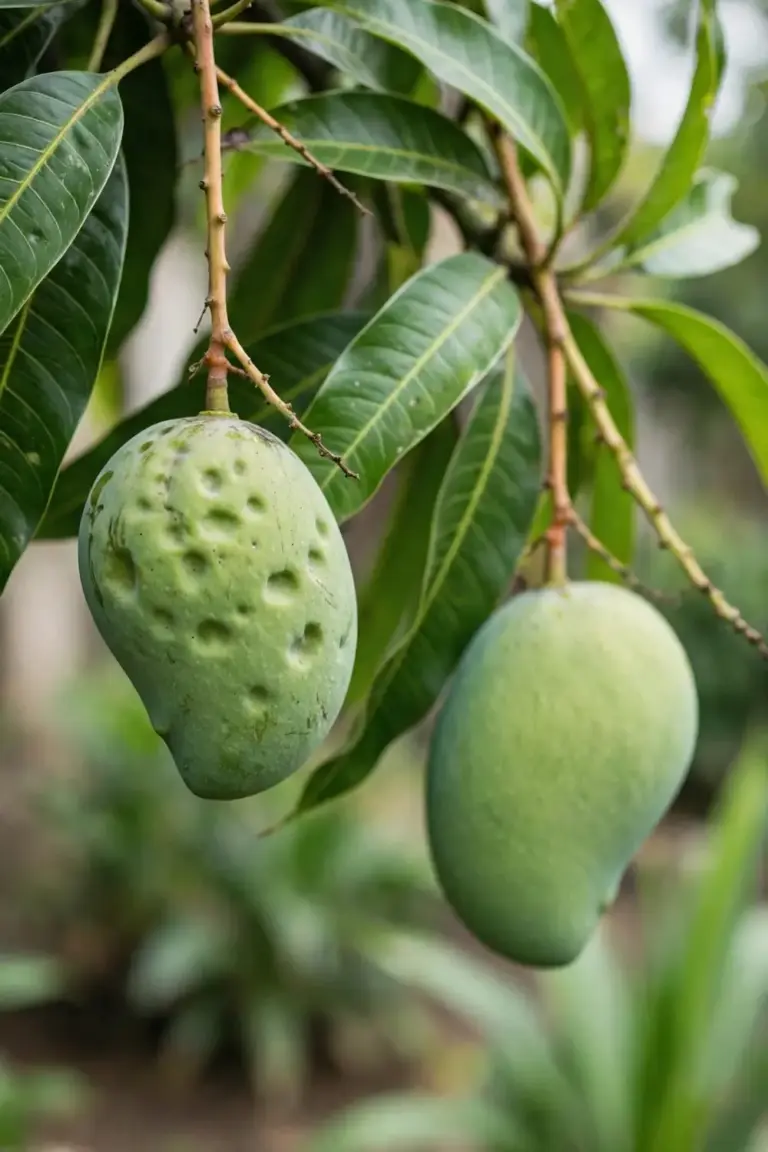
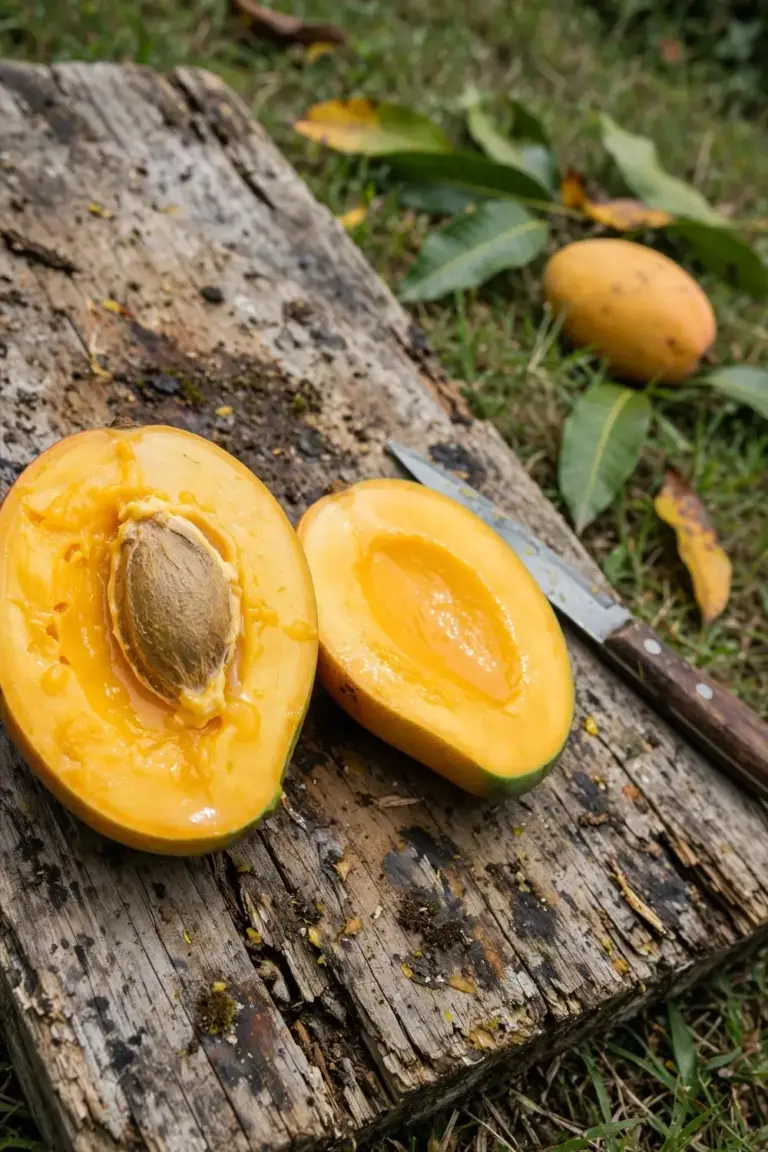
The confirm check is the cut-open test. Cut the dropped fruit open. Fruit spotting bug damage shows dimples and tissue damage under the skin, but no maggots and no tunnel into the seed. Fruit fly damage shows maggots in the flesh. Seed weevil damage shows a grub or a tunnel in the seed itself. Those three cut-open results separate the three fruit pests cleanly, and the cut takes less than a minute.
Bagging and netting are the most reliable controls for a backyard tree. Bag individual fruit soon after fruit set, or net the whole tree with fine fruit-fly netting before fruit colors. Netting must seal at the trunk, because one gap lets the bugs in and traps them inside with the fruit. Check bagged fruit weekly for dimples, because early detection tells you whether the net seal failed. Remove and destroy dropped fruit, because dropped fruit can carry other pests even when spotting bug caused the drop. Avoid broad-spectrum sprays for this pest, because the sprays kill the predators that keep spotting bug numbers down, and the bugs recolonise faster than the predators return.
6. Check Flowers for Mango Flower Beetle at First Bloom
Mango flower beetle, Protaetia fusca, eats flowers. The beetles chew petals and flower parts, and a heavy visit leaves ragged flower clusters that set little or no fruit. The damage is easy to blame on poor pollination or weather, because the beetles feed at dusk and at night, and the grower sees only the chewed flowers in the morning. Flower beetle belongs here because the flower check catches it, and the flower check costs nothing.
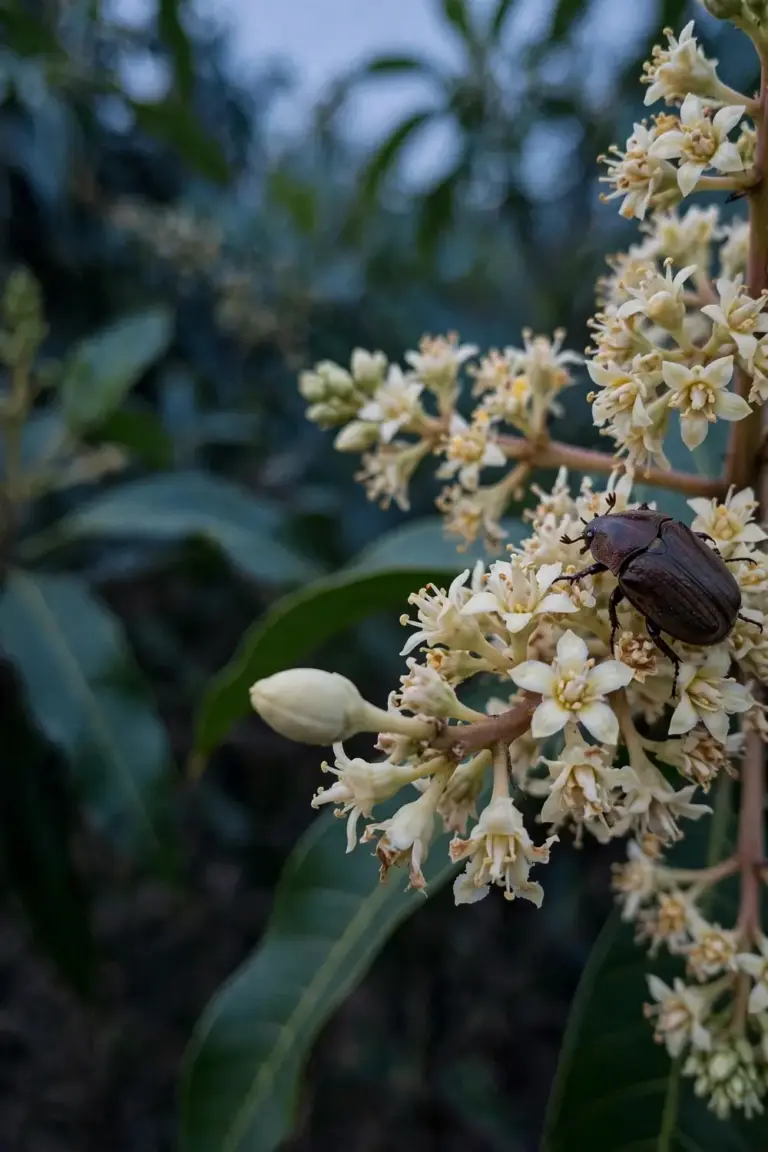
Check at dusk with a torch when the first flower clusters open. Look for chunky beetles on the flower clusters, and look for chewed petals and missing flower parts. Hand-pick the beetles you find into a bucket of soapy water, and repeat the check for several evenings while flowering peaks. Hand-picking works because backyard trees carry small beetle numbers, and each beetle removed is one less flower cluster destroyed. Bagging does not help here, because the target is the flower, not the fruit, and flowers need open access for pollinators.
Do not spray open flowers for this beetle. Flowers feed pollinators and beneficial insects, and a spray on open flowers kills the insects the tree needs for fruit set. If beetle numbers stay high after hand-picking, accept some flower loss and protect the fruit that does set with bags. A mango tree produces far more flowers than it can carry as fruit, so a moderate flower loss rarely reduces the final harvest. The goal is to keep enough healthy flower clusters to set a crop, not to save every flower.
7. Cut Open One Suspect Fruit to Confirm Seed Weevil
Mango seed weevil, Sternochetus mangiferae, is the quietest pest covered here. The adult weevil lays eggs on the surface of young fruit. The larvae burrow through the flesh and into the seed, where they feed and grow. The flesh tunnels close as the fruit expands, so a ripe fruit can look normal on the outside while the seed inside carries the weevil. A Lucidcentral pest fact sheet records that mature larvae reach up to 18 mm long, pupation in the seed lasts about 7 days, and the full life cycle from egg to adult takes 5 to 8 weeks. The adult emerges by chewing through the seed coat up to 2 months after the fruit has fallen and the flesh has decayed. Usually one adult develops in each fruit.
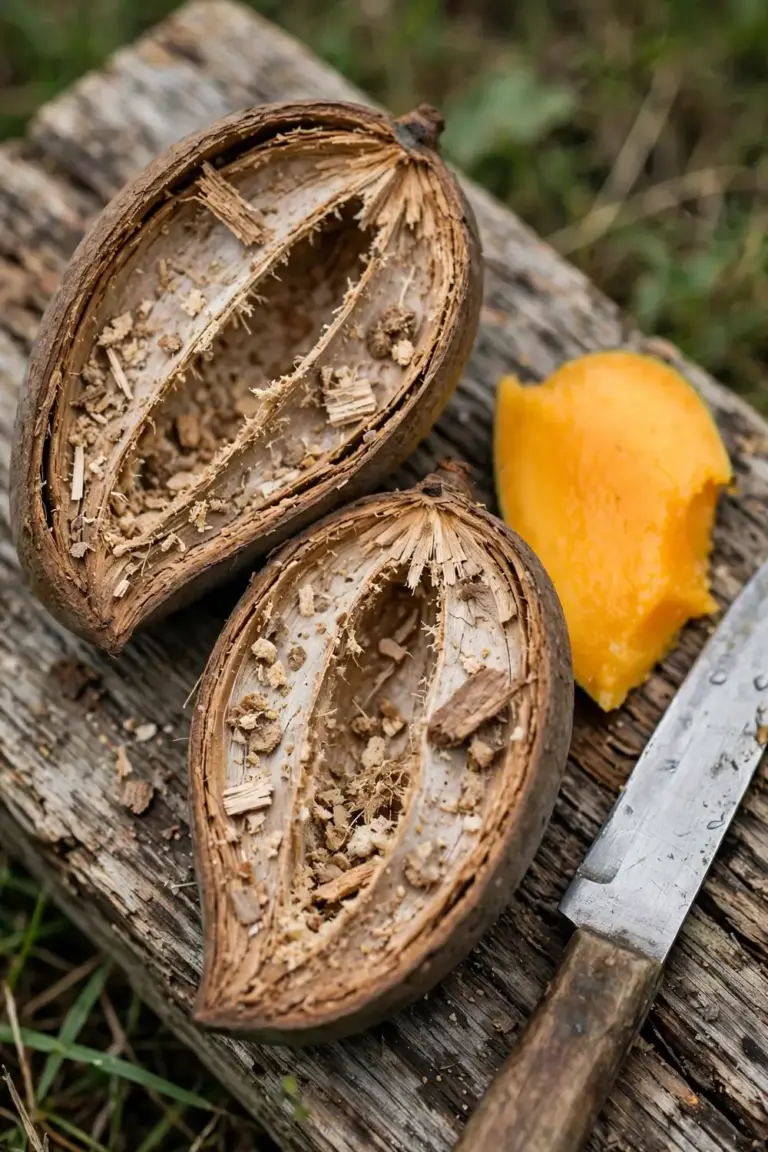
The confirm check is the cut-open test. Cut open one suspect fruit and split the seed. A grub, a pupa, a tunnel, or frass inside the seed confirms seed weevil. Adults are about 8 mm long and dark brown to black with gray markings in Australia, per University of Florida IFAS Extension notes, but you will rarely see the adult, because adults are not strong fliers and they stay close to the tree where they developed. That weak flight explains the hotspot pattern: one tree can carry weevils for years while the next tree stays clean. Spread happens when people move infested fruit, because the weevil travels inside the fruit.
Control is sanitation plus quarantine discipline. Pick up every fallen fruit, and destroy infested fruit by freezing, boiling, or solarising in a sealed bag in the sun before binning it. Do not compost infested fruit. Do not move infested fruit interstate, and do not give suspect fruit to friends or family in another state. Check your state rules before moving any mango fruit across a state border, because mango seed weevil is a quarantine pest in some states, and moving infested fruit can carry it into clean areas. The weevil causes limited production losses. Its presence affects fruit quality and trade, which is why quarantine rules treat it seriously. If you find weevil damage in a tree you bought recently, tell the seller, because the tree may have arrived carrying the pest.
8. Report Exotic Caterpillars Instead of Spraying Them
Two mango caterpillars in Australia are report-first pests: mango shoot looper and red-banded mango caterpillar. Both are exotic pests that authorities track, and the correct response is a phone call, not a spray. Call the Exotic Plant Pest Hotline on 1800 084 881 if you suspect either one. Plant Health Australia runs the reporting pathway, and it asks callers to describe what they saw, when they first noticed it, where they found it, and how widely it has spread. Do not move suspect material, and do not collect samples without advice, because incorrect handling can spread the pest or ruin the sample.
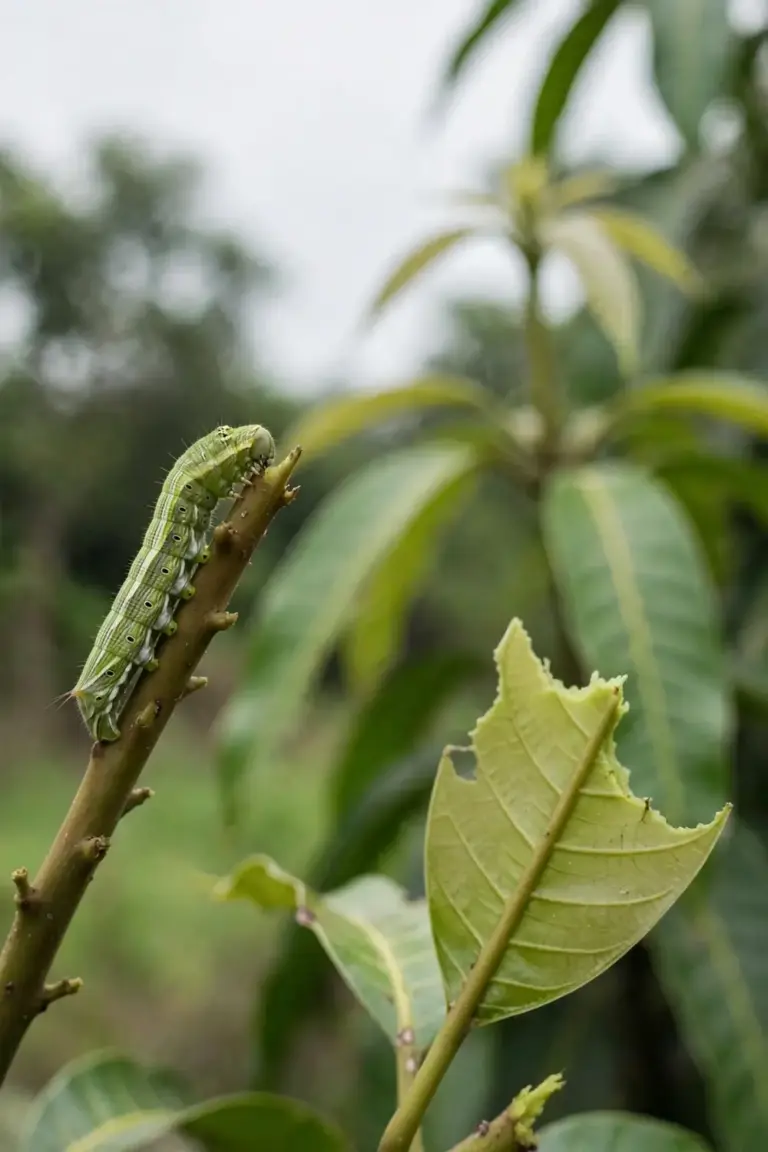
The confirm check is a photo, not a touch. Photograph the caterpillar, the damage, and the tree, then compare the photo with your state agriculture department’s exotic pest pages. Mango shoot looper caterpillars strip new shoots. Red-banded mango caterpillars bore into shoots and fruit. Both look different from the native caterpillars that occasionally chew mango leaves, and a photo lets an expert make the call. Mark the spot, restrict access to the area, and leave the suspect material in place until you have advice.
The reason for the report-first rule is that spraying an exotic pest rarely controls it, and it can scatter the pest to nearby trees. Authorities need to know where the pest is before they decide on a response, and early reports give eradication a real chance. The hotline number is worth saving in your phone: 1800 084 881. The same number covers any plant pest or disease you cannot name, so use it whenever a mango symptom looks unfamiliar rather than guessing at a treatment.
9. Check Leaves for Thrips, Mites, and Leafhoppers
Thrips, mites, and leafhoppers are the small sap feeders that damage leaves, flowers, and young fruit without leaving an obvious insect behind. Thrips rasp leaf and fruit surfaces, leaving silvery scarring and small dark specks of frass. Mites feed on leaf undersides and new growth, causing distortion, bronzing, and stunted flushes. Mango leafhoppers feed on flowers and new growth, and heavy feeding dries flower clusters and causes them to fall. All three are easy to miss because the insects are tiny, and the damage appears days after the feeding.
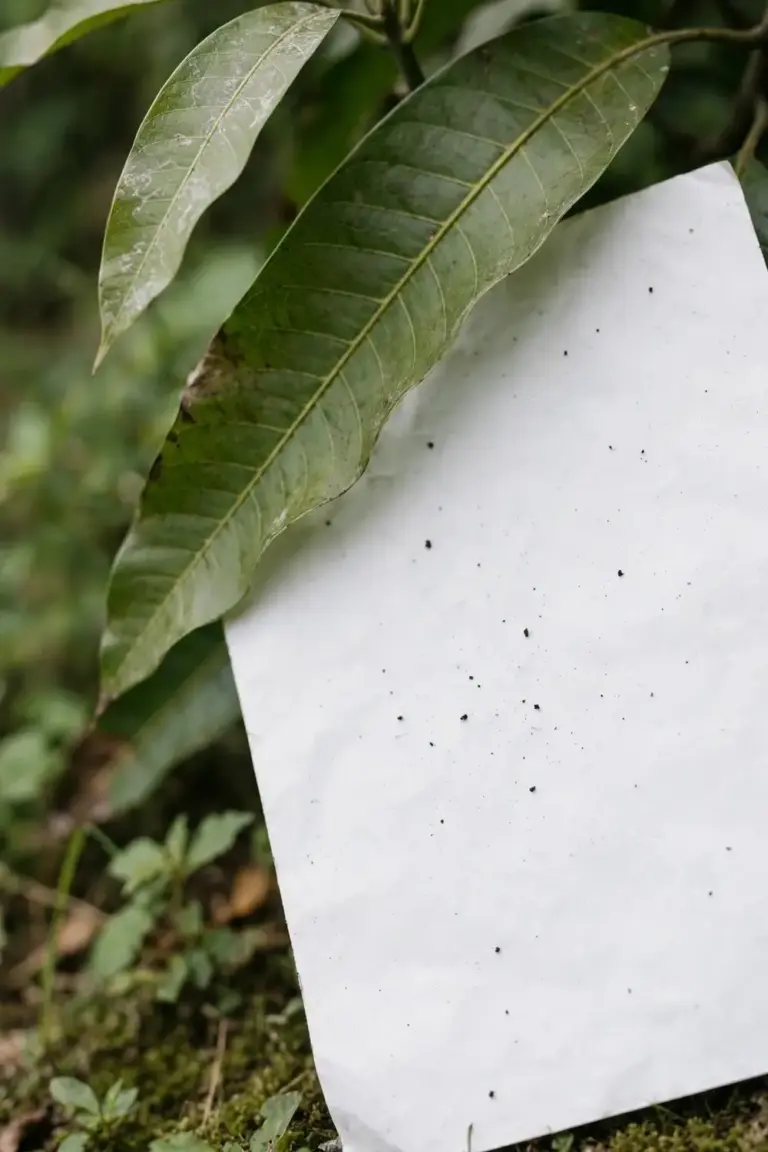
The confirm check is the white-paper test. Hold a sheet of white paper under a suspect leaf or flower cluster and tap the growth firmly. Thrips and mites fall onto the paper as tiny moving specks. Leafhoppers jump, which separates them from thrips and mites in one tap. Follow up with a hand lens on the leaf underside: thrips are slender and fast, mites are round and slow, and leafhopper nymphs cluster on flower stems. Check the newest growth first, because all three feed on soft tissue, and check after warm still weather, because populations build fastest then.
Control starts with water. A firm jet of water knocks thrips and mites off leaves and disrupts leafhopper nymphs, and repeating the wash twice a week for two weeks breaks the breeding cycle. Prune out badly distorted flushes and bin them. Avoid broad-spectrum sprays, because they kill the predatory mites and tiny wasps that hold thrips and mites down, and the pests return faster than their predators. If you use any spray product, follow the label exactly, keep pets and children off until dry, never spray in wind or rain, and never spray open flowers. Leafhopper feeding also produces honeydew, so a leafhopper outbreak can bring sooty mold with it; treat the leafhoppers, and the mold fades as the honeydew supply stops.
10. Starve Ants to Break the Scale and Mealybug Alliance
Ants are not a mango pest. They protect the pests that are. Ants farm scale and mealybug colonies for honeydew, and they drive off the ladybirds, lacewings, and parasitic wasps that would otherwise eat the colony. A colony with ant guards grows faster and lasts longer than a colony without them. The scout notes for this guide call ants the enemy’s bodyguards, and the description fits: the ants get sugar, and the colony gets protection.
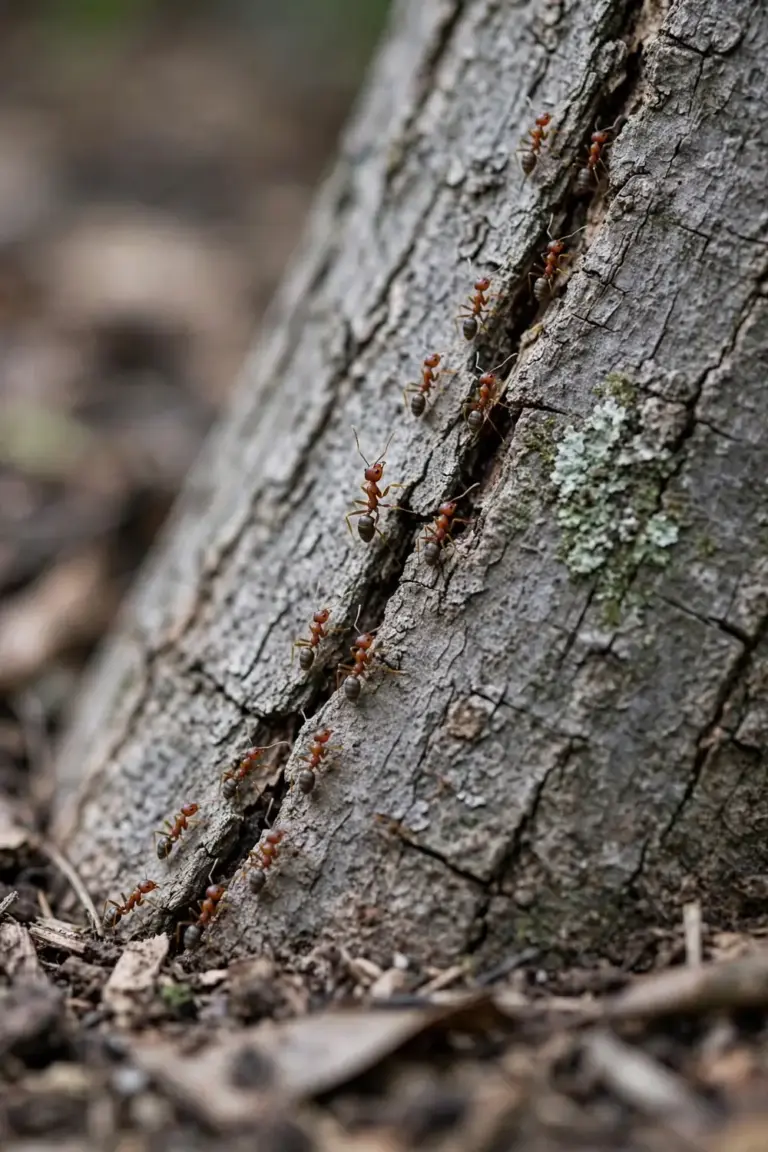
The confirm check is the trunk line. Look for a steady line of ants running up and down the trunk, and follow the line to its end. If the line ends at a scale or mealybug colony, the ants are farming it. If the line ends at a nest or a food source with no colony attached, the ants are foraging, and they are not part of the pest problem. Check the branch bridges too: branches that touch a fence, a wall, or a neighbouring tree give ants a path that bypasses the trunk entirely.
Break the alliance with barriers, not poison. Prune the branch bridges so the trunk is the only path up. Wrap a sticky band around the trunk to block climbing ants, and check the band weekly for debris bridges, because leaves and twigs that rest on the band give ants a path over it. Wash the colony off once the ants are blocked, because the predators will reach it once the guards are gone. Keep the band in place through the fruiting season, and remove it when the colony is gone so the bark can breathe. Never spray the ants with a broad-spectrum product on open flowers, and never place ant bait where pets or children can reach it. Follow the label for any product you use.
11. Keep Ladybirds, Lacewings, and Wasps on Patrol
Beneficial bugs are the unpaid workforce that keeps mango pests down between your checks. Ladybirds eat aphids and scale crawlers. Lacewing larvae eat aphids, mealybugs, thrips, and mites. Tiny parasitic wasps lay eggs inside scale and mealybug, and the wasp larvae eat the pest from inside. Spiders catch leafhoppers, beetles, and moths. Predatory mites eat pest mites. Cryptolaemus, the mealybug destroyer, is a ladybird that specialises in mealybug colonies, and hoverfly larvae eat aphids. A tree with a healthy beneficial population rarely needs a spray, because the predators eat the pests faster than the pests can breed. The Growit beneficial insect guide profiles these predators in more depth.
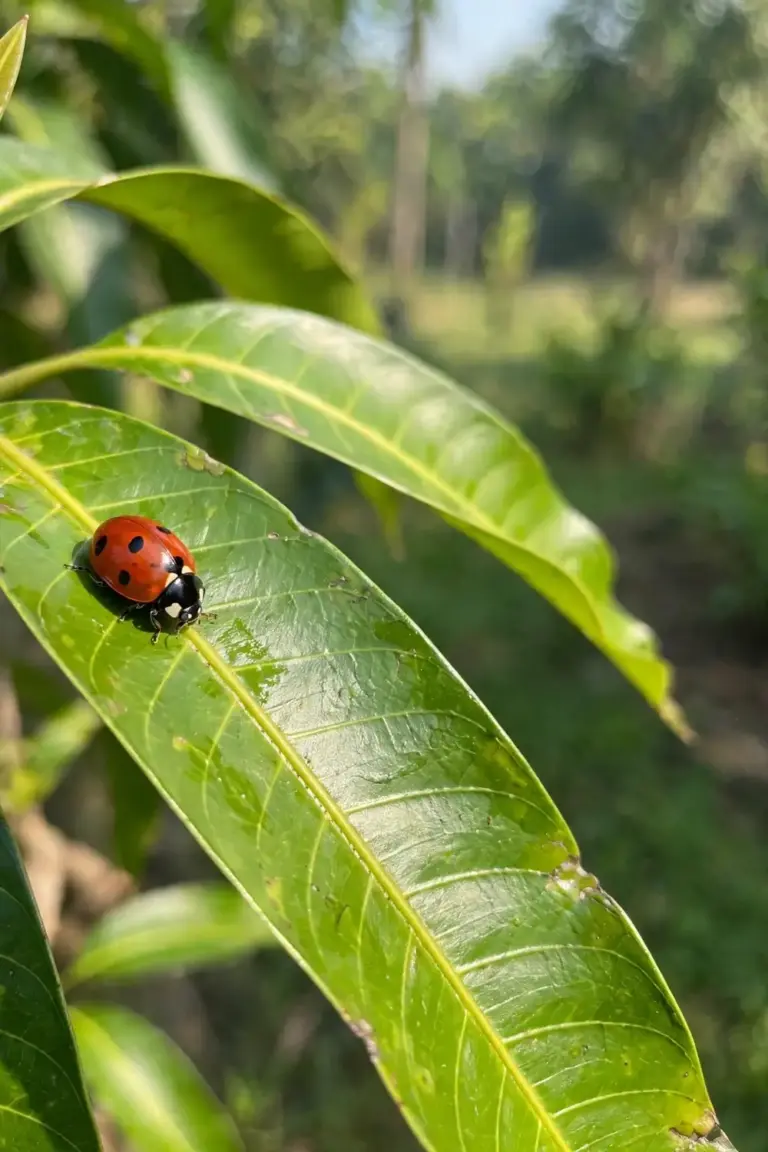
Keep them with three habits. First, never use broad-spectrum sprays on the tree, because broad-spectrum products kill predators and pests together, and the pests return faster. Second, leave a flowering understory under and near the tree, because adult lacewings, hoverflies, and parasitic wasps feed on nectar and pollen when they are not hunting. Herbs, small flowering shrubs, and groundcovers all work. Third, stop cleaning up every leaf. Leaf litter under the tree shelters predatory mites, spiders, and ground beetles through the dry season, and a bare swept floor starves them.
I have learned that the mango I bag before the flies find it beats the mango I spray after they do. The same logic applies to beneficial insects: protect the predators first, and the pest numbers stay low without a spray program. Check for beneficials during your weekly walk. Ladybird larvae look like tiny dark alligators, and they are easy to mistake for pests, so learn their shape before you wash anything off. If you see wasps hovering near a scale colony, leave them alone, because they are working. A mango tree that hosts ladybirds, lacewings, and wasps is a tree with a working defence system, and the best pest control is the one that never needs a spray bottle.
12. Set a Weekly Check That Catches the Next Outbreak Early
A weekly check turns pest control from crisis response into routine. Walk the tree once a week during the growing and fruiting season, and once a fortnight in winter. Carry a white sheet of paper, a hand lens, a cloth, and a bag for fallen fruit. Check fruit first, then flowers, then new growth, then leaf undersides, then bark. The order matters, because fruit damage costs the harvest, and bark damage is slowest to appear.
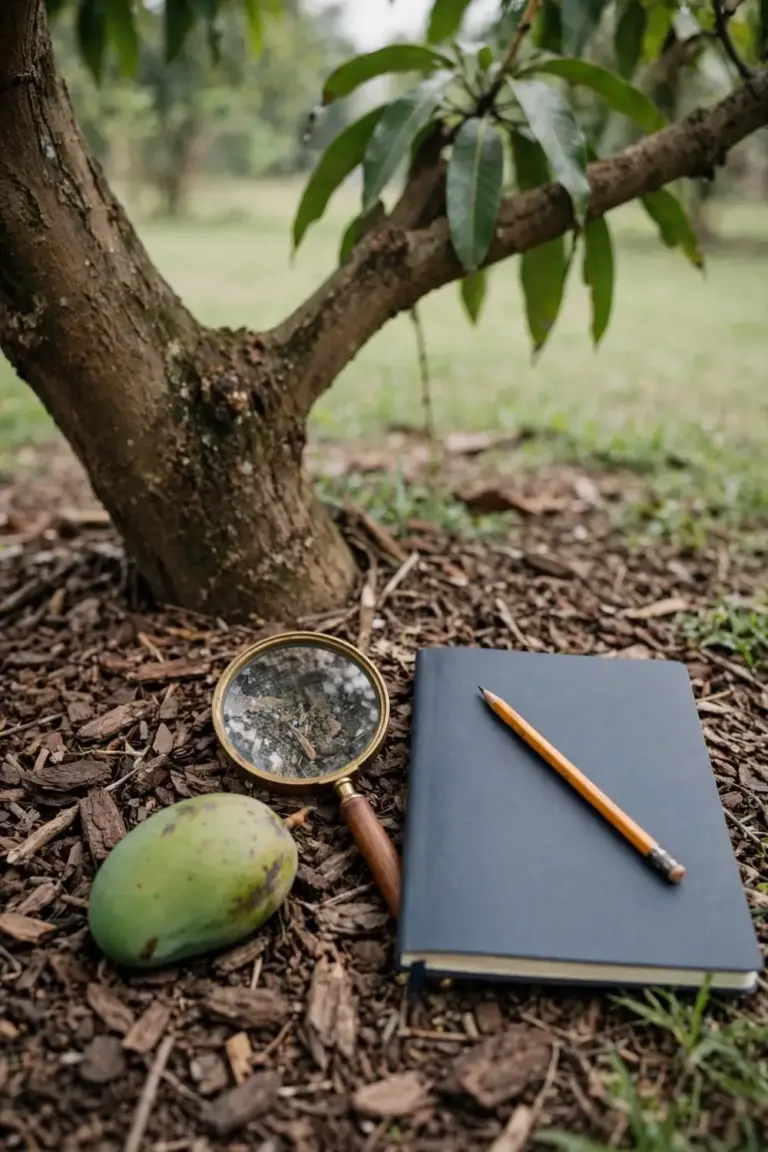
Record what you find. Note the date, the pest, the location on the tree, and the action you took. A notebook entry such as “scale on two lower branches, wiped, ants blocked” tells you next week whether the colony is growing or shrinking. Without a record, you will re-check the same colony three times and miss the new one on the far side of the tree. Check bark cracks for fine frass, which can signal bark beetle activity, and report anything you cannot name to the Exotic Plant Pest Hotline on 1800 084 881 rather than guessing at a treatment. Check the sticky band, the bag seals, and the net seals on the same walk, because a failed seal is an open door.
Prune for airflow on the same schedule. Open canopies dry faster after rain, and dry canopies carry fewer sap feeders and less sooty mold. Remove crossing branches and dead wood, and keep the center open enough that light reaches the inner leaves. Keep the ground under the tree clear of fallen fruit, but leave the leaf litter that shelters beneficial insects. Healthy soil grows a tree that tolerates pest pressure better, and the Growit soil health guide covers that foundation. For planting, feeding, and pruning a mango tree from the start, the Growit mango growing guide covers the growing regime this pest guide leaves out.
FAQ: Mango Tree Pests in Australia
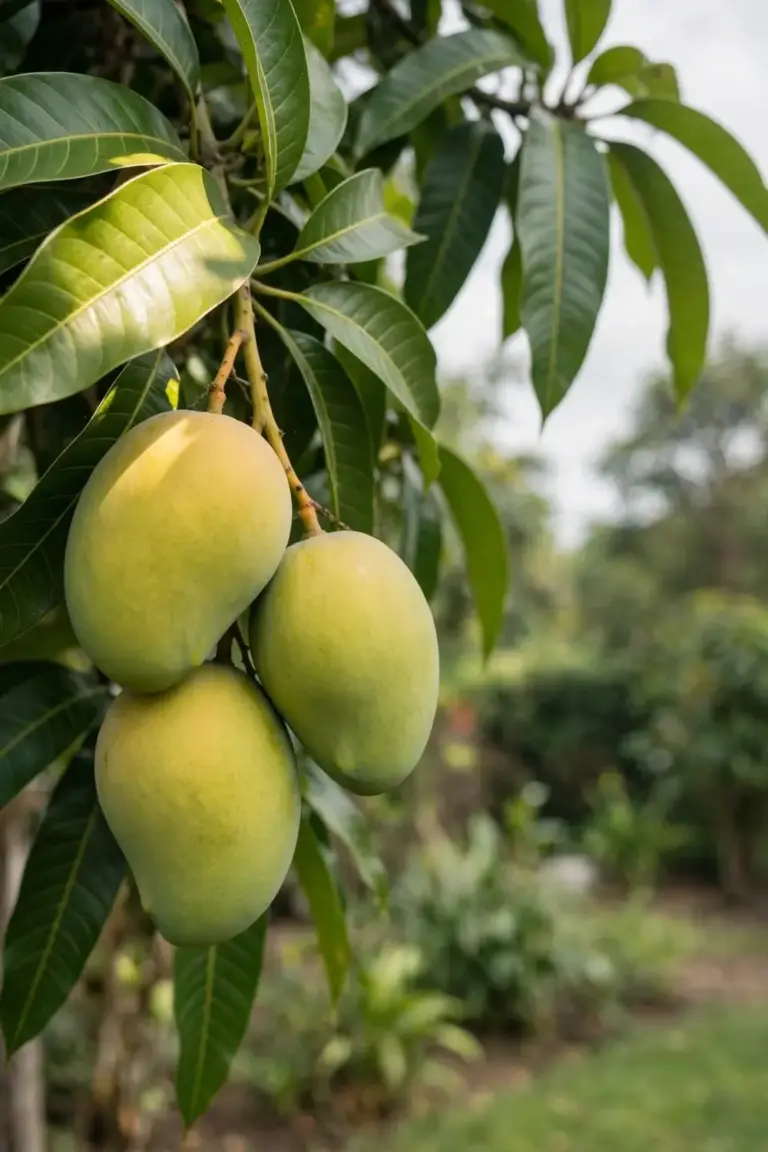
Fruit fly is the most likely culprit when fruit softens, drops, and shows maggots inside when cut open. Fruit spotting bug causes dimples and drop with no maggots. Seed weevil hides inside the seed with no flesh damage. Cut one dropped fruit open to separate the three, then bag sound fruit, pick up fallen fruit daily, and destroy maggots by freezing, boiling, or solarising in a sealed bag in the sun.
The black coating is sooty mold growing on honeydew from sap-feeding insects above it. Find the colony on stems, leaf undersides, or new growth directly above the blackest leaves. Wash the coating off with water, wipe or wash the colony off, and block any ants farming it. Treat the insects, and the mold dries up and flakes off with rain and time.
Leafhoppers, flower beetle, and thrips all damage flowers, and the grower usually sees only the fallen flowers in the morning. Tap a flower cluster over white paper to check for jumping leafhoppers or tiny thrips, and check at dusk with a torch for flower beetle. Hand-pick beetles into soapy water, wash leafhoppers and thrips off with water, and never spray open flowers.
Start with bagging, hygiene, water, wiping, and beneficial insects, because those steps control most backyard mango pests without a spray. Use a spray product only when a colony keeps returning after mechanical control, and choose the narrowest product that targets the pest. Follow the label exactly, keep pets and children off until dry, never spray in wind or rain, and never spray open flowers. The Growit organic pest control guide covers the same ladder for every garden pest.
Call 1800 084 881 whenever you find a pest you cannot name, damage that matches an exotic pest such as mango shoot looper or red-banded mango caterpillar, or a symptom that spreads fast across the tree. Photograph the pest and the damage, mark the spot, do not move suspect material, and do not collect samples without advice. Early reports give eradication a real chance.
Start With One Bagged Branch and One Weekly Walk
Mango pest control starts with two habits: bag the fruit you want to eat, and walk the tree once a week with paper and a hand lens. Bagging stops fruit fly and fruit spotting bug before they reach the fruit. The weekly walk catches scale, mealybug, leafhopper, and sooty mold while the colonies are small enough to wipe off. The hotline covers the rest: anything you cannot name goes to 1800 084 881, not to a spray bottle. Start with one bagged branch this week, and let the weekly walk do the rest.