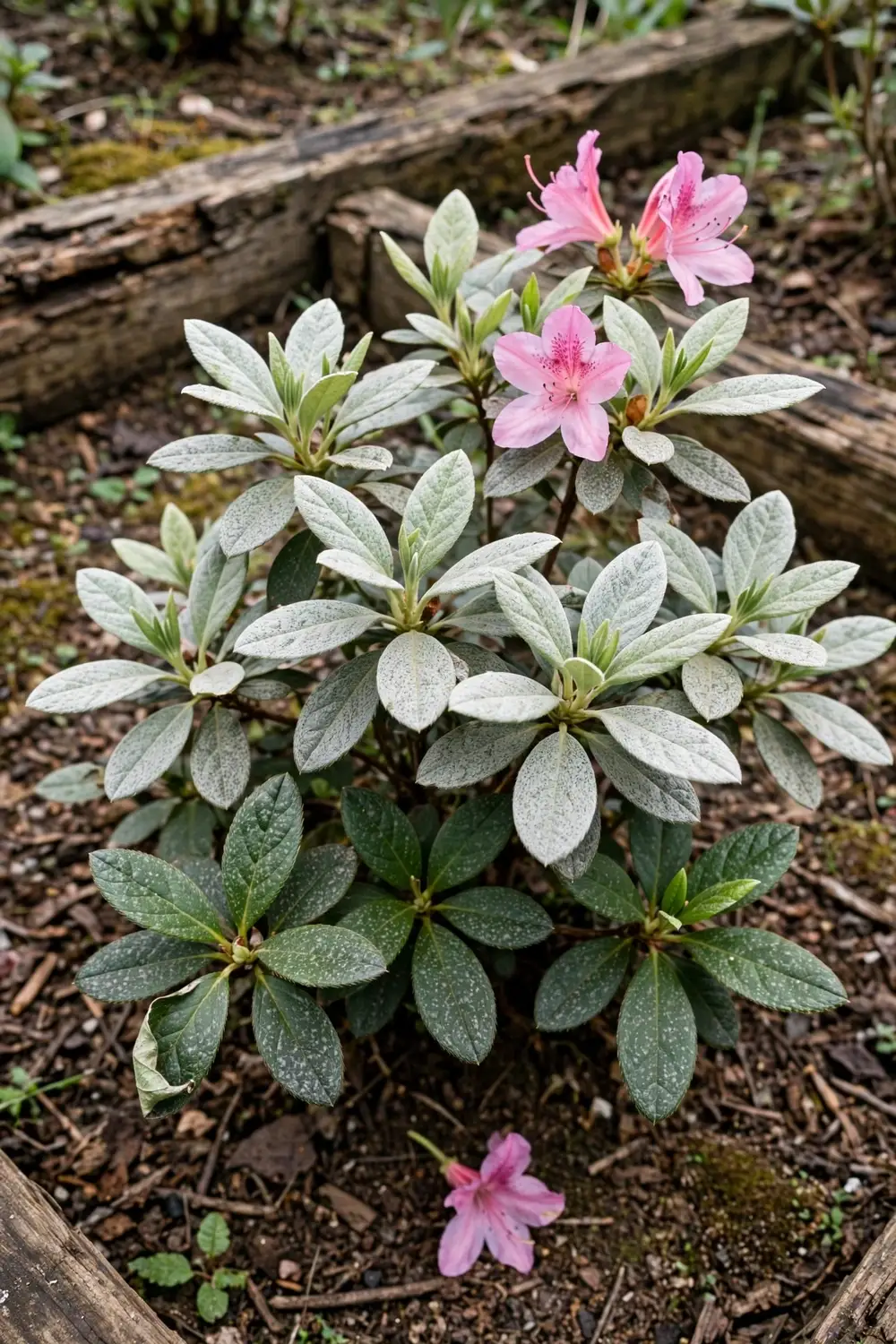

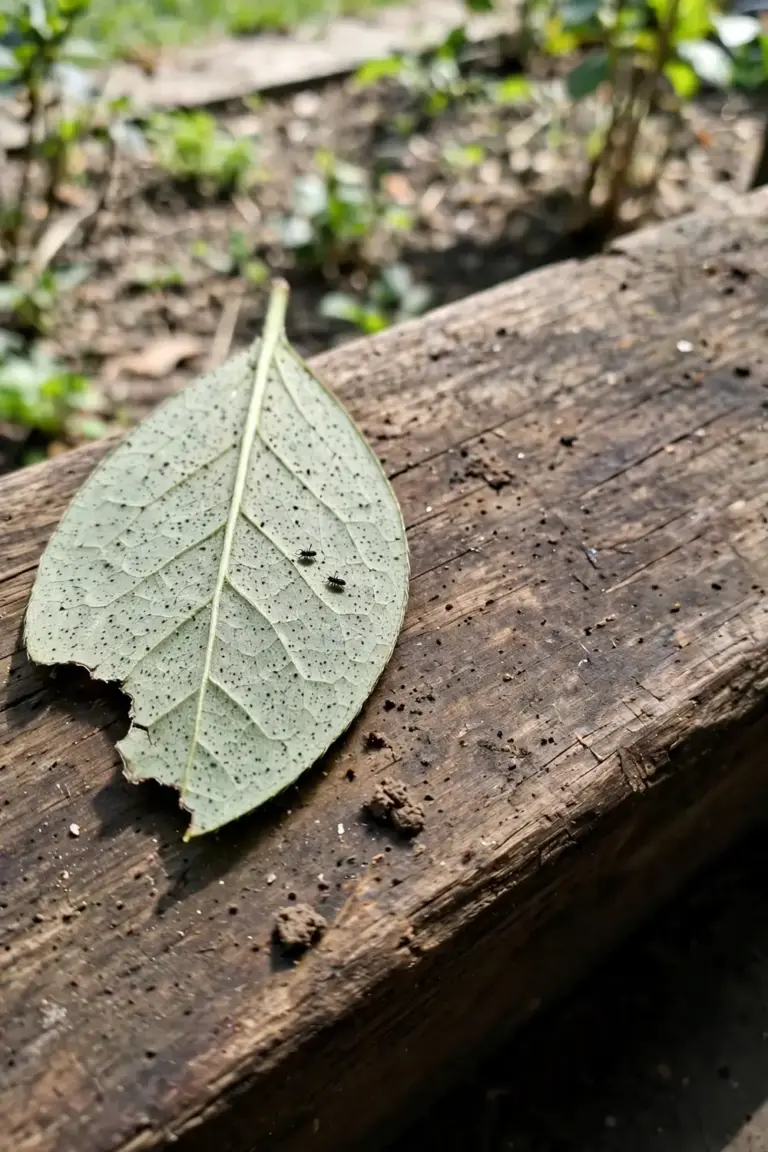
Flip one azalea leaf. Black dots underneath plus pale stippling on top name azalea lace bug. That pair of signs separates it from every other azalea pest, and the check takes 10 seconds.
Azalea lace bug is Stephanitis pyrioides, a sap-sucking insect that feeds on the underside of azalea leaves. It pierces leaf cells with needle-like mouthparts, drains the contents, and leaves empty cells behind as pale dots. I have learned that the leaf I flip over tells me more than any spray label does.
The rest of this page is 8 moves, from the three-sign ID check to the winter litter clean-up that stops next spring. The method is organic-first throughout, and it fits Australian gardens, where mild winters let lace bugs overwinter on plants and in litter. The organic pest control for beginners approach starts with identification, then moves to contact sprays that land on the insect, then to predators and prevention.
1. Check the Underside First: 3 Signs That Name Azalea Lace Bug
Three signs name azalea lace bug, and all three sit on one leaf. Pale stippling covers the upper surface. Black varnish dots speckle the underside. Spiny dark nymphs cluster underneath. Find all three and the ID is settled.
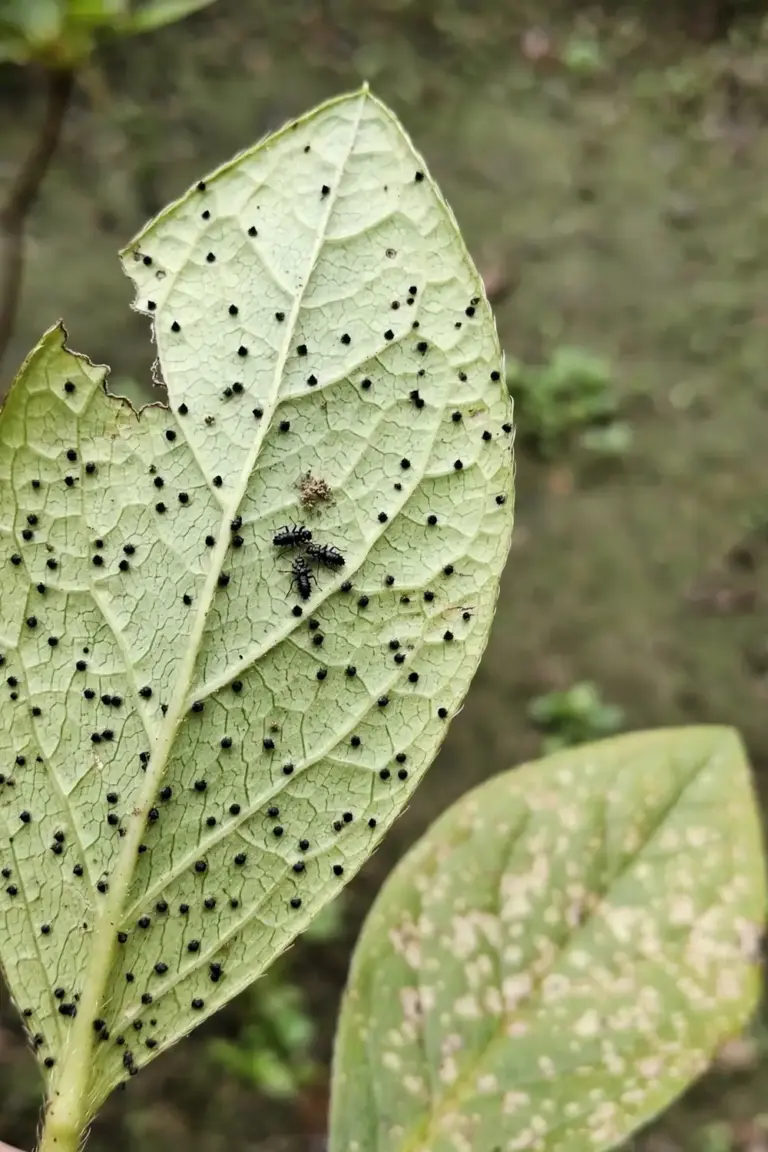
The adult is a small insect about 3 mm long and 1.5 mm wide, with lacy wings that carry brown and black markings, plus light brown legs and antennae, according to the NC State Extension azalea lace bug guide. The wings look like lace, and that pattern gives the insect its common name. Adults are hard to spot at first because they sit flat against the underside and measure only a few millimeters. A hand lens makes the lacy wings visible.
The egg is smooth and white, about 0.4 mm by 0.8 mm, flask shaped with its neck to one side. The female inserts each egg into the tissue of a young leaf along the midrib or a large vein, with the neck slightly above the leaf surface. 90 eggs have been found in a single leaf, and most sit irregularly along the midrib. Eggs spend winter inside the leaf, covered with a drop of excrement that hardens into a varnish-like shield.
The nymph is almost colorless at birth, then turns black and spiny. It molts six times and ranges from 0.4 mm to 1.8 mm before becoming an adult. After the fourth molt, wing pads show distinctly. Nymphs and adults both feed on the undersides of leaves. The bug has at least two generations per year in North Carolina, so a spring check and a second check later in the season both matter.
| Sign | What You See | What It Means |
|---|---|---|
| Pale stippling on top | Tiny pale dots across the upper leaf surface, spreading to a bleached or bronzed look | Lace bugs drained leaf cells from below |
| Black varnish dots underneath | Dark, shellac-like specks stuck to the lower leaf surface | Lace bug excrement, the single most reliable sign |
| Spiny dark nymphs underneath | Small wingless insects, black with spines, clustered on the underside | Active feeding colony, nymphs and adults together |
Stippling alone does not prove lace bug. Spider mites stipple too. The black varnish dots underneath are the deciding sign. Spider mites do not leave bug specks. Flip the leaf first, every time, before you reach for any spray.
Generations stack across the season. Spring nymphs grow into adults, lay eggs, and produce a second wave. Each wave adds stippling to more leaves. A shrub that carried lace bugs last autumn starts this spring with eggs already in the leaves. The spring check catches that first wave while the numbers are still small. The autumn check catches the last wave before it lays the eggs that overwinter.
2. Tell Azalea Lace Bug From Spider Mites, Thrips, and Leaf Miner
Azalea lace bug damage looks like several other pests at first glance. The underside check separates them. Each lookalike leaves a different signature underneath the leaf, and the treatment differs for each one.
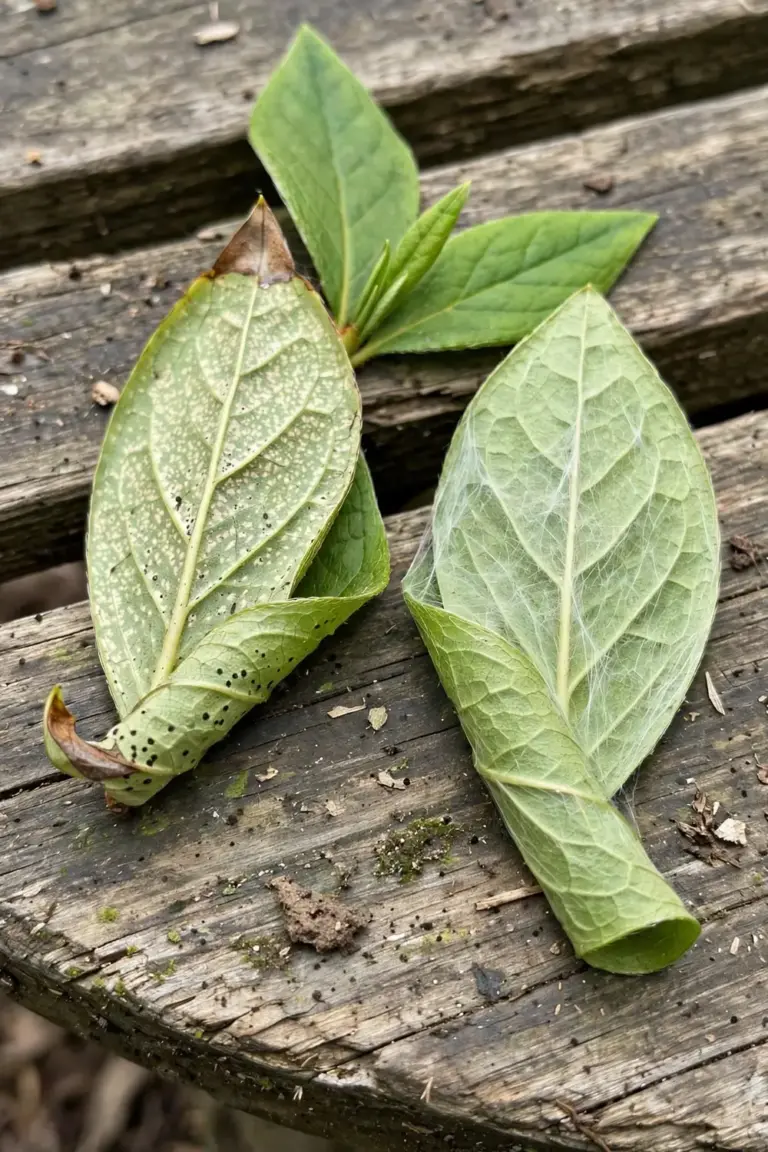
Spider mites cause stippling that resembles lace bug stippling. The underside tells them apart. Spider mites leave fine webbing and tiny mites, but they leave no black varnish dots. Lace bugs leave dark fecal specks on the lower leaf surface. If the underside carries black shellac-like dots, the pest is lace bug. If the underside carries webbing and no black dots, mites are the likely cause.
Thrips cause injury that resembles lace bug injury, but lace bug injury is coarser than thrips injury. Thrips are smaller, and their feeding leaves a finer silvering. Thrips also feed in protected dry areas such as unopened flower buds, while lace bugs stay on the undersides of leaves. Check the buds as well as the leaf undersides when thrips are a possibility. The location of the damage narrows the suspect list.
Leaf miner damage stays inside the leaf. The larva tunnels between the leaf surfaces and leaves a winding trail that shows through the upper surface. You will not find insects clustered on the underside, and you will not find black varnish dots. A winding trail with no underside colony points to leaf miner. A stippled leaf with an underside colony and black dots points to lace bug.
Azaleas growing in full sun suffer worse lace bug attacks than azaleas in filtered shade, according to the Mississippi State Extension azalea lace bug guide. Sun stress makes the plant an easier target. Some azalea varieties resist attack better than others. A plant in hot afternoon sun with stippled leaves deserves an underside check before any other diagnosis.
Check rhododendrons and mountain laurel too. Azalea lace bug attacks deciduous azalea varieties and mountain laurel as well as evergreen azaleas. The same three signs apply on those hosts: stippling on top, black varnish dots underneath, spiny nymphs clustered below. A rhododendron beside an infested azalea often carries the same colony. Treat the whole planting, not one shrub.
Act on the ID, not on the fear. A few stippled leaves on a vigorous shrub call for a hose jet and a watch. A shrub with bronzed leaves across the canopy, black dots on most undersides, and visible nymph colonies calls for the full ladder: hose jet, contact spray, predators, and a winter litter clean-up. The underside count decides the response. Light numbers get the jet. Heavy numbers get every step.
3. Blast Nymphs Off With a Hose Jet First
A hard jet of water from a garden hose knocks young nymphs off the leaf. The jet works best on the first hatch in spring, when nymphs are small, wingless, and clustered on the undersides. Aim the jet upward at the undersides, not down at the tops. Topsides need no spray, since the insects feed underneath.
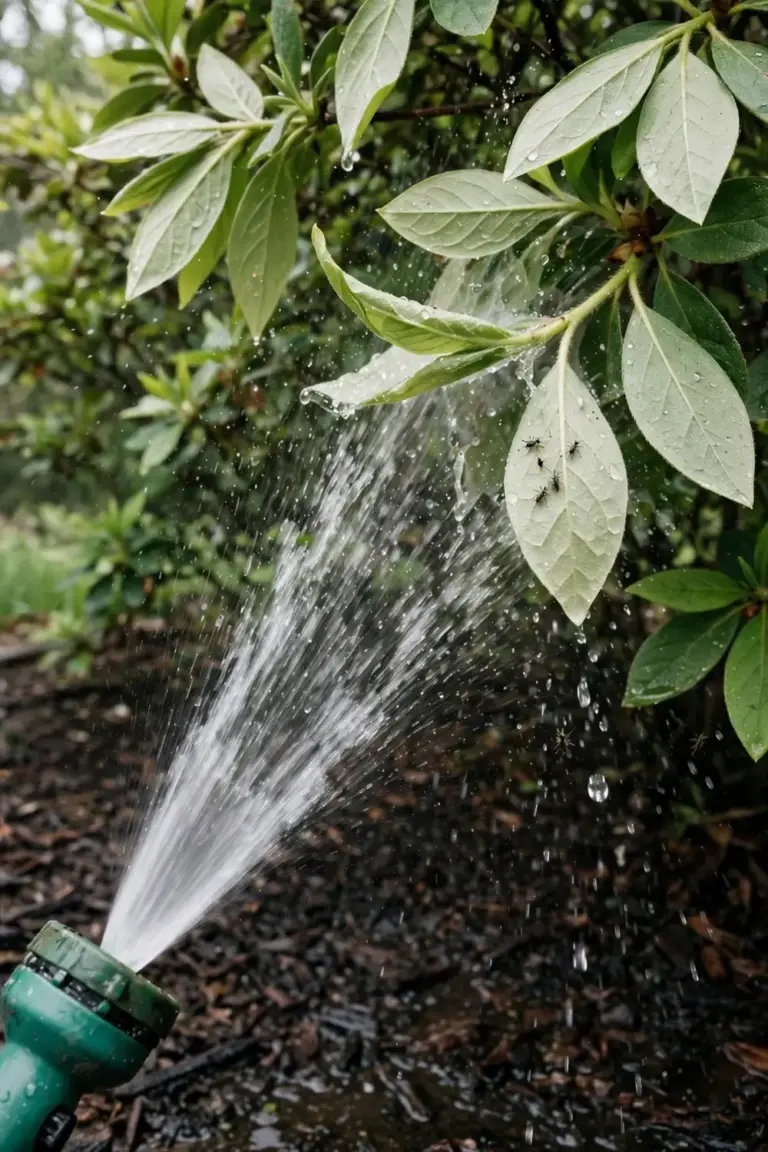
Work leaf by leaf on a small plant, or sweep the hose slowly across the undersides of a larger shrub. The jet dislodges nymphs onto the ground, where most do not climb back. Repeat the jet a few days later to catch nymphs that hatched after the first pass. Eggs hatch over a stretch of days, not all at once, so one pass never finishes the job.
Sweep the ground under the shrub after jetting. Dislodged nymphs that land on bare soil or mulch struggle to climb back onto the leaves. A quick rake of the litter under the shrub after the jet removes both fallen nymphs and some eggs sheltering in the debris. Bin the raked litter. The jet plus the rake clears the shrub and the floor in one visit.
In warm climates, lace bugs complete 3 to 5 generations in a single growing season, according to the UF/IFAS Extension azalea lace bug guide. That Florida figure shows why timing matters: each generation adds numbers through spring, summer, and autumn. Australian gardens run a shorter pressure season than Florida, but the principle holds. Early control of the first generation cuts the numbers that later generations build on.
Inspect plants in early spring to see if insects are present. Look for leaves that are whitish to yellow on the top surface and carry small dark varnish-like spots on the undersides. If leaf damage is heavy, check plants every week for small lace bugs. The first generation is the cheapest one to beat. Every nymph knocked off in spring is a generation that never happens.
4. Spray the Undersides With Neem, White Oil, or Insecticidal Soap
Contact sprays kill lace bugs only when the spray lands on the insect. The insects feed almost exclusively on the underside of the leaf. Spraying the topside wastes the product. Coat the undersides thoroughly, leaf by leaf, until the spray runs slightly.
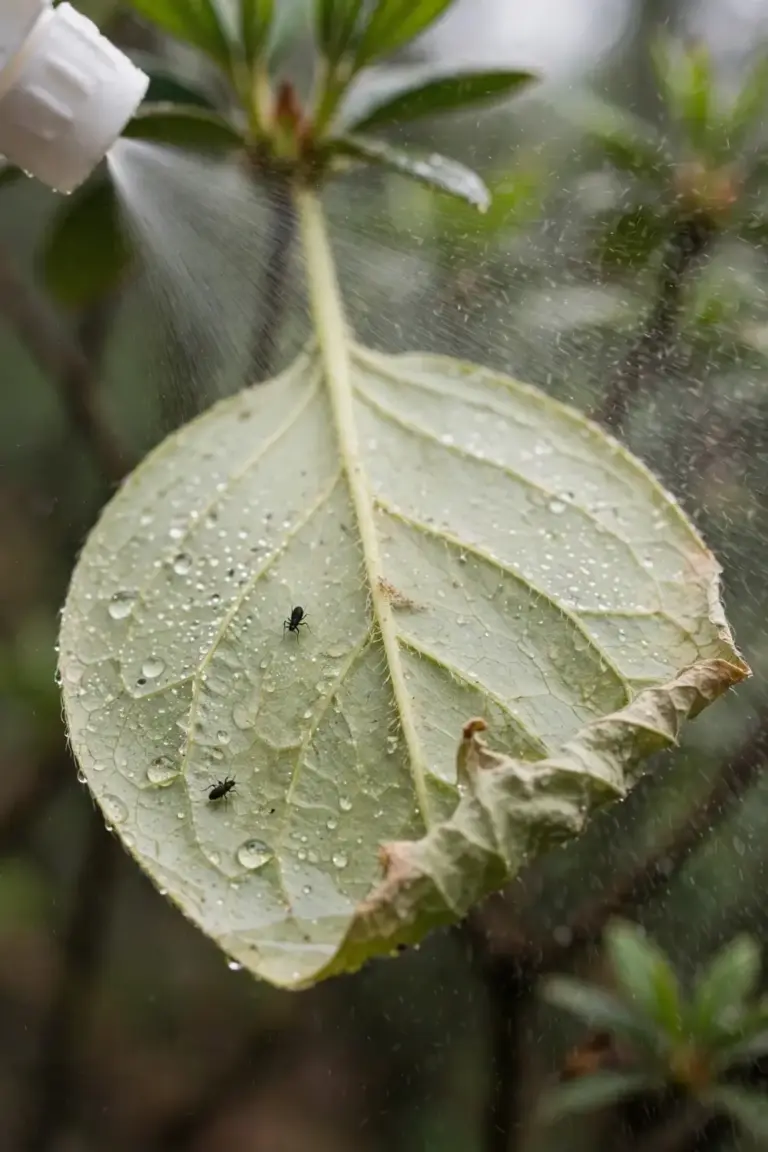
The contact options that suit an organic-first garden are neem oil, white or horticultural oil, insecticidal soap, and pyrethrum sprays. Bulleen Art and Garden lists exactly those four as the contact, non-residual insecticides for azalea lace bug, and warns that spraying the topside is a waste of time because these insecticides need to land on the lace bug to work, in its azalea lace bug guide. Each one works on contact. None of them leaves a long residue behind. That short action is the point: the spray kills the bugs it touches and then fades, so predators and pollinators face less exposure.
Apply in spring when nymphs are active and visible on the undersides. Nymphs are the softest target. Adults carry wings and move away from a spray more easily. A second application a week or two later catches nymphs that hatched after the first pass. Read the label on the product you buy, and follow its mixing and safety directions exactly. Labels differ between products and between brands.
Spray in the cool of the morning or evening. Hot midday sun dries the spray before it coats the insects, and wet leaves in strong sun scorch more easily. Calm air helps too. Wind blows the spray off the undersides and onto your face. A still morning with mild temperatures gives the spray time to coat the nymphs where they sit.
Re-check the undersides two days after spraying, nudging a leaf to see if nymphs still move. Live nymphs move. Dead nymphs stay still and dry out. If live nymphs remain, spray again and check your coverage. Missed undersides are the usual reason a spray fails, so slow down on the second pass. The spray works. The coverage decides it.
Insecticidal soap, horticultural oil, neem oil, and most synthetic insecticides provide good control of lace bugs on azaleas when applied to the backs of the leaves. The underside rule applies to every product type, organic or not. A spray that never reaches the underside never reaches the bug. Walk around the shrub and spray from below, not from above.
Damaged leaves do not heal. Stippled tissue stays stippled, and bronzed leaves stay bronzed. The spray stops new damage. New growth after treatment shows whether the treatment worked. Judge success by the new leaves, not by the old ones.
5. Release Predators and Let Them Work
Predators eat lace bugs. Ladybugs, lacewings, and predatory mites all prey on azalea lace bug. A garden that hosts predators keeps lace bug numbers lower without any spray at all. Predator release works best as a follow-up to the hose jet and the contact spray, not as a replacement for them.
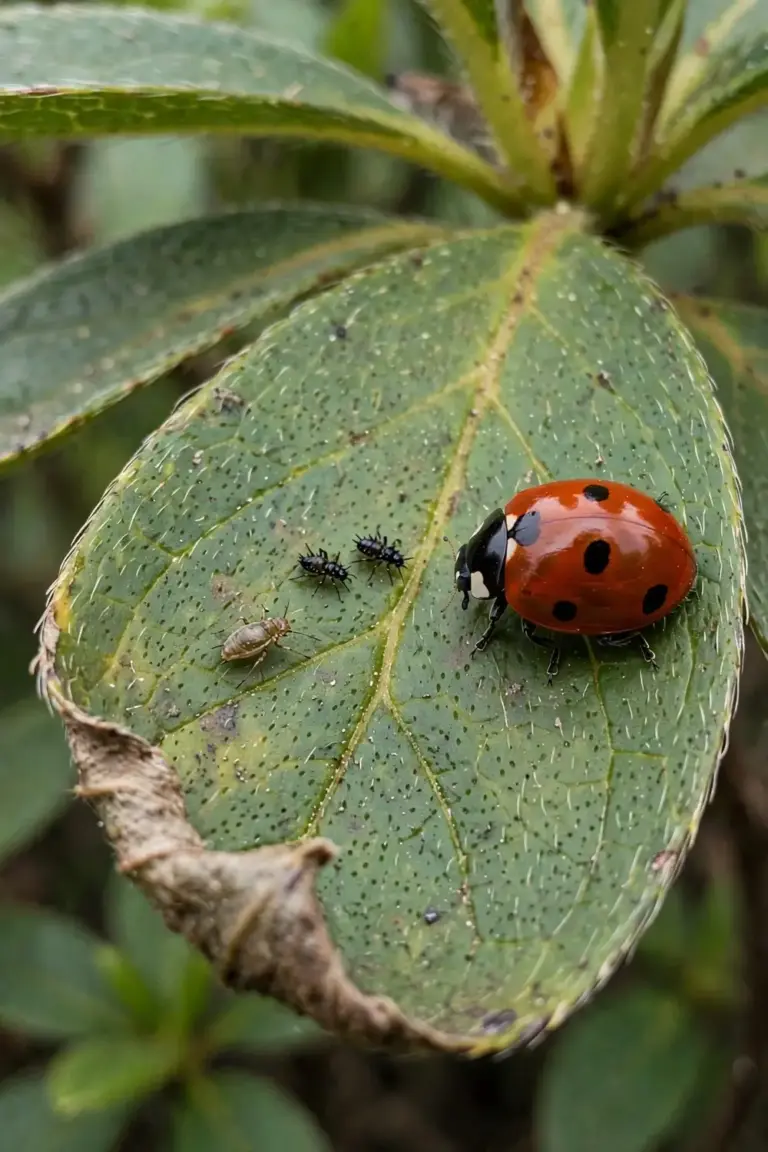
Order predators from a supplier such as Bugs for Bugs, which posts them to Australian gardeners. Release them onto the infested azaleas in the cool of the morning or evening, when they settle rather than fly off. Release near the undersides where the nymphs cluster. Predators need prey to stay, so release while nymphs are still present.
Plant diversity keeps predators around after release. A garden with a mix of flowering plants, ground cover, and shrubs holds predators between pest outbreaks. A bare garden with one azalea hedge and nothing else gives predators nowhere to live when the lace bugs are gone. The beneficial insects guide covers the planting that keeps predators on site.
Expect ladybugs and lacewings to arrive on their own once you stop broad spraying. A garden that has gone a season without residual insecticides builds a resident predator population. Released predators add numbers at the moment of need. Resident predators hold the line between outbreaks. Both matter, and the resident population matters more across a full season.
Avoid broad sprays while predators are active. A contact spray that kills lace bugs also kills the predators that eat them. Time the spray first, wait for the spray to fade, then release predators. That sequence gives the spray its kill and then hands the garden back to the predators. Spraying on top of a predator release wastes the release.
Predators do not erase an infestation overnight. They eat nymphs steadily and hold numbers down across the season. Expect fewer lace bugs over weeks, not a clean plant by tomorrow. Patience is part of the method. The payoff is a garden that regulates itself instead of needing a spray every month.
6. Strip the Winter Litter Before Spring
Lace bugs overwinter in two places: as eggs inside leaves, and as insects sheltering in the litter underneath the plants. Melbourne has relatively mild winters, so lace bugs overwinter fairly easily on azaleas and explode in numbers in spring, and they also overwinter in the litter underneath the plants. The litter is the part of the cycle you can break.
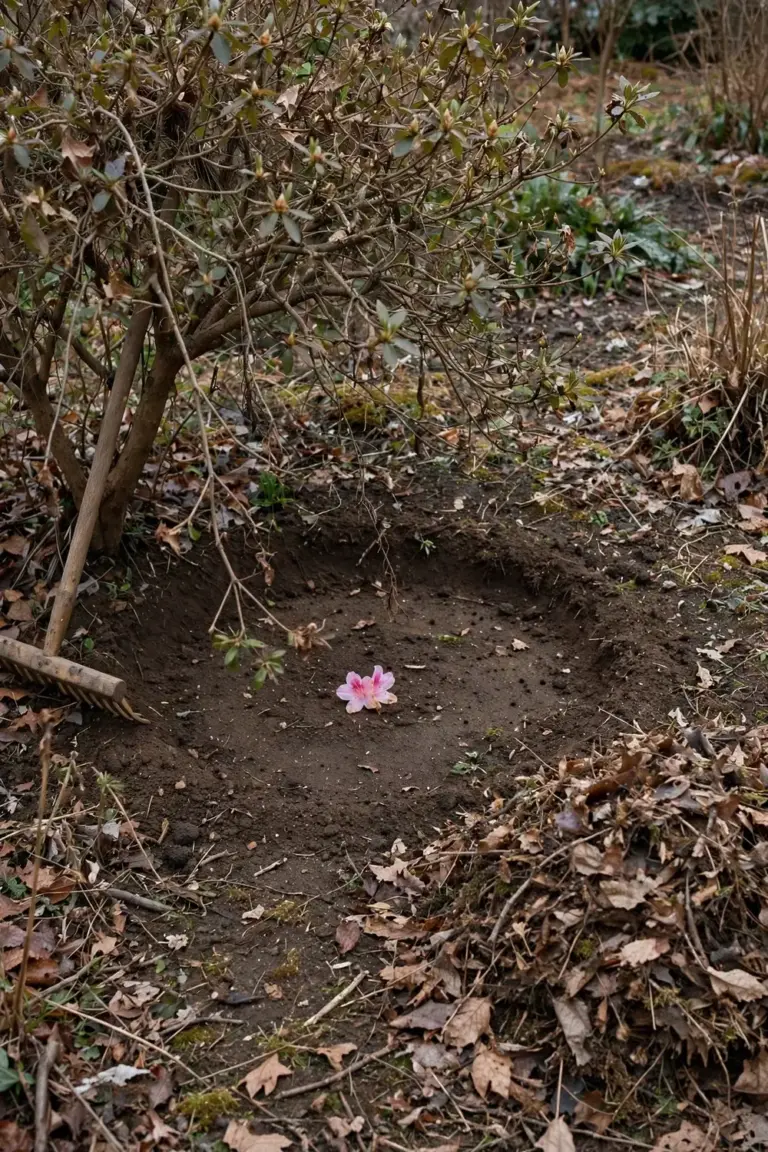
Remove all the leaf litter and old mulch from underneath infested azaleas for winter. Bag the litter and bin it. Do not compost it. Composting keeps the eggs and sheltering insects in the garden. A clean floor under the shrub removes the winter shelter. Re-apply fresh clean mulch next spring, after the litter is gone and the first checks are done.
Fresh mulch still matters. Mulch holds soil moisture, moderates soil temperature, and feeds soil life. The point is not bare soil forever. The point is one clean winter floor, then fresh mulch. The mulching guide covers mulch types and depths for garden beds.
Wash sooty mold off the leaves once the insects are gone. A gentle hose jet lifts the black coating from the leaf surface, and although the mold does not feed on the leaf, clean leaves photosynthesize better and the shrub looks better the same day. Wash after the insects are controlled, not before, because washing first spreads honeydew and mold across clean leaves.
Time the clean-up for late winter, before spring growth starts, and check the undersides at the same visit. Eggs sit along the midrib on the underside, and a hand lens shows them. A plant that carried lace bugs last season deserves a clean floor and an early spring check. Plants that stayed clean last season still deserve a look. Lace bugs spread from neighboring shrubs.
Sooty mold follows lace bug honeydew. Nymphs excrete honeydew, and the sticky coating grows sooty mold on the leaf surface. Sooty mold blocks light and slows photosynthesis. The mold itself does not feed on the leaf. It marks a plant that hosted honeydew producers. Clearing the mold starts with clearing the insects that made the honeydew. Wash the leaves with the hose jet once the insects are gone.
7. Skip Residual Systemics on Flowering Azaleas
Residual systemic insecticides are the wrong tool for this job in a home garden. Bulleen Art and Garden does not recommend residual systemic insecticides for azalea lace bug. Systemics move through the whole plant, including flowers, and they persist for weeks or months, so pollinators that visit azalea flowers meet the residue. The organic-first ladder reaches the same insects without that exposure, and it costs less than a systemic drench.
Systemic products also solve a problem you may not have. A light infestation on a healthy shrub causes cosmetic damage, not plant death. The shrub keeps growing, keeps flowering, and outgrows the damage once the insects are controlled. A systemic drench is a heavy answer to a light problem. Start with the hose jet, then the contact spray, then predators. Reserve stronger measures for a heavy infestation that keeps returning after the organic ladder has been run properly.
Never spray a flowering azalea with a systemic product while bees are active. Bees visit azalea flowers, and systemic residue reaches them through nectar and pollen. If a systemic ever becomes necessary, apply it after flowering, follow the label exactly, and keep it away from any plant in bloom. The label is the law for that product. Read it before you buy, not after you spray. A label that lists lace bugs on azaleas, gives a rate, and names a withholding period is the minimum you should accept.
Damage that looks severe can still be cosmetic. Bronzed leaves look alarming, but the shrub often recovers with new growth once the insects are controlled. Judge the plant by its new leaves and its next flush of growth, not by the worst old leaves. Prune the worst branches only if they block air flow or shade the interior. Most shrubs need no pruning at all after lace bug control.
8. Feed and Water the Shrub So It Outgrows the Damage
A healthy azalea outgrows lace bug damage faster than a stressed one. Stress invites attack. Plants under drought stress, in harsh afternoon sun, or in poor soil carry heavier infestations. The fix is not a stronger spray. The fix is a stronger plant.
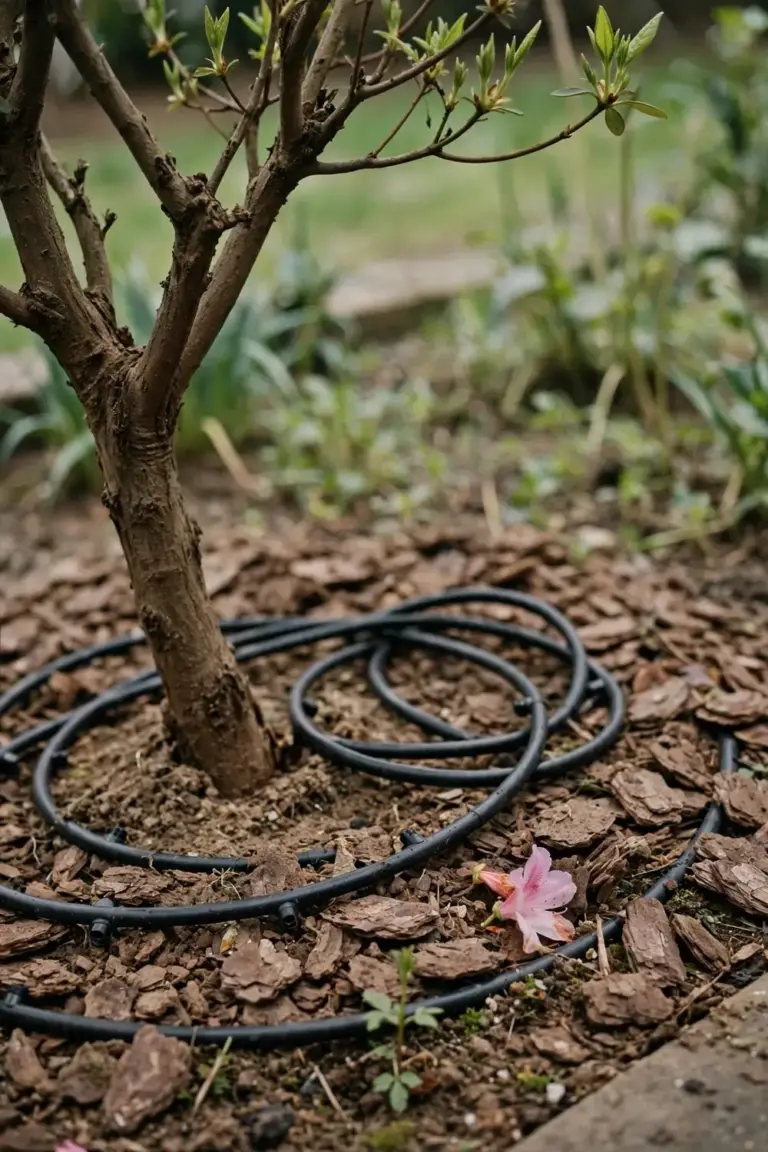
Water deeply during dry spells. Azaleas root shallowly, so the top soil dries first. A slow deep watering that wets the root zone beats a quick sprinkle that wets only the surface. Water at the base, not over the leaves. Wet leaves invite fungal problems that a stressed shrub does not need. Water in the morning so the foliage dries by evening.
Give the shrub morning sun and afternoon shade. Azaleas grow best with filtered light or morning sun. Hot western sun through a summer afternoon stresses the plant and invites lace bugs. A shrub in full sun that keeps getting lace bugs is telling you about its position. Shade cloth for the worst weeks, or a move to a sheltered spot in autumn, solves the recurring problem at its root.
Feed the shrub in spring with a fertilizer suited to acid-loving plants. Azaleas grow best in humus-rich soil that is neutral to acidic. A feed that suits camellias and rhododendrons suits azaleas too. Strong spring growth replaces stippled leaves with clean new foliage, and that new growth is the measure of recovery.
Mulch the root zone with a 5.1 to 7.6 cm layer, kept clear of the stems. The University of Maryland Extension recommends that mulch depth for trees and shrubs in its lace bug advice. Mulch holds moisture, steadies soil temperature, and feeds soil life as it breaks down. Keep the mulch off the stems themselves. Mulch piled against stems holds moisture against bark and invites rot.
Prune lightly to open the interior. Air flow dries the foliage faster after rain and lets spray reach the undersides. Remove crossing branches and dead wood. Do not hard-prune a stressed shrub. Light pruning plus water plus mulch does more for recovery than a heavy cut.
Frequently Asked Questions

Flip a leaf and look at the underside. Black varnish dots plus spiny dark nymphs confirm azalea lace bug. Pale stippling on top alone does not confirm it. Spider mites stipple too. The black dots are the deciding sign. Check several leaves across the shrub. Damage starts on a few leaves before it spreads.
A heavy, repeated infestation weakens the shrub, but lace bug alone rarely kills an established azalea. Bronzed leaves lose photosynthetic capacity, and the plant grows more slowly. Healthy shrubs recover with new growth once the insects are controlled. Young or stressed shrubs suffer more, so treat early and keep the plant watered.
Check undersides in spring, when the first nymphs emerge, and again in autumn, before the insects settle for winter. Melbourne mild winters let lace bugs overwinter on plants and in litter, so a late-winter litter clean-up plus a spring check breaks the cycle. Weekly checks suit a shrub that was infested last season.
Neem oil kills nymphs and adults on contact, but it does not reliably kill eggs. Eggs sit inside leaf tissue under a varnish-like shield. Time the spray for nymphs, not eggs. Spray when nymphs are visible on the undersides, then repeat a week or two later to catch the next hatch. The repeat pass is what makes the treatment work.
No. Damaged leaves do not heal. They still photosynthesize, and stripping them weakens the shrub. Prune only branches that block air flow or shade the interior. Leave the stippled leaves in place and judge success by new growth. New clean leaves mean the treatment worked. Old stippled leaves stay stippled.
Start With the Underside Check This Weekend
Flip one leaf this weekend. Black dots underneath plus pale stippling on top name azalea lace bug. A hose jet, a contact spray on the undersides, predators, and a winter litter clean-up form the full organic-first ladder. Run the ladder in order, and the shrub gets its leaves back.
Start with the check, not the spray. The underside tells you whether lace bugs are even present, how heavy the numbers are, and whether the first generation is still young enough for a hose jet to work. A correct ID saves a spray. A wrong ID wastes one. Ten seconds with a flipped leaf is the cheapest pest control you will ever do.