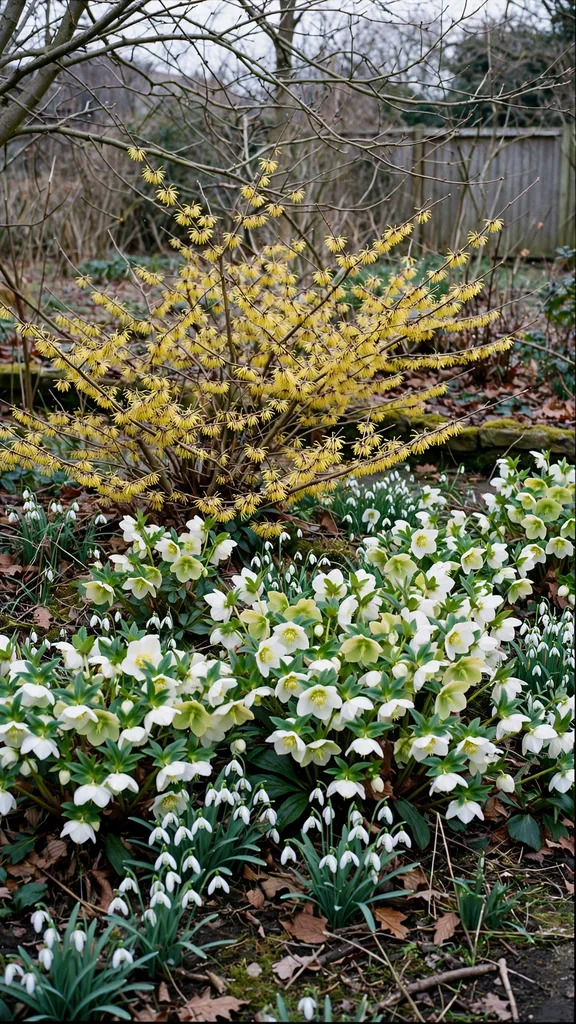
A garden does not have to wait for spring to flower. Snowdrops open in January, witch hazel scents a February path, and a winter cherry can throw blossom in a mild week in November, months before the first daffodil bed wakes up. The 45 plants in this list all flower in the cold months in temperate gardens, from the first sasanqua camellias of late autumn to the camellia finale of early spring.
The list groups into four jobs: bulbs and corms that push through cold soil, perennials and low growers for the front of the border, fragrant shrubs that carry scent on bare stems, and trees, climbers, and one big finish. Every plant gives its bloom window and its hardiness range, so you can match it to your zone and your coldest month.
I plan a winter border the way I plan a relay, with something handing over to the next every two or three weeks from November to March.
At a Glance: Pick Your Winter Flowers by Job
| Plant Group | Item Numbers | Best First Pick | Peak Weeks |
|---|---|---|---|
| Bulbs and corms | 1 to 10 | Snowdrop | January to March |
| Perennials and low growers | 11 to 20 | Christmas rose | December to March |
| Fragrant and flowering shrubs | 21 to 35 | Witch hazel | December to March |
| Trees, climbers, and the finish | 36 to 45 | Winter jasmine | November to April |
For flowers indoors over the same weeks, paperwhites for Christmas are forced on pebbles without any chilling, and the wider season sits in the Christmas garden ideas pillar. Everything below grows outdoors in the ground or in pots that stay outside.
1. Snowdrop (Galanthus nivalis)
The snowdrop is the plant that starts the winter flower year. Single white bells with a green mark at the petal tips hang from 10 to 15 cm (4 to 6 in) stems from January into March, opening through frost and even through a light fall of snow. A drift under a deciduous tree or along a path edge reads from a window, which is where winter flowers earn their place.
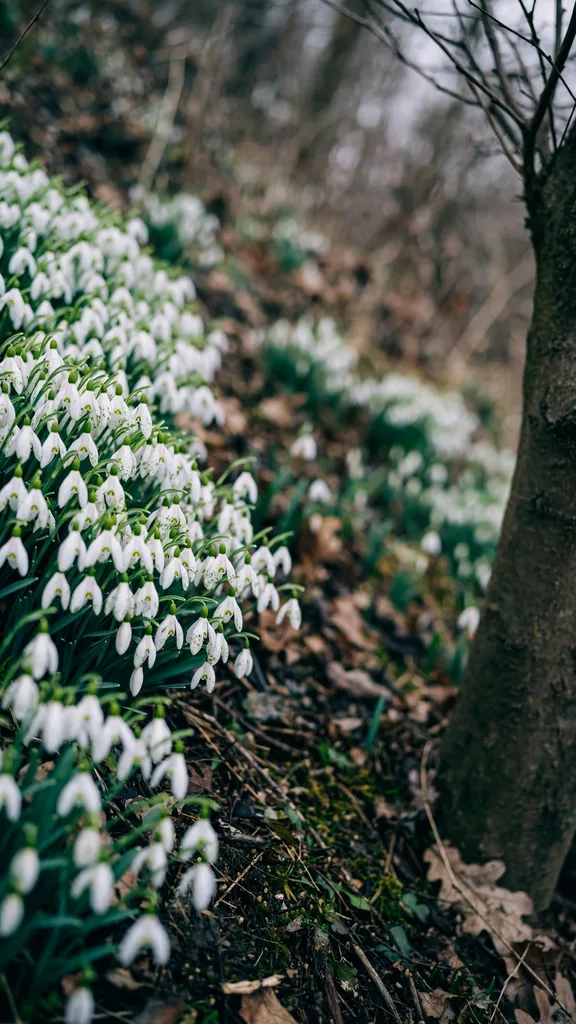
Plant the bulbs in autumn, 7 to 10 cm (3 to 4 in) deep, in soil that stays moist in winter and dries a little in summer. Snowdrops are hardy in zones 3 to 8 and resent being moved as dry bulbs, so buy them in leaf in spring where you can, divide clumps just after flowering, and replant the same day. Leave the leaves to die back on their own.
2. Winter Aconite (Eranthis hyemalis)
Winter aconite opens glossy yellow cups over a ruff of green leaves in February and March, often in the same week as the first snowdrops. The flowers sit almost at ground level, 5 to 8 cm (2 to 3 in) tall, and close at night and in dull weather, then open wide on the first bright morning. A carpet under shrubs or along a wall base glows against bare soil.
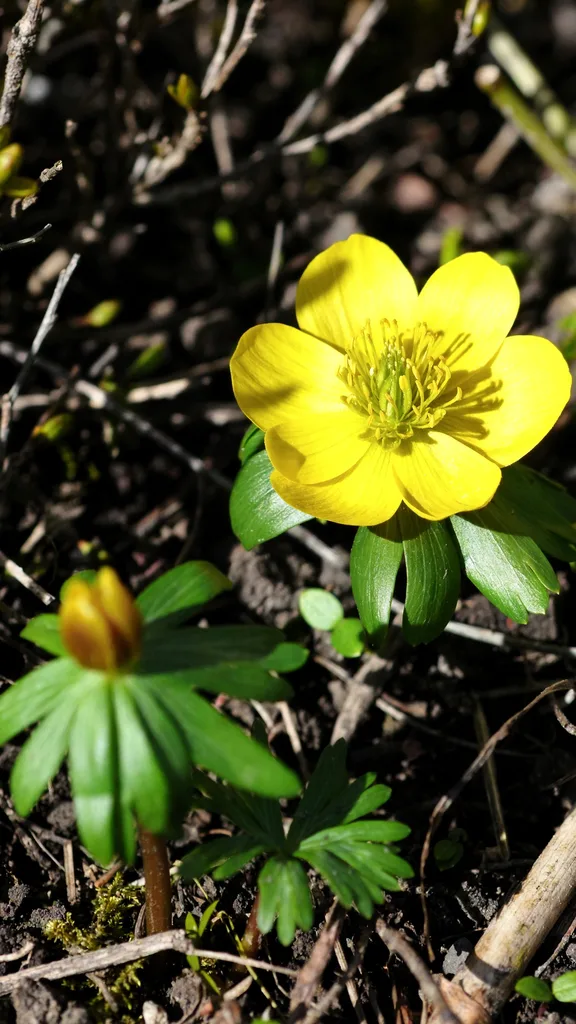
The tubers are hardy in zones 4 to 9 and do best soaked overnight before planting in autumn, set 5 cm (2 in) deep in humus-rich soil that does not dry out in spring. Aconites self-seed freely once settled and can take three years to build a real carpet, so plant them where they can spread and leave the seed heads standing.
3. Early Crocus (Crocus tommasinianus)
This is the crocus that beats the species beds by weeks. Slim lilac to purple goblets open in February and March, 8 to 10 cm (3 to 4 in) tall, closing at night into tight buds that shrug off frost. It flowers before most lawns wake, so a planting through grass or at a path edge gives color while the garden is still brown.
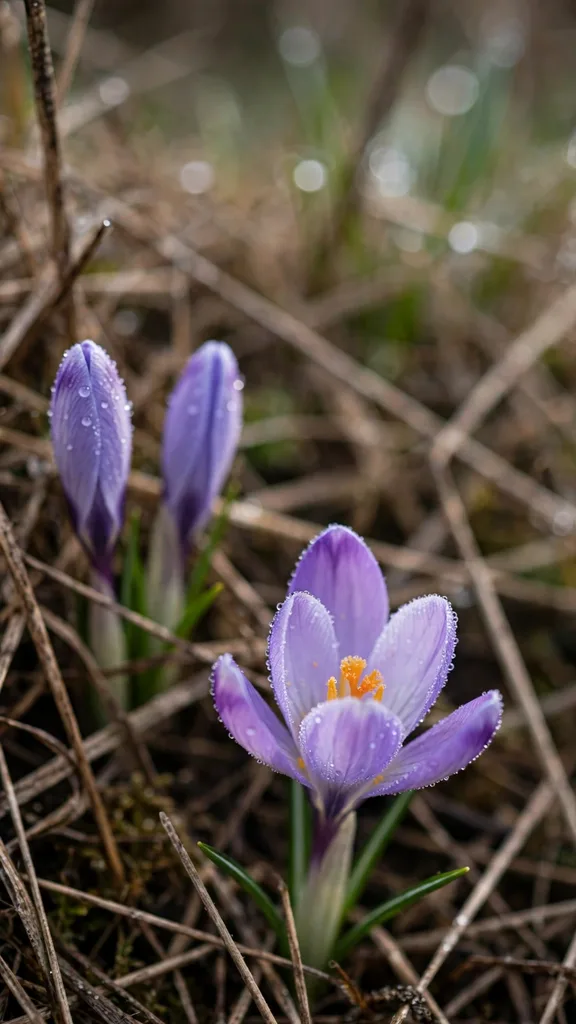
Hardy in zones 3 to 8, it self-seeds more freely than any other crocus and builds colonies in a few seasons. Plant the corms 7 to 10 cm (3 to 4 in) deep in autumn in any free-draining soil. Squirrels dig crocus corms, and this species is said to be the one they leave most often, which is one more reason it naturalizes so well.
4. Reticulated Iris (Iris reticulata)
A miniature iris with the finish of a florist’s flower at ankle height. Violet, blue, or purple blooms with a gold and white signal open in February and March on 10 to 15 cm (4 to 6 in) stems, before the narrow leaves lengthen. One pot by the front door perfumes a whole step on a still day, and a drift in a gravel garden looks deliberate all winter.
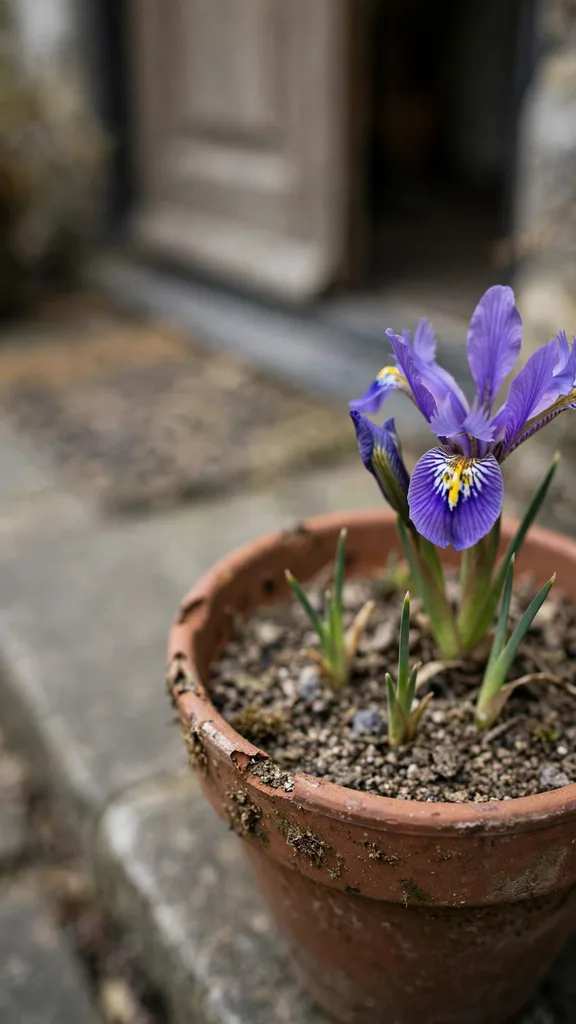
The bulbs are hardy in zones 5 to 8 and need the opposite of the snowdrop: a hot, dry rest in summer. Plant 10 cm (4 in) deep in autumn in gritty, free-draining soil or in pots of bulb fiber, and keep summer bedding water away from them. In heavy soil the bulbs split into small offsets that skip a year of flowering, so drainage is the whole game.
5. Algerian Iris (Iris unguicularis)
The longest-running flower on this list. From November to March, in every mild spell, this iris pushes up lilac-blue blooms on short stems from a clump of tough evergreen leaves, and each flower lasts only a few days before the next buds follow. Picked in bud and brought indoors, the flowers open in a vase with a sweet scent.
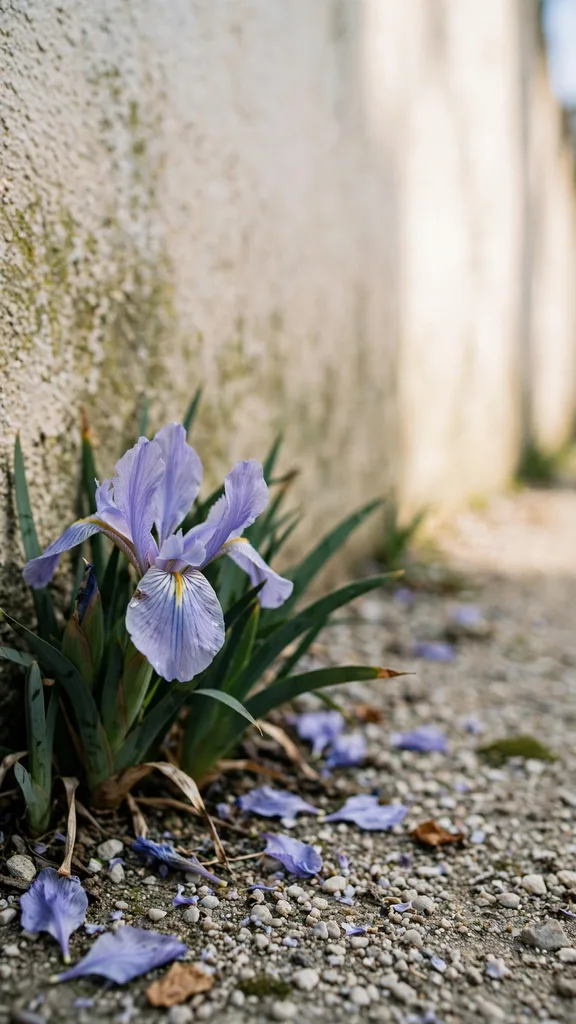
It is hardy in zones 7 to 9 and flowers best half-starved: a hot, poor, dry spot at the base of a sunny wall, planted shallow in gritty soil. Rich feeding and winter wet give leaves instead of flowers. The foliage looks untidy by design, so cut out only the dead leaves in autumn and leave the clump alone for years.
6. Hardy Cyclamen (Cyclamen coum)
Round leaves marbled with silver carry small pink, magenta, or white flowers with swept-back petals from December to March. At 5 to 8 cm (2 to 3 in) tall it is a plant for the front of a shady border, the base of a hedge, or a pot on a cold porch step, where the leaf pattern carries the display for months before the flowers start.
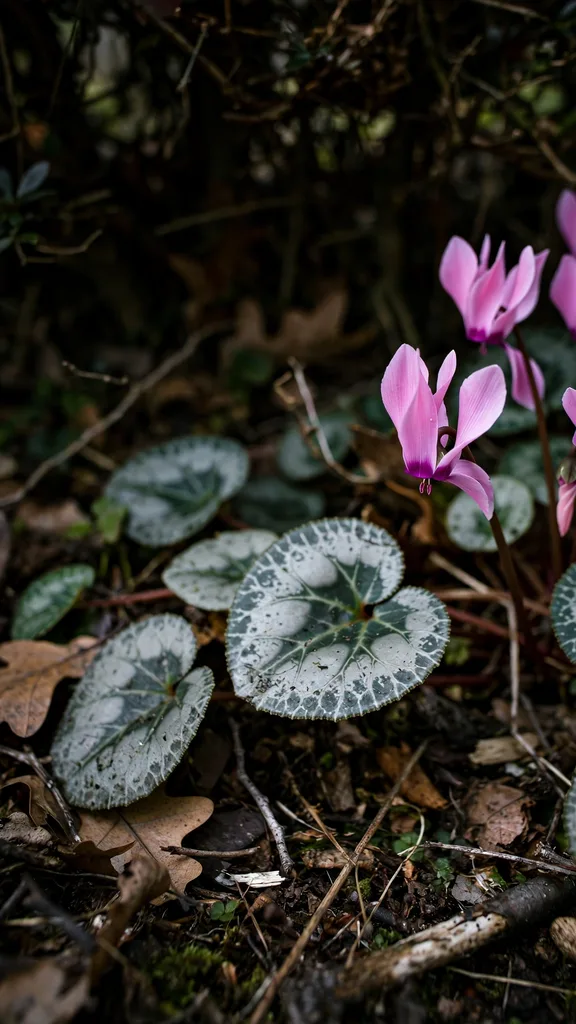
The tubers are hardy in zones 5 to 8 and want shade and leaf mould rather than sun and feed. Plant them just below the surface in autumn in soil that drains freely, and never let summer watering rot the dormant tubers. Ants carry the seed, so seedlings appear in gravel and path cracks around an old clump, which is the cheapest way this plant spreads.
7. Early Daffodil ‘February Gold’ (Narcissus ‘February Gold’)
A full daffodil in miniature, in flower weeks before the main beds. Golden trumpets on 15 to 20 cm (6 to 8 in) stems open from late February in most gardens and earlier in mild ones, standing up to wind that flattens taller varieties. A group at the base of a winter shrub doubles the display on the same square of soil.
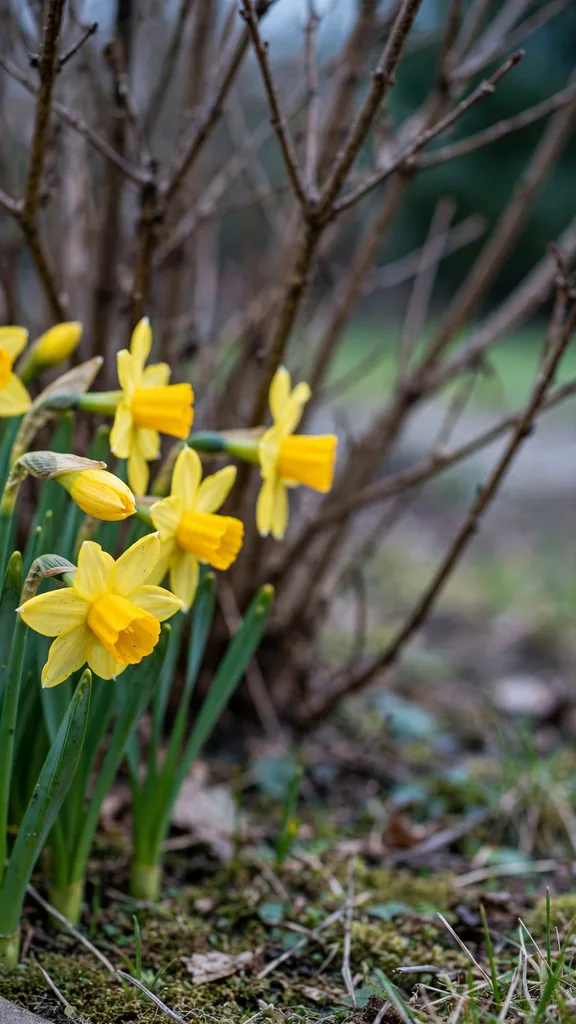
Plant the bulbs in early autumn, three times as deep as the bulb is tall, in any soil that is not waterlogged. Hardy in zones 4 to 8, it naturalizes in grass and borders and multiplies steadily. Deadhead the spent flowers but leave the leaves for six weeks, and mark the clump before the foliage vanishes so autumn planting does not slice through it.
8. Spring Snowflake (Leucojum vernum)
Taller and later than the snowdrop it resembles, the spring snowflake carries white bells tipped with green on 20 to 30 cm (8 to 12 in) stems in February and March. It takes the wet ground that snowdrops dislike, so it is the pick for a boggy corner, a ditch edge, or heavy clay where little else flowers this early.
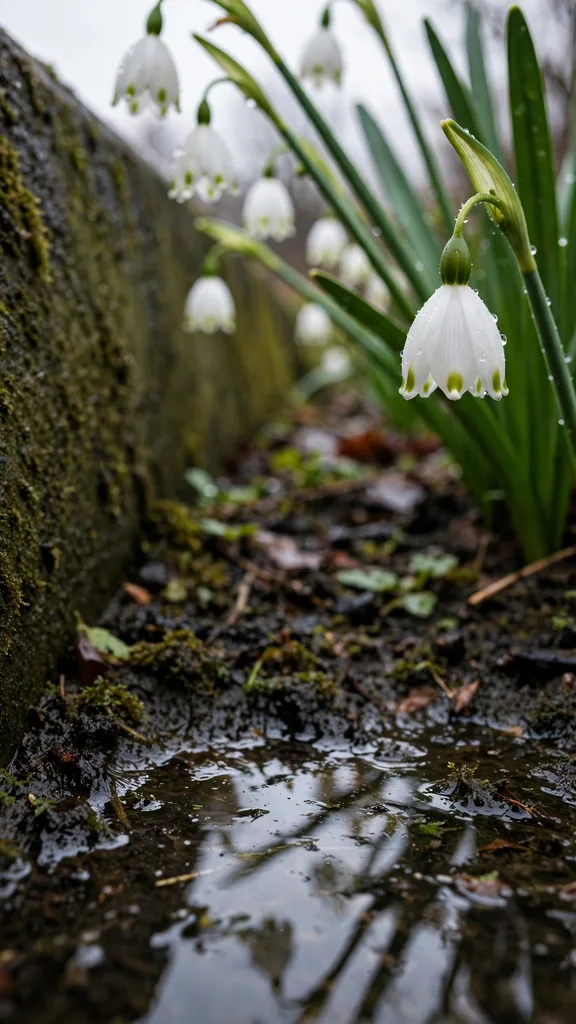
Hardy in zones 4 to 8, it wants moisture all year and sulks in dry shade. Plant the bulbs in autumn, 10 cm (4 in) deep, in soil enriched with compost, and divide crowded clumps in leaf after flowering. Given steady damp it spreads slowly into drifts that hold their own against early daffodils.
9. Siberian Scilla (Scilla mischtschenkoana)
The earliest scilla, flowering while its relatives are still underground. Spikes of pale blue, almost white flowers with a darker stripe open in February and March, 10 to 15 cm (4 to 6 in) tall, and the whole plant is finished and dormant by late spring. It suits the front of a border that fills in later with summer perennials.
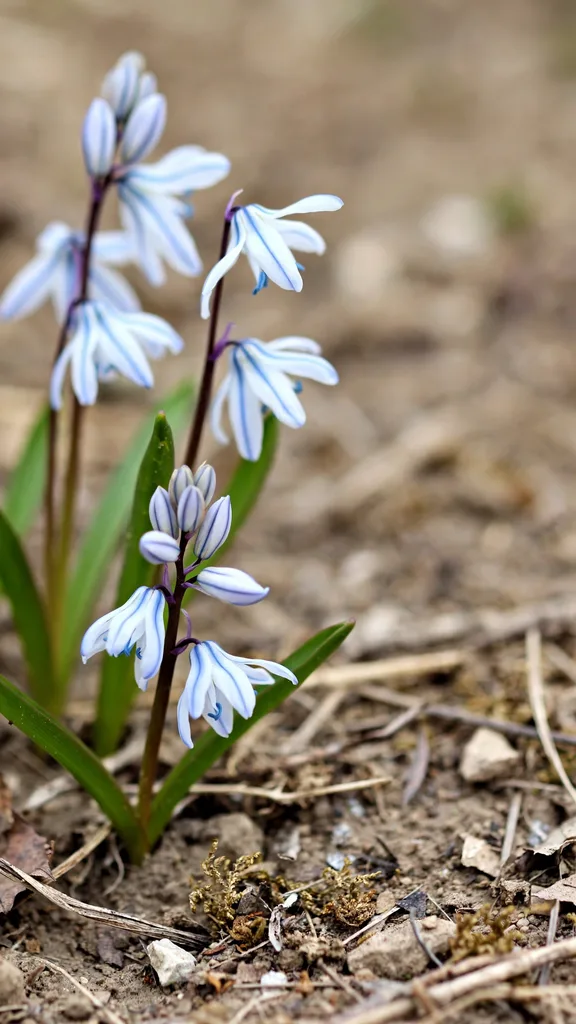
Bulbs are hardy in zones 4 to 8 and ask only for drainage and a sunny or lightly shaded spot. Plant in autumn, 7 to 10 cm (3 to 4 in) deep, in groups of a dozen or more, because single bulbs vanish visually at this scale. It self-seeds gently and the seedlings flower in their second or third year.
10. Glory of the Snow (Chionodoxa forbesii)
Starry blue flowers with white eyes open in February and March over narrow leaves, 10 to 15 cm (4 to 6 in) tall, and a colony in a lawn or rock garden reads as a blue haze from a distance. It flowers as the snowdrops fade, which makes the pair a simple two-act opening for the bulb season.
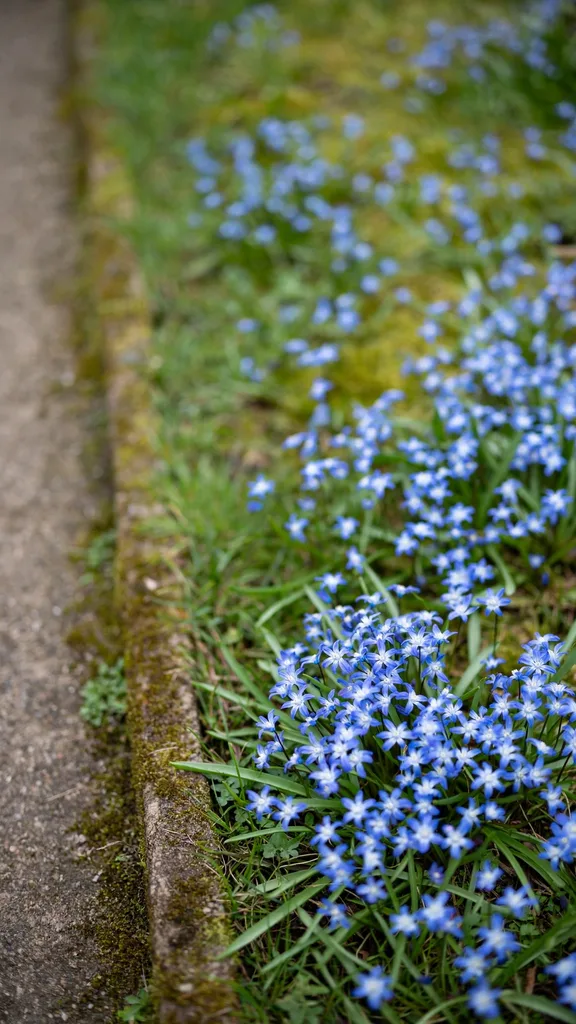
Hardy in zones 3 to 8, it tolerates cold that stops most early bulbs. Plant the small bulbs in autumn, 7 cm (3 in) deep, in any free-draining soil in sun or light shade. It seeds and offsets freely, so one planting of fifty bulbs becomes a drift within five years without any further work.
11. Christmas Rose (Helleborus niger)
The plant this season is named for. White saucers with a boss of gold stamens open from December to February over dark evergreen leaves, on a plant 30 cm (12 in) tall that holds its foliage all year. In a mild December a clump by the door is in flower for Christmas Day itself, and the blooms age to green and hold for weeks more.
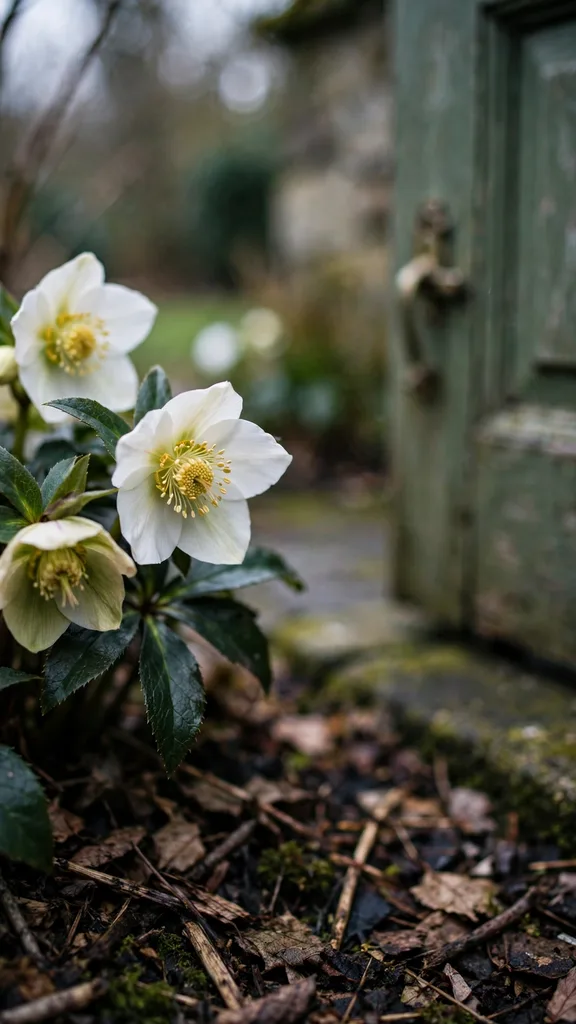
The NC State Extension entry for Helleborus niger lists it as hardy in zones 3 to 8, flowering through winter in well-drained, humus-rich soil. It resents disturbance and dry roots in summer, so plant it in autumn or spring in a shady spot that stays moist, mulch with leaf mould, and then leave the clump untouched for years. All parts are toxic, so site it away from grazing pets.
12. Lenten Rose (Helleborus × hybridus)
Where the Christmas rose is white and early, the Lenten rose is everything else and longer. Saucers in pink, plum, apricot, spotted, and near-black open from February into April on plants 45 cm (18 in) tall, and a single clump can carry flowers for ten weeks. Seedlings vary, so a group planted together becomes a varied mixture of shades by its third winter.
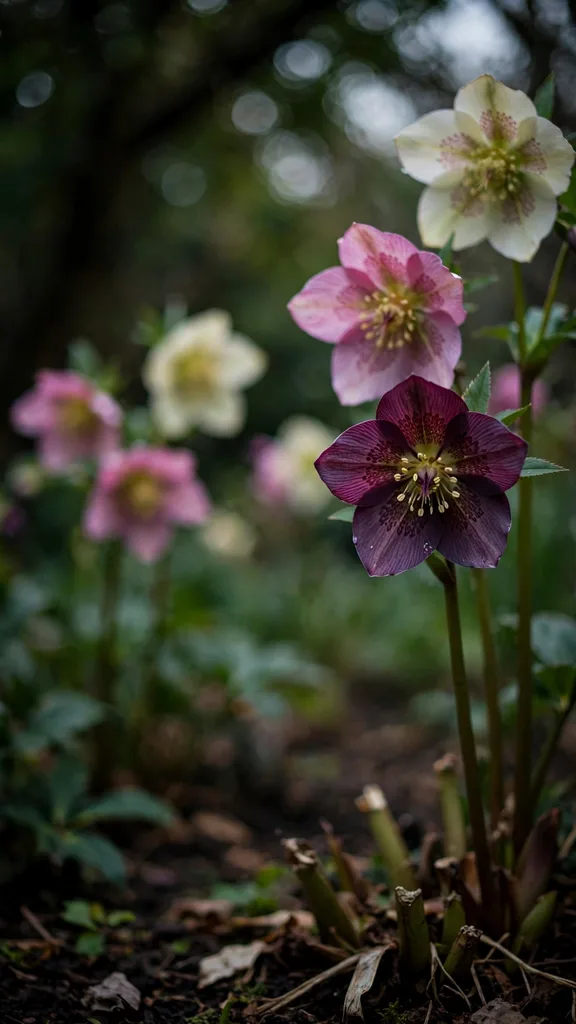
Hardy in zones 4 to 9, it wants the same shade and moisture as its white cousin and the same patience: plants sulk for a year after moving. Cut the old leaves away in late winter before the flower stems rise, both to show the blooms and to remove the leaves that carry fungal spots into the new season.
13. Stinking Hellebore (Helleborus foetidus)
No scent to speak of and no need of one. Upright stems of dark, divided evergreen foliage carry clusters of pale green bells edged with maroon from January to March, at 60 cm (24 in) the tallest hellebore on this list. It is an architecture plant that flowers, and it lights up a dry shady corner that defeats most winter color.
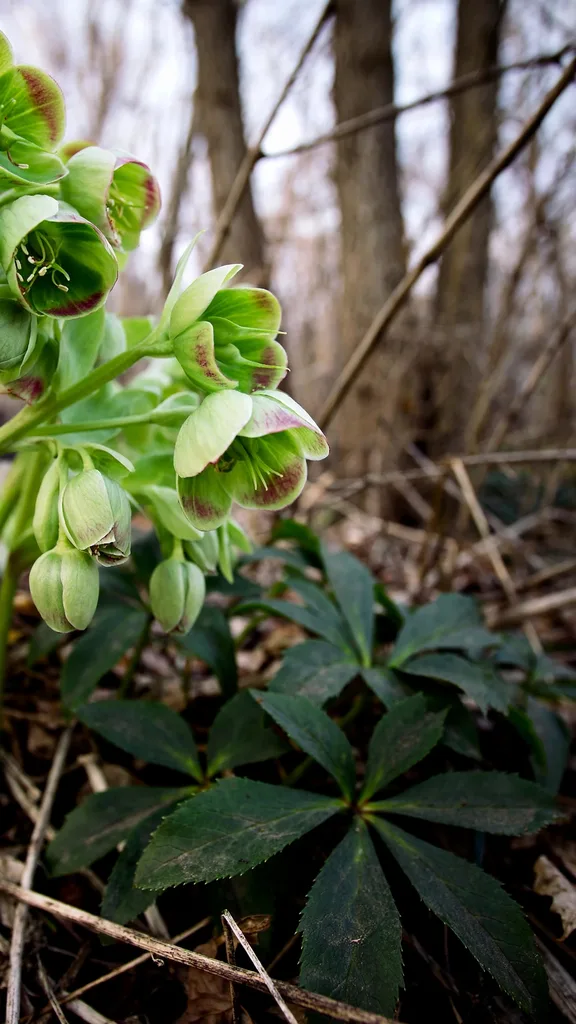
Hardy in zones 5 to 9, it is the hellebore for dry shade and poor soil, self-seeding into gravel and under trees. The name comes from the smell of a crushed leaf, which nobody crushes twice. Give it room, let the seedlings stand where they land, and replace tired plants from their own offspring every few years.
14. Winter Heath (Erica carnea)
A low carpet of needle leaves covered in urn-shaped flowers from December to March, in white, pink, and deep rose, on plants 15 to 30 cm (6 to 12 in) tall. It flowers through snow, feeds the first bees on mild days, and covers a bank or a grave-shaped problem bed better than anything else this season.
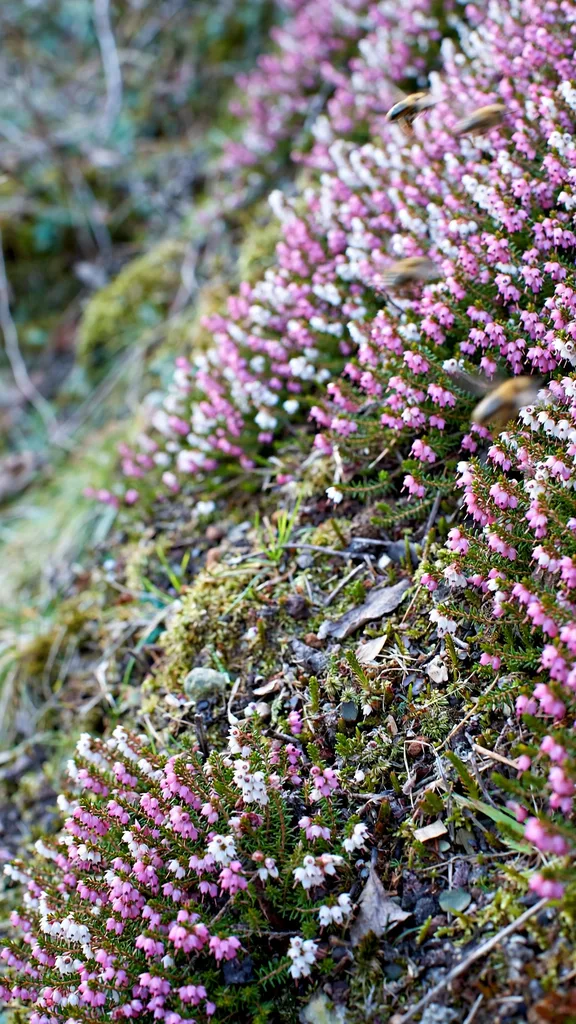
The NC State Extension entry for Erica carnea notes it is hardy in zones 5 to 7, and it is the rare heath that tolerates alkaline soil, which puts it in gardens where other heathers fail. Plant in autumn or spring in full sun, space at 30 cm (12 in), and clip the flowered stems back lightly each spring so the carpet stays dense to the ground.
15. Darley Dale Heath (Erica × darleyensis)
The winter heath’s bigger, longer-running partner. Flowers open from November to April in white, pink, and lilac on mounds 45 to 60 cm (18 to 24 in) tall, and the young spring foliage of some forms is tipped cream and pink. Planted with the smaller winter heath, the two give five months of heather flower from one bed.
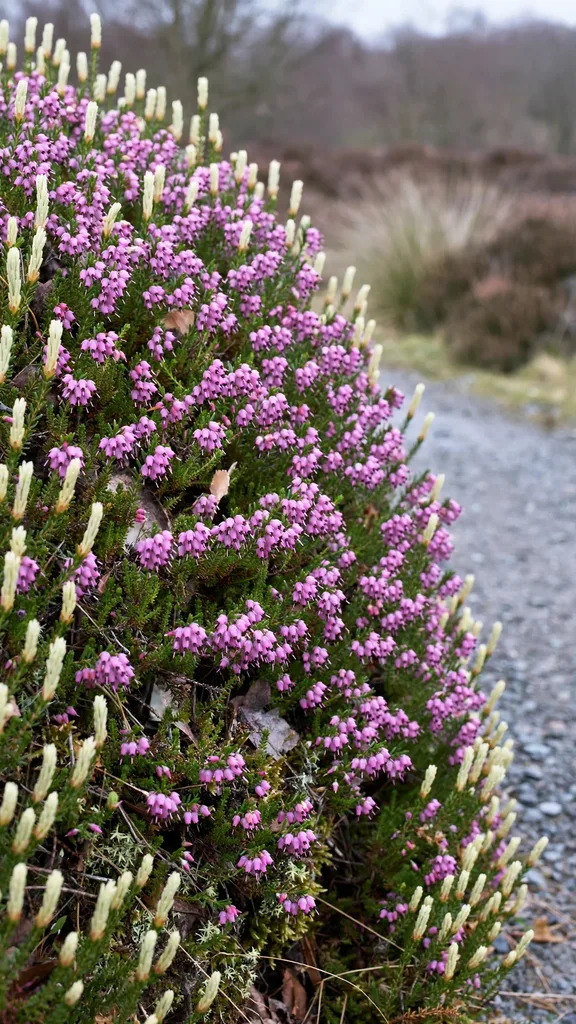
Hardy in zones 6 to 8, it tolerates lime like its parent and asks for sun and drainage. It grows faster and looser than winter heath, so give each plant its full spread and clip after flowering to keep the mound tight. In cold districts it is the safer heather for a winter container by the door.
16. Primrose (Primula vulgaris)
The wild primrose flowers from February to April in mild gardens and starts in sheltered spots before winter ends: pale yellow rosettes at the base of a hedge, in a lawn edge, or under a deciduous shrub. Garden forms add pink, blue, and double flowers, but the plain species is the one that seeds itself into a colony.
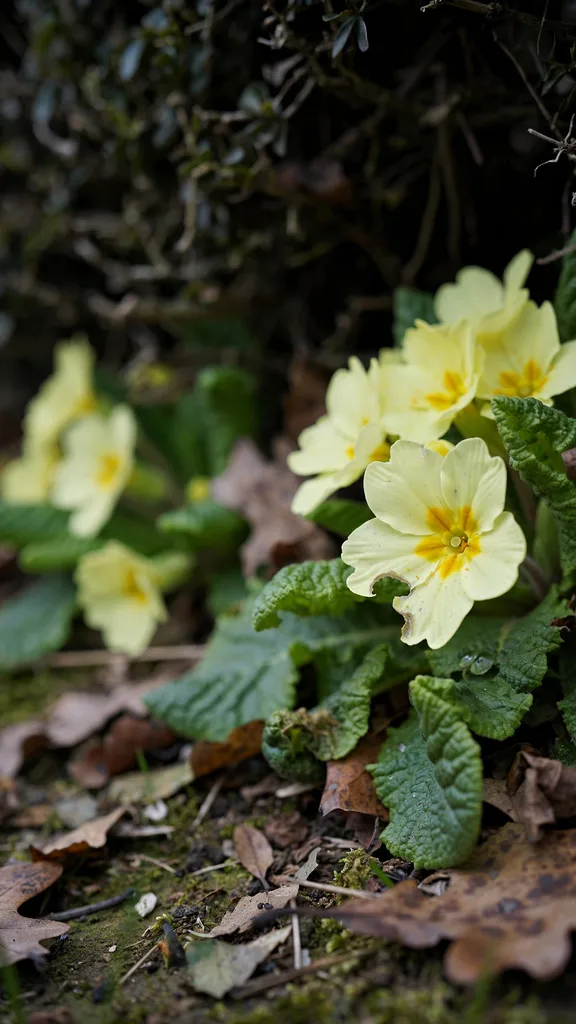
Hardy in zones 3 to 8, it wants moisture and shade in summer and light in winter, which is why it thrives under deciduous cover. Plant in autumn for the earliest flowers, divide clumps after flowering, and water through dry springs. Slugs find it before you do, so a colony big enough to share is the practical defence.
17. Polyanthus (Primula × polyantha)
The primrose’s showier hybrid, bred for the winter bedding trade. Umbels of red, gold, blue, and bicolor flowers stand 15 to 25 cm (6 to 10 in) above the leaves from February to April, and a pot of them by a door outcolors everything else in the garden at that date. In mild districts autumn plantings flower in mild spells all winter.
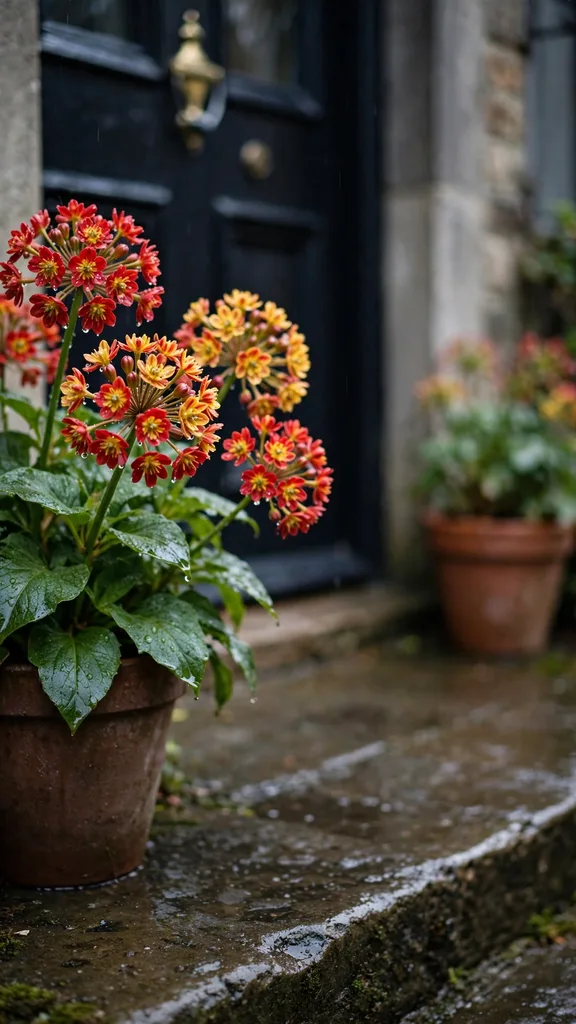
Treat it as a short-lived plant: hardy in zones 3 to 8 but usually grown for one season and replaced. Plant autumn bedding in September or October in rich, moist soil or in containers of multipurpose compost, and deadhead weekly. In pots it needs watering when other winter bedding does not, so check it after every dry, windy week.
18. Winter Pansy (Viola × wittrockiana)
The bedding plant that refuses to stop. Pansies planted in autumn flower in every mild spell through winter in zones 7 to 10 and build to their peak in early spring, in colors from black-purple to white with a blotched face. In colder zones they pause under snow and restart the week it melts.
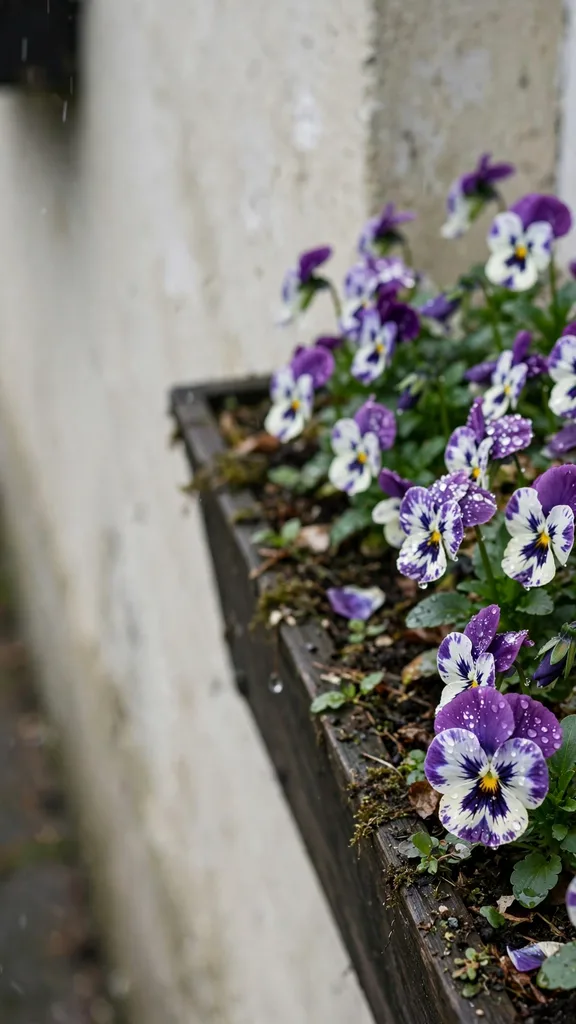
Grow them as winter annuals anywhere, in beds, window boxes, and pots, in sun or light shade. Plant by October so the roots establish before hard frost, and feed lightly in late winter as growth restarts. Deadheading is the difference between a plant that flowers for six months and one that sets seed and quits by March.
19. Winter Viola (Viola cornuta)
Smaller flowers than the pansy and far more of them. A single viola carries dozens of 2 to 3 cm (1 in) blooms in violet, yellow, cream, and bicolor from autumn through winter in mild spells to late spring, and the plants stay compact at 15 to 20 cm (6 to 8 in). It is the edging and container plant of the winter garden.
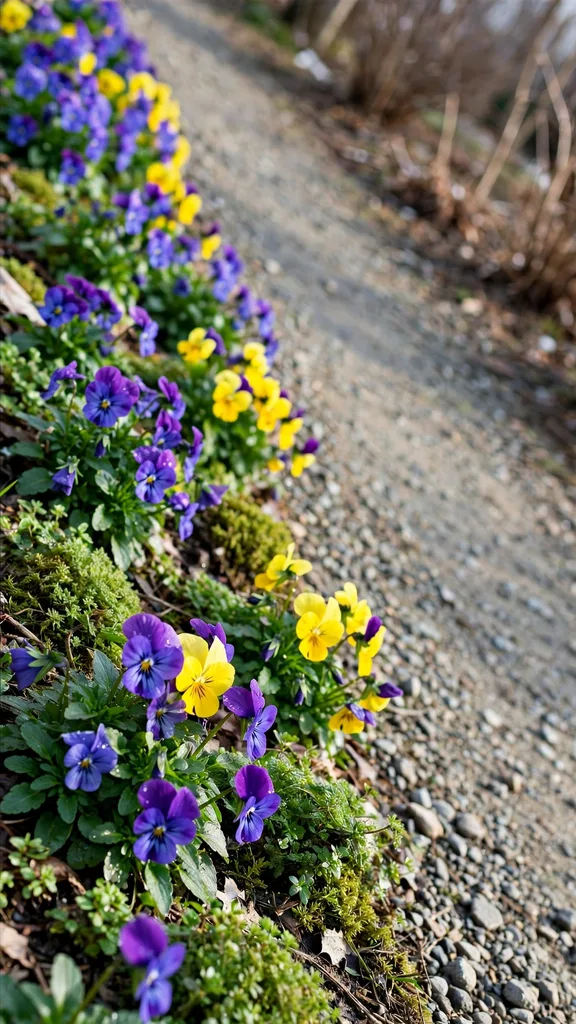
Hardy in zones 6 to 11 and perennial where winters are kind, it self-seeds where it is happy. Plant in autumn in any reasonable soil in sun, clip the whole plant back by half if it sprawls in spring, and it flowers again. Violas tolerate more shade than pansies and still flower, which earns them the north-facing pot.
20. Elephant’s Ears (Bergenia cordifolia)
Bergenia earns its winter place twice: the big round leaves turn bronze and burgundy in cold weather, and the pink flower spikes rise from February to April as the leaves color back to green. At 30 to 45 cm (12 to 18 in) it is groundcover, edging, and cut foliage in one plant, and it holds a bank that little else will cover.
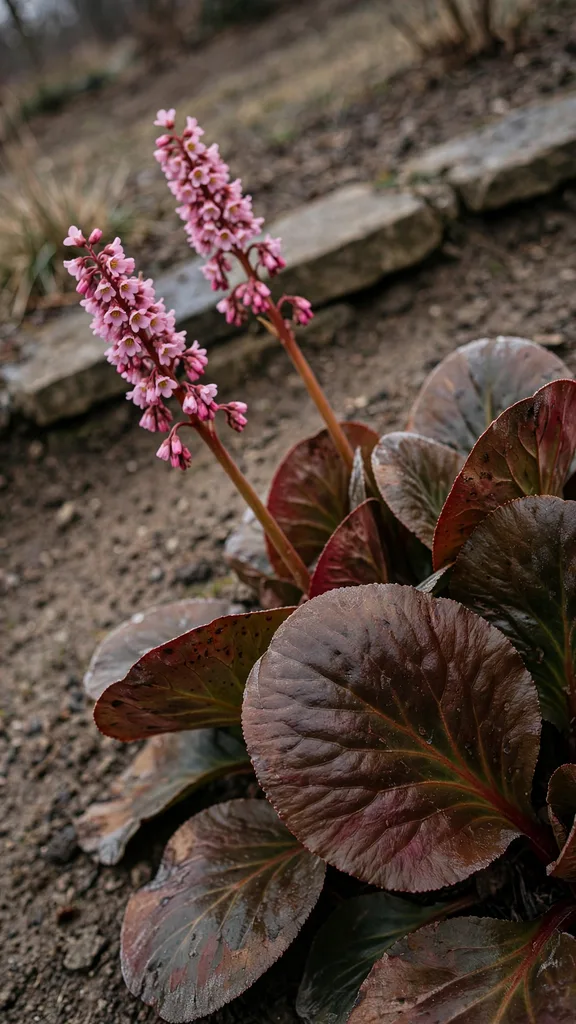
Hardy in zones 3 to 8, it grows in sun or shade, wet or dry, rich or poor soil, which is why it survives in neglected corners for decades. The flowers come earliest in sun and in shelter. Cut away winter-torn leaves in spring, divide every four or five years, and use the spare plants wherever a gap needs filling permanently.
21. Witch Hazel (Hamamelis × intermedia)
The signature scent of the winter garden. Spidery ribbons of yellow, orange, or red open on bare branches from January to March, curling tight on frosty nights and unfurling again by noon, and the spicy scent carries meters on still air. A mature shrub reaches 3 to 4 m (10 to 13 ft) and becomes the plant the whole border is arranged around.
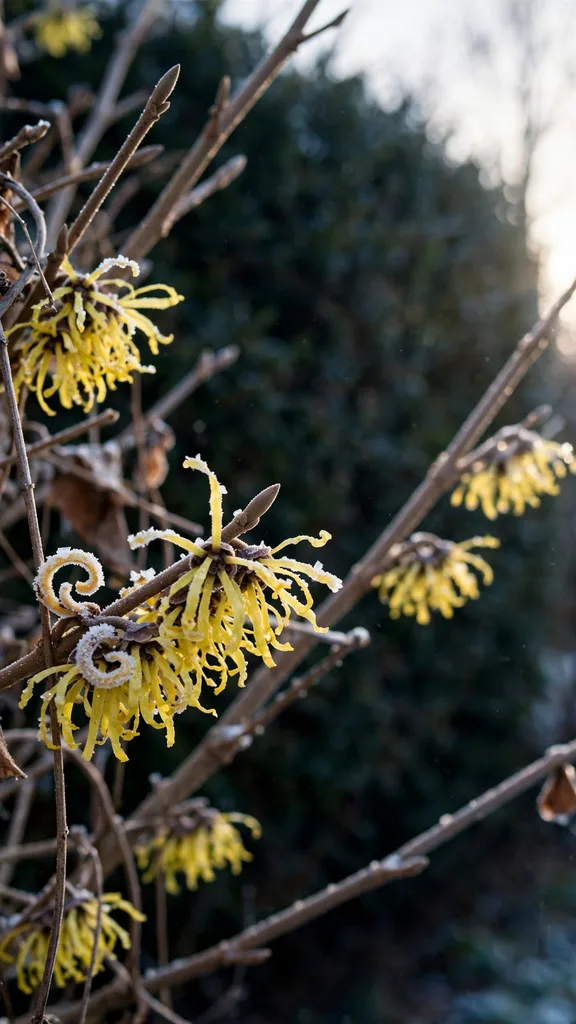
Hardy in zones 5 to 8, it wants acid to neutral soil that stays moist, and shelter from cold east winds that scorch the flowers. Plant it where a path passes close, because the scent is the point. It resents pruning and transplanting, so give it its final space at planting and water through its first two summers.
22. Wintersweet (Chimonanthus praecox)
Grown for perfume first and flowers second. Waxy, translucent yellow bells with purple hearts hang on bare stems from December to February, and a single sprig cut for a vase scents a whole room for days. The shrub reaches 2.5 to 3.5 m (8 to 12 ft) and flowers best against a warm wall in cold districts.
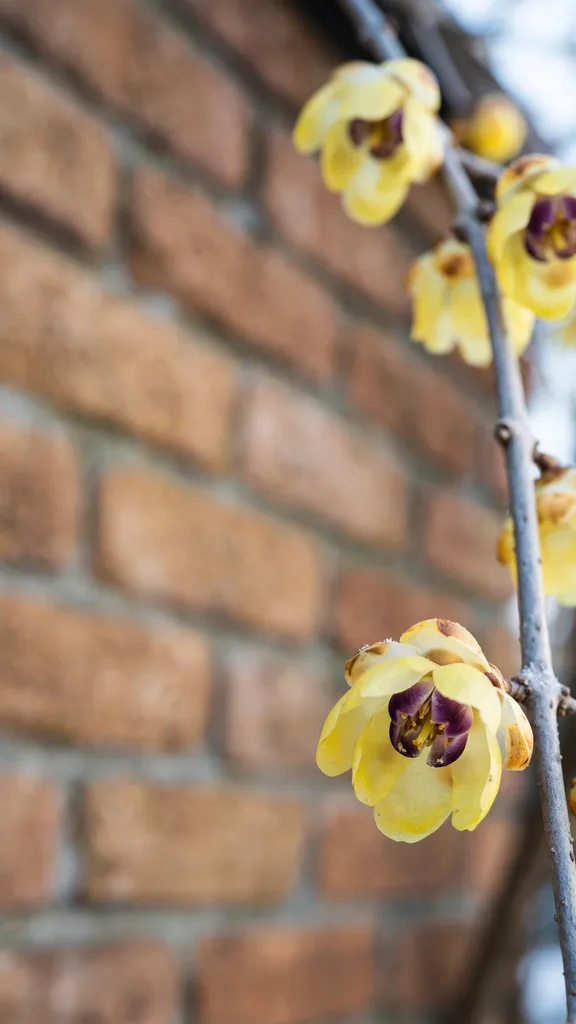
Hardy in zones 7 to 9, it is slow: a plant raised from seed can take seven years to flower, so buy a grafted or cutting-grown plant of a named form. Plant in spring in free-draining soil in full sun, prune only to remove dead wood, and expect the display to improve every year for a decade.
23. Winter Honeysuckle (Lonicera fragrantissima)
Creamy, lemon-scented flowers open in pairs along bare stems from January to March, small enough to miss visually and impossible to miss by smell. It is a loose, arching shrub to 2 m (6.5 ft) that belongs at a gate, a bin store, or a path corner where people pass daily and catch the scent without seeing the plant.
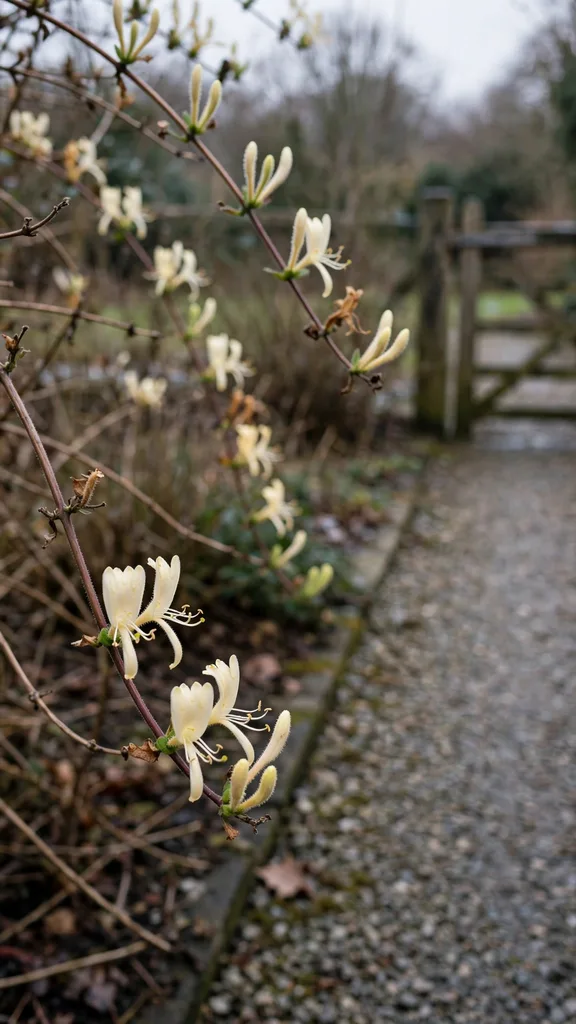
Hardy in zones 4 to 8, it grows in any soil including dry shade, and it can seed itself around, so plant it where spread is welcome and pull seedlings from beds. Prune after flowering by taking out a third of the oldest stems at the base, which keeps the flowering wood young and the shape open.
24. Sweet Box (Sarcococca confusa)
Tiny white flowers hidden under glossy evergreen leaves fill a shady doorway with scent from December to February, stronger than plants ten times its size. The shrub grows slowly to 1 to 1.5 m (3 to 5 ft), holds black berries after the flowers, and asks for nothing once planted. It is the winter plant for the spot where nothing else flowers: dry shade under trees or against a north wall.
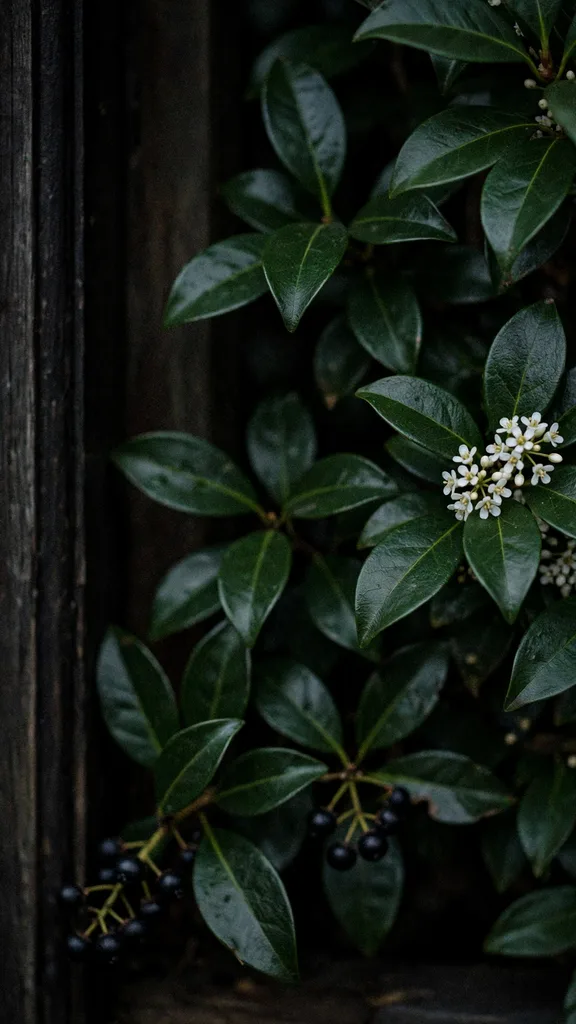
Hardy in zones 6 to 9, it tolerates deep shade, drought once established, and poor soil. Plant in autumn or spring, water the first summer only, and clip lightly in spring if a hedge shape is wanted. One plant by a front door does the work of a whole bed of scented flowers.
25. Winter Daphne (Daphne odora)
The strongest perfume in the winter garden, from clusters of pink buds opening to white stars in February and March. The evergreen leaves, often edged in gold in the common form, make a neat dome 1 to 1.5 m (3 to 5 ft) tall, and one plant scents a courtyard. Cut sprigs last a week in a vase indoors.
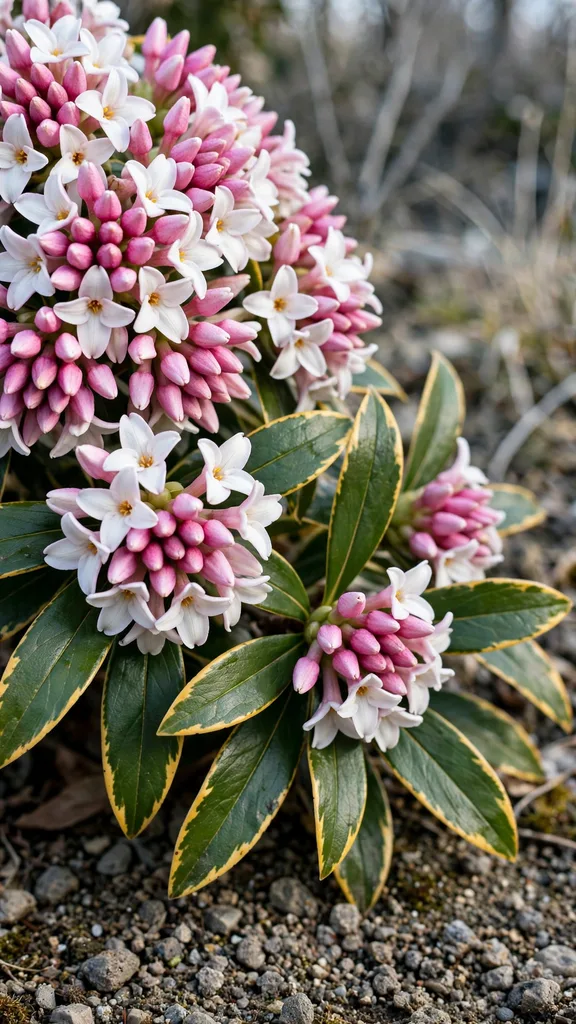
Hardy in zones 7 to 9, it demands sharp drainage and hates being moved, pruned hard, or waterlogged in winter. Plant a container-grown specimen in spring in its final position, in sun or light shade, and mulch with grit rather than compost. Daphnes can die suddenly after years of health, so take a few cuttings each summer as insurance.
26. February Daphne (Daphne mezereum)
The hardier daphne, flowering where the winter daphne cannot. Lilac-pink, intensely scented flowers wrap the bare upright stems in February and March, followed by red berries that birds take and gardeners should not. It is a small shrub, 1 to 1.5 m (3 to 5 ft), for a woodland edge or a shady border.
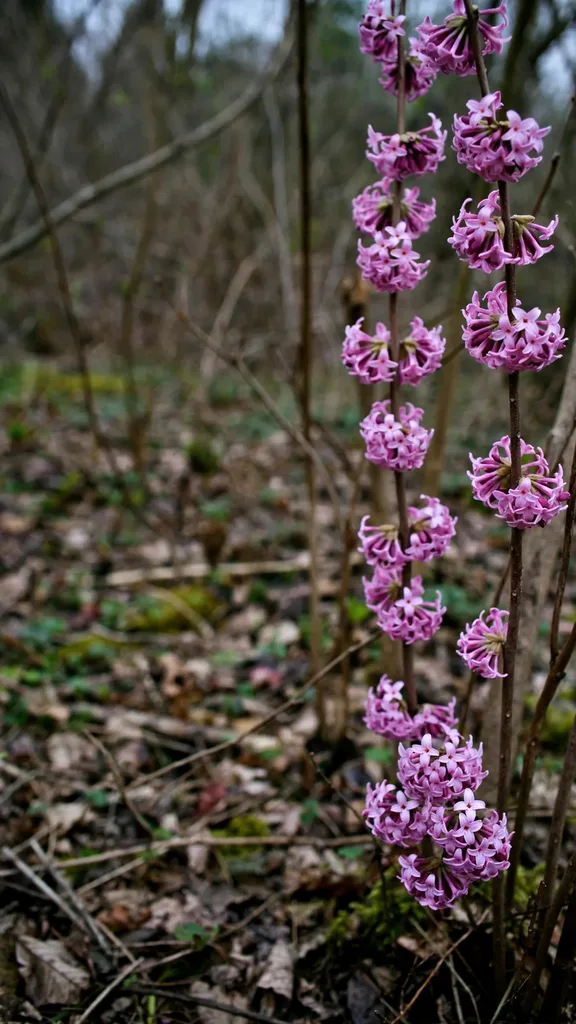
Hardy in zones 4 to 7. It wants cool roots and moist soil, shade at the base with light above, and time. Every part is toxic, berries included, so site it well away from paths used by small children. Where it is happy it self-seeds freely, and those seedlings, lifted young, transplant better than bought plants ever do.
27. Dawn Viburnum (Viburnum × bodnantense ‘Dawn’)
Pink, almond-scented flower clusters open on bare stems in every mild spell from November to March, blackening in a hard frost and replaced by fresh clusters the next mild week. That stop-start habit makes it the longest-value shrub on this list for a small garden: there is almost no winter week when a settled plant has nothing open. It grows to 2.5 to 3 m (8 to 10 ft).
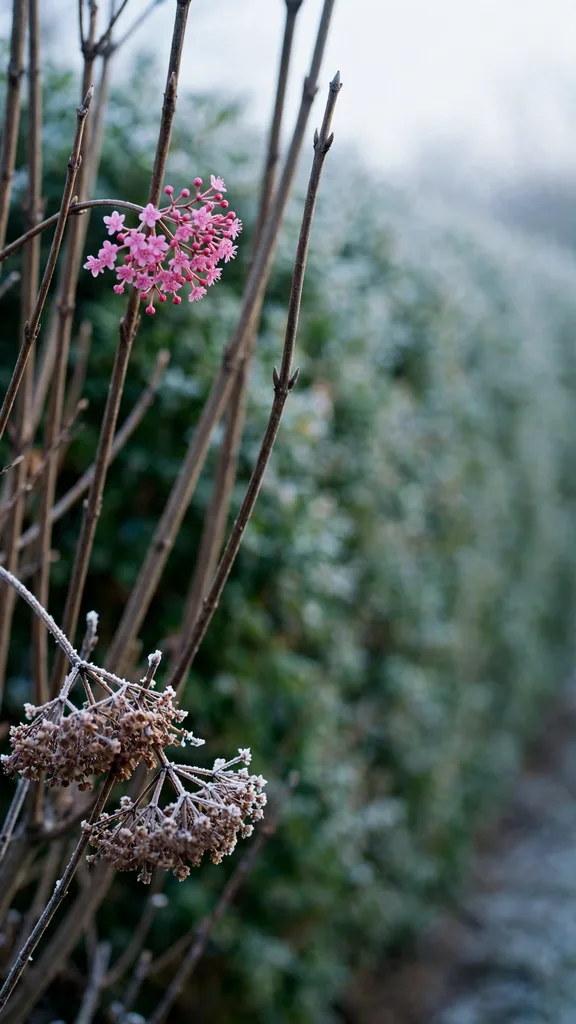
Hardy in zones 5 to 7, it takes any soil that is not waterlogged and flowers in sun or light shade. Plant it where its winter silhouette is seen against a wall or an evergreen. Prune after the main flowering by removing a few of the oldest stems at the base each year.
28. Laurustinus (Viburnum tinus)
Pink buds open to white flower heads from November to April over dense evergreen foliage, with metallic blue-black berries following on the same plant as the last flowers fade. At 2 to 3 m (6.5 to 10 ft) it is a hedge, a screen, and a winter flower display in one, and it clips well enough to hold a formal shape.
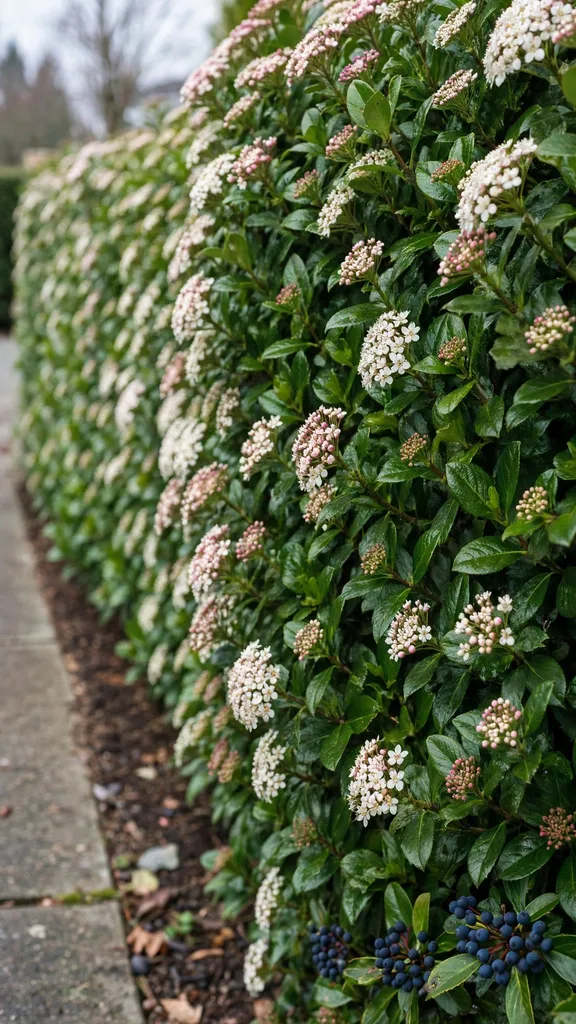
Hardy in zones 7 to 10, it flowers most freely in sun and shelter and sulks in cold, exposed gardens where the buds brown. Plant in spring in cold districts. It tolerates coastal wind and dry soil once established, which makes it the workhorse evergreen of mild-climate winter gardens.
29. Mahonia (Mahonia × media)
Architectural spikes of yellow flowers rise above holly-like evergreen leaves from November to January, scented like lily of the valley, followed by blue-black berries. The winter forms reach 3 to 4 m (10 to 13 ft) in time and flower at the darkest point of the year, when their yellow reads across a whole garden. Bees work the flowers on any mild day.
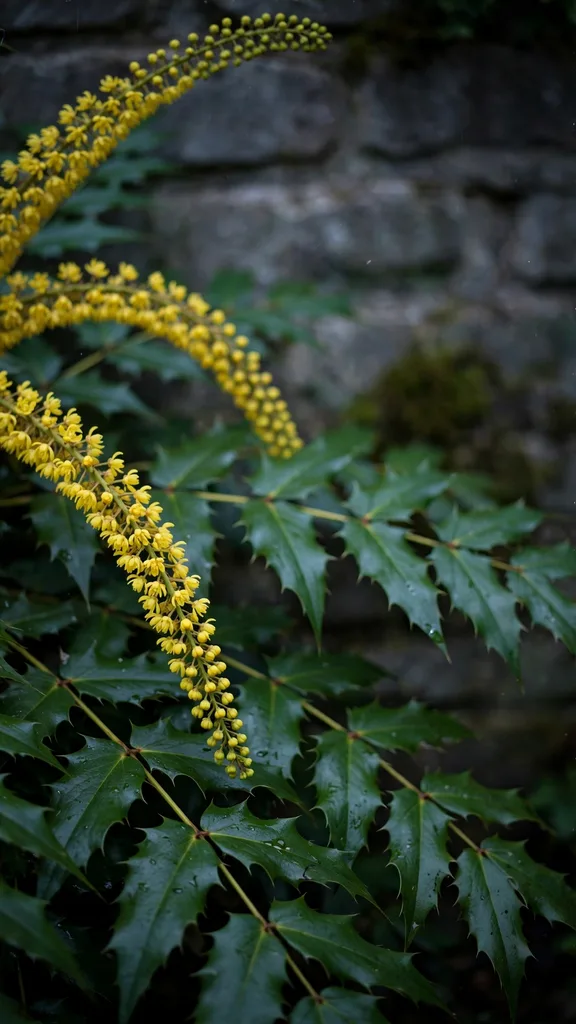
Hardy in zones 6 to 9, it wants shade or part shade and soil that does not dry out completely. The leaves are fiercely spined, so plant it back from paths and use it as a barrier where a barrier is useful. Prune by cutting flowered stems back to a lower whorl of leaves after the berries set.
30. Paperbush (Edgeworthia chrysantha)
Silky silver buds hang at every stem tip all winter like ornaments, then open in February and March into round heads of yellow, richly scented flowers before the leaves appear. The shrub grows to 1.5 to 2 m (5 to 6.5 ft) with an open, tiered habit, and the buds alone justify the plant from November onward.
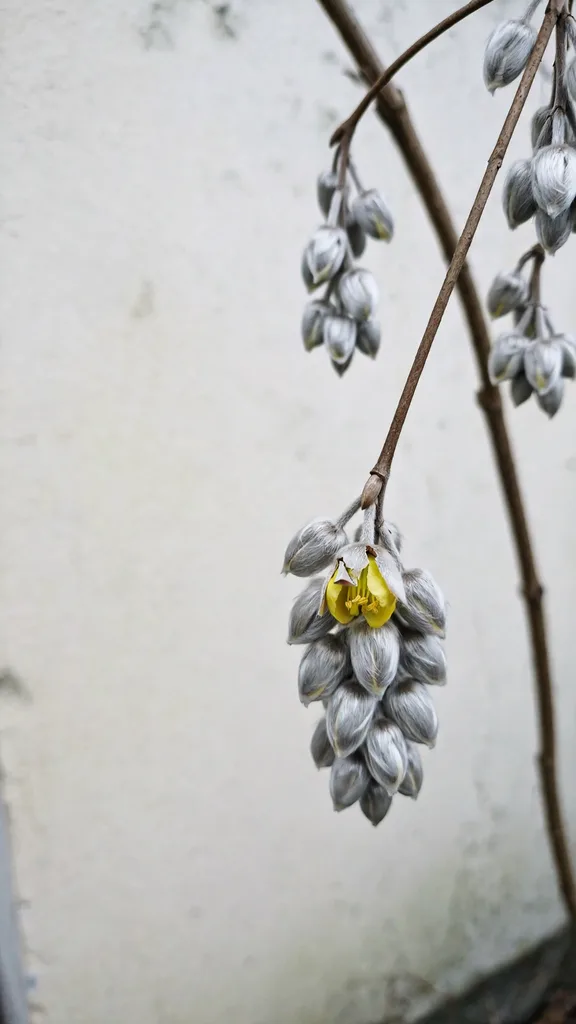
Hardy in zones 7 to 10, and worth trying at a warm wall in zone 6, it wants moist, rich soil and shelter from frost pockets, because a late hard frost can take the opening flowers. Plant in spring, water in dry summers, and prune nothing but dead tips. The bark was once used for paper, and the stems bend without snapping.
31. Winter Hazel (Corylopsis pauciflora)
Short chains of soft primrose-yellow bells hang from bare, slender branches in February and March, with a light primrose scent, weeks before the hazel-like leaves open. It is a graceful, spreading shrub to 1.5 m (5 ft), best where its hanging flowers are seen against a dark hedge or a wall at eye level.
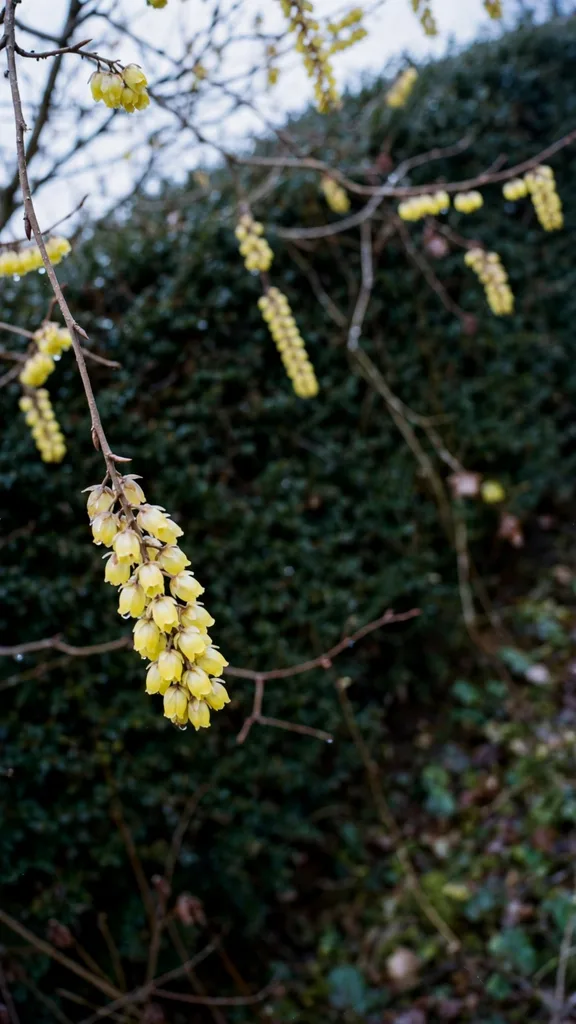
Hardy in zones 6 to 8, it wants acid to neutral soil, moisture, and shelter from late frosts, which can brown the flowers in an exposed site. Plant in a spot that gets morning shade and afternoon light. It needs no pruning beyond removing dead wood, and its autumn leaf color is a second season of value.
32. Silk Tassel Bush (Garrya elliptica)
Grown for catkins rather than petals: silver-gray tassels hang 15 to 20 cm (6 to 8 in) long on male plants from January to March, lengthening and loosening as winter goes on. The evergreen shrub reaches 3 to 4 m (10 to 13 ft) and is usually trained against a wall, where the catkins show against the leaves all winter.
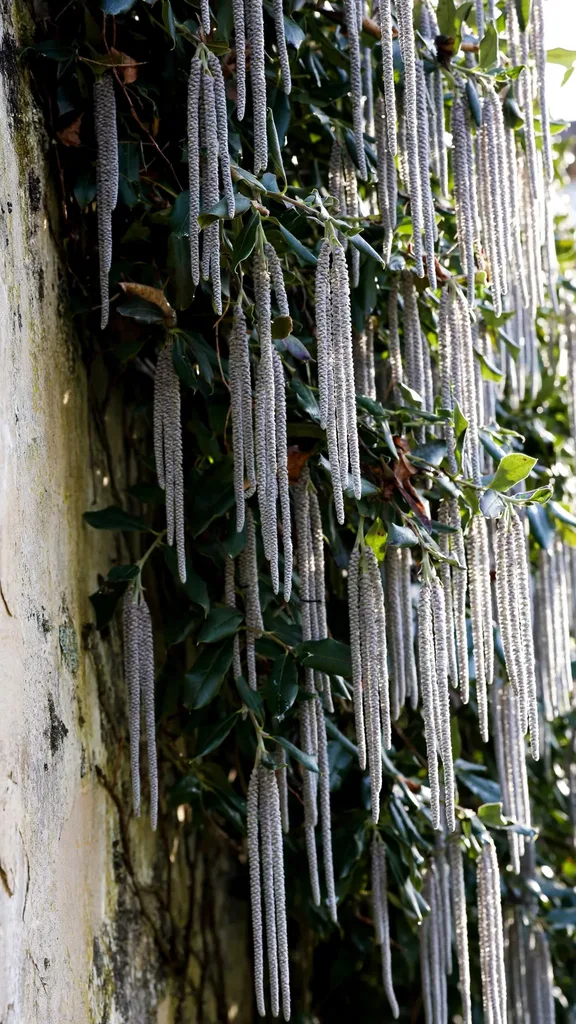
Hardy in zones 7 to 10, it tolerates cold walls, coastal wind, and poor soil, but hard frost cuts the catkins in exposed gardens. Buy a named male form such as ‘James Roof’ for the longest tassels, plant it in spring, and prune after the catkins finish by shortening the flowered stems.
33. Stachyurus (Stachyurus praecox)
Pale yellow-green flower chains hang from arching, red-brown bare stems in February and March, opening from buds that sit visible on the plant all winter like beads. It is a large, open shrub to 2 to 3 m (6.5 to 10 ft) that belongs in a woodland garden or a big border where its stems can arch without cutting back.
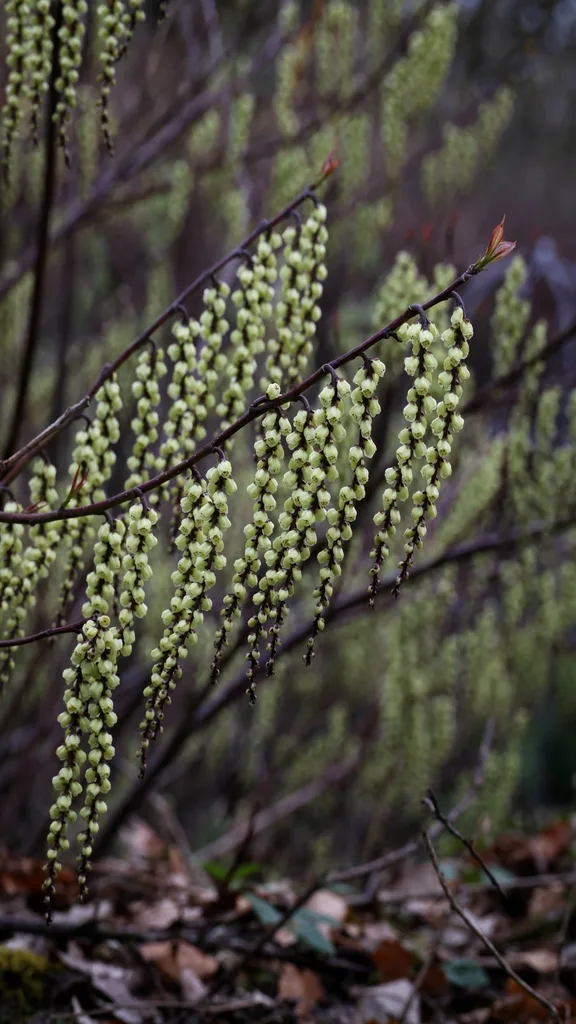
Hardy in zones 6 to 8, it wants moist, acid to neutral soil and shelter from late frost. Plant it in spring and leave it alone: hard pruning removes the stems that carry next year’s buds, which form on the plant the summer before they open. Give it room and it needs nothing else.
34. Flowering Quince (Chaenomeles speciosa)
Scarlet, pink, or white cup-shaped flowers open on thorny, leafless branches from February to April, a few at a time over many weeks, and the earliest open in mild spells in January in sheltered gardens. The shrubs reach 1.5 to 3 m (5 to 10 ft) and are usually wall-trained, where the flowers stud the bare stems like a espaliered orchard tree.
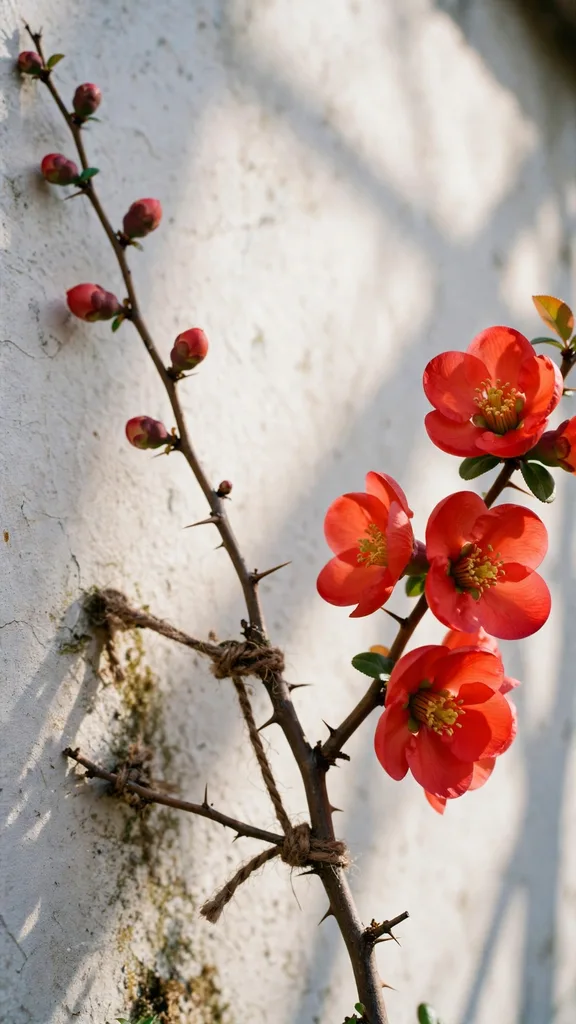
Hardy in zones 4 to 8, it flowers on any soil including thin chalk, in sun or part shade. Wall training gives the longest display because the wall stores heat. Prune after flowering by cutting back the flowered side shoots to two or three buds, and expect hard, scented yellow fruit in autumn that cooks into jelly.
35. Cornelian Cherry (Cornus mas)
A small tree covered in tiny yellow flower clusters in February and March, before the leaves, so dense on a settled plant that the whole crown glows against a gray sky. It grows slowly to 5 to 7 m (16 to 23 ft), carries red cherry-like fruit in late summer that birds and jam-makers both take, and colors well in autumn.
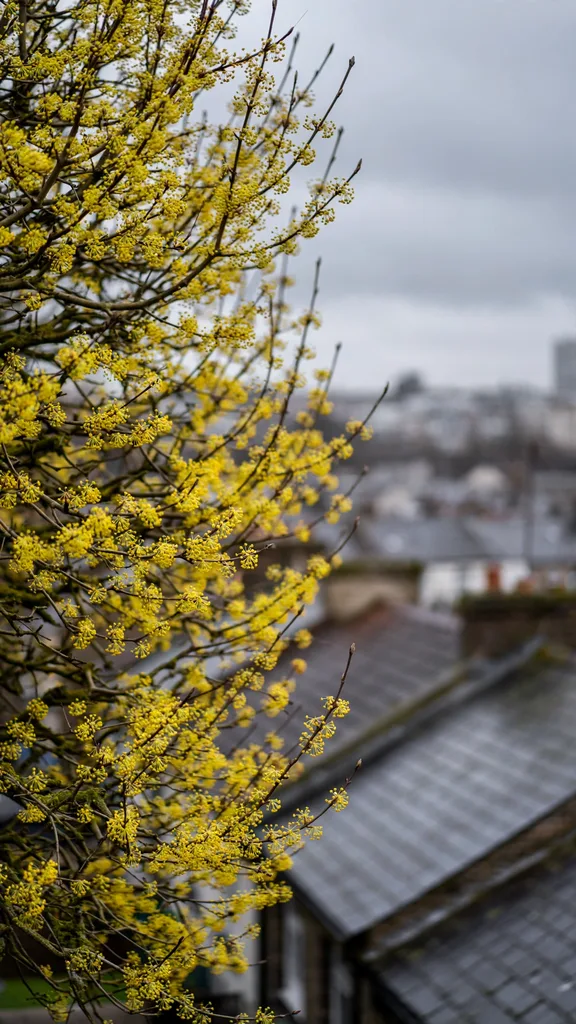
Hardy in zones 4 to 8, it takes any soil including lime, in sun or part shade, and needs no pruning. Plant it where the February crown is visible from the house, because its flowering moment is short and easily missed from a distance. It is one of the longest-lived plants on this list, flowering for decades once settled.
36. Sasanqua Camellia (Camellia sasanqua)
The camellia that opens the season. White, pink, and red single flowers open from October to December over small, glossy evergreen leaves, on shrubs of 2 to 4 m (6.5 to 13 ft) that train flat against a wall or stand as a loose hedge. The petals fall cleanly after a few days, which keeps the plant tidy where a japonica would hold its browning flowers.
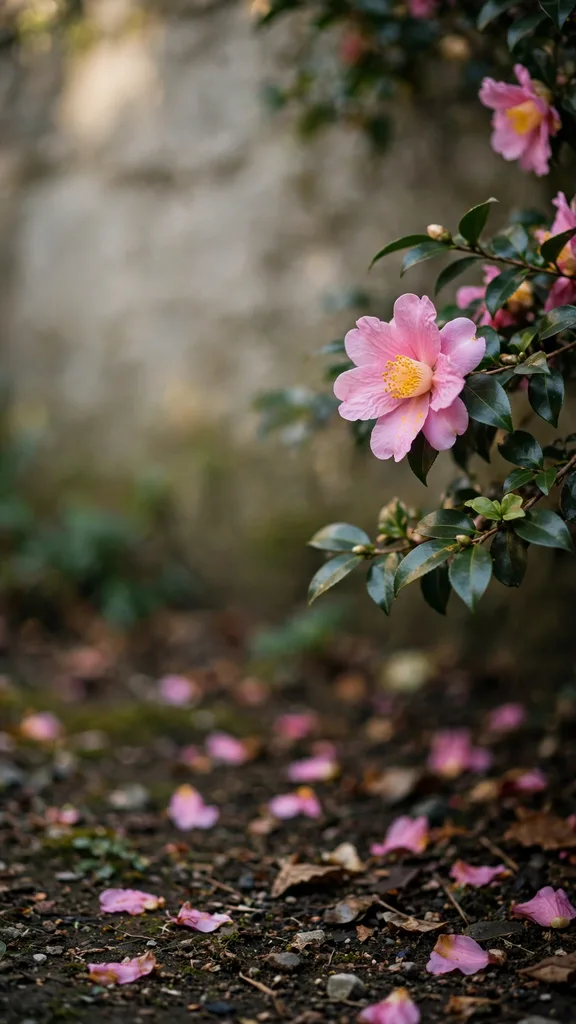
Hardy in zones 7 to 9, it flowers best with sun on the buds and shade on the roots, in acid soil that stays moist. In zone 7 gardens a warm wall makes the difference between a full display and a few scorched flowers. Water well in late summer, when the buds form, or they drop before opening.
37. Lungwort (Pulmonaria officinalis)
Pink buds open to blue and pink flowers together on the same stem from February to April, over white-spotted leaves that stay handsome until autumn. At 25 to 30 cm (10 to 12 in) it is the groundcover for the shady gap under shrubs where the winter bulbs need company, and the first bumblebees find it within days of opening.
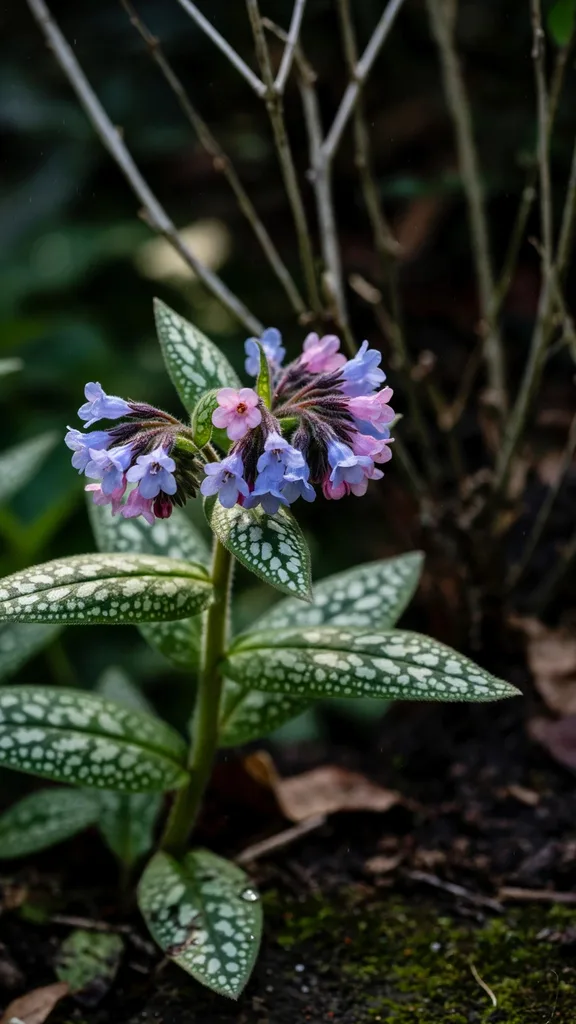
Hardy in zones 3 to 8, it wants shade and soil that stays moist, and it wilts theatrically in drought before recovering overnight. Cut the flowered stems and tired leaves back after flowering and fresh foliage follows. It self-seeds, and the seedlings vary in flower color, which spreads the pink-to-blue range through a colony.
38. Winter-Flowering Cherry (Prunus × subhirtella ‘Autumnalis Rosea’)
The tree that flowers in the middle of winter. Small, semi-double pink-white blossom opens in every mild spell from November to March, a branch at a time, and a twig cut for a vase opens indoors in days. The tree grows to 6 to 8 m (20 to 26 ft) with a light crown, and its autumn leaf color is a second display in October before the blossom starts.
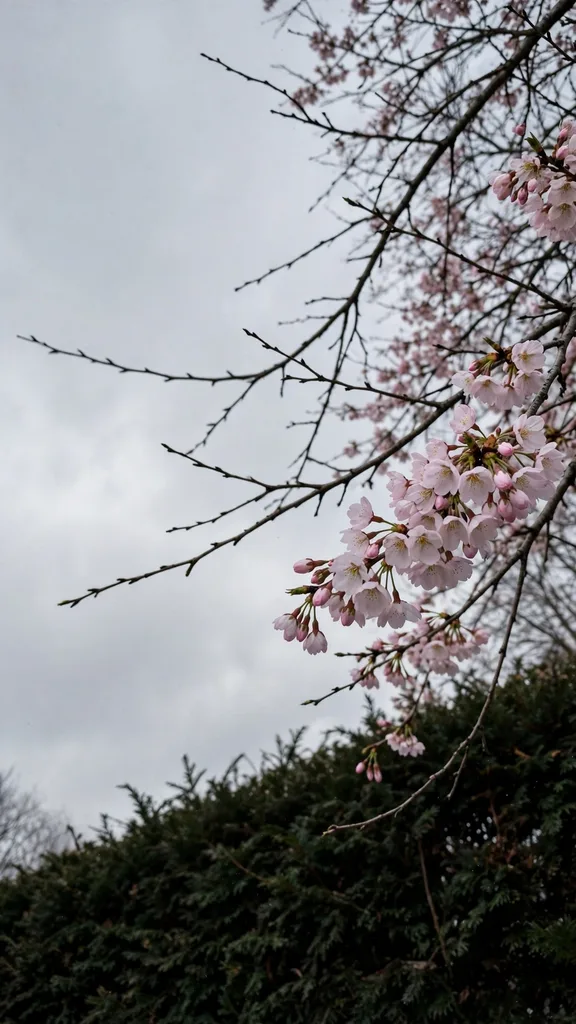
Hardy in zones 4 to 8, it takes any soil that drains and flowers best in full sun. Hard frost browns the open blossom but the buds behind it are unharmed, so the display resumes within a week. Plant it where the winter blossom is seen against a dark hedge or the winter sky, not lost against a pale wall.
39. Winter Jasmine (Jasminum nudiflorum)
Starry yellow flowers open along green, arching stems from November to March, leafless, so the color sits directly on the stems. It is a scrambling shrub to 2 to 3 m (6.5 to 10 ft), usually grown spilling over a low wall or bank or tied up a trellis, and it flowers through weather that stops almost everything else on this list.
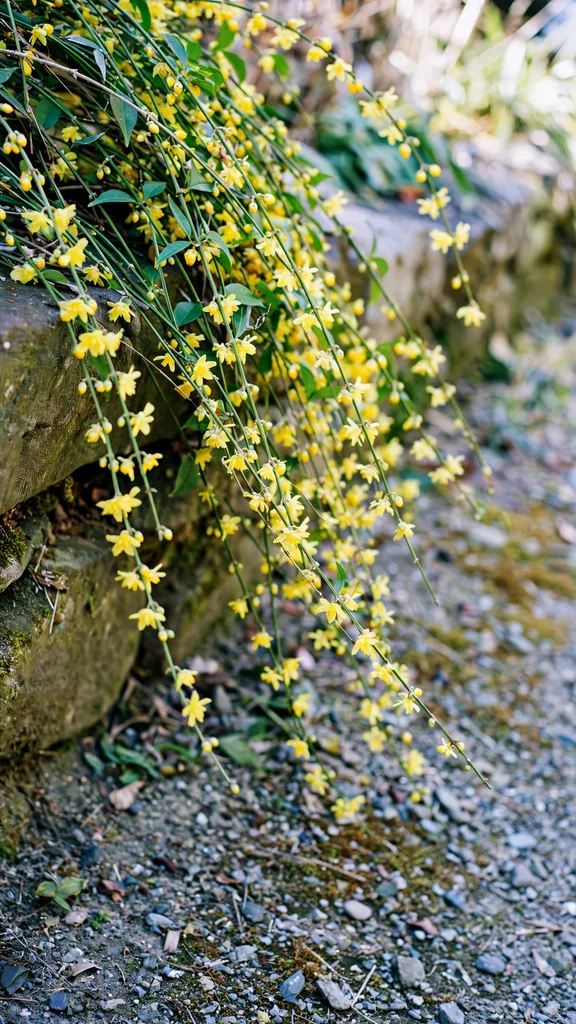
Hardy in zones 6 to 9, it grows in any soil and in sun or shade, flowering most freely in sun. The stems root where they touch the ground, so it covers a bank permanently. Prune after flowering by cutting back the flowered stems to strong new shoots low down, which keeps the plant flowering on young wood.
40. Winter Clematis (Clematis cirrhosa)
Creamy, bell-shaped flowers freckled with maroon hang from an evergreen climber from December to February, followed by silky seed heads. In its freckled forms it is the only clematis in flower at Christmas, and it climbs to 3 to 4 m (10 to 13 ft) over a pergola post, a trellis, or through a large shrub in a sheltered garden.
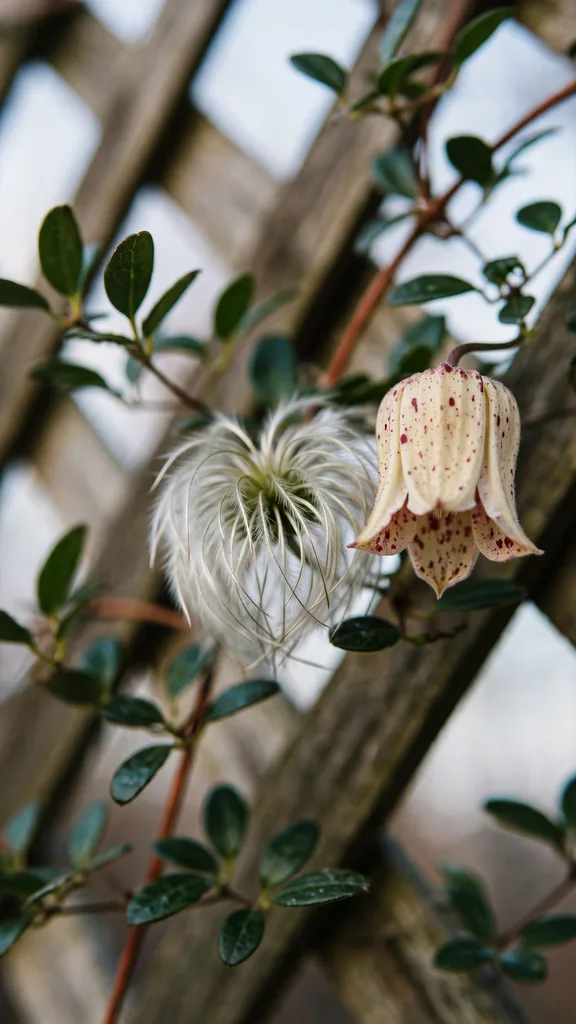
Hardy in zones 7 to 9, it needs a warm, sheltered wall and sharp drainage, and it rests in summer when the foliage can look tired: that dormancy is normal, not a failure. Plant it with its roots shaded and its head in sun, prune lightly after flowering if at all, and let it thread through a host shrub for support.
41. Forsythia (Forsythia × intermedia)
The loudest yellow of late winter. Bare stems cover in gold bells in February and March in mild districts and a few weeks later in cold ones, and cut stems forced in a vase open indoors within days, which makes it the cheapest winter flower arrangement in this list. Shrubs reach 2 to 3 m (6.5 to 10 ft) and grow fast enough to screen a fence in three seasons.
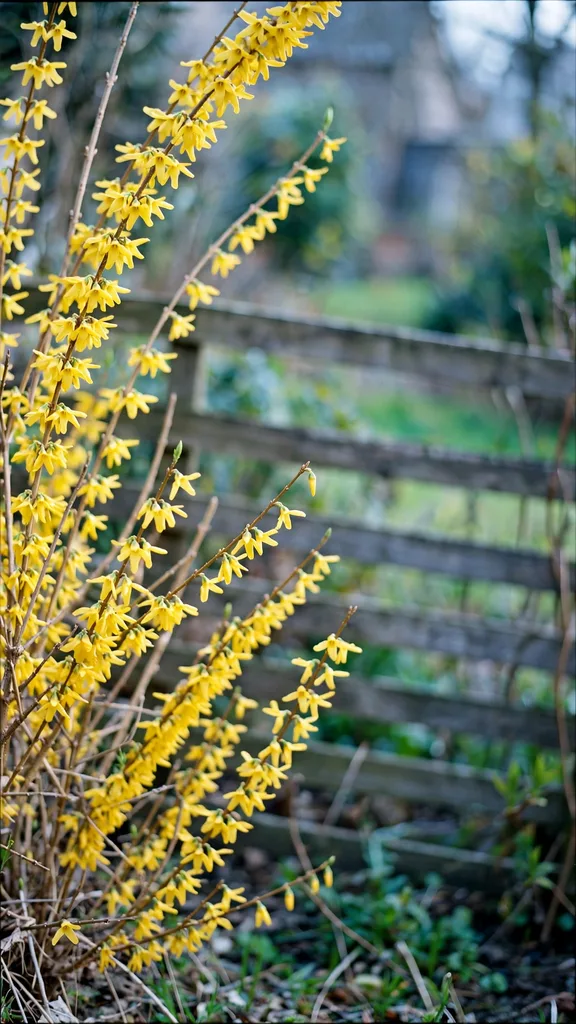
Hardy in zones 5 to 8, it flowers on any soil in sun. The common failure is pruning at the wrong time: it flowers on the previous year’s wood, so prune straight after flowering by removing a third of the oldest stems at the base, and never shear it in autumn unless you want leaves instead of flowers.
42. Pieris (Pieris japonica)
The flower buds form in autumn and hang in white or pink chains all winter as decoration in themselves, opening in February to April into lily-of-the-valley flowers, just as the new leaves flush bronze and red. An evergreen shrub of 2 to 4 m (6.5 to 13 ft), it gives a winter garden structure, buds, flowers, and spring color in sequence from one plant.
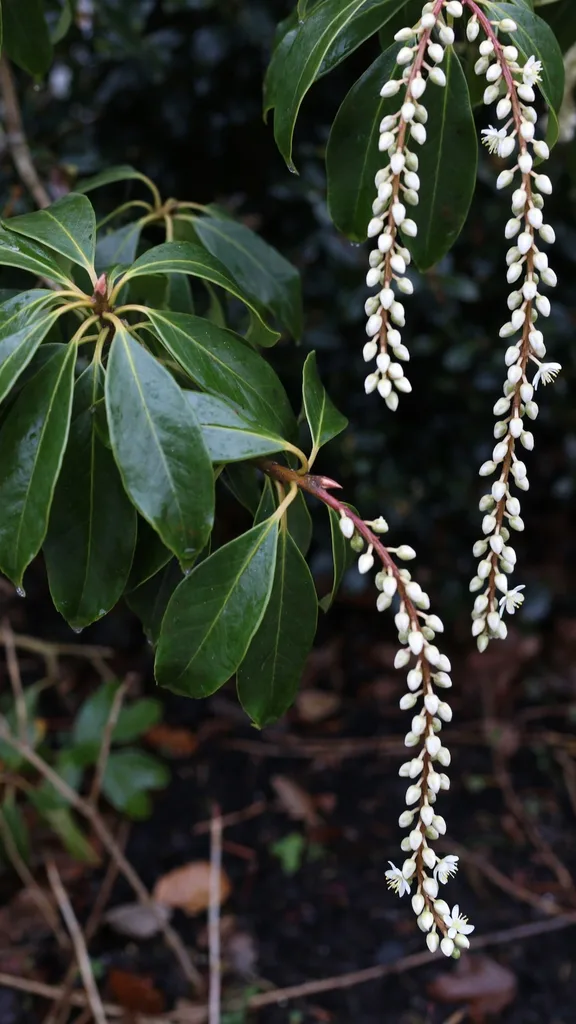
Hardy in zones 4 to 8, it needs acid soil and shelter from cold winds and late frost, which can take the open flowers. In lime soil it yellows and stalls, so grow it in a large pot of ericaceous compost instead. Deadhead the spent flower chains in spring to keep the shape dense.
43. Skimmia (Skimmia japonica)
The winter display is the bud, not the flower: tight clusters of deep red buds sit above glossy evergreen leaves from October to March, then open into scented white flowers in spring. A compact shrub of 1 to 1.5 m (3 to 5 ft), it is the standard plant for the winter pot by the door, where the red buds carry the display for five months.
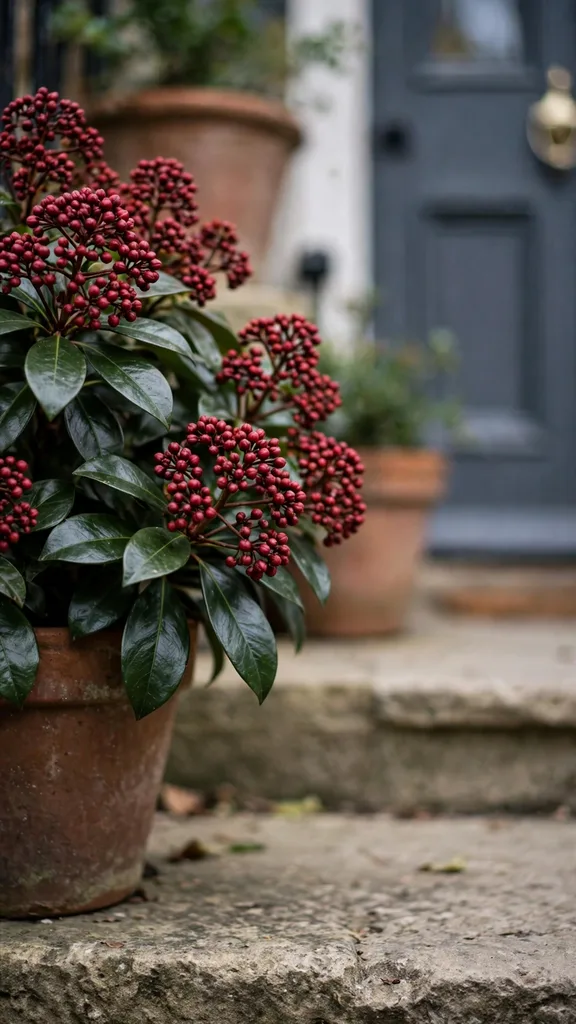
Hardy in zones 6 to 8, it wants shade and acid to neutral soil, and it yellows in hot sun or lime. Male and female plants are separate: a female form carries red berries when a male grows nearby. In containers it needs ericaceous compost and rainwater in hard-water districts to stay dark green.
44. Rosemary (Salvia rosmarinus)
A herb that doubles as a winter flower. Pale blue flowers open along the evergreen stems in every mild spell from December to March in sheltered gardens, and bees work them on winter days when almost nothing else is open. The upright forms reach 1 to 1.5 m (3 to 5 ft) and make a scented hedge in mild districts; trailing forms spill over a warm wall.
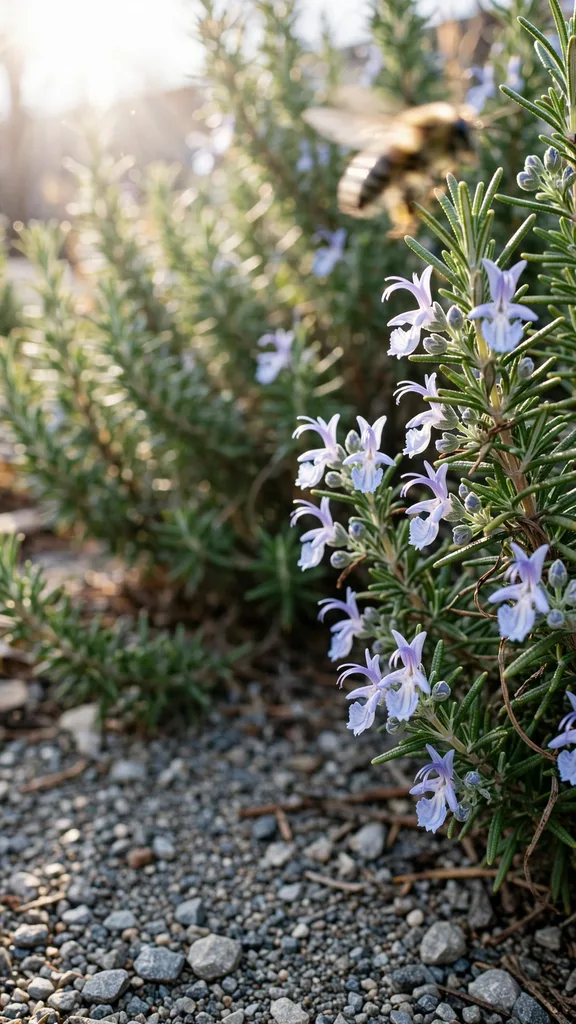
Hardy in zones 7 to 10 in the ground, and the hardiest forms survive zone 6 at a wall base; elsewhere grow it in a pot that winters in a cold greenhouse. Sharp drainage matters more than feeding: winter wet kills more rosemary than frost. Cut sprigs for the kitchen all winter, which keeps the plant compact.
45. Japanese Camellia (Camellia japonica)
The finale of the winter flower year. Formal roses of red, pink, or white, some 10 to 12 cm (4 to 5 in) across, open from January to April over the glossiest evergreen foliage in the garden, on shrubs that reach 3 to 5 m (10 to 16 ft) and live for a century. A settled plant in a mild garden carries hundreds of flowers in sequence, so the display runs for months from one shrub.
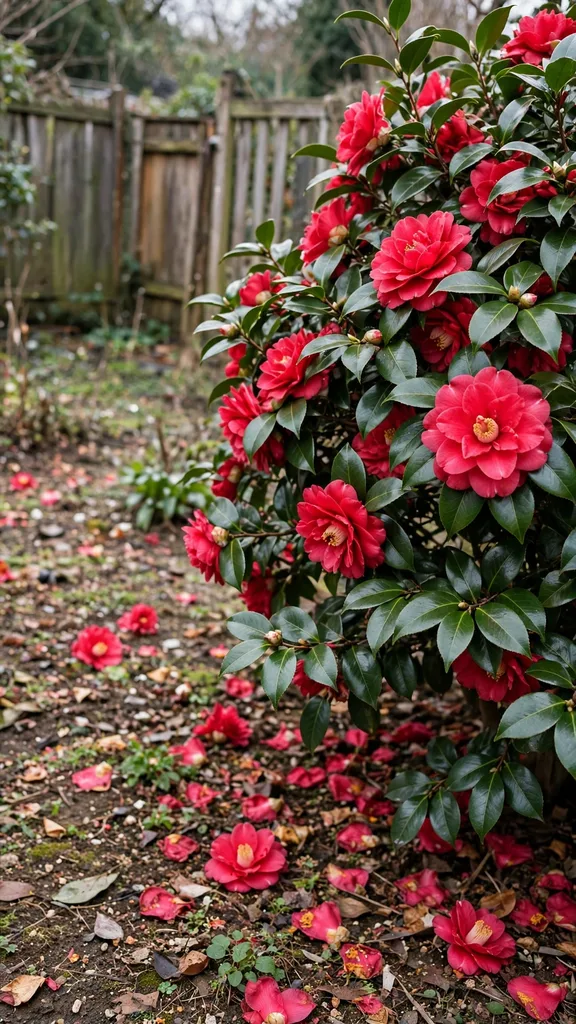
Hardy in zones 7 to 9, it wants acid soil, shelter from cold winds, and morning shade in frosty districts, because buds thawed fast by early sun brown at the edges. Water deeply in late summer while the buds set. Fallen flowers make a clean carpet under the plant, and a single cut bloom floated in a bowl is the winter table centrepiece that needs nothing else.
Frequently Asked Questions About Winter Flowers
Snowdrops, winter aconite, Christmas rose, hardy cyclamen, and winter heath all flower in January in temperate gardens, joined by witch hazel, wintersweet, sweet box, and dawn viburnum among scented shrubs. The secret is choosing plants that set their buds the summer before and open them in the cold, rather than plants trying to grow and flower at once. Site them where you pass daily: a January flower seen from a warm kitchen window is worth three in a far corner.
The scented winter flowers are almost all shrubs flowering on bare stems: witch hazel, wintersweet, winter honeysuckle, sweet box, winter daphne, and dawn viburnum. Sweet box is the strongest for its size and flowers in dry shade by a door, while wintersweet gives the richest perfume from a cut sprig in a vase. Plant fragrant winter shrubs beside paths, gates, and doors, where people pass close, rather than at the back of a border where the scent is lost.
Snowdrops, early crocus, glory of the snow, and Christmas rose all flower in zones 3 and 4, and primrose and bergenia match them for cold tolerance. In very cold gardens the bloom window shifts later, so a snowdrop that flowers in January in zone 7 flowers in March in zone 4, but the plant is unharmed. Mulch bulb plantings after the ground freezes to stop frost heave, and site shrubs out of the path of cold east winds.
Yes, and pots by a door are where winter flowers get seen. Hardy cyclamen, winter heath, pansies, violas, skimmia, and small hellebores all winter in containers in most zones, and a pot can move into shelter for the coldest nights, which widens the choice in cold gardens. Use a pot at least 30 cm (12 in) across so the compost does not freeze solid, raise it on feet so it drains, and water during dry, frost-free spells.
Bulbs and corms go in during autumn, September to November, and flower the first winter. Shrubs plant best in autumn or early spring, and most need one or two seasons to settle before they flower at full strength, so a winter border is planted a year ahead of its best display. Winter bedding such as pansies and polyanthus goes in by October so the roots establish before hard frost.