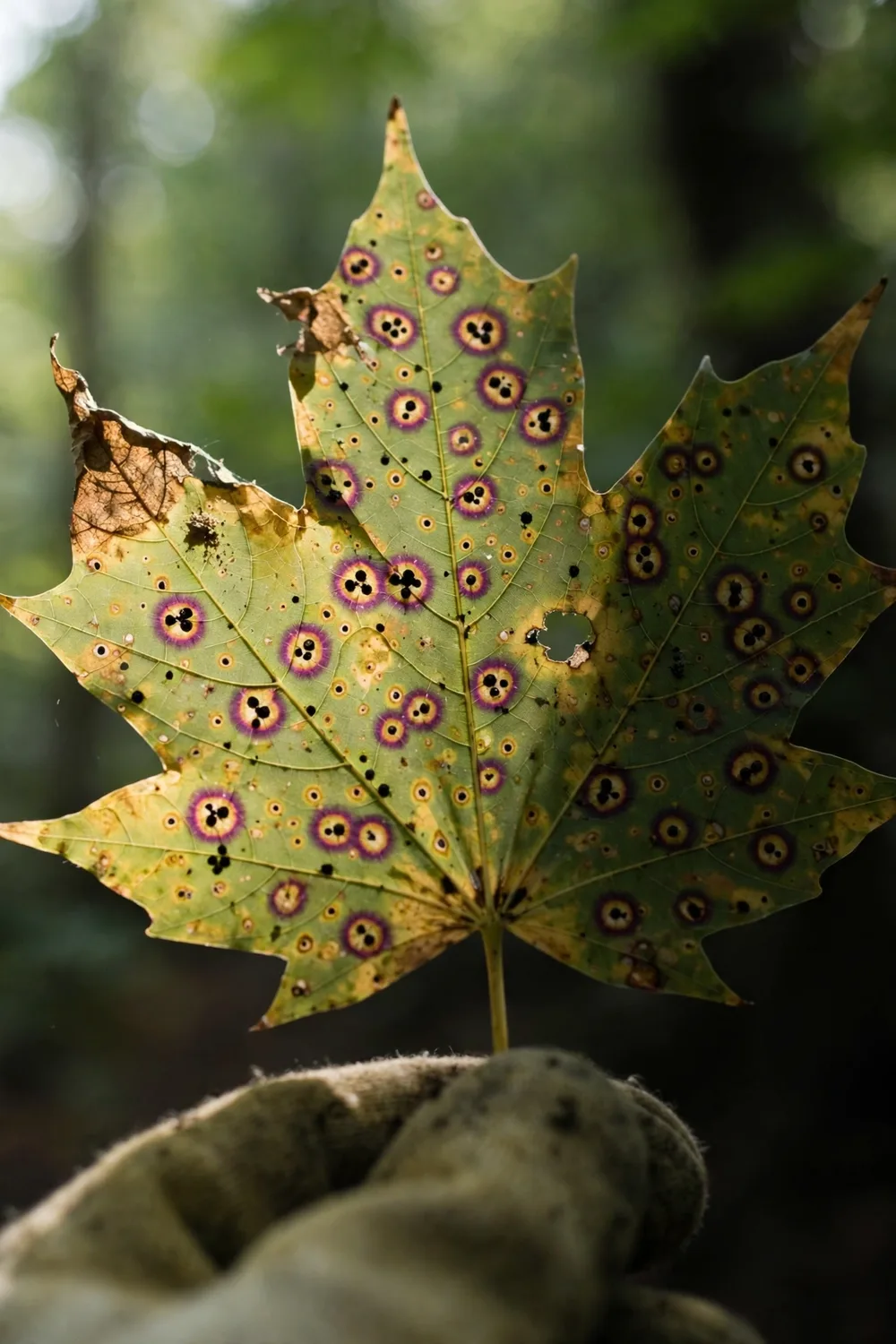

Purple-bordered leaf spot on maple looks alarming and mostly is not. The spots carry purple margins, tan centers, and tiny black dots, and the tree behind them usually keeps growing as if nothing happened. The 7 strategies below confirm the identification, separate the disease from tar spot and anthracnose, and keep one simple sanitation job at the center of the response.
The first move is reassurance with evidence. This disease is primarily cosmetic on maples, and it rarely causes significant damage to a mature, vigorously growing tree. A maple that drops leaves early in one bad season typically grows new leaves within weeks. I have learned that a gardener who rakes the fallen leaves and then stops worrying does more for the tree than one who sprays on sight.
The rest of this page walks the full decision, from the fungus itself to the rare case where spraying earns its place. The disease name leads. The pathogen, Phyllosticta minima, stays in the background after this introduction.
What Purple-Bordered Leaf Spot Actually Is
Purple-bordered leaf spot is a fungal leaf disease of maple. The pathogen is Phyllosticta minima, also written with the synonym Phyllostictina minima. The disease also carries the names eye spot and Phyllosticta leaf spot. The fungus attacks leaves only. It does not canker twigs, rot wood, or kill trees.
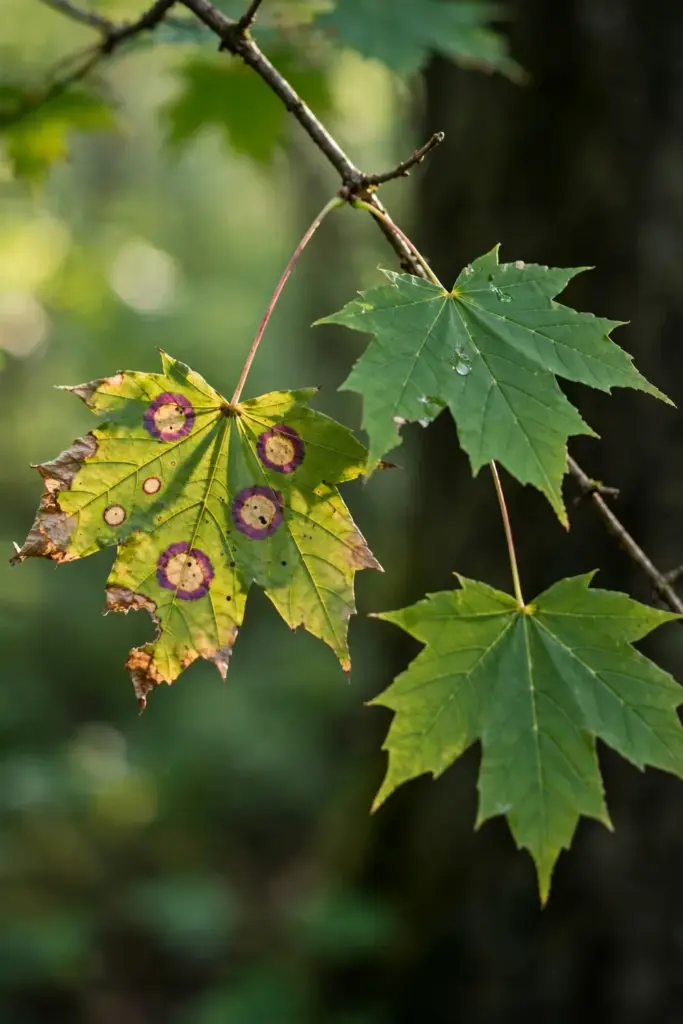
The fungus overwinters in leaf litter. In spring, rain and wind move spores from fallen leaves onto newly developing maple leaves, where infections start. Spores produced on infected leaves can lead to more infections within the canopy through the growing season. The cycle is simple, and the simplicity is the point: the fallen leaf is the whole reservoir.
The disease is primarily cosmetic. The University of Wisconsin Plant Disease Diagnostics Clinic calls it a common disease that is usually only a cosmetic problem, rarely causing significant damage to mature and vigorously growing trees. Washington State University Hortsense agrees, calling it not a serious landscape problem. A cosmetic disease still deserves identification, because its lookalikes include diseases that do real damage.
One naming trap stays fenced off. Frogeye appears in some sources for the purple-brown margin pattern, but frogeye leaf spot on apple is a different disease. This article never uses frogeye as the name for the maple disease. Caragana leaf spot, caused by Phyllosticta gallarum, is a different host and a different species, and it stays out of this article entirely.
How to Identify Purple-Bordered Leaf Spot on Maple Leaves
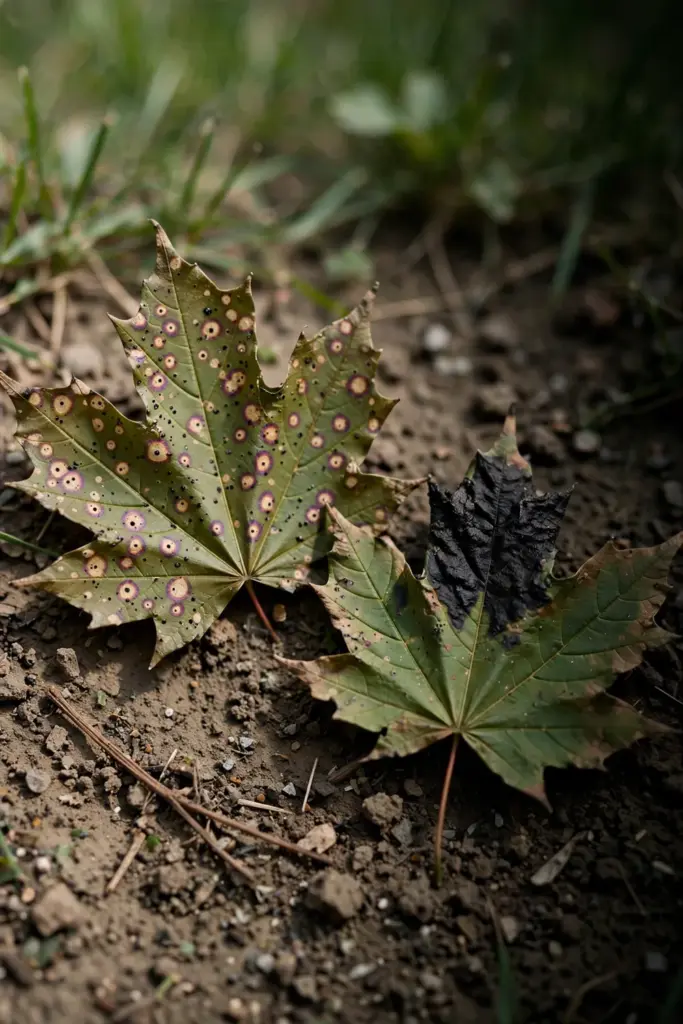
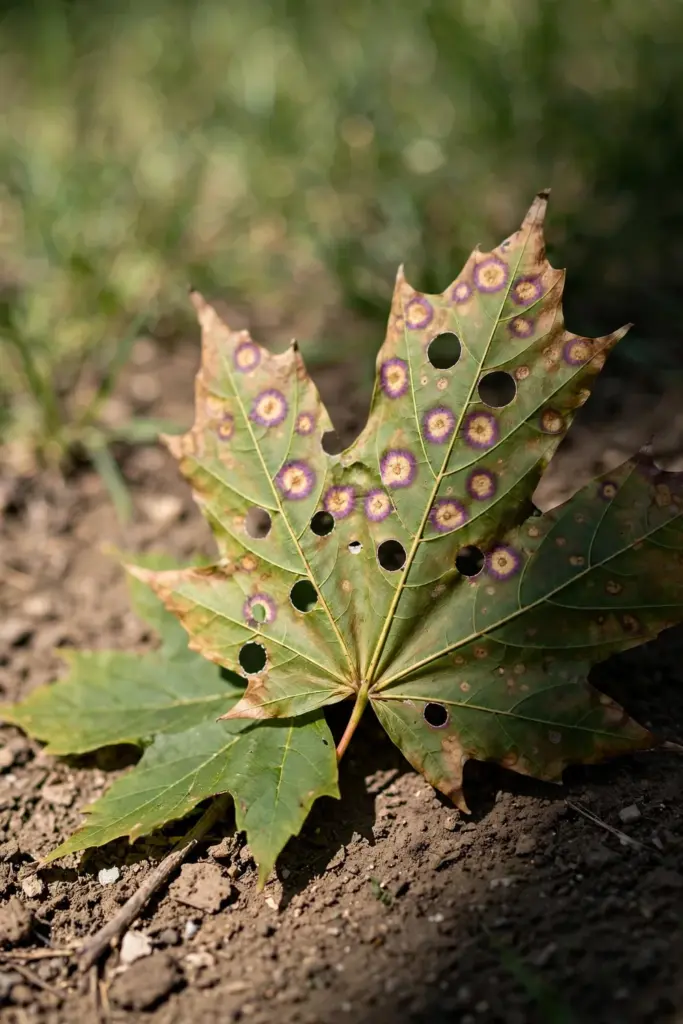
Purple-bordered leaf spot shows as roughly circular dead areas on leaves. The spots typically measure less than 1/4 inch across. Centers turn tan to brown. Margins show distinct purple, red, or brown borders. The combination of small size, round shape, and purple border is the field signature.

Tiny black pimple-like fruiting bodies often form within the spots. These structures are called pycnidia, and they are diagnostic. A hand lens makes them visible. No other common maple leaf spot packs its fruiting bodies into the spot in quite this dotted pattern, so the lens check separates a guess from an identification.
Centers may fall out as spots mature. The dead tissue drops away and leaves roughly circular holes, a shot-hole appearance. A leaf full of small round holes after a season of purple-bordered spots is a leaf that already told its story. The holes look dramatic and they change nothing about the tree.
Japanese maples show a lighter version. Washington State University Hortsense notes that Japanese maples develop yellowish or tan spots, sometimes with transparent centers. The purple border can read faint on a delicate Japanese maple leaf. The round shape, the small size, and the pycnidia still carry the identification.
Which Maples Get Hit Hardest by Purple-Bordered Leaf Spot
Amur, Japanese, red, silver, and sugar maple carry the disease most often. The Wisconsin clinic names those five as the maples in particular, while mountain maple, sycamore maple, and Tatarian maple also host it, which means the disease follows the genus rather than any single ornamental favorite. No maple species is immune, and no maple species dies from it.
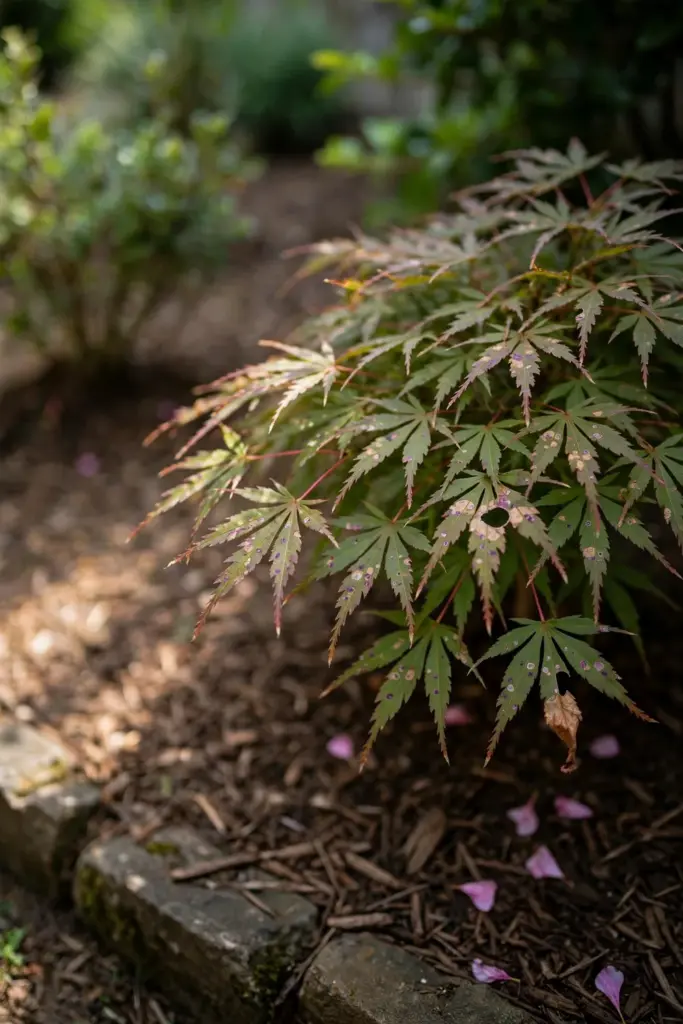
Japanese maples draw the most home-gardener attention. A small ornamental tree with purple-spotted leaves sits at eye level, in the middle of the garden, where every spot shows. The same disease on a 40-foot silver maple goes unnoticed in the upper canopy. The difference is visibility, not severity. The small tree is not sicker. It is only closer.
Wet years and lower canopy leaves show the most spots. Infections favor wet leaves, and the bottom third of the tree stays wet longest after rain. A maple that shows spots only on its lowest branches in a wet spring is showing the normal pattern. The same tree in a dry year may show almost nothing.
Newly planted maples deserve closer watching than established trees. A young tree has fewer leaves to spare, so early defoliation hits harder. The fungicide exception in Strategy 7 exists for newly planted trees for exactly this reason. An established tree with a full canopy shrugs off the same spot load.
Purple-Bordered Leaf Spot vs Tar Spot
The field check is the fruiting body. Purple-bordered leaf spot carries tiny black pimple-like pycnidia dotted inside small spots. Tar spot carries large raised black tar-like stroma on the upper leaf surface. Small dots inside a small spot point one way. A big tarry patch points the other.
| Clue | Purple-Bordered Leaf Spot | Tar Spot |
|---|---|---|
| Pathogen | Phyllosticta minima | Rhytisma species |
| Spot size | Typically under 1/4 inch, discrete and circular | Larger, up to roughly 1 inch, spots coalesce into big black areas |
| Fruiting bodies | Tiny black pimple-like pycnidia dotted within spots, diagnostic | Large raised black tar-like stroma, wrinkled, on the upper leaf surface |
| Shot-hole | Centers may fall out, leaving roughly circular holes | Stroma stays on the leaf, no falling centers |
| Timing | Spots visible through the season | Black stroma develops in late summer |
| Damage | Primarily cosmetic | Primarily cosmetic |
| Management | Rake and destroy fallen litter | Rake and destroy fallen litter |
No published head-to-head comparison table exists for this pair. This table compiles the purple-bordered side from Extension descriptions and the tar spot side from Extension and forestry descriptions of that disease. The two diseases share the same sanitation response, so a mistaken identification still points at the same first move.
Anthracnose gets a section, not a second table. Anthracnose on maple shows vein-associated irregular blotches, leaf distortion, and twig cankers. Discrete circular spots with purple margins point to purple-bordered leaf spot. Blotches that follow veins, plus cankered twigs, point to anthracnose. A lab confirms any case where the two still look alike.
Two one-line lookalikes close the section. Maple eyespot gall is an insect problem, with bull’s-eye spots and a larva at the center, cosmetic, needing no control. Tubakia leaf spot also shows purple-bordered spots on maple; the site’s live Actinopelte leaf spot article is under review, so treat that comparison as provisional and do not merge the two diseases.
Why Fallen Leaves Drive the Whole Disease
Leaf litter is the reservoir because the fungus overwinters there. Spores sit in fallen leaves all winter, then ride spring rain and wind onto new leaves. Every infected leaf left on the ground in fall is next spring’s first infection. Every infected leaf removed is an infection that never happens.
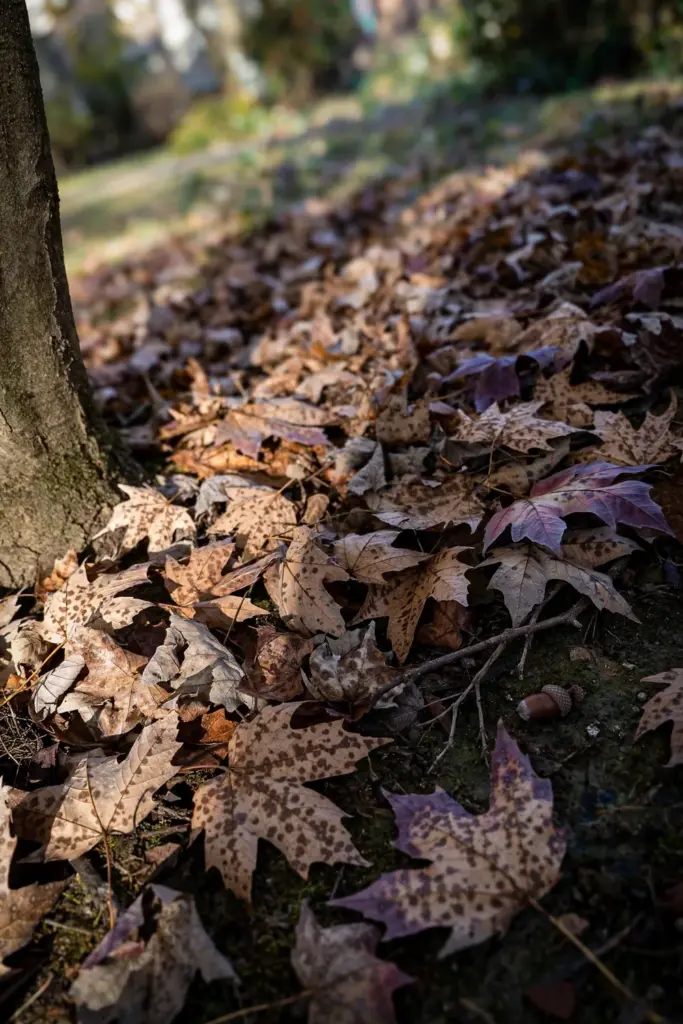
Spring rain sets the infection window. Spores need wet leaves to infect, and spring supplies the wetness. A dry spring means few infections even with litter on the ground. A wet spring means heavy infection even on a tree that looked clean last fall. Weather decides the year, and sanitation decides the baseline.
Secondary cycles extend the season. Spores produced on infected leaves cause more infections within the canopy through the growing season. One spring infection can feed several rounds of spots by late summer. The secondary cycles are why a tree that looked clean in June can look spotted by August.
The reservoir logic explains the whole management plan. No spray program can cover every leaf of a mature maple. Sanitation removes the reservoir instead of chasing the spores. The strategy that wins is the one that empties the litter, not the one that coats the canopy.
The timing of the spring pass deserves its own note. Spores leave the litter with the first warm spring rains, and they land on leaves that are still unfolding and tender. A raking done after bud break still helps, because it removes the litter that feeds the secondary cycles. A raking done before bud break helps more, because it removes the litter before the first infection window opens. The calendar target is the week before buds open, not the week after spots appear.
A maple in a neighborhood of unraked maples still benefits from its own cleanup. Spores blow in from nearby trees, and a clean yard cannot seal itself against every wind-blown spore. What the clean yard does is cut the local dose. Fewer spores at the door means fewer infections in the canopy, even when the neighbors never rake. The job pays even when it cannot finish the work alone.
What Makes Purple-Bordered Leaf Spot Worse in a Home Garden
Overhead irrigation sets the first risk. Sprinklers wet leaves from above and hold them wet for hours. Wet leaves invite infection. Drip irrigation or soaker hoses water the soil without wetting the canopy. A sprinkler that hits the maple every evening is a disease program running on a timer.
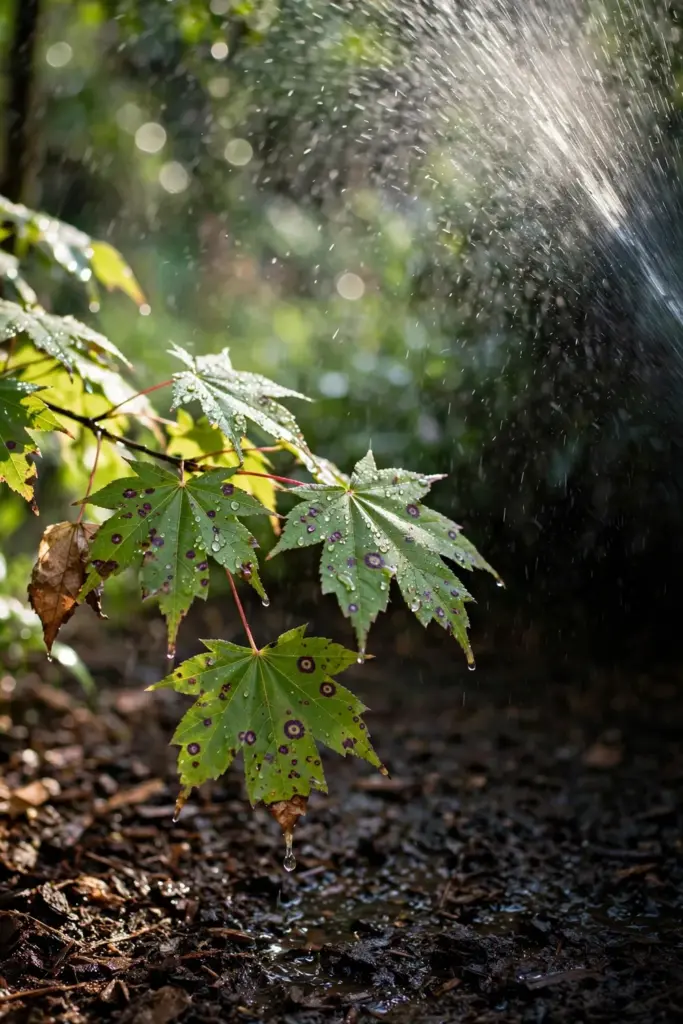
Wet springs set the second risk. Rain in spring and early summer favors disease development, and no gardener controls the rain. The response is not to fight the weather but to keep the litter out from under the tree before the wet season starts. A clean floor under the tree matters most in the wettest years.
Dense low canopies set the third risk. Low branches hold moisture after rain and keep the lowest leaves wet longest. The bottom third of the tree shows the most spots for this reason. Pruning for airflow helps, and the lowest branches are the ones to watch first when scouting.
Skipped fall cleanup sets the fourth risk. A yard that leaves fallen maple leaves in place all winter keeps the full reservoir intact. A yard that rakes and destroys the litter removes it. The fall cleanup is the single highest-value job in this whole article, and it costs nothing but time.
Strategy 1: Confirm the Identification With a Hand Lens
Measure the spots first. Purple-bordered spots typically stay under 1/4 inch across. A ruler or a coin edge gives the scale. Spots far larger than 1/4 inch, or blotches with no round shape, point elsewhere. Size is the fastest filter in the field.
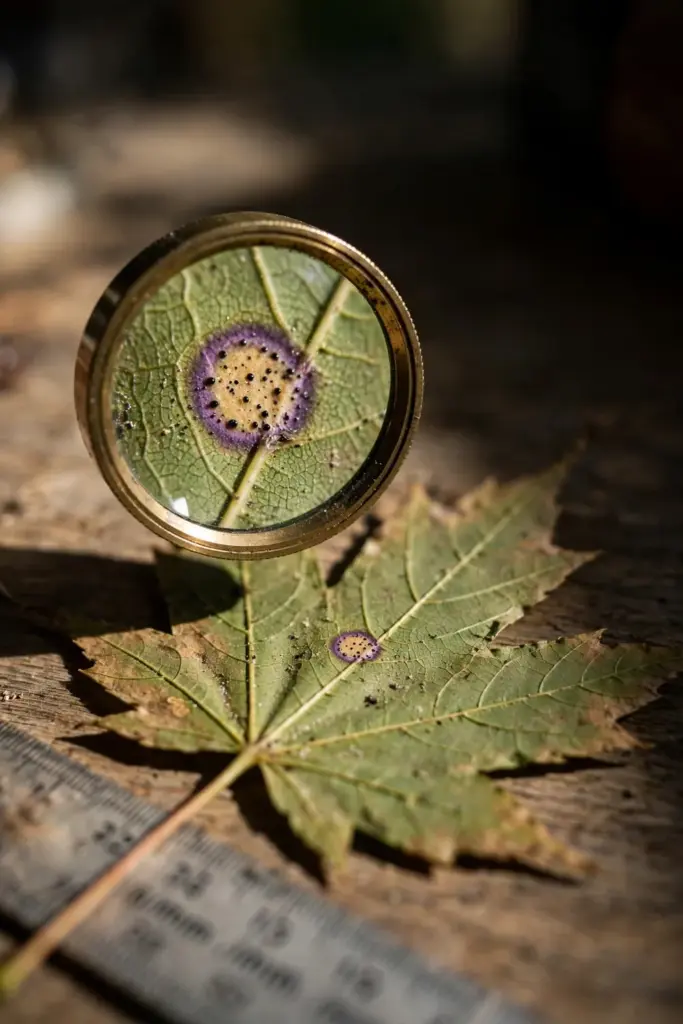
Check the margins next. The borders show distinct purple, red, or brown color. A spot with a tan center and a purple border is the signature. A spot with a yellow halo and no purple border is a different problem. Color plus shape beats color alone.
Find the pycnidia with a hand lens. Tiny black pimple-like fruiting bodies dotted within the spots are diagnostic. The lens turns a guess into an identification in seconds. No pycnidia and no purple border together mean the identification is unproven, and the tree deserves a second look before any action.
Strategy 2: Tell It From Tar Spot With the Comparison Table
Compare the fruiting bodies first. Tiny black dots inside small spots mean purple-bordered leaf spot. A large raised black tar-like patch means tar spot. The fruiting body is the most reliable separator in the field, and it works with a hand lens and good light.
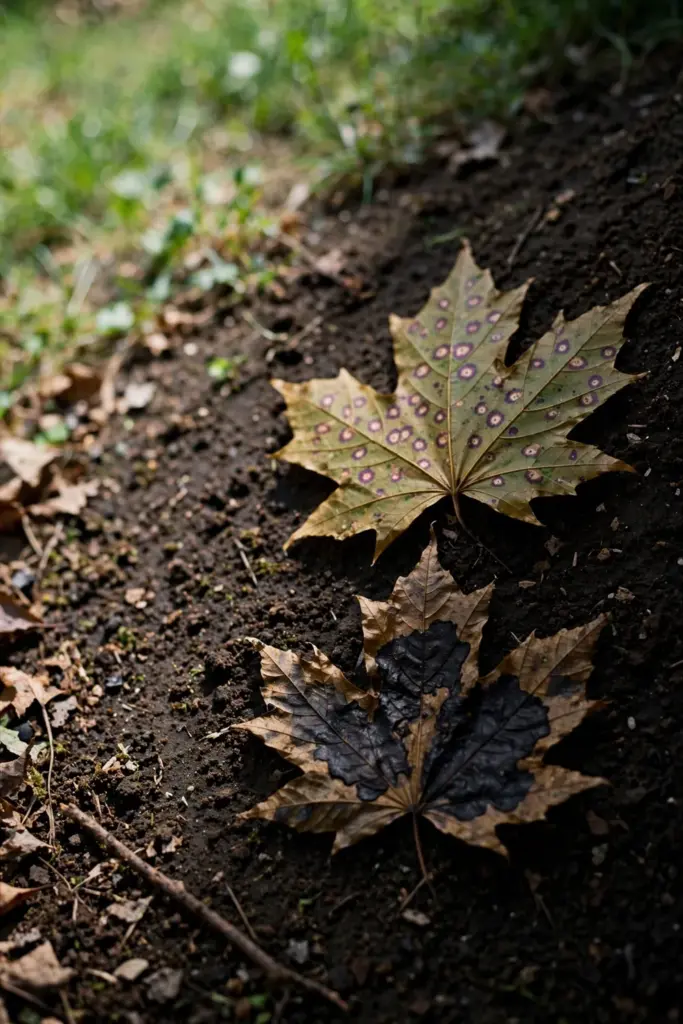
Compare the spot size next. Purple-bordered spots stay small and discrete. Tar spot stroma grows larger and coalesces into big black areas, up to roughly 1 inch across. A leaf covered in one big black patch is not purple-bordered leaf spot, no matter how purple its edges look.
Compare the timing last. Purple-bordered spots show through the season. Tar spot black stroma develops in late summer. A black tarry patch in October is tar spot doing what tar spot does. The same leaf in May would tell a different story.
Strategy 3: Tell It From Anthracnose Before You Act
Follow the veins. Anthracnose on maple makes irregular blotches that track leaf veins, with leaf distortion and twig cankers alongside. Purple-bordered leaf spot makes discrete circular spots with no vein tracking. Vein-following blotches point to anthracnose. Round freestanding spots point to purple-bordered leaf spot.
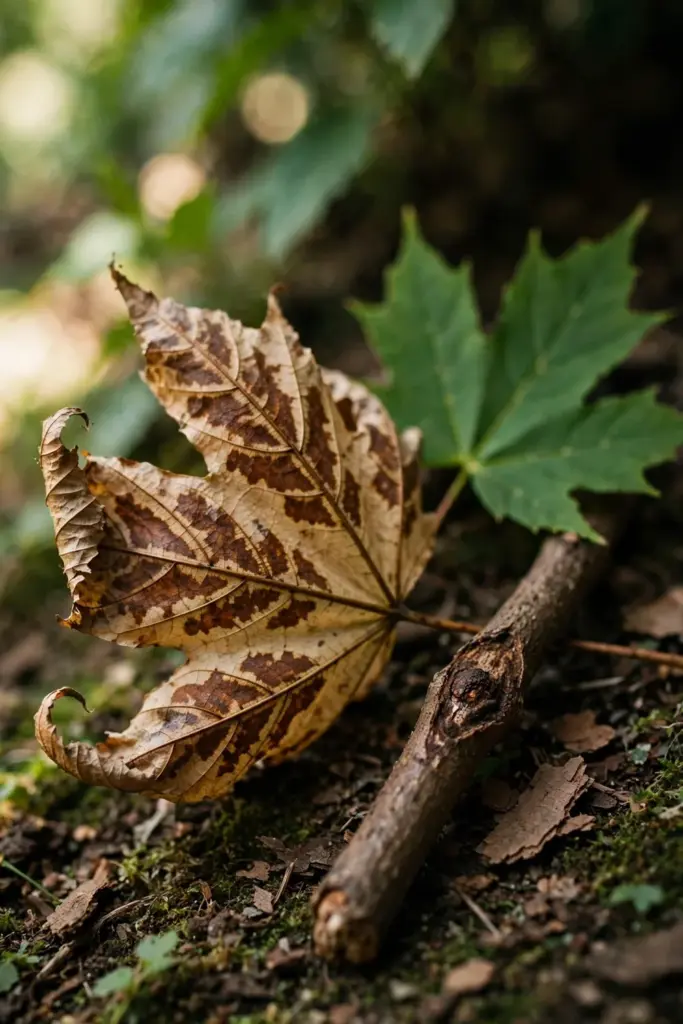
Check the twigs. Anthracnose cankers twigs, leaving sunken discolored bark and dieback. Purple-bordered leaf spot never touches twigs. A maple with spotted leaves and cankered twigs has a twig problem on top of a leaf problem, and the twig problem sets the priority.
Treat the two differently. Anthracnose can damage twigs and young growth, so it earns closer watching and, in severe years, a different conversation with an arborist. Purple-bordered leaf spot earns sanitation and patience. Mixing the two up means either overreacting to a cosmetic disease or underreacting to a twig disease.
Strategy 4: Rake and Destroy Every Fallen Leaf
Rake fallen maple leaves in fall and again before trees releaf in spring. Two passes catch the leaves that fell late and the leaves that blew in over winter. The spring pass matters because spores sit in litter all winter waiting for the first rain. A clean floor before bud break starves the first infection.
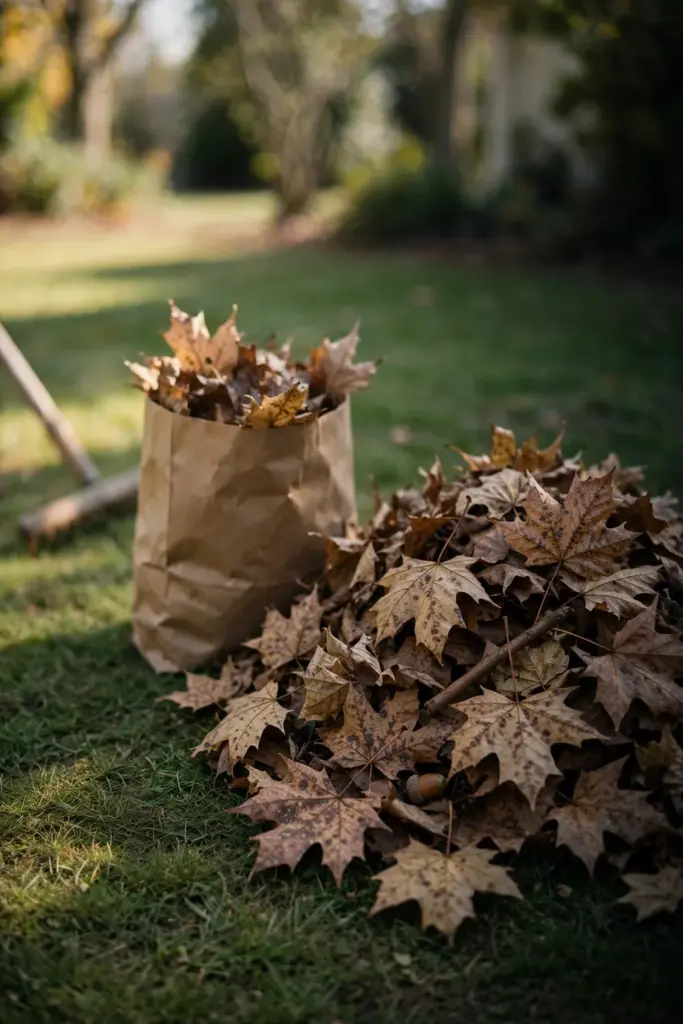
Destroy the litter, do not compost it casually. Bag the leaves for municipal waste as the safe default. A cold or unfinished compost pile will not kill the fungus, and a pile that returns to the garden returns the reservoir with it. Trash is the choice that never backfires.
Mulch mowing does not count as cleanup for this disease. A mower that shreds infected leaves and leaves the pieces on the lawn grinds the reservoir into smaller pieces and spreads it wider. The pieces still carry spores, and the next rain still moves them. Shredding feels like cleanup and acts like distribution. Bag the leaves whole and carry them out.
The same rule covers leaves that fall on beds and paths near the tree. A maple leaf in a shrub bed under the canopy is still reservoir, even though it is not on the lawn. Rake the beds, the paths, and the corners where wind piles leaves against the fence. The fungus does not care whether the leaf sits on grass or on mulch. It waits in either place.
Rake under the whole canopy, not just the visible drift. Wind piles leaves against fences and shrubs, and those piles hold spores as surely as the drift under the tree. The corners and fence lines are the reservoir that survives a careless raking. Walk the full drip line.
Strategy 5: Support the Tree If It Defoliates Early
Water a defoliated tree promptly. The Wisconsin clinic sets the watering guidance plainly: established trees need approximately 1 inch of water per week, and newly transplanted trees need approximately 2 inches per week. A tree that releafs after early defoliation spends stored energy, and water keeps that second flush growing.
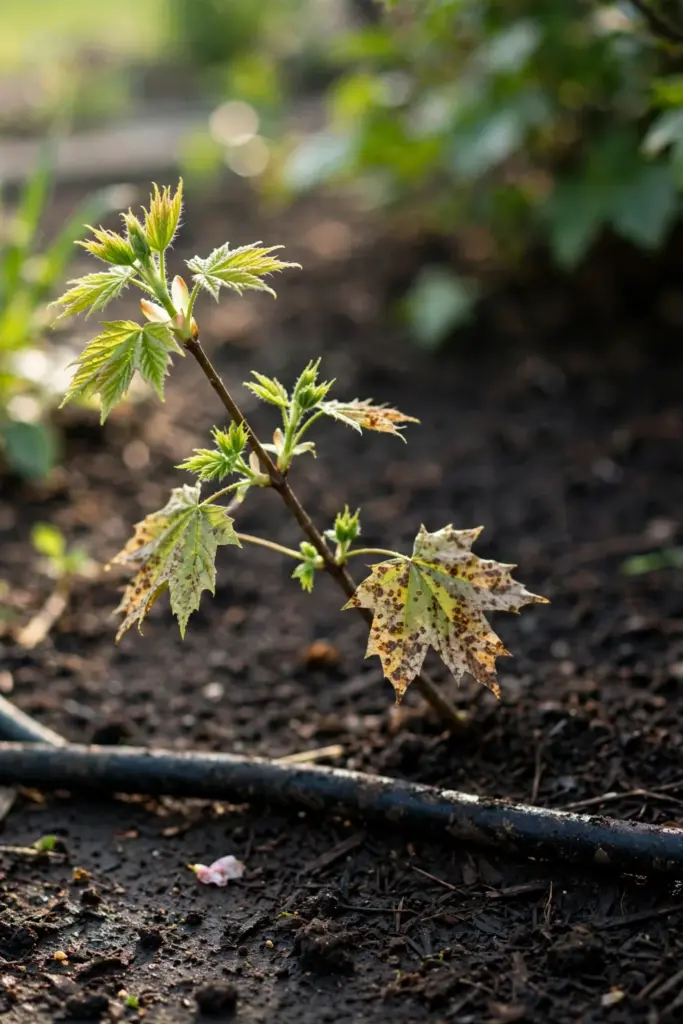
Fertilize only on a soil test. A defoliated tree does not need a rescue dose of nitrogen. It needs the nutrients the soil test says are short, and nothing else. Overfeeding pushes soft growth that invites more disease. Test first, then feed only what the test calls for.
Wait for the releaf. Trees that defoliate early in the season typically produce new leaves within a few weeks. The second flush looks fresh and the season continues. Panic pruning, panic spraying, or panic removal all do more damage than the disease did. Patience is the treatment for a cosmetic disease.
Strategy 6: Choose Resistant Varieties When You Plant
Ask the nursery about resistance before buying. The Wisconsin clinic lists resistant varieties as an option for maples that suffer repeated severe defoliation. A nursery that knows its stock can point to varieties that dodge this disease in the local climate. The question costs nothing and the answer shapes decades.
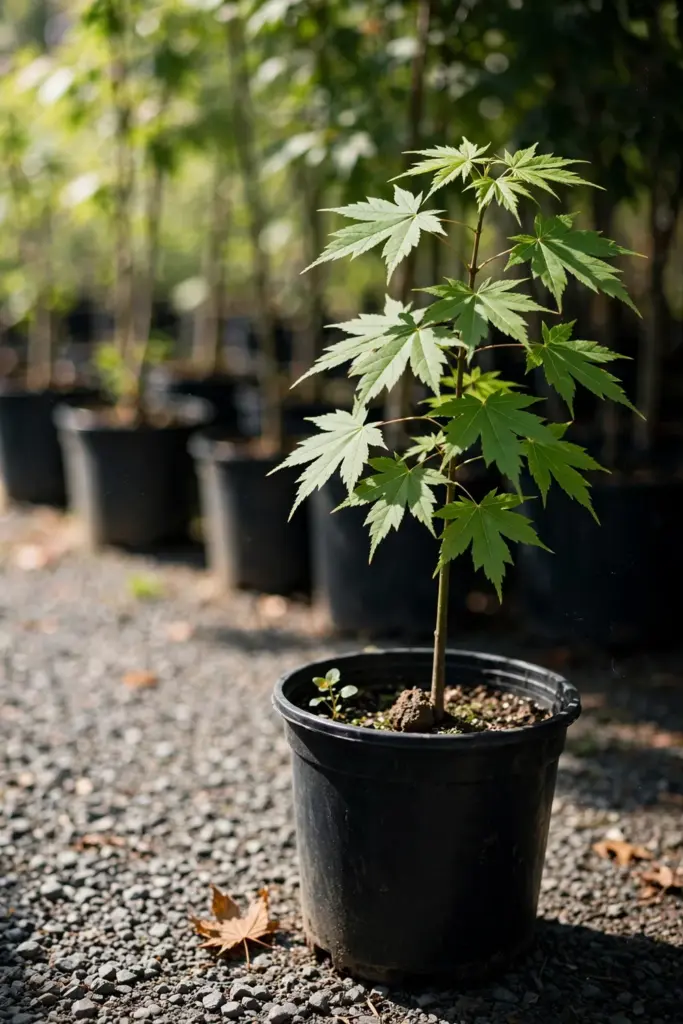
Do not print a variety list from memory. Resistance varies by region and by year, and a list copied from one climate misleads another. The nursery and local Extension office carry the current local answer. This article names no variety list because the evidence supports no universal list.
Match the variety to the site, not just to the disease. A resistant maple planted in a wet low pocket with overhead sprinklers will still spot. A susceptible maple on a breezy slope with drip irrigation may stay nearly clean. Site and water habits matter more than the variety name alone.
Strategy 7: Spray Fungicide Only for Severe Multi-Year Cases
Reserve fungicide for two cases: newly planted maples, and established maples severely affected for several years running. A single spotted season on an established tree never earns a spray. The disease is cosmetic, and spraying a cosmetic disease is spending money to fix a look.
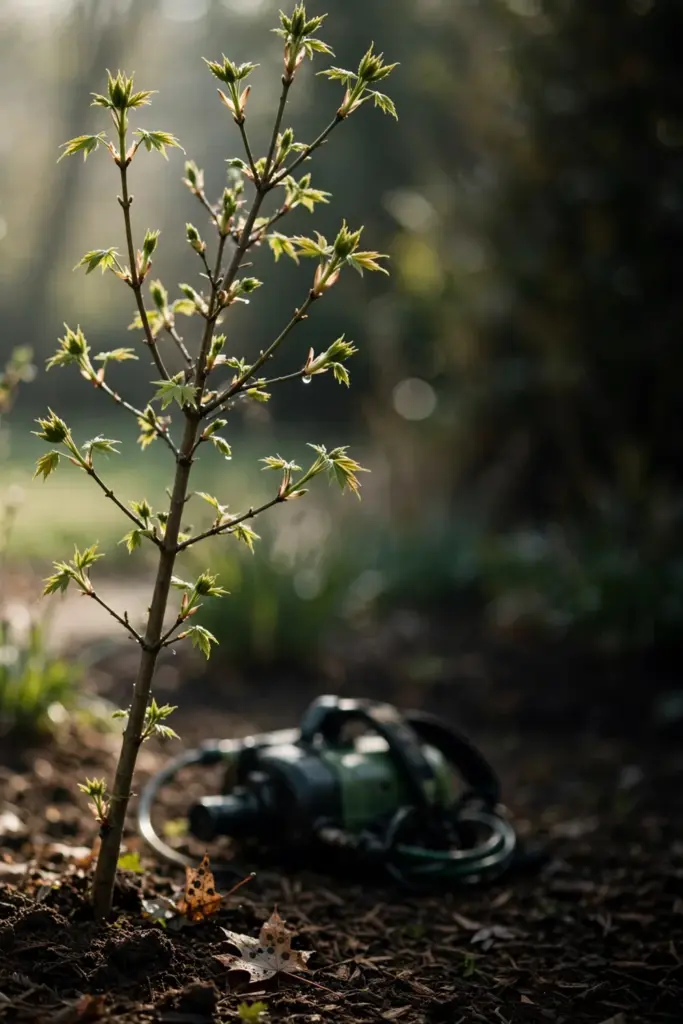
Time three treatments if spraying is warranted. The Wisconsin clinic sets the schedule: bud break, leaves half expanded, and leaves fully expanded. Three treatments cover the infection window. A single late spray after spots appear protects nothing, because the infections already happened.
Rotate at least two active ingredients. The Wisconsin clinic lists chlorothalonil, copper, mancozeb, neem oil, sulfur, and thiophanate-methyl among the options, and warns never to use the same active ingredient for all treatments. Thiophanate-methyl resistance is the specific risk. Read the label for the crop, the state, and the pre-harvest rules, and follow it exactly.
Respect the homeowner spray limit. Washington State University Hortsense sets the rule: homeowners should not make foliar applications to trees over 10 feet tall. A mature maple canopy is a job for a commercial applicator, not a homeowner with a hose-end sprayer. Calling the applicator is not a failure. It is the label-compliant move.
Living With Purple-Bordered Leaf Spot on a Maple You Already Own
A maple with purple-bordered leaf spot is a healthy tree with spotted leaves. Keep raking. Keep watering by the soil test. Keep the sprinklers off the canopy. The disease will return in wet years and fade in dry years, and the tree will keep growing through both.
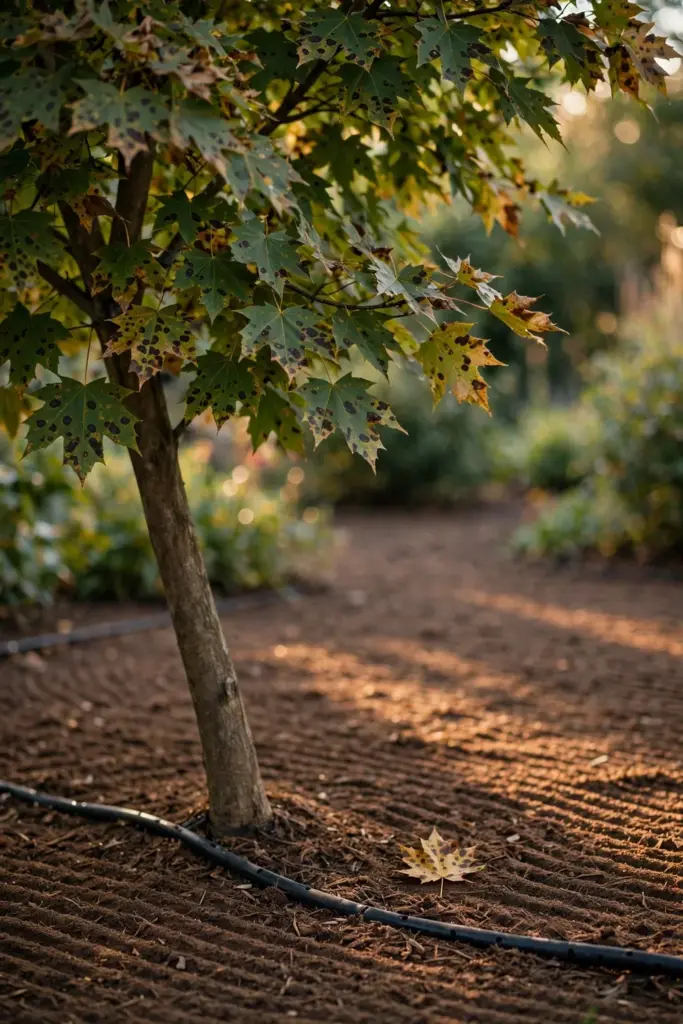
Stop three habits. Do not spray at the first spot. Do not compost diseased litter casually. Do not judge the tree by its worst leaf. The worst leaf is not the tree. The canopy as a whole, the twig growth, and the releaf speed are the health measures that matter.
Keep a short seasonal record. Note the date the spots first appeared, whether the spring was wet or dry, and whether the fall cleanup happened on time. Over three seasons, the record shows the pattern plainly: wet spring plus skipped cleanup means a spotted summer, while a clean floor plus a dry spring means a nearly clean canopy. The record turns a recurring worry into a predictable rhythm, and the rhythm makes the raking feel worth doing.
A maple that defoliates early two years running deserves a second opinion, not a second spray. An arborist or an Extension diagnostic clinic can confirm the identification and rule out anthracnose or a twig problem riding alongside. The visit costs less than a spray program and it answers the question the spots keep asking: is this still the cosmetic disease, or has something else joined it?
The live Phyllosticta leaf spot guide on boxwood and hydrangea covers the same genus on different hosts, and it is a useful companion for gardeners who grow both. The Plant Care archive collects the site’s disease coverage in one place. Neither companion changes the maple plan: rake, destroy, wait.
Frequently Asked Questions
No, in almost every case. The disease is primarily cosmetic and rarely causes significant damage to a mature, vigorously growing tree. Spots look alarming, and the tree keeps growing. Early defoliation in a bad year is the worst usual outcome, and the tree typically releafs within weeks. Treat the spots as a cosmetic problem, not a tree emergency.
Almost never. A newly planted maple has fewer leaves to spare, so early defoliation hits harder than on an established tree. Water the young tree at about 2 inches per week and keep the litter cleaned up. The fungicide exception exists for newly planted trees precisely because they have less margin. Even then, the disease rarely kills. It sets growth back.
Almost always no. Fungicide belongs only to newly planted maples and established maples severely affected for several years running. Spraying a cosmetic disease on an established tree spends money to fix a look. Sanitation does the real work. If the tree is over 10 feet tall, homeowners should not spray the canopy at all, and a commercial applicator is the compliant choice.
Bag them for municipal waste as the safe default. A cold or unfinished compost pile will not kill the fungus, and compost that returns to the garden returns the reservoir with it. A hot, actively managed pile may kill it, but most home piles never stay hot enough long enough. Trash is the choice that never backfires, and it costs nothing but a bag.
Compare the fruiting bodies. Purple-bordered spots carry tiny black pimple-like dots inside small spots under 1/4 inch. Tar spot carries a large raised black tar-like patch, up to roughly 1 inch, on the upper leaf surface. Small dots inside a small spot mean purple-bordered leaf spot. A big tarry patch means tar spot. Both are cosmetic, and both answer to the same raking routine.
Where to Go From Here
Purple-bordered leaf spot rewards the gardener who rakes and then relaxes. Confirm the identification with a hand lens. Separate it from tar spot and anthracnose. Rake and destroy the litter twice a year. Water a defoliated tree and wait for the releaf.
Next season, start clean. A raked floor before bud break, sprinklers kept off the canopy, and a soil test on file will do more than any spray. The Clemson Extension maple diseases guide is a useful companion for the full maple disease picture, since it sets this cosmetic spot in context beside the maple diseases that do real damage.