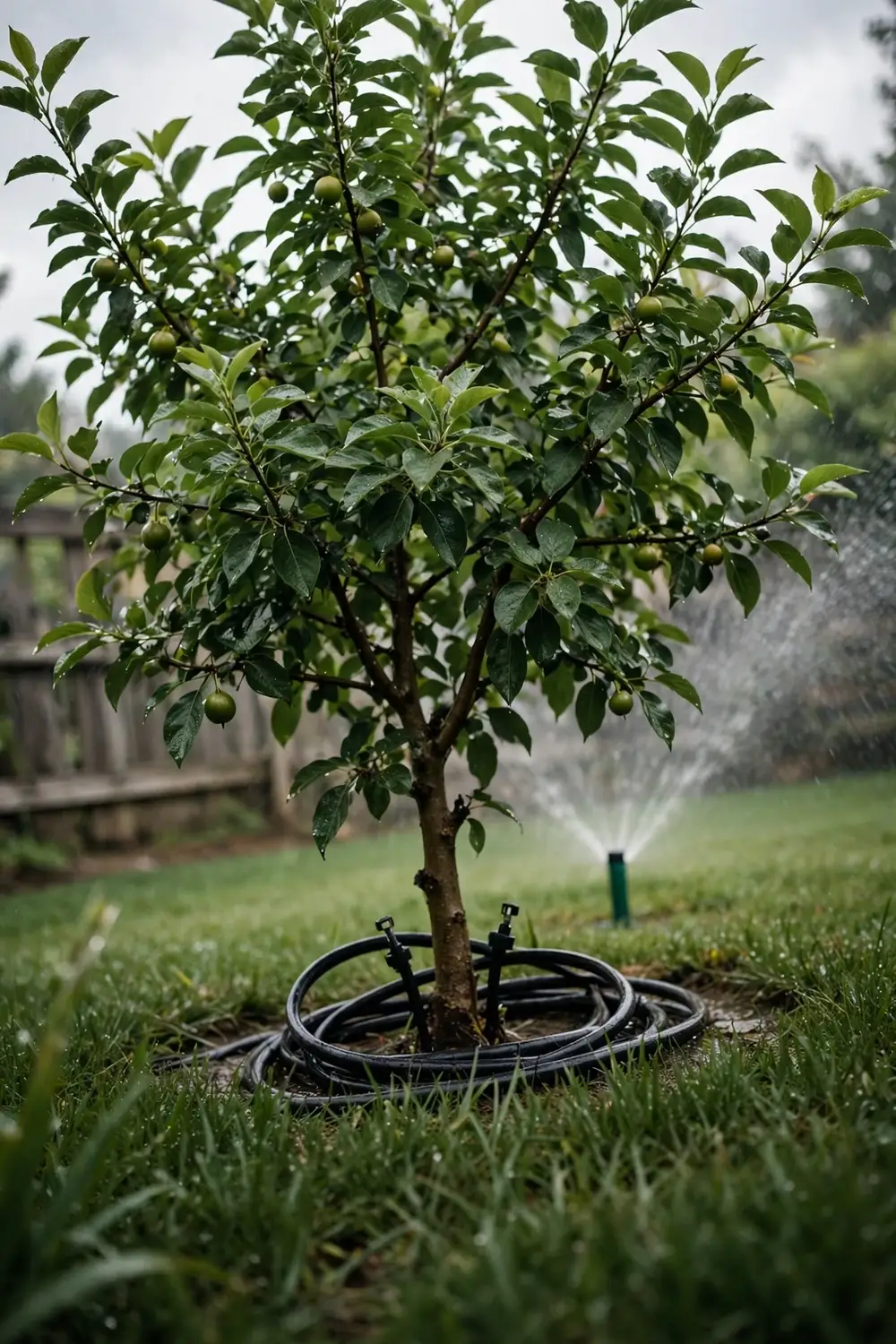

Drip irrigation wins for most home fruit trees on 2 counts: dry leaves and water at the root zone. Overhead watering wins on one night only: a frost night. Micro-sprinklers sit between the two, wetting more soil than drip while keeping most water off the leaves.
That is the overhead watering vs drip irrigation for fruit trees decision in one paragraph. The rest of this page compares all 3 methods on water use, disease pressure, tree age, and setup, then names the method for your tree.
If you are still choosing which fruit tree to plant, the home fruit garden guide covers the planting decision. Check your local water authority’s rules before you buy any kit. Some councils restrict sprinkler days in dry summers, and the rules differ from one district to the next.
1. Start With the 3 Methods on One Page
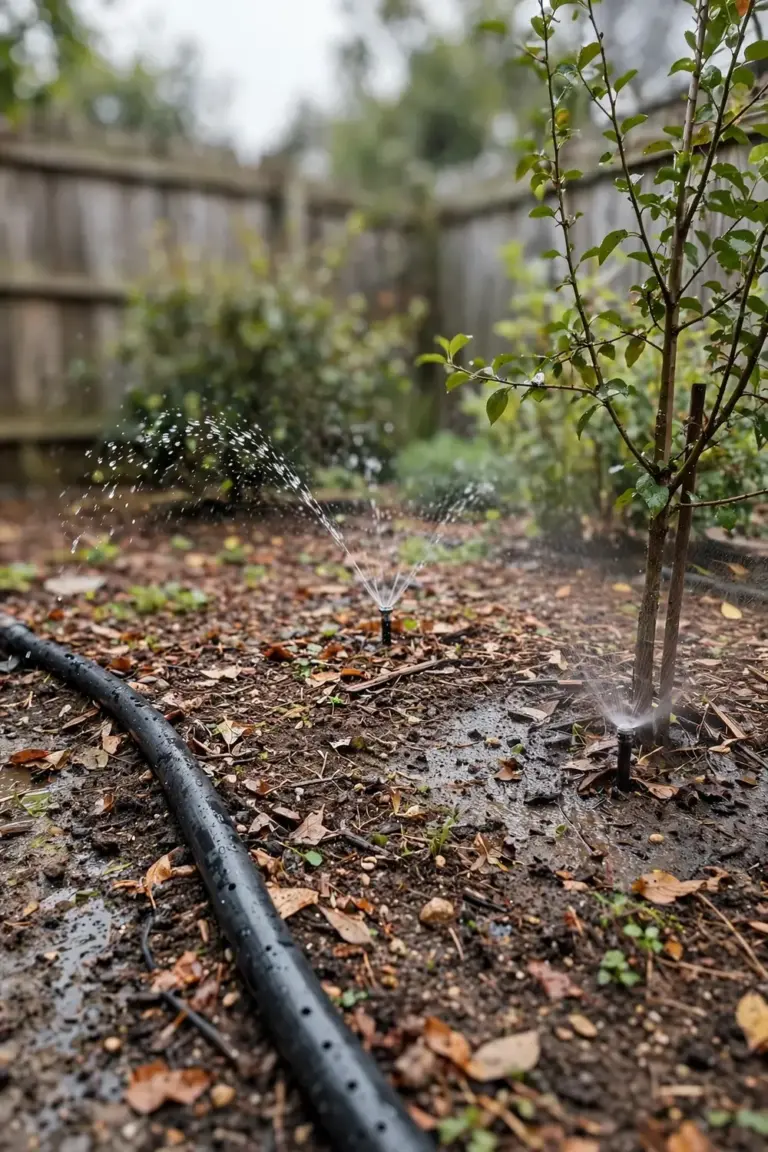
Drip, overhead, and micro-sprinkler differ in one place: where the water lands. Drip lands at the soil. Overhead lands on leaves, fruit, and soil together. Micro-sprinkler lands on the soil in a low spray under the canopy. That landing zone decides water use, disease pressure, and frost protection.
| Method | Water delivery | Leaves stay dry? | Frost control | Main failure |
|---|---|---|---|---|
| Drip | Emitters at the root zone | Yes | No | Clogged emitters |
| Overhead | Sprinkler or hose from above | No | Yes | Evaporation and disease |
| Micro-sprinkler | Low spray under the canopy | Mostly | Some | Wider wetting than drip |
Read the table once, then match the method to your tree age and your climate. A young tree in sandy soil wants a different answer than a mature tree in heavy soil.
Use the table as a shortcut, not a verdict. Find your situation first. Frost-prone valley? Overhead stays in the kit. Humid summer with leaf spot history? Drip leads. Sandy soil and a new planting? Micro-sprinkler leads for year one, then drip takes over. The table ranks the methods. Your garden picks the winner.
2. Run Drip for Dry Leaves and Deep Roots
Drip puts water at the root zone and leaves the canopy dry. Each emitter releases a slow trickle at the soil surface, and the wet patch spreads outward and downward from that point. The leaves never get wet, so the leaf-disease window never opens.
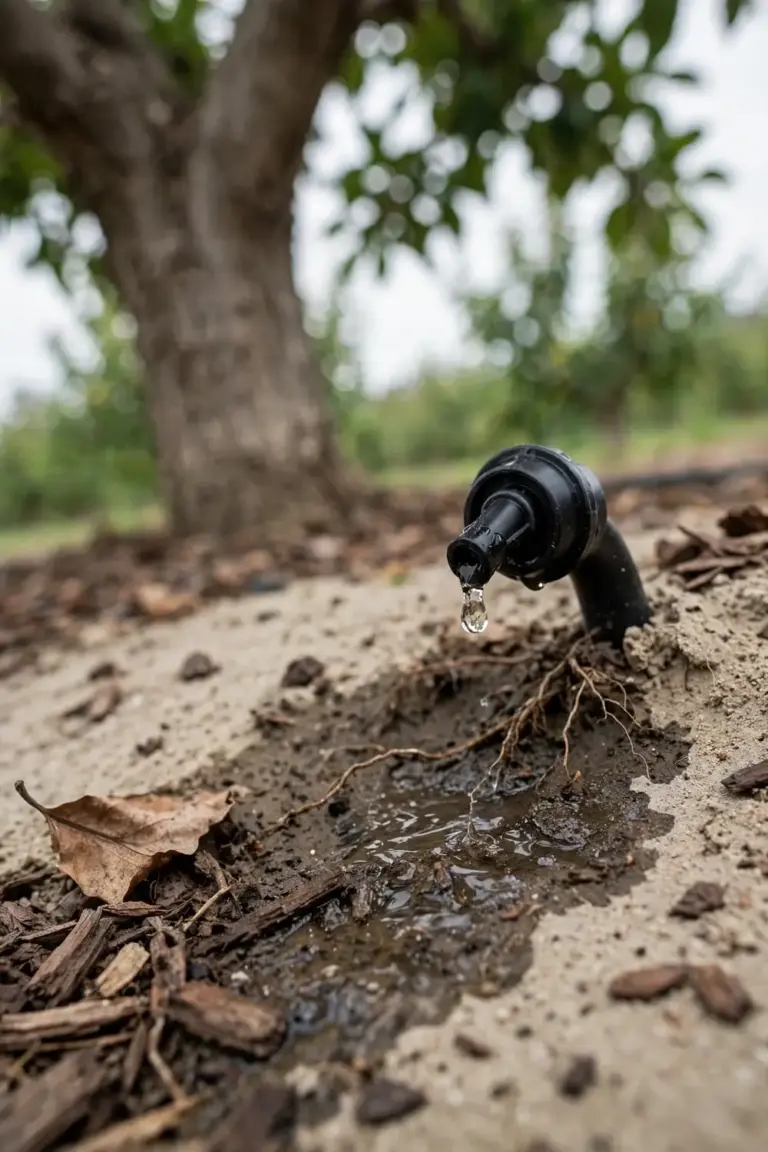
The New South Wales Department of Primary Industries lists drip as potentially the most water-efficient irrigation system, with a reduced need for fungicide sprays, in its guide to choosing an irrigation system for horticulture. The same department’s disease-risk table rates surface drip as low risk for trees, vines, cane, and fruit, while sprinkler irrigation rates as high risk for the same group, in its guide to irrigation in vegetables.
Space emitters 30.5 to 45.7 cm apart along the line, and lay 2 drip lines per bed in sandy soils, following the University of Georgia Extension spacing in its low-volume irrigation guide. Sandy soil drains fast and spreads water in a narrow column, so a second line widens the wet patch. Heavy soil spreads water sideways on its own, so one line does the job.
Run drip long enough to wet the top 30 cm of soil. Push a screwdriver into the ground after a run. It slides easily through wet soil and stops at dry soil. That depth check beats any timer setting, because soil, sun, and wind change every week. A young tree needs 1 or 2 emitters at the root ball. A mature tree needs 4 to 6 emitters spread around the drip line. Add emitters as the canopy widens, and the root zone widens with them.
I walk the far end of the drip line first when I check for clogs, because the last emitter starves first when the filter loads up. A clogged emitter starves one tree while the rest look fine. Walk the line.
Drip also carries fertilizer. The NSW DPI horticulture guide lists drip as highly suited to fertigation, alongside low-level sprinklers, in the same irrigation guide. A fertilizer injector on the mainline feeds the root zone with every run, at a steady low dose. Overhead fertigation wastes fertilizer the same way it wastes water, spraying it across the whole floor. Keep fertilizer in the drip line, and keep the sprinkler for water only.
3. Run Overhead When Frost or Heat Threatens the Crop
Overhead watering is the only method that fights frost. A sprinkler running through a frost night coats buds and young fruit in water, and that water releases heat as it turns to ice. The ice shell holds the tissue at freezing point instead of letting it drop below. Drip cannot do this job. Drip wets soil, not canopy, and the canopy is where frost bites.
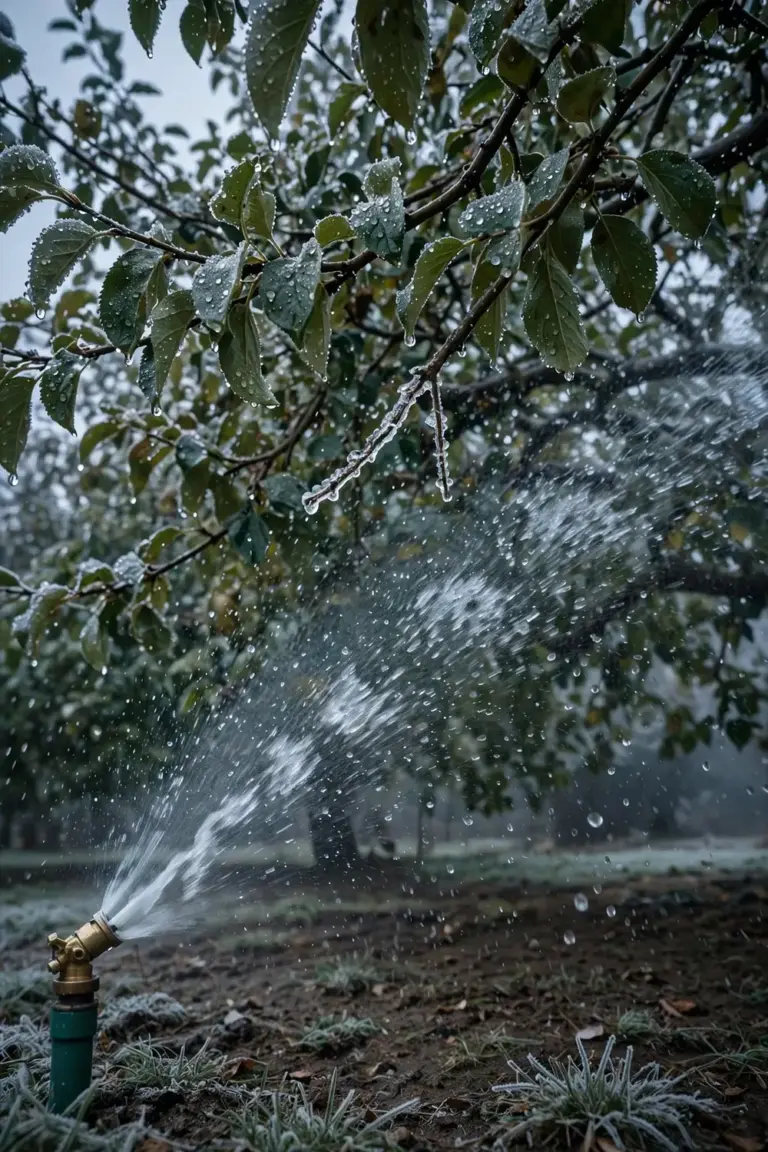
The NSW DPI horticulture guide states that overhead sprinklers can be used for frost control and canopy cooling, in the same irrigation guide. The guide also lists the costs: high evaporation losses on hot, windy days, conditions that suit disease development, more fungicide applications on overhead-irrigated blocks, and salt uptake in leaves when foliage stays wet, especially in citrus.
Use overhead as a tool for frost nights and heat waves, not as a daily routine. Run it at dawn on a hot day so the leaves dry fast. Overhead water on a hot windy afternoon evaporates before it reaches the roots. Run it at dawn or not at all.
Watch fruit near harvest. The NSW DPI horticulture guide warns that overhead water can damage susceptible crop types through splitting and marking, particularly close to harvest, in the same irrigation guide. A cherry or stone fruit that swells fast after a heavy overhead run can split. Stop overhead watering in the last weeks before harvest on splitting-prone fruit, and let drip carry the tree to picking day.
Run a frost night in 3 steps. Start the sprinkler before the temperature hits freezing, while the air still holds some warmth. Keep it running through the cold hours without a break, because a gap lets the ice shell drop below freezing. Stop at sunrise, once the air warms past freezing and the ice melts on its own. A sprinkler started late, after ice already formed on dry buds, does more harm than good.
4. Run Micro-Sprinklers for Young Trees and Sandy Soil
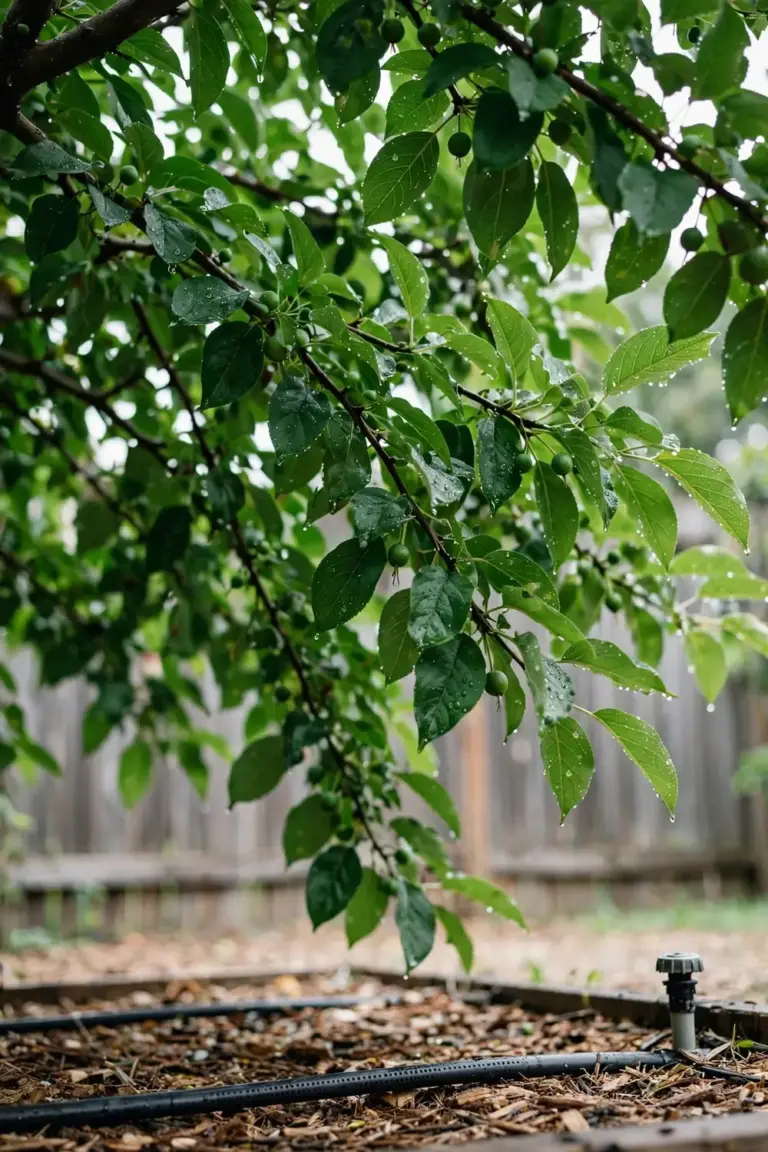
Micro-sprinklers wet a wider ring than drip and keep most water off the leaves. Each head throws a low spray under the canopy, wetting a circle of soil around the tree. Leaves stay mostly dry. The root zone gets a broad wet patch. The tree establishes fast.
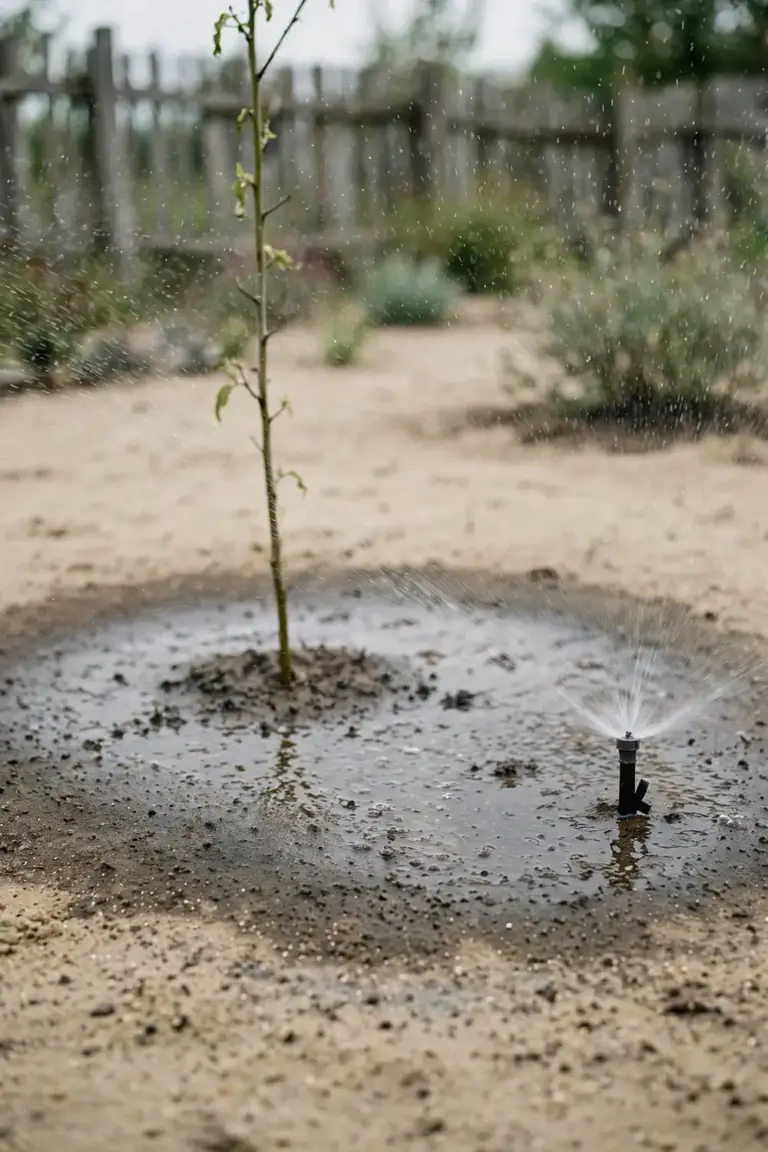
The NSW DPI horticulture guide lists minimal wetting of fruit and foliage as the first advantage of low-level sprinklers, with some frost control and canopy cooling possible, in the same irrigation guide. The guide also notes lower pumping costs than overhead sprinklers.
Australian orchard practice leans this way. A survey of domestic avocado growers found 92% use minisprinklers, and the proportion of orchard floor wetted in mature orchards ranged from 35% to 100%, averaging about 64%, according to the Avocado Australia irrigation survey. The University of Georgia Extension notes that microsprinklers are less efficient at applying water than drip systems because they provide a greater wetting area, and that orchardists adopt them especially for crops grown in sandy soils, in its low-volume irrigation guide.
A micro-sprinkler aimed at the trunk wets bark and invites rot. Aim the spray at the root zone, away from the trunk.
Check uniformity before you trust the system. Set 4 empty cans across the spray pattern and run the head for 10 minutes. The cans should hold near-equal depths. A head that throws twice as much water on one side starves half the root zone. Swap the nozzle or move the head until the cans read even. That 10-minute test saves a season of lopsided growth.
Wind barely moves a micro-sprinkler pattern. The NSW DPI horticulture guide lists minimised wind effects as a low-level sprinkler advantage, in the same irrigation guide. The spray stays low, under the canopy, where the wind cannot bend it. Overhead sprinklers throw water high into moving air, and the wind carries it off target. A windy site tips the comparison further toward low-level delivery.
5. Compare Water Use: Overhead Watering vs Drip Irrigation for Fruit Trees
Drip uses the least water. Overhead loses the most to evaporation. Micro-sprinklers sit in the middle, wetting more ground than drip and losing more to the air.
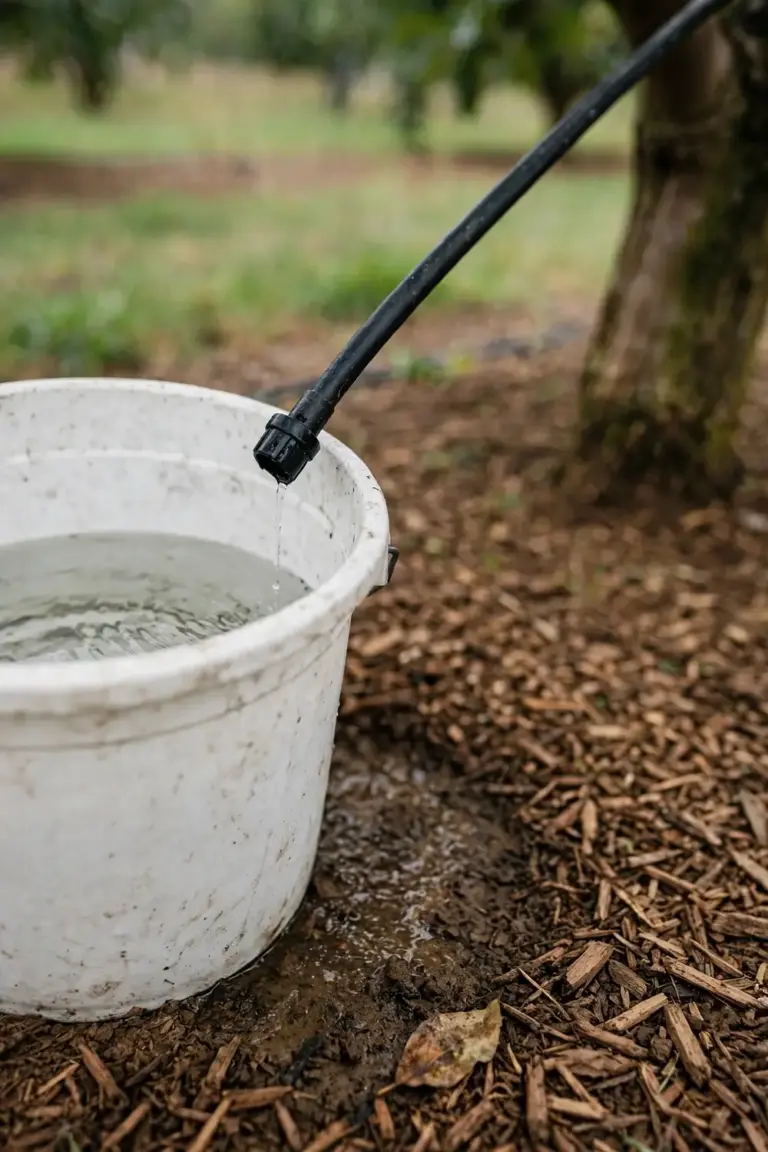
Drip wins because it wets only the root zone. The NSW DPI horticulture guide calls drip potentially the most water-efficient system, and notes large water savings in young plantings from accurate and even water placement, in the same irrigation guide. Nothing else in the comparison wets so little soil.
Overhead loses water twice. Wind bends the spray off target, and hot air dries droplets before they land. The NSW DPI horticulture guide lists high evaporation losses on hot, windy days and relatively high pumping costs compared with low-level sprinkler and drip, in the same irrigation guide. A sprinkler on a windy afternoon waters the path more than the tree.
Micro-sprinklers lose water through their wider wet patch. The avocado survey measured mature orchard floor wetting at 35% to 100%, averaging about 64%, in the same Avocado Australia survey. More wet soil means more evaporation than drip. The University of Georgia Extension states the trade-off plainly: microsprinklers are less efficient than drip because they wet a greater area, in its low-volume irrigation guide.
Pumping cost follows the same ranking. Overhead runs at higher pressure and higher flow than drip, so the pump works harder for every litre delivered. Drip runs at low pressure and low flow, so the pump bill drops. Micro-sprinklers sit between the two on pressure and flow. A home gardener on tank water feels this difference fast, because every litre pumped is a litre the tank must replace.
Measure your own system before you believe any ranking. Put a bucket under one emitter and time 1 minute of flow. Multiply by emitter count and run time. That product is the litres your drip ring delivers per run. Run a sprinkler into the same bucket for 1 minute and compare. Your numbers beat any generic ranking, because your pressure, your soil, and your tree spacing set the real delivery rate. Write the 2 numbers on the tank lid, and recheck them each spring.
6. Compare Disease Pressure Across the 3 Methods
Wet leaves grow disease. Dry leaves do not. This single rule decides the disease ranking of the 3 methods, and it never changes.
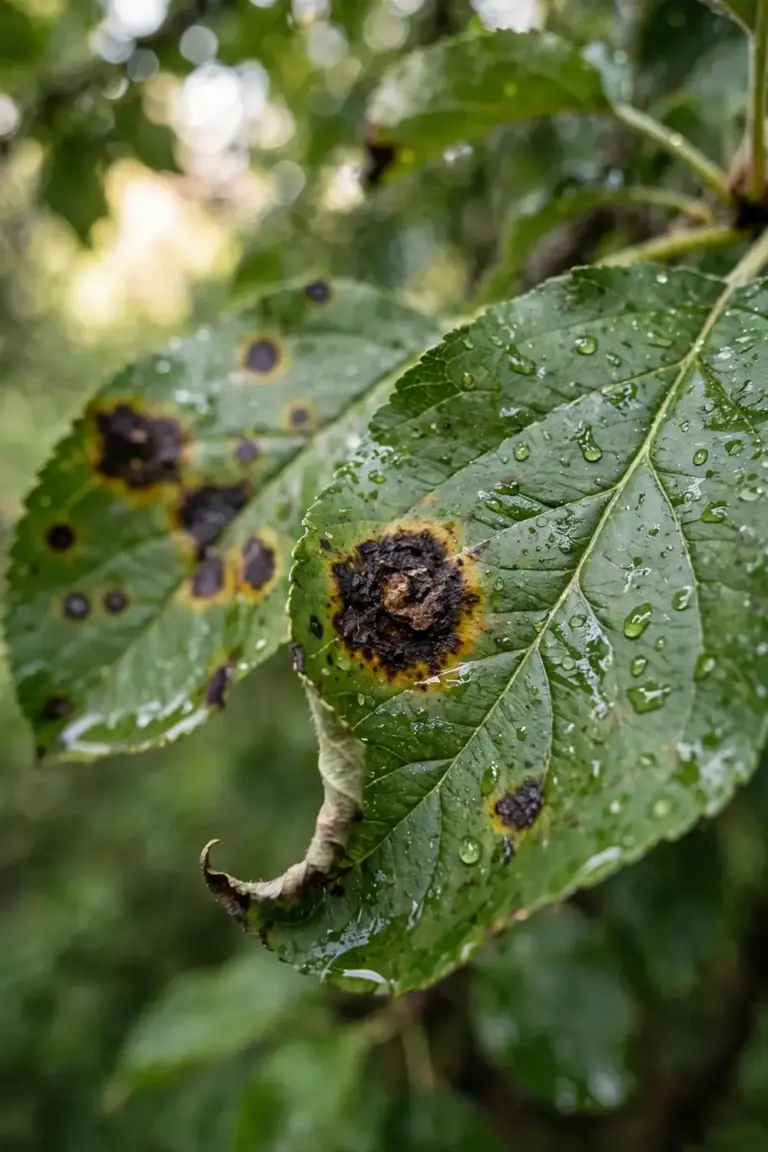
Drip keeps leaves dry, so it carries the lowest disease pressure. The NSW DPI disease-risk table rates surface drip as low risk for trees, vines, cane, and fruit, in the same vegetables irrigation guide. The NSW DPI horticulture guide adds that drip reduces the need for fungicide sprays, in the same irrigation guide.
Overhead carries the highest disease pressure. The NSW DPI vegetables guide states that sprinkler systems increase the risk of leaf fungal and bacterial infections, and its disease-risk table rates sprinkler irrigation as high risk for trees, vines, cane, and fruit, in the same vegetables irrigation guide. The NSW DPI horticulture guide adds that overhead irrigation creates conditions that suit disease development, and that overhead-irrigated blocks often require more fungicide applications, in the same irrigation guide.
Micro-sprinklers sit in the middle. The spray stays low, so the leaves stay mostly dry, but the wider wet patch keeps the soil surface damp longer than drip. That damp soil suits soil fungi and weeds more than drip does.
Overhead watering on a humid evening leaves leaves wet all night. That is the disease window. Water at dawn, or switch the wet method to drip.
Overhead also waters the weeds. A sprinkler wets the whole floor, so weeds germinate across the whole floor. Drip wets only the ring, so weeds stay in the ring. A weeded ring takes minutes. A weeded orchard floor takes an afternoon. The NSW DPI horticulture guide lists easy establishment and maintenance of cover crops as an overhead advantage, in the same irrigation guide. That advantage cuts both ways in a home garden. A cover crop you planted welcomes the water. Weeds you did not plant welcome it just as fast.
7. Match the Method to Your Tree Age
Young trees need a wider wet patch, and mature trees need deep delivery, and the method that suits a first-year tree is not the method that suits a 10-year-old tree.
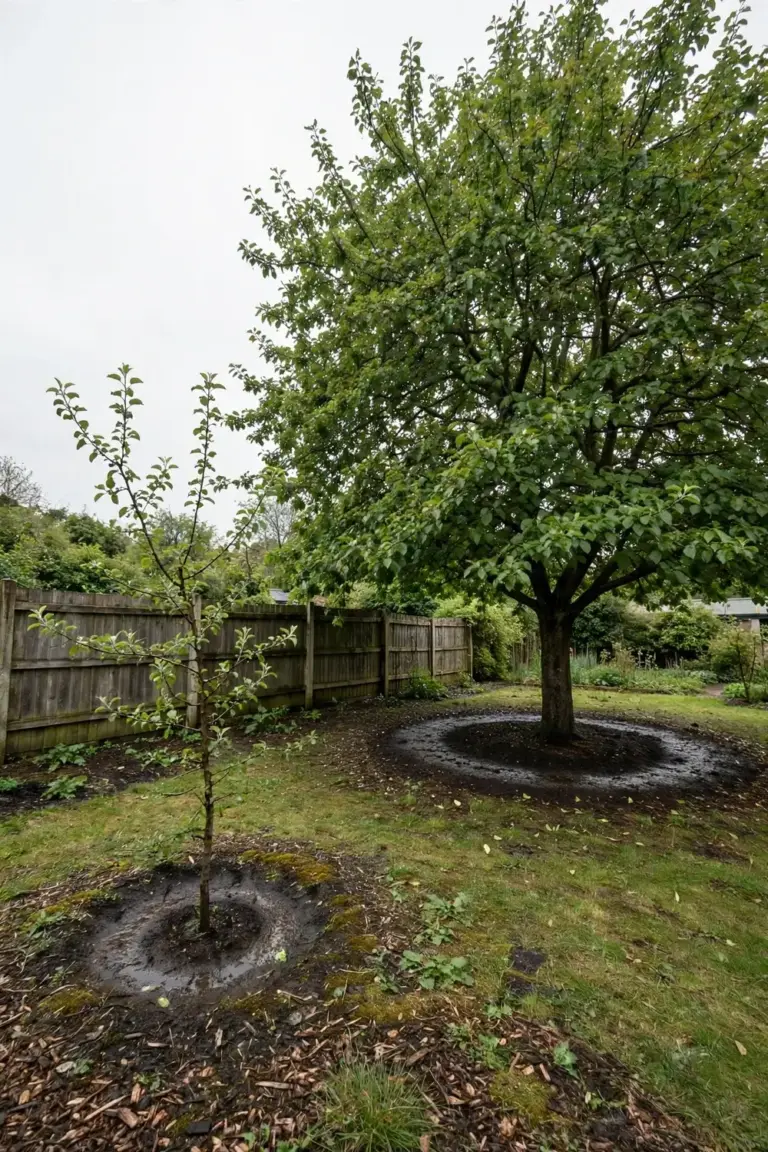
A young tree has a small root ball and shallow roots. It needs frequent light water across a patch wider than the root ball, so the roots grow outward. Micro-sprinklers suit this stage because they wet a broad ring. Drip suits it too, with emitters placed close to the root ball and moved outward as the tree grows. The NSW DPI horticulture guide notes large water savings in young plantings from accurate and even water placement, in the same irrigation guide.
A mature tree has deep roots and a wide canopy. It needs deep water across the full root zone, delivered slowly enough to soak down through 30 cm of soil, and drip with several emitters around the drip line does this job better than any single hose point. Move them outward each year. They must sit under the canopy edge, where the feeder roots live, or they feed nothing, and emitters parked against the trunk wet bark.
Switch methods as the tree grows. Start a new tree on micro-sprinkler or close drip. Move a mature tree to a wide drip ring. The tree tells you when the switch is due: leaves flagging between waterings mean the wet patch is too small.
Soil type changes the answer again. Sandy soil drains fast and holds little water, so it needs more frequent runs and a wider wet patch. Clay soil holds water for days, so it needs longer, less frequent runs and a narrower wet patch. The University of Georgia Extension notes that growers on sandy soils or drought-prone ground lay 2 drip lines per bed to improve coverage, in its low-volume irrigation guide. Dig a hole and look at your soil before you choose. Sand and clay ask for opposite watering rhythms.
The first year after planting is its own case. A transplanted tree has a pruned root ball and few feeder roots, so it needs water across a small patch, often, until new roots grow outward. Micro-sprinklers suit this stage. The broad ring keeps the whole root ball damp. Drip suits it too, with emitters set close to the trunk and moved outward as the tree settles. After year one, widen the ring and lengthen the runs, because the tree moves from establishment watering to maintenance watering and the system must move with it.
8. Set Up a Simple Drip Ring in One Afternoon
A drip ring needs 5 parts: a filter, a pressure regulator, a mainline, emitter tubing, and a flush valve at the far end. Lay the mainline from the tap to the tree, run emitter tubing in a ring under the canopy edge, and close the far end with the flush valve. The whole job fits one afternoon.
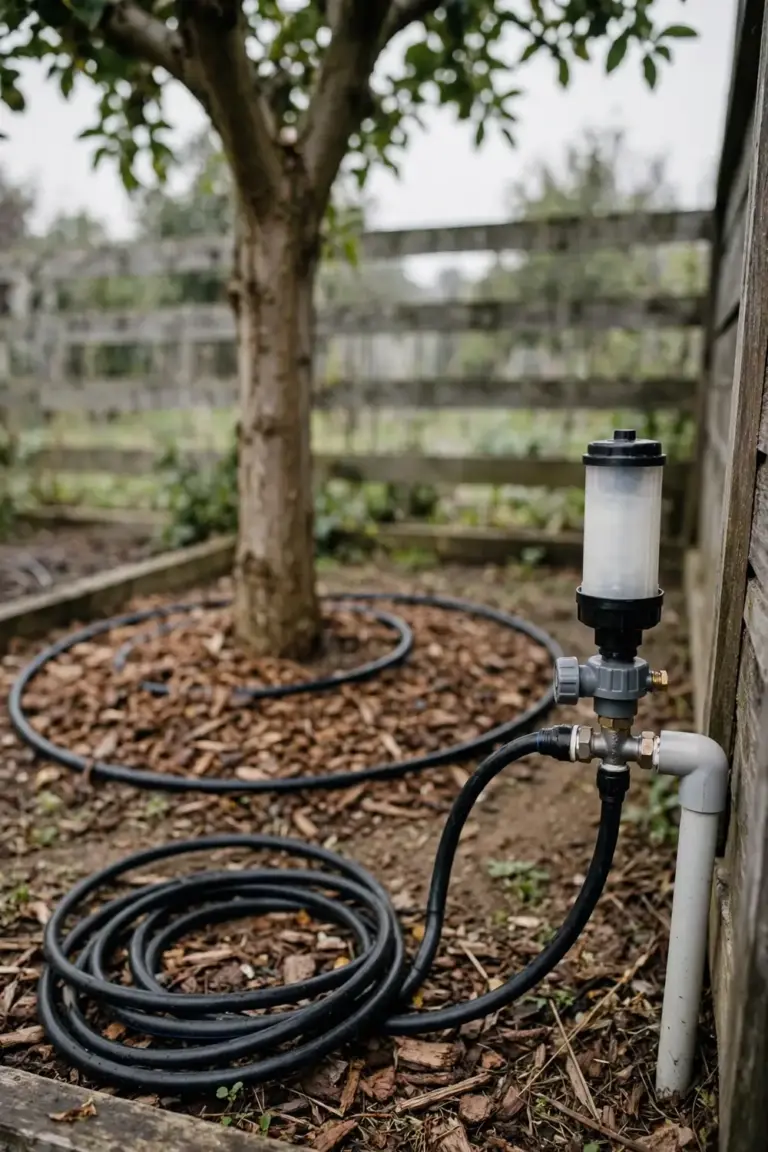
Fit the filter first. The NSW DPI horticulture guide lists a high degree of filtration as a drip requirement, and warns that plants stress quickly if the system fails or watering is delayed, in the same irrigation guide. A filter costs less than one replacement tree. Flush the line through the valve before you cap it. Grit leaves the system. It never lodges in an emitter.
Add a pressure regulator after the filter. Household mains pressure runs far above what drip tubing tolerates, and high pressure blows emitters off the line. A regulator holds the line at the pressure the emitters were built for. Group trees with similar water needs on one zone. Young trees and mature trees do not belong on the same valve, because they need different run times.
Put the whole system on a timer. A battery timer at the tap runs the ring on schedule without a controller box. Set it to run at dawn, when evaporation is lowest and leaves dry fast. Check the timer after a storm. A timer that runs through rain wastes water and waterlogs soil. A rain sensor on the line pauses the schedule for you, and it costs less than one drowned tree.
Feed the soil before you lay the line. The soil health guide covers the groundwork that makes any watering method work harder. Mulch over the line holds moisture and shields the tubing from sun. The mulching guide covers mulch depth and placement.
A line laid without a filter clogs in one season. Fit the filter first.
9. Fix the 5 Failures That Kill Drip Systems
Drip fails in 5 predictable ways. Each one has a fix that takes minutes. Learn the 5, check for them on your monthly walk, and the system runs for years.
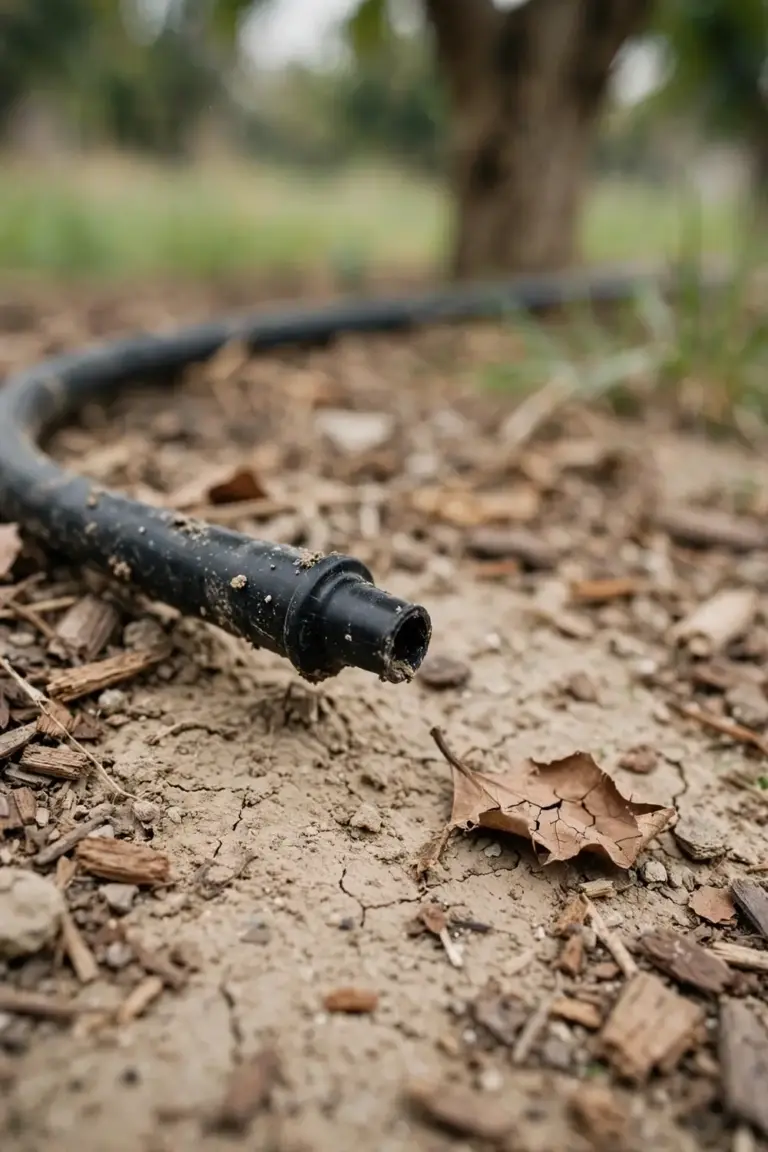
- Clogged emitters. The far emitters slow first. Flush the line through the end valve, clean the filter, and check flow at the last emitter. A filter cleaned twice a year prevents most clogs.
- Emitters against the trunk. Wet bark rots. Move every emitter out to the canopy edge. Check the ring each spring, because the canopy moves outward every year.
- One emitter for a mature tree. One wet spot cannot feed a wide root zone. Add emitters until the ring covers the canopy edge. A mature tree wants 4 to 6 emitters, not 1.
- No flushing. Grit settles in the line. Open the end valve for 2 minutes each month and let the line run clear. Cloudy water from the valve means the flush was overdue.
- Drip on a frost night. Drip wets soil, not canopy, so it gives no frost protection. Keep a sprinkler or hose ready for frost nights, and run it through the cold hours. Turn it off at sunrise so the leaves dry.
Drip rewards a monthly walk of the line. Skip the walk and the system fails quietly, one tree at a time.
10. Frequently Asked Questions
Yes, and a sprinkler suits frost nights and heat waves better than any other method. The cost is water loss and disease pressure. The NSW DPI horticulture guide lists high evaporation losses on hot, windy days and conditions that suit disease development as overhead disadvantages. Use the sprinkler for frost and heat, and use drip for routine watering. That split gives you frost protection without a wet canopy every week.
Drip works for most home fruit trees, from citrus to stone fruit to pome fruit. It suits any tree with a defined root zone and a canopy you can ring with emitters. Sandy soils take 2 lines per bed to widen the wet patch. Heat waves and frost nights are the exceptions. Drip cools no canopy and stops no frost. Keep a sprinkler handy for those 2 jobs.
Run drip long enough to wet the root zone, then let the soil dry partway before the next run. Young trees want short, frequent runs. Mature trees want long, deep soaks, spaced further apart. Check moisture with a finger or a screwdriver at 15 cm depth. Water when the soil there feels barely damp. Calendars ignore rain and heat. Soil does not.
Yes, and most mature trees respond well to the switch. Lay the drip ring under the canopy edge, run it for the first month alongside the old sprinkler at half the old run time, then drop the sprinkler entirely. Watch the tree for 2 weeks after the switch. Leaves flagging in the afternoon mean the wet patch is too small, so add emitters. The roots follow the water, so the wet patch sets the root zone.
They can. Some districts restrict sprinkler days in dry summers, and the rules differ from one district to the next. Drip runs on its own schedule in some schemes and counts as irrigation in others. Check your local water authority’s rules before you buy a kit. A drip ring bought for a roster you cannot run is money wasted.
11. Pick the Method That Fits Your Tree This Weekend
Drip wins the routine. Overhead wins the frost night. Micro-sprinklers win the young tree in sandy soil. Pick drip for routine watering, keep a sprinkler ready for frost, and widen the wet patch as the tree grows. Walk the line once a month, flush the filter, and move the emitters outward each year. The tree does the rest.
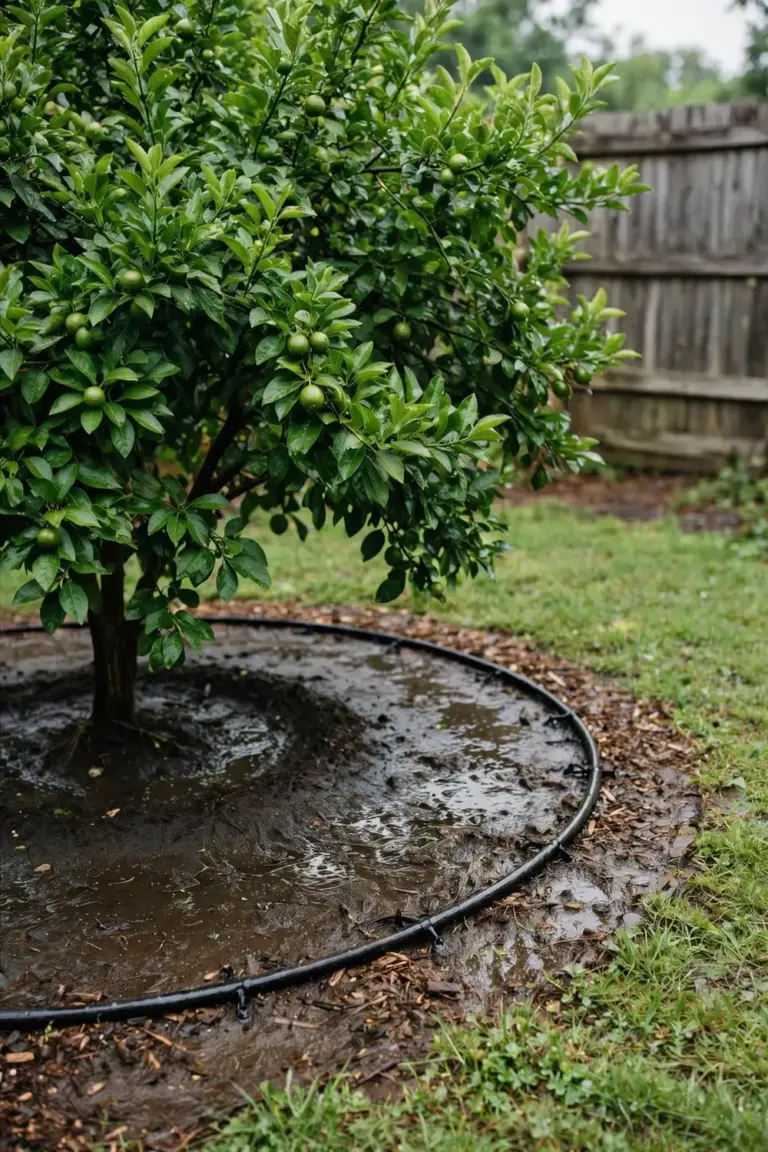
Decide by situation, not by habit. Frost-prone garden? Keep the sprinkler in the kit. Humid summer with leaf spot history? Drip leads. New tree in sand? Micro-sprinkler for year one, drip after that. Mature tree in clay? A wide drip ring with long, spaced runs. One method does not fit every tree, and the best gardeners switch methods as the tree grows.
Buy the drip kit first. A filter, a pressure regulator, 15 m of mainline, emitter tubing, 6 emitters, and a battery timer cover one tree. Add a flush valve at the far end. That kit costs less than one replacement tree, and it runs for years with a monthly walk of the line. Start with one tree, learn the rhythm, then extend the ring to the rest of the garden. The first ring teaches the whole method, and the second ring goes faster.