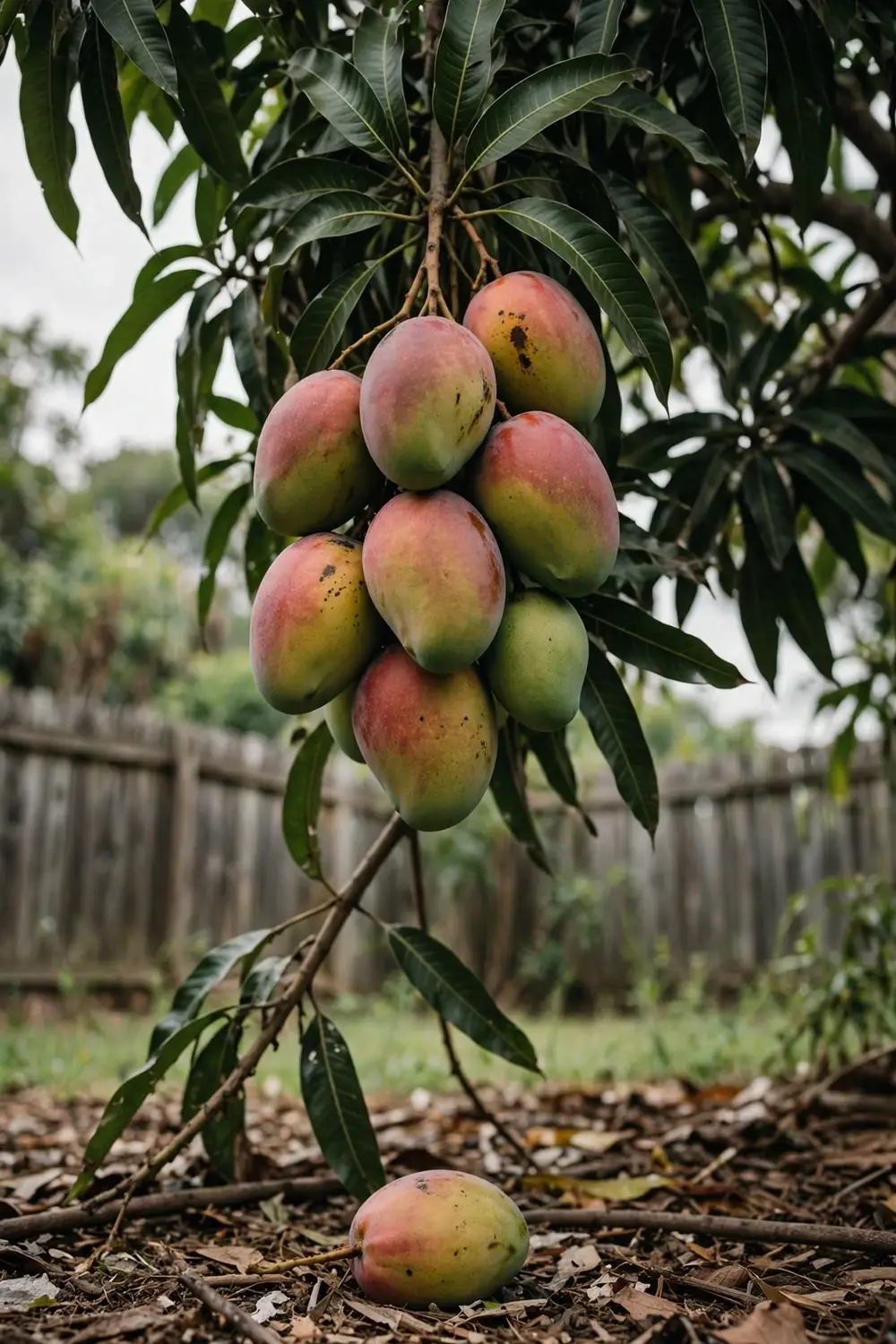

Feed a young mango 114 g of balanced fertilizer every 2 to 3 months in its first year. Feed a bearing mango almost no nitrogen and plenty of potassium. That is the best fertilizer for mango trees in Australia: the right ratio for the tree stage, timed to the growth cycle, checked against a leaf test.
Fertilizer means nutrients added to soil or leaves. NPK means the nitrogen-phosphorus-potassium ratio printed on the bag. Mango trees change what they need as they age. Young trees need nitrogen to build canopy. Bearing trees need potassium to fill fruit, and extra nitrogen at the wrong time grows leaves instead of fruit.
The rest of this page compares the four fertilizer types, gives the NPK band for each tree stage, runs the Australian seasonal schedule, and names the nitrogen trap. A soil test and a leaf test sit underneath every number.
1. Feed by Tree Stage, Not by the Bag
A young mango and a bearing mango need different fertilizer. Buy for the stage your tree is in, not for the prettiest bag. The bag that grows a fast young tree starves a fruiting tree of potassium and drowns it in nitrogen.
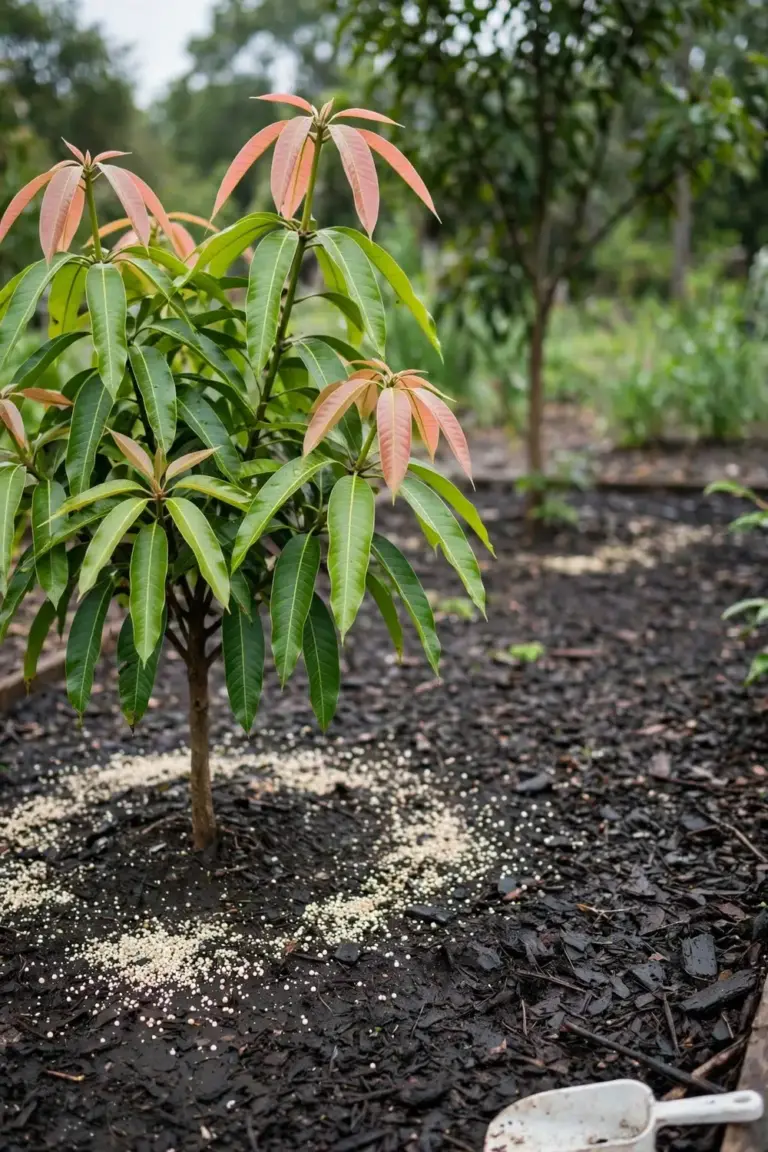
Young trees in their first year take fertilizer every 2 to 3 months, starting at 114 g and rising to 455 g per application, according to the University of Florida IFAS mango guide. After the first year, 2 to 3 applications a year in amounts that grow with the tree are enough. A 3-year-old tree takes about 455 g of granular fertilizer per application, according to the UF/IFAS Miami-Dade fertilizing guide.
Bearing trees flip the ratio. Nitrogen drops to almost nothing. Potassium rises. The University of Florida IFAS mango guide states that little to no nitrogen is needed for mature healthy trees, that growers should emphasize potash and minor element nutrition instead, and that bearing-tree bands run potash at 9 to 15 percent with available phosphoric acid at 2 to 4 percent.
Feed the stage, then check the leaf. The Australian mango nutrition guide sets desired leaf levels at nitrogen 1.0 to 1.5 percent, calcium 2.0 to 3.5 percent, boron 50 to 70 ppm, and potassium 0.7 to 1.2 percent, according to the Horticulture Innovation Australia mango nutrition guide. A leaf test tells you whether the tree needs nitrogen at all. A bag cannot.
2. Match NPK to the Tree Stage
The three numbers on the bag are the whole decision. Read them before you read the brand. Nitrogen grows leaves. Phosphorus supports roots and flowering. Potassium fills fruit and builds flavor. Mango trees want the first number to fall and the last number to rise as they start bearing.
| Tree Stage | NPK | Feed |
|---|---|---|
| Young, year 1 | 6-6-6-2 type | 114 g rising to 455 g, every 2 to 3 months |
| Young, years 2 to 3 | Balanced, low nitrogen | About 455 g per application, 3 to 4 times a year |
| Bearing, mature | 6-3-16 or 0-0-22 type | Nitrogen near zero, potassium 9 to 15 percent |
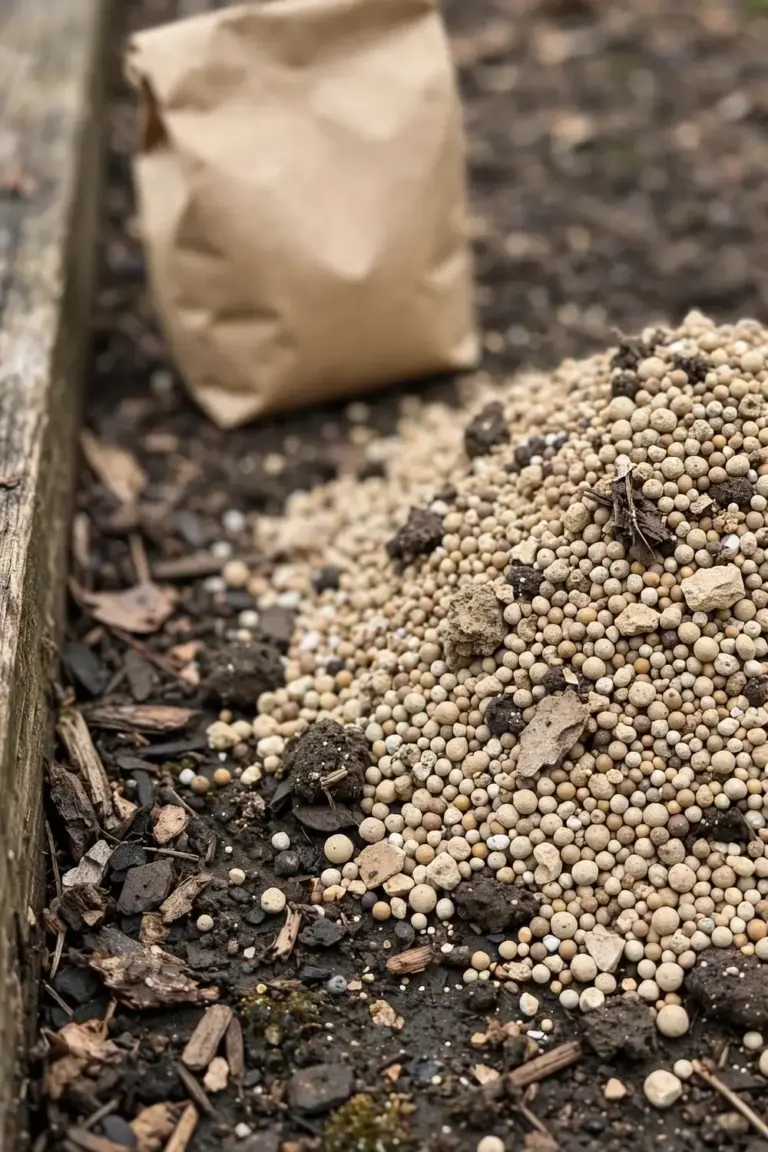
Young-tree mixes that work carry 2 to 6 percent nitrogen, 6 to 10 percent available phosphoric acid, 6 to 12 percent potash, and 4 to 6 percent magnesium, according to the UF/IFAS mango guide. The 6-6-6-2 mix in that guide matches those bands. Bearing-tree mixes shift hard toward potassium. The guide names 6-3-16 and 0-0-22 as bearing-tree examples. The 0-0-22 mix carries no nitrogen at all.
Minor elements ride along with the major ones, and mango trees on high-pH soils take iron as a chelated EDDHA soil drench 2 to 3 times a year, according to the UF/IFAS mango guide. Trees on calcareous soils take annual foliar sprays of copper, zinc, manganese, and boron. Boron runs at very low rates, one three-hundredth of the nitrogen rate, because boron turns toxic at moderate to high rates. Trees on neutral and acidic soils take the same elements as soil-applied dry materials or foliar sprays, with iron on acidic soil going on as iron sulfate watered in 2 to 3 times a year.
Magnesium sits in the young-tree mix for a reason. Young-tree mixes carry 4 to 6 percent magnesium, according to the UF/IFAS mango guide. Magnesium builds chlorophyll, the pigment that powers photosynthesis, and a tree short of magnesium yellows between the veins while the veins stay green. The young-tree band covers magnesium because a growing canopy builds chlorophyll fast. Bearing trees take magnesium through the minor-element mix rather than a separate feed.
A common fruit-tree bag labeled 8-3-9 fails this test for mango, because its first number beats its last number. The UF/IFAS Miami-Dade guide warns that mango and lychee trees do poorly with high nitrogen, and an 8-3-9 ratio would not work well for those crops. A bag with more nitrogen than potassium grows mango leaves at the cost of mango fruit. Skip it.
Nitrogen dose can also come from the leaf test. The Australian guide gives a rule of thumb per square meter of canopy: leaf nitrogen below 1.0 percent calls for 8 g of nitrogen per square meter, leaf nitrogen of 1.0 to 1.2 percent calls for 4 g per square meter, leaf nitrogen of 1.3 to 1.5 percent calls for none, and leaf nitrogen above 1.5 percent is too high, according to the Horticulture Innovation Australia mango nutrition guide. Cultivar targets differ. Kensington Pride sits at 1.1 to 1.3 percent leaf nitrogen, R2E2 and Honey Gold at 1.3 to 1.4 percent, Calypso at 1.0 to 1.5 percent, and Keitt at 1.0 to 1.2 percent, according to the Horticulture Innovation Australia mango nutrition guide.
Spread granular fertilizer at the drip line and beyond, never piled against the trunk. The UF/IFAS Miami-Dade guide puts it plainly: walk around the tree and spread the fertilizer just past the drip line. Roots feed where the canopy drips. Fertilizer heaped at the trunk feeds nothing and burns bark.
3. Pick the Best Fertilizer Type for Your Mango
Four types cover every mango feeding job. None of them is best in every situation. Pick by tree stage, by how fast you need the nutrients, and by how much work you will actually do. A slow-release granular you apply twice a year beats a liquid feed you forget after week three.
| Type | Pros | Cons | Best For |
|---|---|---|---|
| Complete granular | Exact NPK, cheap per feed, easy to measure | Salt burn if over-applied, leaches in sandy soil | Young trees and bearing trees on a schedule |
| Slow-release granular | Feeds for months, low burn risk, few applications | Costs more per kilo, slow to correct a deficiency | Time-poor gardeners, potted trees |
| Organic, manure and compost | Builds soil, feeds slowly, adds biology | NPK varies by batch, bulky, slow to correct a deficiency | Long-term soil health under any mango |
| Liquid, fish emulsion and seaweed | Fast uptake, foliar option, easy to adjust | Needs repeat applications, smell, salt build-up in pots | Quick correction, flowering and fruiting boosts |
Complete granular fertilizer suits gardeners who want a known ratio. A 6-6-6-2 bag for a young tree and a 6-3-16 bag for a bearing tree cover the whole program. Measure each feed. The bag label names the dose for the tree size. Guessing the dose is how trees get burned.
Slow-release granular suits gardeners who forget. One application feeds for months, which removes the weekly chore and lowers the burn risk. The trade is speed. A tree with a visible deficiency needs a fast liquid feed first, then slow-release to hold the level, because slow-release alone will not rescue a yellowing tree this month.
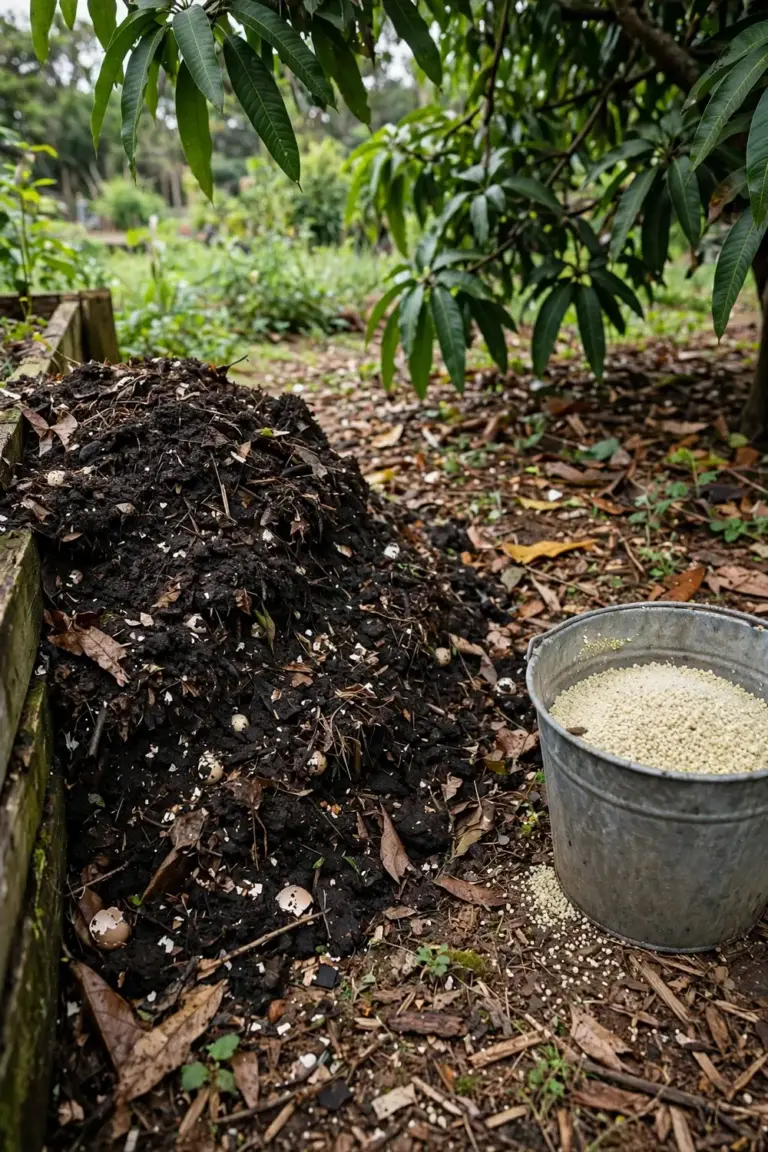
Organic feeds build the soil that holds every other feed. Composted manure and compost add organic matter, hold moisture, and feed soil biology. Their NPK varies by batch, so treat them as soil builders, not as precision feeds. A mango fed only on compost can still run short of potassium at fruit filling, when the tree pulls hardest on that nutrient. Pair compost with a potassium feed when fruit starts to size. Use composted manure, never fresh manure, against the trunk. Fresh manure burns bark and roots.
Liquid feeds act fastest, with fish emulsion carrying nitrogen for young growth while seaweed adds trace elements and growth compounds. Seasol’s grow guide feeds liquid every 2 to 4 weeks during flowering and fruiting. That rhythm suits a bearing tree in fruit fill. Liquid feeds wash through sandy soil fast, so small frequent doses beat one big dose. In pots, liquid feeds build salts, so flush with plain water between feeds and never exceed the label rate.
Sandy soil changes the arithmetic. Sand holds few nutrients, so fertilizer leaches past the roots after heavy rain or heavy watering. The Australian guide notes that sands need small amounts applied often, while loams hold nutrients longer and take larger, less frequent feeds. On sand, split every feed into two or three smaller doses a few weeks apart. On loam, the full dose holds. Know your soil before you set the rhythm.
Read the bag before you buy it. The guaranteed analysis lists NPK and the minor elements. A bag that hides its analysis behind a brand name gives you nothing to check against the leaf test. A bag that names 6-3-16 tells you the bearing-tree ratio at a glance. A bag that names 20-20-20 tells you the nitrogen is far too high for a bearing mango, whatever the front label promises.
Australian shelves carry the same feeds under familiar names. Dynamic Lifter is a pelletized manure product that feeds slow and steady, and blood and bone is a slow-release nitrogen source for young trees. A low-phosphorus native fertilizer suits native plants, not a mango, because mangoes take ordinary fruit-tree ratios and a low-phosphorus mix underfeeds a bearing tree. Use the AU products for their feed type and rate, not for their brand.
4. Run the Australian Seasonal Schedule
Mango trees run a growth cycle, and fertilizer must follow the cycle. The Australian guide lists the stages in order from harvest: shoot flush, root flush, shoot dormancy, flowering, fruit set, fruit development, root flush, harvest. Each stage pulls different nutrients. Feed the stage the tree is in.
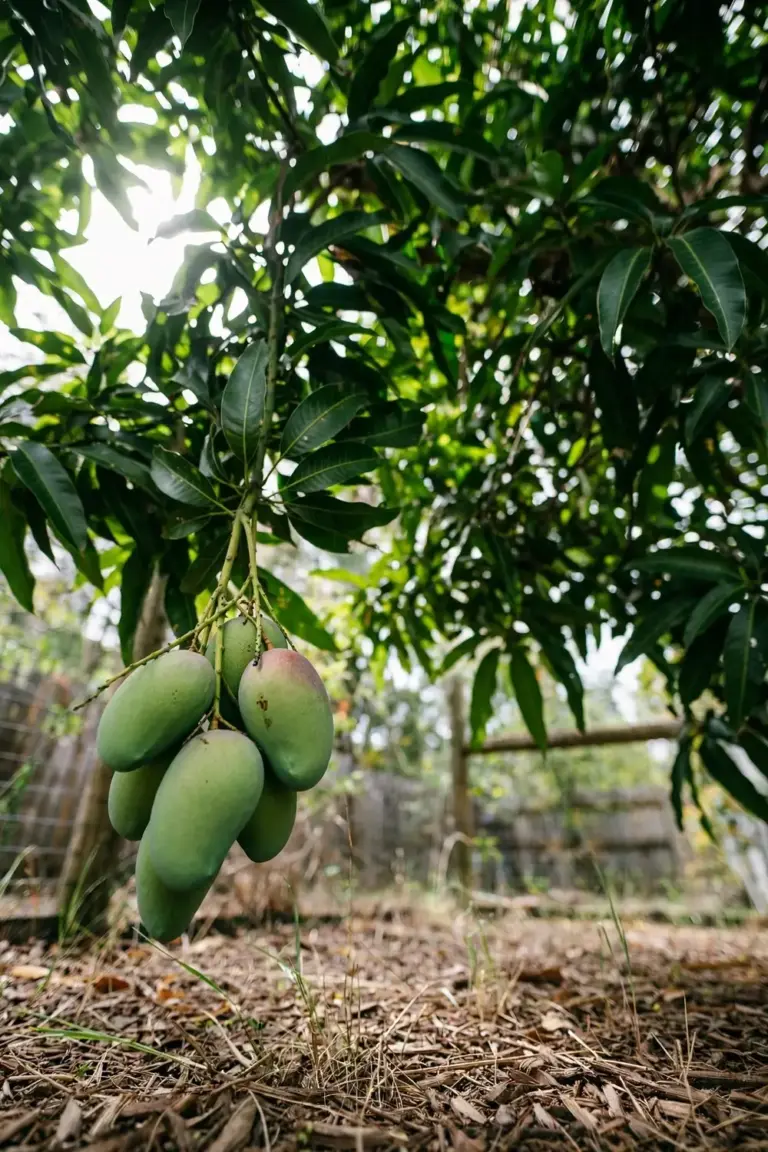
I have learned that the mango I feed after harvest fruits harder than the mango I feed before it flowers.
| Month | Feed | Notes |
|---|---|---|
| February to March, post-harvest | Balanced feed plus potassium | Replace what the crop removed, push the post-harvest flush |
| April to July, dormancy | No fertilizer | Let shoots harden, let the tree rest for flowering |
| August, pre-flowering | Low-nitrogen, potassium feed | Support panicles without pushing leaf flush |
| September to October, flowering and fruit set | Boron plus potassium, small dose | Boron supports pollen tube growth and fruit set |
| November to January, fruit filling | Potassium-heavy feeds, split doses | More than 60 percent of potassium goes here |
| December to February, harvest | No fertilizer | Pick fruit, then feed after harvest |
Post-harvest feeding matters most. The tree spent its reserves on fruit. A feed in February or March replaces those reserves and pushes the flush that builds next season’s flowering wood. The Australian guide warns that the post-harvest flush builds reserves for flowering, so it needs feeding and protection. Skip the post-harvest feed and the next crop starts hungry.
Dormancy needs no fertilizer. Shoots must harden for 2 to 3 months in autumn and winter before flowering, according to the Australian guide. Fertilizer in dormancy pushes soft flush that never hardens. That flush burns in the first cold snap and never flowers. Hold the bag until the tree moves.
Pre-flowering feeding is a narrow window. Nitrogen applied before flowering pushes leaves instead of flowers, according to the UF/IFAS Miami-Dade guide. Applications of nitrogen before trees start to flower may cause foliar growth rather than flowering and disrupt the fruiting cycle. Feed low-nitrogen potassium in August. Let the panicles form.
Fruit filling takes the most potassium. The Australian guide directs growers to apply more than 60 percent of the required potassium during the fruit filling period, split into small applications at several intervals of 2 to 3 weeks during fruit development, up to five splits, rather than one large application early in the period, according to the Horticulture Innovation Australia mango nutrition guide. Small splits beat one dump. One dump leaches in sandy soil or outcompetes calcium uptake early in fruit development. Potassium competes with calcium, magnesium, and sodium for uptake, so excess potassium early in fruit development can crowd out calcium. The Australian guide also warns against feeding during the peak wet season, when heavy rain strips fertilizer before roots take it.
In the far north the same stages run earlier in the year. Darwin fruit can finish months before a southern Queensland crop. Follow the tree stage, not the calendar month. The table gives the stage order, and your tree shows you where it is.
5. Avoid Too Much Nitrogen
Nitrogen is the trap in mango feeding. It grows the fastest visible result and the worst fruit. A tree fed heavy nitrogen looks rich and green. It flowers poorly, sets little fruit, and ripens fruit with thin skins and no blush.
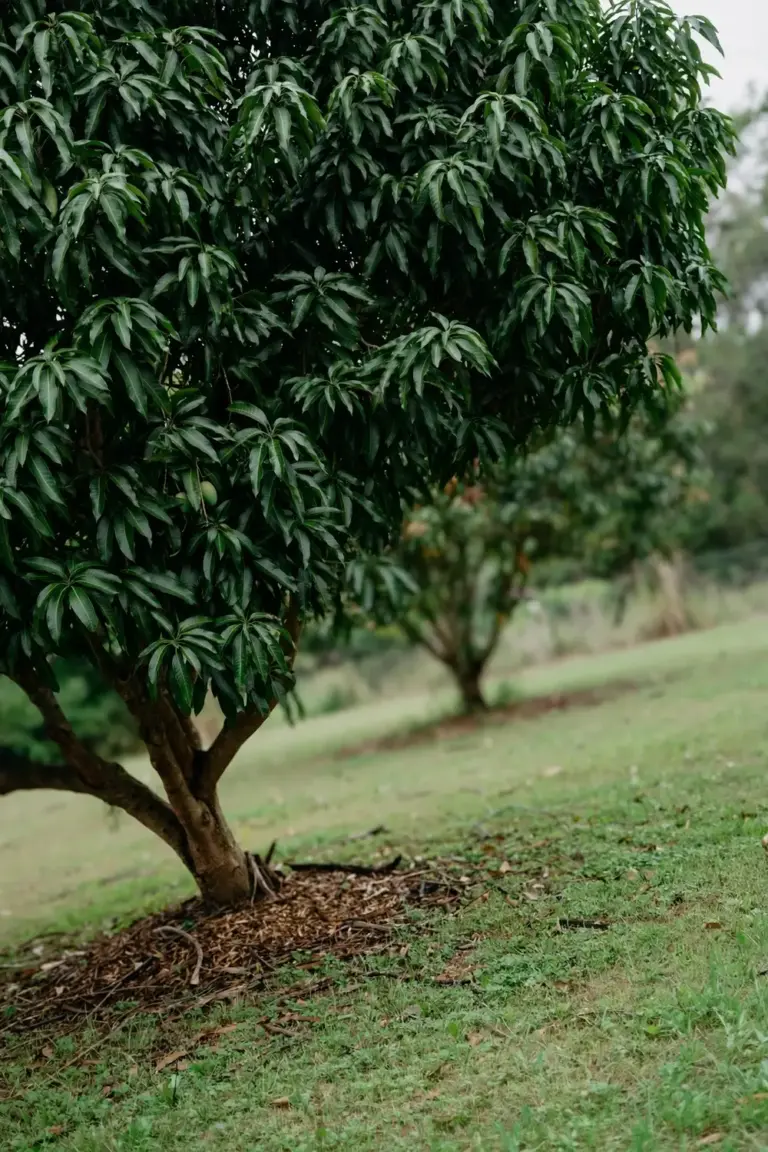
The Australian guide calls this the nitrogen conundrum. Well-timed nitrogen lifts vigor, flowering, fruit set, retention, yield, size, and sweetness. Poorly timed or excessive nitrogen promotes unwanted flush that pulls calcium away from fruit and causes less blush, soft fruit, fruit that fails to color when ripe, and more postharvest disorders. Excess nitrogen also cuts yield by harming flowering. One nutrient, two opposite outcomes, separated only by timing and dose.
Overfertilization with nitrogen aggravates internal breakdown, according to the UF/IFAS mango guide. Internal breakdown shows as soft water-soaked flesh at the far end of the fruit, a cavity at the stem end, or spongy gray-black flesh around the seed. If fruit shows these faults, cut the nitrogen rate. In sandy low-pH soils, extra calcium may help.
Lawn fertilizer is the most common source of accidental nitrogen. Mango trees planted in a fertilized lawn pick up nitrogen from the lawn feed. The UF/IFAS mango guide warns that heavy fertilization of the lawn next to mango trees may reduce fruiting or fruit quality. Keep a grass-free ring 0.6 to 1.5 m around the trunk, and never let lawn fertilizer reach the mango root zone. A mango in a lawn that gets fed four times a year is a mango on a nitrogen drip.
Check the watering too. Lawn sprinklers on a timer overwater mango trees and cause decline, because too much water too often causes root rot, according to the UF/IFAS mango guide. Mature trees need water only in severe drought. A tree that stays wet grows soft and feeds poorly no matter what the bag promises.
Three habits keep nitrogen in check. First, feed after harvest and in fruit fill, never in dormancy or just before flowering. Second, read the leaf test before adding nitrogen. Leaf nitrogen above 1.5 percent means the tree already holds too much, according to the Horticulture Innovation Australia mango nutrition guide. Third, use potassium-heavy mixes on bearing trees. A 0-0-22 mix cannot overfeed nitrogen because it carries none.
6. Read the Leaf Signs Before You Feed Again
Leaves report deficiencies before fruit does. Learn the five patterns. Each pattern points at one nutrient. A leaf test confirms the guess before you buy a bag.
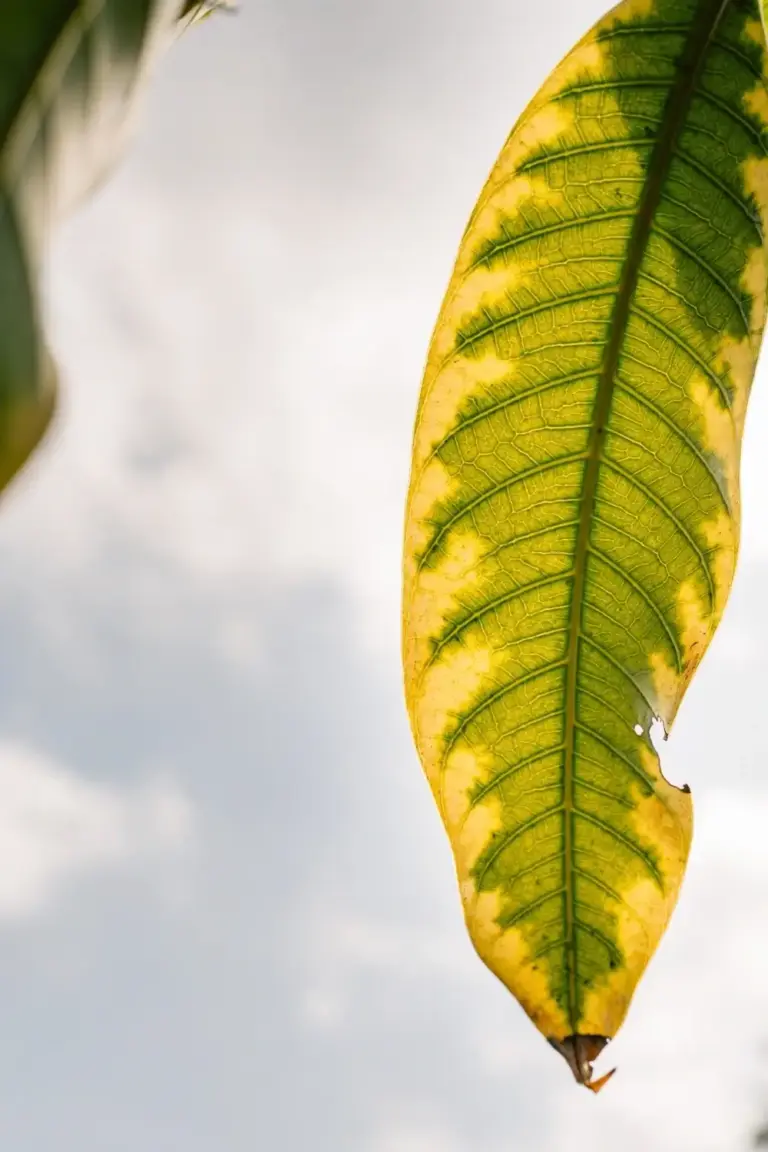
Nitrogen deficiency shows as pale yellow foliage on a low-vigor tree that fails to hold a crop, according to the Australian guide. Nitrogen moves inside the plant, so older leaves yellow first as nitrogen shifts to newer leaves. A tree that is too green can also mislead. Manganese, magnesium, and zinc can all push dark green growth, as can paclobutrazol. A leaf test settles which one it is.
Potassium deficiency shows as general yellowing of leaf margins that progresses to marginal leaf burn starting at the tip, according to the Australian guide. The burn starts at the leaf tip and eats inward along the margin. A tree short of potassium fills small fruit with poor color. Feed potassium in splits during fruit fill.
Boron deficiency shows as shot holes in the leaf, lopsided leaf growth, and flower panicles bent at a right angle, according to the Australian guide. R2E2 suffers low boron more than most varieties, and lumpy fruit often traces to boron shortage. Boron is needed in small amounts at every growth event, most of all at pollination and early fruit development. Boron turns toxic fast. Toxicity shows as a wavy burn along older leaf margins starting at the tip, or dark brown to black discoloration between the veins. Apply small amounts often, never one big dose.
Calcium deficiency hides on the tree and shows in the fruit. The Australian guide links calcium shortage to soft nose, jelly seed, and short shelf life. Calcium strengthens cell walls and must be present in the first 6 to 10 weeks of fruit development, while the fruit still loses water through its skin pores. Calcium does not move inside the plant, so the tree needs a steady soil supply all year. Gypsum suits soils where pH is already right. Lime or dolomite suits acidic soils.
Zinc deficiency shows as little leaf and rosetting: small narrow leaves crowded at shoot tips. A journal study on mango nutrition confirms that little leaf and rosetting are typical zinc deficiency symptoms, and that severe iron deficiency can produce the same look, according to the ISHS Acta Horticulturae paper. Iron and manganese deficiency together drive mango decline, with interveinal chlorosis, stunting, terminal and marginal necrosis, and dead leaves that hang on the tree, according to the UF/IFAS mango guide. When the leaf pattern is unclear, a leaf test beats a guess. Feed the nutrient the test names.
Soil chemistry decides whether any of these nutrients reach the tree. Aim for soil pH near 6.5. Lifting pH from 5.0 to 6.5 takes 3.6 tonnes of lime per hectare, applied in splits, with a 2-week gap between lime and nitrogen fertilizer so the high pH does not waste nitrogen through volatilization, according to the Horticulture Innovation Australia mango nutrition guide. Keep soil potassium at 100 to 150 mg/kg, soil calcium above 1,000 mg/kg, and the calcium-to-magnesium ratio near 8 to 1. High pH cuts zinc and iron availability, so foliar sprays matter more on alkaline soils.
Mulch holds the moisture that carries nutrients into roots. Spread bark or wood chips 5 to 15 cm deep and keep the mulch 20 to 30 cm clear of the trunk, according to the UF/IFAS mango guide. Mulch piled against the trunk holds moisture against bark and invites rot. A clear ring at the trunk and a deep layer past the drip line keeps the feeding roots moist without wetting the bark.
Frequently Asked Questions
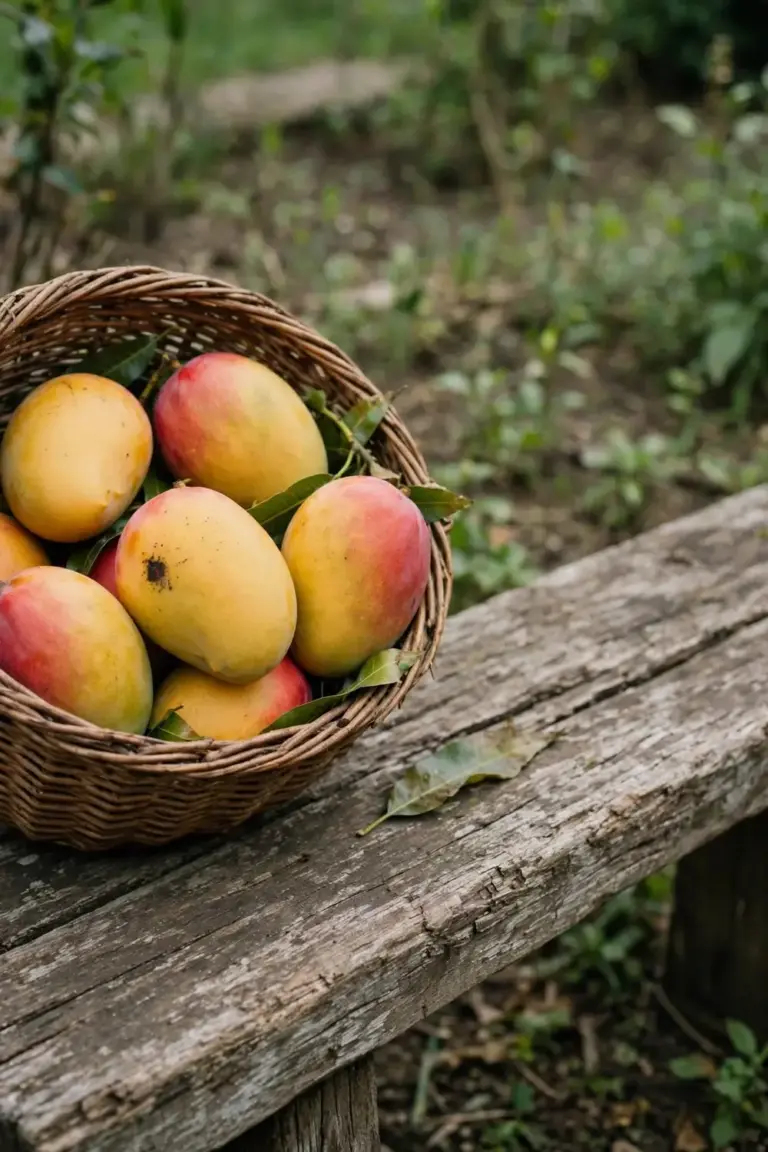
No. Lawn fertilizer carries high nitrogen, and nitrogen pushes mango leaves instead of fruit. The UF/IFAS mango guide warns that heavy lawn fertilization next to mango trees may reduce fruiting or fruit quality. Keep a grass-free ring 0.6 to 1.5 m around the trunk and keep lawn feed out of the mango root zone. A bearing mango needs potassium, not lawn nitrogen.
About 455 g of granular fertilizer per application, 3 to 4 times a year, according to the UF/IFAS Miami-Dade guide. Spread it at the drip line and beyond, never heaped against the trunk. Young trees in year 1 start at 114 g every 2 to 3 months and rise to 455 g. Match the dose to the tree size and the leaf test, not to the bag picture.
A slow-release granular plus small liquid feeds at label rate. Pots leach fast and build salts fast, so little and often beats one big dose. Flush with plain water between liquid feeds. Keep the pot in full sun and let the top few centimeters dry between waterings. A dwarf variety suits a pot better than a vigorous variety that outgrows it in two seasons.
Excess nitrogen is the usual cause. Nitrogen before flowering pushes leaf flush instead of panicles, and heavy nitrogen through the season holds the tree in leaf growth. Cut nitrogen, switch to a potassium-heavy mix, and check the leaf test. Leaf nitrogen above 1.5 percent confirms the tree already holds too much, according to the Horticulture Innovation Australia mango nutrition guide. Feed potassium after harvest and let the tree rest through dormancy.
Yes. The Australian guide recommends soil tests at least twice a year and leaf samples twice a year, at harvest and before flowering. A test costs less than one wasted bag of fertilizer and stops you feeding a nutrient the soil already holds. Target soil pH near 6.5, potassium at 100 to 150 mg/kg, and calcium above 1,000 mg/kg, then feed to the gaps the test shows.
Start With a Leaf Test, Not a Bag
The best fertilizer for a mango tree is the one the leaf test asks for. Feed young trees a balanced mix on a 2 to 3 month rhythm. Feed bearing trees potassium and almost no nitrogen. Time every feed to the growth stage, split potassium through fruit fill, and keep nitrogen out of dormancy and pre-flowering.
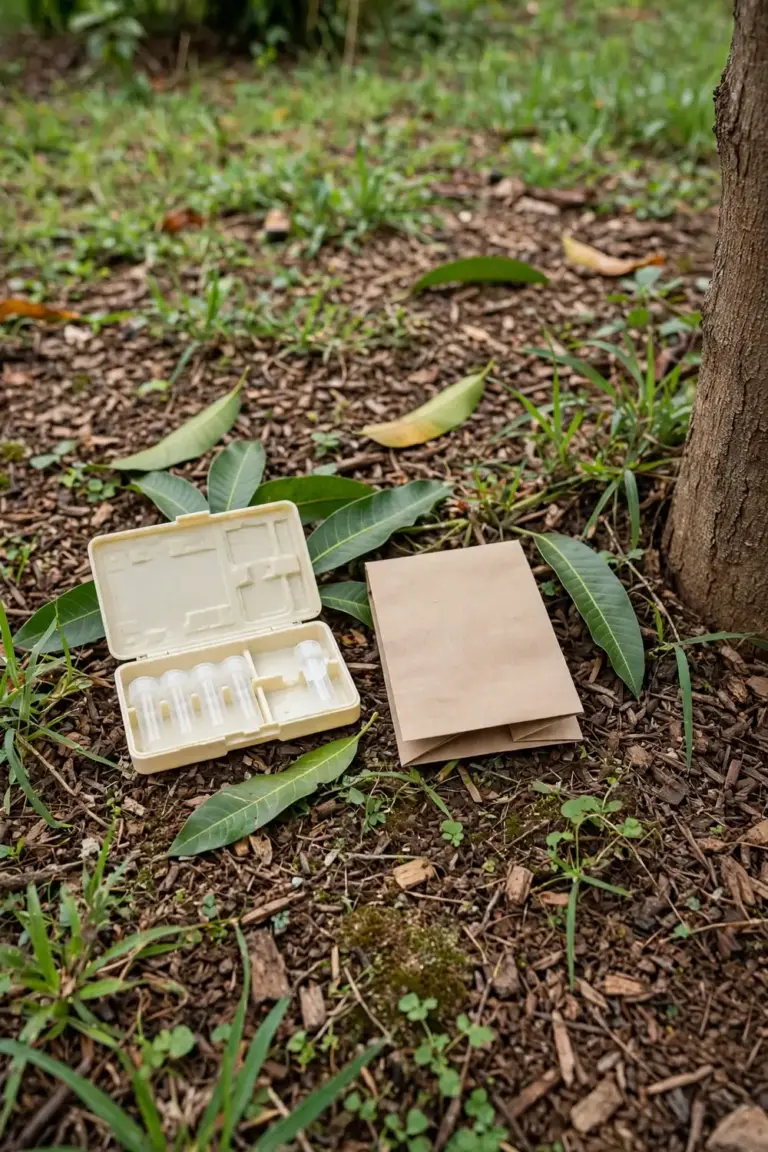
Test soil twice a year and leaves at harvest and before flowering. A test turns guessing into feeding. For the rest of the mango job, planting, pruning, and harvest, see the site’s how to grow mango fruit guide. Keep the soil healthy with the soil health guide, and hold moisture with a mulch layer from the mulching guide.