
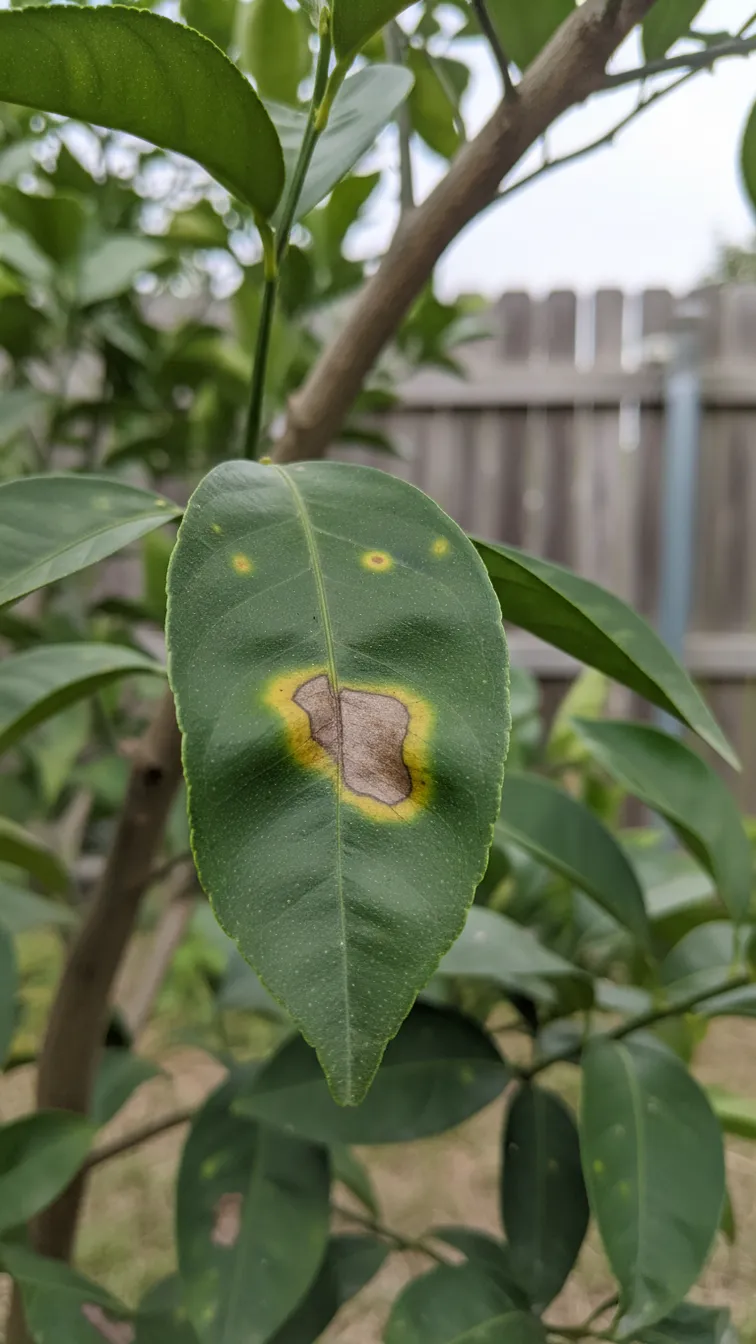

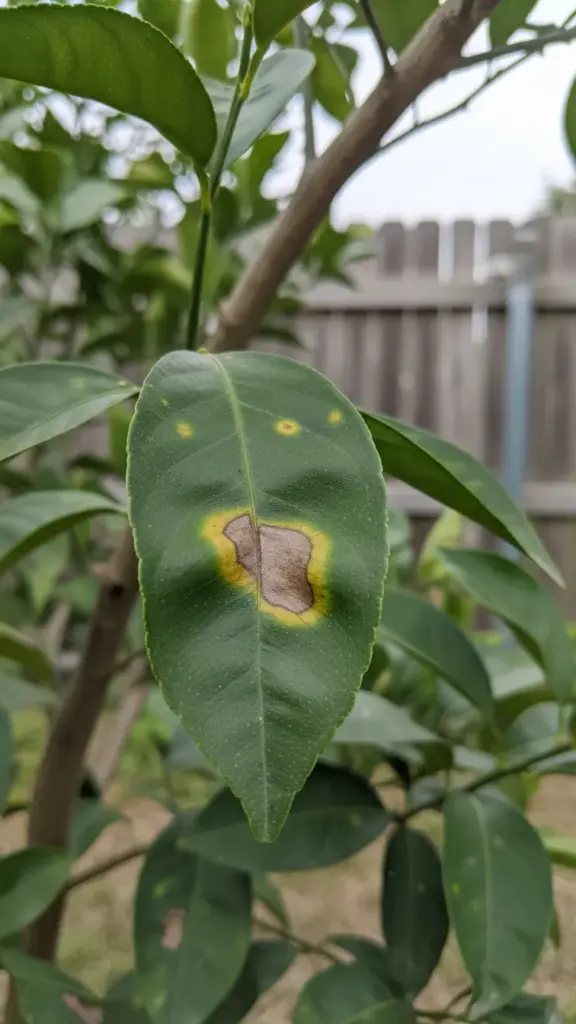
The first sign of citrus greasy spot is a tree that looks tired for no obvious reason. Nothing dramatic happens to the fruit. Nothing dies back. The older leaves just go blotchy, then yellow, then they are on the ground, and by the middle of winter the tree is half bare and building a smaller crop for next season.
It also has the most awkward timing of any citrus problem I deal with. The infection happens in the warm wet part of summer and the symptoms turn up months later in autumn or winter. By the time you can see the disease clearly, the useful moment passed long ago. Everything worth doing this season is aimed at next season’s leaves.
This page covers what greasy spot looks like on a leaf and on the fruit, what the fungus is doing during those silent months, the three things that actually reduce it in a backyard garden, and the handful of unrelated problems that get blamed on it every year.
What Greasy Spot Actually Is
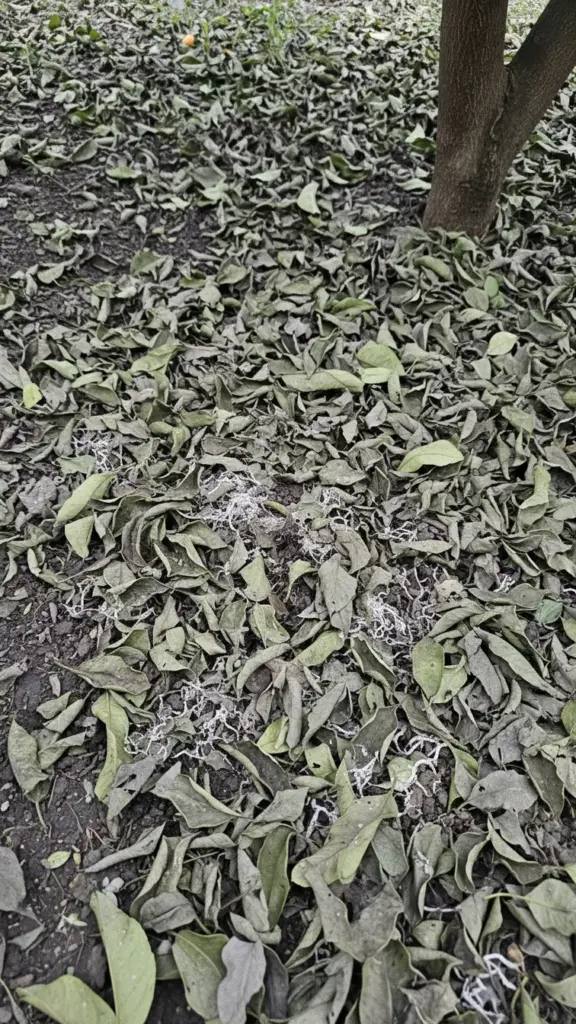
Greasy spot is a fungal disease of citrus leaves, and the fungus does not live in the tree between seasons. It lives on the ground.
The University of Florida citrus production guide is blunt about the source: airborne spores produced in decomposing leaf litter on the ground are the main inoculum, they germinate on the underside of leaves and on the fruit, the fungus grows on the leaf surface for a while before pushing in through the stomates, and internal growth is so slow that symptoms do not appear for several months.
Read that sequence again, because it explains every practical decision further down this page. The disease starts under your tree, not in it. It enters through the pores on the underside of the leaf, which is why anything sprayed only on the top surface is wasted effort. And the long silent stretch inside the leaf is why spraying when you first see spots is treatment applied to damage that is already finished.
Warmth plus long periods of wet leaf surfaces is the combination it needs. In my garden that means summer rain, humid nights, and heavy dew that sits on the foliage until mid morning. Dry summer climates get far less of it. Anywhere subtropical and humid gets it every year, forever, and the goal shifts from eliminating the disease to keeping it below the level that strips the tree.
How to Identify Greasy Spot on Leaves
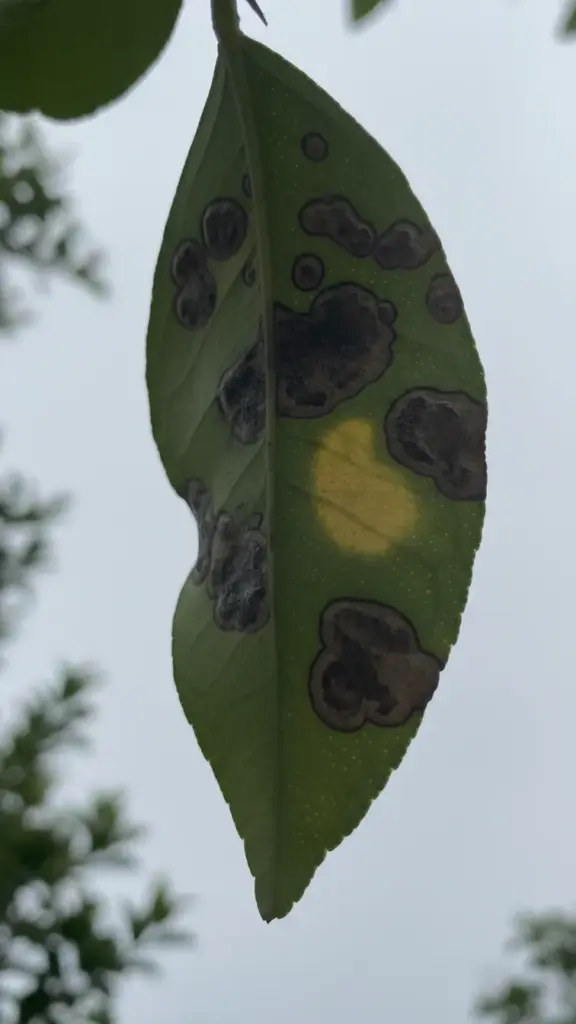
Turn a leaf over. That is the whole diagnosis, and most people never do it.
The visible sequence runs like this:
- A soft yellow patch appears on the upper surface of an older leaf, with no sharp edge to it. It looks like a nutrient problem at this stage and gets treated as one all the time.
- On the underside of that same patch, a slightly raised blister develops. Early on it is dull yellow brown. Later it darkens to brown or black.
- The blister spreads and takes on the look the disease is named for, a dark patch that seems oily or wet when you tilt it against the light, even though it is dry to the touch.
- Eventually the dark stain shows through to the upper surface too, and the leaf drops.
Two details narrow it down further. Greasy spot is a disease of mature leaves, so it shows on last season’s foliage low and deep inside the canopy rather than on the bright new flush at the tips. And it never stays as one tidy spot. A leaf with a single circular lesion and a clean margin is usually something else.
The part that catches people out is described plainly in the Florida guide to citrus problems in the home landscape: leaf drop can happen before the full leaf symptoms have even developed. So a tree can shed a large share of its interior leaves while the remaining foliage still looks passable, and the owner concludes the tree is short of water or feed.
Greasy Spot Rind Blotch on Fruit
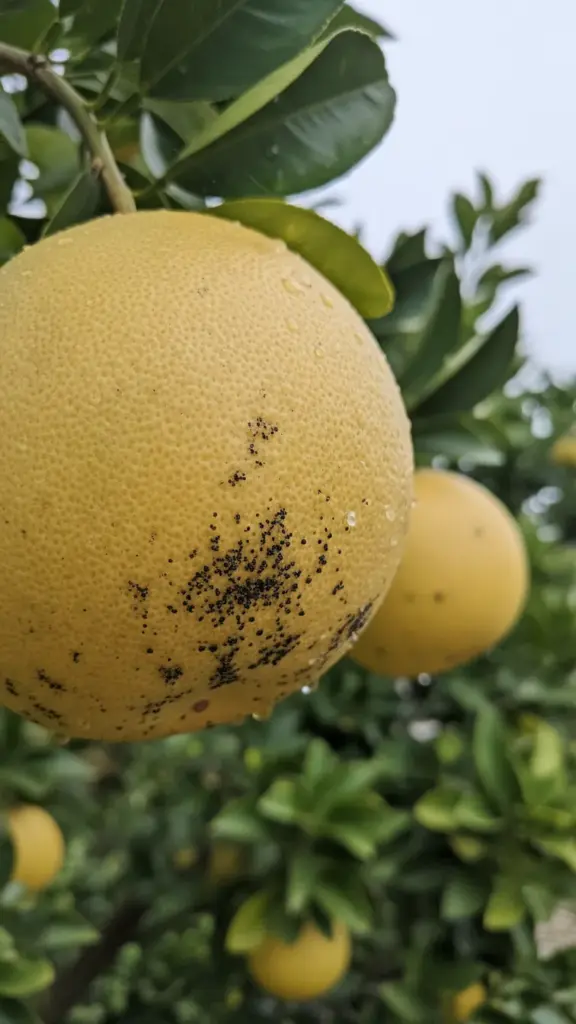
The same fungus reaches the fruit, where the result is called rind blotch. Instead of a blister you get a scatter of tiny dark specks in the skin, usually across the middle and lower part of the fruit, often concentrated between the oil glands so the rind looks dirty rather than spotted.
It is cosmetic. The flesh underneath is unaffected, the fruit is fine to eat, and in a home garden it matters only if you are handing fruit to other people and want it to look tidy. Grapefruit shows it worst in my garden and mandarins barely show it at all. That ranking is my own observation rather than a sourced claim, so treat it as one garden’s pattern.
Why the Damage Shows Up Months After Infection
Here is the timeline that makes greasy spot so hard to manage by reacting to what you see.
| Stage | Roughly when | What you can see |
| Spores released from rotting leaf litter | Warm wet weather from late spring onward | Nothing |
| Spores germinate, fungus grows on the leaf surface | Summer, wherever leaves stay damp for hours | Nothing |
| Fungus enters through pores on the leaf underside | Summer | Nothing |
| Slow internal growth inside the leaf | Weeks to months | Nothing |
| Yellow blotching and underside blisters appear | Autumn | The first visible symptom |
| Leaf drop | Late autumn into winter | Thin canopy, bare interior branches |
Every gardener I know first notices greasy spot at the bottom of that table and starts spraying there. That spray does nothing for those leaves. It also does nothing for next year unless it happens to land during the following summer’s infection window.
What Makes It Worse in a Home Garden
A few conditions turn a mild annual nuisance into a tree that defoliates.
Old leaf litter left sitting under the canopy is the big one, because that is the factory. A neat gravel or paved surface under a tree breaks the cycle almost by accident, while a thick permanent mulch of the tree’s own fallen leaves feeds it.
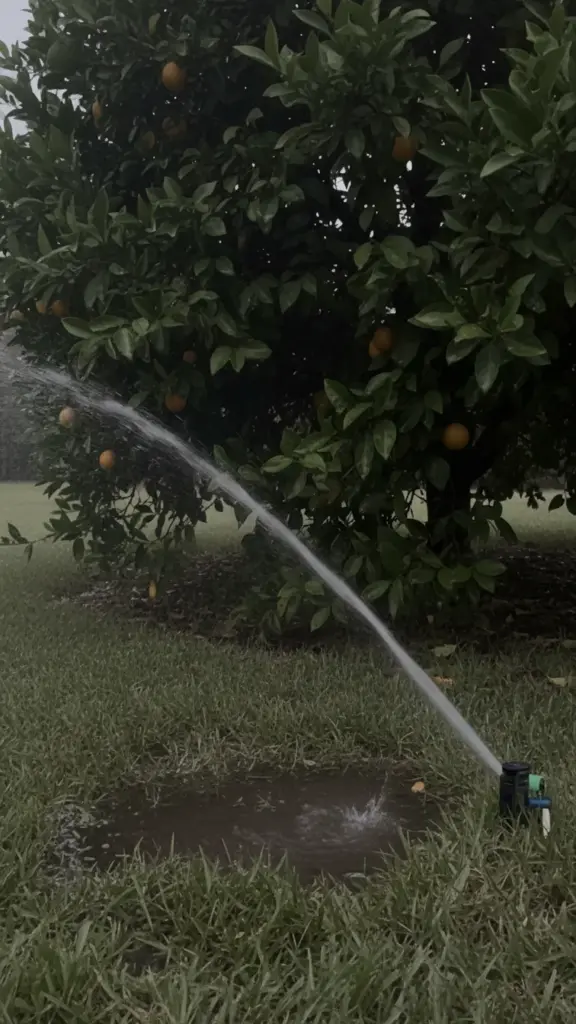
Overhead sprinklers running at night come second. They extend the hours the leaf surface stays wet, right through the part of the night when temperatures are perfect for the fungus. A lawn sprinkler that clips the edge of a citrus canopy is enough.
A dense unpruned canopy holds humidity in the interior long after the outside has dried. Crowded planting does the same thing on a larger scale, and a tree wedged into a corner between two walls is the worst position I have on my block.
Container trees are not exempt. A potted lemon standing in its own dropped leaves has the whole disease cycle contained in one pot.
Things That Get Mistaken for Greasy Spot
More than half the greasy spot questions I see are about something else. This table covers what I check before deciding.
| What you see | Likely cause | How to tell it apart |
| Black coating that rubs off with a cloth, sticky leaves | Sooty mould growing on insect honeydew | The black sits on the surface and wipes away, and there are insects above it |
| Fine pale speckling all over the leaf, dusty look | Spider mites | Speckling is even and tiny, and the underside has webbing and moving specks |
| Yellow between the veins with a green V at the leaf base | Magnesium shortage | The pattern is symmetrical and repeats on every leaf, with no blisters underneath |
| Raised corky warts on leaves and fruit, distorted young growth | Citrus scab | It deforms the leaf, greasy spot never does |
| Blotchy yellow that is not the same on both sides of the midrib | Serious tree disease worth diagnosing properly | Asymmetric mottling plus lopsided bitter fruit needs an expert, not a fungicide |
The first row is the one to check hardest, because a sticky black tree usually means a sap feeding insect rather than a fungus. If a black film wipes off between your fingers and the leaves feel tacky, look for the population producing the honeydew. Something like citrus whitefly will do it, and fixing the insect fixes the black.
Step 1: Deal With the Leaf Litter
This is the one job that changes the outcome, and it costs nothing.
I rake the fallen citrus leaves out from under the canopy at the end of winter, before the weather warms up, and I get them away from the tree. Not raked into a ring around the drip line. Away. They go into a hot compost heap or under a decent layer of soil in a bed on the other side of the garden, where they can rot without releasing spores into a citrus canopy.
Doing it once helps. Doing it every year is what actually shifts the level of disease, because you are draining the reservoir a bit further each season. My worst affected tree took two years of this before the difference was obvious, and it has stayed better since.
A small honest caveat. A neighbour’s untended lemon fifteen metres away is also a spore source, and spores travel. Clearing your own litter reduces the pressure a lot, but it will not give you a clean tree in a street full of citrus.
While you are down there, keep organic mulch pulled back a hand’s width from the trunk. That has nothing to do with greasy spot and everything to do with not rotting the base of the tree, but the rake is already in your hand.
Step 2: Open the Canopy and Change How You Water
The fungus needs hours of wet leaf surface. Take those hours away and the infection rate falls.
Thin out the crossing branches and the crowded interior growth in late winter so air moves through the middle of the tree. You are not shaping the tree for looks. You are trying to make the inside of the canopy dry out by mid morning instead of noon.
Then look hard at your irrigation. Water at soil level, with a drip line or a slow hose under the canopy, and never with a sprinkler that throws water into the leaves. If you have no choice but overhead watering, run it at dawn so the foliage dries fast, rather than in the evening when it stays wet all night. Moving one badly aimed sprinkler head has done more for my most affected tree than any spray.
Container trees get the same treatment, plus a sweep of the pot surface whenever leaves collect on it.
Step 3: Time Any Spray to the Flush, Not to the Symptoms
If litter clearing and airflow are not enough, spraying is the third lever, and timing is the entire point.
The target is the early summer window, when the spring flush leaves have expanded and hardened but before long spells of warm wet weather have delivered the main dose of spores. In a bad year a second application partway through summer covers the later infection period. Spraying in autumn, when the yellow blotches finally appear, achieves nothing at all.
Coverage decides whether it works. The spores enter through the underside of the leaf, so the spray has to reach the underside of the interior foliage, which on a mature tree means getting under the canopy and aiming upward and outward, slowly. A quick pass over the top of the tree is a waste of product.
For materials, horticultural oil is the traditional backbone in home gardens and it needs to be applied at the label rate and not in extreme heat, or the leaves will burn.
Which Citrus Gets Hit Hardest
Susceptibility varies enough to change how much effort a particular tree deserves.
University of Florida horticulturists note in their guide to identifying greasy spot that the lesions look more yellowish and diffuse on lemons and grapefruit, and more raised and darker on tangerines, and that on the more susceptible types such as grapefruit and tangelos copper usually needs to be included in the spray for control to work.
In practice that means grapefruit and lemons are the trees I watch, tangelos are close behind, sweet oranges sit in the middle, and mandarins in my garden shed the fewest leaves. If you have one problem tree in a row of citrus, it is almost always the grapefruit.
The Greasy Spot Year at a Glance
This is the rhythm in my own humid subtropical garden. Shift it to match your own season.
| Season | What the fungus is doing | What I do |
| Late winter | Spores maturing in last season’s fallen leaves | Rake and remove all leaf litter, thin the canopy |
| Early spring | Spring flush emerging, little infection yet | Check irrigation, move any sprinkler wetting the leaves |
| Early summer | Spring flush leaves now vulnerable, spore release building | First spray if the tree defoliated last winter |
| Midsummer | Peak infection during warm wet weather | Second spray in a bad year, keep the ground clear |
| Late summer | Fungus growing silently inside the leaves | Nothing useful, resist the urge |
| Autumn | Yellow blotching and underside blisters appear | Assess severity, note which trees were worst |
| Winter | Leaf drop | Rake as leaves fall rather than waiting for the lot |
What to Do With a Tree That Has Already Dropped Its Leaves
A defoliated citrus tree looks alarming and is usually fine.
Leave the pruning saw alone. The tree will push a new flush in spring from buds that are perfectly healthy, and cutting back a stressed tree just removes reserves it needs. Water normally through the bare period, because a tree with fewer leaves needs less, not more, and overwatering a thin tree in cool weather is a good way to add a root problem to a leaf problem.
Feed at the normal time in spring rather than immediately. There is no fertiliser that regrows leaves in winter.
Expect a lighter crop the following season. That is the real cost of greasy spot, and it is the reason the raking matters. Then do the three steps above in order, and judge the result the winter after next rather than this one.
Common Questions
Does Greasy Spot Kill a Citrus Tree
Not on its own. It weakens the tree by removing leaves year after year, which means smaller crops and a tree less able to handle drought or cold. A tree that defoliates badly every winter for many years in a row goes into a slow decline, but the disease is not a killer in the way root rot is.
Can I Eat Fruit From a Tree With Greasy Spot
Yes. The leaf disease does not affect the flesh, and rind blotch is a skin blemish only. Wash the fruit and use it normally.
Is Greasy Spot the Same as Sooty Mould
No, and it is the most common mix up. Sooty mould is a black film sitting on top of a sticky leaf, produced by insect honeydew, and it wipes off. Greasy spot is inside the leaf tissue and cannot be rubbed away.
Will Neem Oil or Baking Soda Fix Greasy Spot
Neither is a reliable answer once the fungus is inside the leaf, which it will be by the time you notice anything. Oil sprays have a genuine role during the summer infection window, applied with full coverage of the leaf undersides. A baking soda mix applied to autumn blotches does nothing that I have ever been able to see.
Does Greasy Spot Spread to Other Plants
It is a citrus disease. It will move between citrus trees, including potted ones, but your roses and vegetables are not at risk from it and their leaf spots are unrelated.
Why Did My Tree Get It When My Neighbour’s Did Not
Usually a difference in how long the leaves stay wet or how much old litter sits underneath. A tree in an open windy position with bare ground under it can stay nearly clean while an identical tree in a sheltered corner with deep leaf mulch defoliates every year.
Where to Go From Here
If you do one thing this year, clear the fallen leaves out from under your citrus before the weather warms up. It is free, it takes an hour, and it removes the only source the disease has.
Then mark the early summer window in whatever calendar you actually look at, because that is the moment the tree can be protected and it arrives months before anything looks wrong. Managing greasy spot is mostly an exercise in acting on a schedule instead of acting on symptoms, and once you accept that, the tree stops surprising you every winter.








