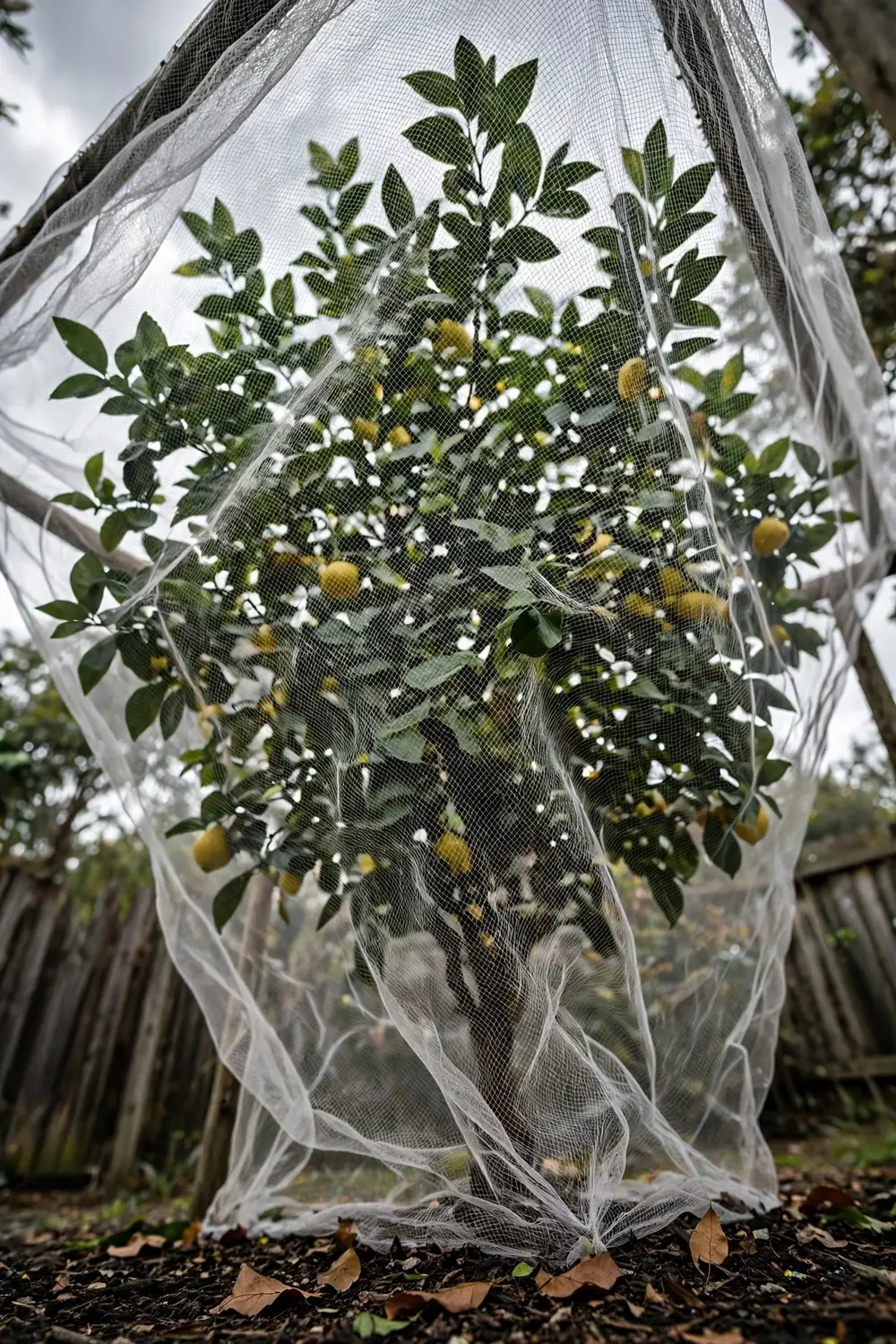

Stop the possum from reaching the fruit. Net the tree or cage it. One brushtail strips a small lemon tree bare within 7 nights of visits. This guide shows how to stop possums eating your lemon tree, starting with proof that a possum is even the culprit.
Possums feed at night, so the damage appears overnight while you sleep. A lemon tree stripped of its young leaves and fruit by morning looks like vandalism. The fix is exclusion, not war. A barrier the possum cannot climb past or chew through protects the fruit, and the possum moves on to another tree.
I have learned that the net I check every morning saves more wildlife than the net I leave up and forget. Check the net each day for trapped animals, and free any animal at once. The how to grow lemon fruit guide covers feeding and watering once the tree is protected.
1. Confirm the Culprit Before You Stop Possums Eating Your Lemon Tree
Check the tree at night before you blame a possum. Possums are nocturnal, so the animal that eats your lemons feeds after dark. A torch check at 10 pm settles the question faster than any guess. Stand back and watch the canopy for ten minutes. A possum moves slowly through the branches and eats in the open.
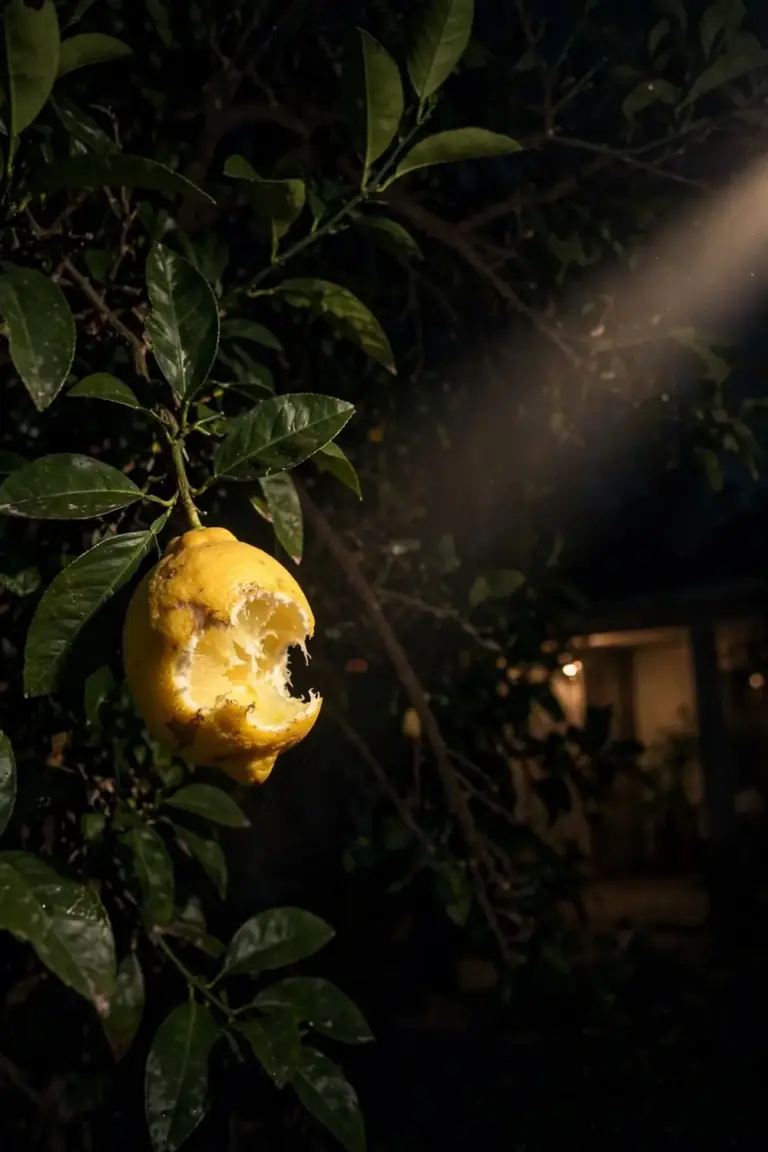
Look for droppings and tracks in the morning. Brushtail possum droppings are blunt pellets about the size of a large bean. Ringtail droppings are smaller and rounder. Tracks in soft soil show five toes on each foot, with the front feet gripping like small hands. Fresh bark chew marks on the trunk point to a climber, not a bird.
Listen for the possum after dark. Brushtails hiss, screech, and cough through the night, and the noise carries across a yard. Ringtails stay quieter, with soft high-pitched calls. A loud screeching match in the lemon tree at midnight is almost always two brushtails arguing over territory. A silent stripped tree points to a ringtail, a rat, or a possum that fed and left without a fight.
Confirm the animal before you spend money. Rats, birds, and insects all eat lemons, and each one needs a different fix. A net keeps out possums and birds together. A rat slips through a gap a possum cannot use. The next section separates the four signatures so you act on the right animal.
Tell a brushtail from a ringtail before you act. The common brushtail possum is the larger animal, with a thick bushy tail, pointed ears, and a stocky body. The common ringtail possum is smaller, with a slender tail tipped in white that it uses like a fifth limb to grip branches. Ringtails build a round nest of grass and shredded bark called a drey in a tree fork or dense shrub, and several animals may share one nest, per Australian Museum and NSW National Parks species notes. Brushtails shelter in tree hollows and roof spaces. Both feed at night on leaves, flowers, and fruit. Both are protected. The difference matters for diagnosis: a drey in the lemon tree itself points to ringtails living on site, while a brushtail usually commutes in from a hollow or roof nearby.
2. Read the 4 Damage Signatures on Your Lemon Tree
Read the damage before you choose a fix. Each animal leaves a different mark, and the mark names the animal. Possum damage is broad and rough. Rat damage is neat and precise. Bird damage is local and shallow. Insect damage stays on the leaves.
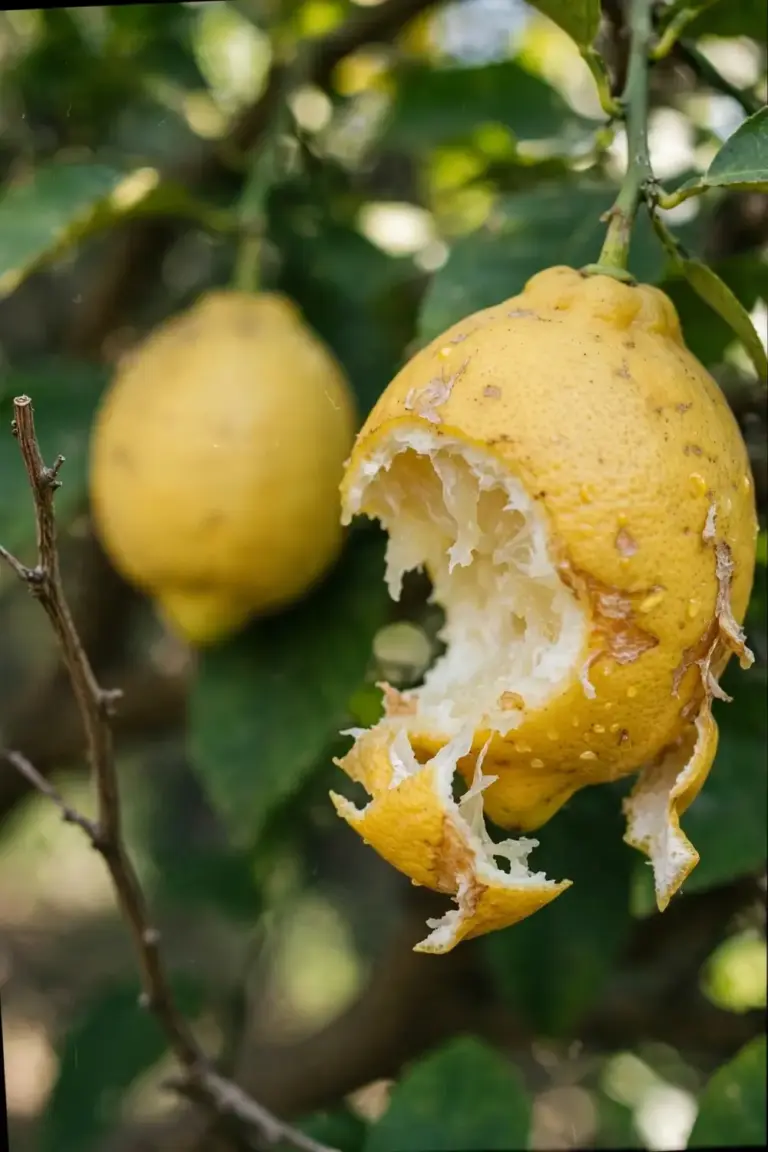
Fruit peeled with the pith left hanging is usually rats, not possums. Possums often take the whole fruit or bite a chunk out of it. Rats strip the rind clean and leave the segmented pith hanging from the tree, and they chew bark on the trunk and main branches too. Leaf Root and Fruit notes that possums often get blamed for damage rats actually cause, and that possums do not usually favor citrus leaves or fruit. Treat a peeled fruit as a rat sign first, and a possum sign second.
| Damage | Possum? | Other Cause |
|---|---|---|
| Fruit gone or bitten in large chunks | Yes, likely | Rats take smaller bites |
| Fruit peeled, pith left hanging | Unlikely | Rats strip the rind |
| Young leaves and shoots stripped overnight | Yes, likely | Caterpillars eat by day |
| Bark chewed or ringed around the trunk | Yes, possible | Rats also chew bark |
| Neat round holes in fruit | No | Birds peck holes |
| Holes and skeletonized leaves | No | Insects feed on leaves |
Young growth is the possum’s real target on a lemon tree. New flush growth is soft and easy to chew, and a possum strips a whole flush in one night. Fruit comes second. A tree that loses its flush three nights running stops growing, even if the fruit survives. Protect the flush first when you net or cage the tree.
Run the torch check on two nights, not one. A possum that feeds on Monday may skip Tuesday, and a single quiet night proves nothing. Check at the same time each night, and check the ground under the tree each morning for fresh droppings and fallen fruit. A pattern across two nights names the animal with confidence. One night of damage with no animal seen still leaves rats on the list.
Ring-barking is the most serious possum sign. A possum that chews bark all around the trunk cuts the tree’s food supply. A full ring kills the tree above the ring. A partial ring weakens it. Check the trunk after every bad night, and treat bark damage as urgent.
Possums prefer ripe fruit and soft growth. A lemon that colors draws the possum first, and the possum returns to the same tree night after night once it feeds there. Pick fruit as soon as it colors, and do not leave fallen fruit under the tree. Fallen fruit teaches the possum that the tree feeds it, and the lesson holds for the next crop. A clean floor under the tree breaks the habit before it forms.
3. Climb the Deterrence Ladder From Light to Physical
Start with the cheapest deterrent and climb only when it fails. Deterrents work on a possum that has other food nearby. A starving possum eats through every deterrent you spray. The ladder runs from light, to scent, to physical barriers, and the physical barrier is the step that holds.
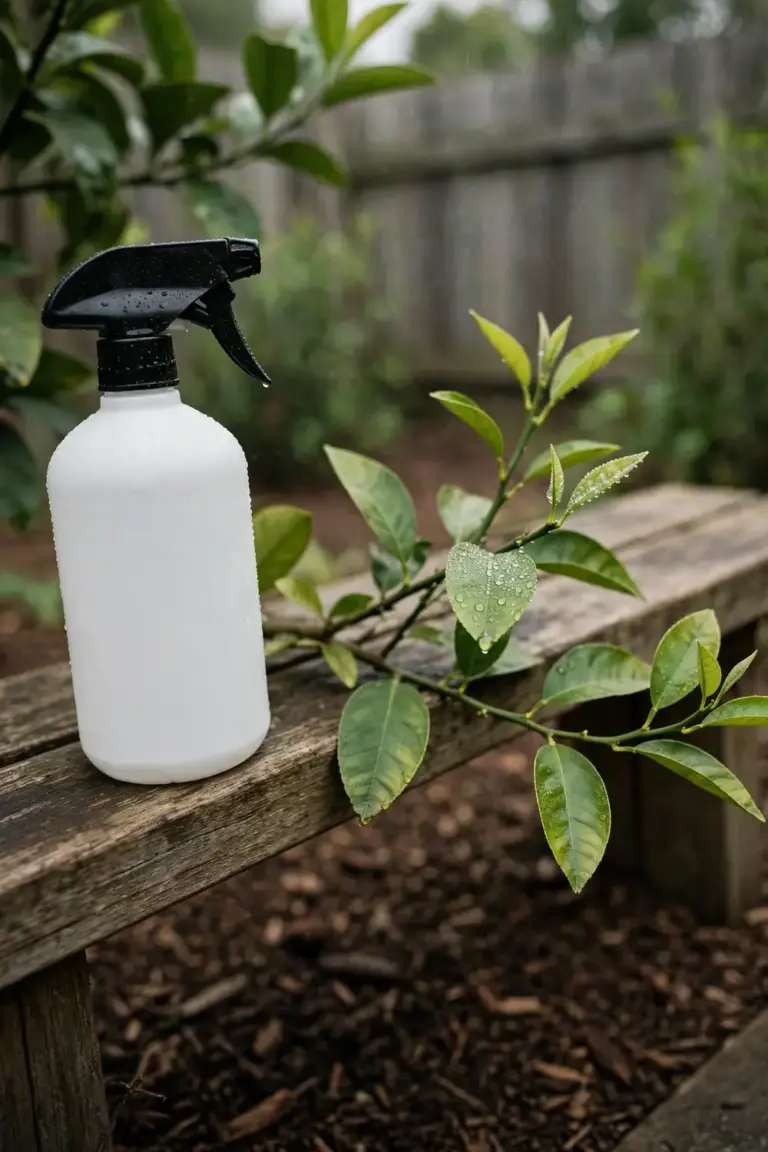
Light is the first rung. A solar sensor light that switches on when the possum climbs startles it for the first few nights. The possum learns the light fast, so light alone never holds for a whole season. Use light as a short bridge while you build the real barrier. Move the light every few nights so the possum does not map it.
Scent is the second rung. Pyrethrum spray made possums avoid treated lemon trees in the Melbourne garden of Professor Lynne Selwood, who went on to develop a commercial possum repellent from the finding. Open Forum recounts how Selwood noticed possums avoiding her pyrethrum-sprayed lemon trees, then found the spray broke down in sunlight and washed off in rain. Reapply after rain and after watering. Blood and bone fertilizer scattered around the base of the tree deters possums by smell, according to Sustainable Gardening Australia guidance. Garlic spray and quassia spray work the same way, by taste and smell on the leaves. Wash fruit before eating it after any spray.
Apply scent deterrents to dry leaves in the late afternoon. A spray applied to wet leaves runs off before it dries, and a spray applied at midday breaks down in full sun before the possum arrives. Late afternoon gives the spray hours to dry on the leaf before the possum feeds. Cover the fruit, the young shoots, and the trunk collar line. A possum that meets the scent on the trunk turns back before it reaches the canopy.
Physical barriers are the third rung, and they are the rung that works. A smooth trunk collar stops a possum from climbing. A cage stops a possum from reaching the canopy. Netting stops a possum from reaching the fruit. Each one works every night, in rain, with no reapplication. The next two sections cover netting and cages in full.
Skip the ultrasonic gadget. No published evidence shows ultrasonic devices keep possums off fruit trees. The possum hears it once and ignores it. Spend the money on netting instead. A barrier you can see beats a sound you cannot verify, and it works on the first night.
Deterrents fail when the possum is hungry and the lemon tree is the only food in reach. A possum with a full belly moves on after one bad taste. A possum that has eaten nothing else that week pushes past light, scent, and taste alike. That is why the ladder ends at a physical barrier. Spray buys days. Netting buys the season.
4. Net the Tree Without Trapping Wildlife
Net the whole tree with wildlife-safe mesh, and check it every day. Loose large-mesh netting traps birds, bats, lizards, snakes, and possums, and a trapped animal injures itself struggling free. The safe net is knitted, white, taut, and fine. The unsafe net is thin nylon monofilament thrown loosely over the canopy. Never use monofilament netting. It pulls out of shape when an animal climbs on it, and the line cuts into the animal.
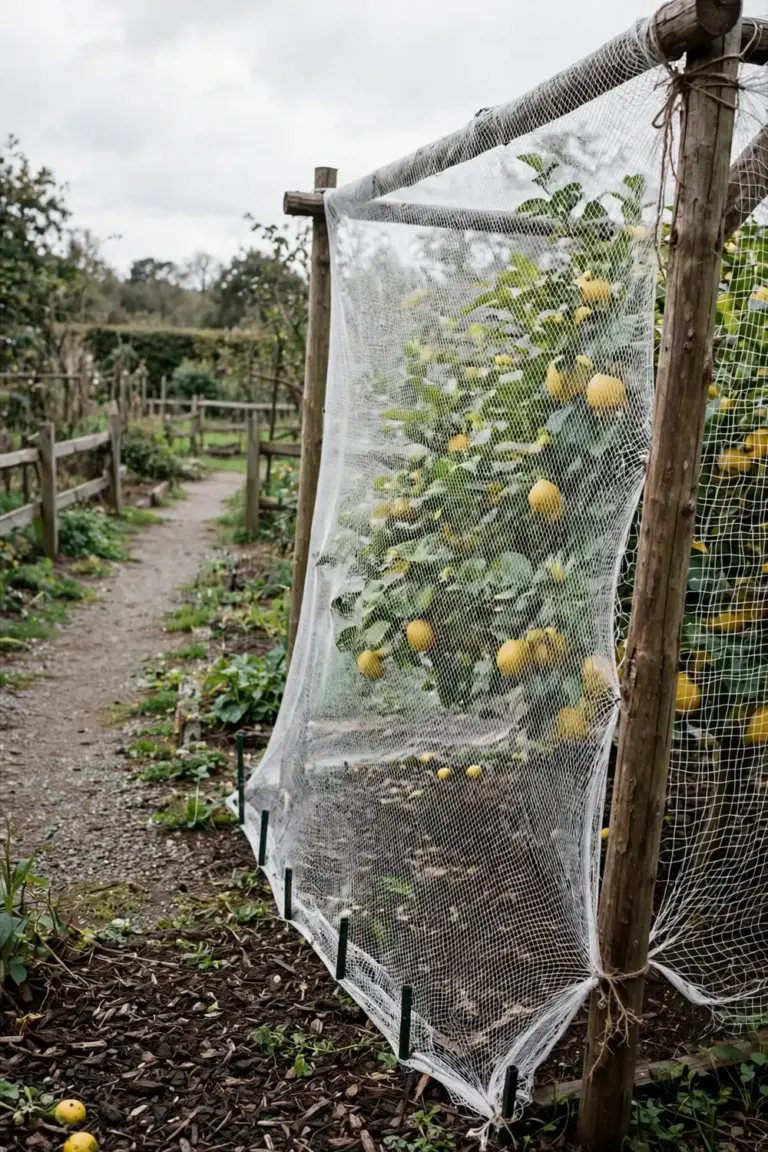
Queensland government guidance sets the standard for safe fruit-tree netting. Queensland guidance requires sturdy knitted netting with a mesh aperture smaller than 5 mm by 5 mm when stretched, woven from strands at least 500 microns thick, which keeps out birds, possums, flying-foxes, and rats. White netting stands out against the foliage, so flying-foxes see it and avoid it. The same netting protects fruit from sunburn and hail. Buy the net from a hardware store, nursery, or netting specialist, and check the label for mesh size and strand thickness before you pay.
Build a frame before you drape the net. A frame holds the net away from the canopy, so a possum cannot press the net against the fruit and bite through it. Timber stakes, poly pipe, or metal posts all work. Size the frame to clear the canopy by a hand span on every side, and leave a gap at the top for the next flush. The frame also keeps the net taut, and a taut net does not fold around an animal. Drape the net over the frame, pull it tight, and fix the base to the trunk or the ground. A gap at the base lets the possum walk straight in under the net. Weight the base with bricks or peg it down so wind cannot lift it.
Check the net every morning. Walk the full circle and look for trapped animals, torn mesh, and gaps at the base. Free a trapped animal at once, and call WIRES on 1300 094 737 if it is injured, per City of Ryde guidance. Remove the net promptly after fruiting so new growth does not tangle in it. A net left up through the next flush strangles the shoots it was meant to protect.
Watch for chew holes in the net itself. A determined possum chews a hole in knitted mesh given enough nights, and a hole the size of a fist is a doorway. Patch holes with a needle and twine, or replace the panel. A net with three patches still beats a new monofilament net. Inspect the base line hardest, since the possum works the base first.
Fruit protection bags beat whole-tree netting on a small lemon. A bag over a single fruit or a single branch uses less mesh, leaves no loose net for animals to tangle in, and lets you protect the fruit the possum wants most. Bag the fruit on the lowest branches first, since those are the branches a possum reaches first. Combine bags with a trunk collar for a small tree, and skip the whole-tree net entirely.
Store the net dry between seasons. A net left in a damp shed grows mold and weakens, and a weak net tears the first night a possum climbs it. Wash the net, dry it in the sun, and hang it on a hook. A net stored well lasts many seasons.
5. Protect Potted Lemons Differently From In-Ground Trees
Move a potted lemon under cover at night. A pot gives you a move the in-ground tree never gets. Wheel the pot onto a veranda, into a shed, or under a roof overhang each evening, and wheel it back into the sun each morning. The possum cannot eat fruit it cannot reach. This single move protects a young potted lemon better than any spray.
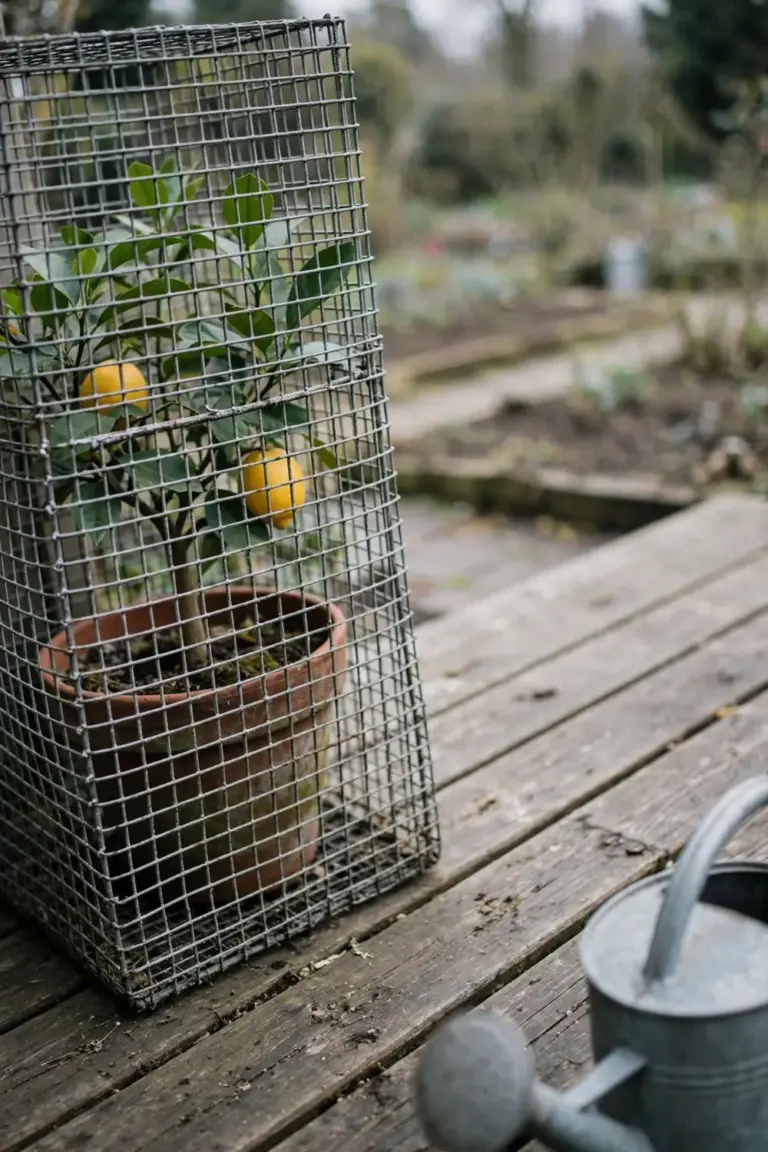
Cage a potted lemon that stays outside. A cage of rigid mesh over the whole pot stops the possum and stops the pot from tipping. Build the cage from welded wire mesh with openings small enough that a possum cannot push its head through. Fix the cage to the pot or to the ground so the possum cannot lift it. Leave room inside the cage for new growth, and lift the cage to water and feed.
Set the pot clear of fences, walls, and other pots. A possum jumps from a fence onto a pot in one move, and a pot parked against a fence hands the possum a ladder. Leave a clear gap of at least a metre between the pot and any climbable surface. A pot on an open veranda with a gap on every side forces the possum to cross open ground, and most possums refuse that crossing.
Fit a trunk collar on a potted lemon with a single straight trunk. A smooth collar of sheet metal or rigid plastic around the trunk stops a possum from climbing. The collar must sit tight against the bark with no gap. It must also sit high enough that the possum cannot jump past it from a nearby pot or wall. A collar fails when a branch droops low enough to act as a ladder, so prune any branch that touches a fence, wall, or neighboring pot. Pruning for clearance is part of the collar, not a separate job.
In-ground trees need the full barrier. A mature lemon in the ground cannot move, and its canopy touches fences, roofs, and neighboring trees. Net the tree on a frame, fit a trunk collar, and clear every branch that bridges to a fence or roof. A possum that cannot climb the trunk walks in from the roof instead. Cut the bridge, and the collar works. Leave the bridge, and the collar is decoration.
Walk the bridge line once a season. Branches grow back toward the fence within months, and a new bridge defeats a collar that worked all last year. Cut the regrowth before the fruit colors, not after the possum finds it. A ten-minute prune in late winter saves a month of nightly fruit loss.
Water and feed the tree after a bad night. A stripped lemon loses leaves it needs for photosynthesis, and it needs water and nutrients to push new growth. The soil health guide covers feeding the soil so the tree recovers, and mulching holds moisture around the roots while the canopy regrows. Prune only dead wood. Leave every living leaf, since the tree needs each one.
6. Never Trap, Poison, or Relocate a Possum
Possums are protected native wildlife in every Australian state. Trapping, harming, or relocating a possum without a licence is illegal. New South Wales Environment guidance states that possums are protected under the Biodiversity Conservation Act 2016, and catching and releasing possums is illegal in that state without a licence. Victoria protects possums under its Wildlife Act 1975, and Queensland under its Nature Conservation Act 1992, per state wildlife guidance. Each state sets its own licence rules. Check your state wildlife authority before you touch a trap.
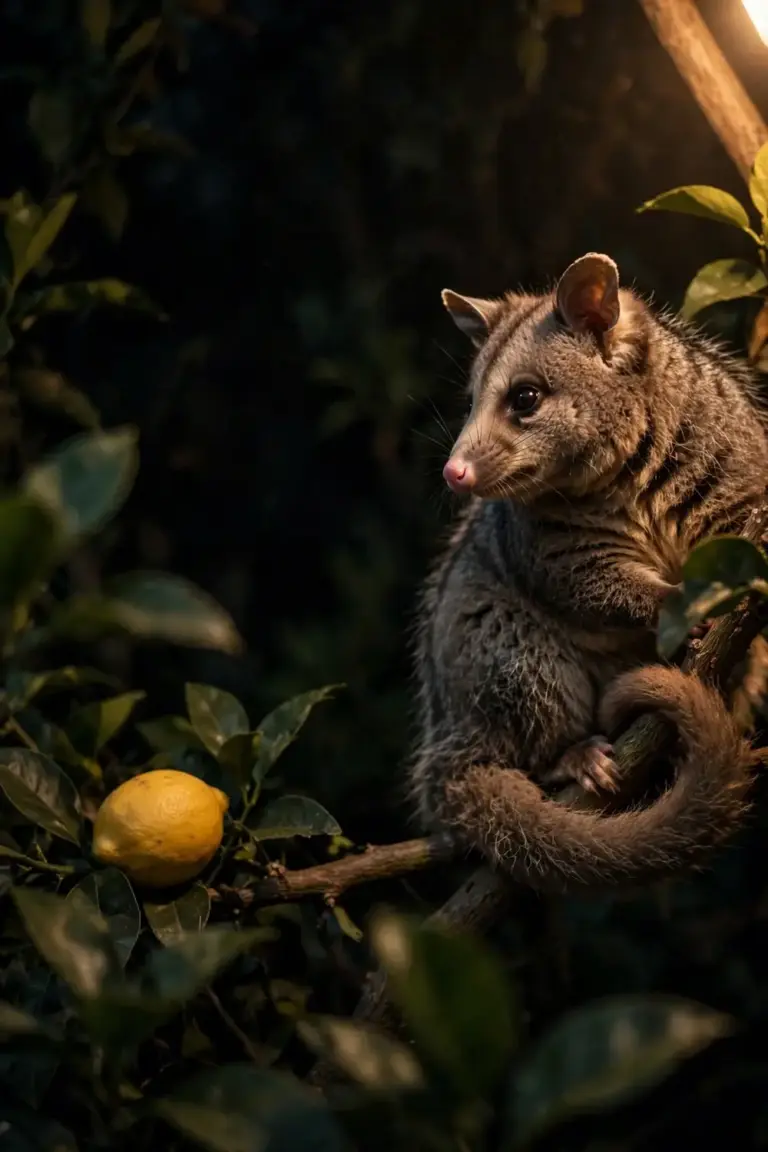
Relocation kills possums even when it is licensed. Possums are territorial animals, and a possum dumped outside its home territory faces cats, dogs, foxes, cars, stress, and starvation as it searches for a new refuge. A possum released far from where it was caught rarely survives. Exclusion beats relocation on every measure: the possum lives, the tree keeps its fruit, and you never handle the animal.
Poison is illegal, cruel, and useless. Poison kills possums, pets, native birds, and any animal that eats the poisoned carcass. A poisoned possum dies slowly, and another possum takes its territory within days. The fruit stays unprotected. Skip poison entirely. No lemon is worth a poisoned garden.
Trapping without a licence carries fines and prosecution. A trap also catches the wrong animal: a cat, a bandicoot, a bird, or a ringtail when you meant a brushtail. Leave trapping to licensed catch-and-release operators, and only for a possum inside a roof cavity, not for a possum eating fruit in a garden. A garden possum is a fencing problem, not a trapping problem.
Call a licensed operator if a possum moves into your roof. Roof possums need professional removal, sealing of entry points, and a nest box or drey in a nearby tree as an alternative home. The operator holds the licence, follows the release rules, and seals the roof so the next possum cannot move in. Your job is the lemon tree. Their job is the roof.
Give the possum somewhere else to go. A nest box for a brushtail or a drey for a ringtail in a tree away from the lemon tree offers the animal a home that costs you no fruit. The possum still crosses your yard, but it feeds in the neighbor’s grevillea instead of your lemon. Exclusion works better when the animal has an alternative, since a possum with nowhere to go tests every barrier you build.
Frequently Asked Questions
A possum eats fruit night after night until the tree is bare. A single brushtail strips a small lemon tree in a week of nightly visits. Net the tree or cage it before the fruit colors, since a possum returns to a tree that fed it once. A tree that loses its fruit also loses its flush growth, so the damage reaches past one season.
Spray works for a few nights, then fades. Pyrethrum spray made possums avoid treated lemon trees, but sunlight breaks pyrethrum down and rain washes it off the leaves. Reapply after rain and after watering. Spray is a bridge while you build a barrier. A net or cage holds every night, in rain, with no reapplication.
Use knitted white netting with a mesh smaller than 5 mm by 5 mm when stretched, woven from strands at least 500 microns thick. Never use thin nylon monofilament netting, since it pulls out of shape and cuts into trapped animals. Build a frame, pull the net taut, fix the base, and check the net every morning for trapped wildlife.
No, unless you hold a licence. Possums are protected native wildlife, and catching or relocating one without a licence is illegal. Relocation usually kills the possum, since a possum dumped outside its home territory faces predators, cars, stress, and starvation. Use exclusion instead: net the tree, fit a trunk collar, and cut every branch bridge.
Possums take whole fruit or bite large chunks, and they strip young leaves and shoots overnight. Rats strip the rind and leave the segmented pith hanging from the tree, and they chew bark on the trunk. Birds peck neat round holes in fruit. Insects eat leaves by day. Check the tree at night with a torch to confirm which animal feeds there.
Check the Tree and Let It Recover
Walk the tree the morning after you net it. Look for fresh damage, gaps in the net, and branches bridging to a fence or roof. Fix the gap the same day, since a possum that finds a gap once uses it every night. A net with a gap protects nothing.
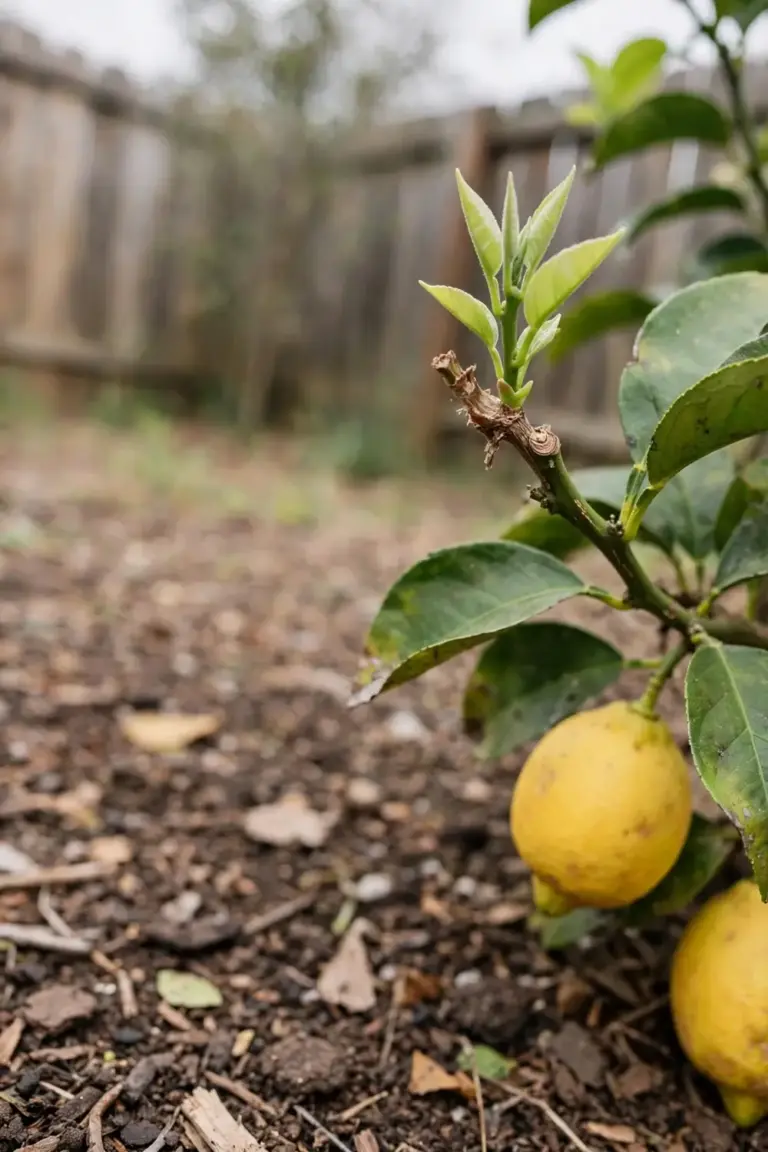
Let the tree regrow at its own pace. A stripped lemon pushes new flush within weeks in warm weather, and slower in cold weather. Water steadily, keep the mulch layer intact, and feed lightly. Do not cut the tree back hard to force regrowth. Hard pruning on a stressed tree costs it the leaves it has left. The tree sets its own timetable, and your job is water, food, and protection while it follows that timetable.
A ring-barked tree may not recover. A full ring around the trunk cuts the food supply to the canopy, and the tree above the ring dies. A partial ring gives the tree a chance. Bridge grafting is a specialist job, and most home gardeners replace a fully ring-barked young tree rather than fight for it. Protect the replacement with a collar from day one. The organic pest control for beginners guide covers exclusion methods that work across the whole garden, not just on one lemon tree.
Call a wildlife carer when you find an injured possum. A possum caught in netting, hit by a car, or attacked by a dog needs trained hands, not good intentions. Keep dogs and cats inside, keep the animal warm and dark, and do not feed it. WIRES takes wildlife rescue calls on 1300 094 737 in New South Wales, and other states run their own wildlife rescue lines. Your lemon tree survives the night. The possum may not.