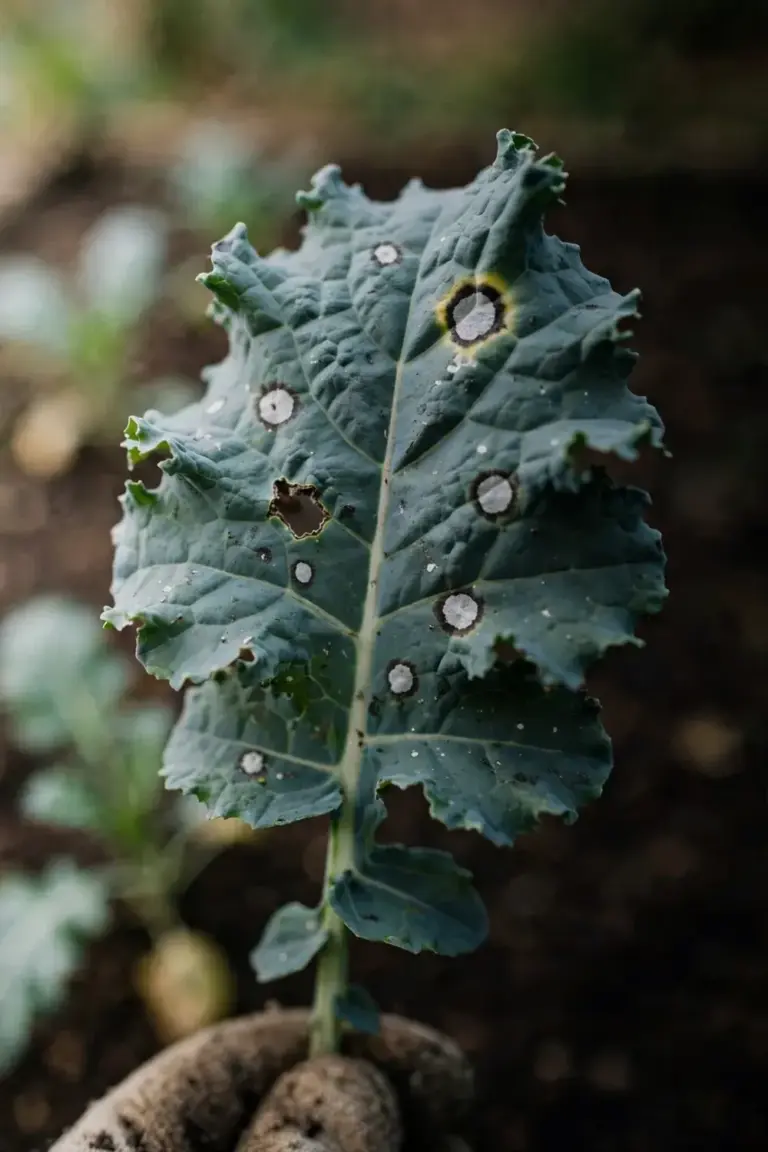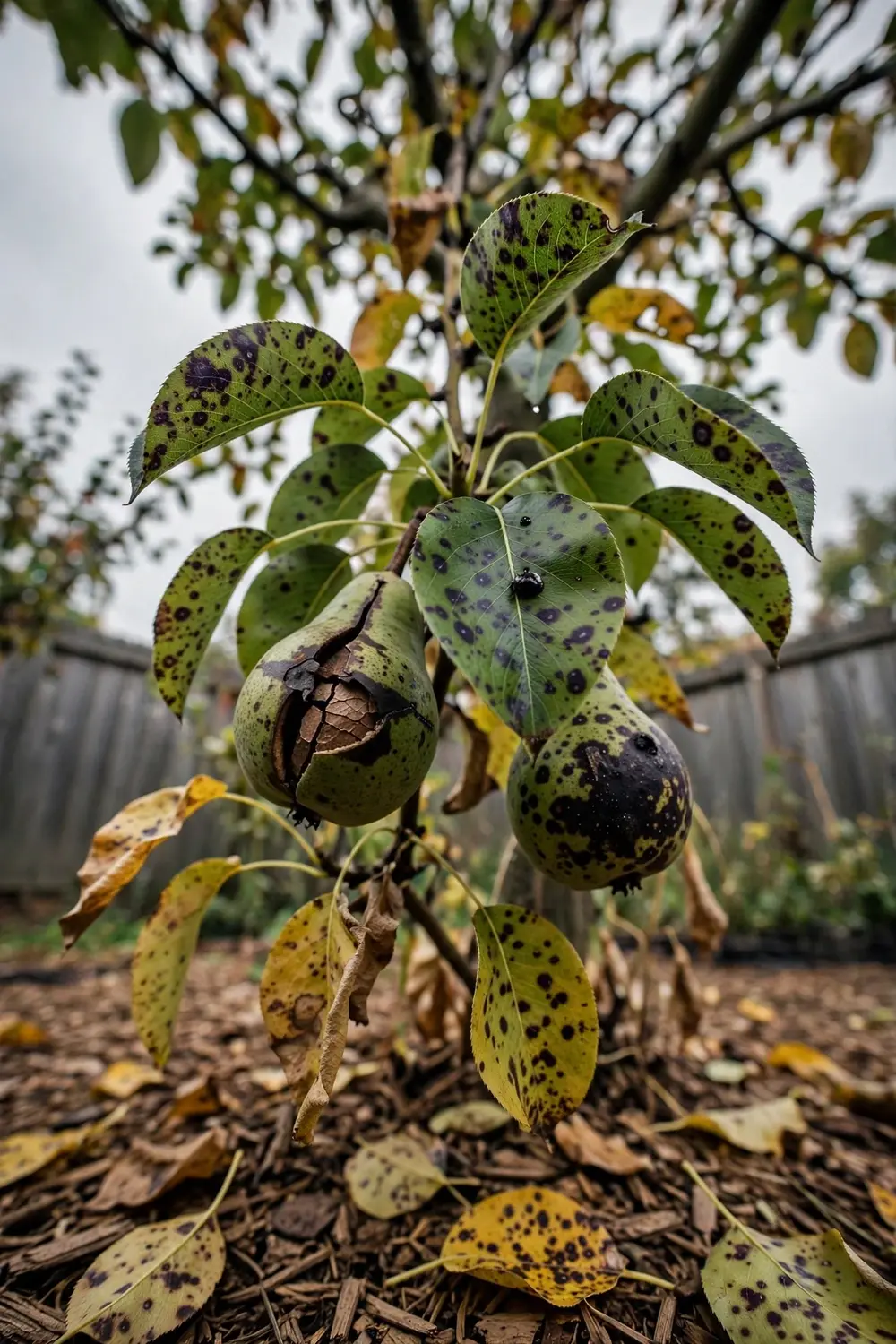

Check the lowest leaves of your pear tree in midsummer. If you find small purple dots, 1 to 3 millimeters across, that grow into purplish-black spots with a black pimple at the center, you are looking at fabraea leaf spot on pear. Left alone in a wet season, the disease can strip a tree bare within a few weeks.
I have learned to check the lowest leaves first, since the first spots show up there. The lower canopy stays wet longest after rain, and the fungus uses that damp shade to build up spores. A tree that looks fine from the driveway can already carry spots on its lowest limbs.
The sections below walk through identification on leaves, fruit, and twigs, the pears hit hardest, the two lookalikes that fool gardeners, and three steps that decide whether treatment pays. The last section tells you how to live with damage that is already done.
1. What Fabraea Leaf Spot on Pear Actually Is
Fabraea leaf spot on pear is a fungal disease of pear trees caused by Diplocarpon mespili. Garden books also list it under two older names, Fabraea maculata and Entomosporium mespili, for the same fungus. The same fungus causes the leaf spot on red-tip photinia, and the photinia guide covers that host. This page stays on pear.
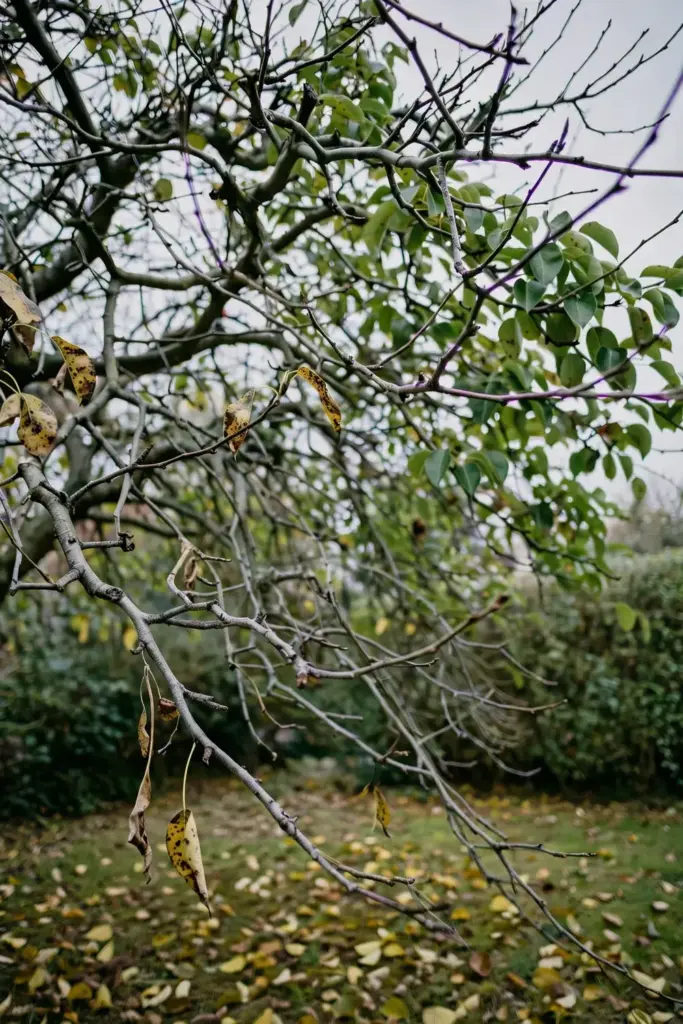
The fungus infects the leaves, fruit, and shoots of pear and quince and the leaves of apple trees, according to Penn State Extension’s guide to leaf and fruit spot of pear in home gardens. That host range matters. A quince bush beside a pear tree can hold the same disease, and apple leaves can carry it too, so sanitation has to cover the whole planting, not one tree.
The damage runs on a simple chain. Spots cut down the working leaf area. Heavy infection drops leaves early. Early defoliation leads to small fruit, weak bud formation, and fall blossoming, according to the same Penn State guide. Infected fruit has no sale value and often turns out cracked and misshapen. One bad season rarely kills a mature tree. Two or three in a row drain the reserves that build next spring’s buds.
The speed surprises first-time growers. The disease can build up rapidly, even in orchards where it has not been a problem, according to Penn State Extension. If conditions favor the disease and it goes unchecked, pear trees can be defoliated in a few weeks. That pace sets the whole management approach. You do not wait for spots to spread before acting. You cut the inoculum in winter and you protect new leaves before the wet weather arrives.
2. How to Identify Fabraea Leaf Spot on Pear Leaves
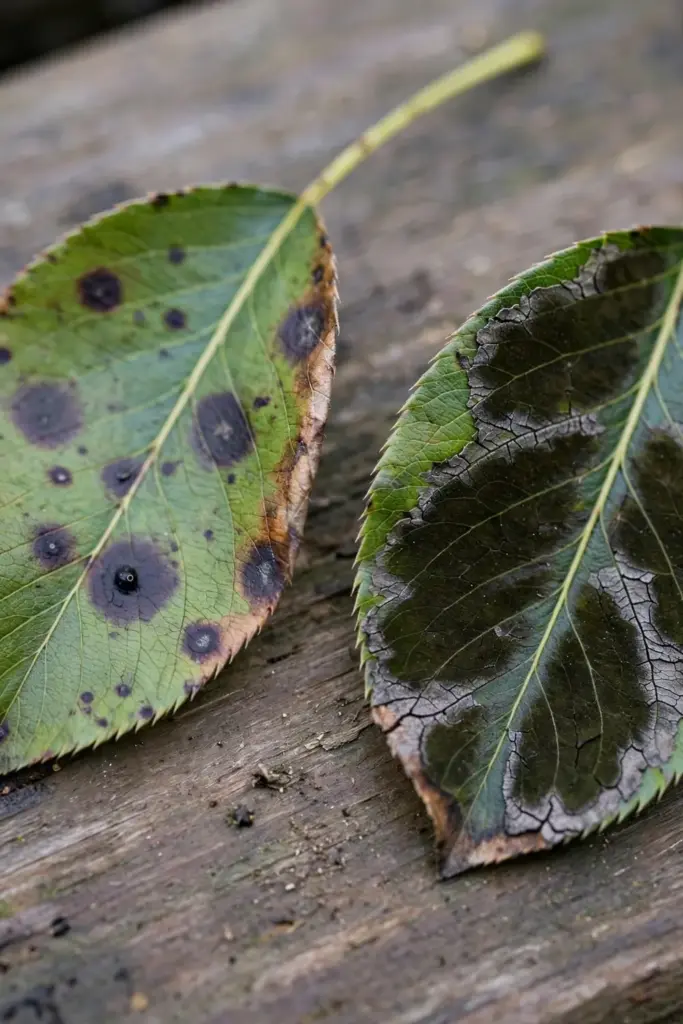
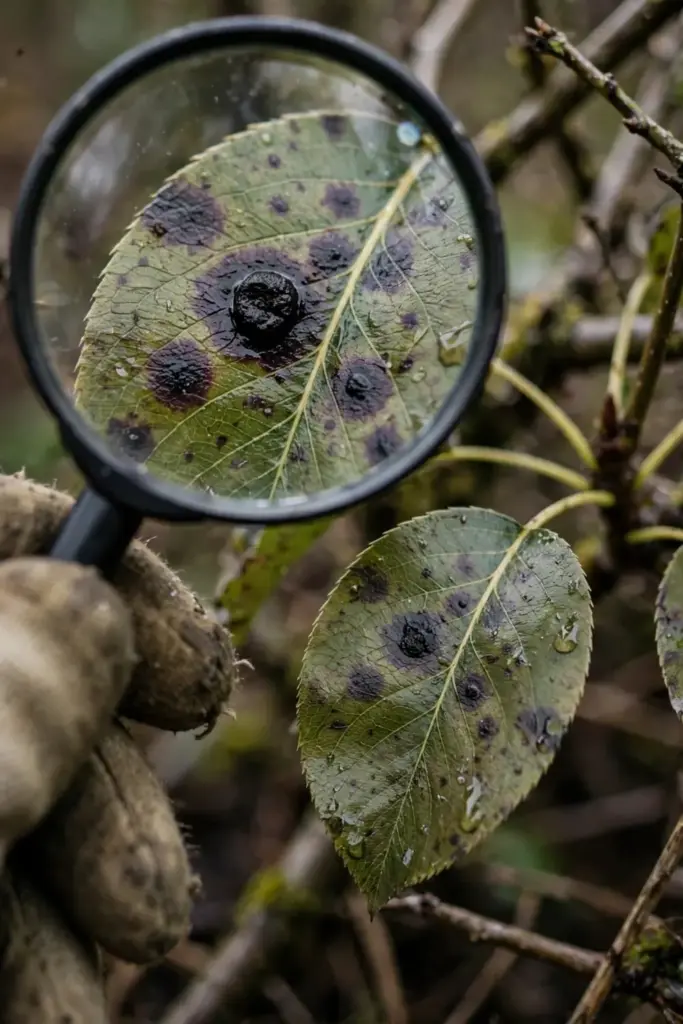
Start on the leaves nearest the ground in early summer. Leaf spots first appear as small, purple dots on the leaves nearest the ground, according to Penn State Extension. They grow into circular spots and become purplish-black or brown. The first spots measure 1 to 3 millimeters across, according to the New England pear crop profile. At that size they look like flecks of dirt. A hand lens turns a guess into a diagnosis.
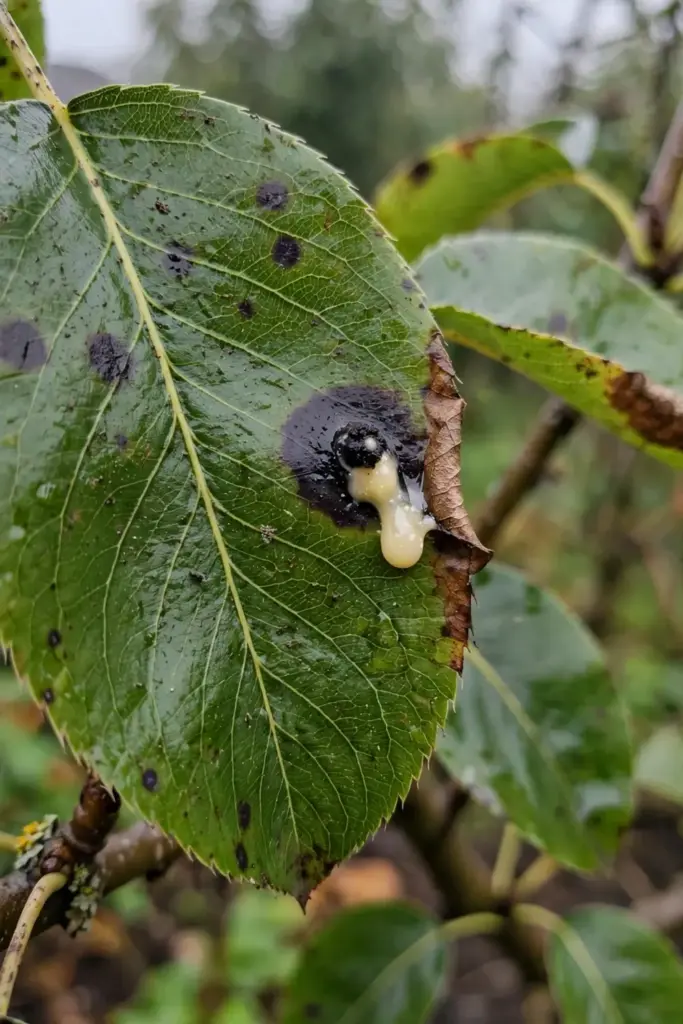
The mark that separates this disease from a generic spot is the center. A small, black pimple appears in the center of the spot. When the leaf is wet, a gelatinous mass of spores oozes from the pimple, giving the spot a creamy, glistening appearance, according to Penn State Extension. That wet-leaf check is the field test. Mist a suspect leaf with water, wait a minute, and look at the pimple with a lens. A glistening bead of spore slime confirms Fabraea. A dry, flat spot with no pimple points elsewhere.
Spots multiply fast once the first infections land. Each lesion might have dozens of spots, resulting in extensive defoliation, according to Penn State Extension. Heavily infected leaves often yellow and drop prematurely, according to the Connecticut Agricultural Experiment Station guide for home pear orchards. The pattern runs bottom-up. Lower leaves spot first, drop first, and feed spores upward into the canopy with every rain. When you see yellow leaves piling under the tree in July, the disease already holds the lower canopy.
3. How to Identify Fabraea Leaf Spot on Pear Fruit
Fruit lesions look much like those on leaves, but they are black and slightly sunken, according to Penn State Extension. The spots start small and dark. They can be so numerous that they run together, causing the fruit to crack. Lesions on fruit appear similar to those on leaves but become slightly sunken as fruit expand, according to the Connecticut Agricultural Experiment Station guide for home pear orchards. Severely infected fruit may also crack. A cracked pear loses its skin barrier. Rot organisms move in through the split, and the fruit finishes the season on the ground.
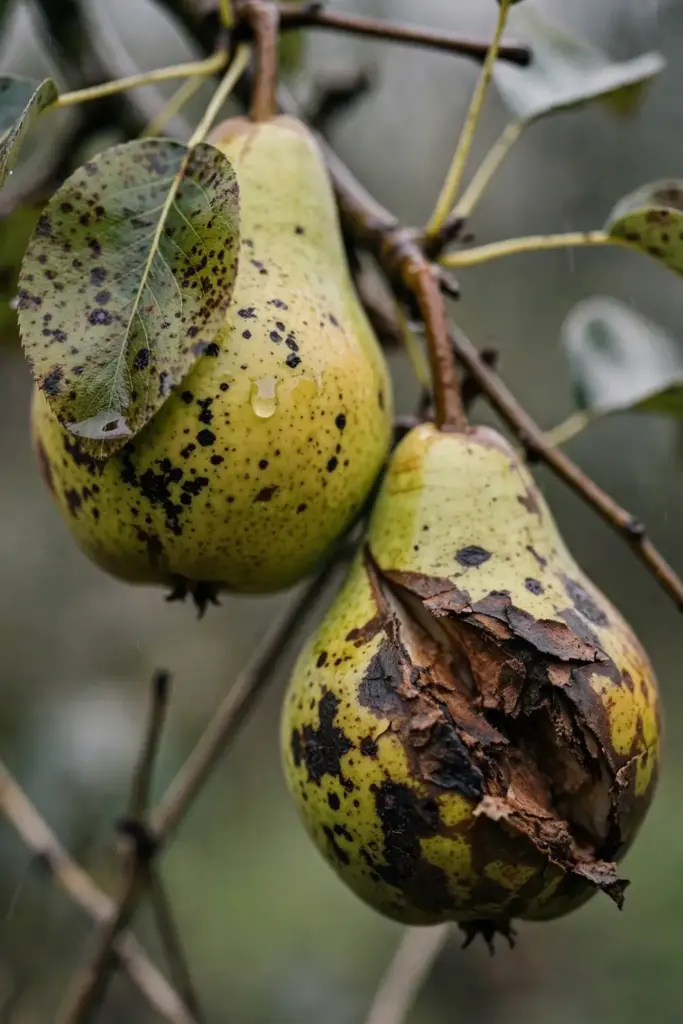
Timing tells you how much fruit is at stake. If fungicide protection is lacking or inadequate, fruit can become severely infected during July and August, according to the New England pear crop profile. Fruit with spots cannot be sold. That July-to-August window is the reason early leaf protection matters more than late fruit rescue. By the time fruit spots show, the spores that caused them landed weeks earlier.
Pick spotted, cracked fruit off the tree and off the ground. Bag it and bin it. A cracked pear under the tree is a spore source for the next rain, and it draws wasps and rot. Sound fruit with a few flat spots and no cracks still needs a close look at harvest. Cut one open. If the flesh under the spot stays firm and clean, the fruit ripens normally for home use. If the flesh under the spot has turned brown and soft, the fruit goes in the bin with the cracked ones.
4. How to Identify Fabraea Leaf Spot on Pear Twigs and Shoots
Twig lesions show up on current-season growth. Lesions on twigs occur on current-season growth, according to Penn State Extension. They are purple to black with indefinite margins. The lesions can run together and form a superficial canker. Superficial is the key word. The canker sits on the surface. It does not chew deep into the wood the way a bacterial canker does.
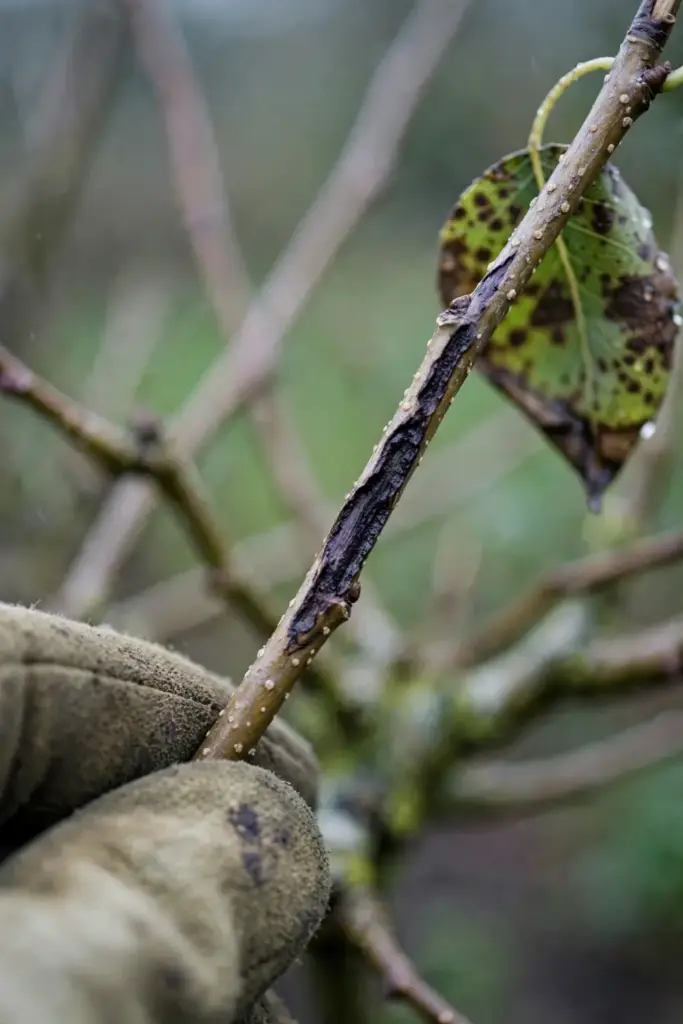
Those twig cankers carry the disease into next season. The fungus can overwinter in small cankers 5 to 10 millimeters across on one-year-old twigs or in fallen leaves, according to the New England pear crop profile. Twig cankers release conidia in spring during or shortly after bloom, while ascospores mature and release from leaves after bloom. A twig that looked healed in winter can still puff spores at bloom. That is why dormant pruning has to remove cankered twigs, not just fallen leaves.
Tell a Fabraea canker from a bacterial one by depth and ooze. A Fabraea canker stays shallow, keeps indefinite edges, and shows no bacterial ooze. A bacterial canker sinks. It girdles. It often weeps amber fluid. The bacterial canker guide covers the bacterial side in full. If you find a sunken, girdling canker with ooze on a pear branch, treat it as bacterial until proven otherwise, and disinfect tools between cuts.
5. Which Pears and Related Trees Get Hit Hardest
All pear trees can catch this disease, but the hit is uneven. Bosc and Seckel are much more susceptible than Bartlett, according to the University of Massachusetts New England tree fruit guide for pears. That ranking shapes buying and planting decisions. If you grow Bosc in a wet climate, plan on a full sanitation routine every year. If you grow Bartlett in a dry spot with open airflow, the same routine still helps, but the pressure runs lower.
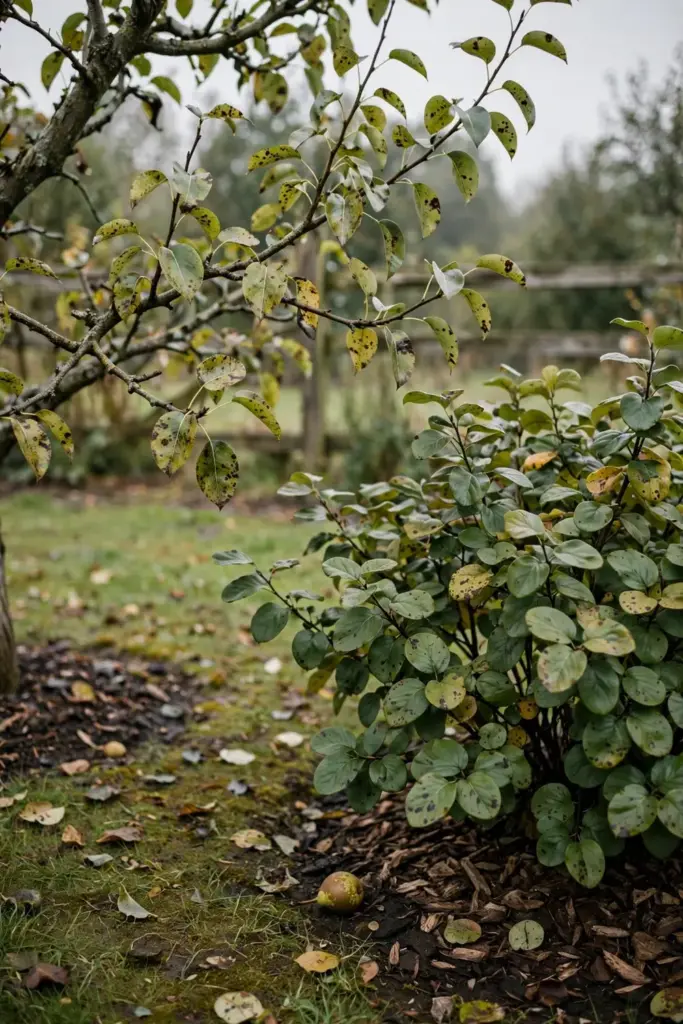
Quince takes the same disease on leaves, fruit, and shoots. Penn State Extension lists quince beside pear as a full host. A quince bush near a pear tree is not a neutral neighbor. It can carry the fungus through the same season and hand spores back across the fence with every rain. The quince growing guide covers quince care, and its sanitation steps match the ones here. Treat the two plantings as one disease block. Clean both in winter, or the dirty one reinfects the clean one.
Apple trees sit one step back. The fungus infects the leaves of apple trees, according to Penn State Extension. Apple fruit escapes. An apple tree beside a pear tree can show spotted leaves and still crop normally. The risk runs the other way too. A pear tree shedding spores can spot apple leaves, which then hold inoculum near the pear. Rake apple leaves in a mixed planting with the same care you give pear leaves.
Young trees suffer more than old ones. A young pear has a small leaf area and small reserves. Early defoliation on a young tree stalls growth for the whole season and sets back the first real crop. A mature tree with a full canopy can lose a share of its lower leaves and still ripen fruit. Step 1 uses that gap. A young tree earns a spray program sooner than an old one does.
6. How to Tell Fabraea Leaf Spot From Pear Scab and Fire Blight
Three pear diseases spot leaves and ruin fruit. The table below sorts them by what you can see in the garden. Read the row that matches your tree, then check the decisive test in the last column.
| Disease | Pathogen | Leaf Clue | Fruit Clue | Twig Clue | Decisive Check |
|---|---|---|---|---|---|
| Fabraea leaf spot | Diplocarpon mespili (fungus) | Purplish-black spots with a black pimple at the center | Black, slightly sunken lesions that run together and crack the fruit | Purple-black lesions with indefinite margins forming a superficial canker | Wet the leaf. A glistening bead of spore slime oozes from the pimple |
| Pear scab | Venturia pirina (fungus) | Circular, velvety olive-black spots that turn gray and cracked with age | Dark spots, often misshapen fruit, cracking on old infections | Small lesions on twigs, sometimes sloughed off | Spots look velvety and olive, never show the black pimple with ooze |
| Fire blight | Erwinia amylovora (bacterium) | Leaves blacken and stay attached, often along the mid-vein | Fruitlets wither, turn black or brown, and cling to the spur | Shoot tips wilt and bend into a shepherd’s crook, with sticky amber ooze | The shoot tip bends. Fabraea never bends a shoot tip |
Pear scab is the close call. Pear scab, caused by the fungus Venturia pirina, is a disease quite similar to apple scab, according to the Connecticut Agricultural Experiment Station guide for home pear orchards. The fungus causes circular, velvety olive-black spots on leaves, fruit, and sometimes twigs. As the lesions age, they become gray and cracked. The color and texture carry the diagnosis. Scab looks velvety and olive. Fabraea looks purplish-black with a pimple. The two fungi share a control program, so a mistaken call between them costs little. The spray timing and the sanitation in Steps 2 and 3 cover both.
Fire blight is the dangerous call. Fire blight is bacterial, and it kills shoot tips fast. A blighted shoot tip wilts, blackens, and bends into a shepherd’s crook, and sticky amber ooze may bead on the surface. Fabraea never bends a shoot tip. It spots leaves first and works slowly upward. If your pear shows bent black shoot tips with ooze, stop treating it as a leaf spot. Cut the blighted shoots well back into healthy wood, disinfect tools between cuts, and keep the cut wood out of the compost pile. Fire blight moves through the tree faster than any leaf spot, and a week of delay can cost a branch.
Apple scab belongs in the same conversation for a different reason. Apple scab is a separate fungus on apple, and the apple scab guide covers it. Pear scab and apple scab look alike because the two fungi are close relatives, but each stays on its own host. A pear tree with scab did not catch it from your apple tree, and an apple tree with scab did not catch it from your pear. Treat each tree for its own disease.
7. Why Wet Leaves Drive Every Fabraea Leaf Spot on Pear Outbreak
Water writes the schedule for this disease. The sexual spore stage develops on fallen, overwintered leaves, according to Penn State Extension. Conidia, the asexual spores, might also develop in the spots on overwintered leaves, or they can be produced in the previous season’s shoot infections. Often, the first infections do not occur until mid-June to the first of July. Secondary infections begin about 1 month later and reoccur throughout the season during periods of rain. Every wet stretch after mid-June is a fresh infection window.
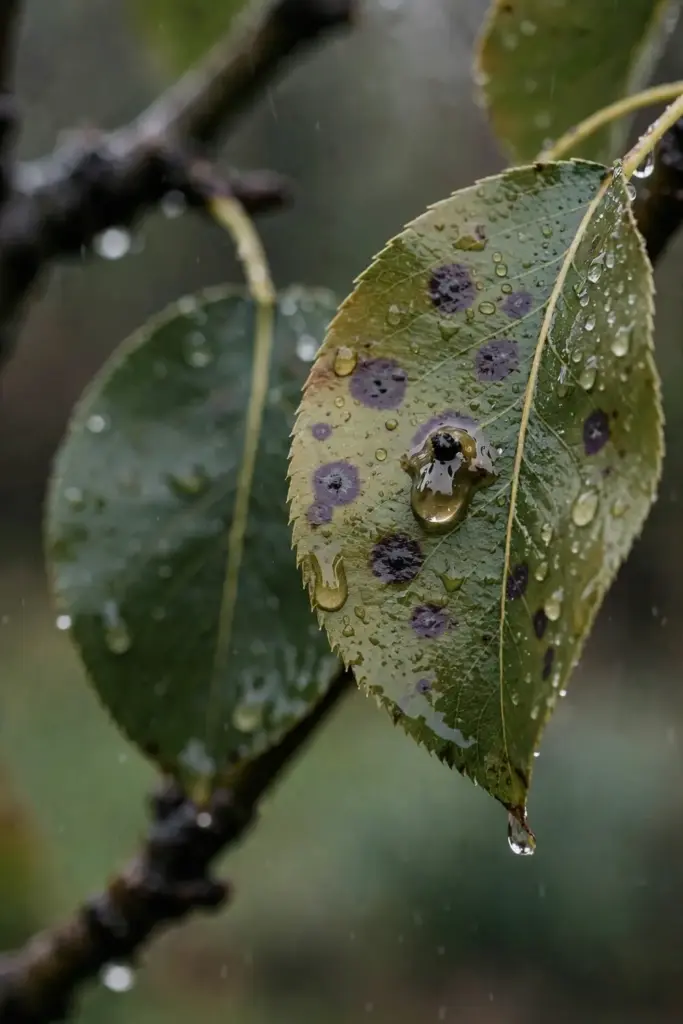
Infections occur during periods of leaf wetting from rain or dew, according to the New England pear crop profile. Spores of the fungus are easily spread by splashing rain and wind in the spring, according to the Connecticut Agricultural Experiment Station guide for home pear orchards. A dry leaf is a closed door. A wet leaf is an open one. The fungus needs that film of water to germinate and enter the tissue. A season of well-spaced rain with dry afternoons keeps the disease quiet. A season of drizzle, dew, and overhead watering hands it week after week of open doors.
Each first infection punches above its weight. Each initial infection can produce millions of slimy spores that are disseminated by splashing rain or by pear psylla and other insects, according to the New England pear crop profile. If spores are disseminated by insects, infection can occur during long dew periods in the absence of rain. A handful of overlooked spots in June becomes the spore factory for July. That multiplication is why early action beats late action by so much. One missed leaf in June costs more than ten missed leaves in September, because the June leaf gets three months to multiply.
The practical rule falls out of the biology. Keep foliage dry. Water at the base. Space trees for airflow. Prune for light. Rake the leaves that carry next spring’s spores. None of these steps kills the fungus directly. Each one shortens the wet window the fungus needs. Stack enough of them and the disease never reaches the steep part of its curve.
8. What Makes Fabraea Leaf Spot on Pear Worse in a Home Garden
Fallen leaves left in place are the top risk. Once established in a tree or a planting, this disease is difficult to control since significant amounts of fungal inoculum overwinter on infected leaves, according to the Connecticut Agricultural Experiment Station guide for home pear orchards. A thick leaf blanket under the tree is a spore bank. Spring rain draws on it. Every leaf you leave in place is a leaf you will fight next June. The fix costs nothing but an afternoon with a rake.
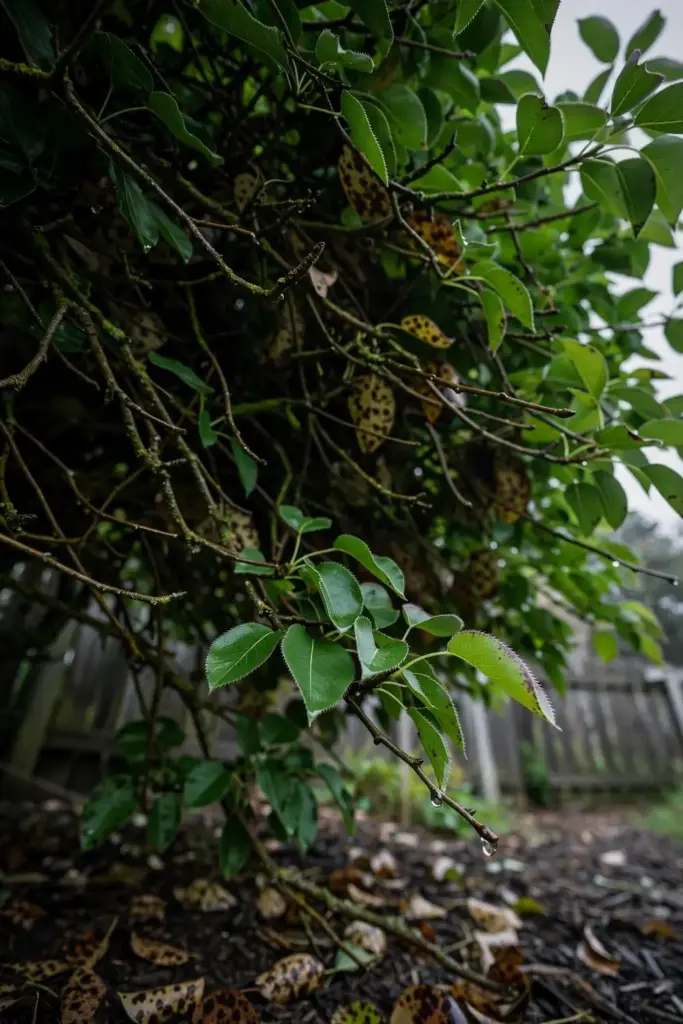
Overhead watering is the second risk. Sprinklers wet the whole canopy and hold it wet into the evening. A sprinkler that runs at dusk leaves the tree wet all night, which is exactly the leaf-wetting window the fungus needs. Drip lines and soaker hoses put water at the roots and keep leaves dry. If you must use a sprinkler, run it early in the morning so the sun dries the canopy fast.
Dense, unpruned canopies come third. A crowded canopy dries slowly after rain. Inner leaves can stay wet hours after outer leaves dry. Those inner leaves sit beside the spore sources on the ground. A winter prune that opens the center lets wind move through and dries the canopy after every rain. Airflow is a fungicide that never runs out.
A susceptible cultivar in a wet climate stacks the deck. Bosc and Seckel carry more risk than Bartlett, according to the University of Massachusetts New England tree fruit guide for pears. A Bosc tree in a damp hollow with overhead watering and leaves left down will test every control you own. The same tree on a breezy slope with drip irrigation and a clean floor will often stay clean with sanitation alone. Site and cultivar decide how much of the spray program you actually need.
9. Step 1: Decide Whether Treatment Is Worth It
Look at the tree before you reach for a sprayer. A mature pear with light spotting on lower leaves, clean fruit, and strong growth does not need a spray program. Sanitation alone holds that tree. Rake the leaves, prune the cankered twigs, and check again next June. Spraying a tree that does not need it wastes money and adds fungicide to a garden that never asked for it.
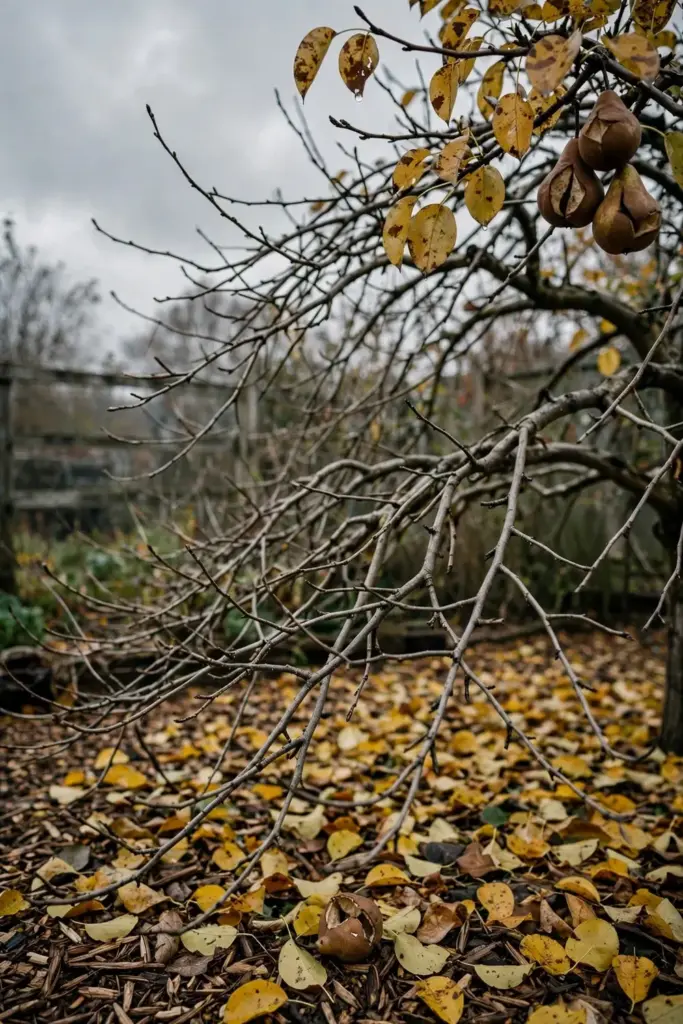
A different picture earns a spray program. Severe defoliation can substantially reduce tree vigor and yield, especially if trees are defoliated several years in a row, according to the Connecticut Agricultural Experiment Station guide for home pear orchards. Severely infected Bosc trees can lose most of their leaves by late August and may fail to form fruit buds the following spring, according to the New England pear crop profile. If your tree lost most of its leaves by August last year, or if cracked fruit ruined the crop, the spray program in Step 3 pays. If the tree defoliated two years running, it pays double.
Young trees get a lower threshold. A young pear cannot spare its leaves. Early defoliation on a young tree stalls the growth that builds its frame, and a stalled young tree fruits late. Treat a young tree at the first sign of heavy spotting. An old tree with a deep root system and a full canopy can absorb one bad year. A two-year-old tree cannot.
One honest limit applies to every case. Protectant sprays shield healthy tissue. They do not heal spotted leaves or uncrack fruit. If the canopy already shows heavy spotting and the fruit already cracks, this season’s spray money is gone. Spend the effort on sanitation instead, and start the spray program next spring before the first infection window opens. The decision in this step is a calendar decision. You are choosing next year’s health, not fixing this year’s damage.
10. Step 2: Strip the Inoculum Out of the Garden
Winter sanitation is the highest-return work in the whole program. Since overwintering infected leaves are a major source of spores in the spring, removal of all fallen leaves during the dormant season significantly reduces the chances for new infection, according to the Connecticut Agricultural Experiment Station guide for home pear orchards. Rake every leaf from under the pear, the quince, and any apple tree nearby. Bag the leaves and bin them. Do not pile them beside the tree. A leaf pile at the fence still releases spores into the next wind-driven rain.
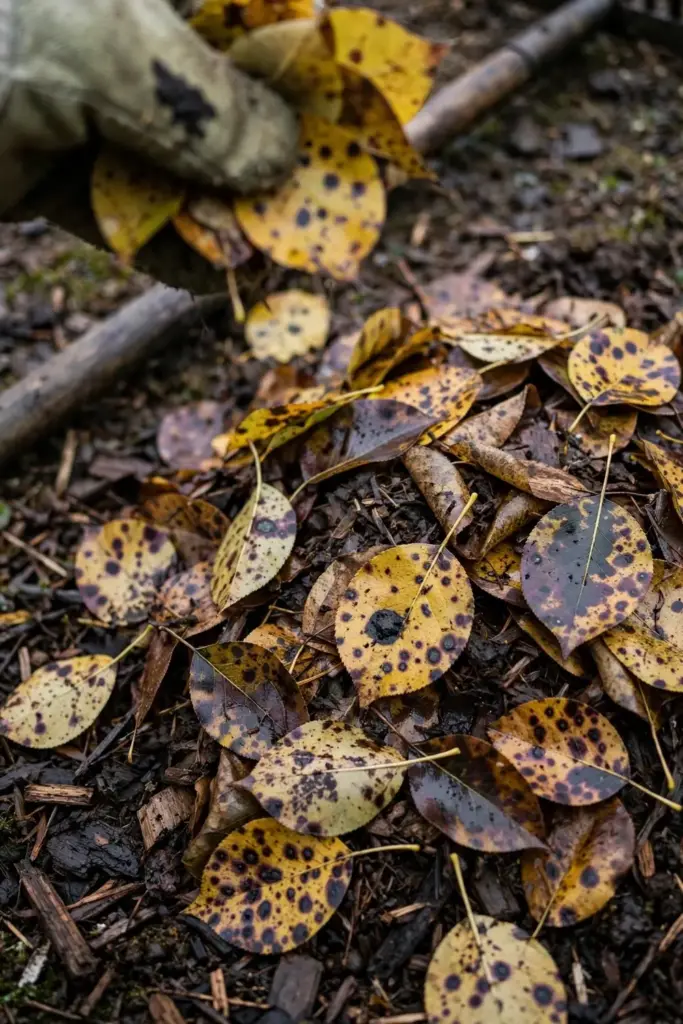
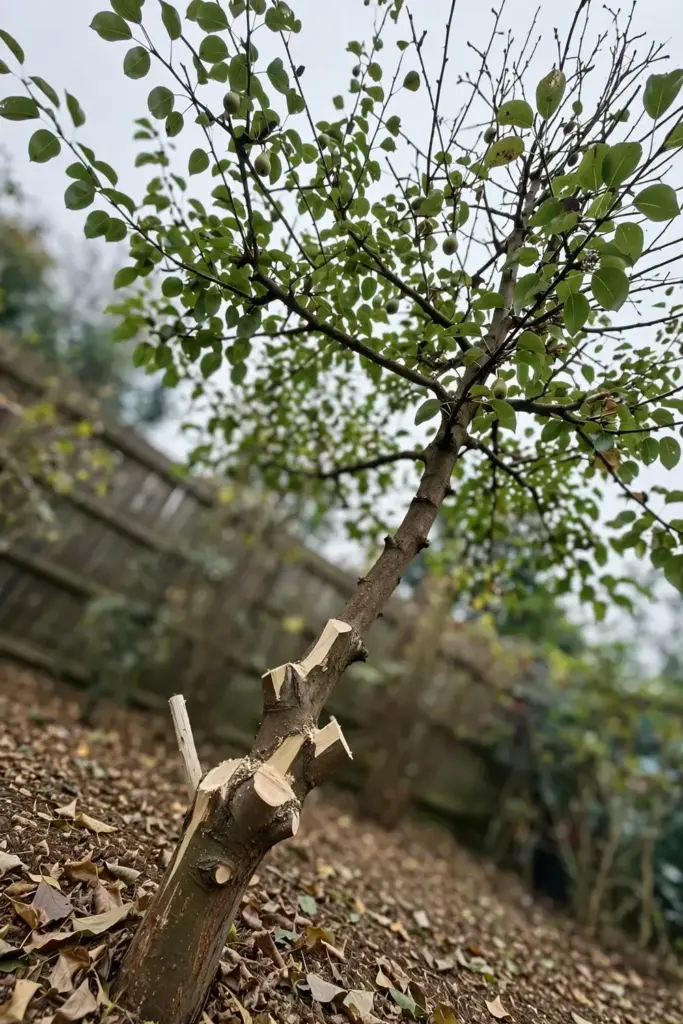
Prune the twig cankers while the tree stands bare. Cut out twigs that show purple-black lesions with indefinite margins. Cut back to healthy wood with a clean margin around the lesion. A cankered twig left on the tree releases conidia at bloom, and one cankered twig can seed the whole lower canopy. Winter is the right time because the bare tree shows every lesion, and the fungus sits dormant in the wood.
Disinfect tools between cuts. A pruning shear that cut a cankered twig carries spores to the next cut. Wipe blades with rubbing alcohol or household bleach, then rinse and dry them. The step takes seconds. Skipping it turns the pruning round into a spore delivery round.
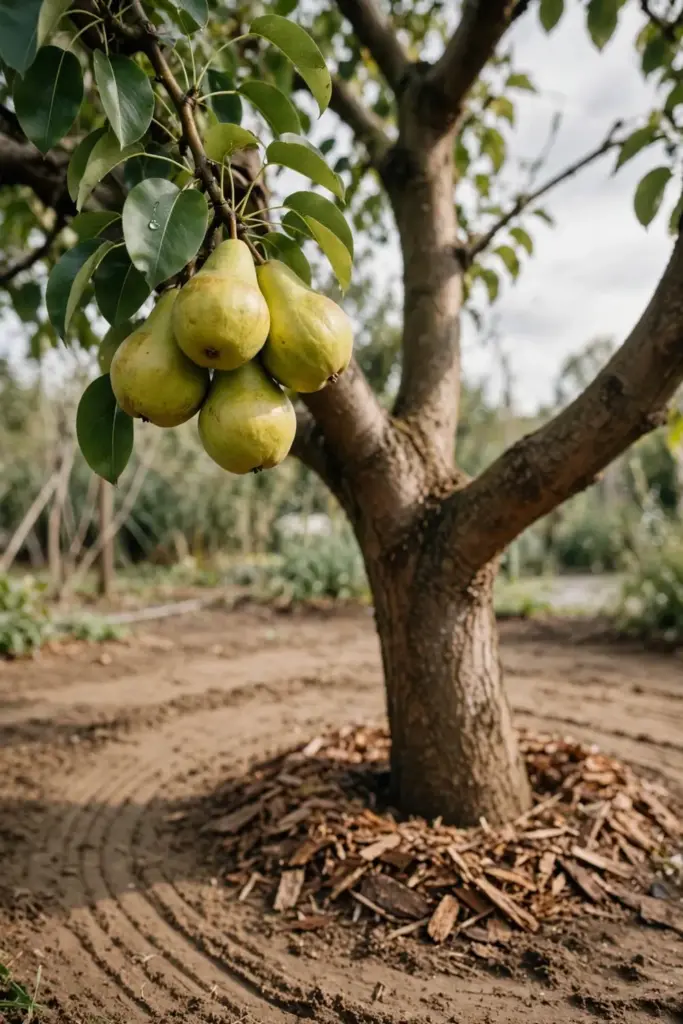
Run a mower over the ground after raking. Shredding leftover leaf litter breaks up the fragments that the rake missed and speeds their decay. Follow with a fresh mulch ring that stops short of the trunk. The mulch is not a fungicide. It buries any leftover fragments and keeps the next rain from splashing soil and spores straight onto low leaves.
11. Step 3: Time Protectant Sprays to Wet Weather
Sprays work only when they land before the spores do. The New England guide sets the start by last year’s pressure. Sprays should start at green cluster if the year is wet and disease was prevalent last year, according to the University of Massachusetts New England tree fruit guide for pears. Otherwise, wait until white bud. Continue sprays at 10- to 14-day intervals through the first or second cover. The interval matters more than the product. A protectant coat that wears off before the next rain leaves the new growth bare.
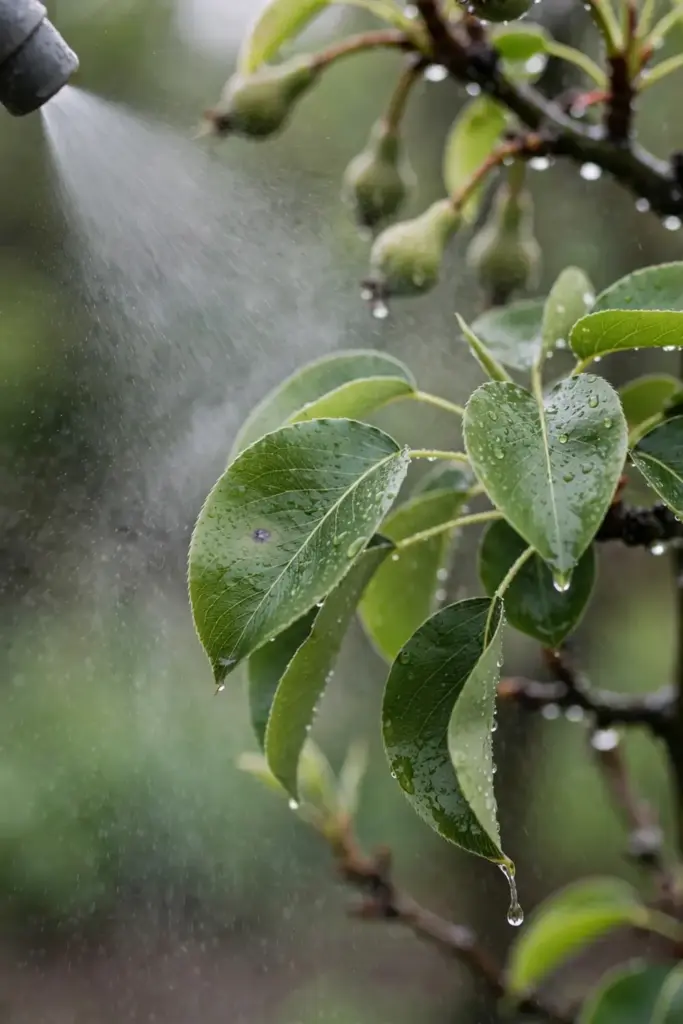
Heavy pressure shortens the interval. In orchards with high inoculum, apply a mancozeb spray at 7-day intervals after petal fall until reaching either the 77-day pre-harvest interval or the limit on the number of sprays per season, according to the same University of Massachusetts guide. Home gardeners should read the label for the product they buy and follow the harvest interval printed on it. The label is the law for that product. Extension timing tells you when to spray. The label tells you how much and how close to harvest you may go.
Rotate chemical groups to slow resistance. Summer applications of Sovran, Flint, or Pristine to control scab or sooty blotch should also control Fabraea leaf spot, according to the University of Massachusetts New England tree fruit guide for pears. For resistance management, do not apply more than four applications per season of those materials. A home gardener who sprays the same single product all season breeds resistant fungus. Two products from different groups, alternated, last longer than one product used alone.
| Timing | Action | Why It Works |
|---|---|---|
| Green cluster (wet year, disease last year) or white bud (otherwise) | Start the protectant program | Early infections set the season. Blocking them starves the later cycles |
| 10- to 14-day intervals through first or second cover | Recoat new growth on schedule | New leaves emerge unprotected. The interval keeps a coat on them |
| After petal fall, high pressure only | Shorten mancozeb to 7-day intervals, respecting the 77-day harvest interval | Heavy inoculum overwhelms a thin coat. The shorter interval holds the line |
| All season | Cap Sovran, Flint, and Pristine at four applications each | Rotation slows fungicide resistance |
Use a product labeled for pears and Fabraea leaf spot in your state, and follow its label. The guide above sets timing. The label sets the rate, the safety gear, and the harvest interval. If your state extension office publishes a home-fruit spray list, that list beats a general article every time, because it matches local labels and local pressure.
12. Living With Damage That Is Already Done
A defoliated tree needs a quiet season, not a rescue push. Early defoliation leads to small fruit, weak bud formation, and fall blossoming, according to Penn State Extension. The tree spent its reserves growing leaves that fell early. Heavy nitrogen fertilizer after defoliation pushes soft late growth that the fungus spots again and the winter may kill. Water the tree through dry spells, hold a mulch ring around it, and let it rebuild at its own pace.
Fall blossoms after early defoliation rarely set usable fruit. The tree opens them because the leaf loss confused its seasonal signals, not because it has energy to spare. Do not chase the late bloom with fertilizer. Leave the blossoms alone, and put the effort into the winter sanitation that protects next spring’s real bloom.
Expect a smaller crop next year. Severely infected Bosc trees can lose most of their leaves by late August and may fail to form fruit buds the following spring, according to the New England pear crop profile. One clean season restores the bud count. Two clean seasons restore full cropping. The recovery clock runs on sanitation, not on sprays. A tree that holds its leaves through next August has already won.
Keep the cracked fruit off the ground. Pick it, bag it, bin it. Check the twigs in winter and cut out the cankered ones. The damage you see now is a record of last June’s wet weeks. The work you do this winter decides whether next June repeats it.
13. Frequently Asked Questions About Fabraea Leaf Spot on Pear
Fabraea leaf spot on pear rarely kills a mature tree outright. It kills by slow drain. Repeated early defoliation cuts the leaf area that feeds the roots and buds, and the tree weakens year by year. Young trees and heavily infected Bosc trees face the most risk. One bad season costs a crop. Three bad seasons in a row can leave a tree too weak to recover without a full sanitation reset.
Extension sources describe cracked, misshapen fruit with no sale value. They do not publish an eating-safety verdict for lightly spotted pears. Cracked fruit invites rot organisms through the split, so remove cracked fruit and bin it. Lightly spotted fruit that stayed firm and clean inside is a judgment call for the home gardener. When in doubt, discard the fruit rather than storing it.
The same fungus infects many rose-family hosts, including photinia, pear, quince, and apple leaves. Spores move by splashing rain, wind, and insects, so a spotted pear can seed a photinia hedge downwind and the hedge can seed the pear back. Treat a mixed planting as one disease block. Rake leaves under both hosts, prune cankered twigs on both, and keep the canopy open for airflow.
Start at green cluster if the year is wet and the disease hit hard last year. Otherwise, wait until white bud. Recoat at 10- to 14-day intervals through the first or second cover. Under heavy pressure, shorten mancozeb to 7-day intervals after petal fall while respecting the harvest interval on the label. Protectant sprays shield healthy tissue. They do not heal spotted leaves, so the first spray must land before the first infection window opens.
Raking alone cuts the spore bank hard, but it rarely ends the disease by itself. Twig cankers still release spores at bloom, and a wet June can still drive secondary cycles from a few missed infections. Pair raking with dormant pruning, tool disinfection, and dry foliage habits. Add a protectant spray program in wet years or after a heavy season. Sanitation is the foundation. Sprays are the roof.
14. Where to Go From Here
Walk the tree now. Check the lowest leaves for purple dots and black-pimpled spots. Rake the ground beneath it. Put the spray schedule on the calendar for green cluster or white bud next spring. Fabraea leaf spot on pear rewards the gardener who acts in winter and in early spring, long before the spots show. The fungus needs wet leaves and last year’s litter. Take both away, and the tree keeps its canopy through August.