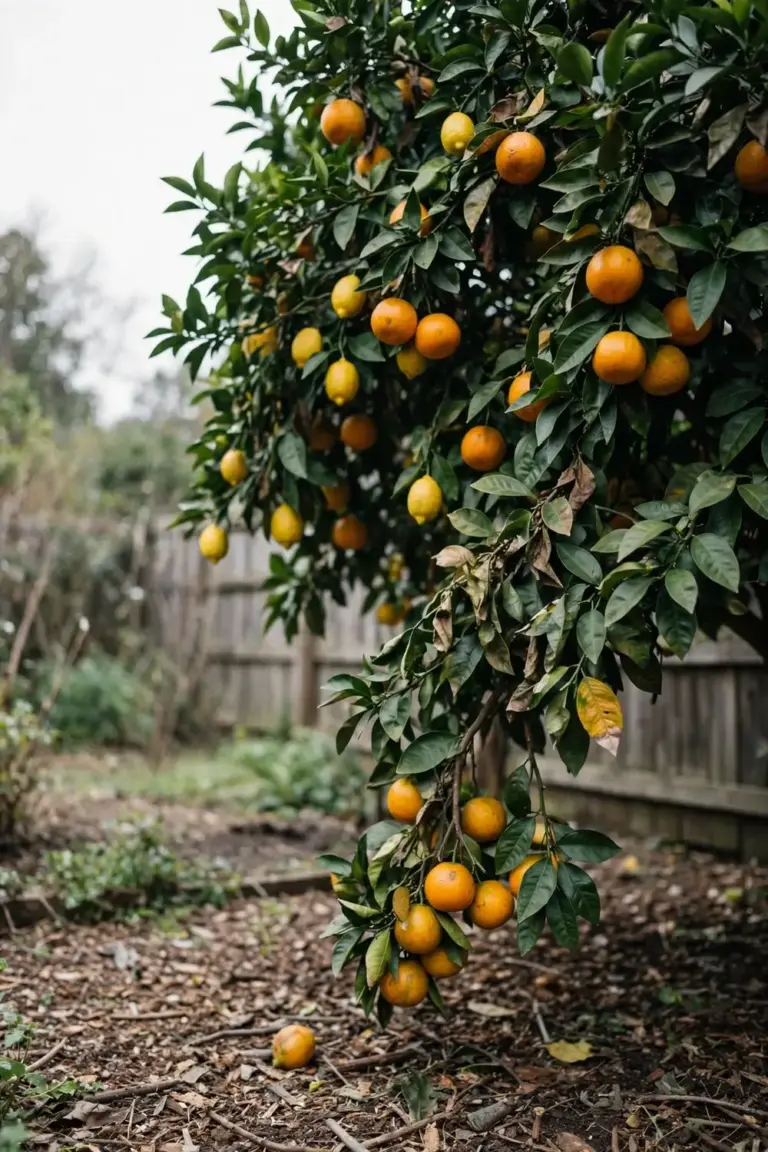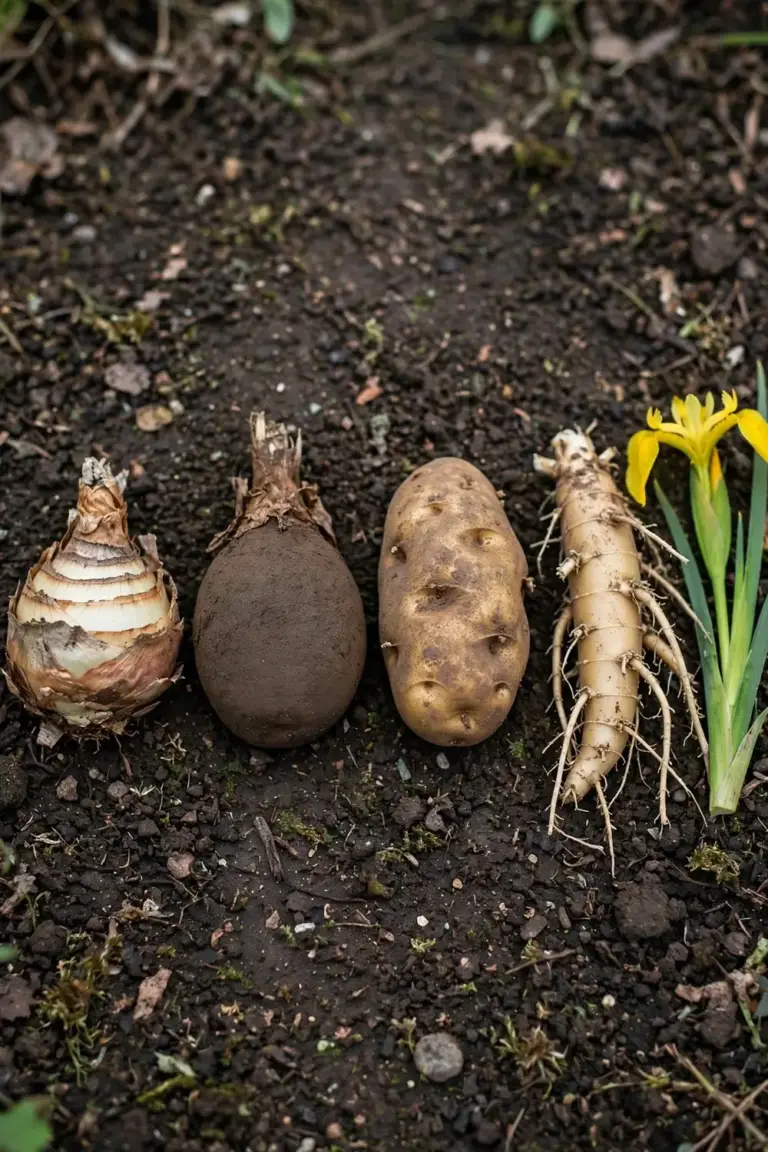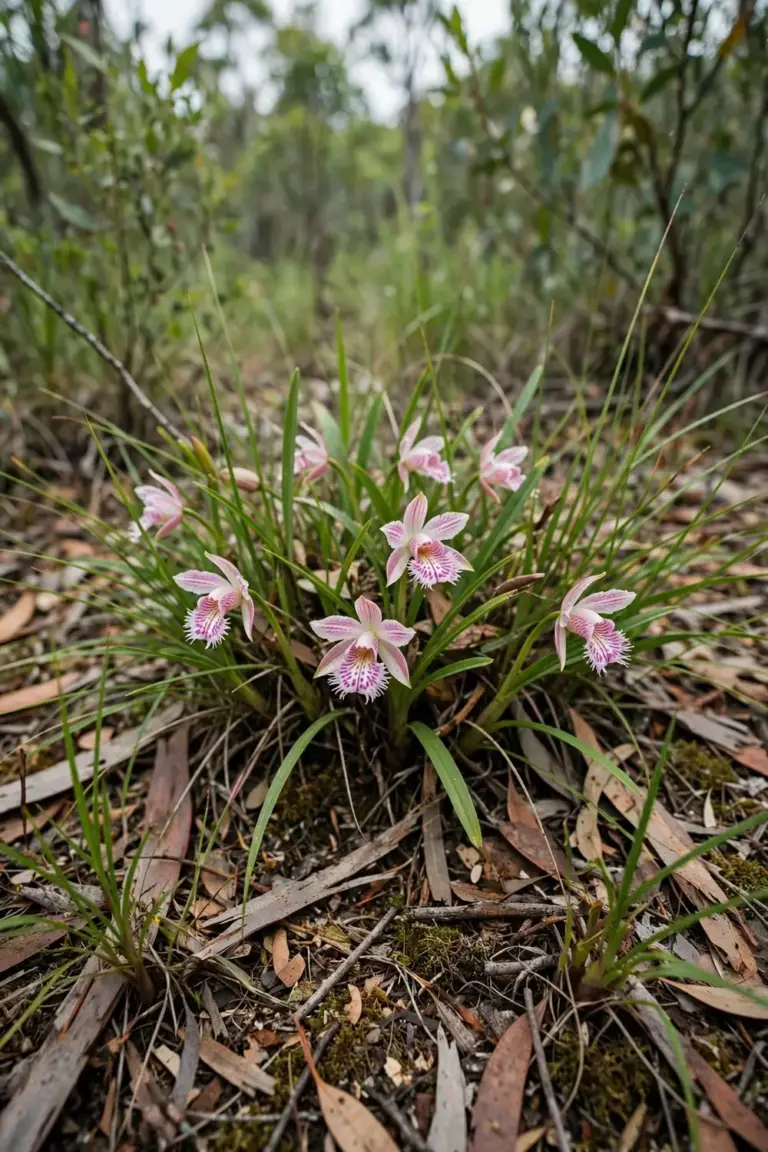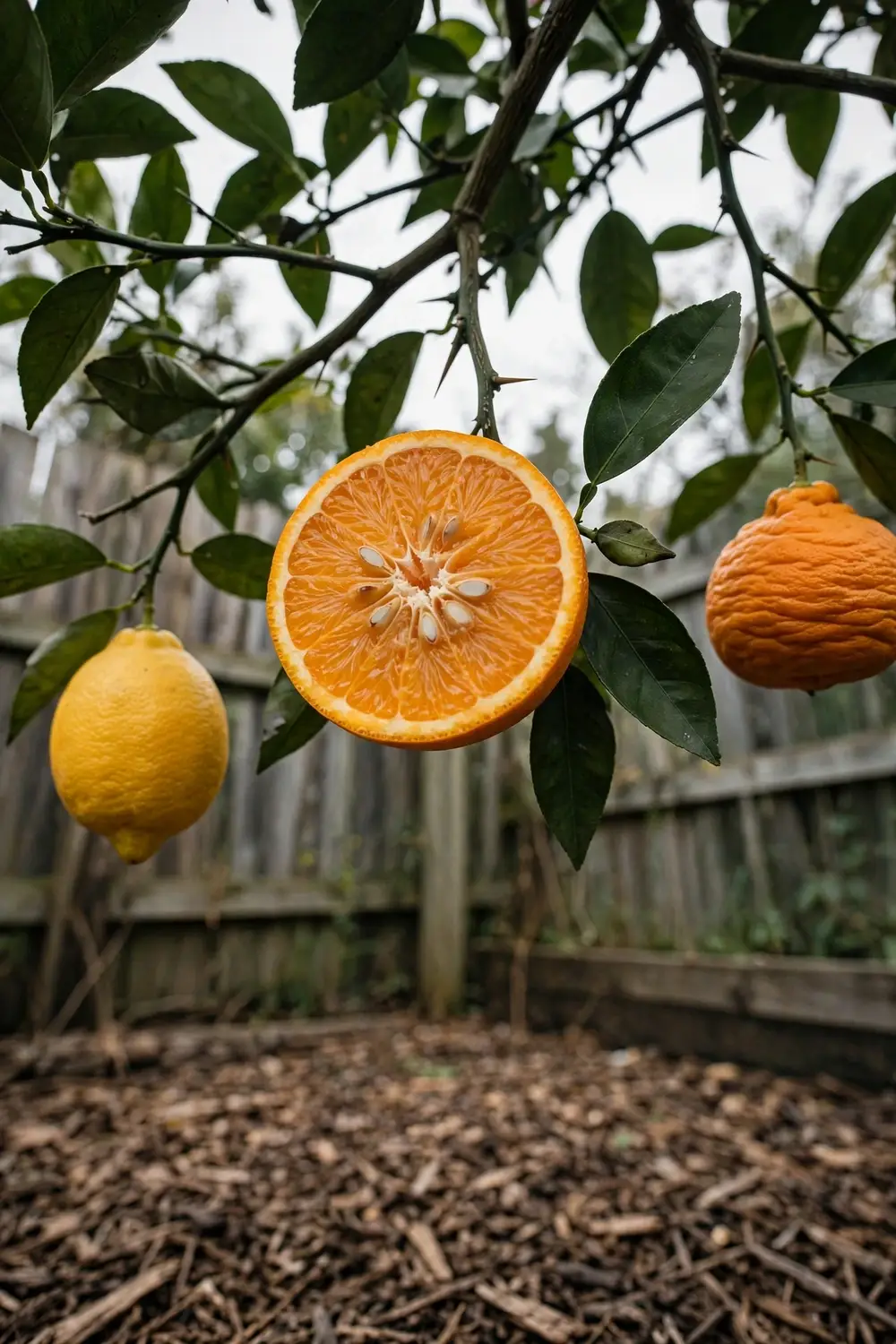

Count 5 clues before you name any citrus tree. Leaf shape, flower scent, fruit build, thorns, and tree habit together name the tree. One clue alone misleads.
That five-clue check is citrus identification in Australia. The reader is a home gardener facing an unknown tree: an inherited tree, a lost label, a market seedling, a fruit that does not match the tag. The rest of this page runs the key, then splits the pairs that confuse people most: lemon against lime, orange against mandarin, grapefruit against pomelo. It finishes with kumquat, the native citrus set, the rootstock trap, and a photo checklist. I have learned that the citrus tree I name from its crushed leaf and its fruit together beats the tree I name from its fruit alone.
1. Run the 5-Clue Key Before You Name Anything
Run all five clues on every unknown citrus tree, because leaf, flower, fruit, thorns, and habit each narrow the field in a different way. Two trees can share any single clue. No common citrus pair shares all five.
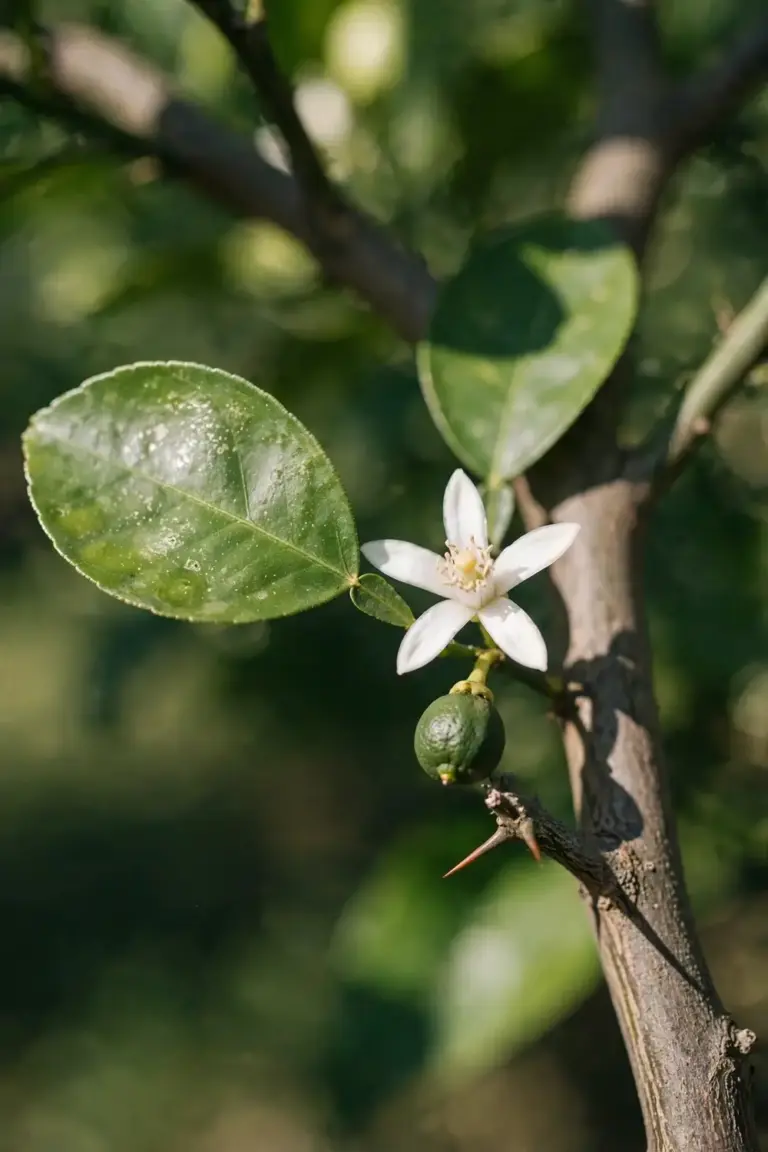
Start with the leaf. Citrus leaves grow alternate along the twig and carry oil glands, so a crushed leaf releases a scent that often matches the fruit: lemon leaves smell of lemon, lime leaves smell of lime, orange leaves smell faintly of orange. Look at the petiole, the stalk between twig and leaf blade. Some citrus carry a wing, a flat green flap along the petiole, and grapefruit and pomelo leaves show broad wings while sweet orange leaves show a narrow wing or none. Sour orange rootstock leaves carry longer, more broadly winged petioles than sweet orange leaves, and their crushed leaves carry a lemon odor, according to a University of California rootstock study. A winged petiole rules out several trees at once.
Next, read the flower. Citrus flowers are white, five-petaled, and sweetly scented, though flower size and scent strength vary across the group. Flowering season shifts with climate and with the tree. A tree in flower gives one clue, while a tree out of flower gives none, so the other four clues carry the identification.
Then cut the fruit, since fruit build decides more pairs than any other clue. Note the skin: thick or thin, loose or tight, smooth or pebbled. Count the segments, check the seeds, and note whether they run many, few, or none. Taste the juice only from your own tree. Note the shape, round, oval, flattened, or finger-shaped, and record the color of skin and flesh.
Then read the thorns. Thorns vary from absent to long and stout, and young citrus trees carry more thorns than old trees. A thorny sucker low on the trunk usually belongs to the rootstock, not to the named variety, and section 8 covers that trap in full.
Finish with habit. Note the tree shape, upright, spreading, or shrubby, plus the size class and the cold tolerance the tree shows in your district. Habit alone never names a tree. Habit plus leaf plus fruit usually does.
2. The Quick Key Table: 10 Citrus Groups at a Glance
Use this table as the first pass. Match your tree against each row, and strike out every row that fails on any single clue. The rows that survive the first pass go to the pair sections that follow for confirmation.
| Citrus | Leaf Clue | Fruit Clue | Thorns | Confused With |
|---|---|---|---|---|
| Lemon | Lemon-scented crushed leaf, narrow petiole wing | Oval fruit, nipple at the tip, thick rind | Few, short | Lime |
| Tahitian lime | Lime-scented crushed leaf | Round fruit, thin rind, seedless | Few, short | Mexican lime |
| Mexican lime | Lime-scented crushed leaf | Small round fruit, thin rind, seedy | Short | Tahitian lime |
| Makrut lime | Double leaf, two leaflets joined | Warty green fruit, little juice | Short | Other limes |
| Sweet orange | Narrow petiole wing or none | Round fruit, tight skin, firm segments | Few | Mandarin |
| Mandarin | Narrow petiole wing or none | Flat fruit, loose skin, segments separate | Few | Sweet orange |
| Grapefruit | Broad petiole wing | Round fruit, thin rind, fruit in clusters | Few | Pomelo |
| Pomelo | Broad petiole wing, large leaf | Very large fruit, thick rind, thick segment walls | Few | Grapefruit |
| Kumquat | Small glossy leaf | Small oval fruit, sweet edible rind | Small, sometimes | None |
| Finger lime | Tiny leaf, to 2.5 cm wide | Finger-shaped fruit, caviar vesicles | Sharp spines to 2.5 cm | Other native limes |
| Desert lime | Small gray-green leaf | Small round fruit | Thornless when mature | Round lime |
| Round lime | Small leaf | Round green fruit | Few | Desert lime |
| Trifoliate rootstock | Three leaflets per leaf | Small sour fruit, many seeds | Long, stout | Named variety |
The table lists 13 rows across 10 groups. Limes occupy four rows because the name “lime” covers several species. Read the lime rows together. The pair sections below explain each split.
Work the table from the leaf column first. Leaf scent and petiole wings eliminate whole rows before fruit enters the picture. Then test the surviving rows against fruit build, thorns, and habit. A row that fails on any one clue leaves the list, even when it matches on the other four. That elimination habit keeps the key honest when a tree carries fruit that looks like two species at once.
3. Lemon vs Lime: The Hardest Pair in the Citrus Set
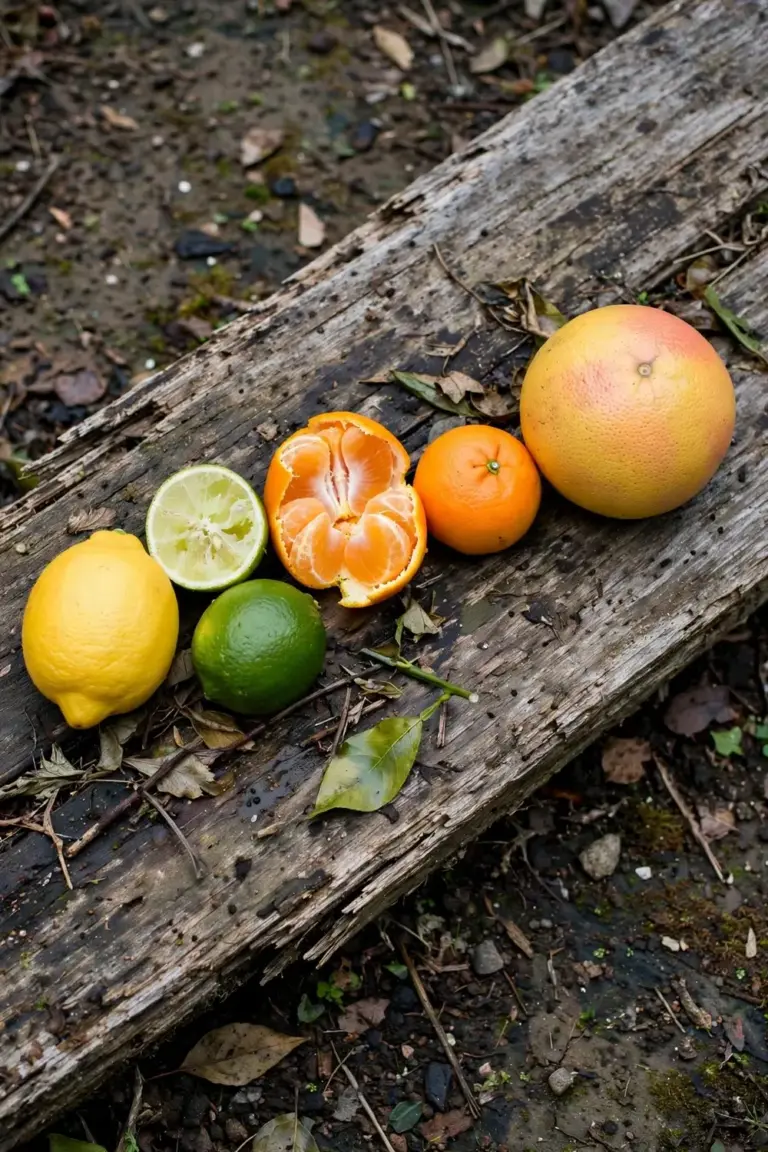
Crush a leaf first when lemon and lime confuse you. A lemon leaf smells of lemon when crushed, while a lime leaf smells of lime. That scent test separates the pair faster than any fruit trait, because both fruits turn yellow on the tree and both taste sharp.
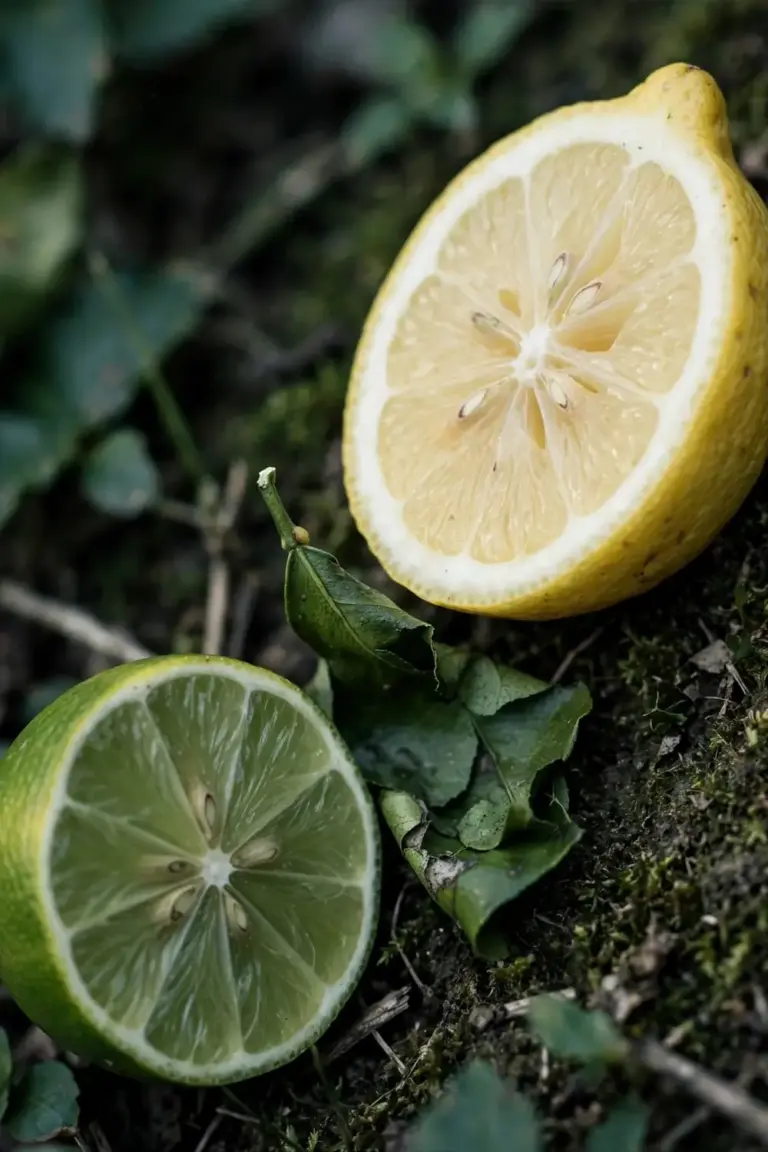
Fruit shape backs up the scent test. A lemon grows oval and often carries a nipple at the tip. Its rind runs thick, and the fruit holds its shape in the hand. A lime grows rounder and smaller, with a thin rind that gives under the thumb. Eureka, Lisbon, and Meyer are the lemons Australian nurseries sell most often, while Tahitian lime is the lime most Australian shops and markets stock. The site’s lemon guide names Eureka, Lisbon, and Meyer as the lemons Australian nurseries sell, which helps when a tag names a variety rather than a species.
Meyer lemon complicates the pair. Meyer is a lemon hybrid with mandarin or orange parentage, and its fruit grows rounder and thinner-skinned than a Eureka or Lisbon lemon. Its crushed leaf still smells of lemon, and its fruit still carries the lemon nipple, though softer. When a round, thin-skinned yellow fruit smells of lemon in the leaf, Meyer is the likely answer. When the same fruit smells of lime in the leaf, it is a lime.
Limes split further. Tahitian lime, Citrus latifolia, carries seedless fruit with a thin rind. Mexican lime, Citrus aurantiifolia, also called Key lime, carries smaller fruit crowded with seeds. Makrut lime, Citrus hystrix, sold for years as kaffir lime, carries a double leaf: two leaflets joined end to end, a shape no lemon or lime shares. Its fruit grows warty and green, with little juice. The double leaf names a makrut lime before the fruit forms.
Yellow fruit does not settle the pair. Limes turn yellow when fully ripe, yet a yellow lime still smells of lime in the crushed leaf, still carries a thin rind, and still lacks the lemon nipple. Trust the leaf and the rind over the skin color. When the tree carries no fruit at all, the crushed-leaf scent test and the thorn check carry the whole identification.
4. Orange vs Mandarin: Peel, Segments, and Seeds Decide It
Peel one fruit to split orange from mandarin. A sweet orange, Citrus sinensis, carries tight skin that resists the thumb. The segments hold together, and the fruit keeps a round shape. A mandarin, Citrus reticulata, carries loose skin that slips off in sheets. The fruit sits flatter, the segments separate cleanly, and the skin often shows a puffy gap above the flesh. Imperial is the mandarin most Australian nurseries label, and the site’s mandarin guide names Imperial among the mandarins Australian nurseries sell.
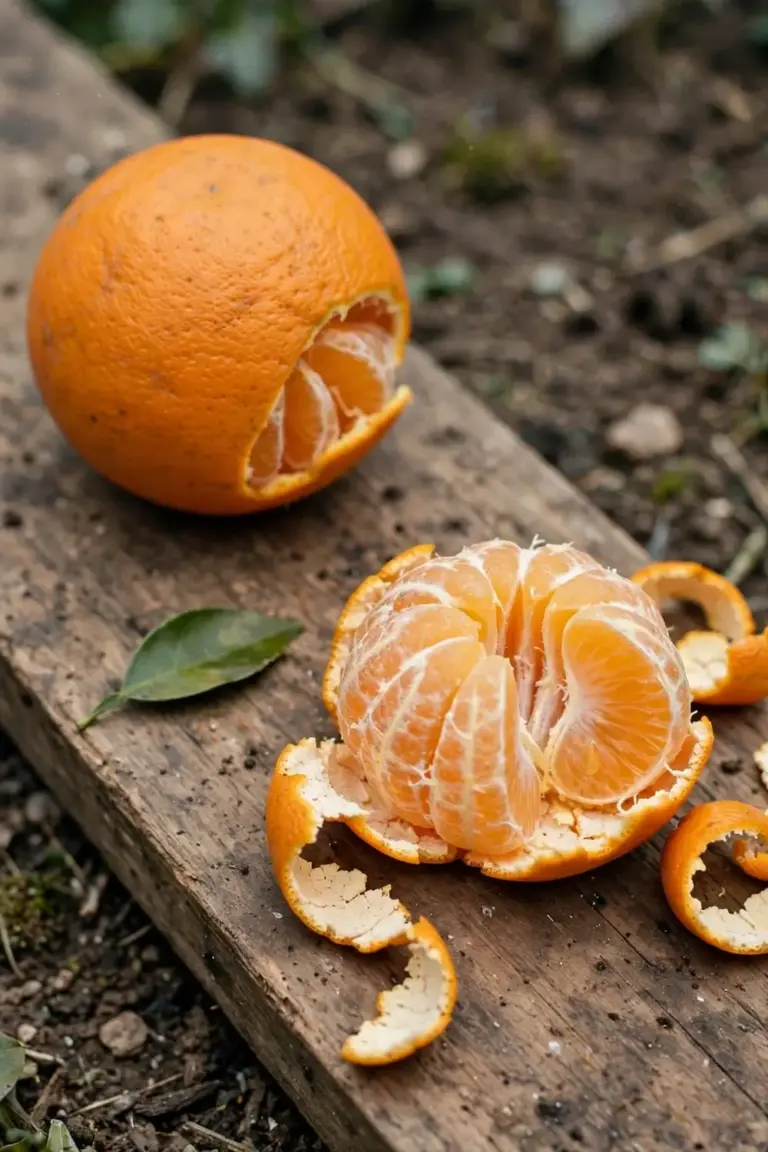
Tangerine is a mandarin type, not a separate species. Nurseries sell tangerines under their own names, and shoppers treat them as a third fruit. Botanically they sit inside Citrus reticulata. A tangerine peels like a mandarin, segments like a mandarin, and carries the mandarin leaf. Clementine is a mandarin hybrid with thinner skin than most mandarins. Treat both as mandarins at the key.
Blood orange is a sweet orange, not a mandarin. Its flesh runs red, from streaked ruby to deep crimson, while its skin and segments match a standard sweet orange. The site’s blood orange guide describes red flesh as the trait that sets blood oranges apart from other sweet oranges. Red flesh alone names a blood orange. Peel and segment tests still confirm the sweet orange frame.
Seeds help but never decide alone. Seed counts vary by variety, by pollination, and by season. A seedless mandarin can sit beside a seedy orange on the same street. Peel, segment separation, and fruit shape carry more weight than any seed count.
Sweet orange varieties add one more check. Valencia oranges ripen in the warmer months and hold round fruit with tight skin. Washington Navel oranges carry a navel, a small secondary fruit embedded at the blossom end, visible as a bump on the skin. A navel on the blossom end names a navel orange at once. No mandarin carries a navel.
5. Grapefruit vs Pomelo: Size, Rind, and Segment Walls
Weigh the fruit in your hand to split grapefruit from pomelo. Pomelo, Citrus maxima, is the largest citrus fruit, and a pomelo dwarfs a grapefruit. A grapefruit, Citrus paradisi, is a hybrid of pomelo and sweet orange, and it grows smaller than its pomelo parent. Size alone separates most pairs. A fruit that fills two hands points to pomelo. A fruit that fills one hand points to grapefruit.
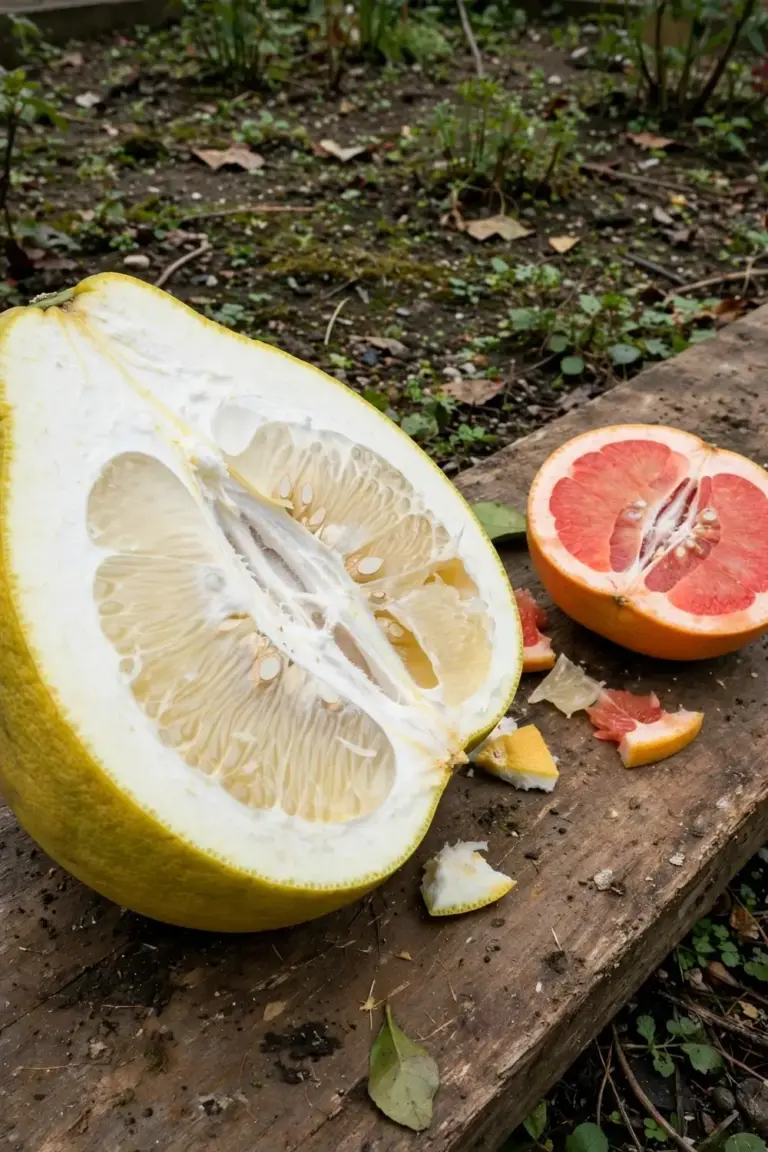
Cut the fruit to confirm. A pomelo carries a very thick rind and thick, chewy walls around each segment. The flesh pulls out in firm, dry chunks, and the juice runs low for the fruit size. A grapefruit carries a thinner rind and thinner segment walls. The flesh gives juice freely, and the segments break apart with less effort. The segment walls tell the story when size sits in the middle.
Read the clusters too. Grapefruit grows in clusters, and the name records that habit: fruit hanging in bunches like grapes. Pomelo fruit hangs singly or in small groups. A tree carrying bunches of round fruit points to grapefruit. A tree carrying single giant fruit points to pomelo.
Flesh color misleads. Both fruits range from white or pale yellow to pink or red. A pink pomelo and a pink grapefruit share flesh color and nothing else. Check size, rind thickness, and segment walls before color. Color confirms a variety. It never names the species.
Grapefruit varieties add one more check. Ruby Red grapefruit carries deep red flesh, while Marsh grapefruit carries pale flesh. Both share the grapefruit frame: one-hand fruit, thin rind, thin segment walls, clustered habit. Pomelo varieties run larger across the board, with Chandler among the round forms sold in Australian markets. When a fruit matches the grapefruit frame but runs oversized with a thick rind, it is a pomelo, whatever the flesh color.
6. Kumquat: The Small Fruit With the Edible Rind
Eat the rind to confirm a kumquat. Kumquat, Citrus japonica, long sold as Fortunella, is the one common citrus whose rind tastes sweet while its pulp stays sharp. No other citrus reverses the flavors that way. Peel a kumquat and the test vanishes, so taste the whole fruit: sweet skin, acid flesh, and a small burst of juice.
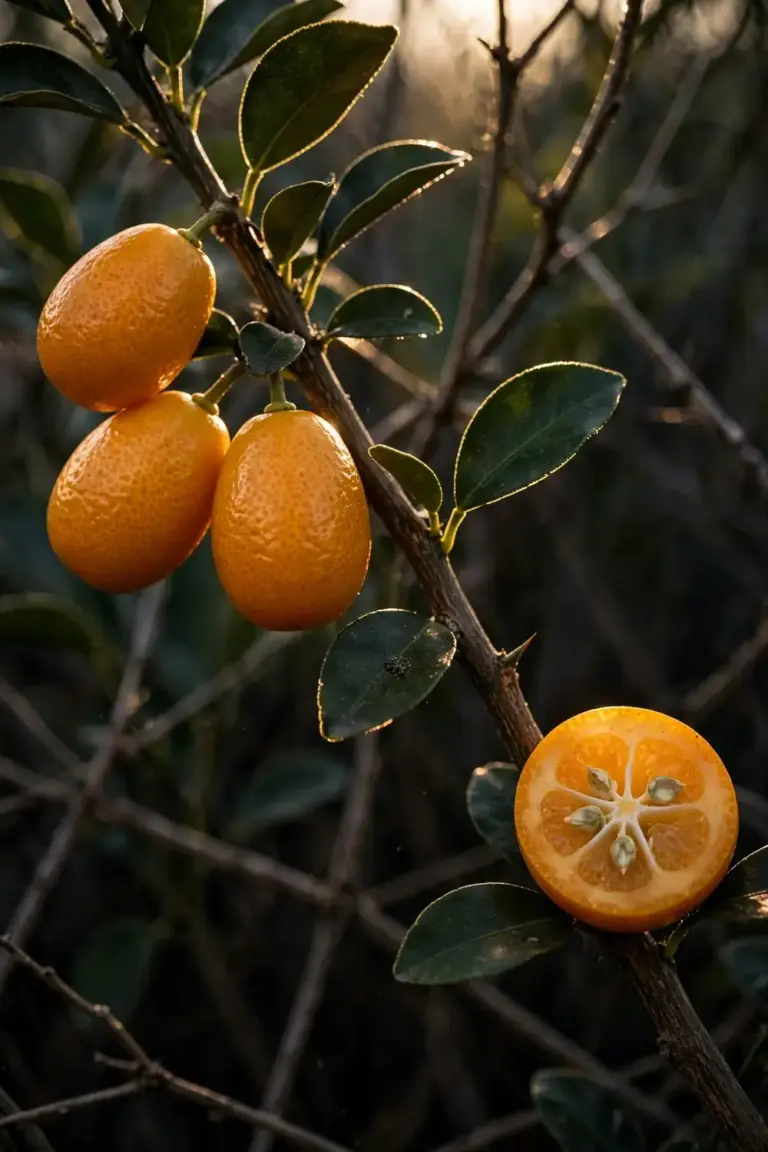
Size confirms the taste test. Kumquat fruit measures 1.6 to 4 cm wide, oval-oblong or round, with golden-yellow to reddish-orange peel and large, conspicuous oil glands, according to a University of California, Davis crop profile. The pulp sits scant, in 3 to 6 segments, acid to subacid, with small pointed seeds. The tree grows slow and evergreen, 2.5 to 4.5 m tall, with dark green glossy leaves 3.25 to 8.6 cm long. The same profile records sweetly fragrant five-petaled white flowers, borne singly or 1 to 4 together in the leaf axils.
Branches sometimes carry small thorns. That thorn trait separates kumquat from the thornless dwarf citrus sold beside it, and the small leaf separates it from every larger citrus. A fruit under 4 cm wide with a sweet rind names a kumquat. A fruit over 4 cm wide with a bitter rind belongs elsewhere in the key.
Kumquat hybrids confuse the picture. Calamondin and limequat cross kumquat with other citrus, and both carry kumquat-sized fruit with edible or semi-edible rind. A hybrid still shows the kumquat frame: small fruit, small leaf, sweet rind. Name the group first. Variety names can wait for a fruit specialist.
7. Native Citrus: Finger Lime, Desert Lime, and Round Lime
Native citrus means Australian-native species, not imports. Australia holds several native Citrus species, formerly placed in the genera Microcitrus and Eremocitrus, now grouped inside Citrus. They grow wild in rainforest, woodland, and arid inland country, and nurseries now sell selected forms. The native set differs from cultivated citrus in leaf size, fruit shape, and habitat. Small leaves and unusual fruit mark most of them.
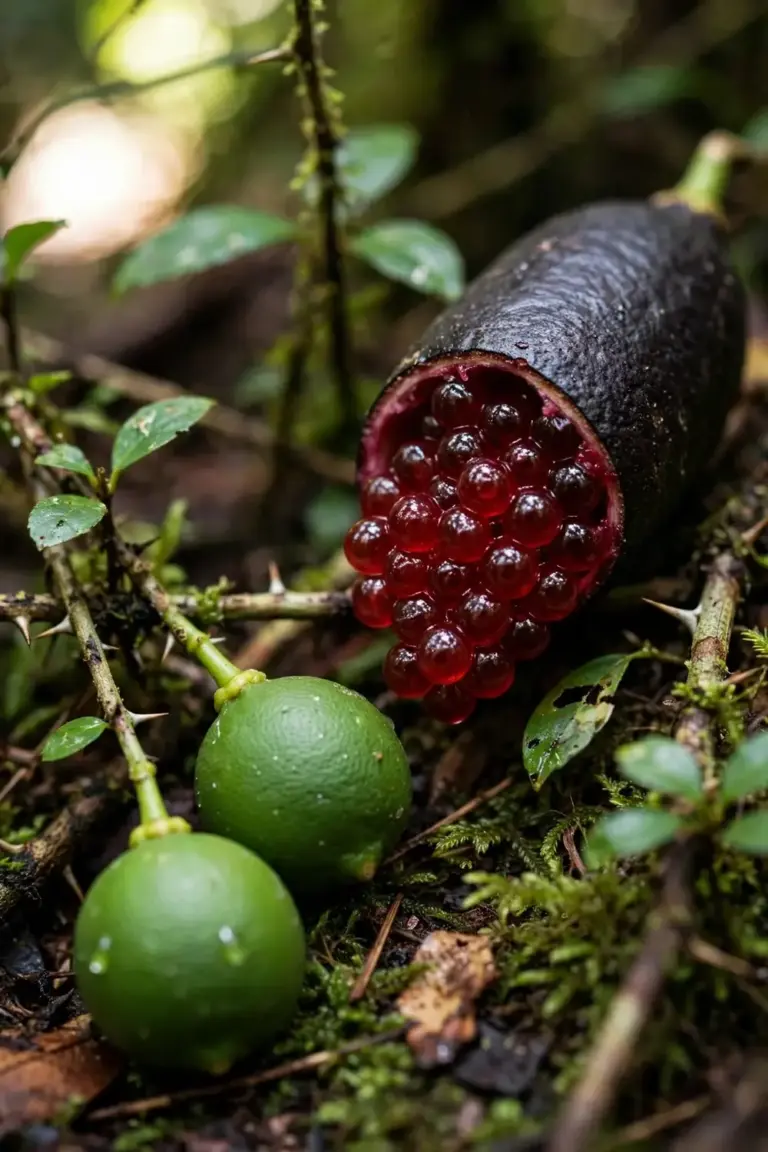
Finger lime, Citrus australasica, carries the most distinctive fruit in the native set. The fruit grows elongated and cylindrical, reaching 7 cm long, with peel color ranging from green, red, and yellow to purple-black, according to a peer-reviewed review of native Australian citrus species. The pulp sits in small spherical vesicles, cream, green, or deep red, which burst apart like caviar when the skin opens. The leaves run tiny, to 2.5 cm wide and long, and sharp spines to 2.5 cm long guard the leaf axils. Finger lime grows as an understory shrub or tree in rainforests of southern Queensland and northern New South Wales. A finger-shaped fruit with caviar vesicles names a finger lime.
Desert lime, Citrus glauca, grows in arid inland Australia. Its fruit runs small and round, produced in summer. The mature foliage carries no thorns, a trait the same review notes for mature desert lime vegetation. The leaves run small and gray-green, suited to dry country. A small round fruit on a thornless mature tree from arid country points to desert lime.
Round lime, Citrus australis, grows in southeastern Australia. Its fruit runs round and green. The tree reads as a standard small citrus at a glance, which is why round lime confuses gardeners more than finger lime does. Check the fruit: round, green, and smaller than a standard lime. Check the leaf: small, with a citrus scent when crushed.
Three more natives round out the set. Mount White lime, Citrus garrawayi, carries elongated fruit reaching 10 cm long, with cream to pink subglobose juice vesicles. Kakadu lime, Citrus gracilis, carries the largest fruit of any native Australian Citrus, 8 to 10 cm in diameter, green and globose to pear-shaped. Russell River lime, Citrus inodora, carries fruit 6 to 7 cm long and 3 cm wide, lemon yellow when ripe, with unique lengthwise ribbing on the peel. All three figures come from the same peer-reviewed review. A large native fruit with lengthwise ribs points to Russell River lime. A giant round native fruit points to Kakadu lime.
8. Rootstock Suckers: The Fruit Below the Graft Is Not Your Variety
Find the graft union before you trust any fruit. Most nursery citrus trees are grafted: a scion of the named variety joins a rootstock that supplies the roots. The union shows as a bump, a bend, or a change in bark texture low on the trunk. Fruit above the union belongs to the named variety. Fruit below the union belongs to the rootstock. That rule settles more unknown-tree arguments than any leaf test.
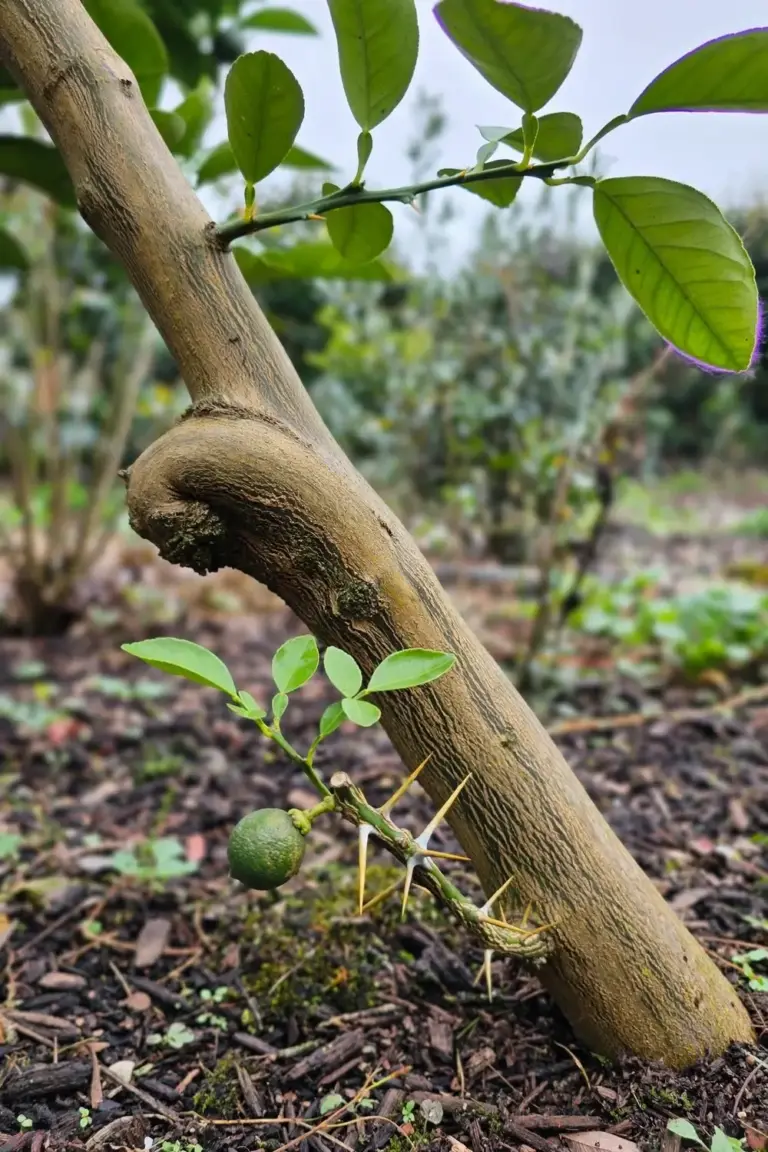
Trifoliate orange, Citrus trifoliata, also listed as Poncirus trifoliata, is a widely used rootstock species in the citrus trade. It carries three leaflets per leaf, a trait no cultivated citrus shares. Its branches carry long, stout thorns. Its fruit runs small, extremely sour, and full of seeds. A Louisiana State University AgCenter guide states that thorns on new growth from the base mark rootstock growth, and that trifoliate orange fruit tends to be extremely sour and full of seeds. A thorny sucker with three-leaflet leaves and sour, seedy fruit is rootstock growth, not a new variety.
Sour orange rootstock hides better. Its leaves look like standard citrus leaves, but they carry longer, more broadly winged petioles than sweet orange leaves, and their crushed leaves carry a lemon odor. The University of California rootstock study records both traits. A sucker with long winged petioles and lemon-scented crushed leaves below the graft union points to sour orange rootstock.
Check every sucker against the graft union. A sucker that starts below the union is rootstock, while a sucker that starts above the union is scion growth, even when it looks thorny. Young scion wood carries thorns too. The union, not the thorn count, decides. Photograph the union, the sucker leaves, and the sucker fruit together. That trio names the rootstock with confidence.
9. Photograph the Five Clues Before You Name It
Photograph the five clues in one visit. The photo set replaces memory, and it lets a nursery or botanic garden confirm the identification later. Work through the clues in the order of the key.

Shoot the leaf first. Photograph one leaf against a plain background, with the petiole and the twig in frame. Include a ruler or a coin for scale. Crush a second leaf and note the scent in the photo notes: lemon, lime, orange, or faint.
Shoot the flower next, when the tree carries any. Photograph one open flower from the side and one from above. Note the scent strength and the flowering month. Flowers fade fast, so shoot them the day you see them.
Shoot the fruit twice. Photograph one whole fruit beside a ruler, then cut a second fruit and photograph the cross-section: skin thickness, segment count, seed count, and flesh color. Cut fruit shows the segment walls and the rind in one frame.
Shoot the thorns and the graft union last. Photograph thorns against a ruler. Photograph the graft union with the trunk in frame, and mark which growth sits above the union and which sits below. That photo decides the rootstock question.
Never pick fruit that is not yours. Photograph fruit on the tree, or fruit the owner hands you. A cutting of leaves and one fruit from your own tree is enough for any identification. A full branch is not.
Write the scent and the season into the photo notes. A crushed-leaf scent fades from memory within the hour, and a flowering month anchors the identification to a season. Note the district and the month with every photo. A nursery or botanic garden reads those notes alongside the images, and the notes often settle a close call between two lookalikes.
Frequently Asked Questions
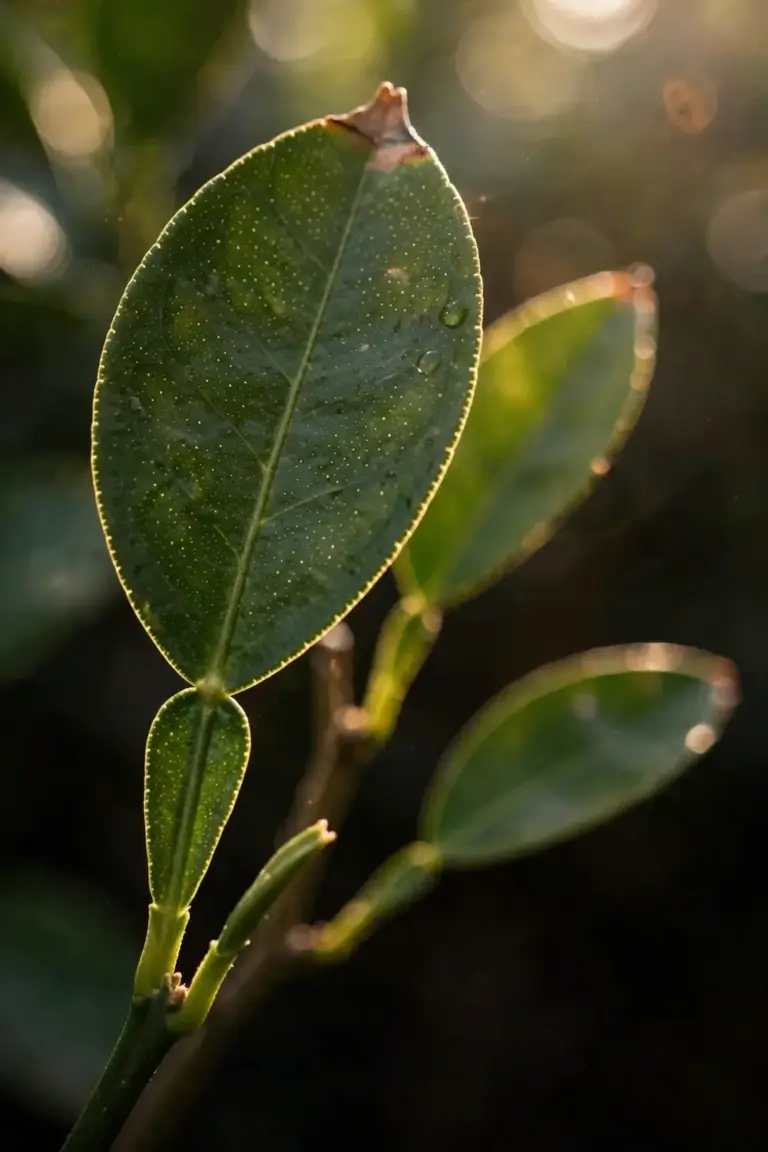
Leaves alone narrow the field but rarely finish the job. A crushed-leaf scent test splits lemon from lime, and a three-leaflet leaf names trifoliate rootstock at once. Most other citrus share leaf shapes, and petiole wings overlap across species. Add fruit, thorns, and habit before settling the name. A leaf photo plus a fruit photo names more trees than either photo alone.
Fruit below the graft union belongs to the rootstock, not to the lemon. Trifoliate orange rootstock fruit tastes extremely sour and carries many seeds. Sour orange rootstock fruit tastes bitter and sharp. Check the graft union low on the trunk: growth from below the union is rootstock growth, while growth from above the union is the named lemon, even when young wood carries thorns.
A tangerine is a mandarin type. Botanically it sits inside Citrus reticulata, the mandarin species. It peels like a mandarin, segments like a mandarin, and carries the mandarin leaf. Nurseries sell tangerines under their own names, and shoppers treat them as a third fruit. The key treats them as mandarins. Clementine is a mandarin hybrid with thinner skin than most mandarins.
Finger lime, Citrus australasica, carries finger-shaped fruit with caviar-like vesicles inside. The fruit reaches 7 cm long, and the peel ranges from green, red, and yellow to purple-black. The leaves run tiny, and sharp spines guard the leaf axils. Finger lime grows wild in rainforests of southern Queensland and northern New South Wales. Nurseries sell selected forms with red, pink, or green vesicles.
Seedling citrus can be narrowed but rarely named before fruiting. Leaf shape, petiole wings, crushed-leaf scent, and thorns place a seedling in a group: trifoliate rootstock, lime type, or mandarin type. Seedlings also differ from their parents, so a seedling from a lemon may not grow true lemon fruit. Wait for fruit before settling the name. Photograph the seedling leaves and record the parent tree when known.
Start With the Leaf, Confirm With the Fruit
Name the tree with five clues, not one. Leaf scent splits lemon from lime, peel and segments split orange from mandarin, and size and rind split grapefruit from pomelo. Rind taste names a kumquat, while fruit shape and vesicles name the native set. The graft union settles the rootstock trap. Photograph each clue, compare the set against the table, and confirm in the pair section that matches your tree.