
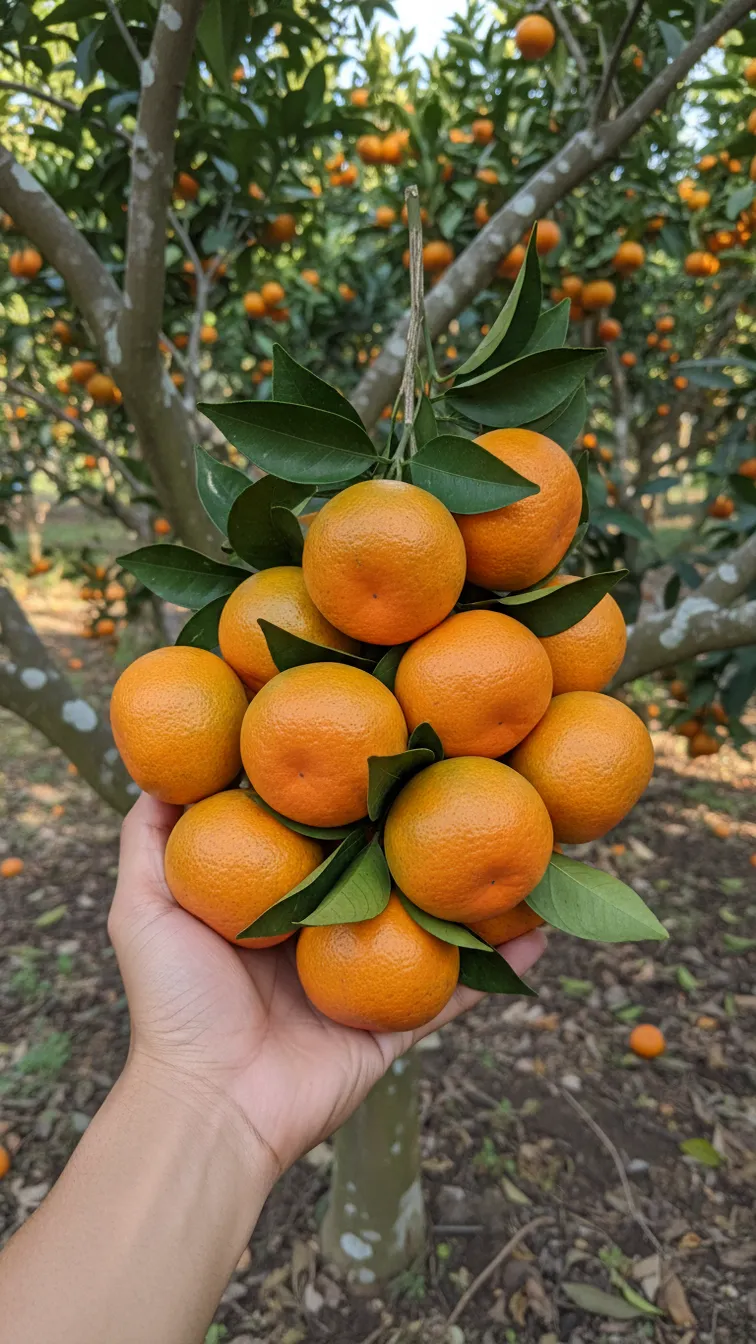

The first mandarin I ever planted came from a supermarket seed I sprouted in a yoghurt pot. I looked after that tree for six years before I understood it was never going to fruit in my lifetime. The second was a grafted satsuma from a local nursery. It gave me nine fruit in its third summer and around forty the year after.
Those two trees taught me the only two decisions that really matter: what you buy, and whether your winter suits it. The rest, the watering and feeding and pruning, is ordinary gardening you can correct as you go.
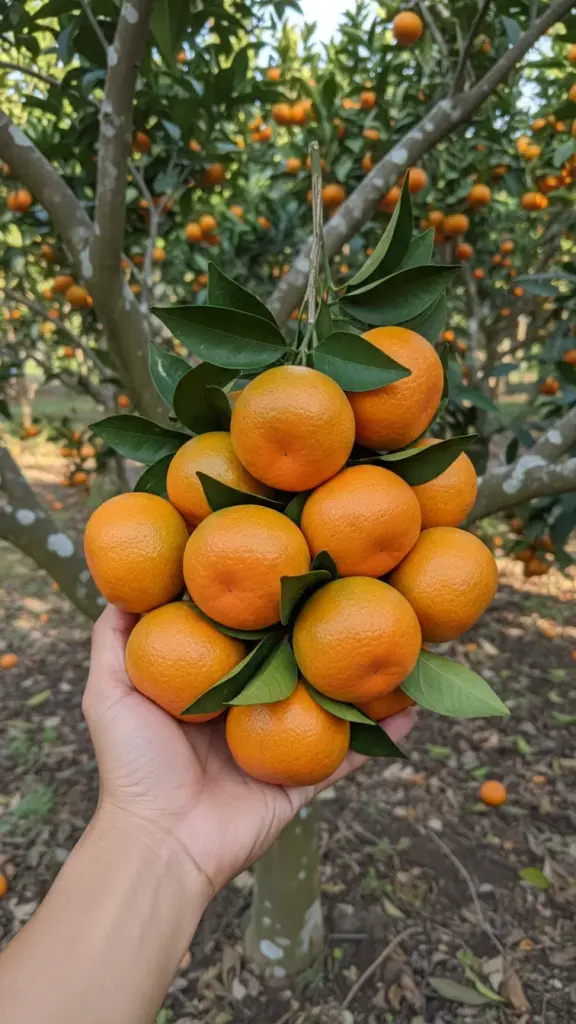
There is a naming problem worth clearing up before anything else. A mandarin is not one fruit. It is a group that includes satsumas, clementines, tangerines and a long list of modern hybrids, and the gap between them is wider than most guides admit. A satsuma will shrug off a frost that kills a tangerine outright.
So this guide treats the whole group. It starts with matching a variety to your coldest month, walks through a full year of care both in the ground and in a pot, and ends with the part most people get wrong, which is knowing when to pick.
The short version, if you want it now. Buy a grafted tree of a variety suited to your winter. Plant it high, in full sun, in soil that drains. Water deeply and rarely. Feed nitrogen in three windows between late winter and early summer, then stop. Prune very little. Taste one fruit before you strip the tree.
The Mandarin Group, and Why the Name Matters
Walk into a nursery and you will see labels that read mandarin, satsuma, clementine and tangerine, sometimes on trees that are near enough the same plant. The labels are loose. Tangerine in particular is a trade name rather than a botanical one, and it gets applied to almost any easy peeling orange fruit.
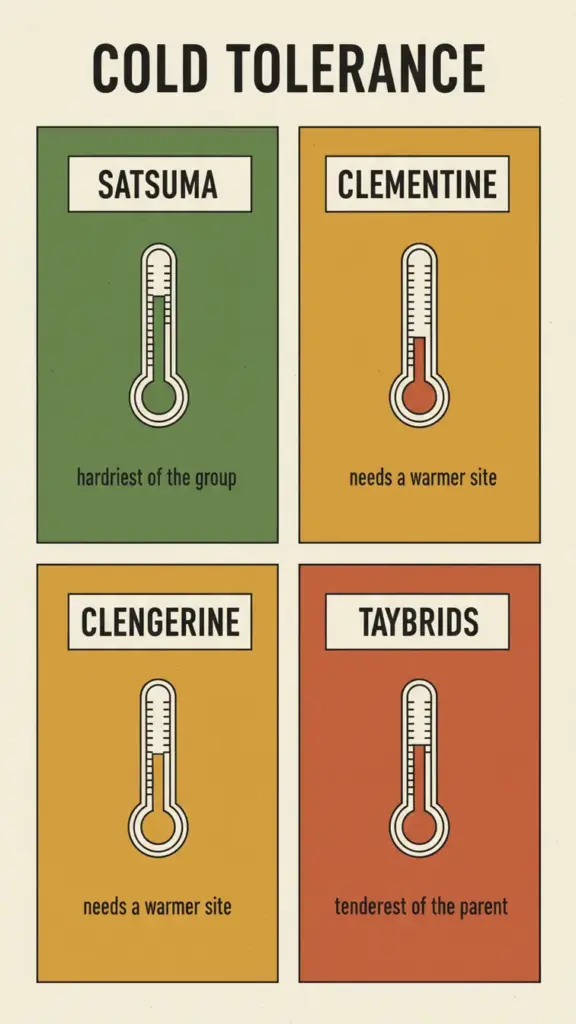
For a grower, the useful way to sort them is by how much cold they take and when they ripen.
| Type | Cold tolerance | Season | Worth knowing |
| Satsuma | Highest in the group | Early, autumn into early winter | Seedless, very loose skin, slightly drooping habit |
| Clementine | Moderate | Midwinter | Sweet, small, needs a warmer site than satsuma |
| Tangerine | Lower | Midwinter to late winter | Loose trade name, often deeper orange and more acidic |
| Modern hybrids | Varies by parent | Late winter into spring | Gold Nugget, Tango, Pixie and Murcott hold on the tree for months |
If you only remember one line from this section, make it this. Satsuma is the safe bet in a cold garden, and the hybrids are where the long harvest season lives.
The habit of the tree matters too. Satsumas grow low and spreading, and the branches sag under a crop until the fruit sits on the soil. Most clementines and hybrids grow more upright. That single difference decides how much room you need and how often you will be propping branches in November.
Step 1: Match the Variety to Your Winter
This is the step that decides everything else, so do it before you look at a single price tag. Find your average winter low, then find the record low for the last ten years, because the record is what kills trees.
Satsumas are the reason mandarins can be grown well outside the citrus belt. UF/IFAS reports that mature dormant satsuma trees have come through minimum temperatures of 14 to 18 degrees Fahrenheit without serious injury, which is roughly minus 10 to minus 8 Celsius. They also carry a low total heat requirement, so they ripen earlier than oranges and earlier than most other mandarins. Cold winter, short summer, and the fruit still finishes. No other sweet citrus manages that combination.
Read the two qualifiers in that sentence though. Mature, and dormant. A tree in its first two years, or a tree pushed into soft growth by a warm spell and then hit by a freeze, is far more vulnerable than the number suggests.
| Your coldest nights | What to plant | Ground or pot |
| Regularly below minus 8 C | Satsuma only, and expect to protect it | Pot, so you can move it under cover |
| Minus 4 to minus 8 C | Satsuma, hardy hybrids | Ground with frost protection ready |
| Minus 4 C to freezing | Most of the group, including clementine | Ground |
| Never freezes | Anything, including late hybrids | Ground, and choose for season length |
One more filter before you buy. Match the ripening season to your climate, not to your appetite. A late hybrid that finishes in March is wonderful in a mild coastal garden and useless where hard freezes arrive in December, because the crop hangs on the tree through exactly the weather that ruins it. In a cold garden, early is not a compromise. It is the whole strategy.
Step 2: Buy a Grafted Tree, Not a Seedling
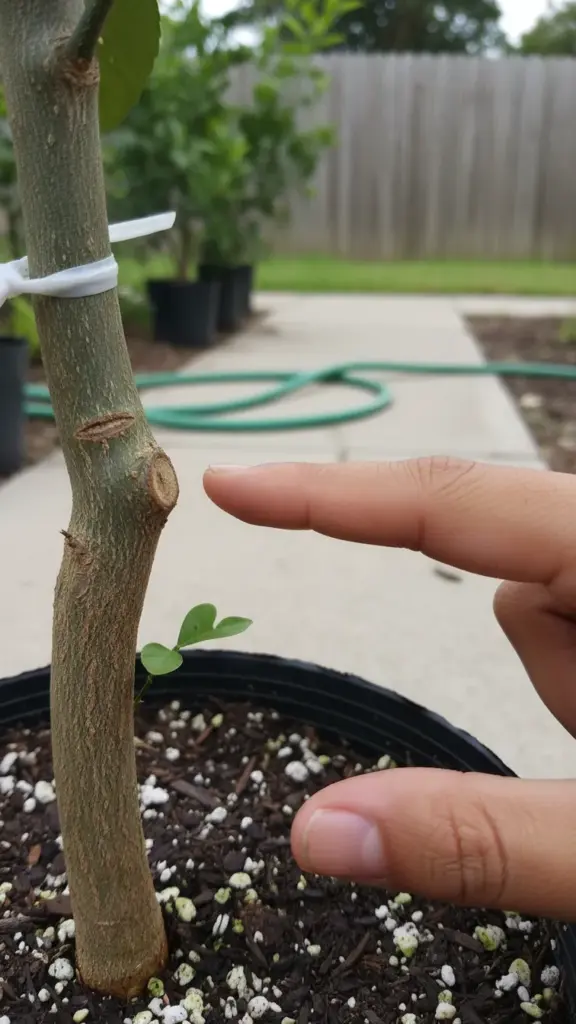
Every worthwhile mandarin tree is two plants joined together. The top provides the fruit you want, and the roots below belong to a different citrus chosen for cold tolerance, soil tolerance, disease resistance and often for keeping the tree small. Look at the lower trunk and you will find the join, a diagonal scar or a slight kink somewhere between ten and twenty centimetres above the soil.
That join is the reason a grafted tree fruits in three years while my seedling sulked for six. Seedlings spend years in a juvenile phase, they often carry vicious thorns, and the fruit they eventually produce may be nothing like the fruit the seed came from.
When you are standing in front of a row of trees, ignore the one carrying the most fruit. A heavy crop on a tree in a nursery pot is a stress signal, not a promise. Look instead for even green leaves with no yellowing between the veins, a straight clear trunk, and a graft union that is well above the soil line and free of shoots. Turn a few leaves over and check the undersides for the small brown limpets of scale insects, because whatever is on the tree in the shop comes home with you.
Ask which rootstock it is on. If the nursery cannot tell you, that is information in itself. Trifoliate orange and its hybrids give the best cold tolerance and hold the tree smaller, which is what you want for a pot or a small garden.
Step 3: Plant It High in the Sunniest Corner
Mandarins need sun to make sugar. Six hours is the floor and eight is better, and a tree in partial shade will grow perfectly good leaves while producing fruit that never sweetens properly. In the northern hemisphere, a spot in front of a south or west facing wall is ideal, because the masonry soaks up heat during the day and gives a few degrees back overnight in winter.
Drainage decides whether the tree lives. Citrus roots need air, and ground that stays saturated after rain will kill a mandarin faster than any pest. If water sits in the hole you dug, build a low mound thirty centimetres high and plant into that instead.
Plant high whatever the soil. Set the top of the root ball two or three centimetres above the surrounding ground and slope the backfill up to meet it, so that water always runs away from the trunk rather than pooling against it. Resist the urge to enrich the hole with compost or manure. A rich pocket surrounded by ordinary soil behaves like a bucket, holding water and encouraging the roots to circle inside their comfortable patch instead of spreading out into the garden.
Before you backfill, take the tree out of its pot and look at the roots. If they are spiralling around the outside of the root ball, tease the outer centimetre loose with your fingers or score it in three places with a knife. A pot bound mandarin planted untouched will keep growing in a circle for years.
Finish with mulch spread as wide as the canopy, then pull it back a full hand span from the trunk. Bark against a citrus trunk keeps it damp, and damp bark at the graft union invites rot. Keep the grass away too, because turf competes hard for both water and nitrogen right where the feeding roots are.
Step 4: Water Deeply, Then Leave It Alone
More mandarins die from steady kindness than from neglect. A daily splash keeps the surface damp and the deeper roots dry, and it teaches the tree to root shallowly, which is exactly what you do not want in a heatwave.
In the Ground
Soak the whole root zone, out to the edge of the canopy and a little beyond, then wait. Before you water again, push a finger into the soil to the second knuckle. Damp means wait. Dry means water. Through summer that usually lands somewhere between every five and every ten days depending on your soil, and in winter a tree in the ground may need nothing at all.
Leaves that curl inward along the midrib in the afternoon and recover overnight are normal in heat. Leaves that stay curled the next morning, or that go dull and grey green, mean the tree is genuinely short of water.
In a Container
A pot dries from the outside in, so the finger test is less reliable. Lift the pot instead, or tilt it, and learn what heavy and light feel like. Water until it runs freely from the drainage holes, then tip out anything that collects in the saucer within the hour. Standing water in a saucer is the single most common way potted citrus is killed.
Go up one container size at a time as the tree grows, from nursery pot to a ten gallon, then a fifteen gallon, then a half barrel. Jumping straight to an enormous pot surrounds a small root ball with wet soil it cannot use, and the roots rot in it.
Step 5: Feed Nitrogen in Three Windows
Citrus is a hungry, nitrogen driven plant, and mandarins in particular put on a heavy bloom that costs them a great deal. The rhythm that works is three feeds, front loaded into the first half of the year.
- Late winter, just before the buds move. This feed builds the flush of new leaves that will carry the crop.
- Mid spring, once the small fruit have set and the natural drop has finished. Feeding earlier, during full bloom, tends to push leaf growth at the expense of fruit.
- Early summer, while the fruit is sizing. This is the last one.
Then stop. Nitrogen applied in late summer or autumn pushes out a flush of soft new growth just as the nights turn cold, and soft growth is the first thing a frost destroys. In a marginal climate this single mistake causes more winter damage than the weather does.
Spread the fertiliser evenly across the whole area under the canopy and slightly beyond it, then water it in thoroughly. Do not pile it in a ring against the trunk, where it can scorch the bark and where there are almost no feeding roots to take it up anyway. Potted trees are the exception to the whole schedule, since frequent watering flushes nutrients out of the mix, so use a slow release citrus feed and top it up according to the label.
The bloom itself is one of the real pleasures of growing this fruit. If the scent is what pulled you toward citrus in the first place, orange blossom is worth growing in its own right, and the perfume from a mature mandarin in full flower carries just as far.
Step 6: Prune Almost Nothing
Mandarins fruit on wood all through the canopy, so pruning for shape costs you crop. Take out dead wood, anything crossing and rubbing, and every shoot that appears below the graft union, since those belong to the rootstock and will overrun the tree if you let them. Lift the lowest skirt of branches clear of the soil, especially on a drooping satsuma. That is the whole job.
Step 7: Pick by Taste, Not by Colour
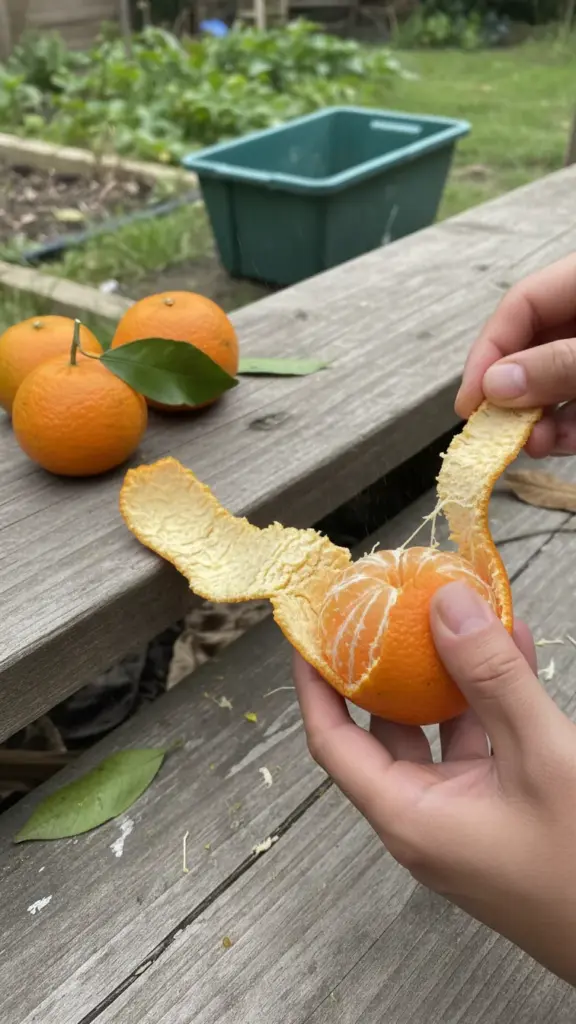
Here is where I lost most of my first satsuma crop. The fruit turned a convincing orange in early October, so I picked it, and it was sharp enough to make my jaw ache.
Rind colour is a response to cool nights, not a report on what is happening inside the fruit. Cold nights break down the green chlorophyll in the skin and reveal the orange underneath, and that can happen weeks before the sugars are ready. In a warm autumn the reverse occurs and fruit stays greenish while the flesh is perfectly sweet.
And unlike a peach or a banana, citrus does not improve after picking. UC Davis puts the point plainly in its handling guidance: mandarins are non climacteric and do not ripen once they leave the tree. Whatever sugar and acid balance the fruit holds at harvest is what you get, permanently, so an early pick is not just an impatient pick.
Use these signals instead of the calendar:
- The taste test. Pick one fruit from the sunniest side, eat it, and if it makes you wince then wait two weeks and try another. Repeat until it stops making you wince.
- Weight in the hand. Ripe mandarins feel heavy for their size, because they are full of juice.
- Slight give in the skin. The loose skin of a satsuma detaches from the flesh as it ripens and yields under gentle thumb pressure.
- The stem. Cut mandarins off with snips rather than pulling them. Pulling tears the button out of the top of the fruit and opens a wound that rots within days.
One warning about leaving them too long. Satsumas in particular go puffy if they hang past their peak, with the skin lifting away from a drying, less flavourful flesh. The window is generous but it is not endless, so once the taste test passes, harvest over two or three weeks rather than two or three months.
The Mandarin Year at a Glance
| Season | What the tree is doing | What you do |
| Late winter | Dormant, buds beginning to swell | First nitrogen feed, remove dead wood, keep frost cover ready |
| Spring | Heavy white bloom, then natural fruit drop | Second feed after set, steady deep watering |
| Summer | Fruit sizing, new growth flushes | Third feed in early summer, water deeply, mulch topped up |
| Autumn | Rind colouring, sugars still climbing | No more nitrogen, start tasting, prop heavy branches |
| Winter | Harvest, then rest | Pick by taste, protect from freezes, hold off on water |
Alternate Bearing, and the Year You Get Almost Nothing
Mandarins are notorious for cropping heavily one year and barely at all the next. A tree that sets an enormous crop pours its reserves into ripening it, leaving little behind to initiate flower buds for the following season. Hybrids like Gold Nugget and Pixie are especially prone to it.
You cannot switch the habit off, but you can soften it. Thin a heavy crop in early summer, once the natural drop has ended, taking off enough fruit that the remaining ones sit roughly a hand’s width apart. It feels wasteful. It gives you larger fruit this year and an actual crop next year, and on a young tree it also stops branches from bending to the ground and snapping.
Keep water and feeding steady through the heavy year rather than trying to compensate afterwards. By the time you notice the bare year, the buds for it were set months earlier.
Protecting the Tree When a Freeze Is Forecast
A mandarin does not have to freeze solid to be damaged. Fruit is more tender than wood, and a night or two in the low twenties Fahrenheit can turn the flesh dry and grainy while the tree itself looks untouched. The history of citrus in the Gulf states is a long record of exactly this, with UGA noting that repeated freezes wiped out satsuma plantings across the region several times in the last century before growers came back each time.
What works for a home tree:
Water the ground thoroughly the day before a freeze, because moist soil holds and releases far more heat overnight than dry soil. Bank soil or mulch up around the graft union, so that even in the worst case the tree can regrow from the variety rather than from the rootstock. Drape a frost cloth or an old blanket right down to the ground and weight the edges, since the point is to trap heat rising from the soil, and a cover tied only around the canopy does very little. Take it off during the day.
Do not wrap the tree in plastic against the leaves, and do not prune away frost damaged wood in the middle of winter. Damaged growth looks terrible but it shelters what is behind it, and you cannot see the true extent of the injury until the tree pushes new growth in spring. Wait until then and cut back to living wood.
A potted tree makes all of this easier. Wheel it against a wall, into a garage, or under a porch roof for the two or three nights that matter, and bring it back out.
Pests I See on My Own Trees
Mandarins attract the same short list as every other citrus, and most of it is manageable without reaching for anything drastic.
- Scale. Small brown or grey limpets clamped along stems and leaf undersides, usually with sooty black mould growing on the honeydew below them. Rub them off small infestations by hand and use a horticultural oil spray for anything larger.
- Mites. Leaves that look dull, stippled and slightly silvered during hot dry weather. Citrus red mite damage builds up quietly and is easy to mistake for drought stress until you look at a leaf closely in good light.
- Whitefly. Clouds of tiny white insects lifting off when you brush the canopy, with flat scale like larvae underneath the leaves. Citrus whitefly rarely kills a healthy tree, though the honeydew and mould it leaves behind make a mess of the fruit.
- Leaf miner. Silvery winding tunnels through new leaves, which curl and distort. Ugly, and largely cosmetic on an established tree. Do not prune off the damage, because the tree still uses those leaves.
Before you treat anything, turn over a dozen leaves and look for the ladybird larvae and tiny parasitic wasps that are already working on the problem. A broad spectrum insecticide removes those first and usually makes the second wave of pests worse.
Common Questions
Can I Grow a Mandarin From a Supermarket Seed?
You can sprout one easily, and it makes a handsome glossy houseplant. It will take many years to leave its juvenile phase, it will probably be thorny, and the fruit will not match the parent. If you want the experiment anyway, treat it as a curiosity rather than an orchard, and the same approach works for growing a lime tree from seed.
How Long Until It Fruits?
A grafted nursery tree usually sets its first small crop in the second or third year after planting, with a real harvest from year four. Remove any fruit that sets in the first year so the tree puts its energy into roots and branches.
Why Are the Leaves Turning Yellow?
The pattern tells you which problem you have. Uniformly pale yellow leaves across the whole tree usually mean nitrogen shortage or waterlogged roots. Yellow between green veins on new leaves points to iron or zinc, which is common in alkaline soil. Older leaves yellowing and dropping in autumn while the rest of the tree looks fine is just the tree shedding its oldest foliage.
Do I Need Two Trees for Fruit?
No. Satsumas and most mandarins are self fertile and will crop alone. The catch runs the other way round: a seedless variety planted near other flowering citrus can pick up cross pollination and produce seeds it would not otherwise have.
Can I Grow a Mandarin Indoors All Year?
It survives, but it rarely fruits well. Indoor light is a fraction of what the tree needs, and dry heated air invites spider mites. The better arrangement is outdoors from spring to autumn and indoors in a cool bright room only for the coldest weeks.
Why Is My Fruit Dry and Puffy Inside?
Usually fruit left hanging well past ripeness, which is the classic satsuma fault. Frost during the ripening period does the same thing, as does severe water stress while the fruit is sizing. Taste one fruit a fortnight through the season and you will catch the peak before the texture goes.
Where to Go From Here
If you take one thing away, make it the order of operations. Choose the variety for your winter first, buy grafted, plant high, then let the tree settle into a rhythm of deep water and three feeds. The interesting decisions are all made before the tree is in the ground.
And if your winter turns out to be colder than even a satsuma will tolerate, do not give up on citrus altogether. A kumquat grown in a pot takes more cold than any mandarin, stays small enough to move indoors, and fruits reliably on a balcony.
Mark a date in your calendar for the first taste test this season. That habit alone will improve your harvest more than anything else in this guide.








