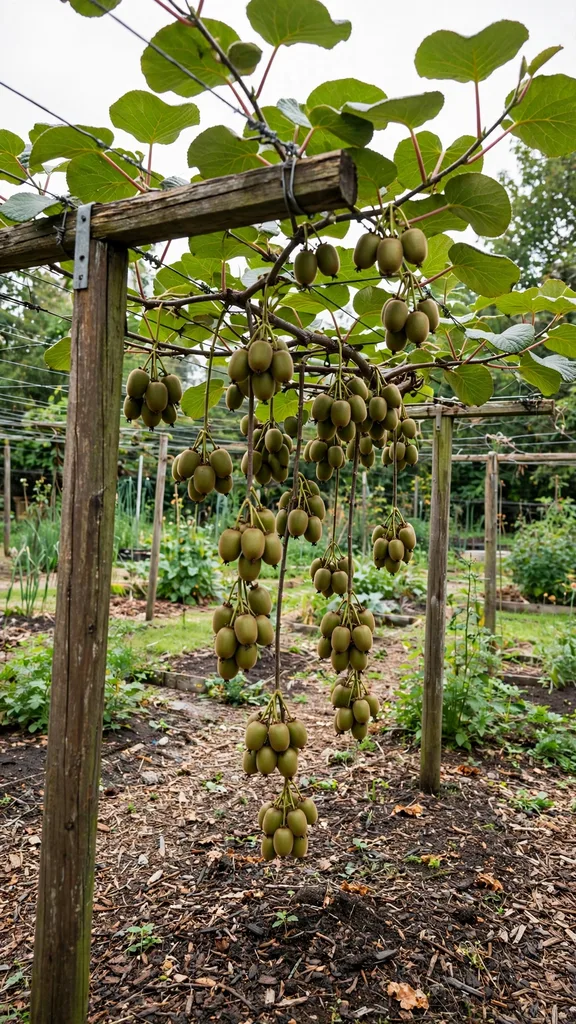
Plant 2 vines at minimum, one male and one female, and build the trellis before either vine leaves its pot. Learning how to grow kiwi berry means planning for a climber that outgrows a fence panel in a few seasons and fruits only when a pollinator stands within bee range. Skip the male and the female flowers open, fade, and drop with no fruit behind them. Pair the sexes, train one trunk, prune twice a year, and the vine pays back smooth fruit you eat whole, skin and all.
The kiwi berry is the fruit of hardy kiwi, Actinidia arguta, a deciduous twining vine from northeastern Asia. Gardeners also call the fruit a kiwiberry, one word, and the plant travels under arctic kiwi in some nursery lists, a name shared with a colder cousin. The berries run grape sized, the skin stays smooth, and the flesh tastes sweeter than a shop kiwi. One vine, once established, crops for decades.
| Attribute | Detail |
|---|---|
| Botanical name | Actinidia arguta |
| Common names | Kiwi berry, kiwiberry, hardy kiwi |
| Plant type | Perennial deciduous twining vine |
| Hardiness | USDA zones 4 to 8 for most cultivars, with a 150 day frost free season |
| Cold limit, dormant wood | Down to -31.7 °C once fully dormant |
| Sun | Full sun, sheltered from wind and late frost |
| Soil | Moist, well drained soil, pH 5.5 to 7.0 |
| Spacing | 3.05 m between vines on the row |
| Pollination | One male vine for up to 9 female vines; ‘Issai’ is self-fertile |
| Fruit size | About 2.5 cm long, smooth skinned, eaten whole |
| First fruit | 3 to 5 years after planting |
| Support | T-bar trellis, pergola, or horizontal wires on a wall |
Meet the Kiwi Berry, a Smooth-Skinned Actinidia Arguta
Hardy kiwi grows wild across northeastern Asia, climbing into tree canopies on stems that thicken with age. Cornell University’s fruit program describes the hardy kiwifruit as a strong-growing perennial vine that can grow to 12.19 m in length and climbs trees and fences when left unpruned. The garden version keeps that energy. A single season of new growth runs meters long, and the vine wraps, twines, and pulls at weak supports until the support gives way.
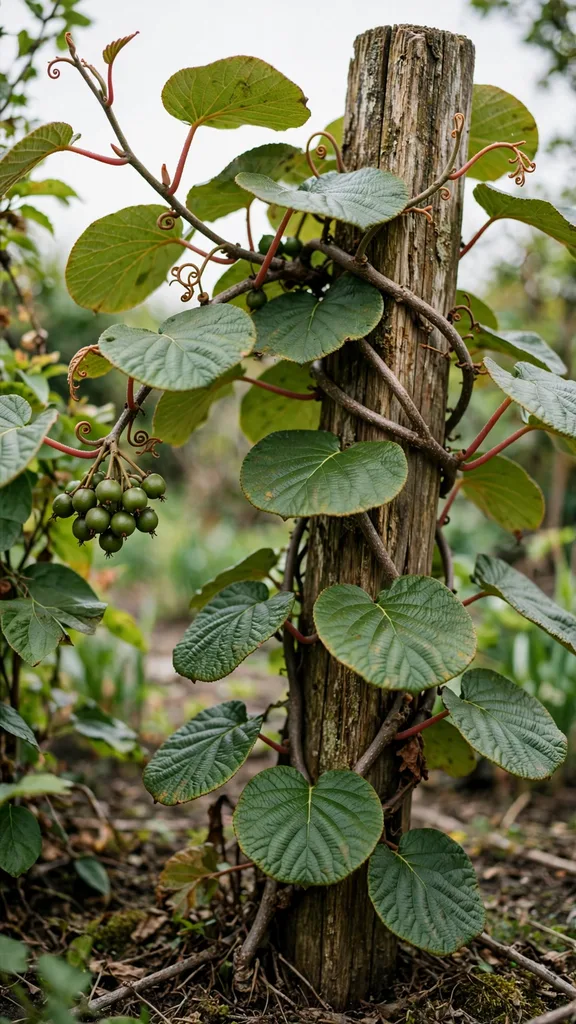
The fruit sets the species apart at a glance. The same Cornell notes record that the fruits run about the size of a large grape, carry no fuzz, hold small seeds, and can be eaten out of hand without peeling. Cut one open and the inside reads as a miniature kiwi: green flesh, a pale core, and a ring of tiny black seeds. The skin goes down with the flesh. No spoon, no peeling, no fuzzy bite.
Flowering runs on the previous season’s wood. Small white flowers with dark centers open in early summer along spur growth laid down the year before, and bees and wind move the pollen between vines. That one fact drives the pruning system on this page: this year’s leafy shoots are next year’s fruiting wood, and a winter cut that strips them strips the crop.
Longevity rewards the gardener who builds properly at the start. Cornell records that plants usually fruit by their fourth year, bear full crops after the eighth year, and can live for 50 or more years once established. A kiwi berry vine is a piece of garden infrastructure. Treat the planting like a small orchard tree: deep soil work, a serious trellis, and a framework you train once and renew in pieces.
Kiwi Berry vs Kiwi Fruit: Read the Skin, Not the Label
Confusion between the two species fills nursery benches every spring, and the plants look alike in a pot. The fruit settles the question in one look. The Royal Horticultural Society sets the kiwi berry at about 2.5 cm long with a smooth skin, while its larger cousin runs longer and wears a brown fuzzy coat. Smooth and grape sized means arguta. Fuzzy and egg sized means the other species.
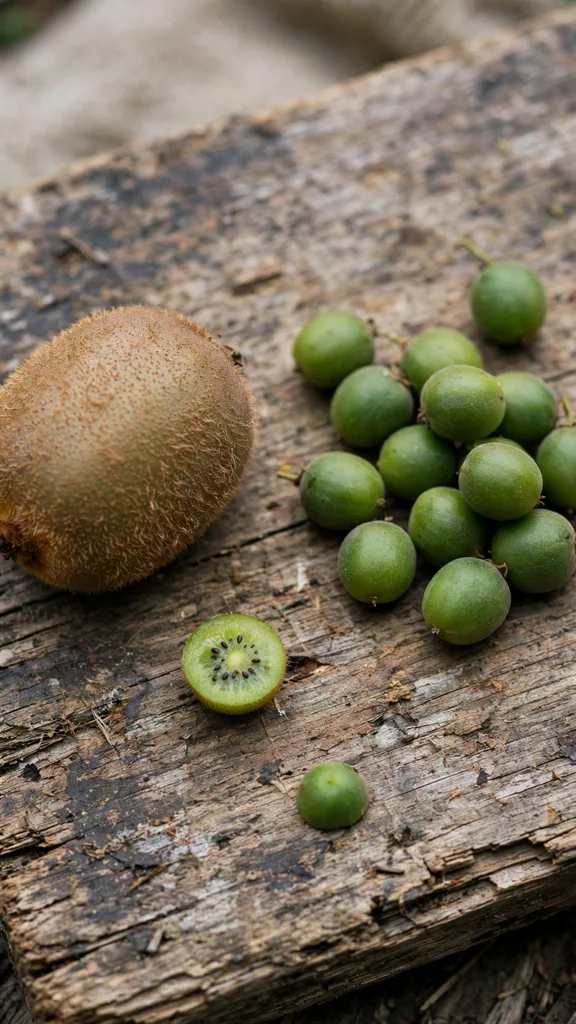
Cold separates them a second way. Dormant arguta wood tolerates deep winter cold that kills its cousin outright, which is why arguta owns the northern half of the map and the fuzzy species stays in milder districts. A vine sold for a cold garden under a plain kiwi label deserves a second look at the botanical name on the tag. Actinidia arguta is the name that survives the winter.
Growing fuzzy kiwi fruit is a different job. That lives on How to Grow Kiwi Fruit, which covers Actinidia deliciosa. This page stays on the kiwi berry: Actinidia arguta, smooth fruit eaten whole, male and female vines, and a trellis built for a climber with real weight.
| Trait | Kiwi Berry | Kiwi Fruit |
|---|---|---|
| Botanical name | Actinidia arguta | Actinidia deliciosa |
| Fruit length | About 2.5 cm | 3 to 5 cm |
| Skin | Smooth, eaten whole | Brown and fuzzy, peeled |
| Cold hardiness | Hardy through zone 4 winters for most cultivars | Needs a milder climate |
| Vine habit | Twining climber, up to 12.19 m unpruned | Twining climber, heavy and vigorous |
| Pollination | Male and female vines; ‘Issai’ self-fertile | Male and female vines; ‘Jenny’ self-fertile |
| Eating | Whole, straight off the vine | Cut or scooped, skin discarded |
Pick a Sunny, Sheltered Site and Test the Soil First
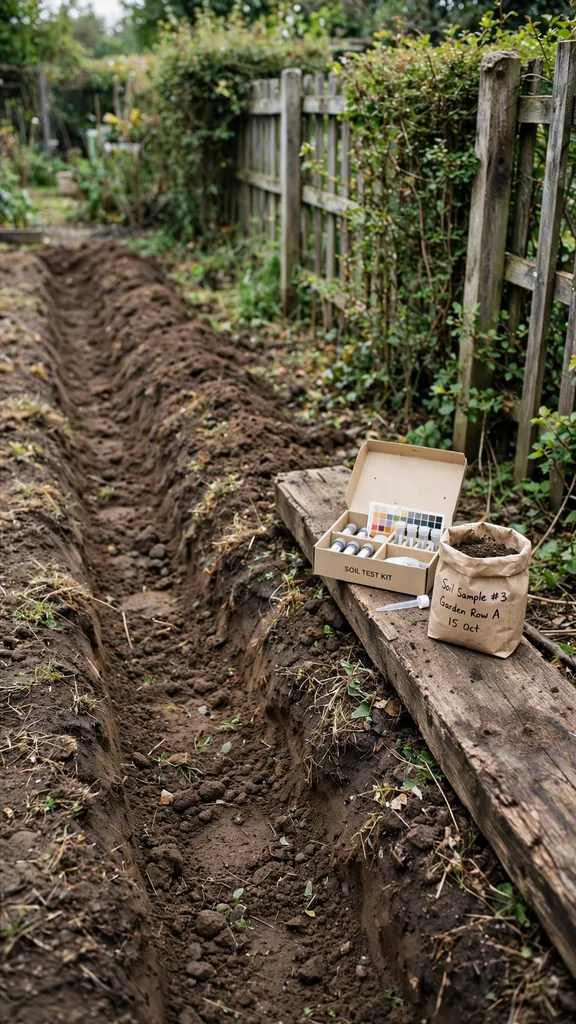
Plant hardy kiwi in full sun on ground that drains freely after rain. Cornell advises that kiwifruit grows in any garden soil provided the pH sits between 5.5 and 7.0, thrives in moist soil, and fails in poorly drained ground. Test the soil the autumn before a spring planting. Lime lifts a low pH slowly over winter. Elemental sulfur pulls a high pH down on the same slow clock, and a test taken on planting day leaves no time for either fix.
Frost pockets sink a planting that the soil test passed. Cold air pools in hollows and against solid fences, and arguta breaks dormancy early in a warm spell, pushing soft shoots straight into the last frosts. Cornell warns growers to avoid frost pockets and favour sites that delay early spring growth, since late frosts damage the new shoots. A gentle slope with air drainage, or a north facing aspect in cold districts, buys the vine a later, safer start.
Wind works on the vine all season. Long succulent shoots snap at the tie points in a gusty week, and leaves scorch at the edges on exposed sites. A hedge, a fence line, or a building on the windward side calms the air without shading the row. Shelter and sun together are the target. Shade alone cuts the crop and holds moisture on the foliage after rain.
Space decides whether the mature planting stays workable. Two vines planted tight grow into one thicket that no pruning schedule untangles, and the fruit inside a thicket ripens unevenly in permanent shade. Walk the site with the mature spread in mind: meters of vine in every direction, a trellis line with room to work on both sides, and picking access along the whole row. Ground that fits a grape vine fits a kiwi berry. Ground that fits a raspberry cane does not.
Choose Female, Male, and Self-Fertile Cultivars
Sex is the first decision at the nursery, and the label carries it. Most arguta vines are dioecious: a plant bears male flowers or female flowers, never both. Cornell states the rule plainly, that most plants bear either male or female flowers, so fruit needs one plant of each sex in the planting. Only the female sets fruit. The male flowers, sheds pollen, and earns his space on pollination alone.
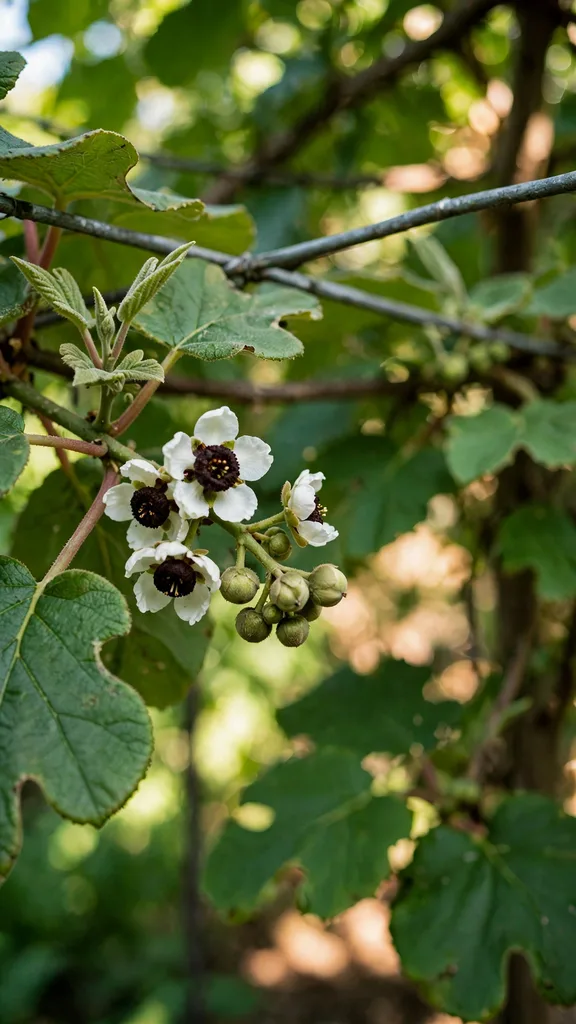
The ratio is generous. Cornell advises growers to purchase at least one male plant for every 9 female plants to ensure pollination and fruit set. A home garden runs far below that ceiling: one male planted beside one or two females covers the usual backyard planting, provided the male flowers at the same time as the females. Buy the male as a named pollinator matched to your females, and plant him on the same trellis line so bees cross between vines in a single flight.
The self-fertile exception carries a name. The Royal Horticultural Society lists ‘Issai’ as a self-fertile arguta cultivar that crops without a partner vine. A male vine is not required for ‘Issai’. One vine on a small pergola fruits on its own flowers, which makes ‘Issai’ the pick for a garden with room for a single plant. Crops on a lone ‘Issai’ still run heavier with a male nearby, and the vine grows less vigorously than the big females, a useful trait on a short trellis.
Female cultivars divide by flavor and ripening date. ‘Ananasnaya’ carries a pineapple edge and ripens early. ‘Geneva’ runs sweet and productive in cold districts. ‘Ken’s Red’ colors its smooth skin pale red in full sun. Cornell’s New York trials name ‘Ananasnaya’, ‘Geneva’, ‘Meader’, ‘MSU’, and the 74 series as selections that perform well, with ‘Meader’ sold in both male and female forms, so read the sex on the tag twice before paying.
Buy named, grafted, or cutting-grown vines of known sex. A seedling carries an unknown sex that shows only at first flowering, years after planting, and half of all seedlings flower male. The nursery premium for a labelled female and a labelled male is the price of a crop. Cheap unlabelled vines cost seasons.
Build a T-Bar Trellis or Pergola Before Planting
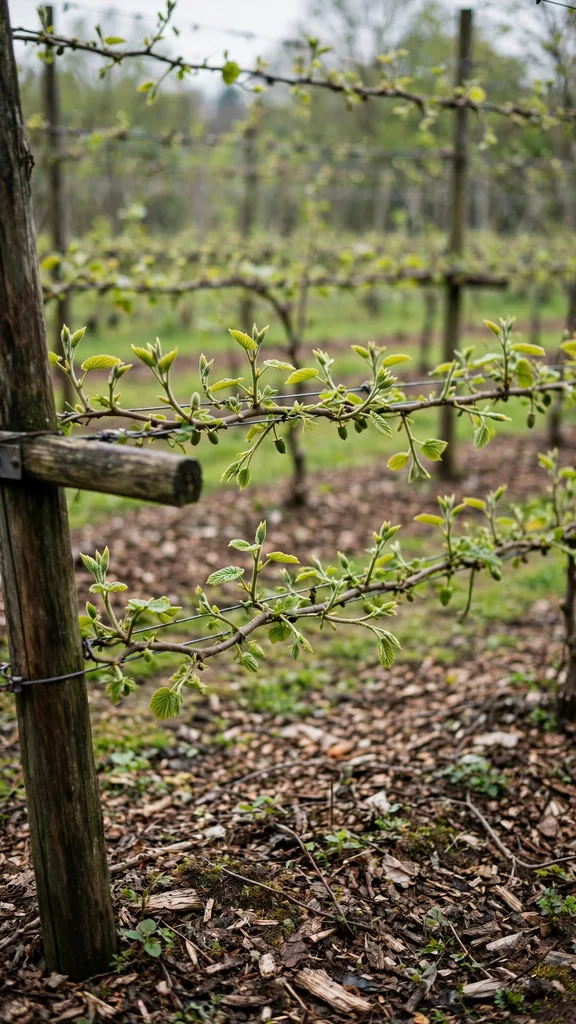
Build the support before planting day, because a vine planted against a finished trellis trains upward from its first week, while a vine left to sprawl must be lifted, untangled, and cut back hard the year the posts finally go in. The standard fruiting frame is a T-bar: a stout post, a crossarm at the top, and wires strung along the row. Cornell dimensions the classic frame with posts set 3.05 m apart, a crossarm about 2.13 m off the ground, and about 7 wires spread across a 1.52 m crossarm. The trunk climbs the post. Two arms run along the center wire. Fruiting laterals drape over the outer wires and hang their fruit down through the frame, clear of the foliage and easy to pick.
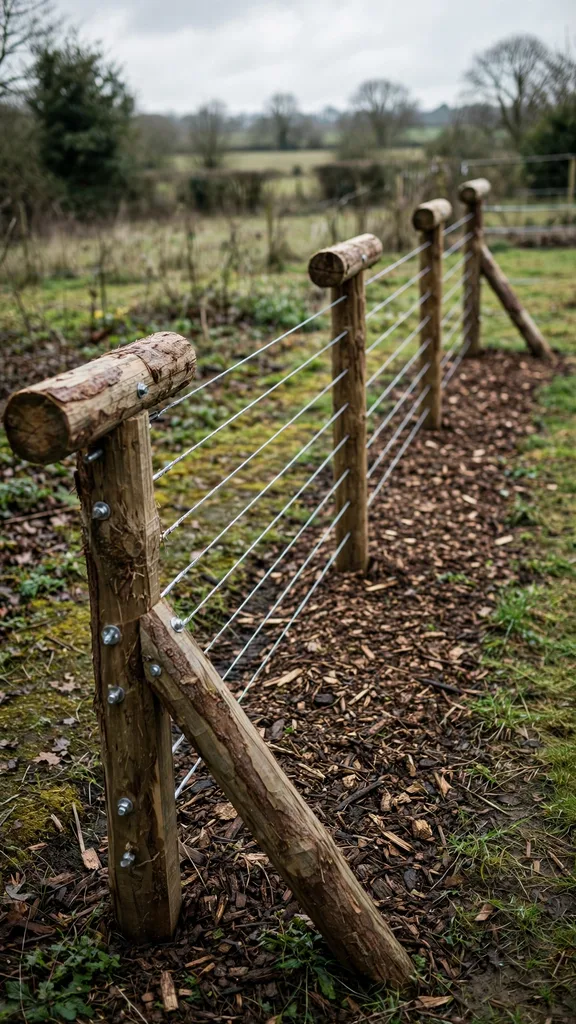
Wire tension carries the crop. Cornell specifies that trellis wire should hold 136.08 kg of tension, a figure that tells you the gauge and the end bracing the job demands. A mature vine in full leaf, wet from rain and loaded with fruit, pulls sideways with real force. Brace every end post with an angled strut or a ground anchor, and tension the wires at build time and again after the first season.
A pergola does the same work in a garden that doubles as a sitting space. The frame stands higher, the arms spread across the top beams, and the fruit hangs through within reach of a step stool. Pick a pergola with posts and beams sized for a mature vine, and leave one side open for pruning access. A decorative arch built for roses folds under a kiwi berry by its third summer. The vine always wins that contest.
Wall wires suit a sunny sheltered wall. The Royal Horticultural Society trains kiwis as tiered espaliers on horizontal wires spaced at 40.51 to 50.8 cm intervals, a pattern that fits arguta against brick or a solid fence. Stand the vine 30.5 cm out from the wall so air moves behind the foliage, and fix the wires on vine eyes that hold the same gap along the whole run. Reflected heat from a south facing wall ripens fruit early in cool districts and cooks foliage in hot ones. Choose the wall by your summers.
Plant Vines in Spring at 3.05 m Spacing
Plant in spring, after the last hard frost, while the vine still sits dormant or just breaks bud. Cornell plants kiwifruit 3.05 m apart in mid spring, once the danger of frost has passed. Container vines from a nursery go in across a longer spring window. Bare-root vines go in the week they arrive, before the roots dry.
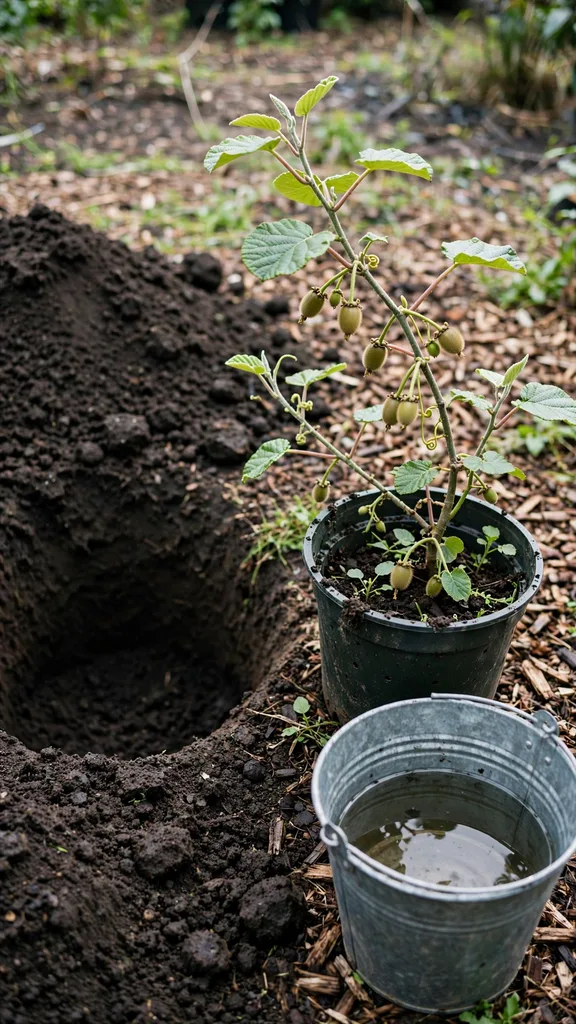
Dig the hole twice the width of the root ball and no deeper. Work compost or well-rotted manure into the backfill, since the Royal Horticultural Society directs growers to dig plenty of garden compost or well-rotted manure into the soil from the planting hole and backfill with the enriched mix. Set the vine at the depth it grew in its pot, spread circling roots outward with your fingers, and firm the backfill in layers so no air pocket survives against the roots.
Water the planting in with a full bucket, even in a wet week. The water settles soil against the root ball and starts the moisture regime the young vine depends on, since Cornell notes that plants require frequent watering from the time they are transplanted. Mulch the root zone 7.6 cm deep with straw, shredded bark, or compost, and pull the mulch a hand’s width clear of the stem. Mulch against the young trunk holds damp against bark that rots.
Cut the new vine back hard at planting. The Royal Horticultural Society directs growers to select the strongest shoot after planting and prune it back to 30.5 cm, cutting just above a healthy bud, and remove the weaker shoots. The stub looks severe and it is the correct cut. One strong shoot becomes the trunk. A fan of weak shoots becomes a tangle that no later pruning fully repairs, and the roots spend their first season feeding wood the framework never uses.
Place the male with the same care as the females. Bees work a short radius around the hive of activity at flowering, and a male exiled to the far end of the garden flowers out of the females’ flight path. On a T-bar row, the male takes a post position inside the row. On a pergola, the male climbs the opposite corner. Same trellis, same flowering week, short flight.
Train One Trunk Up and Two Arms Along the Wire
Training builds a permanent skeleton: one trunk, two horizontal arms, and short fruiting laterals renewed along the arms. Cornell instructs growers to train the main cane up the pole to the height of the crossarm, then train arms along the center wire, with laterals tied to the outside wires. Tie the young trunk to the post as it climbs, in a loose figure eight that holds the stem without girdling it. Never let the trunk twine around the post. A twining trunk strangles itself as it thickens and fuses to the support in a spiral no pruning saw enjoys.
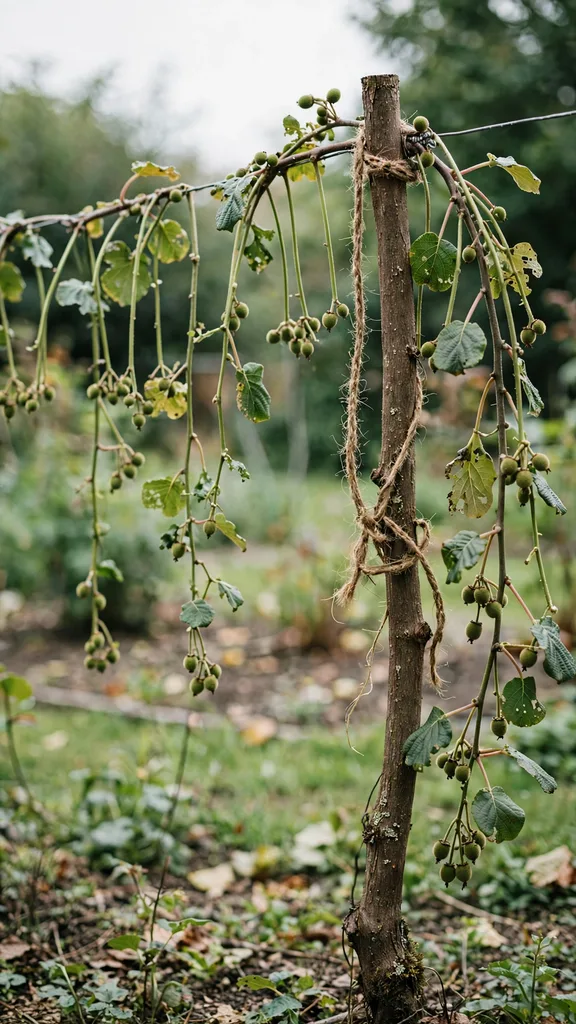
At the wire, turn two shoots in opposite directions and tie them along the center wire as the permanent arms, called cordons. Pinch the tip of each arm once it fills its allotted run, which on a home T-bar is the midpoint to the next post. The arms thicken into the framework that carries every later crop. All other shoots at the top of the trunk come off. The framework holds two arms. A third arm is a future tangle wearing a disguise.
Laterals grow from the arms and carry the fruit. Space them along the arm, let them drape over the outer wires, and tie them loosely where wind worries them. Wire-trained vines follow the same logic as the tayberry canes in Do Tayberries Need a Trellis?: the fruit hangs in the air and the sun, clear of wet soil and shaded foliage. Fruiting laterals on arguta hang down through the T-bar wires, and picking runs along the row at standing height.
Renewal keeps the skeleton young. Each winter, a share of the oldest laterals comes out and strong one-year shoots take their places along the arm. The trunk and arms stay for the life of the vine. The fruiting wood rotates. A vine trained this way reads clearly in winter: post, trunk, two arms, spaced laterals. A vine that reads as a haystack in winter was never trained, only planted.
Prune Twice a Year: Summer Cuts and Winter Renewal
Pruning is the job this vine punishes hardest when skipped. An unpruned arguta spends its energy on leaf and length, shades its own fruiting wood, and sets a thin crop inside a thicket. Cornell requires pruning at least 2 or 3 times during the growing season and once during winter. Two of those cuts carry most of the weight: a summer tidy and a winter renewal.
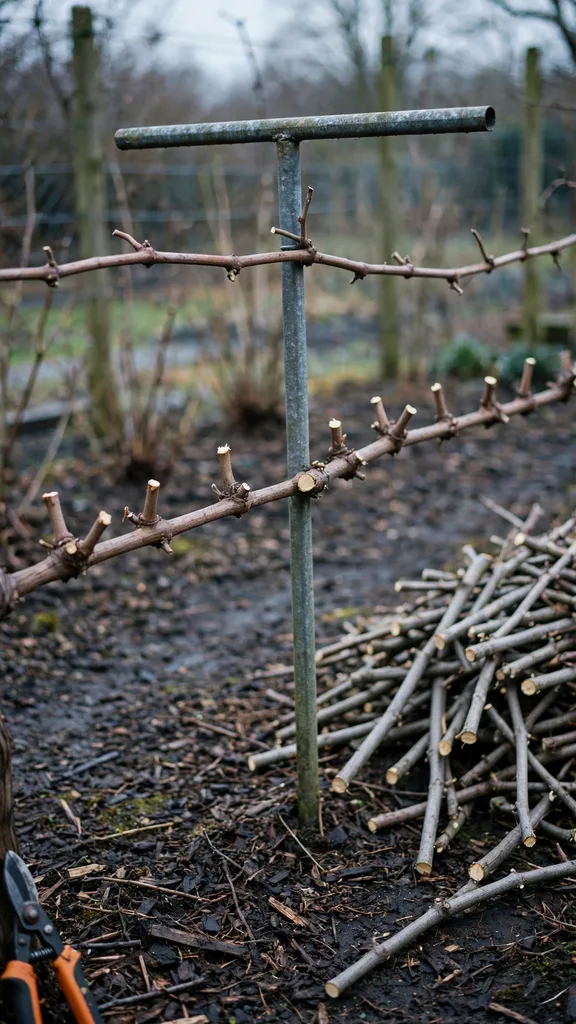
Summer pruning controls the green growth while it is soft. From June onward, the Royal Horticultural Society directs growers to pinch fruiting shoots back to 4 or 5 leaves beyond the maturing fruit, and cut non-fruiting laterals back to 5 leaves. Sunlight reaches the ripening clusters, air moves through the canopy, and the vine stops spending the season on shoots that end in the hedge. Work the row every few weeks rather than once savagely. Small cuts, often.
Winter pruning renews the fruiting wood. Work in late winter while the vine sleeps, and finish before sap rises, since cuts made as growth starts bleed sap for days. Cornell’s dormant routine removes canes that fruited last season plus dead, diseased, and tangled wood, keeps the best one-year-old laterals spaced 30.5 cm apart along the arms, and trims them back to about 8 buds. Fruit forms on shoots that grow from the base of the previous year’s growth, so the one-year laterals you keep are the crop. The gray fruited wood you remove already paid out.
Mature vines take a harder renewal. The Royal Horticultural Society advises growers to prune back a quarter to a third of the oldest laterals on mature plants to about 5.1 cm from the base, leaving stubs that push fresh fruiting shoots in spring. That rolling third keeps the arm clothed in young wood along its whole length. Skip the renewal for three winters and the arm fruits only at its far end, meters of bare cordon behind a tuft of distant berries.
Prune the male on the same calendar, lighter. His job is flowers, and flowers form on the same one-year wood, so keep a framework of arms and laterals and remove the tangle. A male pruned to the ground in winter flowers weakly the following spring. A male never pruned swallows the end of the row and shades the female beside him. Middle course: framework kept, surplus out, every winter.
Water Young Vines and Feed From the Second Year
Water decides whether a young vine establishes or stalls. The roots of a new planting sit shallow, and a dry fortnight in the first summer checks growth that the season never repays. Soak the root zone deeply once a week in dry weather for the first two seasons, and water in the morning so foliage dries before evening. Established vines ride ordinary dry spells on their deep roots and still crop better with a soak while fruit swells in a long drought.
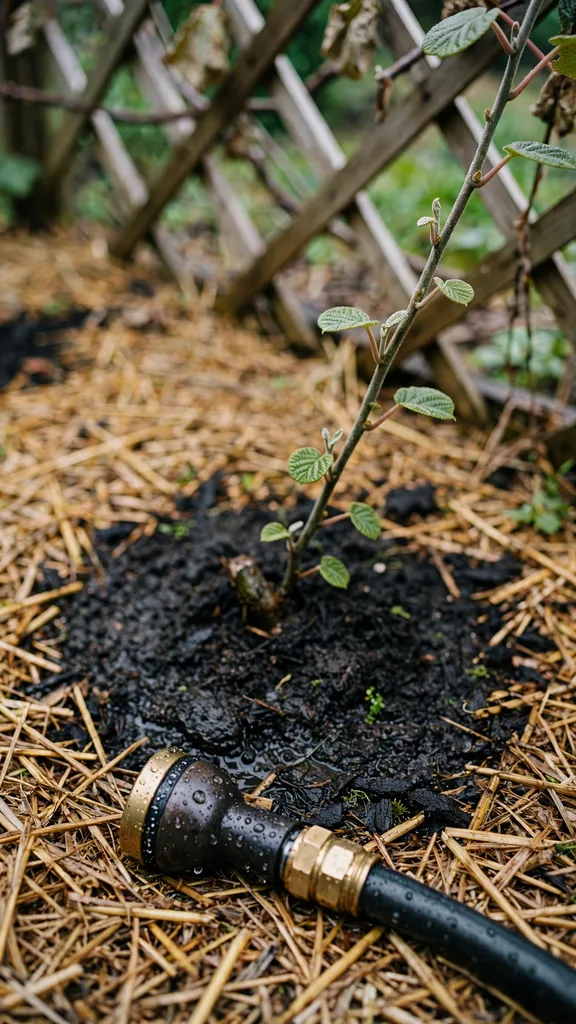
Feeding starts late and stays modest. Cornell directs growers to skip fertilizer entirely in the planting year, then sprinkle 56.7 g of 10-10-10 around each plant in early spring of the second year. Soft, overfed growth is the growth winter kills, and roots of this species burn easily under a heavy hand with the fertilizer bag. A spring mulch of compost does the gentle feeding on established vines, topped up only when growth or leaf color asks for more.
The Cornell schedule builds by small steps. The same notes raise the dose by 56.7 g each year until the plant receives 226.8 g, and cap the dose there. Spread the granules in a ring under the canopy edge, clear of the trunk, and water them in or time the feed ahead of rain. Granules piled against the trunk scorch bark and feed nothing.
Pale leaves with green veins on alkaline ground point at the soil, not the feed bag. Arguta resents chalky soil, and iron locks away from the roots as pH climbs past the top of its band. The fix runs through the soil test: sulfur worked in over a season to pull pH down, plus a foliar iron spray to green the current leaves while the soil turns. Feeding more nitrogen at a chlorotic vine grows pale leaves faster.
How Long Until the First Fruit?
Patience is a line item in this crop’s budget. The Royal Horticultural Society records that kiwi plants may take 3 or 4 years to start fruiting, and Cornell puts hardy kiwifruit fruiting by the fourth year with full crops after the eighth year. The honest planning figure for a home planting is first fruit in 3 to 5 years: a taste in year three on a strong vine, a real crop in year four or five, and full weight once the framework matures.
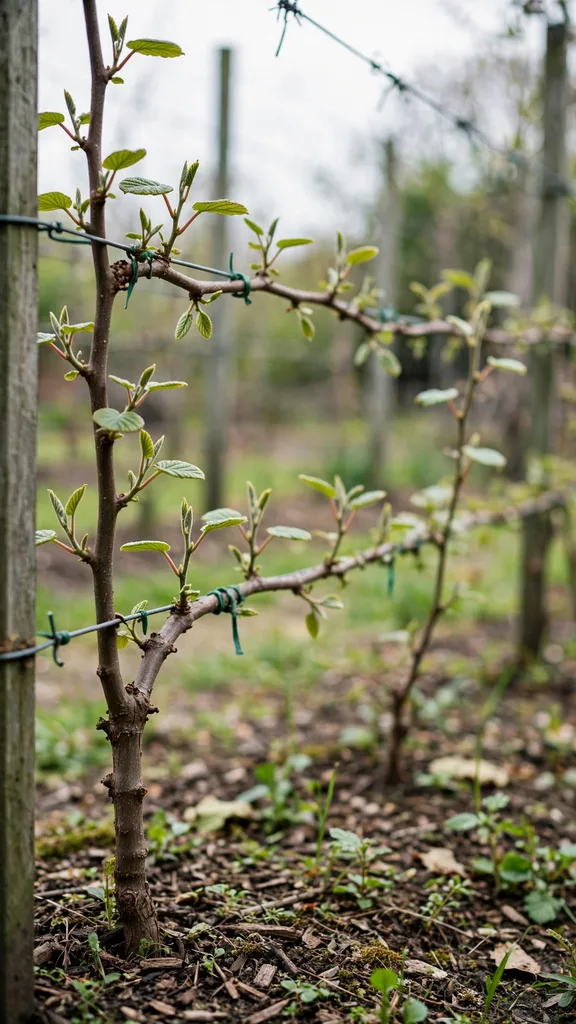
The wait shortens or lengthens on decisions you control. A named female vine, planted in sun, trained up a finished trellis, and pruned on schedule fruits at the early end. A seedling fruits at the late end or later, and its sex stays unknown until the first flowers open. Hard winter pruning that strips one-year wood pushes the crop back a season by removing the shoots that would have flowered. Every winter cut is a decision about next summer’s fruit, taken with the saw in your hand.
Judge the young vine by its framework, not its fruit bowl. A three-year vine with a clean trunk, two arms at full length, and laterals spaced along both arms stands one season from cropping. A three-year vine in a self-shaded thicket stands one season from a renovation pruning, and the renovation costs another year. The calendar measures the training. The training sets the calendar.
Pick Smooth Fruit Soft and Ripen the Rest Indoors
Harvest runs late, into autumn, and the fruit hides its ripeness behind firm flesh. Kiwi berries ripen unevenly along the vine, cluster by cluster, so picking runs in passes over 2 or 3 weeks. A berry ready to eat yields slightly under a gentle squeeze and comes away from its stem without a tug. The Royal Horticultural Society directs growers to pick any unripe fruit before the first hard frost and ripen it indoors, where it softens over several weeks. Frost on unpicked fruit ends the harvest where it hangs.
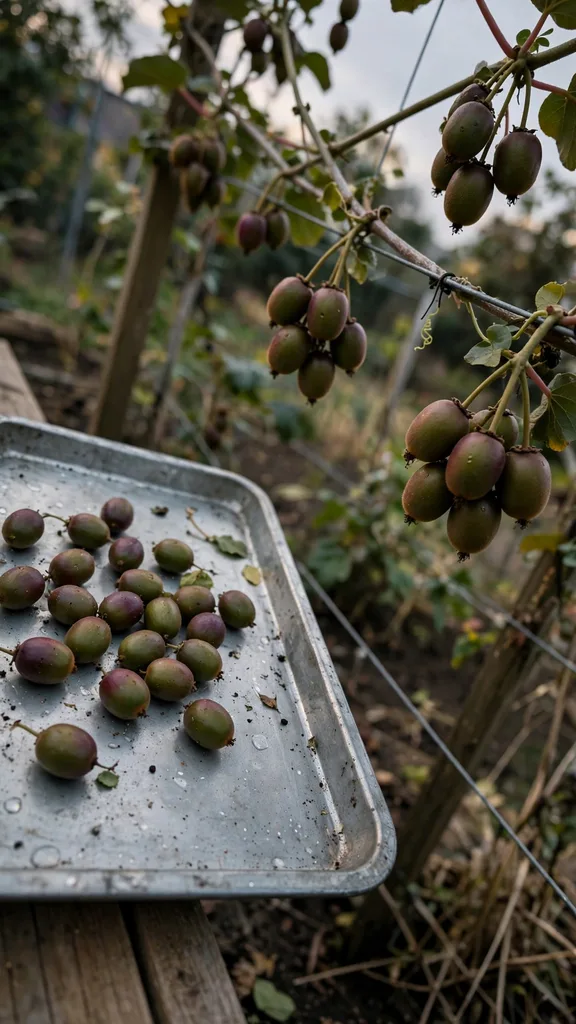
Ripening indoors wants a single layer and patience. Spread the picked fruit on a tray at room temperature, and move each berry to the refrigerator as it softens, where the Royal Horticultural Society notes ripe fruit keeps for a couple of weeks in the fridge. A ripe banana or apple on the tray speeds the batch through its ethylene. Check daily. A kiwi berry passes from firm to perfect to overripe in a short window, and overripe fruit ferments on the skin.
Eat the crop whole, skin and all, straight from the tray. The smooth skin carries no fuzz and no bitterness worth peeling away, which is the entire charm of the species at the table. Surplus fruit dries into sweet chewy pieces, freezes whole on a tray for winter smoothies, and cooks into a jam that needs no peeling labour at any stage. Birds work the vine in the same weeks you do. Net the row when the first clusters soften, or accept the birds’ share as rent on the trellis.
Start New Vines From Cuttings, Layers, and Seed
Cuttings clone a known vine, sex and flavor included, and nurseries raise arguta this way. Cornell takes hardwood cuttings any time after the plant has received 500 hours of chilling, or softwood cuttings in July. Hardwood cuttings of pencil thickness, cut in late winter and set in a gritty mix, root as growth starts. Softwood cuttings taken in midsummer root under mist or a clear cover that holds humidity around the leaves.
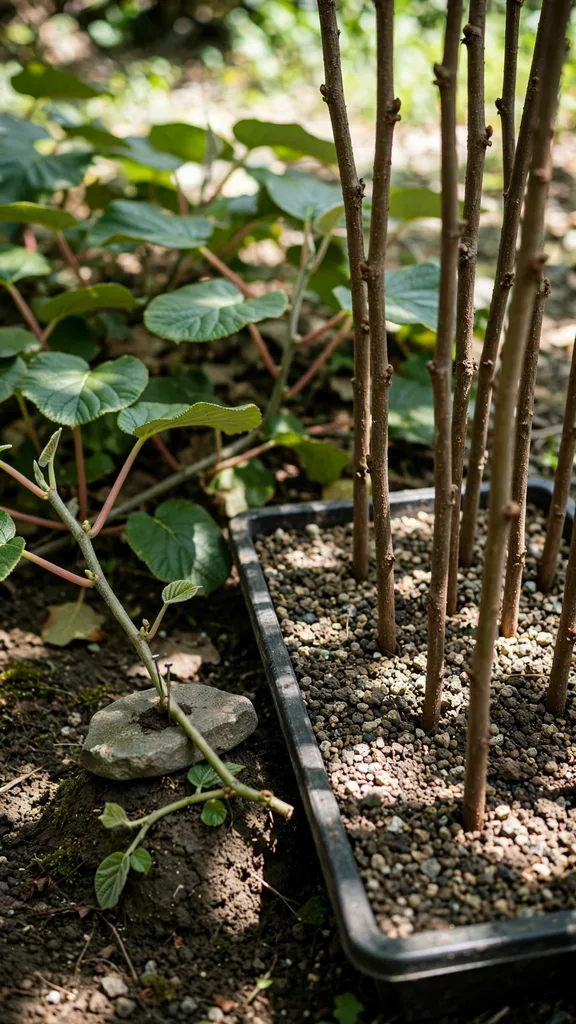
Layering roots a shoot while the parent vine feeds it. Bend a low one-year shoot to the soil in spring, pin a section under 5.1 cm of soil with a stone or a wire peg, and leave the tip exposed. Roots form at the buried nodes over the season. The following spring, sever the layer from the parent and dig it with its root ball intact. A layer carries the parent’s sex with certainty, which makes layering the safe way to multiply a proven female.
Seed is the slow route and the honest label on it is experiment. Cornell’s seed routine dries the seed for 2 days, refrigerates it in moist perlite at 4.4 °C for 4 months, then sows it no deeper than 0.32 cm in sterile mix. Seedlings germinate readily after that cold treatment and grow fast in pots. The catch arrives years later: seedlings fruit late, vary in flavor, and split roughly half male, half female, with the sex hidden until flowering. Grow seed for rootstocks and curiosity. Grow cuttings and layers for the fruit row.
Name every propagated plant the day it roots. A cutting labelled with its parent vine, its sex, and its year stays identifiable through every repotting. An unlabelled arguta in a pot is a five-year question mark, and gardens accumulate enough of those without breeding more.
Fix the Failures: No Fruit, Frosted Shoots, and Tangled Growth
A vine that flowers and sets nothing has a pollination fault until proven otherwise. Walk the row at bloom and sex every vine by its flowers: female flowers carry a fat central pistil with sticky stigmas, male flowers carry pollen anthers around an empty center. A planting of two females, sold as a pair by a careless label, flowers beautifully and fruits never. The fix is a grafted male branch or a male vine in a large pot set against the trellis for flowering week, then a permanent male planted the following spring.
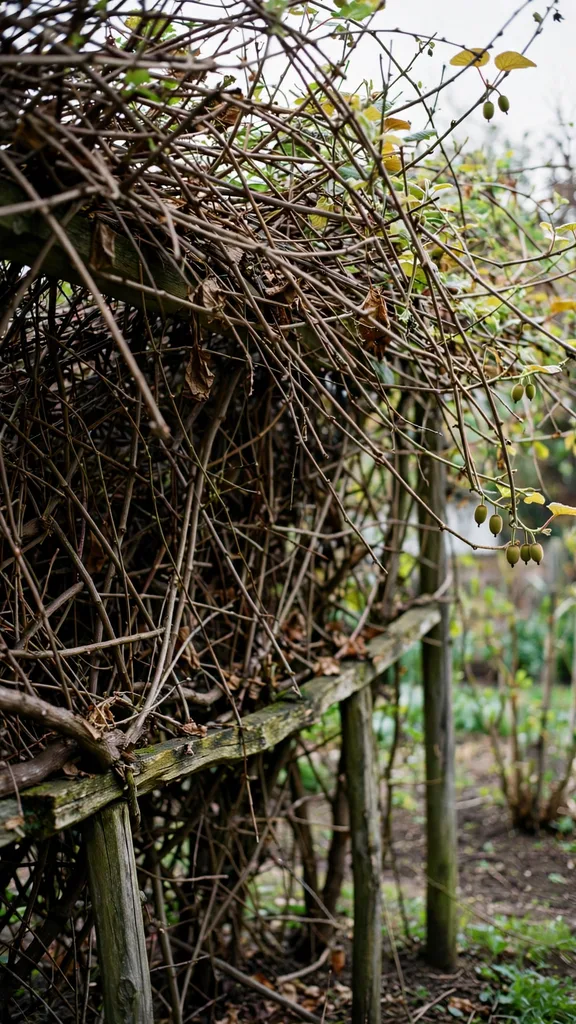
Flowers that open and drop in a cold snap tell a frost story. Arguta pushes growth early, and one hard night after bud break kills the season’s flower buds on exposed sites. The vine releafs and grows on, healthy and fruitless. Protect young shoots with horticultural fleece on forecast frost nights in spring, and site the next vine out of the frost pocket. Cornell notes that plants usually regrow after spring frost damage, with fruit development delayed, so a frosted vine is a lost season, not a lost plant.
Tangled growth is a pruning debt coming due. A vine left two seasons unpruned shades its own fruiting wood, and the crop retreats to the outer skin of the thicket where the sun lands. Renovate in winter: cut the worst third of the oldest wood back to the arms, space the remaining one-year laterals, and accept a light crop the following summer while the framework rebuilds. Then hold the twice-yearly schedule. The debt compounds at vine speed.
Vigour itself becomes a failure at the garden boundary. Cornell warns that hardy kiwifruit may escape and smother neighbouring trees and forest growth in some districts, particularly on calcareous soils. A garden vine pruned twice a year stays a garden vine. A vine abandoned at a woodland edge becomes the woodland’s problem, so plant arguta where you will keep cutting it, and cut any seedling that springs up beyond the row.
Frequently Asked Questions
Most kiwi berry vines do. A female Actinidia arguta flowers and fruits only with pollen from a male vine of the same species flowering nearby, and one male covers up to 9 females. The exception is ‘Issai’, a self-fertile cultivar that crops on a single vine with no male required. Buy labelled sexes. An unlabelled pair is a coin toss that takes years to settle.
Dormant arguta wood survives deep winter cold, with Cornell recording tolerance down to -31.7 °C once the vine is fully dormant, and most cultivars crop through USDA zone 4 winters given a long enough frost free season. The weak point is spring. New shoots that break early take damage from a single late frost, so shelter and frost fleece matter more than the winter low.
Grow one in a pot as a holding step or on ‘Issai’ in a large container with a stout obelisk, and expect a modest crop. A standard arguta vine wants meters of run in every direction, and roots confined to a pot cap the growth that carries fruit. A container of 56.8 L or more, free drainage, and hard annual pruning keep a potted vine honest for a few seasons.
Prune twice a year. Summer pruning runs from June onward, pinching fruiting shoots to 4 or 5 leaves beyond the fruit and non-fruiting laterals to 5 leaves. Winter pruning runs in late winter while the vine sleeps: fruited wood out, one-year laterals spaced along the arms and trimmed to about 8 buds. Finish winter cuts before sap rises. Late cuts bleed.
Count the causes in order. A lone female with no male nearby flowers and drops every blossom. A young vine under 3 years old is still building its framework. Hard winter pruning that removed the one-year wood removed the flowers with it. A late frost after bud break kills a season’s buds outright. Fix the cause you find. The vine keeps the score honestly.