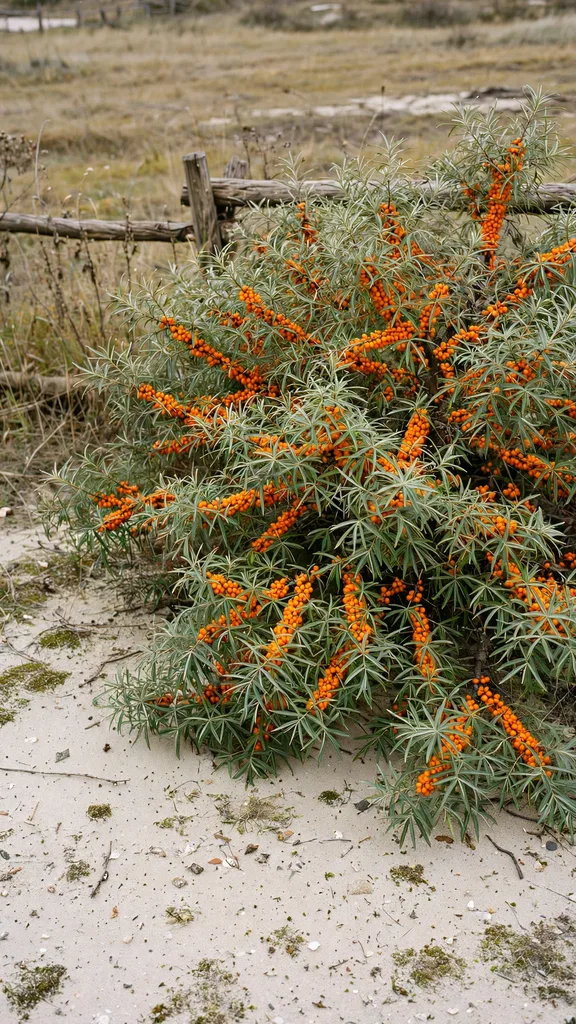
Plant 7 seaberry shrubs in a single spring row, 1 male and 6 females, and the planting fruits for decades on poor soil that starves most fruit bushes. Learning how to grow sea buckthorn means managing three facts from day one: the plants are male or female and only females carry berries, seed needs 90 days of cold before it wakes, and the roots send up suckers that turn one shrub into a colony. Get those three right and Hippophae rhamnoides asks for almost nothing else.
Sea buckthorn carries a second name, seaberry, and nurseries sell it under both. The shrub fixes its own nitrogen through root nodules, so it grows in sand, gravel, and thin coastal soil where a raspberry row sulks. The berries ripen bright orange, taste sharply tart, and hold vitamin rich juice that cooks into sauces, jams, and drinks. The plant earns its place on fruit and hardiness together.
| Attribute | Detail |
|---|---|
| Botanical name | Hippophae rhamnoides |
| Other name | Seaberry |
| Plant type | Deciduous thorny shrub or small tree, dioecious |
| Height and spread | 2.44 to 4.57 m |
| Hardiness | USDA zone 4a and warmer on the Cornell listing |
| Sun | Full sun |
| Soil | Sandy, loamy, or gravelly, free draining, pH 5.0 to 8.0 |
| Sex ratio | 1 male for every 6 to 8 females |
| Seed treatment | 90 days of cold moist stratification at 2 to 5 degrees Celsius |
| First fruit | Year 3 to 4 from seed, year 2 to 3 from nursery shrubs |
| Spread habit | Suckers freely and forms colonies |
Meet the Seaberry, Hippophae Rhamnoides
Seaberry grows wild on sea coasts, river banks, and dry slopes across Europe and northern Asia, and the wild habit explains the garden behavior. The roots run shallow and wide, grip loose soil, and send up new stems at a distance from the parent crown. A single planted shrub becomes a thicket given five free years. Gardeners plant it for the berries and keep it for the toughness: salt spray, wind, drought once established, and hard winter cold all land on this shrub and fail to kill it.
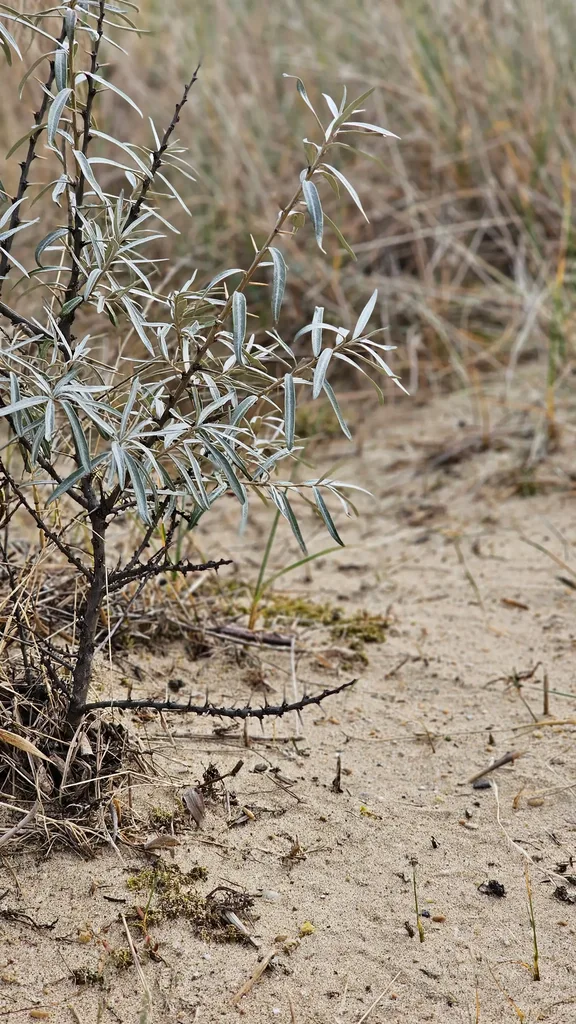
The foliage names the plant at a glance. Narrow willow shaped leaves run silver green, pale and scaly underneath, and the stems carry stiff thorns at the tips. Flowers open small and yellow green in early spring before the leaves, males in tiny catkins and females in small clusters. Wind carries the pollen. Bees play no part in a seaberry crop, so a cold still spring costs nothing and a windy flowering week sets fruit heavily.
One confusion to clear at the nursery gate. Sea buckthorn shares half a name with common buckthorn, Rhamnus cathartica, a different plant entirely and a listed invasive shrub in several northern states. The seaberry on this page is Hippophae rhamnoides, family Elaeagnaceae. Read the botanical name on the tag before money changes hands. A wrong genus in the ground wastes three years.
The nitrogen fixing habit changes how you feed the row. Root nodules host bacteria that pull nitrogen from the air, so the shrub greens itself on poor ground and even improves the soil around it over time. Rich feeding backfires. Heavy nitrogen grows long soft thorn wood, delays fruiting, and feeds the sucker problem. Plant seaberry lean and keep it lean.
Plant 1 Male for Every 6 to 8 Females
Sea buckthorn is dioecious: each plant carries one sex for its whole life. Females flower, set fruit, and carry the orange crop. Males flower and shed pollen and never fruit. A planting of females alone blooms every spring and harvests nothing. A planting with one male in the wrong corner, far downwind, sets a thin crop on the nearest females and nothing on the far row.
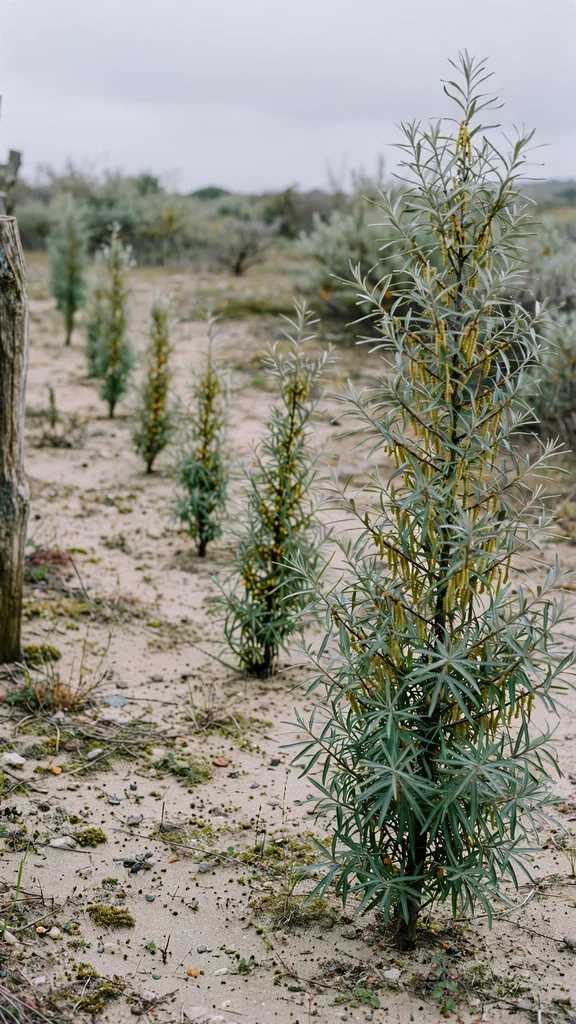
The Cornell University Woody Plants Database entry for the species states the working rule plainly: it lists the need for a ratio of 6 females to 1 male for pollination to ensure fruit production. Home plantings stretch that ratio to 1 male for every 6 to 8 females, and the brief fence for this crop holds the same band. Seven plants, one of them male, fill a family row. Fifteen plants take two males, spaced apart along the row.
Place the male upwind of the females. Spring wind moves the pollen, so the male belongs on the side the prevailing spring breeze comes from, at the end of the row or woven into the middle of a block. Keep every female within easy wind reach of a male. A male marooned 30 m away behind a fence pollinates the fence.
Sex shows only at flowering, and seedlings hide their sex for years. A seed grown plant reveals itself at its first flowering, usually in year 3 or 4, and half a seed batch runs male on average. That single fact drives the buying advice in the cultivar section below: fruit rows come from named, sexed nursery stock, and seed rows are a breeding project with a long wait and an unknown sex split at the end of it.
Pick a Full Sun Site With Free Draining Soil
Plant seaberry in the sunniest open ground you have. Full sun drives the crop, colors the fruit, and keeps the foliage dry. A shrub in half shade grows long, thin, and nearly fruitless, and it leans toward the light until the thicket lists sideways. Open exposure suits the plant. Wind that flattens softer shrubs passes through a seaberry row and does the pollination work on the way.
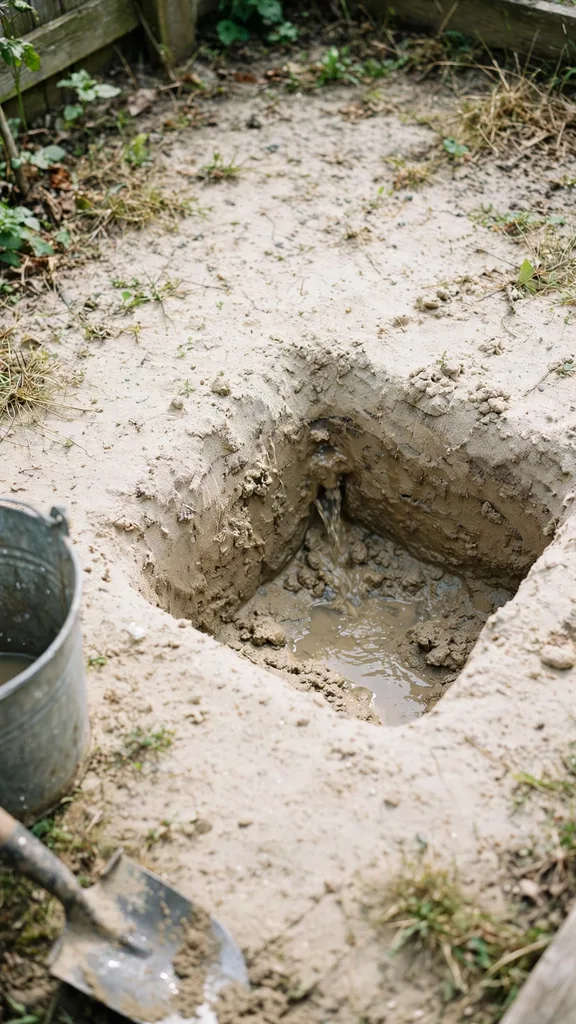
Soil drainage decides survival more than soil richness. The Cornell database records the species tolerating soil pH from 5.0 to 8.0, salt spray, and salty soil, a wide band that covers most garden ground. Wet feet sit outside that tolerance. Roots in standing water through winter rot, and a shrub that leafs out weakly in spring on a wet site is drowning from below. Dig a test hole on clay ground, fill it with water, and watch the level. Water still standing the next morning means a raised row or a different site.
Poor soil is home ground for this plant. Sand, gravel, thin topsoil over rubble, and dry banks all grow seaberry well once the roots establish. The nitrogen nodules cover the feeding, and the wide root system finds water at a distance. Save your compost and manure for crops that need them. A seaberry planted into a rich, heavily amended hole grows rank, suckers harder, and fruits later than its lean planted neighbor.
Give the planting room at the start. Space shrubs 1.83 to 3.05 m apart in the row, wider where you plan to mow between plants, and keep the row at least 3 m from vegetable beds, paths you want clear, and the neighbor boundary. The suckers travel. A row planted tight against a fence sends its colony under the fence within a few seasons, and the argument that follows costs more than the berries earn.
Choose Named Cultivars With Known Sex
Named cultivars solve the two problems seed cannot: unknown sex and unknown fruit quality. Nurseries propagate cultivars from cuttings taken from sexed parent plants, so a labeled female fruits and a labeled male pollinates, guaranteed by the propagation method itself. Cultivar fruit also runs larger, hangs in denser clusters, and in the best modern selections carries shorter thorns than wild type seedlings.
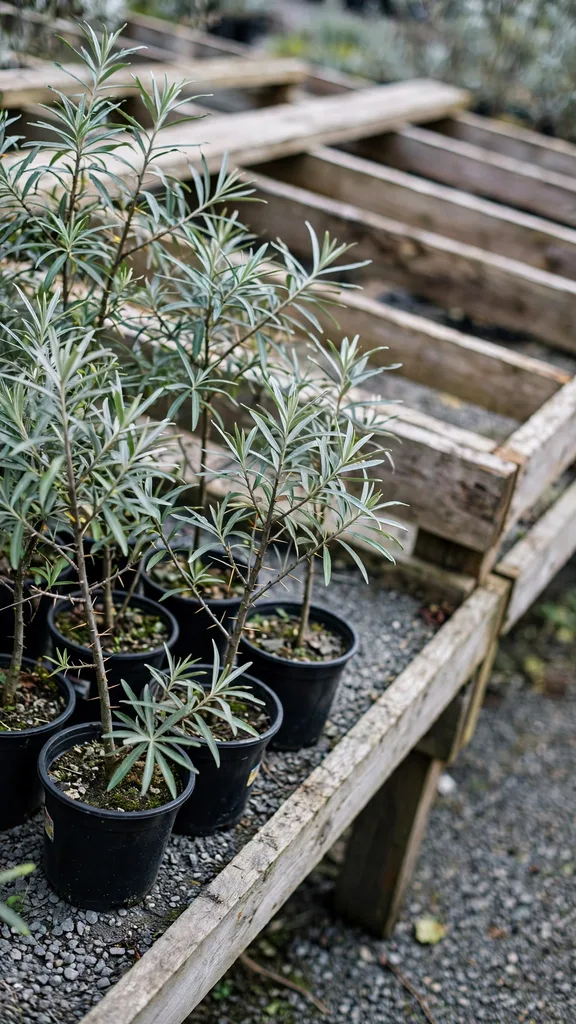
Female selections to look for include ‘Leikora’, a heavy cropping German selection with large fruit, ‘Hergo’, an early ripening female, and ‘Askola’, a late female with deep orange berries and strong juice color. Male selections include ‘Pollmix’, the standard pollinator bred to flower alongside the common females, and ‘Lord’, a male sold for the same job. Regional nurseries stock regional lists, and Siberian and Canadian selections such as the ‘Russian Orange’ group suit very cold districts. Match the male flowering time to your females: a male that finishes flowering before the females open sets nothing.
Buy bare root or container shrubs from a fruit nursery that labels sex on the tag. An unlabeled seaberry is a coin toss priced as a certainty. Check the tag for three things: the cultivar name, the sex, and the botanical name Hippophae rhamnoides. Walk away from a pot labeled only with the words sea buckthorn and a picture of orange berries. That pot hides its sex, and the picture promises a crop the plant in the pot may never carry.
Seed grown stock has one honest use: a cheap windbreak or soil holding thicket where berries are a bonus. Plant seed where the sex split costs nothing, let the males stand as shelter, and graft or replace later if a fruit row becomes the goal. For a fruit row, the named cultivar premium pays for itself the first harvest, because every plant in the row is a known female plus its one planned male.
Stratify Seed for 90 Days Before Sowing
Seaberry seed carries internal dormancy, and dry seed sown straight into warm soil sits there and rots or germinates in a thin scatter across two seasons. Cold breaks the dormancy. The seed study literature summarized by the Polish Academy of Sciences Institute of Dendrology records that mature seeds carry internal dormancy, broken by seed stratification in sand for 90 days at 2 to 5 degrees Celsius. Ninety days is the working number for this crop. Shorter cold periods wake a fraction of the batch.
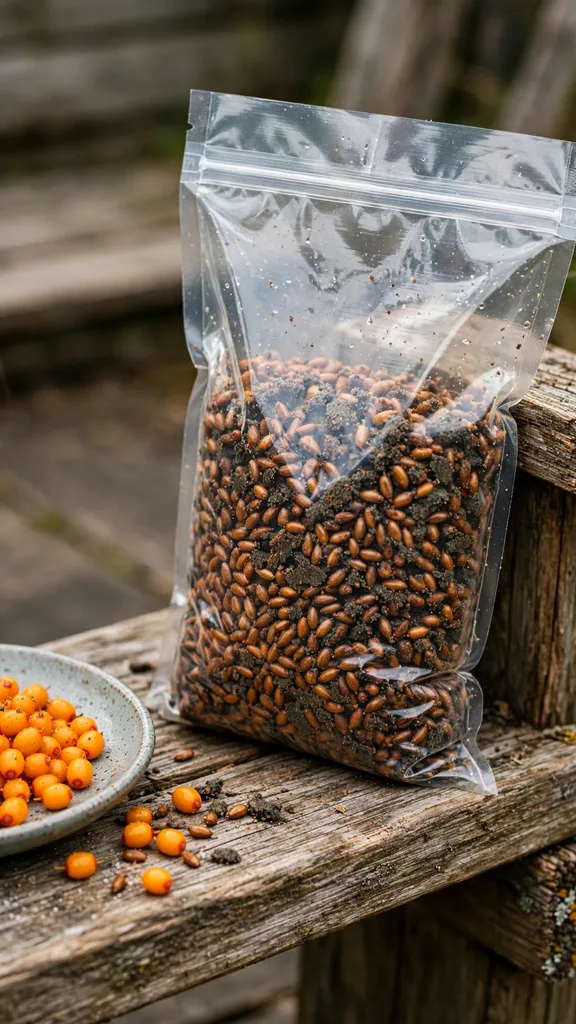
Run the stratification in a refrigerator. Clean the seed first: crush ripe berries in water, rub the pulp away, and keep the seeds that sink. Mix the cleaned seed with damp sand or damp vermiculite in a sealed bag or lidded jar, at roughly 1 part seed to 3 parts medium by volume. The medium should feel like a wrung out sponge. Wet medium rots seed. Dry medium stratifies nothing.
Label the bag with the start date and count forward 90 days on the calendar. Check the bag every 2 weeks. Add a spoon of water if the medium dries, and pick out any seed showing mold and rinse the rest before rebagging. Seeds that sprout inside the bag near the end of the cold period are ready ahead of schedule: pot those at once, root down, and return the rest to the cold for the remaining days.
Autumn sowing outdoors does the same job on the garden clock. Sow cleaned seed into a nursery bed or a deep pot left outside through winter, covered with wire mesh against mice, and winter cold stratifies the batch in place. The refrigerator route wins on control: no mice, no washouts, and a known start date. The outdoor route wins on effort. Both routes deliver the same 90 days of cold the seed demands.
Growing berry shrubs from seed is a different job for each species. That work for blackberries lives on How to Grow Juicy Blackberries from Seed. This page stays on seaberry: 90 days of cold, a shallow spring sowing, and seedlings whose sex stays hidden until flowering.
Sow Stratified Seed Shallow in Spring
Sow the stratified seed as soon as the cold period ends, in early spring. Fill deep pots or a nursery bed with a gritty, free draining mix, 2 parts compost to 1 part coarse sand by volume, and firm the surface flat. Scatter the seed thinly, cover it with 0.64 cm of fine grit or mix, and water with a fine rose until the pot drains from the base. Deep pots matter: seaberry seedlings drive a long first root, and a shallow tray stunts it within weeks.
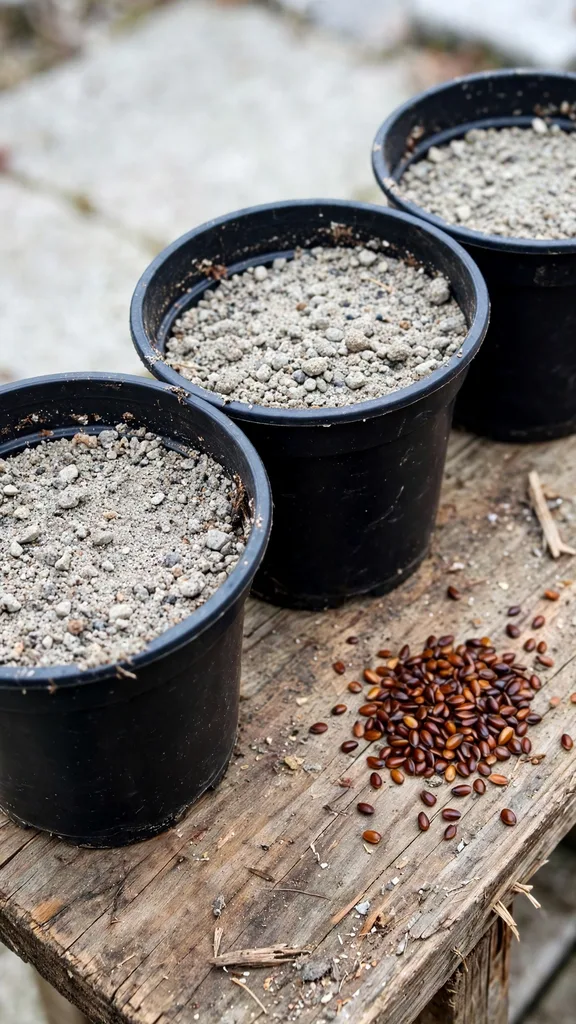
Warmth wakes the batch. Hold the pots at room temperature on a bright sill or in a glasshouse and keep the surface damp. Germination runs across the following 2 to 4 weeks in a staggered pattern, early seeds first and laggards behind them. A pot that shows nothing at week 2 is still working. Tip it out at week 6 only, and even then check for sprouting seed before the mix goes to the compost.
Prick seedlings out at 2 true leaves into individual deep pots of the same gritty mix. Handle them by a leaf, never by the stem, and water them in at once. Grow the young plants on in full sun, watered when the mix dries at the surface, and pot up once roots circle the base. By the end of the first season a well grown seedling stands 30.5 to 61 cm tall and carries the silver foliage of the parent species.
Plant seedlings out in their second spring, after a full season in pots, and mark every plant with its sowing year. Expect the long wait: first flowers in year 3 or 4, and the sex of each plant announced only then. Keep the best fruiting females when the split reveals itself, graft or remove surplus males down to the 1 in 6 to 8 the row needs, and accept the seed route for what it is, a slow breeding bench that occasionally raises a seedling better than its parents.
Plant Nursery Shrubs in Spring or Autumn
Plant container or bare root shrubs in early spring as the soil works, or in early autumn while the ground still holds warmth. Spring planting suits cold districts, where an autumn planted shrub faces winter before its roots grip. Autumn planting suits mild districts and gives the roots a head start on spring growth. Either way, plant on a still, overcast day when the soil is damp and workable.
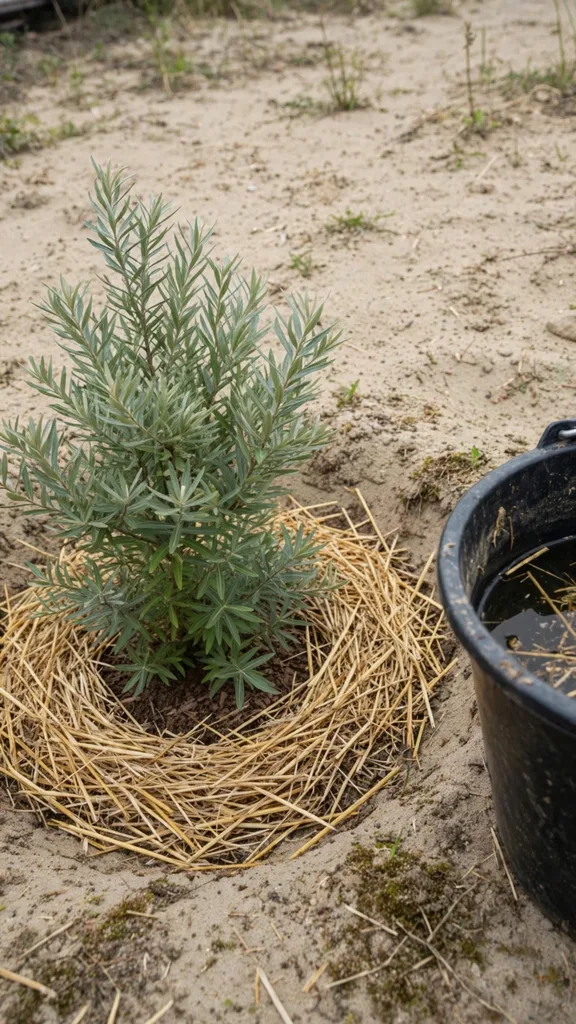
Dig the hole twice the width of the root ball and the same depth. Set the shrub at the depth it grew in the nursery, spread bare roots over a low mound of soil in the hole base, and backfill with the dug soil firmed in layers. Skip the amendments. Backfill of plain site soil forces the roots outward into the row, and a pocket of rich mix holds water against the crown in winter. Water each shrub in with a full bucket at planting, even in a wet week, to settle soil against the roots.
Mulch the row 7.6 cm deep with straw, wood chips, or shredded bark, kept a hand width clear of the stems. Mulch holds the first season moisture, cools the shallow roots, and marks the line the sucker patrol walks later. Water through the first dry season whenever 2 weeks pass without rain: a deep soak at the base, then nothing until the next dry spell. A shrub watered little and often grows surface roots and falls over in its third year wind.
Stake only on exposed sites, and stake low and loose for one season. Seaberry stems flex in wind and thicken in response, and a tight tall stake grows a weak trunk that snaps the year the tie comes off. Remove the stake at the end of the first growing season whatever the weather did. The roots and the flexing stem carry the plant from there.
Water Through the First 2 Seasons, Then Stop Pampering
Establishment is the only thirsty phase of a seaberry life. Water new plantings deeply through their first 2 seasons in dry weather, soaking the root zone rather than wetting the surface. The wide shallow root system spreads fast, and by the third season a garden shrub finds its own water in all but a hard drought. A mature seaberry that wilts in an ordinary dry summer is telling you about a soil problem, usually compaction or a root zone sealed under paving.
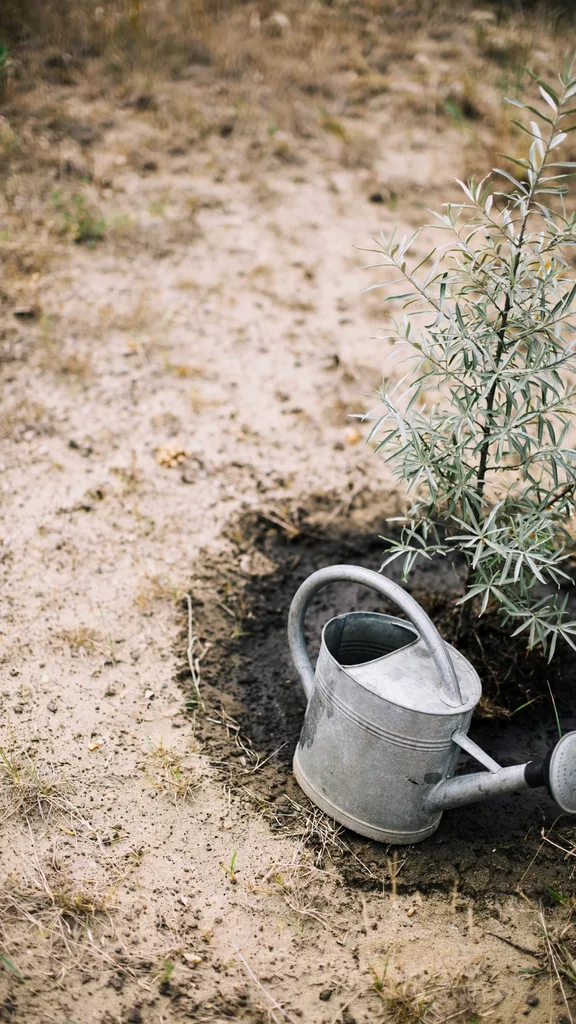
Skip fertilizer as a routine. The nitrogen nodules feed the shrub, and phosphorus and potassium sit adequate in most garden soils for a plant bred by evolution for poor ground. Yellow foliage on an established plant points first at waterlogging, second at extreme alkalinity locking up iron, and a long way third at hunger. Fix the drainage before opening a fertilizer bag. Feeding a waterlogged shrub grows softer wood over dying roots.
Weed control matters more than feed. Keep a mulched, weed free circle at least 91.4 cm across around each young shrub for the first 3 years. Grass growing to the stems steals the surface moisture the shallow roots depend on, and a strimmer working against grass at the stem base rings the bark and kills the shrub it meant to tidy. Mulch and a hand pull twice a season do the whole job.
Watch the row in late spring for the one pest pattern worth acting on: aphid colonies curling the soft shoot tips. Blast them off with a hard water jet on 3 mornings in a row and the ladybird patrol finishes the work. Seaberry carries few diseases in open ground. A shrub losing whole branches in summer usually shows root damage or waterlogging at the base when you dig down to look, and the fix is drainage and removal of the dead wood, not a spray program.
Control Suckers Before the Colony Takes the Bed
Suckering is the seaberry habit that ends plantings. The species grows as a large, suckering shrub that forms wide colonies, and the colony spread runs well beyond the planted footprint. Every root that runs outward carries buds, and every bud near the surface pushes a sucker. A row left alone for 3 seasons stands as a thicket 2 m wider than the row you planted.
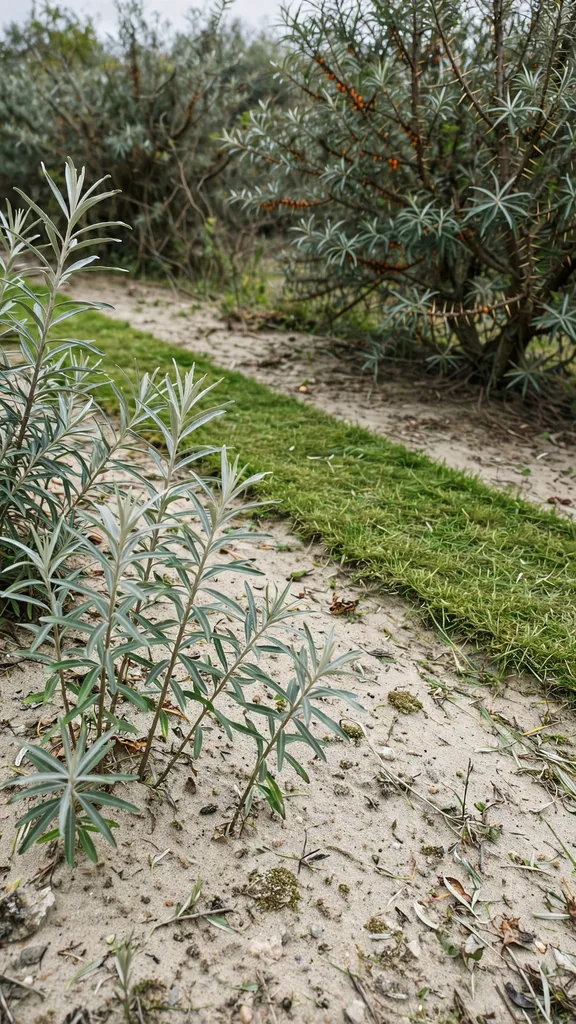
Mowing is the first control and the cheapest. Run the mower or strimmer along both sides of the row on the normal lawn schedule and every sucker outside the row line gets cut at ground level before it lignifies. Suckers cut young and often drain the root that sent them. Suckers left to grow leaves feed that root and fund the next ring of suckers further out. The mown strip is a border the colony respects because it has no choice.
Dig out the suckers that rise inside the row where they crowd the planted shrubs. Trace each unwanted stem down to the running root, cut the root on both sides of the stem with a spade, and lift the section out. Cutting a sucker at soil level alone earns you 3 replacement shoots from the stub by midsummer. The root section comes out or the sucker comes back stronger.
Barriers suit small gardens. Sink a rigid root barrier 61 cm deep along the side of the row that faces beds, paths, or the boundary, and leave the field side open if you have one. A barrier on all sides boxes the roots and the shrub sulks in drought, so barrier the threatened side only. Gardeners with real space take the opposite deal: plant seaberry as a shelter thicket at the far end of the plot, mow a lane around it, and let the colony be the windbreak and the bird pantry it wants to be. Hard pruning a whole thicket back is the failure at the end of neglect. Years of woody suckers take a full winter weekend to clear, and the roots resprout from every cut for 2 seasons after.
Prune in Late Winter and Keep the Center Open
Prune in late winter, while the shrub sleeps and before the buds swell. The winter silhouette shows every crossing branch, every dead tip, and the thorn pattern you work around. Wear thick gloves and eye protection and use loppers and a pruning saw: seaberry thorns puncture thin gloves and the scratches inflame. Cut dead, damaged, and crossing wood first, back to a live outward facing bud or branch.
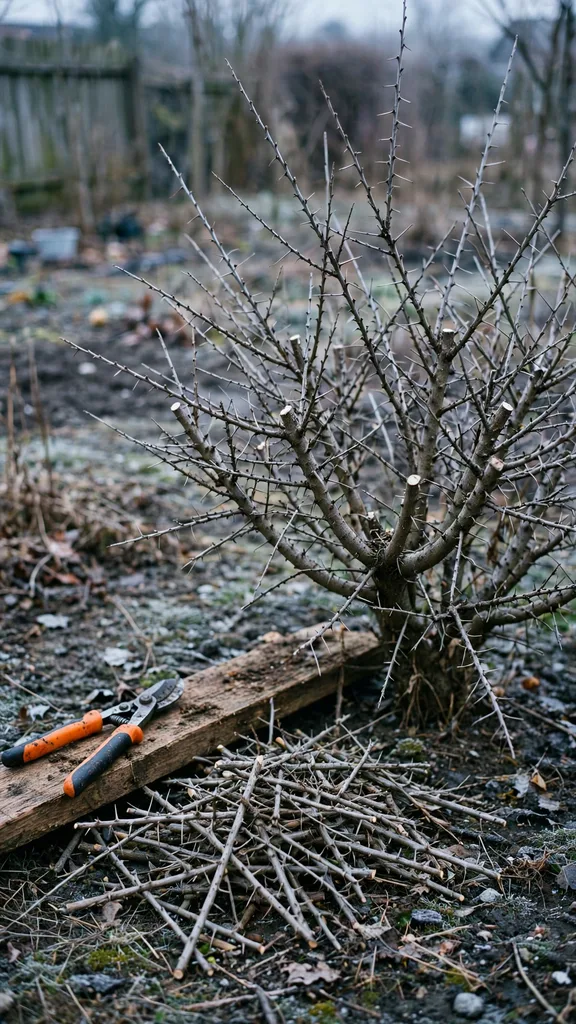
Keep the center open. Remove 1 or 2 of the oldest, thickest stems at the base each winter on a mature shrub, and the plant replaces them with fresh fruiting wood from the crown. Fruit forms on the previous season growth, concentrated on 2 and 3 year old wood, so a shrub pruned to bare sticks in winter fruits the following year on nothing. Renewal pruning takes a share of old wood each year and never the whole framework at once.
Shorten wayward leaders that push the shrub past its space, cutting to a side branch that points where you want the growth to go. Head a seaberry back hard in one pass and it answers with a thicket of straight, thorny, fruitless whips from every cut. Small annual cuts keep the shrub shaped, pickable, and fruiting. The harvest section below gives a second reason for restraint: berries strip fastest from open, reachable branches.
Form decides the pruning style. A single stemmed small tree form suits a specimen planting and lifts the fruiting branches to picking height. A multi stemmed shrub suits a fruit row and a shelter thicket. Pick the form in year 1 by removing or keeping the low stems, and hold it. A shrub switched between forms every winter carries the scars of both and the crop of neither.
Grow Seaberry in a Large Container
A large container holds a seaberry where the colony habit rules out open ground: a paved yard, a balcony with load bearing for a heavy pot, or a garden too small for a mown sucker strip. Choose a pot at least 61 cm across and 45.7 cm deep for a single shrub, and expect to finish one sex per pot. A fruiting patio planting takes 2 pots, one male and one female, standing side by side so the wind moves pollen across the gap.
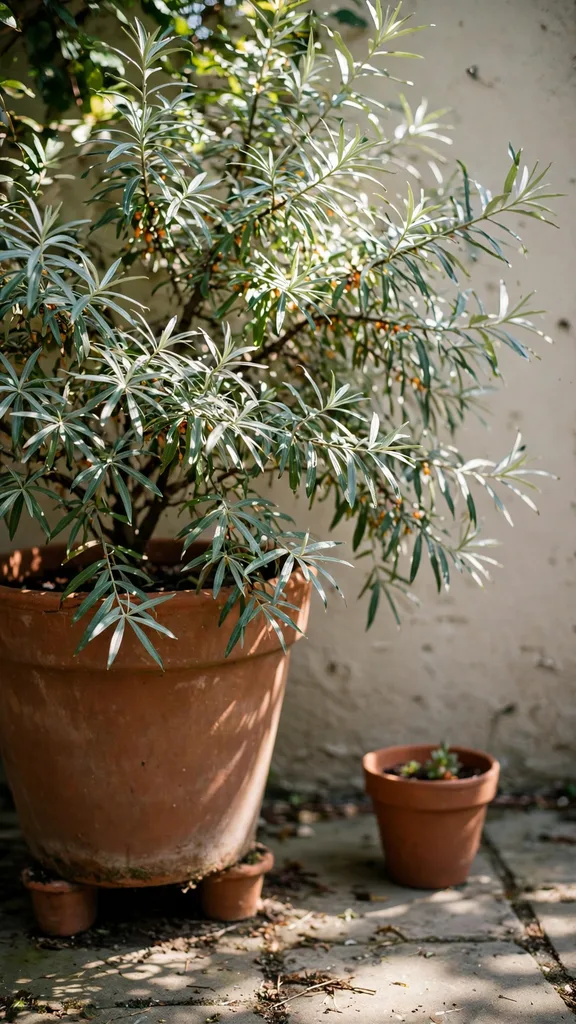
Fill the pot with a gritty mix, 3 parts multipurpose compost to 1 part coarse grit or perlite by volume, over a layer of crocks at the drainage holes. Seaberry in a pot dies of wet mix faster than of anything else, so the drainage layer and the grit earn their place. Set the pot on feet or bricks so the holes drain clear of the paving. A pot standing in its own runoff through winter rots its roots by spring.
Container shrubs drink on your schedule. Water when the top 5.1 cm of mix dries, soak until the pot drains, and repeat through every dry week of the growing season. Feed once each spring with a slow release fertilizer at half the label rate for shrubs: the nitrogen nodules still work in a pot, and full rate feeding pushes soft growth the thorns make miserable to prune. Repot or root prune every 3 years in late winter, cutting back a third of the circling roots and refreshing the mix.
Winter asks little. The roots in a pot freeze harder than roots in the ground, so group pots against a sheltered wall in cold districts and wrap the pot in fleece or bubble wrap during a hard freeze week. The top growth takes deep cold without complaint. Bring the pot back into the open in spring, prune lightly, and the container shrub fruits on the same schedule as its ground planted siblings, in a smaller crop that fits a small garden.
Hardy berry shrubs in pots are a small family of their own. The goji row on this site, How to Grow Goji Berries, works the same large pot, sharp drainage logic for a different tough fruit. Seaberry adds the sex ratio and the sucker patrol to that shared pattern.
Harvest Orange Berries and Use Them Tart
Harvest when the berries color fully orange and soften slightly, from late summer into autumn depending on the cultivar and the district. Taste one berry before stripping a branch. A ripe seaberry stays tart, sharply acidic with a tropical edge, and softens in the hand. A hard, pale berry picked a week early stays harsh and never sweetens off the plant. Color plus a slight give is the ripeness test, and the birds, which largely leave this crop alone, give you the time to wait for both.
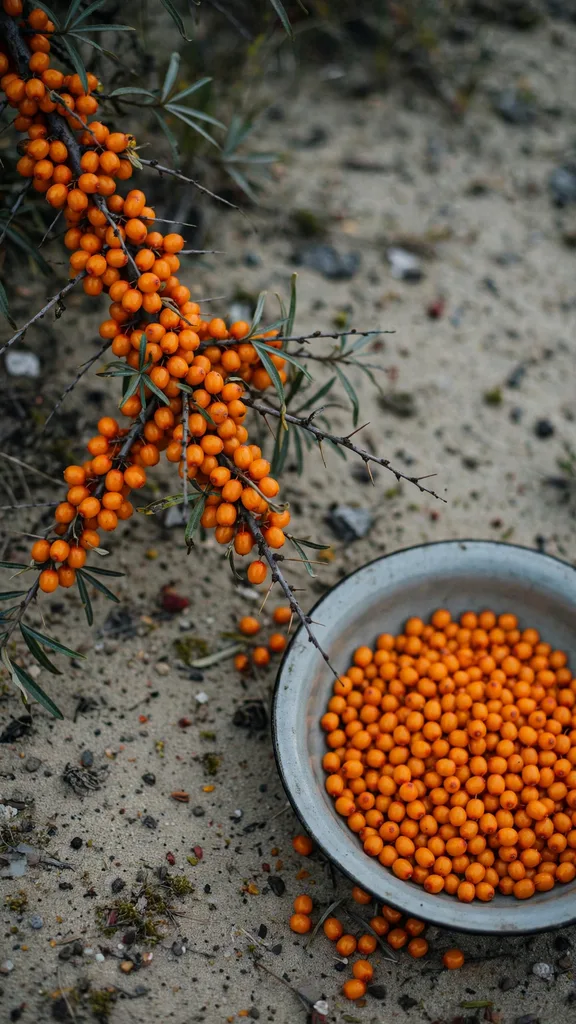
The picking is the hard part of the whole crop. Berries cling tight to short stalks along thorny branches, burst under a hard squeeze, and stain everything orange. Work branch by branch with thick gloves. Strip berries downward into a shallow container held under the branch, or snip whole fruiting laterals with secateurs and strip them at a table. Orchards freeze whole branches and shake the frozen berries free, and a home grower with 2 or 3 loaded laterals can run the same trick in a chest freezer overnight: frozen berries release clean and whole.
Expect the first real crop in year 3 or 4 from seed grown plants and year 2 or 3 from nursery shrubs, building as the framework matures. A mature female in a good year carries berries along every fruiting branch, kilograms of them from a single shrub, and the harvest window runs for weeks because the fruit holds on the branch without rotting. Pick in passes, taking the ripest branches first, and leave the last pass on the shrub if the kitchen has had enough: the berries persist into winter and feed birds through the cold months.
Use the fruit where acidity works. Juice blends with apple or carrot to drinkable sweetness, jam and jelly set fast on the natural pectin and acid, and a seaberry sauce cuts rich meat the way cranberry does. Freeze surplus berries whole on trays, then bag them: frozen fruit juices and cooks exactly like fresh through the winter. A shrub that fruits and then stands unused is the quiet failure of this crop. The tartness that puts pickers off raw is the whole value in the kitchen.
Another slow native fruit worth the same patience grows on this batch list: How to Grow Dewberry ripens weeks ahead of its blackberry kin on trailing canes. Seaberry takes the long game further, asking years for its first crop and then fruiting for decades.
Frequently Asked Questions
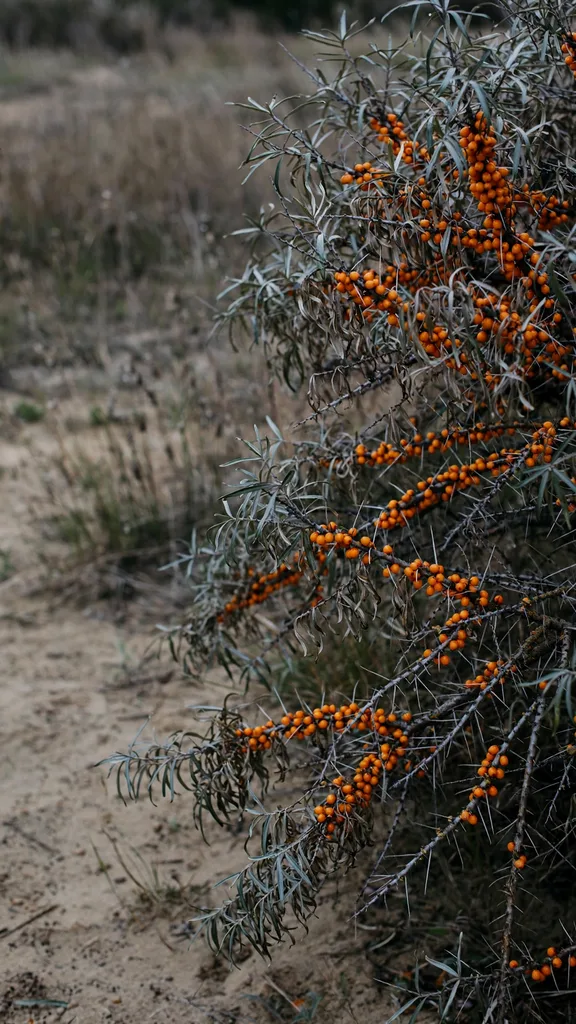
Plant 1 male for every 6 to 8 females. The male fruits never, flowers reliably, and pollinates every female within wind reach of its position in the row. A single shrub planting for fruit takes 2 plants, one of each sex, and a lone female of any age or size sets no berries at all without a male flowering nearby in the same spring weeks.
Give cleaned seed 90 days of cold moist stratification at 2 to 5 degrees Celsius, in damp sand or vermiculite in a refrigerator, or sow outdoors in autumn and let winter supply the same cold. Seed sown warm without the cold period germinates thinly and erratically across months. Label the bag on day one and sow the day the count ends.
The roots sucker freely and an unmanaged shrub forms a wide colony within a few seasons. Mow a strip along both sides of the row on the lawn schedule, dig out suckers that rise inside the row with their root section attached, and sink a barrier on the side facing beds or boundaries. Managed that way, a row holds its line for decades.
Nursery shrubs of named cultivars fruit in year 2 or 3 after planting. Seed grown plants fruit in year 3 or 4, and only the females fruit at all, with the sex hidden until the first flowering. The first crop is light either way. Heavy crops build as the framework of 2 and 3 year old fruiting wood fills out.
Yes, and expect a sharp, acidic bite closer to a lemon than to a raspberry. The berries are safe raw, rich in vitamin C, and eaten fresh in small handfuls by growers who like the tartness. Most kitchens cook them into juice, jam, jelly, or sauce, where sugar and blending tame the acid and the orange flavor carries the dish.
No routine feeding. Root nodules fix nitrogen from the air, and heavy feeding grows soft thorn wood and delays fruit. Yellow leaves point at waterlogging or extreme alkalinity first. Fix drainage before opening any fertilizer bag.
Hippophae rhamnoides rewards the gardener who plans the sex ratio, the cold, and the sucker line before the first hole is dug. Plant the male upwind, give the seed its 90 days, mow the border, and the orange crop arrives on schedule.