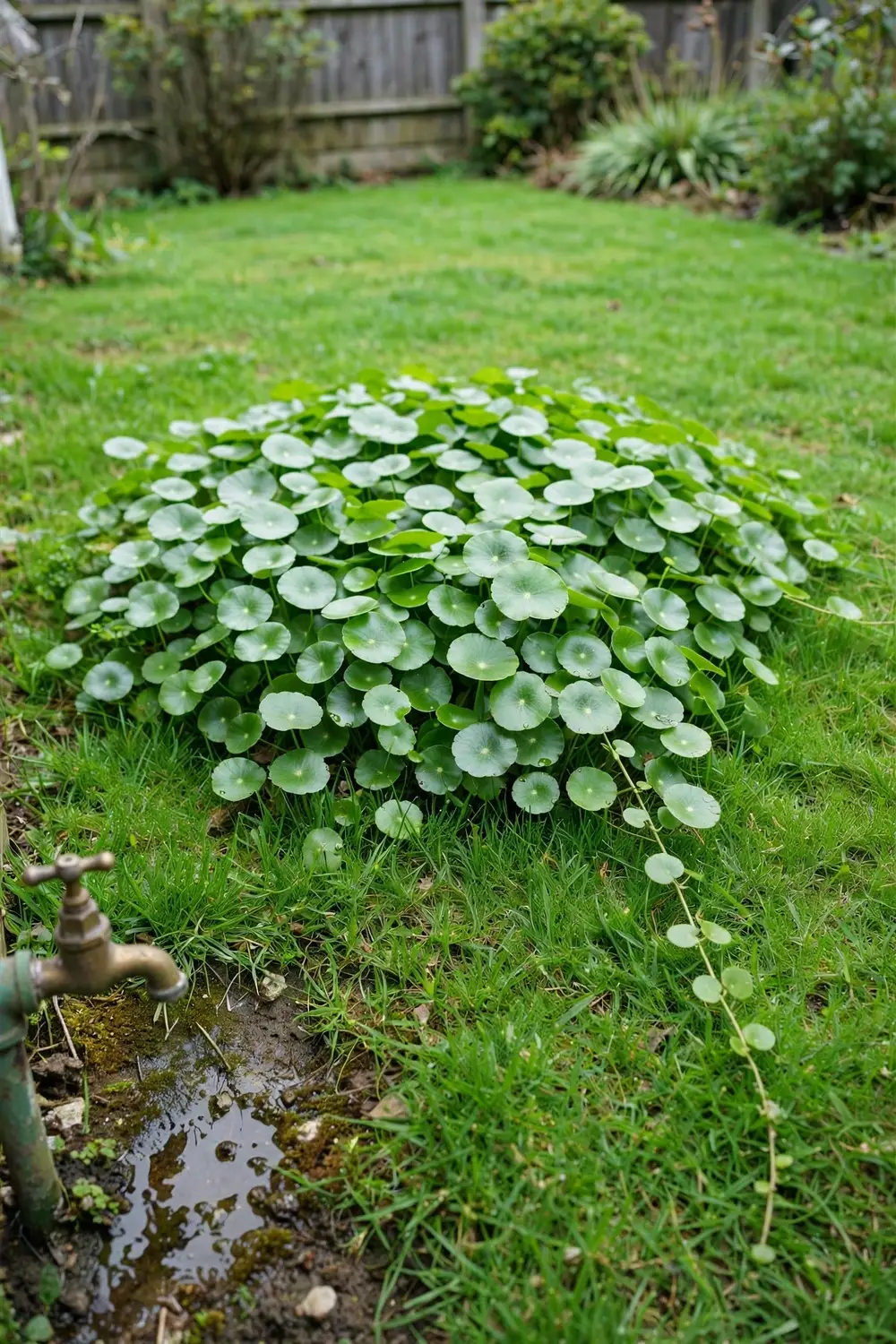

Pull every runner, fix the wet soil, and re-check in 14 days. That is how pennywort leaves a lawn. Pennywort in Australian lawns is usually Hydrocotyle bonariensis, known as Kurnell Curse. It spreads by creeping stems that root at the nodes, so a single pull that snaps the leaf stem leaves the runner behind to regrow.
I have learned that the pennywort I pull after rain comes out with its runners attached, while the pennywort I yank from dry soil snaps and regrows.
The rest of this page runs identity first, then removal, then the wet-soil and thick-turf fix that stops it coming back.
1. Name the Pennywort in Your Lawn Before You Touch It
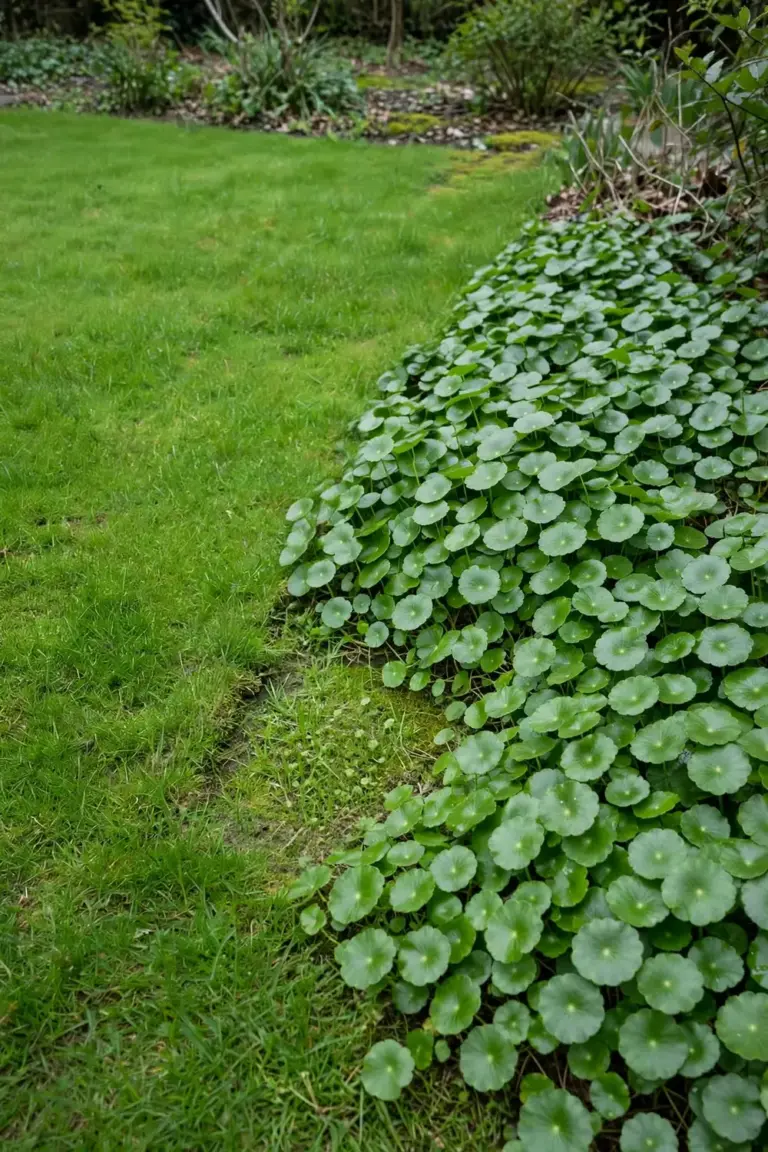
Name the plant first, because three round-leaved creepers share the lawn and only one is Kurnell Curse. Kurnell Curse is Hydrocotyle bonariensis. Its leaves are circular with shallow lobes and reach up to 12 cm wide, the stem joins the leaf in the center, and the underside of the leaf is dull, according to NSW WeedWise. WeedWise notes that this plant is very common and widespread in the Greater Sydney region, especially in lawns.
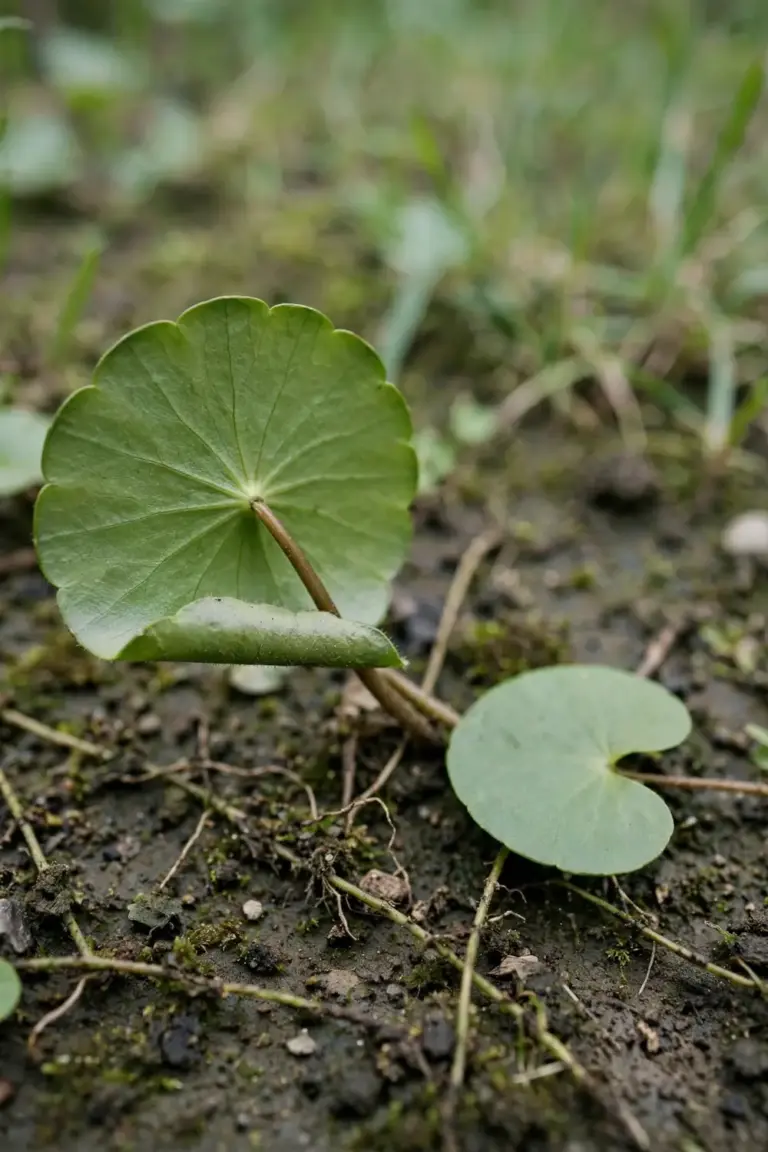
Dichondra is the closest lookalike in turf. Its leaf is kidney-shaped with the stem at the edge of the leaf, while pennywort carries the stem in the center of the leaf, according to Mississippi State University Extension. Dichondra is often a wanted lawn plant. Pennywort is not.
Dollarweed is the United States common name for the Hydrocotyle species that invade American lawns. Australian lawns carry Kurnell Curse. The control principles transfer. The labels do not.
Gotu kola is Centella asiatica, a different genus from pennywort. People also call it Indian pennywort. Do not eat lawn pennywort, and do not carry gotu kola claims about food or medicine onto a lawn weed. The two plants share a common name and nothing else that matters in the lawn.
Water pennywort is Hydrocotyle ranunculoides, a water weed confined to the Perth region. Its leaves can reach up to 18 cm wide, and it grows in waterways rather than lawns, according to NSW WeedWise. A round-leaved creeper in a dam or drain is a different job from a round-leaved creeper in turf. Do not treat a water weed with lawn products.
Native Australian Hydrocotyle species also exist. Stinking pennywort, Hydrocotyle laxiflora, is one endemic species. A native pennywort in a bush edge or a damp native bed deserves a different response from Kurnell Curse in a lawn. Leave native plants alone.
| Plant | Leaf | Stem | Habit |
|---|---|---|---|
| Kurnell Curse (Hydrocotyle bonariensis) | Round, waxy, stem joins the center, up to 12 cm wide | Creeping, roots at the nodes | Lawn mats in wet soil |
| Dichondra | Kidney-shaped, stem at the leaf edge | Creeping | Lawn plant, often wanted |
| Gotu kola (Centella asiatica) | Round, sharp V where the leaf joins the stem | Creeping | Moist shade, a different genus |
| Water pennywort (Hydrocotyle ranunculoides) | Round, up to 18 cm wide | Floating stolons | Waterways, Perth region |
Work from the table, not from memory. A center-joined stem plus a dull leaf underside plus a lawn mat in wet soil points to Kurnell Curse. An edge-joined stem points to dichondra. A plant in standing water points away from the lawn entirely.
Run three checks on the plant in front of you. First, lift a leaf and look at where the stem meets it: a stem that joins the middle of the leaf is the pennywort sign, while a stem that joins the edge is the dichondra sign. Second, flip the leaf and look at the underside. Kurnell Curse shows a dull underside. Third, trace the stem back to the ground and follow it along the soil, because a creeping runner that roots at the nodes confirms a Hydrocotyle, while a plant with no runner and no creeping stem is something else. Three checks take a minute. They save a season of treating the wrong weed.
2. Learn How Pennywort Spreads Across the Lawn
Pennywort spreads by creeping stems that root at the nodes and by seed. A stem that touches damp soil puts down roots at the next node and keeps going. A mat that looks like one plant is often one runner network with many leaves.
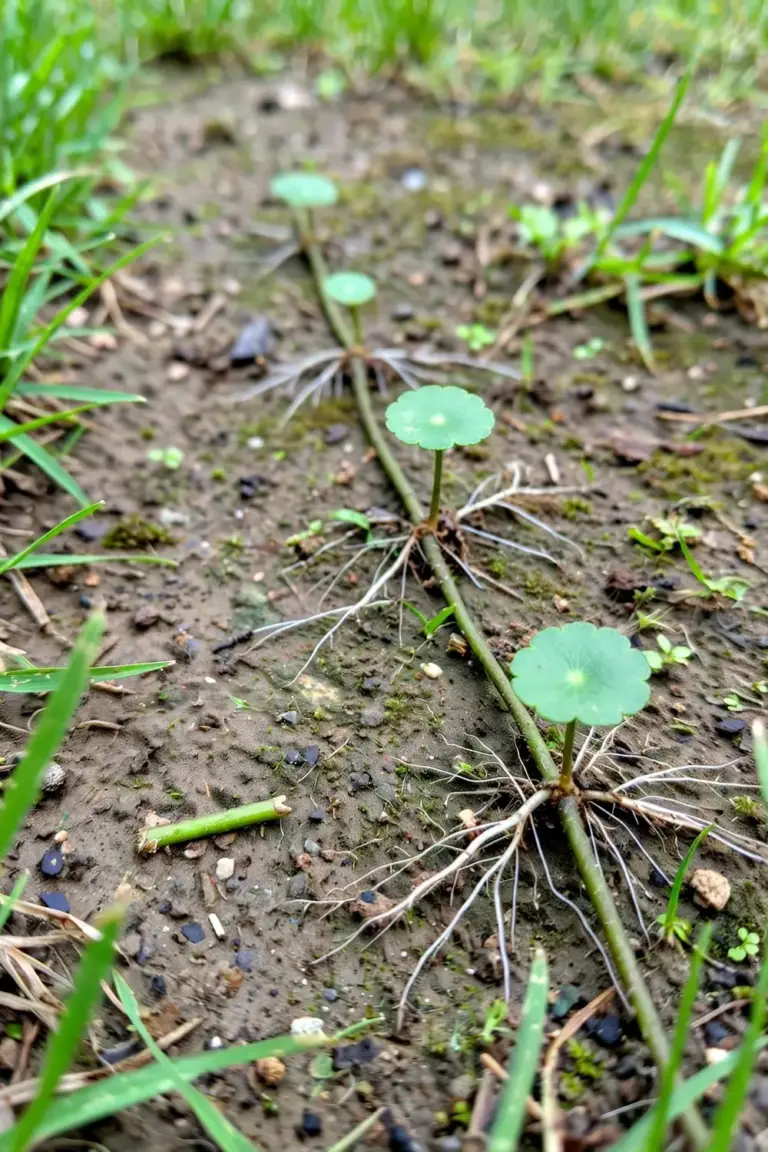
Fragments spread it too. A stem piece that breaks off during pulling or mowing can re-root where it lands. Every fragment is a new start. This fact shapes the whole removal method. Pulls must lift runners whole. Mowing must not scatter stem pieces across clean turf.
Seed plays a smaller role in the lawn than runners do. Runners do the fast work. Seed keeps the patch banked for the next wet season. Both matter, which is why removal plus a thick lawn beats removal alone.
Pennywort favours wet soil. It shows up where water sits, where irrigation runs too often, or where shade keeps the ground damp. A patch in a low spot or under a dripping tap tells you about water before it tells you about weeds.
Wet soil favours pennywort over grass for a simple reason. Grass roots need air in the soil to grow deep. Waterlogged soil squeezes the air out, so grass roots stay shallow and weak. Pennywort runs along the surface, so it never needs deep roots. A wet patch is a fair fight for the weed and an unfair fight for the grass. Drain the patch and the contest turns back in favour of the lawn.
Start scouting when average air temperatures reach 13 degrees Celsius, according to Gilba Solutions. Autumn is an ideal time to carry out control of this perennial weed, the same guide notes. Warm soil plus active growth makes every method work better than a winter attempt on dormant runners.
Pennywort follows the Australian seasons. Growth is strongest from spring through autumn, when soil is warm and rain is regular. Winter slows it. The runners stop extending, but they do not die. A mat that looks dead in July wakes up in September. Treat a winter mat as resting, not gone.
Autumn is the control window. The weed is still active, the soil is still warm, and the lawn has the cooler months ahead to close gaps. A spring pass catches the first flush of growth. An autumn pass catches the mat before winter rest. Both beat a mid-summer pass on dry, stressed turf, when pulling snaps stems and spraying stresses grass.
Seed keeps the patch banked even after the runners are gone. A mat that flowered last season dropped seed into the soil. That seed waits for the next wet spell. This is why one clean pull does not end the job. The runners are gone. The seed bank is not. Follow-up passes catch seedlings while they are small and their runners are short.
3. Hand-Pull Pennywort Without Leaving Runners Behind
Hand-pull small patches, and pull for runners, not for leaves. The leaf stem is weak. It snaps off and leaves the underground runner behind, and the plant regrows from that runner, according to Gilba Solutions. A pull that harvests leaves and leaves runners is wasted work.
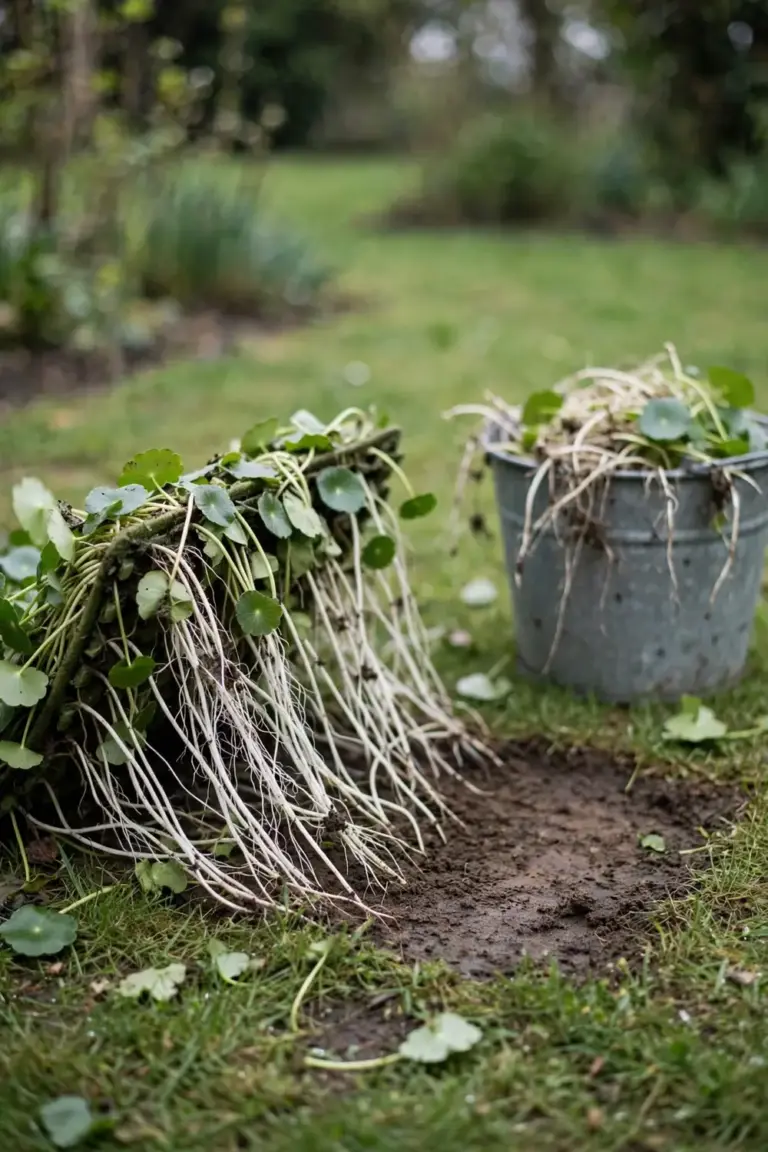
Water the patch first, or pull after rain. Wet soil lets runners slide out whole. Dry soil grips them and snaps the stems. Work from the edge of the mat inward, so you lift clean runners before you reach the dense center. Slide a hand fork under the mat and tease the runners out in one piece where you can.
Pull all the white rhizomes as well as the plant itself, according to University of Florida IFAS Gardening Solutions. The same guide notes that dollarweed appears in wet areas, so adjust irrigation or improve drainage in the area. A pull that leaves white runners behind buys two weeks, not a clean lawn.
Bag what you pull. Do not drop stem pieces on the lawn, and do not toss runners onto the compost heap. A fragment on damp soil re-roots. A fragment in a cool heap survives. Bag the mat, bin it, and sweep the area for loose pieces before you walk away.
Hand removal works best on patches you can finish in one session. Gilba Solutions notes that cultural or mechanical control is generally unsuccessful against this weed, and that hand removal of Hydrocotyle does not work well on large infestations. A mat the size of a door needs repeated passes, not one heroic pull. Pull, wait two weeks, pull the regrowth, and repeat until nothing comes back.
Re-check on a two-week rhythm through the growing season. New leaves at the old patch edge mean a runner survived. Pull it while it is small. A runner pulled at two weeks costs seconds. A runner left for two months rebuilds the mat.
Carry three tools. A hand fork lifts the mat without shredding it. A bucket holds the pulled runners so no fragment drops back on the lawn. A kneeling pad keeps you on the job long enough to finish the patch. Gloves help when the soil is gritty. None of these tools matter more than patience. The fork finds the runner. Patience lifts it whole.
Section a large mat into grids and work one square metre at a time. Clear it fully, bag the runners, and move to the next square. A grid keeps the job honest. A whole-mat attack pulls leaves from everywhere and runners from nowhere. Finish one square before you start the next, and mark the cleared edge with a stick so you know where to re-check.
4. Smother Pennywort With Shade and Mulch
Smothering works by cutting light. Coarse textured mulches like pine straw or pine mulch 5 to 10 cm deep help smother pennywort and limit invasion in ornamental beds, according to Mississippi State University Extension. Landscape fabrics under the mulches also help reduce emergence, the same guide notes. Mulch depth matters. A thin scatter feeds the weed. A deep blanket starves it.
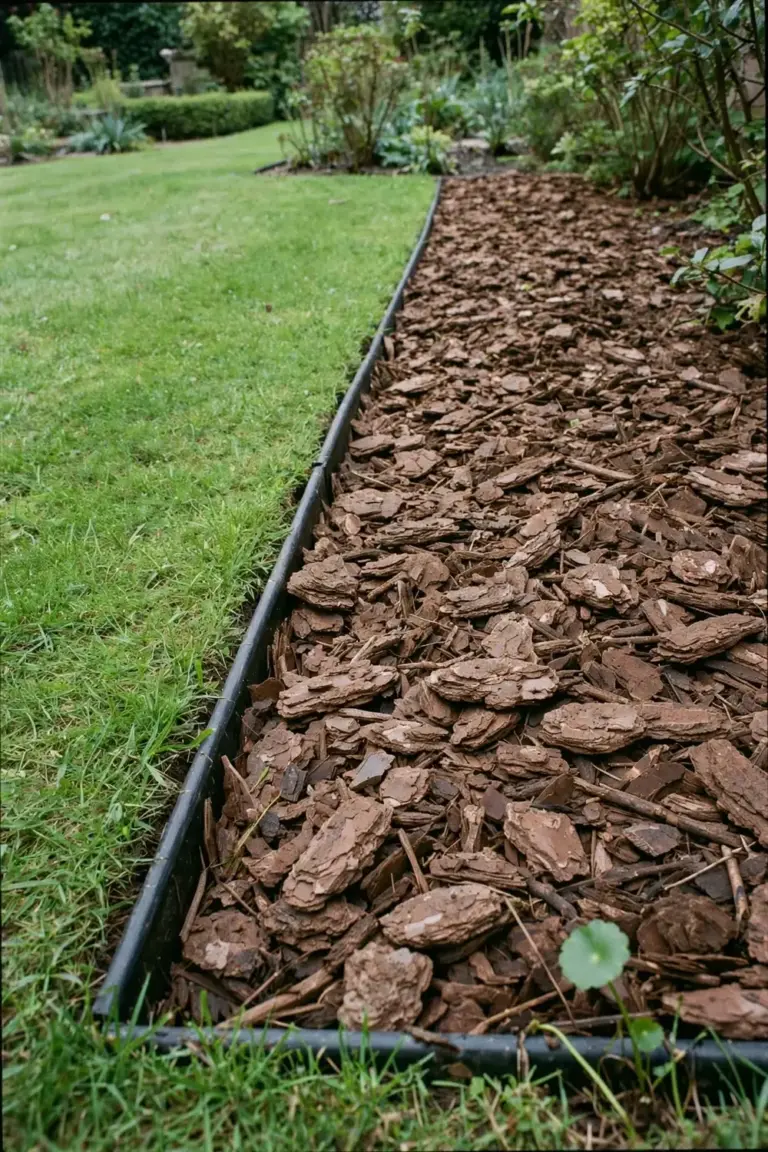
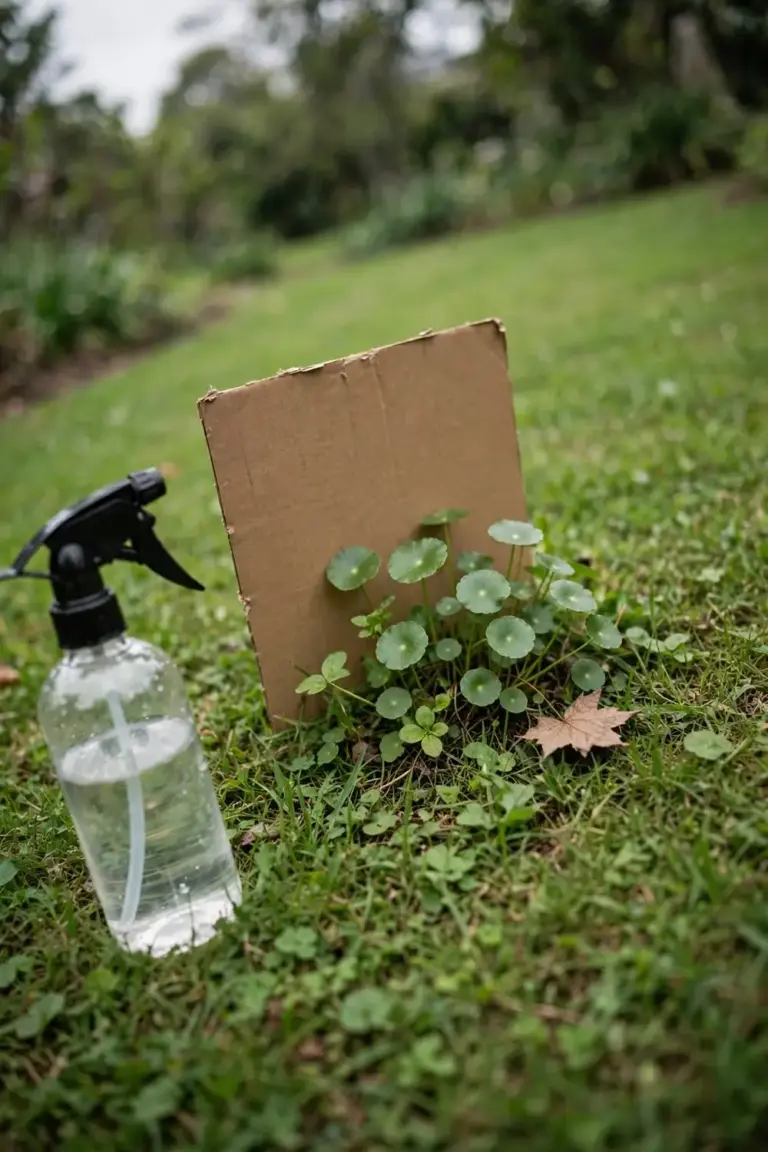
Smothering kills lawn grass too. Do not lay cardboard and mulch across a lawn patch and expect the grass to survive underneath. Cardboard plus mulch belongs on bed edges, on paths, and on patches you plan to re-turf. On a lawn you want to keep, shade comes from dense turf, not from a blanket.
Dense turf is the lawn version of smothering. A thick grass canopy shades the soil surface, dries it faster after rain, and leaves no bare ground for runners to colonise. A thin lawn invites pennywort. A thick lawn starves it of light at the soil line.
Mowing does not smother pennywort. Gilba Solutions notes that mowing to directly control Hydrocotyle is most likely going to result in poor results, because although it removes taller plants, those under the mower blades are not affected and can continue to spread. Mow to keep the lawn dense and healthy, not to kill the weed. The blades pass over the mat.
Use smothering on the edges where the lawn meets the bed. Pennywort creeps in from damp bed edges, from under fences, and from low spots near taps. A mulched bed edge with a clean hard border stops runners at the boundary. An unmulched edge feeds them.
Leave no bare soil behind. A cleared patch is an open invitation until grass covers it again. Runners from the next mat will colonise bare ground faster than grass seed or turf will. Close the gap as soon as the patch is clear. A thick lawn edge, a filled low spot, and a mulch-topped bed edge all serve the same purpose. Bare soil serves the weed.
5. Spot-Spray Only With the Label in Your Hand
Spray is the last tool, not the first. Pull first. Fix the water second. Spray only what survives both. A spray that kills leaves and leaves runners behind buys the same two weeks as a bad pull.
United States extension pages list herbicide classes for dollarweed in turf. Pre-emergence options include atrazine and isoxaben, and post-emergence options include 2,4-D, dicamba, imazaquin, and metsulfuron, according to Mississippi State University Extension. Glyphosate can control pennywort, but it kills turfgrass too when it lands on green plant parts, the same guide notes. Those listings describe United States dollarweed and United States labels. Australian labels govern here.
Read the label before you buy anything. Check three things: the weed name on the label, the turf type on the label, and the rate and safety directions. A product that lists dollarweed but not your turf type is not a safe pick. A product that lists your turf type but not pennywort is not a safe pick either.
The buffalo trap is real. Australian lawn-care guides warn that dicamba-based broadleaf products damage buffalo turf, and dicamba is not registered for Kurnell Curse in Australia. Do not use a product off-label on buffalo. Do not assume a United States listing transfers to an Australian label. The label is the only authority that counts.
Spot-spray, never broadcast, when you do spray. Mix only what the patch needs. Spray on a calm day with no wind drift. Shield desirable plants with cardboard. Keep children and pets off the area until the label says it is safe. One careful spot-spray on a small patch beats a broad spray across a lawn that did not need it.
Expect follow-up. Herbicide that kills the leaves does not always kill the runners. Re-check in two weeks and pull or re-treat regrowth on-label. A spray program with no follow-up is a spray program that fails.
Spray when the weed is actively growing. A dormant runner in winter takes up little spray. A drought-stressed plant takes up little spray. Wait for active growth, moist soil, and mild weather. Do not spray before rain, and do not spray on a windy day. Rain washes the product off the waxy leaves. Wind carries it onto plants you want to keep.
If the spray fails, change the method, not the dose. Never exceed the label rate. A failed spray usually means the timing was wrong, the coverage was thin, or the runners survived under the mat. Pull the regrowth by hand, fix the water, and try once more on-label in the next window. A stronger mix off-label risks the turf and breaks the law. The label rate is the ceiling, not a starting point.
Clean up after every spray. Rinse the sprayer three times and pour the rinse water onto the treated patch, never into a drain or onto clean lawn. Wash gloves and hands with soap and water. Bag any pulled runners the same day. A sprayer left dirty carries residue into the next job, and a pile of pulled runners left on the lawn re-roots in the first rain.
6. Starve Pennywort by Fixing Wet Soil and Thick Turf
Pennywort is a moisture signal. A lawn that stays wet grows pennywort. A lawn that dries between waterings grows grass. Fix the water and the weed loses its edge.
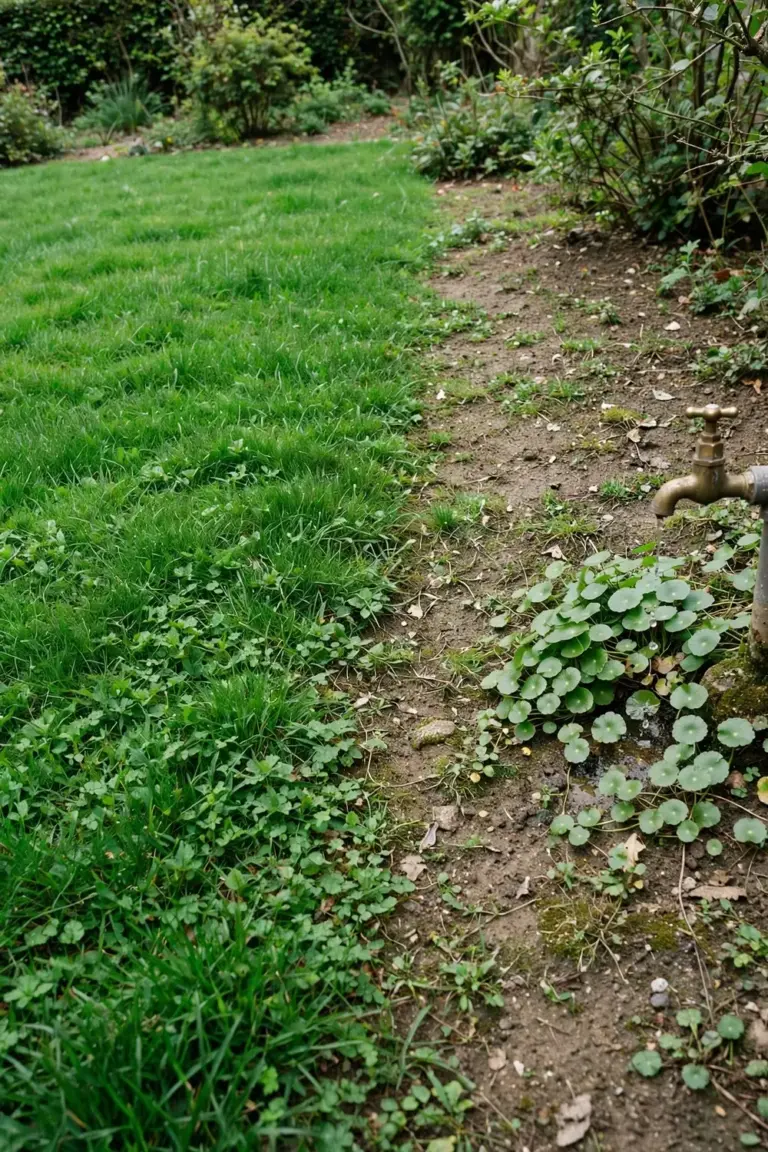
Dollarweed usually appears in places where a gardener has overwatered or in naturally wet places, according to University of Florida IFAS Gardening Solutions. The same guide advises adjusting irrigation or improving drainage in the area. Water deeply and less often. Let the top soil dry between waterings. A lawn that stays soggy after every watering invites the mat back.
Reducing irrigation frequency results in less Hydrocotyle, according to research cited by Gilba Solutions. Do not overwater, and fix any drainage issues that cause wet soils, the same guide advises. Low areas that drain poorly are ideal for Hydrocotyle. Fill a low spot, clear a blocked drain, or move a downpipe outlet that dumps water onto the lawn.
Shade keeps soil damp longer. Turf in shade remains damp for longer, according to Gilba Solutions. Prune a low branch that shades the patch all day. Thin a hedge that blocks the breeze. Sun and air dry the surface between waterings, and dry surface soil slows runners.
Set a watering rhythm the weed cannot use. Water deeply and less often. Push a finger into the soil to the second knuckle before you water. Water only when the top 3 cm feel dry. A lawn watered on a timer stays wet whether it needs water or not. A lawn watered by feel dries between sessions, and dry surface soil starves runners at the soil line.
Check compaction where the mat sits. Press a screwdriver into the soil. Soil that resists the screwdriver stays wet on top and dry below, which suits pennywort and starves grass roots. Aerate the compacted area so water moves down instead of pooling on top. A lawn that drains through its profile grows grass deep. A lawn that ponds on top grows pennywort shallow.
Feed the lawn so it fills in behind the weed, because a thick lawn is the long-term control. Fertilising a lawn in spring sets the feeding window, and building soil health sets the base the grass needs to stay dense. A fed lawn closes gaps. A starved lawn leaves gaps for runners.
Mow at the right height for your turf type. A dense, thick turf cover goes a long way toward the control of Hydrocotyle, according to Gilba Solutions. Short scalped grass exposes soil and invites runners. Grass cut at its proper height shades the soil and crowds the weed. The spring lawn care tips guide sets the seasonal rhythm for mowing, feeding, and watering.
7. Decide When Pennywort Is a Lawn Problem or a Garden Problem
A lawn patch is a lawn problem. Runners in turf need pulling, water fixes, and thick grass. The lawn tools are the fork, the bag, the irrigation timer, and the mower. Keep them in that order.
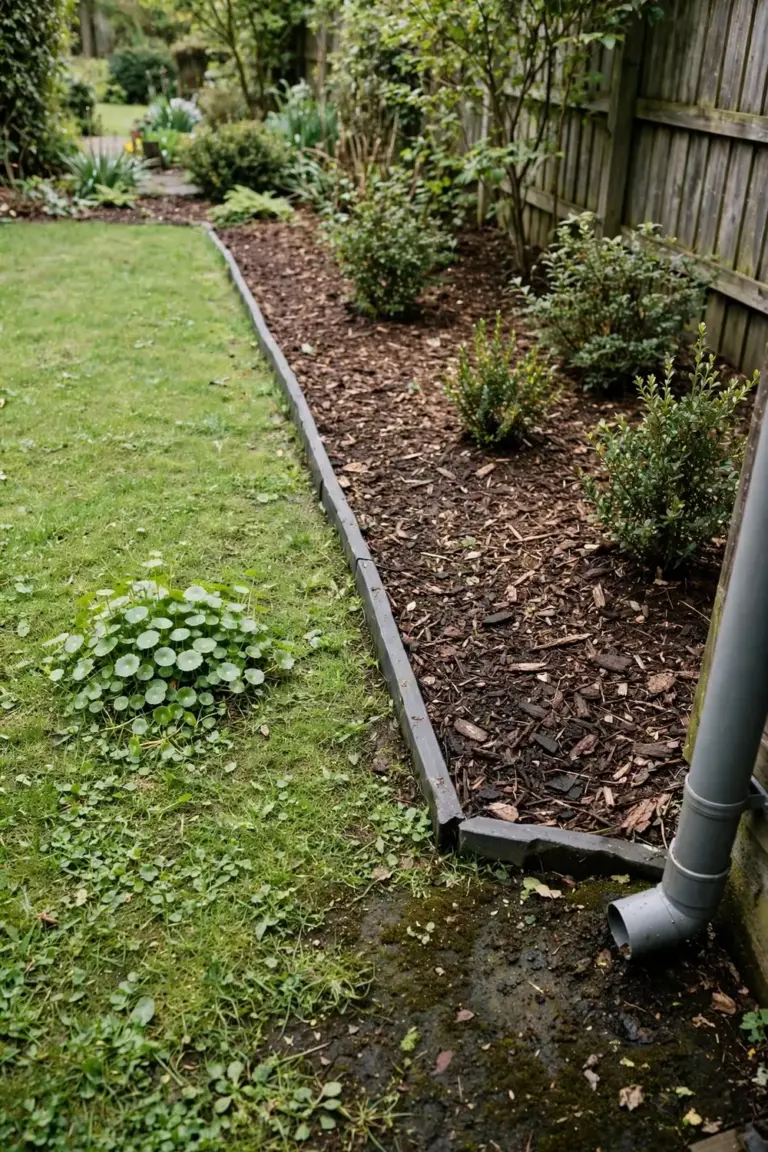
A bed patch is a garden problem. Mulch 5 to 10 cm deep, landscape fabric under the mulch, and hand-pulling work in beds, according to Mississippi State University Extension. Few effective herbicides are available in ornamentals, the same guide notes. Cultural practices and mulches are the best defence in beds. Do not spray a bed full of broadleaf ornamentals with a broadleaf weedkiller. The spray cannot tell the weed from the shrub.
A waterway patch is not your job to spray. Water pennywort in a dam, drain, or creek belongs to the local council or the state weeds authority. Do not pour lawn herbicide into water. Do not pull water weeds and dump them on the bank, where fragments wash back in. Report it and follow the authority’s directions.
A native pennywort is not a weed at all. Hydrocotyle laxiflora and other native species belong in native beds and bush edges. Learn the difference before you pull. A center-joined waxy leaf in a lawn mat is Kurnell Curse. A native pennywort in a damp native bed is a keeper.
Call a contractor when the patch is bigger than you can finish in two sessions, or when it runs onto a steep bank, a dam wall, or a creek edge. Large mats need repeat passes with disposal, and waterway edges need a licensed operator with the right permits. A contractor also helps when the patch sits across a boundary fence, where runners cross between two properties. One property treated while the other is ignored means the mat returns from next door.
Frequently Asked Questions About Pennywort in Lawns
No. Mowing trims the leaves and leaves the runners untouched. Gilba Solutions notes that mowing to directly control Hydrocotyle gives poor results, because plants under the mower blades keep spreading. Mow to keep the lawn dense and healthy, not to kill the weed. Pull the runners, fix the water, and let thick grass shade the soil.
Pennywort smothers grass under a dense mat, but it rarely kills an established lawn outright. It wins in thin, wet, shaded turf where grass already struggles. A thick, well-fed lawn holds its ground. A thin, soggy lawn loses ground to the mat. Fix the thin lawn and the weed loses its advantage.
No. Do not eat lawn pennywort. Kurnell Curse is Hydrocotyle bonariensis, a lawn weed. Gotu kola is Centella asiatica, a different genus with its own food and medicine uses. A shared common name does not make the plants interchangeable. Eat only plants you have identified with certainty and grown for food.
Only with a label that names both pennywort and buffalo turf. Read the label before you buy. Australian lawn-care guides warn that dicamba-based broadleaf products damage buffalo turf, and dicamba is not registered for Kurnell Curse in Australia. Do not use a product off-label on buffalo. Pull small patches by hand and fix the water first.
Plan on a season of follow-up, not a single weekend. Pull the mat, fix the water, and re-check every two weeks through the growing season. Each pass removes runners the last pass missed. A small patch can clear in a few passes. A large mat needs repeated passes across the season. Stop only after two clean checks in a row.
Walk the Lawn Again in Two Weeks
How to get rid of pennywort in lawns comes down to runners, not leaves. Name it first. Pull every runner whole, fix the water that invited it, and feed the grass that replaces it, because spray alone never finishes the job. Spray only on-label, only as a spot treatment, and only after the pull and the water fix.
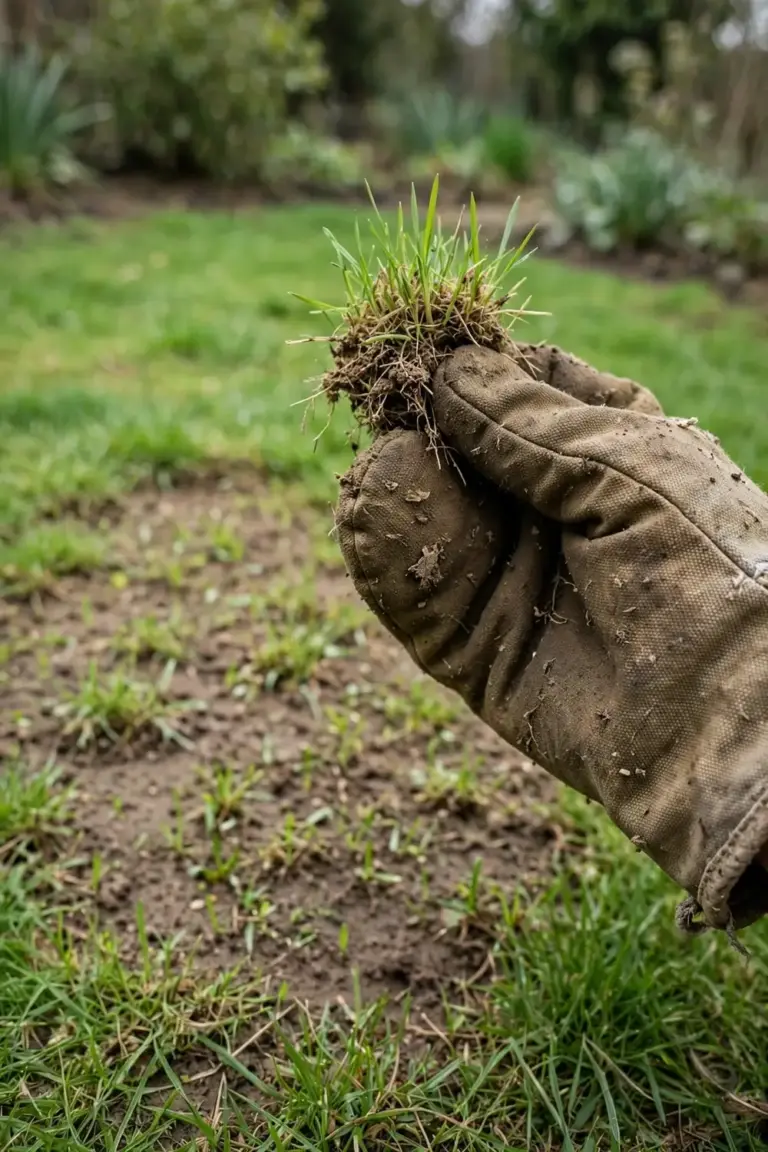
Walk the lawn again in two weeks and pull the regrowth while it is small. A patch checked every two weeks shrinks, while a patch ignored for two months rebuilds the mat. The second pass is the one that wins, because the first pass finds the mat and the second pass finds the runners the first pass missed.