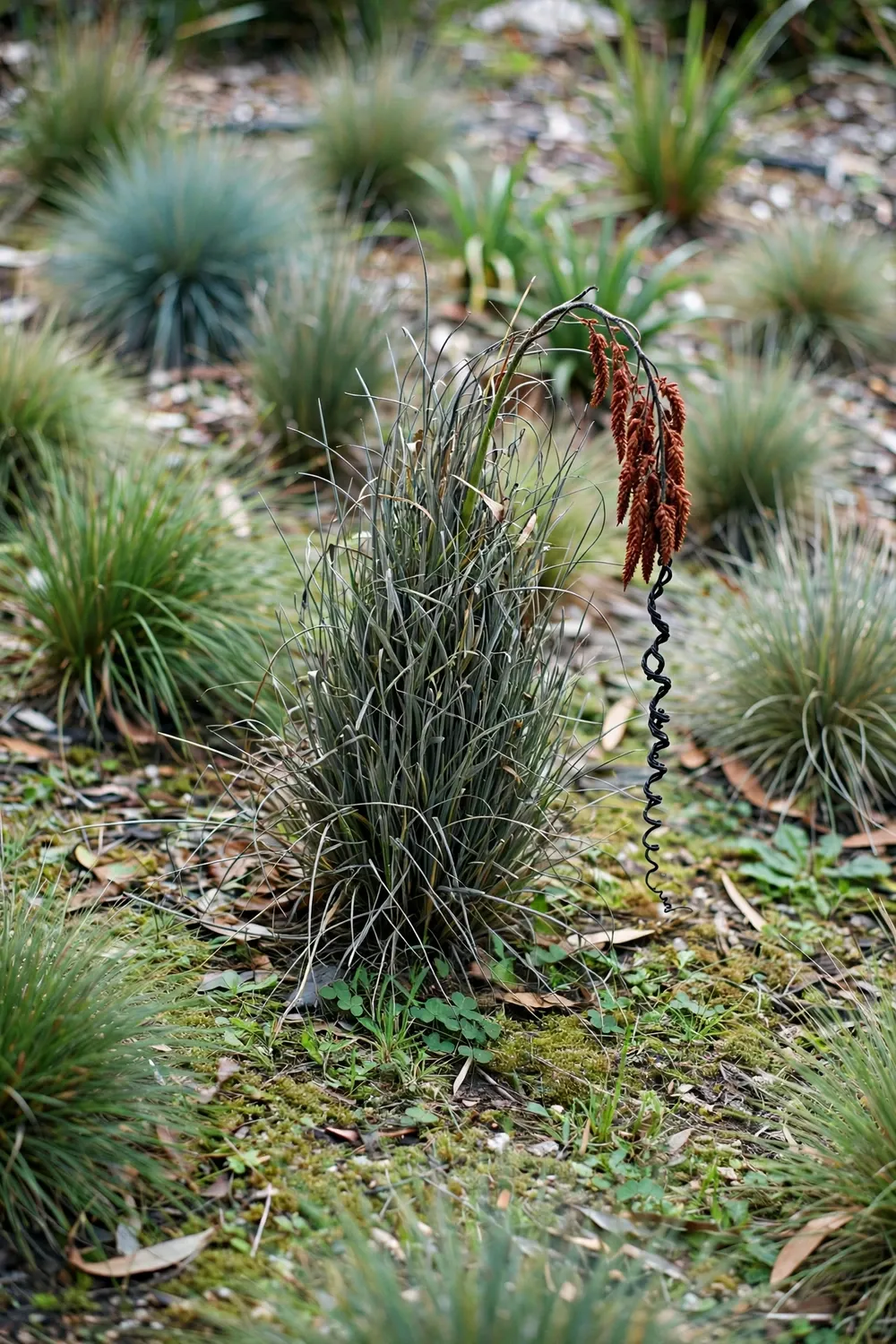

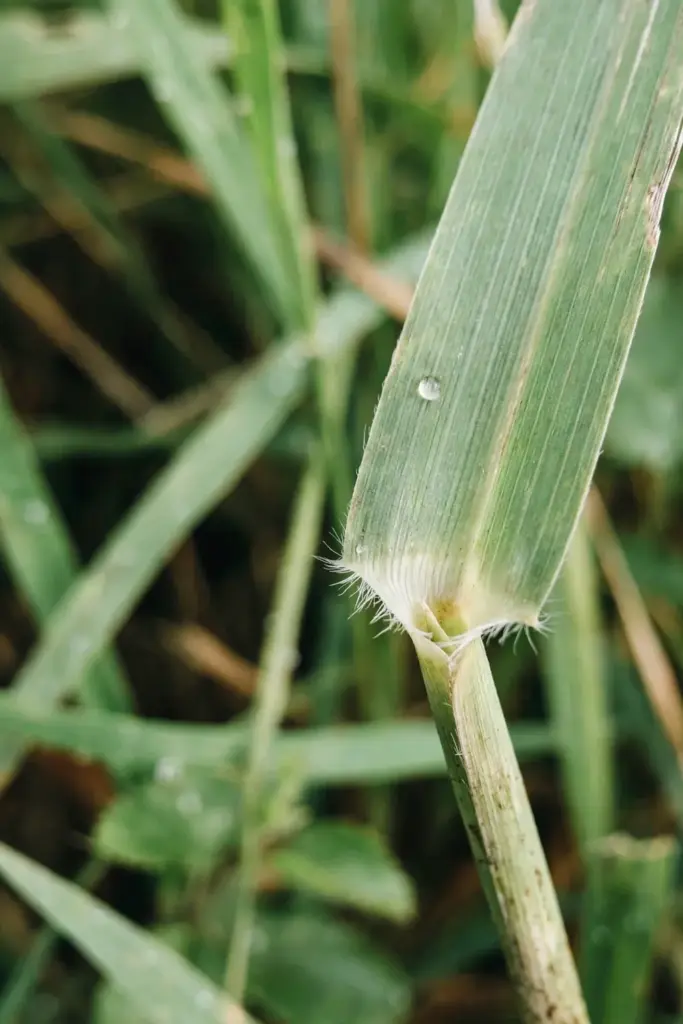
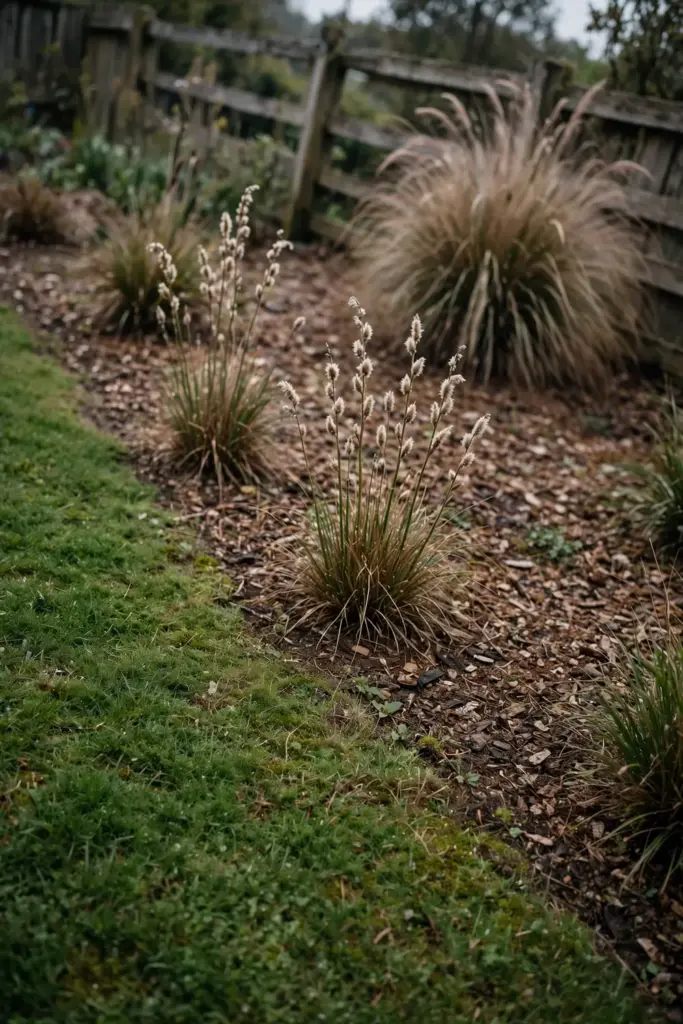
Australian grass identification starts with three photographs: the whole clump, one leaf pulled flat, and one seed head. Those three shots separate a lawn grass from a native grass and an ornamental grass in most cases. A grass that still puzzles you after those three shots usually needs the 5-mark check below, starting at the ligule.
I have learned that the seed head settles more arguments than the leaf ever does.
The rest of this page runs 12 grasses through 5 marks: growth form, leaf, ligule, seed head, and roots. Four sit in lawns, five grow wild as natives, and three stand as ornamentals. Read the marks in order. Name the grass before you decide what it means.
Read 5 Marks Before You Name a Grass
Five marks name a grass: growth form, leaf, ligule, seed head, and roots. Work through them in that order. Growth form splits the field fast. Leaf and ligule narrow it further. The seed head usually closes the case.
Growth form comes first, and a tussock grass grows as a clump from one crown. A runner grass spreads sideways. Stolons run above the ground and root at the nodes. Rhizomes run below the ground and send up new shoots. A grass with both stolons and rhizomes forms a mat that is hard to lift in one piece. A tussock grass lifts as one crown with deep roots.
Leaf shape comes second. Pull one leaf flat between your fingers and note the width, the tip, and the feel: a broad flat blade with a rounded tip points one way. A narrow rolled blade with a sharp tip points another. Hairs on the blade or the sheath count as a mark. A rough leaf that drags against your fingertip is a mark too.
The ligule sits where the blade meets the sheath. Peel the blade back gently and look at the junction, where a ligule can be a thin membrane, a fringe of hairs, or a rim of hairs. Some grasses show almost no ligule at all. The ligule separates lookalikes that share leaf shape and growth form. Couch grass shows a ring of white hairs. Kangaroo grass shows a rim of hairs, and those two marks are small and decisive.
The seed head is the flower of the grass. Grasses are wind-pollinated, so their flowers are plain spikelets grouped into a head, never showy petals. Read the shape of the whole head. A spike holds spikelets tight against one stem. A panicle spreads them on branches. A windmill head fans spikes out from one point like spokes. A bottlebrush head packs them into one dense cylinder. A seed head that fans into fingers belongs to a short list of grasses.
Roots confirm the growth form. Dig one small edge with a trowel. Stolons show as thick runners on the surface. Rhizomes show as pale underground stems with nodes. A tussock shows a fibrous crown with no runners, and the roots also read the soil under the grass, and building soil health covers the soil side of the job in full.
Three families look alike and cause most misidentifications. Sedges have edges. Roll a sedge stem between your fingers and you feel three flat faces. Rushes are round. A rush stem feels smooth and round with no joints. Grasses have nodes. Run a finger up a grass stem and you feel the swollen joints where leaves attach. The Illinois Extension guide to telling apart grasses, sedges, and rushes states the same rhyme and adds that plants do not always follow the rules, so treat it as a strong first test and confirm with the seed head.
Season gives one more clue. Cool-season grasses grow strongest in autumn, winter, and spring. Warm-season grasses grow strongest in summer. Wallaby grass and spear grass grow most in the cool months. Kangaroo grass is a C4 grass that grows strongest in summer heat. A grass that greens up in winter while its neighbors sleep is telling you its season.
Grass-like plants add a last trap. Lomandra, dianella, and grass trees carry long narrow leaves and clumping habits, yet none of them is a grass. Their flowers prove it. Lomandra and dianella flower with petals. A grass tree carries a tall flower spike that no grass matches. Nutgrass is a sedge. Its triangular stem gives it away under your fingers. Check the stem before you name any of them.
Compare the 12 Grasses at a Glance
The table below lines up all 12 grasses on the same 5 marks. Use it to narrow a grass to two or three candidates, then read the full entry for the winner. The deciding mark sits in the last column.
| Grass | Growth Form | Leaf Clue | Seed Head | Roots | Deciding Mark |
|---|---|---|---|---|---|
| Buffalo Grass | Mat | Broad flat blade, rounded tip | Flattened spike | Thick stolons | Broad leaf plus thick runner |
| Couch Grass | Mat | Fine gray-green blade | Finger-like spikes | Stolons and rhizomes | Finger-like seed head |
| Kikuyu Grass | Mat | Hairy light-green blade | Hidden, few spikelets | Thick stolons and rhizomes | Hairy leaf plus thick mat |
| Zoysia Grass | Mat | Fine dense blade, sharp tip | Single spike | Stolons and rhizomes | Single spike seed head |
| Kangaroo Grass | Tussock | Gray-green blade, rim-of-hair ligule | Large red-brown head, twisted awn | Deep fibrous crown | Red-brown head with twisted awn |
| Wallaby Grass | Tussock | Fine narrow blade | Fluffy white at maturity | Fibrous crown | Fluffy white seed head |
| Weeping Grass | Mat or tussock | Fine arching blade | Weeping panicle | Rhizomes | Weeping seed head |
| Spear Grass | Tussock | Fine rolled rough blade | Open panicle, scythe awn | Fibrous crown | Long scythe-shaped awn |
| Common Tussock Grass | Tussock | Long blue-green blade | Delicate plume | Shallow fibrous crown | Plume above tall tussock |
| Swamp Foxtail Grass | Clump | Arching blade | Bottlebrush, purple-brown | Deep fibrous crown | Bottlebrush seed head |
| Windmill Grass | Low clump | Blunt-tipped blade | Windmill spokes | Short stolons | Windmill seed head |
| Pampas Grass | Giant clump | Long arching blade, razor edge | Tall plume | Dense crown | Plume above head height |
1. Buffalo Grass
Buffalo grass gives a lawn a broad flat leaf and a thick runner that roots at every node. The leaf is the widest of the four lawn grasses on this page. The runner is thick enough to feel through the turf with a bare hand. Those two marks name it before any seed head appears.
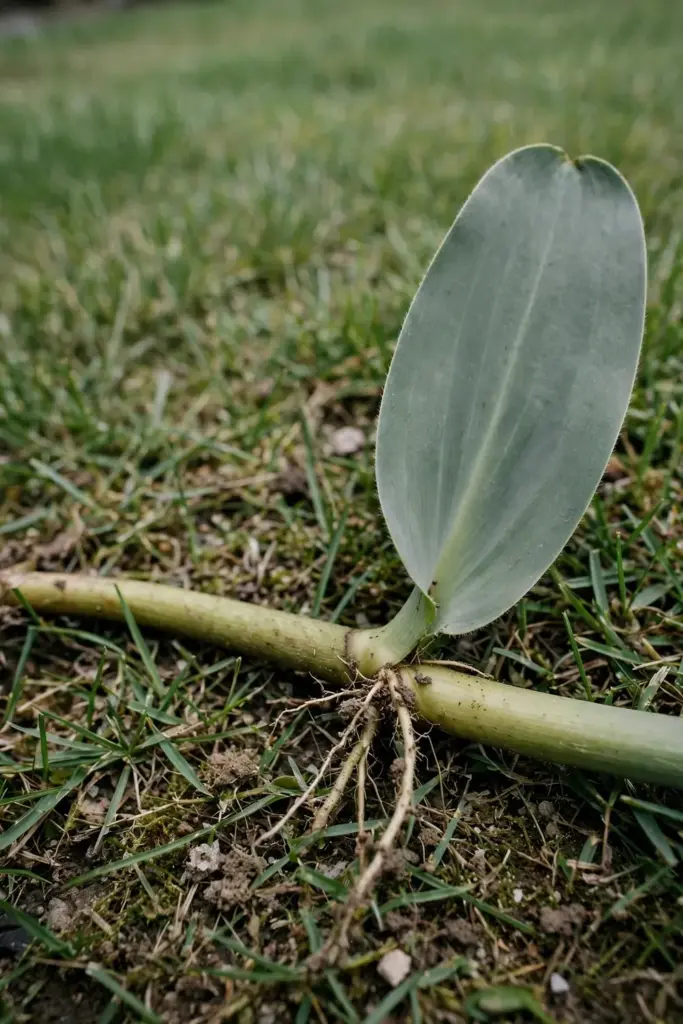
The blade runs broad and flat with a rounded tip. The color reads dull gray-green to blue-green. The sheath hugs the stem and the blade spreads wide from it. A buffalo leaf feels soft and folds without resistance. A couch leaf feels fine and wiry beside it. A kikuyu leaf feels hairy beside it. Width plus softness separates buffalo from the other three lawn grasses.
Stolons carry the spread. Buffalo spreads by thick above-ground runners that root where each node touches soil. Lift one runner and the nodes show roots and a new shoot. The mat grows dense and crowds out bare patches. The seed head is a flattened spike that sits low and shows rarely in a mown lawn. An unmown patch shows it first. Skip the seed head when the lawn is mown. The leaf and the runner decide it.
2. Couch Grass
Couch grass gives a lawn a fine gray-green blade and a seed head that fans into finger-like spikes. The seed head is the fastest mark in the whole article. An unmown patch of couch shows the full fan. A mown lawn hides it, so read the leaf and the runners instead.
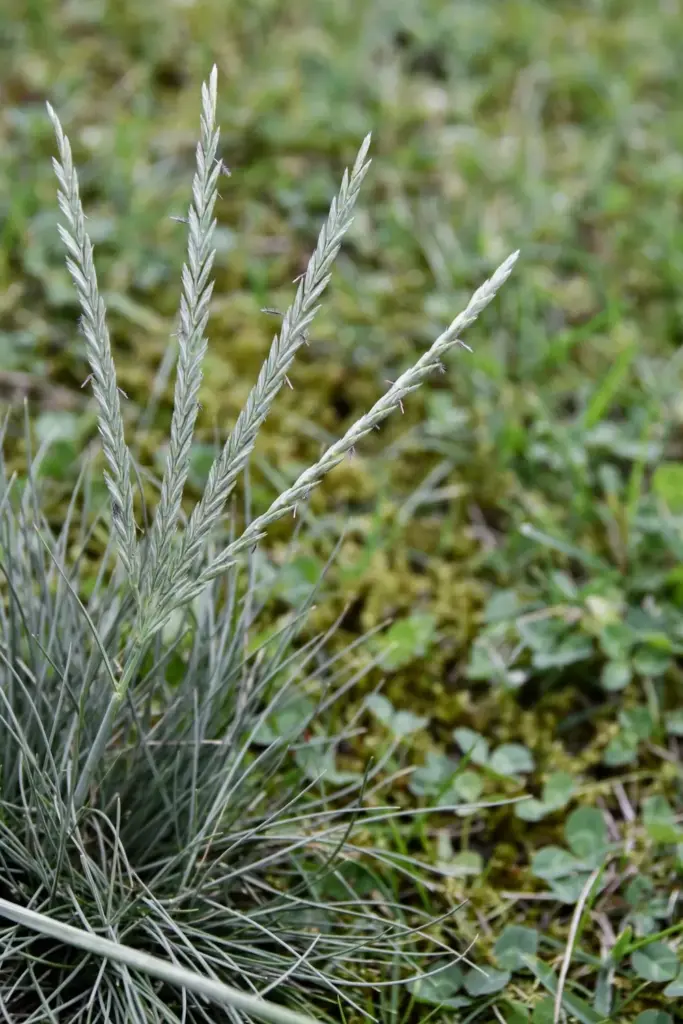
The blade runs fine and gray-green with rough edges. The tip comes to a point. The sheath may carry sparse hairs near the base. The ligule shows as a ring of white hairs where the blade meets the stem. That ring of hairs is small and worth a close look. Couch shares it with few lawn grasses. A hand lens makes it plain.
Couch spreads two ways at once. Stolons run above the ground while rhizomes run below it. Both root at nodes and both send up new shoots. That double spread builds a dense mat that survives heat and wear. The roots run deep in penetrable soil and hold the mat through dry spells. The seed head fans into finger-like spikes from one point at the stem tip, so count the fingers: the shape reads like a small hand, and no other lawn grass on this page carries that fan.
3. Kikuyu Grass
Kikuyu grass gives a lawn a hairy light-green leaf and a mat so thick it feels springy underfoot. The hair is the first mark. Run a finger along the blade and the hairs catch the skin. The mat is the second mark. A kikuyu mat resists a trowel more than a buffalo mat does.
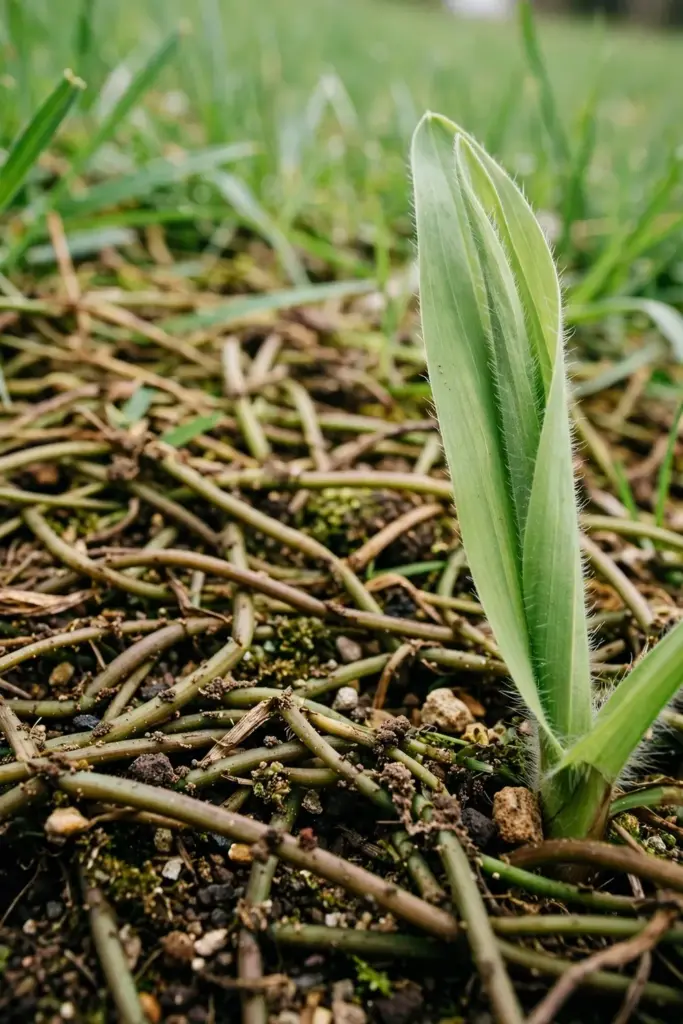
The blade runs light green and hairy, with a folded shape along the midrib. The sheath carries hairs too. The ligule shows as a hairy fringe. The leaf feels coarse beside zoysia and soft beside spear grass. The color reads lighter than buffalo and lighter than couch. Light green plus hairy plus folded names kikuyu from the leaf alone.
Kikuyu spreads by thick stolons and rhizomes that knit a dense mat, run above and below the surface, root at every node, and climb over edging and into beds when left alone. The seed head stays hidden. Kikuyu produces few spikelets tucked low in the leaf axils, and a mown lawn rarely shows any. Skip the seed head on kikuyu. The hairy leaf and the thick mat decide it.
4. Zoysia Grass
Zoysia grass gives a lawn a fine dense leaf and a single spike for a seed head. The density is the first mark. A zoysia lawn feels like a carpet with no gaps. The seed head is the second mark. One spike stands alone where couch shows a fan.
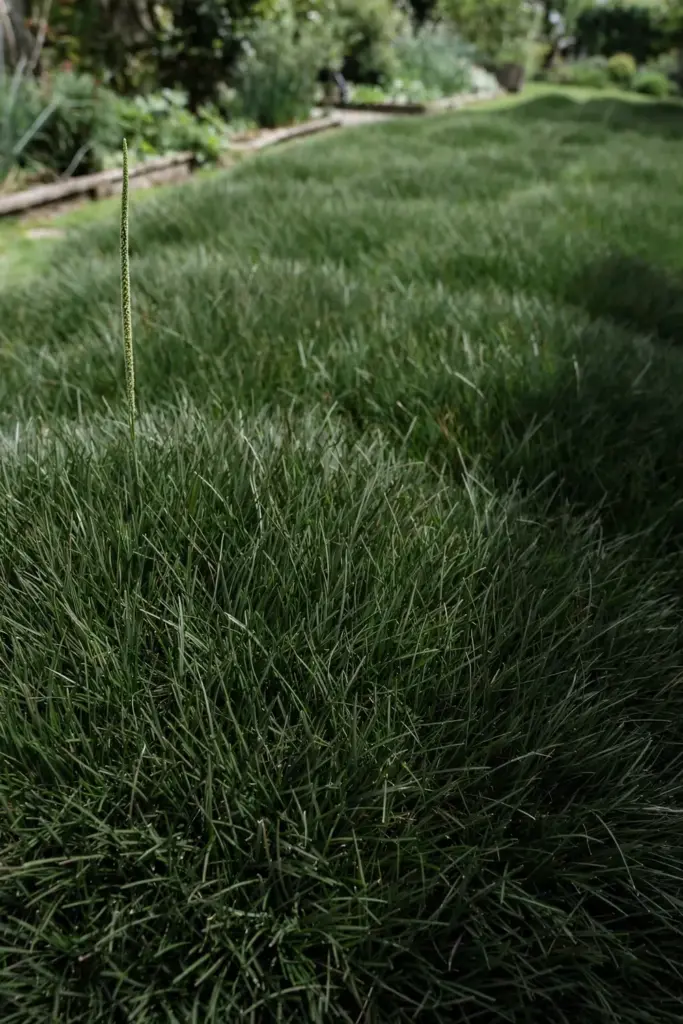
The blade runs fine to medium, dark green, with a sharp tip. The leaf feels smooth and dense in the hand, with a texture finer than buffalo and finer than kikuyu. The ligule is short and hairy. Auricles are absent. The leaf arrangement rolls in the bud, which a cross-section of a young shoot shows. Those small marks matter because zoysia and couch share stolons and rhizomes.
Zoysia spreads by stolons and rhizomes like couch, and the two grasses confuse readers in lawns. The seed head separates them. Zoysia carries a single spike-like raceme. Couch fans into fingers. A lawn that shows single spikes on unmown stems is zoysia. A lawn that shows fans is couch. Zoysia grows slowly and fills gaps late. The mat turns brown in cold months and greens again with warmth.
5. Kangaroo Grass
Kangaroo grass gives a native patch a tall tussock and a large red-brown seed head with a twisted black awn. The seed head is the loudest mark of any native grass on this page. It droops, it colors red-brown, and it carries a long awn that twists like a corkscrew. No other grass on this page matches that head.
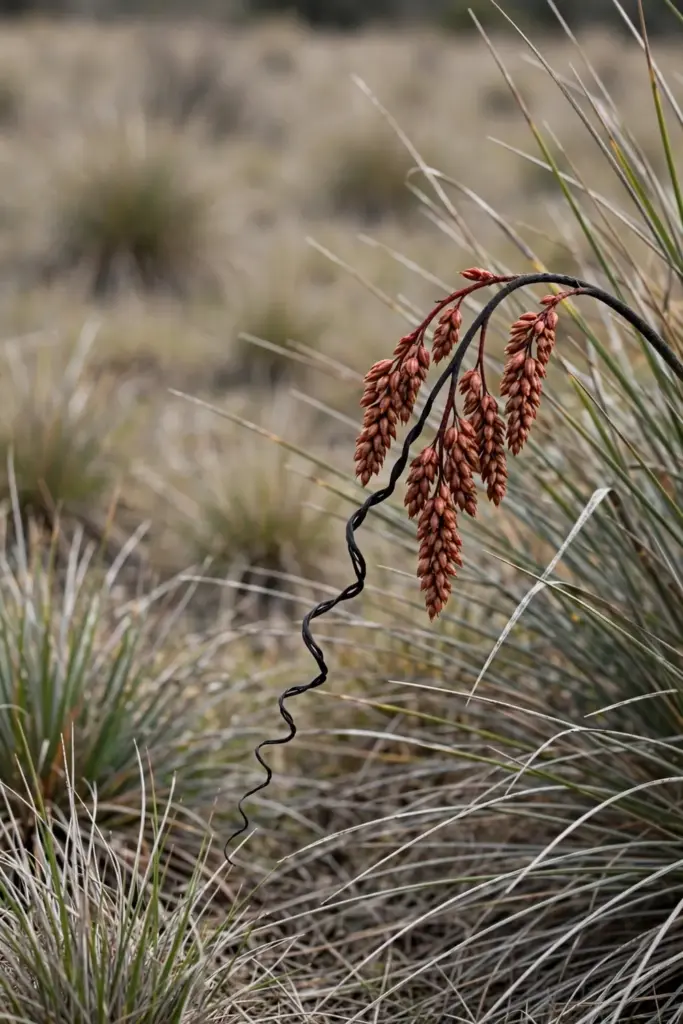
The tussock grows as a dense tuft with deep roots. Kangaroo grass stands up to about 1.5 m tall, with individual tussocks up to 0.5 m across, according to the NSW Department of Primary Industries kangaroo grass page. The leaves run up to 50 cm long and 3 mm wide, with sparse hairs on the blades, according to the same page. The leaves read gray-green in winter and turn red-brown in summer. The ligule shows as a rim of hairs. That rim is a small mark that confirms the identification when the seed head is gone.
The seed head carries the decision. The head runs large and often reddish, with a drooping look, and the spikelets cluster with several sterile spikelets around one fertile spikelet, according to the same NSW page. The fertile spikelet bears a large, black, geniculate and twisted awn. Geniculate means bent like a knee. The awn twists and bends, and the whole head moves in the wind. Flowering runs through summer from December to late April in eastern Australia, according to the same page. A tussock with that head in summer is kangaroo grass.
6. Wallaby Grass
Wallaby grass gives a native patch a neat tussock and a seed head that turns fluffy white at maturity. The fluffy white head is the mark to wait for. Early heads read green with pink tinges along the glume edges. Mature heads read fluffy white. That color change names the grass across the season.
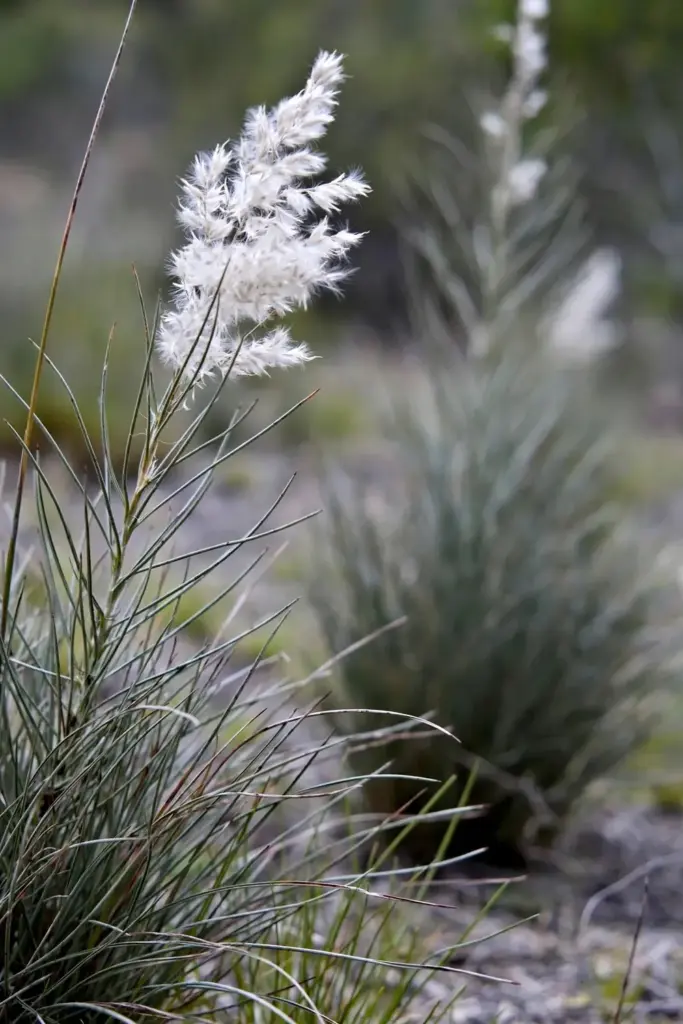
The tussock grows dense and evergreen, from 20 to 90 cm tall. The leaves run long and narrow, hairless or hairy, flat or rolled, with a hairy fringe where the blade meets the sheath. The fringe is the ligule mark for this grass. The tussock holds its shape through the year and stays green when summer dries other grasses. Wallaby grass grows most in late winter and spring. That cool-season growth separates it from kangaroo grass, which peaks in summer.
The seed head runs as a loosely contracted panicle. The spikelets start green with pink tinges and turn fluffy white as they mature. Each floret carries three rings of hairs and an awn that runs well past two lateral lobes. The lobes end in bristles. The fluffy white head sways above the tussock in late spring and early summer. A tussock with a fluffy white head and a hairy fringe at the leaf junction is wallaby grass. The genus covers many species, so treat the size range as broad and the head shape as the fixed mark.
7. Weeping Grass
Weeping grass gives a shady patch a fine arching leaf and a seed head that weeps. The weeping head is the mark. The panicle bends and droops as it expands, and the whole plant reads soft and arching. No other grass on this page weeps like this one.
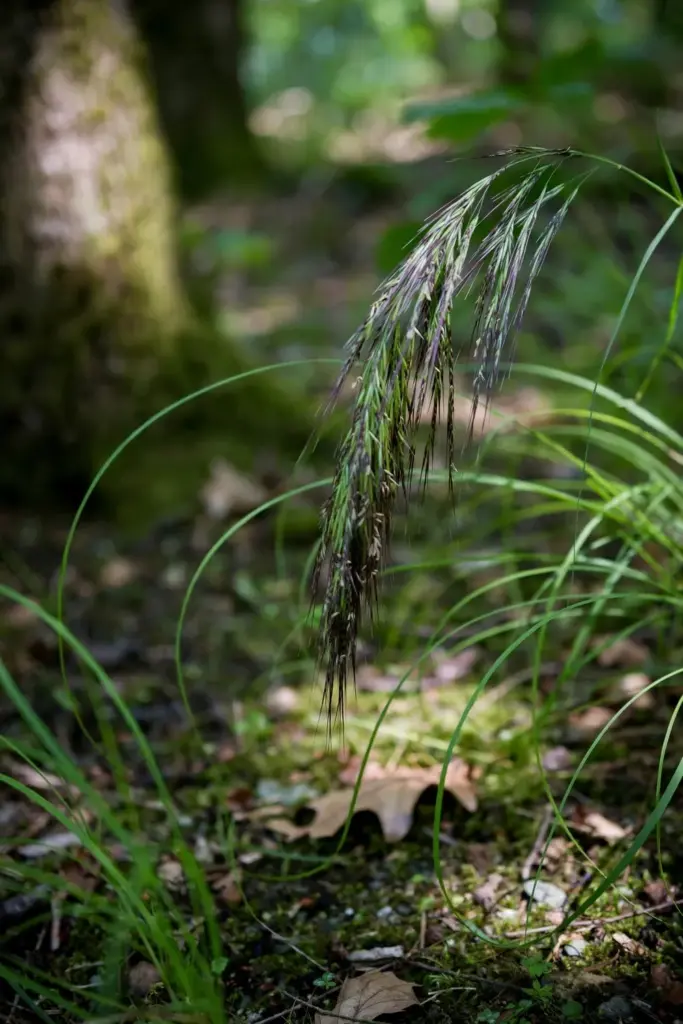
The plant grows as a rhizomatous perennial, tufted or mat-forming, with culms that ascend. The leaves spread half open, with flat blades that run smooth or hairy. The ligule shows as a minute membranous rim under 0.5 mm long, with a sheath summit that carries a few long hairs on its lobes. That tiny ligule separates weeping grass from wallaby grass, which carries a clear hairy fringe. The leaves read bright green and fine. The plant forms natural lawns in shade where other grasses thin out.
The seed head runs as a narrow raceme or panicle that weeps when fully expanded. The spikelets run long with awns, and the color runs green to dark purplish-brown. Flowering runs through the year with a peak from October to March. The weeping head, the shade patch, and the minute ligule name it, and a grass that holds a lawn together under trees and weeps its seed head is weeping grass.
8. Spear Grass
Spear grass gives a dry patch a fine rolled leaf and a long scythe-shaped awn that can pierce skin. The awn is the mark and the warning. It runs long, it bends like a scythe, and its seed is sharp. Handle seeding spear grass with care and check dogs after walks through it.
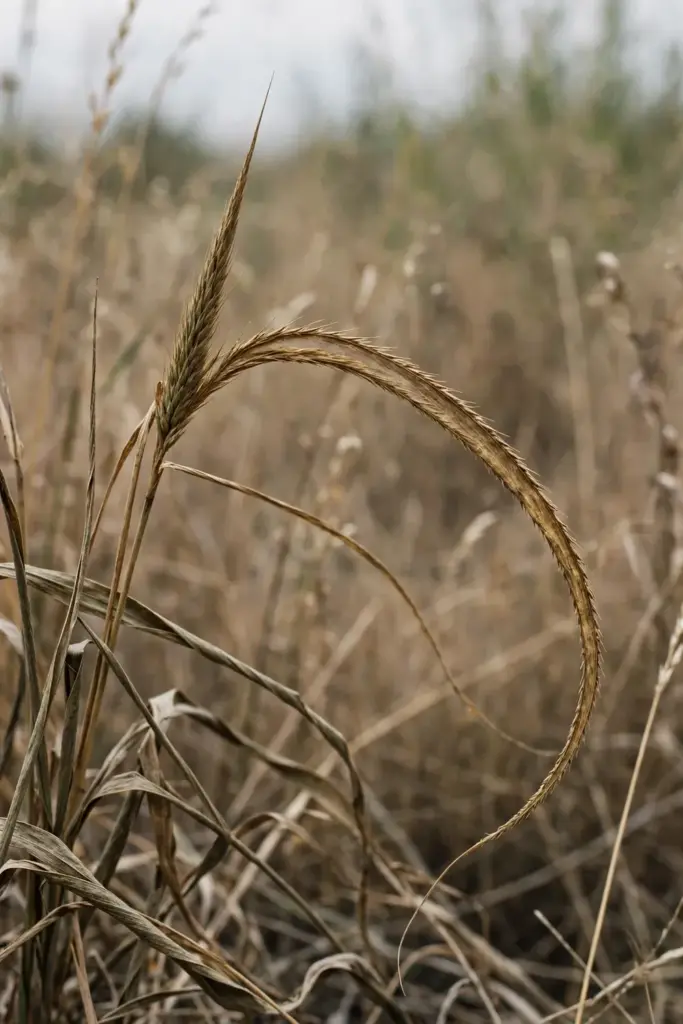
The plant grows as a tufted perennial to 80 cm tall, with leaves that run very fine, long, rolled, and usually rough to the touch, according to the NSW Department of Primary Industries rough speargrass page. The seed head runs as a moderately contracted or open panicle to 30 cm long, according to the same page. Each spikelet runs 10 to 15 mm long, sharp pointed, with a long scythe-shaped awn. The plant is a C3 perennial, which means it grows most in the cool months. Flowering runs from spring to autumn.
The sharp seed is the reason spear grass earns respect. The seed is sharp and can penetrate fleeces and skin or cause eye damage, according to the same NSW page. Awns catch in fur and work inward because their barbs point one way. Check between a dog’s toes, inside the ears, and around the eyes after a walk through seeding spear grass. A dog that shakes its head or licks one paw after such a walk needs a vet check. The awn plus the rough rolled leaf plus the dry patch name the grass. The sharp seed decides the response.
9. Common Tussock Grass
Common tussock grass gives a damp patch a tall coarse tussock and a delicate plume that floats above the leaves. The plume is the mark. It rises well above the foliage and spreads into feathery branches. No other tussock on this page carries a plume that fine.
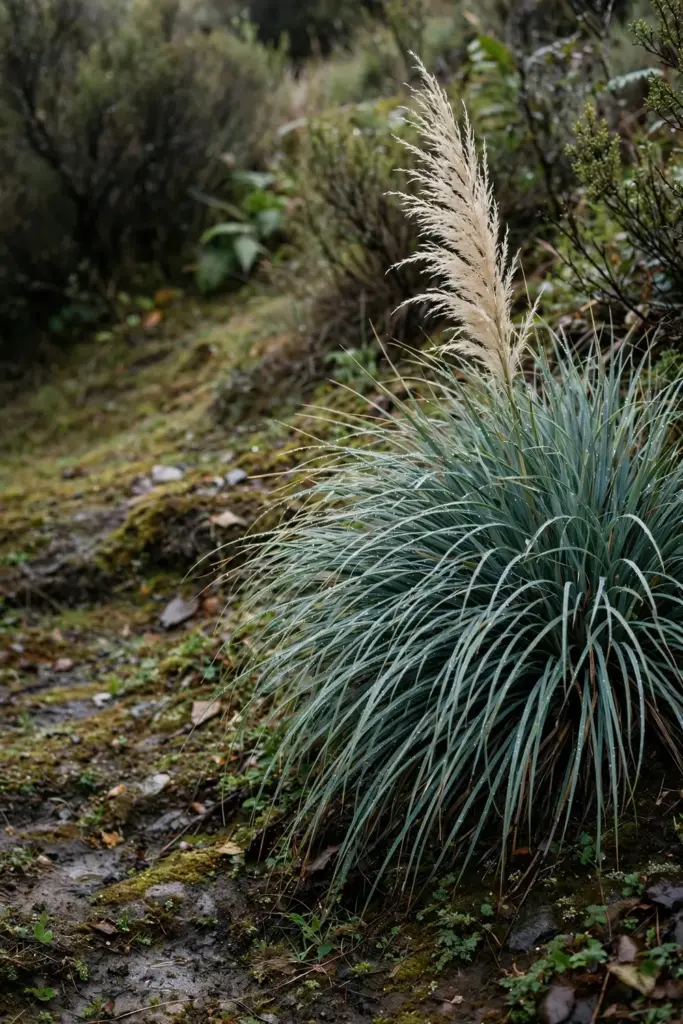
The tussock grows dense and coarse, with gray-green or blue-green leaves that run long and slender with rolled or flat blades. Common tussock grass can reach a height of 120 cm, according to the Australian National Botanic Gardens common tussock grass page. The plant favors open forest, grassy woodland, and moist ground on low slopes and valley floors that stay wet, according to the same page. The leaves hold their blue-green color through winter and spring. The tussock stands tall in a bed and reads as a vertical accent among lower plants.
The flower heads read like delicate plumes that extend above the foliage, according to the same Gardens page. Flowering runs in spring to summer. The plume opens loose and feathery, with spikelets that carry a pinkish tinge early and dry to straw. The plume plus the tall coarse tussock plus the damp ground name it. A tussock that stands waist high on a moist slope with a plume above it is common tussock grass.
10. Swamp Foxtail Grass
Swamp foxtail grass gives a garden bed a clumping fountain shape and a bottlebrush seed head that turns purple-brown. The bottlebrush head is the mark. It packs spikelets into one dense cylinder that arches outward from the clump. The head starts white and ripens purple-brown. No other grass on this page packs a head that tight.
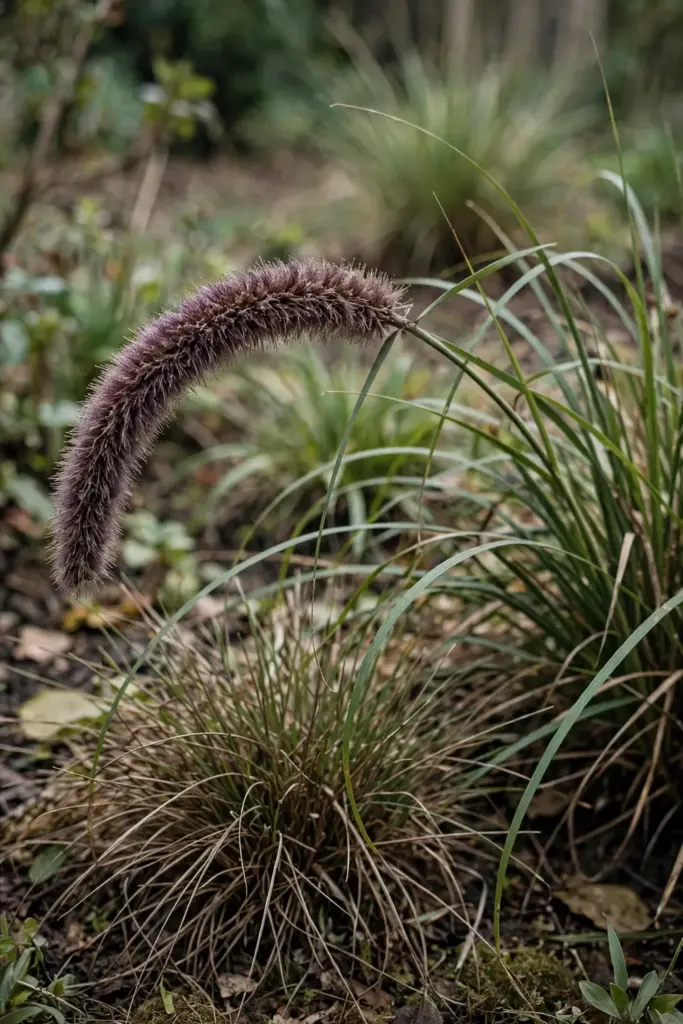
The clump grows wiry and tufted, with leaves that arch outward. The blades run hairless, flat or folded, light green above and darker below. The clump stays under a meter tall and holds a fountain shape through the season. The leaves arch and fall outward from the crown. The plant reads soft and flowing beside the stiff tussocks of poa and spear grass. The fountain shape plus the arching leaves name the plant before the head appears.
The seed head decides it. White spikes arch outward from the clump in late summer and ripen into purple-brown heads that look like small bottlebrushes. The heads hold their shape long enough to cut for arrangements. The plant seeds freely, so a clump left standing drops seed around itself. A clump with a bottlebrush head and arching leaves is swamp foxtail grass. The same plant also sells under the name fountain grass, so check the botanical name before you compare it with other fountain grasses.
11. Windmill Grass
Windmill grass gives a dry patch a low clump and a seed head shaped like a windmill. The windmill head is the mark and the easiest identification on this page. Spikes radiate from one point at the stem tip like spokes. No other common grass carries that fan of spokes.
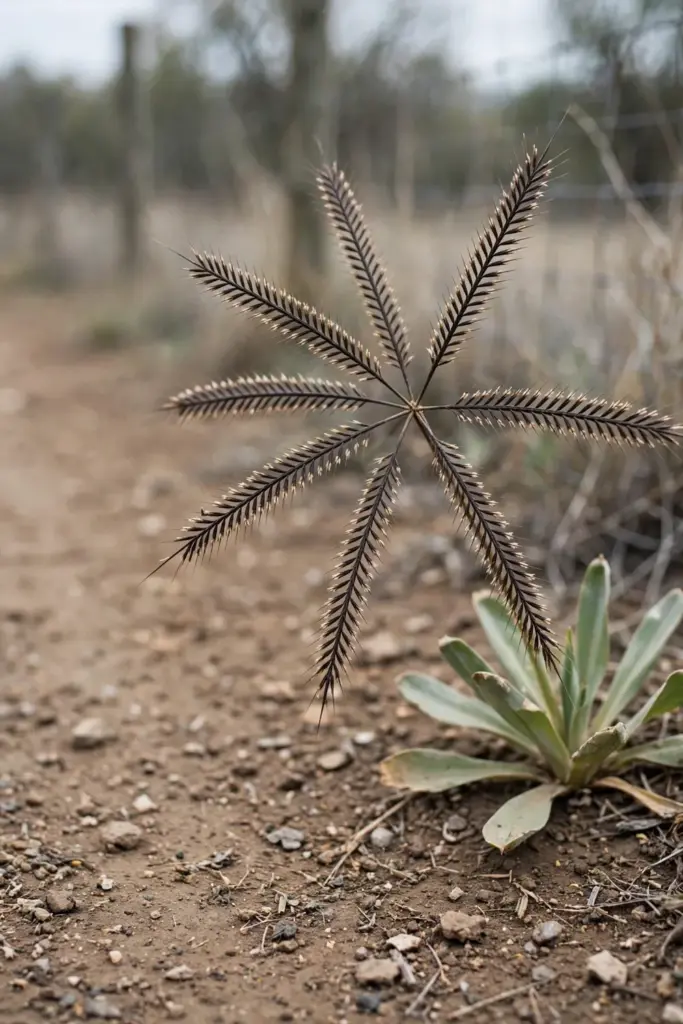
The clump grows low and wiry, with leaves that run light green and carry a blunt tip. The leaf tip is the second mark. Most grasses taper to a point. Windmill grass leaves end blunt, as if cut off. The sheath at the base runs flattened. The clump spreads by short stolons that root at the lower nodes. The plant favors full sun and open ground. It appears in lawns, paths, and bare patches where other grasses struggle.
The seed head carries the decision. The head fans into windmill-like spikes that radiate from the end of one stalk. Each spike lines up spikelets in two rows. The florets ripen from green to purple and then to black. The ripe head breaks free and blows along the ground until a fence or a plant stops it. A low clump with a windmill head and blunt leaf tips is windmill grass. Couch grass also fans its seed head, but couch runs mats by stolons and rhizomes and its spikes carry no awns, while windmill grass carries awned florets on a low clump.
12. Pampas Grass
Pampas grass gives a garden a giant clump and tall plumes that rise above head height. The plume is the mark. It stands tall, feathery, and silvery-white, and it shows over fences and hedges. The leaf edge is the warning. Pampas leaves cut like paper. Wear gloves and long sleeves near a clump.
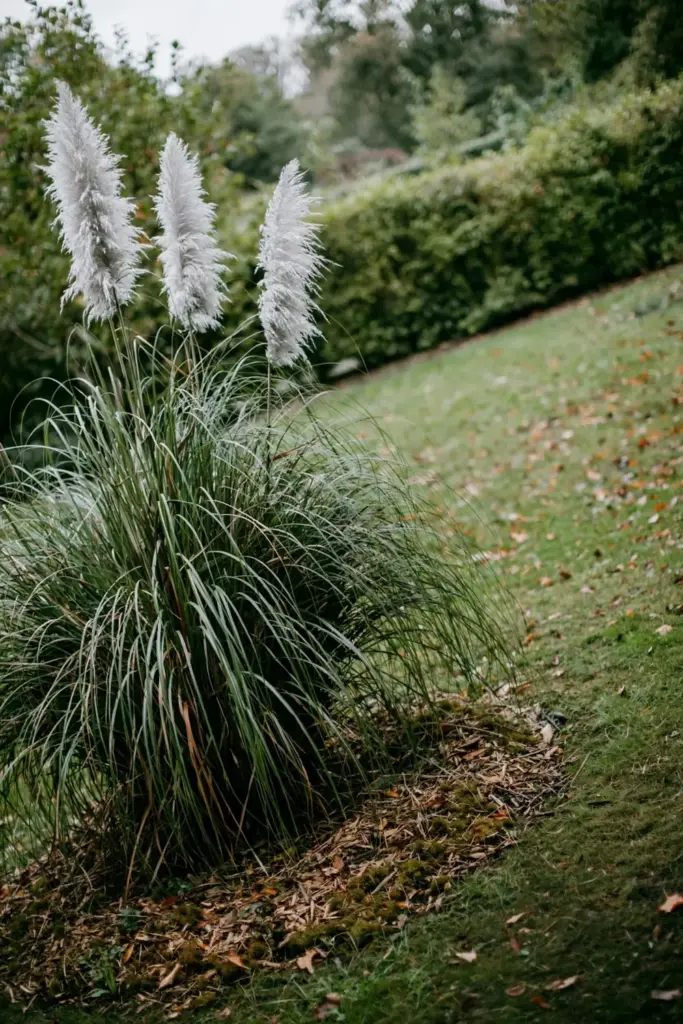
The clump grows dense and evergreen, with long arching leaves that run narrow and sharp-edged. The leaves reach well past a meter and arch outward from a dense crown. The color reads mid-green to blue-green. The clump spreads wider each year and crowds its neighbors. A mulch ring around the clump keeps the bed tidy and holds moisture in the soil, and what mulching does for weed control and moisture covers the mulch side of the job in full. Keep the mulch clear of the crown so the crown stays dry.
The plume decides it. Tall stems rise above the leaves and carry dense silvery-white plumes in late summer and autumn. The plumes hold their shape into winter and show well against dark evergreens. The plant seeds freely on the wind, so a clump near bushland drops seed far from the garden. Some councils list pampas as a weed, so check your state weed list before planting one. A giant clump with razor leaves and tall silvery plumes is pampas grass.
Frequently Asked Questions About Australian Grass Identification

Roll the stem between your fingers. A sedge stem feels triangular with three flat faces. A rush stem feels smooth and round with no joints. A grass stem feels round with swollen nodes where leaves attach. That one test sorts most grass-like plants. Check the flowers next. Grass flowers are spikelets grouped into a seed head. Sedge and rush flowers differ in shape and arrangement. The stem test plus the flower test names the family.
Read the leaf, then the runners, then the seed head. Buffalo shows a broad flat leaf and a thick runner, while couch shows a fine gray-green leaf and a fan of finger-like spikes. Kikuyu shows a hairy light-green leaf and a thick springy mat. Zoysia shows a fine dense leaf and a single spike. A mown lawn hides seed heads, so leaf and runners decide it. One unmown patch through summer shows the seed head and closes the case.
Windmill grass carries the windmill head. Spikes radiate from one point like spokes, and the florets ripen from green to purple to black. The leaves end blunt. The clump stays low and wiry. Couch grass also fans its seed head, but couch spreads by stolons and rhizomes into a mat and its florets carry no awns. The blunt leaf tip plus the windmill head confirms it.
Seeding spear grass can injure dogs. The sharp seed pierces skin, and the barbed awn travels one way through tissue. Ears, paws, eyes, and armpits are the common entry points. Check a dog after walks through seeding spear grass. Look between the toes, inside the ears, and around the eyes. A dog that shakes its head or licks one paw after such a walk needs a vet check. A vet removes a lodged awn under sedation in most cases.
Bright green grass in winter is often winter grass, a cool-season annual that greens up while warm-season lawn grasses sleep. It forms soft bright patches in lawns and beds. It flowers and seeds in the cool months and fades as summer heat arrives. Identification comes first. A patch that matches winter grass is a different plant from the lawn around it, and the lawn grasses on this page stay dull or brown through the same cold months.
Name the Grass, Then Decide What It Means
Name the grass first. The name tells you whether the plant is a lawn grass, a native grass, or an ornamental grass. The name also tells you whether the plant belongs where it stands. A lawn grass in a bed is a different problem from a native grass in a lawn. Identification comes before any other decision.
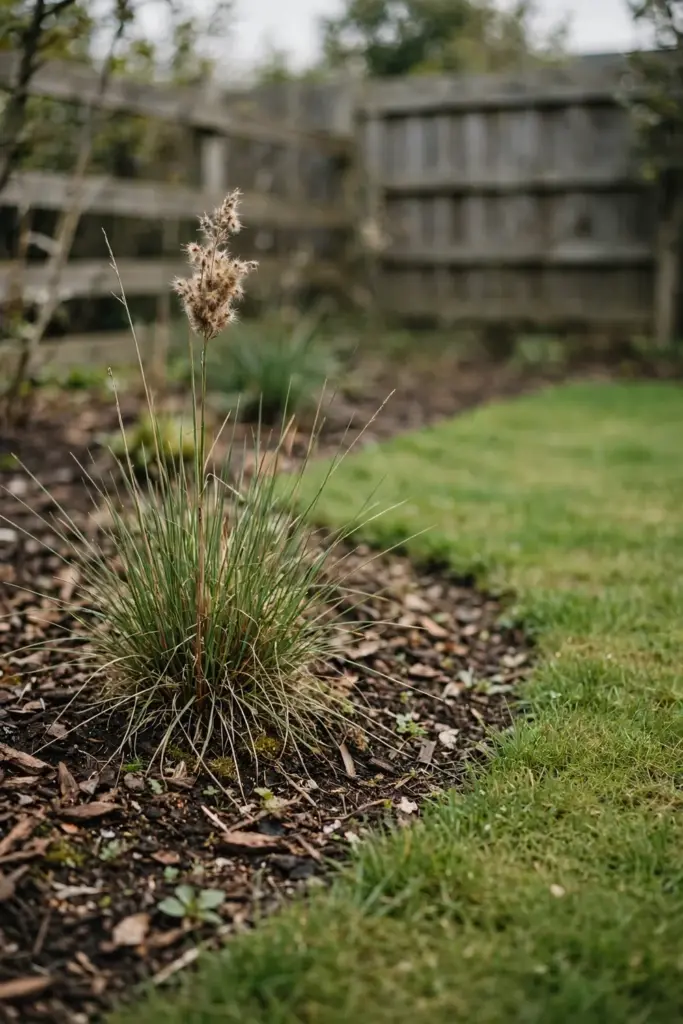
Five marks carry the whole job. Growth form splits the field. Leaf and ligule narrow it. The seed head closes the case and roots confirm it. Season and habitat check it. A grass that matches on three marks is a strong identification. A grass that matches on one mark is a guess. Photograph the clump, the leaf, and the seed head, and the name follows.