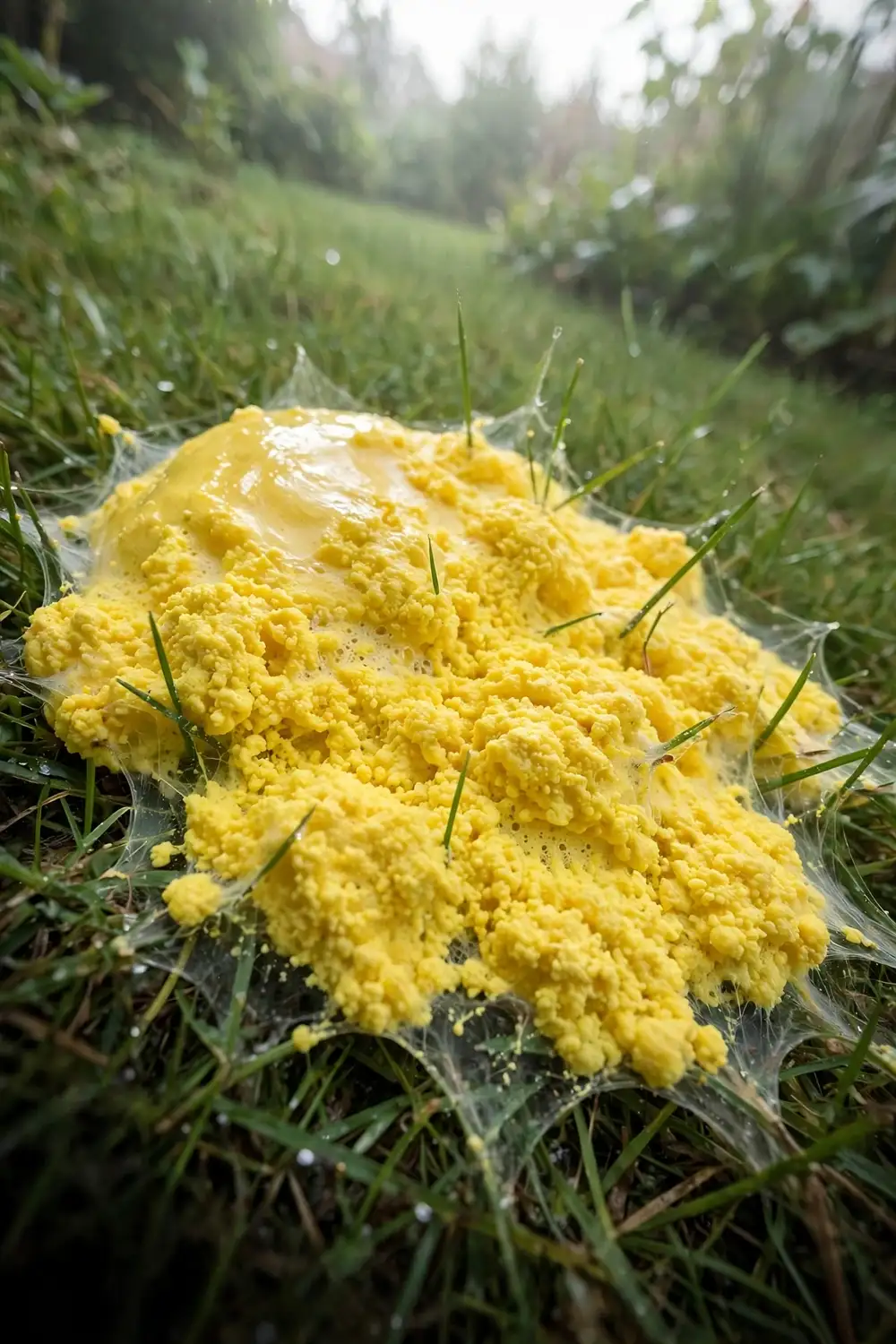

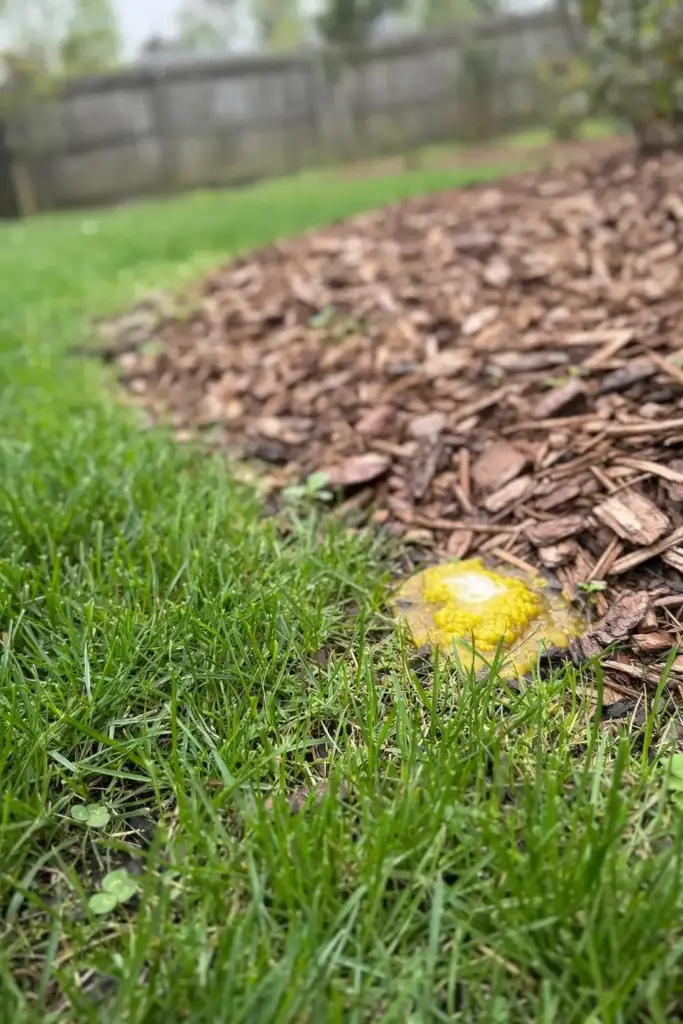
You wake up after two days of rain, look out at the lawn, and there it is: a lumpy yellow blob up to 8 inches across sitting on grass that was clean yesterday. It looks like scrambled eggs. Or, less politely, like dog vomit. Your first thought is that something is attacking your lawn, and your second thought is which spray to buy.
Here is the short version, and it is good news: that yellow blob is a slime mold, most likely Fuligo septica. It is not a disease. It is not a fungus. It will not kill your grass, and you do not need any fungicide to deal with it. Most of the time, the correct treatment is to do nothing at all. It will be gone within days once the weather dries.
If you searched for slime mold lawn treatment expecting a spray schedule, this article will save you money instead. Below you will find out what that blob actually is, how to tell it apart from real lawn diseases, the five mechanical ways to remove it if you cannot stand looking at it, and what to change so it shows up less often. Every claim about the organism comes from university extension sources, and the whole honest point is this: slime mold is a curiosity, not a crisis.
What Slime Mold on Grass Actually Is
Slime mold is a myxomycete, a member of a group of organisms that scientists once classified as fungi but now place in their own phylum, the myxomycetes, within the Kingdom Protista. University of Vermont Extension plant pathologist Ann Hazelrigg explains that they more closely resemble amoebas than mushrooms, which is why the old classification was retired. The name is a legacy of a mistake, not a description of what the organism does.
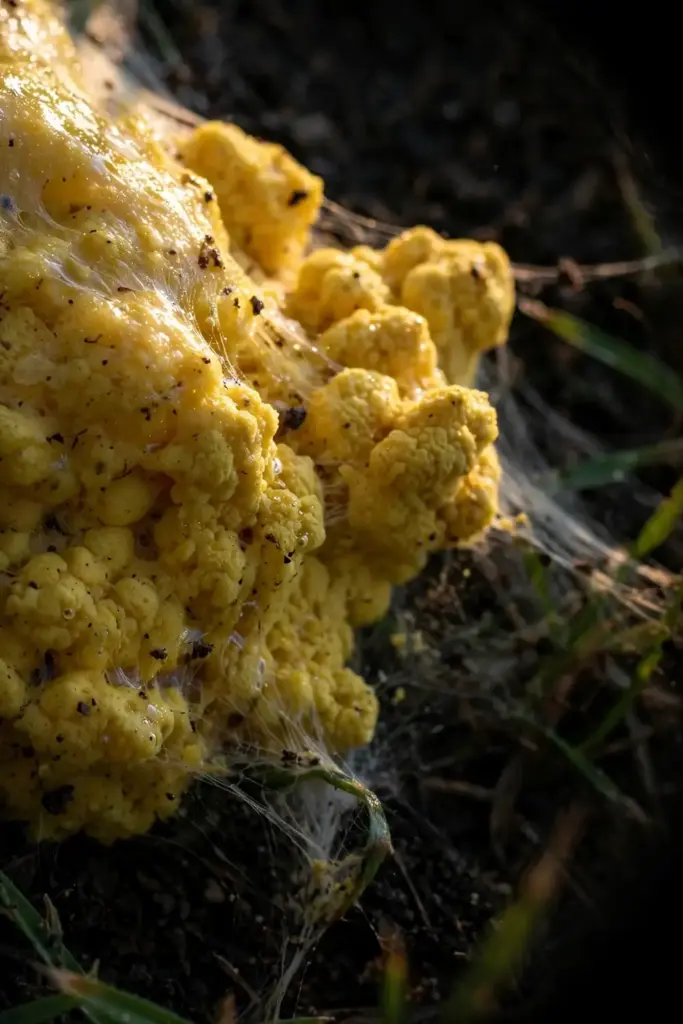
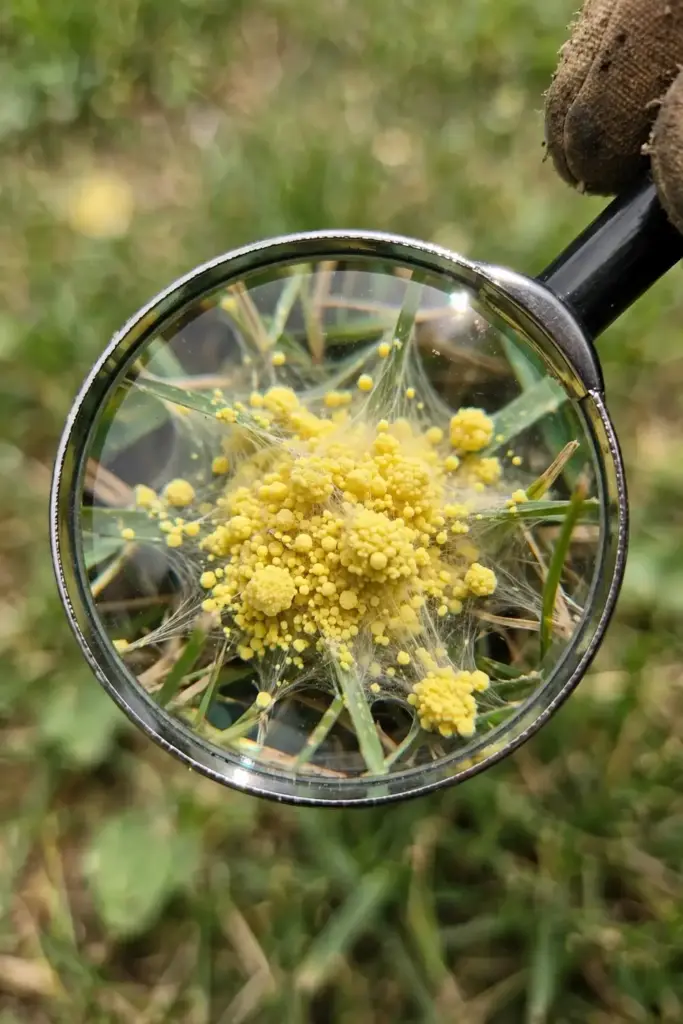
The yellow blob on your lawn is the plasmodium, the feeding stage of the organism. It is a single multinucleate mass of protoplasm, a living sheet with no cell walls dividing it, that creeps across surfaces in an amoeba-like fashion. As it moves, it engulfs bacteria, yeasts, and decaying organic matter. It does not have roots, it does not penetrate grass blades, and it does not feed on living turf. The grass is a stage, not a meal.
The most common lawn species is Fuligo septica, called the dog vomit slime mold for reasons that become obvious the first time you see a dried one. It appears worldwide on rotten wood, plant debris, mulch, and, after wet weather, on lawn grass. Genetic evidence suggests the roughly 1,000 known slime mold species share a common ancestor about a billion years old, according to the University of New Hampshire Cooperative Extension. Your lawn blob is, biologically speaking, ancient.
What Slime Mold Looks Like on Your Lawn
Fresh slime mold plasmodium looks like bright yellow scrambled eggs spread across the grass blades. University of Missouri Extension turf pathologist Lee Miller uses exactly that description for the early stage of Fuligo septica. The blob can range from a couple of inches across to nearly 8 inches in diameter, and it sits on top of the grass rather than growing out of it. Touch it and it feels slimy and wet.
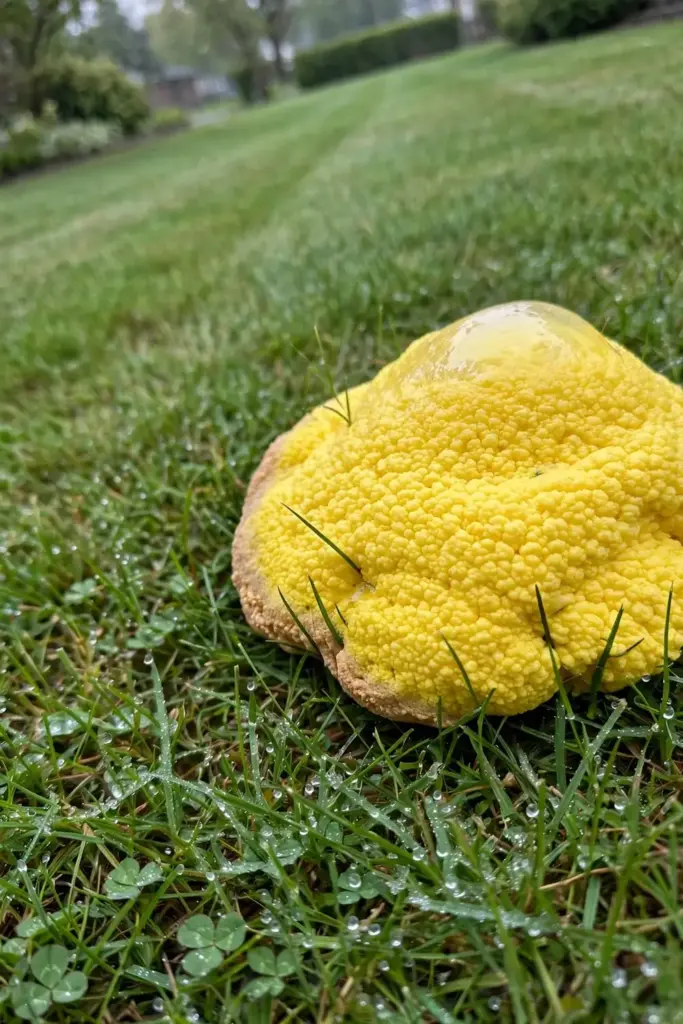
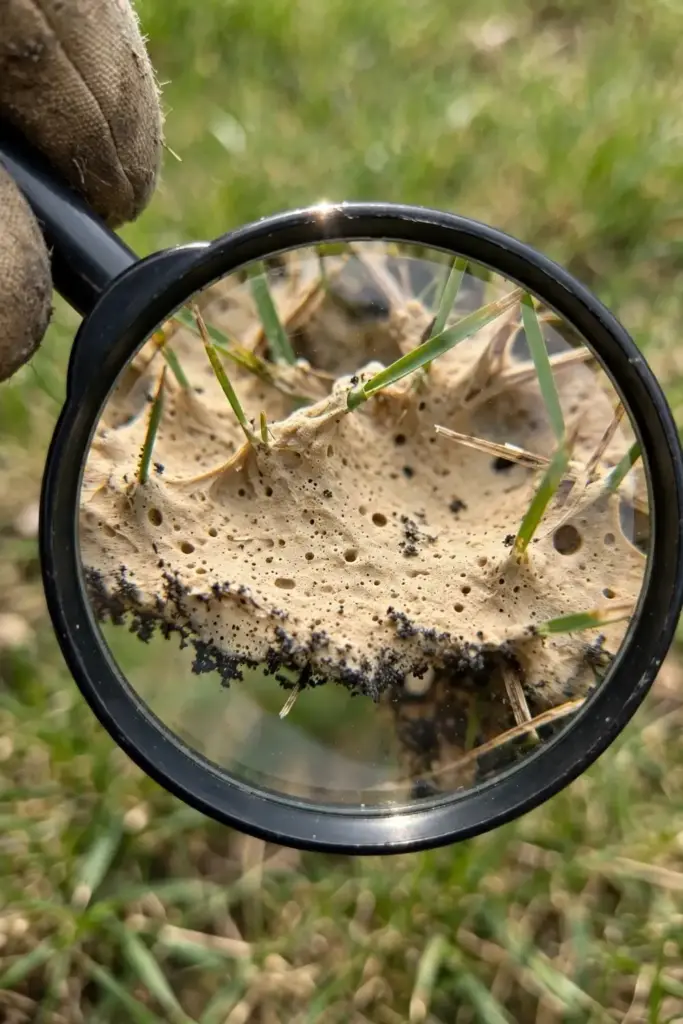
Over the next day or two, the appearance changes. The bright yellow fades to a crusty dull tan as the organism dries and shifts into its spore-production stage. Nebraska Extension in Lancaster County notes that this dried stage can look like dried expandable foam insulation, which is why some homeowners describe it as gray or whitish crust stuck to the blades. A tan or light-orange crust with black spores on the underside marks the fruiting stage of Fuligo septica, per UNH Extension.
The plasmodium can also be white, gray, or shades of red depending on the species and the stage, though yellow is the classic lawn presentation. If wet weather returns, the wet slimy stage can come back and feeding continues; when the food runs out, the mass dries again and releases spores. The whole visible episode typically lasts a few days. Nothing about this progression damages the grass underneath, though a very large blob can briefly shade the blades it covers.
Why Slime Mold Appears After Wet Weather
Slime mold spores are everywhere and patient. Nebraska Extension explains that spores can remain dormant in soil or leaf litter for many years, waiting until conditions are right. When warm, wet weather arrives, the spores absorb moisture, crack open, and release cells that fuse into the plasmodium you see on the lawn. That is why the blob seems to appear overnight after a rainy stretch: the organism was already there, invisible, and the rain woke it up.
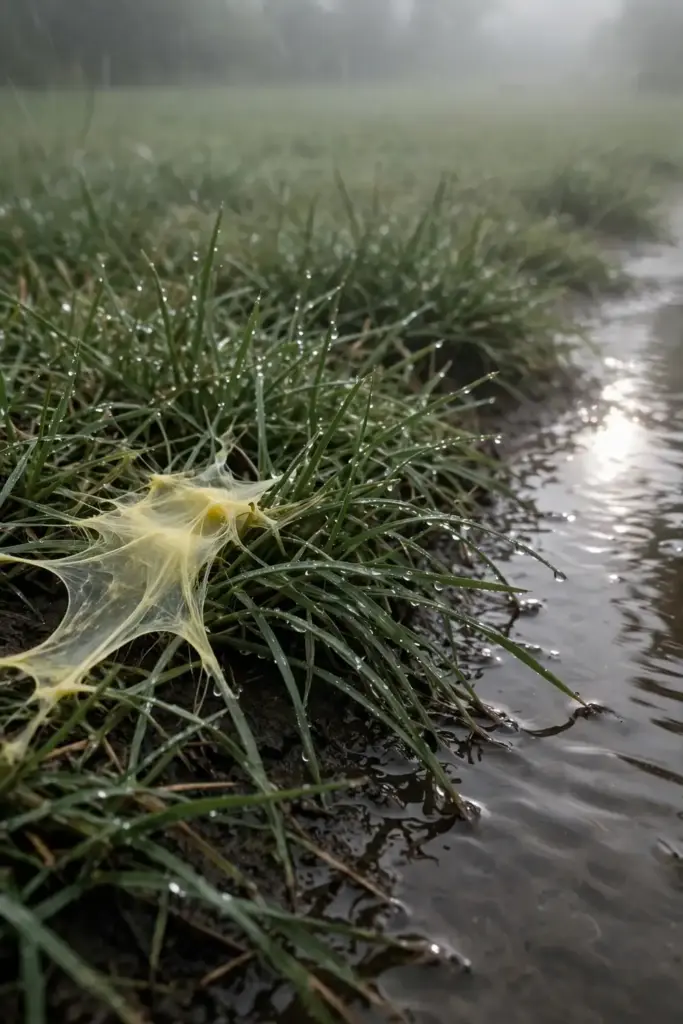
The other ingredient is food. Dead turfgrass leaf blades and thatch provide the organic matter and the bacterial colonies that slime molds feed on. A lawn with a thick thatch layer, or one where clippings and debris accumulate, offers a richer buffet. This is not a sign of a sick lawn in the disease sense. It is a sign of a damp lawn with something to eat, which describes most lawns after a week of rain.
Temperature matters too. Slime molds favor the warm side of the season, which is why sightings cluster in late spring and summer after storms. Michigan State University Extension tracks the same wet-weather pattern for slime molds on turf. Once hot, dry weather returns, the plasmodium dries out and hardens, and the episode ends. No intervention is required for this part of the cycle. Breaking the blob apart with a rake can hasten the breakdown, as the University of Vermont Extension notes, but sunshine and dry air do the same job for free.
The spores themselves travel well. Wind carries them across the neighborhood, and beetles in the Latridiidae family are known to disperse Fuligo septica spores, according to taxonomic literature. This means a blob can appear in a lawn that has never had one, far from any obvious source. There is no quarantine that works against an organism whose spores ride the breeze. The practical takeaway is the same: you manage the conditions, not the organism, and the conditions that matter are moisture and food.
Slime Mold vs Dollar Spot vs Fairy Ring vs Dog Urine
The yellow blob is distinctive once you know it, but several lawn problems get confused with it. The table below sorts them by what you can actually observe.
| Clue | Slime Mold | Dollar Spot | Fairy Ring | Dog Urine |
|---|---|---|---|---|
| What you see | Yellow, white, or gray slimy or crusty mass sitting ON TOP of blades | Straw-colored circular patches 1 to 6 inches, sunken, with bleached blades | Dark green ring or arc of stimulated grass, sometimes with mushrooms | Round yellow or brown dead patch, often with a dark green ring around it |
| Texture | Slimy when fresh, crusty and foam-like when dry; wipes or rakes off | Blades thin and rotted at the crown; does not wipe off | Grass itself changes color; mushrooms may appear in the ring | Grass is dead or dying, not coated |
| Speed of appearance | Overnight after rain | Develops over days in warm, humid weather | Develops over weeks | Appears within a day or two of the event |
| Grass damage | None; the grass underneath is fine | Real turf disease; kills grass in the patch | Can stress or kill grass in the ring zone | Chemical burn kills the grass |
| Treatment | Rake, wash off, or ignore | Fungicide or cultural program for the lawn disease | Aeration, nitrogen, sometimes fungicide | Flush with water; train the dog elsewhere |
If the yellow stuff sits on top of the blades and you can brush it off with your hand, it is slime mold. Real lawn diseases like dollar spot and fairy ring change the grass itself. Our brown patch guide covers another fungal patch disease that actually kills turf, which is a useful contrast: brown patch rots the grass, slime mold just visits it. The bipolaris leaf spot guide covers a second lookalike that spots the blades themselves rather than coating them.
How Slime Mold Feeds Without Harming Your Grass
The plasmodium moves like a giant amoeba, flowing over grass blades and engulfing bacteria, fungal spores, and decaying organic matter in its path. Nebraska Extension describes the feeding stage as mobile, moving up to several feet in a day, which is why a blob can seem to have relocated overnight. It is not growing into the plant. It is grazing across it.
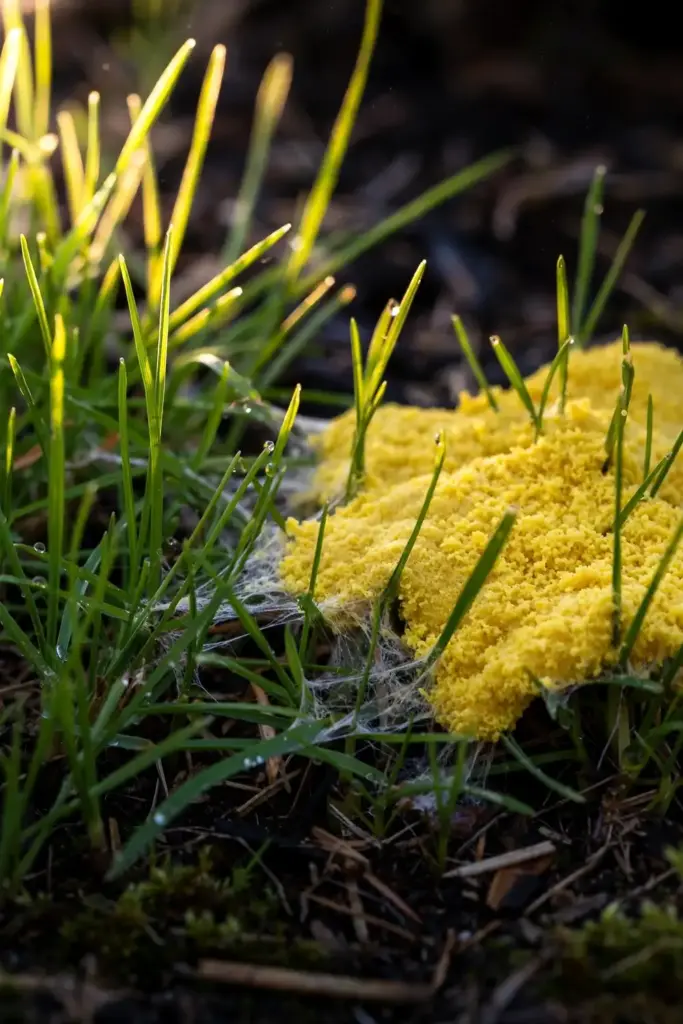
This distinction is the entire reason slime mold is harmless. Plant pathogens penetrate tissue, steal nutrients from living cells, and leave dead grass behind. A slime mold plasmodium does none of that. It uses the blades as a surface, the way a snail uses a sidewalk. The grass keeps photosynthesizing, keeps growing, and is unchanged once the blob dries and flakes away.
The one partial exception is shading. UNH Extension notes that in rare cases a very large plasmodium may injure small plants by shading or smothering them. On a lawn, this means the blades under a big, thick blob might look pale for a few days after it clears. They recover with normal mowing and sunlight. This is cosmetic and temporary, not disease damage, and it does not warrant any chemical response.
There is also a second, subtler reason the grass stays safe. The plasmodium’s food is the microbial film on the blade surface and in the thatch, not the blade tissue. It has no mechanism for penetrating a plant cell wall. A true pathogen brings enzymes and pressure to breach the leaf; a slime mold brings appetite for bacteria. The grass is the ground floor of a microscopic food web that was already running before the blob became visible.
Is Slime Mold Safe for Kids, Dogs, and Pets?
Yes. Pet and child safety is the question extension offices hear most about slime mold, and the answer from every source is consistent. University of Missouri Extension states plainly that Fuligo septica does not harm plants, people, or animals. It is not toxic, and it will not harm your lawn, garden, or plants.
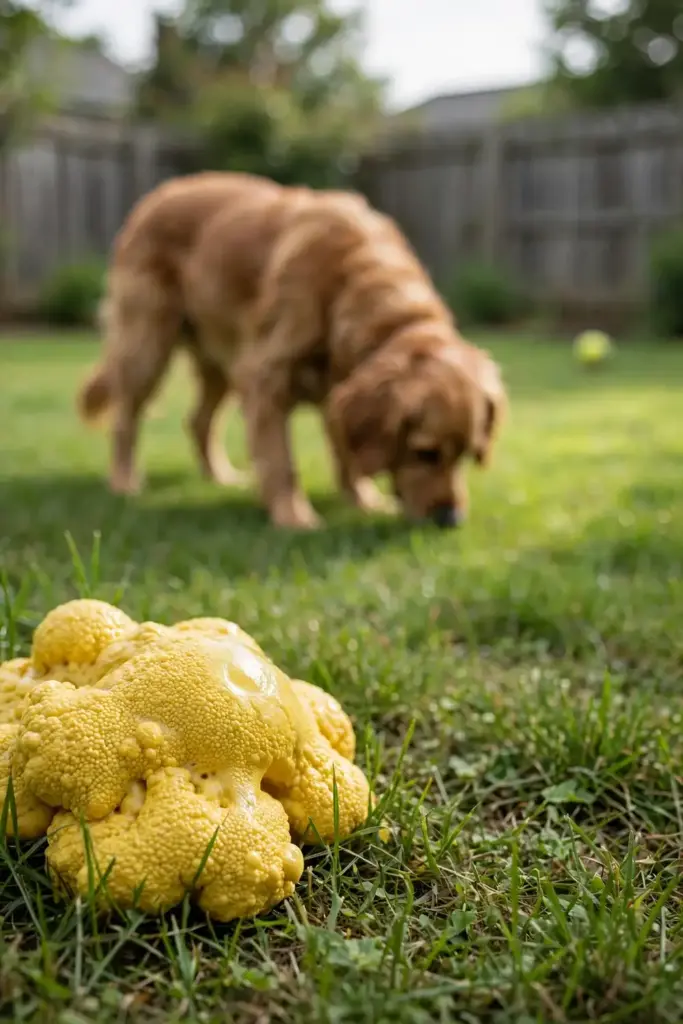
The dog vomit nickname causes most of the worry. It looks like something a sick animal left behind, so people assume it is unsanitary or poisonous. It is neither. The organism is a decomposer doing cleanup work on your lawn’s thatch and debris. Dogs can sniff it, kids can poke it, and the worst outcome is a slimy finger.
The practical implication: you do not need to keep pets or children off the lawn because of slime mold, and you do not need to disinfect anything after removing it. If a dog eats some, monitor as you would with anything odd eaten outdoors, but the organism itself is not a toxin producer. The reassurance is the treatment.
Step 1: Decide Whether to Do Anything at All
Start with the honest cost-benefit call, because it is the step most articles skip. Doing nothing costs nothing, risks nothing, and works every time. The plasmodium will dry out, release its spores, and vanish within days as the weather dries. Nebraska Extension lists “do nothing” alongside the mechanical options without ranking it last. Every authority agrees: no control is necessary.
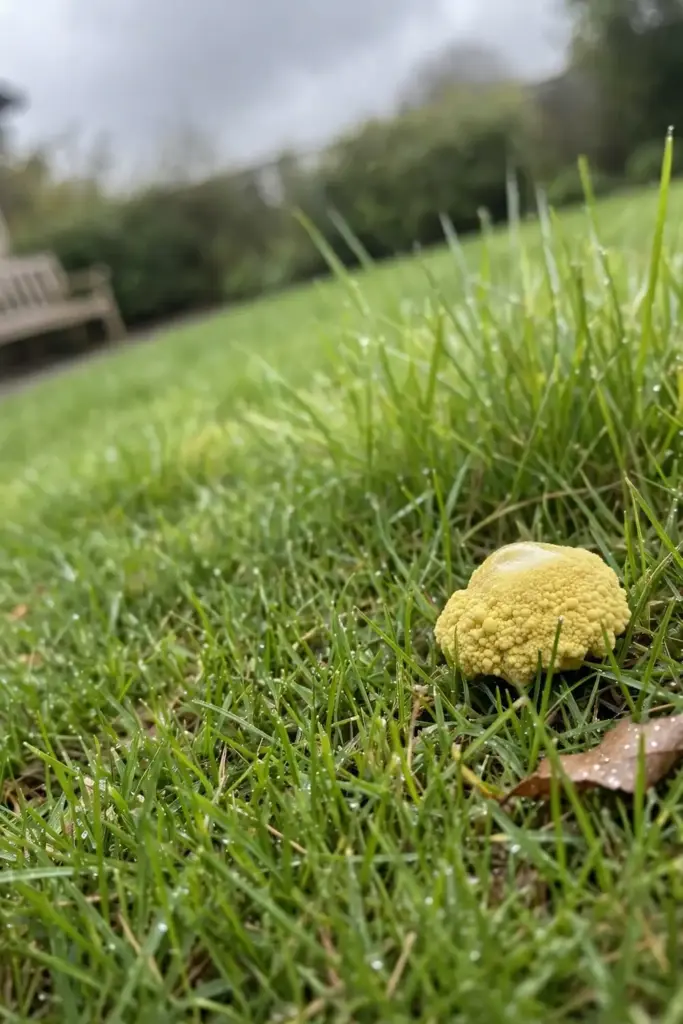
Do something only if the blob bothers you to look at, or if it is large enough to mat down the grass and you want it gone faster. The remaining four steps are removal methods, not treatments. None of them cures anything, because there is nothing to cure. Pick the one that matches your tolerance for yellow blobs and move on.
What you should not do is buy a fungicide. Nebraska Extension states directly that fungicide applications are not necessary or recommended for slime mold. That sentence is the entire slime mold lawn treatment protocol the extension services recommend: nothing, or a rake. A broad-spectrum fungicide wastes money on an organism that is not a fungus and not a pathogen, and it kills beneficial soil fungi your lawn actually needs. If a product label lists slime mold, that is marketing, not plant pathology.
Step 2: Rake It Off the Grass Blades
The fastest removal is a leaf rake. Drag it lightly across the affected area to break the blob apart and knock the crusty or slimy mass off the blades. The University of Vermont Extension recommends breaking the plasmodium apart with a rake to hasten its breakdown, and Nebraska Extension lists raking as the standard removal for slime mold on turf.
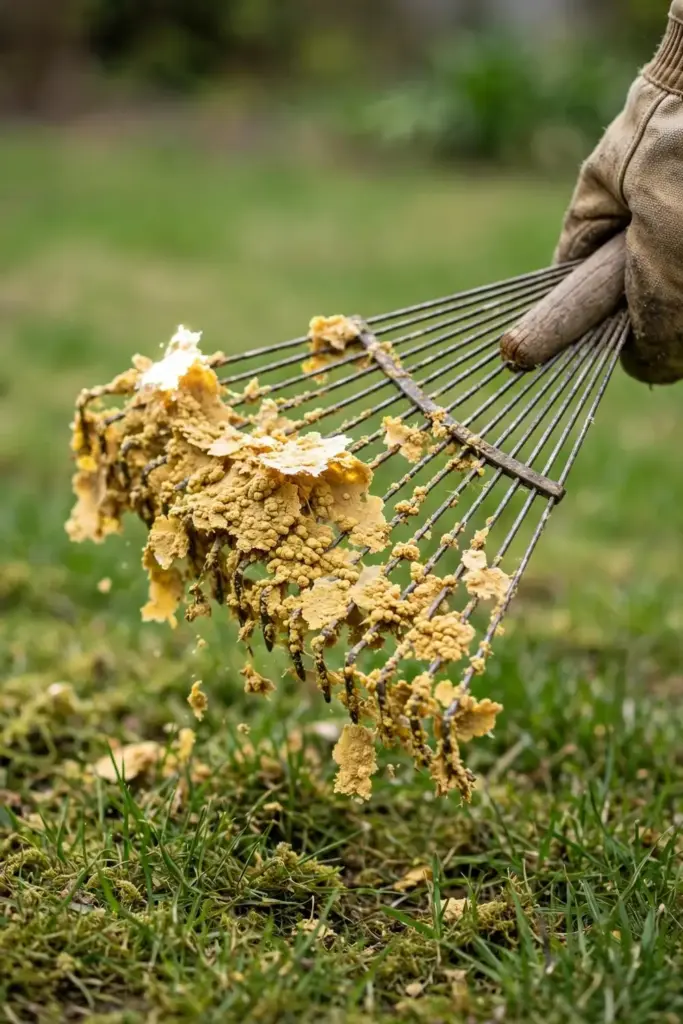
Use a light touch. You are dislodging a surface coating, not dethatching. A few passes is enough. The broken pieces dry out quickly once exposed to air and sunlight, and the grass underneath stands back up within a day or two of normal growth. Bag the raked debris if you want to reduce the spore load in that spot, though spores are ubiquitous in soil anyway, so this is tidiness rather than prevention.
This method works on both the fresh slimy stage and the dried crusty stage. On the dried stage, the crust flakes off easily and the rake is especially effective. Ten minutes with a rake resolves most lawn episodes completely.
Step 3: Wash It Away With a Strong Stream of Water
If you prefer the hose to the rake, a strong stream of water knocks the plasmodium off the blades just as well. Nebraska Extension recommends using a strong stream of water to remove slime mold from turf leaf blades. Aim the nozzle at an angle so the water lifts the mass off rather than driving it deeper into the turf.
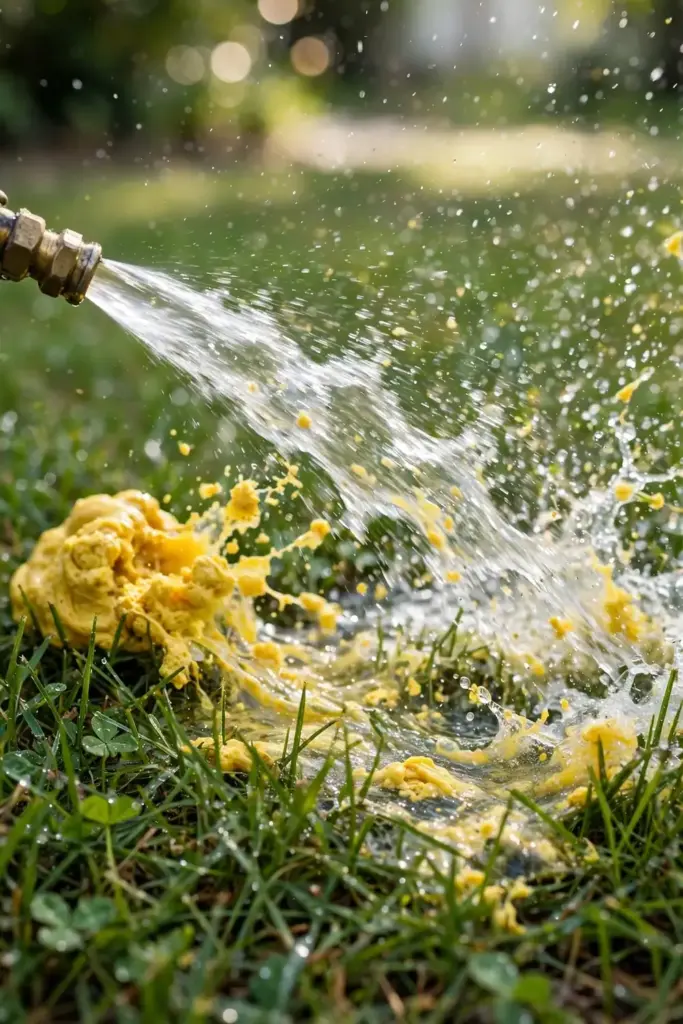
This sounds contradictory, since wet weather caused the problem, but the logic holds: the organism is already at the end of its visible life or can be physically dislodged, and a brief wash does not recreate the days of damp conditions that woke the spores. Do this in the morning so the grass dries during the day. Avoid soaking the area, which would only extend the damp conditions slime molds enjoy.
For mulch beds, the same guidance applies: break the mass up and wash it into the soil with water, or scoop it out and trash it, per Nebraska Extension. On the lawn, the wash method is the gentlest option for anyone worried about raking too aggressively.
Step 4: Mow Right Through It Normally
The third option requires no special effort at all: mow the lawn as usual. The mower blades chop the plasmodium into pieces and scatter them, which breaks up the mass and exposes it to drying air. Bag the clippings on that pass if you want the yard to look clean immediately.
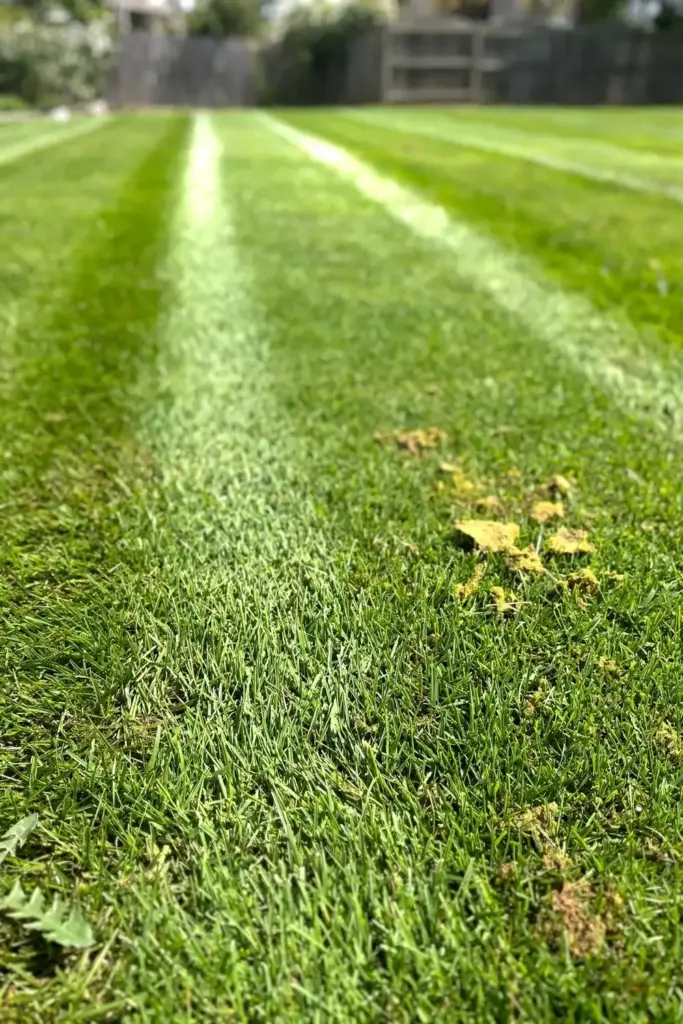
Keep the mower at your normal height. There is no reason to scalp the lawn over slime mold, and cutting too short stresses the grass for no benefit. This method pairs well with doing nothing: mow on your regular schedule, and the slime mold episode ends on its own timeline regardless. Many homeowners discover the blob is gone at the next mow without ever having addressed it directly.
One caution: if the blob is very large and wet, mowing can smear it across the deck. Rinse the mower deck afterward. This is a cleanup annoyance, not a lawn health issue.
Step 5: Dry Out the Conditions That Invite It Back
Slime mold will return whenever warm, wet weather coincides with a food supply. You cannot eliminate the spores, which persist in soil for years, but you can make the lawn less inviting. The levers are the standard lawn-health practices: they reduce thatch, improve drainage, and shorten the damp periods that wake the organism.
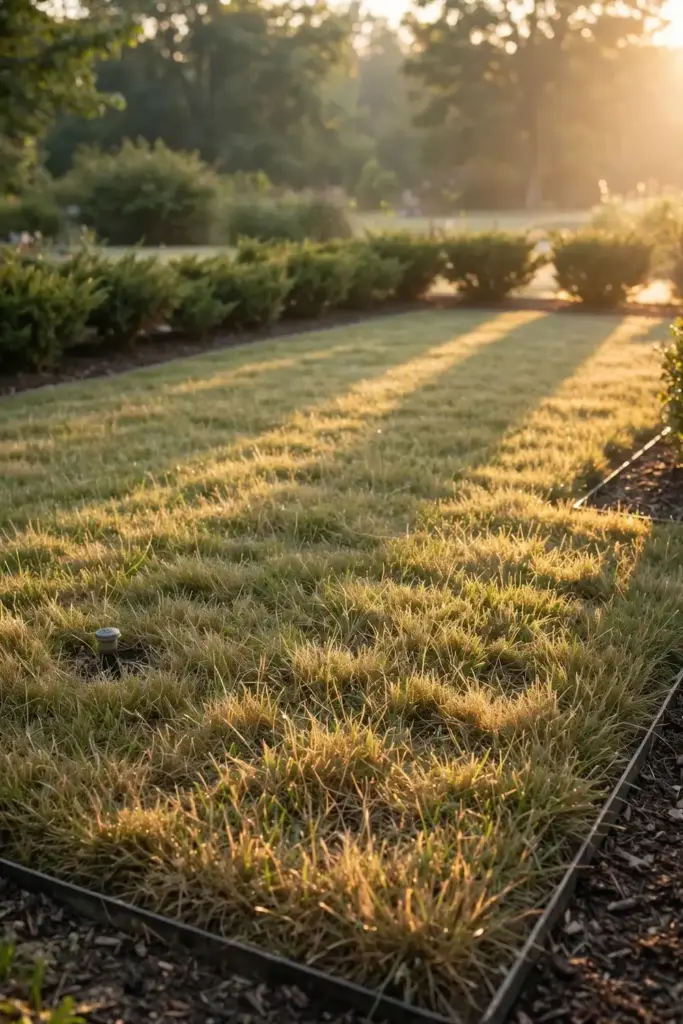
Dethatch if the thatch layer is thicker than half an inch, since dead blades and debris are the food source. Water deeply but infrequently, and water in the morning so the grass dries during the day; evening watering extends the damp window slime molds need. Improve air circulation by pruning overhanging shrubs, and address low spots where water pools. Our soil health guide covers drainage and soil structure in depth, which is the long-term version of this step.
None of this is a slime mold treatment. It is lawn care that happens to make the conditions less favorable. Expect the blob to reappear after the next long rainy stretch anyway. That is normal, and it is still harmless.
One more source worth checking: mulch beds next to the lawn. Fresh woodchip mulch is prime slime mold habitat, and blobs that start in the bed often creep onto the bordering grass. If your lawn blobs always begin at the mulch edge, thin the mulch layer rather than treating the lawn. The lawn is just the overflow zone.
Living With a Lawn That Grows Slime Mold Every Year
Some lawns get slime mold every summer after storms, and that is fine. The spores are permanent residents of the soil, the food supply renews with every mowing season, and warm rain is not something you can schedule away. A recurring blob is not a sign that your lawn is failing or that you missed a treatment. It is a sign that the decomposer community in your thatch is active, which is arguably a healthy-soil indicator.
The practical routine is simple. When a blob appears, decide in ten seconds whether it bothers you. If not, leave it. If so, rake it or hose it off. Keep mowing normally, keep the thatch in check, and water in the mornings. Skip the fungicide aisle entirely. Over a season, you will spend less time and money on slime mold than on any other lawn issue you have, because the correct effort level is nearly zero.
If the blobs appear constantly even in dry weather, look at irrigation first. Daily watering or an overshooting sprinkler head can keep a zone perpetually damp enough for slime mold between rains. Adjusting the watering schedule, covered in our spring lawn fertilization timing guide alongside seasonal lawn routines, usually resolves the mystery.
And if you find yourself oddly fond of the blob, you are in good company. Garden writers have documented people keeping dog vomit slime mold as a temporary curiosity, watching it creep and change color through its life cycle. The visible life of a slime mold is fleeting, usually just a few days, but it is one of the stranger and more harmless shows a lawn can put on. Next time one appears, you might reach for the rake. Or you might just watch it for a day first.
Frequently Asked Questions
Nothing needs to kill it. Slime mold is a harmless decomposer, and no treatment exists for an organism that is not a disease. Sunlight and dry air end the visible stage within days. If you want it gone faster, rake it off the grass or wash it away with a strong stream of water. Fungicides are not necessary or recommended, per Nebraska Extension, and they waste money on an organism that is not a fungus.
Yes, always. The plasmodium is a temporary feeding stage. As the weather dries, the mass hardens, releases its spores, and disappears. The whole episode typically lasts a few days. You can hasten it by breaking the blob apart with a rake, but doing nothing works just as reliably. No follow-up is needed once it is gone.
No. University of Missouri Extension states that Fuligo septica does not harm plants, people, or animals, and it is not toxic. The dog vomit nickname describes the appearance, not a health hazard. Kids and pets do not need to avoid the lawn because of it, and you do not need to disinfect anything after removing it.
Dormant spores in the soil wake up during warm, wet weather and fuse into the visible plasmodium. Dead grass blades and thatch provide the bacteria and organic matter it feeds on. Spores can stay dormant for many years, which is why the blob can appear in a lawn that never had one before. Wet weather plus a food supply is the complete recipe.
It is not dangerous at all. Despite the alarming name and appearance, Fuligo septica does not infect grass or steal nutrients from it. It feeds on bacteria and decaying matter on the blade surfaces. The grass underneath is unharmed, and any pale look after a large blob clears is temporary shading, not disease damage.
No. Slime mold uses turf blades as a surface for growth but does not damage the grass, per Nebraska Extension. Real lawn killers are fungal diseases like brown patch and dollar spot, which rot the blades and crowns. If your grass is actually dying in patches, compare against the differential table above rather than blaming the yellow blob.
Where to Go From Here
The yellow blob on your lawn is a slime mold, almost certainly Fuligo septica: a myxomycete, not a fungus and not a disease. Warm rain woke dormant spores. The blob will vanish within days as things dry, and it harms nothing in the meantime. If you want it gone today, rake it off or hose it away. Skip the fungicide, and put the money toward something your lawn actually needs.
The one action worth taking is the boring one: keep the thatch thin, water in the mornings, and fix the soggy spots. That is not slime mold lawn treatment. It is just good lawn care, and it makes every future blob smaller and shorter-lived. The next time one appears after a storm, you will know exactly what it is, and you will know that the correct response is a shrug and a rake.