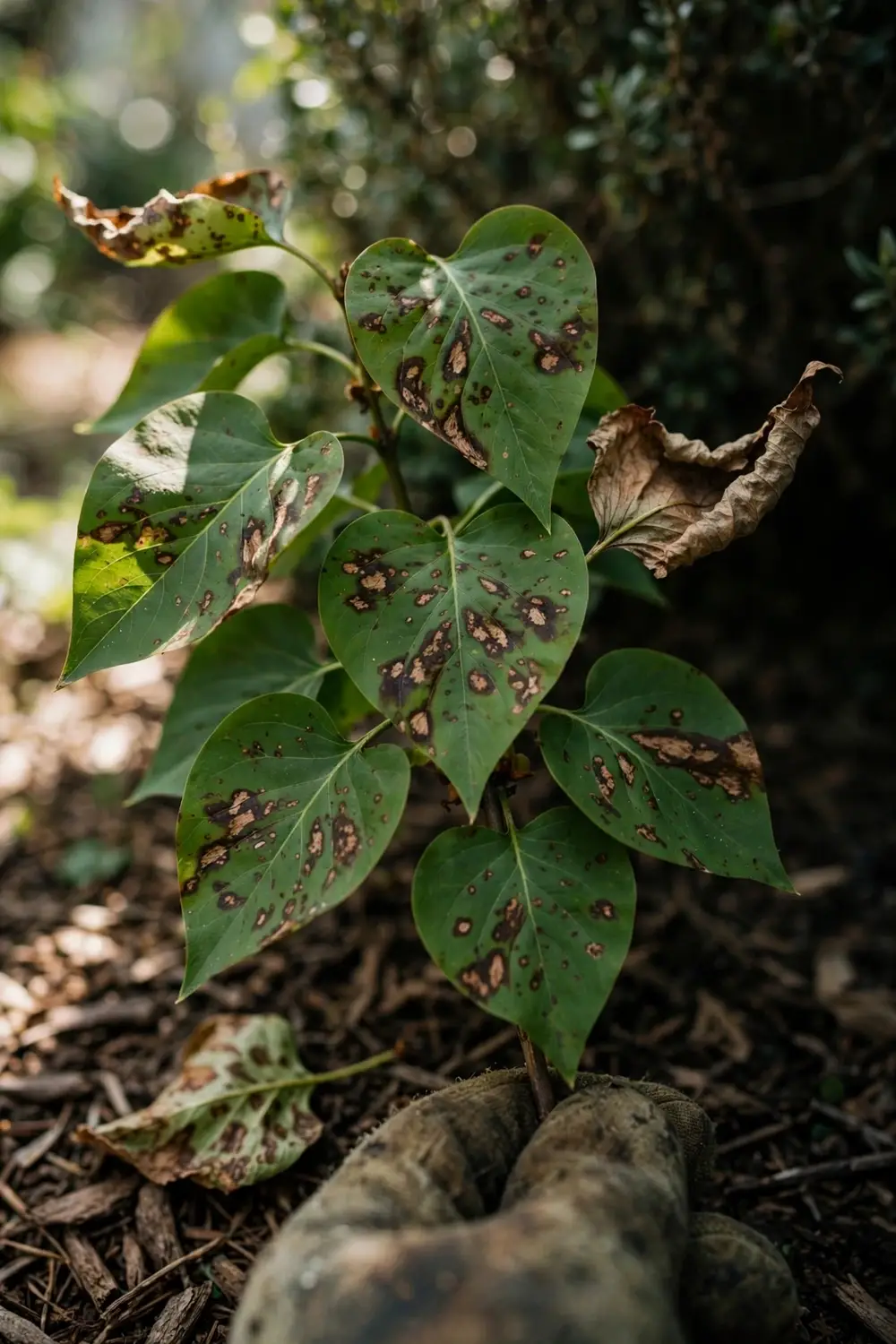

Pseudocercospora leaf spot turns lilac leaves brown and drops them early, and 8 cleanup-first strategies hold the line. The spots look alarming by late summer. The shrub usually survives them.
The disease hits two ornamental shrubs here: lilac and mountain laurel. A true fungus causes it. Repeated defoliation weakens a shrub across seasons, so the plan below treats cleanup as the main weapon and spray as the rare exception.
The 8 strategies run from the triage call to a clean start next spring. Read the identification sections first if the shrub still holds leaves. Start at Step 1 if the canopy already looks bare.
What Pseudocercospora Leaf Spot Actually Is
Pseudocercospora leaf spot is a fungal leaf spot disease of lilac and mountain laurel. Fungi in the genus Pseudocercospora cause it. The disease lives on leaves, and it returns to the same shrub year after year when infected leaves stay on the ground.
The mountain laurel pathogen carries a full name. The UMass Extension mountain laurel page names it Pseudocercospora kalmiae, a fungus formerly placed in Cercospora. That former name explains why older guides call the same disease Cercospora leaf spot. The lilac pathogen stays at genus level in extension pages, listed as Pseudocercospora species. No extension source consulted here names a separate lilac species, and no separate lilac species is named here.
The pathogen runs repeated infection cycles in one season. Iowa State Extension describes the pathogen as polycyclic, a fungus able to infect again and again while conditions stay favorable. Each new lesion sheds spores that start the next round. That cycle explains why a shrub can look fair in July and bare in September.
Infection favors warm humid weather. The Iowa State Extension lilac page puts the sweet spot near 76 degrees Fahrenheit, with symptoms showing 7 or more days after infection. Warm humid weeks in midsummer set the outbreak in motion, and the damage shows a week later. A gardener who links the spots to last week’s weather reads the timing right.
How to Identify Pseudocercospora Leaf Spot on Lilac Leaves
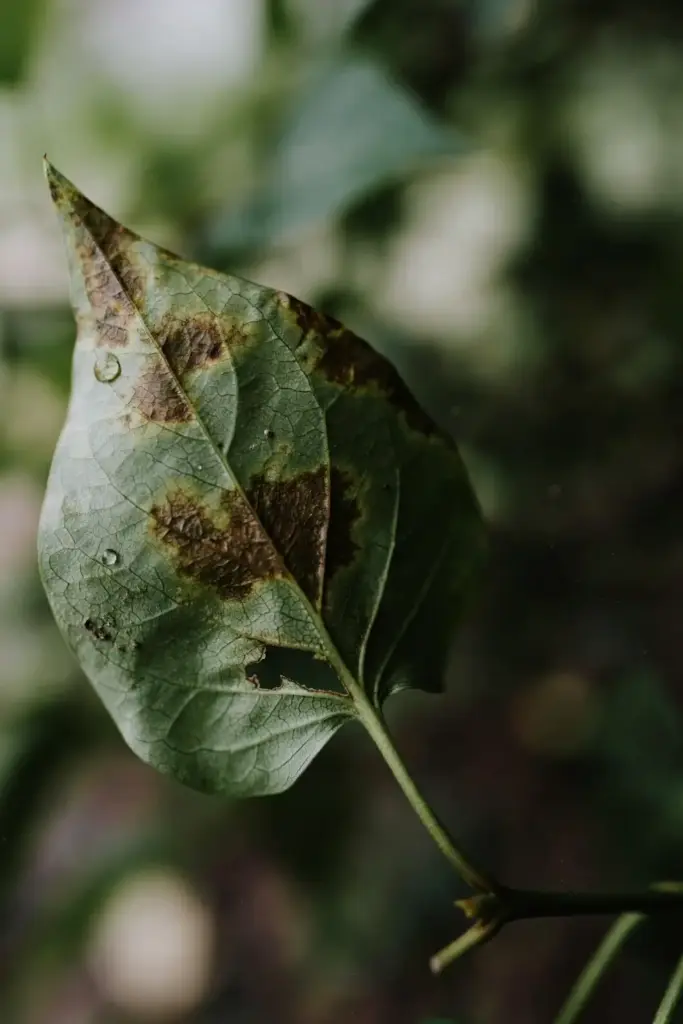
Pseudocercospora leaf spot on lilac starts as brown spots at the leaf edges. The spots grow, merge, curl the leaf, and drop it early, and that edge-first browning plus curling plus early leaf drop is the field pattern.

Spots start small and enlarge. The Iowa State Extension lilac page describes spots that start small, enlarge, and stop at the veins, then merge into blight, which means rapid tissue death. Vein-bounded spots give the leaf a blocky, patchwork look. A leaf with a few small spots in July can carry large dead patches by September.
Timing runs from midsummer into fall. Iowa State Extension first diagnosed the disease in late July in 2024, and more than two weeks earlier in 2026. Warm humid weather in early summer starts the clock. The spots arrive weeks later, so the worst damage often lands in late summer when the shrub should still look green.
Look under the leaf in humid weather. The Iowa State Extension lilac page notes that long conidia, the fungal spores, can be seen under magnification inside the spots under humid conditions. A hand lens shows the spore tufts. That check separates a fungal spot from sun scorch, which shows no spore tufts at all.
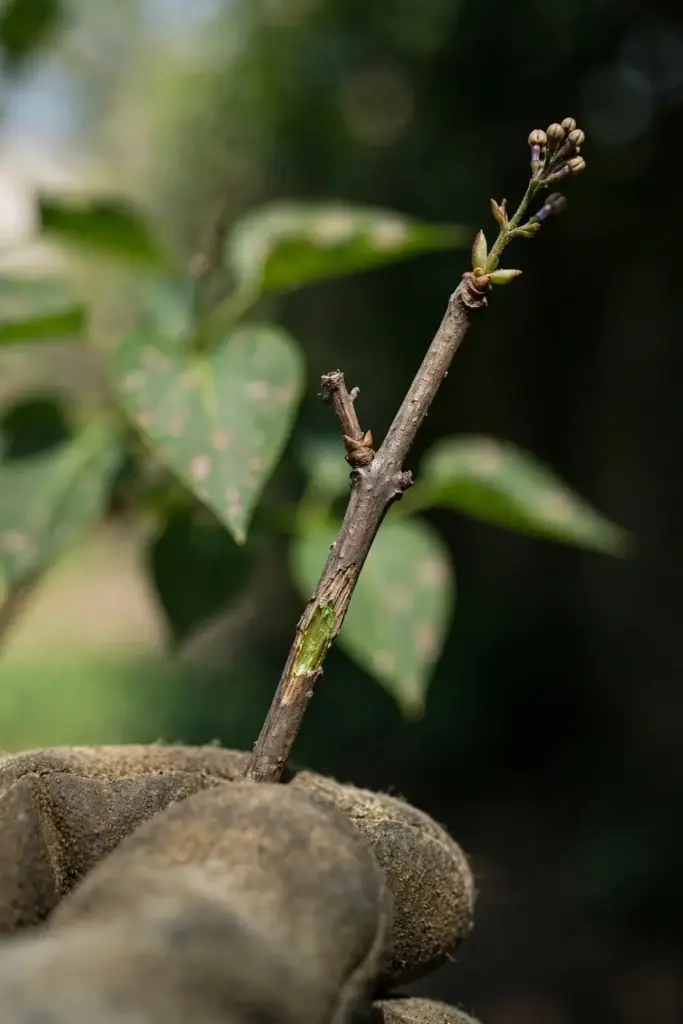
Test whether the shrub still lives. Scratch a thin patch of bark near the end of a twig. Green tissue under the bark plus obvious terminal buds for next year means the shrub will leaf out again in spring. University of Vermont Extension gives that scratch test for lilacs losing leaves to this disease. Brown dry tissue under the bark with no buds means that twig died, and it belongs on the prune pile.
How to Identify Pseudocercospora Leaf Spot on Mountain Laurel Leaves
Pseudocercospora leaf spot on mountain laurel shows circular to irregular spots with purple to brown margins and tan centers. The spots merge into larger dead blotches as infections multiply. Purple-brown margins with tan centers on a leathery evergreen leaf mark this disease.
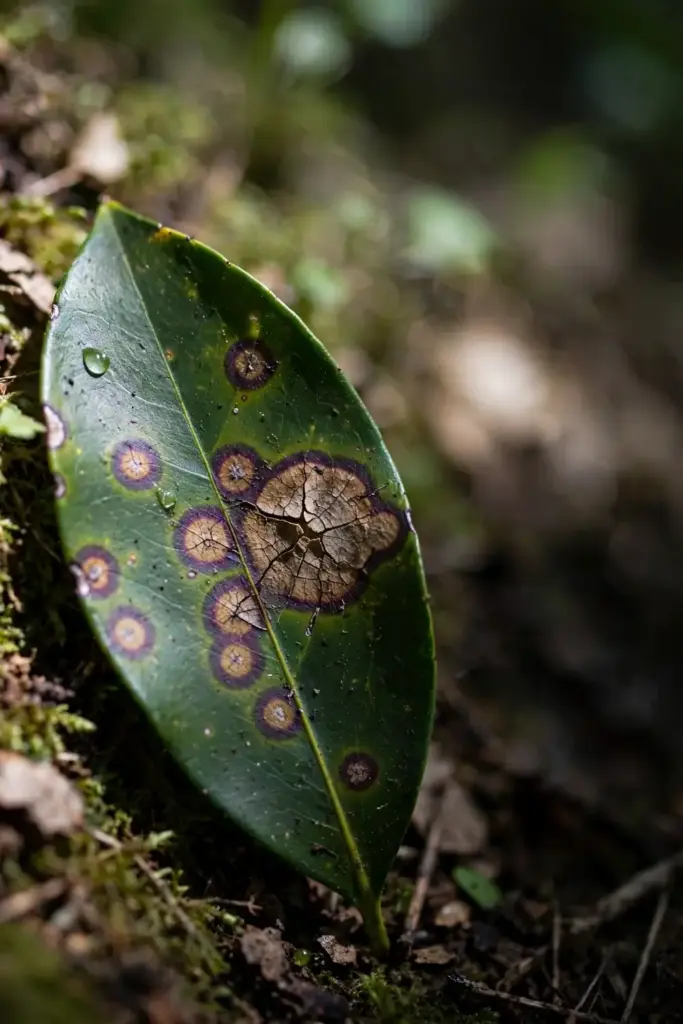
Severe infection eats large parts of the leaf. The UMass Extension mountain laurel page states that severe infections can consume large portions of the leaf and lead to reductions in growth and flowering. A mountain laurel that blooms poorly after a spotted season paid for the disease with flower buds. Light infection leaves the bloom alone.
Infection starts as new leaves expand in spring. The UMass Extension mountain laurel page explains that most infections develop shortly after new leaves begin expanding in spring, while persistent wet and humid weather allows spore germination and dispersal. Older infected leaves supply the spores that infect the new leaves. Even badly infected leaves usually stay on the shrub through winter, so the shrub carries its own inoculum into the next season.
Shade makes mountain laurel disease worse. The UMass Extension mountain laurel page reports that plants growing in deep shade or understory settings suffer higher rates of disease, and that placement in part to full sun settings can help avoid the disease. A mountain laurel under a dense canopy sits in the worst spot in the yard for this fungus.
Know the leaf before you judge the spot. Mountain laurel leaves run 2 to 5 inches long and 0.75 to 1.5 inches wide, and UMass Extension describes them as dark green, glossy, and leathery with smooth margins and pointed tips. Spots sit on that thick glossy surface. The same spots on a thin soft leaf would point to a different shrub and a different problem.
Handle mountain laurel with care. UMass Extension notes that all parts of the plant are toxic if ingested. Wear a worn garden mitt when you pick spotted leaves for inspection, keep clippings away from children and pets, and wash up after the work.
Which Lilacs and Mountain Laurels Get Hit Hardest
Common lilac and Japanese tree lilac both host Pseudocercospora leaf spot. Common lilac, Syringa vulgaris, fills older gardens with fragrant spring bloom. Japanese tree lilac, Syringa reticulata, carries the same disease on a small tree frame, and the tree lilac growing guide covers its bloom care and site needs. Both species drop leaves early under heavy infection, and neither escapes the fungus by being a tree.
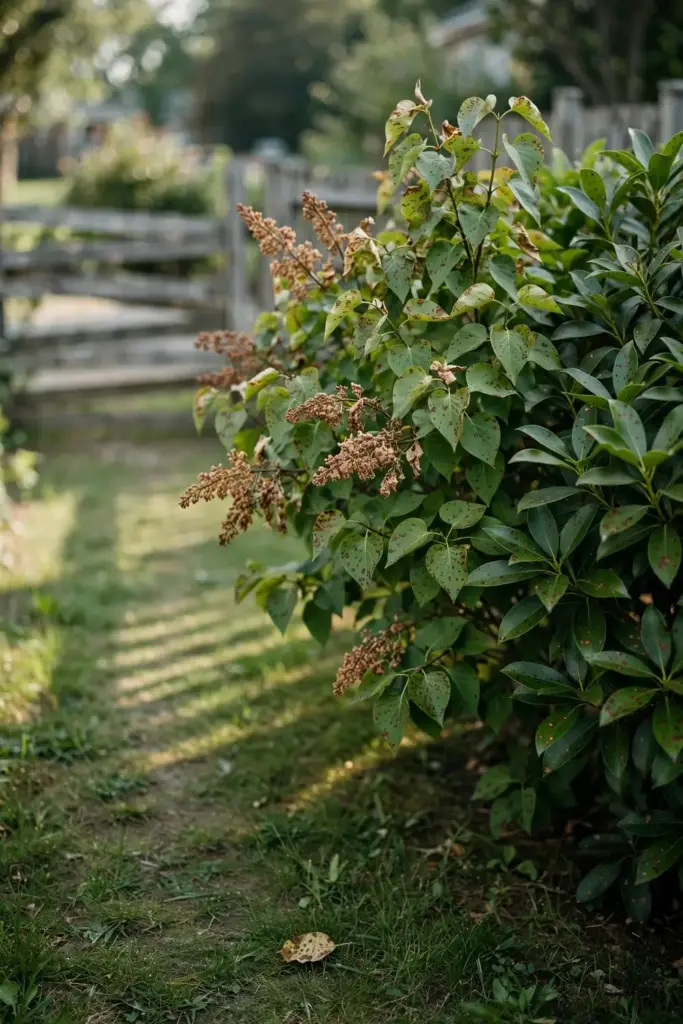
Dense unpruned shrubs sit at the top of the risk list. Crowded stems trap humid air inside the canopy and hold wet leaves long after rain stops. A lilac that never sees thinning shears builds the damp interior this fungus wants. The shrub that blooms behind a fence, jammed against a neighbor, suffers first.
Shade ranks second. Mountain laurel in deep shade suffers higher disease rates, per UMass Extension. Lilac in shade blooms weakly and dries slowly, which stretches leaf wetness after every rain. A shrub that gets morning sun and dries by midday breaks the wet-leaf chain the fungus needs.
Stress ranks third. Iowa State Extension lists inconsistent soil moisture, saturated soils, shaded locations, and lack of proper pruning as stressors that worsen late-season lilac leaf problems. A shrub with wet feet and dry spells between rains defends itself poorly. Steady water and open air matter more than any product.
No published resistant-cultivar list for this disease exists in the extension sources behind this guide. Data not available for a ranked list of resistant lilac varieties against Pseudocercospora leaf spot. Buy for bloom, fragrance, and site fit, and manage the disease with cleanup and thinning rather than hunting a resistant label that no extension source confirms.
Pseudocercospora Leaf Spot vs Cercospora Leaf Spot
Pseudocercospora leaf spot and Cercospora leaf spot look alike in the yard, and no gardener separates them by eye. The distinction lives under the microscope and in the taxonomy books. Management stays the same for both, so the name matters less than the cleanup.

| Clue | Pseudocercospora Leaf Spot | Cercospora Leaf Spot |
|---|---|---|
| Name history | Mountain laurel pathogen Pseudocercospora kalmiae was formerly named Cercospora | The older umbrella name for many leaf spot fungi, still used in older guides |
| Pathogen | Pseudocercospora species, a true fungus | Cercospora species, a true fungus |
| Spots on lilac and mountain laurel | Brown spots bounded by veins on lilac, purple-brown margins with tan centers on mountain laurel | Circular spots with dark margins and pale centers, often called frogeye |
| Signs under magnification | Long conidia visible in spots under humid conditions | Long slender colorless conidia with 5 to 10 or more cross walls per spore |
| Host call | Lilac pathogen named to genus only in extension pages, mountain laurel pathogen named to species | Cercospora species attack a wide range of plants, and each species stays narrow in its host range |
| What changes for you | Nothing in the yard plan, cleanup and thinning carry both | Nothing in the yard plan, cleanup and thinning carry both |
The University of Georgia Cercospora guide describes Cercospora conidia as long, slender, colorless, straight to slightly curved, with 5 to 10 or more septations per spore. Pseudocercospora conidia run long as well, per Iowa State Extension. A lab tells them apart by spore shape and by the structures that bear the spores. A gardener tells them apart by the host and the season, and treats both the same way.
The Cercospora leaf spot guide covers the older name in full, and it pairs with this guide rather than replacing it. When an older book or label says Cercospora leaf spot on lilac, it usually means this same disease. The fungus got a new genus name. The yard work did not change.
Other leaf problems ride along and confuse the picture. Iowa State Extension notes that Septoria leaf spot and powdery mildew also contribute to lilac leaf blight and leaf drop in many seasons. Septoria leaf spot shows its own spotting pattern, and powdery mildew coats leaves with a white powdery film. Phyllosticta Leaf Spot, Phoma Leaf Spot, Entomosporium Leaf Spot, and Septoria Leaf Spot each stand as separate diseases with their own identification marks. One shrub can carry two leaf diseases at once, so a mixed symptom picture means mixed causes.
Bacterial blight differs from both fungal spots. Oregon State Extension describes lilac bacterial blight as a spring disease with blackened shoots and buds after cool wet weather, caused by the bacterium Pseudomonas syringae. Spring shoot blackening points to bacteria. Summer leaf spots with curling and drop point to the fungal leaf spots on this page.
Why Wet Leaves Drive Pseudocercospora Leaf Spot
Wet leaves drive Pseudocercospora leaf spot because spores need water to germinate and infect. Dry leaves stop the cycle cold. Every strategy below traces back to that single fact.
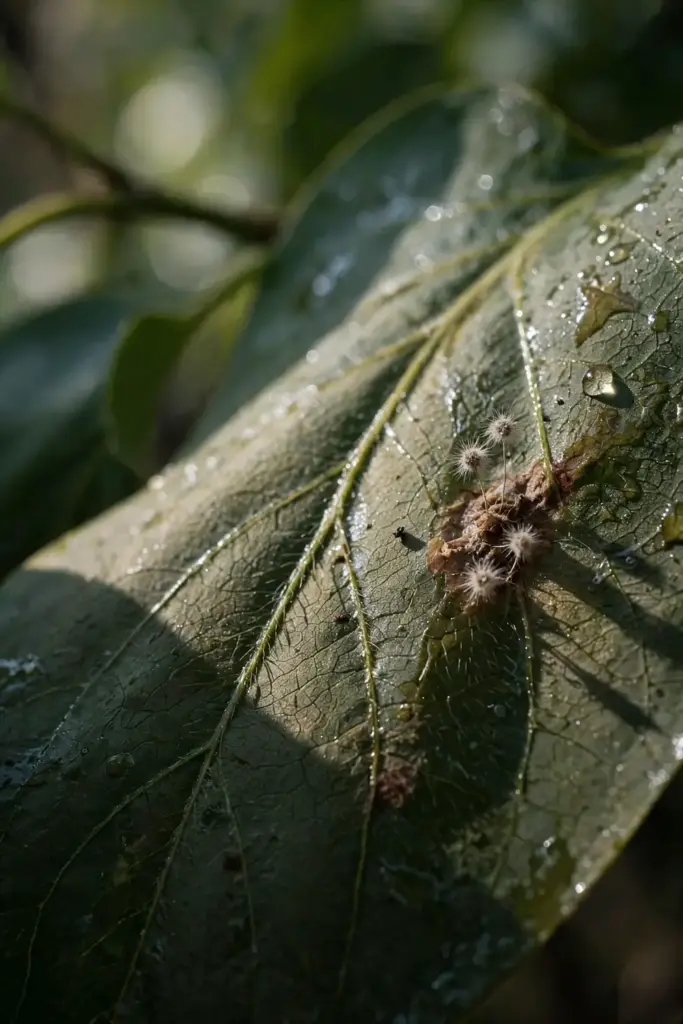
Spores land on a wet leaf and germinate. The Iowa State Extension lilac page ties high infection to high humidity and moderate temperatures near 76 degrees Fahrenheit. Rain splash and wind move spores from infected leaves to healthy ones. A leaf that stays wet for hours after rain gives spores the window they need.
The latent period hides the infection. Symptoms do not develop until 7 or more days after infection, per Iowa State Extension. A shrub looks clean the week the fungus enters. Spots appear later, after the weather that caused them has passed. That delay tricks gardeners into blaming the current week for last week’s infection.
The polycyclic cycle repeats all season. Iowa State Extension describes the pathogen as able to infect repeatedly while conditions stay favorable. Each lesion releases spores that infect fresh leaves. One wet month can run several cycles, and each cycle adds spots to leaves that were clean at the last check.
Inoculum waits in last season’s leaves. University of Vermont Extension explains that the fungus overwinters on fallen leaves and infects emerging leaves in spring during wet weather. Mountain laurel adds its own twist, since badly infected leaves usually stay on the shrub through winter, per UMass Extension. Fall cleanup removes the lilac inoculum, and spring inspection catches the mountain laurel carryover.
What Makes Pseudocercospora Leaf Spot Worse in a Home Garden
Shade makes Pseudocercospora leaf spot worse. UMass Extension links deep shade to higher disease rates on mountain laurel. Shade slows drying, and slow drying stretches the wet-leaf window after every rain. A shrub that never sees direct sun stays wet longest.
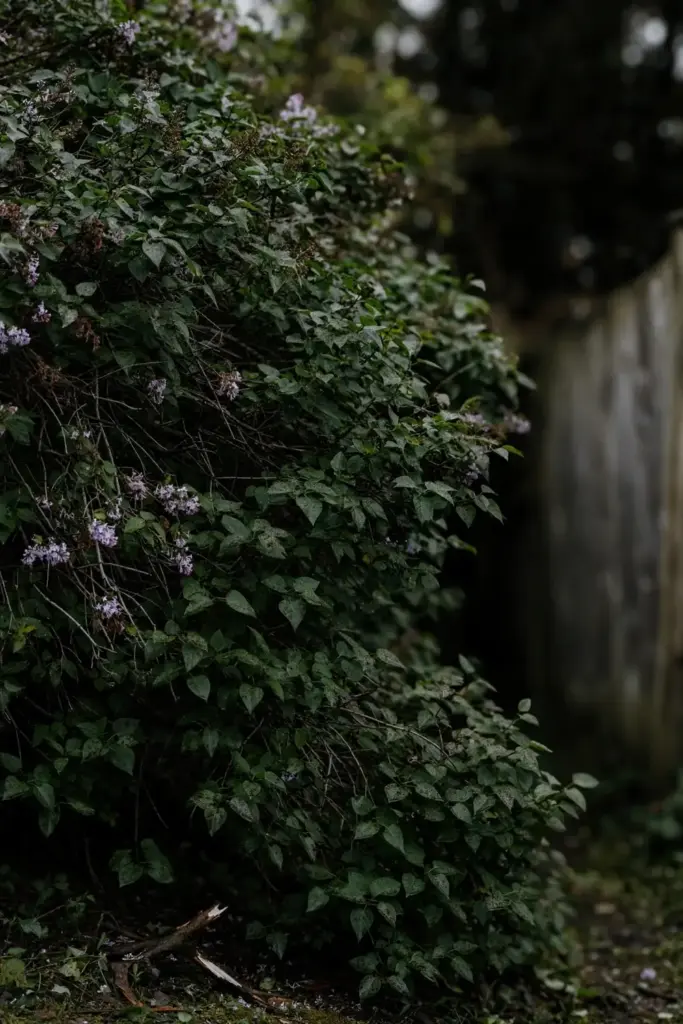
Crowding makes it worse. Iowa State Extension lists lack of proper pruning among the stressors that worsen late-season lilac leaf problems. Dense stems block air and trap humidity inside the canopy. The inner leaves stay wet while the outer leaves dry, and the inner leaves spot first.
Overhead watering makes it worse. Sprinklers wet the canopy from above and extend leaf wetness into the evening. A shrub watered from above every evening lives in a permanent wet-leaf state through the warm months. Soil-level water breaks that pattern.
Skipped fall cleanup makes it worse. University of Vermont Extension warns that the fungus overwinters on fallen leaves and infects emerging leaves in spring. Leaves left under the shrub all winter hand the fungus a bridge to the new season. One skipped raking can seed the next spring.
Stress makes it worse. Iowa State Extension lists inconsistent soil moisture and saturated soils among the stressors that worsen lilac leaf problems. A shrub that swings between soaked roots and dry soil grows weak leaves. Weak leaves spot faster and drop sooner. Steady soil moisture and open air give the shrub its best defense.
Repeat defoliation weakens the shrub over years. University of Vermont Extension notes that over several years of defoliation, the plant may be weakened. One bad season costs bloom and looks. Several bad seasons in a row drain the shrub’s reserves and open the door to dieback. The cleanup plan below aims at breaking the yearly repeat.
Step 1: Decide Whether Treatment Is Worth It This Season
Decide whether treatment is worth it before you buy anything. For most home lilacs, the answer is cleanup, not spray. A shrub with spotted leaves and healthy buds needs a rake and shears, not a chemical.
Iowa State Extension gives the blunt version. Do not panic. Do not reach for the fungicide. Fungicide applications will not help once the polycyclic cycle runs, since the pathogen keeps infecting while conditions stay favorable. Iowa State Extension adds that fungicide applications are seldom warranted for foliar fungal diseases on trees and shrubs in the yard, with rare exceptions. A spray after spots show up cannot heal spotted leaves.
Treatment earns its place in narrow cases. Iowa State Extension notes that fungicides may be beneficial for recurring severe infections. A young specimen shrub that loses its leaves every year, or a mountain laurel that loses growth and flowering year after year, qualifies for the spray conversation in Step 6. A healthy older lilac with one spotted season does not.
Run the triage checks first. Scratch the bark near a twig tip and look for green tissue. Check that terminal buds for next year stand obvious and firm. University of Vermont Extension gives both checks for lilacs losing leaves to this disease. Green cambium plus firm buds means the shrub lives, and cleanup carries the plan. Dead twigs with no buds belong on the prune pile.
Step 2: Rake and Destroy Every Fallen Leaf
Rake and destroy every fallen leaf under the shrub. Fallen leaves carry the fungus into next season. Removing them cuts the spring inoculum at the source.
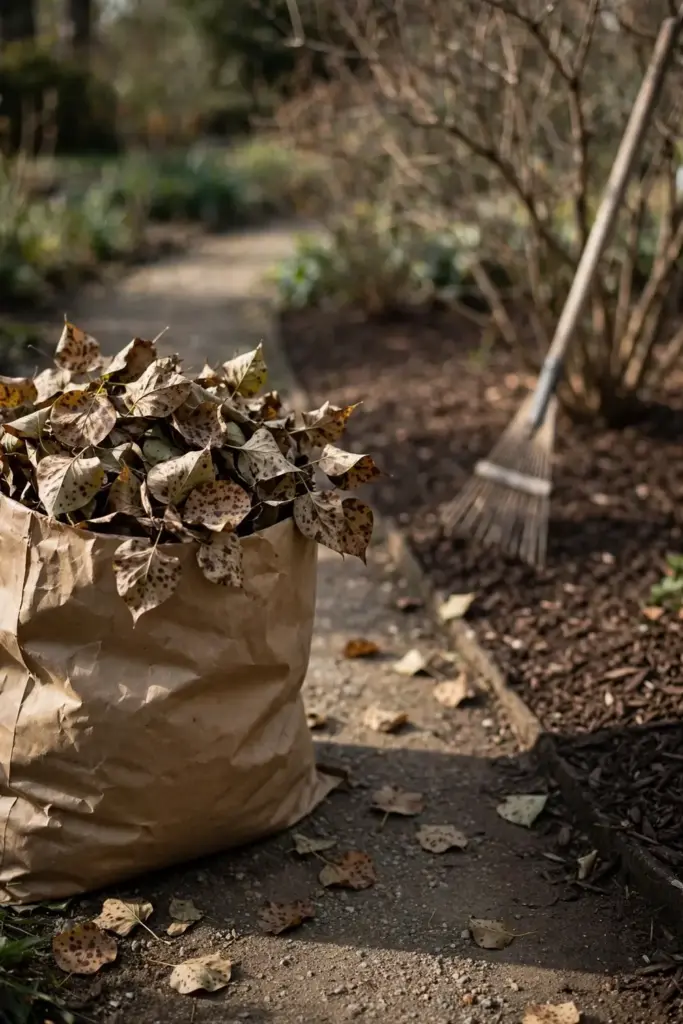
The University of Vermont Extension lilac leaf blight page gives the core instruction: rake and destroy the infected fallen leaves in autumn. Iowa State Extension gives the same core instruction in its lilac guidance: removal and destroying of leaf debris ranks among the preventative measures. Two extension services agree on the move, and it costs nothing but an afternoon.
Work the ground under the shrub, not just the lawn. Spotted leaves hide under the canopy, inside the branch crotch, and in the mulch. Pull them out by hand where the rake cannot reach. Bag the leaves for municipal waste. Kansas State Extension lists composting or discarding diseased leaves as options, but destroying them removes all doubt, and a home compost pile may not heat enough to kill the fungus.
Repeat the pickup through the season. A spotted leaf that drops in August seeds September infections while it lies on the soil. Pick up fresh drops every few weeks during the outbreak, then run the full cleanup in autumn. Mountain laurel needs the same pickup for its fallen leaves, plus a spring check of infected leaves still hanging on the shrub.
Step 3: Thin the Shrub for Air and Light
Thin the shrub to open the canopy to air and light. Thinning dries leaves faster after rain, and faster drying breaks the wet-leaf chain. A shrub that dries by midday spots less than one that stays damp until evening.
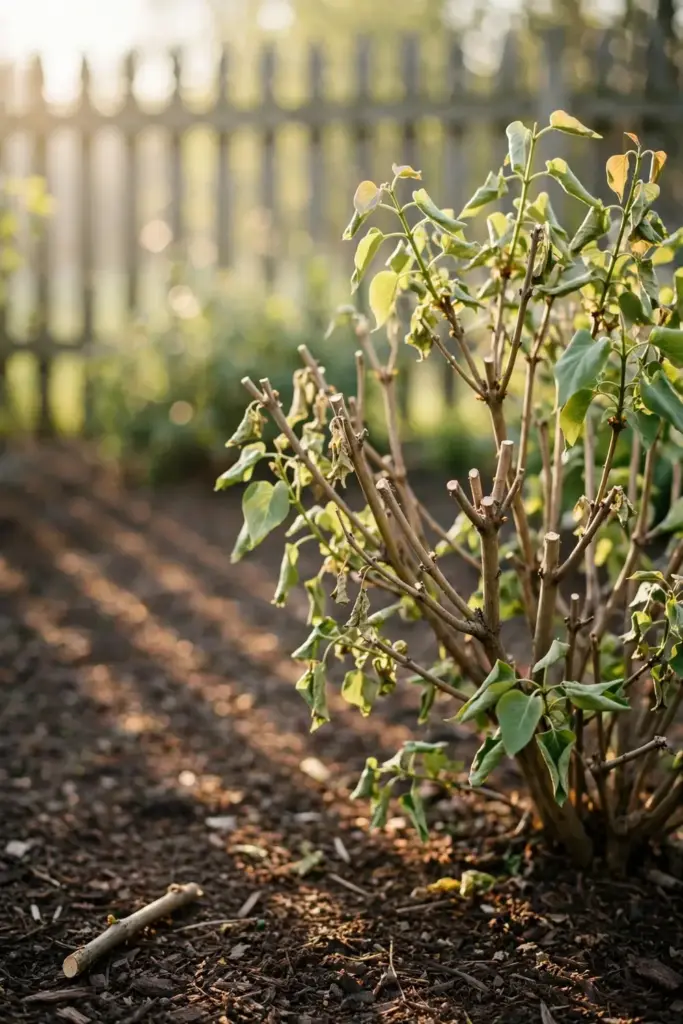
Start with dead wood. Iowa State Extension lists pruning out dead branches among the preventative measures for this disease. Cut dead branches back to live wood. Remove twigs that the scratch test marked dead. Carry every cutting out of the bed and destroy it with the raked leaves.
Thin the crowded interior next. University of Vermont Extension advises thinning the plant during winter to improve air circulation and light penetration, and adds that plants must not sit crowded. Remove crossing stems and weak suckers that tangle the center. Keep the strongest stems with space between them, so wind moves through the canopy.
Cut with clean tools and clean them again after. Use a 10 percent bleach solution, one part household bleach to nine parts water, then rinse, between shrubs. University of Maryland Extension gives the same protocol for tool sanitation. The spring pruning techniques guide covers the cut-and-clean basics in full. Clean blades stop one shrub’s problem from riding to the next shrub on the same shears.
Step 4: Water at the Base and Keep Leaves Dry
Water at the base and keep leaves dry, since soil-level water feeds roots without wetting the canopy. The fungus needs wet leaves. Dry leaves starve it.
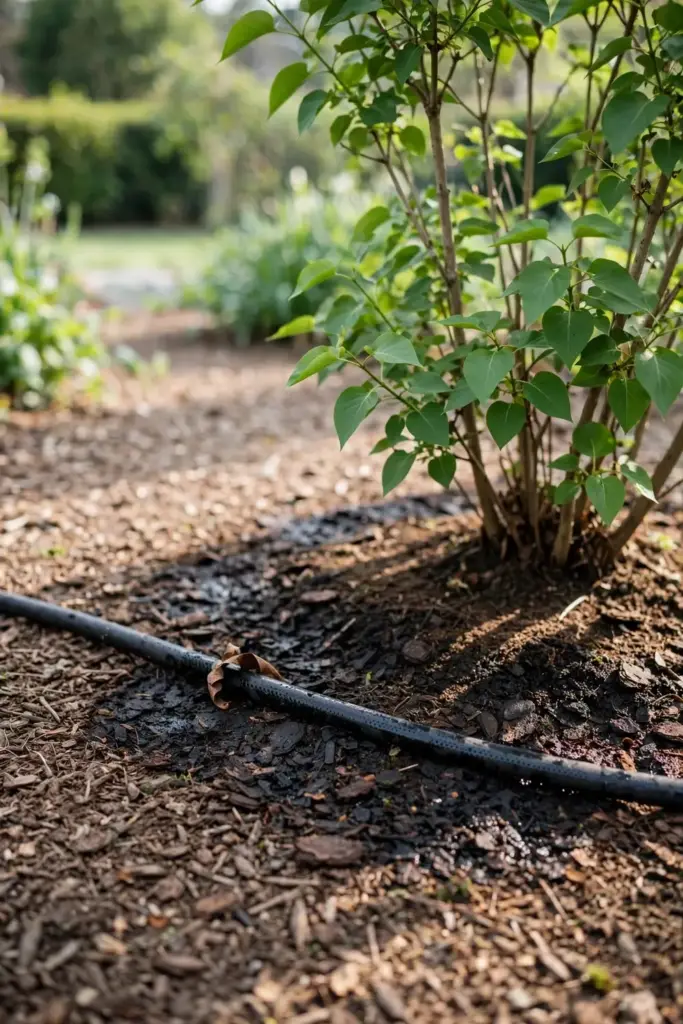
Water in the morning at the root zone. A soaker hose or a slow hose at the base puts water where roots drink. Morning water gives any incidental splash the full day to dry. Evening overhead water leaves the canopy wet overnight, which hands the fungus a long wet window.
Skip sprinklers on spotted shrubs. Overhead spray wets every leaf and extends leaf wetness into the night. A shrub that already carries spots needs dry evenings more than it needs a shower. Move the sprinkler head, shorten the lawn zone, or hand-water the shrub at the base.
Mulch the root zone to stop soil splash. A 2 to 3 inch layer of straw or bark mulch keeps rain from bouncing soil and spores onto lower leaves. Keep the mulch a finger width off the stems so the bark stays dry. Mulch also holds soil moisture steady, which steadies the shrub against the stress swings that worsen the disease.
Step 5: Fix the Site Before You Spray Anything
Fix the site before you spray anything. Sun, spacing, and drainage beat spray on every shrub this disease hits. A shrub in the wrong spot will spot again no matter what you apply.
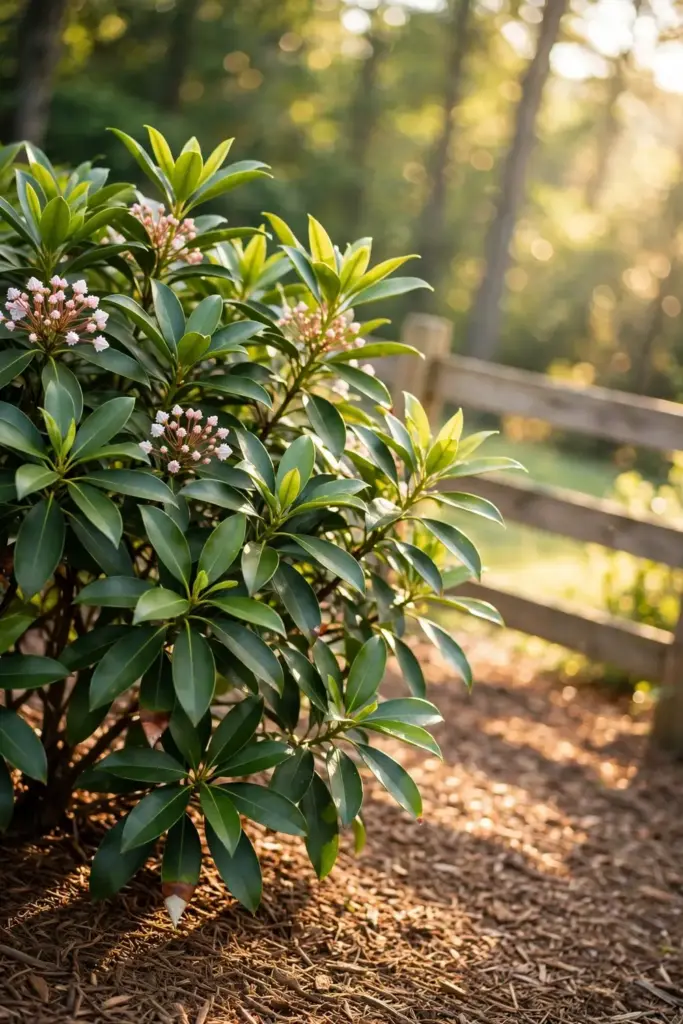
Move mountain laurel out of deep shade. UMass Extension ties deep shade to higher disease rates and points to part to full sun settings as the fix. A mountain laurel under a dense canopy needs a brighter spot. Dig and move it when the shrub rests, and settle it into a site with morning sun and air movement.
Give lilac room to breathe. University of Vermont Extension advises keeping plants uncrowded, since crowded plants trap humidity and shade each other. A lilac jammed against a fence or a neighbor shrub dries slowly and spots early. Space shrubs so air moves between them, and keep nearby plants from leaning into the canopy.
Fix wet feet. Iowa State Extension lists saturated soils among the stressors that worsen lilac leaf problems. A shrub that stands in puddled soil after rain grows weak leaves. Raise the bed, open the drainage, or move the shrub to higher ground. Dry roots grow leaves that resist spotting longer.
Step 6: Use Fungicide Only for Recurring Severe Cases
Use fungicide only for recurring severe cases. Most home gardens never need this step. Spray works as prevention before infection, never as a cure after spots show.
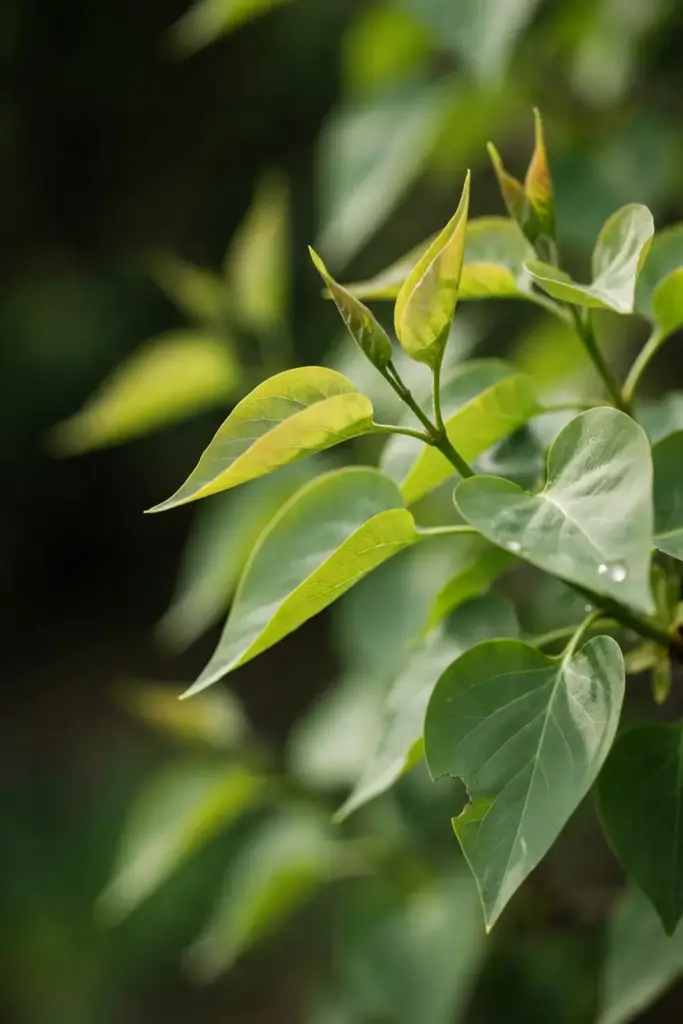
The timing rule is strict. Kansas State Extension states that an application after the leaf spots appear will not help. Spray must go on as leaves develop in spring, before infection, to protect clean leaves. A bottle bought in August, after the canopy already spots, buys nothing.
The product and interval come from Kansas State Extension. Kansas State Extension lists myclobutanil as labeled for lilac leaf spot, applied every 10 to 14 days as leaves develop in spring. Read the label for your state and your shrub, follow the label rate, and wear the label’s protective gear. Stop when the label says stop. UMass Extension adds that preventative fungicide applications when new leaves develop may help decrease severity on mountain laurel.
Weigh the cost before you commit. A spray program runs all spring on a 10 to 14 day cycle, per Kansas State Extension, and it protects only the leaves it covers. Miss a cycle in wet weather and the fungus enters through the gap. Iowa State Extension states that fungicides may be beneficial for recurring severe infections, which sets the bar: recurring and severe, not one spotted season. A shrub that meets that bar earns the spray. A shrub that does not meets the rake instead.
Step 7: Feed and Mulch for Recovery After Defoliation
Feed and mulch for recovery after defoliation. A shrub that dropped its leaves early needs water and steady soil, not a heavy fertilizer push. Recovery grows from roots and buds, not from a bag.
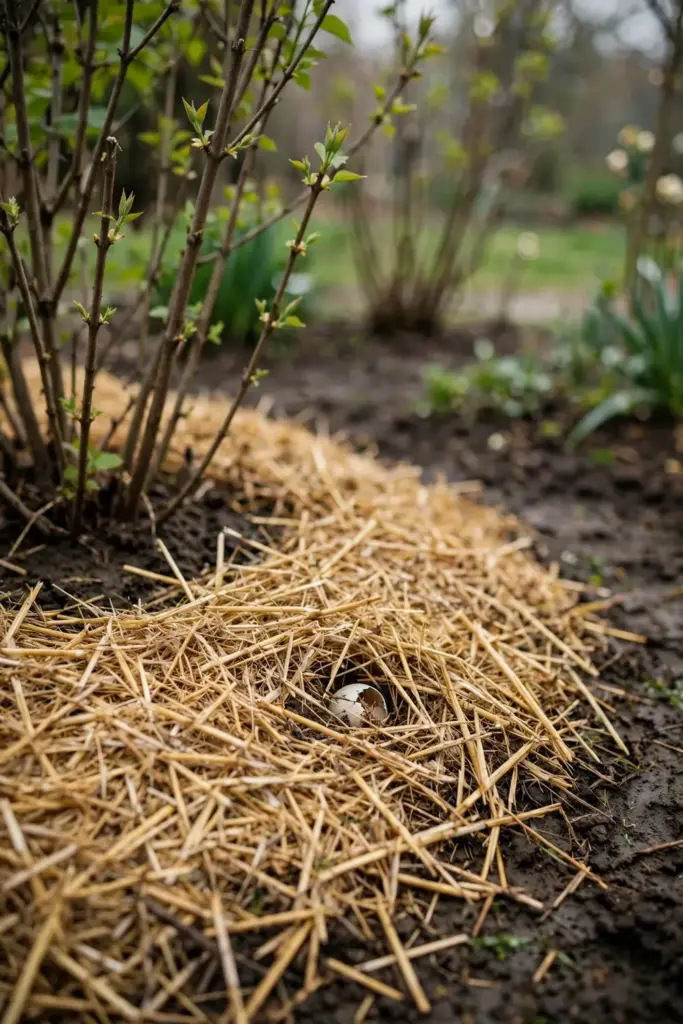
Water at the base during hot dry weather. University of Vermont Extension advises watering at the base of the plant during hot dry weather and mulching plants to conserve water. A defoliated shrub still loses water through its stems and remaining leaves, and dry soil adds stress on top of disease. Deep slow watering at the base keeps the root zone moist without wetting the canopy.
Mulch to hold that moisture. A 2 to 3 inch layer of straw or bark mulch slows evaporation and steadies soil temperature. Keep the mulch a finger width off the stems. Mulch also stops soil splash onto the lowest leaves, which cuts the spore traffic that starts the next cycle.
Protect the buds that carry next spring. University of Vermont Extension notes that terminal buds for next year should stand obvious on a living shrub. Those buds hold next spring’s bloom. Do not prune them off in a cleanup frenzy. Cut dead twigs only, leave the firm budded tips alone, and let the shrub rebuild its canopy from the buds it already set.
Step 8: Start Next Spring With a Clean Canopy
Start next spring with a clean canopy. Spring is the season the fungus meets the new leaves, and a clean start breaks the yearly repeat. The work runs from bud break to full leaf expansion.

Inspect new leaves as they expand. UMass Extension explains that most mountain laurel infections develop shortly after new leaves begin expanding in spring. Lilac follows the same spring pattern, since the fungus overwinters on fallen leaves and infects emerging leaves in wet weather, per University of Vermont Extension. Watch the first leaves closely, and act at the first spots rather than waiting for the canopy to fill with them.
Pick off the first spotted leaves and destroy them. Early pickup removes the first lesions before they shed spores across the canopy. Drop the picked leaves in a bag, not on the soil. Wash up after the work, and keep the gloves or mitt out of the clean bed until cleaned.
Hold the thinning and watering discipline from Steps 3 and 4. Thin any winter-killed twigs before bud break. Water at the base from the first warm weeks. Keep the mulch layer even and off the stems. A clean spring plus dry leaves plus open air gives the shrub its best season since the outbreak began.
Living With Pseudocercospora Leaf Spot Damage You Already Have
Living with Pseudocercospora leaf spot damage means accepting spotted leaves this season and breaking the cycle for next season. The spots will not heal. The shrub can still thrive.
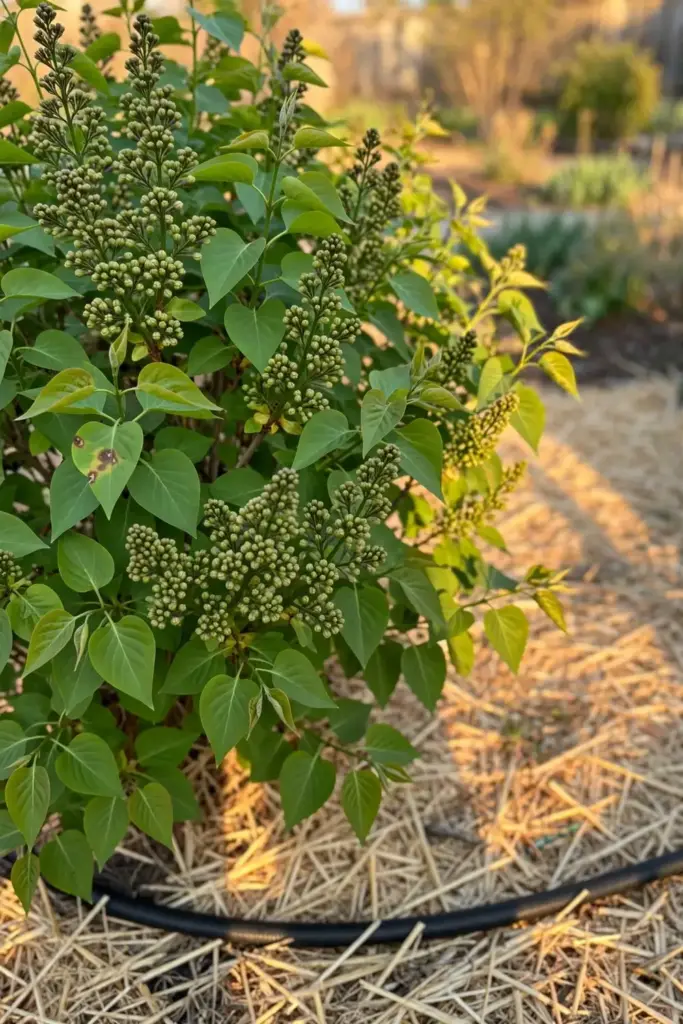
I have learned that a shrub with Pseudocercospora leaf spot rewards cleanup more than spraying. The spots stay ugly through fall, and the rake does more than the spray bottle. A shrub with green cambium and firm terminal buds will leaf out again in spring, per University of Vermont Extension. That promise holds when the cleanup holds.
Keep the three habits that matter most through every season of the outbreak. Rake and destroy fallen leaves. Thin the canopy for air and light. Water at the base and keep leaves dry. Those three moves cut inoculum, shorten leaf wetness, and starve the next cycle. The lilac white flowers growing guide covers bloom care for white-flowered lilacs, which bloom on the growth the shrub protects this season.
Stop three habits that feed the disease. Do not leave spotted leaves under the shrub all winter. Do not water from above in the evening. Do not spray after spots appear and expect a cure. Each habit hands the fungus what it needs: inoculum, wet leaves, and wasted effort.
Expect a slow recovery, not a sudden one. One clean season cuts the pressure. Two clean seasons in a row rebuild the canopy and the bloom. A shrub that drops leaves early for several years in a row weakens, per University of Vermont Extension, so the cleanup must repeat every season until the pattern breaks. The work is dull. The shrub answers it.
Frequently Asked Questions
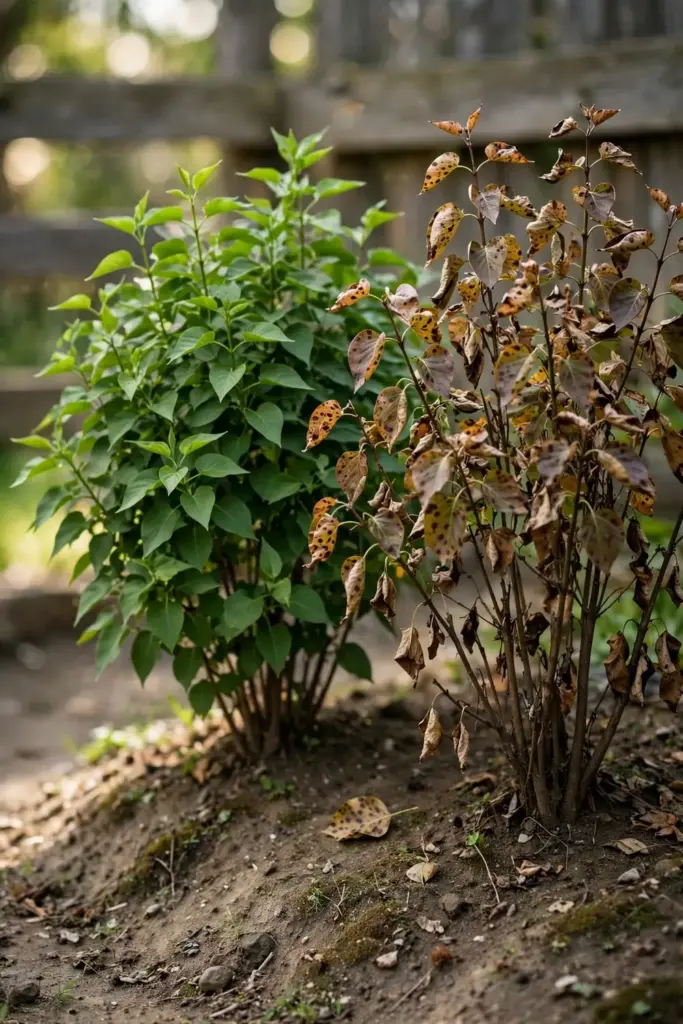
Pseudocercospora leaf spot rarely kills a healthy lilac outright. The disease strips leaves early and weakens the shrub, and repeated defoliation across several years can drain its reserves. Run the scratch test on a twig tip. Green tissue under the bark plus firm terminal buds means the shrub will leaf out again in spring.
Spraying spotted leaves will not heal them. Fungicide works as prevention on clean leaves in spring, before infection, and never as a cure after spots show. Kansas State Extension states that an application after the leaf spots appear will not help. Save spray for recurring severe cases, and spend the season on raking, thinning, and dry leaves.
Hand-picking every spotted leaf wastes an afternoon and strips the canopy the shrub still needs. Pick the worst leaves early, when a few lesions can still seed the whole canopy, and destroy them. Let fall cleanup carry the main load. Rake and destroy every fallen leaf in autumn, when the full season’s inoculum lies on the ground.
Mountain laurel usually holds infected leaves through winter, unlike lilac, which drops them early. UMass Extension notes that even badly infected leaves are usually held through the winter. Severe infection still cuts growth and flowering, and deep shade worsens it. Move the shrub toward part to full sun, thin for air, and pick up fallen leaves.
No gardener separates the two by eye. The distinction lives under the microscope and in taxonomy, where spore shape and spore-bearing structures tell the genera apart. The host and the season give the practical clue, and the yard plan stays the same for both. Cleanup, thinning, and dry leaves carry both diseases, so the exact genus name changes nothing in the yard.
A lilac with green cambium and firm terminal buds blooms again next spring after early leaf drop. University of Vermont Extension gives the scratch test: green tissue under the bark plus obvious terminal buds means the shrub lives. Water at the base during hot dry weather, mulch to hold moisture, and protect the buds through cleanup.
Where to Go From Here
Pseudocercospora leaf spot rewards fast cleanup and steady habits. Confirm the edge-first spots and the curling leaves. Make the honest triage call in Step 1. Then work the sequence: rake, thin, water at the base, fix the site, and start next spring clean.

Start with the rake this week. Pick up every fallen leaf under the shrub and destroy it. Thin one crowded shrub before the next wet spell. Those two moves cut more future spots than any bottle on the shelf.