
Ornamental vs fruiting plum trees split on four clues: fruit size, leaf color, bloom timing, and growth habit. An ornamental plum carries cherry-size fruit, about 3.2 cm across, if it carries fruit at all. A fruiting plum carries full-size plums you can eat fresh. The rest of this page runs the clues in order, from flowers to fruit, so you can name the tree in your yard.
I have learned that the plum I name from its fruit beats the plum I name from its flowers.
Ornamental plum means Prunus cerasifera cultivars grown for flower and foliage, not fruit. Fruiting plum means Prunus domestica and Prunus salicina grown for fruit. Plum means the genus Prunus. Three native Australian trees share the word plum and belong to other genera entirely, and this page rules those out too.
1. Watch the Flowers First: Bloom Timing and Color
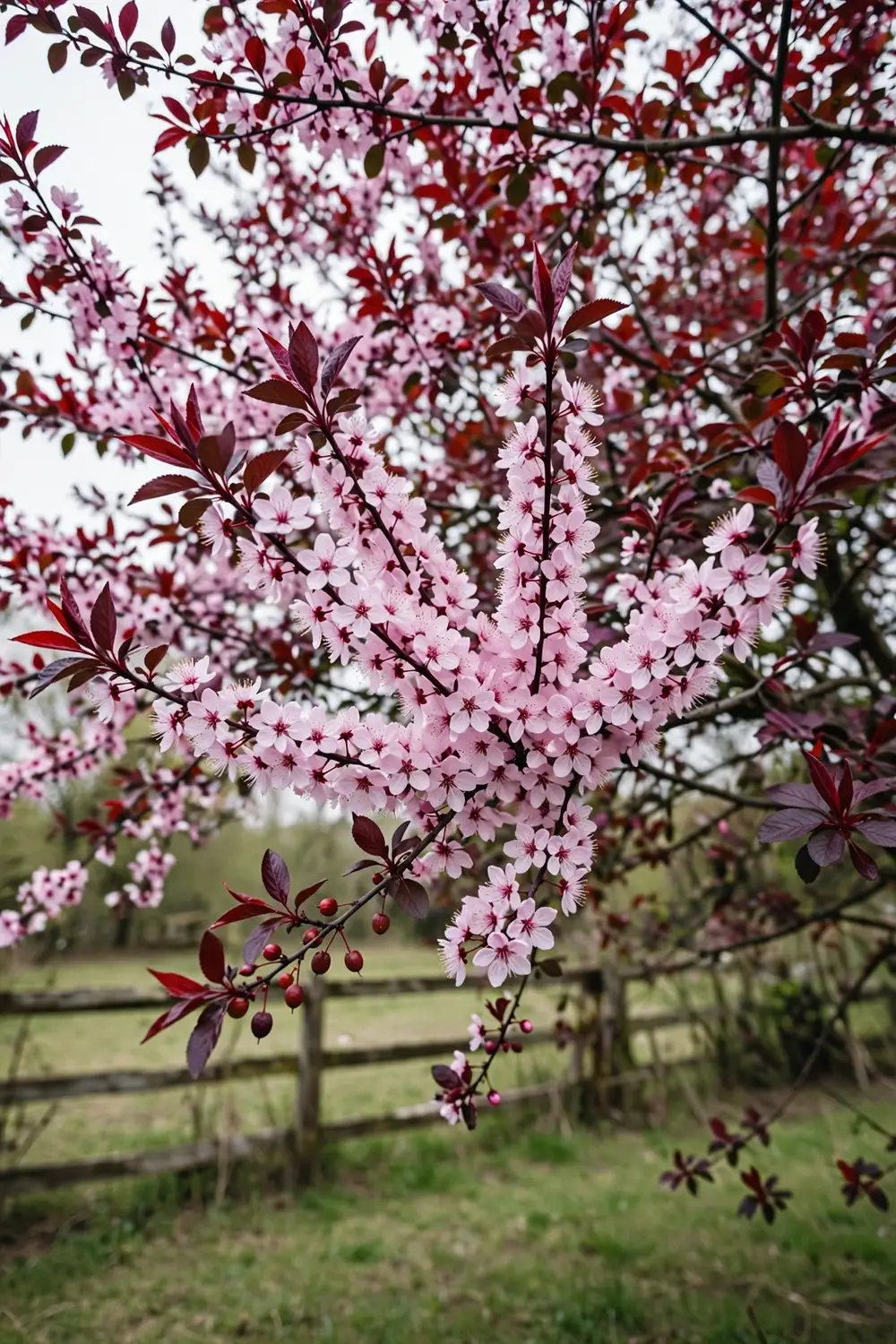
Flowers give the first clue, and they give it in spring. An ornamental plum opens pink blossoms on bare wood, just before its leaves emerge. A fruiting plum opens white flowers as its leaves unfold. Bloom order alone does not settle the question, and the fruit section below carries the deciding test.
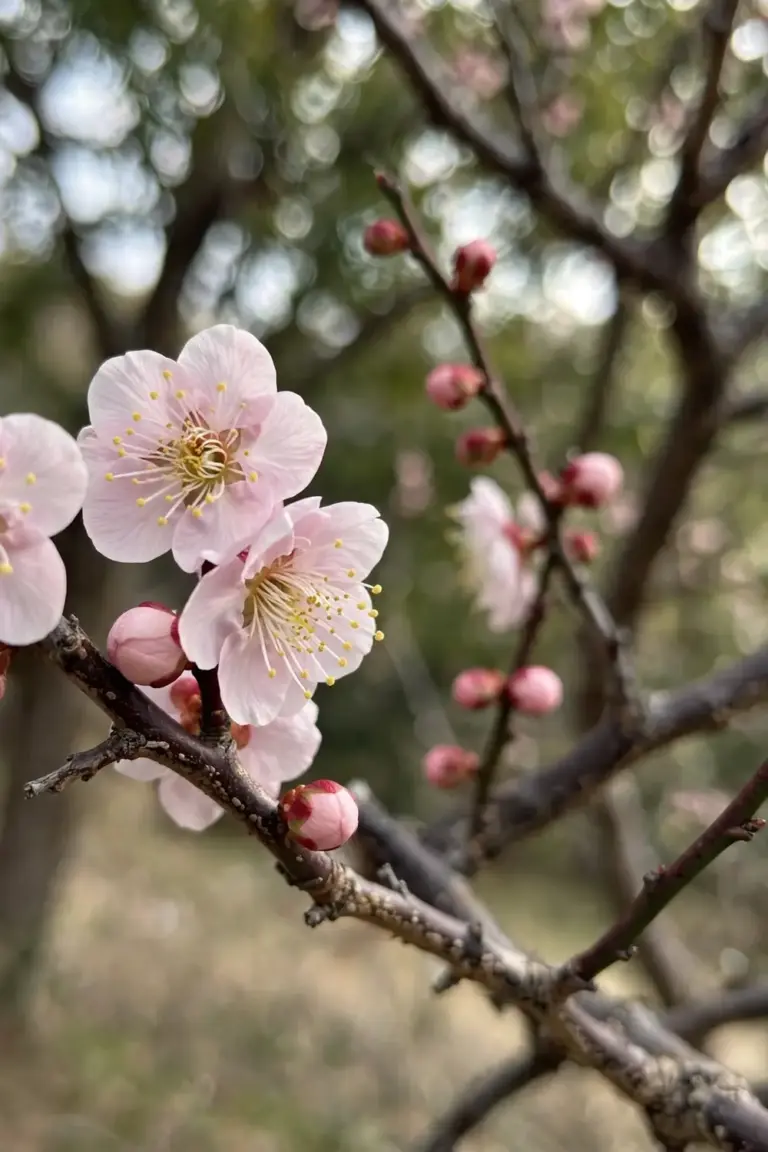
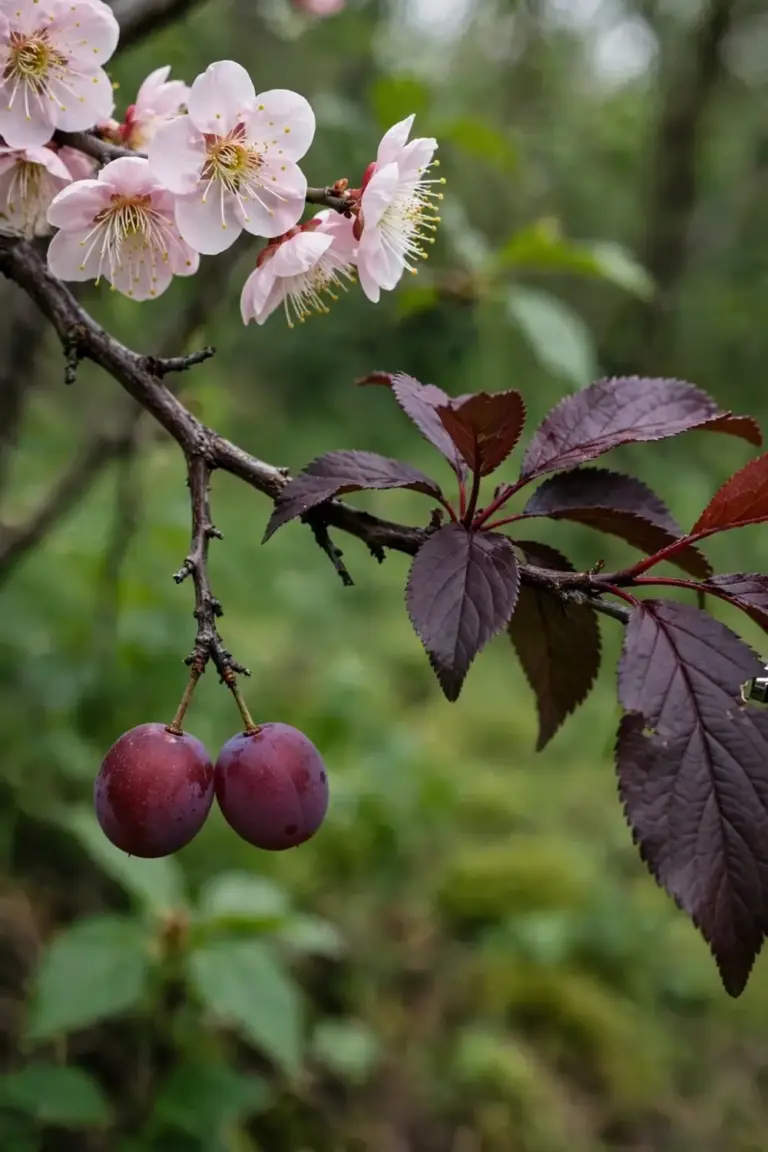
The ornamental species sets small, fragrant, pure white, 5-petaled flowers with numerous stamens, and those flowers bloom in spring as the leaves emerge, according to the North Carolina Extension Gardener Plant Toolbox profile of Prunus cerasifera. The purple-leaf cultivars break that pattern in one visible way. Their flowers run pale pink or lavender instead of white. The color shift is easy to spot against dark foliage, and it is the first sign that the tree in front of you is a cultivar grown for looks.
The best-known purple-leaf cultivar sharpens the timing clue further. Pink blossoms blanket the stems of Prunus cerasifera ‘Thundercloud’ right before the leaves emerge, and the pale pink flowers sit against dark red stems, according to the North Carolina Extension profile of ‘Thundercloud’. That bare-wood bloom is the ornamental signature. A fruiting plum flowers with its leaves, not ahead of them. If you see a cloud of pink on bare wood in early spring, you are almost certainly looking at an ornamental plum.
Fruiting plums add a second timing layer inside their own group. European plums bloom 10 to 14 days later than Japanese plums, according to Utah State University Extension. Japanese and American plums bloom just as apricots finish flowering in spring. The sequence runs ornamental first, then Japanese fruiting, then European fruiting. The sequence holds in either hemisphere. Calendar months flip between north and south, and the order of the three groups does not.
In Australia the same sequence plays out in spring, and the order is what matters, not the month. Ornamental plums flower first, on bare wood. Japanese fruiting plums follow as their leaves unfold. European fruiting plums come last, roughly two weeks behind the Japanese group. A reader in Sydney or Melbourne watches the same parade in September, October, and November that a reader in Utah watches in March, April, and May. Do not force a northern calendar onto a southern garden. Watch the order.
Do not stop at flowers. A white-flowered ornamental species tree looks much like a fruiting plum in bloom, and a young fruiting tree can flower before it ever sets a crop. Flowers point. Fruit decides. Move to the fruit next.
2. Weigh the Fruit: Size Tells the Story
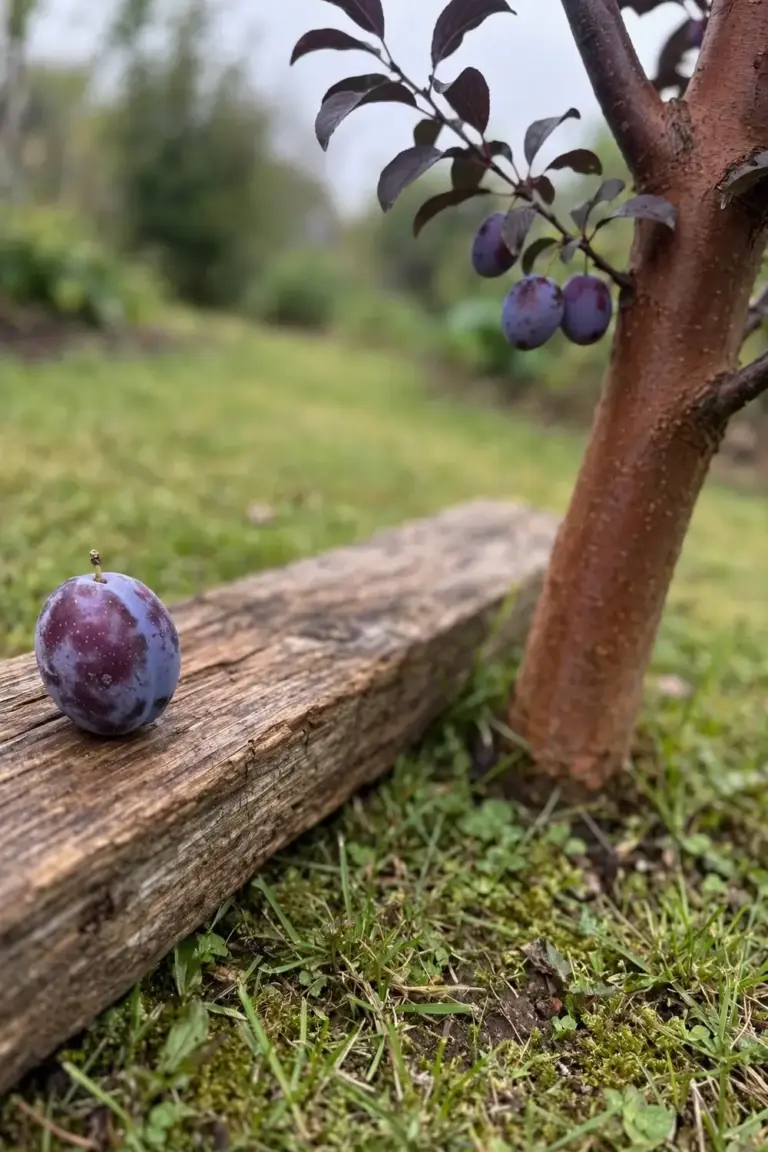
Fruit settles the question. Ornamental plum fruit stays cherry-size, about 3.2 cm across, and many trees set none at all. Fruiting plum fruit grows to full eating size, with flesh you can bite into fresh. If the tree in your yard carries fruit, pick one and measure it. That single measurement answers the question faster than any other clue.
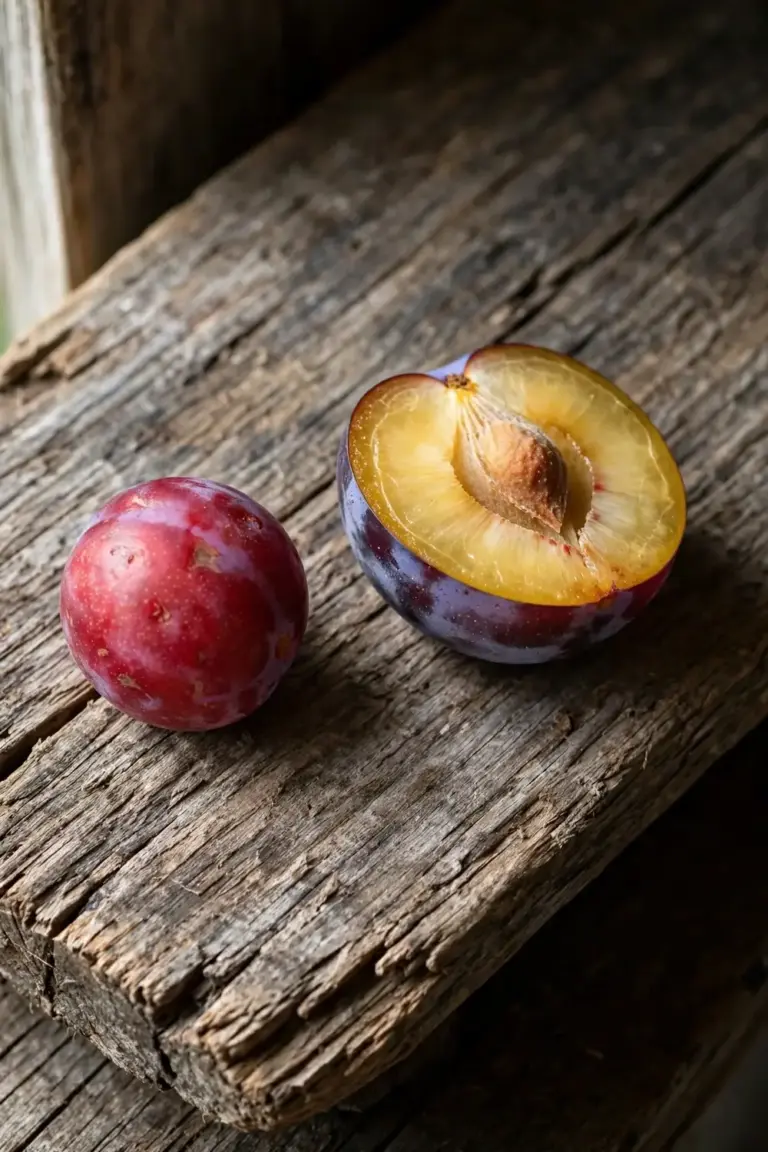
The ornamental fruit stays small by design. Fruits, if produced, are cherry-like yellow or red, according to the North Carolina Extension Gardener Plant Toolbox profile of Prunus cerasifera. The same profile puts a number on that size. The fruit is a round, 1.25 inch drupe, reddish to yellow, which converts to about 3.2 cm across. Most years, these ornamental trees produce little or no fruit. A tree that flowers heavily every spring and then carries nothing, or carries a scattering of cherry-size drupes, fits the ornamental pattern exactly.
Fruiting plums tell a different story in both size and shape. European prune-type plums carry oval fruit with blue or purple skin and yellow flesh, while fresh-eating European cultivars run more rounded with red or yellow flesh, according to Utah State University Extension. Japanese plums produce fruit that is juicy and fairly large. The plums are round, and skin color can range from yellow to red with some being almost black, while the flesh of the fruit is yellow or red. The same source notes that Japanese plums are primarily consumed as a fresh fruit. Size, shape, and use all point the same way. A plum you would slice and eat fresh belongs to a fruiting tree.
The honest caveat matters here. Ornamental plums do set fruit in some years, and that fruit is edible. The flesh of Prunus cerasifera fruit is small and edible, to about 2.5 cm across, and sweet but somewhat tasteless, according to the Missouri Botanical Garden Plant Finder. Utah State University Extension adds that the ornamental purple-leaf plum ‘Newport’ periodically produces fruit that can be processed. Small, tart, and occasional is the ornamental pattern. Large, sweet, and yearly is the fruiting pattern. Taste one fruit and the difference is obvious, and the flesh is the only part to taste. Eat the flesh only and never the kernel. North Carolina Extension flags low-severity poison characteristics for purpleleaf plum, and the kernel inside the stone is not food. If the identification is still uncertain, do not eat anything from the tree until the fruit and leaf clues agree.
Cut one fruit open and the inside confirms the outside. Every plum is a drupe: flesh around one hard stone. European plum flesh runs yellow in prune types and red or yellow in fresh-eating types, while Japanese plum flesh runs yellow or red, according to Utah State University Extension. The stone sits alone at the center. A cherry-size fruit with yellow flesh and one hard stone fits the ornamental pattern. A full-size fruit with yellow or red flesh and one hard stone fits the fruiting pattern. The cut test takes thirty seconds and it never lies about size.
3. Read the Leaves: Purple Means Ornamental
Purple leaves name an ornamental plum. Fruiting plums carry green leaves through the season. No fruiting plum cultivar holds purple foliage all season long. Leaf color is the fastest clue after fruit, and it works from across the yard.
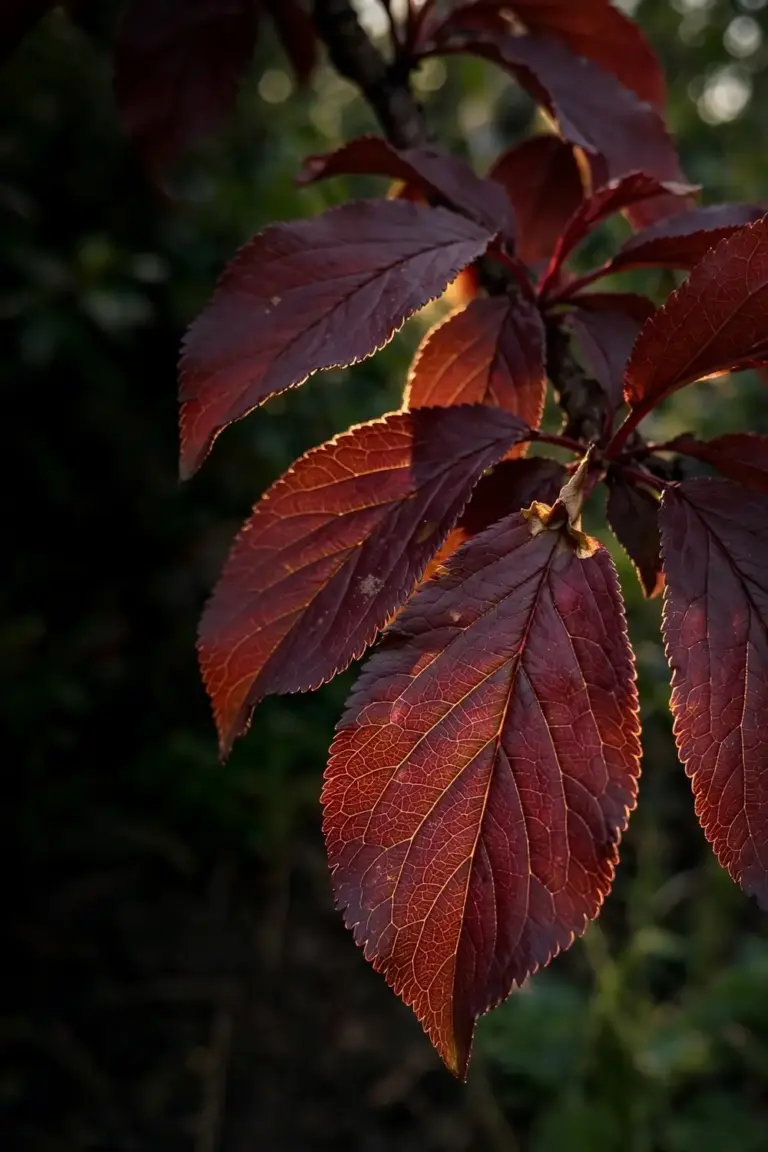
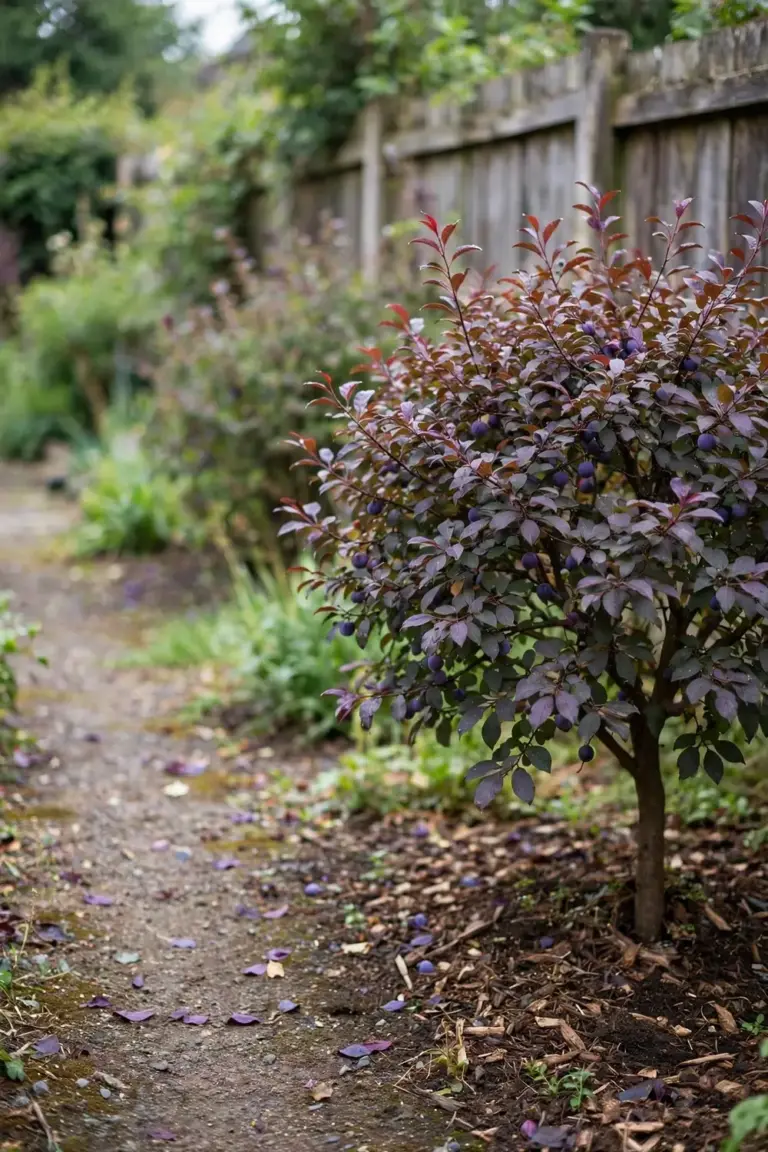
The purple-leaf cultivars keep their color from spring to leaf drop. Varieties or cultivars of Prunus cerasifera have deep reddish purple foliage, and the unique feature of these cultivars is that the leaves retain the purple color until they drop in the fall, according to the North Carolina Extension Gardener Plant Toolbox profile of Prunus cerasifera. The species itself carries green leaves. Those leaves are ovate or elliptic with serrated margins. The contrast is clean. Green leaves mean the species form or a fruiting plum. Purple leaves that hold their color all season mean an ornamental cultivar.
The best-known cultivar shows how strong that signal runs. Prunus cerasifera ‘Thundercloud’ is noted for having one of the darkest purple leaves and twigs of all the flowering plums, according to the North Carolina Extension profile of ‘Thundercloud’. The purple foliage stays colorful throughout the growing season. That persistence is the point. Many trees flush purple in spring and green out by summer. A true purple-leaf plum does not. Its leaves stay purple until they fall.
Shade complicates the picture, and the same source names the exception. Purple leaf coloring occurs in full sun, while trees in shade tend to produce green leaves. A ‘Thundercloud’ planted under a bigger tree can leaf out green and fool a reader who trusts color alone. Check the fruit when shade muddies the leaf clue. A shaded ornamental still sets cherry-size fruit or none at all, and that fruit clue does not change with light.
Australian nurseries sell the purple-leaf ornamental plums under several cultivar names, including ‘Nigra’, ‘Elvins’, and ‘Blireana’. The nursery listings confirm the names, and this page claims nothing further about ‘Elvins’ or ‘Blireana’ beyond their place on the ornamental side of the split. Data not available for cultivar-by-cultivar trait tables for those two names, so the key below leans on the traits the extension sources verify: purple foliage, pink bloom on bare wood, and cherry-size fruit or none. If a nursery tag names one of those cultivars, treat the tree as ornamental and confirm with fruit.
4. Check the Bark and Growth Habit
Habit backs up the leaf and fruit clues. An ornamental plum grows upright and twiggy, with a rounded to vase-shaped crown and brittle wood. A fruiting plum grows with a purpose. European plums grow upright and somewhat vase-shaped. Japanese plums grow more rounded and spreading. Habit alone never settles the question, and habit plus fruit settles it fast.
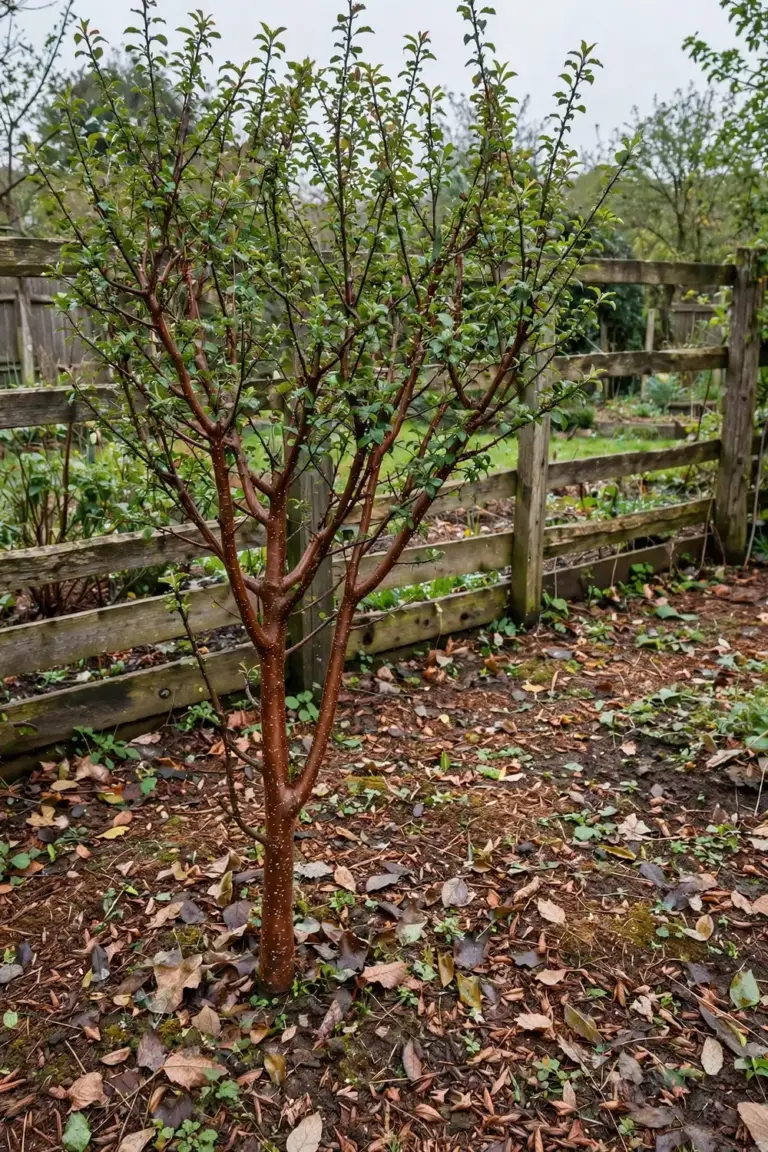
The ornamental frame is light and twiggy. The purple leaf plum or cherry plum is a medium-sized, ornamental, deciduous tree that is typically short-lived, according to the North Carolina Extension Gardener Plant Toolbox profile of Prunus cerasifera. The tree is upright and twiggy with a rounded to vase-shaped crown and brittle wood. Brittle wood is a field mark you can feel. Twigs snap cleanly instead of bending, and the crown looks airy next to the denser frame of a fruiting tree. A well-cared-for tree may live 60 to 80 years, the same profile notes, so a short-lived reputation does not mean a young tree.
Bark changes with age, and that change helps date the tree. Young bark runs thin, reddish-brown to dark gray, and smooth with lenticels. As the tree matures, the bark splits and develops furrows and ridges. Bark on a young ornamental plum can look almost polished, while bark on an old tree of the same species looks deeply ridged. How trees add a new ring of wood each year explains why that shift happens: the trunk lays down new wood inside while the outer bark splits to make room. Do not mistake an old ornamental for a different species because its bark turned rough. Rough bark is age, not identity.
Fruiting plums carry their own habit signatures. European plum trees are upright and somewhat vase-shaped, according to Utah State University Extension. Japanese plum trees are more rounded and spreading than European plums. The size gap helps too. ‘Thundercloud’ matures to 25 feet high and wide, which converts to about 7.6 m each way. A fruiting plum on a standard rootstock can outgrow that frame, and its branches carry the weight of a real crop. A tree that sags under fruit in late summer is fruiting. A tree that stands light and twiggy through summer is ornamental.
5. Run the 5-Clue Key for Ornamental vs Fruiting Plum Trees
Run the clues in order. Start with fruit, confirm with leaves, check flowers, then habit and bark, and the tree names itself. The table below sets the five clues side by side, one column per tree type. Read down one column and the pattern jumps out.
| Clue | Ornamental Plum (Prunus cerasifera) | Fruiting Plum (Prunus domestica / Prunus salicina) |
|---|---|---|
| Fruit | Cherry-size, about 3.2 cm, or none at all in most years | Full-size eating plums, yearly on a healthy tree |
| Leaves | Deep reddish purple all season on purple-leaf cultivars; green on the species form | Green through the season; no purple-leaf fruiting cultivar |
| Flowers | Pink blossoms on bare wood, before leaves emerge | White flowers as leaves unfold; European blooms 10 to 14 days after Japanese |
| Habit | Upright, twiggy, rounded to vase-shaped crown, brittle wood | European upright and vase-shaped; Japanese rounded and spreading |
| Bark | Young bark smooth, reddish-brown to dark gray with lenticels; old bark split and ridged | Bark ages the same way; habit and fruit carry the split, not bark alone |
Work two examples through the key. Purple leaves plus pink blossoms on bare wood plus no fruit equals ornamental. The leaf clue alone would answer it, and the flower and fruit clues confirm it. Green leaves plus white flowers plus full-size fruit equals fruiting. The fruit clue alone would answer it, and the leaf and flower clues confirm it. The key earns its keep on the hard case. Green leaves plus no fruit yet equals wait. A young fruiting tree may not fruit for its first seasons, and a shaded ornamental may leaf out green. Check bark and habit, then check fruit again next season. A tree that never sets more than cherry-size fruit across several seasons is ornamental.
One more lookalike deserves a pointer. Cherries belong to the same genus, Prunus, and a cherry tree can confuse a reader who leans on fruit size alone. If the fruit looks too small even for an ornamental plum, or the tree carries paired fruit on long stems, consider cherry before settling on plum. Growing cherry fruits covers the cherry side of that comparison. This page stays on the plum split. The cherry pointer exists so a reader with a cherry tree does not force it into a plum key.
When the clues disagree, trust fruit first and treat the rest as supporting evidence. A shaded ornamental with green leaves still sets cherry-size fruit or none. A young fruiting tree with no fruit yet still carries green leaves and white flowers with its leaves. A grafted fruiting tree can even carry one ornamental branch if the rootstock suckers below the graft, and those suckers show the ornamental pattern while the top of the tree shows fruiting. Check where each clue came from on the tree. Clues from the grafted top name the cultivar you bought. Clues from a sucker below the graft name the rootstock, not the tree you wanted.
6. Rule Out the Native Plums That Are Not Prunus
Two Australian trees share the word plum and belong to other genera: Burdekin plum is Pleiogynium timoriense, and Davidson’s plum is Davidsonia. Neither is Prunus. The disambiguation takes one test, and it lives in the leaf. Prunus leaves are simple, one blade per stalk, while both native plums carry compound leaves with leaflets along a central stalk. Compound leaves rule out Prunus on sight.
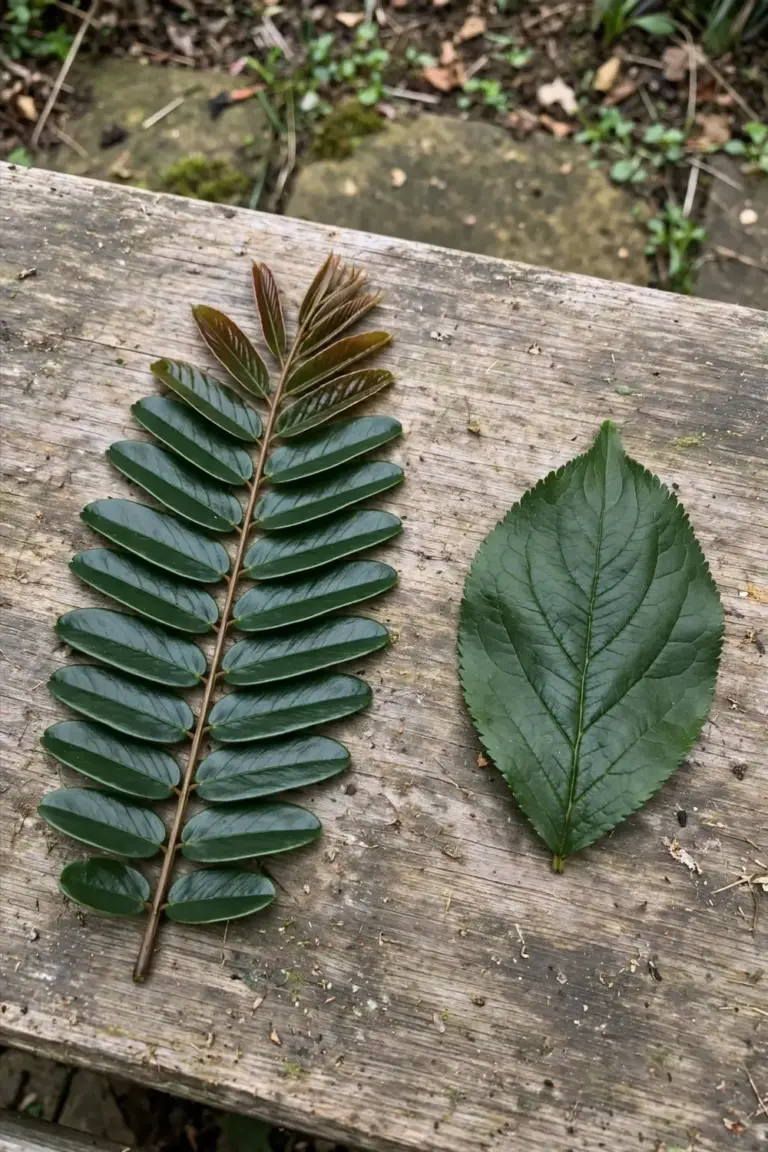
Burdekin plum is the one most likely to confuse a reader in Queensland and northern New South Wales. It is a tropical, rainforest tree which may reach 20 meters but which is usually smaller in cultivation, according to the Australian Native Plants Society profile of Pleiogynium timoriense. Leaves are pinnate, comprising leaflets on opposite sides of a central axis, consisting of 3 to 11 leaflets. They are dark, shiny green with bronze new growth. The fruits are large and fleshy and, when ripe, are deep purple in color. Flowering occurs in winter and spring and the fruits ripen in summer and autumn. The same profile notes the fruits have received attention as bush tucker. The flavor is palatable and, although fairly astringent, can be made into excellent jams. The leaf test settles it. Pinnate leaves with 3 to 11 leaflets are not Prunus leaves, whatever the fruit looks like.
Davidson’s plum needs the same treatment. Davidsonia is a genus of three rainforest tree species native to Australia, and its fruits superficially resemble the European plum but are not closely related, according to the Davidsonia genus account. The fruit carries sour burgundy flesh and measures no more than 50 mm across. The leaves are large and compound, divided into leaflets, and the new growth shows a pink flush. The compound leaf is again the deciding mark. A tree with large compound leaves and plum-like fruit in eastern Australia is Davidsonia, not Prunus. The sour flesh confirms it. A true plum tastes sweet to sweet-tart when ripe. A Davidson’s plum tastes sharply sour and belongs in jam, sauce, or cordial rather than the fruit bowl.
Simple leaves plus a single stone fruit means Prunus. That is the whole rule. Compound leaves mean something else, whatever the common name says. Nurseries and garden centers sometimes label native trees with plum in the name, and the label is the trap. Trust the leaf. Ignore the label.
7. Decide What to Do With the Fruit
Fruiting plum fruit goes to the kitchen. Ornamental plum fruit goes to the jam pot or stays for the birds. Either way, eat the flesh only and never the kernel. The kernel inside the stone is not food. That rule covers every plum on this page, ornamental and fruiting alike.
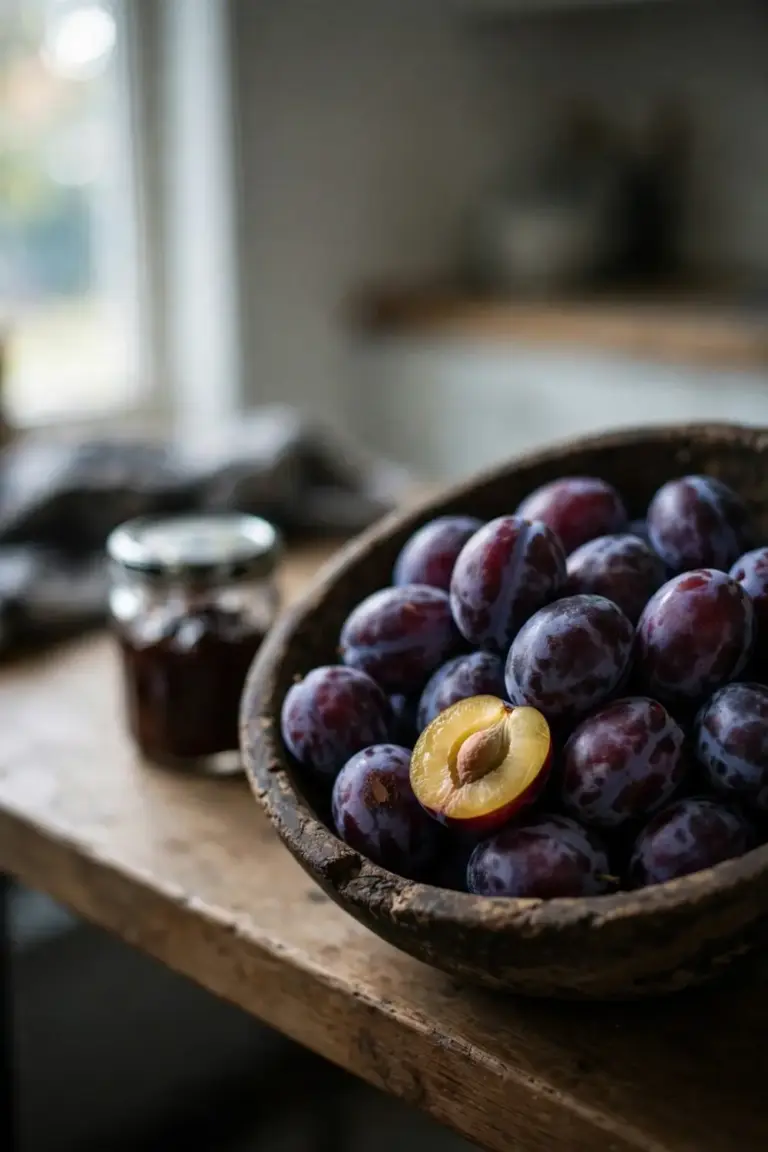
Ornamental fruit is small, tart, and occasional. The flesh is edible, and cooking suits it better than fresh eating. The ornamental purple-leaf plum ‘Newport’ periodically produces fruit that can be processed, according to Utah State University Extension. Jam, jelly, and sauce use the tartness well. Birds eat the fruit too, and North Carolina Extension notes that ornamental plum fruits are very attractive to birds. Leaving the crop for birds is a fair choice. The tree was planted for flowers and foliage, and the fruit is a bonus, not the point.
Fruiting plum fruit earns a harvest. Plums ripen in late summer to early fall, depending on cultivar, and yields of 3 to 5 bushels per tree may be expected, according to Utah State University Extension. When ripe, fruit softens and usually changes from green to blue, purple, or red, also depending on cultivar. Refrigerate plums once ripe and use within 3 weeks. The same source lists the uses plainly. Plums can be prepared and eaten in many ways including eating fresh, canned, frozen, dried, and processed into jam, jelly, and syrup. A fruiting tree pays for its space. Pick the fruit at ripeness and use it fresh first.
One pointer closes the loop for readers who want more trees. If the tree is fruiting and you want to grow another from its seed, growing a plum tree from a fresh seed covers the method. Seed-grown plums vary from their parent, so a seedling may not match the fruit you tasted. Grafted trees match. That pointer is the only growing advice on this page. The growing guide owns the rest.
One season of no fruit proves nothing on a young tree. A fruiting plum can flower for a season or two before it holds a crop, and a late frost can strip a whole bloom in one night. Judge a tree on two or three seasons of evidence, not one. Mark the tree, note what it did this year, and check again next season. The key still works on the second pass, and the second pass catches the young tree that fooled the first.
Frequently Asked Questions
Yes, eat the flesh only. Ornamental plum fruit is small, tart, and edible, and cooking suits it better than fresh eating. The ‘Newport’ cultivar periodically produces fruit that can be processed. Never eat the kernel inside the stone. North Carolina Extension flags low-severity poison characteristics for purpleleaf plum. If the identification is still uncertain, do not eat anything from the tree until the fruit and leaf clues agree.
That pattern is normal. Most years, ornamental plum trees produce little or no fruit, according to North Carolina Extension. These cultivars are grown for flower and foliage, not for a crop. ‘Thundercloud’ is grown primarily as an ornamental tree and not as a fruit-bearing tree. A healthy ornamental plum with no fruit needs nothing. A fruiting plum with no fruit is a different problem.
Shade is the usual cause. Purple leaf coloring occurs in full sun, while trees in shade tend to produce green leaves, according to North Carolina Extension. A purple-leaf plum under a bigger tree can leaf out green all season. The fruit clue still works in shade. Check fruit size and presence. Cherry-size fruit or none at all confirms the ornamental identification even when the leaves run green.
No. Burdekin plum is Pleiogynium timoriense, not Prunus. It is a tropical rainforest tree that may reach 20 m, usually smaller in cultivation, according to the Australian Native Plants Society. Its leaves are pinnate with 3 to 11 leaflets, and its fruits are large, fleshy, and deep purple when ripe. The compound leaf is the field mark. Prunus leaves are simple. The fruit is bush tucker, astringent, and best in jam.
No. Davidson’s plum is Davidsonia, a genus of three rainforest tree species native to Australia, and its fruits superficially resemble the European plum but are not closely related. The fruit carries sour burgundy flesh and measures no more than 50 mm across. The leaves are large and compound. The sour flesh belongs in jam, sauce, or cordial rather than the fruit bowl. The compound leaf rules out Prunus on sight.
Tell Your Ornamental Plum From Your Fruiting Plum This Weekend
Fruit first, leaves second, flowers third, habit fourth, native check last. That order names the tree. Pick one fruit and measure it. Check the leaf color in full sun. Note whether the flowers opened on bare wood or with the leaves. Run the key in the table above and the answer lands. If the leaves are compound, the tree is not Prunus at all, whatever the label said. Walk out, run the five clues, and name the tree in your yard.