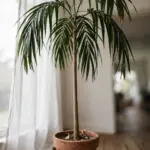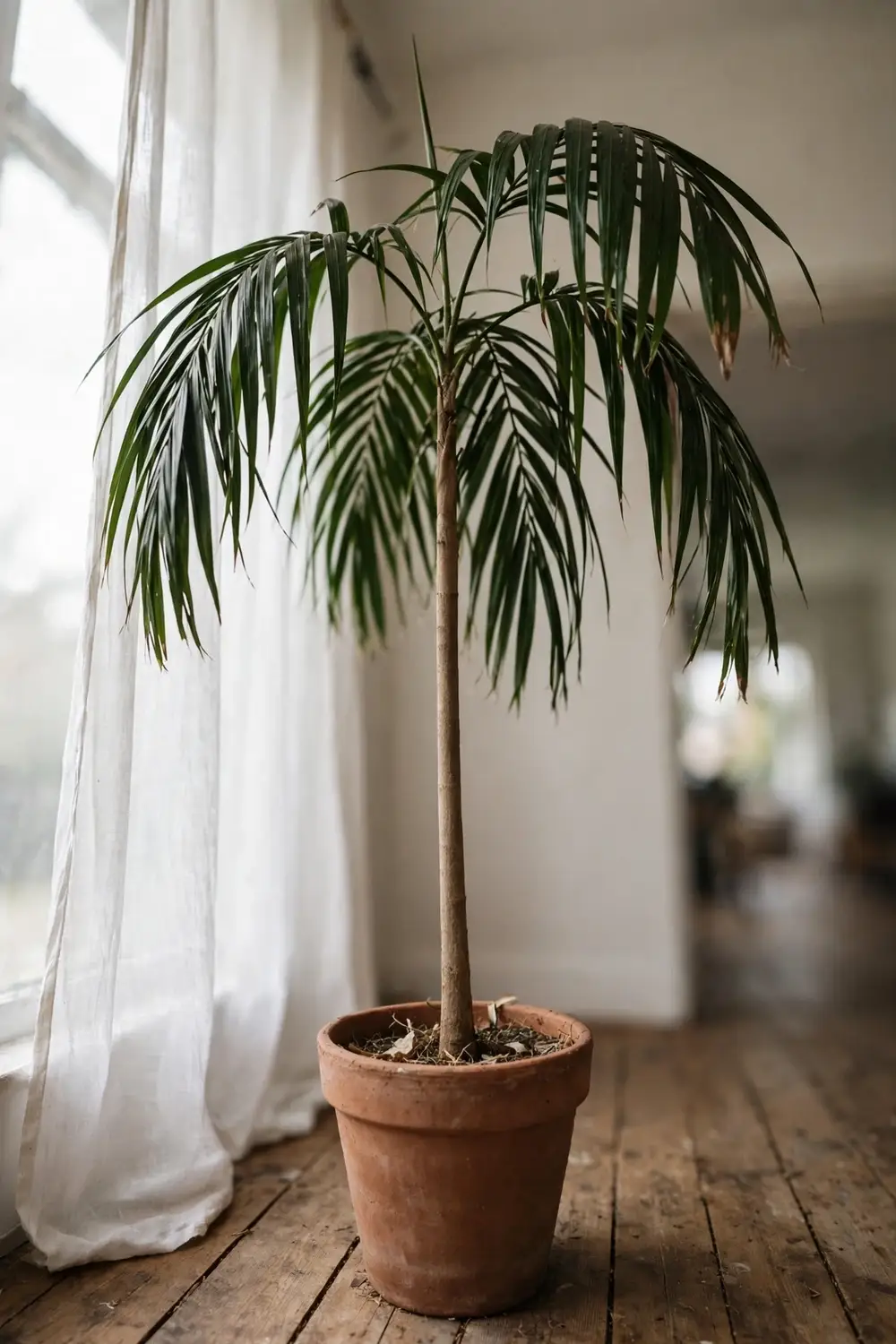

Give a kentia palm bright indirect light, water when the mix dries, and never let the room fall below 10 degrees. That routine is kentia palm care indoors in Australia, and it keeps a kentia palm alive for decades. I have learned that the kentia I leave alone between waterings outgrows the kentia I water on a schedule.
Kentia palm is Howea forsteriana, a single-stemmed evergreen palm endemic to Lord Howe Island, off the New South Wales coast. Indoors, it grows slowly and asks for little: light without direct sun, a mix that stays moist but never waterlogged, and a monthly feed in summer. The rest of this page is 8 care moves, from light to diagnosis, plus answers to the 5 questions every kentia owner asks.
1. Place Your Kentia in Bright Indirect Light
Put the pot where the fronds see the sky but never the direct sun. A bright east-facing window suits most Australian rooms. A south-facing window works when the light stays bright through the day. A north-facing window in Australia takes the harshest sun, so pull the pot back from the glass or hang a sheer curtain between the fronds and the pane.
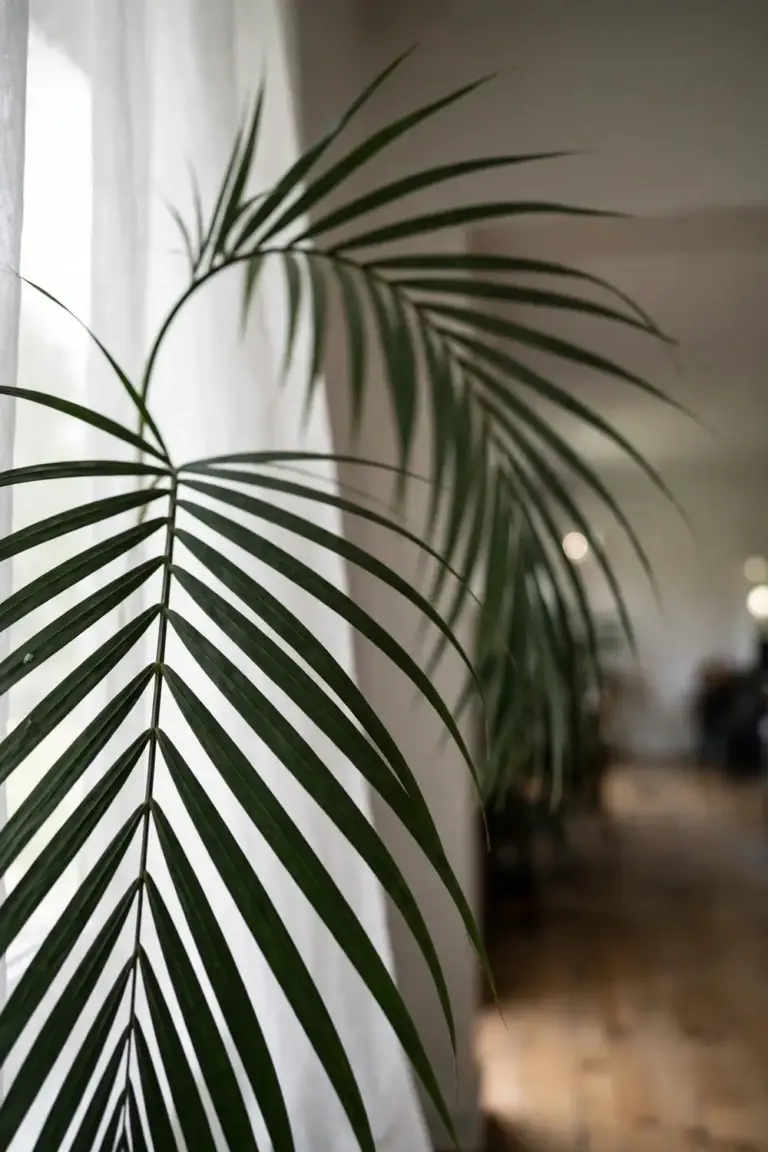
The kentia palm tolerates low light, and that tolerance is exactly what gets it into trouble. In a dim corner the palm survives but barely grows, and the fronds stretch thin and pale. The Royal Horticultural Society notes that kentia grows in bright light with protection from the sun, and North Carolina State University Extension describes its indoor need as moderate light. Bright indirect light sits inside both statements. Direct sun scorches the fronds, so a spot that takes two hours of morning sun through glass is the limit.
If the only free corner stays dim, add a grow light. The site’s grow lights guide covers distance and hours for indoor plants. Turn the pot a quarter turn every month so the crown grows evenly instead of leaning toward the window.
Test the light with your hand. Hold one hand 30 cm above a sheet of paper in the spot where the pot will stand. A sharp shadow means direct sun, and the spot needs a curtain or a step back from the glass. A soft shadow with a clear edge means bright indirect light, and the kentia will grow there. A faint shadow with no edge means the spot is too dim for anything but survival, and the palm will stall there. Run that test at midday, when the light is strongest, and again in the late afternoon.
Australian rooms change with the seasons. A spot that stays bright through winter can take direct western sun in January, when the sun tracks further south. Check the spot once per season, and move the pot before the fronds scorch. A kentia palm that loses fronds to sunburn grows replacements slowly, so prevention beats repair. The palm forgives a dim month far more readily than it forgives a scorched frond.
| Care | Setting |
|---|---|
| Light | Bright indirect light, no direct sun |
| Water | Soak when the mix dries, drain fully |
| Feed | Liquid fertilizer monthly in summer, none in winter |
| Temperature | Comfortable room temperature, never below 10 degrees |
| Humidity | Moderate humidity, pebble tray in dry rooms |
| Repot | Only when the pot is full, one size up |
2. Water When the Mix Feels Dry, Then Soak It
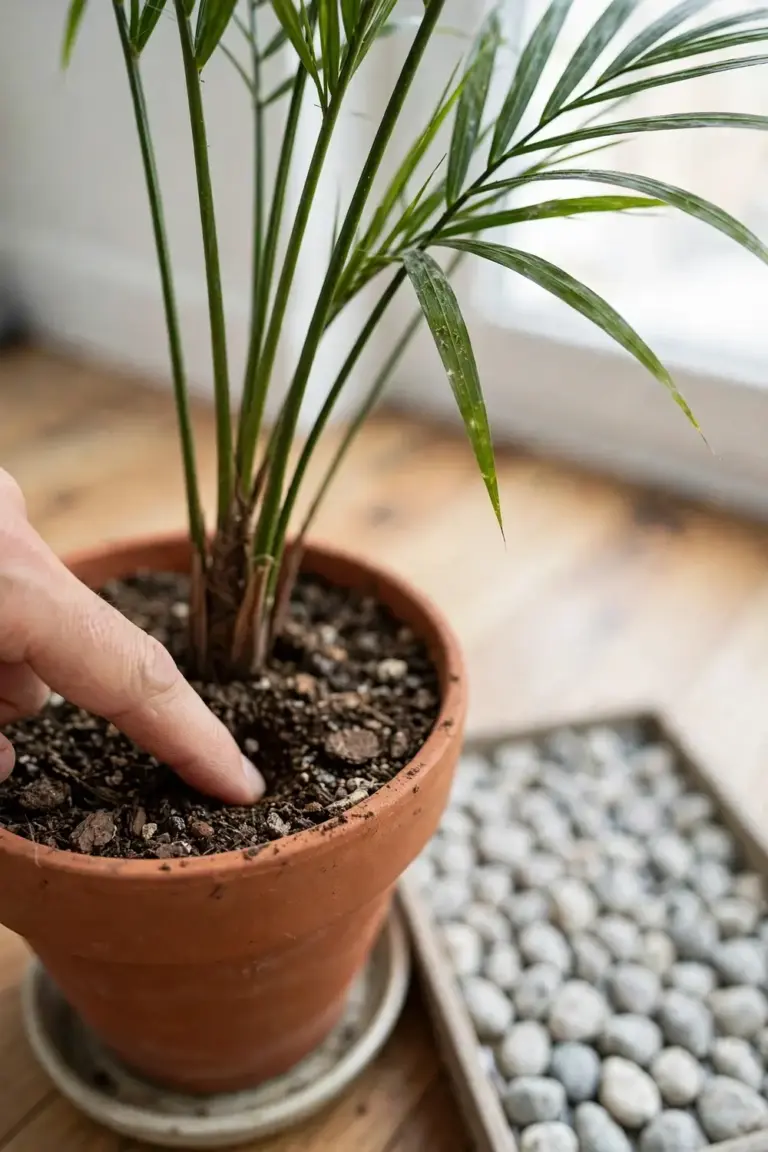
Push one finger into the mix to the second knuckle. Water when that depth feels dry. Water slowly until liquid runs from the drainage holes, wait 10 minutes, then empty the saucer. The roots must never sit in standing water.
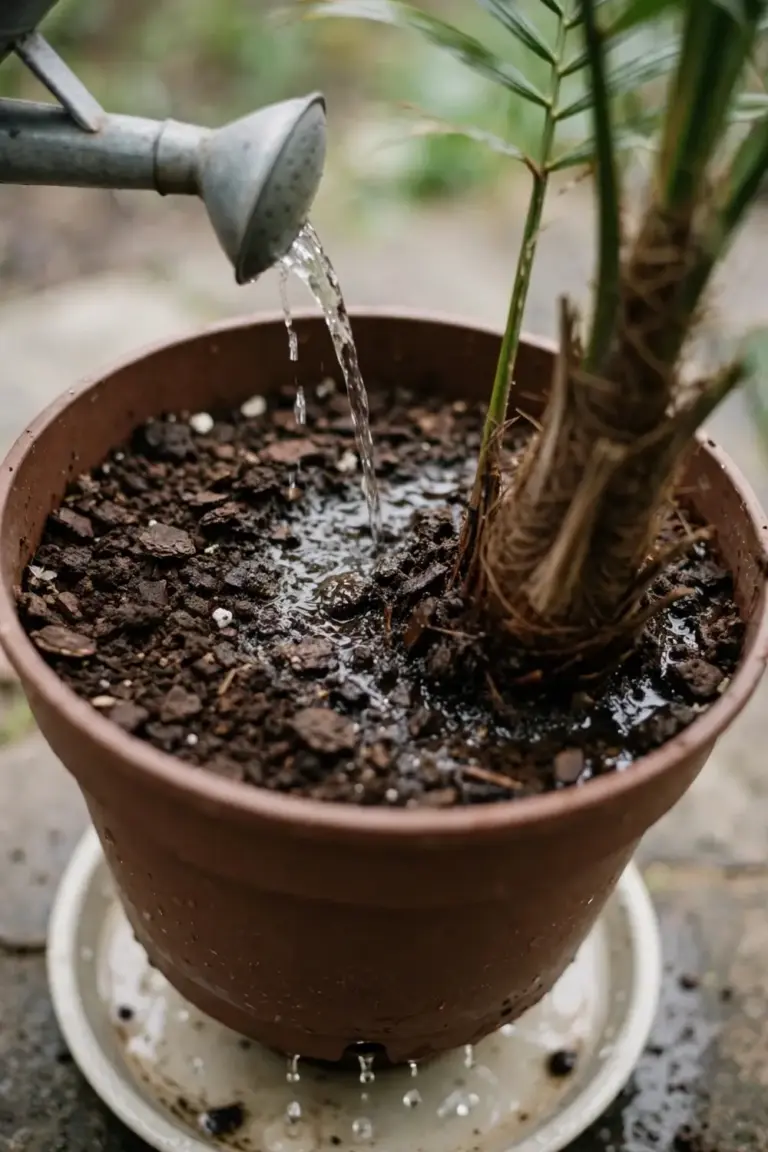
Summer and winter need different rhythms. Clemson Cooperative Extension advises watering kentia palms abundantly during the summer, and watering only when the potting mix is dry during the winter. In an Australian summer, that can mean a soak every week in a warm room. In winter, the same pot may go two or three weeks between soaks. The finger test decides, not the calendar.
North Carolina State University Extension adds the other half of the rule: the kentia palm wants a well-drained, humus-rich potting mix that does not dry out. Read those two rules together. The mix stays evenly moist in the growing season. It dries at the surface between waterings in winter. The whole pot never dries out, and the saucer never stays full. A thin bark top layer slows surface drying, and the site’s mulching guide explains how a mulch layer holds moisture.
Yellow leaves that soften from the base up mean too much water. Brown, crisp frond tips mean too little water or air that is too dry. Both faults show first on the oldest fronds, so check the lower leaves before changing anything.
Drainage decides whether the watering rhythm works. A pot with no drainage hole turns every soak into a swamp, and no finger test saves it. A pot with drainage holes but a blocked saucer does the same job more slowly. Lift the pot after watering and feel its weight. A freshly soaked pot feels heavy. A pot that needs water feels light. After a month of lifting, the weight alone tells you when to water, and the finger test becomes the backup check.
New kentia palms arrive in nursery mix that holds water well. That mix suits a greenhouse, where the air moves and the light runs bright all day. In a home, the same mix dries slower, so the first month in a new room is the risky month. Water less often than the nursery did, and watch the lower fronds. If they yellow in the first month, the mix is staying wet too long, and the pot needs a brighter spot or a longer gap between soaks.
3. Feed Monthly in Summer With a Balanced Liquid Feed
Feed once a month from spring through summer with a balanced liquid fertilizer mixed at half the label strength. Apply it to mix that is already damp, never to a dry pot. Stop feeding in autumn and winter.
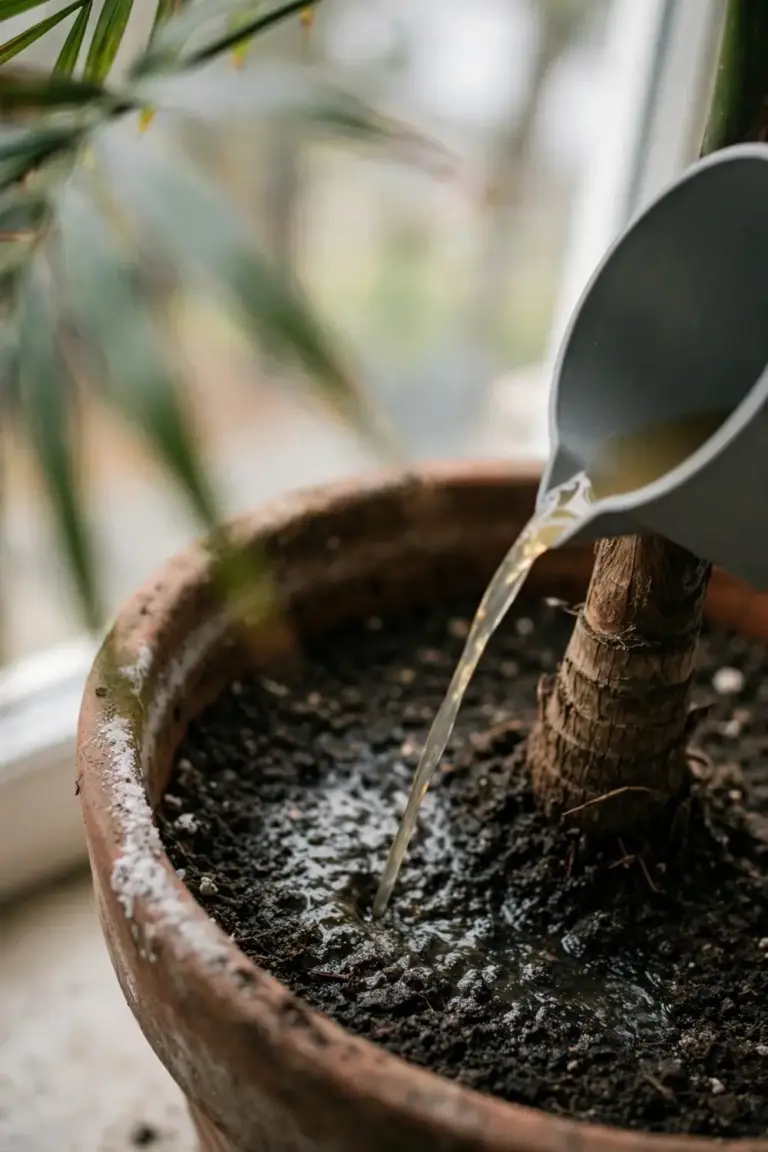
The Royal Horticultural Society prescribes a liquid fertilizer monthly during the summer for kentia palm grown under glass. North Carolina State University Extension takes the lighter path: fertilize with houseplant fertilizer infrequently, and notes that an encapsulated, slow-release fertilizer is ideal. Both methods work. Pick one. A monthly liquid feed gives you control over the dose. A slow-release feed gives you one application per season. Never run both at full strength, or the salts build up and the frond tips brown.
Kentia is not a heavy feeder. Overfeeding shows as brown tips and a white crust on the mix surface. If that crust appears, flush the pot with plain water until it runs clear from the drainage holes, then skip the next two feeds. A palm that grows slowly in bright light needs less feed than the label suggests, not more.
Half strength matters more than the brand. Full-strength liquid feed in a small indoor pot leaves salts behind with every application, and the salts concentrate as the mix dries between waterings. Half strength feeds the palm and leaves far less residue. Mix the feed in a watering can, water the mix first with plain water, then apply the feed to the damp mix. Dry mix plus fertilizer salts burns root tips, and burned root tips show as brown frond tips a week later.
A slow-release feed suits a palm that you check rarely. One application in spring carries the palm through summer, and you never mix a can. The trade-off is control: you cannot stop a slow-release feed once it sits in the mix, so a palm that shows salt stress keeps receiving feed until the granules run out. A liquid feed lets you stop at once. Choose the slow-release path when the palm lives in bright light and grows steadily. Choose the liquid path when the palm is young, recovering, or living in a dim room.
4. Keep the Room Comfortable and Never Below 10 Degrees
If the room feels comfortable to you, the temperature suits the kentia palm. North Carolina State University Extension puts it plainly: indoors, kentia needs moderate light and temperatures that are comfortable for people. That single sentence covers most Australian homes for most of the year.
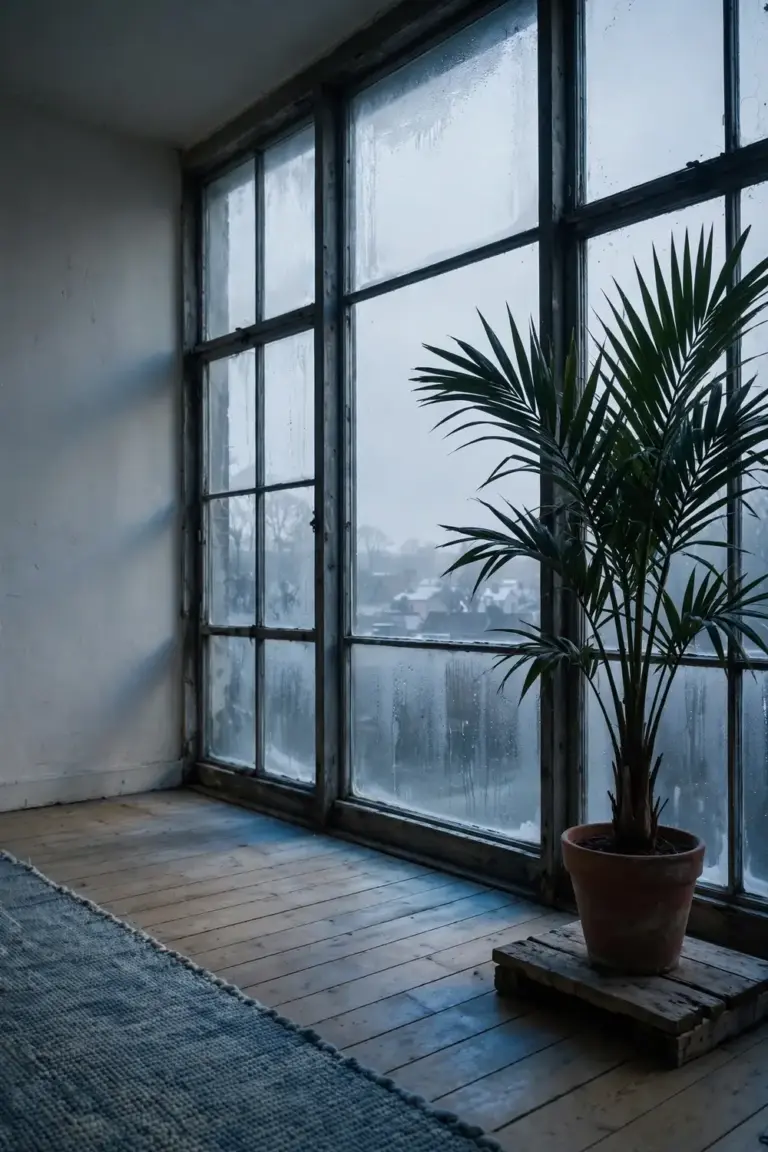
The floor matters more than the ceiling. Sustainable Gardening Australia gives the kentia palm a minimum temperature of 10 degrees. Below that line, fronds chill and growth stalls. In southern Australia, an unheated room can drop below 10 degrees on a winter night, so keep the pot away from cold glass and off a cold tile floor. A pot standing against a single-glazed window loses heat through the glass all night. Move it back 30 cm from the pane in winter.
Heat is the easier half of the equation. Kentia tolerates warm rooms, and North Carolina State University Extension records that the palm can withstand outdoor temperatures reaching 100 degrees Fahrenheit, which converts to 37.8 degrees Celsius, as long as direct sunlight is avoided. An Australian summer room that hits 35 degrees will not kill it, provided the mix stays moist and the sun stays off the fronds. Keep the palm away from heater vents and air-conditioner outlets. Both blast dry air across the fronds and swing the temperature faster than the palm can adjust.
Australian rooms split into two camps. In Darwin, Brisbane, and Perth, the risk is a summer room that stays above 35 degrees for days, with the mix drying fast and the fronds crisping at the tips. Water more often there, and keep the pebble tray full. In Melbourne, Canberra, and Hobart, the risk is a winter night when an unheated room falls toward the 10 degree floor. Move the pot off a cold tile floor onto a timber board or a rug, and keep it clear of the glass. A palm that sits against a window in a Hobart winter takes the cold straight through the pane.
Sudden swings hurt more than steady cold. A palm that moves from a heated living room to an unheated hallway every night rides a 10 degree swing twice a day, and the fronds show it as droop and tip burn. Pick one spot for winter and leave the palm there. Stability beats a perfect temperature that changes every evening.
5. Lift Humidity Without Waterlogging the Pot
Kentia comes from a humid island, and dry indoor air shows on the frond tips. The Royal Horticultural Society advises moderate humidity while the palm is in growth. Clemson Cooperative Extension notes that kentia tolerates relatively low humidity, but grows best with bright light and regular care. Between those two statements sits the practical rule: average indoor humidity keeps the palm alive, and a small lift keeps the fronds clean-tipped.
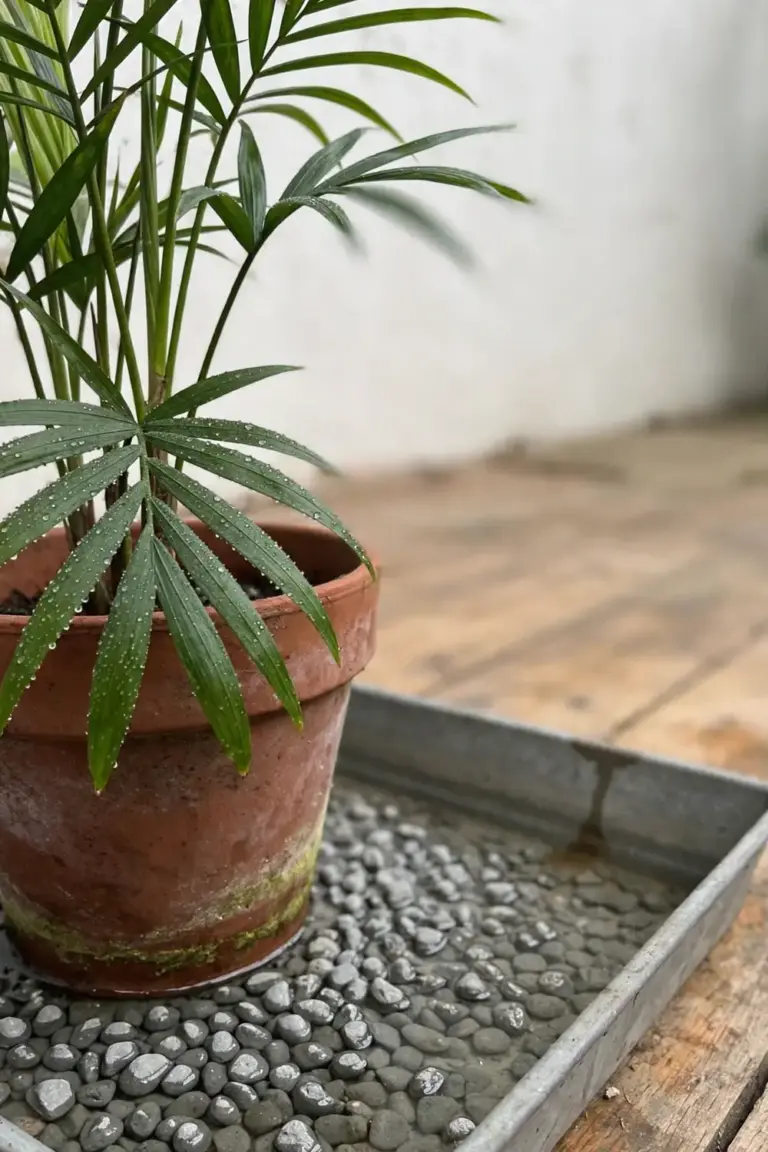
Set the pot on a pebble tray filled with water, with the pot base standing above the waterline on the pebbles. Group the kentia with other indoor plants so their leaves share one pocket of damper air. Mist the fronds with warm water on dry days. Sustainable Gardening Australia suggests that spraying with warm water may prevent the leaf tips from browning.
Never raise humidity by keeping the mix wet. A saucer full of water lifts humidity for a day and rots roots for a month. Humidity work happens in the air around the fronds, not in the pot. In a heated winter room, the pebble tray does more than misting, because it runs all day without wetting the fronds.
Build the pebble tray once and it runs itself. Set a shallow tray wider than the pot, fill it with pebbles, and add water until the waterline sits below the tops of the pebbles. Stand the pot on the pebbles, never in the water. Top the tray up when the pebbles show dry. The evaporating water lifts the humidity around the crown all day, and the pot base stays dry because the pebbles hold it above the waterline.
Showering the fronds does two jobs at once. Once a month, stand the palm in a shower or under a gentle outdoor hose and rinse the fronds with lukewarm water. The rinse washes dust off the leaflets, and dust blocks light. It also knocks off the first mites and mealybugs before they settle. Let the palm drip dry in bright indirect light, then return it to its spot. Never shower a palm and return it to a dim corner with wet fronds, or the crown stays damp overnight.
6. Repot Only When the Pot Is Full, One Size Up
Repot when the roots circle the drainage holes, the mix dries within a day of watering, or the palm wobbles in a pot that looks too small for the crown. Nursery guides put the interval at roughly 3 to 4 years for a healthy kentia. A palm that shows none of those signs stays in its pot.
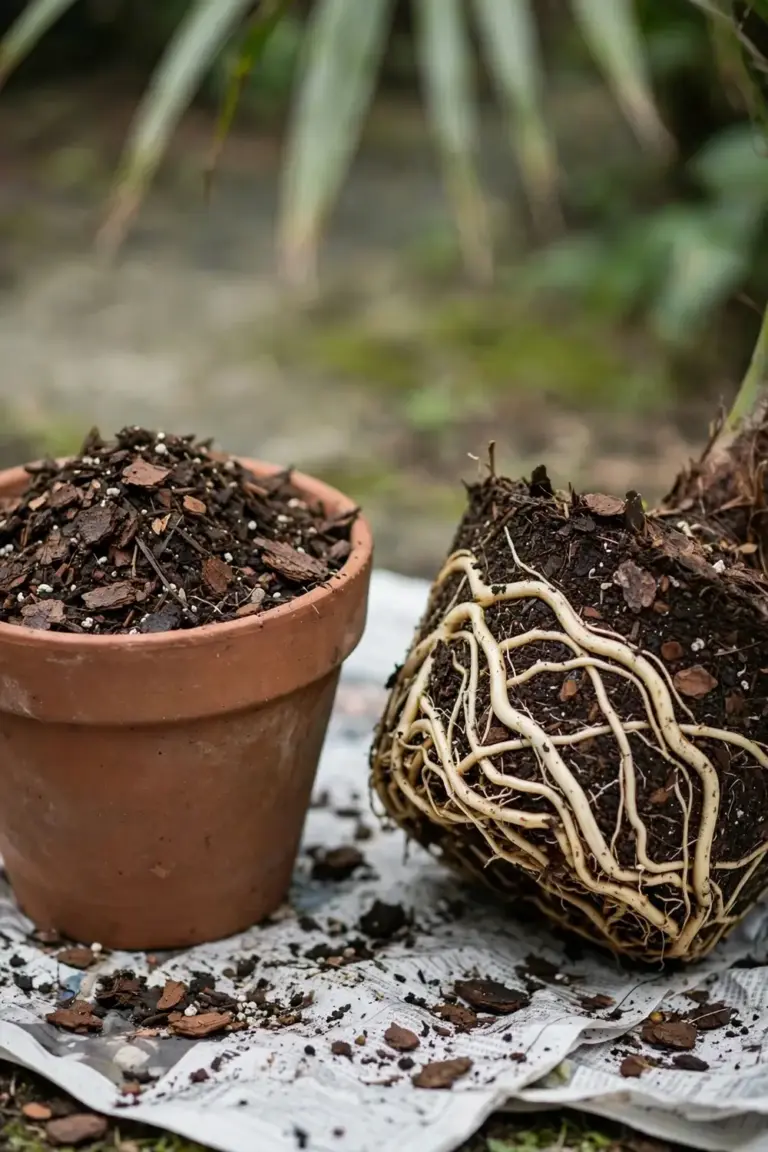
Choose a pot one size up, with drainage holes. A pot 5 cm wider than the old one is enough. A pot far larger holds mix the roots cannot reach, and that wet mix rots. Tip the palm out, keep the root ball whole, and set it at the same depth it grew before. Never bury the trunk deeper than it sat in the old pot. Backfill with a well-drained, humus-rich mix, and water once to settle it.
North Carolina State University Extension stresses that the kentia palm wants a well-drained, humus-rich potting mix. The site’s soil health guide explains what humus-rich means in practice: organic matter that holds moisture without turning to mud. After repotting, wait at least a month before feeding. Fresh mix already carries nutrients, and disturbed roots burn easily under fertilizer salts.
The Royal Horticultural Society gives the mix recipe for kentia grown under glass: a peat-free, loam-based compost with equal parts added of composted bark and leaf mould. That recipe translates to a bagged palm mix with extra bark chips stirred through, or a general potting mix cut with perlite and bark. The bark opens air channels through the mix, and the loam holds the moisture. A mix of pure peat or pure coir stays wet too long in a home, and a mix of pure sand dries too fast. The bark, loam, and leaf mould balance holds.
Handle the root ball gently. Kentia roots are thick and brittle, and a snapped root never regrows from the break. If the root ball resists the old pot, squeeze the pot sides and slide the palm out, never yank the trunk. Tease out only the roots circling the base, and leave the rest of the ball intact. A repot that keeps the ball whole settles in weeks. A repot that tears the ball apart can stall the palm for a season.
7. Check Fronds Weekly for Scale, Mealybugs, and Mites
Turn one frond over every week and look at the underside. Scale insects sit as small brown bumps along the midrib. Mealybugs gather as white cottony clumps where the leaflets join the stalk. Mites are harder to spot: look for fine stippling on the leaflets, and faint webbing between them in a bad case. Catching any of the three early keeps the fix small.
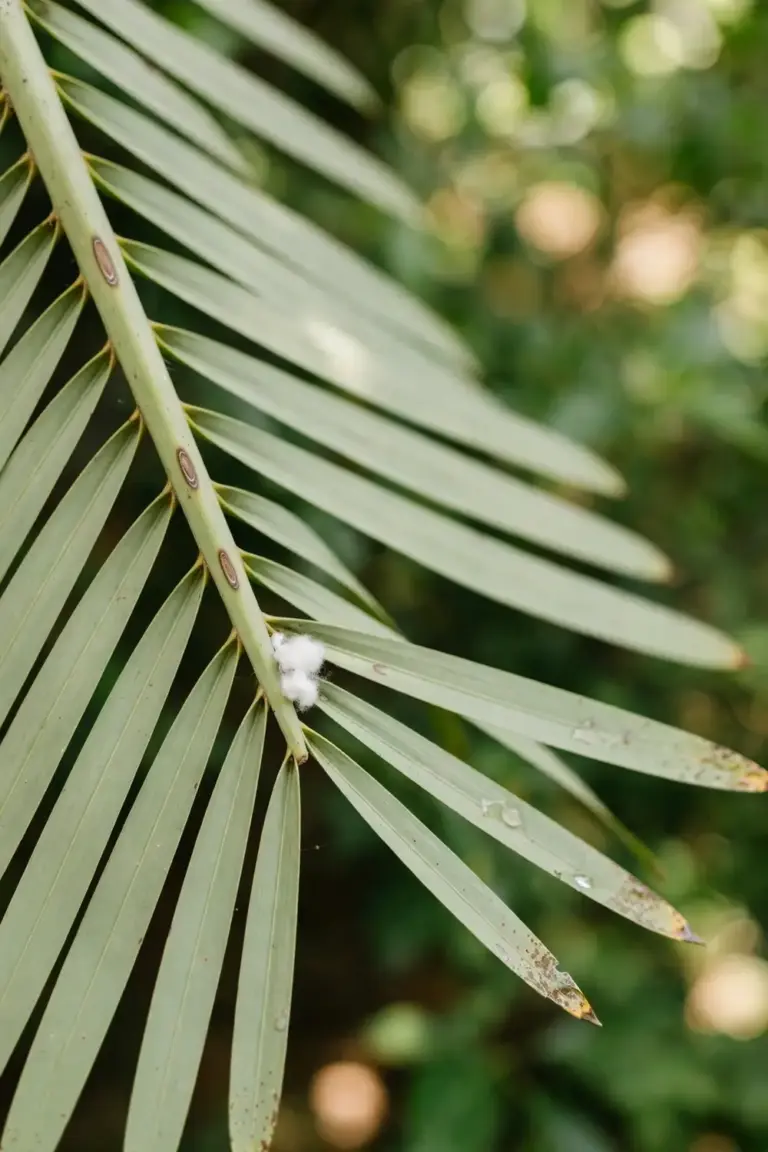
Sustainable Gardening Australia lists mealybugs, mites, and scale as the pests that trouble kentia palm. Wipe a light infestation off with a cloth dampened in soapy water, then check again in 7 days. Isolate a badly infested palm from other indoor plants until the pests are gone, or the crawlers spread to the neighbours.
For a stubborn infestation, Sustainable Gardening Australia publishes a non-toxic spray recipe credited to Wolverton: 10 ml vegetable oil, 0.6 ml washing-up liquid, and 230 ml warm tap water, shaken vigorously in a spray bottle and sprayed on the leaves. Test it on one frond first, wait 48 hours, then treat the whole palm if the frond shows no damage. The site’s organic pest control guide covers the same inspect, isolate, treat sequence for indoor plants.
Kentia palm can also succumb to Phytophthora root rot in low light and very moist conditions, per Sustainable Gardening Australia. That disease starts below the mix, so prevention is the whole defence: bright light, a mix that drains, and a saucer that stays empty.
Check on the same day every week. A weekly check catches scale while it is still a few bumps, and a monthly check finds a colony. Work frond by frond, starting at the crown and moving down to the oldest leaves. Pests settle first on the undersides of the lower fronds, where the air moves least and the light runs dimmest. Flip each frond and look along the midrib. The check takes 5 minutes on a small palm and 10 on a tall one.
Quarantine a new palm before it joins the room. Keep a new kentia palm away from other indoor plants for 2 weeks, and check it twice in that time. Nursery palms often carry a few scale insects or mealybugs that show up only after the palm settles into a new home. Two weeks of separation keeps one infested palm from seeding pests across every plant in the room.
8. Read Brown Tips and Yellow Leaves Before You Act
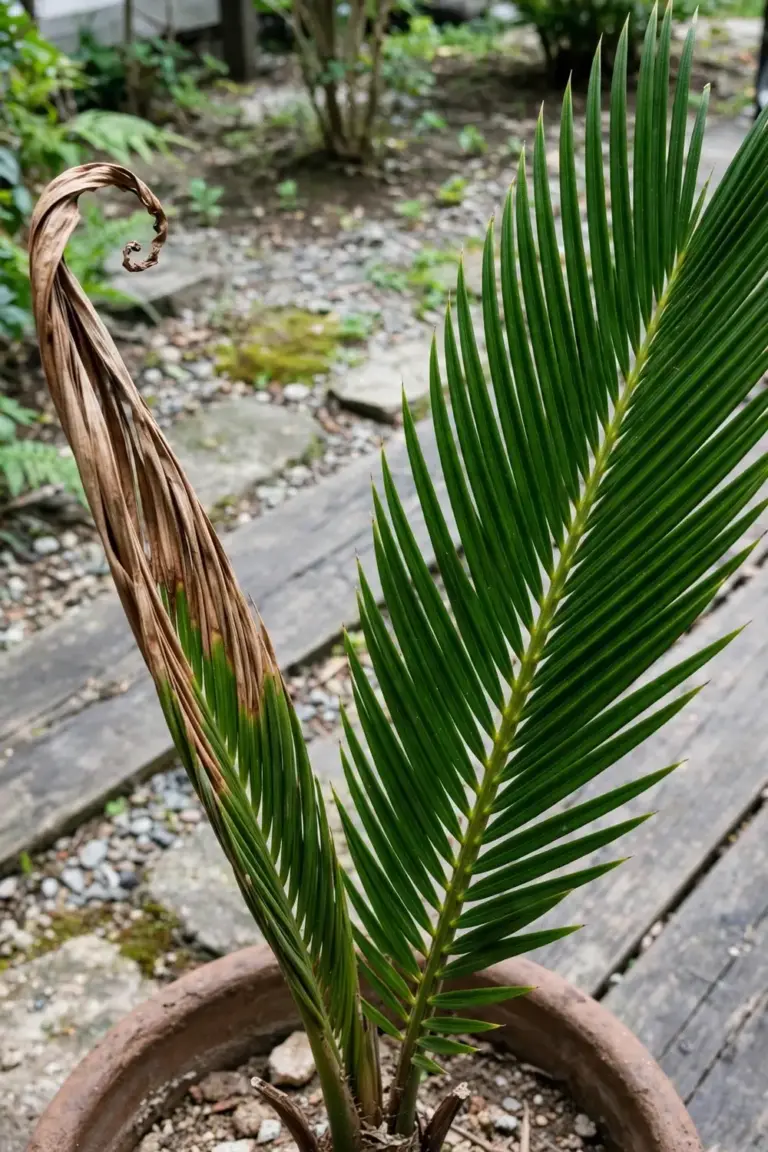
The fronds report the fault before the palm fails. Read the symptom, match it to the table, and change one thing at a time. Changing water, light, and feed in the same week hides which fix worked.
| Symptom | Likely Cause | First Move |
|---|---|---|
| Brown, crisp frond tips | Dry air or underwatering | Raise humidity with a pebble tray, check the finger test |
| Yellow lower leaves, soft base | Overwatering | Empty the saucer, let the mix dry, check drainage holes |
| Pale, stretched fronds | Light too low | Move to a brighter spot, add a grow light |
| Scorched patches on fronds | Direct sun | Pull back from the window, add a sheer curtain |
| No new fronds for a year | Slow growth, or low light and no feed | Check light and summer feeding, then wait |
| Drooping crown after a cold night | Cold draft or cold glass | Move 30 cm from the window, check the 10 degree floor |
Brown tips deserve a calm response. Trim the dead tip with clean scissors, cutting just inside the brown edge so no dead tissue remains. Never cut into green tissue. A brown tip on an old frond is cosmetic. Brown tips across every frond mean the room is too dry or the watering rhythm is wrong.
Cut with clean scissors, and wipe the blades with rubbing alcohol between fronds when you suspect pests. A cut into green tissue leaves a wound that dries brown, so the trim must stay inside the dead edge. Snip at a slight angle that follows the frond’s natural taper, and the trim disappears into the frond’s shape. A flat cut across the frond leaves a blunt edge that draws the eye.
Droop after a cold night needs warmth, not water. A crown that slumps overnight beside a cold window has chilled, and a soak will not straighten it. Move the pot to a warmer spot, keep the mix barely moist, and wait. The fronds either recover their stance in a week or they do not. A frond that stays limp and yellows is dead tissue. Cut it at the base and let the palm put its energy into the next frond.
No new fronds for a year rarely means the palm is dying. The Royal Horticultural Society gives kentia a time to maturity of 20 to 50 years. A palm that holds its fronds, keeps its color, and opens one new frond each summer is growing at its own pace. Judge the palm by the fronds it holds, not by the height it gains.
9. Frequently Asked Questions
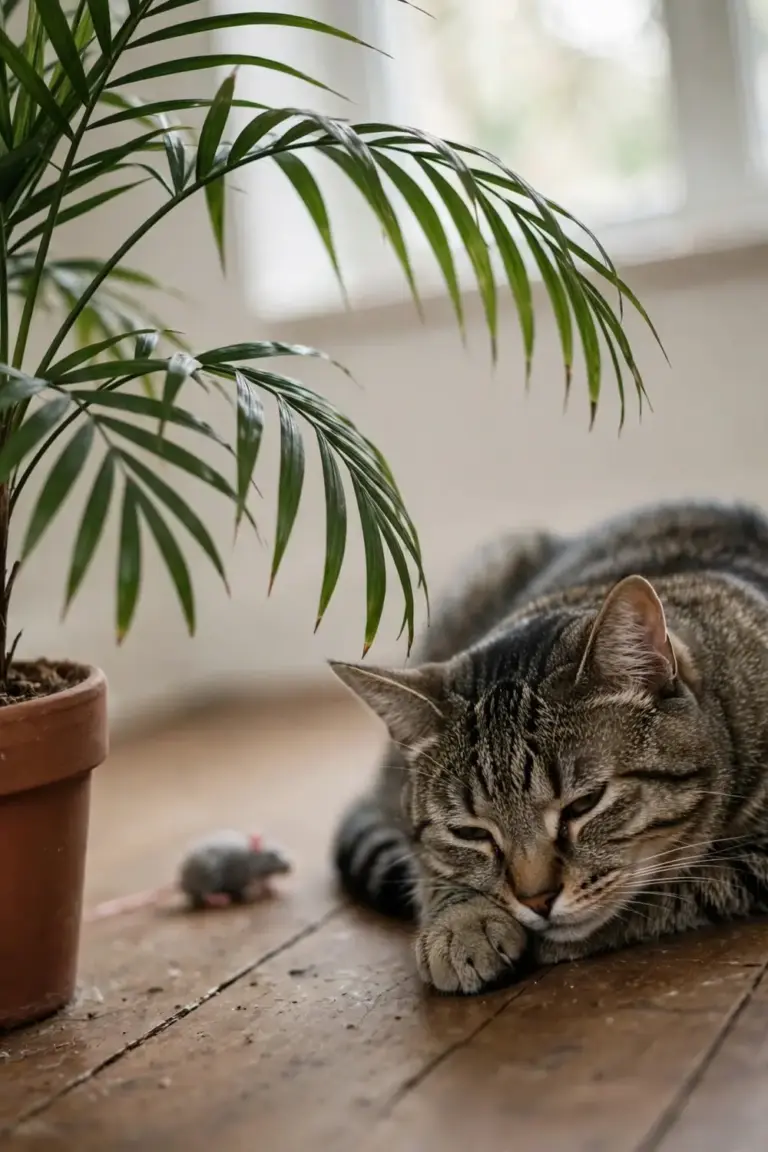
Yes. The ASPCA lists kentia palm, Howea forsteriana, as non-toxic to dogs and non-toxic to cats. A cat that chews a frond or a dog that nibbles a leaflet faces no poisoning risk from this plant. Keep the palm out of reach anyway, because chewing shreds the fronds and a chewed frond never heals.
Slowly. The Royal Horticultural Society gives kentia a time to maturity of 20 to 50 years. Indoors, a kentia palm opens one or two new fronds in a good summer and adds little height in a year. Buy the size you want to live with, because the palm will not race to fill a tall corner.
It can, in a sheltered spot, in the warmer parts of the country. North Carolina State University Extension records that kentia withstands outdoor temperatures reaching 100 degrees Fahrenheit, or 37.8 degrees Celsius, as long as direct sunlight is avoided. Keep an outdoor kentia in shade, out of wind, and bring it inside before winter nights drop near 10 degrees.
Low light is the usual cause. A kentia palm in a dim corner holds its fronds and opens nothing new. Move it to bright indirect light, feed monthly through summer, and wait one full growing season. A palm that keeps its color and drops no fronds is resting, not failing.
Check the leaflets and the label. North Carolina State University Extension notes that the Belmore sentry palm, Howea belmoreana, has leaves that are recurved, while kentia palm leaves are not recurved. Belmore grows slower and comes from higher ground on Lord Howe Island. Buy a plant labelled Howea forsteriana if you want the faster, easier kentia.
10. Start Kentia Palm Care Indoors This Weekend
Walk to the pot and check three things. First, the light: the fronds see the sky with no direct sun on them. Second, the mix: a finger pushed to the second knuckle comes up dry or damp, and the saucer sits empty. Third, the temperature: the room stays above 10 degrees at night and the pot stands clear of cold glass.
Fix the worst of the three this weekend and leave the rest. A kentia palm rewards a steady routine, not a weekend overhaul. Bright light, a soak when the mix dries, a monthly summer feed, and a room that stays comfortable will carry this Lord Howe Island native for decades.