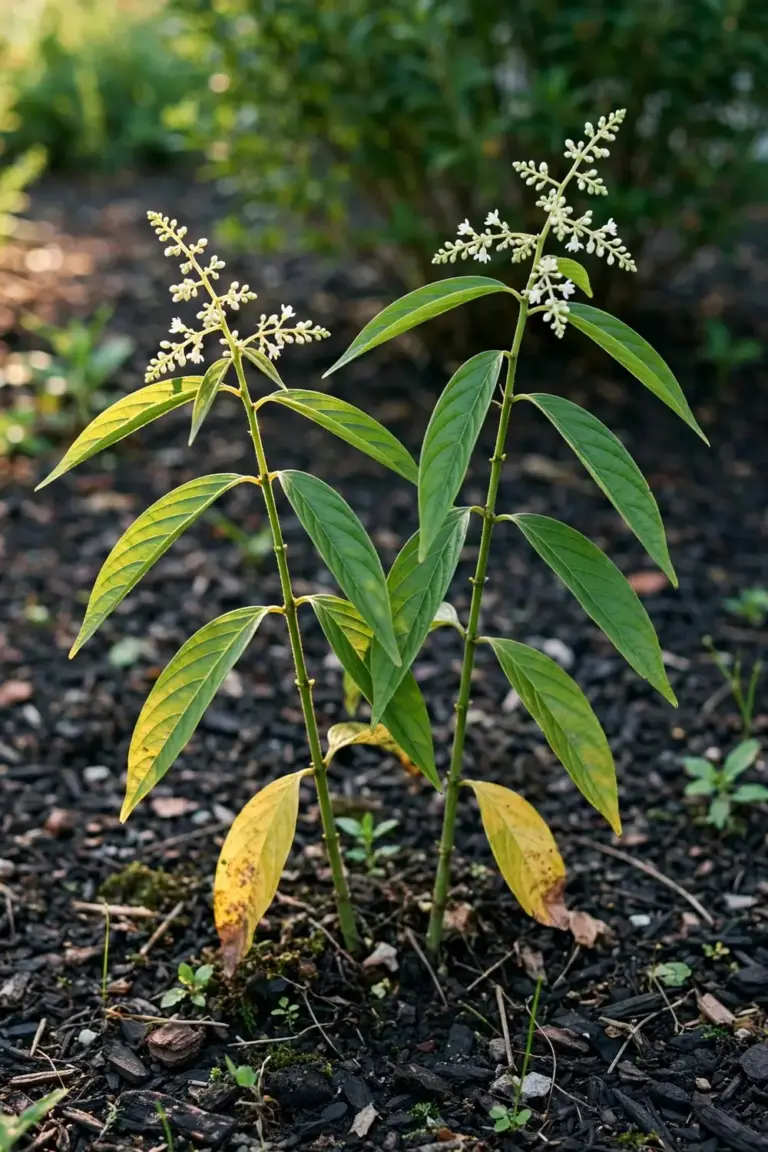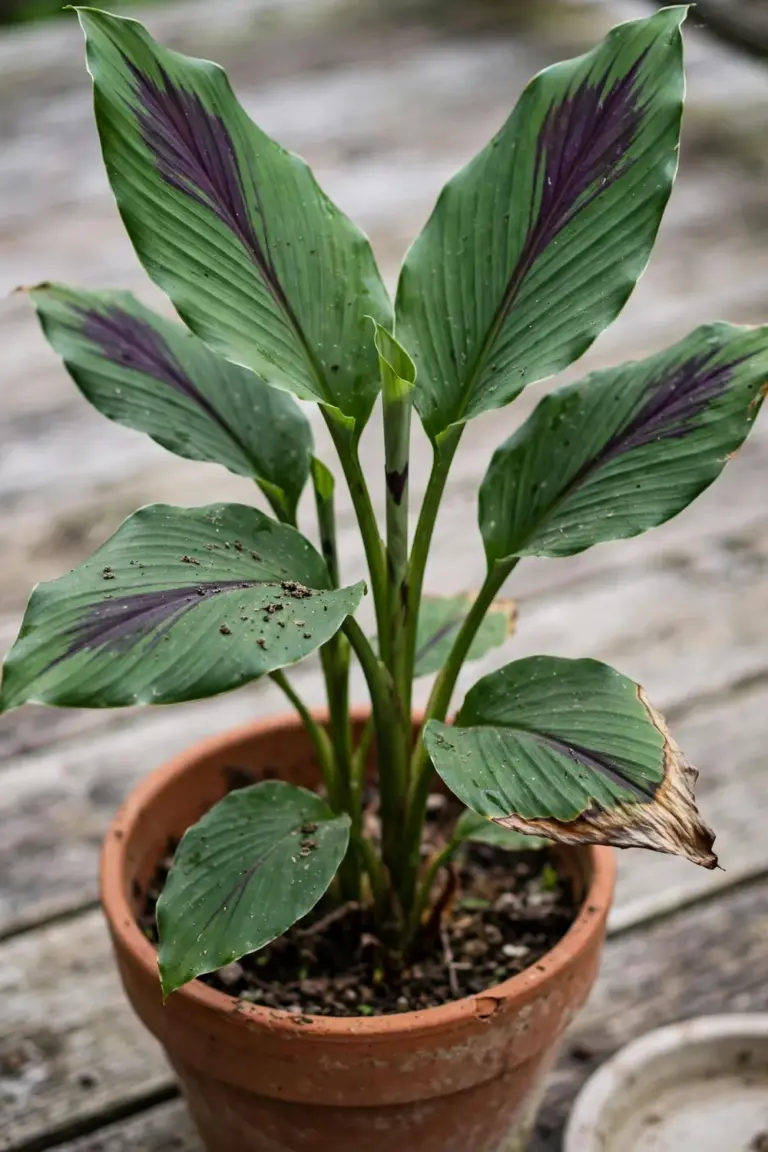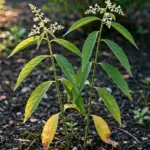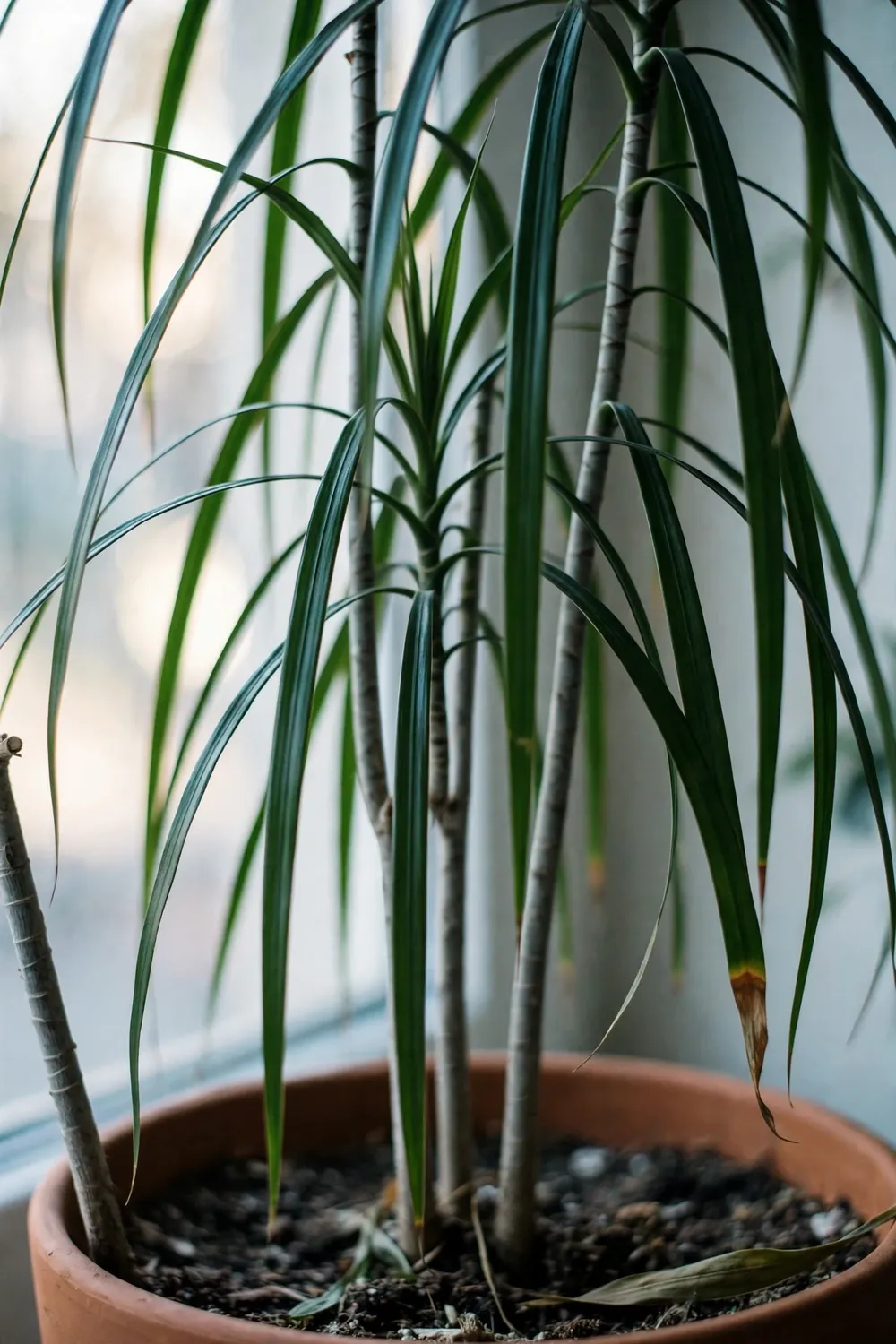

Cut a 15 to 20 cm tip from a healthy stem, strip the lower leaves, and set it in moist mix. That is how to grow suji leaf plant in a pot on a bright windowsill, and the same plant hands you the leaves for a natural green dye. The rest of this page is 16 steps, from the first cutting to a jar of green dye.
Start cuttings in spring. Harvest dye leaves once the plant fills its pot. Keep the pot indoors through winter.
Suji is daun suji, the Indonesian name for Dracaena angustifolia. The plant is a slender evergreen shrub from the tropical forests of Southeast Asia, where it grows in the shade under taller trees. Older nursery labels may call it Pleomele angustifolia. The name on the label matters less than the leaf: long, narrow, dark green ribbons on smooth grayish stems.
Suji earns its place through color. Fresh leaves carry 3,773.9 parts per million of chlorophyll, split between 2,524.6 parts per million of chlorophyll a and 1,250.3 parts per million of chlorophyll b, with 73.25 percent water in the fresh leaf, according to the Atlantis Press paper on suji and pandan rice flour. That pigment is the reason Indonesian cooks blend suji leaves for green cakes and rice dishes, and the reason this article treats the plant as two crops in one pot, a houseplant and a dye plant.
| Spec | Detail |
|---|---|
| Botanical name | Dracaena angustifolia (Asparagaceae) |
| Indonesian name | Daun suji |
| Plant type | Evergreen tropical shrub, grown as a houseplant |
| Height | 1 to 3 m in its native range; pot size sets indoor height |
| Leaves | 20 to 45 cm long, 1.5 to 5.5 cm wide, dark green ribbons |
| Flowers | Greenish white, 1.9 to 2.3 cm, in terminal clusters |
| Fruit | Orange berry, 0.8 to 1.2 cm across |
| Main propagation | Tip cuttings |
| Dye pigment | Chlorophyll, 3,773.9 parts per million in fresh leaves |
| Pet safety | Toxic to cats and dogs |
1. Root a Tip Cutting in Moist Mix
A tip cutting roots faster than any other start. Cut the top 15 to 20 cm from a healthy stem, strip the lower leaves, and set the bare stem in moist potting mix.
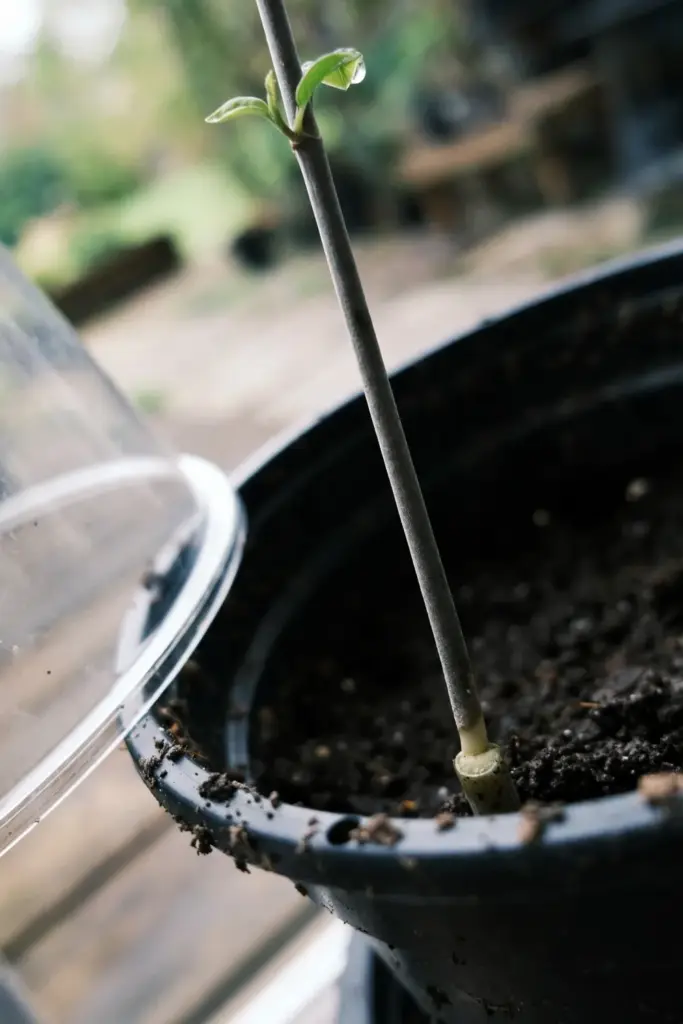
Use a sharp knife or shears, wiped clean before the cut. Cut straight across just below a leaf node, where roots form first. Leave two or three leaves at the top to feed the cutting, and strip the rest so the stem loses less water through its leaves.
Set the cutting one third of its length into the mix and firm the mix around it. Water lightly, then cover the pot with a clear plastic bag to hold humidity. Open the bag daily for fresh air. A cutting that stays limp after a week usually sat too wet or too dry. Check the mix with a finger and adjust.
Roots grip within a few weeks. Tug gently on the stem and feel for resistance before you move the plant. Pot it up once new leaves open at the tip.
2. Sow Fresh Seed When You Can Get It
Seed works when you can find fresh seed, and it runs slower than cuttings. Sow seed shallow in warm, moist mix and leave it alone.
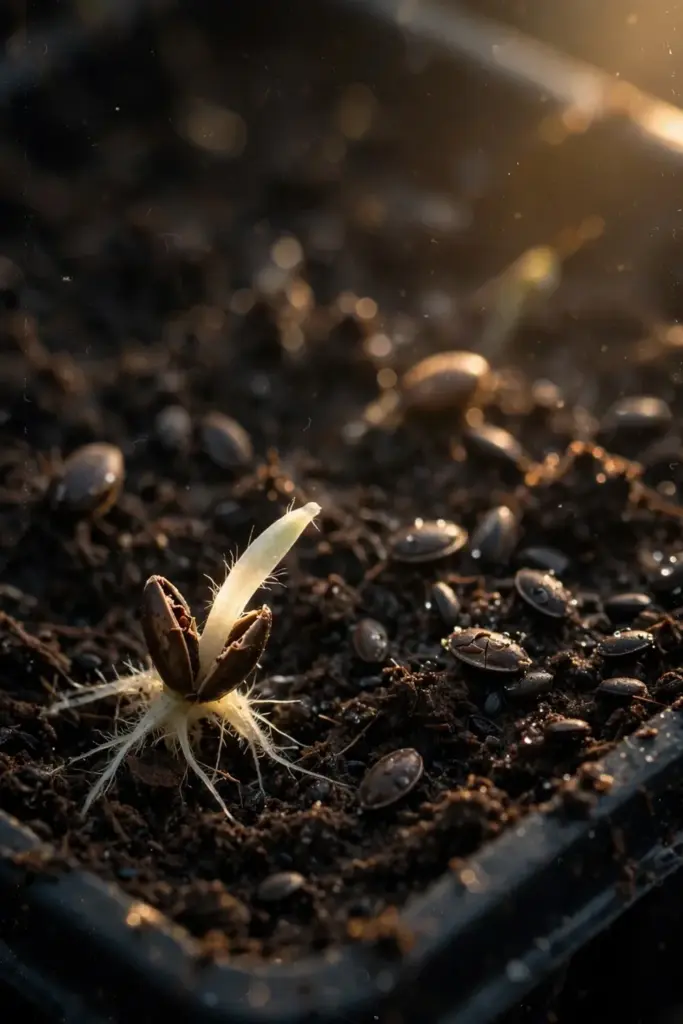
Suji seed is scarce in the nursery trade. Plants grown indoors rarely set seed, and seed that sits on a shelf loses strength within months, so a packet bought on impulse is a gamble. Ask the seller for the harvest date before you buy. Seed of unknown age is compost, not a crop.
No published germination timetable for suji seed was available, so this article gives no day count for sprouting. Sow in spring. Keep the tray warm and damp, and label the pot with the sowing date. Seedlings that appear get the same care as rooted cuttings. Pair this with the site’s seed starting steps for trays, heat, and timing.
3. Build a Fast-Draining Mix That Holds Moisture
Suji wants a mix that drains fast and still holds moisture. Standard indoor potting mix with a scoop of perlite or bark does the job.
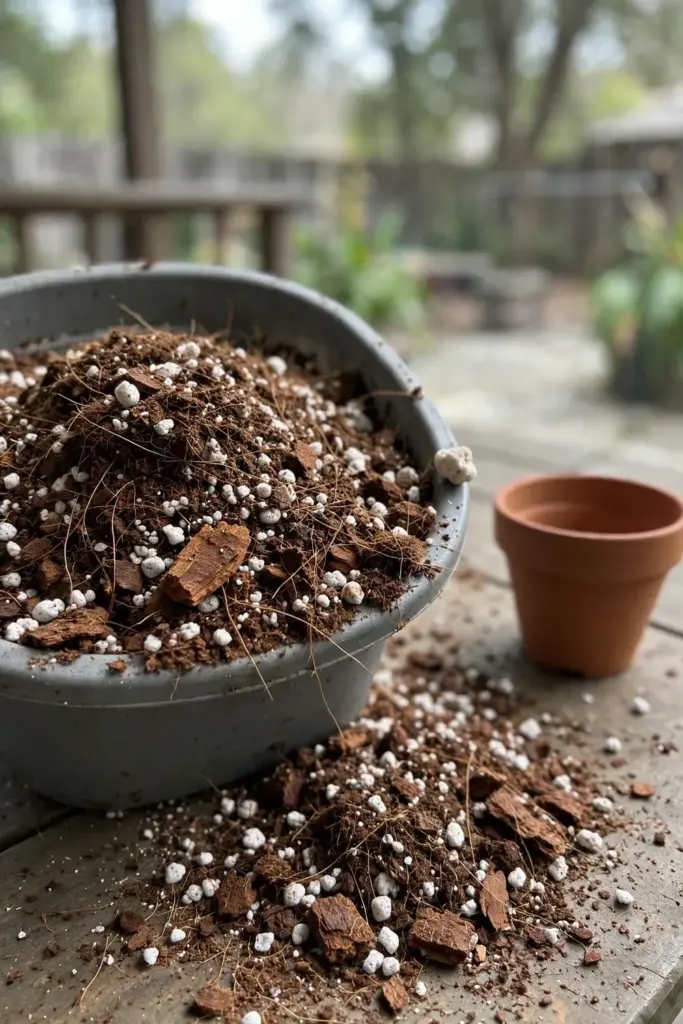
Fill the pot with fresh mix. Never garden soil from a bed. Garden soil packs down in a pot, squeezes air from the roots, and stays wet for days after watering. A mix built on coir or peat with perlite stays open. Excess water runs through. A mix of two parts potting mix to one part perlite suits most pots.
Work a spoonful of slow-release balanced fertilizer into the top layer at potting time, or leave the mix plain and feed later in the season. Either route works. The mix itself decides more than the feed does. Roots in airy mix grow. Roots in soggy mix rot.
Pair this with the site’s notes on building soil health for the longer view on organic matter and drainage.
4. Choose a Pot with Drainage and Room for Roots
A pot with drainage holes and room for roots beats a pretty pot with none. Start a cutting in a medium pot and move up one size when roots circle the mix.
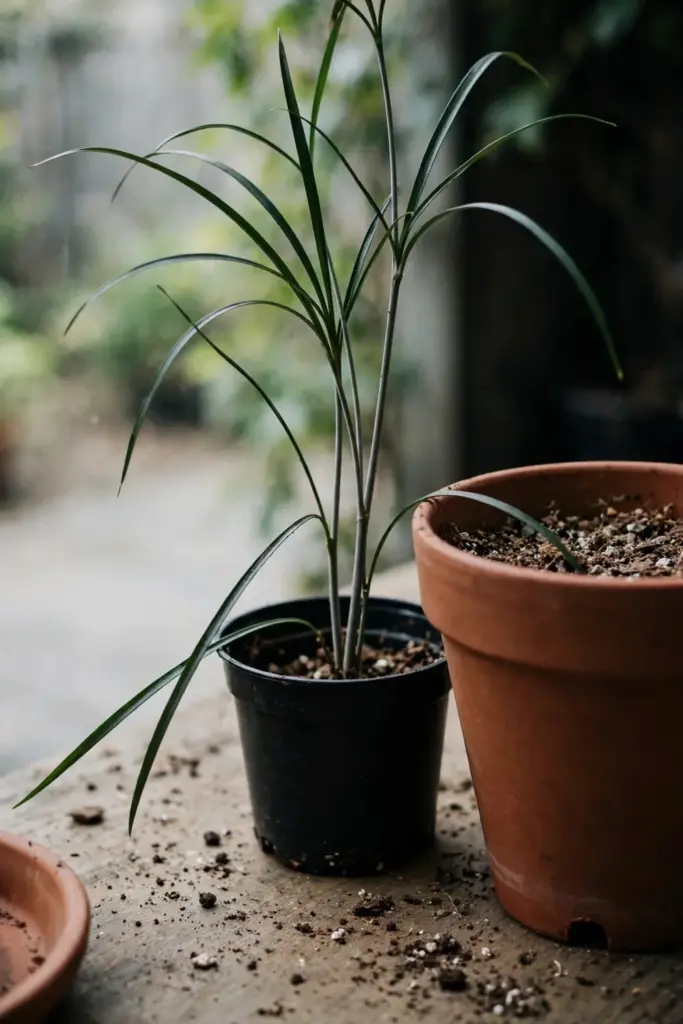
Suji builds a rhizomatous rootstock that creeps and clumps under the mix. A shallow bowl cramps it. A deep pot gives the rootstock room to run and holds moisture longer between waterings.
Set the plant at the same depth it grew before. Burying the stem deeper invites rot at the base. Water after potting and let the pot drain fully before it goes back on the saucer.
Repot in spring, before the main growth flush. Slide the root ball out, tease the outer roots loose, and move up one pot size with fresh mix around the sides. A plant that has lived in the same pot for two full seasons deserves fresh mix even if the pot size stays the same.
A cachepot hides the plastic and catches drips. Set the nursery pot inside a larger decorative pot, and lift the inner pot out to water. Water in the sink, let it drain, then set the plant back. A cachepot with water pooled in the base is a saucer that never empties, and the roots pay for it.
5. Give Suji Bright Indirect Light Like a Forest Understorey
Bright indirect light grows the darkest leaves. Suji evolved as a forest understorey plant, so it wants the light under a canopy, never the full sun that burns its leaves.
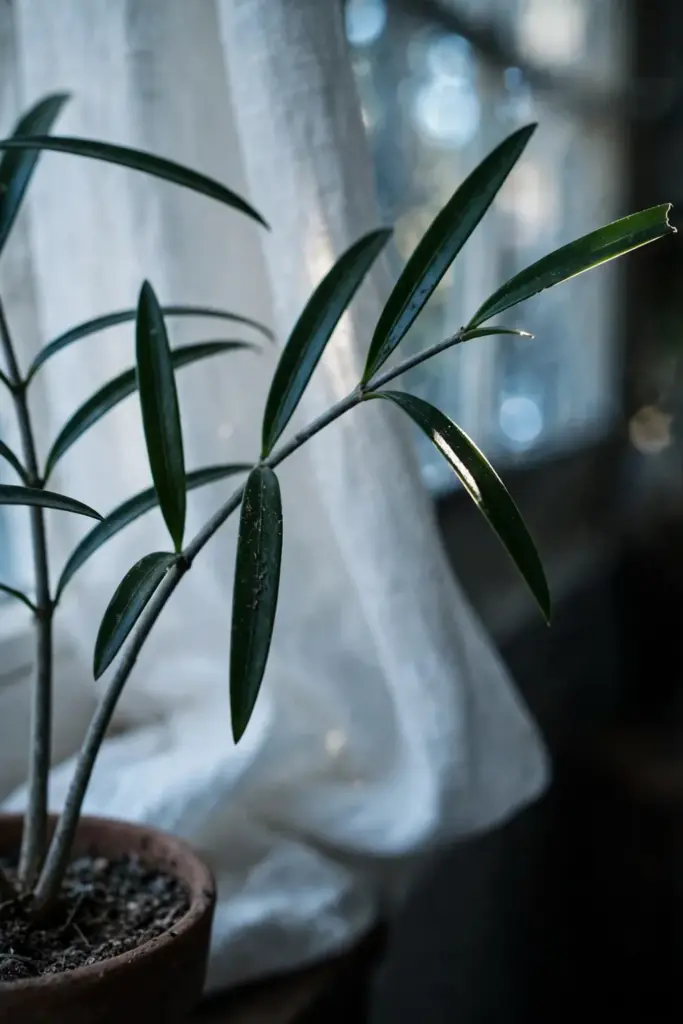
Set the pot near an east or north window, or a few steps back from a south or west window. A sheer curtain between the plant and strong sun does the same work. Leaves that bleach to pale green or crisp at the edges sit too close to the glass.
Low light keeps the plant alive and thins it out. Stems stretch, leaf gaps widen, and new leaves come in smaller and paler. Move a leggy plant closer to the window and prune the stretched stems back. Growth resumes from the nodes below the cut.
A grow light covers a dark winter window. Hang a full-spectrum LED bar 30 cm above the plant and run it 10 to 12 hours a day. The plant grows slower under lights than in a bright window, but it holds its color and keeps pushing leaves. Switch the light off at night. Plants need a dark rest as much as they need light.
6. Water When the Top Layer of Mix Dries
Water when the top layer of mix feels dry to the touch. Push a finger into the mix up to the second knuckle. Dry mix means water. Damp mix means wait.
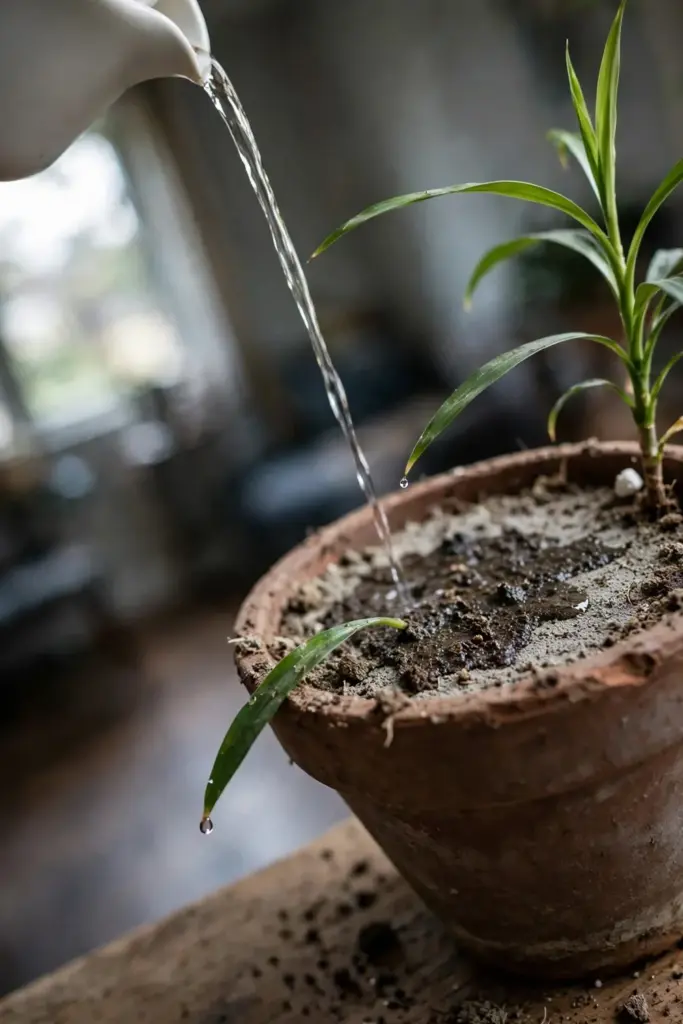
Water slowly until it runs from the drainage holes, then empty the saucer. A pot that sits in standing water rots from the base up. The first sign is a soft stem at soil level, and a stem that has gone soft rarely recovers.
Suji tolerates a dry spell better than a wet week. The plant stores moisture in its rhizome and thick stems. A missed watering costs a drooping leaf. A week of wet mix costs the plant.
Empty the saucer after every watering, because a saucer left full keeps the base wet for days and breeds fungus gnats. Gnats themselves harm little, but their presence means the mix stays too wet. Dry mix between waterings clears them faster than any spray.
7. Feed Sparingly Through Spring and Summer
Feed sparingly while the plant grows in spring and summer, and skip feed in winter. A weak plant that gets heavy feed grows soft stems that flop.
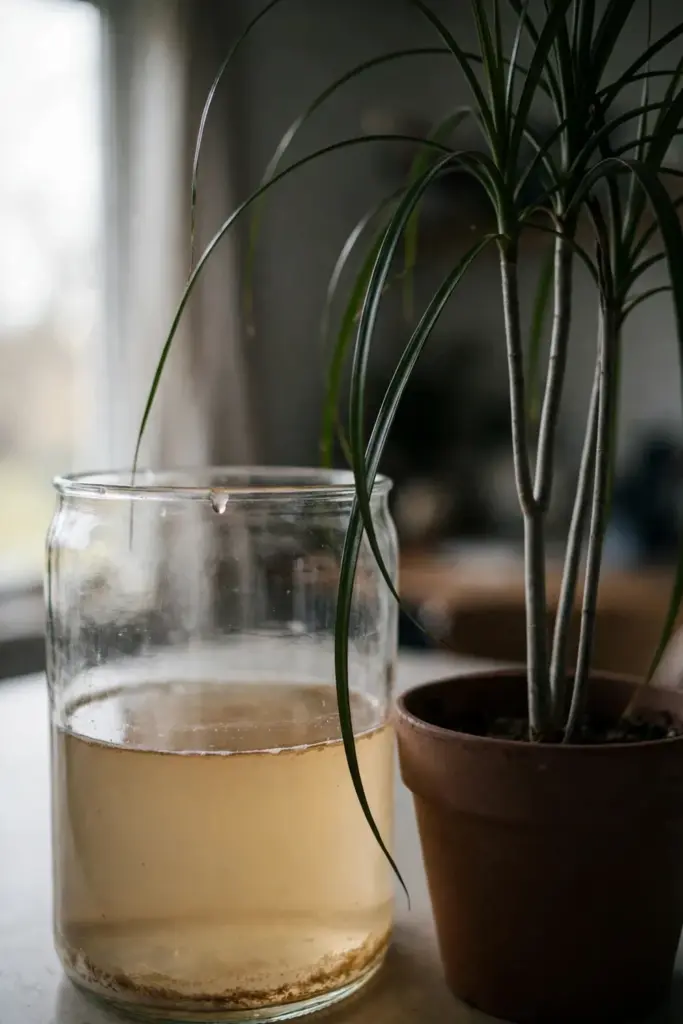
Use a balanced liquid feed at half the strength printed on the bottle, once a month from spring to midsummer. Flush the pot with plain water once between feeds so salts do not build up in the mix. Salts show up as brown leaf tips and a white crust on the mix surface.
No suji-specific fertilizer rate was available, so this article stays with the light half-strength routine used for Dracaena houseplants generally. A plant in fresh mix needs no feed for its first two months. The mix feeds it.
A plant that grows in low light needs less feed than a plant in a bright window. Match the feed to the growth you see. A plant pushing new leaves each month earns its monthly feed. A plant that sits still all winter earns none.
8. Bring Suji Inside Before the First Frost
Suji lives outdoors only where frost never arrives. Everywhere else, the pot comes inside before the first frost and stays inside until spring nights turn reliably warm.
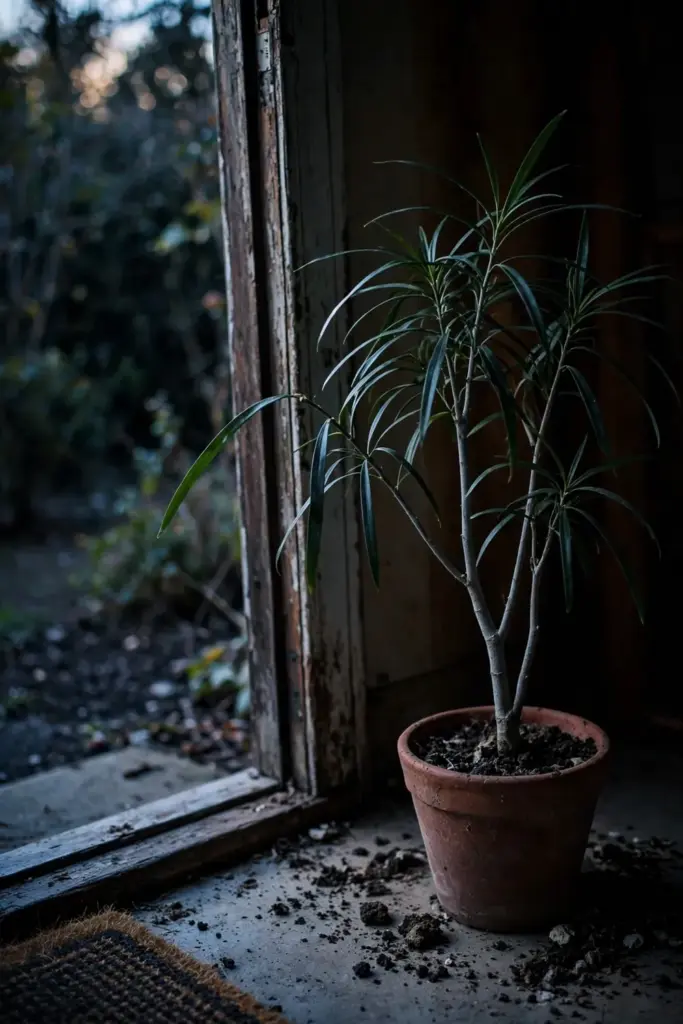
The plant comes from tropical forests and carries no frost protection. A single frost night can collapse the leaves and kill the stems to the base. The rhizome may resprout, but the season is lost. Bring the pot in while nights still feel mild.
Indoors, give the plant the brightest window and cut watering back. Growth slows in winter. A plant that barely grows drinks little, so the mix may stay damp for weeks between waterings. Resume normal watering when new leaves open in spring.
9. Prune the Top to Force Bushy Side Growth
Cut the top off a leggy stem and the plant answers with side shoots. Prune in spring, when growth restarts, so the plant has a full season to fill out.
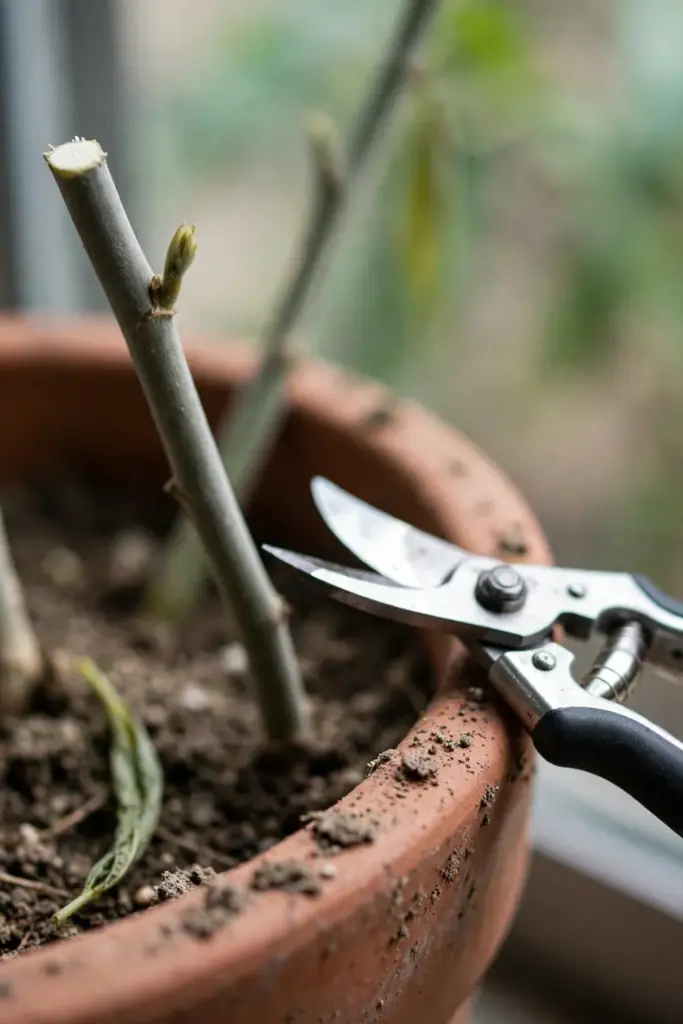
Cut the stem straight across above a leaf node, using clean shears. The top piece becomes a cutting. The stump below the cut pushes one or two new shoots from the nodes nearest the cut. A plant cut hard in spring looks bare for a month, then bushes out.
Strip yellow or dead leaves as they appear. A dead leaf left on the stem holds moisture against the stem and invites mold. A clean plant dries fast after watering and stays healthy.
Root the cut top instead of binning it. A top cutting with two or three leaves roots the same way as a tip cutting, and it gives you a second plant for free. Set it in moist mix, cover it with a bag, and wait for new leaves. One pruning session can double the collection.
10. Harvest Leaves for Green Dye Without Stripping the Plant
Pick mature leaves from the outer stems. Leave the growing tip alone. A plant harvested this way keeps growing while it feeds the dye pot.
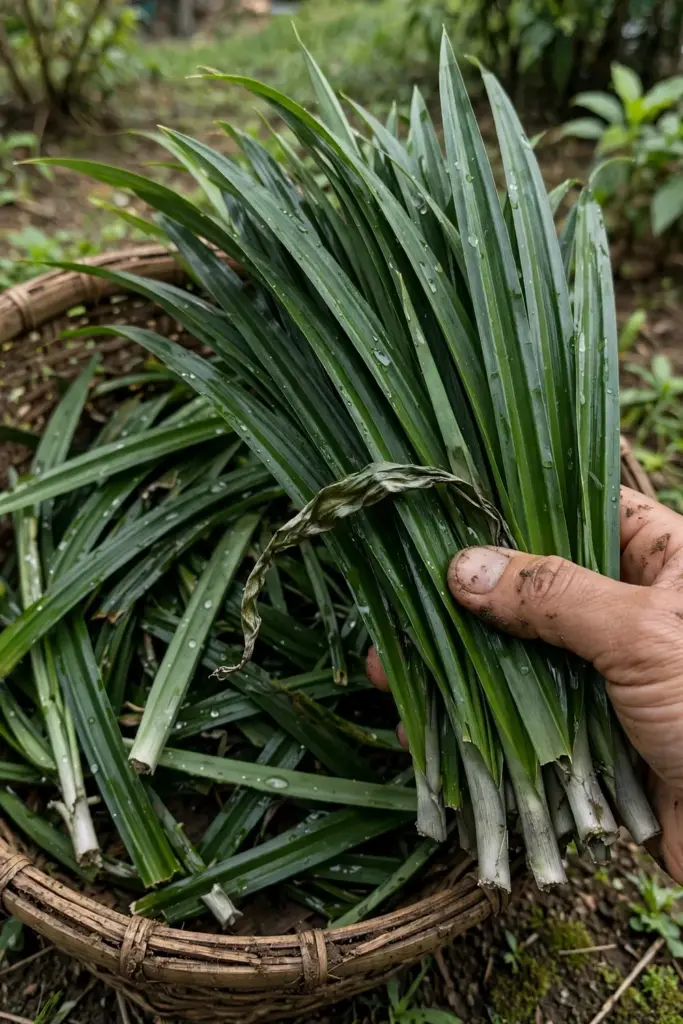
Take a few leaves at a time, never more than the plant can spare. A young plant with fewer than ten leaves gives nothing yet. Wait until the plant fills its pot. New leaves from the tip mean it is ready. Cut each leaf at the stem with clean shears, and take the oldest leaves first.
Morning harvest beats afternoon harvest. Leaves cut in the morning hold more water and blend into a smoother dye. Rinse the leaves, pat them dry, and use them the same day. Leaves left in a bag for days lose color and turn limp.
11. Blend Fresh Leaves into Green Dye the Same Day
Blend fresh leaves with water, strain the liquid, and use it the same day. That green liquid is the dye. It fades fast once it sits.
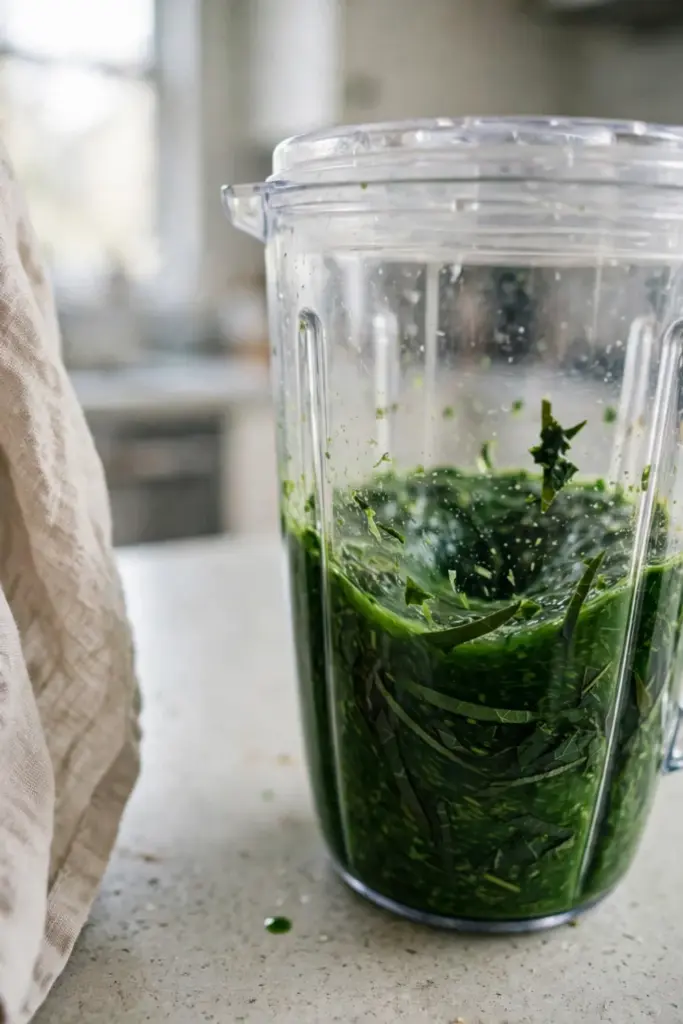
Roughly chop a handful of leaves and blend them with just enough water to keep the blades moving. Strain the pulp through a fine cloth and squeeze the cloth to catch every drop. The liquid should read as deep green, not pale. Pale liquid means too much water or too few leaves.
Fresh suji leaves carry 3,773.9 parts per million of chlorophyll, split between 2,524.6 parts per million of chlorophyll a and 1,250.3 parts per million of chlorophyll b, according to the Atlantis Press paper on suji and pandan rice flour. That load of pigment is the reason a small handful of leaves colors a whole batch of rice or cake batter. Use the dye within hours. Chlorophyll breaks down after harvest, and old dye turns dull.
12. Keep the Green Bright with Gentle Heat and Alkaline Water
Gentle heat and a pinch of baking soda keep the green bright. Hard boiling and acid turn the same dye olive brown.
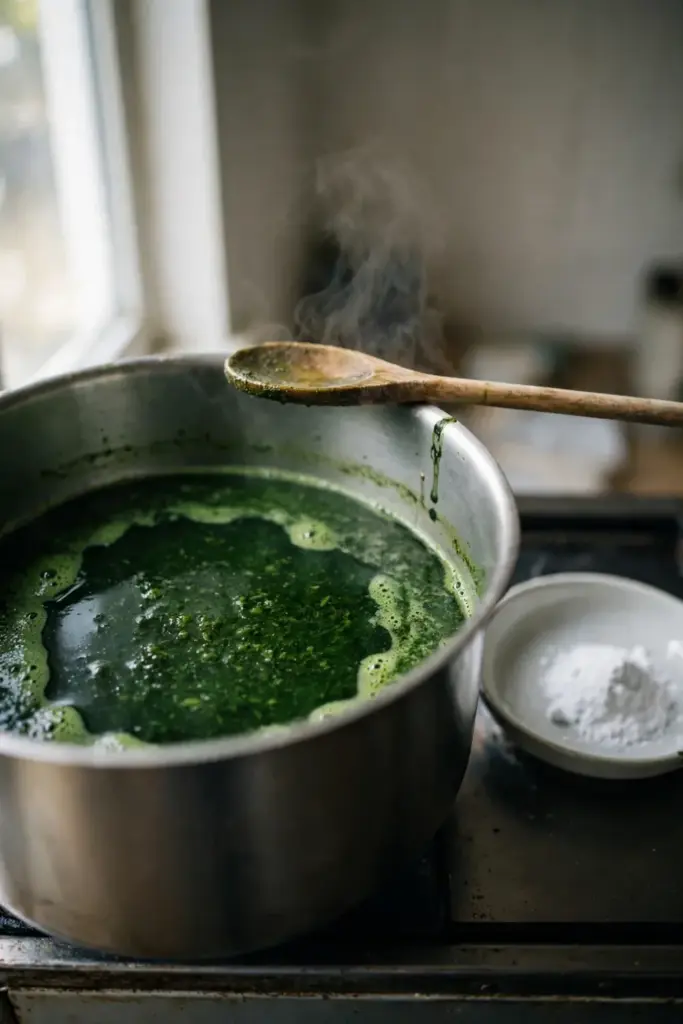
Heat drives the magnesium out of the chlorophyll molecule and leaves pheophytin, a dull olive pigment. Acid does the same work faster. I have learned to keep the heat gentle, since hard boiling turns the green muddy.
Blanch the leaves briefly in water with a pinch of baking soda before blending when the color must survive cooking. The study behind this method blanched suji and pandan leaves in a 1% alkaline solution to stabilize the color, according to the same Atlantis Press paper. Add the dye late in cooking and keep the pot below a hard boil. A dye added early and boiled hard arrives at the table brown.
13. Tell Suji Apart from Pandan, Marginata, and Lucky Bamboo
Suji gives color and pandan gives aroma, and the two plants differ in leaf and use. Three lookalikes cause most of the confusion, and the table below sorts them.
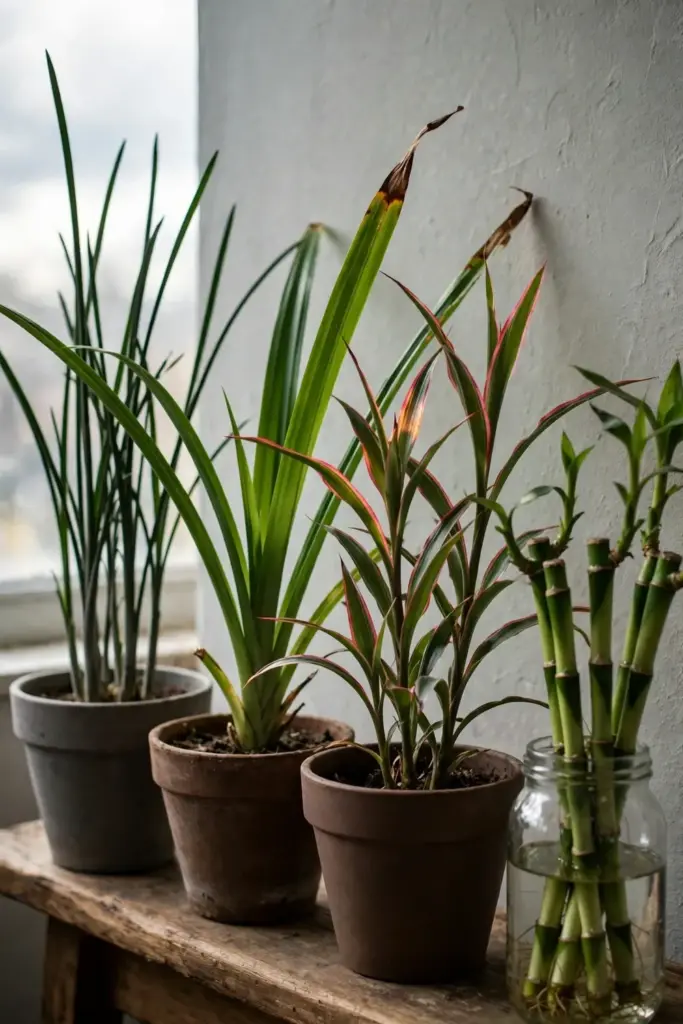
Suji is Dracaena angustifolia, a shrub with smooth grayish stems and narrow dark green leaves 20 to 45 cm long and 1.5 to 5.5 cm wide, according to the Flora of China account for the species. The same account places it in forests and thickets from southern China through Southeast Asia to northern Australia, flowering in March through May with greenish white flowers 1.9 to 2.3 cm long, and fruiting in June through August with orange berries 0.8 to 1.2 cm across. Older labels may call it Pleomele angustifolia.
Pandan is Pandanus amaryllifolius, a different plant entirely. Its leaves carry the aroma compound 2-acetyl-1-pyrroline, which gives pandan its warm scent, according to the same Atlantis Press paper. Suji leaves smell of little when crushed and give color instead. Cooks who want green use suji. Cooks who want scent use pandan. Cooks who want both use the two leaves together.
Two Dracaena cousins confuse buyers. Dracaena marginata carries thin leaves with red edges and a bare cane stem. Lucky bamboo, Dracaena sanderiana, grows as jointed green canes sold in water. Suji carries plain dark green leaves with no red edge and no jointed cane. Check the leaf edge and the stem before you buy.
Buy from a seller who names the species on the label. A pot sold only as “suji” or “green plant” may hold any Dracaena. Ask for Dracaena angustifolia by name, and check the leaf against the description above: narrow, dark green, plain edge, on a smooth grayish stem. A seller who cannot name the species cannot promise the dye.
| Plant | What It Gives | Leaves | Check |
|---|---|---|---|
| Suji (Dracaena angustifolia) | Green color | Narrow, dark green, plain edge | Smooth grayish stem, no red edge |
| Pandan (Pandanus amaryllifolius) | Warm aroma | Long, green, fragrant when crushed | Scent on crushing |
| Dracaena marginata | Ornamental foliage | Narrow with red edges | Red leaf edge |
| Lucky bamboo (Dracaena sanderiana) | Ornamental cane | Shorter, on jointed canes | Jointed cane stem |
14. Keep Cats and Dogs Away from Suji Leaves
Keep suji away from cats and dogs. Every Dracaena carries saponins that sicken pets that chew the leaves.
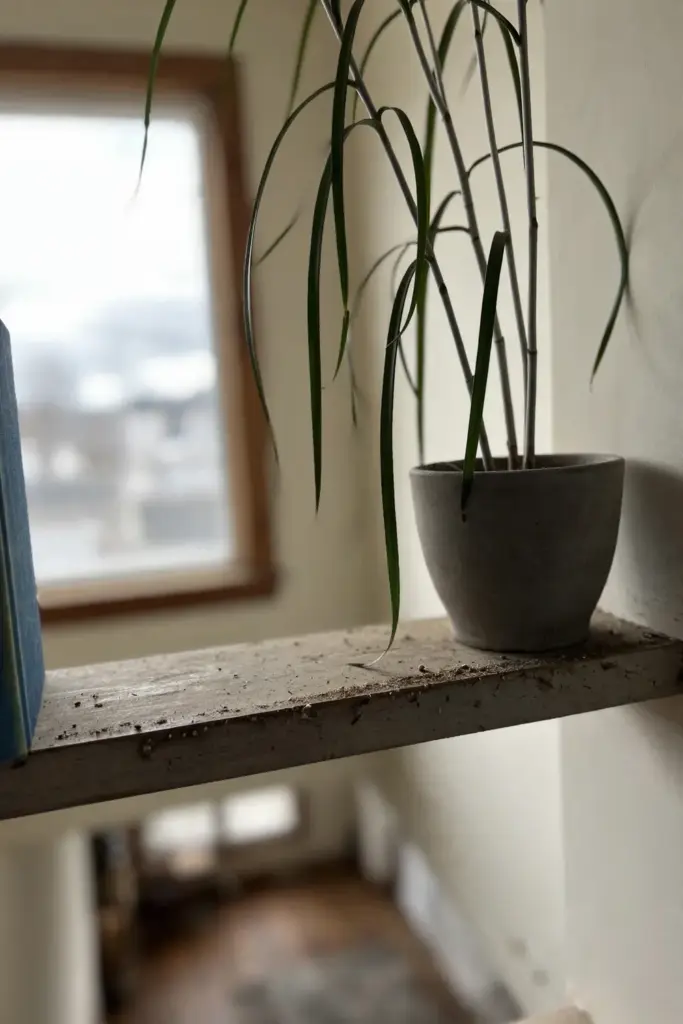
The ASPCA Dracaena listing lists Dracaena species as toxic to dogs and cats, with saponins as the toxic principle and vomiting, depression, loss of appetite, excess salivation, and dilated pupils in cats as the clinical signs. A pet that chewed leaves needs a vet call, not a wait-and-see afternoon.
Set the pot on a high shelf or in a room pets never enter. Pick up fallen leaves at once, since a leaf on the floor is an invitation. A hanging pot works when the trails stay short and the plant stays out of jumping range.
15. Fix the 5 Failures That Stop Suji
Five failures stop suji, and each one shows on the leaves first. Read the leaf, then fix the cause.
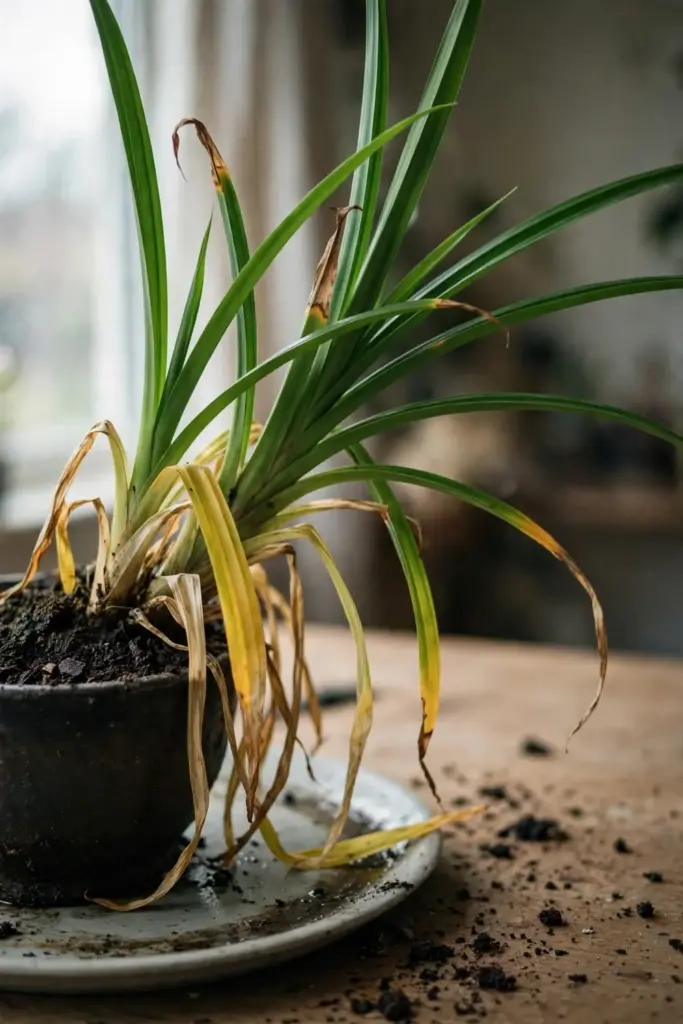
Yellow lower leaves mean wet mix. Let the pot dry, check the drainage holes, and repot into fresh mix when the base feels soft. Brown leaf tips mean dry air, salts in the mix, or both. Flush the pot with plain water and move the plant away from a heat vent.
Leggy stems mean low light. Move the plant closer to a window and prune the stretched stems back. No growth in winter is normal. The plant rests in short days and resumes in spring. Pests stay rare indoors. The University of Florida Dracaena notes list mites, thrips, and chewing insects as the pests to watch, with leaf spot diseases as the disease risk. Wipe small outbreaks off with a damp cloth and isolate the plant until the pests clear. Pair this with the site’s guide to organic pest control for sprays that suit an indoor plant.
A plant that drops leaves after a move is adjusting, not dying. Give it steady light and water, and leave it alone for a month. New leaves at the tip mean the plant settled.
16. Grow Suji for Years with a Simple Yearly Routine
A suji plant lives for years on a simple yearly routine. Repot in spring, prune after repotting, feed through summer, and bring the pot inside before frost.
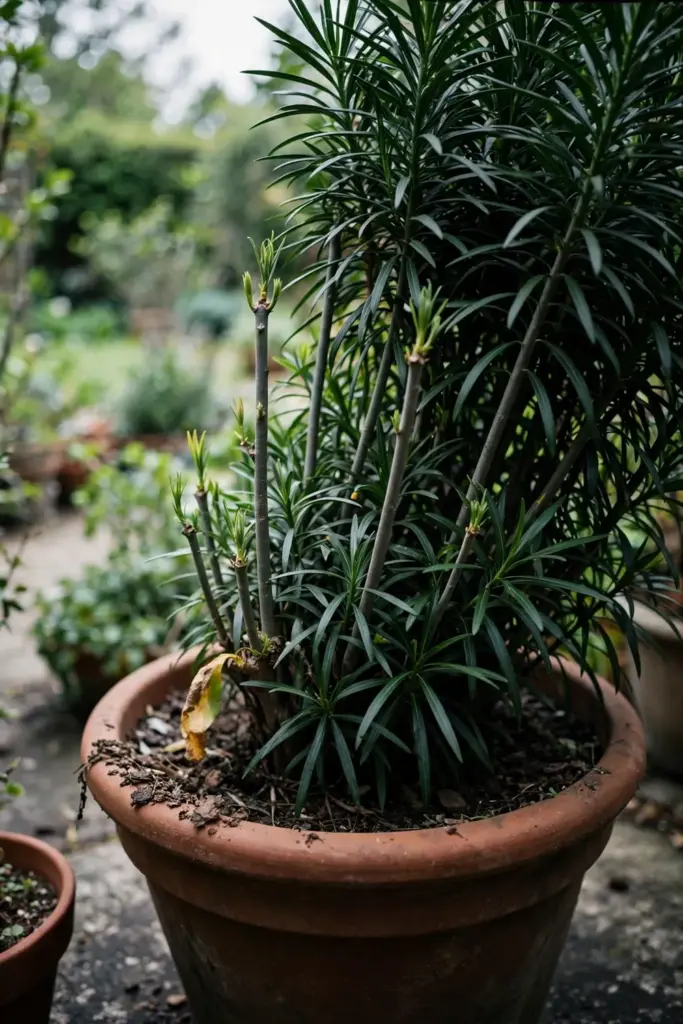
Each spring, slide the root ball out and check the mix. Fresh mix and one pot size up carry the plant through the season. Prune the tallest stems back to force side growth, and root the cut pieces as new plants. A plant that gets this treatment every spring stays dense and keeps pushing the mature leaves the dye pot needs.
Keep one plant for leaves and one for looks when space allows. The dye plant gets harvested hard and pruned often. The show plant keeps its shape and loses only a leaf or two. Two plants cost one cutting and a second pot.
Give cuttings away. A plant pruned each spring throws more cuttings than one windowsill needs, and a cutting in a jar of water makes a gift that roots on the recipient’s sill. Label the jar with the species name so the gift stays correctly named. Suji spreads through cuttings, not through shops, and a named cutting beats an anonymous pot.
Frequently Asked Questions
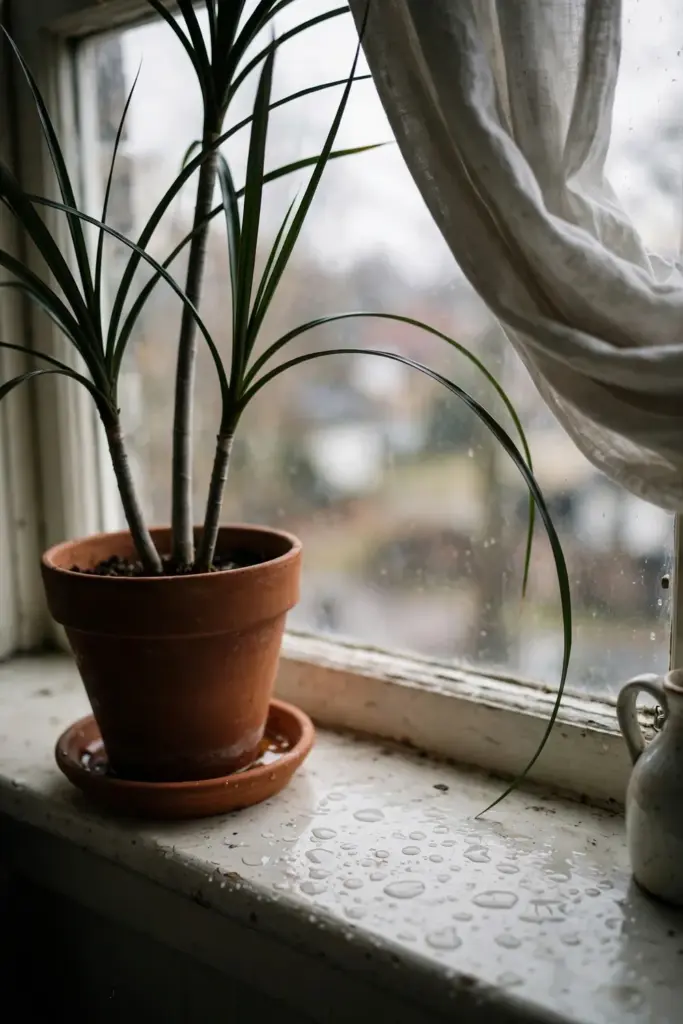
No. Suji is Dracaena angustifolia and pandan is Pandanus amaryllifolius, a different plant entirely. Suji gives green color from chlorophyll. Pandan gives warm aroma from 2-acetyl-1-pyrroline. Cooks use suji for color, pandan for scent, and both together when a dish needs green and fragrance. Check the botanical name before you buy, since the two leaves look alike in a market bundle.
Outdoors year-round, no. Here is how to grow suji leaf plant outside the tropics: in a pot, kept outside through the warm months, and brought inside before the first frost. The plant comes from tropical forests and carries no frost protection. A single frost night can collapse the leaves and kill the stems. The pot-and-bring-inside routine is the whole temperate method.
Yes. Every Dracaena carries saponins that sicken cats and dogs that chew the leaves. Signs include vomiting, depression, loss of appetite, excess salivation, and dilated pupils in cats. Keep the pot on a high shelf or in a room pets never enter. Pick up fallen leaves at once. A pet that chewed leaves needs a vet call, not a wait-and-see afternoon.
A cutting roots within a few weeks in warm, moist mix, then pushes new leaves from the tip. The plant grows fastest in spring and summer and rests in winter. A cutting taken in spring fills a medium pot by autumn and gives its first dye leaves in its second season. Feed sparingly, give bright indirect light, and repot when roots circle the mix. Patience beats fertilizer for this plant.
Yes. Indoor leaves carry the same green pigment as outdoor leaves. Harvest mature outer leaves, blend them with water the same day, and strain the liquid through a fine cloth. Use the dye within hours, since chlorophyll breaks down after harvest. Keep the heat gentle and add the dye late in cooking. A plant on a bright windowsill gives enough leaves for small batches through the growing season.
Yellow lower leaves usually mean wet mix. Let the pot dry, check the drainage holes, and repot into fresh mix when the base feels soft. Yellow leaves with dry mix point to hunger or old age. Feed once at half strength and watch the new growth. New leaves that open green mean the plant recovered. Old leaves that yellow one at a time are normal shedding, not disease.
Keep a Suji Plant on the Windowsill and Dye in the Kitchen
One pot gives you a houseplant and a dye plant, and that is how to grow suji leaf plant at its best: a bright window, a damp pot, and a sharp pair of shears. Start with one cutting this spring. Harvest a few leaves in the second season. The green in the dye pot will tell you the plant settled.
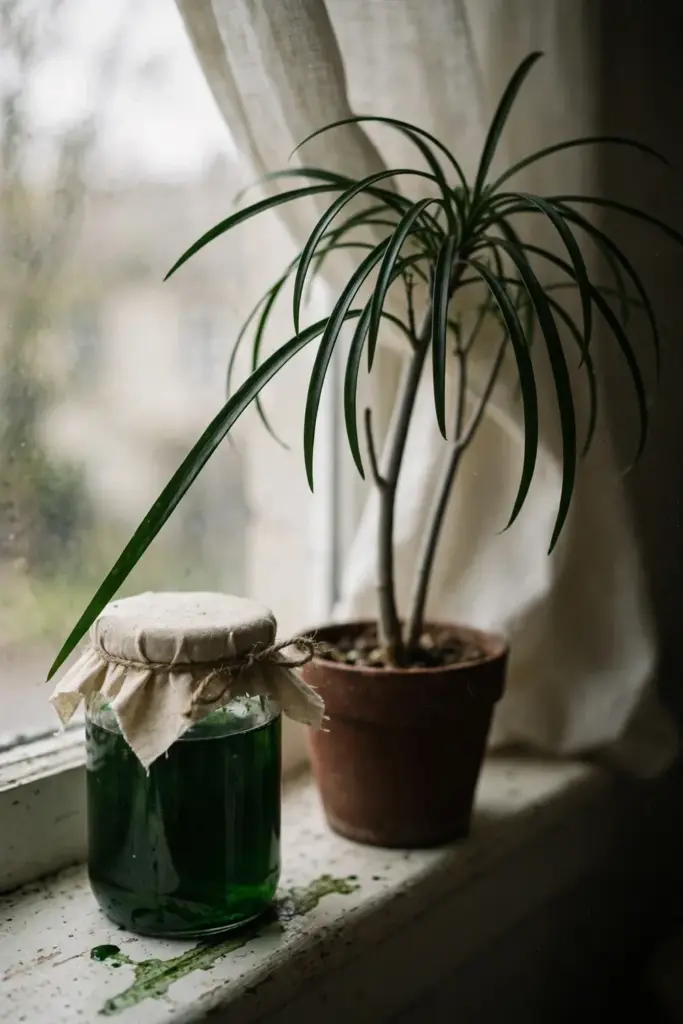
Pair suji with another Indonesian herb on the same windowsill. The site’s lemongrass guide covers a second tropical herb that grows in a pot and flavors the kitchen. Suji gives the color. Lemongrass gives the scent. The two pots sit well together.