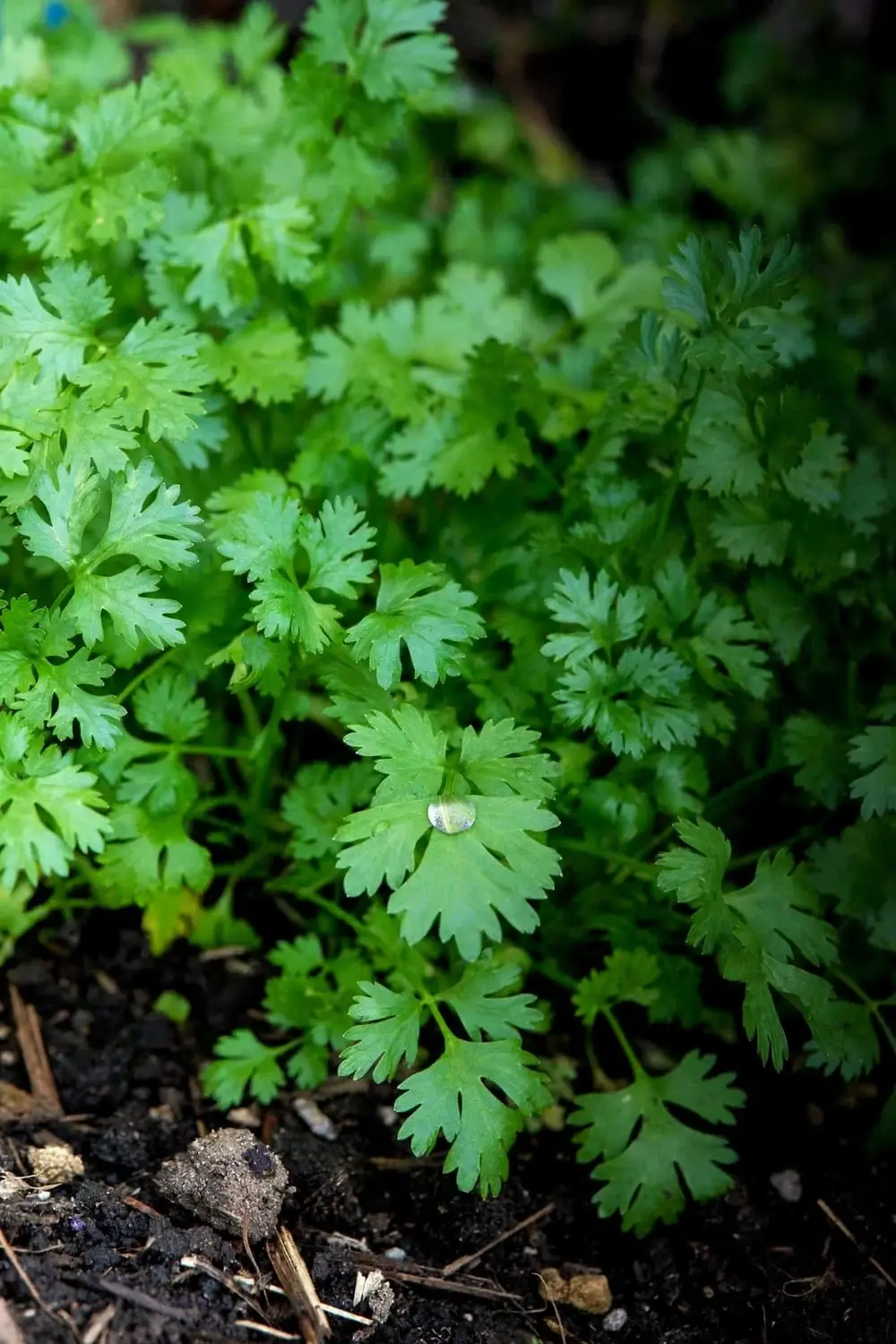

Dhaniya is the fastest herb in the Indian kitchen garden. From sowing to first leaf harvest can take as little as 10 weeks, and one planting gives you two crops: fresh dhaniya patti for garnishing and, if you let the plants finish, sabut dhania for the spice box. This guide shows how to grow coriander from India the way Indian home gardeners do it, adapted for Western temperate climates where summers run hot.
The catch is heat. Coriander is a cool-season annual. It grows leaves happily in spring and fall, then bolts the moment summer arrives. Most beginners plant once, watch it flower, and conclude the plant failed. It did not fail. That is the life cycle. The method below works with it: sow in cool weather, harvest leaves fast, and keep a second set of plants running to seed. If you want to know how to grow coriander from India for a continuous supply, the secret is succession, not a single perfect sowing.
This article is the Indian dhaniya method: dhaniya patti plus sabut dhania, the dual harvest. The botanical name is Coriandrum sativum, the same species behind every cilantro and coriander article on this site.
1. Start With the Season, Not the Seed
Dhaniya is a rabi-season crop in India. Rabi means the winter growing season, roughly October to March, when days are short and nights are cool. That single fact explains almost every failure Western gardeners report. Sow coriander in June and it flowers in weeks. Sow it in March or September and it gives leaves for months.
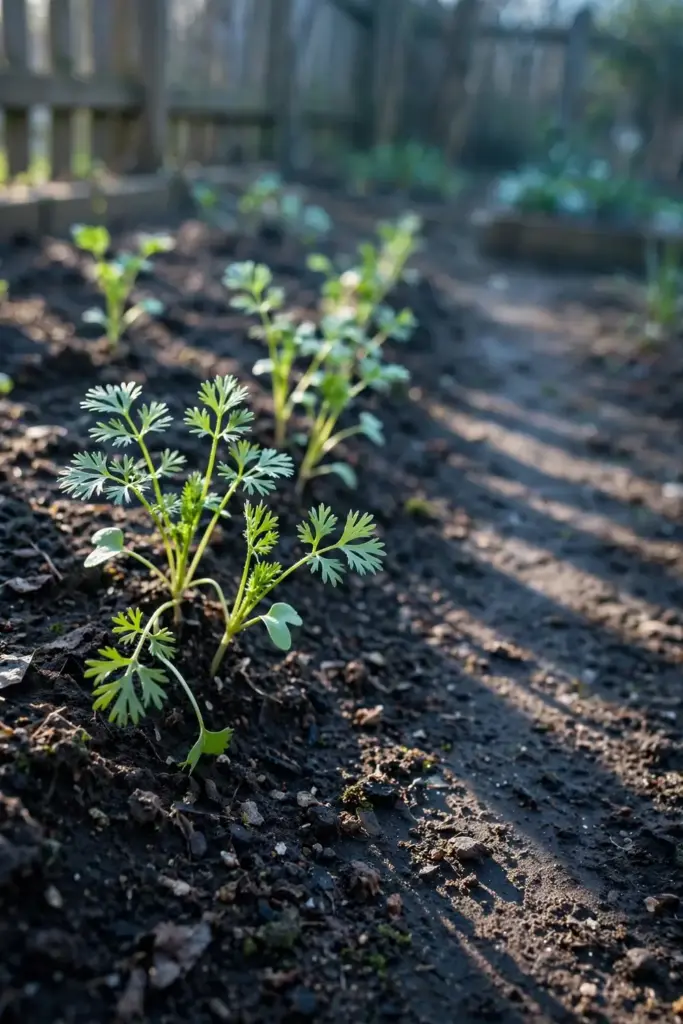
The plant reads two signals. Temperature and day length together trigger flowering. Oregon State University Extension notes that in warm weather the plant finishes its life cycle faster, and in mid-summer it typically bolts into small white flowers and produces seed within four to six weeks (How to grow cilantro for leaves, or coriander seeds). In the cooler, shorter days of spring and fall, the same plant grows leaves for several weeks or months before flowering.
Your sowing calendar therefore has two windows in most temperate zones. The spring window opens as soon as soil can be worked, about 4 to 6 weeks before the last frost. The fall window opens in late summer when night temperatures drop below about 75 F. In mild climates you can also sow through winter under cover. Avoid the peak-summer slot entirely. OSU Extension is blunt about it: avoid planting during peak summer heat, when plants are likely to bolt before producing many leaves.
Plan backward from heat. If your first 85 F day usually lands in early June, your last useful spring sowing is mid-April. If fall nights cool down in September, your first fall sowing goes in the ground in mid-August. Write these two dates on a calendar before you buy seed. They matter more than the variety you choose.
2. One Plant, Two Harvests: Dhaniya Patti and Sabut Dhania
In India the same plant serves two harvests. Dhaniya patti is the fresh leaf, chopped over dal, curries, and chutneys at the last minute. Sabut dhania is the whole dried seed, roasted and ground for spice blends or used whole in tadka. Western guides usually pick one lane. This article plans for both from the start, because the dual harvest changes how you sow and space.
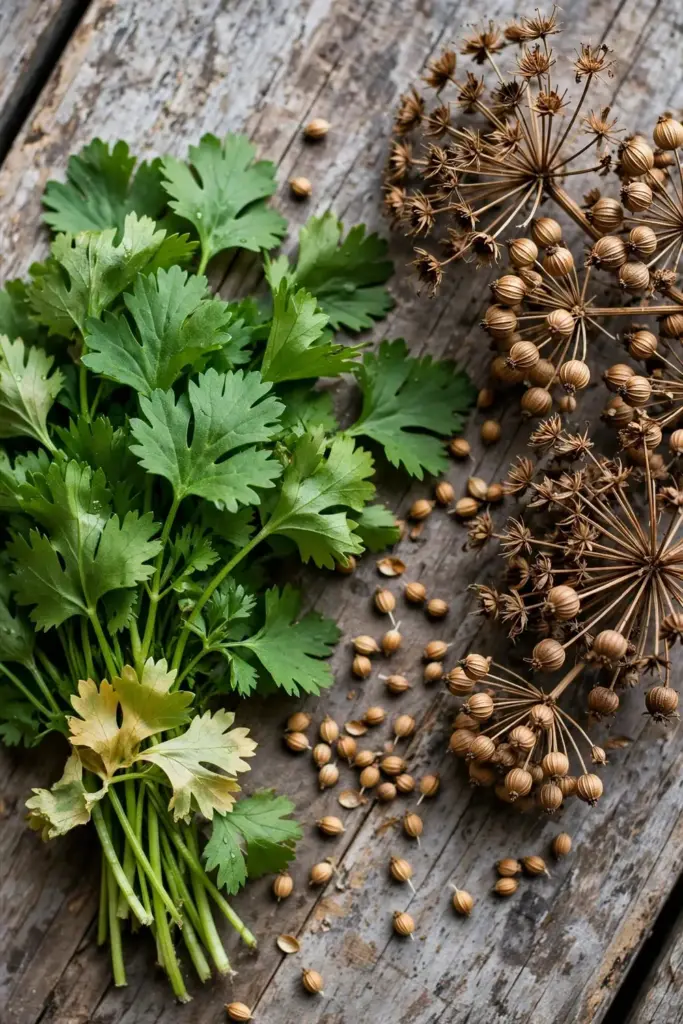
The decision is made at thinning time, not at sowing. Sow one bed generously. Then split it: half the plants get picked hard for leaves, and half get left to flower and set seed. The table below shows what changes between the two goals.
| Decision | Leaf Harvest (Dhaniya Patti) | Seed Harvest (Sabut Dhania) |
|---|---|---|
| Final spacing | 2 inches apart | 8 to 10 inches apart |
| When to sow | Spring and fall, cool weather | Spring, to allow full ripening |
| Picking | Outer leaves every few days | Do not pick leaves after flowering starts |
| Bolting | Delay it with shade and water | Welcome it; flowers become seed |
| End of season | Plants pulled when they bolt | Plants left standing until brown |
The spacing numbers come from Utah State University Extension, which recommends thinning seedlings to 2 inches for leaf harvest or 8 to 10 inches for seed production (Cilantro/Coriander in the Garden). The logic is simple. Leaves want a dense stand that shades the soil and keeps it cool. Seeds need airflow and light around each plant so the seed heads dry and ripen evenly.
One warning about expectations. A plant that gives you a great leaf harvest will give you a poor seed harvest, and the reverse is also true. Leaves come from vegetative growth. Seeds come after the plant commits to flowering and stops making leaves. Choose your lane per plant, not per season, and you get both crops from one bed.
3. Buy Seed Meant for Sowing, Not for the Spice Rack
Coriander seed from the spice aisle will sometimes sprout. Sometimes. The problem is that culinary seed is sold for flavor, not germination. It may be old, it may have been heat-treated during processing, and the packet carries no germination date. Home growers who start with spice-jar seed and get patchy emergence usually blame their technique. The seed was the problem.
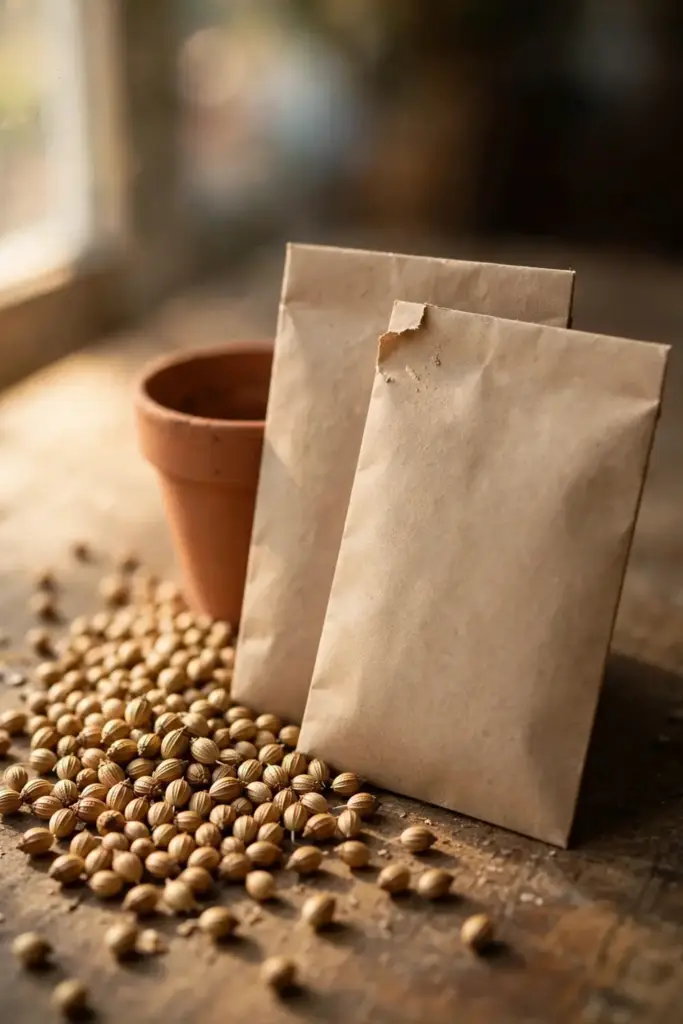
Buy seed packed for sowing. Look for the packed-for date on the packet and choose the freshest one on the rack. Coriander seed stays viable for several years when stored cool and dry, but germination drops with age, so fresher is always better. OSU Extension notes that seeds can last 3 to 4 years for planting or eating, which tells you the ceiling, not the ideal (Cilantro).
For the dhaniya lane, choose a slow-bolting variety if you can find one. Utah State University Extension lists Slow Bolting and Leisure among the excellent varieties, and notes that slow-bolting types are the right pick when harvesting for leaves (Cilantro/Coriander in the Garden). Seed catalogs also sell Calypso and similar bolt-resistant selections. If only generic coriander seed is available, it will still work. You will just manage bolting with timing and succession instead of genetics.
Buy more than you think you need. A serious dhaniya grower sows every 2 to 3 weeks through the season, and seed is cheap. Two or three packets cover a full season of succession sowings for a family.
4. Split and Soak: The 24-Hour Seed Prep
What we call a coriander seed is really a fruit. Botanically it is a schizocarp: two seeds fused inside one round husk. Each half can grow into a plant, but the husk slows water uptake, which is why coriander germination is famously uneven. Some sprouts appear in a week, others take three.
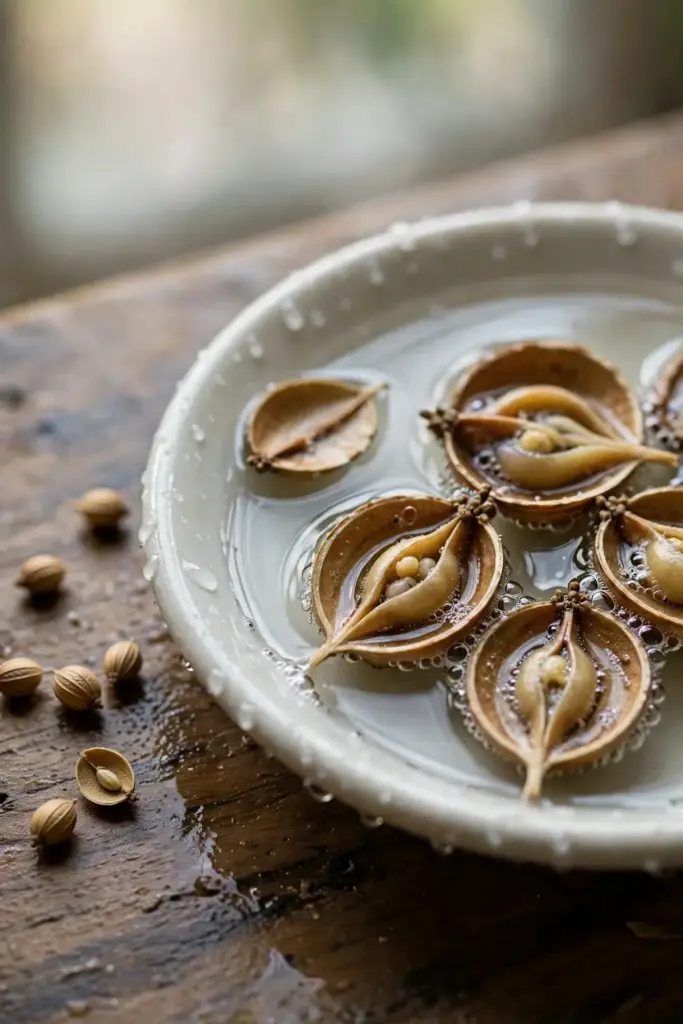
Indian growers have a standard fix. Lightly crush the round seeds with a rolling pin or the flat of a hand until each one splits into halves. Do not grind them to powder. You want two clean halves, not dust. Then soak the halves in room-temperature water for about 24 hours before sowing. The split lets water reach the embryo directly, and the soak starts germination before the seed meets soil.
Drain the seeds on a paper towel just until they are surface-dry enough to handle, then sow immediately. Do not let soaked seed sit for days. Once imbibition starts, the embryo is committed, and drying it out again kills it.
Is the prep mandatory? No. Untreated seed sown into moist cool soil will germinate in about 3 weeks according to USU Extension. But the split-and-soak routine is the difference between a ragged stand that emerges over three weeks and an even stand that comes up together. For succession sowing, where timing matters, that evenness is worth the day of prep.
5. Sow Direct: The Taproot Rule
Coriander grows a long taproot fast, and it resents being moved. Transplanting breaks or bends that root, and the plant responds by bolting early, which is the single most common cause of instant flowering in store-bought seedlings. The fix is absolute: sow where the plant will live, every time.
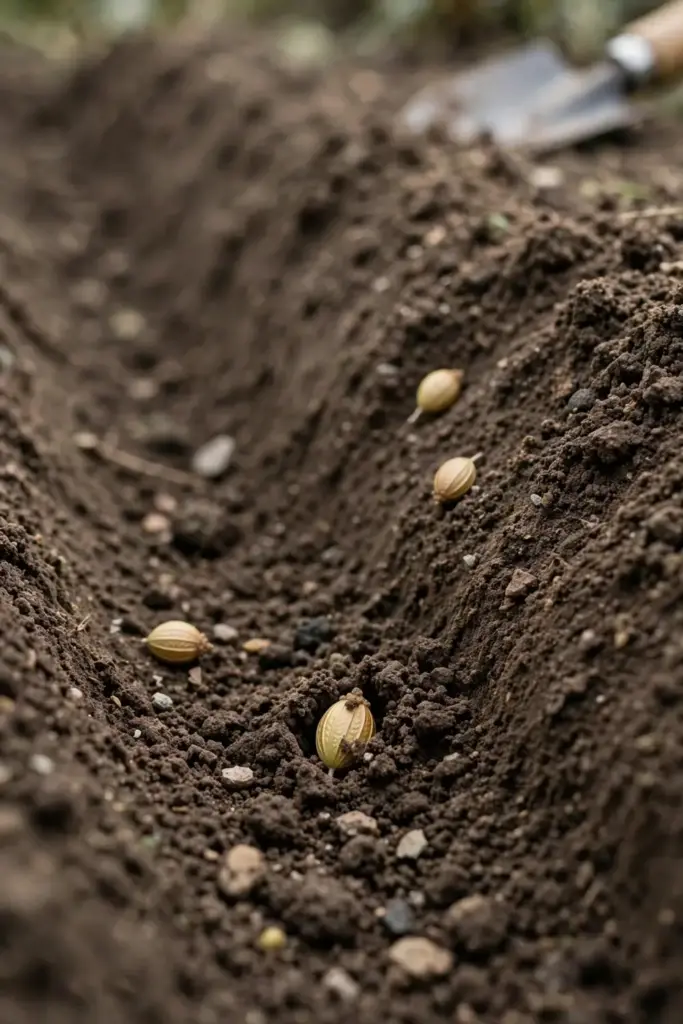
Sow 1/4 to 1/2 inch deep in the final bed or pot. Cover lightly with fine soil or compost and water gently so the seeds do not wash out of place. Rows 15 inches apart suit a garden bed; in pots, scatter and thin later. Keep the seedbed evenly moist until emergence. Utah State University Extension gives the depth and spacing numbers and notes germination in about 3 weeks (Cilantro/Coriander in the Garden). In warm soil above 70 F, expect the fast end of that range. In cool spring soil, expect the slow end.
Do not start coriander in small cells with plans to transplant. If you must start indoors for an early season, use biodegradable pots that go into the ground whole, and move them out while the seedlings are still small. Even then, direct sowing beats transplanting every time. The Royal Horticultural Society puts it plainly: coriander is easy to grow from seed sown outdoors, in the ground or in containers, from spring onwards (How to grow Coriander).
One sowing is never enough. Mark your calendar for the next sowing the day you sow the first. Section 11 turns that reminder into a system.
6. The Pot Method: Wide, Not Deep
Dhaniya grows well in pots, which is how most Indian apartment gardeners grow it on balconies and terraces. The pot rules differ slightly from garden beds. Coriander roots run deep fast because of the taproot, but OSU Extension notes that cilantro roots are not deep overall, so shallow containers work if they are wide (Cilantro). Choose width over depth: a container 12 inches wide and 8 inches deep beats a narrow deep pot.
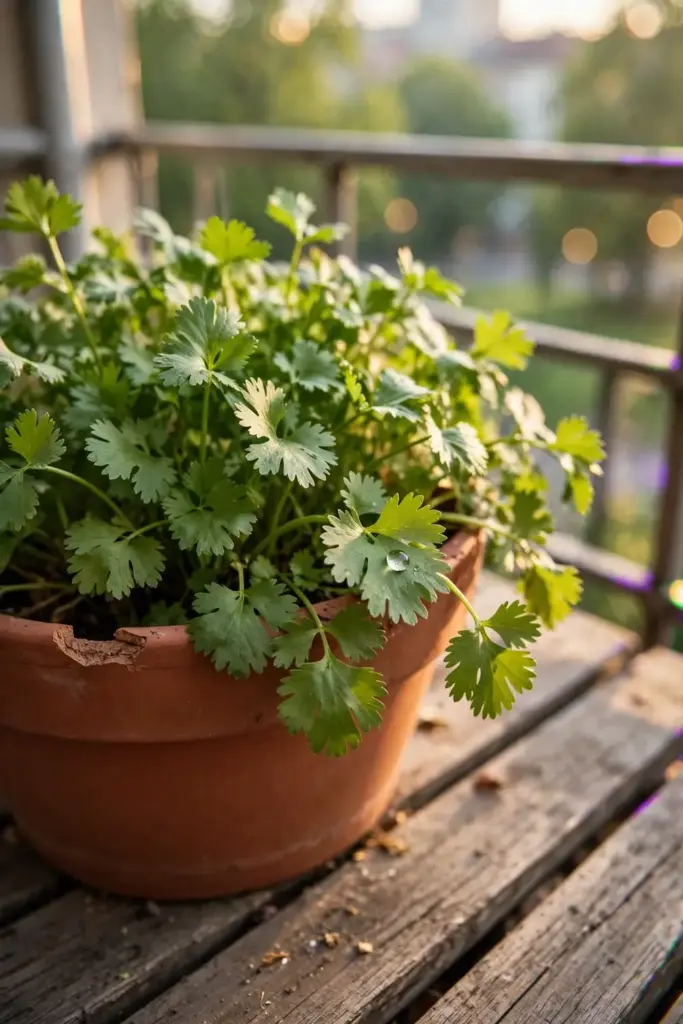
Drainage holes are non-negotiable. Coriander hates wet feet. Fill with a light potting mix, not heavy garden soil, and leave an inch of headroom at the rim for watering. Sow the seed across the surface rather than in rows, about 1/2 inch apart, then thin to 2 inches once seedlings are 2 inches tall. A 12-inch pot holds 15 to 20 leaf-harvest plants comfortably.
Pots warm up faster than garden soil, which means they bolt faster. In summer, move pots to a spot that gets morning sun and afternoon shade. Indoors, a bright windowsill or a simple grow light keeps a winter pot productive. A wide shallow container dries from the top and the sides at once, so check the top inch of mix daily in warm weather.
7. Soil: Fertile, Loose, and Well Drained
Dhaniya asks two things from soil: drainage and organic matter to feed fast leaf growth. The RHS recommends fertile, well-drained soil, and notes that leaf production is more productive in partial shade (How to grow Coriander). Heavy clay that stays wet rots the crown. Pure sand that dries in hours starves the leaves.

In a garden bed, work 2 to 3 inches of compost into the top 6 inches before sowing. The compost does three jobs: it feeds, it loosens, and it holds moisture between waterings. Coriander is a light feeder, so do not overdo nitrogen. Rich soil plus heavy fertilizer grows big plants with diluted flavor. USU Extension advises fertilizing lightly, about 1/4 cup of nitrogen fertilizer per 25 square feet once or twice a season, and warns that overfertilization decreases flavor (Cilantro/Coriander in the Garden).
Keep the pH near neutral if you can, roughly 6.0 to 7.5. Most garden soils and bagged potting mixes already sit in this range, so testing is optional unless your soil is extreme. Mulch the bed with an inch of straw or shredded leaves once seedlings are 3 inches tall. Mulch keeps the root zone cool, and cool roots delay bolting.
For the bigger picture on building soil that feeds herbs without constant fertilizing, the soil health guide lays out the long game (soil health and pest resistance).
8. Watering: Steady Moisture, Never Soggy
Coriander wants consistent moisture, especially during germination and early growth. Dry soil at the seedling stage triggers stress, and stressed coriander bolts. Water the seedbed gently every day until emergence, then settle into a rhythm that keeps the top few inches evenly moist but never waterlogged.
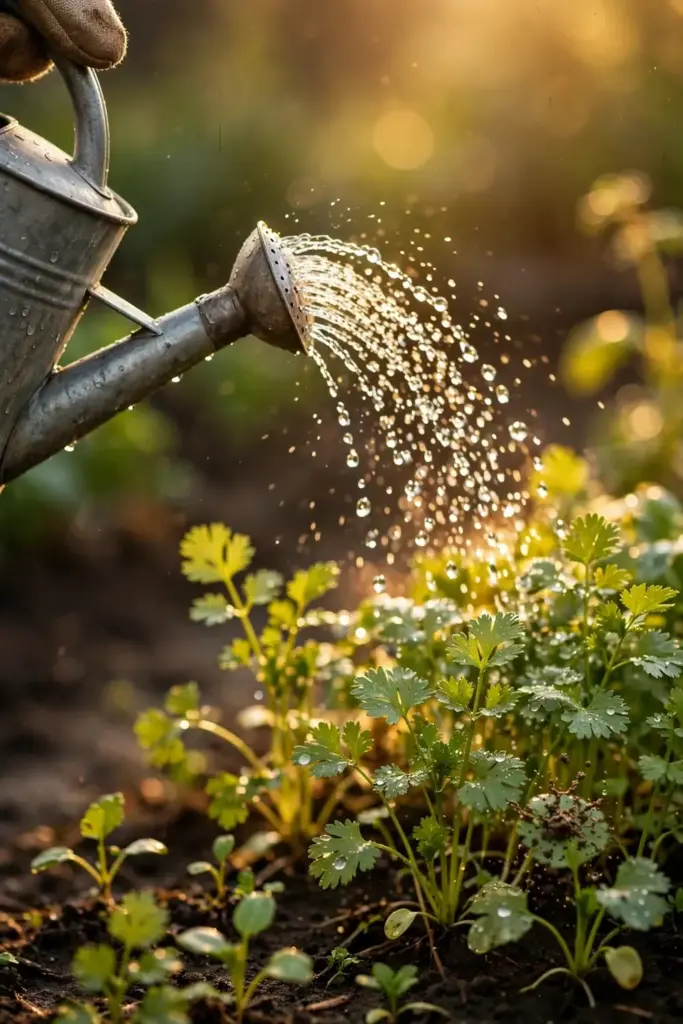
Established plants are more forgiving. USU Extension advises watering regularly while plants establish, then only as needed, and warns that overwatering can dilute flavor (Cilantro/Coriander in the Garden). The practical test is the finger test. Push a finger an inch into the soil. If it feels dry, water. If it feels damp, wait.
Morning watering beats evening watering, because wet foliage overnight invites fungal problems, and coriander is susceptible to a few. Water at the base, not over the leaves, once the plants are up. In hot spells, a deep watering every two to three days beats a daily sprinkle. Deep water reaches the taproot. Sprinkles keep only the surface alive and teach roots to stay shallow.
Pots follow the same rule with a faster clock. Check daily. In a heat wave, a wide pot may need water twice a day. Mulch helps pots too: a half inch of coco chips on the surface slows evaporation.
9. Thin Early or Harvest Crowded
Thinning feels wasteful. It is not. Crowded coriander competes for light and water, stays spindly, and bolts sooner. The seedlings you pull are your first micro-harvest anyway. Eat them.
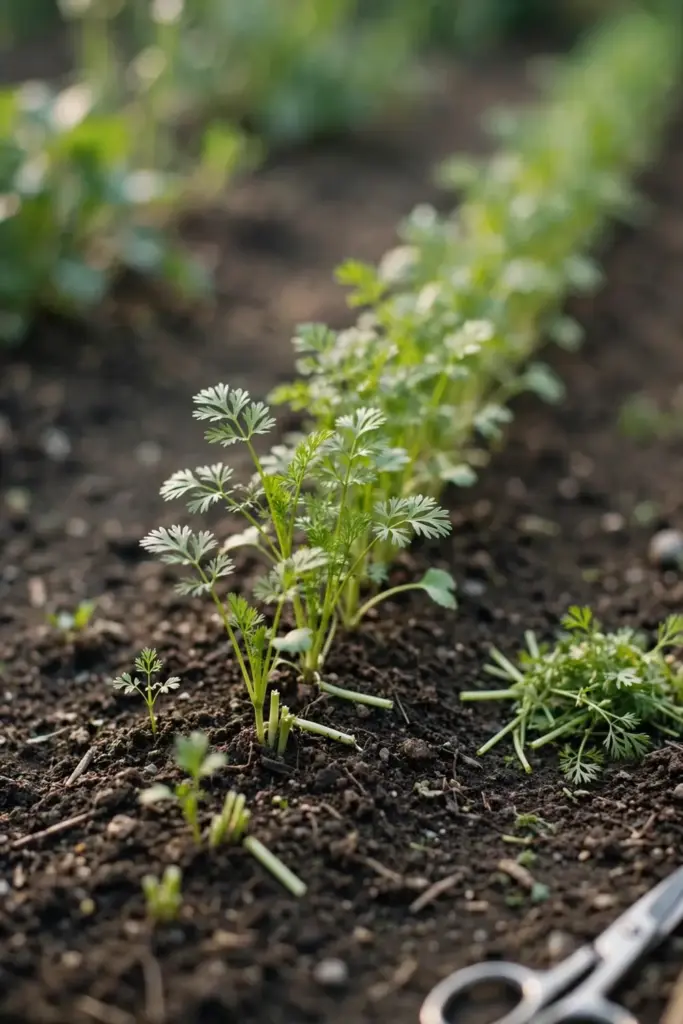
Thin when seedlings are 2 to 3 inches tall. For the leaf lane, leave plants 2 inches apart. For the seed lane, leave them 8 to 10 inches apart. These are the USU Extension numbers, and they reflect the two different goals: dense stands for leaves, airy stands for seed (Cilantro/Coriander in the Garden).
The technique matters. Do not yank. Pulling disturbs the taproots of the neighbors, which triggers the bolting response you are trying to avoid. Snip the extra seedlings at soil level with small scissors instead. The roots decay in place and feed the soil.
If you skipped thinning and the bed is a mat of seedlings, do not try to fix it by transplanting the extras. Compost them or eat them as microgreens. Transplanted coriander bolts. Every time.
A useful rhythm: thin in the evening, water after, and harvest the thinnings for dinner. Nothing is wasted, and the remaining plants get a cool night to recover.
10. Bolting: Heat Is the Trigger
Bolting is coriander flowering. The stem shoots up, the leaves turn feathery and bitter, small white or pale pink umbels open, and the plant stops making the broad leaves you want. It is not a disease. It is the plant doing exactly what annuals do: reproducing before it dies.
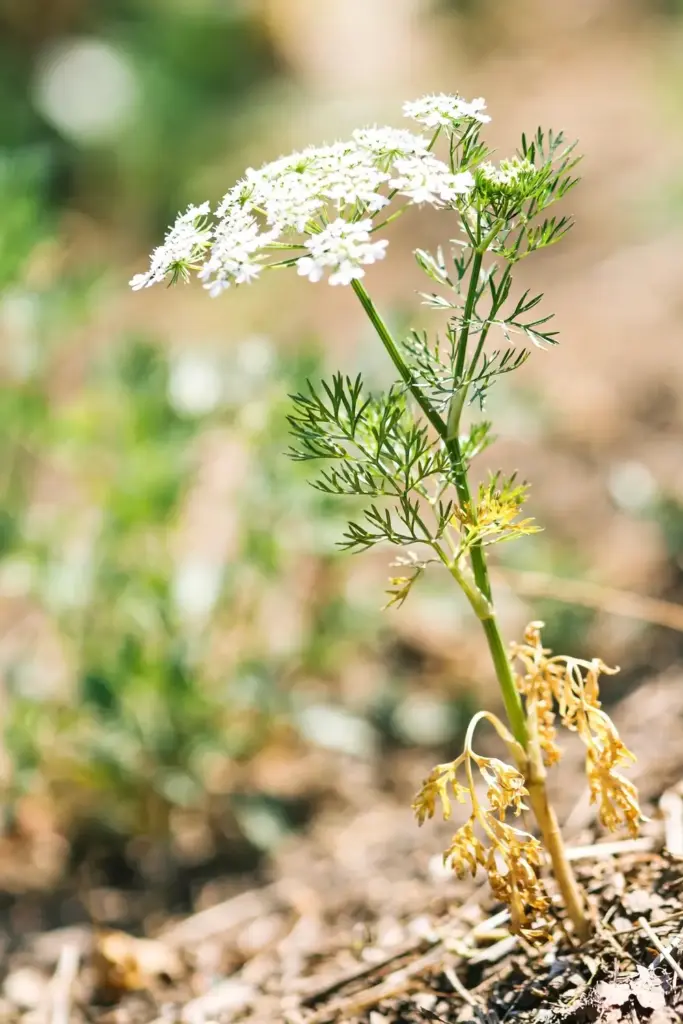
Heat is the main trigger. OSU Extension reports that cilantro bolts quickly when temperatures rise above 80 F, and that summer-sown plants can flower and set seed within four to six weeks (Cilantro). Day length adds to the effect: long summer days push flowering even in moderate temperatures. Drought stress, root disturbance, and overcrowding all accelerate it.
You cannot stop bolting forever in a warm climate, but you can delay it. Four tactics work. First, sow in the cool windows and skip summer. Second, give afternoon shade in warm spells; a shade cloth or a taller neighboring crop buys weeks. Third, keep soil evenly moist and mulched so roots stay cool. Fourth, choose slow-bolting varieties like Leisure or Slow Bolting for the leaf lane.
When bolting starts, decide fast. If the plant is in the seed lane, let it go. If it is in the leaf lane, pull it and eat what is usable, then sow the next succession. Pinching flower buds buys a few days at most. It does not reset the plant.
Here is the mindset shift this article is built on. Bolting is not failure. It is the second harvest beginning. Section 14 turns those flowers into sabut dhania.
11. The Succession System: Sow Every 2 to 3 Weeks
Succession sowing is the whole game. Because each planting gives leaves for only a few weeks before bolting, the only way to a continuous supply is a pipeline of plantings at different ages. When the oldest batch bolts, the next one is ready to pick.
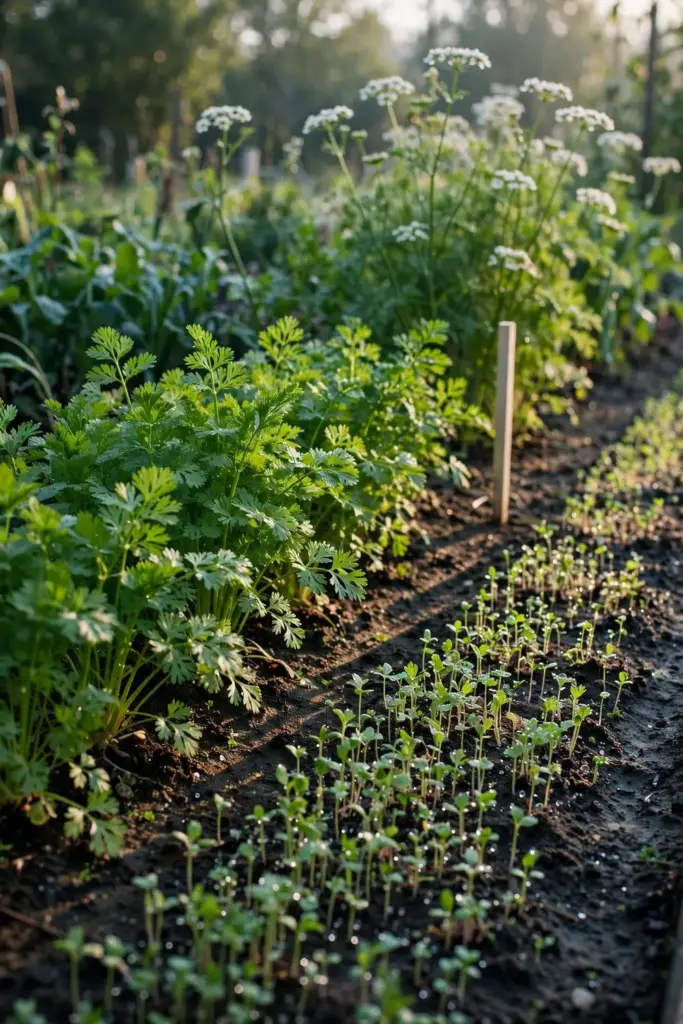
The interval is 2 to 3 weeks. OSU Extension recommends sowing small batches every few weeks for a steady supply, and the RHS advises sowing small batches every month or so for continual leafy harvests (How to grow cilantro for leaves, or coriander seeds; How to grow Coriander). In cool weather, stretch toward 3 weeks. In warm shoulder seasons, tighten to 2.
A simple succession plan for a temperate spring looks like this. Adjust the dates to your frost calendar.
| Succession | Sow Date | Expected Leaf Window |
|---|---|---|
| 1 | 6 weeks before last frost | Early spring, cool and slow |
| 2 | 4 weeks before last frost | Mid spring, peak production |
| 3 | 2 weeks before last frost | Late spring, watch for heat |
| 4 | At last frost | Early summer, bolts fastest |
| Pause | Summer heat | No sowing; harvest seeds instead |
| 5 | 8 weeks before first frost | Fall recovery, cool returns |
| 6 | 6 weeks before first frost | Late fall, slowest and sweetest |
Each sowing needs only a short row or one pot. Small and frequent beats big and rare. A 2-foot row sown every 2 weeks feeds a family that uses dhaniya patti daily.
Keep a seed envelope and a marker pen by the door. The system fails when sowing depends on remembering. Write the next sow date on the envelope the day you sow. When the date arrives, sow, and write the following one.
12. Pests and Diseases Worth Watching
Coriander is a low-drama crop. Most seasons pass with no serious pest pressure, which is one reason it suits beginners. Two problems show up often enough to name.
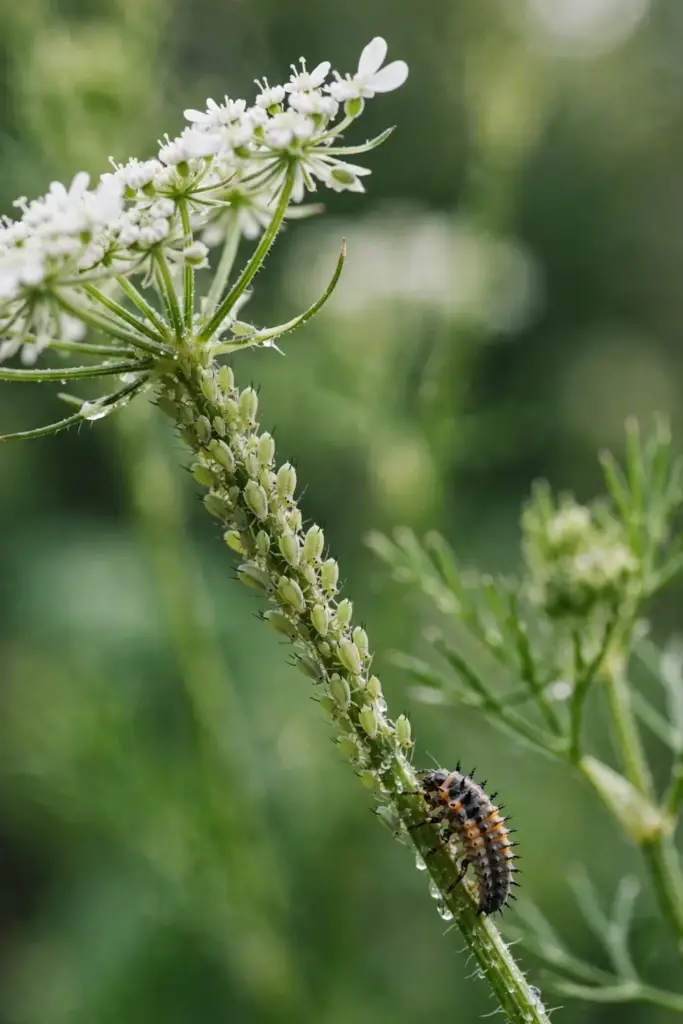
Aphids find the tender flower stalks first. They cluster on the umbels and the upper stems, sucking sap and spreading sooty mold. A strong jet of water knocks most of them off. For stubborn colonies, insecticidal soap applied in the evening works and washes off before harvest. The RHS lists aphids among the pests coriander may face (How to grow Coriander).
Powdery mildew appears as a white dusting on leaves in humid, crowded conditions. It rarely kills the plant but ruins leaf quality. Prevention is spacing, morning watering, and airflow. If mildew shows up on a leaf-lane planting, harvest what is clean and pull the rest. Do not compost heavily infected material.
Cutworms and slugs take seedlings at soil level in some gardens. A cardboard collar around young transplants, or an evening patrol with a flashlight for slugs, handles both. Leafhoppers appear in the USU Extension notes as a pest to watch in some regions.
None of this should worry you much. Healthy coriander in the right season outgrows minor damage. The best pest control for dhaniya is the right sowing date.
13. Harvest Leaves: Cut Dhaniya Patti the Right Way
Start picking when plants are about 6 inches tall. USU Extension gives this as the leaf-harvest size, and from a spring sowing you reach it roughly 6 to 8 weeks after germination, with the RHS noting harvests in as little as 10 weeks from sowing (Cilantro/Coriander in the Garden; How to grow Coriander).
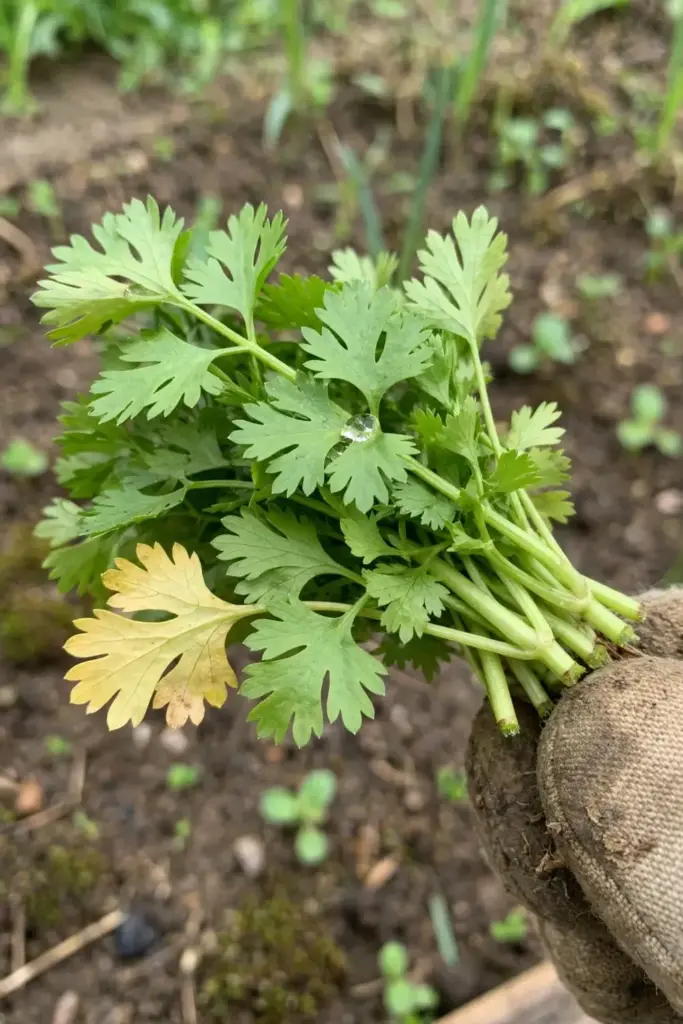
Harvest the outer leaves first, cutting stems near the base and leaving the center growing point intact. The plant keeps producing from the center for weeks. Take no more than a third of the plant at once. Hard stripping shocks it into bolting.
Morning harvest gives the best flavor. The leaves are crisp, the oils are concentrated, and the plant has the day to recover. Use the leaves the same day if you can. Cut dhaniya patti wilts fast. If you must store it, wrap the bunch loosely in a damp paper towel inside a bag in the fridge and use within 2 to 3 days.
The broad lower leaves are the prize. Once the plant starts sending up feathery, finely divided upper leaves, flowering is close. Those ferny leaves taste sharper and slightly bitter. Harvest them anyway for cooking, where heat mellows the edge, and let the plant move to the seed lane.
Never pull the plant to harvest leaves unless the bed is finished. Cut and come again. A well-managed leaf plant gives 3 to 4 pickings before it bolts.
14. Harvest Seeds: Letting Plants Make Sabut Dhania
The seed-lane plants get a different ending. Let them flower fully. The small white or pale pink umbels attract bees and hoverflies, which is a bonus for the whole garden. After pollination, green pods form where the flowers were. Those green seeds are edible with a fresh, spicy zing, and Indian cooks sometimes use them green. For sabut dhania, wait.
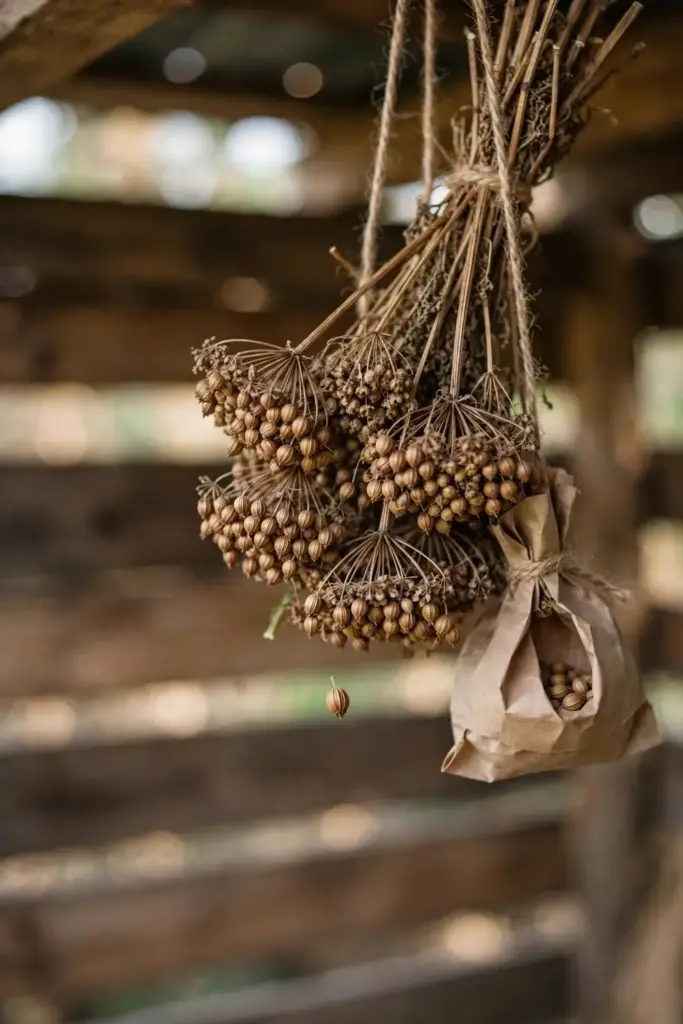
Wait until the plant turns brown and the seed heads feel dry and brittle. OSU Extension advises harvesting the seeds after they turn mostly brown (Cilantro). Cut the whole stalks with a few inches of stem, slip a paper bag over each head or lay the stalks on a sheet in a dry, airy spot out of direct sun.
Drying takes 1 to 2 weeks depending on humidity. The seeds are ready when they rattle in the pod and a rubbed head shatters easily between your fingers. Then thresh: rub the heads inside the bag or over a tray until the round seeds fall free. Winnow by pouring between two bowls in a light breeze, or pick out the chaff by hand for small batches.
Gardenary’s seed-saving walkthrough follows the same arc: let the plants go to seed, cut at the base, hang to dry until no green remains on the stems, then rub the pods off. OSU Extension’s cilantro guide covers the same steps: harvest the seeds after they turn mostly brown, cut them off with a few inches of stalk, and store them in a paper bag in a cool, dry place to finish drying (Cilantro). Home-saved seed closes the loop. Next season’s dhaniya starts from this season’s plants, already selected for your climate.
15. Dry and Store: Keep the Flavor
Seeds and leaves store differently because they are different crops. Treat them separately.
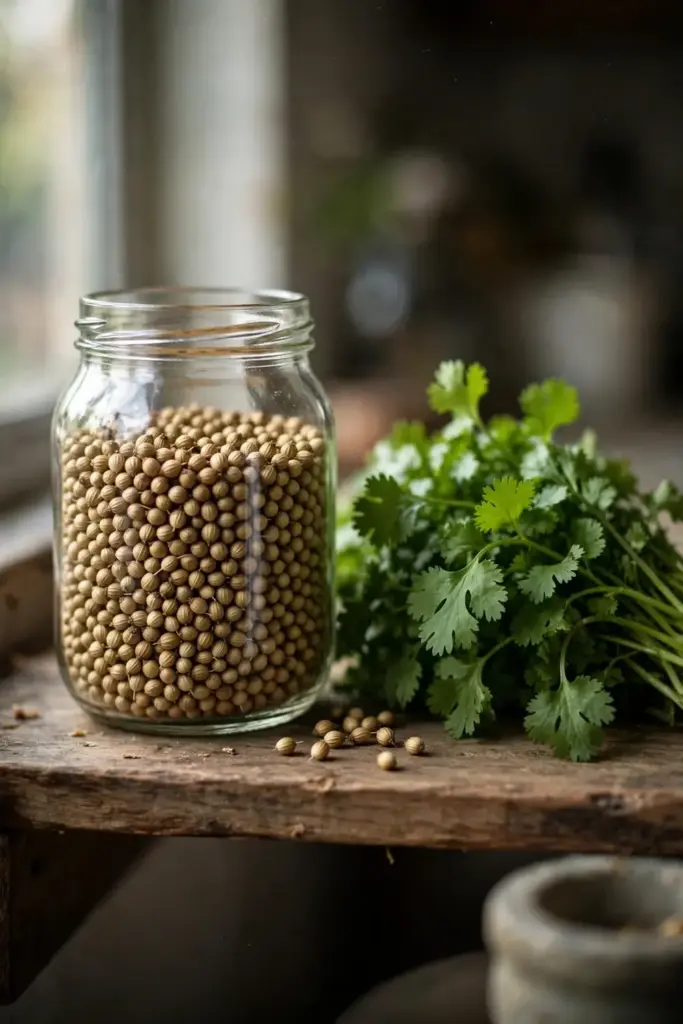
Sabut dhania stores beautifully. Make sure the seeds are completely dry before jarring, since any residual moisture grows mold in a sealed jar. The bite test works: a dry seed cracks cleanly instead of denting. Store in an airtight glass jar in a cool, dark cupboard. Whole seeds keep their aroma for a year or more. Grind only what you need. Ground dhania powder fades in weeks. OSU Extension notes that for the most flavor, you should toast or grind just before using (Cilantro).
Dhaniya patti does not dry well. Dried cilantro leaves lose most of their character, which is why the spice trade sells the seed, not the leaf. For leaves, fresh is the only real option. Short-term, the damp-towel-in-the-fridge method holds 2 to 3 days. For longer keeping, chop the leaves and freeze them in ice cube trays with a little water, then bag the cubes. Frozen dhaniya works in cooked dishes where texture does not matter.
Label everything with the date. Seed saved this year sows next year. A jar of 2-year-old seed still sprouts, but fresh seed wins.
16. In the Indian Kitchen: How the Two Harvests Get Used
This is where the dual harvest pays. Dhaniya patti and sabut dhania do different jobs in Indian cooking, and growing both means the spice box and the garnish bowl fill from the same bed.
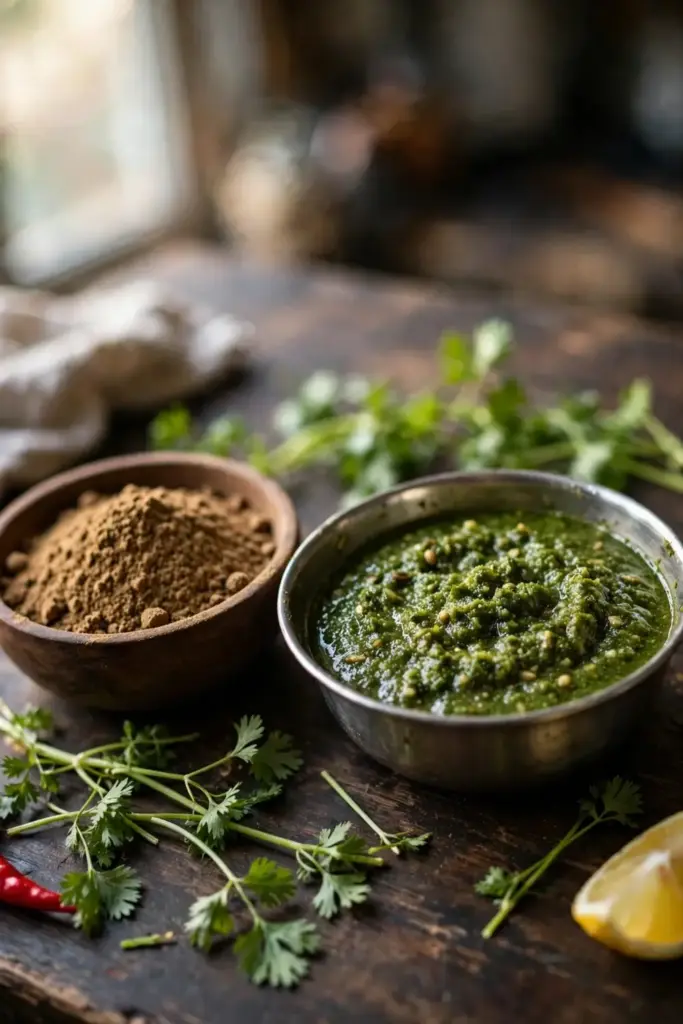
Dhaniya patti goes in fresh at the end. Chopped over dal tadka, sambar, rasam, curries, and biryani just before serving. Blended into green chutney with mint, green chili, and lemon. Stirred into raita. The rule is simple: heat destroys the fresh flavor, so it goes in last or not at all.
Sabut dhania is a foundation spice. Dry-roasted until fragrant, then ground, it becomes dhania powder, the earthy base of countless masalas. Used whole, it goes into tadka, pickles, and spice blends where the round seeds slowly release flavor into hot oil. Freshly ground from home-grown seed, it tastes noticeably brighter than pre-ground powder that has sat on a shelf.
The green seeds deserve a mention too. Chefs and home cooks who catch the pods at the green stage use them as a fresh spice with a citrusy heat. If you grow the seed lane, taste a few green pods before they dry. It is a flavor most Western gardeners never meet.
17. 7 Mistakes That Kill a Dhaniya Crop
1. Sowing once and expecting a season of leaves. One planting gives a few weeks of leaves, then bolts. The fix is succession: sow every 2 to 3 weeks through the cool seasons.
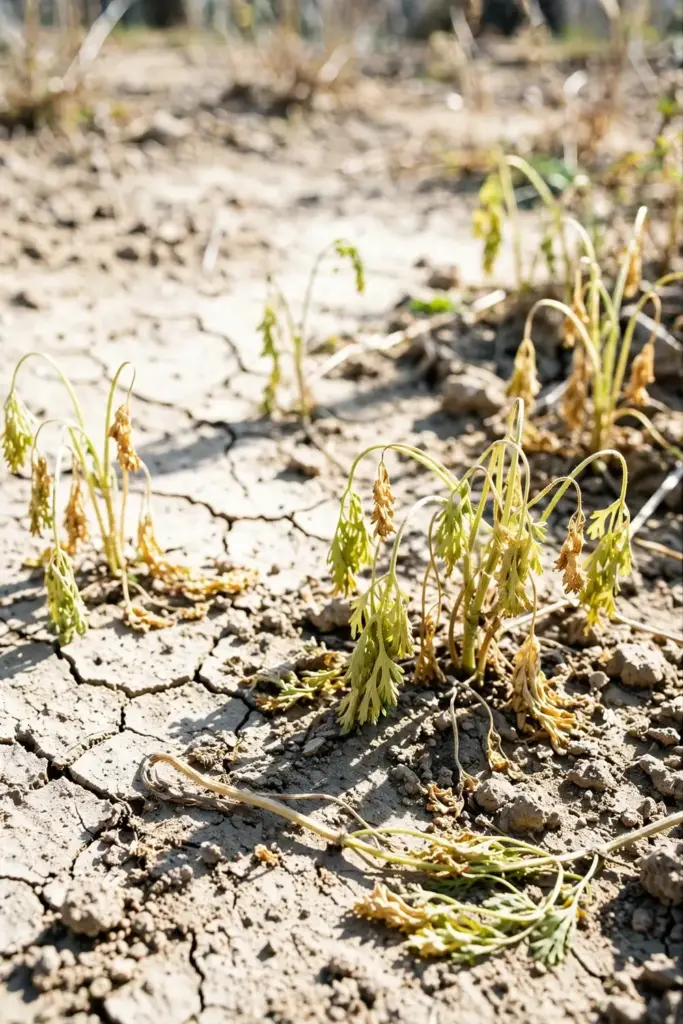
2. Transplanting seedlings. The taproot breaks, the plant panics, and it flowers within days. The fix is direct sowing, always, in the final spot.
3. Sowing in summer heat. Soil above 80 F pushes the plant straight to seed. The fix is the two-window calendar: spring and fall, with a summer pause.
4. Using old spice-jar seed. Patchy germination gets blamed on technique. The fix is fresh seed packed for sowing, with a visible pack date.
5. Sowing too deep. Seeds buried an inch deep run out of energy before emergence. The fix is 1/4 to 1/2 inch deep, no more.
6. Letting seedlings dry out. A dry seedbed stalls germination and stresses young plants into early bolting. The fix is daily gentle watering until the stand is up.
7. Harvesting leaves from seed-lane plants. Stripping a plant you meant for seed weakens it and cuts the seed yield. The fix is the lane decision at thinning: mark which plants are for leaves and which are for seed, and treat them differently from that day on.
18. Troubleshooting
Seedlings emerged patchy and uneven. Old seed or uneven moisture is the usual cause. Next sowing, use the split-and-soak prep from section 4 and keep the seedbed evenly damp. Do not sow deeper to compensate.
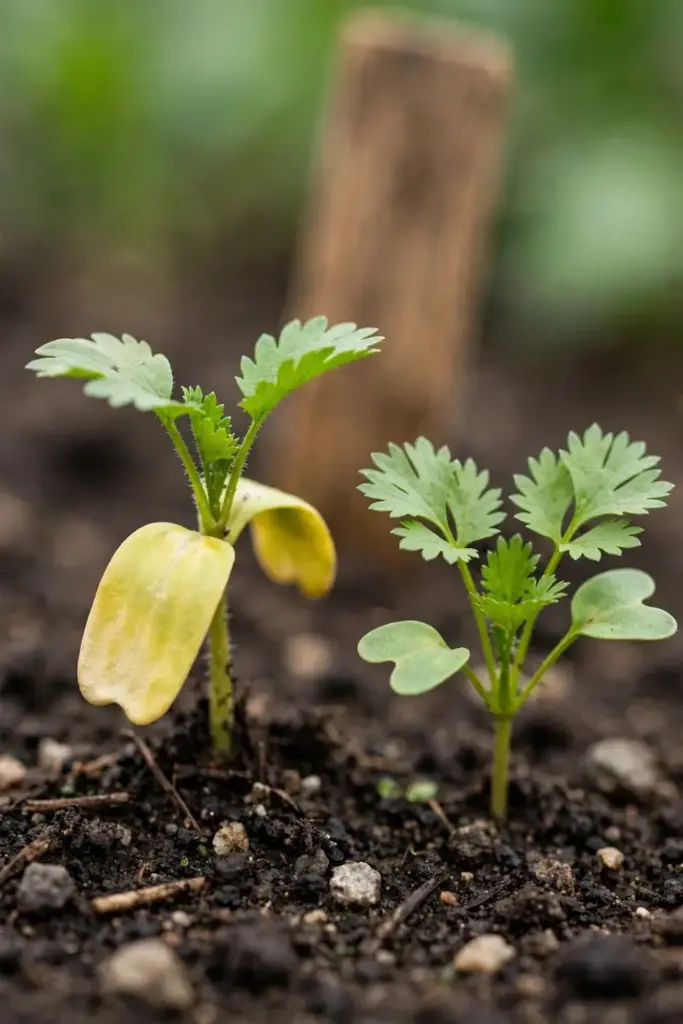
Plants bolted within weeks of sprouting. Heat, transplant shock, or drought stress. Check which one applies. If the weather turned hot, there is no rescue; pull the plants, eat what you can, and wait for the fall window. If you transplanted, switch to direct sowing.
Leaves taste bitter or soapy. Bitterness comes from heat stress and the ferny pre-flowering leaves. The soapy note is genetic; some people taste it strongly in all cilantro. Harvest younger, broader leaves in cool weather for the mildest flavor.
Seed heads molded before drying. Humidity got to them. Next time, cut earlier and dry indoors with airflow, or space seed-lane plants wider for air circulation. Discard moldy seed; do not try to save it.
Aphids coating the flower stalks. Blast with water first. If they persist, insecticidal soap in the evening, and harvest after the recommended wait on the label. Flowering plants near the end of their life can be pulled early with no real loss.
No germination at all after 3 weeks. The seed was dead or buried too deep, or the bed dried out. Test remaining seed with a damp paper towel in a bag: if nothing sprouts in 2 weeks, buy fresh seed.
Frequently Asked Questions
Sometimes, but it is a gamble. Spice-aisle seed is sold for flavor, not germination, and it may be old or heat-treated. Expect patchy emergence at best. For reliable results, buy seed packed for sowing with a visible pack date. The price difference is small and the germination difference is large.
Heat is the trigger. Above 80 F, the plant races to flower and set seed, sometimes within 4 to 6 weeks of sowing. Transplant shock, drought, and crowding speed it up. Sow in the cool windows of spring and fall, keep soil moist and mulched, and choose slow-bolting varieties like Leisure for the leaf harvest.
Yes, with enough light. A bright south-facing windowsill works in winter; a basic grow light works any time. Use a wide pot, sow every 2 to 3 weeks for succession, and keep the room cool, since warm indoor air causes bolting. Indoor plants stay smaller, so sow a little denser and harvest young.
They are the same plant, Coriandrum sativum. Dhaniya is the Hindi name, used in India for both the leaves (dhaniya patti) and the seeds (sabut dhania). Cilantro is the Spanish-derived name common in the Americas for the leaves. Same species, same plant, different culinary traditions naming different harvests.
About 1 to 3 weeks in moist soil, with warmth speeding things up. Splitting the round fruits and soaking overnight before sowing gives a faster, more even stand. If nothing has emerged after 3 weeks in warm soil, the seed was likely too old, and fresh seed is the fix.
No. Coriander is an annual. Each plant lives one season, sets seed, and dies. The Royal Horticultural Society is explicit: as an annual, plants die after setting seed. But it self-sows readily. Leave a few seed heads to shatter in the bed and volunteers appear next spring, which feels like a perennial until you look closely.
Where to Go From Here
That is how to grow coriander from India for the double harvest: dhaniya patti in the cool months, sabut dhania from the plants you let finish. Sow small and often, never transplant, and let bolting become the second crop instead of the end of the first.
One note on the rest of this site. The general cilantro and coriander guides already cover the basics well: the speedy cilantro method walks through fast leaf production, and the coriander vegetable guide covers leaves and seeds in a Western kitchen-garden frame. This article is the Indian dhaniya lane: the dual harvest, the succession system, and the rabi-season timing. Read the speedy cilantro guide for the fastest possible leaf turnaround, or the coriander vegetable guide for the general Western method, then come back here for the dhaniya system.
For the fall window, the fall herb planting calendar helps you time the late-season sowing (fall herbs to plant). Sow this week, mark the next date on the envelope, and the dhaniya never stops.