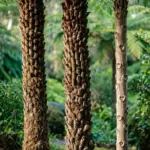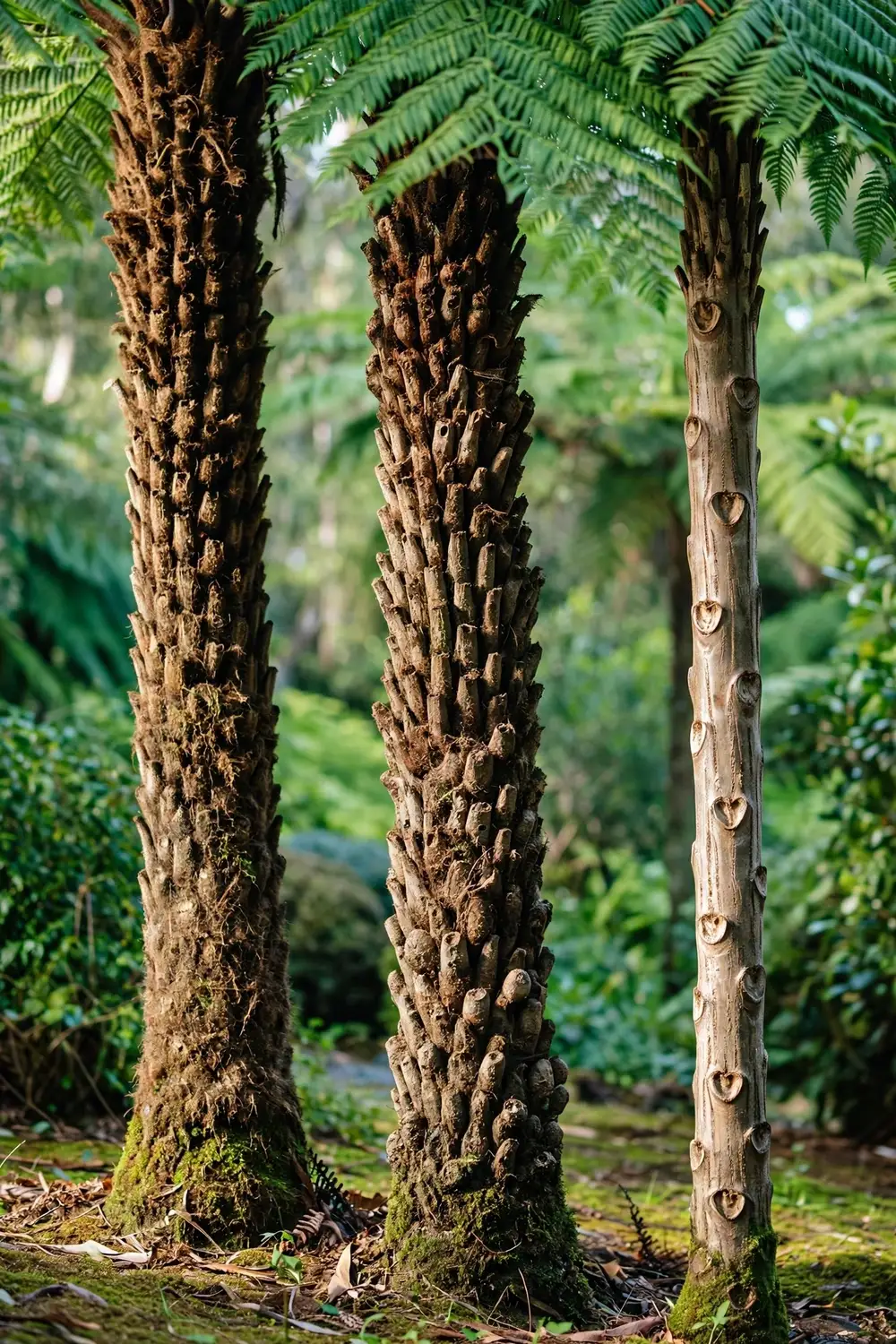

Touch the trunk. If it feels like coarse hair on one of Australia’s 4 native tree ferns, you are looking at Dicksonia antarctica, the soft tree fern. If it feels like sandpaper over knobs, that is Cyathea australis, the rough tree fern. That is tree fern identification in Australia: three native species, one trunk test, and the stipe check that confirms it.
Tree fern means Dicksonia or Cyathea, the two genera that grow a trunk in Australia. These are ancient plants, survivors from the age of dinosaurs, and they carry their history in their structure. Identification means telling them apart by trunk, stipe bases, and crown, the three features that never lie. This article covers ID only. For the general fern key covering ground ferns, staghorns, and bird’s nests, see the site’s broader fern identification guide.
The three tree ferns you will meet in Australian gardens and bushland are Dicksonia antarctica (soft tree fern), Cyathea australis (rough tree fern), and Cyathea cooperi (lacy tree fern). A fourth, Cyathea cunninghamii, appears in cool Tasmanian and Victorian gullies. All four are native to Australia, and they sit among the country’s most recognisable Australian native plants. Learn the trunk test once and you will never confuse them again. The test takes ten seconds and works in any season, on any size plant, without special tools.
1. Tree Fern Identification Starts With the Trunk
A tree fern has a trunk. A ground fern does not. This sounds obvious, but young tree ferns start trunkless, and a mature ground fern with a raised crown can fool a quick glance. The key is the vertical structure: a tree fern lifts its crown on a distinct column, while a ground fern keeps its crown at or near soil level.

Look for a vertical stem at least 30 cm tall, made of packed roots and old stipe bases, with fronds emerging from a single crown at the top. The trunk is not wood. It is a dense column of roots growing down through the decaying remains of old frond bases, which is why it feels fibrous rather than solid. Measure from the ground to the crown if you are unsure; a ruler or a hand span gives you the number. Dicksonia antarctica grows a trunk 2 to 12 m tall, according to VicFlora, the Royal Botanic Gardens Victoria flora. Cyathea australis reaches 2.5 to 20 m, with a trunk 16 to 40 cm in diameter, per PlantNET, the NSW Royal Botanic Gardens flora. A trunk under 30 cm may belong to a juvenile that has not yet developed its mature texture, so check the stipe bases as well.
If there is no trunk, you are looking at a ground fern, not a tree fern. The trunk test comes first because every other ID feature assumes it. Ground ferns spread by rhizomes at or below soil level, while tree ferns lift their crown into the air on that root-packed column. The distinction is structural, not just a matter of size.
2. Feel the Trunk: Soft, Rough, or Scarred
Run your palm up the trunk. The texture gives you the genus in seconds. Do it slowly, from waist height upward, because the lower trunk on an old plant may be weathered smooth while the upper trunk still shows its character. Press firmly enough to feel through any moss or lichen, but do not strip the surface. You are reading the structure underneath, not the garden growing on top of it. On a wet day the differences feel even sharper, as water darkens the fiber and the scales.

Dicksonia antarctica feels soft. The trunk is covered in matted, fibrous roots that hide the old stipe bases. VicFlora describes the stipe bases as persistent and crumbly, but soon hidden by matted adventitious roots, often extending into buttresses near the ground. Other plants colonise this soft trunk: seedlings, epiphytes, and mosses take hold in the fiber. In a rainforest gully you will often see a soft tree fern carrying a whole garden on its trunk, with small ferns and mosses rooted in the fiber.
Cyathea australis feels rough. The trunk carries the broken-off bases of old stipes, hard and knobbly to the touch. The Friends of Tarra-Bulga National Park field notes describe it plainly: the rough tree fern has much of its trunk covered by the remains of broken-off stems, which are rough to the touch, while the soft tree fern is soft to the touch and covered by masses of soft hairs which are actually roots. The knobs are the blunt ends of old stipes, and they stay hard for years after the frond has gone.
Cyathea cooperi feels different again. Where old fronds have broken off, the slender trunk shows clean coin-shaped scars, not a thatch of stipe bases. This coin-spot trunk is the fastest field mark for the lacy tree fern. The scars are smooth to the touch, slightly dished, and arranged in a regular spiral up the trunk.
I check the trunk before I trust the fronds, because two tree ferns can carry similar crowns while their trunks tell completely different stories. The fronds change with the seasons, dropping old growth and pushing new, but the trunk keeps its texture year-round. It is the one feature that does not depend on the plant’s current growth phase.
3. Meet Dicksonia Antarctica, the Soft Tree Fern
Dicksonia antarctica is the commonest tree fern in Victoria, growing in high-rainfall forest, shaded gullies, and near streams from sea level to the subalps, according to VicFlora. It is native to Queensland, New South Wales, Victoria, South Australia, and Tasmania. The distribution follows the wetter forests of the east coast and the island state, wherever rainfall is reliable and the canopy provides shelter. In gardens, it wants the same sheltered shade it seeks in the wild, the kind of cool garden shade that protects ferns from harsh afternoon sun.

The stipe is short and stout, dark brown, and smooth. At the base it carries hairs 2 to 3 cm long, coarse and brittle, shiny red-brown. This is the critical distinction: Dicksonia carries hairs, Cyathea carries scales. VicFlora states it directly: Dicksonia antarctica is most easily distinguished from the Cyathea species by its smooth stipe bases covered in hairs rather than scales. The hairs persist on old stipe bases even after the frond has fallen, so you can read them on the trunk as well as on living fronds.
Fronds reach up to 4 m long, narrowly oblong, dark green, with pinnae 30 to 40 cm near the middle of the frond. The fronds arch outward and slightly downward from the crown, creating the classic tree fern silhouette. The sori are numerous and conspicuous, one per lobe, with a two-valved protective structure. Each sorus is a cluster of spore capsules, visible as small dots on the frond underside.
If the trunk feels like a fiber mat and the stipe bases wear red-brown hairs, you have the soft tree fern. No other Australian tree fern combines those two traits. The combination is diagnostic: soft trunk plus hairs equals Dicksonia antarctica, with no overlap into Cyathea. No other Australian tree fern combines those two traits.
4. Meet Cyathea Australis, the Rough Tree Fern
Cyathea australis is the rough tree fern, native to Queensland, New South Wales, Victoria, Tasmania, and Norfolk Island. It grows in rainforest, open forest, gullies, and moist shady hillsides. The range is broad, from subtropical Queensland to cool Tasmania, which is why it appears in so many different garden contexts. Wherever it grows, the trunk texture stays constant.

The trunk is 2.5 to 20 m tall and 16 to 40 cm in diameter, covered at least in the upper part by the persistent bases of the stipes. The scales on the trunk and stipe bases are shiny, red-brown, stiff, often twisted, and 2 to 5 cm long, per PlantNET. The stipe itself runs to 60 cm long and bears conical spines on its dark brown base. Those spines are sharp enough to catch a glove, and they persist on the stipe long after the frond has withered.
Fronds are 2 to 3 m long, mostly three-pinnate, dark green above and paler below. The fronds emerge in a shuttlecock arrangement from the crown, arching outward under their own weight. The sori lack a true indusium, though the base of each sorus often bears a semicircular row of small scales. The spores ripen in late summer and autumn in most populations.
The rough tree fern dominates slopes while the soft tree fern prefers the moist gullies, notes the Friends of Tarra-Bulga. Habitat is a hint, never a verdict. The trunk texture decides. A rough tree fern on a dry slope and a soft tree fern in a wet gully can grow within sight of each other, and only the trunk tells them apart.
5. Meet Cyathea Cooperi, the Lacy Tree Fern
Cyathea cooperi is the lacy tree fern, also called the Australian tree fern in cultivation. It is native to Queensland and New South Wales, and widely planted in gardens across the country. Nurseries sell it as a fast-growing feature plant, which is why it appears in gardens far beyond its natural range.

The trunk is slender, markedly narrower than the rough tree fern, and the old frond bases break off cleanly to leave round coin-shaped scars. No thatch of persistent stipes, no fiber mat. The scars sit in neat rows up the trunk. On a mature plant the trunk looks almost patterned, with the pale scars standing out against the darker bark between them.
The fronds are the lacy part: bright green, finely divided, fast-growing, forming a broad spreading crown. Growth is rapid compared with the slow soft tree fern. In a garden bed, a lacy tree fern can push a full crown of new fronds in a single warm season while its neighbours add one whorl. The fronds arch gracefully outward, and the overall effect is lighter and more open than the dense crowns of the other species.
If the trunk shows coin spots and the fronds look like green lace, you have Cyathea cooperi. The slender trunk plus clean scars separates it from both the soft and rough tree ferns at a glance.
6. Meet Cyathea Cunninghamii, the Slender Gullies Fern
Cyathea cunninghamii grows in cool, sheltered gullies in Tasmania, Victoria, and New South Wales. It is the least commonly encountered of the four in gardens, but it appears in bushland where the other tree ferns grow. Look for it in the deepest, dampest gullies, where the canopy closes overhead and the air stays humid.

The trunk is slender, similar to Cyathea cooperi, but the stipe scars are oval rather than round. The crown is small and compact compared with the broad crown of the lacy tree fern. Fronds are shorter. The whole plant reads as a narrower, more upright version of its cousins, a tree fern drawn in thin lines rather than broad strokes.
Separation from Cyathea cooperi rests on the scar shape: round coin spots mean cooperi, oval scars mean cunninghamii. In practice, most garden specimens labelled as slender tree ferns are cooperi. Cunninghamii is a gully specialist that rarely reaches cultivation. If you are in a Tasmanian gully and the slender tree fern has oval scars, you may have found it.
Data on exact trunk diameters and frond lengths for cultivated cunninghamii is not available in the sources consulted. The scar-shape test is the field distinction.
7. Read the Stipe Bases: Hairs Tell, Scales Tell Louder
When the trunk is ambiguous, perhaps on a young plant or a pruned specimen, read the stipe bases where the fronds meet the crown. The crown is the growing point at the top of the trunk, where new fronds unfurl from coiled fiddleheads. The stipe bases cluster tightly here, and their covering is fresh and readable even on a plant whose trunk has not yet developed.

Dicksonia antarctica carries hairs: coarse, brittle, shiny, red-brown, 2 to 3 cm long at the stipe base. Run a finger along them. They feel like stiff bristles. The hairs point outward from the stipe, and they catch the light with a reddish sheen.
Cyathea australis carries scales: shiny, red-brown, stiff, often twisted, 2 to 5 cm long, with small pale fragile edges. The stipe base also bears conical spines. The scales feel flat and papery compared with the bristly hairs of Dicksonia. On an old plant the scales may weather to a gray-brown, but the twisted shape remains readable.
This hairs-versus-scales test is the single most reliable genus distinction, and it works even when the trunk is too young to show its mature texture. VicFlora and PlantNET both foreground it in their descriptions because it holds across the full range of each species. Botanists use it for the same reason: it is a structural difference, not a matter of degree.
Memorise it as a pair: hairs mean Dicksonia, scales mean Cyathea. Say it out loud once while touching a stipe base and you will not forget it. The pair works because it reduces a complex botanical distinction to a single tactile test that anyone can perform.
8. Read the Crown: Frond Length, Color, and Habit
The crown confirms what the trunk and stipes suggest. Read it last, not first, because crowns are the most variable part of the plant.

Dicksonia antarctica carries fronds up to 4 m long, dark green, comparatively narrow, with a dense crown. Although trunks usually bear a single crown, some plants grow six or more crowns per trunk, noted in the Taggerty-Alexandra area of Victoria. A multi-crowned soft tree fern looks like a fountain of fronds from every angle.
Cyathea australis carries fronds 2 to 3 m long, dark green above and paler below, in a broad arching crown. The crown looks open and spreading compared with the dense head of the soft tree fern. Individual fronds arch outward and the gaps between them let light through.
Cyathea cooperi carries bright green, lacy, fast-growing fronds in a wide crown that can look almost tropical. The color reads a full shade lighter than the dark green of the other two. In a garden the lacy crown often looks fresher than its neighbours because it replaces fronds faster.
Crown alone never identifies a tree fern. Frond length varies with age, shade, and water. A young plant in deep shade grows shorter fronds than a mature plant in dappled light, even within the same species. Use the crown as confirmation after the trunk and stipe tests have done the real work. The crown tells you the plant is healthy and growing well; the trunk and stipes tell you its name.
9. The Master Tree Fern ID Table
Use this table in the field. Start with the trunk row, which gives you the fastest answer. If the trunk is ambiguous, move to the stipe row. The frond and sori rows confirm a tentative ID but rarely decide one on their own. The habitat hint is the weakest row; it suggests where to look, not what you have found.

| Feature | Dicksonia antarctica (Soft) | Cyathea australis (Rough) | Cyathea cooperi (Lacy) |
|---|---|---|---|
| Trunk texture | Soft, fibrous, matted roots | Rough, knobbly stipe bases | Slender, clean coin-spot scars |
| Stipe base covering | Hairs, 2-3 cm, red-brown, bristly | Scales, 2-5 cm, red-brown, twisted | Data not available |
| Trunk height | 2-12 m | 2.5-20 m | Data not available |
| Trunk diameter | Thick, buttressed at base | 16-40 cm | Slender |
| Frond length | Up to 4 m | 2-3 m | Fast-growing, lacy |
| Frond color | Dark green | Dark green above, paler below | Bright green |
| Sori | Conspicuous, one per lobe, 2-valved | No true indusium, small scales at base | Data not available |
| Habitat hint | Moist gullies, high rainfall | Slopes as well as gullies | Gardens, warm sheltered spots |
Work the table left to right: trunk first, stipe second, fronds third. Any single column that matches on trunk and stipe is enough. The frond row only breaks ties. Print it or save it to your phone before a bush walk, because the table works best when the plant is in front of you and you can check each feature in order.
10. Rule Out the Cycad: Spores Versus Cones
A cycad can look like a tree fern at a glance: a trunk, a crown of large divided fronds, a tropical silhouette. The difference is absolute, and it sits in the reproductive structures.

Tree ferns reproduce by spores. Look under a fertile frond for sori, the small round clusters of spore capsules. Dicksonia antarctica carries numerous conspicuous sori, one per lobe. Cyathea australis bears sori without a true indusium. No flowers, no seeds, no cones, ever. The sori are small but visible to the naked eye on a mature fertile frond. Turn a frond over gently and look for the rows of dots along the midveins. Their presence confirms you are looking at a true fern, not a cycad or another lookalike.
Cycads reproduce by cones. A cycad crown carries either a large seed cone or a pollen cone, never sori. The seed cones are often massive, pineapple-shaped structures that sit in the center of the crown. The pollen cones are narrower and more cylindrical. The fronds are stiff and leathery compared with the soft divided fronds of a tree fern, and they do not wilt or droop the way fern fronds do. The trunk shows a regular diamond pattern of old leaf bases rather than stipe thatch or fiber. Each diamond marks where a frond once attached, and the pattern is geometric and repeating, unlike the irregular texture of a tree fern trunk. The leaflets of a cycad are thick and rigid; the pinnules of a tree fern are thin and flexible. Bend a leaflet gently and you will feel the difference immediately.
Spores mean tree fern. Cones mean cycad. One look under the frond settles it. Carry a hand lens if you want to see the sori clearly, though the naked eye is enough on a mature fertile frond. The sori sit in neat rows along the pinnule midveins, and their presence confirms you are looking at a true fern.
Frequently Asked Questions

Feel the trunk. Dicksonia antarctica, the soft tree fern, has a trunk covered in soft matted fibrous roots like coarse hair. Cyathea australis, the rough tree fern, has a trunk of hard broken-off stipe bases, rough and knobbly. Confirm with the stipe test: Dicksonia carries red-brown hairs 2 to 3 cm long, Cyathea carries shiny twisted scales 2 to 5 cm long.
Yes. Dicksonia antarctica grows in Queensland, New South Wales, Victoria, South Australia, and Tasmania. Cyathea australis grows in Queensland, New South Wales, Victoria, Tasmania, and Norfolk Island. Cyathea cooperi is native to Queensland and New South Wales. Cyathea cunninghamii is native to Tasmania, Victoria, and New South Wales. None of the four is introduced.
Hairs are bristle-like and stand out. On Dicksonia antarctica they are coarse, brittle, shiny red-brown, 2 to 3 cm long. Scales are flat and papery, lying against the surface. On Cyathea australis they are shiny red-brown, stiff, often twisted, 2 to 5 cm long, with pale fragile edges. Hairs feel bristly, scales feel layered. Hairs mean Dicksonia, scales mean Cyathea.
Yes, using the stipe test. Even on a trunkless juvenile, the stipe bases carry the genus mark: hairs for Dicksonia, scales for Cyathea. The trunk texture develops with age, but the stipe covering is present from the first fronds. Do not rely on frond size or crown shape on a young plant. Wait for the stipe character, which never lies.
No. Tree ferns reproduce by spores and never produce flowers. The spore clusters, called sori, sit under fertile fronds. Dicksonia antarctica has conspicuous sori with a two-valved structure, one per lobe. Cyathea australis has sori without a true indusium. If the plant carries cones or flowers, it is not a tree fern. Check for a cycad instead.
Write the Name Down Before You Walk Away
Name it in the field, not from memory later. Touch the trunk, read the stipe bases, and check the crown against the table while the plant is in front of you. Memory blurs the difference between rough and soft by the time you reach the car. A notebook entry made with the trunk under your hand stays accurate. Write the date and the location too, because a tree fern seen in a gully in Tasmania and one seen in a Sydney garden may be different species even when they look similar.

Soft fiber and red-brown hairs mean Dicksonia antarctica. Rough knobs and twisted scales mean Cyathea australis. Coin-spot scars and lacy bright fronds mean Cyathea cooperi. Oval scars on a slender trunk in a cool gully mean Cyathea cunninghamii, though you will meet it rarely. Each ID rests on two independent features, trunk and stipe, so a single ambiguous trait never decides alone.
Three natives, one trunk test, and the hairs-versus-scales rule that never fails. That is tree fern identification in Australia. The method fits in your pocket: feel, look, confirm. No specialist equipment, no laboratory, just your hands and your eyes and the willingness to touch the trunk. Practice on garden specimens first, where nursery labels give you the correct botanical answer, before testing yourself on wild plants in the Australian bush.