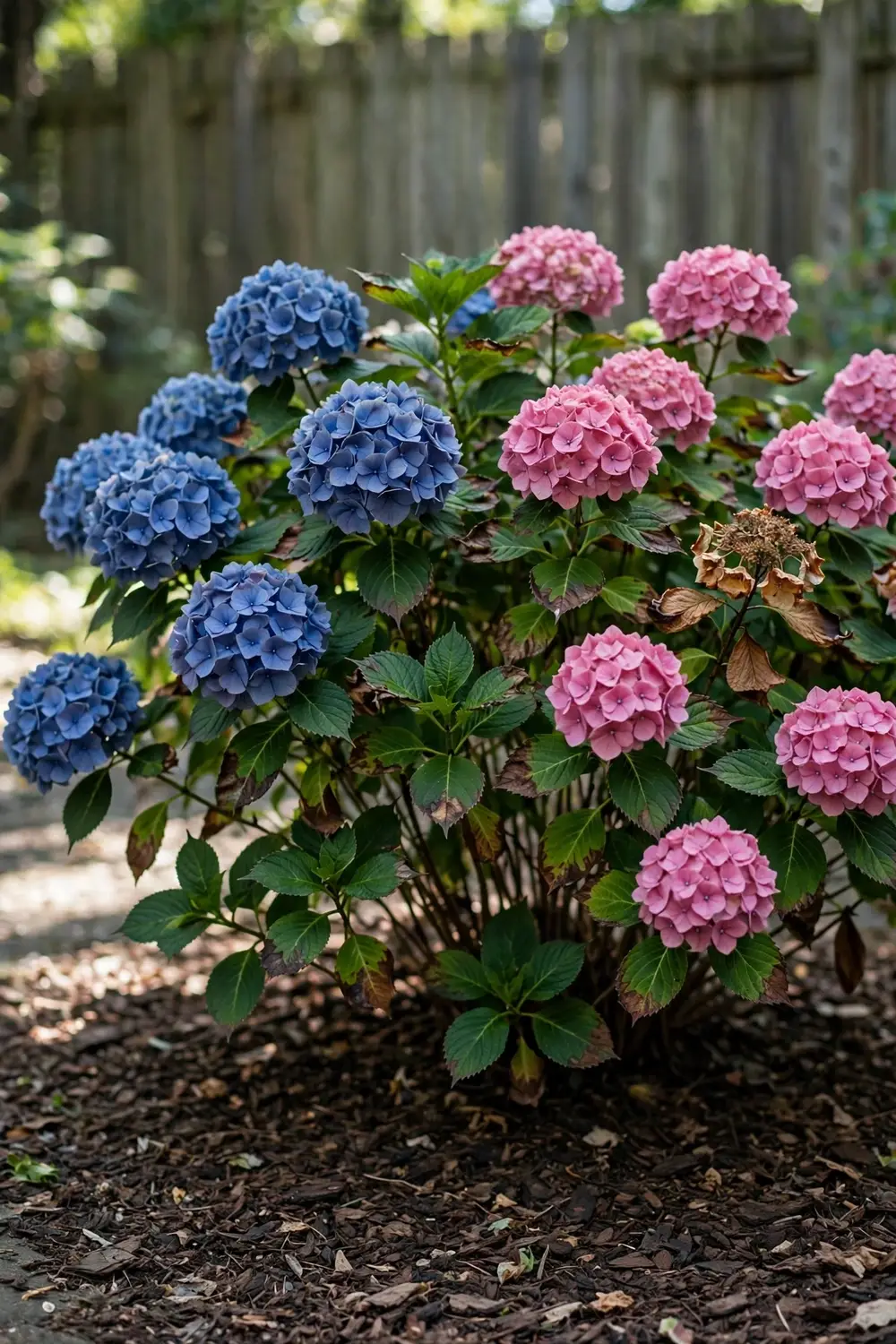

Test the soil pH first, then treat. That is how to change hydrangea color in Australia: shift the pH, and the blooms follow. A bigleaf hydrangea turns blue below pH 5.5 and pink above pH 6.5, because pH controls how much aluminium the roots can take up.
Aluminium in the flower tissue causes the blue coloration. Acid soil frees aluminium for uptake. Alkaline soil locks it away. The gardener changes the soil, and the plant changes the bloom.
Growing a healthy hydrangea is a different job, and that lives on the site’s blooming elegance guide to growing hydrangeas. This page stays on color change: which plants respond, what to add, when to add it, and what to skip. I have learned that the hydrangea I test before I treat outcolors the hydrangea I dose on a guess.
1. Check Your Hydrangea Can Change Color Before You Spend a Cent
Only bigleaf hydrangea and mountain hydrangea change color in a controlled way. Bigleaf hydrangea is Hydrangea macrophylla, the mophead and lacecap forms. Mountain hydrangea is Hydrangea serrata, a smaller shrub with smaller leaves and flowers. Both respond to soil pH and aluminium.
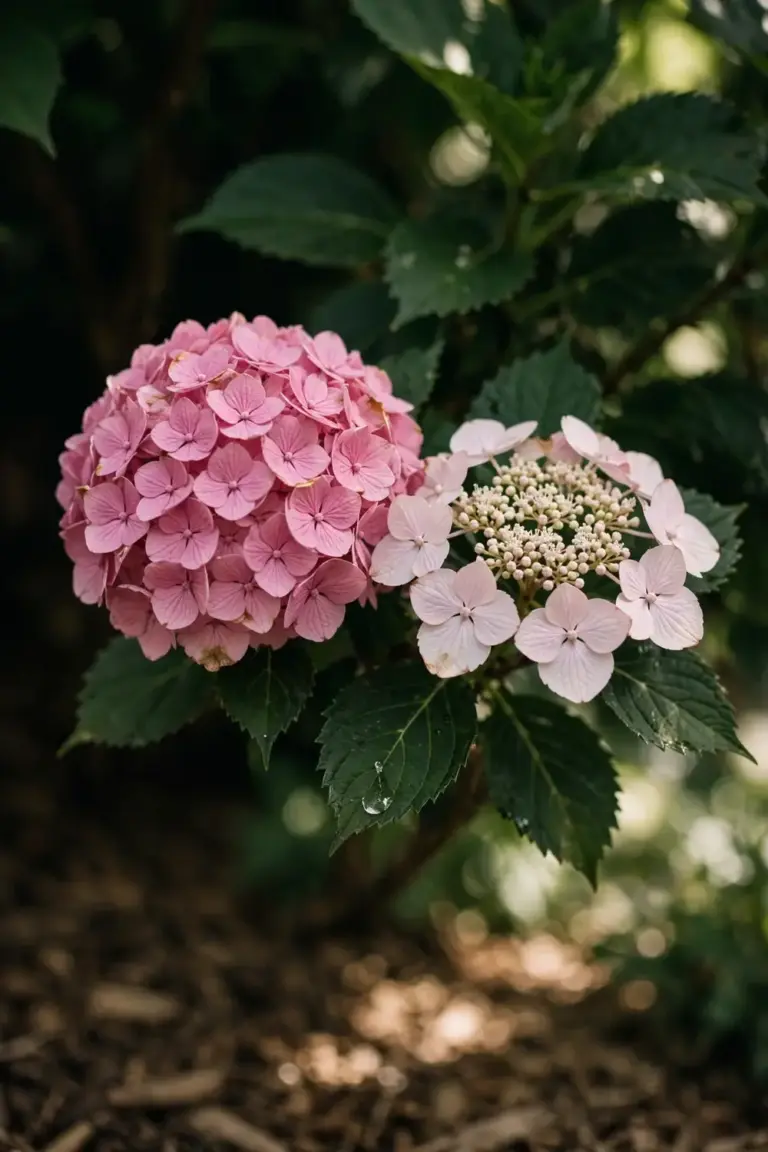
Mophead and lacecap are two flower forms of the same species. A mophead carries a large ball-shaped head of sterile flowers, like a pom-pom. A lacecap carries a flat round head with fertile flowers in the center and a ring of sterile flowers around the edge. Both forms change color. The flower form decides the look. The soil decides the color.
Bigleaf hydrangeas grow 0.9 to 1.8 m tall and about as wide. Mountain hydrangeas stay smaller at 0.9 to 1.5 m, with a rounded habit. Size decides placement. Soil pH decides color.
Panicle, oakleaf, smooth, and climbing hydrangeas do not change color through soil pH. A panicle hydrangea opens white and ages pink on its own schedule. An oakleaf hydrangea turns pinkish as its white panicles age. No soil treatment redirects either one.
White-flowered cultivars stay white. White blooms carry no pigment for aluminium to shift. A white-flowered cultivar may sport a pink or blue eye, but the bloom stays white. Some cultivars lean one way no matter the soil: a cultivar bred blue stays blue, and a cultivar bred pink stays pink.
Name the plant before you buy a single amendment. A mophead or lacecap bigleaf hydrangea earns the treatment. Any other type earns a different plan.
Check the label at the nursery before you buy, because the label names the species and the species decides everything. A label that reads Hydrangea macrophylla names a plant that responds. A label that reads Hydrangea paniculata or Hydrangea quercifolia names a plant that does not. A label that names only “hydrangea” tells the gardener nothing. Ask for the species.
2. Learn the Aluminium Rule That Decides Blue or Pink
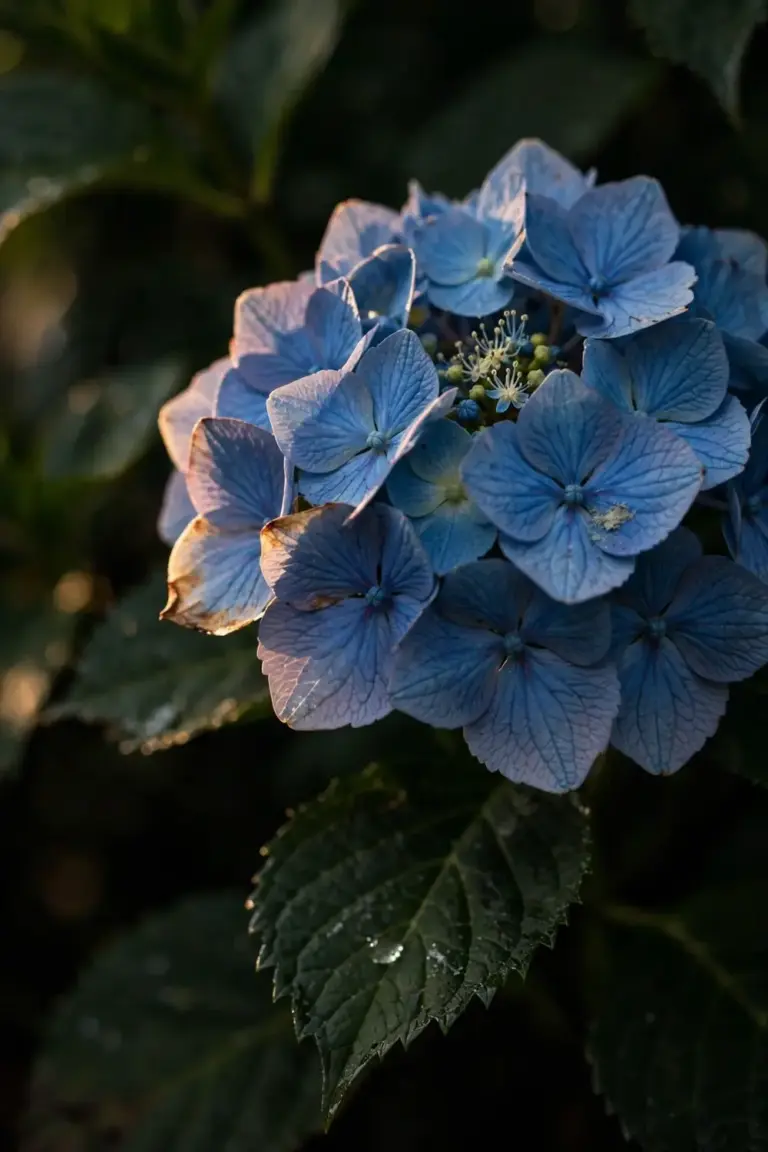
Soil pH decides color because soil pH decides aluminium availability. Most soils hold enough aluminium. The aluminium stays out of reach when soil pH runs high. Acid soil frees it. The roots take it up. The flower tissue turns blue.
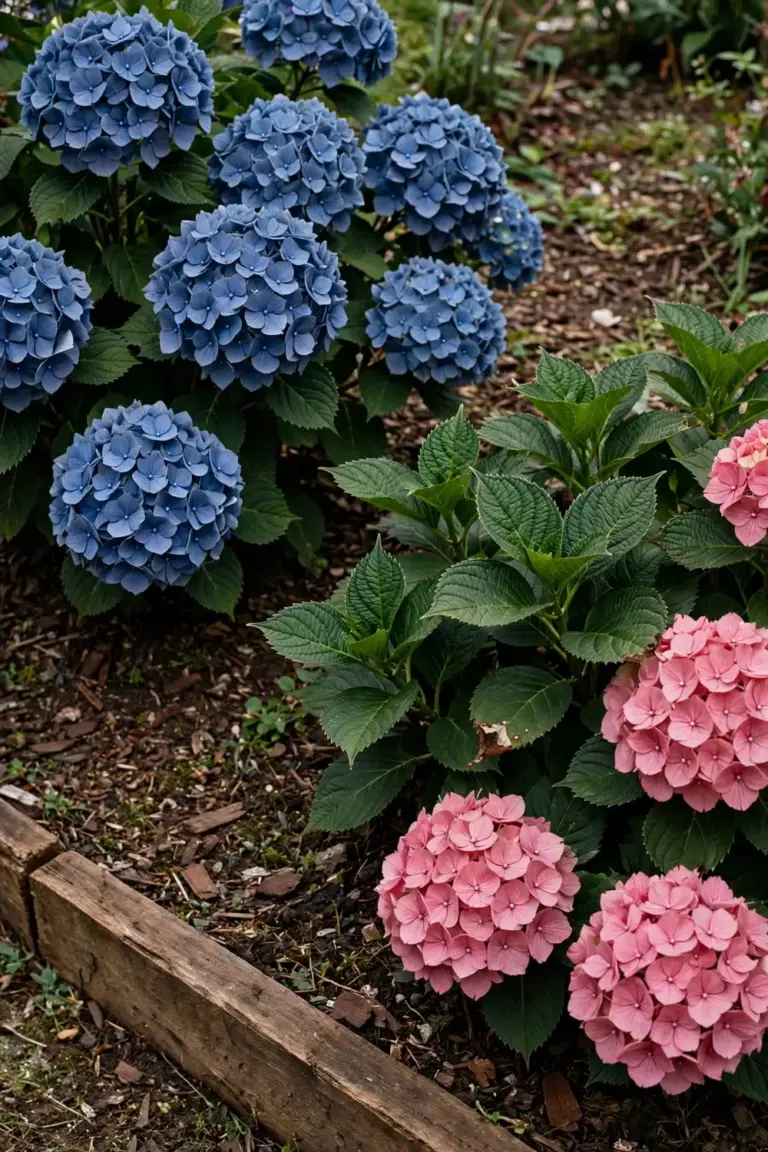
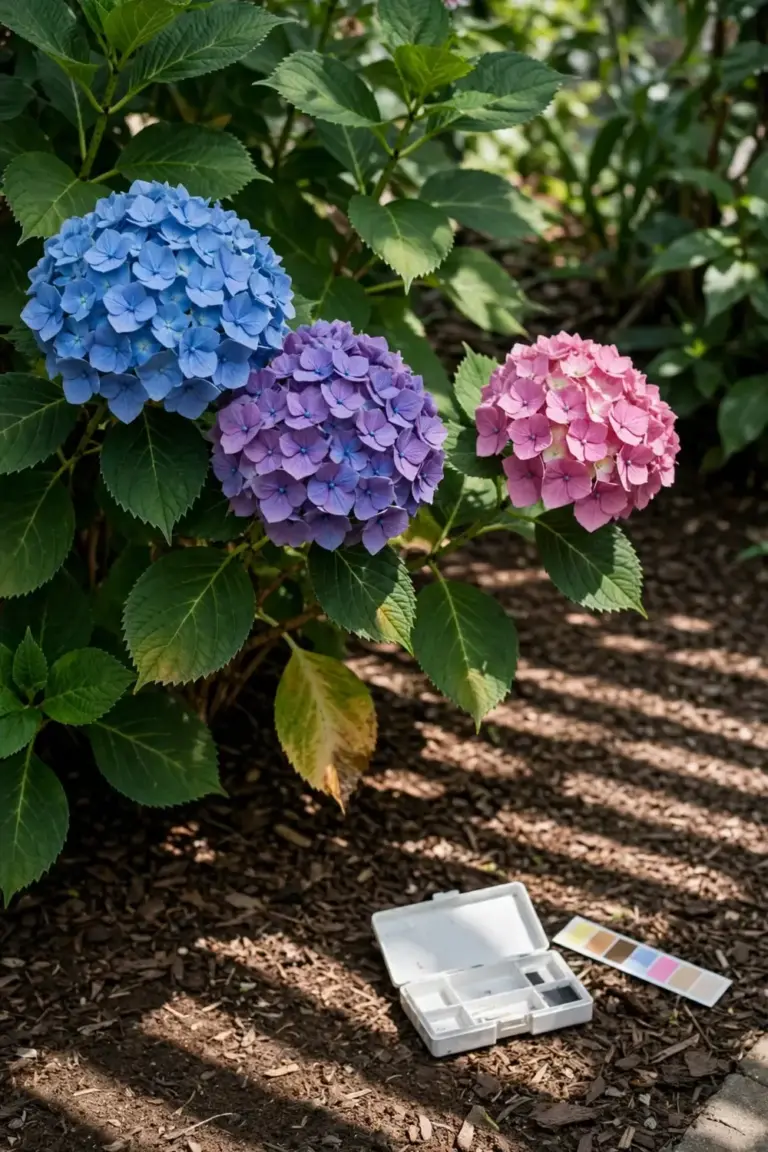
Blue blooms form in acidic soil below pH 5.5. Pink blooms form in neutral to alkaline soil above pH 6.5. Between pH 5.5 and pH 6.5, blooms turn purple, or a single plant carries a mix of blue and pink. UMass Extension states the bands this way. One American extension source states the bands tighter, with blue at pH 5 to 5.5 and pink at pH 6 to 6.5, in its Mississippi hydrangea guide. The mechanism matches either way: lower pH frees aluminium, higher pH locks it away.
Purple is the middle state, not a failure. A plant sitting between the two bands shows purple blooms, or blue and pink on the same shrub. A gardener who wants a clean blue or a clean pink pushes past the middle band. A gardener who likes purple holds the middle band and stops there. Both are valid targets. The soil decides which one appears.
| Target Color | Soil pH | Aluminium Availability |
|---|---|---|
| Blue | Below 5.5 | Available |
| Purple or mixed | 5.5 to 6.5 | Partly available |
| Pink | Above 6.5 | Locked away |
Phosphorus complicates the picture. Phosphorus ties up aluminium in the soil, which makes it unavailable for root uptake and leads to pink flowers. A fertilizer low in phosphorus supports blue. A fertilizer higher in phosphorus supports pink. The middle number on the bag shows the phosphorus content.
Color change is chemistry, not paint. The gardener sets the pH, the soil sets the aluminium supply, and the plant sets the bloom.
3. Test Your Soil pH Before You Add Anything
Test first. Treat second. The exact amount of lime or aluminium sulphate a soil needs varies with the current soil pH and the soil type. A dose that shifts a sandy loam barely dents a heavy clay. A dose that suits one bed overshoots another.
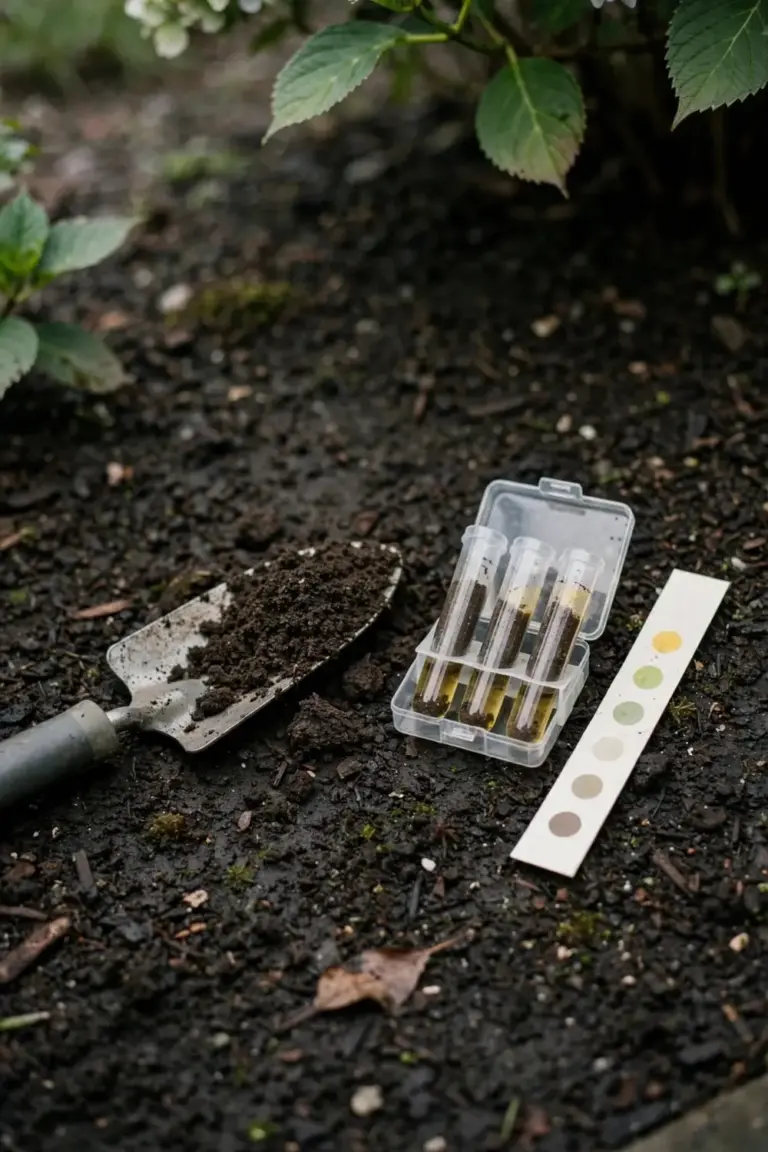
A home pH test kit gives a reading in minutes and costs little. A lab soil test gives a fuller picture with amendment rates matched to the result. Either one beats guessing. Guessing produces two common failures: a dose too small to move the pH, or a dose too large that stresses the plant.
Sample the soil the way the test asks. Take small samples from several spots around the plant, not one scoop from the surface. Mix them. Test the mix. One scoop from one spot reads one pocket of soil. A mixed sample reads the bed the roots actually use.
Read the number against the neutral point. A pH below 7 reads acidic, a pH above 7 reads alkaline, and a pH of 7 reads neutral. The hydrangea bands sit on the acidic side of neutral: blue below 5.5, purple between 5.5 and 6.5, pink above 6.5. A reading of 7.5 means the soil needs a large shift for blue. A reading of 6.8 means pink needs only a small push.
Test pots and beds separately. Potting mix starts near neutral and drifts with watering and feeding. Garden soil starts wherever the local geology put it and drifts slower. One test never covers both. Test each pot on its own, and test each bed on its own.
Retest after treatment. Soil drifts back toward its natural pH over time, so one reading never settles the question for good. Test each autumn before the amendment round, and test again in spring before the drench round. Write the numbers down. A notebook with two readings a year shows the drift before the blooms do.
Healthy soil makes every amendment work better. The site’s soil health guide covers the structure, organic matter, and biology that hold pH steady. A soil rich in organic matter buffers pH swings and keeps the color change in place longer.
4. Turn Pink Hydrangeas Blue With Aluminium Sulphate
Dissolve 1 tablespoon of aluminium sulphate in 3.8 L of water. Drench the soil around the plant with the mix in September, October, and November, keeping the mix off the leaves. Do not increase the amount, because aluminium in high doses harms hydrangea plants.
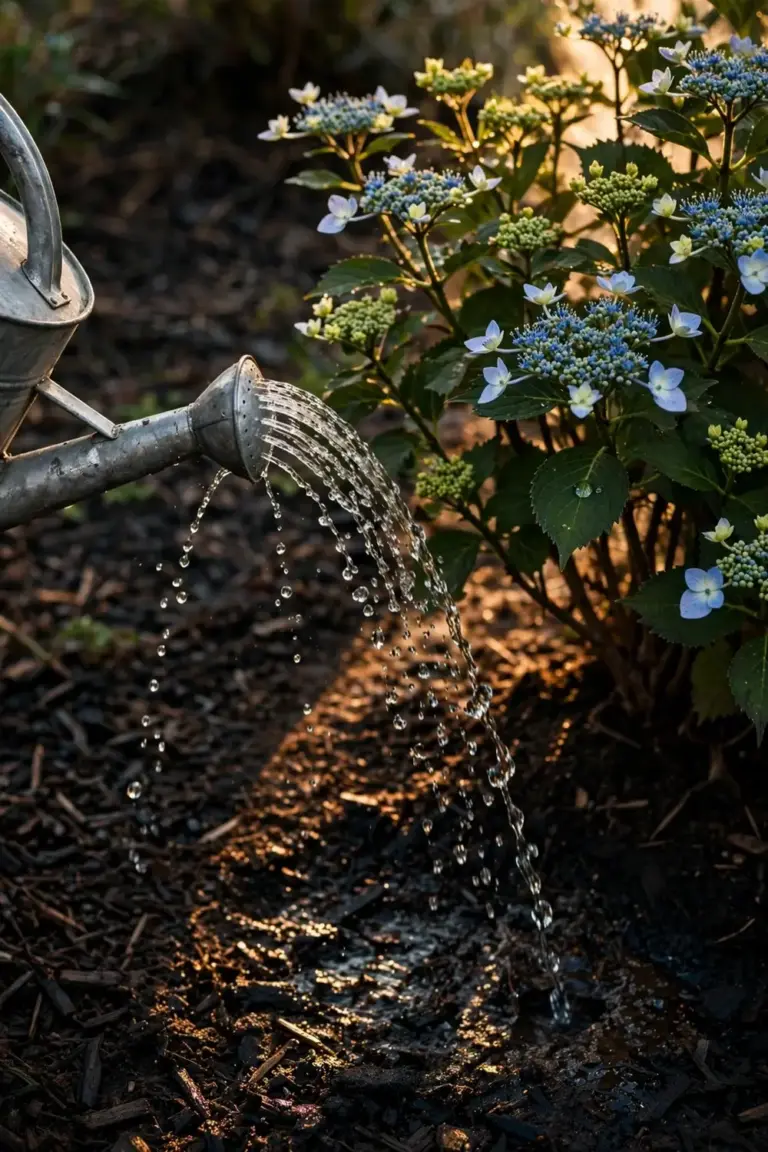
The spring drench works fast because it hits the roots as buds form. Water the plant well before the drench. A dry root zone takes up a concentrated dose and burns. A moist root zone takes up the dose evenly. Apply the drench in the cool of the morning, then water again lightly to wash any splash off the foliage.
For a slower, longer shift, apply sulfur in autumn. Spread 1/2 cup of sulfur per 0.93 m² around the plant in autumn and let soil microbes work on it through winter. Sulfur lowers pH gradually. The spring drench then tops up the shift as buds form. Sulfur needs warmth and microbial activity to convert, so an autumn application spends winter working and arrives ready for spring growth.
Feed for blue with a fertilizer low in phosphorus. One extension source recommends a 12-4-8 formulation for blue cultivars of bigleaf and mountain hydrangea. The low middle number keeps phosphorus from tying up the aluminium the plant needs. Skip superphosphate and bone meal while chasing blue. Both load phosphorus into the soil and push the blooms pink.
Repeat the treatment every year. Soil reverts to its natural pH. Blue is a maintained state, not a one-off fix.
5. Turn Blue Hydrangeas Pink With Garden Lime
Dissolve 1 tablespoon of hydrated lime in 3.8 L of water. Drench the soil around the plant with the mix in September, October, and November, keeping the mix off the leaves. Do not increase the amount, because lime in excess pushes pH past the target and starves the plant of iron.
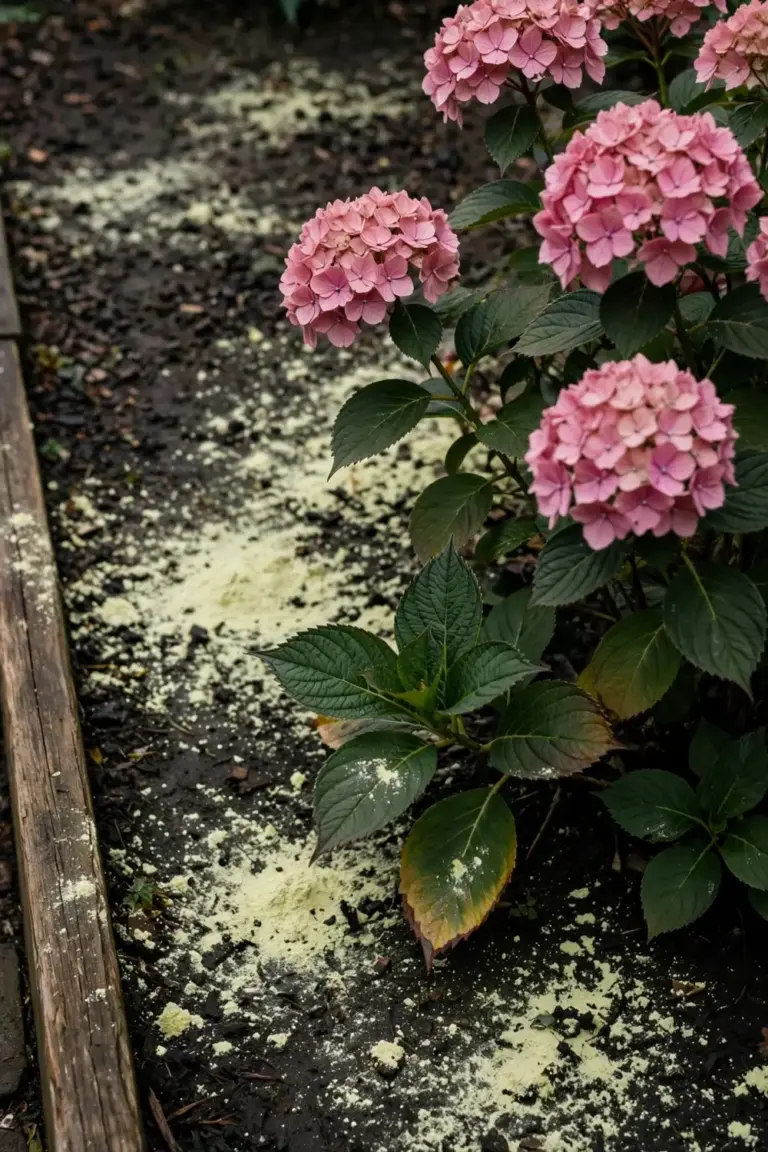
For a slower, longer shift, apply dolomitic lime in autumn. Spread 1 cup of dolomitic lime per 0.93 m² around the plant in autumn. Dolomitic lime raises pH and adds magnesium. Garden lime does the same job without the magnesium. Either one works for pink. Dolomitic lime suits a soil short on magnesium. Garden lime suits a soil already carrying enough.
Too much lime yellows new growth. The yellowing comes from iron shortage, because high pH locks iron away from the roots. A plant with yellow new leaves and green veins tells the gardener the lime went too far. Stop. Retest. Let the soil settle before the next dose.
Feed for pink with a fertilizer higher in phosphorus. Phosphorus ties up aluminium, which is exactly what pink needs. The same mechanism that blocks blue builds pink. A balanced fertilizer with a solid middle number suits pink better than a low-phosphorus acid-lover formula.
Pink holds easier than blue in most Australian soils. Alkaline soil is the default in many districts, so pink often needs less maintenance than blue.
6. Time Every Treatment to the Australian Season
American sources give northern hemisphere months. Translate them before use. A March, April, and May drench in American guides becomes a September, October, and November drench in Australia. A fall amendment in American guides becomes an autumn amendment in March, April, and May in Australia. The season matters. The calendar month does not.
| Northern Hemisphere Guide | Australian Equivalent |
|---|---|
| March, April, May drench | September, October, November drench |
| Fall amendment | Autumn amendment, March to May |
| Spring feeding | Spring feeding, September to November |
| Winter dormancy | Winter dormancy, June to August |
Autumn is the season to adjust soil pH. Apply the granular amendment, lime or sulfur, in autumn and let it work through winter. Apply the liquid drench in spring as buds form. The two rounds work as a pair: autumn sets the pH, spring tops it up.
Expect months, not days. The effect takes months and needs maintaining, because soil reverts. A treatment applied this autumn shows in next summer’s blooms. A treatment applied in spring may shift late blooms in the same season, but the full change arrives the following year.
Existing blooms do not change color. A bloom that opened pink stays pink. The treatment reaches the blooms that form after it. Patience is part of the method. A gardener who treats in autumn and watches the next summer’s flowers sees the result.
A missed autumn round is not a lost year. The spring drench still shifts the coming blooms, though the change runs lighter than a full autumn-plus-spring program. Treat in spring, then run the full autumn round the next year. The color catches up on the second season.
A gardener who buys a plant already in flower starts next autumn. The blooms on the plant already carry the nursery’s soil pH. No drench recolors them. Enjoy the flowers as they are, test the garden soil while they bloom, and run the first amendment round in autumn. The following summer shows the gardener’s own color.
7. Hold the Color in Pots With a Controlled Mix
Pots give far more reliable control than a garden bed. A pot holds a fixed volume of mix. A bed holds a whole soil profile with its own pH, drainage, and aluminium supply. Holding a bed at a target pH is an ongoing project. Holding a pot at a target pH is a manageable routine.
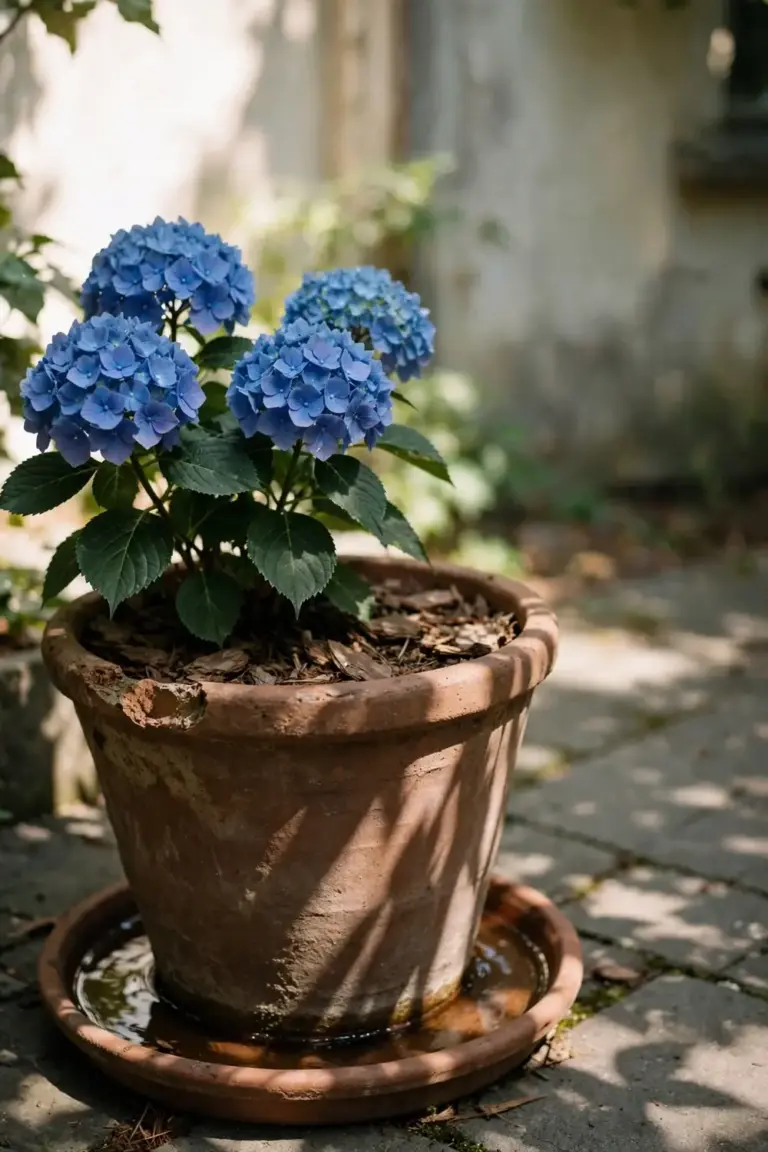
Use pots 40 cm or wider. A wide pot holds enough mix to buffer pH swings and enough water to carry the plant through a hot afternoon. A small pot dries fast and swings pH fast. Both failures show in the blooms.
Fill the pot with a premium potting mix, then treat the mix the same way as garden soil. Aluminium sulphate drives the mix toward blue. Garden lime drives it toward pink. Test the mix pH before each treatment round, the same as garden soil. A pot still reverts, but it reverts slower and the gardener sees the drift sooner.
Repot when the plant outgrows the pot. A root-bound hydrangea dries fast and drinks unevenly, which stalls the color shift. Move up one pot size, keep the same mix recipe, and retest pH after the move. Fresh mix reads close to neutral until the gardener treats it.
Mulch the pot surface. A layer of mulch 5.1 to 7.6 cm deep keeps the shallow roots cool and cuts summer watering. Pine bark mulch or peat suits a blue pot, because both nudge pH downward. The site’s what is mulching guide covers mulch depth and materials in full.
Water pots often. Potted hydrangeas dry faster than garden plants, so expect to water daily in summer. A pot that dries out between waterings stresses the plant and stalls the color shift. Empty the saucer after watering so the roots never sit in standing water.
8. Read the Australian Map Before You Fight Your Soil
Hydrangeas grow best where summers stay cool and moist. The Australian map splits into easy country and hard country. Match the effort to the location before fighting the soil.
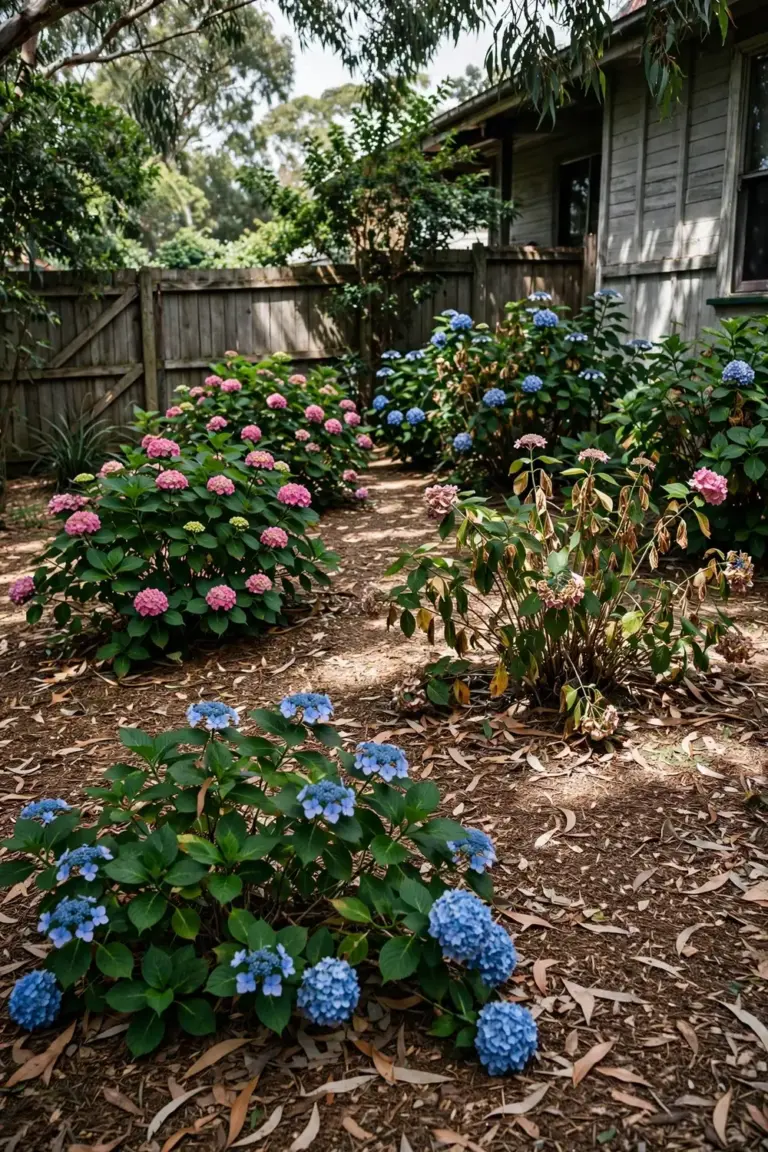
| Australian Location | How Hydrangeas Perform |
|---|---|
| Melbourne, Adelaide Hills, Tasmania | Ideal. Cool moist conditions suit them closely |
| Sydney and the Blue Mountains | Excellent in shaded sheltered positions |
| Canberra | Good, with protection from hard frost on new growth |
| Brisbane and southeast Queensland | Workable in deep shade with reliable water. Heat is the limit |
| Perth | Difficult. Dry heat and alkaline sand both work against them |
| Tropical north | Not suited |
Perth and coastal Adelaide carry naturally alkaline limestone sands. Those sands push hydrangeas pink by default. Getting blue there is an ongoing project rather than a one-off treatment. A Perth gardener chasing blue fights the whole soil profile. A pot removes that fight.
Morning sun with full afternoon shade is the target everywhere. In Brisbane or Perth, shade covers most of the day. Flower production improves with about 5 hours of direct sunlight, and bigleaf hydrangeas suffer in hot, dry, exposed sites. Shade and water decide whether the plant thrives. Soil pH decides only the color.
Frost shapes the Canberra row of the table. Established hydrangeas handle frost well because they stand dormant and leafless through winter. Late spring frosts burn new shoots, so a Canberra gardener avoids frost hollows and covers young plants when a late frost threatens. The color treatment waits until the frost risk passes. A frost-burned bud produces no bloom in any color.
9. Skip the Myths That Waste a Season
Pennies, coffee grounds, and nails will not change the color of hydrangea flowers. A breeder guide states the point flatly. Each myth survives because it sounds like chemistry. None of them moves pH or aluminium enough to matter.
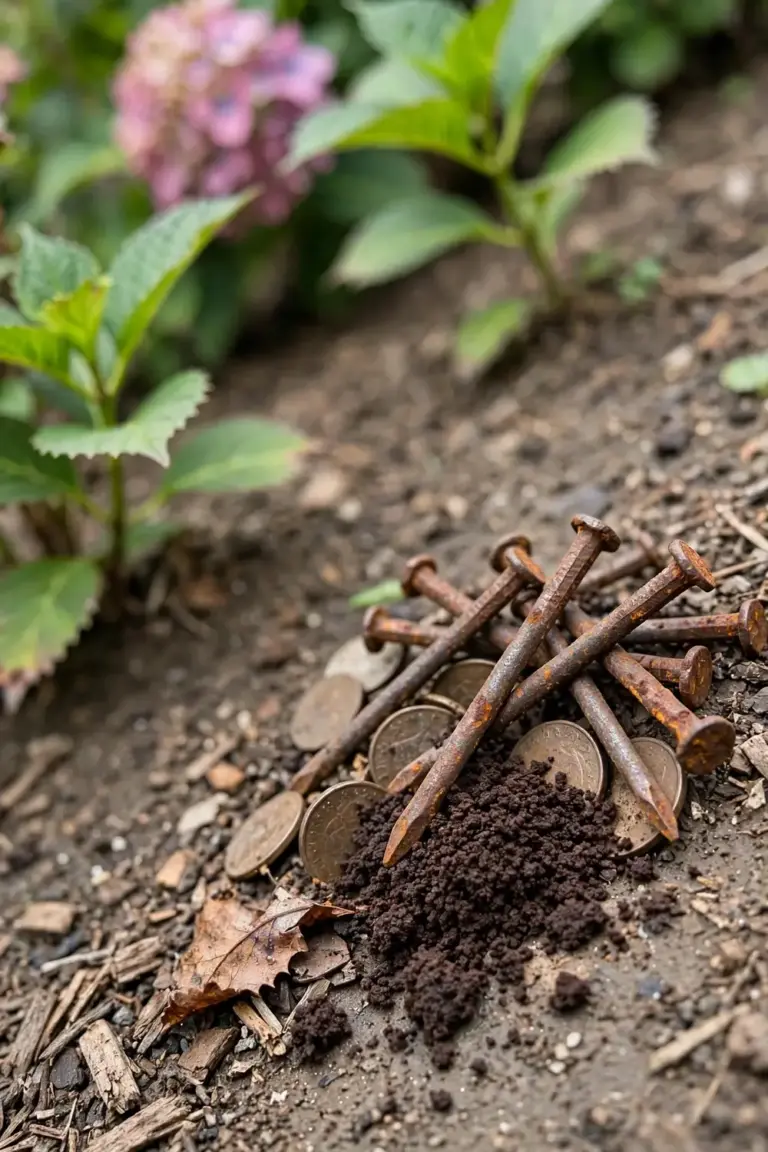
Rusty nails fail twice. Burying rusty nails under a hydrangea adds iron, not aluminium. Iron does not drive the blue shift. Aluminium does. Mississippi State’s Southern Gardening column warns that lowering soil pH is only part of the story, because aluminium is also required to produce blue flowers. Nails supply the wrong metal, and sharp metal hidden in a border becomes a hazard for people and pets.
Coffee grounds fail on dose. Used grounds carry little acid. The acid content in used grounds is negligible for shifting soil pH. Fresh, unused grounds carry more acid but still fall short of a real amendment, and they risk burning the plant. Spent grounds work as mulch. They do not work as a color treatment.
Pennies fail on chemistry. A coin buried in soil releases almost no soluble metal. The soil pH stays where it was. The blooms stay where they were.
Vinegar, banana peels, and aluminium foil belong in the same pile. No household scrap replaces a measured dose of aluminium sulphate or lime. The myths cost a season. The real amendment costs a few dollars and a soil test.
The myths survive because each one holds a grain of truth. Coffee grounds are acidic when fresh. Iron does feed plants. Metal does break down in soil. The grain of truth is real, and the dose is not. A color change needs a measured shift in soil pH plus available aluminium at root depth. Household scraps deliver neither at a useful scale. Measure the pH, apply the real amendment, and let the chemistry do the work.
10. Fix a Color Change That Stalls
A stalled color change has a short list of causes. Work through them in order.
Check the type first. A panicle or oakleaf hydrangea never responds to pH treatment. A white-flowered cultivar never responds either. A cultivar bred to hold one color holds it. No dose fixes a plant that cannot change.
Check the pH second. Retest the soil. A pH that never moved means the dose was too small for the soil type, or the soil buffered it. A heavy clay needs more amendment than a sandy loam. A retest shows the gap.
Check the fertilizer third. A high-phosphorus fertilizer blocks blue by tying up aluminium. A gardener chasing blue while feeding a high-phosphorus blend works against the treatment. Switch to a low-phosphorus formula for blue. Switch to a higher-phosphorus formula for pink.
Check the calendar fourth. A treatment applied after buds set misses the season. The blooms that already formed keep their color. The next season carries the change. Mark the autumn and spring rounds on the calendar and keep them.
Check the dose fifth. Too much aluminium sulphate injures the plant. Too much lime yellows new growth through iron shortage. Both failures look like a sick plant, not a color problem. Stop. Retest. Resume at the label rate.
Check the overshoot sixth. A color change that runs past the target means the dose pushed pH too far. A plant aimed at purple that lands deep blue overshot toward acid. A plant aimed at pink that lands purple undershot toward acid. Both cases call for the same response: stop treating, retest, and let the soil drift back before the next round. A second dose on top of an overshoot makes the swing worse.
Check the fade seventh. Blooms age and shift as they mature, which is normal and separate from soil pH. A blue bloom that greens late in the season is aging, not reverting. A pink bloom that deepens toward red as it ages is aging too. Judge the color change on fresh blooms at their peak, not on tired blooms at the end of the season.
Pruning is a separate job from color change. The site’s spring pruning techniques cover the general method. On a mophead, cut only the stems that flowered. A hard all-over cut removes next summer’s flowers along with the old wood.
Frequently Asked Questions
No. White hydrangea blooms carry no pigment for aluminium to shift. Soil pH treatment leaves them white. A white-flowered cultivar may sport a pink or blue eye, but the bloom stays white. Plant white hydrangeas where the color is certain. Spend the amendment budget on a pink or blue cultivar that responds.
Expect months, not days. A treatment applied in autumn shows in next summer’s blooms. A spring drench may shift late blooms in the same season, but the full change arrives the following year. Soil reverts to its natural pH, so the gardener repeats the treatment every year. A pot holds the change longer than a garden bed.
No. Used coffee grounds carry negligible acid for shifting soil pH. They work as mulch. They do not work as a color treatment. Pennies and nails fail the same way. A measured dose of aluminium sulphate moves pH and supplies aluminium. Household scraps do neither at a useful scale. Skip the myths and use the real amendment.
Yes. Treat each plant on its own. Soil pH varies across a garden, so two plants in different beds may need opposite treatments. Pots make the split easy: one pot holds acidic mix for blue, another holds limed mix for pink. Label each pot with its target color and its last treatment date. The label prevents a mix-up at the next round.
A fertilizer does not paint the blooms. Its phosphorus level shifts aluminium availability, which shifts color, because phosphorus ties up aluminium and pushes blooms pink. A low-phosphorus fertilizer keeps aluminium free and supports blue, while a higher-phosphorus fertilizer suits pink. Match the fertilizer to the target color, and keep the dose at the label rate.
Start With a Soil Test This Weekend
Color change starts with a test, not a purchase. Test the soil pH. Name the hydrangea type. Pick the target color. Then treat: aluminium sulphate for blue, garden lime for pink, autumn for the granular round, spring for the drench. Retest each year and repeat. The blooms follow the soil, and the soil follows the gardener who measures first.
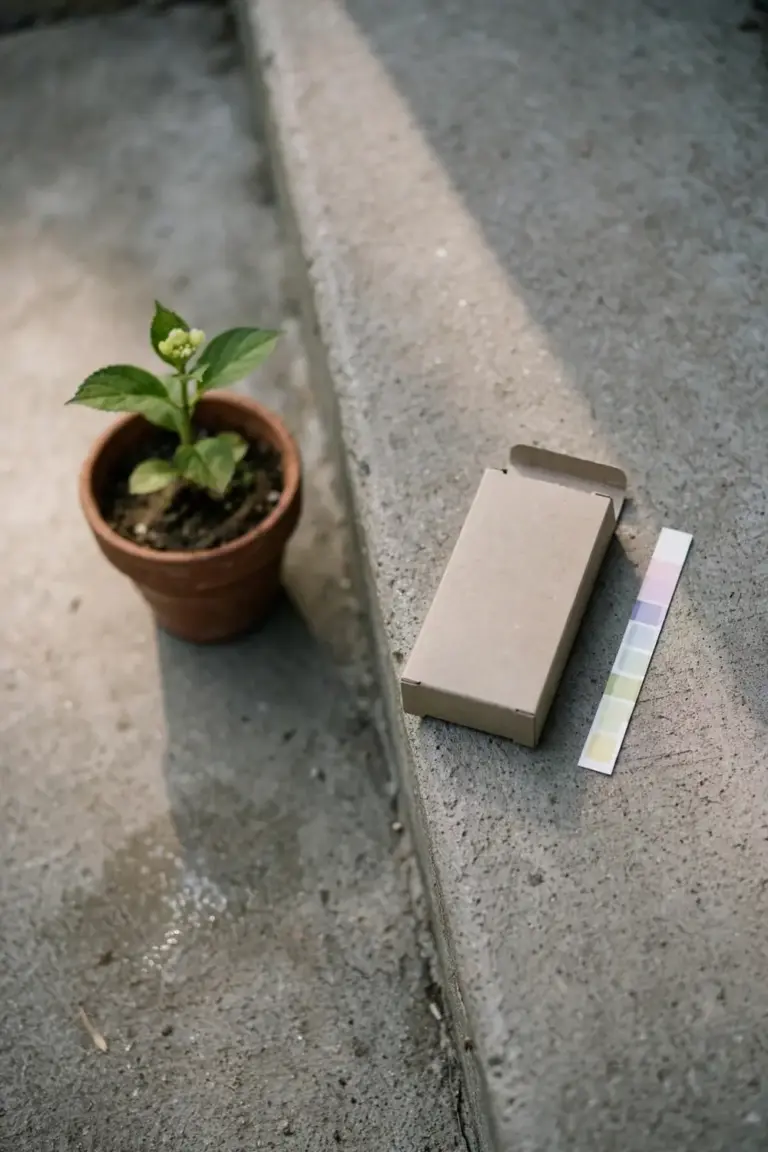
Start this weekend with the test kit. One reading tells the gardener which direction to push and how far the soil must travel. The amendment can wait until the number is known. The blooms will follow next summer.