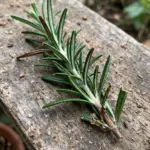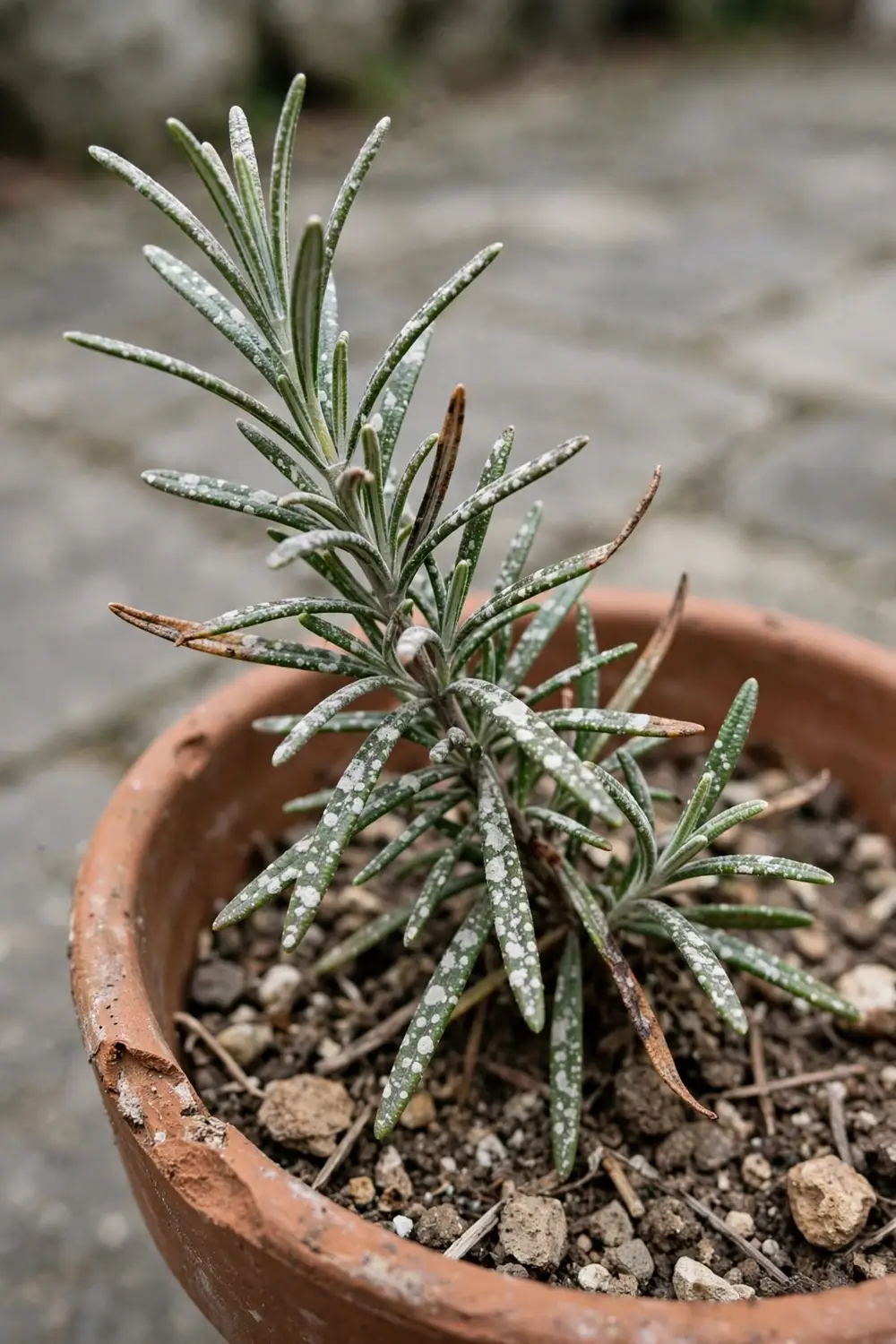

White spots on rosemary leaves come from 7 causes. Run the wipe test first. Wipe a spot with a damp finger. Powder that brushes off points to powdery mildew. Dots that stay put point to pests, burn, or scorch. I have learned that the rosemary I wipe before I spray keeps more good leaves than the one I treat on a guess.
The rest of this page runs 7 causes, from powder that brushes off to patches that never move, then the eating rule and the fix order. Rosemary is Salvia rosmarinus. Nurseries still sell it under the old name Rosmarinus officinalis. Rosemary is a culinary herb, so every fix below respects that. No bleach. No spray on leaves you plan to eat today.
1. Run the Wipe Test First: 30 Seconds That Split 7 Causes Into 2 Groups
The wipe test splits the 7 causes into 2 groups before you treat anything. Take a damp white cloth or a damp finger and wipe the top of one spotted leaf. Then flip the leaf and look at the underside. Then check the stem joints and the leaf axils.
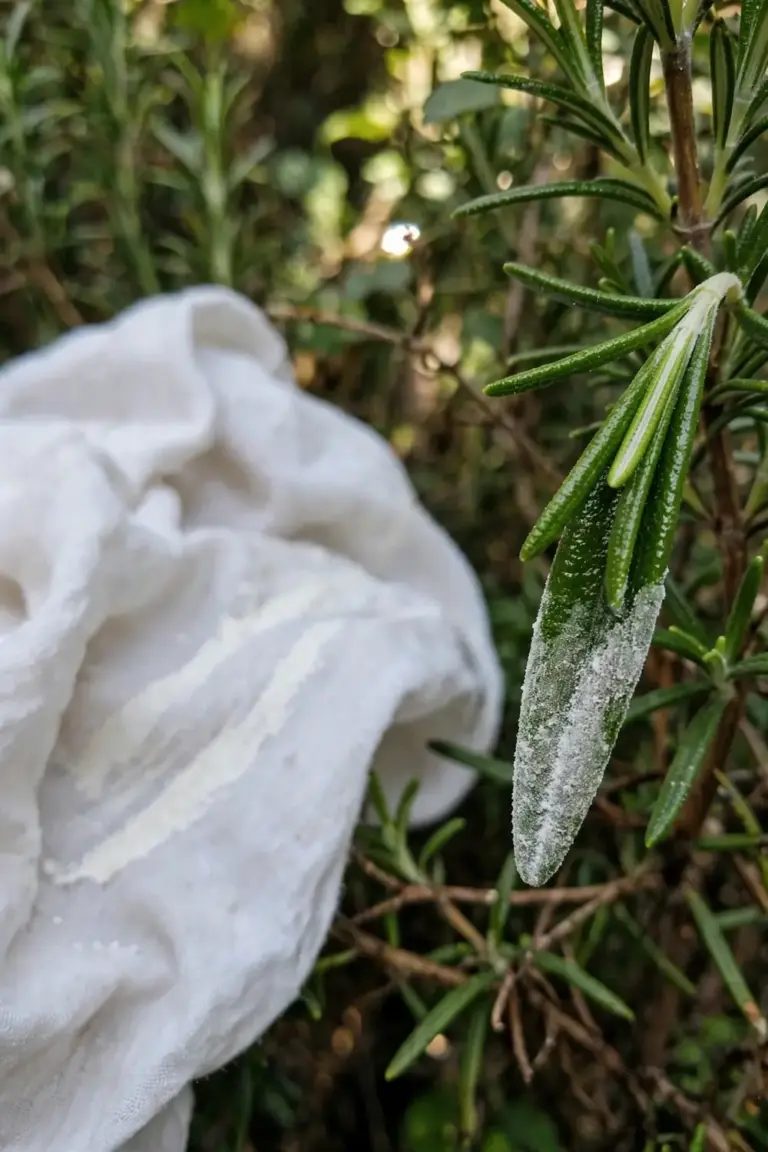
Powder that comes off on the cloth belongs to group one. Mildew and mineral dust sit on the surface, and a damp wipe lifts them. Dots that stay put belong to group two, because pest punctures, burn, and scorch live inside the leaf tissue where no wipe can reach them.
Run two more checks while you stand there. Look for fine webbing in the leaf axils. Webbing means mites. Look for white froth at the stem joints. Froth is spittlebug foam, and it is harmless. It is not spots, and it needs no treatment.
Check the undersides with a hand lens if you own one. Mites, whitefly nymphs, and young scale all hide there, and the tops of the leaves tell you nothing about them. A 10x lens turns a blank-looking underside into a readable colony. No lens? Hold white paper under the branch and tap the branch hard. Tiny moving dots on the paper are mites or crawlers. No movement means the spots are burn, scorch, or old damage.
2. Match the White Spot to the Cause: The 7-Row Differential Table
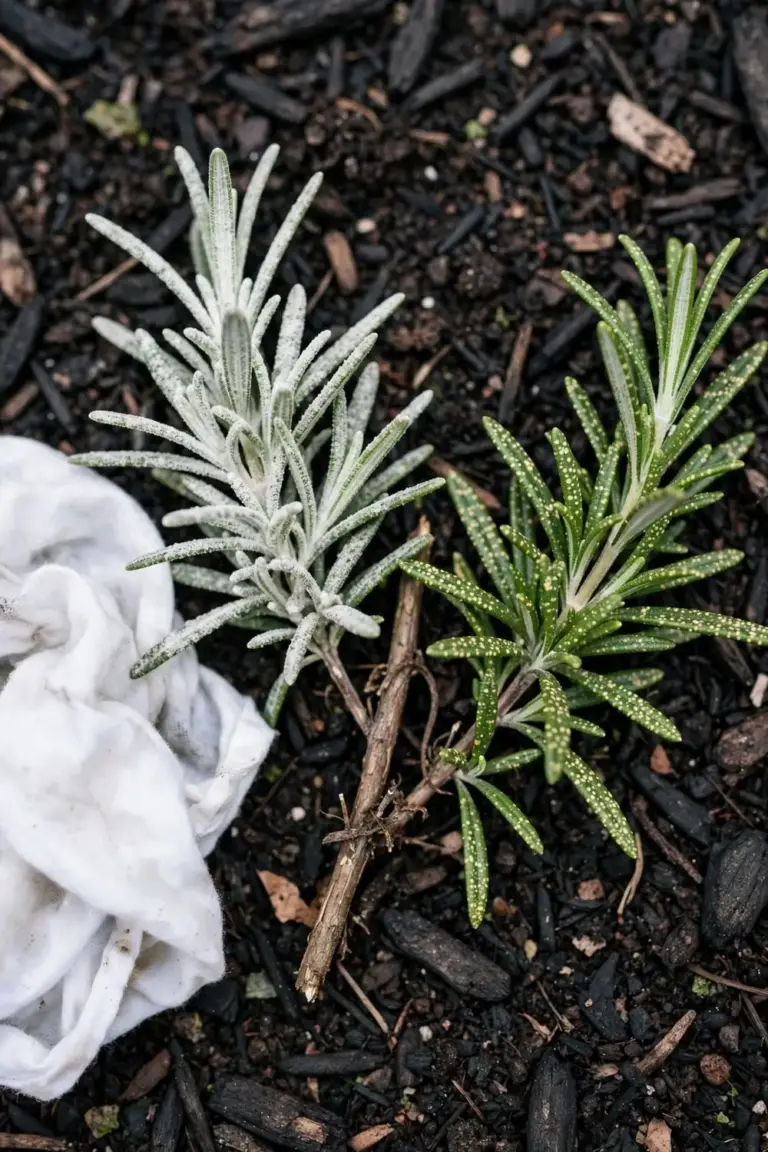
The table below matches what you see to the cause, the wipe test result, the eating verdict, and the first fix. Find your row, then read that cause section for the full fix.
| Cause | What the Spot Looks Like | Wipe Test Result | Safe to Eat? | First Fix |
|---|---|---|---|---|
| Powdery mildew | White powdery coating, small circular spots that spread | Powder brushes off | Wash; discard heavily coated leaves | Prune worst leaves, open airflow, water at the base |
| Spider mites | Yellowish-white stippling, fine webbing in leaf axils | Dots stay; webbing stays | Wash; discard webbed leaves | Blast with water, undersides first |
| Whiteflies | White dots, tiny adults that fly when disturbed | Dots stay; adults fly off | Wash; discard sticky leaves | Hose adults off, hang yellow sticky traps |
| Mealybugs | White cottony masses in stem joints and leaf axils | Cottony masses stay | Discard infested leaves | Dab with alcohol, prune worst stems |
| Scale | White or gray bumps on stems and leaves that do not move | Bumps stay | Wash; discard encrusted leaves | Prune worst stems, apply horticultural oil |
| Salt and fertilizer burn | White crust on soil and pot rim, brown leaf tips | Crust stays on soil, not leaf | Wash; discard scorched leaves | Scrape crust, flush soil, hold fertilizer |
| Sun scorch and water splash | Bleached white patches on sun-facing leaves | Patches stay | Wash; discard worst leaves | Move to morning sun, water at the base |
Two traps sit outside the 7 rows. Spittlebug foam is white froth at stem joints. It looks alarming and does nothing. Leave it alone. Leafhoppers leave yellow-white puncture dots, and the adults jump when disturbed. Repotting does not fix leafhoppers. Treat them like whiteflies: water, traps, and predators.
Never spray bleach on rosemary. Bleach burns leaves and poisons food, and the forum suggestion to bleach-spray rosemary is wrong. Skip it entirely.
3. Powdery Mildew: White Powder That Brushes Off
Powdery mildew is a fungal disease. It is not a pest. It shows as a white powdery growth on leaves, and young leaves develop small circular white powdery spots that slowly enlarge to cover the leaflets, according to the UC IPM powdery mildew guide. A slight yellowing may appear on infected leaves. Humid nights plus dry leaf surfaces plus still air grow it fast. Coastal summers in Australia suit it well.
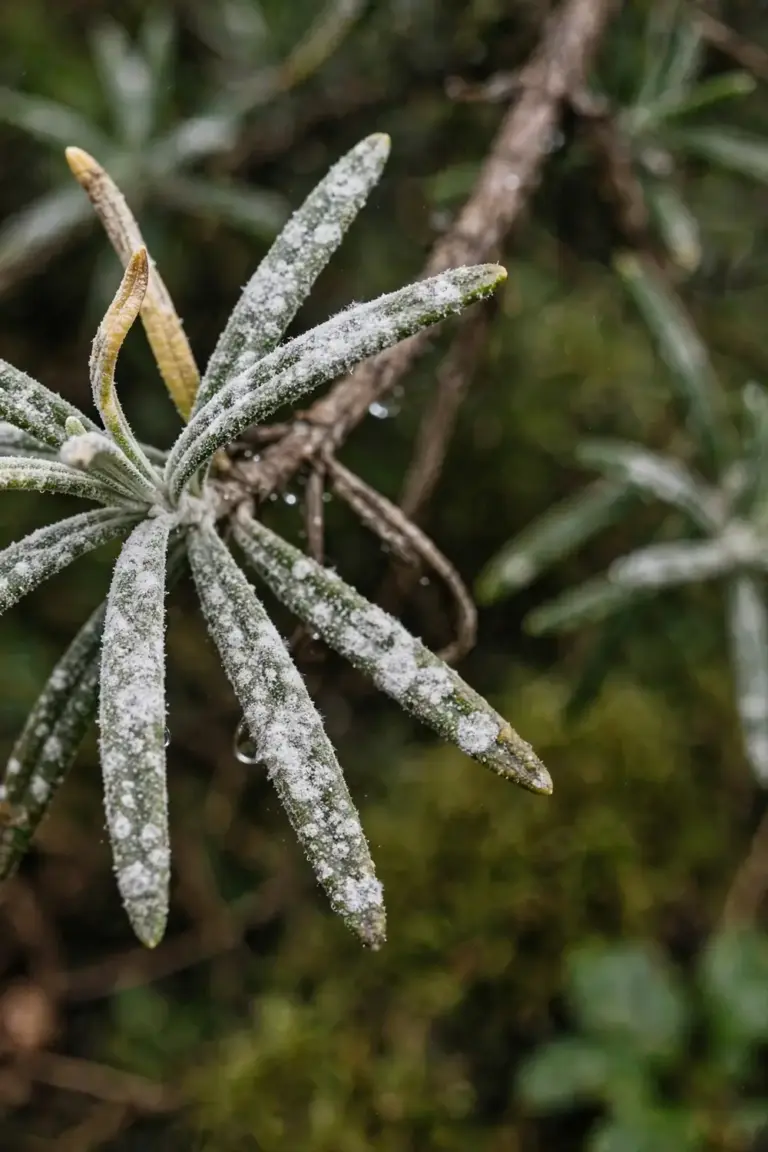
Start with the worst leaves. Prune out diseased tissue as soon as it appears and bin it. Do not compost it. Then open the airflow. Space pots apart. Prune lightly so air moves through the plant. Water at the base and keep leaves dry. The same UC IPM guide advises planting in unshaded areas and avoiding excess fertilizer, since soft overfed growth mildews faster.
Sulfur may be used where infection is extensive. Follow the label. Do not spray sulfur on a water-stressed plant or in extreme heat. Do not apply sulfur within 30 days of an oil spray. The two react and burn leaves. Keep pets and children off the plant until it dries. Never spray in wind or rain, and never spray open flowers.
Eating verdict: wash the leaves under running water and rub them. Lightly dusted leaves wash clean. Heavily coated leaves go in the bin. Mildew is a surface fungus. It washes off, but a leaf that stays gray and limp after washing is done.
Prevention beats spraying. Space pots so leaves do not touch. Give the plant morning sun and moving air. Thin the center lightly so wind passes through the plant instead of around it. Water at the base in the morning, never overhead in the evening. Wet leaves overnight in still air are the mildew invitation. A rosemary that dries by mid-morning rarely mildews at all.
4. Spider Mites: Stippling That Stays Put
Spider mites are not insects. They are mites, arachnids like spiders and ticks. They leave yellowish-white stippling that never wipes off, because each dot is a punctured leaf cell. Fine webbing in the leaf axils confirms them. Adults are less than 1.3 mm long and have eight legs, according to the UC IPM spider mite guide. Colonies live mostly on leaf undersides, and a single colony can hold hundreds of mites.
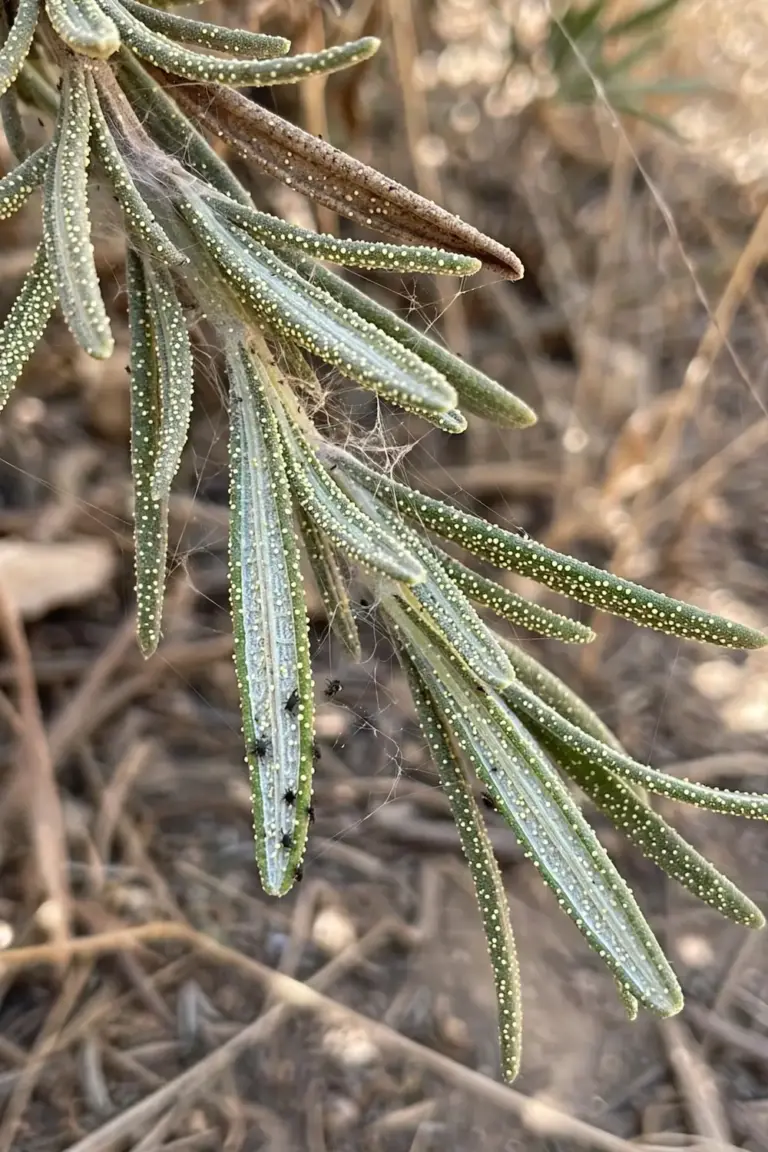
Mites reproduce fast in hot weather. A generation can complete in less than a week when temperature and food suit them. Damage is usually worst in hot, dusty conditions and on water-stressed plants. That pattern fits Australian summers: a dry spell plus a dusty patio plus a thirsty pot equals mites.
Blast first. Apply a water spray or mist to the undersides of leaves at least once a day. Cover the undersides fully. Mites hide there, and a spray that only hits the tops misses them. If water alone does not hold them, use insecticidal soap or insecticidal oil. Follow the label. Do not spray soaps or oils on water-stressed plants or when temperatures exceed 32 degrees. Both conditions burn leaves. Keep pets and children off the plant until it dries. Never spray in wind or rain, and never spray open flowers.
Protect the predators. Predatory mites, lacewings, lady beetles, and minute pirate bugs eat spider mites. One predator for every 10 spider mites provides control, per the same UC IPM guide. Broad-spectrum insecticides kill those predators and often trigger a mite outbreak days later. Skip them. Our beneficial insect guide names the predators that do this work in a home garden.
Monitor before you spray again. Mites hide on leaf undersides, and damage shows before the mites themselves do. Check the undersides with a hand lens and tap a branch over white paper. If the paper stays clean and the stippling has stopped spreading, the colony has collapsed. Plants often recover on their own once mites leave. Spray only when live mites are present, because a spray on an empty plant kills predators for nothing.
Eating verdict: wash leaves well. Mites themselves are not a food-safety hazard. Discard leaves matted in webbing. They taste dusty and clean poorly.
5. Whiteflies: White Dots With Adults That Fly
Whiteflies are tiny, sap-sucking insects that fly around plants when disturbed. The adults are white. The nymphs are oval, legless, and do not move. Nymphs sit on leaf undersides and cause most of the damage, according to the UC IPM whitefly guide. Leaves turn yellow, silver, or dry where nymphs feed. Sticky honeydew coats the leaves, and black sooty mold grows on the honeydew.
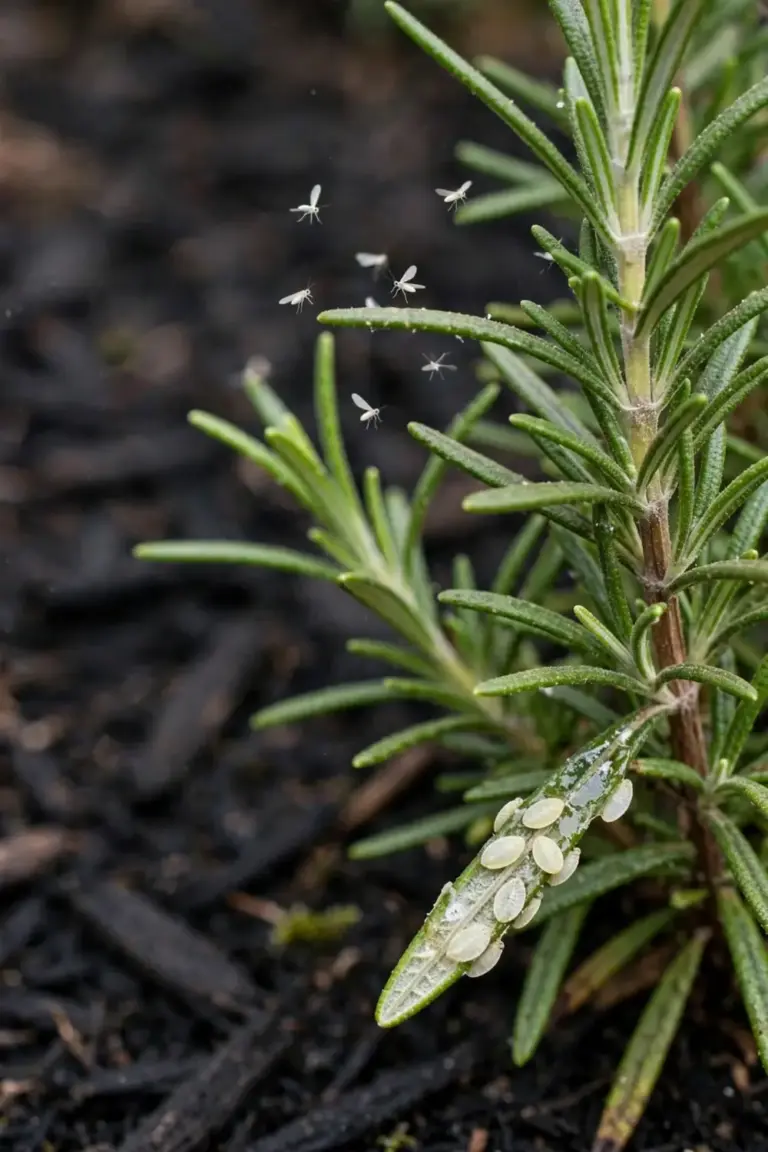
Shake the branch gently. A small white cloud that lifts and settles back is whiteflies. That flight test separates them from mealybugs and scale, which never fly. Check the undersides next. Tiny oval nymphs confirm the diagnosis.
Hose the adults off with a strong stream of water. Prune out isolated infested leaves when you first detect them. Hang yellow sticky traps to catch adults and to monitor numbers. Reflective mulch repels whiteflies from small plants. Keep ants out of the plant, since ants protect whiteflies from natural enemies.
When a spray is needed, choose insecticidal soap or oil. Follow the label. Good coverage, including the underside of leaves, is essential. Repeat applications may be required. Avoid broad-spectrum pesticides such as pyrethroids, organophosphates, or neonicotinoids. Even the most toxic insecticides are only partly effective against whiteflies, and they kill the lacewings and lady beetles that eat them. Keep pets and children off the plant until it dries. Never spray in wind or rain, and never spray open flowers.
Eating verdict: wash sticky leaves under running water. Honeydew washes off. Discard leaves blackened with sooty mold. They clean poorly and taste stale.
Traps also tell you when the fight is over. A yellow sticky trap that catches fewer adults each week means the colony is shrinking. A trap that fills fast means eggs are still hatching and a second round is due. Replace traps when they fill with dust and insects, since a coated trap catches nothing. Our organic pest control guide covers the full water, trap, and predator sequence for garden pests.
6. Mealybugs: White Cottony Masses in the Joints
Mealybugs are soft, oval, wax-covered insects that feed in colonies in protected spots: the crown of the plant, branch crotches, and stem joints. They look like white cottony masses. Females lay 100 to 200 or more eggs in cottony egg sacs over a 10 to 20 day period, per UC IPM mealybug notes. Rosemary sits on the herb list that mealybugs attack, alongside sage and other kitchen herbs.
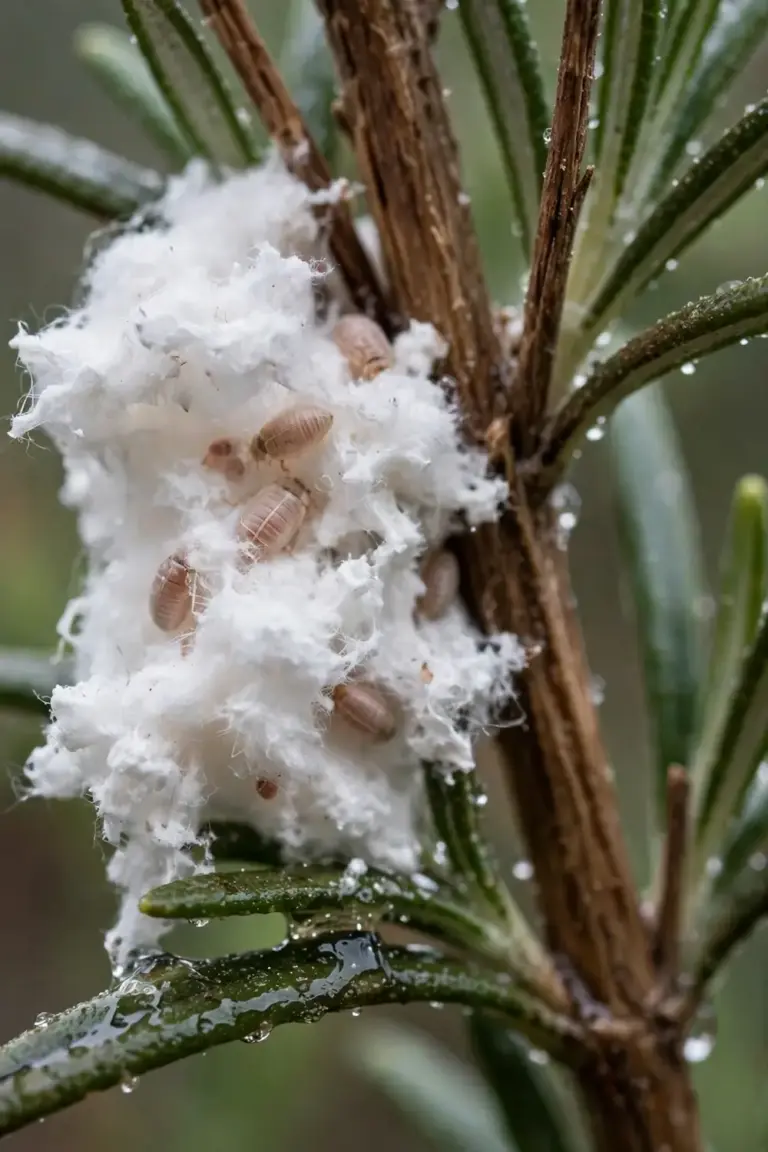
Poke the mass gently with a fingertip. A mealybug feels soft and segmented under the wax. Scale feels hard and shell-like. That touch test separates the two in one second. Mealybugs also excrete sticky honeydew, so sooty mold often grows nearby.
Dab first. Apply a solution of 70 percent or less isopropyl alcohol and water directly to the insects with a cotton swab. Test on a small part of the plant first and watch for leaf burn. Then prune the worst stems and bin them. For exposed populations, spray with a strong stream of water and repeat every few days. Keep pets and children off the plant until it dries. Never spray in wind or rain, and never spray open flowers.
Hold the nitrogen. Over-application of nitrogen fertilizer combined with regular irrigation stimulates tender new growth where mealybugs prefer to lay eggs, per the same UC IPM notes. Feed less until the colony is gone. Protect the predators: parasitic wasps, lady beetles, lacewings, and spiders. The mealybug destroyer lady beetle, Cryptolaemus montrouzieri, is the most important predator in many areas.
Eating verdict: discard infested leaves. Do not eat leaves with alcohol residue. Wash any leaf you keep and wait until it is fully dry.
Repeat the treatment. Eggs in cottony sacs survive the first dab, and crawlers hatch over days. Check the joints every few days and dab the new crawlers before they settle and grow wax. Two or three rounds break the cycle. One round never does, because the sacs you missed hatch after you stop looking.
7. Scale: White Bumps That Do Not Move
Scale insects are immobile insects that suck plant juices. Adults appear as circular, elongate, or oval bumps on bark, leaves, or fruit. Their coverings range from 1.0 to 6.4 mm long, according to the UC IPM scale guide. They lack an obvious head or legs and do not resemble most other insects. That stillness is the diagnosis. Mealybugs shift when poked. Whitefly nymphs sit flat but small. Scale never moves at all.
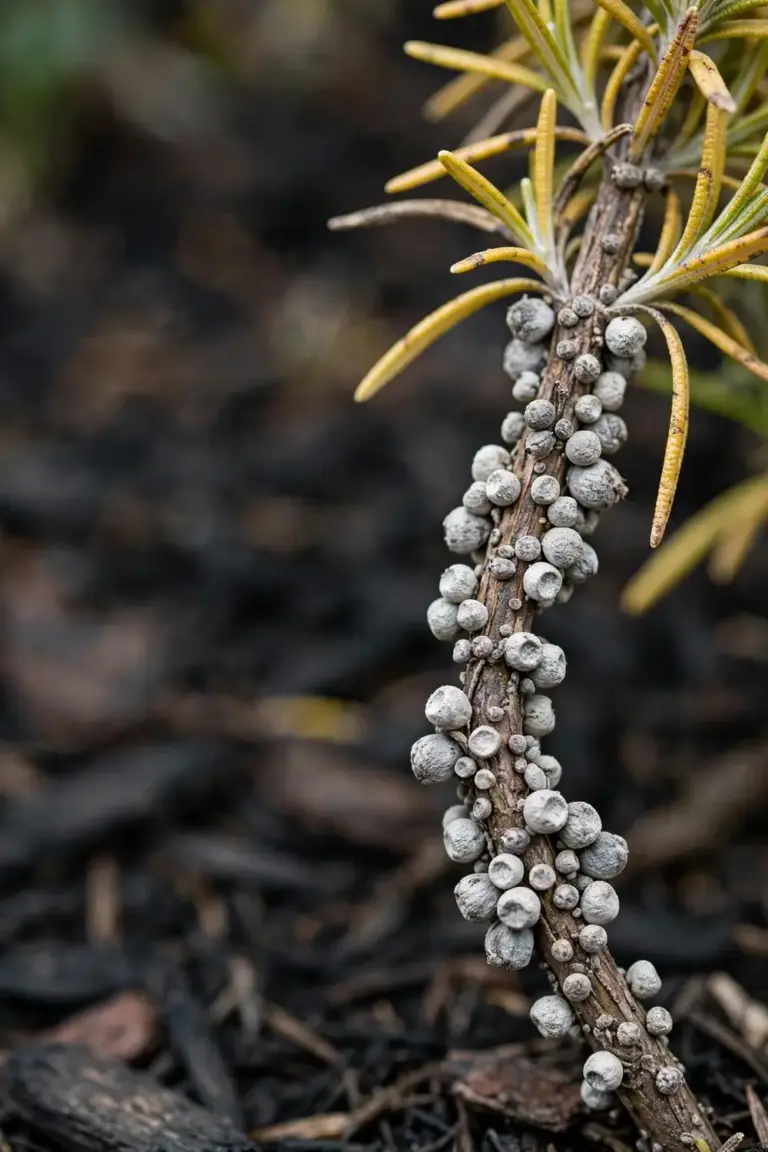
Split scale into two families, because the split decides the fix. Armored scales are tiny and flat, with covers under 3.2 mm that usually lift off the body, and they do not secrete sticky honeydew. Soft scales are larger, rounder, and excrete honeydew. Honeydew plus sooty mold points to soft scale, while dry bumps with no stickiness point to armored scale.
Prune the worst stems first and bin them. Then spray horticultural oil during the dormant season or when crawlers are active in the growing season. Follow the label. Crawlers are the one mobile stage: tiny yellow to orange young that walk before they settle. Oil works when it coats them. Avoid broad-spectrum insecticides that kill beneficial insects. Most plants tolerate low to moderate numbers of scales, so a small colony is a watch job, not an emergency. Keep pets and children off the plant until it dries. Never spray in wind or rain, and never spray open flowers.
Eating verdict: wash leaves under running water. Discard leaves encrusted with scale. They clean poorly and the bumps stay on.
Time the oil to the crawlers. Crawlers walk for a short window before they settle and grow their covers, and oil works best while they are still moving. Check stem joints and leaf undersides with a hand lens every few days in warm weather. When you see tiny yellow to orange crawlers, spray within days. Oil on settled adults with hard covers does far less, which is why one mistimed spray looks like a failure.
8. Salt and Fertilizer Burn: White Crust, No Bugs
Salt and fertilizer burn leaves a white crust on the soil surface and the pot rim, with brown leaf tips. No bugs are present. The wipe test finds nothing on the leaf, because the damage sits in the roots. Excess fertilizer salts build up in the potting mix, and hard or bore water leaves mineral deposits behind. Both dry the roots from the outside in.
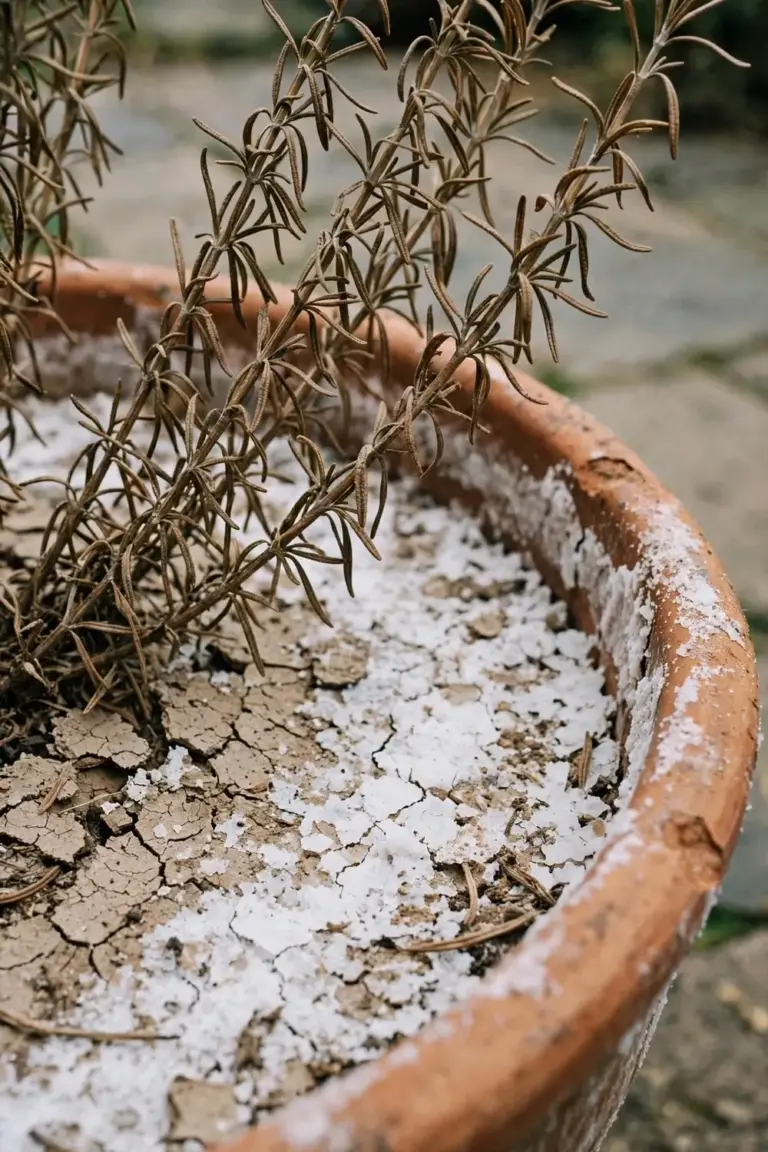
Scrape the crust off the soil surface and bin it. Then flush the pot. Water slowly until water runs freely from the drainage holes. Let the pot drain fully. Repeat once if the crust was thick. Hold all fertilizer until new growth looks clean. Feeding a salt-burned plant adds more salt to the problem.
Prevention is simple. Feed less than the packet suggests for a potted herb. Water with rainwater where your tap or bore water is hard. Repot into fresh mix when the soil surface stays crusty after two flushes. Fresh mix resets the salt level in one move.
Bore water deserves its own check. Bore and tank water in many Australian areas carries dissolved salts that leave white crust on soil and pots. If the crust returns within days of a flush, the water is the source, not the fertilizer. Switch to rainwater for that pot, or blend rainwater with bore water. The plant will tell you within weeks: new growth comes clean and the crust stops returning.
Eating verdict: wash the leaves. Burn itself is not a pathogen, so leaves that wash clean are safe to eat. Discard leaves with brown, papery tips. They taste bitter and woody.
9. Sun Scorch and Water Splash: Bleached Patches After a Move
Sun scorch leaves bleached white patches on the leaves that face the sun. The patches appear after a pot moves into full sun. Water splash adds small bleached dots where droplets sat on leaves in hot sun and acted as lenses. Both stay put under the wipe test, because the tissue itself is bleached.
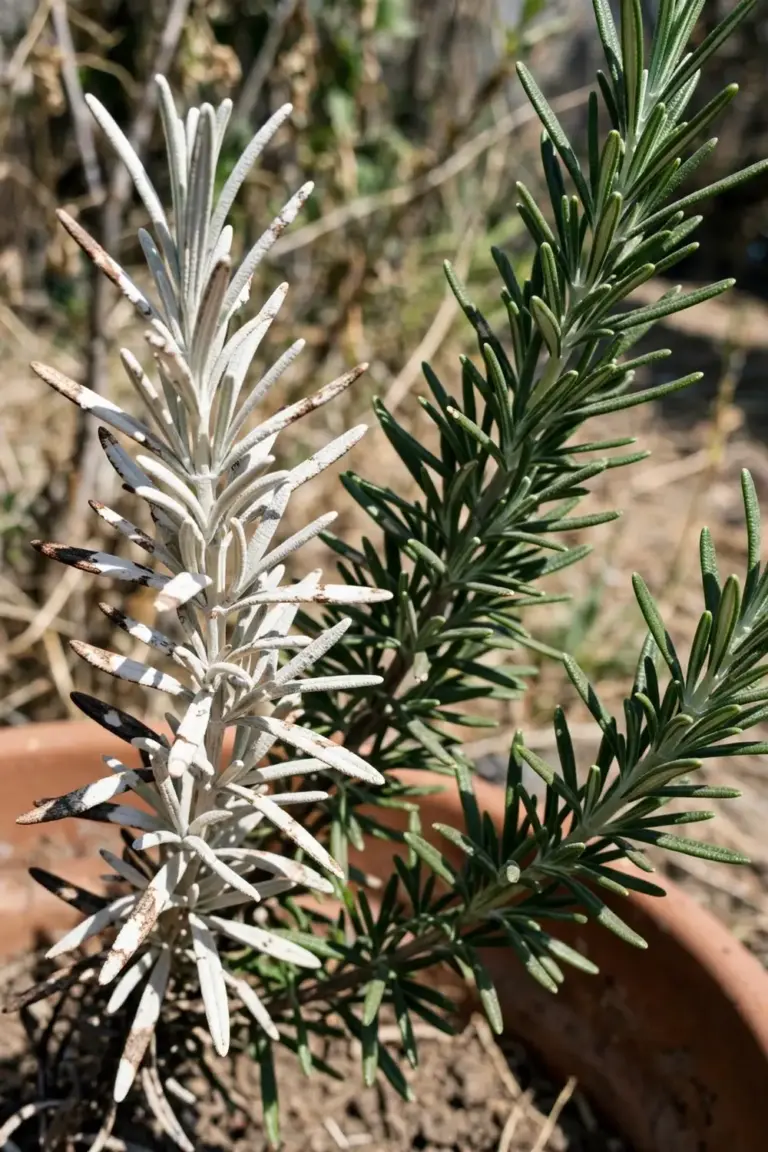
Move the pot to morning sun with afternoon shade. Rosemary loves sun, but a plant moved straight from a shaded nursery bench to a full-sun patio scorches. Harden the move over several days. Shift the pot into stronger sun one step at a time. Water at the base. Keep leaves dry in the heat of the day.
Prevention is placement plus watering habit. Morning sun dries dew fast and burns nothing, while afternoon shade protects leaves in heatwaves. Mulch keeps the soil cool and the roots steady. Water early in the day so leaves dry before the sun strengthens.
Harden every move. A rosemary that lived on a shaded nursery bench needs days to adjust to a full-sun patio. Start with morning sun only, then add an hour of stronger sun each day. Watch the newest leaves. They scorch first when the move is too fast. If they bleach, pull the pot back a step and hold it there for two more days before moving forward again.
Eating verdict: wash the leaves. Scorched leaves are safe after washing, but they taste woody. Discard the worst bleached leaves and cook with the green ones.
10. What Is Safe to Eat: Wash, Inspect, Discard
The eating rule has three steps: wash, inspect, discard. Wash every leaf under running water and rub it between your fingers. Inspect it after washing. Discard the worst leaves. When in doubt, discard. One sprig is never worth a bad meal.
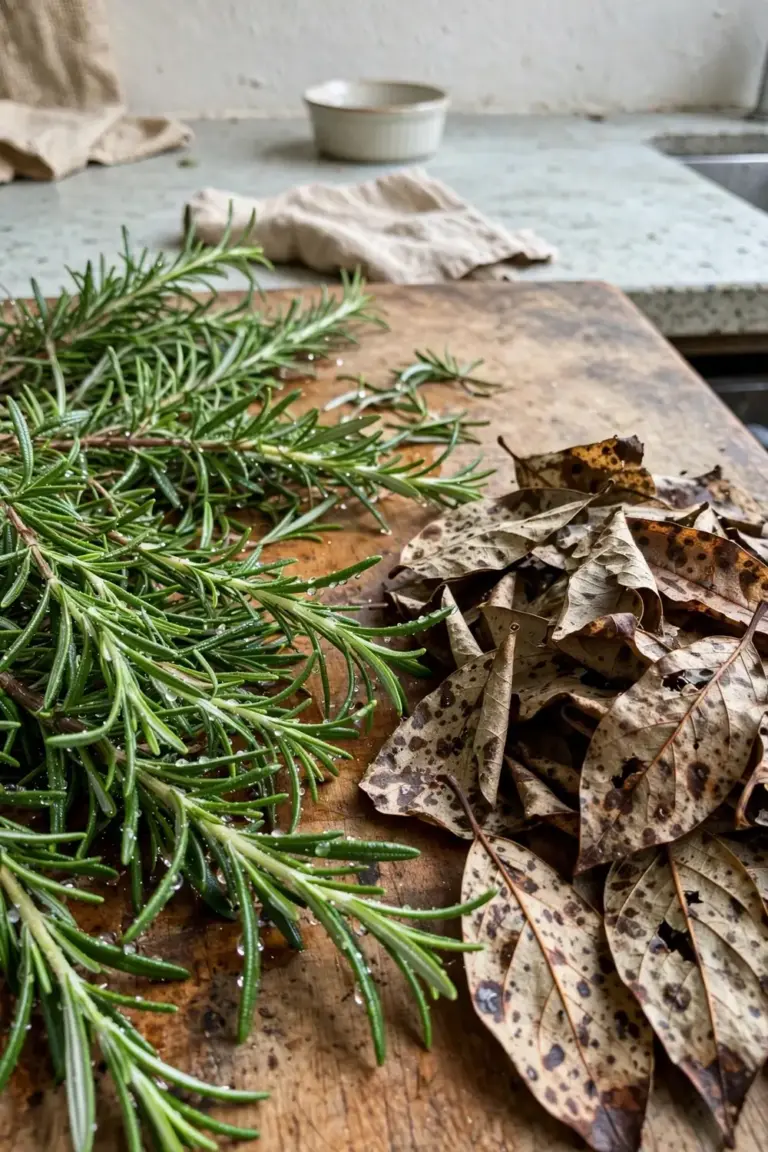
Follow the label on any spray you use. Soap and oil sprays carry withholding guidance on the label. Wait out the stated period, then wash the leaves before cooking. If you plan to harvest today, use water only, since water has no withholding period and no residue.
Never eat leaves with spray residue on them. Never eat leaves with unknown spots you could not identify. Never eat leaves you treated with bleach. Bleach has no place on a culinary herb. Discard any leaf you bleached, and do not compost it into a herb bed.
Rosemary is a culinary herb first and a garden plant second. The safe move is always the same: wash, inspect, discard. The plant regrows. The meal does not need the risk.
Read the label before every spray, even a spray you have used before. Labels change, and the withholding period is the number that matters for a culinary herb. Write the spray date on a tag tied to the pot. That tag removes all guessing about when the leaves are safe to pick again.
11. Run the Fix Order: Wipe Test, Identify, Fix, Prevent
The fix order runs four steps: wipe test, identify, fix, prevent. Do them in that order. Skipping the first two wastes sprays on the wrong cause.
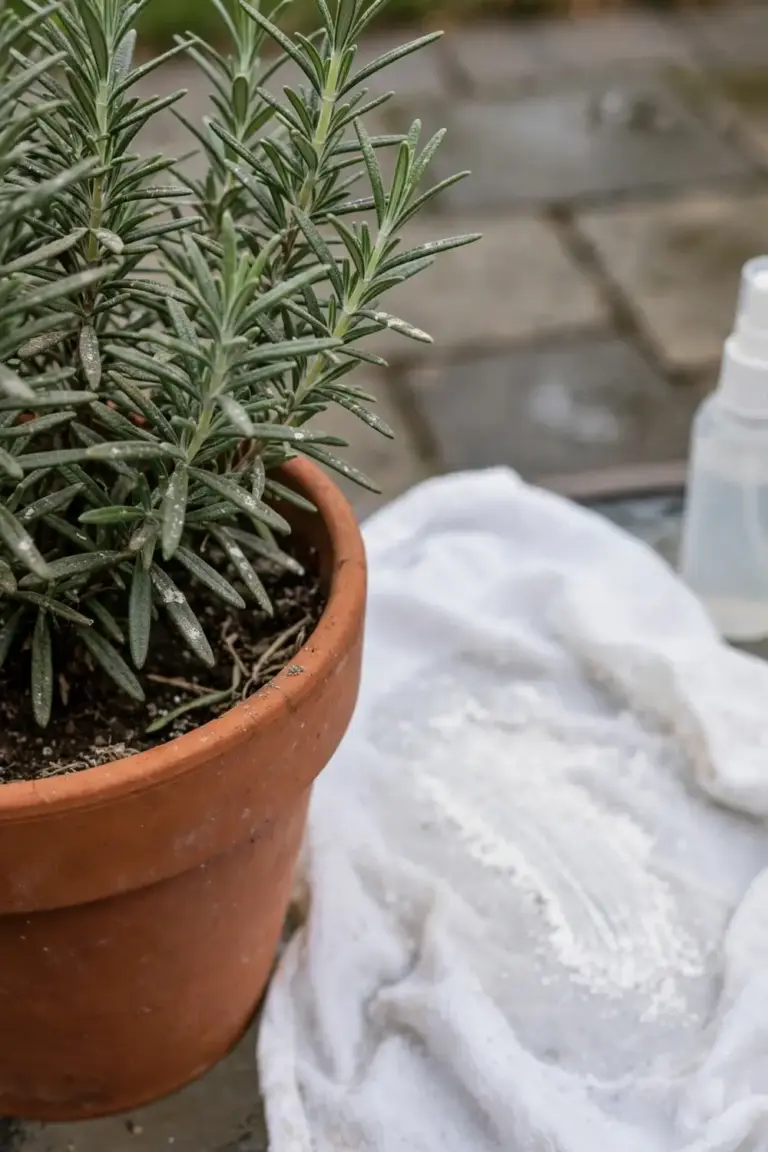
Step one is the wipe test. Wipe one spotted leaf with a damp finger. Powder off means mildew. Dots staying means pests, burn, or scorch. Step two is the table. Match the spot to its row. Step three is the first fix for that row: water first for mites and whiteflies, prune first for mildew and scale, dab first for mealybugs, flush first for salt burn, and move first for scorch.
Step four is prevention. Give the plant sun and airflow. Water at the base. Keep the soil free-draining and do not over-feed. Our soil health guide covers the free-draining mix that keeps rosemary roots happy. Prune lightly for airflow; our spring pruning guide shows the cuts. Recheck the plant in a few days. New clean growth means the fix worked, while fresh spots mean you misread the cause and need to run the wipe test again from the start.
Keep a short log. Note the date, the wipe test result, and the fix you applied. A log turns a second outbreak into a pattern: same cause twice means the prevention step failed, not the spray. Most repeat outbreaks trace to one of three gaps, leaves staying wet overnight, pots crowded together, or fertilizer still running too rich, and fixing the gap stops the spots from returning for good.
Frequently Asked Questions (FAQ)
Yes, in most cases, after washing. Wash the leaves under running water and rub them, then discard leaves that stay spotted, sticky, webbed, or encrusted after washing. Discard any leaf with spray residue or unknown spots. When in doubt, discard. The plant regrows, and one sprig is never worth a bad meal.
Yes. Mildew spores travel on air currents to nearby plants. Space pots apart so air moves between them. Prune the worst leaves and bin them. Water at the base and keep leaves dry. Plants in still, humid corners mildew first, so move the rosemary to an open, sunny spot.
Eggs and hidden insects survive most single sprays. Mite and mealybug eggs hatch over days, and crawlers hide on leaf undersides. Repeat the water blast or soap spray, and check the undersides each time. Protect predators, since lacewings and lady beetles eat the survivors your spray misses.
No, in almost every case. Most white-spot causes are manageable: mildew, mites, whiteflies, mealybugs, scale, burn, and scorch all respond to the first fixes below. Discard the plant only when the whole crown is dead, the roots are mushy, or three rounds of correct treatment change nothing.
Neem oil appears on extension lists as an oil option for mites. On leaves you will eat, follow the label withholding period, then wash the leaves before cooking. If you plan to harvest today, use water only. Water has no withholding period and no residue, so it never forces the question.
Start With the Wipe Test, Then Trust What It Tells You
White spots on rosemary leaves look alike until you wipe one. The wipe test splits 7 causes into 2 groups in 30 seconds. Powder off means mildew. Dots staying means pests, burn, or scorch. The table names the row. The row names the first fix.

Start there. Wipe one leaf now. Then fix the cause the test names, and cook with leaves that wash clean.