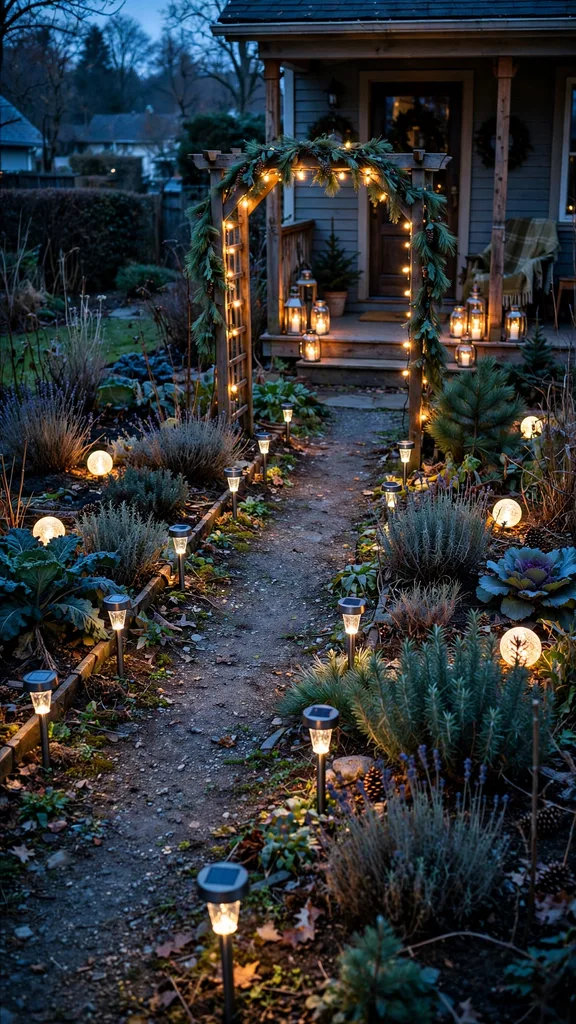
A solar light in December lives on the shortest, lowest sun of the year, so a solar Christmas garden is won or lost on placement, not on purchases. This list gathers 45 solar garden ideas in three parts: placements that charge in short winter days, displays that light the garden’s features, and the techniques, sun mapping, panel care, rotation banks, and honest backups, that keep the system glowing to the solstice and back.
The governing rule is the split: the panel goes where the winter sun is, and the light goes where the beauty is, and the two are connected by a lead, a rotation, or a short walk. I map my own garden’s bright hours every November and place every light by the map, because a solar light in the wrong place is a good light standing in the shade.
| Job | Placement | December Rule |
|---|---|---|
| Path row | South side, tilted panels | Move shaded stakes in November |
| Feature spots | Sunniest wall or bed | Panel in sun, beam in shade |
| Strings and jars | Arch, porch, evergreen corner | Panels wiped and reachable |
| Working light | Gate, steps, mailbox | Reliability before beauty |
| Dark displays | Shaded arch, north door | Rotation bank of charged spares |
1. South Facing Stake Row Along the Path
Line the path with solar stake lights whose panels face the midday sun, which in a northern garden means tilting the row to the south side of the path where nothing shades it. A path row is the solar garden’s backbone: it charges all day and guides every evening arrival.
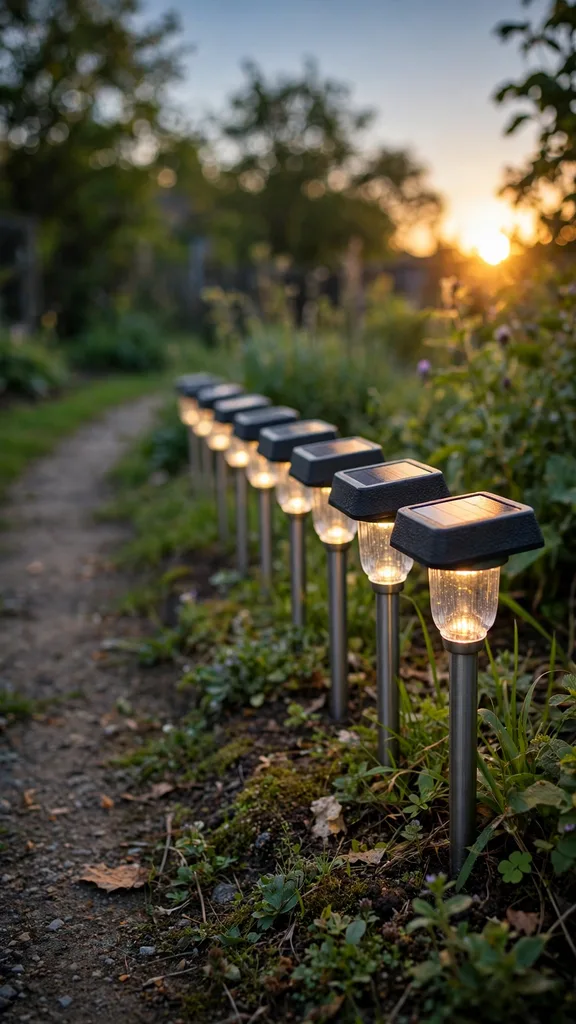
In December the sun is low and brief, so a stake that charged happily in June may starve behind a hedge now. Walk the row at midday in November and move the shaded stakes before the season starts; placement is decided by the winter sun, not the summer one.
2. Panels Tilted to the Low Winter Sun
Tilt solar panels toward the low winter sun rather than leaving them flat: a panel angled at the December sun collects hours more charge than a horizontal one staring at a gray sky. Many stake lights and spotlights adjust; the ones that do not can be wedged on a stone or a brick.
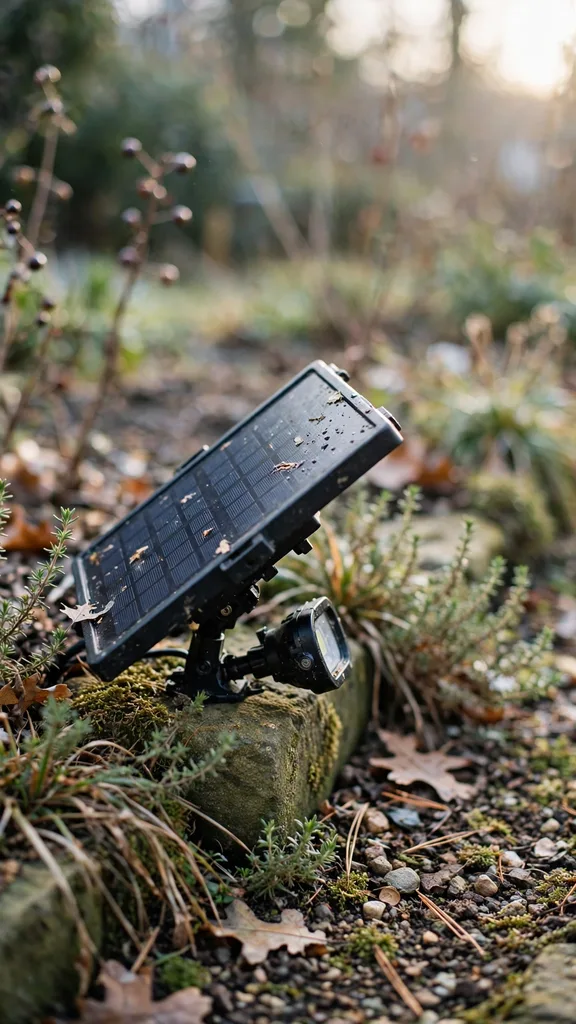
The lower the sun, the steeper the useful tilt. Recheck the angle in January, when the sun begins its slow climb. Five minutes with a wedge in November is worth an hour of light every night of the season.
3. The Sunny Fence Line Display
Run solar string lights or stake lights along the garden’s sunniest fence, where the panels sit in open sky all day and the lights outline the boundary all evening. A fence line is usually the least shaded run in a small garden, which makes it the solar display’s natural home.
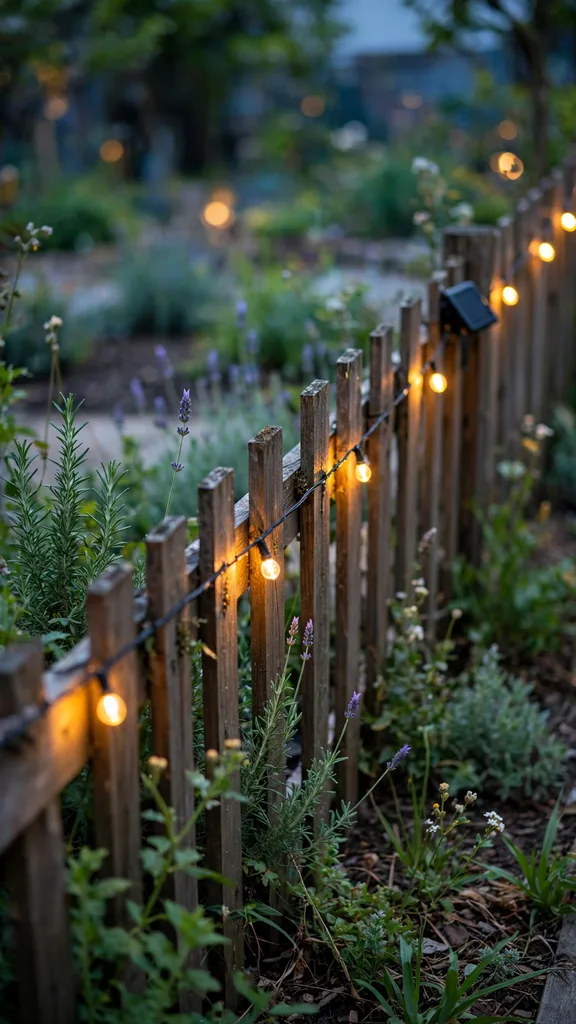
Fix strings so the panels, often on a separate lead, sit in the sun even when the lights themselves drape into shade. That split, panel in sun, light in shade, is the trick that makes half the ideas in this list possible.
4. Solar Spots on the Garden’s Sunniest Wall
Mount solar spotlights on the sunniest wall and aim them at the door wreath, the evergreen corner, or the garden’s best winter shrub. Wall mounting lifts the panels above bed shade and puts the light exactly where a stake cannot reach.
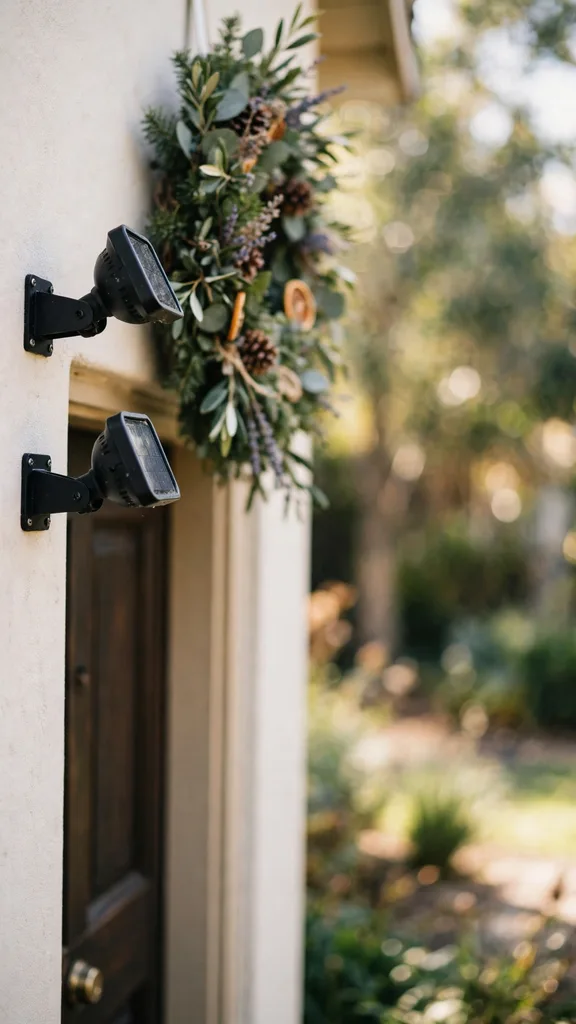
A wall spot charging all day on a south wall will run most of a December night. Aim the beam before you fix the bracket; a spotlight’s drama is all in its angle, and the wall gives you every angle the ground cannot.
5. Raised Bed Edge Lighting
Set small solar lights along the raised beds’ sunny edges, where the bed’s height lifts the panels above the low shade of paths and lawns. The beds’ winter structure, kale, leeks, and bare soil under mulch, gains an outline that makes the kitchen garden part of the display.
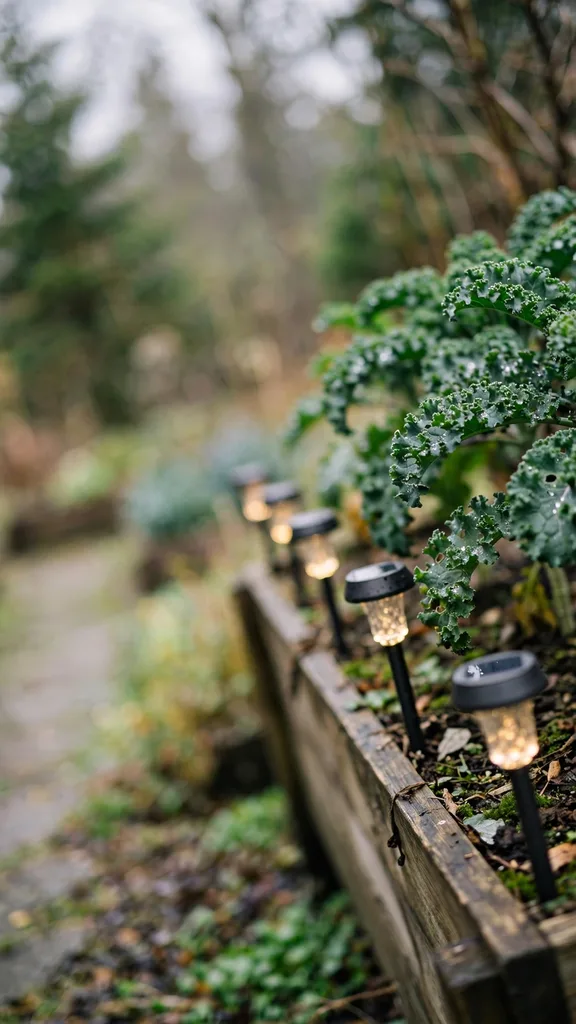
Bed edge lights also mark the working garden for the evening harvest, a torch you do not have to hold, and their panels want wiping clear of mulch splash after rain, since a wiped panel charges like a new one.
6. Lights at the Tree Canopy’s Sunny Edge
Hang solar lanterns or string lights at the sunny edge of a tree’s canopy rather than deep inside it, where the panels can see the sky. The light still glows among the branches, but the charge comes from the edge, and December cannot afford generosity with shade.
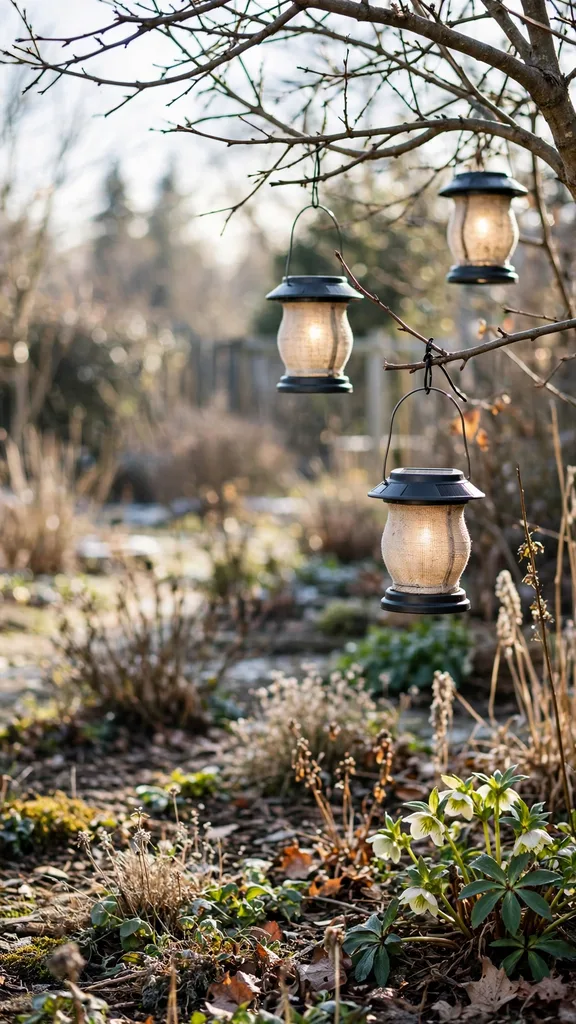
Bare winter branches shade less than summer canopies, which is the outdoor tree’s solar advantage. The technique and safety of lighting the living tree itself are covered in christmas lights on living plants, this list’s companion for everything with a plug or a panel near bark.
7. Clearing the Panel: Snow, Leaf, and Frost Duty
A solar panel under a leaf, a film of frost, or an inch of snow charges nothing, so the winter solar garden has a small daily chore: brush the panels when you pass. It takes seconds per light and doubles many displays’ run time in the darkest weeks.
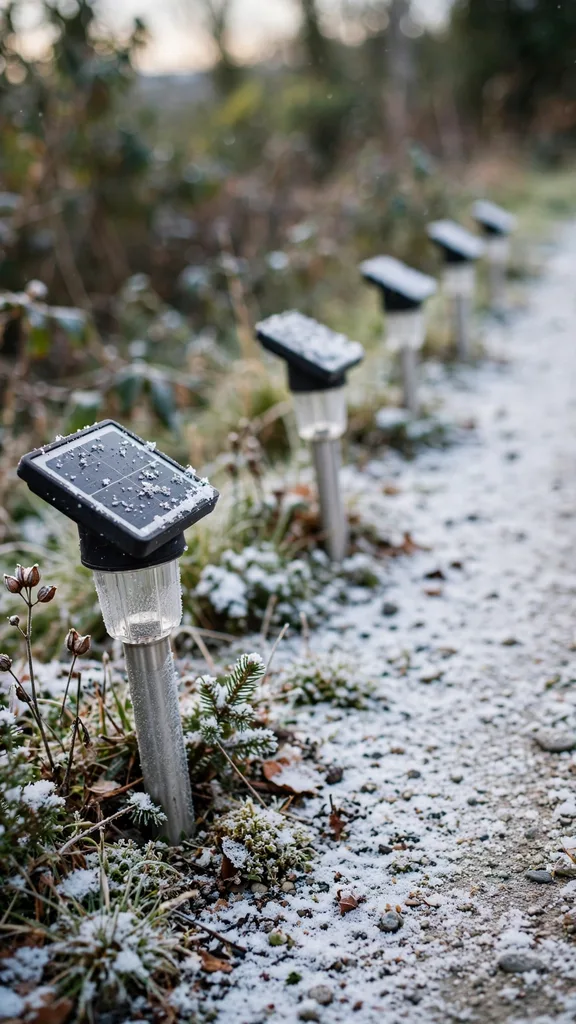
After snow, clearing the panels is the first garden job, before the path. A soft brush lives by the door for the season. Solar lights do not fail in December nearly as often as they are left dirty, which is good news disguised as a chore.
8. Map Your Garden’s Winter Sun First
Spend one bright November day noting where the sun actually falls at 10, noon, and 2, and place every solar light by that map. Winter sun reaches places summer shade forgets and misses places summer gardeners assume, because the sun’s whole path sits lower and further south.
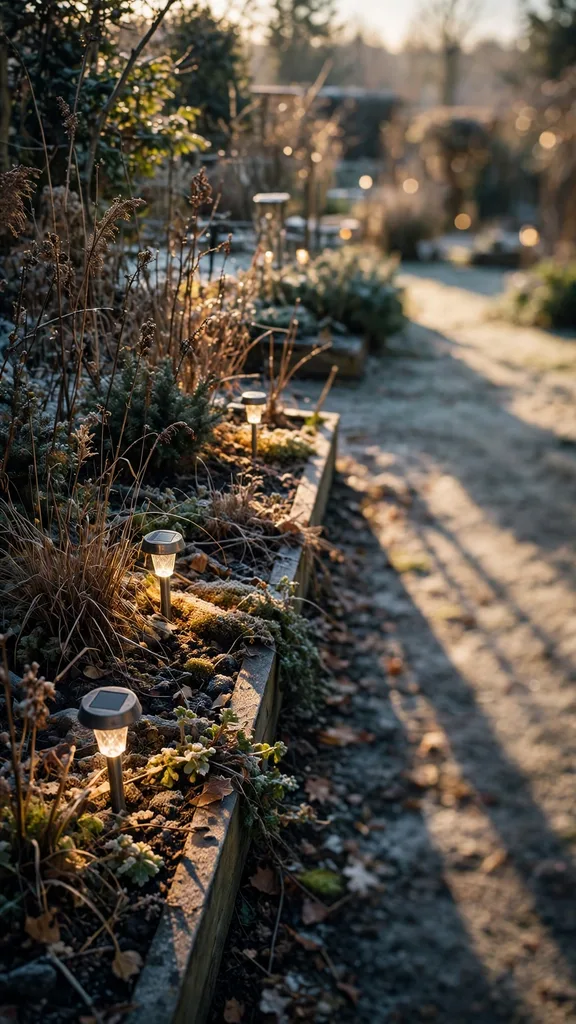
The map takes an hour and governs every placement in this list. I redraw mine every few years as trees grow, since a garden’s bright hours move as its canopy does. Solar decorating without the map is guessing with batteries.
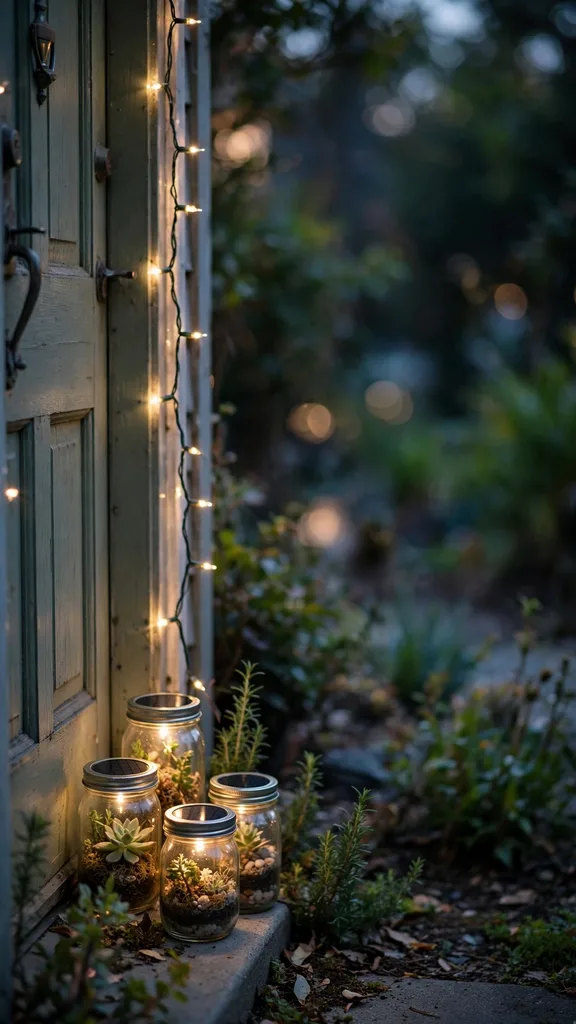
9. Solar Lantern Jars on the Porch
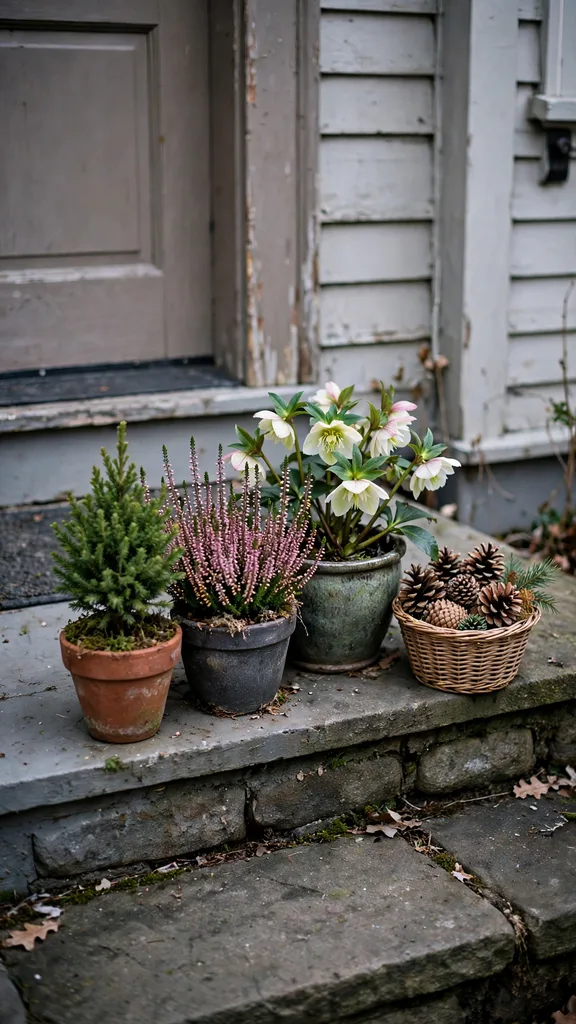
Set solar lantern jars, or jars fitted with solar lids, along the porch and the steps, filled with a few cones or evergreen tips so they glow as specimens by day and lanterns by night. The porch’s shelter keeps their panels cleaner than any in the open garden.
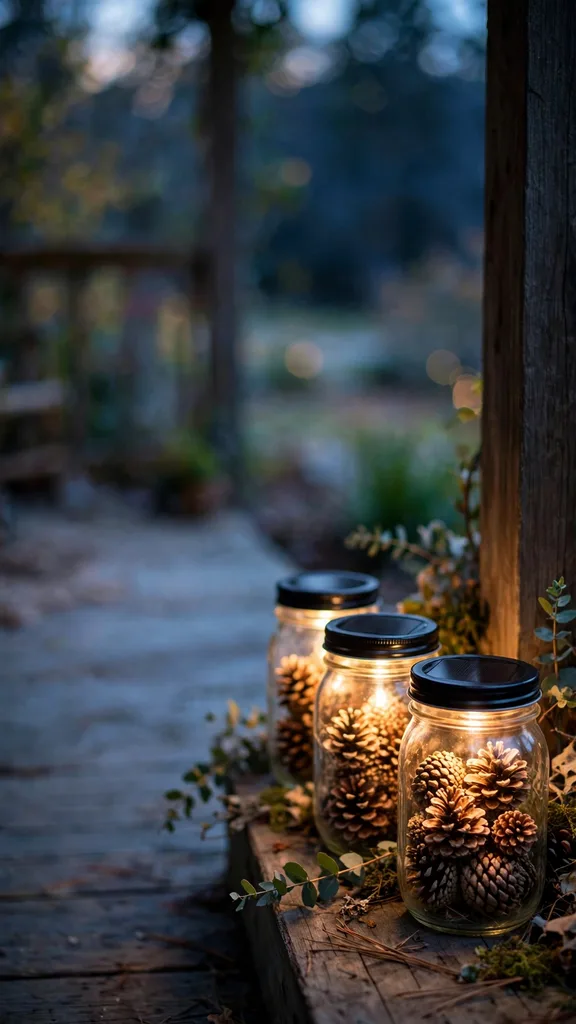
Jar lanterns charge on the porch rail where the sun reaches and glow where they stand; no carrying in and out. Group them in threes for a designed look. They are the gateway solar light: cheap, pretty, and honest about their limits.
10. Solar Micro Lights in the Evergreen Swag
Thread a solar micro light string through the door swag or a porch garland and its tiny panel hides in the greens by day while the lights star the arrangement by night. Micro lights weigh nothing, so the swag hangs as it always did.
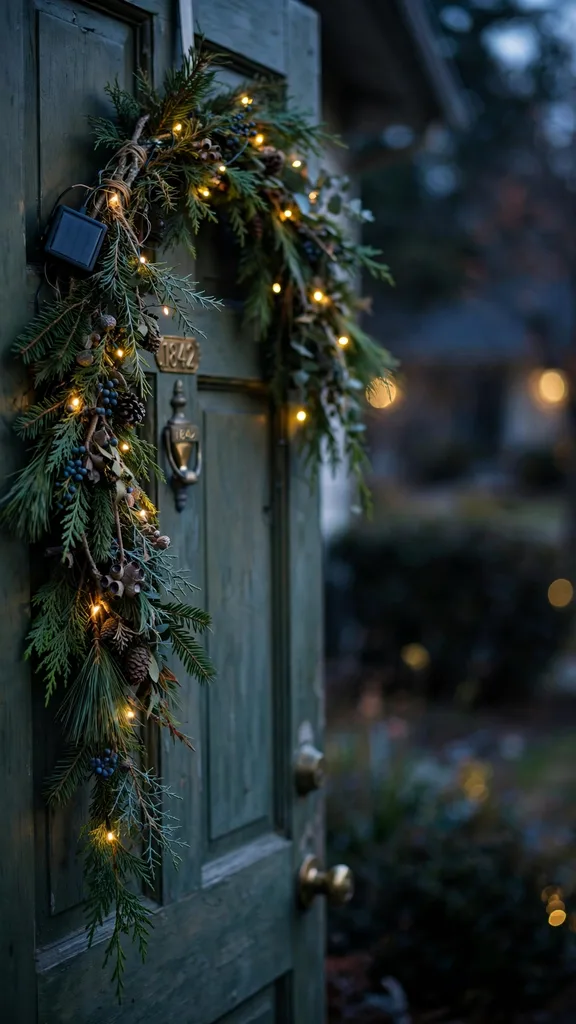
Site the panel at the swag’s sunniest edge, facing out. A swag on a shaded north door will not charge its own panel; give that door a string whose panel leads around the corner to the sun, or accept a battery string there and solar everywhere else.
11. Solar String Lights on the Garden Arch
Drape solar string lights over the garden arch or arbor and the entrance glows against the winter garden beyond it. The arch is high, open to the sky, and usually in the garden’s brighter half, which is everything a solar string asks.
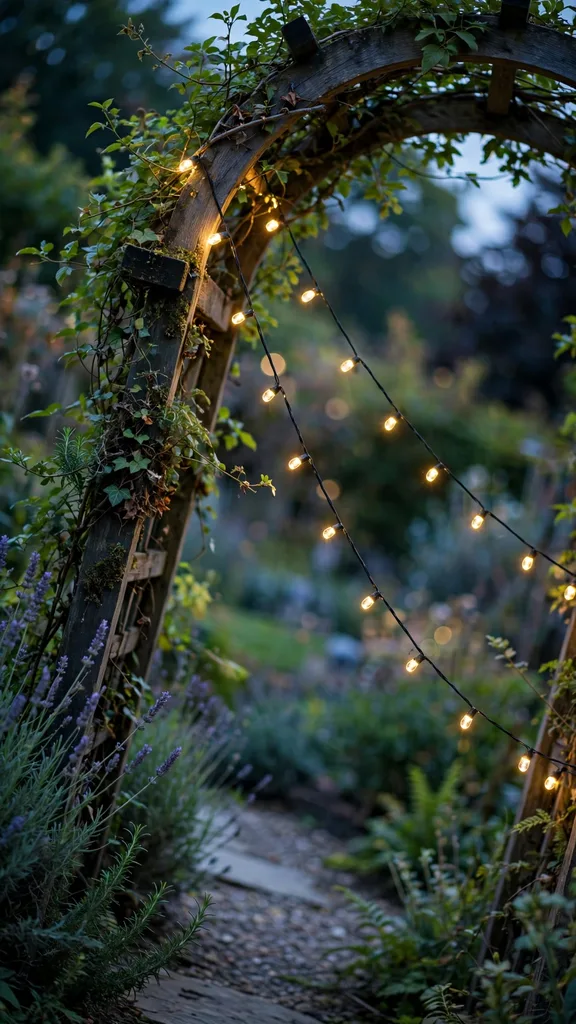
Run the panel to the arch’s sunny post at head height, where it can be wiped clean. An arch lit from dusk makes the whole garden beyond it look deeper and larger, the cheapest landscape lighting effect there is.
12. Lit Pinecone Baskets
Nestle a small solar light or a short micro string among the cones in the doorstep basket and the basket glows from inside its own material. Cones around a light look like a fire’s memory, which is the porch’s coziest effect at the cost of one small light.
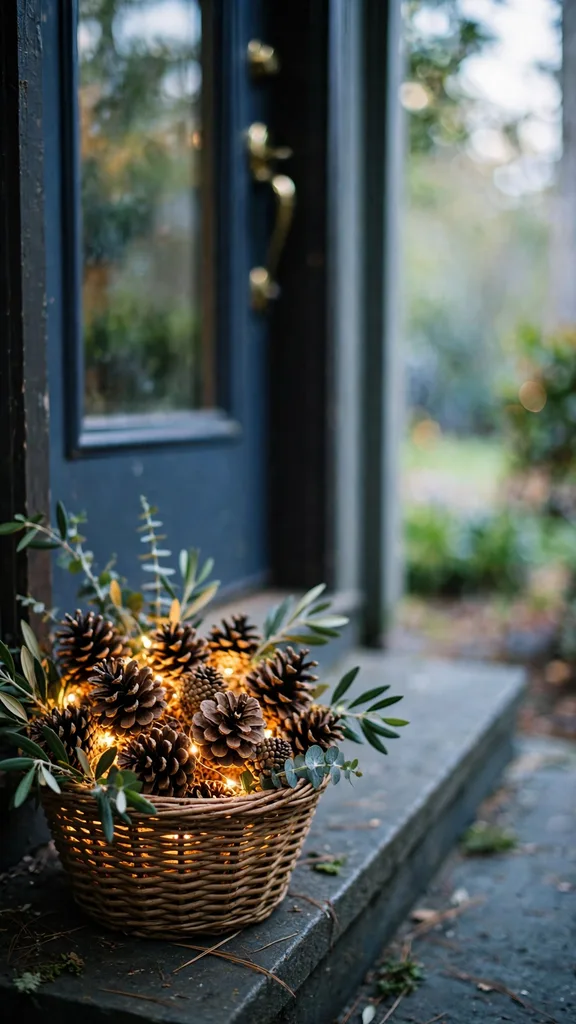
Keep the panel peeking out of the basket’s sunny side. The basket sits by the door where its glow is seen at every arrival. It is the display most likely to be copied by neighbors, being one basket and one light deep.
13. Solar Light at the Log Stack
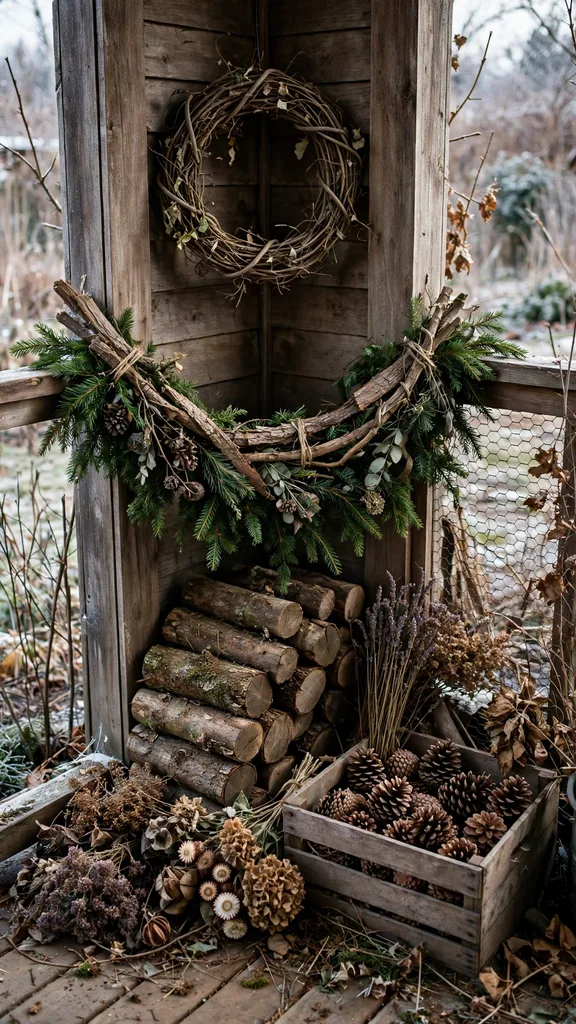
Set a solar lantern or a spot at the log stack’s edge and the winter fuel store becomes a lit feature, its rounds and bark glowing under a warm beam. The stack is by the house, usually in decent light, and already the porch’s biggest texture.
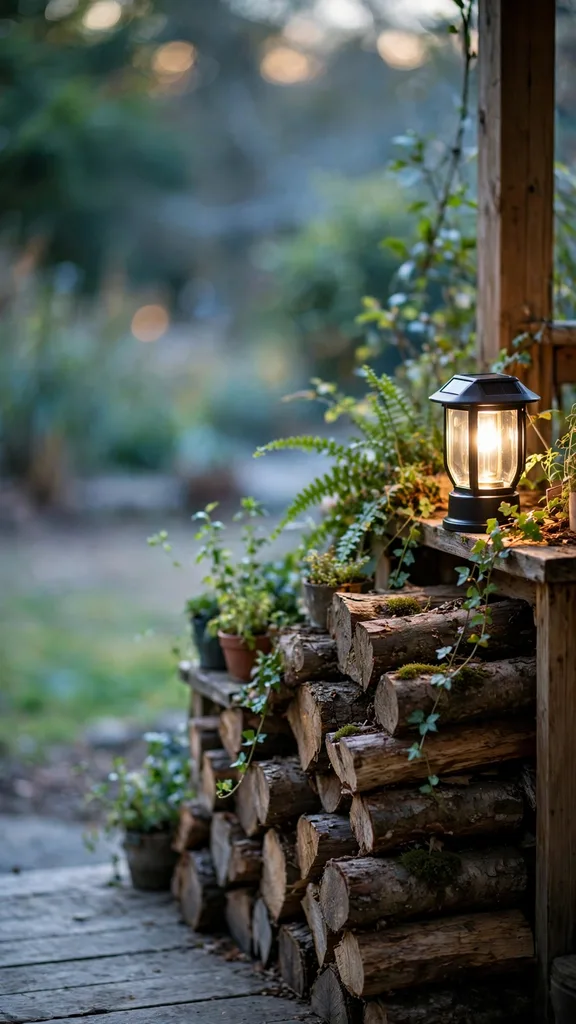
A spot aimed along the stack’s face rakes light across the log ends and doubles the effect. Keep the light clear of the working side where logs are pulled. Even a fuel store can hold a place in the display if it is lit like one.
14. Glowing Orbs Among the Winter Beds
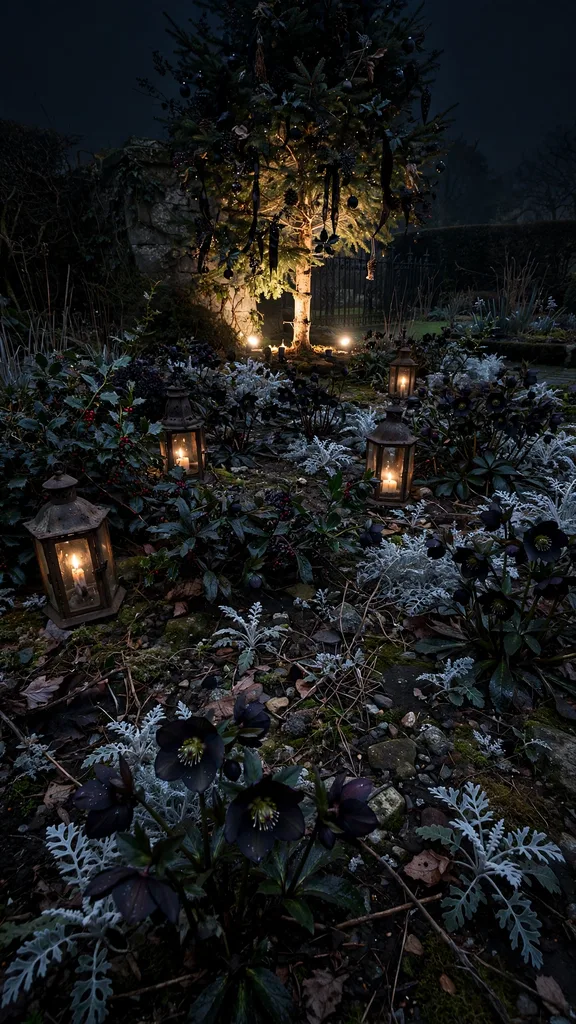
Place solar orbs or globe lights among the winter beds, where they sit like moons fallen into the planting and glow from dusk among the seed heads and evergreens. Orbs are the modern solar piece, and a winter bed is their best setting, all structure and silhouette.
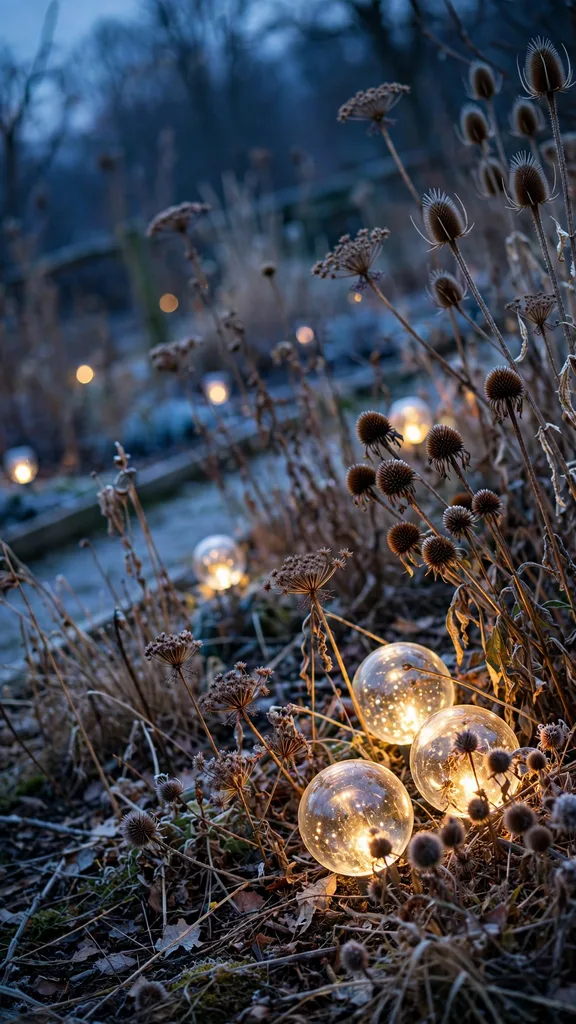
Orbs charge where they sit, so their bed must have bright hours. Two or three orbs in a rhythm beat a scatter of ten. In snow they glow through a dusting and look like the garden is dreaming, which in December it is.
15. Solar Fairy Lights in Bare Shrubs
Wind solar fairy lights through bare shrubs by the door and along the front beds, where the branches’ structure carries the lights like a diagram of itself. Bare shrubs are the solar string’s winter gift: no leaves to shade the panel’s lead or hide the lights.
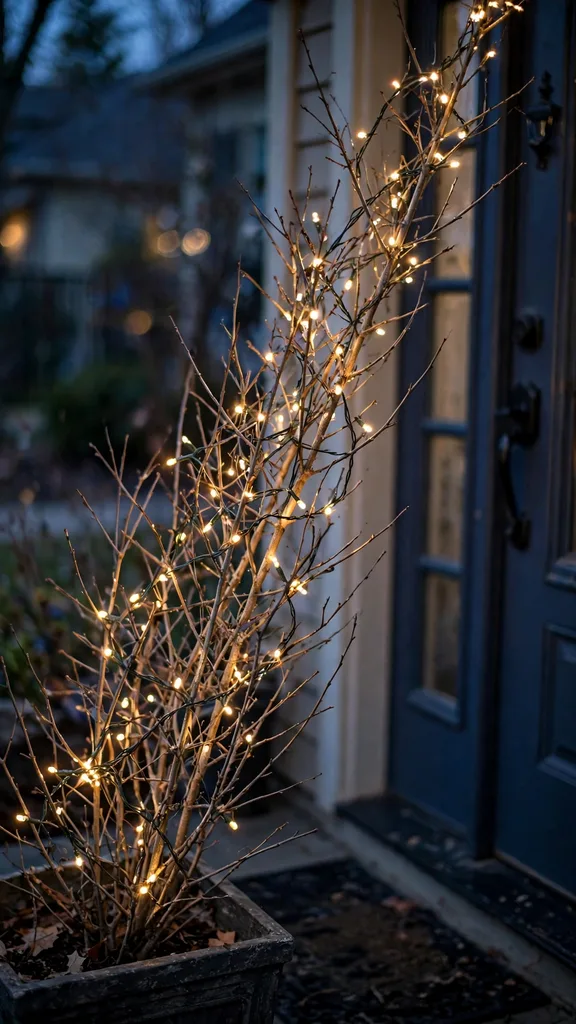
Keep the panel in the open at the shrub’s sunny side. A lit bare shrub doubles the winter garden’s perceived planting, since a shrub you can see at night counts twice. Choose warm white for shrubs; colored light on bare branches reads as a fairground.
16. Lit Window Box From a Solar Spot
Aim a solar spot from the ground or the sill at the winter window box and the box’s evergreens and pansies glow against the house after dark. A lit window box frames the window from outside and doubles the room’s sense of garden from inside.
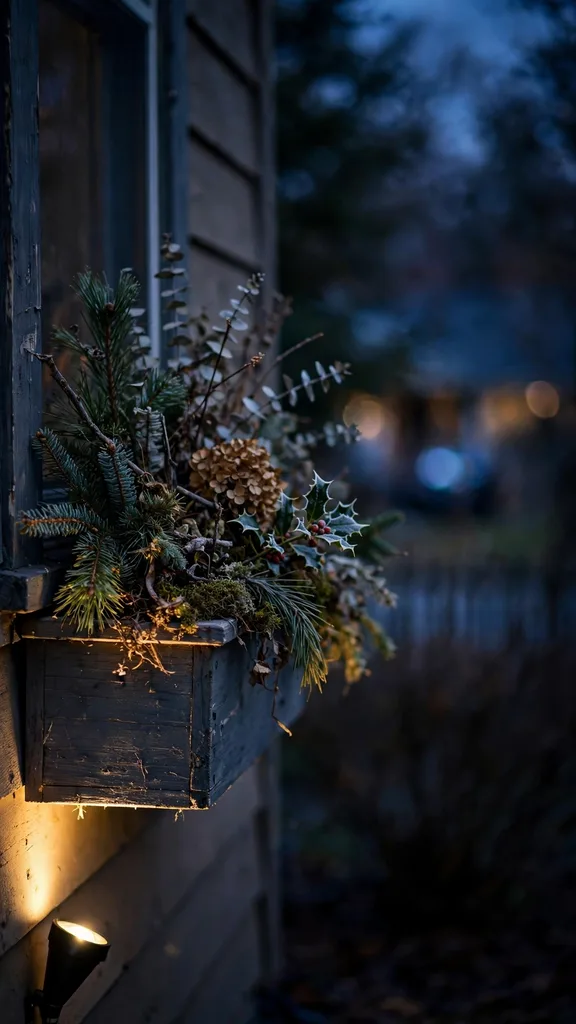
The spot’s panel needs the sill’s or the bed’s sunniest patch. This is the display for the house’s public face, the one the street sees, and it costs one spotlight and the box you already planted.
17. Solar Candles in Jars on the Outdoor Table
Set solar candles or tea lights in jars along the outdoor table for the winter meal’s lighting, charged on the table itself through the short day. Jars protect the flames that are not flames from the wind that would kill the real ones.
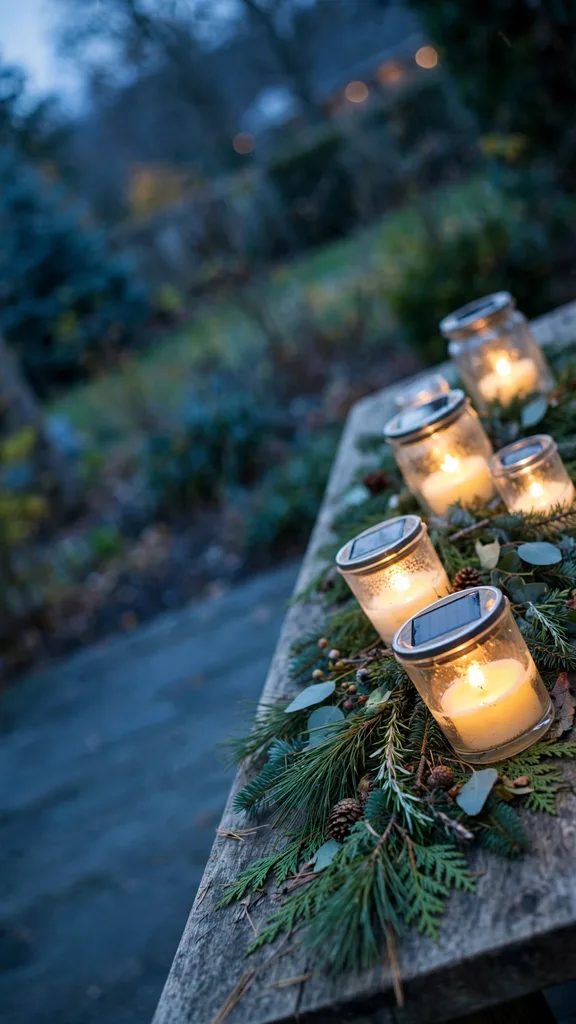
Table solar charges where the table stands, so a table in full shade needs its jars charged on a sunny sill and brought out, a small ceremony before the meal. The glow among the evergreen runner and the cones is worth the carrying.
18. Solar Lit Bird Feeding Station
Set a soft solar light near the bird feeding station, aimed away from the feeders themselves, and the evening garden gains a watched corner where the last feeders visit at dusk. The Penn State Extension guide to winter bird feeding grounds the station itself: black oil sunflower seed and suet are the menu that draws the widest range of winter birds.
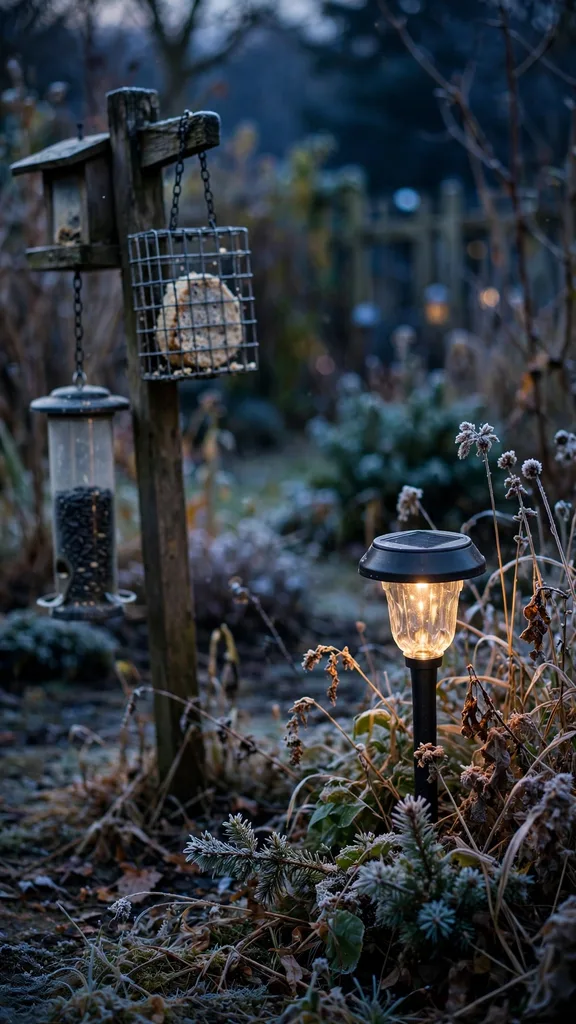
Keep the light gentle and off the feeders’ direct line; birds feed by daylight and the light is for the watchers, not the watched. A lit feeding station extends the bird show into the December dusk, which is when the house is finally sitting down to see it.
19. Solar Lights for the Gate and House Numbers
Light the gate and the house numbers with a solar spot or a lit lantern and the garden’s entrance works after dark: guests find the latch, deliveries find the number, and the house looks inhabited from the street.
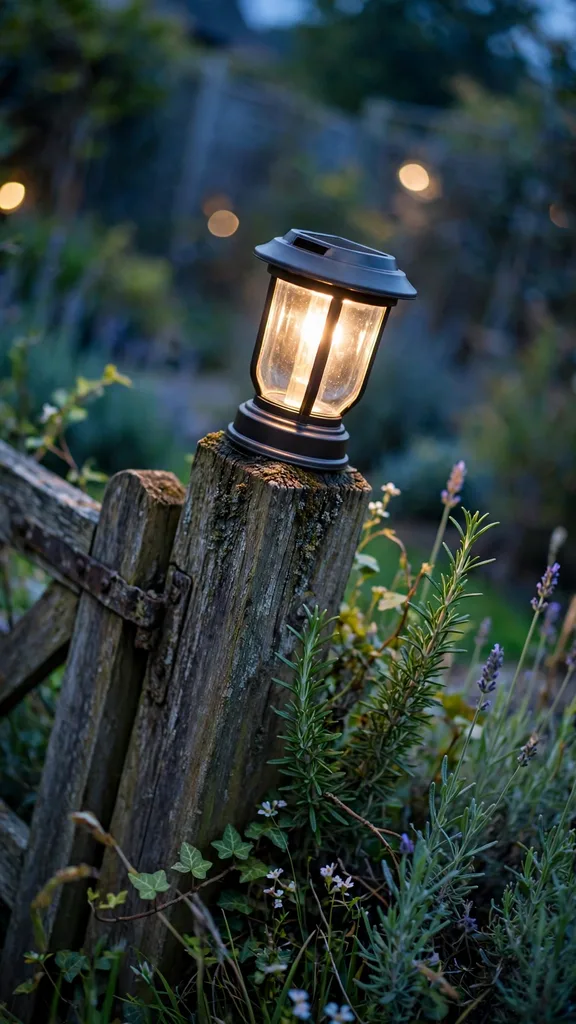
This is the practical display that justifies the decorative ones to the household’s accountants. Site its panel with extra care, since a gate light that fails at midnight fails at its only job. Reliability here is a placement problem, solved by sun.
20. Step and Stair Solar Lights
Set solar lights at the garden steps and the porch stairs, one per tread edge or a spot raking across them, and the winter garden’s level changes become safe and beautiful at once. Steps are where garden lighting earns its keep in the dark months.
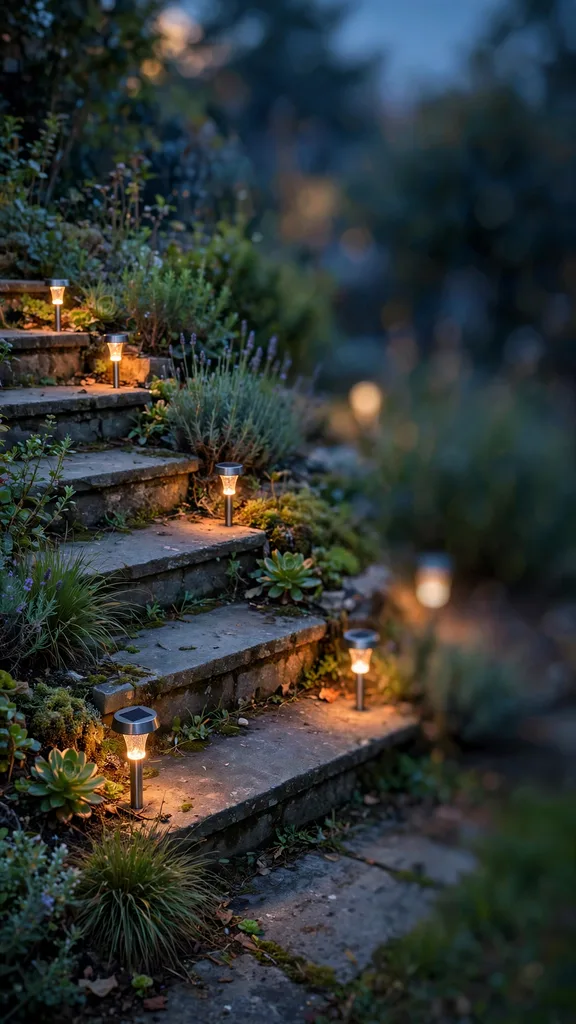
Step lights charge poorly in a stair’s own shade; spots aimed across the steps from a sunny post often work better. Test the arrangement on the darkest evening, not the brightest, since December’s 5 PM is the design condition.
21. Solar Spot on the Door Wreath
Aim a solar spotlight at the door wreath from a pot or the path and the wreath becomes the house’s lit portrait after dark. One spot, one wreath, and the whole front of the house has a focal point that costs no wiring.
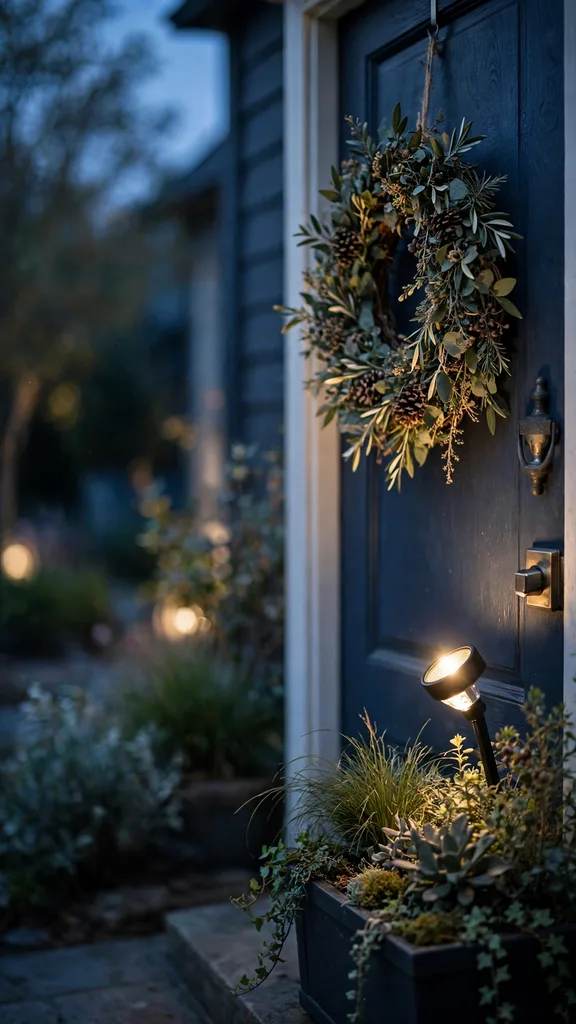
The spot can hide in the doorstep planter it also lights. Aim it slightly from the side so the wreath’s texture shadows. A lit wreath photographed from the street is the house’s Christmas card, taken by the garden.
22. Lit Mailbox Post
Wrap the mailbox post with a small solar string or set a lantern on its cap and the furthest point of the property joins the display. The mailbox is seen by more people than any other part of the garden, which argues for lighting it.
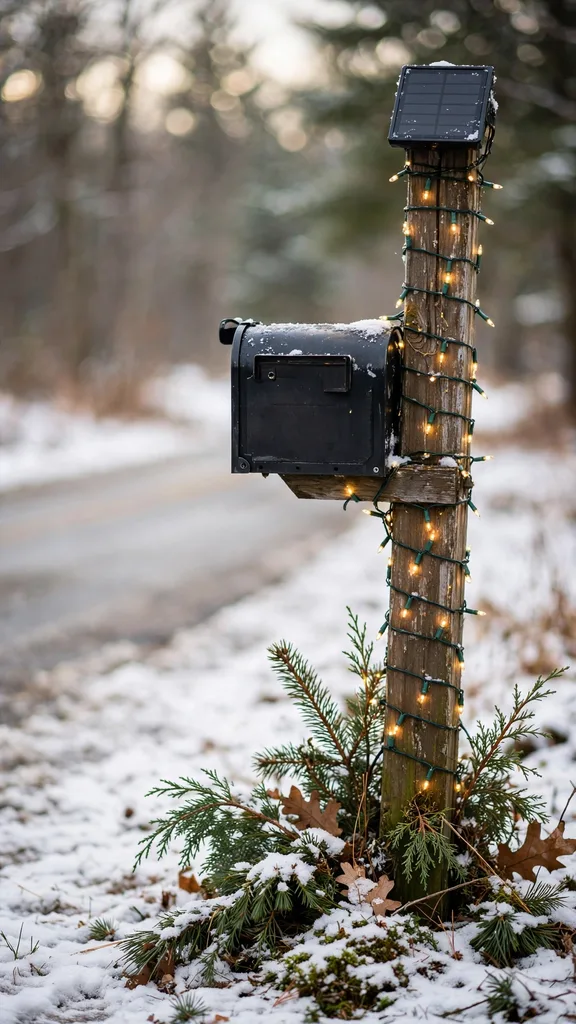
Mailbox posts usually stand in open sky by the road, the best charging site on the property. Keep the flag and the door clear of lights and wire. A lit mailbox in snow is the street’s landmark for the season.
23. Solar Lanterns on Shepherd’s Crooks
Hang solar lanterns from shepherd’s crooks along the path and over the beds for lantern light at head height that moves with the seasons. Crooks push in anywhere, so the lantern row can follow the winter garden’s best line rather than the path’s.
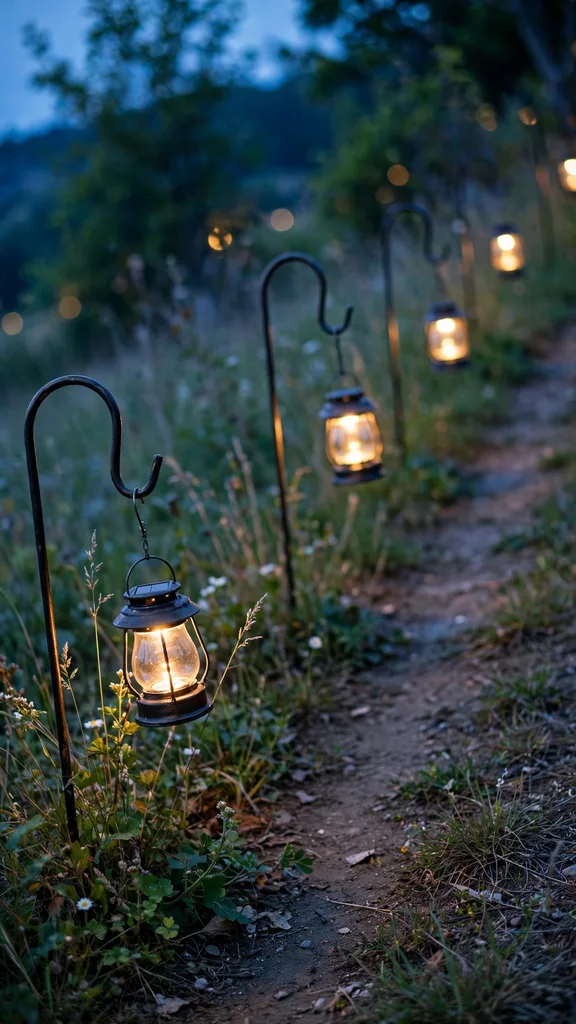
Lanterns charge hanging in the open, their tops to the sky, which suits December better than ground stakes in shade. Space them by their light pools, not by the tape measure: where one pool ends, the next crook goes.
24. Solar Discs Set Into the Lawn Path
Set flat solar discs along a lawn path or stepping stone route and the way glows at ground level, each disc a small moon underfoot. Discs suit the informal garden where a stake row would look like an airport.
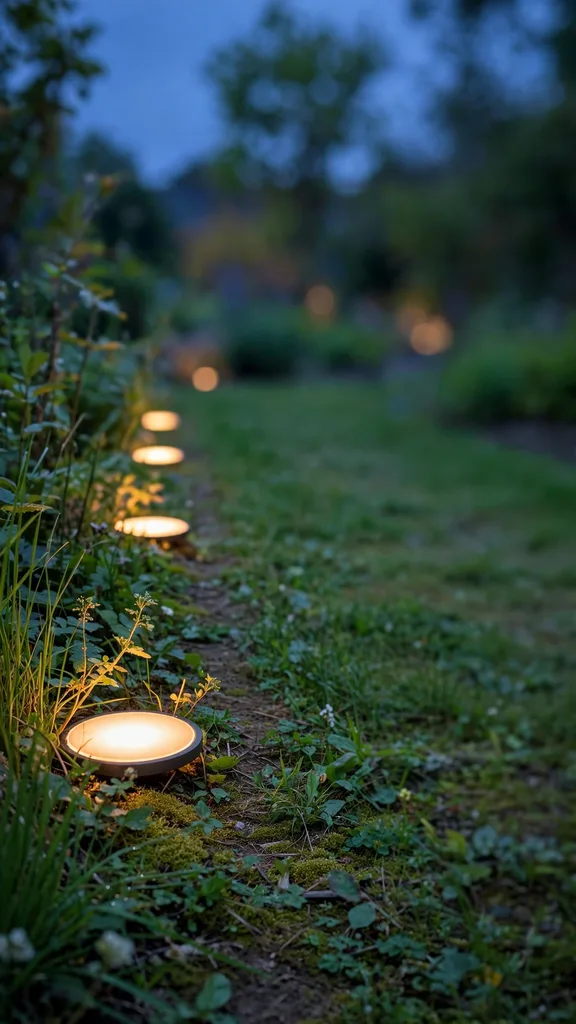
Discs charge flat to the sky, so their path must be an open one, and they need lifting before mowing in spring, though December’s grass asks little. In frost they glow through a white edging like stepping stones on a pond.
25. Greenhouse and Cold Frame Glow
Set a solar lantern inside the greenhouse or cold frame and the structure glows at dusk like a small lit house in the garden. The glass that grows the plants also displays the light, and the frame’s silhouette becomes a feature.
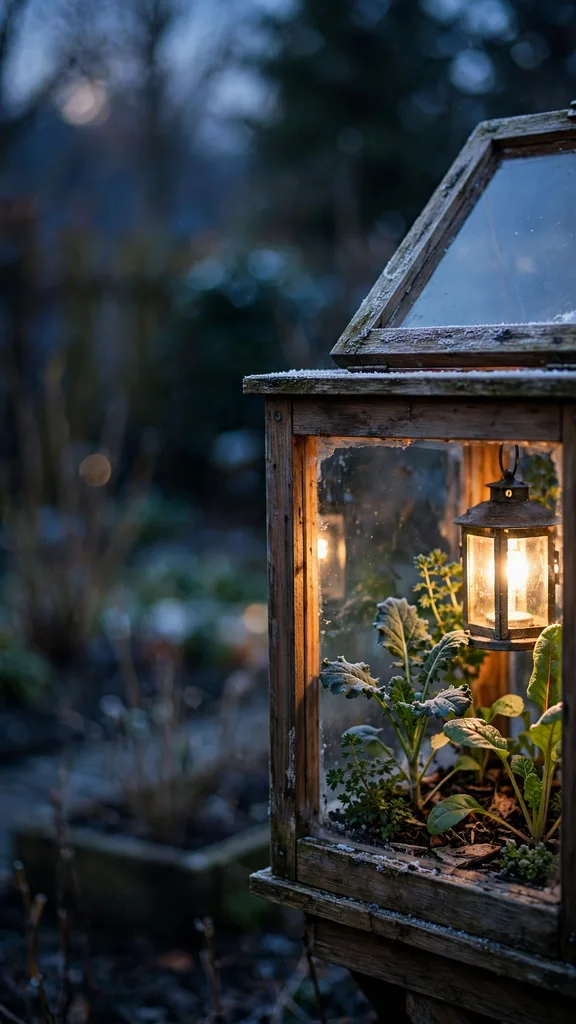
The panel charges outside the glass or on the frame’s sunny side, since glass and plastic cut the charge. A lit cold frame also tells you at a glance, from the house, that the vents and latches are as you left them, which is information disguised as beauty.
26. DIY Solar Jar Lanterns With Garden Fill
Make jar lanterns with solar lids and fill each jar with a few cones, a dried orange slice, or evergreen tips before setting them along the porch. The fill turns a plain solar jar into a specimen lantern, and every jar can hold a different piece of the garden.
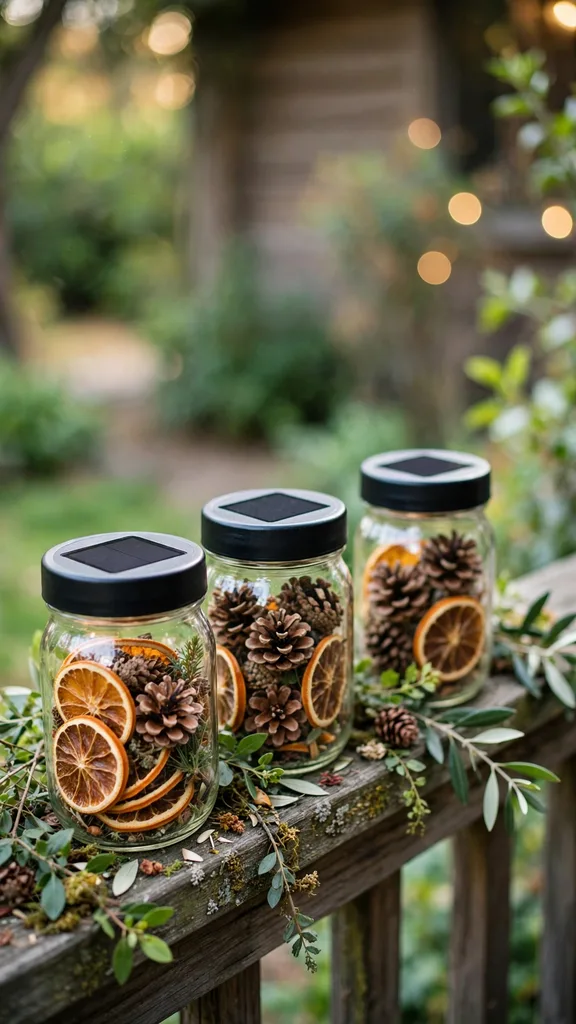
Use wide jars so the fill shows and the lid’s panel sits flat to the sun. These are the solar lights children can make and the ones guests ask about, being part lantern, part nature table.
27. Solar Bottle Lights in the Border
Push solar bottle lights, the cork shaped panels that fit a bottle’s neck, into colored bottles and set them in the border for a row of glowing glass among the winter plants. Old bottles from the recycling become the border’s jewels for the price of the corks.

Bottles charge where they stand, panel up in the neck, so give them the border’s sunny gaps. Green and amber glass glow warmest. A bottle row is the upcycled display that looks intentional rather than improvised, provided the bottles match in size if not in color.
28. Upcycled Tin Can Solar Lanterns
Punch patterns in tin cans, fit them with small solar lights or set them over solar pucks, and hang or stand them as lanterns with patterned light. The cans’ punched stars and dots throw the garden’s cheapest light show onto paths and walls.
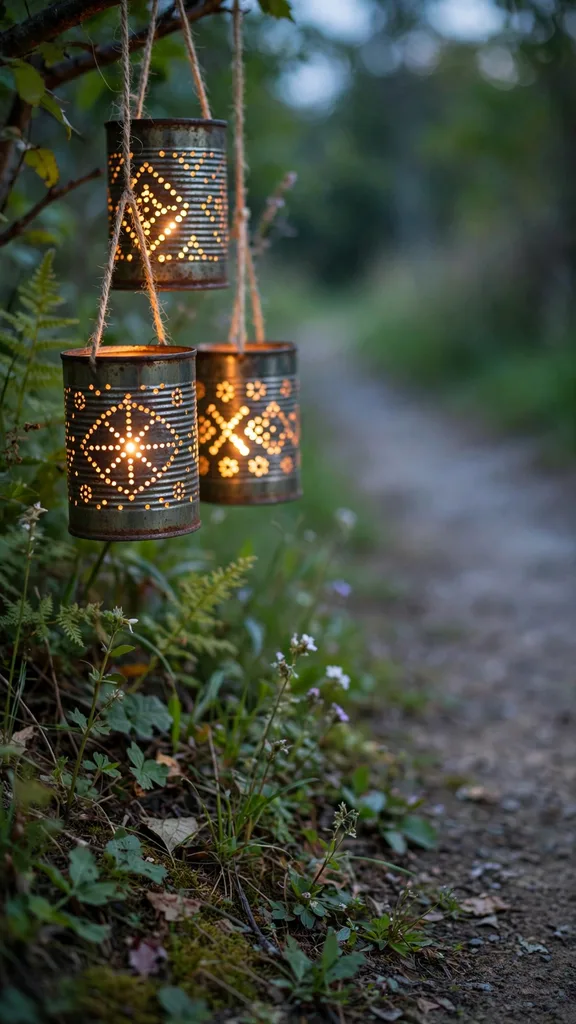
File the punched edges smooth and keep the solar puck’s panel clear at the can’s top. Tin lanterns suit the rustic scheme, being the shed’s materials lit. They last seasons if stored dry, unlike most of December’s purchases.
29. Solar Chandelier Ring Over the Table
Hang a ring or a branch above the outdoor table fitted with solar jar lights and micro strings for a chandelier that charges on the pergola all day and glows over the winter meal. It is the outdoor room’s ceiling light, with the sky as its power station.
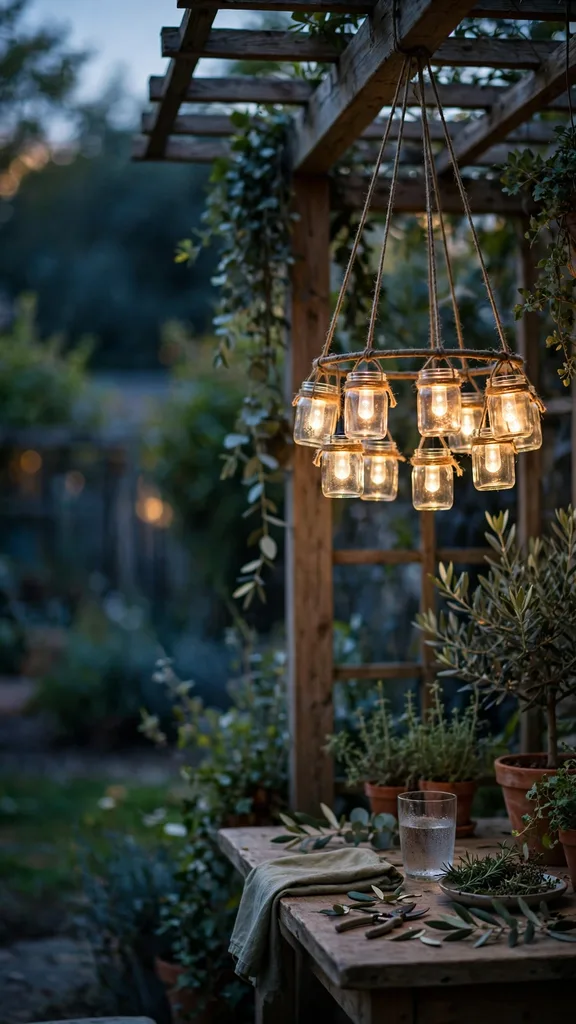
The ring’s panel or the jars’ lids need the day’s sun where they hang; a pergola in open sky is ideal. Over a table, solar light has no cable to drape and no socket to weatherproof, which is why the idea belongs to solar and to no other power.
30. A Collection of Solar Lids and Jars
Build a small collection of solar lids that fit standard jars and rotate them through the garden’s jars, vases, and bottles as displays change. The lids are the system; the vessels are whatever the house and garden provide, which makes the collection endlessly re-dressable.
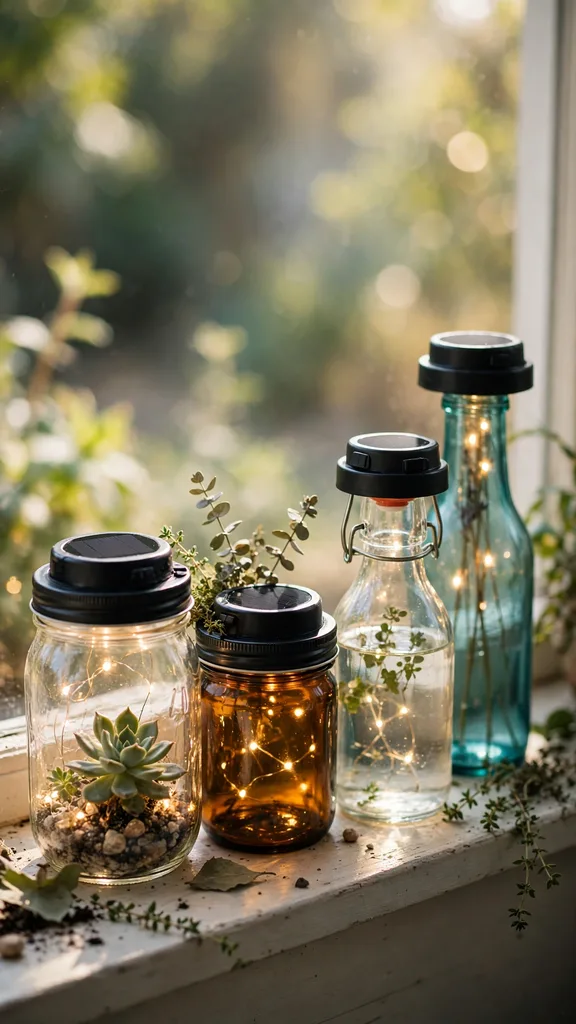
Store the lids charged and clean, and they are ready for any vessel in a minute. A lid collection is the thrifty solar strategy: buy the light once, borrow the lantern from the recycling forever.
31. Charge the Spares: A Sunny Sill Battery Bank
Keep spare solar lights and lids charging on the sunniest indoor sill or the greenhouse bench, and swap them into shaded displays as the in place ones fade. A rotation bank turns December’s weak sun from a limit into a logistics problem, and logistics can be solved.
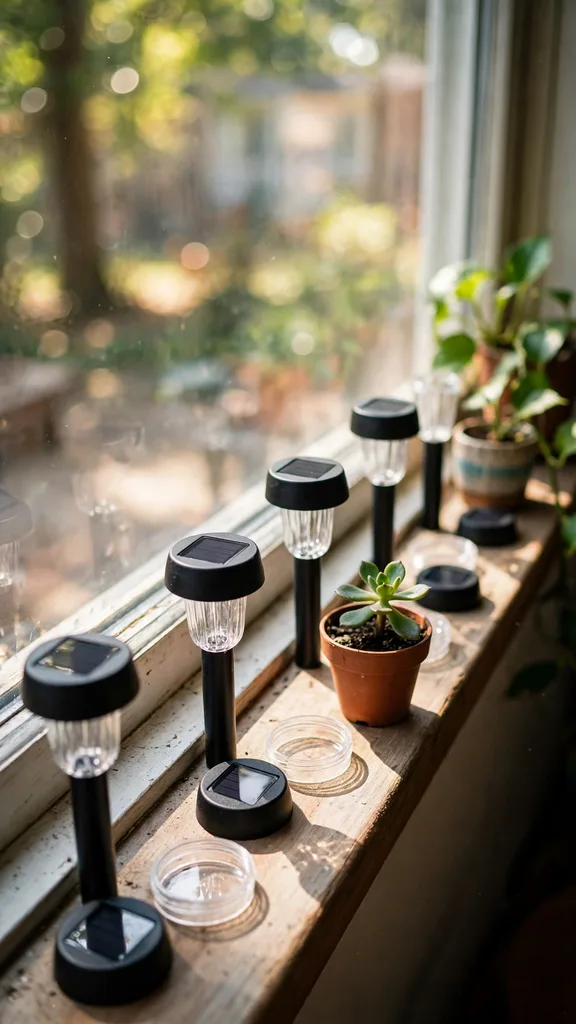
Label the spares by their display so the swap takes a minute. Two sets for the darkest displays, the door swag and the shaded arch, keep them lit all season. The sill bank is the solar garden’s power station, disguised as a windowsill of jars.
32. Hybrid Backup for the Darkest Weeks
Accept that the week around the solstice defeats some placements, and back the key displays, the door, the steps, the gate, with battery or mains versions for that week while the solar set rests and charges. The CPSC holiday safety center publishes the season’s electrical safety guidance, which the plugged backups should follow as strictly as any indoor light.
A hybrid plan is not a failure of solar; it is December at a northern latitude, described honestly. The solar displays return as the days lengthen in January, which is a small celebration of its own, marked in light.
33. Audit the Shade: Bare Trees Still Shade
Re-audit every panel’s shade in December itself, since bare trees, fences, and the house still cast long shadows at the low sun, and a panel in a branch’s lacework may see the sun for an hour a day. Shade that did not exist in June is December’s main crop.
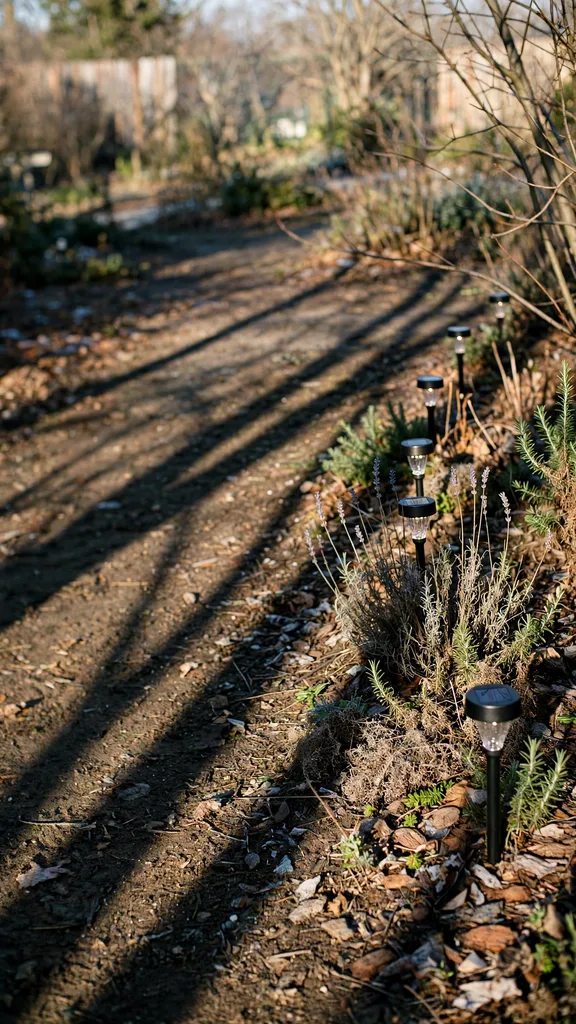
Move the starved lights rather than blaming them; most solar disappointment is a placement error wearing a product’s name. The audit takes one bright day and a notebook, and it is the highest value hour in the solar garden’s year.
34. Group Dim Lights for Impact
One small solar light alone looks apologetic; five of them in a rhythm look like a design. Group solar lights in clusters, rows, and repetitions so their modest individual glows add up to a scheme, and place single lights only where a spot’s beam does the work.
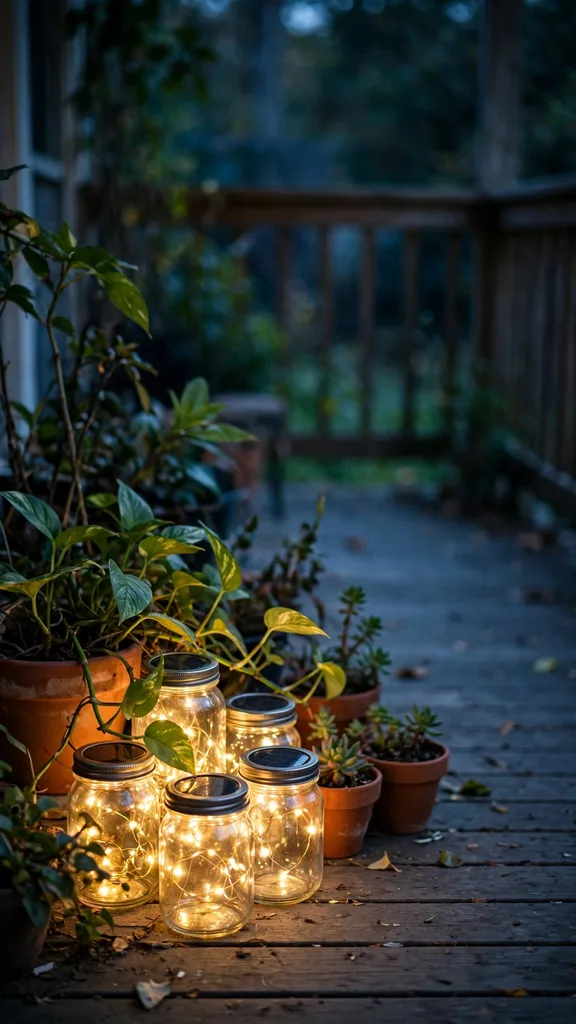
Repetition is the solar garden’s amplifier. A row of jar lanterns, a cluster of orbs, a fence of stakes: the eye reads the pattern, not the wattage. Buy solar lights in sets with this in mind, since a set is a scheme and a single is a sample.
35. Warm White for Garden Materials
Choose warm white solar lights for displays among garden materials, since warm light flatters wood, cones, evergreens, and brick, while blue white makes the garden look like a car park and colored light turns it into a fairground. One color temperature across the garden unifies every display in this list.
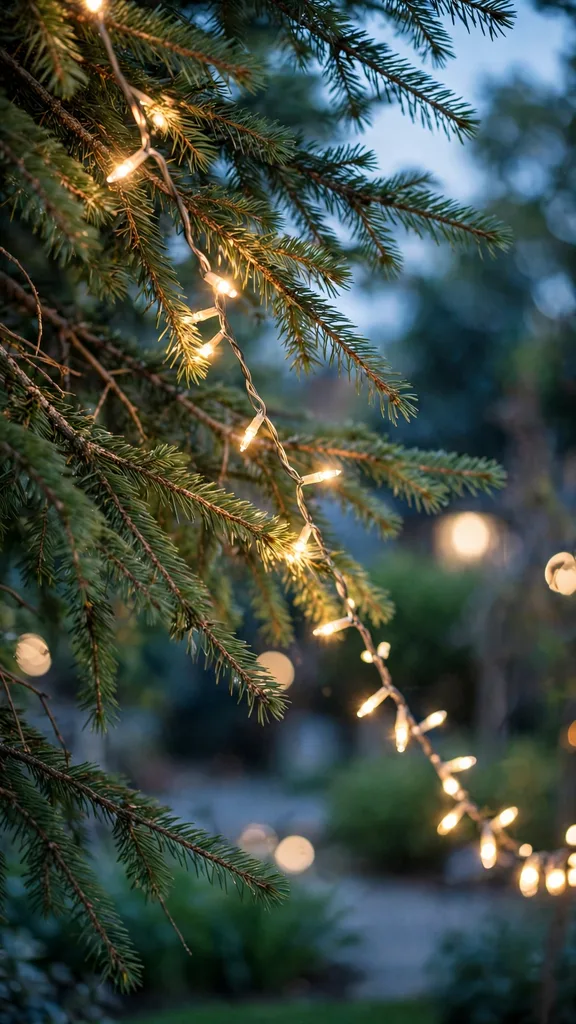
Check the color before buying the set; packaging photographs lie cheerfully. A single cool white string among warm ones will draw the eye all season for the wrong reason. Consistency is the cheapest polish the solar garden can buy.
36. Timers, Motion, and Saving the Charge
Use solar lights with timers or dusk to dawn settings that match the household’s hours, and motion sensor spots at the gate and the bins, so the charge is spent when someone is there to see it. A light that burns at 3 AM for the foxes is a light stolen from the evening.
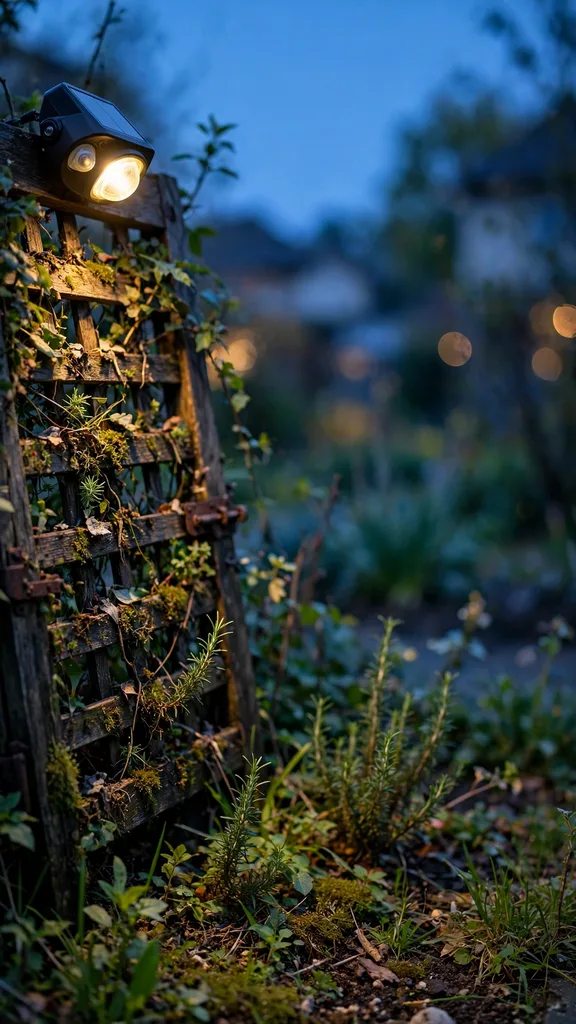
Six hours of evening light is the realistic December budget for a well placed light; plan the displays for the hours they will be seen. Motion spots at the working corners, steady glow at the showpieces: the budget spent by audience.
37. Clean Panels Monthly, Store Spares Charged
Wipe every panel monthly and after storms, and store spare lights and lids fully charged in a dry box, since a solar light stored flat and dirty wakes up in December already behind. Maintenance is the solar garden’s only running cost, and it is paid in minutes.
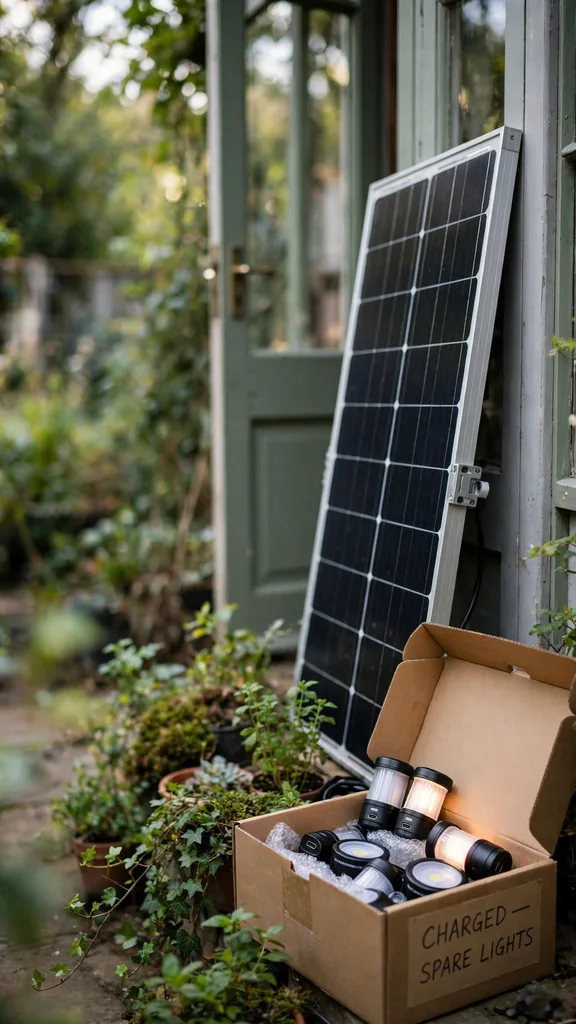
A stored light’s battery thanks you for a mid year charge too. The box of spares by the door, clean and charged, is what makes the rotation bank and the five minute refresh possible, which is to say it makes the whole system work.
38. Solar Lanterns in the Bare Fruit Trees
Hang solar lanterns in the bare fruit trees of the orchard or the espalier, where their branches hold the lights like a crop of small moons. Fruit trees stand in the garden’s most open ground, planted for sun, which makes them the best charging structures a garden grows.
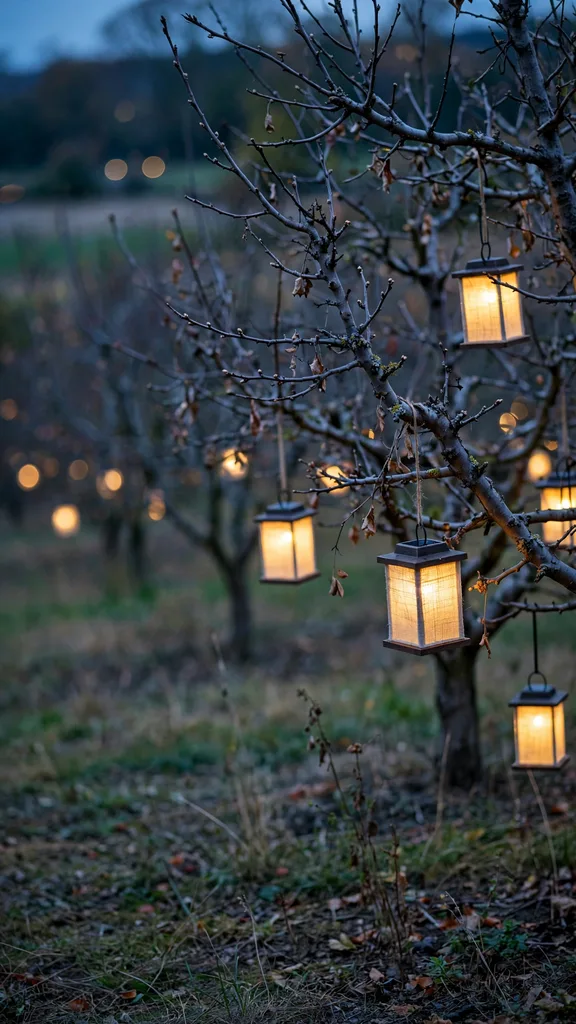
Hang the lanterns on the outer branches where their tops see the sky. An espalier against a sunny wall is the finest solar tree of all, panel wall and branches in the same sun. The orchard in lantern light is the winter garden’s orchard rent, paid in glow.
39. Test the Old Lights in November
Bring every solar light from last year out in November, clean its panel, charge it for two bright days, and leave it on for a night to see what it still has. Lights that fail the test are replaced or demoted to the rotation bank before the season depends on them.
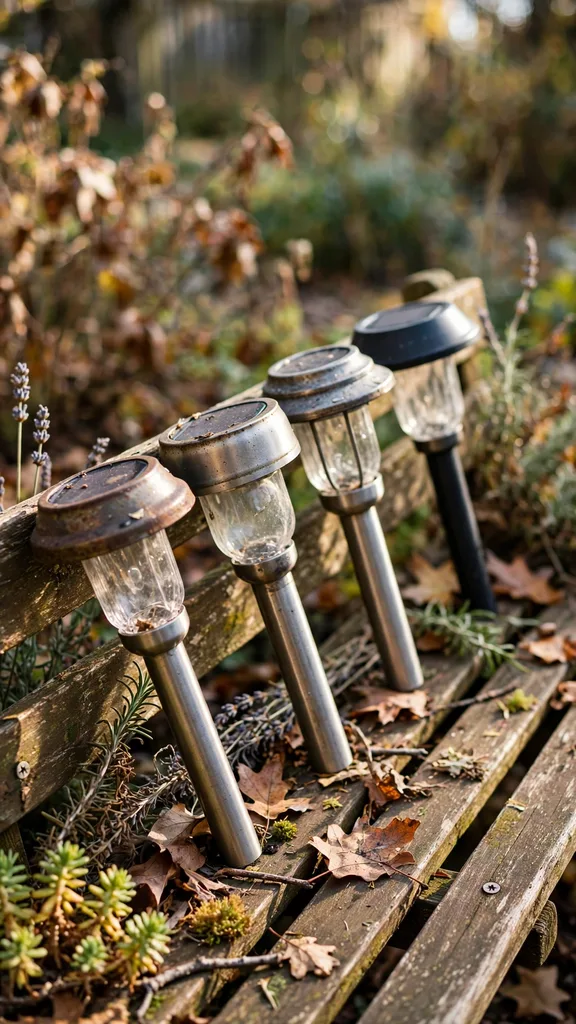
Most old lights pass; a dim one usually wants a clean panel or a new rechargeable battery, not a bin. Testing in November is what separates a system from a drawer of surprises, and it costs one bright weekend day.
40. The Solar Lit Evergreen Corner
Build one corner completely: an evergreen shrub in fairy lights, an orb at its feet, a lantern on a crook beside it, and a spot raking the wall behind, all solar, all placed by the sun map. A single finished corner beats a garden of scattered singles, and it is where the household will stand with hot drinks.
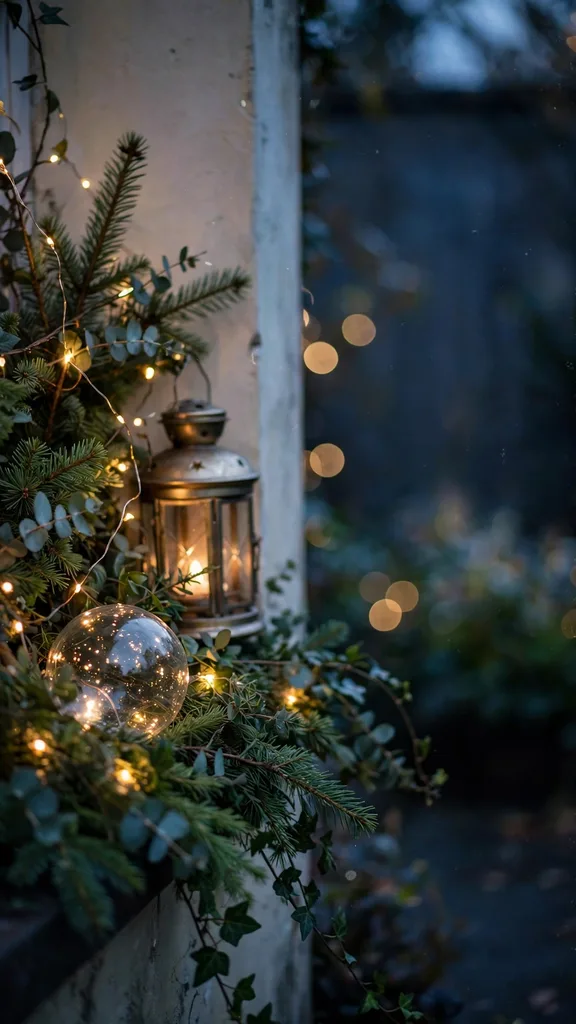
Corners against a wall gain the wall’s reflected light and shelter. Build the corner where the house’s main window sees it; the solar garden’s best audience is indoors, warm, looking out at the light they placed in the cold.
41. Solar Entrance: Gate, Arch, and Path Together
Light the whole entrance sequence in solar: the gate lantern, the arch string, and the path row, so arrival is a lit journey from street to door. Entrances are where solar’s wire free nature wins outright, since no cable crosses the path or the gate’s swing.
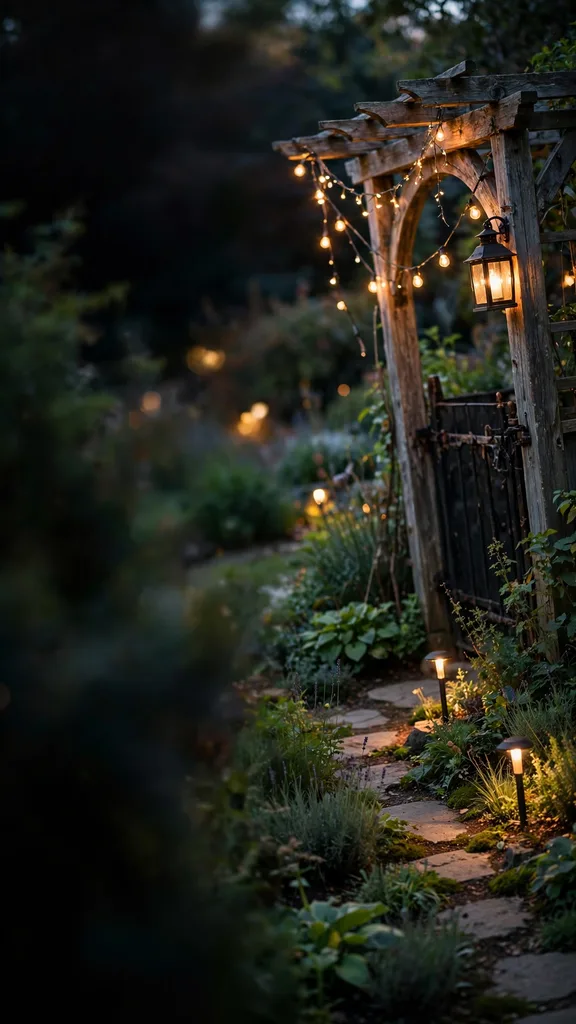
Place the three by the sun map as one system, since the gate’s sun and the arch’s may differ. A lit entrance is the display the household uses most and photographs least, which is the correct priority for working light.
42. Kitchen Garden Glow
Light the kitchen garden’s structure for winter: bed edge lights, a lantern at the cold frame, and a string along the herb bed’s fence, so the productive garden joins the display instead of going dark at 4 PM. The winter kitchen garden is all structure, and structure is what light loves.
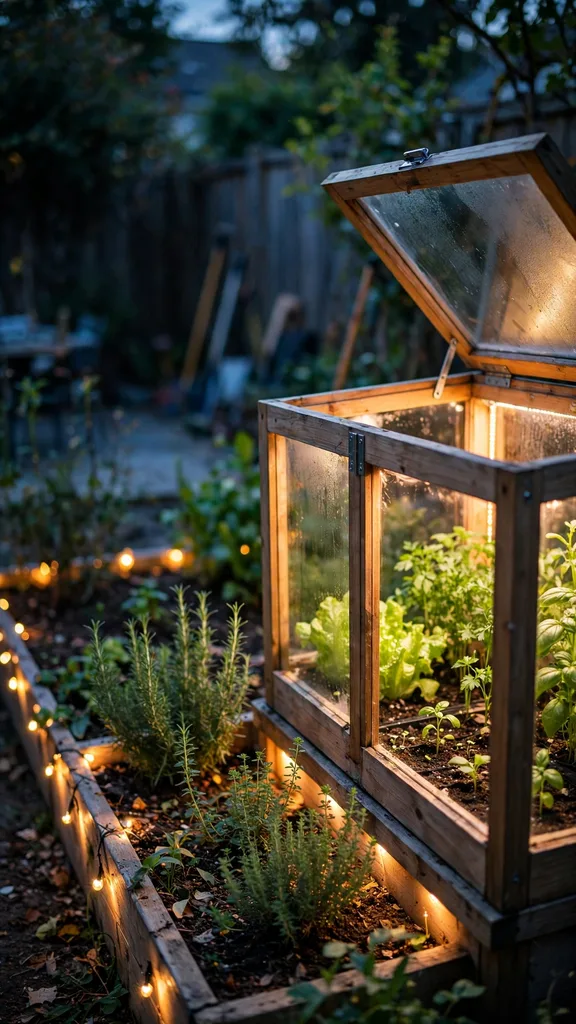
The glow also serves the cook, who harvests leeks and herbs at dusk in December. A lit kitchen garden is beautiful because it is useful, lit like a workshop and glowing like a display, which is the garden’s favorite combination.
43. Doubled Light: Reflections in Water and Glass
Place solar lights where water, a pond, a birdbath, or the house’s windows reflect them, and every light works twice. A single orb by the pond is two orbs; a jar row along the glasshouse is a double row, and the reflections move, which no bought effect matches.

Reflections need still air and dark surroundings, both of which December provides. Site the original light for its panel’s sun and let the reflection fall where it will. The doubled display is the solar garden’s dividend, paid nightly.
44. The Dark Corner Rescue: One Strong Spot
Every garden has a dark corner that swallows decorations; rescue it with one strong solar spotlight on the best plant or structure there, a berried shrub, a small tree, a stone feature. One beam in a dark corner is a stage, and the corner becomes the garden’s drama instead of its gap.
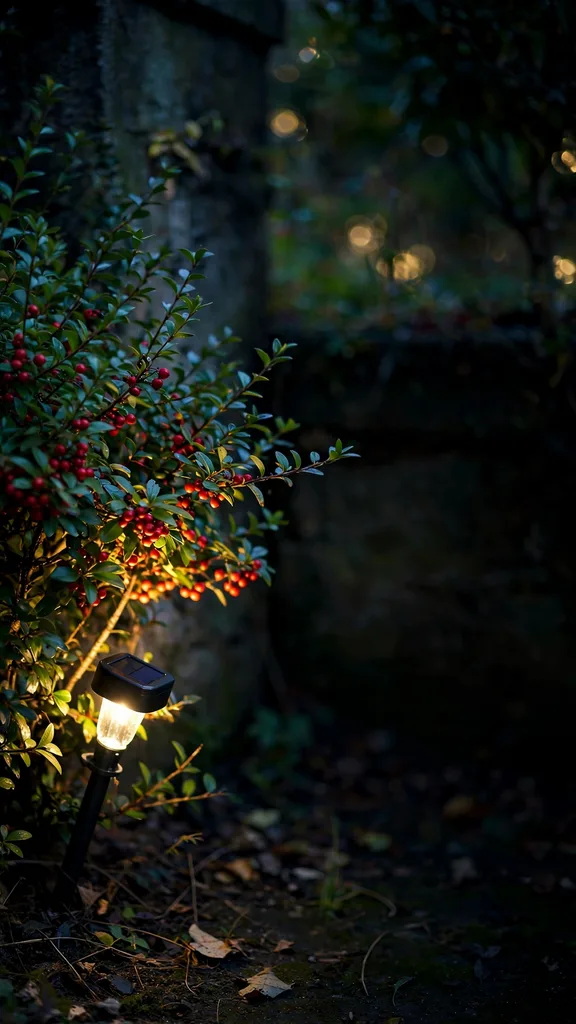
The spot’s panel may need to live elsewhere on a lead, in the sun the corner lacks. A rescued corner changes the whole garden’s night shape, since the eye travels between lit points and the dark between them becomes depth rather than neglect.
45. The Whole Solar Garden at Dusk: Every Light Placed by the Sun
Assemble the whole system at dusk: path row, arch, evergreen corner, orbs in the beds, jars on the porch, the gate and the steps lit, every panel placed by the winter sun map and every light warm white. The garden that was a charging problem in November is a lit landscape in December, powered by the shortest days of the year.
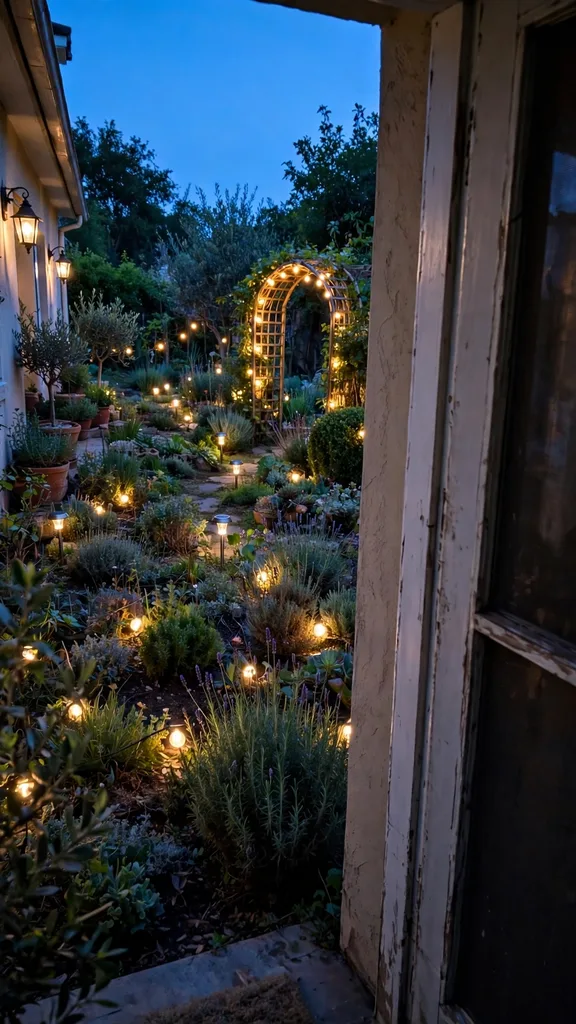
Walk it once on the darkest evening and move the two weakest lights to better sun; the system tunes itself by observation. The wider season’s displays gather in the Christmas garden ideas pillar, but this garden runs on daylight it collected itself, which no other display here can claim.
Frequently Asked Questions
Yes, with placement doing the heavy lifting. A panel in full winter sun, tilted toward the low sun and kept clean, charges enough for 5 to 8 hours of evening light even in December. A panel in shade, lying flat, or covered in frost and leaves may manage an hour. The difference between a solar garden that glows and one that disappoints is almost never the lights; it is where they were put in November.
Where the winter sun actually falls between 10 AM and 2 PM: the south side of paths, open fence lines, sunny walls, and the edges of beds and canopies. Map the garden’s bright hours on a sunny November day before placing anything, since the low sun shades places that are bright all summer, including spots behind bare hedges and under leafless trees, whose branches still cast long shadows.
Rotate them. Keep spare lights and solar lids charging on the sunniest sill or bench and swap them into the shaded displays every few days. Group lights so their combined glow reads as a design even at reduced hours, set timers to the hours the garden is actually seen, and back the essential lights, door, steps, and gate, with battery or mains versions for the solstice week without apology.
Warm white, everywhere, for consistency. Warm light flatters wood, brick, evergreens, and cones, and a single color temperature unifies separate displays into one scheme. Blue white light makes plantings look cold and institutional, and colored lights turn a garden into a fairground unless used with great restraint in one place. Buy sets in one color and check them lit before committing the whole garden to them.
Wipe the panels monthly and after snow or storms, since a dirty or covered panel charges little or nothing. Clear snow off panels before clearing anything else. Store spare lights clean and fully charged, with a mid year top up charge for their batteries. Solar garden maintenance is measured in minutes per month, and most failures traced to it are placement or dirt, not dead lights.