
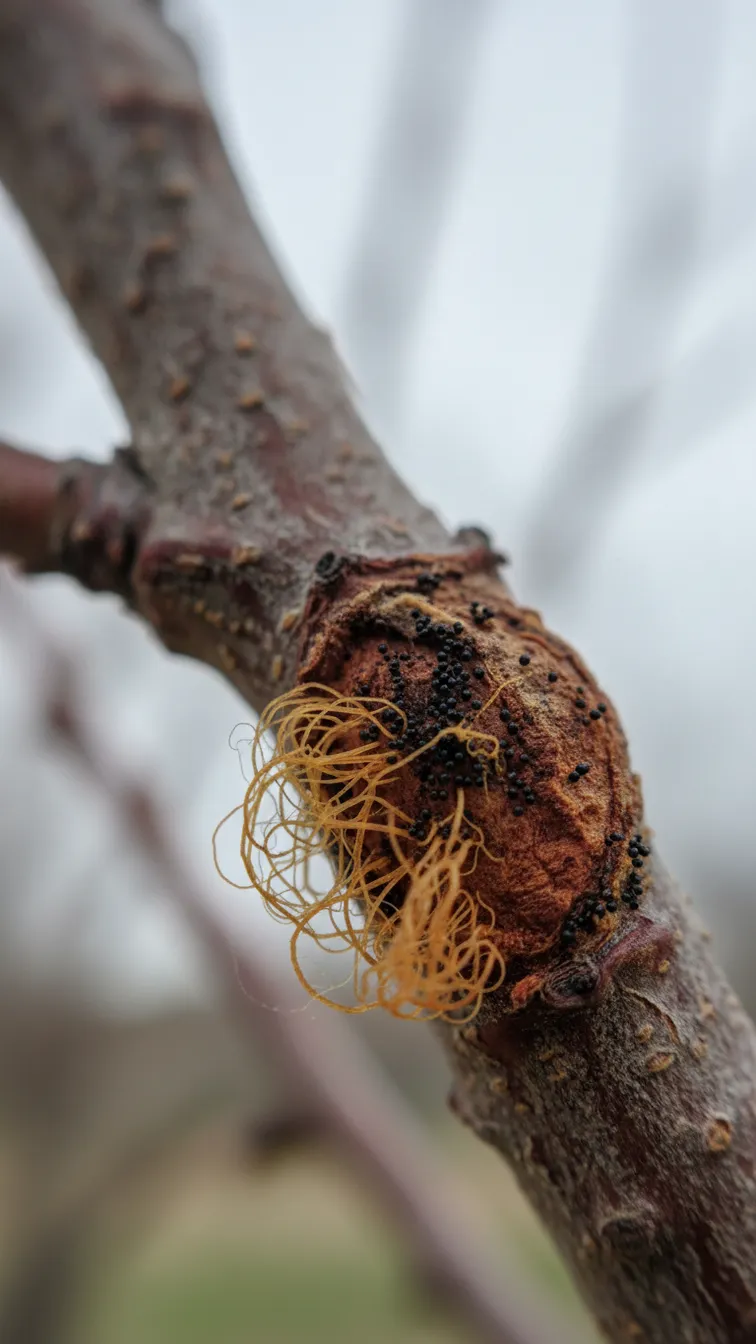

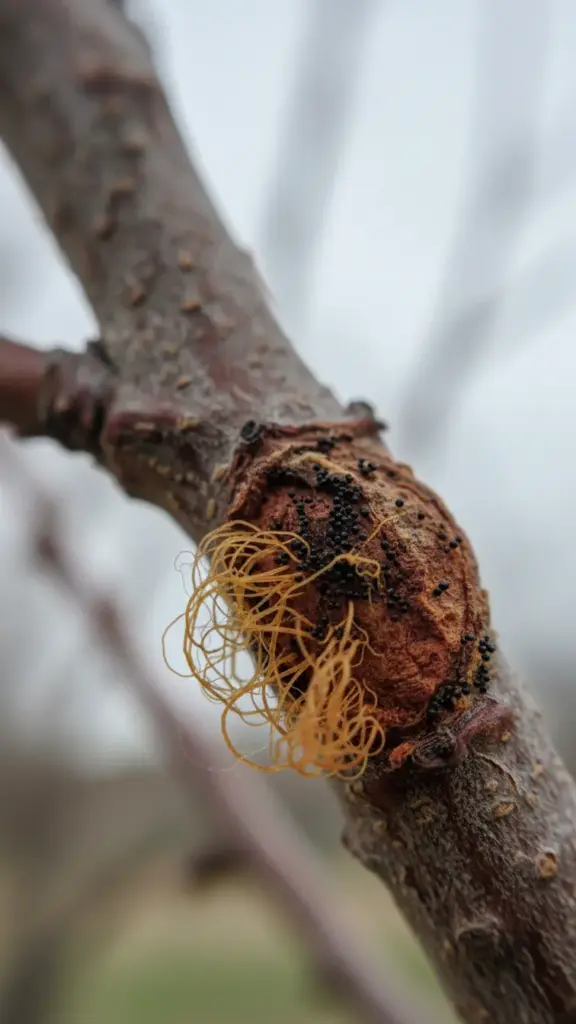
Constriction canker is a fungal disease of peach twigs and buds caused by Phomopsis amygdali (synonym Fusicoccum amygdali), named for the way small cankers form around leaf scars and slowly constrict, or girdle, the twig until it dies. It is closely related to the broader group of stone fruit cankers that also affect apricot and other Prunus species.
What Constriction Canker Is
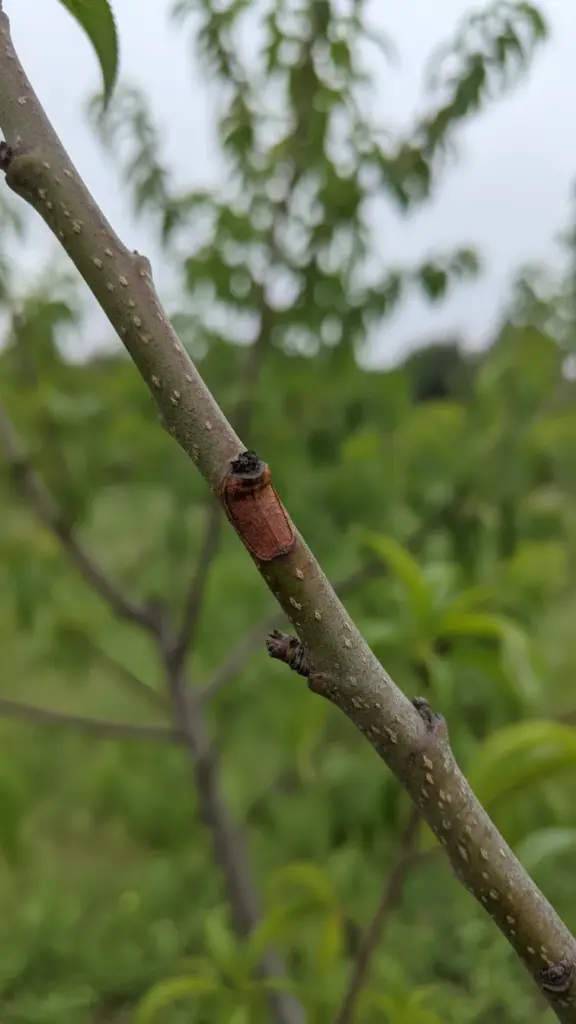
Constriction canker gets its name from the way the fungus infects a twig at a leaf scar and forms a lesion that gradually enlarges around the circumference, eventually cutting off the flow of water and nutrients to everything beyond that point. The disease is also called Fusicoccum canker, reflecting an older name for the causal fungus.
The pathogen primarily infects peach buds, producing reddish-brown elongate cankers around twig nodes that can girdle and kill buds the following summer. Left unmanaged across several seasons, constriction canker can noticeably reduce shoot growth and fruiting wood on an orchard tree.
How to Identify Constriction Canker on Twigs
Look for small, slightly sunken, reddish-brown cankers surrounding leaf scars on young twigs, usually first visible by late fall or early winter. These lesions are often dotted with very tiny black fruiting bodies called pycnidia, which can be seen with a hand lens.
Under favorable wet conditions, tendrils of conidia (spore masses) may be exuded from the pycnidia and are visible as thread-like strands on the canker surface. On leaves, the same fungus can cause large, irregularly shaped brown spots, which is a useful secondary clue if twig symptoms are hard to confirm.
Where Constriction Canker Appears on the Tree
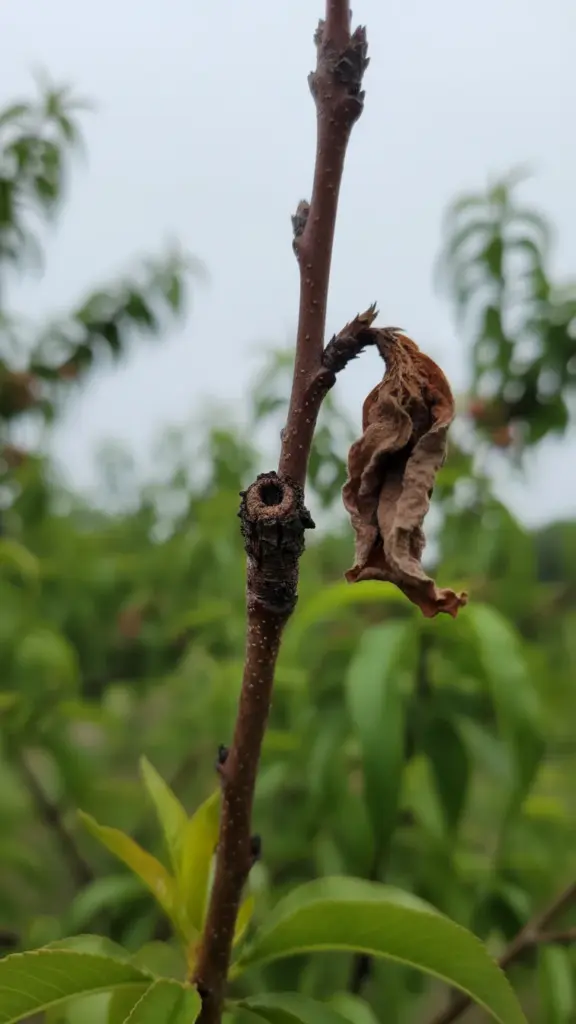
Cankers form most often around leaf scars on one-year-old twigs, the same points where leaves attached during the previous growing season. As the canker enlarges, it can eventually encircle the entire twig, causing the classic shoot blight symptom where the twig tip wilts and dies while the canker itself remains visible lower down.
Because the fungus enters through leaf scars rather than random wounds, the disease is concentrated on new growth rather than older scaffold limbs, at least in the earlier stages of an infection.
How Constriction Canker Spreads and Survives
Spores are disseminated by rain-splash and wind-blown rain to fresh leaf scars, according to Rutgers Plant & Pest Advisory. After landing on a scar, the pathogen enters the twig tissue and begins colonizing the surrounding wood.
Small cankers can often be seen by late fall or early winter, and they continue to develop and enlarge during any warm periods through winter and into the following spring and summer. Eventually the canker girdles the twig, producing shoot blight and direct fruit loss on infected wood.
Constriction Canker vs Other Peach Twig Problems
Several peach twig and canker problems can look similar early on, so a side-by-side comparison helps with diagnosis.
| Problem | Typical Location | Key Feature | Cause |
| Constriction Canker | Leaf scars on one-year-old twigs | Small sunken reddish-brown lesions with black pycnidia, girdles the twig | Phomopsis amygdali (fungus) |
| Blossom Blight | Flowers and adjacent twig tissue | Blighted blossoms, tan-brown flower tissue, can spread into twig | Monilinia fructicola (fungus) |
| Bacterial Canker | Trunk, scaffold limbs, young trees | Gummosis, dark sunken bark, worse on stressed or young trees | Bacterial (Pseudomonas syringae) |
| Winter Cold Injury | Twig tips, especially exposed wood | Blackened, split bark, no fruiting bodies | Environmental, not infectious |
The presence of tiny black pycnidia embedded in the lesion is one of the most reliable ways to separate constriction canker from blossom blight and cold injury, both of which lack these fruiting structures.
Conditions That Favor Constriction Canker
Wet weather during leaf drop in fall is the critical window, since fresh leaf scars are only susceptible to infection for a limited time after the leaf falls. Rain or wind-driven moisture during this period greatly increases how many scars become infected.
Mild, wet winters also favor the disease because cankers continue expanding during any warm spell rather than staying dormant, which means a mild winter can leave more girdled twigs by spring than a consistently cold one.
Can Constriction Canker Be Cured Once a Twig Is Girdled
No. Once a canker has fully encircled a twig, the tissue beyond that point cannot be saved, since the flow of water and nutrients has already been cut off. The twig tip will wilt and die regardless of any treatment applied afterward.
Management at that stage shifts to removing the girdled wood and protecting the rest of the tree’s new growth from future infections, rather than trying to reverse existing damage.
Step 1: Scout Twigs for Small Reddish-Brown Lesions
Check one-year-old twigs in late fall and again in late winter for small sunken lesions forming around leaf scars. Catching cankers while they are still small gives you a better chance to prune them out before they girdle the twig.
Pay closest attention to twigs on the interior of the canopy, which tend to dry more slowly after rain and can show a higher rate of infection than twigs in more exposed, sunny positions.
Step 2: Prune Out and Destroy Infected Wood
Pruning and destroying infected branches reduces disease pressure, according to Michigan State University Integrated Pest Management. Cut well below any visible canker to make sure you remove tissue that may already be colonized but not yet showing symptoms.
Burn, bag, or otherwise remove pruned wood from the orchard rather than leaving it on the ground, since infected debris left in place can continue producing spores.
Step 3: Time Fungicide Applications Before Infection
Fungicides applied prior to infection reduce disease incidence, though results vary. Protectant fungicides such as chlorothalonil and captan have been the most effective options tested, yielding roughly 46 to 71 percent control in field trials, according to Rutgers Plant & Pest Advisory.
Because protection has to be in place before spores land on fresh leaf scars, timing sprays around the fall leaf-drop period matters more than spraying after cankers are already visible.
Step 4: Reduce Tree Stress and Improve Vigor
Keep trees on a consistent watering and fertilizing schedule, since stressed or poorly vigorous trees tend to show more severe canker development and slower recovery from pruning wounds. Avoid letting trees compete heavily with weeds or turf for water during dry stretches.
Balanced nitrogen levels help support steady new growth without pushing excessive, weak shoot growth that can be more vulnerable to infection through its leaf scars.
Step 5: Manage Pruning Wounds and Sanitation
Sanitize pruning shears between cuts when moving from a visibly infected twig to healthy wood, reducing the chance of spreading spores on tool surfaces. Prune during dry weather whenever the schedule allows, since fresh cuts made just before rain are more vulnerable to new infections of any kind.
Removing narrow-angled crotches and weak or dead wood during the same pruning pass also reduces other entry points for cankers and borers that commonly complicate constriction canker in the same orchard.
Does Constriction Canker Reduce Fruit Yield
Yes, when infection is heavy. Girdled twigs die before they can mature fruit, and shoot blight on flowering wood causes direct fruit loss in the affected season. Orchards with high canker pressure over several years can see a measurable decline in overall yield, which is why scouting and pruning are worth the time even though the disease itself is rarely fatal to the whole tree.
Common Questions
Is Constriction Canker the Same as Fusicoccum Canker
Yes. Fusicoccum canker is an older name for the same disease, reflecting a previous classification of the causal fungus. Both names refer to the reddish-brown, pycnidia-dotted cankers that form around peach leaf scars.
Can Constriction Canker Affect Apricot or Other Stone Fruit
Peach is the primary documented host, though related Phomopsis and Fusicoccum species cause similar canker and dieback symptoms on other stone fruit. If you grow both peach and apricot, inspect both for twig cankers rather than assuming only one is at risk.
How Is Constriction Canker Different From Brown Rot Blossom Blight
Brown rot blossom blight mainly damages flowers and can move into adjacent twig tissue, but it lacks the small, pycnidia-dotted cankers around leaf scars that mark constriction canker. Checking for those black fruiting bodies is the fastest way to tell the two apart in the field.
Do Fungicides Fully Control Constriction Canker
No. Even the most effective protectant fungicides tested have only reached 46 to 71 percent control, well below the control levels expected from fungicides against many other orchard diseases. Fungicides work best as one part of a program that also includes pruning and sanitation.
How Long Does It Take for a Canker to Girdle a Twig
A canker that starts around a leaf scar in fall can enlarge through any warm periods in winter and continue into spring and summer, meaning full girdling often takes several months rather than happening in a single season all at once.
Where to Go From Here
Constriction canker is a slow-building disease that takes hold at leaf scars in fall and quietly expands over winter until it finally girdles a twig the following season. Scouting twigs during the dormant season, pruning out infected wood promptly, and timing protective fungicide sprays around leaf drop will do more to limit damage than reacting only after shoot blight is already visible.








