
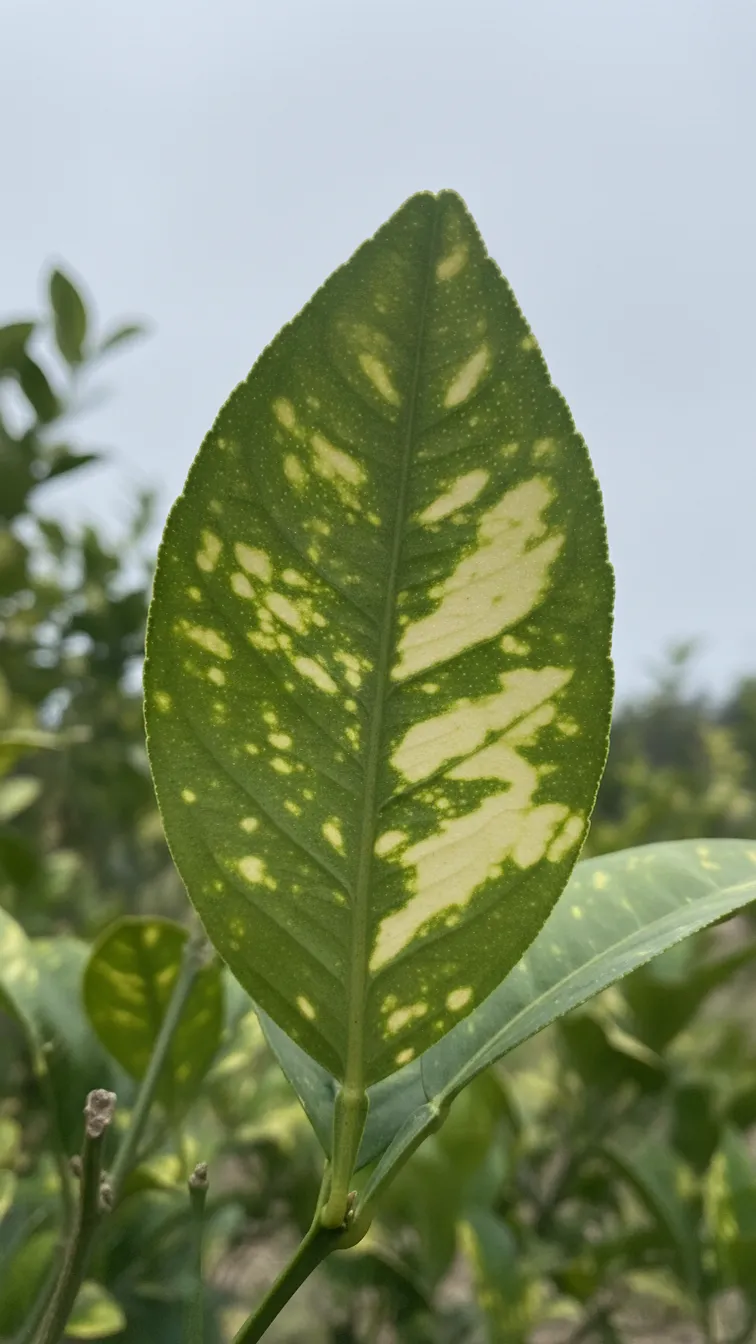

Citrus greening is the one citrus problem where I do not tell people to try a few things and see how the tree responds. It is a bacterial disease, it has no cure, and a tree that has it will decline and eventually die no matter how well it is fed. The only useful thing a home gardener can do is recognise it correctly and act quickly, which is exactly what this page is for.
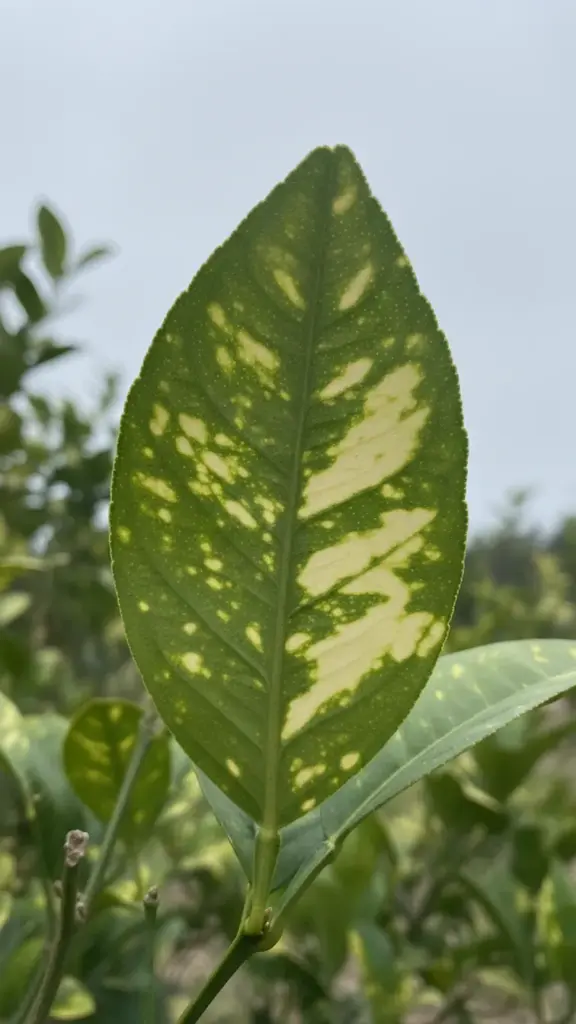
The difficulty is that the early symptoms look like ordinary garden problems. Yellow leaves, a thinning canopy, fruit that never sweetened properly. Every one of those has half a dozen harmless explanations, and most of the time it will be one of those instead. I have talked more people out of a greening diagnosis than into one.
So this page works through the difference. What the disease actually does, the single leaf pattern that separates it from a nutrient problem, the insect that carries it, the look-alikes that get blamed on it, and what happens after a positive test.
What Citrus Greening Actually Is
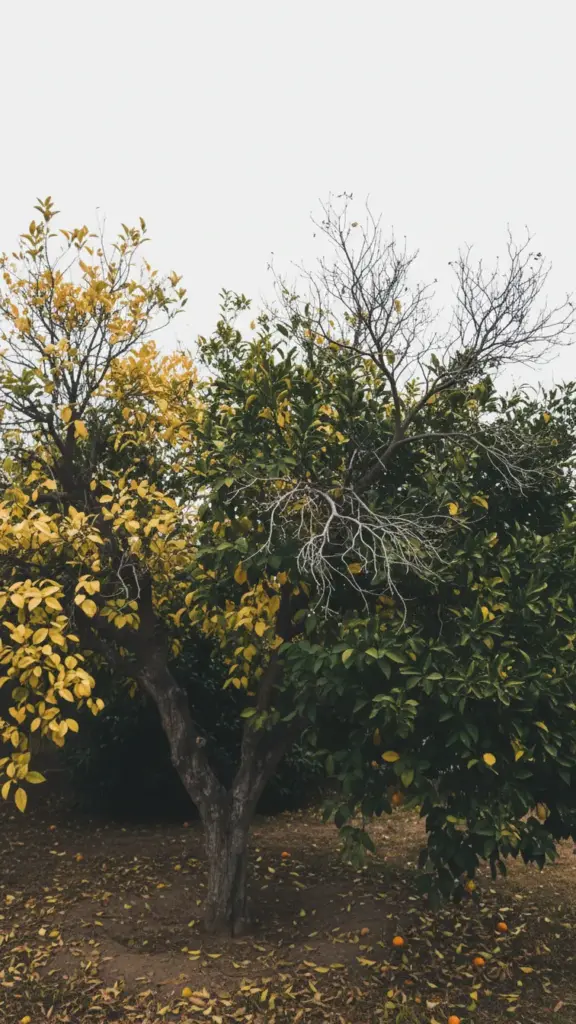
Citrus greening, also called huanglongbing or HLB, is caused by a bacterium that lives in the tree’s phloem, the plumbing that carries sugars around the plant. It is not a fungus, so no fungicide touches it. It is not a nutrient shortage, so no fertiliser fixes it.
Because the bacterium blocks and disrupts that internal transport, the tree cannot move sugars where they belong. Nutrients strand in some parts of the canopy and never reach others, which is why the yellowing turns up in patches instead of evenly. Roots decline first in many cases, before anything above ground looks wrong. Fruit stops filling and stops sweetening.
The disease does not spread through soil, tools, or pruning cuts. It moves in two ways only. A tiny sap feeding insect carries it from tree to tree, and infected plant material carries it across long distances when someone moves a tree, a budstick, or fruit with leaves attached.
The name comes from the fruit. It ripens unevenly and stays green at the end furthest from the stem, so a supposedly ripe orange has a stubborn green patch on it.
The Symptom That Separates Greening From Everything Else
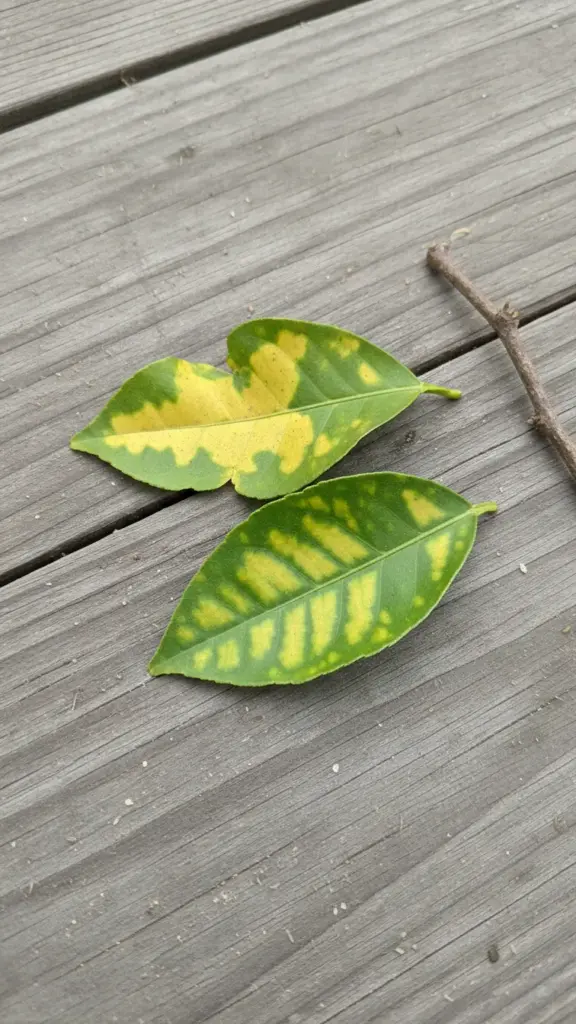
If you take one diagnostic idea from this page, take this one: greening yellowing is lopsided.
Hold a suspect leaf up and look at the midrib as a line of symmetry. A nutrient problem produces a pattern that matches on both sides of that line. The same veins stay green, the same areas go yellow, and every affected leaf on the tree repeats the same design. Greening does not do that. It produces blotchy mottling where a patch of yellow on the left has no matching patch on the right, and no two leaves look alike.
UC Integrated Pest Management staff make the same point in their homeowner guide to the psyllid and the disease it carries: the yellowing from nutrient deficiencies typically appears symmetrically, equally on both sides of the midvein, while the disease also produces small misshapen fruit with bitter juice, fruit that stays partly green, dark aborted seeds, and premature fruit drop. They also note that fruit and tree symptoms may take two years or more to appear after the bacteria infect a tree.
Other leaf clues worth checking once the asymmetry test points that way:
- Whole shoots turning yellow while neighbouring shoots stay green, so the tree looks patchy rather than uniformly pale.
- Leaves that feel thick and leathery rather than soft, sometimes standing more upright than usual.
- Enlarged corky midribs and veins, raised enough to feel with a fingertip.
- Yellowing that appears on one branch or one side of the tree first and stays there for months.
None of these on its own proves anything. Asymmetric mottling plus abnormal fruit on a tree in an area where the disease exists is the combination that should send you to get a test rather than to the fertiliser shelf.
What Infected Fruit Looks Like
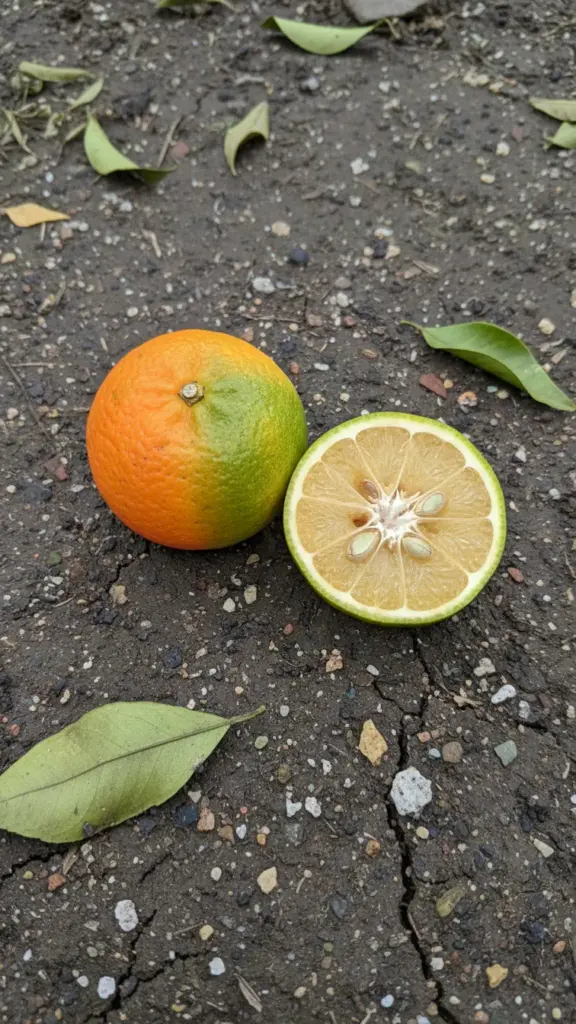
The fruit tells a clearer story than the leaves, which is unhelpful, because by the time fruit is symptomatic the tree has been infected for a long time.
Infected fruit stays small and never rounds out properly. It sits lopsided, with one shoulder larger than the other. The colour breaks in the wrong order, starting at the stem end while the far end stays green, which is backwards from healthy fruit. Cut it open and the seeds are small, dark, and shrivelled. The juice tastes sour, bitter, and faintly medicinal rather than simply underripe.
Most of it drops before you get the chance to pick it, and the drop is heavy enough that people often blame wind or watering.
Meet the Asian Citrus Psyllid
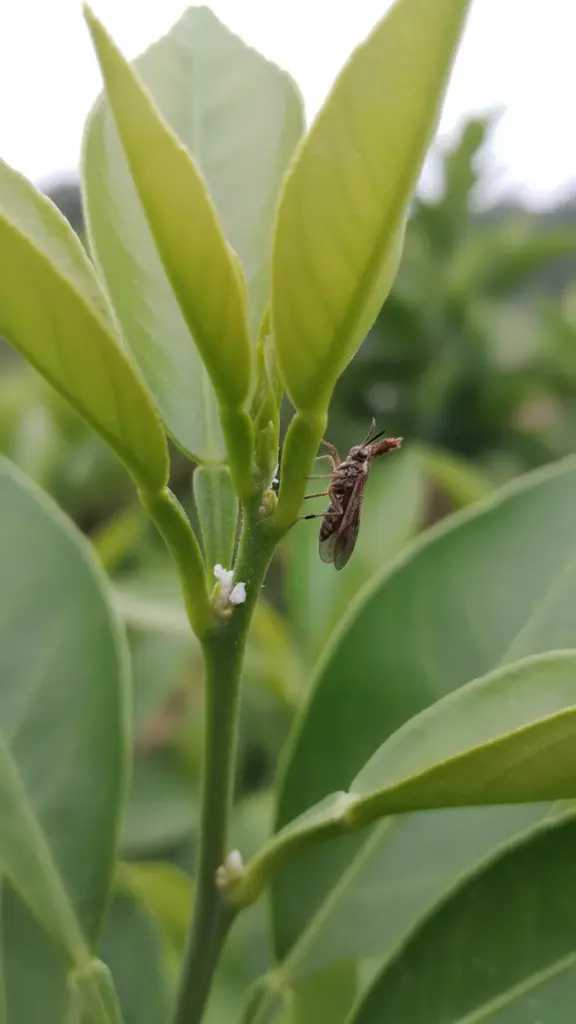
The disease travels inside an insect about the size of an aphid.
The adult is a mottled brown insect three millimetres long that sits at a distinctive steep angle, head down and rear end lifted, on the tender new growth. Tap a flush and they hop and fly rather than walking away. They feed only on citrus and a few close relatives, and they lay eggs only on the soft new flush, so the tips of a tree pushing spring or summer growth are where you look.
The nymphs are easier to spot than the adults once you know what to look for. The Louisiana State University AgCenter guide to citrus greening describes them as yellow bodied with red eyes, producing white waxy secretions that can be spotted from a distance when the infestation is heavy. The same publication is direct about the disease itself: once a tree is infected it stays infected for the rest of its life, there is no cure, and no chemical control exists for the bacterium.
An important detail that changes how you think about the insect. A psyllid on your tree does not mean your tree has greening. The insect only carries the bacterium if it fed on an infected plant. In some regions the psyllid is present and the disease is not, which is precisely the window in which controlling the insect still protects everything.
Insects on Your Citrus That Are Not the Psyllid
Citrus attracts a long list of small sap feeders, and most of the ones people photograph in a panic are something else entirely.
| What you see | Likely insect | How it differs from the psyllid |
| White fluffy waxy clumps in leaf joints, slow moving | Mealybugs | Soft and cottony all over, they crawl slowly and do not hop |
| Flat immobile brown or grey bumps stuck to stems and leaves | Scale insects | They do not move at all once settled |
| Dark slow moving insects in spiny rows on the underside of leaves, sticky foliage | Citrus blackfly | Found in tidy circular groups on older leaves, not just the new flush |
| Tiny green insects clustered on soft shoot tips, no wax tubes | Aphids | Pear shaped and soft, they cluster densely and do not lift their rear ends |
| Fine speckling and dusty leaves with webbing underneath | Citrus red mite | Almost too small to see as individuals, no wings at any stage |
Two of those are worth reading up on properly if you find them, because they cause real damage of their own. The waxy white clumps are usually citrus mealybug, which is the most common false alarm I see, since the psyllid nymph also produces white wax. The sticky leaves with black film are usually citrus blackfly or a similar honeydew producer.
The practical difference in the field is behaviour. Psyllid nymphs sit on brand new growth and produce waxy tubes that curl outward. Mealybugs sit anywhere, in the joints and under the fruit calyx, in soft cottony masses.
Look-Alike Problems That Are Not Greening
More yellow citrus leaves are caused by the items in this table than by the disease. Work through it before you assume the worst.
| Pattern on the leaf | Likely cause | The tell |
| Yellow between the veins, green veins, same on both sides of the midrib | Iron, zinc or manganese shortage | Perfectly symmetrical and repeated identically on many leaves |
| Whole leaf pale yellow, oldest leaves first, tree growing slowly | Nitrogen shortage | Even fading with no blotches, the newest leaves stay greener |
| Yellowing across the whole tree after a wet spell, leaves dropping | Waterlogged or damaged roots | Soil stays soggy, and the yellowing arrived suddenly rather than over months |
| Blotchy yellow leaves with fine speckling and dull surfaces | Mite damage | Look under the leaf with a lens and you find the mites |
| One branch yellow and wilting while the rest of the tree is fine | Branch injury, borer damage or a graft problem | The affected wood is damaged or dying at a point you can find |
If you are chasing dull speckled foliage rather than blotches, start with the citrus red mite rather than with the disease, because mite damage is common everywhere and greening is not.
The honest summary is that symmetry rules out greening fairly reliably, and asymmetry does not rule it in. Asymmetric mottling only becomes a strong signal when it comes with the fruit symptoms and the tree is in a region where the disease has been confirmed.
Why the Disease Is So Hard to Catch Early
Three things conspire to make greening spread before anyone notices.
The first is the delay. A tree can be infected for a year or two before a single symptom appears, and during that time it feeds bacteria to every psyllid that visits it. The second is the resemblance to ordinary problems, which means the first symptomatic year often gets treated as a feeding issue. The third is that a tree can look reasonable from the street while the interior is quietly declining.
Put those together and you get the real problem with this disease. An infected tree can stand there looking ordinary while acting as a source of bacteria for every psyllid that feeds on it. That is why the disease is handled as a regional problem rather than a private garden problem, and why a single untested backyard tree matters to everyone growing citrus nearby.
How Greening Arrives in a Home Garden
Two doors, and one of them is entirely within your control.
The insect door opens when infected psyllids fly in from a neighbouring property. There is not much you can do about that beyond watching your own new flush and supporting whatever area wide programme exists where you live.
The plant material door is the one that matters. Every long distance jump this disease has made has been on a plant, a cutting, or budwood that somebody moved. A tree bought from an uncertified seller, a bag of cuttings from a friend interstate, a potted lime carried home from a holiday. That is why citrus quarantines exist and why they cover trees, cuttings, and often fruit with leaves and stems attached.
Buy citrus only from a reputable nursery selling certified stock, and never propagate from a tree of unknown health. Grafting a budstick from a neighbour’s productive lemon is a lovely idea right up until it is not.
What a Home Gardener Can Actually Do
There is no spray, no soil drench, and no feeding programme that removes the bacterium from an infected tree. What follows are the things that genuinely help.
Inspect the new flush. That is where the psyllid lives, so every time your tree pushes soft growth, look at the tips. Two minutes, a few times a season.
Look at leaves properly rather than glancing at the tree. The asymmetry test takes five seconds per leaf and it is the whole diagnosis in a home garden.
Control ants if you have them running up the trunk, because ants protect sap feeding insects from the predators that would otherwise keep them down. This helps against several citrus pests at once.
Keep the tree genuinely healthy with sensible watering and feeding. This does not prevent infection and it does not cure it. A vigorous tree simply carries symptoms longer and gives you more time.
Do not move citrus material. No cuttings to friends, no potted trees across a quarantine boundary, no fruit with leaves attached into a region that is still clean.
Report a suspect tree rather than sitting on it. In most affected countries there is a plant health authority that will test a sample at no cost, because they want the data more than you want the answer.
Getting a Suspect Tree Tested
You cannot confirm greening by eye. Nobody can, including specialists, which is why laboratory testing exists.
Diagnosis uses a laboratory test on leaf tissue that detects the bacterium’s genetic material. The sampling matters more than people expect. Bacteria are distributed unevenly through an infected tree, so a sample from a healthy looking branch can come back negative on a tree that is infected. A good sample takes symptomatic leaves, with the leaf stalks and midribs attached, from several points around the canopy.
Contact your national or state plant health service rather than a garden centre. They will tell you how to submit, and in quarantine regions they may come and sample it themselves.
One negative result on a tree you are suspicious about is worth repeating the following season. Given the long silent period, an early test can miss a young infection.
Should You Remove an Infected Tree
This is the hardest part of the page to write, because the answer is usually yes and nobody wants to hear it.
A confirmed infected tree will not recover, and while it stands it is a reservoir that psyllids draw from and carry to every other citrus tree in the neighbourhood. Mississippi State University Extension puts the reasoning plainly in its coverage of a citrus quarantine: an infected tree acts as a reservoir of the disease and leads to more widespread infection, so a tree confirmed to be infected should be removed.
Remove the whole tree including the stump, and follow local rules for disposal rather than dragging it across town to a green waste facility. In some regions the removal is organised or required by the authorities, and in others it is your decision, in which case it is worth thinking about the other gardeners on your street.
If you decide to keep a confirmed infected tree for a while, at least control the psyllid population on it hard, and accept that the fruit will be poor and the tree will die.
Can an Infected Tree Be Saved
No, and it is worth being blunt because the internet is full of claims otherwise.
Enhanced nutrition programmes are widely used in commercial groves, and they can keep an infected tree productive for longer than it would otherwise be. That is life extension, not a cure. The bacterium is still there and the tree still spreads it. In a backyard, that trade rarely makes sense, because your one tree is not a business but it is a risk to every other tree nearby.
Antibiotic treatments exist in commercial agriculture in some countries under strict regulation. They are not available to home gardeners, they do not eliminate the bacterium, and injecting a backyard tree with anything you can buy online is both illegal in many places and pointless.
Heat treatments, garlic sprays, magnetic devices, and hydrogen peroxide drenches all show up in search results as cures. None of them work.
Planting Citrus in a Greening Region
People in affected regions ask whether it is still worth planting a citrus tree. I think it usually is, with the expectations adjusted.
Buy certified stock from a proper nursery. In quarantine regions this may mean trees that were raised under insect proof screening, which is exactly what you want. Keep the receipt and the label.
Consider growing under screening yourself if the disease is well established locally, since a physical barrier is the only reliable protection against an insect this small. A dwarf tree in a large pot under a fine mesh enclosure is a realistic backyard version.
Plan for a shorter tree life than you would have expected twenty years ago, and plant something else as well so your garden does not depend on citrus alone.
Common Questions
Is Citrus Greening Dangerous to People
No. The bacterium infects plants only. Fruit from an infected tree is safe to eat, it simply tastes bitter and sour and is usually not worth eating.
Can Citrus Greening Spread to My Other Plants
Only to citrus and a small number of closely related plants, including ornamental orange jasmine. Your apples, roses, and vegetables cannot catch it.
Does Pruning Spread Citrus Greening
No. Unlike some plant diseases, it does not travel on secateurs. It spreads through the insect and through grafting infected budwood onto a healthy rootstock.
My Tree Has Yellow Leaves, Should I Panic
Almost certainly not. Check whether the pattern is symmetrical around the midrib. If it is, you are looking at a nutrient or root problem, and greening is not on the list.
Can I Replant Citrus Where an Infected Tree Was Removed
Yes. The bacterium does not survive in the soil, so the site is not contaminated. The risk to the new tree comes from psyllids and from nearby infected trees, not from the ground.
Will a Potted Citrus Tree Indoors Be Safe
Mostly, since the psyllid has to reach it. A tree that lives indoors or in a screened space year round has a much lower risk than one standing outside in an affected region.
Where to Go From Here
Start with the leaf test, because it settles most cases in a few seconds. Symmetrical yellowing around the midrib is a feeding or root problem and you can go and fix it. Asymmetric blotches on a tree that is also carrying small lopsided bitter fruit is the combination that justifies a phone call.
After that, the useful habits are small and cheap. Look at the new flush when the tree pushes it, keep ants off the trunk, buy trees only from certified nurseries, and never move citrus material between regions. None of that is dramatic, and collectively it is the only thing standing between a backyard tree and the disease that has already emptied whole citrus districts.








