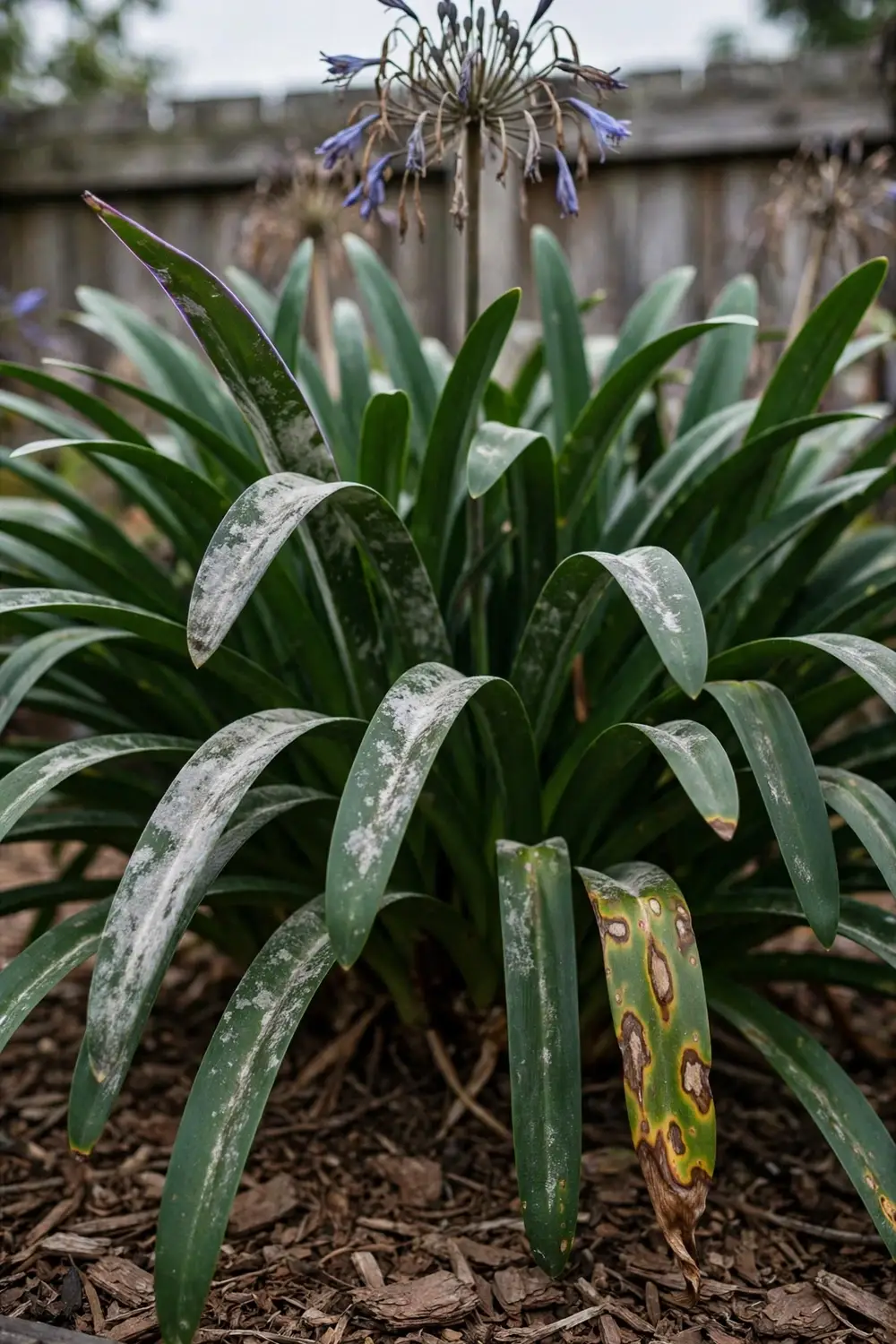

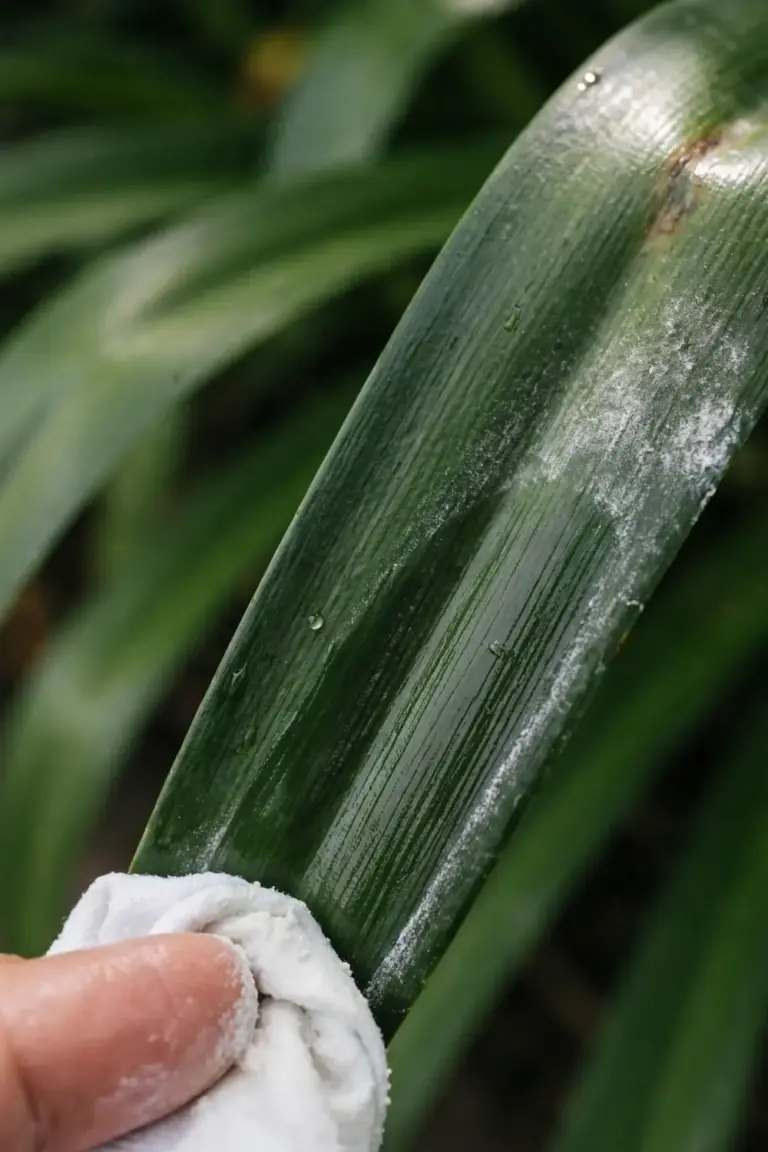
Wipe the spot with a damp finger and read the result in under 60 seconds. If white dust comes off on your finger, the mark sits on the leaf surface, and the cause is powdery mildew, a pest coating, or mineral residue. If nothing moves, the mark is inside the leaf tissue, and the cause list narrows to fungal leaf spot, rust, or virus. That single wipe test settles the first fork in under a minute, and every section below starts from its result.
White spots on agapanthus leaves are a symptom, not a disease. Agapanthus is the genus Agapanthus, a group of South African perennials grown across Australian gardens for strappy leaves and blue or white flower heads. White spots is a plain description of white marks on those leaves. The wipe test is a wipe that separates surface deposits from tissue damage. This guide covers white spots on agapanthus leaves from the wipe test to the fix, one cause at a time. Work through the fork, match the look, and treat the cause you actually have.
1. Start With the Wipe Test
Rub one white spot with a damp fingertip, then look at your finger and at the leaf. White dust on your finger points to a surface coating. A clean finger and an unchanged spot point to damage inside the leaf. That split decides which sections below apply to your plant.
| Wipe result | What you see | Likely cause | First move |
|---|---|---|---|
| Dust comes off | White powdery coating | Powdery mildew | Improve air flow, remove worst leaves |
| Dust comes off | White crust that dissolves | Mineral residue | Rinse leaves, water at the base |
| Clusters stay put | Cottony white clumps in leaf bases | Mealybugs | Dab with alcohol, then oil spray |
| Nothing moves | Brown spots with yellow halos | Fungal leaf spot | Remove spotted leaves, keep leaves dry |
| Nothing moves | Raised spots, orange dust on finger | Rust | Remove affected leaves, avoid overhead watering |
| Nothing moves | Yellow streaks or mottling | Virus | Rogue the plant out |
Check the leaf bases and the undersides, not just the tops. Mealybugs hide where the leaf meets the stem, and powdery mildew often starts on shaded lower leaves. Note whether the spots sit on one clump or across several plants. A virus pattern usually follows one plant, while mildew and leaf spot spread across a clump in damp weather. Note the weather too. A wet week before the spots appeared points toward leaf spot, while a dry, shaded month points toward mildew. Those two observations, plus the wipe, give you the cause in most cases. You need three things for the whole job: a damp cloth for the wipe test, a magnifying lens for a close look at clusters and pustules, and a bag for spotted leaves you remove. The lens earns its place in the mealybug and rust sections, where the difference between a cottony insect and a powdery coating is hard to see with the naked eye.
2. Powdery Mildew: White Coating That Wipes Off
Powdery mildew is a white powdery fungal growth on leaf surfaces, and it is the most common cause of white spots that wipe off agapanthus leaves. The coating starts as small white patches and spreads across the leaf. Leaves may yellow, distort, and drop early as the infection advances.
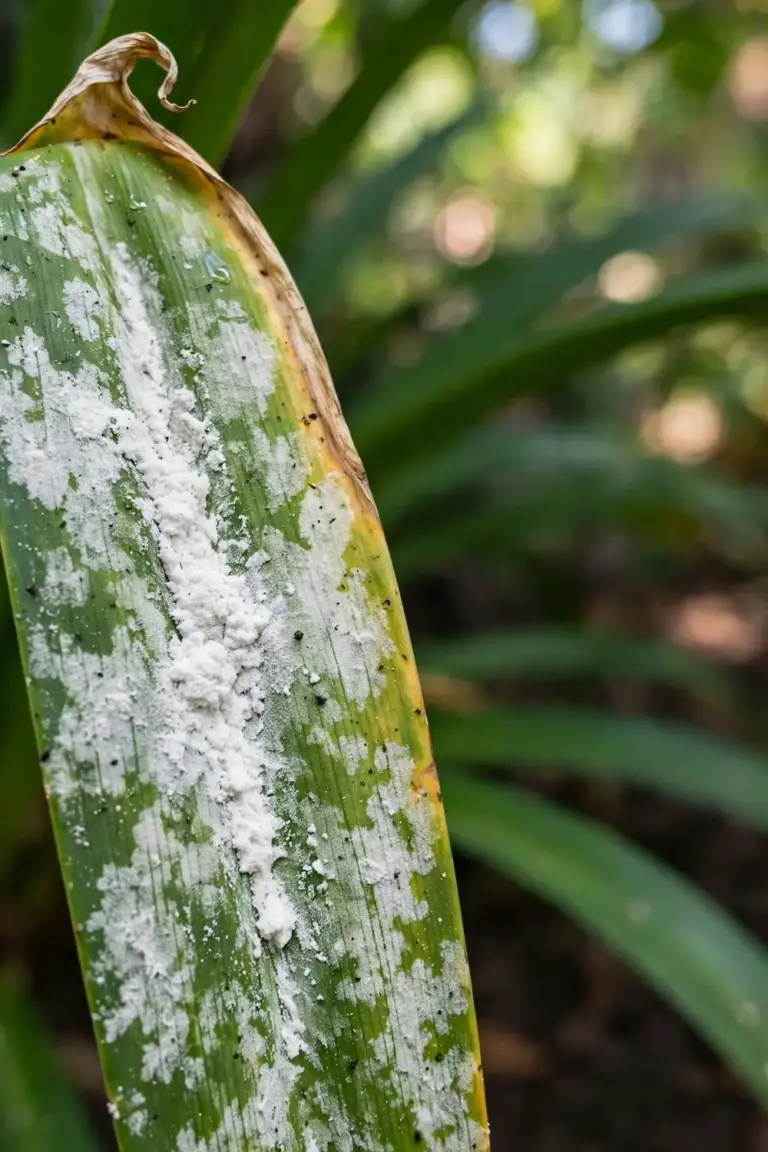
The fungus favors moderate temperatures of 60 to 80 degrees Fahrenheit, which converts to 15.6 to 26.7 degrees Celsius, plus shade, according to the University of California IPM powdery mildew guide. Powdery mildew spores germinate without water on the leaf surface, so a dry leaf is no protection. Water sitting on leaves for long periods actually inhibits spore germination and kills the spores of most powdery mildew fungi. Heat above 95 degrees Fahrenheit, or 35 degrees Celsius, suppresses growth.
Treat mildew by opening the clump to air and light. Prune out the worst leaves and bin them, never compost them. Space crowded clumps so leaves dry faster. Water at the base in the morning so foliage stays dry. Wind carries powdery mildew spores to new hosts, so a clump standing in shade beside a wall or under a tree sits in the highest-risk spot, while direct sun and extreme heat suppress the fungus. Downy mildew is the usual confusion, but University of California guidance distinguishes the two: downy mildew spores sit mostly on leaf undersides, while powdery mildew covers both sides of the leaf, and downy mildew is a cool-weather disease while powdery mildew thrives in warm weather. If the white growth coats both sides of the leaf in warm weather, powdery mildew is the likely cause. On perennial hosts, powdery mildew survives from one season to the next as strands in buds or as small black fruiting bodies on leaves or stems, which is why a clump hit last year often shows mildew again in the same place. Clearing dead leaves and cutting back hard after a bad year reduces that carryover. A fungicide labeled for powdery mildew on ornamentals can slow a heavy infection, but it protects new growth rather than curing spotted leaves. Read the label and follow it. If the coating covers most leaves on a clump, cut the clump back hard and let it regrow from the rhizome. Spot treatment suits a few coated leaves. A clump that is mostly white needs the reset, because spraying leaf after leaf costs more time than cutting back and the regrowth comes through clean in a better-ventilated clump. Hold the fungicide for the regrowth if mildew returns, since a protectant works best on new leaves rather than on leaves already coated.
3. Mealybugs: Cottony Clusters That Do Not Wipe Off
Mealybugs are soft insects that form white cottony masses on plants, and on agapanthus they cluster in the leaf bases where the leaves meet the stem. The clusters look like small tufts of cotton wool. They do not wipe off like mildew, because the insects cling to the leaf and the waxy coating sticks to the plant.
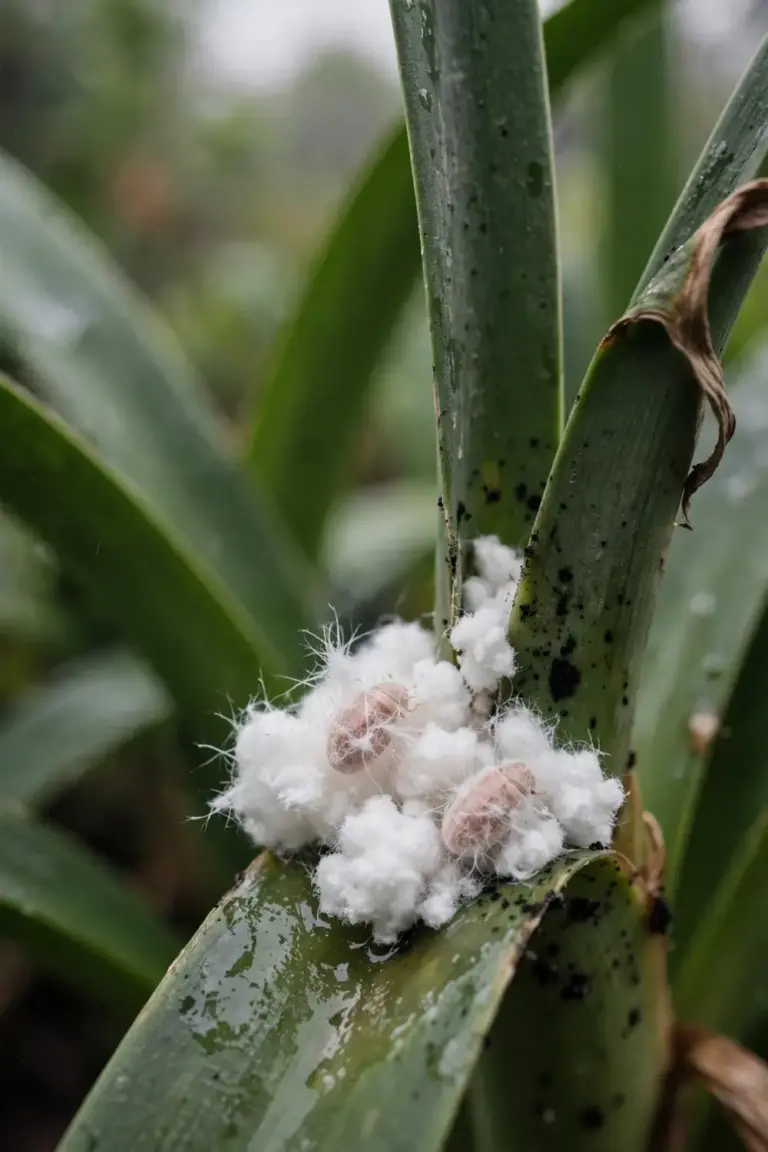
Mealybugs feed on stems and leaves. High populations slow plant growth and cause premature leaf drop. Mealybugs also produce honeydew, a sticky sugar liquid, and black sooty mold grows on that honeydew. Sticky leaves plus cottony clusters confirm mealybugs rather than mildew. I check the leaf bases first, because mealybugs hide where the leaf meets the stem.
Mealybugs are sometimes confused with woolly aphids, which also carry a white waxy coating. Aphids are pear-shaped with long legs and tailpipes on the rear, while mealybugs are oval and flat with waxy filaments around the margins. The distinction matters because the treatments differ, and a hand lens settles it in seconds. Sooty mold is a third sign that points the same way. The mold itself is harmless to the leaf, but it marks a spot where honeydew has been sitting, and honeydew means a sap-feeding insect is working nearby.
Control starts with physical removal. Dab visible clusters with a cotton swab dipped in a 70 percent or weaker solution of isopropyl alcohol in water, following the University of California IPM mealybug guide, and test the solution on a small part of the plant 1 to 2 days beforehand to check for leaf burn. Repeat every week until the clusters stop returning. Check potted plants around the pot lip and the soil surface as well as on the leaves, because mealybugs hide on roots and under pot lips too. For larger infestations, spray insecticidal soap or narrow-range horticultural oil directly onto the insects, since the waxy coating repels sprays that only touch the leaf surface. Manage ants, because ants protect mealybugs from their natural enemies. Natural predators such as parasitic wasps, lady beetles, and lacewings provide good control outdoors when broad-spectrum insecticides do not kill them. Wipe honeydew off leaves with a damp cloth while you treat the insects, because the sticky film feeds sooty mold and blocks light from the leaf. Expect repeat work. Mealybug eggs and crawlers hide in crevices, so one dab rarely ends the colony. A weekly check for three to four weeks catches each new hatch before it settles. Do not reach for a broad-spectrum insecticide first. It kills the predators that keep mealybugs down.
4. Fungal Leaf Spot: Brown Spots With Yellow Halos
Fungal leaf spot is a fungal disease that makes discrete spots on leaves, and on agapanthus the spots often carry a yellow halo around a brown center. The spots do not wipe off, because the fungus grows inside the leaf tissue. The wipe test separates leaf spot from mildew in one stroke.
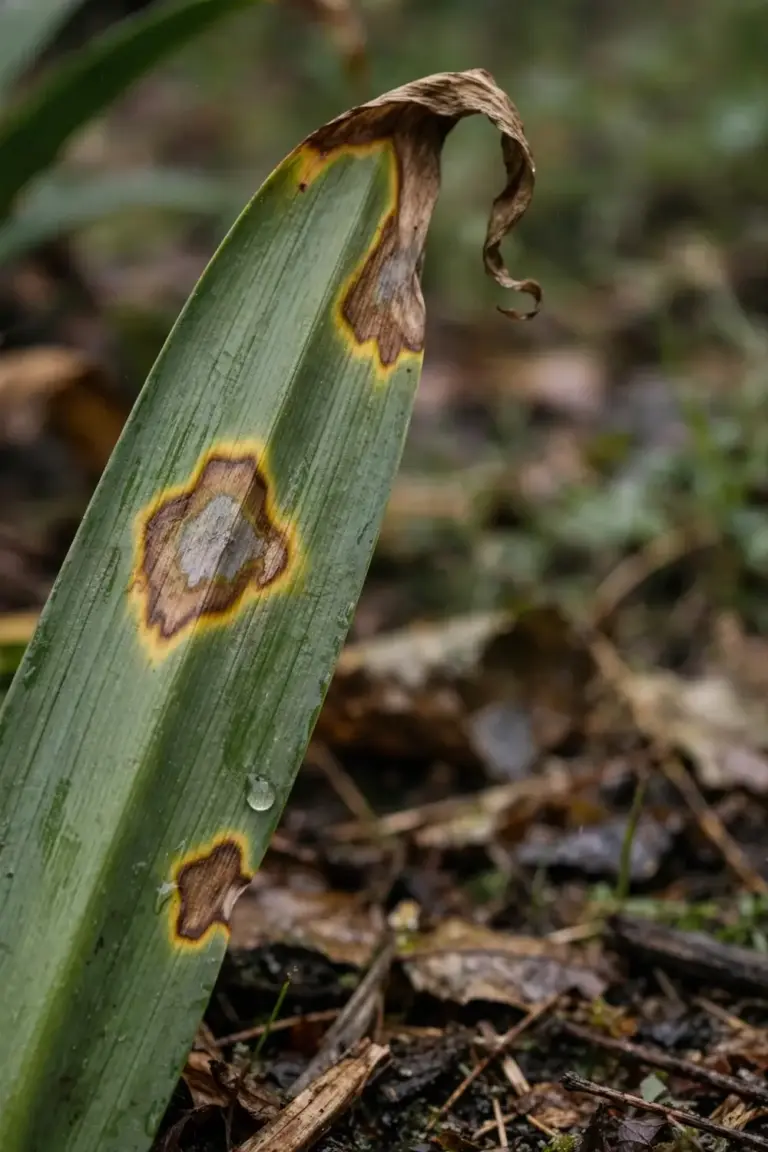
Alternaria leaf spot symptoms begin as small brown spots, often with a yellow halo, and develop into irregular lesions up to an inch across, which converts to 2.5 cm, according to the Purdue Plant Doctor Alternaria leaf spot guide. Severely infected leaves turn brown, curl, wither, and die. Spores are produced in spring on previously infected leaf litter and plant debris, then blow or splash onto nearby plants. Infections occur when humidity is high, temperatures are warm, or the plant stays wet.
Treat leaf spot by removing the source of spores. Pick off spotted leaves and clear fallen leaf litter from around the clump, then bin the material. Purdue advises removing and destroying infected plants and plant debris, which for a home gardener means the bin, not the compost pile, because a home pile does not reliably kill the spores. Overhead watering and rain splash move spores from debris onto leaves, which is why the same clump often shows fresh spots after a wet week. A base-watering routine breaks that chain. Keep leaves dry by watering at the base and avoiding overhead watering. Space clumps for air flow. Fungicides labeled for homeowner use against leaf spot can only prevent new infections, and they must be reapplied while temperatures sit between 55 and 80 degrees Fahrenheit, which converts to 12.8 to 26.7 degrees Celsius. Always read and follow the directions on the product label. One agapanthus-specific leaf spot pathogen, Fusarium agapanthi, was described from leaf and stem spot on Agapanthus praecox in Italy and Australia, so a lab identification is the only way to name the exact fungus behind a given outbreak. For home treatment, the cause name changes nothing. The fix is the same. Reach for a fungicide only when sanitation and dry leaves have not stopped fresh spots after two weeks. A protectant spray guards the new leaves while the clump outgrows the infection, but it never rescues leaves already spotted.
5. Rust: Raised Pustules That Turn Orange
Rust is a fungal disease that makes raised spots on leaves, and it is the least certain cause on this list. A true rust spot feels raised or blistered, and rubbing it can leave orange dust on your finger. That orange dust is the spore mass, and it separates rust from every other white-spot cause. Look on the leaf undersides as well as the tops, because rust pustules often break through the lower surface first. A spot that stays flat and white after a week of watching is almost certainly not rust.
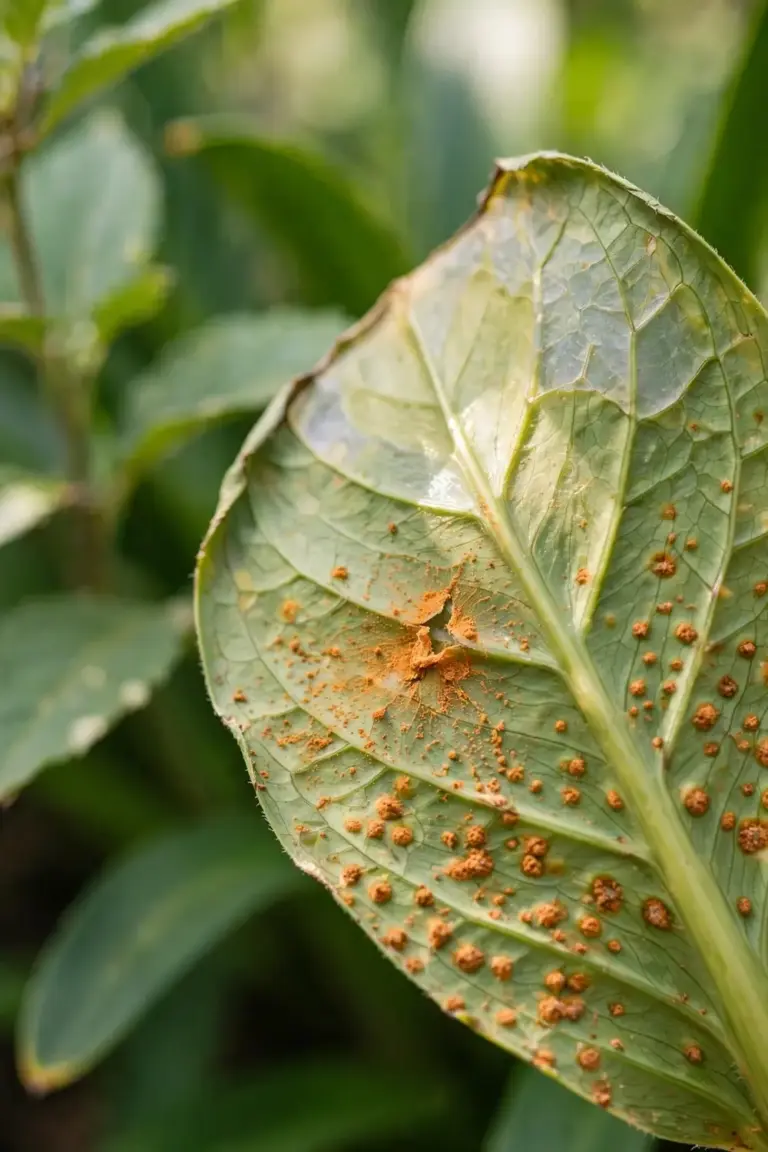
Honesty matters here. General garden guides list rust among agapanthus diseases, but no verified primary source names a specific rust pathogen on agapanthus, and no confirmed Australian record turned up in the sources checked. The species name for an agapanthus rust is data not available. Do not treat a rust diagnosis on agapanthus as certain without a lab identification. What you can do is act on the visible sign.
Remove affected leaves and bin them, because rust spores spread from leaf to leaf. Avoid overhead watering, which spreads fungal spores. Improve air flow by thinning crowded clumps. A fungicide labeled for rust on ornamentals can protect new growth, but it will not cure spotted leaves. If the spots stay white and flat after a week of watching, rust is unlikely, and the cause sits earlier in this list. Rust earns its place here as a check, not as a confident diagnosis.
6. Virus: Yellow Streaks That Never Wash Off
Virus is the one cause on this list with no cure. A virus infection shows as yellow streaks, mottling, or ring patterns inside the leaf, and no wipe or spray changes it. The plant often grows stunted and flowers poorly or not at all.
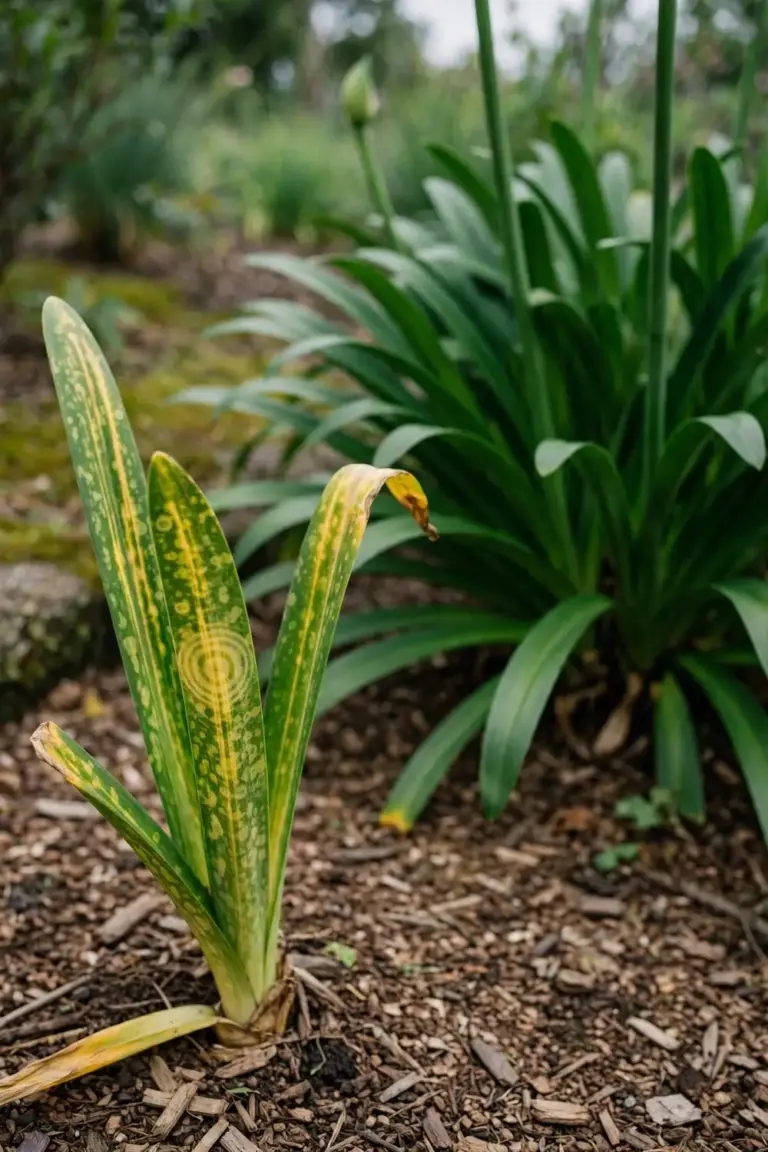
Tomato spotted wilt virus has been confirmed in common agapanthus in Australia. Plants collected from a residential property in Hobart, Tasmania, showed concentric ring and line patterns, irregular chlorotic blotches, and streaks, according to the American Phytopathological Society first report. Symptomatic plants were severely stunted and failed to flower. The report confirmed the virus by laboratory testing, and it was the first report of this virus in common agapanthus.
Rogue a virus-suspect plant out. Dig up the whole clump, including the rhizome, and bin it. Do not compost it. Do not take divisions from it. Clean tools after the job. Virus spreads through sap, insects, and infected divisions, so a half-hearted removal leaves the problem in the bed. One detail from the Hobart report helps the diagnosis. Symptomatic leaves prematurely senesced, but young foliage subsequently produced was symptomless. A plant that stays stunted and flowerless across a season, with streaked older leaves and clean new leaves, fits a virus picture better than a fungus picture. Nutrient deficiency is the usual confusion here, but deficiency yellows leaves fairly evenly, while a virus draws streaks, blotches, and rings inside the leaf. If the pattern follows streaks and rings rather than an even fade, treat the plant as a virus suspect and rogue it out. Replace the plant with fresh nursery stock, not with a division from a neighbor’s clump. One stunted, streaked clump is not worth the risk to the rest of the bed. When you buy the replacement, check the leaves for streaks and mottling before it goes into the ground, and keep new plants apart from old clumps for a few weeks of watching. A virus that arrives on a new plant is far harder to remove once its roots tangle with the bed.
7. Sunscald and Mineral Residue: White Marks That Are Not Disease
Sunscald and mineral residue are lookalikes, not diseases. Sunscald is bleached white or pale tissue where sudden strong sun scorches a leaf, often after a plant moves from shade into full sun or after neighboring shade disappears. The bleached patch feels dry and papery, and it does not spread to other leaves. Mineral residue is a white crust left on the leaf surface by hard water, fertilizer splash, or spray deposits. The crust wipes or rinses off, which is the key test.
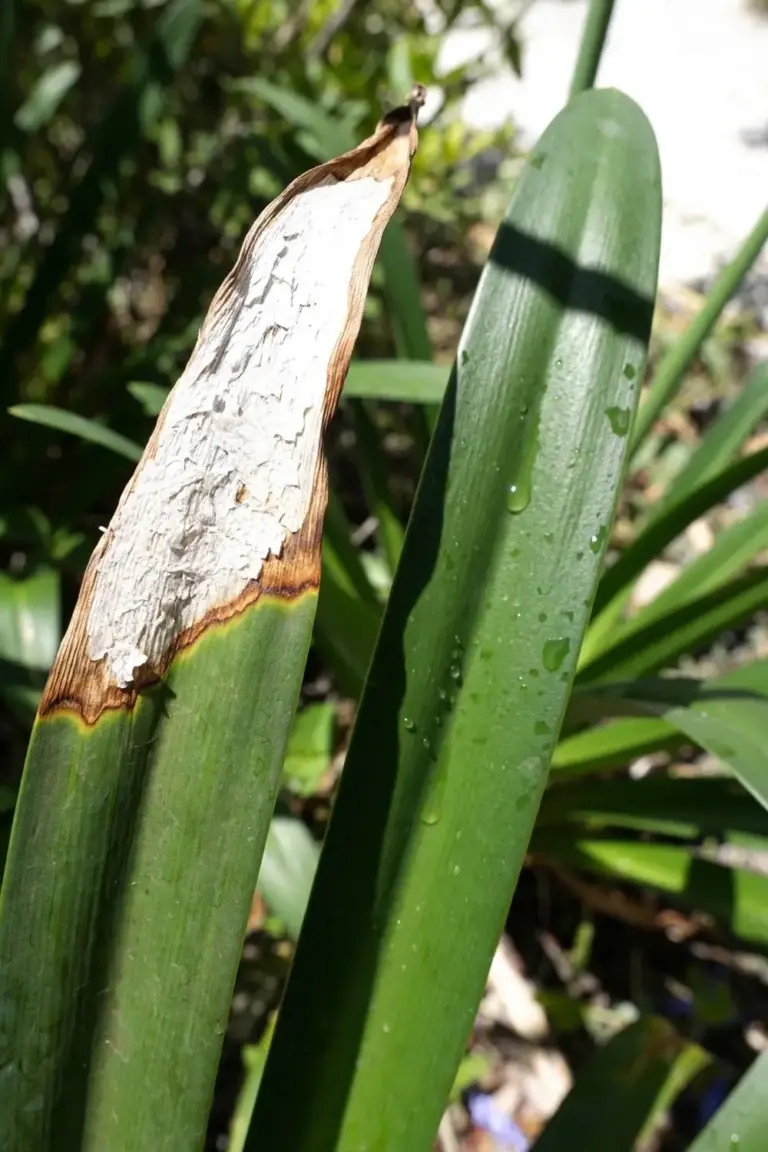
Treat the lookalikes by removing the cause. Rinse mineral crust off with clean water and switch to watering at the base. A crust that rinses away and does not return after you change the watering method was residue, not disease. Mildew, by contrast, smears when wiped and regrows within days if the clump stays shaded and crowded. If the white marks appeared right after feeding, check whether fertilizer splashed onto the leaves, and rinse the foliage with clean water. For sunscald, shade the plant during the hottest part of the day until new growth hardens, or move a potted plant to a spot with morning sun and afternoon shade. Do not spray a fungicide on a lookalike. A fungicide treats a fungus, and neither sunscald nor mineral residue is one. Cut away badly scorched leaves only if they bother you. The plant recovers by growing new leaves.
8. Decide the Fix From the Wipe Result
Match the fix to the cause, and skip the fixes for causes you ruled out. A mildew fix will not cure a virus, and an insecticide will not cure a fungus. The table in section 1 gives the first move for each cause. This section turns that first move into a weekend sequence.
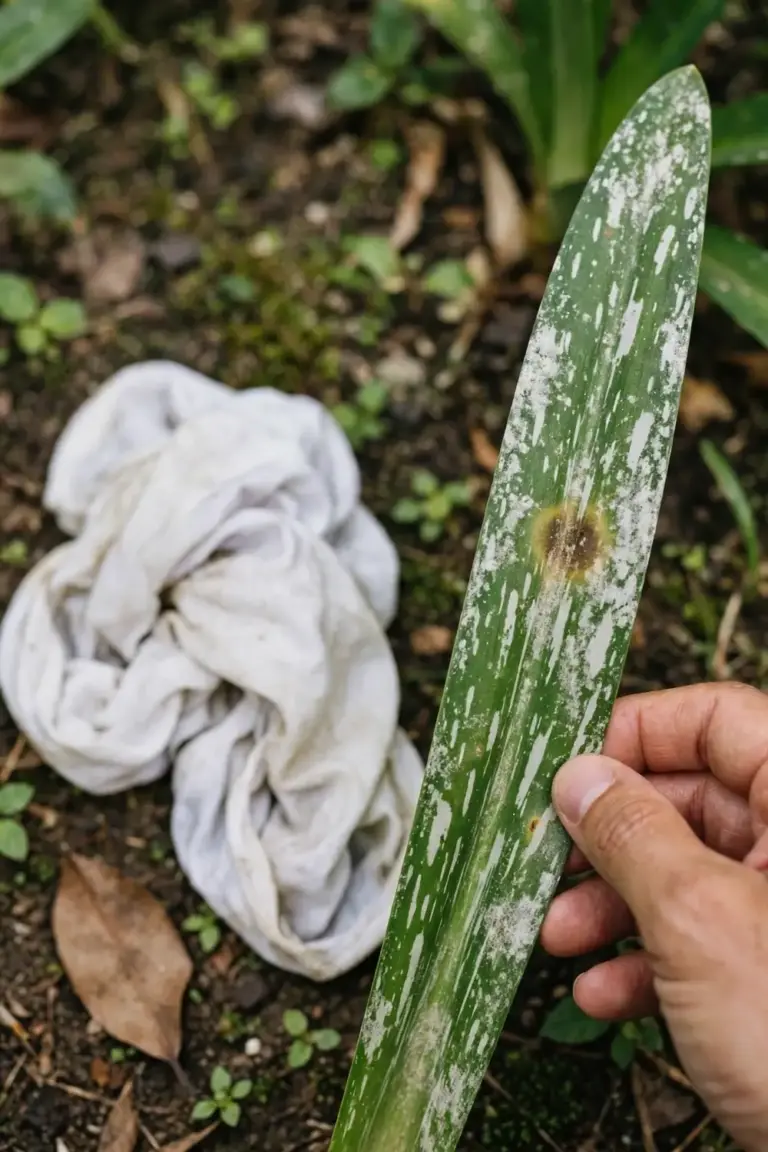
Start with the wipe test and a close look at the leaf bases. Remove the worst leaves from the clump and bin them. Wash your hands and tools after handling a virus-suspect plant, because sap and debris carry the problem to the next plant you touch. Then apply the one treatment that matches your cause: air and light for mildew, alcohol and oil for mealybugs, dry leaves and debris cleanup for leaf spot, leaf removal for rust, roguing for virus, rinsing or shade for lookalikes. Recheck the clump after one week. New spots on new leaves mean the cause is still active, while a clean flush of new growth means the fix is working.
Do not spray everything at once. A fungicide plus an insecticide plus a fertilizer in one weekend hides which treatment worked and stresses the plant. One cause, one fix, one week of watching. That sequence also keeps the garden safer for the predators that eat mealybugs and for the pollinators that visit the flowers. If the second check shows the same cause spreading, repeat the matching treatment once more before considering a stronger product. Two rounds of the right fix beat one round of everything. Write down the date, the cause, and the treatment you used. A phone photo of the spots before treatment helps, because you can compare the new growth against the old damage instead of trusting memory. That note turns next season’s diagnosis into a one-minute job, because you will know what hit this clump last year and what fixed it.
9. Stop White Spots Coming Back
Prevention is mostly water and air. Water agapanthus at the base, in the morning, so leaves dry fast. Space clumps so air moves between them. Clear fallen leaves and spent foliage from around the clump each season, because leaf spot spores overwinter on dead leaves, and a clean bed in autumn means fewer spores in spring. Feed the soil rather than the leaf: a healthy plant in soil with good structure resists disease better than a stressed one. A mulch layer keeps soil moisture even and stops soil splash onto lower leaves. Keep broad-spectrum insecticides out of the bed so the beneficial insects that eat mealybugs stay on patrol. When you buy new agapanthus, inspect the leaf bases before the plant goes into the bed, because mealybugs travel home on nursery stock.
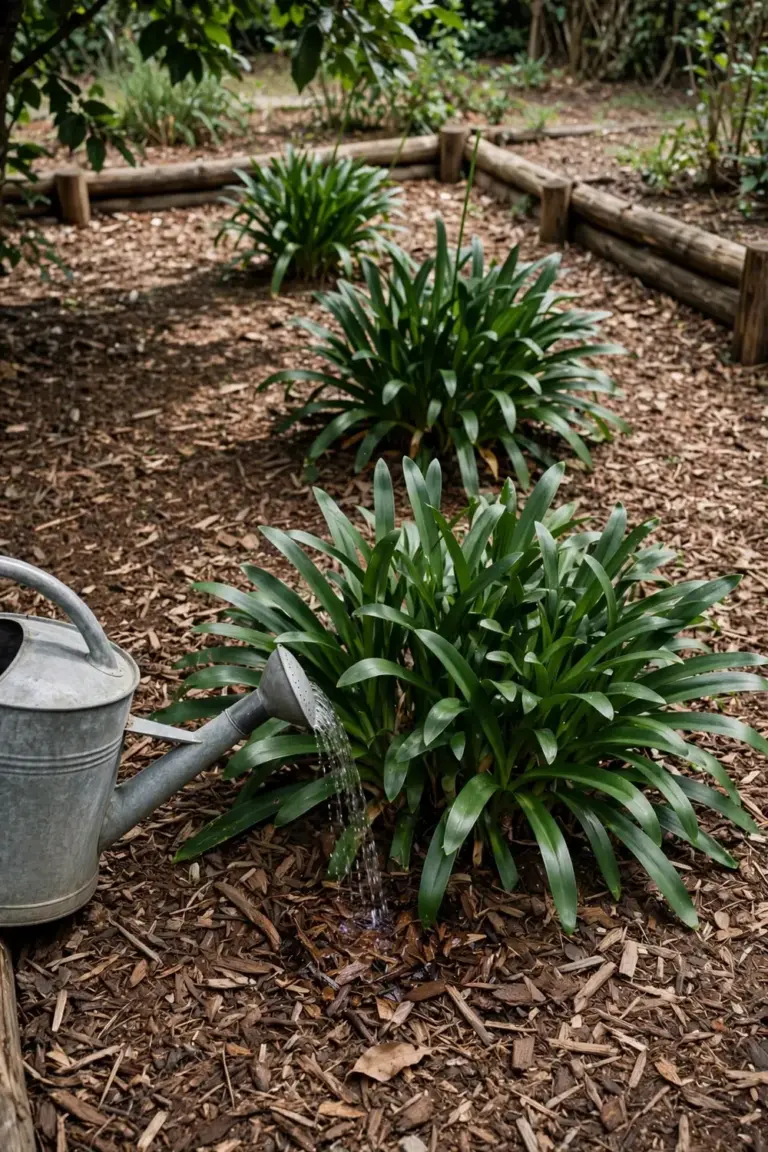
Deadhead spent flower heads before they set seed. Agapanthus is listed as an environmental weed in parts of New South Wales and Victoria, and seed from garden clumps spreads into bushland. Cutting the heads off after flowering costs a few minutes and stops that spread. It also keeps the clump tidy. Check the clump once a month through the growing season. A two-minute look at the leaf bases catches mealybugs before they build cottony colonies, and catches mildew before it coats the clump. In autumn, clear the dead foliage from around the clump and check the rhizome crowns for rot, because a clean bed going into winter carries fewer spores into spring. When you plant new agapanthus, give the clump a position with morning sun and moving air, not a tight corner against a wall where leaves stay damp. A clump that dries fast after rain rarely grows mildew, and a clump that never sits wet rarely grows leaf spot.
10. Frequently Asked Questions
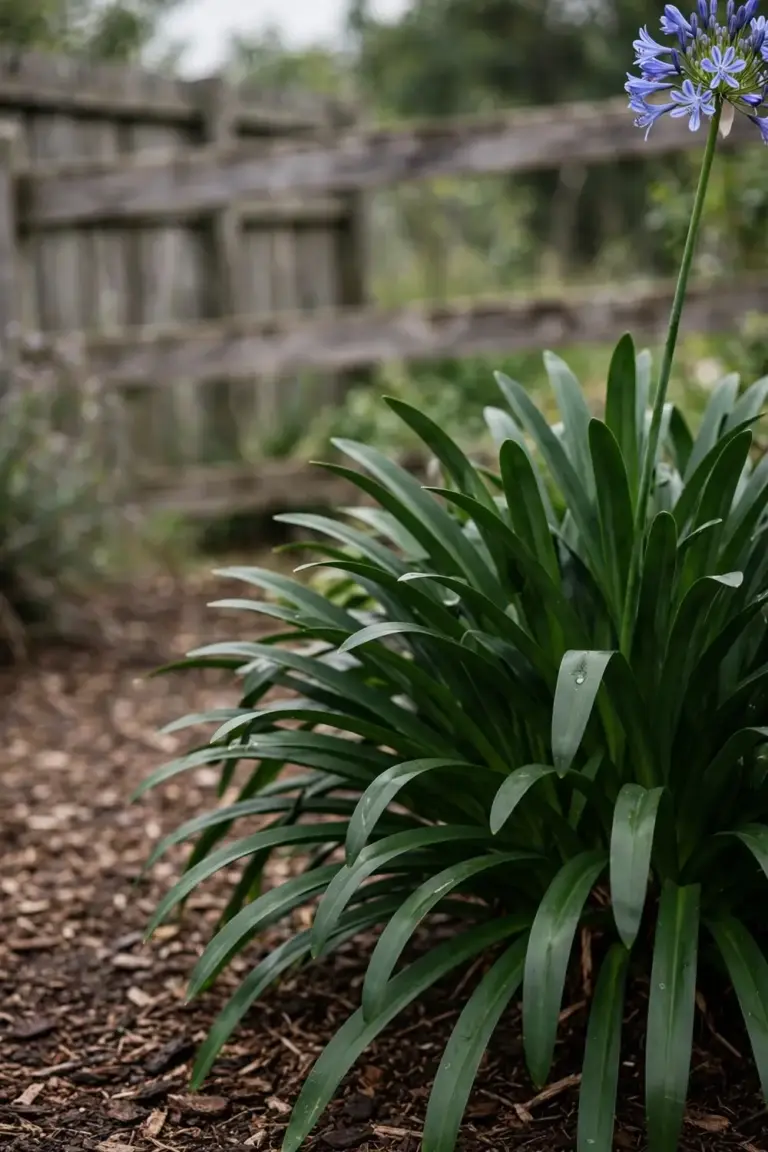
No. Do not eat agapanthus leaves, with or without spots. Agapanthus leaves, sap, and rhizomes are poisonous if ingested, so keep children and pets away from the plant. White spots do not change that rule. Treat the plant, enjoy the flowers, and leave the leaves alone.
It depends on the cause. Powdery mildew and leaf spot spores spread to nearby plants, especially in damp, still air. Mealybugs crawl to neighboring plants. A virus spreads through insects and infected divisions. Mineral residue and sunscald do not spread at all. Identify the cause first, then decide whether neighbors need checking.
Remove the worst leaves, not every spotted leaf, because a clump stripped bare cannot feed its rhizome and the stress invites new problems. Cut the heaviest-spotted leaves. Bin them. Leave lightly spotted leaves to keep feeding the plant while it recovers, then recheck after a week and remove any leaves that worsened.
Rarely. Powdery mildew weakens the plant and looks bad, but it seldom kills an established agapanthus clump. The risk rises when mildew covers most leaves for weeks, because the plant loses photosynthetic area. Open the clump to air, remove the worst leaves, and let new growth come through clean.
Baking soda spray can suppress powdery mildew on some plants, but it is not a cure, and it can burn leaves if mixed too strong or sprayed in hot sun. It does nothing for leaf spot, rust, virus, mealybugs, or mineral residue. Match the treatment to the cause from the wipe test before spraying anything.
11. Name It, Then Treat It
White spots on agapanthus leaves end with the wipe test, not with a guess. Wipe the spot. Dust on your finger means a surface coating. A clean finger means damage inside the leaf. Match the look to the cause, apply the one fix for that cause, and recheck after a week. Agapanthus is a tough plant, and most white-spot causes yield to air, water at the base, and a few minutes of cleanup. The one exception is virus, and for virus the right move is removal, not treatment. Keep that distinction in mind and the rest of the list stays manageable.