
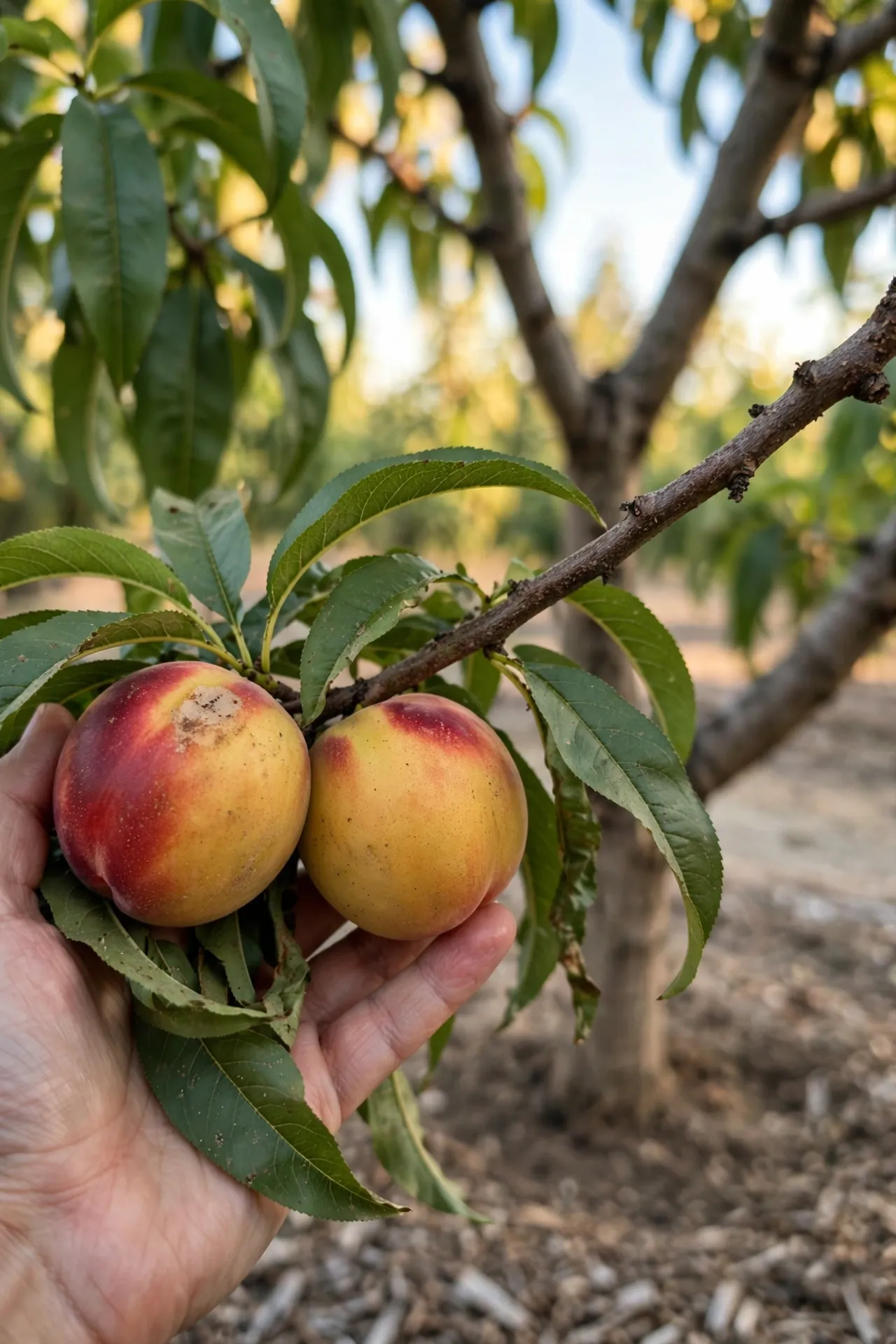

Nectarines are decided before they are planted. Two choices set the outcome: whether your winters deliver the chill your cultivar needs, and whether you will actually manage the disease pressure that comes with fuzz-free skin. Soil, fertilizer, and watering matter far less than either of those.
Should you plant a nectarine at all?
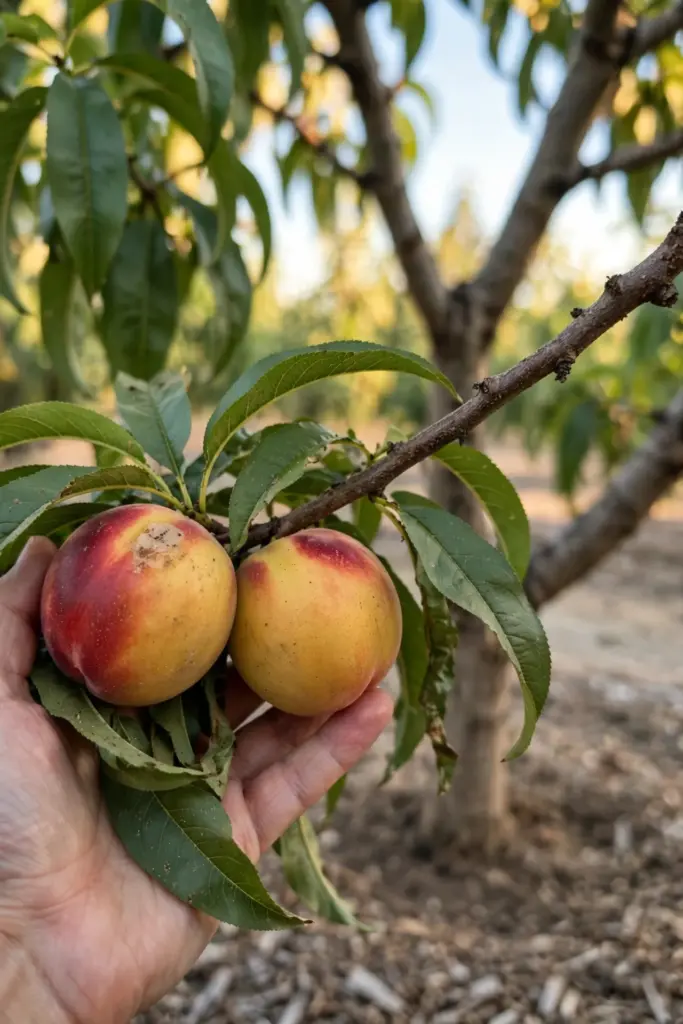
Worth asking before you spend money on a tree. A nectarine is a peach (Prunus persica) carrying a smooth-skin trait, so almost all peach advice transfers. What does not transfer is the margin for error. A Missouri Extension home fruit guide notes that many nectarine cultivars carry only moderate to poor resistance to bacterial spot and that nectarines are generally more challenging than peaches.
| Your summers | What growing nectarines feels like | Honest verdict |
|---|---|---|
| Dry, low humidity through ripening | Sanitation and pruning usually carry you. Fungal losses stay occasional. | Good candidate |
| Warm with rain or heavy dew near harvest | Brown rot arrives every year. You will need a spray plan, not just tidiness. | Possible, with commitment |
| Humid, and you refuse to spray | Fruit collapses in the last week before ripeness, season after season. | Grow a disease-tolerant fuzzed peach instead |
What you need before the tree arrives
- A grafted tree whose label states a chill requirement, bare-root or potted
- The sunniest open spot you have, with air that moves
- Coarse mulch, plus pruners and loppers you trust
- A local extension guide for stone fruit disease timing, saved somewhere you will find it in spring
Step 1: Count your winter chill before you shop
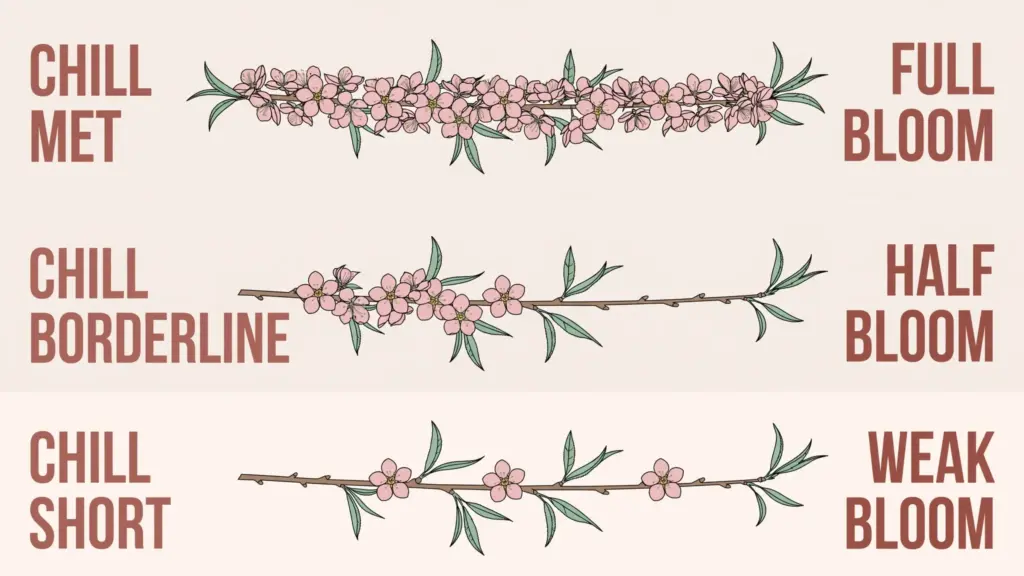
Nectarines need accumulated winter cold to break dormancy cleanly. Plant a high-chill cultivar in a mild-winter region and the tree still leafs out, but bloom straggles over weeks and fruit set stays thin.
How to get your number
Ask your local extension office, or use a regional chill model. Counting methods disagree with each other, which matters more than most beginners expect, and UC ANR walks through the differences in How to Count Winter Chill. Pick one method, then compare cultivars against that same method.
What the number decides
| Your typical winter chill | What to buy | What happens if you ignore this |
|---|---|---|
| Comfortably above the cultivar requirement | Almost any cultivar rated at or below your accumulation | Nothing. This is the easy case. |
| Close to the requirement, varies year to year | A cultivar rated below your average, so bad winters still work | Good crops in cold years, near-empty trees in warm ones |
| Well below the requirement | Low-chill cultivars bred for mild winters | Scattered bloom, weak set, and a tree that never explains itself |
An unlabeled tree from a garden center clearance rack is the single most common cause of a healthy nectarine that never fruits.
Step 2: Choose the cultivar around your worst disease
Most people shop for flavor and ripening date. Shop for your climate’s weak point first, then choose flavor among what survives it. If bacterial spot is common in your area, resistance ratings deserve more weight than a tasting note. If your rain lands during ripening, an earlier-ripening cultivar can sometimes beat the worst of the disease window entirely, which is a quieter trick than spraying and costs nothing. Ask a local nursery which cultivars they see returned or complained about, since that answer is usually more useful than a catalog description written for a whole country.
Step 3: Site it for sun and moving air
Give it the sunniest position you have, then check what happens to air in that spot. Fences, dense hedges, and building corners feel protective and often make things worse, because they block wind while shading the canopy, so leaves and fruit stay wet for hours longer after rain. Avoid low ground where cold air pools on clear spring nights, since bloom is the moment a nectarine is most exposed. If your only good sun happens to sit in a frost pocket, plan on active protection during bloom and read our guide to protecting plants from a late frost before your first spring.
Step 4: Build an open center in the first two winters
A shaded, crowded canopy is a rot incubator. Structural pruning is disease control that happens to also shape the tree.
Make these cuts
Remove the leader early so the tree grows outward into a vase of three or four scaffold limbs. Take out anything dead, damaged, or crossing. Keep the whole tree low enough to thin and pick with both feet on the ground, because a tree you cannot reach is a tree you will not maintain. If you inherited a neglected nectarine, Illinois Extension notes that peaches and nectarines tolerate heavy renovation pruning, including dehorning, at the cost of a season’s crop, in their nectarine growing notes. General timing and technique are covered in our overview of spring pruning techniques.
Check your work
Stand under the tree and look up. You should see broken patches of sky rather than a solid ceiling of leaves. Timid trimming is the usual failure here, since stone fruit responds to decisive cuts.
Step 5: Thin the fruit harder than feels right
When fruit reach roughly thumbnail size, take most of them off. Start with anything misshapen, scarred, or doubled, then keep thinning until the survivors have room to swell without touching a neighbor. Two fruit resting against each other trap moisture between them and hand brown rot a bridge from one to the next. Thinning feels wasteful, which is why gardeners skip it, and then spend the season with small fruit, split branches, and rot moving through clusters. A tree carrying a third of what it set will usually outproduce the same tree left alone, measured by fruit you actually eat.
Step 6: Stop brown rot before you can see it
Brown rot does not begin at harvest. It infects blossoms and twigs in spring, waits, then surfaces as soft tan patches on fruit that looked perfect five days earlier. By the time you notice, the spores that caused it were released weeks ago. Wisconsin Extension covers the symptom sequence and home management clearly in its brown rot guide.
A home-garden routine that holds up
Sanitation comes first and costs nothing. Strip every mummified fruit off the tree in winter, since those dried fruit are next spring’s spore factories. Rake and remove fallen fruit through the season rather than letting it compost under the canopy. Then use structure: the airflow from Step 4 and the spacing from Step 5 shorten the hours that fruit surfaces stay wet, which is the variable the fungus depends on.
If your bloom or pre-harvest window is wet, sanitation alone will not hold, and timing matters more than product choice. UC IPM lays out where the protective sprays fall in the season in its nectarine bloom guidelines. A missed bloom application cannot be repaired later in the year.
Physical protection is the option most home growers overlook. Bagging individual fruit after thinning keeps rain, spores, and insects off the skin, and it works well on a backyard-sized tree where spraying feels like overkill. Our walkthrough on how fruit tree bags protect ripening fruit covers the timing.
Step 7: Pick firm, then finish indoors
Harvest when color and aroma have developed but the fruit still resists a gentle squeeze. UC IPM recommends picking peaches and nectarines firm and ripening them indoors in a paper bag, advice in its home harvest guidance that exists mainly to keep fruit away from pests and rot during the final soft days.
What years one through four look like
Patience is part of the plan. Illinois Extension states that peaches and nectarines should start bearing during their 3rd year in the orchard, with heavier production after that. Spend years one and two on structure and root establishment, and strip most of any early fruit the tree sets. Plan the spacing for that mature tree from day one, since crowding is difficult to undo: an Ask Extension answer on stone fruit spacing suggests keeping semidwarf peaches and nectarines to about 10 to 12 feet tall through pruning, with roughly 15 feet between trees.
When it still goes wrong
- Fruit collapses days before you planned to pick. Brown rot under warm, wet conditions. Tighten sanitation now, prune harder next winter, and move your protection earlier next season.
- Heavy bloom, almost no fruit. Look at chill mismatch first, then frost during bloom, then cold or wet weather that kept pollinators grounded.
- Rough, corky patches on otherwise sound fruit. Usually thrips feeding at bloom. UC ANR’s Ventura County office explains the russeting this causes on nectarines and notes that home garden control is often not recommended, since the damage is cosmetic.
- Vigorous shoots everywhere, little fruiting wood. Pruning is too light, too late, or aimed at shape rather than renewal.
FAQ
How many chill hours does a nectarine tree need?
It varies by cultivar across a wide range, so the number on the label matters more than any general figure. Match it to your own accumulation using one consistent counting method, then build in a margin for warm winters. UC ANR’s chill counting guide explains why two methods can disagree about the same winter.
Are nectarines harder to grow than peaches?
Usually yes. They are the same species, and the missing fuzz leaves the skin more exposed to rot and insect damage. Missouri Extension also flags weaker bacterial spot resistance across many nectarine cultivars.
Do I need two nectarine trees to get fruit?
No. Most nectarine cultivars are self-fertile, so a single tree will set a crop. A second tree spreads your risk across two ripening dates, which is a better reason to plant one than pollination is.
Can I grow a nectarine in a container?
Yes, on dwarfing rootstock, and container growing solves a real problem for people in marginal climates because you can move the tree out of a frost event during bloom. Expect a smaller crop and a watering routine you cannot skip in summer.
Why did my nectarine bloom beautifully and then set nothing?
Rule out frost first, since open blossoms are damaged at temperatures that leave leaves untouched. If frost is not the answer, suspect a chill mismatch, especially when bloom was scattered over several weeks rather than concentrated.
Where to go from here
Get the two hard decisions right and nectarines stop feeling temperamental. Match chill hours to the winters you actually get, and treat brown rot as something you prevent in February rather than something you discover in July. Pruning and thinning do the rest, and both cost time instead of money.
If your climate came out badly in the table at the top of this guide, there is no shame in planting something with better odds. Japanese plums give you the same stone fruit season with a thicker skin and a far more forgiving disposition.








