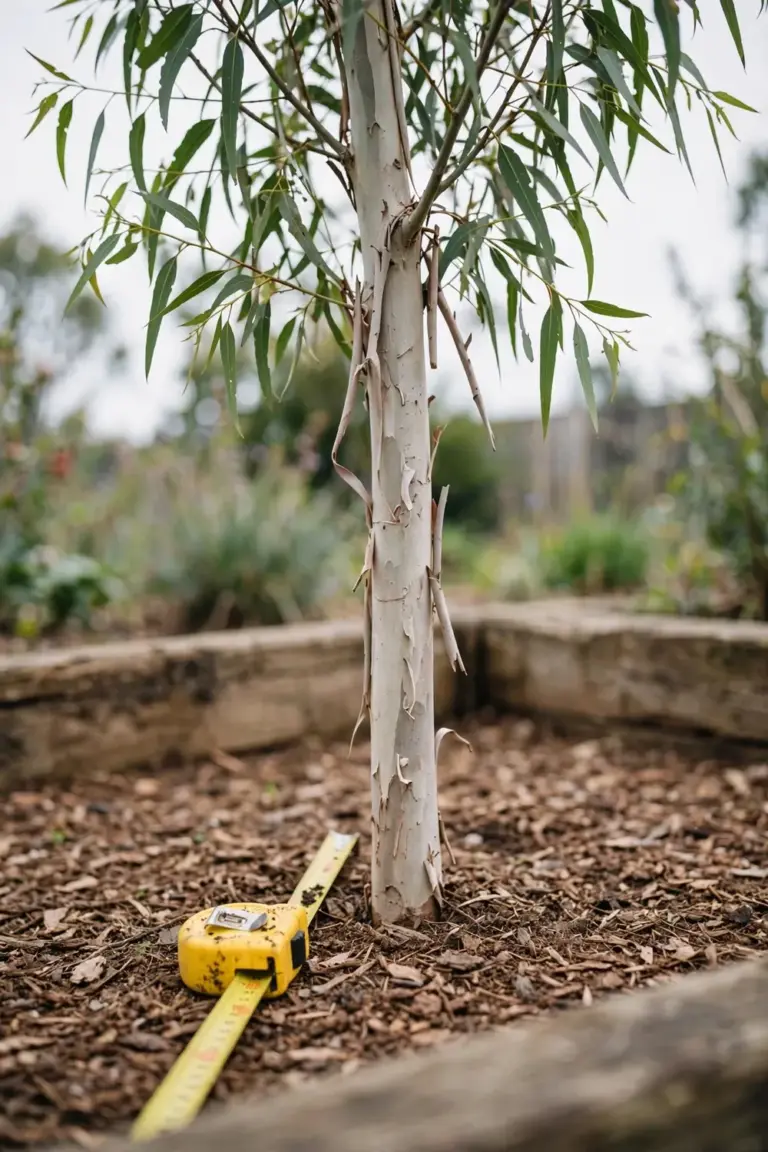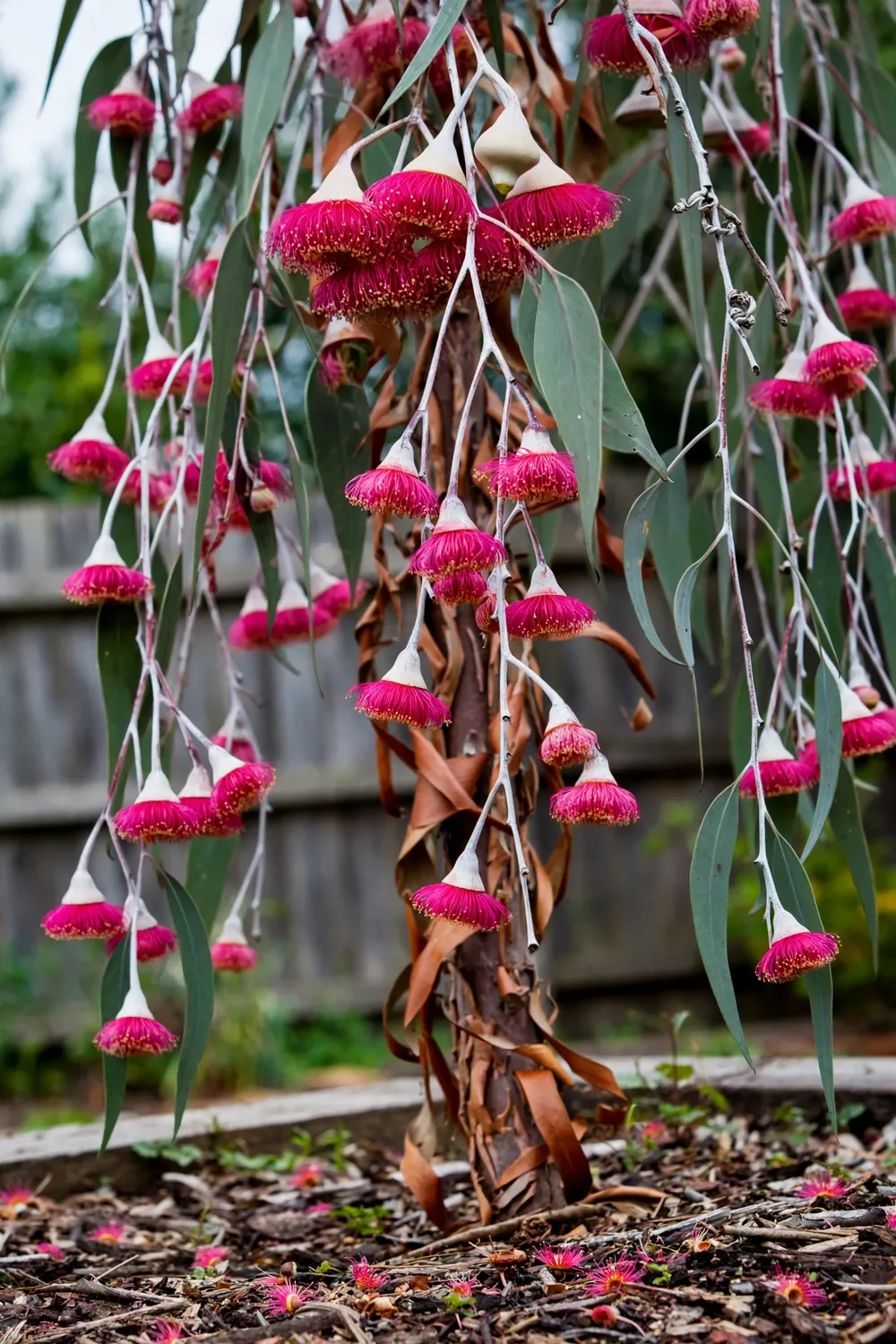

Pick the gum that fits the block, because the best eucalyptus species for home gardens earn their place at mature size, not at nursery-pot size. The 12 picks below run from a 2 m mallee to a 20 m shade tree, and each one carries its mature height, its spread, its flower color, and the climate it suits.
I have learned that the smallest gum that does the job beats the biggest gum the block can hold.
Eucalyptus counts more than 800 species, from mallees under 7 m to forest giants over 30 m. This page ranks 12 species that stay garden-sized or earn a large block, then closes with a 4-check chooser and a comparison table. Read the mature size first. Buy the tree second.
1. Silver Princess Gum
Silver Princess Gum gives a small garden a weeping feature tree with pink-red flowers and bark that peels in curls.
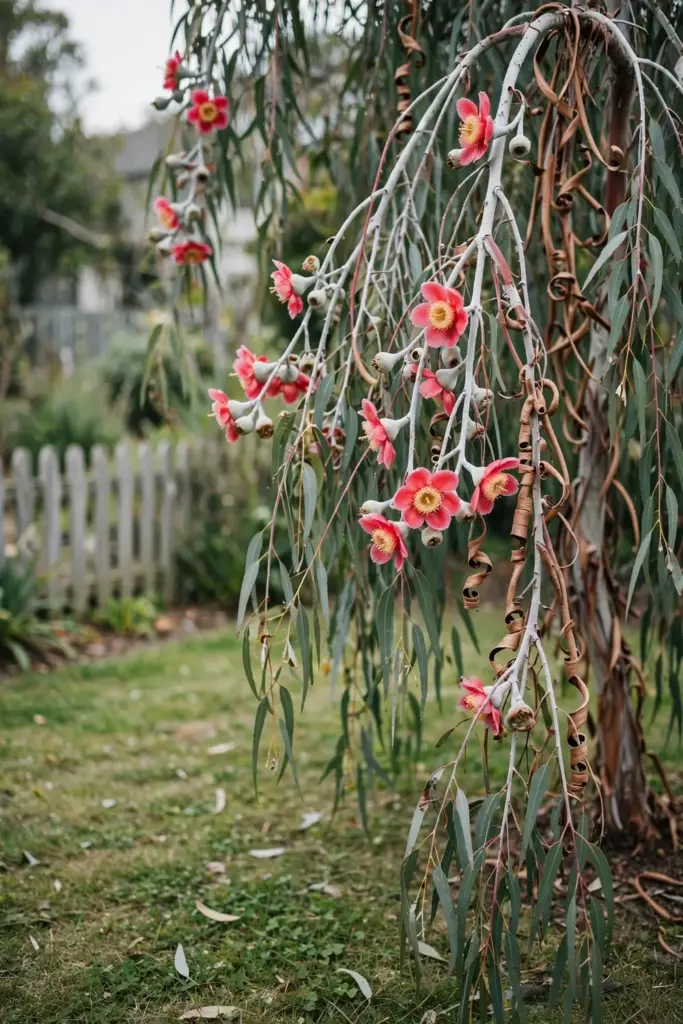
Eucalyptus caesia ‘Silver Princess’ grows 6 to 8 m tall and 3 to 4 m wide, with a gently weeping habit. The flowers are large, pink to red, with yellow stamens, and they open in winter and spring. The bark is minni ritchi bark, red-brown curls that peel to show pale wood beneath. The silver-white powder on young stems, buds, and gum nuts gives the tree its name.
This gum suits a front garden, a courtyard, or a lawn feature where the weeping form reads from the street. It wants full sun and sharp drainage. It handles light frost and dry summers once established. It sulks in heavy clay that stays wet and in humid coastal air.
Give it one care pointer. Prune lightly to remove damaged or unruly growth. Hard pruning breaks the weeping shape that makes this tree worth planting.
2. Plunkett Mallee
Plunkett Mallee gives a courtyard a true mallee that stays under 7 m and flowers white in summer.
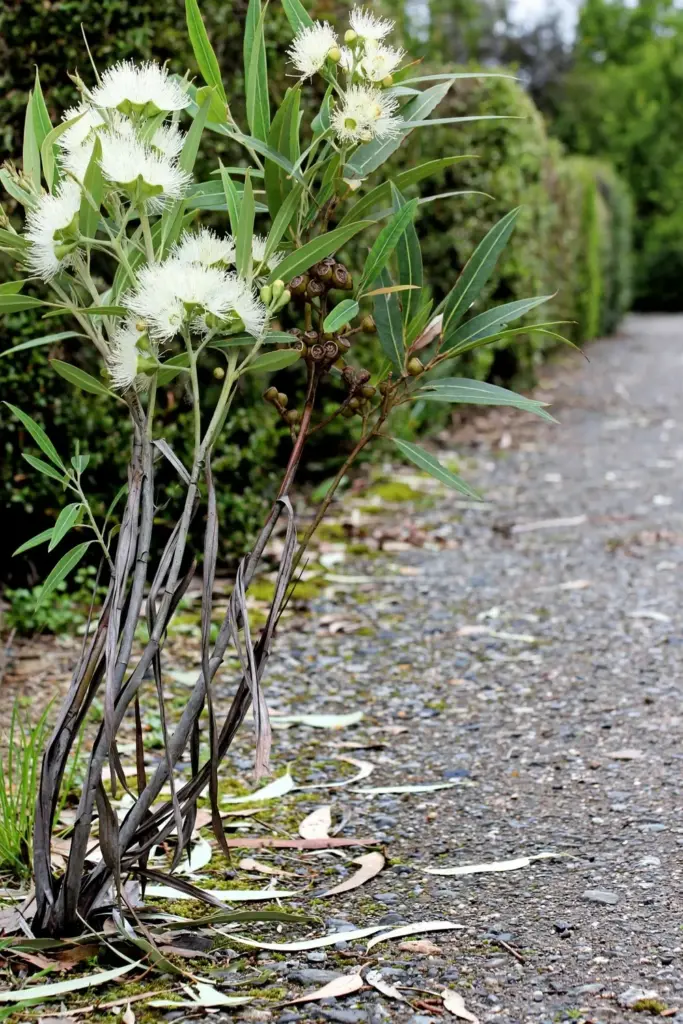
Eucalyptus curtisii grows 2 to 7 m tall as a multi-stemmed mallee from a lignotuber. The spread runs to about 5 m. The bark is smooth, gray-brown, and sheds in strips. White flowers open in summer and draw honeyeaters. The small size comes from the mallee habit itself, so the tree keeps its shape without hard pruning.
This mallee suits a courtyard, a large pot, or a narrow bed beside a path. It comes from the Plunkett area of south-east Queensland and suits warm temperate and subtropical gardens. It wants full sun and free-draining soil. It tolerates light frost once established.
Give it one care pointer. Water through the first two summers, then let rainfall carry it. A mallee in a pot needs a fast-draining native mix and a pot with open drainage holes.
3. Silver-Leaved Mountain Gum
Silver-Leaved Mountain Gum gives a small garden silver foliage all year and cream flowers in winter and spring.
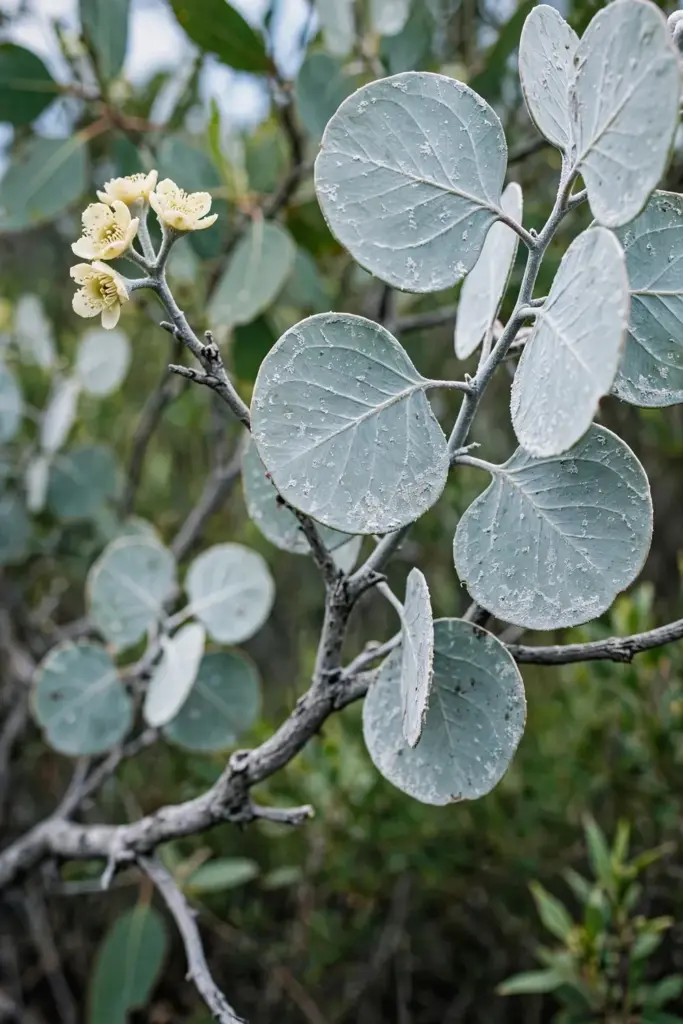
Eucalyptus pulverulenta grows 5 to 10 m tall and 2 to 4 m wide, with a crooked trunk and a spreading crown. The juvenile leaves are round, silver-blue, and dusted with white wax, and they persist on mature plants. Cream flowers open in clusters of three from winter into spring. Florists cut the foliage for arrangements because the round leaves hold their color in a vase.
This gum suits a small feature spot, a mixed native bed, or a pot on a patio. It comes from the tablelands of southern New South Wales and suits cool temperate gardens. It wants full sun and shelter from cold drying wind. It handles light frost.
Give it one care pointer. Prune back after flowering to keep juvenile foliage coming. Coppicing holds it as a foliage shrub when the block runs short on room.
4. Coral Gum
Coral Gum gives a dry garden coral-pink flowers and a compact crown that stays under 8 m.
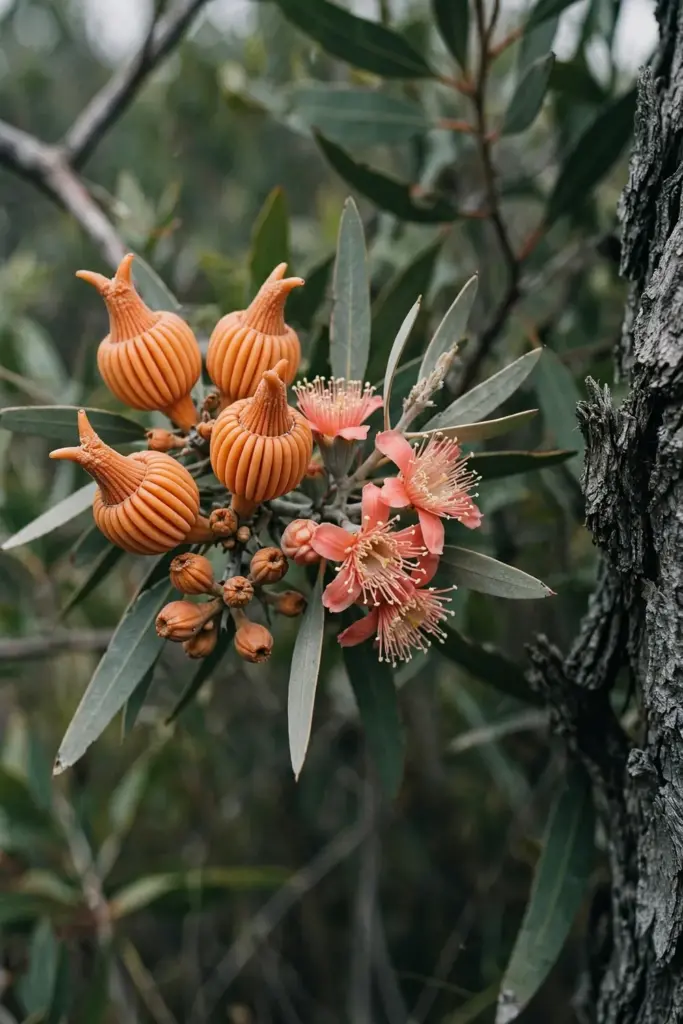
Eucalyptus torquata grows 4 to 8 m tall and 3 to 5 m wide, with a spreading crown on a short trunk. The buds are orange, barrel-shaped, with ribbed bases, and they open to coral-pink flowers from late winter into summer. The bark is rough, gray-black, and persistent on the trunk. The flower display draws honeyeaters and native bees in numbers.
This gum suits a dry garden, a street verge, or a small front yard in a low-rainfall district. It comes from the goldfields of inland Western Australia and suits Mediterranean and semi-arid gardens. It wants full sun and sharp drainage. It handles drought and light frost once established. It sulks in humid coastal air and in wet clay.
Give it one care pointer. Water weekly through the first two months, then taper. An established coral gum lives on rainfall in most dry gardens.
5. Small-Leaved Gum
Small-Leaved Gum gives a cold, damp garden a compact tree with small round leaves and a smooth gray trunk.
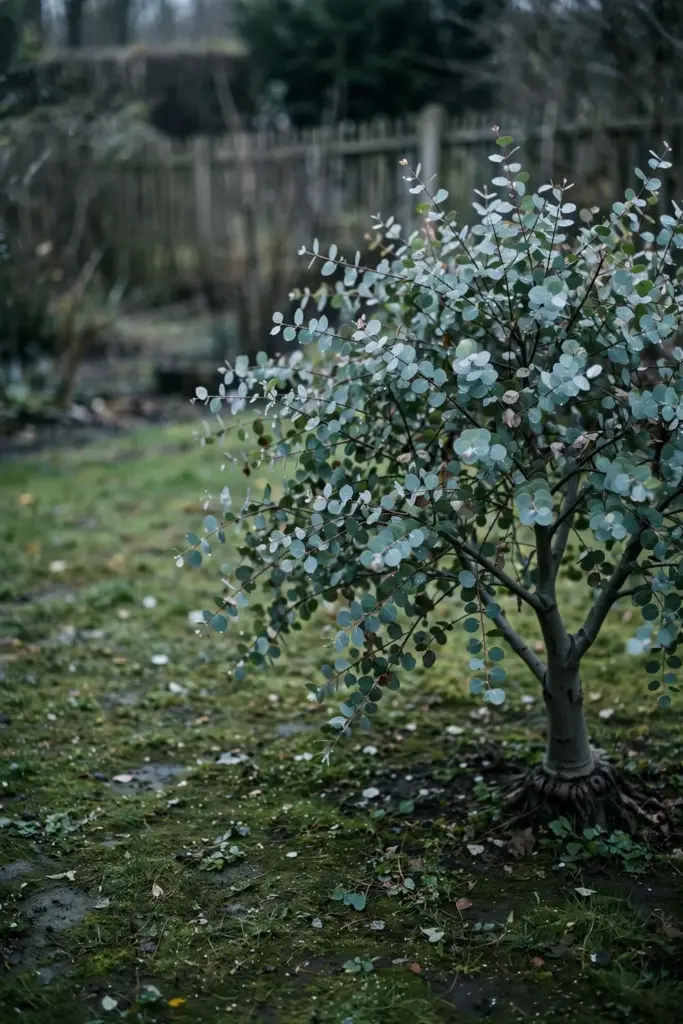
Eucalyptus parvula grows to 10 m tall. It can grow wider than tall, with a rounded crown and branches close to the ground. The trunk sheds bark in thin strips and shows a smooth dark-gray surface, with a collar of hard ridged bark at the base. The mature crown keeps many small juvenile leaves, opposite and about 25 mm long, which gives the tree its name. White flowers open from January to March, according to the Australian National Botanic Gardens small-leaved gum page.
This gum suits a cold garden, a damp low spot, or a windbreak row where other gums sulk. It comes from the high country of south-eastern New South Wales. There it grows in valleys with poor drainage, frost, snow, and heavy mist. Waterlogged soil, frost, and snow cause it no trouble. Give it a drink through summer to hold condition.
Give it one care pointer. Water well in summer. The same page notes that this species grows best with steady summer moisture, and it stays freer of pests than many gums.
Buy this species from a nursery, never from the wild. Small-leaved gum is a threatened species with a small natural range, and wild plants sit mostly on private land and roadsides. Nursery stock carries the same small leaves and cold tolerance without touching a wild stand. A garden tree grown from nursery seed still feeds bees and birds, and it leaves the wild population alone.
6. Snow Gum
Snow Gum gives a cold-climate garden a sculptural tree with patterned bark and white flowers in summer.
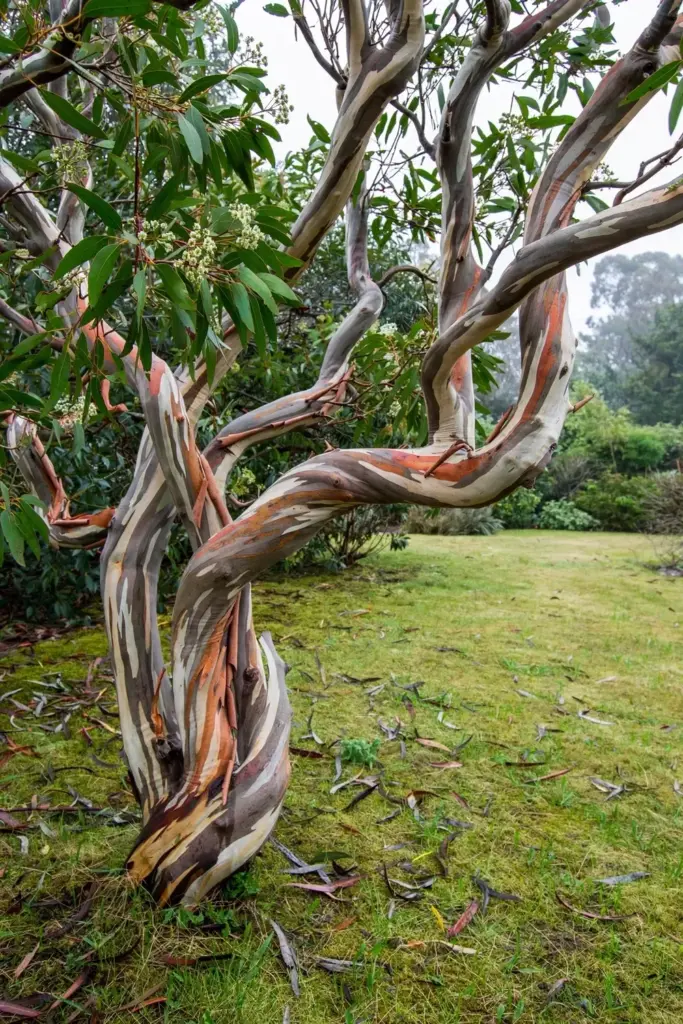
Eucalyptus pauciflora grows 4 to 15 m tall and 3 to 10 m wide, with a short twisted trunk and spreading limbs. The bark is smooth, white to light gray, shedding in patches to show cream, green, and rust. White flowers open in clusters from late spring into summer. The tree grows from a large lignotuber, which feeds the spreading form.
This gum suits a cold garden, a mountain block, or a large lawn feature in a frost district. It comes from the high country of south-eastern Australia and suits cool temperate and cold gardens. It handles heavy frost and snow. It sulks in hot humid subtropical air, where growth turns poor and short-lived.
Give it one care pointer. Plant it where the bark shows. A snow gum beside a path or a window earns its keep through the bark alone, and a tree hidden behind a shed wastes its best trait.
The lignotuber does quiet work underground. It stores starch and dormant buds, so a snow gum cut by fire or frost reshoots from the base instead of dying. That same storage feeds the spreading, multi-stemmed form that makes the tree look sculptural. A garden snow gum rarely faces fire, but the lignotuber still explains why the tree recovers fast from a hard prune or a storm-damaged limb.
7. Cider Gum
Cider Gum gives a cold garden silver-blue juvenile foliage, fast growth, and a tree that coppices into a shrub.
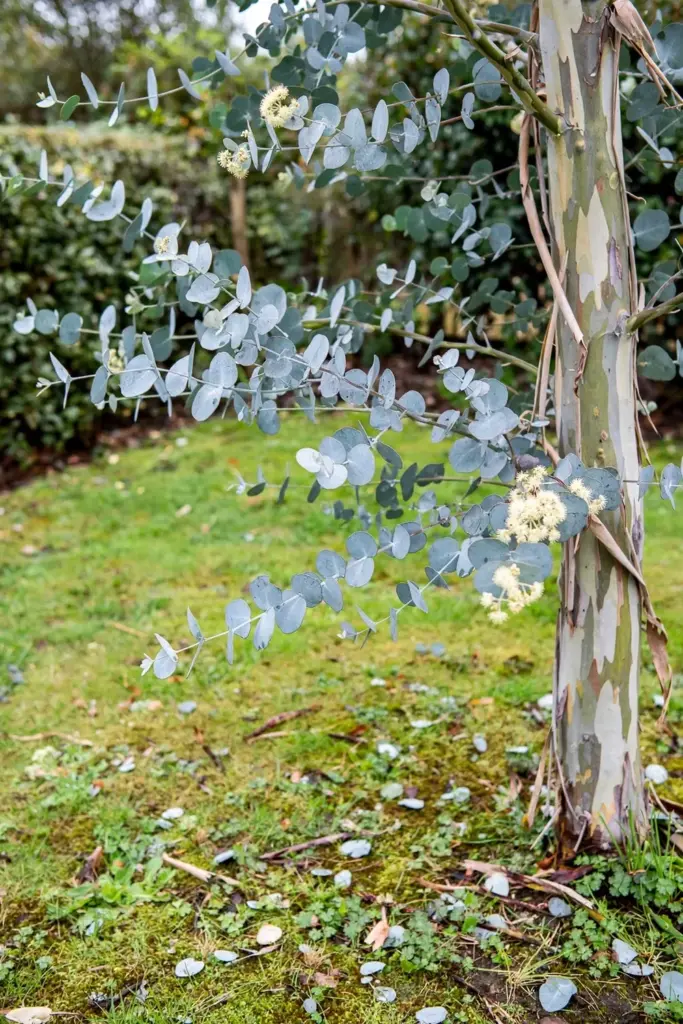
Eucalyptus gunnii grows 10 to 15 m tall and 6 to 8 m wide in cultivation, with a broad upright crown. The juvenile leaves are round and silver-blue. Adult leaves turn longer and gray-green. Cream flowers open in summer. The bark sheds in strips to show cream and green patches. The species comes from the Tasmanian highlands and ranks among the hardiest gums in Australia.
This gum suits a cold garden, a windbreak row, or a large block where a fast shade tree earns its place. It handles heavy frost, wind, and poor soil once established. It tolerates drought. It sulks in humid subtropical air.
Give it two care pointers. Coppice in late winter to hold it as a 2 to 3 m shrub in silver juvenile leaf. Prune in spring with clean cuts outside the branch collar, and spring pruning techniques covers the general method. The Glacier form is a compact cultivar with its own page, and the Glacier eucalyptus guide covers that single cultivar in full.
Florists cut cider gum stems for the round silver leaves. A coppiced shrub puts that foliage at waist height, where cutting takes minutes and needs no ladder. A tree left to grow tall puts the same leaves 10 m up, where no one cuts them. Coppicing turns an ornamental tree into a working foliage plant, and the shrub form fits a block that could never hold the full tree.
8. Argyle Apple
Argyle Apple gives a garden silver-blue foliage that reads from across the street and white flowers in spring.
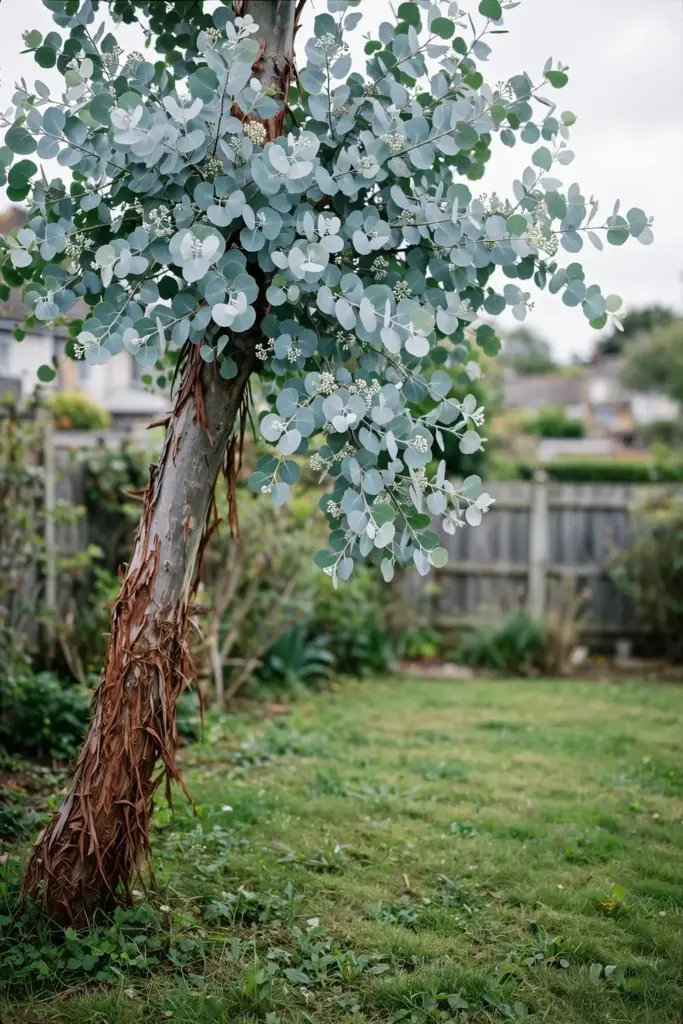
Eucalyptus cinerea grows as a tree to 15 m high, according to PlantNET. The spread runs 6 to 10 m in garden conditions. The bark stays rough and fibrous on the trunk, red-brown to gray-brown, and turns smooth above. Juvenile leaves are round and glaucous. Adult leaves turn broad-lanceolate and gray-green. White flowers open in clusters of three from May to November.
This gum suits a feature spot where silver foliage sets off darker plants behind it. It comes from the tablelands of New South Wales and Victoria and suits cool temperate and warm temperate gardens. It handles light frost and drought once established. It wants full sun and well-drained soil.
Give it one care pointer. Prune to hold the silver crown. Left alone, the tree grows tall and the silver juvenile foliage moves out of reach. A yearly light prune keeps the color where eyes land.
Argyle apple also prunes into a hedge. A row of young trees, trimmed through the warmer months, holds a silver screen that screens a boundary without the bulk of a fence. The hedge needs regular trimming, because a skipped season lets the leaders shoot up and the screen turn ragged. A gardener who wants a hedge buys three or four small trees and trims them from the first year, not one large tree that already outgrew the row.
9. Red Flowering Gum
Red Flowering Gum gives a garden the loudest flower display of any gum on this page, in red, pink, orange, or white.
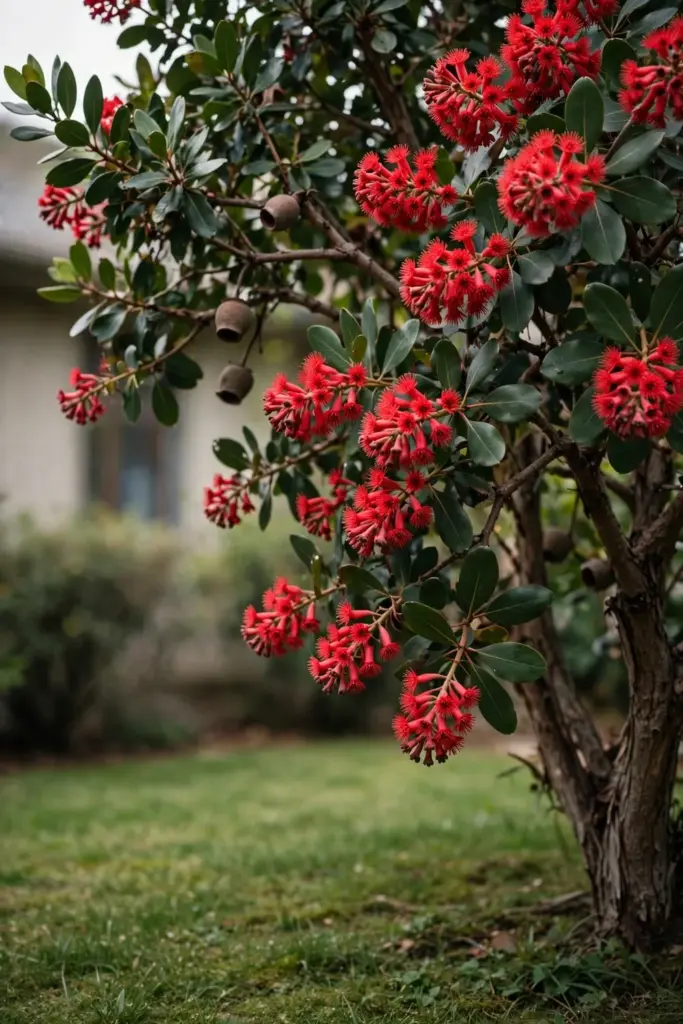
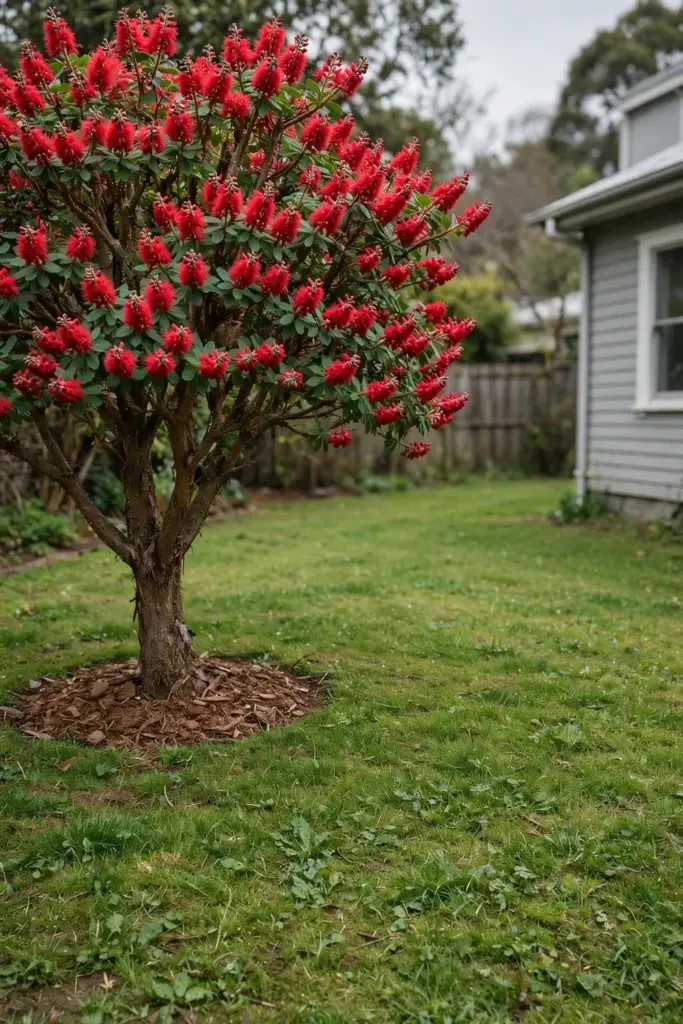
Corymbia ficifolia grows to 12 m tall and 5 m wide as a species tree, and most trees stay at 10 m or less, according to the red flowering gum guide. The botanical name moved from Eucalyptus to Corymbia in 1995. Nurseries still sell it beside the gums, and it earns its place here on merit. The flowers open in large terminal clusters from December to May. Grafted cultivars hold 6 to 8 m and lock in one flower color, which seed-grown trees cannot promise.
This gum suits a front garden, a street verge, or a feature lawn in a dry-summer district. It comes from the south-west of Western Australia and suits Mediterranean and warm temperate gardens. It wants full sun and free-draining soil. It handles drought once established. It sulks in humid coastal air, where seed-grown trees fail more often.
Give it one care pointer. Buy a grafted cultivar by name for a set flower color. A seed-grown tree can flower any shade from white to red, and the color stays a surprise until the first bloom.
Grafting solves two problems at once. The scion carries the exact flower color of the parent, so a ‘Wildfire’ graft flowers crimson-red every time. The rootstock carries vigor and tolerance, so the grafted tree handles eastern humidity better than a seed-grown ficifolia. A grafted tree costs more than a seedling, and the extra price buys a known color on a tougher root system. Check the graft union at planting and keep it above soil level.
10. Wallangarra White Gum
Wallangarra White Gum gives a large garden powdery white bark, willow-like foliage, and dappled shade.
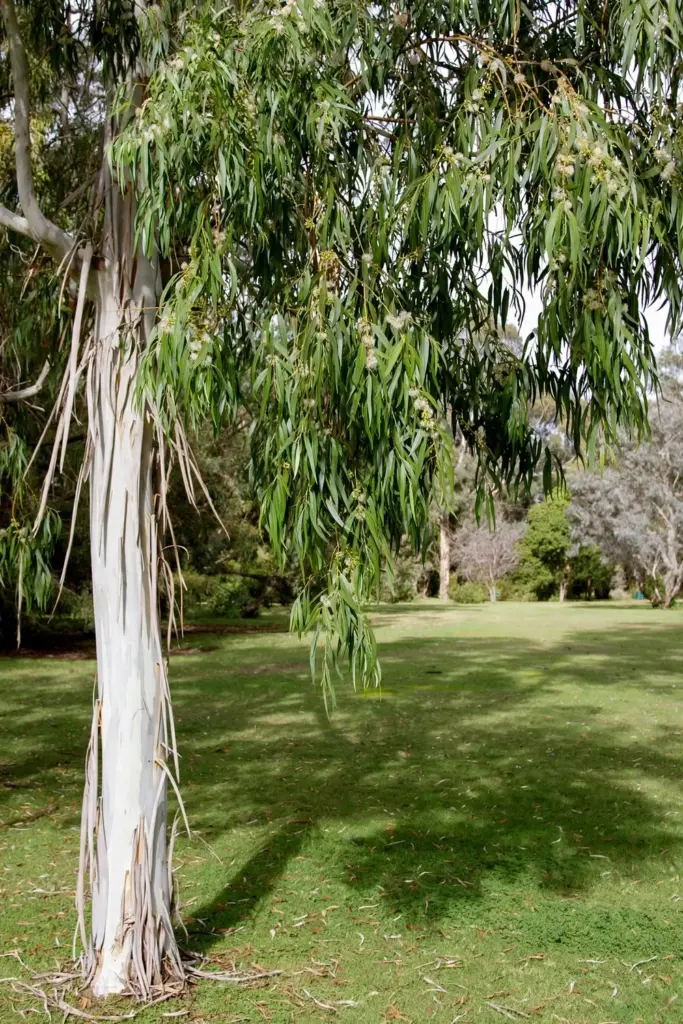
Eucalyptus scoparia grows 12 m tall and 12 m wide, with a slender trunk and a broad open crown. The bark is smooth, powdery, white to pale gray, and sheds in narrow strips. Adult leaves are narrow, glossy, and willow-like. Cream-white flowers open in early summer. The species comes from a small area on the Queensland and New South Wales border, where it grows on granite slopes.
This gum suits a large garden, a park, or a street tree in a cool district. It handles frost to minus 7 degrees and drought once established. It wants full sun and well-drained soil. It sulks in wet soils, in coastal salt, and where roots meet excavation.
Give it one care pointer. Formative prune early to build one strong central leader. A young tree left to fork low grows a weak crown that sheds limbs after drought or high wind.
Wallangarra white gum is a threatened species in the wild, listed as vulnerable. Its wild stands sit on a few granite mountains near the Queensland and New South Wales border. Garden trees come from nursery stock, and a garden planting never justifies digging a wild tree. The garden tree still does real work: it shades a street, feeds bees with cream flowers, and shows a white trunk that reads from down the block.
11. Yellow Gum
Yellow Gum gives a garden a long flower season, from autumn through winter into spring, when little else blooms.
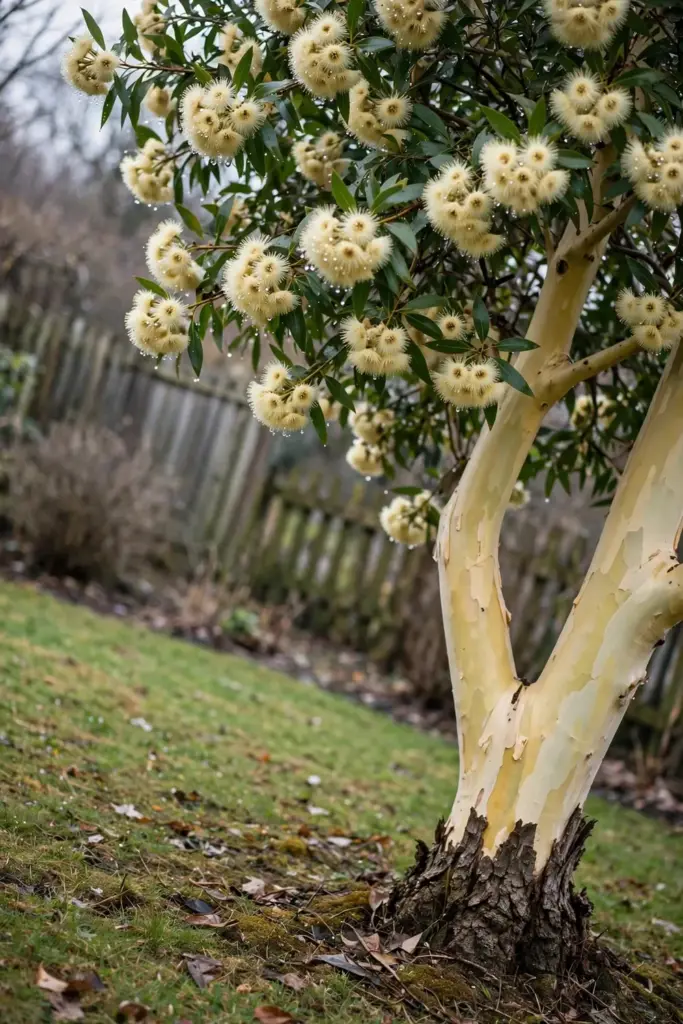
Eucalyptus leucoxylon grows 10 to 15 m tall and 6 to 10 m wide, with a rounded canopy on a single trunk. Bark stays rough at the base. Above it turns smooth, cream to yellow-gray. Flowers are cream, sometimes flushed pink, and they carry heavy nectar for months. The ‘Rosea’ form flowers pink and holds 12 to 15 m tall. The species covers Victoria, South Australia, and the south-west slopes of New South Wales.
This gum suits a native garden, a street verge, or a shade tree over lawn. It handles frost, clay soil, limestone, coastal exposure, and salt spray. Humid subtropical air is the one climate it dislikes. There the bark discolors. Growth slows.
Give it one care pointer. Plant it where winter flowers feed birds. A yellow gum in flower in July pulls honeyeaters and lorikeets into a garden that otherwise sits quiet.
Yellow gum covers six subspecies in Victoria alone, and the garden forms differ. The ‘Rosea’ form flowers pink and holds 12 to 15 m tall with a 7 m spread. The connata form flowers cream. It holds 10 to 15 m tall with a 6 to 10 m spread. The megalocarpa form carries larger fruit on a smaller frame. A label that names the subspecies or cultivar tells the buyer which tree arrives. A label that names only the species leaves both open.
12. Brittle Gum
Brittle Gum gives a large block a white trunk that reads from across a paddock and a fast, upright shade tree.
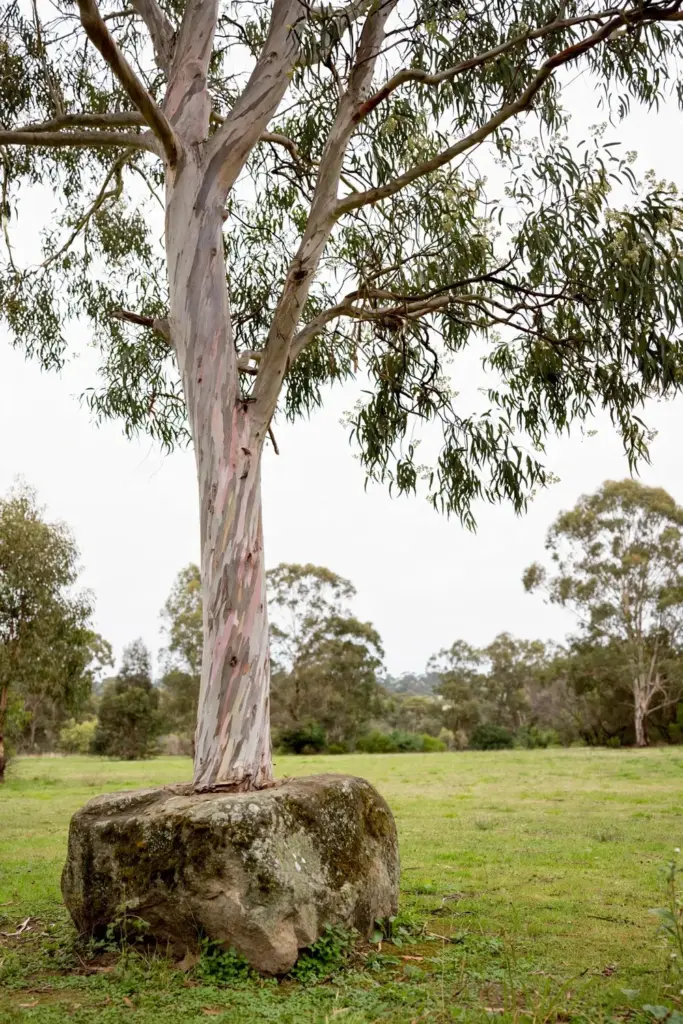
Eucalyptus mannifera grows 10 to 20 m tall and spreads to 13 m, according to the Australian National Botanic Gardens brittle gum page. The trunk is smooth and white, often mottled with gray, and turns pink in late spring or summer. The leaves are narrow and dull green. White flowers open in autumn in Canberra and at other times elsewhere. The same page warns that the wood is brittle, so a large tree should not overhang a dwelling.
This gum suits a large block, an avenue, or a shade tree over lawn. It comes from the Central and Southern Tablelands of New South Wales and suits cool temperate gardens. It handles frost, drought, and poor soil. It grows in rainfall of 500 to 1000 mm a year, according to the same Gardens page.
Give it one care pointer. Site it clear of the house, the driveway, and any seat. Limbs can shed without warning, and a tree this size drops them from height.
Brittle gum works as an avenue tree. A row along a long drive, spaced 8 to 10 m apart, lets the canopies meet without crowding, and the white trunks line up like posts. A single tree in open lawn shows the trunk best, because no neighbor canopy hides the bark. A group of three or five reads as one feature from a distance. Space any planting 8 m from paving and services, because the roots run wide even when the crown looks narrow.
Match the Species to Your Block in 4 Checks
The right species follows four checks, in order: space, climate, soil, and start.
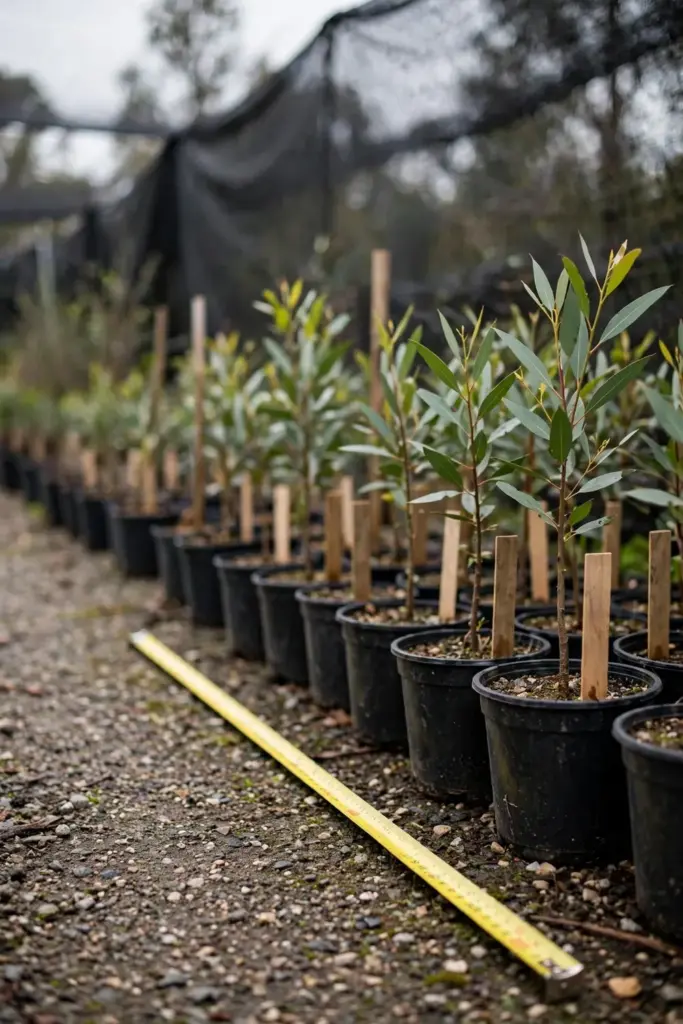
Check one is space. Measure the planting spot and the distance to the house, the fence, and the pipes. Match the mature spread in the table below to the gap you measured. A tree that needs 10 m of spread gets 10 m of clear ground, not 6 m and a hope.
Check two is climate. Match the species to your frost, your summer heat, and your humidity. A snow gum handles frost and fails in humid heat. A coral gum handles dry heat and fails in humid air. A small-leaved gum handles cold and damp. A red flowering gum wants a dry summer. Buy the species that fits the climate you have, not the climate you wish for.
Check three is soil. Most gums want free-draining soil and full sun. A yellow gum handles clay and limestone. A silver princess wants sharp drainage. A brittle gum handles poor soil. Soil health shapes establishment, and building soil health covers the soil side of the job in full.
Check four is start. Buy nursery stock with a label that names the full botanical name, the mature height and spread, and the frost and humidity tolerance. Starting from seed takes years and suits a patient gardener, and growing a eucalyptus tree from seed covers that method in full. For most home gardens, a labeled nursery tree removes the guesswork.
| Species | Mature Height | Mature Spread | Best For |
|---|---|---|---|
| Silver Princess Gum | 6 to 8 m | 3 to 4 m | Small feature spot, weeping form |
| Plunkett Mallee | 2 to 7 m | To 5 m | Courtyard, large pot, narrow bed |
| Silver-Leaved Mountain Gum | 5 to 10 m | 2 to 4 m | Silver foliage, small feature spot |
| Coral Gum | 4 to 8 m | 3 to 5 m | Dry garden, coral-pink flowers |
| Small-Leaved Gum | To 10 m | To 10 m or more | Cold damp garden, windbreak row |
| Snow Gum | 4 to 15 m | 3 to 10 m | Cold garden, patterned bark |
| Cider Gum | 10 to 15 m | 6 to 8 m | Cold garden, coppiced foliage shrub |
| Argyle Apple | To 15 m | 6 to 10 m | Silver foliage feature, screening |
| Red Flowering Gum | To 12 m | To 5 m | Flower display, front garden |
| Wallangarra White Gum | 12 m | 12 m | Large garden, white bark, dappled shade |
| Yellow Gum | 10 to 15 m | 6 to 10 m | Long flower season, shade over lawn |
| Brittle Gum | 10 to 20 m | To 13 m | Large block, white trunk, avenue |
Sizes in the table are garden figures. Wild trees can grow taller. Check the label on the plant you buy.
Skip the forest giants. River red gum reaches 20 to 30 m, blue gum reaches 55 m, and messmate reaches 90 m in the bush. None of them belongs in a home garden, and none of them appears in the 12 picks above. A nursery that sells a forest giant as a garden tree sells a future removal job. The 12 picks on this page stay garden-sized or earn a large block, and every one of them fits a block that a homeowner can measure with a tape.
Frequently Asked Questions About Eucalyptus Species for Home Gardens

Plunkett Mallee stays smallest, at 2 to 7 m in the ground and smaller in a pot. Silver-Leaved Mountain Gum and Coral Gum also suit large pots with sharp drainage. Pick a mallee or a dwarf cultivar by name. A forest gum in a pot outgrows the pot in one season and then sulks. Use a native potting mix, keep drainage holes open, and prune to hold the shape.
Red Flowering Gum carries the loudest display, in red, pink, orange, or white from December to May. Coral Gum follows with coral-pink flowers from late winter into summer. Silver Princess Gum opens large pink-red flowers in winter and spring. Buy a grafted cultivar by name when the flower color matters, because seed-grown trees vary in shade.
Plant at least one mature canopy width from the house, the driveway, and any paved area. A tree with a 10 m spread gets 10 m of clear ground from trunk to wall. Roots reach past the drip line, so the canopy width is the minimum. Check pipe maps before you dig, and plant no gum over a sewer line or a septic trench.
Snow Gum and Cider Gum handle the hardest frost, including snow. Small-Leaved Gum handles cold, damp, frosty valleys. Brittle Gum and Wallangarra White Gum handle frost to minus 7 degrees. Silver Princess Gum and Red Flowering Gum handle light frost only. Protect a young tree through its first winter in any frost district.
Small-Leaved Gum suits cold and damp ground, and Yellow Gum tolerates coastal exposure. Most dry-country gums fail in humid air. Coral Gum, Red Flowering Gum, and Silver Princess Gum sulk in humid coastal conditions. In a humid garden, pick a species from a damp or coastal origin, give it full sun and air flow, and skip the dry-country picks.
Choose the Smallest Gum That Does the Job
A gum tree lives for decades, and the choice you make at the nursery outlives the planting day. Measure the gap first. Match the species to the climate second. Buy the labeled tree third. The smallest gum that does the job gives flowers, bark, shade, and birds without a fight against the house, the pipes, or the fence.
Start with one tree. A single well-placed gum teaches the gardener more in a year than a row of guesses teaches in five. Watch how it handles the first summer, the first frost, and the first dry spell. The second gum gets easier, because the first one showed what the block actually grows.