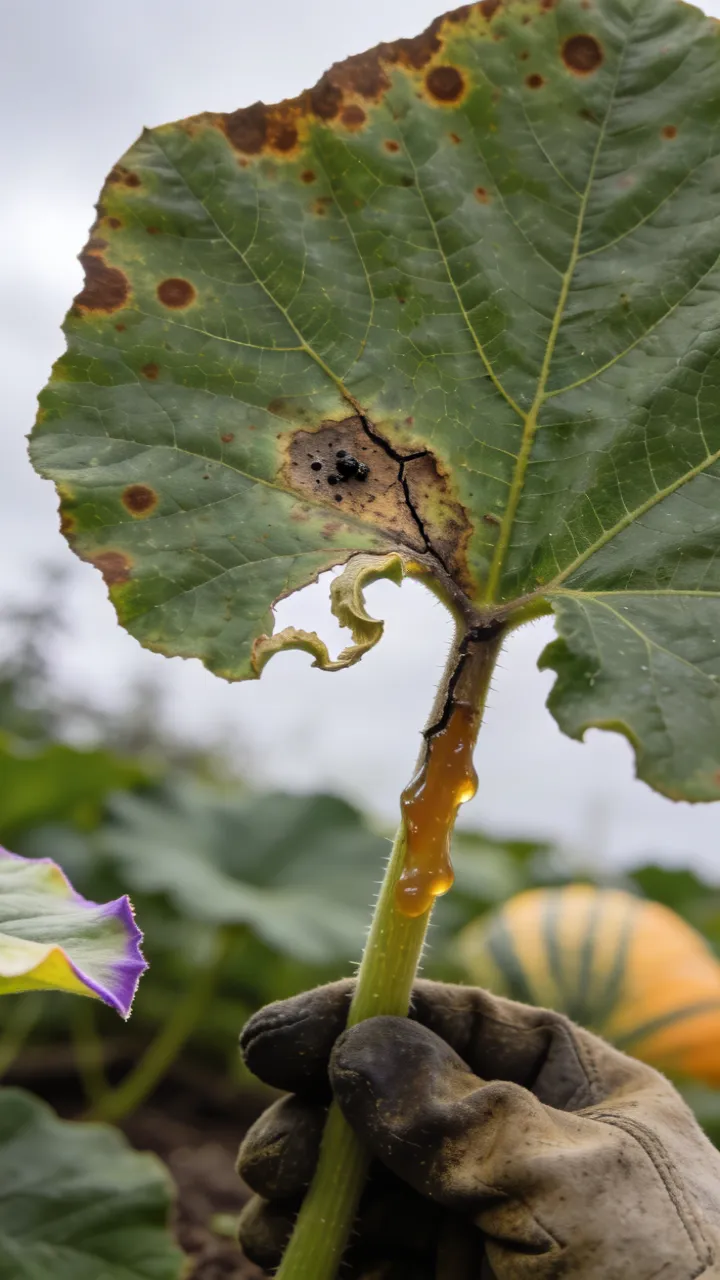

Gummy stem blight kills cucurbit vines from the stem outward, and the 10 strategies below stop it before the gum ever appears. The disease shows as water-soaked lesions that crack open and ooze red to amber gum, and the same fungus rots fruit under the name black rot.
The signature is a cracked stem canker with sticky gum plus brown leaf spots that start at the leaf margins. Seedlings collapse, vines wilt a few weeks after infection, and stored squash rots from the inside. Every strategy below works on one of three levers: clean seed, dry leaves, or debris removal.
The rest of this page runs the order a gardener should follow. Identify the disease on leaves, stems, seedlings, and fruit first, then separate it from anthracnose, then work the 10 strategies from certified seed to cold storage. I have learned that the week spent starting from certified seed beats any rescue once gum appears on the stem.
What Gummy Stem Blight Actually Is
Gummy stem blight is a fungal disease of cucurbits. The pathogen is Stagonosporopsis cucurbitacearum, formerly known as Didymella bryoniae, with the asexual state Phoma cucurbitacearum.
The Ohio State University Extension report on gummy stem blight of cucurbits names Didymella bryoniae as the cause and describes gummy stem blight as a significant disease of squash, pumpkins, cucumbers, and watermelons. The same report states that the disease can impact plants at any growth stage. The disease also threatens greenhouse-grown cucumbers, and it attacks every above-ground part of the plant.
The current name carries a wrinkle worth knowing. Research published by Stewart and colleagues in 2015 showed that the fungi causing gummy stem blight form a complex of three closely related species: Stagonosporopsis cucurbitacearum, Stagonosporopsis citrulli, and Stagonosporopsis caricae. No visible feature separates the three species. For the home gardener the three names change nothing, since the symptoms, the spread, and the controls stay the same across all three.
Gummy stem blight and black rot are two phases of one disease. The Utah State University Extension fact sheet on gummy stem blight states that leaf and stem infections carry the name gummy stem blight, while the same fungus on squash fruit carries the name black rot. Oklahoma State University Extension groups the phases slightly differently, placing leaf infections with the black rot phase. The naming split confuses gardeners, so this article uses the Utah State grouping throughout: gummy stem blight on leaves and stems, black rot on fruit.
Gummy stem blight stays inside the cucurbit family. Cucumber, squash, pumpkin, melon, watermelon, cantaloupe, and gourd all host the disease. No crop outside the cucurbit family carries it, so a tomato or bean bed beside an infected cucumber bed does not catch gummy stem blight.
How to Identify Gummy Stem Blight on Leaves
Look for brown spots that start at the leaf margins and grow inward. A cucurbit leaf with dark yellow or reddish-brown lesions beginning at the edges, then spreading until the whole leaf dies, carries gummy stem blight until proven otherwise.
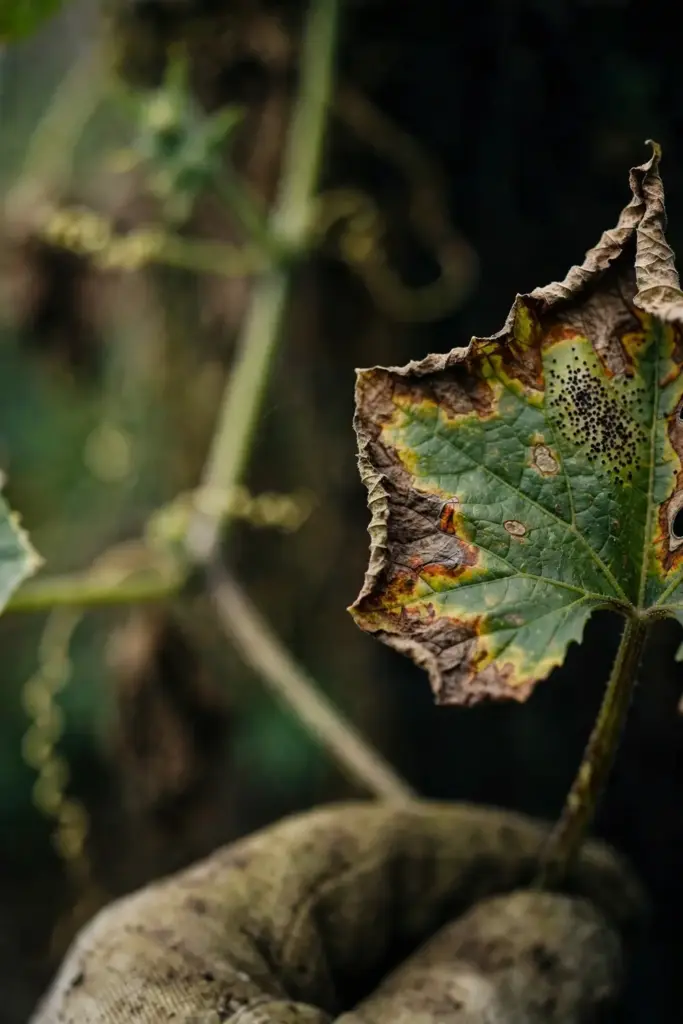
The Ohio State University Extension report on gummy stem blight of cucurbits gives the leaf pattern plainly. Dark yellow or reddish-brown lesions appear, often starting at the leaf margins and progressing inward, leading to leaf death. The spots grow fast in wet weather. A leaf that yellows evenly without spots, margins, or gum points at nutrition or water instead.
Leaf spots on watermelon add one more clue. The University of Delaware Weekly Crop Update on gummy stem blight in watermelon describes leaf lesions in watermelon that often start at the leaf margin and stay brown, circular, and ringed with concentric circles. Concentric rings on a watermelon leaf, paired with stem gum anywhere on the vine, strengthen the diagnosis considerably.
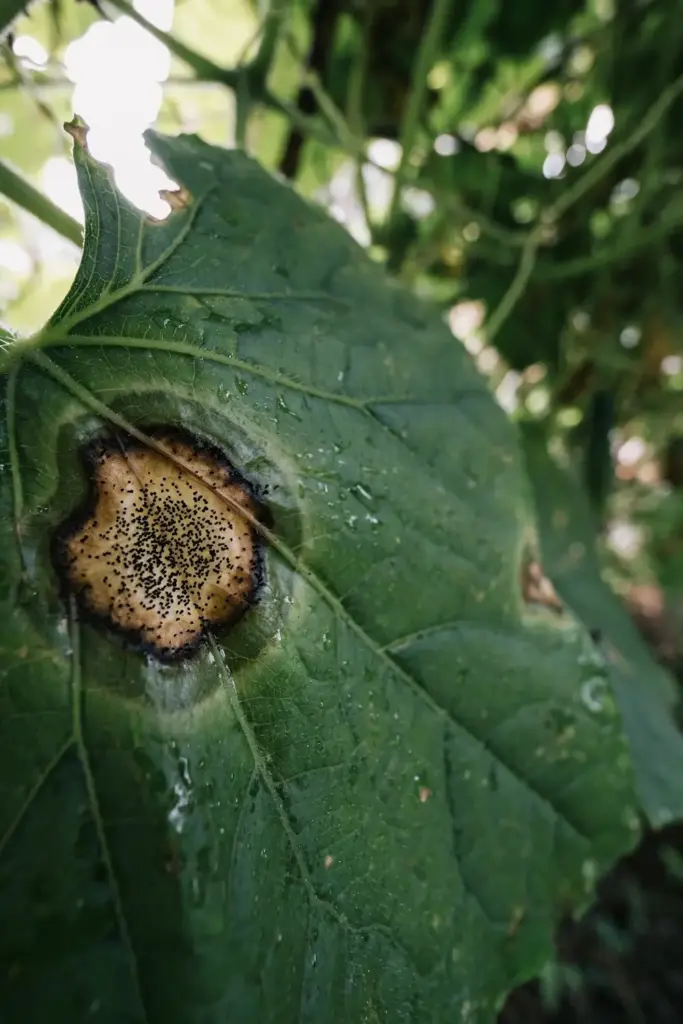
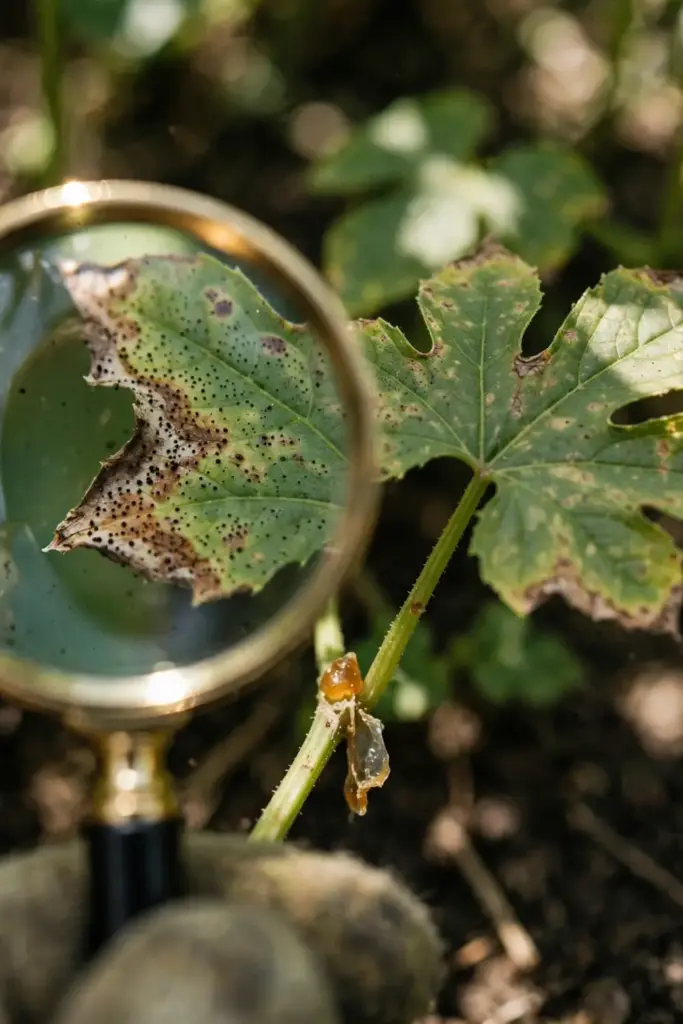
Check the lesion centers with a hand lens. Black fruiting bodies called pycnidia sit inside older lesions, and the same Delaware update calls these black fruiting bodies a diagnostic sign of gummy stem blight. Tiny black specks embedded in a brown lesion, plus gum on the stem, settle the identification in most home gardens.
Severe leaf infection defoliates the vine. Leaves die, curl inward, and stay attached to upright petioles for a time. A vine stripped of leaves cannot ripen fruit, and sunscald often finishes the exposed fruit. Early leaf spotting deserves action the day it appears, since the stem phase follows close behind.
How to Identify Gummy Stem Blight on Stems and Vines
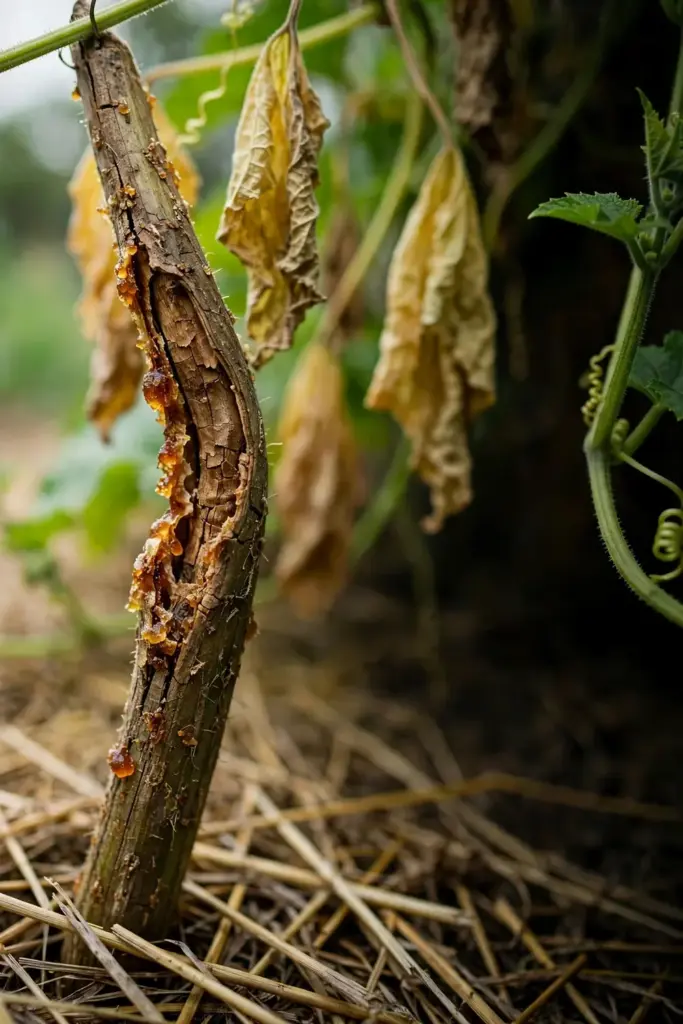
Look for water-soaked stem lesions that crack and ooze gum. A cucurbit stem with a greasy, water-soaked patch that splits open and leaks red to amber gum carries gummy stem blight until proven otherwise.
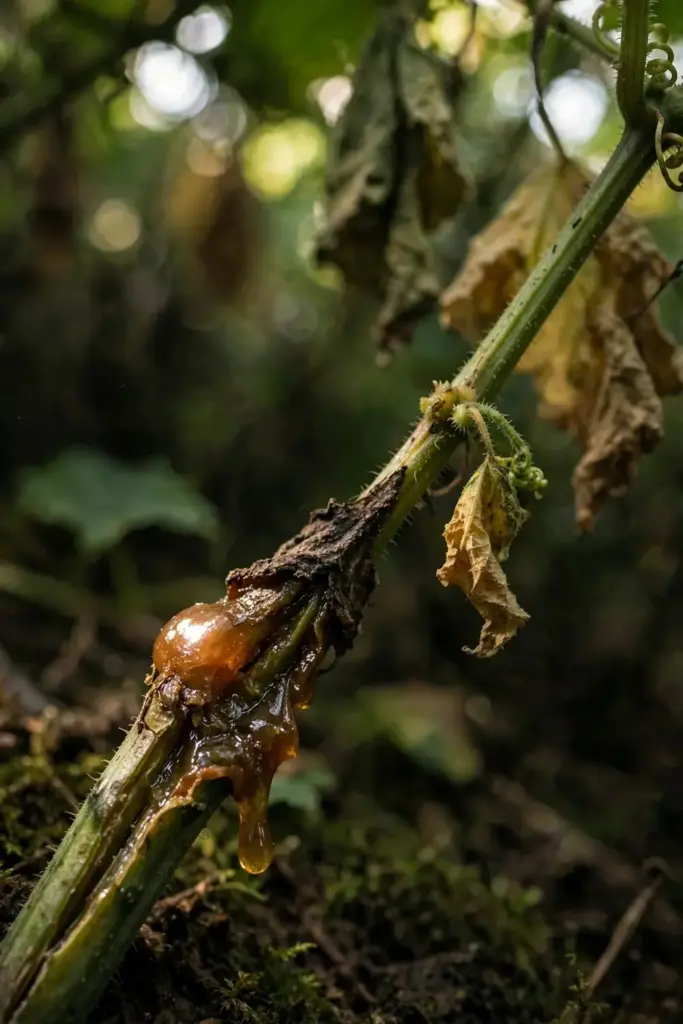
The Utah State University Extension fact sheet on gummy stem blight describes stems that sometimes ooze gum, and the same fact sheet ties the oozing stems to necrotic spots on leaves. The gum ranges from red to amber to brown as it dries. Fresh ooze looks wet and shiny. Old ooze hardens into a dark crust along the crack.
Stem cankers girdle the vine. The University of Delaware Weekly Crop Update on gummy stem blight in watermelon states that stem cankers can girdle the stems and cause wilting a few weeks after infection. A girdled vine wilts even when the soil stays moist, since the canker chokes the water path. Wilting that ignores watering, paired with a cracked gummy stem, points straight at gummy stem blight.
Cankers also form at stem nodes near harvest. Cantaloupe vines show the pattern late in the season, with nodes turning water-soaked and leaking sap that dries into amber gum deposits. Vines beyond an infected node yellow, wilt, and die. One girdled node can end the whole vine past that point.
Stem symptoms separate gummy stem blight from most other cucurbit leaf diseases. Downy mildew spots leaves. Powdery mildew coats leaves white. Neither oozes gum from a stem or cracks one open. A stem that leaks gum belongs to gummy stem blight, and the grower should treat it as such.
How to Identify Gummy Stem Blight on Seedlings
Look for water-soaked spots on cotyledons and a dark lesion where the cotyledon meets the stem. A seedling with a water-soaked stem at the cotyledon joint, plus brown spots on the seed leaves, carries gummy stem blight until proven otherwise.
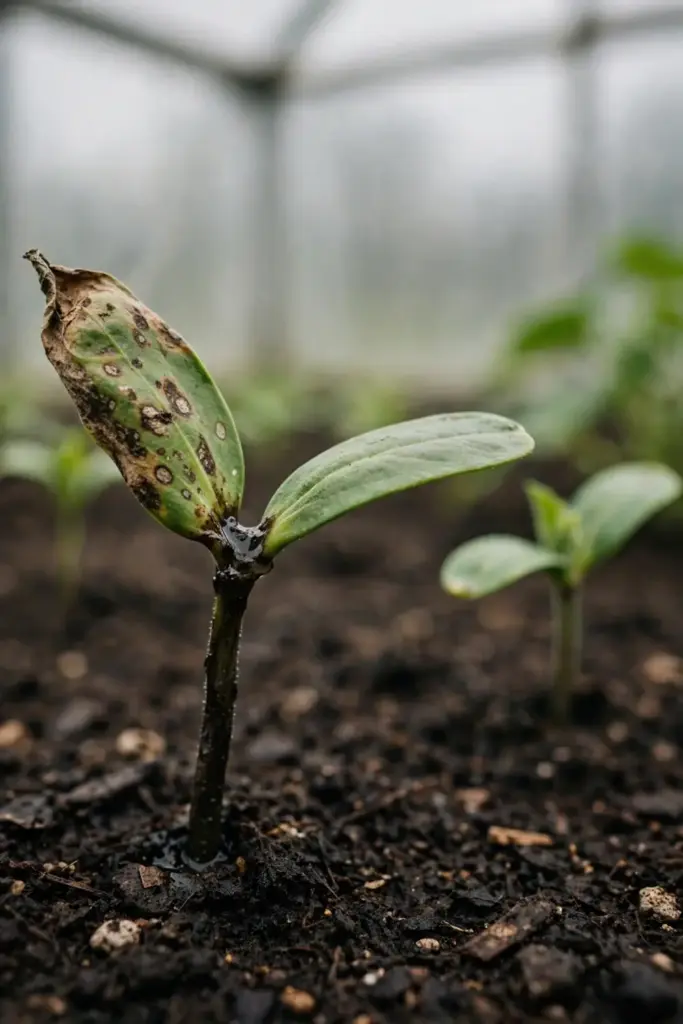
The University of Delaware Weekly Crop Update on seedling diseases describes a water-soaked lesion where the cotyledons attach to the hypocotyl as a symptom of gummy stem blight. The lesion sits above the soil line, which matters, since the anthracnose seedling lesion sits near the soil line below it. Seedlings infected through seed often appear in clusters around the first sick seedling, since spores splash to neighbors.
Infected seedlings can look healthy at first. The Utah State University Extension fact sheet on gummy stem blight warns that seedlings can become infected without showing symptoms when the seed carries the fungus. A tray of clean-looking transplants can carry the disease into the bed. That silent start is why certified seed matters more than any spray.
Greenhouse seedlings face the highest risk. Warmth, humidity, and overhead watering keep leaves wet for hours, and crowded trays let spores splash from plant to plant. The same Utah State fact sheet states that no products available in Utah can be applied to seedlings in the greenhouse to control the disease. Sanitation carries the whole load in a greenhouse, so trays, pots, tables, and ceilings need disinfecting after any outbreak.
Destroy sick trays outright. The University of Delaware Weekly Crop Update on greenhouse seedling diseases advises destroying all trays with symptomatic plants, moving adjoining trays aside for observation, and never shipping a tray that shows symptoms. A single sick tray kept for one more week can seed the whole greenhouse.
How to Identify Black Rot on Fruit
Look for water-soaked spots on fruit that expand, leak gum, and turn black. A squash or melon with a water-soaked fruit spot that exudes gummy material and darkens to black carries black rot until proven otherwise.
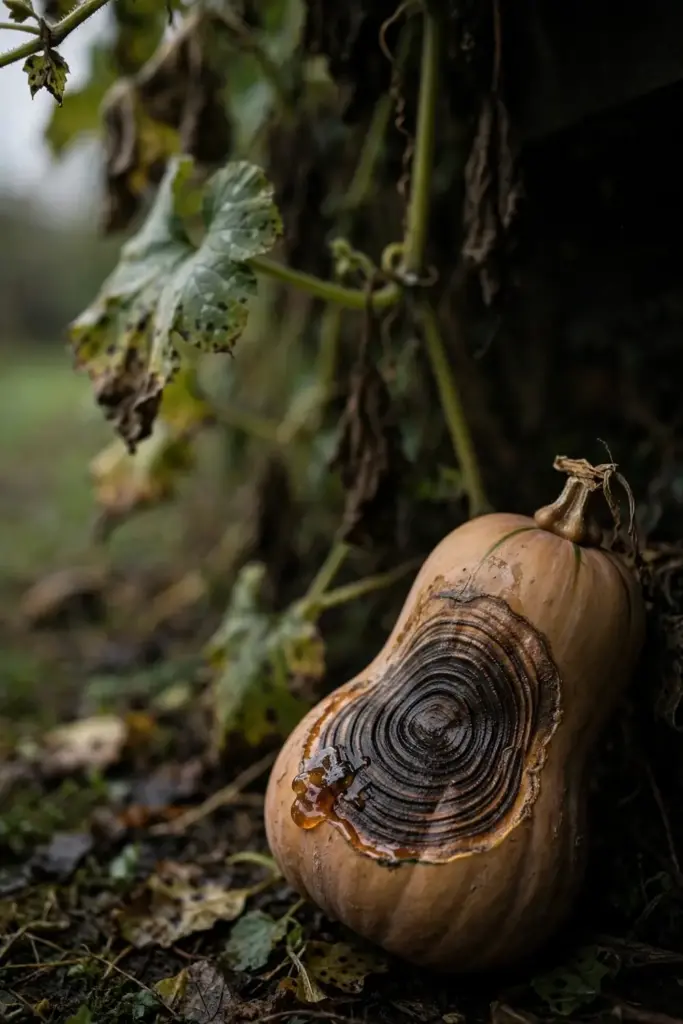
The Ohio State University Extension report on gummy stem blight of cucurbits describes winter squash black rot that affects the rind, the flesh, and the seed cavity, with visible growth of white and black fungus. The rot often starts at the attachment point, where the stem meets the fruit. Fruit rot can run deep while the outside shows only a small spot.
Butternut squash shows the most distinctive fruit pattern. The Utah State University Extension fact sheet on gummy stem blight notes that the disease may form distinct concentric rings on butternut squash. Concentric rings on a butternut, paired with leaf spots or stem gum on the same vine, confirm black rot without a lab test.
Watermelon fruit rots only after severe vine infection. The University of Delaware Weekly Crop Update on gummy stem blight in watermelon states that black rot of watermelon fruit occurs only when the vines carry severe infection. Early fruit symptoms look circular and greasy, then merge and turn brown to black. A watermelon with greasy spots and a badly cankered vine fits the pattern.
Black rot also strikes after harvest. Fruit that looked clean at picking can develop water-soaked spots in storage, and the spots expand and leak gum. Wounds from rough handling open the door, and warm storage speeds the rot. Harvest care and cold storage decide whether a clean-looking squash stays clean.
Which Cucurbits Get Hit Hardest by Gummy Stem Blight
Watermelon and cantaloupe show the most dramatic damage from gummy stem blight. Cucumber and pumpkin follow close behind, and squash carries the disease with fruit rot that ruins storage.
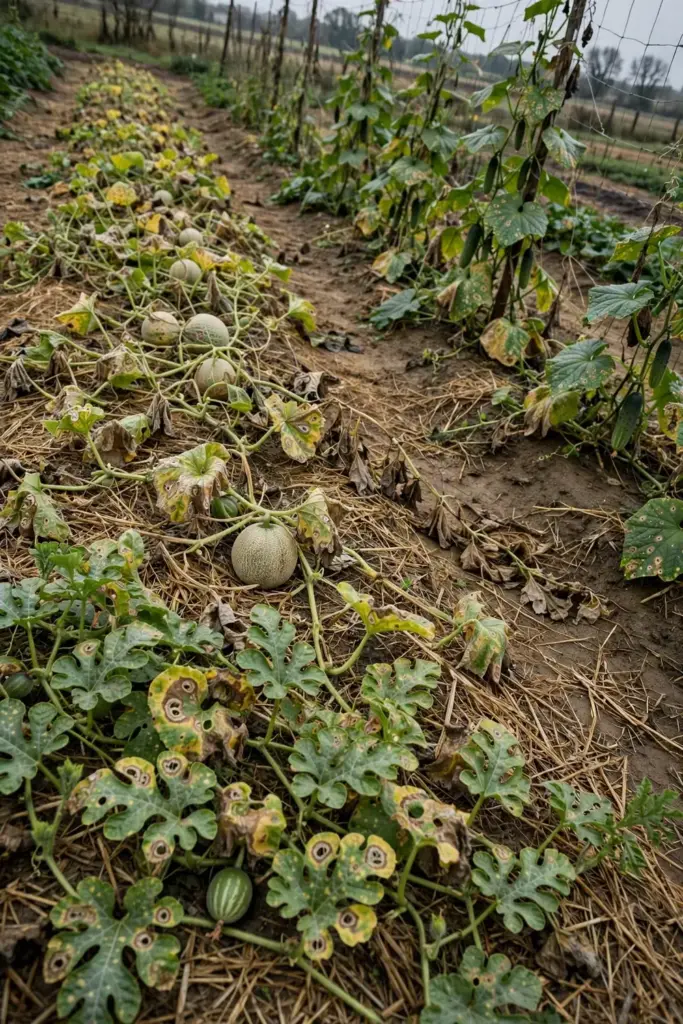
Watermelon earns the top spot because every phase hits hard. Leaf lesions ring with concentric circles, vines crack and ooze gum, and fruit rots once the vines carry severe infection. The University of Delaware Weekly Crop Update on gummy stem blight in watermelon covers watermelon specifically because the crop shows the full disease so clearly. A watermelon bed in wet weather needs the closest watching.
Cantaloupe shows the stem phase at its worst. Nodes near harvest turn water-soaked and leak sap that dries into amber gum, and vines beyond an infected node die. Cucumber shows black blossom end rot on immature fruit in the field, plus water-soaked spots that appear after harvest. Pumpkin and winter squash lose the most in storage, since black rot hollows the fruit from the inside.
The guide to growing squashes covers the summer and winter types that share the same susceptibility, and the guide to growing zucchini from seed walks through spacing and harvest for a clean crop. Both crops sit inside the disease host range, so spacing and leaf dryness matter as much for them as for watermelon.
Greenhouse cucumbers face a special risk. The Ohio State University Extension report on gummy stem blight of cucurbits flags greenhouse-grown cucumbers as a concern, since warm humid air keeps leaves wet and spores splash easily between plants. A home greenhouse with cucumbers needs the same seed discipline and sanitation as a field bed.
Gummy Stem Blight vs Anthracnose vs Target Leaf Spot
Check the stem first. Gummy stem blight leaks gum from water-soaked stem lesions, anthracnose makes narrow tan vine lesions without gum, and target leaf spot stays on the leaves with light centers and dark edges.
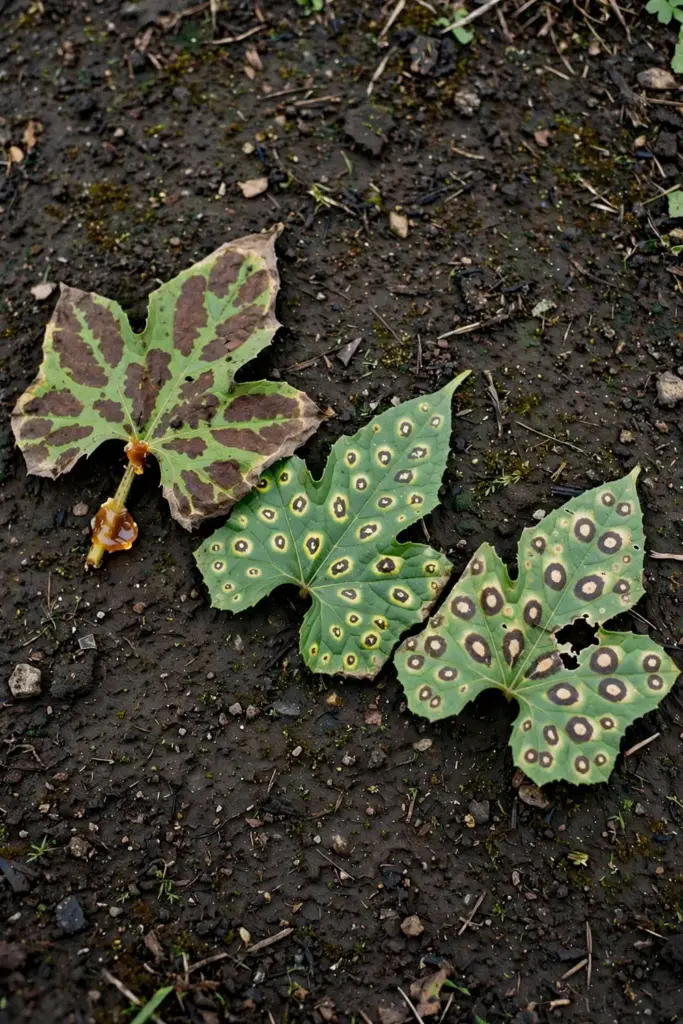
The table below lines up the three diseases that confuse cucurbit growers most. Read the stem row first, then the petiole row, then the leaf row.
| Sign | Gummy Stem Blight | Anthracnose | Target Leaf Spot |
|---|---|---|---|
| Pathogen | Stagonosporopsis cucurbitacearum, formerly Didymella bryoniae | Colletotrichum orbiculare | Corynespora cassiicola |
| Stem and vine signs | Water-soaked greasy lesions that crack and ooze red to amber gum; dry beige or tan cankers on the main stem | Spindle-shaped narrow tan lesions on vines; no water-soaking, no gum, no cankers on the main stem | No stem cankers; the disease stays on leaves |
| Petiole test | A petiole lesion that goes completely around the petiole points to gummy stem blight | A petiole lesion that stops short of circling the petiole points to anthracnose | Petioles stay mostly clear |
| Leaf signs | Larger spots, uniform color, often starting at margins; black pycnidia inside older lesions | Smaller spots, angular or irregular, often with a yellow halo; no blighting and no gummy ooze | Light centers with darker edges; centers of old lesions drop out; spots stay smaller than gummy stem blight spots |
| Fruit signs | Black rot: water-soaked spots expand, leak gum, turn black; internal rot possible | Sunken dark fruit lesions without gum | Fruit stays mostly clear |
| First move | Remove infected plants, keep leaves dry, rotate out of cucurbits | Choose resistant varieties, buy disease-free seed, rotate away from cucurbits for 3 years | Remove infected leaves, improve airflow, keep leaves dry |
The Growing Produce field scouting guide for gummy stem blight carries the dedicated side-by-side comparison behind this table. The same guide states that water-soaking or a greasy appearance of lesions on mature plants marks gummy stem blight, while anthracnose causes spindle-shaped narrow tan lesions on vines that never appear with gummy stem blight. The guide also states that a petiole lesion going completely around the petiole identifies gummy stem blight, and that dry beige or tan cankers on the main stem occur with gummy stem blight while anthracnose makes no cankers.
Seedling age adds one more separation. The University of Delaware Weekly Crop Update on seedling diseases notes that anthracnose symptoms stay mild until the canopy closes, while gummy stem blight strikes seedlings early. Anthracnose seedling lesions sit near the soil line, below the gummy stem blight lesions at the cotyledon joint. The same update notes that resistant varieties exist for anthracnose, which gives growers one more tool that gummy stem blight does not offer.
Other cucurbit problems stay separate diagnoses. Crater rot, also called ink spot, shows a leaf blight phase on watermelon in fall, and it never merges into a gummy stem blight diagnosis. Downy mildew spots leaves and never oozes gum from stems. Fusarium wilt wilts seedlings and vines without gum or leaf spots. Zucchini yellow mosaic virus mottles leaves yellow and distorts fruit without cankers. Each problem keeps its own diagnosis, and none of them merges into gummy stem blight.
Why Seed and Splashing Water Decide Everything
Seed carries gummy stem blight into the garden. Splashing water carries it from plant to plant. Every management choice below breaks one of those two links, and the grower who breaks both links stops the outbreak at its source.
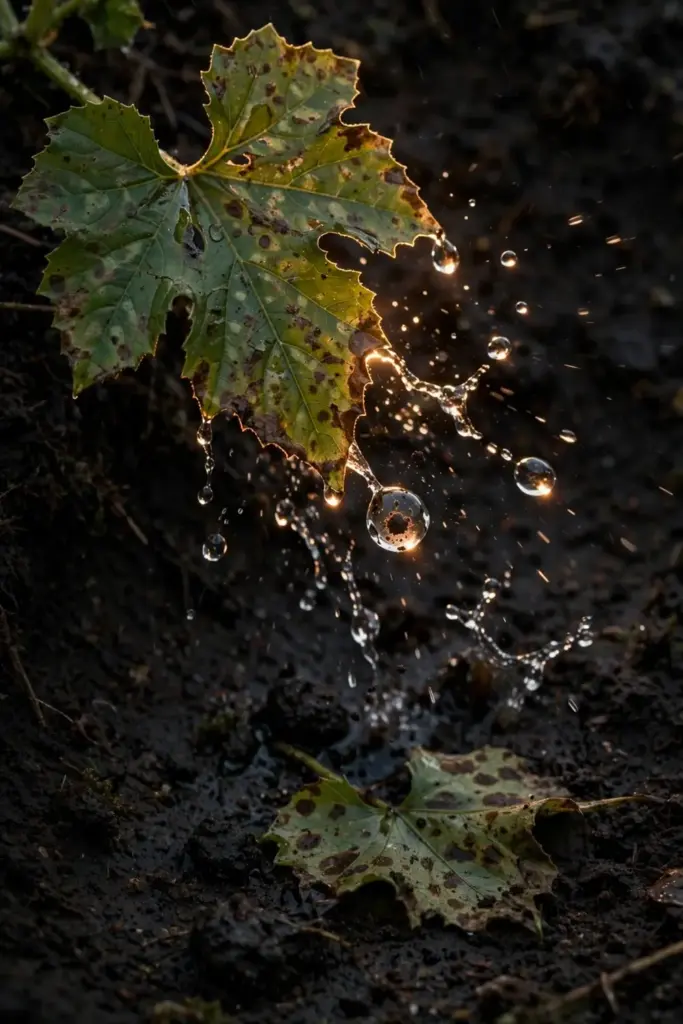
The Utah State University Extension fact sheet on gummy stem blight states that the fungus is seedborne and soilborne, and that the fungus can survive on infected plant debris for up to 2 years in the soil. The same fact sheet states that spores move to new leaves and neighboring plants through splashing water.
The Ohio State University Extension report on gummy stem blight of cucurbits adds the second spore type. The fungus spreads through two types of spores: ascospores, which ride the wind, and pycnidiospores, which spread by splashing water. Wind moves the disease between beds. Splash moves it leaf to leaf inside one bed.
Temperature and wetness set the infection window. The Ohio State University Extension report on gummy stem blight of cucurbits puts optimal conditions at 61 to 75 degrees Fahrenheit. The Utah State University Extension fact sheet on gummy stem blight puts the optimum at 65 to 75 degrees Fahrenheit with moisture that can last 10 hours. The University of Delaware Weekly Crop Update on gummy stem blight in watermelon puts the watermelon optimum at 75 degrees Fahrenheit with leaf wetness of 1 to 10 hours. The three ranges overlap, and the shared message is simple: warm plus wet equals infection.
Leaf wetness duration decides severity. A leaf that dries within an hour rarely infects. A leaf that stays wet for 10 hours invites it. Overhead watering, dense canopy, and still air all extend wetness, and each one raises infection pressure. Dry leaves break the cycle even when spores sit on them.
What Makes Gummy Stem Blight Worse in a Home Garden
Wet leaves, saved seed, tight spacing, and old debris make gummy stem blight worse. Each factor lengthens wetness, adds inoculum, or both.
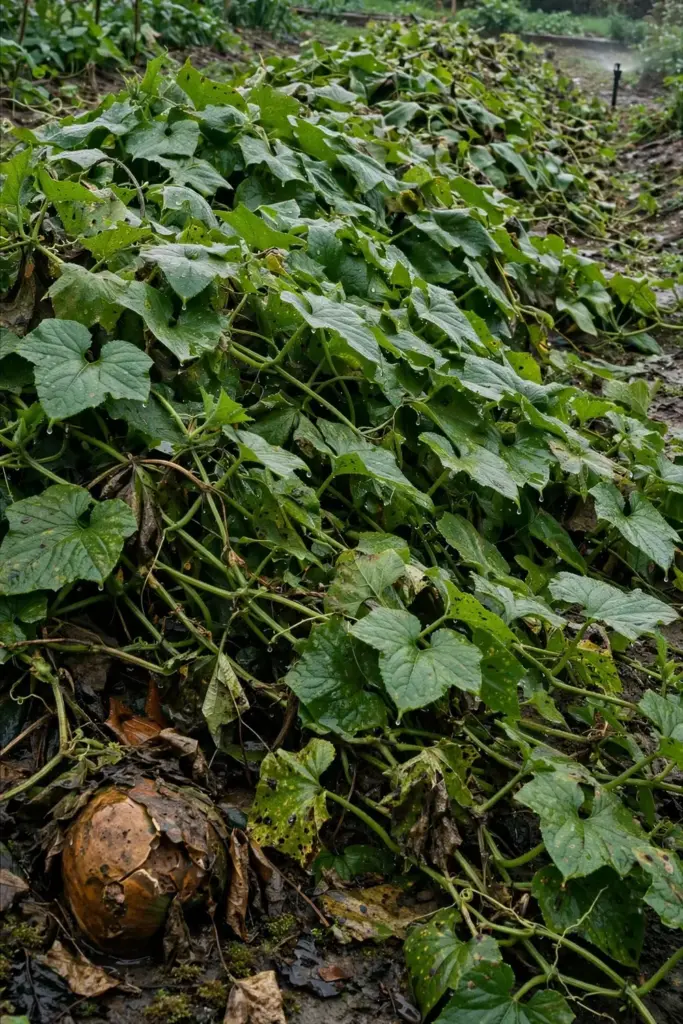
Overhead watering tops the list. Sprinklers wet every leaf and splash spores from soil and debris onto low leaves. A sprinkler that runs in the evening leaves leaves wet all night, which hands the fungus the 10-hour wetness window it needs. Drip lines and soaker hoses keep leaves dry and cut splash at the same time.
Saved seed from an infected crop carries the fungus into next season. Seed from a vine that showed gum, leaf spots, or fruit rot may look clean while carrying the pathogen inside. The Utah State University Extension fact sheet on gummy stem blight warns that seedlings can become infected without showing symptoms when the seed carries the fungus. One infected seed lot can start an outbreak that looks like it came from nowhere.
Tight spacing keeps leaves wet. Vines that overlap trap humid air, shade the soil, and slow drying after rain or watering. A dense canopy also blocks sprays from reaching lower leaves. Wide spacing, trellising, and pruning for airflow shorten the wetness window on every leaf.
Old debris feeds next season. The Utah State University Extension fact sheet on gummy stem blight states that the fungus survives on infected plant debris for up to 2 years in the soil. Vines left on the bed over winter, plus fruit left to rot, hold inoculum through the cold months. A clean bed in fall starts the next season with far less pressure.
Wounded fruit invites black rot. Rough picking, stem tears, and insect feeding all break the rind, and the fungus enters through the wound. Warm storage then speeds the rot. Gentle harvest and cold storage close that door.
Strategy 1: Decide Whether Treatment Is Worth It
Decide first, then act. A vine with a few leaf spots deserves treatment, while a vine girdled at the base deserves removal.
Gummy stem blight often looks worse than it behaves. Leaf spots alone rarely kill a healthy vine, and fruit from a lightly infected plant still eats well once the grower cuts away the damaged parts. Heavy stem cankers tell a different story. A vine girdled at the base will not recover, and sprays cannot reopen a choked stem.
Run the cost check before buying anything. A home garden with two cucumber vines loses little by pulling one sick vine, while a large melon bed justifies fungicide and labor. Resistant cultivars offer no shortcut here. The Ohio State University Extension report on gummy stem blight of cucurbits states plainly that resistant cultivars are currently unavailable. No variety purchase solves this disease.
Set the threshold in advance. Pull any vine with a girdled stem, a collapsed crown, or wilt that ignores watering. Treat vines with leaf spots and sound stems. Re-check treated vines every few days, and pull any vine that develops a girdling canker despite treatment. Early removal protects the healthy vines beside the sick one.
Strategy 2: Plant Certified Disease-Free Seed
Plant certified disease-free seed every season. Seed is the primary way gummy stem blight enters a garden, and certified seed removes that route.
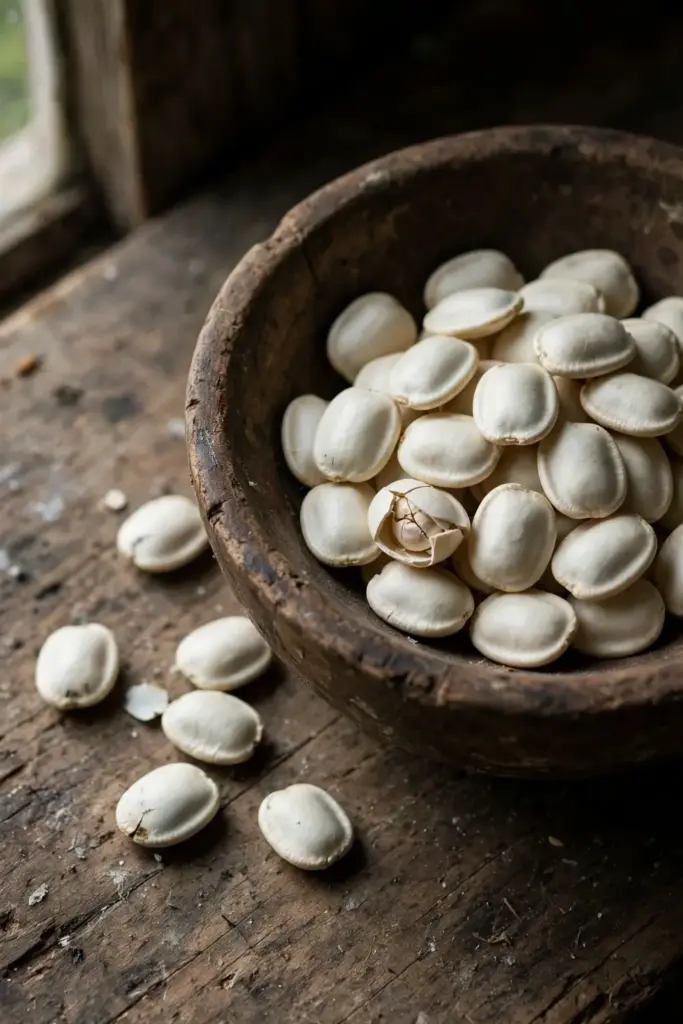
The Utah State University Extension fact sheet on gummy stem blight lists certified disease-free seed as the first management step, and it warns that seedlings can carry infection without showing symptoms. A clean-looking transplant grown from infected seed carries the disease into the bed. Certified seed breaks that chain before planting.
Buy seed from a reputable supplier that tests seed lots for cucurbit pathogens. The University of Delaware Weekly Crop Update on greenhouse seedling diseases notes that a seed source should have tested negative for the pathogen with a minimum assay of 1,000 seeds. A supplier that tests at that scale gives real assurance. A supplier that cannot describe its testing gives none.
Never save seed from a vine that showed gummy stem blight. Seed from infected fruit may look normal while carrying the fungus inside, and no home treatment reliably cleans it. Seed saving works well for many crops, and cucurbits with a gummy stem blight history are not among them. Buy fresh certified seed for the next season.
Keep seed lots labeled and separate. A labeled lot lets the grower trace an outbreak back to its source and avoid replanting the same lot. Mixing lots spreads one bad lot across the whole bed.
Strategy 3: Inspect Seedlings and Rogue Sick Transplants Early
Inspect seedlings daily from emergence, and rogue any sick transplant the day symptoms appear. Early roguing removes the outbreak source before splash spreads it.
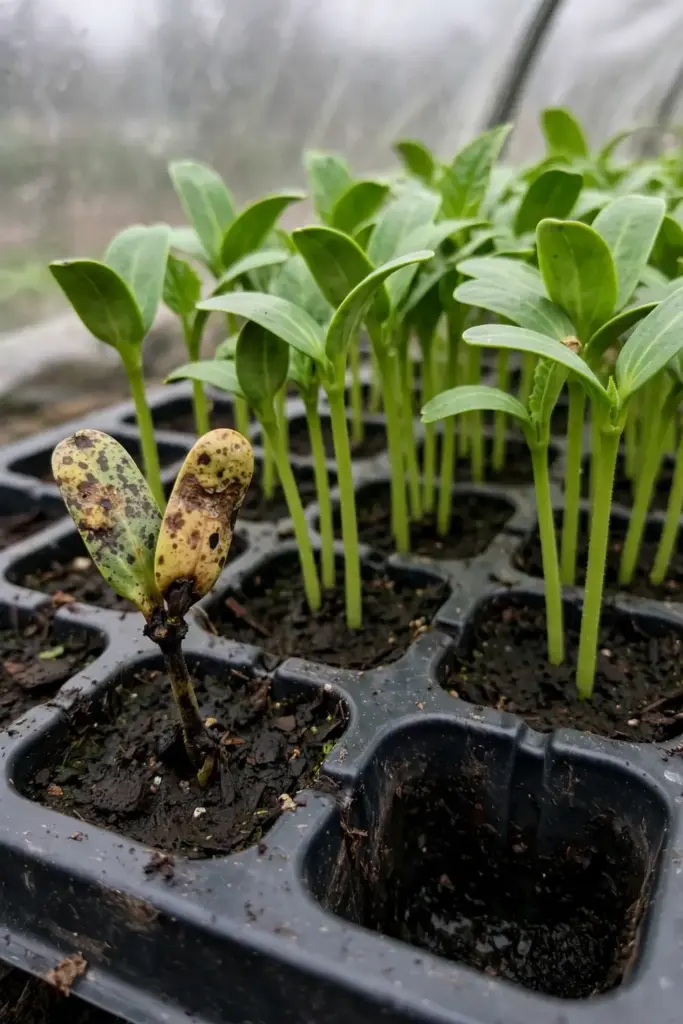
Check the cotyledon joint first. A water-soaked lesion where the cotyledon meets the stem, plus brown spots on the seed leaves, marks gummy stem blight. Check leaf margins next, since spots start there. The seed starting guide covers clean trays, fresh mix, and steady moisture for a strong start, and a strong seedling shows symptoms faster and recovers better.
Pull sick seedlings with their root ball, and bag them before carrying them past healthy trays. Splash spreads spores, so work the healthy trays first and the suspect trays last. Wash hands and tools after handling sick seedlings. A blade that cuts a sick stem carries sap and spores to the next cut.
Destroy sick trays outright in a greenhouse. The University of Delaware Weekly Crop Update on greenhouse seedling diseases advises destroying all trays with symptomatic plants, moving adjoining trays aside for observation, and never shipping a tray that shows symptoms. Home growers should apply the same rule to any tray bound for the garden bed.
Disinfect the greenhouse after any outbreak. The Utah State University Extension fact sheet on gummy stem blight advises disinfecting trays, pots, tables, and ceilings after removing infected seedlings, since spores can sit on any greenhouse surface. Fresh mix in clean trays starts the next batch with no carryover.
Strategy 4: Rotate Cucurbits Out for 3 to 4 Years
Rotate cucurbits out of each bed for 3 to 4 years. The fungus survives on debris in the soil, and time without a host starves it out.
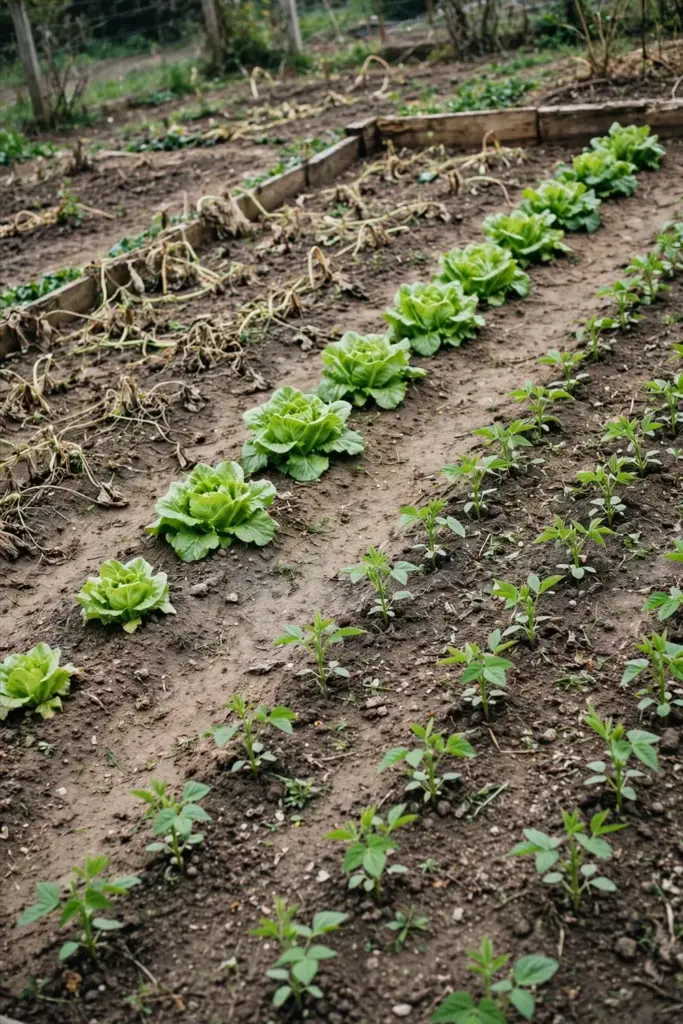
The Ohio State University Extension report on gummy stem blight of cucurbits advises rotating crops to avoid growing cucurbits in the same location for 3 to 4 years. The Utah State University Extension fact sheet on gummy stem blight advises rotating cucurbit crops for 2 to 3 years. The home garden should follow the longer Ohio State interval, since a home bed holds more debris than a commercial field.
Rotation covers every cucurbit, not just the crop that got sick. Cucumber, squash, pumpkin, melon, watermelon, and gourd all host the same fungus, so a cucumber bed that follows a sick melon bed inherits the problem. The crop rotation guide covers planning rotations that keep soil healthy while starving soilborne disease. Fill the rotation years with unrelated crops like beans, corn, lettuce, or carrots.
Map the beds on paper. A simple sketch with last season, this season, and next season per bed prevents the common mistake of planting melons where squash grew last year. Volunteer cucurbits break rotation too, so pull any seedling that sprouts from last season dropped fruit.
Rotation works best with debris removal. Time alone clears the fungus slowly, and buried debris clears faster than debris left on the surface. Strategy 5 handles that half of the job.
Strategy 5: Bury or Remove Infected Debris After Harvest
Remove every infected vine, leaf, and fruit at season end, and bury or destroy the debris. Debris carries the fungus through winter, and a clean bed starts spring with far less inoculum.
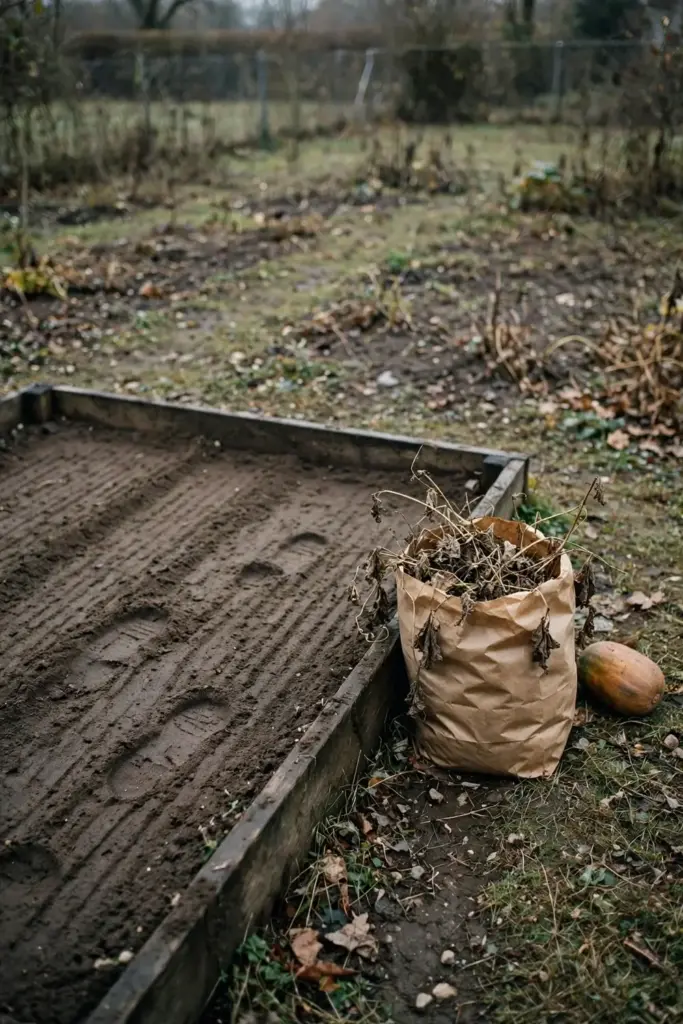
The Ohio State University Extension report on gummy stem blight of cucurbits advises deeply plowing crop residue after harvest. Deep burial speeds decay and puts spores where they cannot splash onto leaves. Home gardeners without a plow can dig debris deep under the soil, or bag it and remove it from the garden entirely.
Never compost infected vines in a home pile. Home compost rarely reaches the sustained heat that kills fungal spores, and finished compost made from infected vines spreads the fungus back onto the bed. Bag infected material and send it with household trash, or burn it where local rules allow.
Clear fruit too. Fallen squash, split melons, and dropped cucumber fruit all carry the fungus, and a fruit left to rot on the soil seeds the bed for next year. Pick up every fruit at season end, including the small ones hidden under leaves.
Clean tools and trellises with the bed. Spores sit on twine, stakes, and cages, and a dirty trellis re-infects next season crop. Wash trellis materials, then disinfect them before storing. Replace twine yearly, since twine cannot be disinfected reliably.
Strategy 6: Water at the Base and Keep Leaves Dry
Water at the base with drip lines or soaker hoses, and never let sprinklers wet cucurbit leaves. Dry leaves break the infection cycle even when spores sit on them.
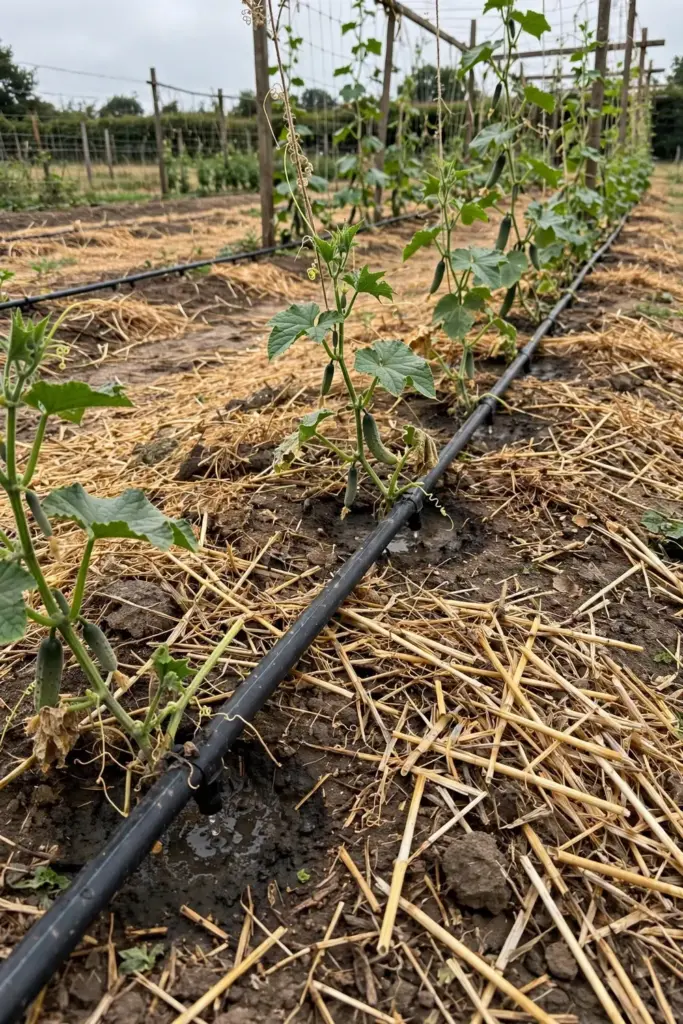
Splash drives this disease. The Utah State University Extension fact sheet on gummy stem blight states that spores move to new leaves and neighboring plants through splashing water. Every overhead watering event splashes spores from soil and low leaves onto clean leaves above. Drip irrigation removes that vehicle entirely.
Water in the morning when possible. Morning watering lets any accidental leaf wetness dry in the sun, while evening watering leaves leaves wet all night. The infection window needs hours of continuous wetness, and a leaf that dries by midmorning rarely infects.
Mulch under the vines to cut splash further. Straw or wood chip mulch blocks soil splash from reaching low leaves, and it keeps fruit off wet soil. Keep mulch pulled slightly back from the stem base, since wet mulch piled against a stem invites crown rot.
Fix drainage in low spots. Beds that puddle after rain keep leaves wet for hours, and vines in low spots show the first symptoms in most gardens. Raised beds, shallow swales, and loose soil all move water away from the vines.
Strategy 7: Space Vines for Airflow and Morning Sun
Space vines wide, trellis where possible, and give the bed full morning sun. Airflow dries leaves fast, and dry leaves resist infection.
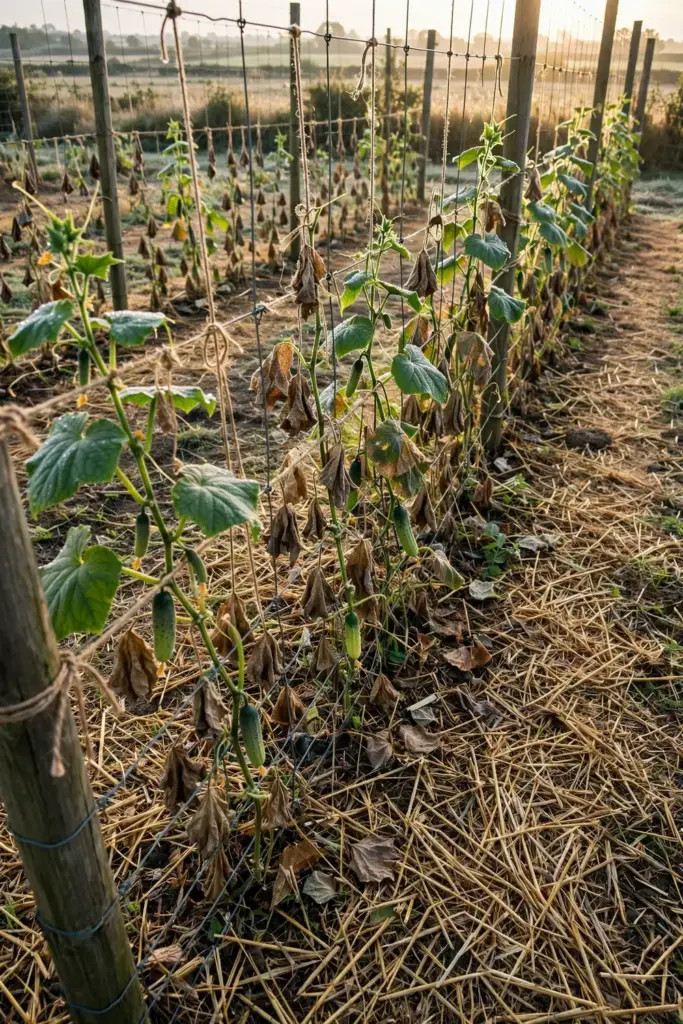
Tight spacing traps humid air. Vines that overlap shade each other, slow drying after rain, and block sprays from reaching lower leaves. Follow the seed packet spacing, and treat the packet number as a minimum, not a target. Extra space costs a little yield per bed and saves the whole crop in a wet year.
Trellis cucumbers and small melons. Vertical vines dry faster than vines sprawled on soil, and trellised fruit stays off wet ground. Tie vines loosely, and prune the lowest leaves to open airflow under the canopy. A trellis also lifts fruit away from soil splash.
Prune for airflow in midseason. Remove the oldest, most spotted lower leaves once the vine sets fruit, and bag the prunings rather than dropping them on the soil. Work the healthy vines first and the spotted vines last, and disinfect blades between vines. Morning sun matters most, since it dries dew fast. A bed that catches early sun dries hours before a bed shaded until noon.
Strategy 8: Protect Fruit From Wounds and Harvest With Care
Protect fruit from wounds, and harvest with care. Every break in the rind opens a door for black rot.
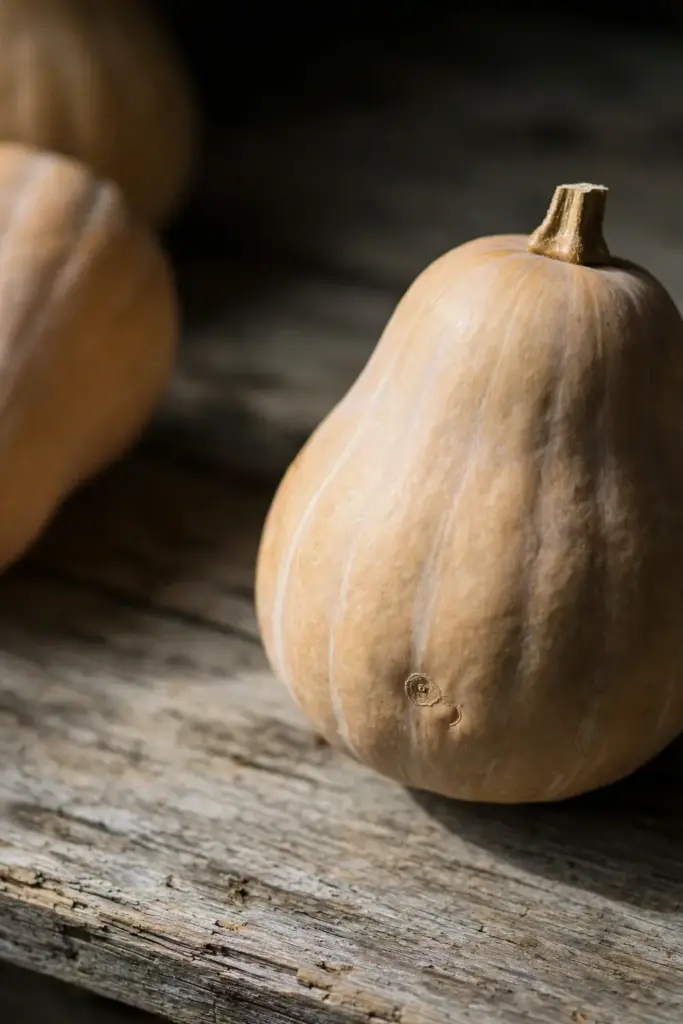
The Ohio State University Extension report on gummy stem blight of cucurbits advises avoiding fruit wounding during harvest to prevent postharvest rot. Cut stems with a clean blade instead of tearing fruit from the vine. Tearing leaves a ragged wound that rots fast. Leave a short stem stub on squash and pumpkins, since the stub seals the attachment point.
Handle fruit gently at every step. A dropped melon, a stacked squash, and a fingernail nick all break the rind. Carry fruit in a padded basket or a single layer in a crate, and never pile heavy squash on top of thin-skinned cucumbers. Inspect fruit at picking, and eat or process any nicked fruit right away rather than storing it.
Keep harvest tools clean. A blade that cuts an infected vine carries spores to the next fruit stem. Wipe blades with disinfectant between vines, and wash baskets between harvests. Harvest healthy vines first and visibly sick vines last, so the dirtiest work lands at the end of the session.
Pick in dry weather when possible. Wet fruit carries spores on its surface into storage, and wet stems tear more easily. A dry morning harvest, with fruit dried before storage, stores far better than a rainy-day harvest.
Strategy 9: Store Harvested Fruit at 45 to 50 Degrees Fahrenheit
Store harvested squash, pumpkin, and melon at 45 to 50 degrees Fahrenheit. Cool storage slows black rot, while warm storage speeds it.
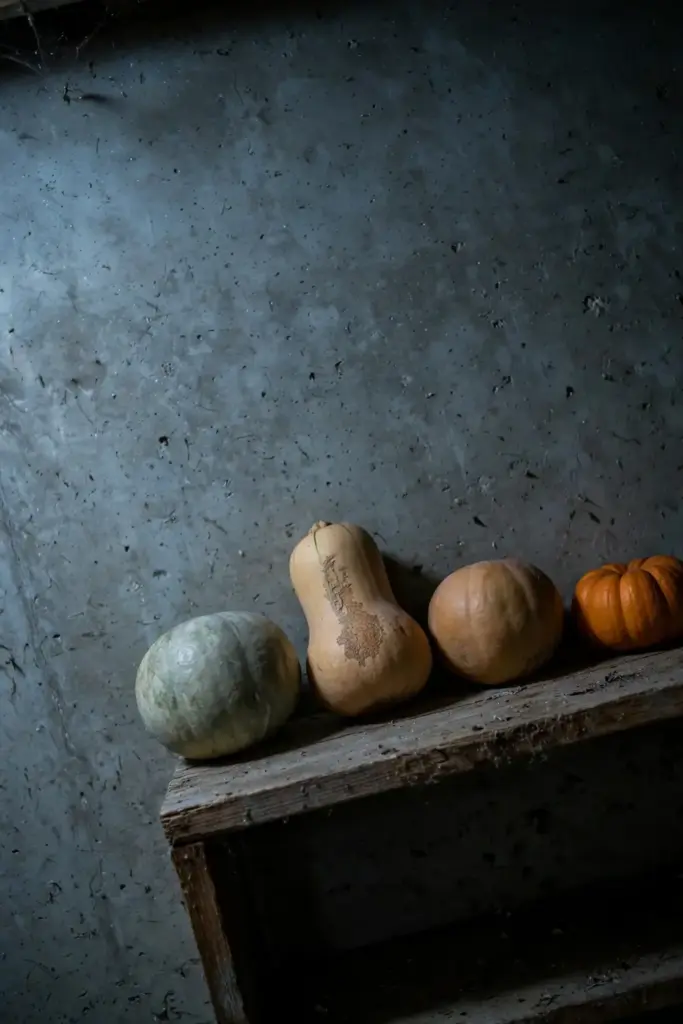
The Ohio State University Extension report on gummy stem blight of cucurbits advises storing fruit at 45 to 50 degrees Fahrenheit to prevent postharvest rot. A cool pantry, a basement shelf, or a spare refrigerator all serve, as long as the temperature stays steady. Temperatures below 45 degrees chill cucurbits and cause their own damage, so stay inside the band.
Cure winter squash and pumpkins before storage. Curing hardens the rind and heals small harvest wounds, which closes the entry points black rot uses. Cure in a warm, dry, ventilated spot until the rind hardens, then move the fruit to cool storage. Eat any fruit with soft spots, cracks, or gum first, since those fruits will not store.
Check stored fruit weekly. One rotting squash in a crate spreads spores to its neighbors, and a weekly check catches the rot before it spreads. Remove any fruit that softens, spots, or leaks gum, and wipe the shelf before replacing the remaining fruit. A clean shelf and a weekly check save the rest of the harvest.
Strategy 10: Use Protective Fungicides With Class Rotation
Use protective fungicides only after cultural controls, and rotate fungicide classes. Sprays protect healthy leaves, and they never cure an infected stem.
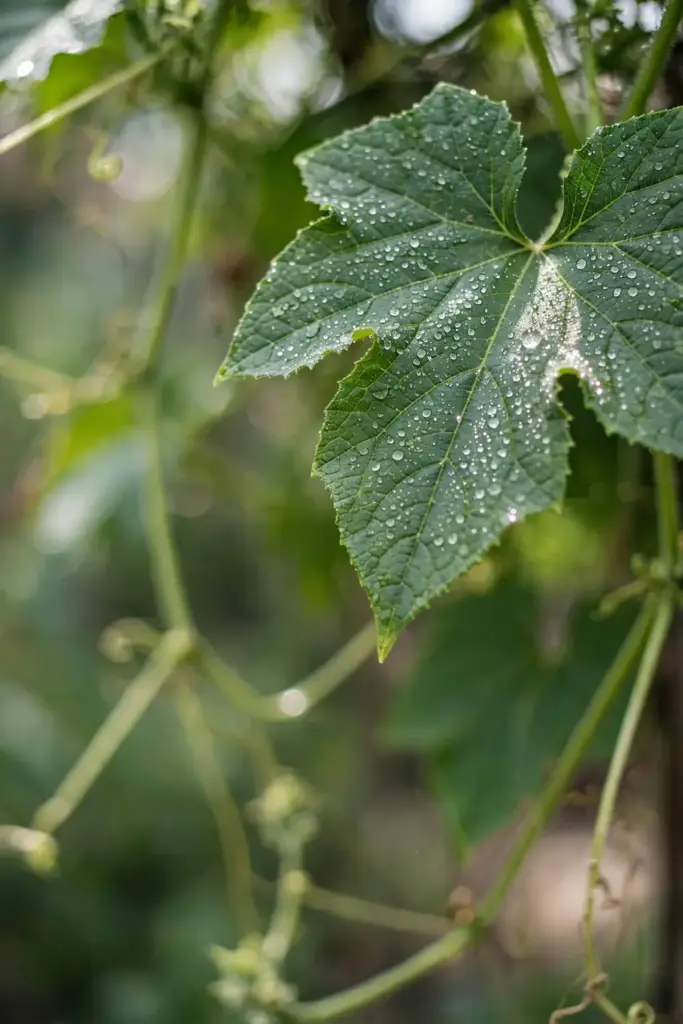
The Ohio State University Extension report on gummy stem blight of cucurbits advises applying protective fungicides regularly once the disease threatens. Protective means the spray must coat the leaf before spores land. A spray applied after lesions appear protects the new growth, and it does nothing for the lesions already present.
Rotate between fungicide classes. The Utah State University Extension fact sheet on gummy stem blight states that rotation between fungicide classes is very important for fungicide resistance management, and that reports exist of Didymella bryoniae developing resistance to some fungicides in other states. Repeating one class all season breeds resistant fungus. Alternating classes keeps every class working longer.
LSU AgCenter lists chlorothalonil or mancozeb as the preventative fungicide options for gummy stem blight on cucurbits. Home gardeners should choose a product labeled for cucurbits and for gummy stem blight in their state, and follow the label exactly for rate, interval, and pre-harvest waiting period. The label is the law, and label rates differ by crop and state.
Time sprays to wet weather. Apply before a forecast wet spell, not after it, since protection must sit on the leaf before spores germinate. Cover leaf undersides as well as tops, since spores land everywhere. Stop spraying once the vines die back or the season ends, since a dead vine needs no protection.
Living With Gummy Stem Blight Damage You Cannot Undo
Keep harvesting from a lightly infected vine. Leaf spots alone rarely end production, and fruit from a vine with spotted leaves still eats well once the grower cuts away damaged parts.
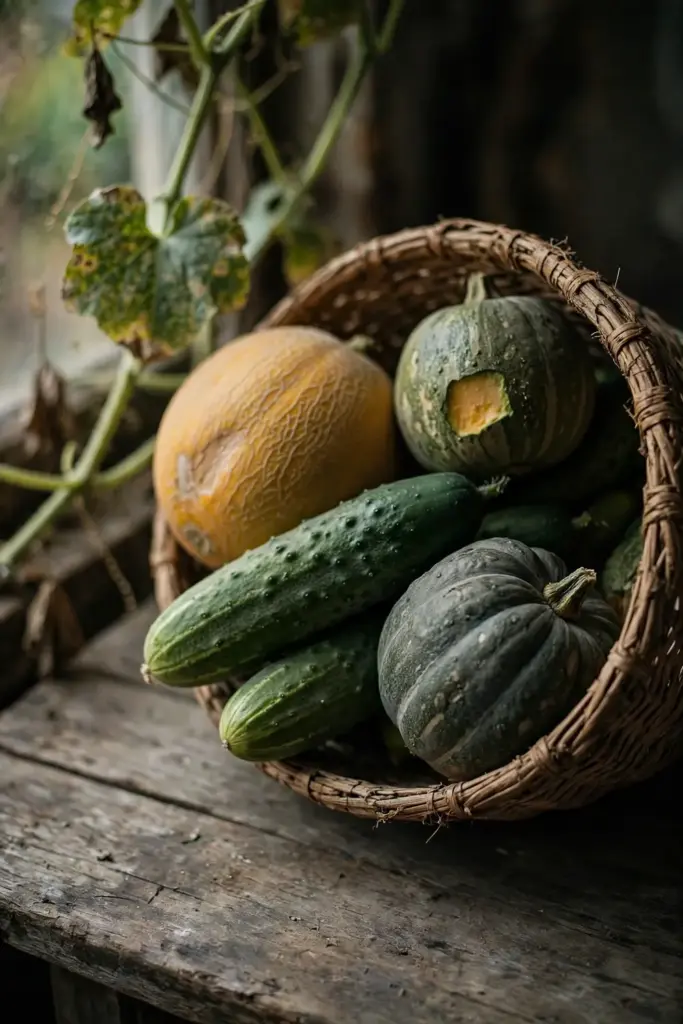
Eat fruit from infected vines promptly. Fruit with small black rot spots can still serve if the grower cuts away the rot with a wide margin and cooks the rest. Never serve raw slices from a rotted fruit, and never store a spotted fruit with the clean harvest. A spotted fruit belongs in tonight dinner or the trash, not the storage shelf.
Pull girdled vines without delay. A vine with a canker circling the stem will not recover, and it sheds spores onto its neighbors while it dies. Bag the vine, carry it out of the bed, and wash tools after. The space left behind dries faster, which helps the vines that remain.
Plan next season from this season damage. Mark the beds that showed gummy stem blight, and keep cucurbits out of those beds for 3 to 4 years. Order certified seed early, and set up drip lines before planting. The grower who lost vines this year grows the cleanest crop next year by acting on the damage record, not by forgetting it.
Frequently Asked Questions
Yes, with care. Leaf spots and stem gum on the vine do not poison the fruit, so a clean fruit from a lightly infected vine eats normally. Cut away any black rot spots with a wide margin, cook the rest, and never store a spotted fruit with the clean harvest. Fruit with deep internal rot, soft flesh, or a sour smell belongs in the trash. Wash hands, knives, and boards after cutting a rotted fruit.
No. Gummy stem blight stays inside the cucurbit family, so tomatoes, beans, corn, peppers, and lettuce never catch it. The fungus infects cucumber, squash, pumpkin, melon, watermelon, cantaloupe, and gourd, and no crop outside that family hosts it. A tomato bed beside an infected cucumber bed stays safe. Rotation still needs care, since every cucurbit in the rotation shares the same risk.
A girdled vine wilts a few weeks after infection, while a vine with leaf spots alone can produce for weeks longer. The University of Delaware notes that stem cankers girdle stems and cause wilting a few weeks after infection. Leaf-only infection rarely kills outright, though heavy defoliation weakens the vine and ruins fruit. Pull girdled vines at once, since sprays cannot reopen a choked stem.
No. Seed from an infected vine may look clean while carrying the fungus inside, and no home treatment reliably cleans it. Utah State warns that seedlings can carry infection without showing symptoms when the seed carries the fungus. Buy fresh certified disease-free seed for the next season. Seed saving works well for many crops, and cucurbits with a gummy stem blight history are not among them.
Black rot strikes after harvest, since fruit that looked clean at picking can develop water-soaked spots in storage. Wounds from rough handling open the door, and warm storage speeds the rot. Ohio State advises storing fruit at 45 to 50 degrees Fahrenheit to prevent postharvest rot. Harvest gently, cure winter squash before storage, check stored fruit weekly, and remove any fruit that softens or spots.
No. Soil removal is unnecessary, since rotation and debris cleanup starve the fungus without moving soil. Utah State states that the fungus survives on infected plant debris for up to 2 years in the soil, so debris removal matters more than soil removal. Pull all vines and fruit, bury or bag the debris, and keep cucurbits out of the bed for 3 to 4 years. Fresh mulch and a clean trellis finish the reset.
Where to Go From Here
Gummy stem blight rewards the gardener who acts early and punishes the gardener who waits. Certified seed, dry leaves, and clean beds prevent most outbreaks, and early roguing stops the rest.

Start with one bed check today. Walk the cucurbit bed, look for gum on stems and spots at leaf margins, and pull any girdled vine on the spot. Order certified seed for next season, and sketch the rotation map before planting. The 10 strategies above work as a system, and the gardener who runs all 10 grows the cleanest cucurbits in the neighborhood.