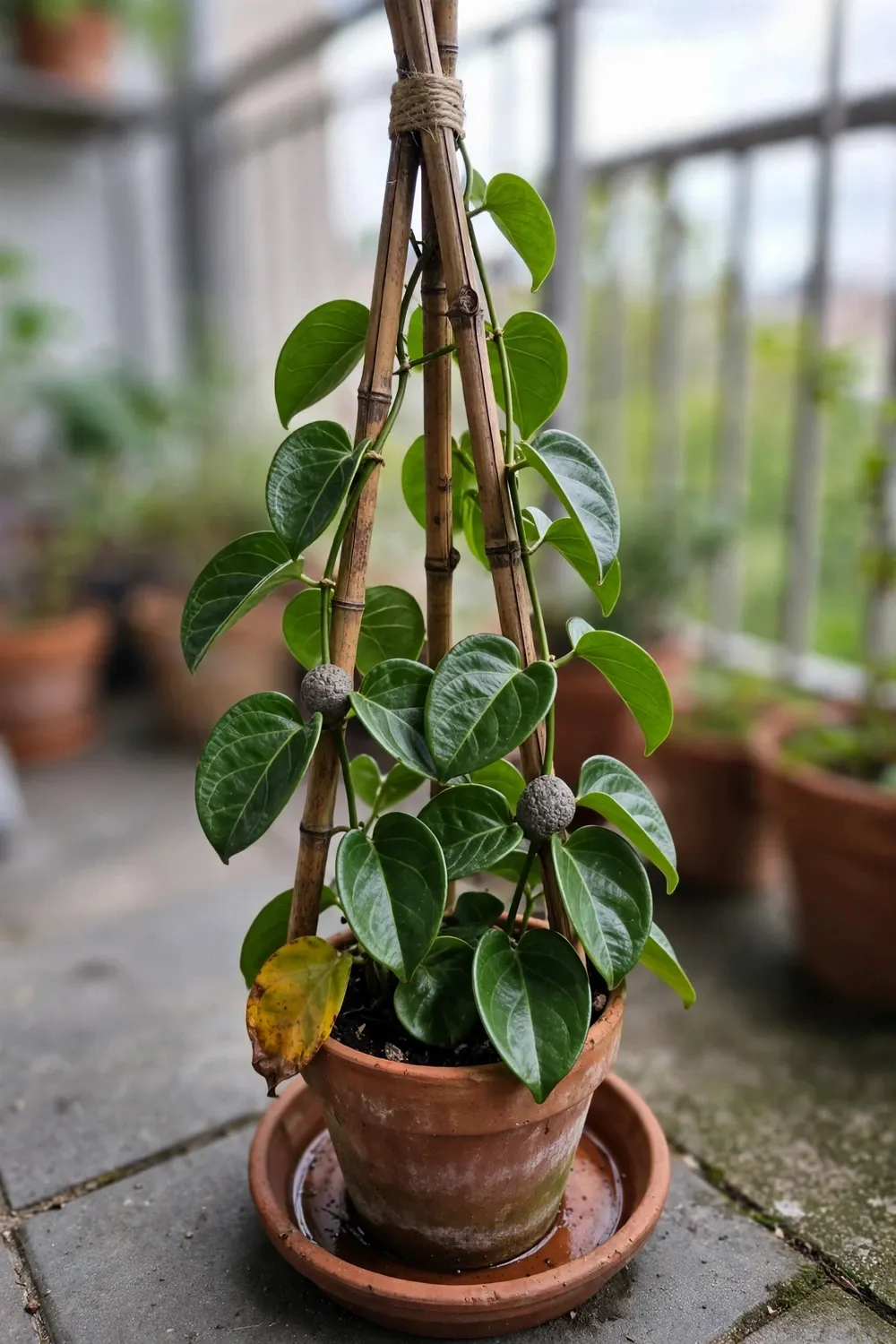

Grow binahong in one sealed pot, on pavement, with a trellis the vine never outgrows. That single decision answers how to grow binahong without turning a garden plant into a neighborhood problem. Madeira vine, or Anredera cordifolia, is a fast perennial climber with stems that reach 5 m, and it spreads through tubers rather than seed. Keep it contained and it gives a steady supply of heart-shaped leaves. Let it touch open soil and it escapes.
Binahong is the Indonesian name for this vine. English-speaking gardeners know it as Madeira vine, and the plant behind both names is Anredera cordifolia. Its leaves are thick, glossy, and heart-shaped, and its stems drop small aerial tubers that root where they land. One plant in a pot on a balcony stays a kitchen herb. The same plant in a warm-climate garden bed becomes a smothering weed that climbs trees and buries fences. The container is the whole strategy, and every step below serves it. Readers who already grow tropical herbs in pots will recognize the rhythm from growing katuk in a pot, another Indonesian leafy green that behaves best under the same discipline.
I have learned to treat the pot as a quarantine cell, because one escaped tuber restarts the whole problem. That habit shapes this guide. You will not find a planting-out step here, because planting Madeira vine in open ground in a warm climate is the one move this article refuses to recommend.
1. How to Grow Binahong in a Pot Without Letting It Escape
How to grow binahong safely starts with one rule. Grow it in a single pot that never touches soil, and treat every tuber as a future plant. A contained pot gives you leaves for the kitchen and zero escape routes. An open bed gives you a vine that outruns your pruning shears.
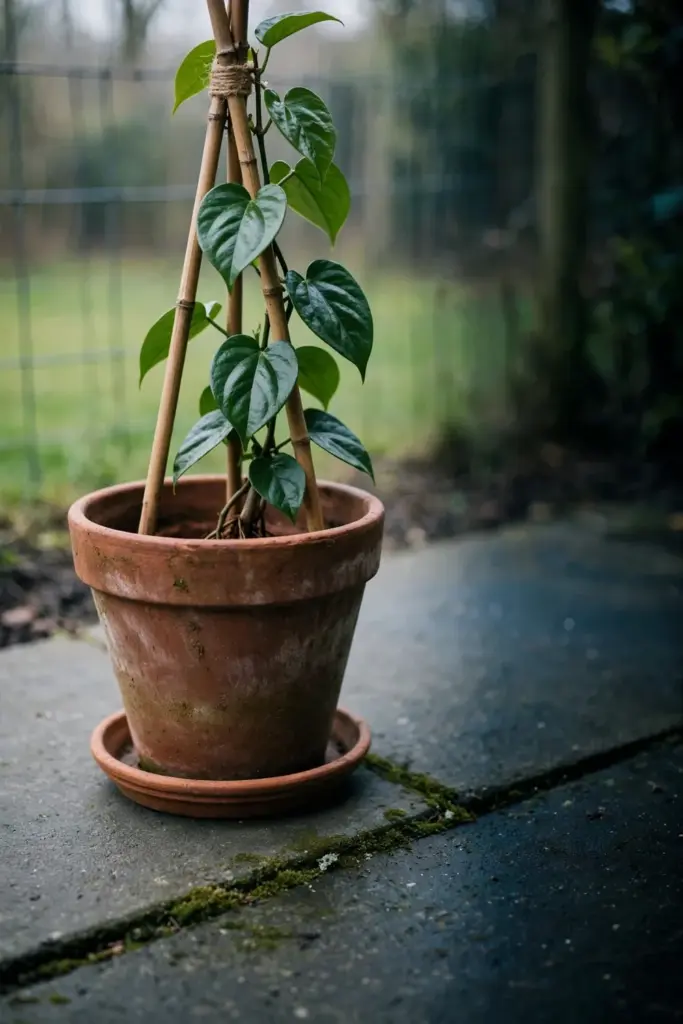
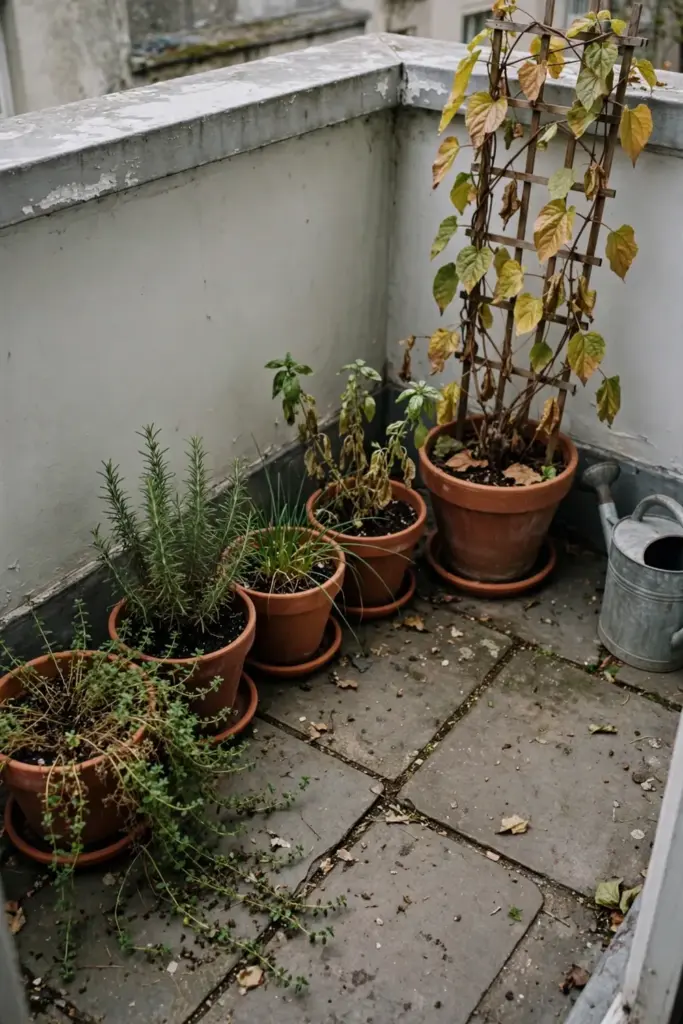
Set the pot on pavement, a balcony, or a raised stand with a solid base. Keep it away from garden beds, fences, hedges, and trees the vine could climb. A vine that reaches a fence uses it as a ladder, and a vine that reaches a tree drops tubers into the canopy. Prune the stem tips before they stretch past the trellis. Pick up every fallen tuber the day you see it. Underground tubers can reach 20 cm across on an established plant, according to a Camden Council fact sheet sourced from NSW WeedWise, so even one season of neglect builds a tuber bank under the pot.
Think of the pot as a sealed system. Nothing leaves it except the leaves you pick and the prunings you bag. Water drains into a saucer you empty and inspect. Soil stays inside the pot. Tubers stay inside the pot. That discipline sounds strict, and it is. The strictness is the point, because Madeira vine forgives nothing once it reaches open ground.
2. Identify Madeira Vine by Its Heart Leaves and Aerial Tubers
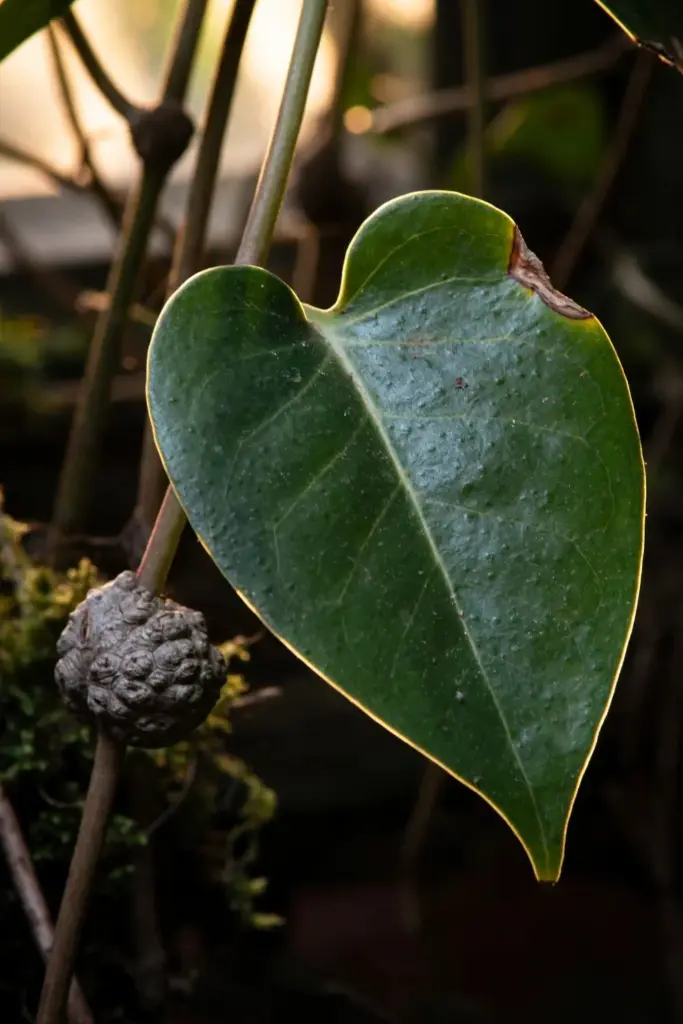
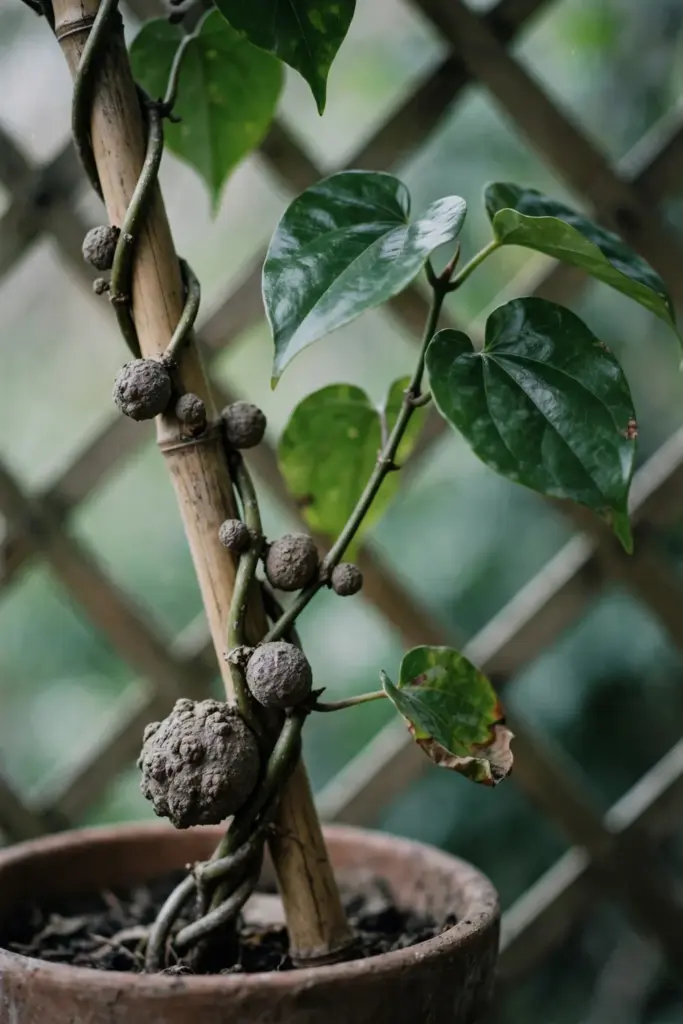
Madeira vine shows three marks that separate it from every look-alike. Leaves are alternate, slightly fleshy, glossy, and heart-shaped or broadly oval, 2 to 10 cm long and 1 to 7 cm wide. Stems are green or reddish when young and turn rope-like and gray-brown with age. Warty aerial tubers form at the leaf nodes along older stems, and each one can start a new plant.
Flowers confirm the identification in late summer. The vine carries drooping racemes 10 to 35 cm long, sometimes reaching 60 cm, covered with small cream-white fragrant star-shaped flowers. Seeds rarely form, and seed-set is rare in cultivated material, so the plant spreads almost entirely through tubers. If your plant makes no aerial tubers and no heart-shaped leaves, you bought the wrong vine. Check the label against the table below before you pot it.
| Plant | Check Before You Buy | Why It Matters |
|---|---|---|
| Madeira vine, Anredera cordifolia | Heart-shaped fleshy leaves plus warty aerial tubers at the leaf nodes | This is the plant this guide covers |
| Anredera baselloides | A separate species, restricted to Ecuador and Peru, often confused with Madeira vine in older treatments | Old labels and old articles mix the two names |
| Anredera tucumanensis | A separate species in the same genus, not Madeira vine | Care advice written for one species does not transfer cleanly to the other |
| Pride of Madeira, Echium candicans | A woody shrub with tall purple flower spikes, not a vine at all | Nurseries and name lists mix it with Madeira vine, and the two plants share nothing in care |
The botanical record places Anredera cordifolia in the Basellaceae family, native to southern and central South America and widely grown as an ornamental in tropical and subtropical regions, per the Kew Plants of the World Online entry. The same entry notes that the species often naturalizes after escaping cultivation and turns aggressive in parts of its introduced range. That history is why identification matters before planting. A correct label keeps you from nursing a stranger, and a wrong label can hand you a weed you never meant to grow. The Flora of North America treatment supplies the measurements in this section and confirms the confusion with A. baselloides in older floristic treatments.
3. Check Local Weed Rules Before You Buy One Tuber
Check your local weed list before you buy a tuber or accept a cutting from a friend. Madeira vine is listed as a restricted or noxious weed in several regions, and in some places sale and planting are limited by law. A quick search of your state or national weed register takes five minutes and can save you a fine or a forced removal order.

Start with your agriculture department or biosecurity authority. Ask whether Anredera cordifolia appears on a declared weed list for your area, and whether container growing is allowed under any conditions. In warm regions with no frost, the answer may be a flat no, and you should accept it. In cool regions with hard winters, the rules may allow a potted plant with containment conditions attached. Where the rules ban the plant outright, skip it and pick a different vine from the alternatives at the end of this guide.
Keep the receipt and the label if you buy a tuber. A labeled purchase proves the species if a neighbor or an inspector ever asks, and it helps you avoid the mislabeled stock described in the identification table. Never accept an unidentified vine cutting from a garden swap. A cutting without a name is how Madeira vine enters gardens that never invited it, and how gardeners end up growing a weed they cannot name.
4. Choose a 40 Liter Pot With a Saucer and Zero Ground Contact
Choose a pot of at least 40 liters with drainage holes and a deep saucer. A pot this size holds one plant through a full season without drying out by noon, and the saucer catches every drop of drainage before it reaches soil. Smaller pots dry too fast, and a dry vine drops stressed leaves and sulks.
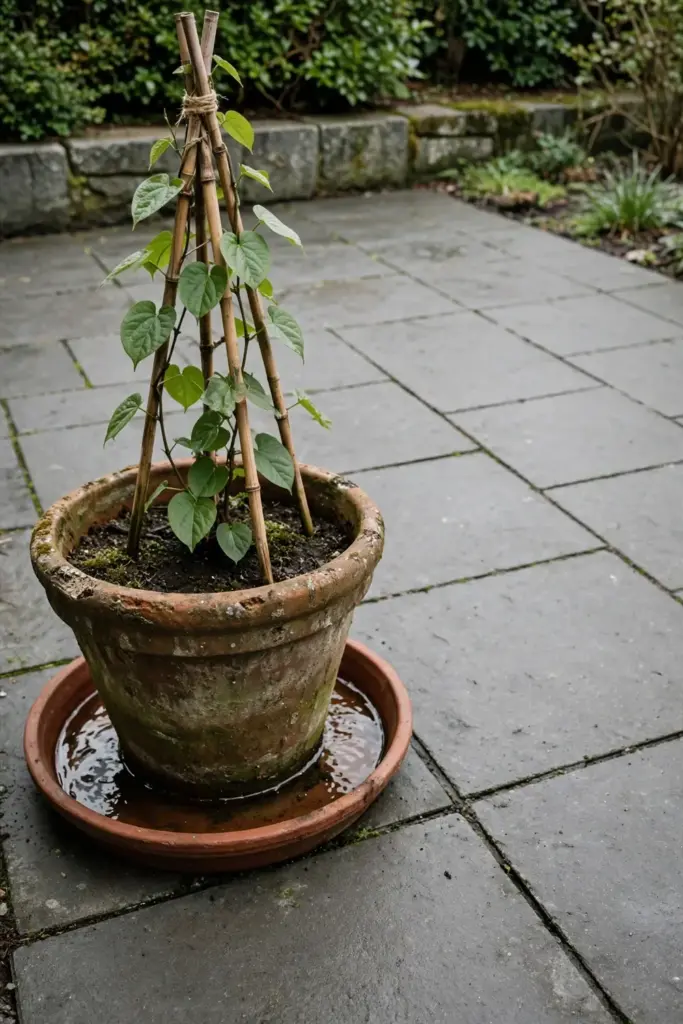
Pick a heavy pot. Terracotta or thick plastic both work, and weight matters because a vine in full leaf catches wind. A light pot tips in a storm and spills tuber-laden soil across the garden, which is exactly the accident this guide exists to prevent. Set the pot on a solid base, such as a paving slab or a metal stand with a tray. Never set it directly on soil, mulch, or gravel, where a drainage hole becomes an escape hatch for roots and small tubers.
Check the saucer weekly. Empty standing water after rain so mosquitoes do not breed, and look for tiny tubers that washed through with the drainage. A saucer that holds a tuber is a nursery. Rinse it, pick out anything solid, and return it under the pot. When the season ends, scrub the saucer before storing it, since a forgotten tuber in a stored saucer sprouts in spring.
5. Mix a Free-Draining Loam That Holds Moisture
Mix a free-draining loam that holds moisture without staying wet. Madeira vine likes steady moisture around its roots and rots in stagnant water, so the mix must drain fast and still hold a drink between waterings. A simple blend works well, with two parts good potting mix, one part mature compost, and one part coarse perlite or pumice.
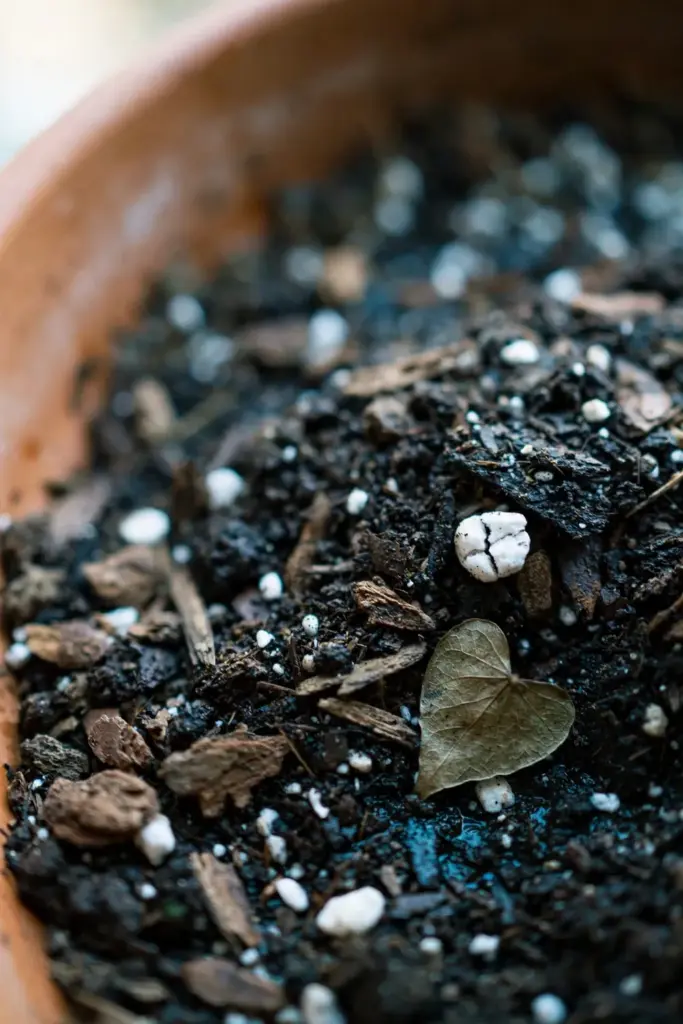
Sieve out the fine dust from the potting mix if the bag feels heavy and peaty. Fine particles pack down and seal the surface, and a sealed surface starves the roots of air. Add a handful of horticultural grit if your mix still feels dense after the perlite goes in. The finished mix should feel like a wrung-out sponge when squeezed, holding shape for a second and then falling apart.
Fill the pot to 3 cm below the rim. That gap leaves room for watering without overflow, and overflow is a real problem here, since spilled water carries small tubers and stem fragments over the edge. Top up the surface with a 2 cm layer of coarse bark chips. The bark slows surface drying, keeps the mix in place during heavy rain, and makes fallen tubers easy to spot against the dark background.
6. Plant One Tuber 5 cm Deep After the Last Frost
Plant one tuber per pot, 5 cm deep, after the last frost date in your area. One plant fills a 40 liter pot by midsummer, and two plants in one pot tangle into a knot that is hard to prune and harder to inspect. A single plant stays legible, and legibility is what lets you find every aerial tuber.
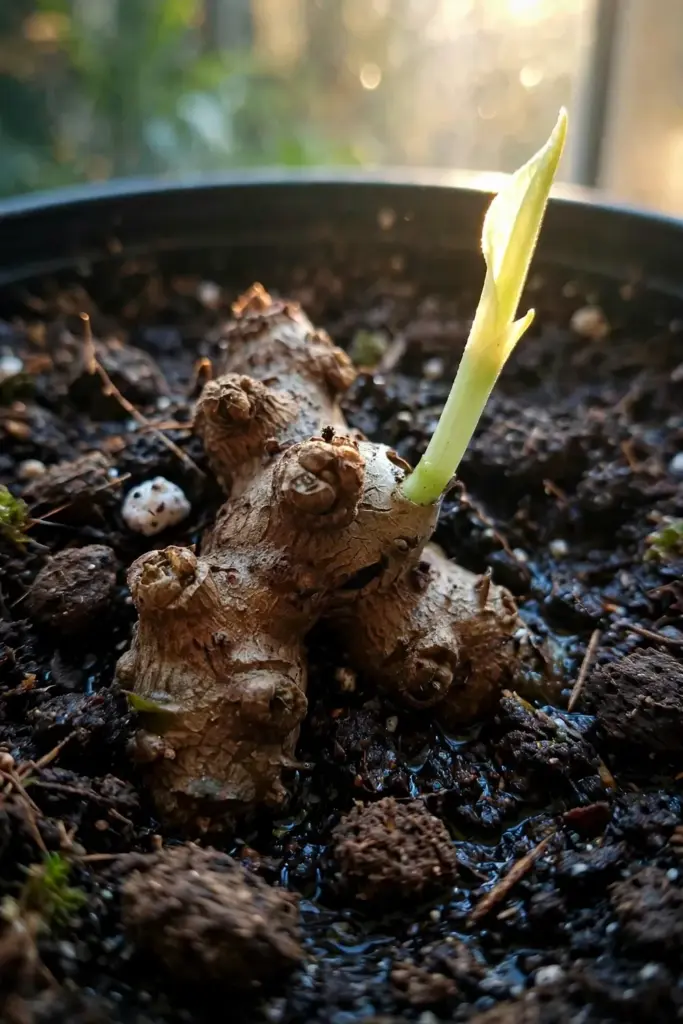
Lay the tuber on its side with any visible eye or sprout pointing up, then cover it with mix and water gently. If you start from a stem cutting instead, take a 15 cm section with two leaf nodes, strip the lower leaf, and set the lower node 5 cm deep in moist mix. Keep the cutting in bright indirect light until new growth shows, then move it to full sun over a week.
Warm soil wakes the tuber faster. Warm soil wakes the tuber faster. Cold soil leaves the tuber sitting and risks rot. If spring stays cold, start the tuber indoors on a warm windowsill and move the pot outside once nights stay above 10 degrees Celsius. Mark the planting date on the pot with a paint pen so you can track the season without guessing.
7. Give Madeira Vine Full Sun and a Sturdy Trellis
Give Madeira vine full sun to part shade and a trellis that holds its full weight. The vine grows hardy in USDA Zones 9 to 11, reaches 12 to 100 feet in frost-free ground, and flowers from September to October, according to the Missouri Botanical Garden Plant Finder entry. In a pot, expect a shorter vine, and plan the trellis for the plant you have, not the plant the garden center promised.
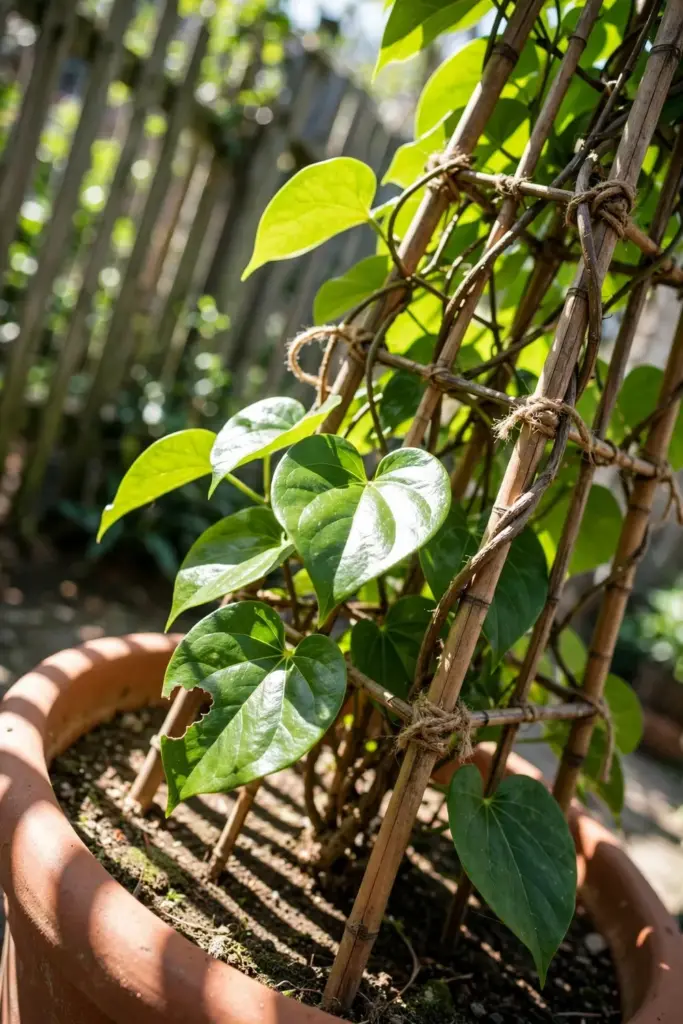
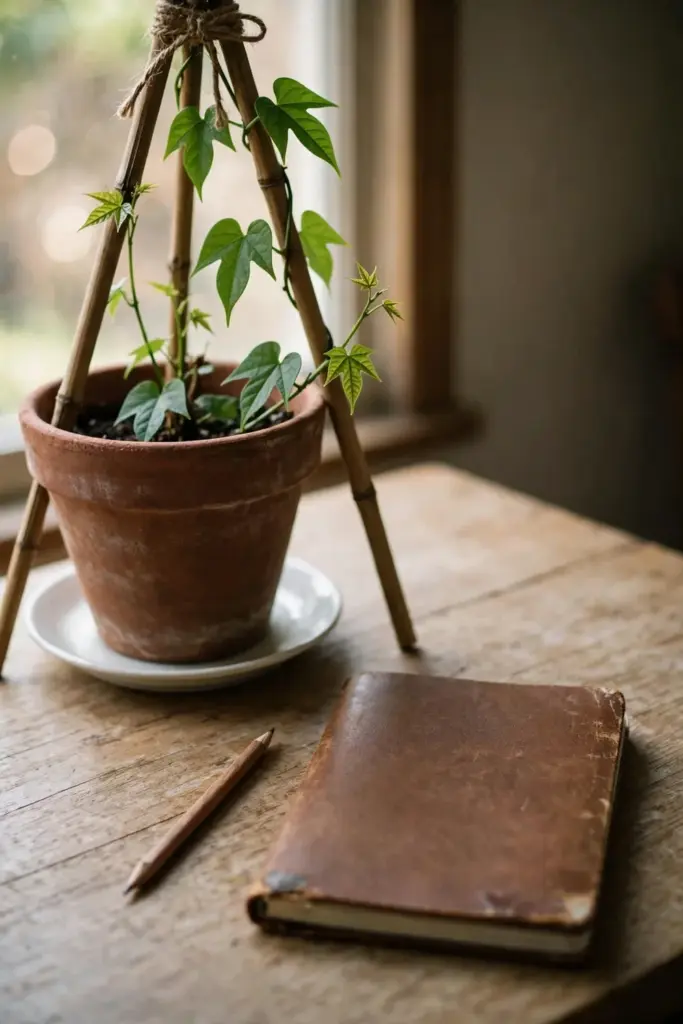
A freestanding obelisk or a tripod of bamboo canes inside the pot works best. The support must stand in the pot itself, never lean against a fence or a wall, because a vine that touches a fence climbs it. Tie the main stem loosely to the support with soft twine every 30 cm as it grows. Loose ties let the stem thicken without girdling, and regular tying keeps the vine on the trellis instead of sprawling across the balcony floor.
Light shapes leaf quality. Full sun gives thick glossy leaves and the heaviest tuber set, while deep shade gives thin pale leaves and weak growth. A spot with morning sun and light afternoon shade suits most gardens, and a balcony that gets 6 hours of direct sun grows a strong plant. Turn the pot a quarter turn each week so all sides get light and the vine grows evenly instead of leaning into one lopsided curtain.
8. Water When the Top 3 cm Dry and Feed Lightly Every 4 Weeks
Water when the top 3 cm of mix feel dry to a fingertip. Madeira vine wants steady moisture, and the fleshy leaves show drought stress fast, with dull color and soft edges. Water slowly until drainage runs into the saucer, then stop. A fast pour runs down the inside of the pot and leaves the center dry.
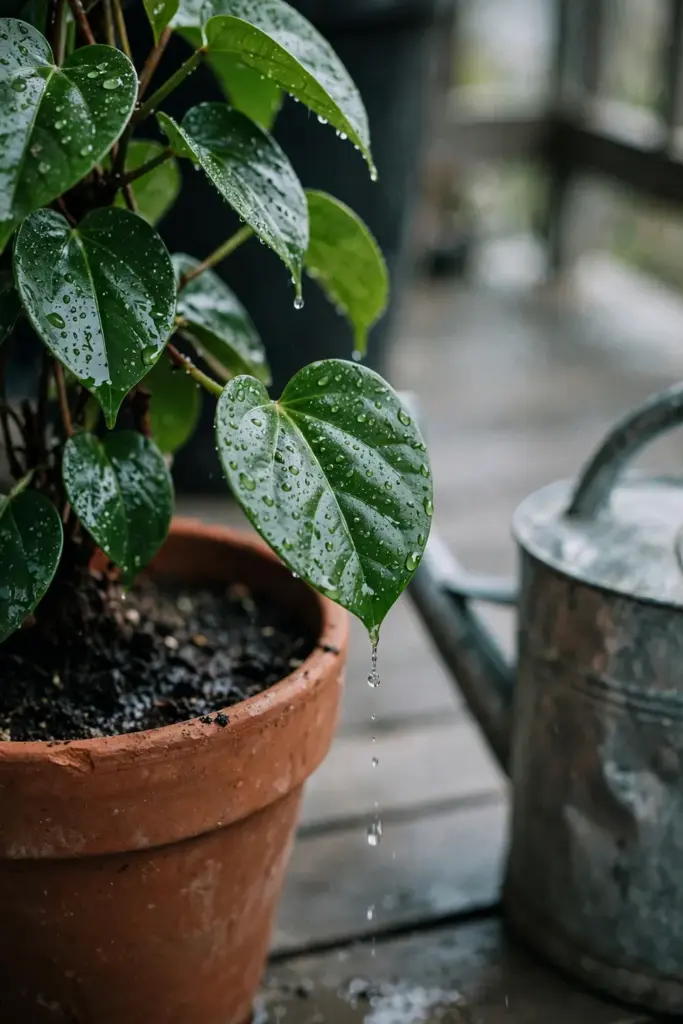
Summer heat changes the rhythm. A 40 liter pot in full sun may need water daily in a heat wave, while the same pot in a cool week may go 4 days between drinks. Check the mix, not the calendar. A moisture meter helps if you tend to overwater, but a fingertip works just as well and costs nothing. Reduce watering in autumn as growth slows, and keep the mix barely moist through winter dormancy.
Feed lightly through the growing season. A balanced liquid feed, applied every 4 to 6 weeks following the label, keeps growth steady without pushing soft stems that snap in wind. Skip the feed in winter, when the plant rests. Overfeeding grows a vine that outruns its trellis and sets more aerial tubers than you can strip, so light feeding is a containment tool as much as a nutrition choice.
9. Prune Weekly in Summer and Strip Every Aerial Tuber
Prune weekly through summer, and strip every aerial tuber you find. Weekly pruning is the containment habit that decides whether this plant stays a kitchen herb or becomes a problem. A vine left for a month in midsummer doubles its reach, and every new stem node can carry a tuber.
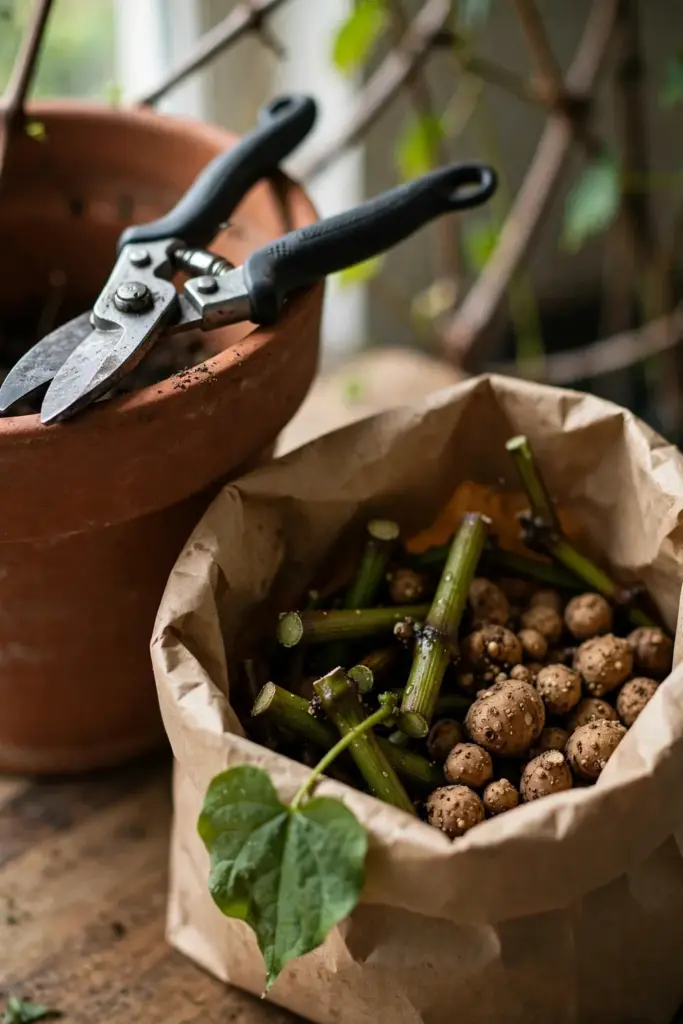
Cut the stem tips back to the trellis line with clean scissors. Drop every cutting straight into a bag, not onto the soil or the balcony floor. Then run your fingers along each stem and feel for the warty nubs at the leaf nodes. Twist each aerial tuber off and drop it in the same bag. A tuber the size of a pea already holds enough energy to start a new plant, so no tuber is too small to matter.
Work from the top of the vine downward. Tubers near the top fall the farthest, and a top-down pass catches them before they bounce into other pots. Inspect the soil surface last, and pick out anything that dropped since your previous pass. Rinse the scissors before you use them on another plant, since a stem fragment stuck to a blade can travel to the next pot.
10. Propagate Madeira Vine From Tubers and Cuttings Without Spreading It
Propagate Madeira vine indoors, over a tray, and never outdoors over open soil. The safest propagation method uses the aerial tubers you stripped during pruning. Each one is a ready-made starter plant, and using them turns a containment chore into next season’s stock.
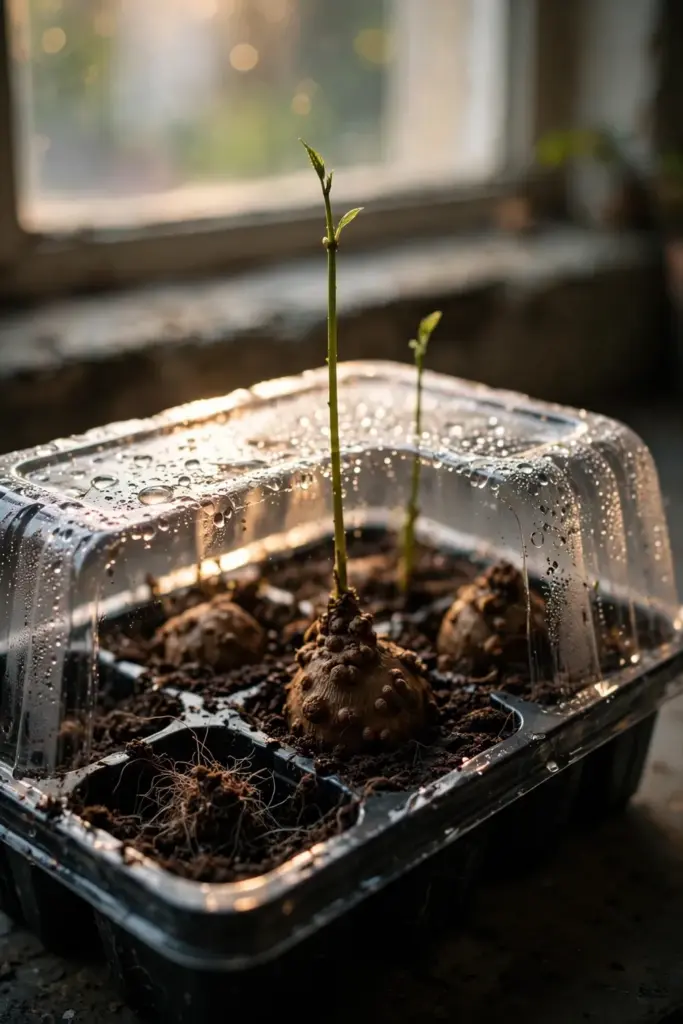
Set the tubers on moist potting mix in a tray, press them in halfway, and cover the tray with a clear lid. Keep the tray in bright indirect light at room temperature. Sprouts follow over the next few weeks. Pot each sprouted tuber into its own small pot, one tuber per pot, and grow it on the same windowsill until it fills the pot with roots.
Stem cuttings work the same way. Take a 15 cm section with two leaf nodes, strip the lower leaf, and set the lower node in moist mix. Keep the cutting humid and out of direct sun until new growth shows. Label every pot with the species name and the date. An unlabeled pot of Madeira vine is how a well-meaning gardener hands a weed to a friend, and the label takes ten seconds. The same pot discipline that suits this vine also suits growing stonebreaker in a pot, another Indonesian herb that rewards a gardener who keeps the pot system closed.
11. Harvest Leaves as a Cooked Green and Treat Bulbils as Planting Stock
Harvest leaves as a cooked green, and treat bulbils as planting stock, never as food. Pick the youngest fully expanded leaves first, since they cook tender and the plant replaces them fastest. Take no more than one third of the leaves at one picking, and leave the growing tips alone so the vine keeps its shape.
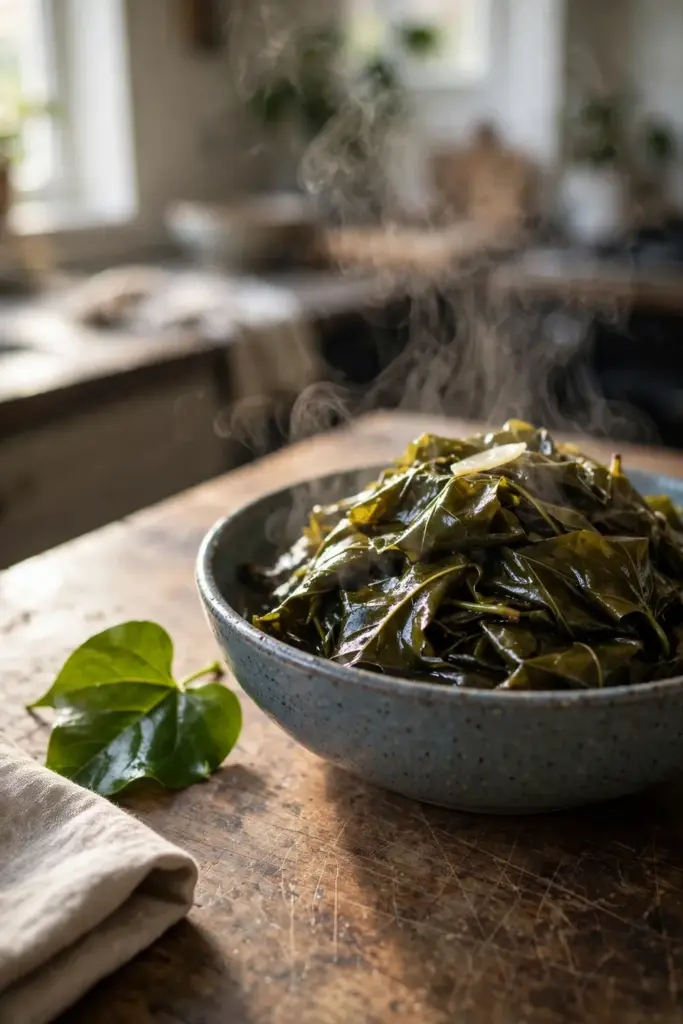
Published advice on eating Madeira vine disagrees. Some sources call the leaves toxic, while others describe them as a cooked vegetable eaten in several food traditions. This guide does not settle that dispute, and no reader should treat a gardening article as a safety verdict. Cook the leaves, start with a small portion, and stop if you feel unwell. Keep the plant away from pets and small children, and never eat a plant that has been sprayed. Bulbils stay in the planting tray, not the kitchen.
Wash the picked leaves well, then cook them the way you would cook spinach. A quick saute with garlic and oil softens the slight mucilage and keeps the color bright. The texture turns soft and a little slippery, which is normal for this family. If you want a comparison leaf to practice on first, growing spinach at home teaches the same harvest rhythm of picking young outer leaves and letting the plant regrow. Madeira vine leaves cook down fast, so pick more than you think you need, and plan one picking per week at the height of summer.
12. Overwinter Tubers Indoors Where Winters Bring Frost
Overwinter tubers indoors where winters bring frost. Madeira vine is a subtropical plant, and hard frost kills the stems to the ground. The tubers carry the plant through winter if you lift them before they freeze, and the Missouri Botanical Garden notes that stems killed by hard frost resprout in spring only where the roots stay unfrozen.
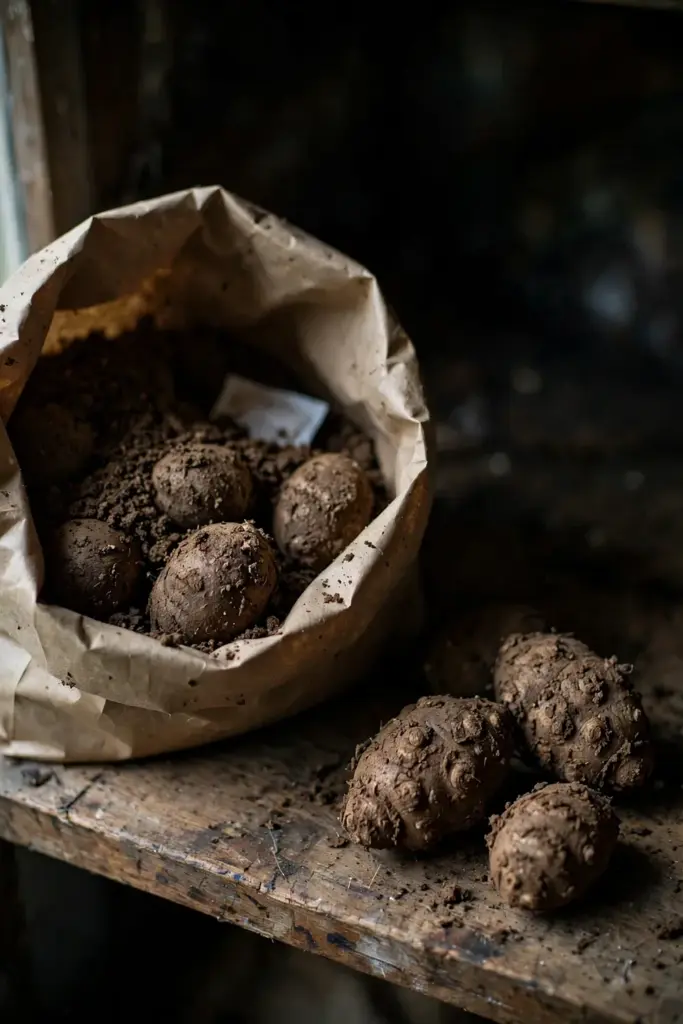
Lift the tubers after the first light frost blackens the leaves, but before a hard freeze reaches the pot. Cut the stems off at the mix surface and bag them for disposal. Tip the pot out over a tray and sort through the mix by hand. Save the firm, undamaged tubers and discard any soft or rotten ones into the same bag.
Store the saved tubers in a paper bag of dry peat or sawdust, in a cool dark spot. Check the bag monthly and remove any tuber that softens. In spring, pot the firm tubers into fresh mix and start the season again. Growers in frost-free Zones 9 to 11 can keep the pot outdoors and cut the vine back after flowering, but even there a pot left standing in a cold snap deserves a sheltered wall and a fleece cover. The indoor routine for tender herbs in the indoor herb garden guide follows the same move-before-frost logic.
13. Bag Every Scrap and Never Compost Madeira Vine Trimmings
Bag every scrap of Madeira vine and bin it with household waste. Never compost the trimmings, and never dump them on a garden bed, a verge, or a green-waste pile. Composting fails against this plant, because stem fragments and tubers survive cool compost and sprout wherever the compost spreads.
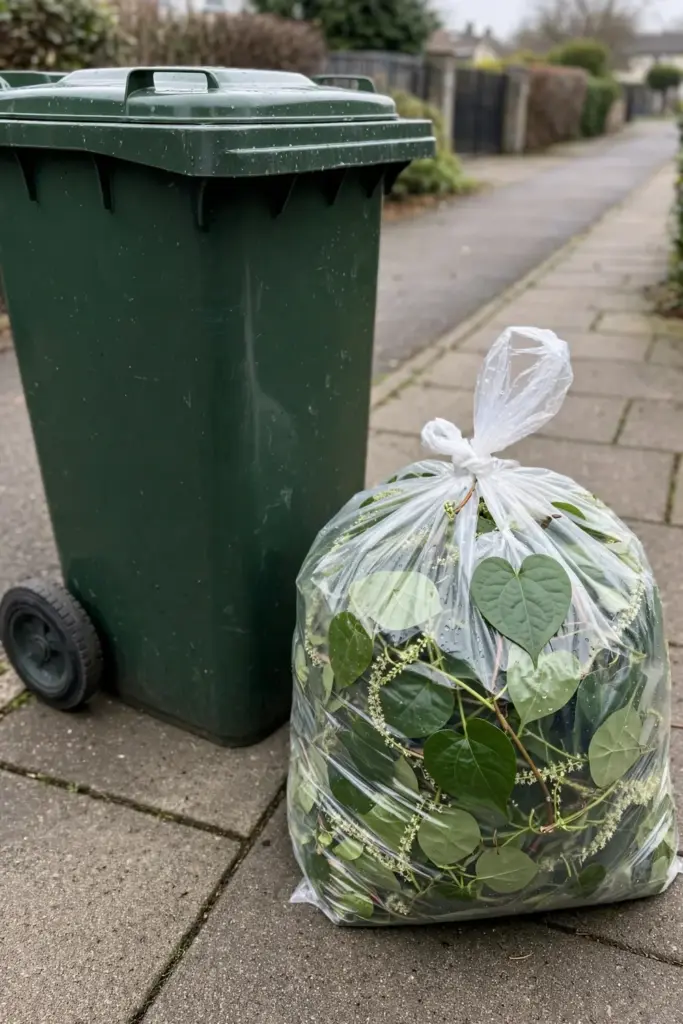
Work with a bag open beside you during every pruning session. Cuttings, stripped tubers, fallen leaves, and spent stems go straight into the bag. Tie the bag shut before you carry it through the garden, since a torn bag scatters tubers along the path. Wash your gloves and tools after the session, and check your shoes and clothing for clinging fragments before you walk to another bed.
Treat the soil in the pot as contaminated at repotting time. Do not tip old mix onto a garden bed or into a compost bin. Bag it with the rest of the waste, or solarize it in a sealed black bag in full sun for several weeks and then bag it anyway. A gardener who bags scraps for one season builds a clean site. A gardener who composts them builds a tuber bank that outlives the pot.
14. Watch for Aphids, Spider Mites, and Powdery Mildew
Watch the leaf undersides weekly for aphids and spider mites, and watch the upper surfaces for the white dust of powdery mildew. Pests find this vine fast in warm still air, and a weekly check catches colonies while they are still small enough to wash off.
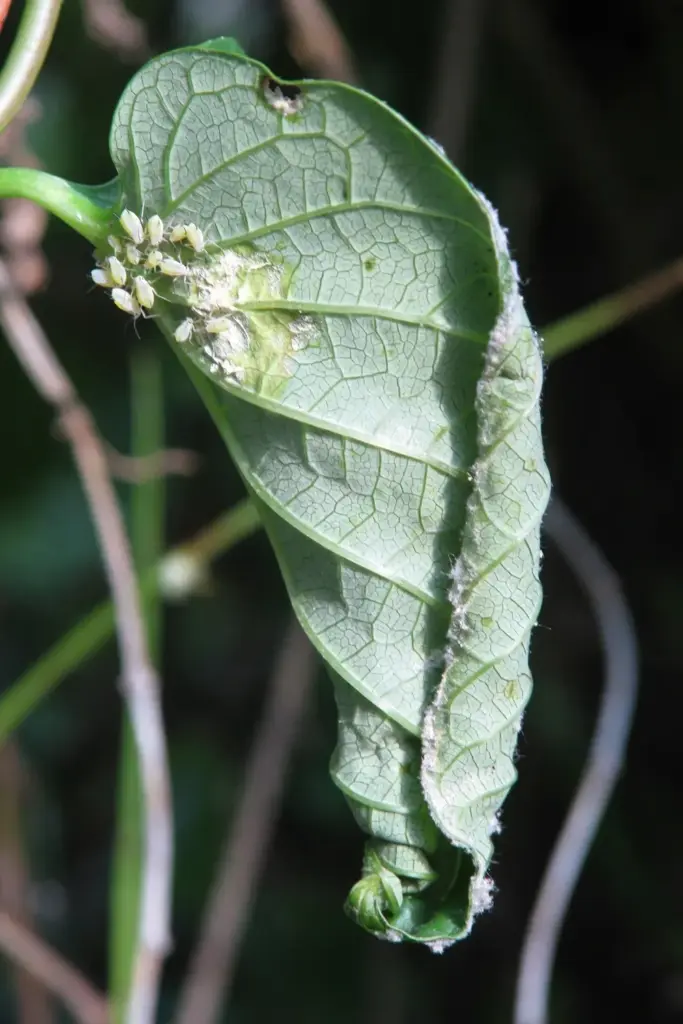
Aphids cluster at the stem tips and under young leaves. Blast them off with a strong jet of water, and repeat after 3 days to catch the next hatch. Spider mites show as fine stippling and faint webbing on the leaf undersides, and they love hot dry air. Raise humidity around the pot with a saucer of water and pebbles, and wash the leaves top and bottom. Powdery mildew follows humid nights and poor airflow, so space the pot away from walls and avoid wetting the leaves late in the day.
Cut out any leaf that shows heavy mildew and bag it with the pruning waste. Do not spray a plant you plan to harvest within the week. Wash harvested leaves well, and wait out the spray interval on the product label before picking again. A healthy vine in full sun with steady water shrugs off most pests, so treat the outbreak as a signal and fix the light, water, or airflow first.
15. Replace Madeira Vine With a Safer Vine When Containment Fails
Replace Madeira vine with a safer vine when containment fails. If tubers keep escaping, if the vine reaches a fence twice in one season, or if you cannot keep up with weekly pruning, the honest move is removal. A plant you cannot contain is a plant you should not keep.
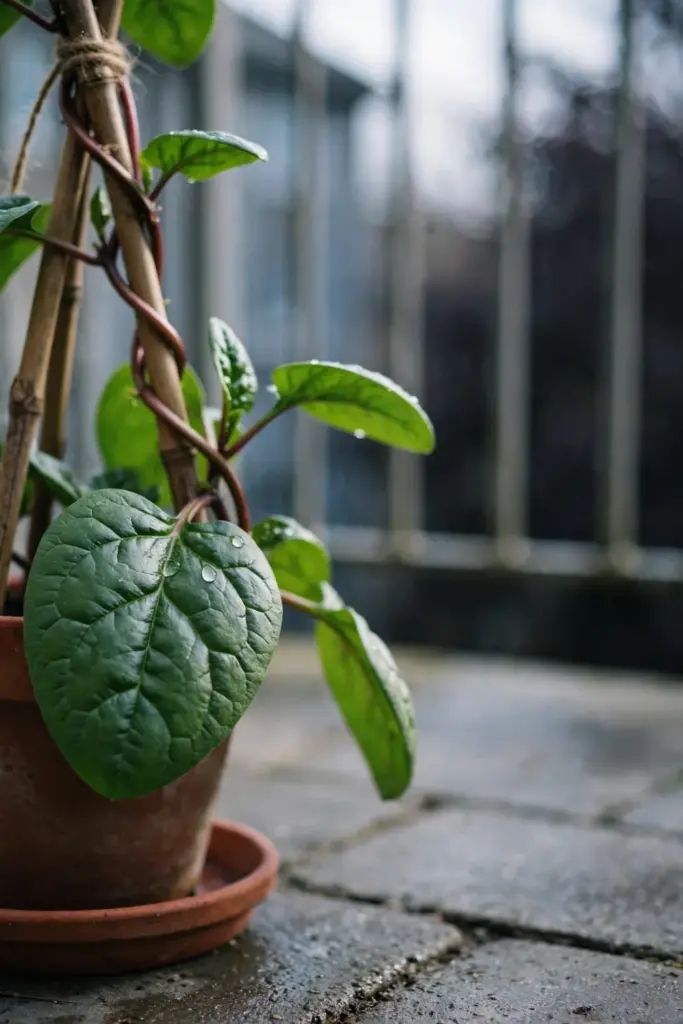
Dig the whole pot out over a tray, bag every tuber and stem fragment, and bin the lot. Scrub the pot, the saucer, and the stand before reuse, since a single forgotten tuber restarts the cycle. Check the ground around the old pot site weekly for a full season, and pull any sprout the day it appears, tuber and all.
Malabar spinach, or Basella alba, gives a similar cooked leaf from a tropical vine with a far smaller weed record in most regions. Katuk offers another Indonesian leafy green for the same pot and trellis. Check the local weed status of any replacement before planting, since every vigorous vine deserves the same question you asked for Madeira vine. A replacement that earns its pot is a better garden than a Madeira vine that owns the fence.
16. Keep a Tuber Log So Next Spring Starts Clean
Keep a tuber log so next spring starts clean. Write the planting date, the number of tubers potted, the number stripped during pruning, and the number stored for winter. The log turns a vague memory into a count, and the count tells you whether the pot system held.
Record each pruning pass on one line, with the date and the tuber count. A rising count through summer means the vine is outgrowing its trellis and needs harder pruning or a smaller feed rate. A falling count means the routine works. Note the first frost date and the lift date, so next year you can plan the move a week earlier.
Store the log with the seed packets and the pot labels. A gardener who opens spring with a written record knows exactly how many tubers went into storage and how many came out. The habit takes two minutes a week and removes the spring guessing that lets a forgotten tuber sprout in a stored pot.
Frequently Asked Questions
Yes. Binahong is the Indonesian name for the same plant English-speaking gardeners call Madeira vine, botanically Anredera cordifolia. The plant behind both names carries heart-shaped fleshy leaves and warty aerial tubers at its leaf nodes. Buy by the Latin name, since common names shift between sellers. A packet labeled only binahong or only Madeira vine deserves the same identity check against the leaf and tuber marks.
No. Hard pruning cannot contain this plant, because it spreads through tubers, not through stem length alone. Aerial tubers drop from the vine, underground tubers spread through the soil, and stem fragments root where they fall. Pruning keeps the top tidy while the tuber bank grows below. In warm climates, ground planting turns a kitchen herb into a smothering weed. Grow it in one sealed pot or not at all.
Published advice disagrees, so treat the leaves with caution. Some sources call them toxic, while others describe them as a cooked vegetable. Cook the leaves, start with a small portion, and stop if you feel unwell. Keep the plant away from pets and small children. Never eat a plant that has been sprayed, and never eat the bulbils. This article covers growing the plant, and it is not a safety verdict.
Madeira vine grows fast enough to outrun a careless pruning routine. Stems reach 5 m in a season, and one plant fills a 40 liter pot by midsummer. Weekly pruning in summer keeps the vine on its trellis, and a missed month can double its reach. The speed is the reason the pot, the saucer, and the weekly tuber strip matter more than any feeding schedule. Containment is the real growing skill here.
Madeira vine survives winter outside only where frost stays light and roots never freeze. Hard frost kills the stems to the ground, and the plant resprouts in spring only where the roots stay unfrozen. In Zones 9 to 11, a sheltered pot may persist with a cutback after flowering. Anywhere colder, lift the tubers after the first light frost and store them indoors in a cool dark spot until spring.
Pick them up the same day, and bag any you cannot identify. Every aerial tuber can start a new plant, so a fallen tuber is a future vine, not garden litter. Check the soil under the trellis after every windy day and after every pruning pass. If a tuber has already sprouted, pull the whole sprout with its tuber attached, and check the spot again the following week for a second sprout.
Where to Go From Here
Binahong earns its pot the way the best tropical herbs do, with one warm season, one sturdy trellis, and a gardener who never lets a tuber leave the system. Mastering how to grow binahong in a pot is mostly containment discipline: one sealed pot, weekly pruning, a tuber strip at every pass, and bagged waste at every step. The leaves reward that discipline with a steady cooked green through summer. The how-to-grow-herbs archive holds the sibling guides for the rest of the warm-season herb shelf, so your Madeira vine never sits alone on the balcony.