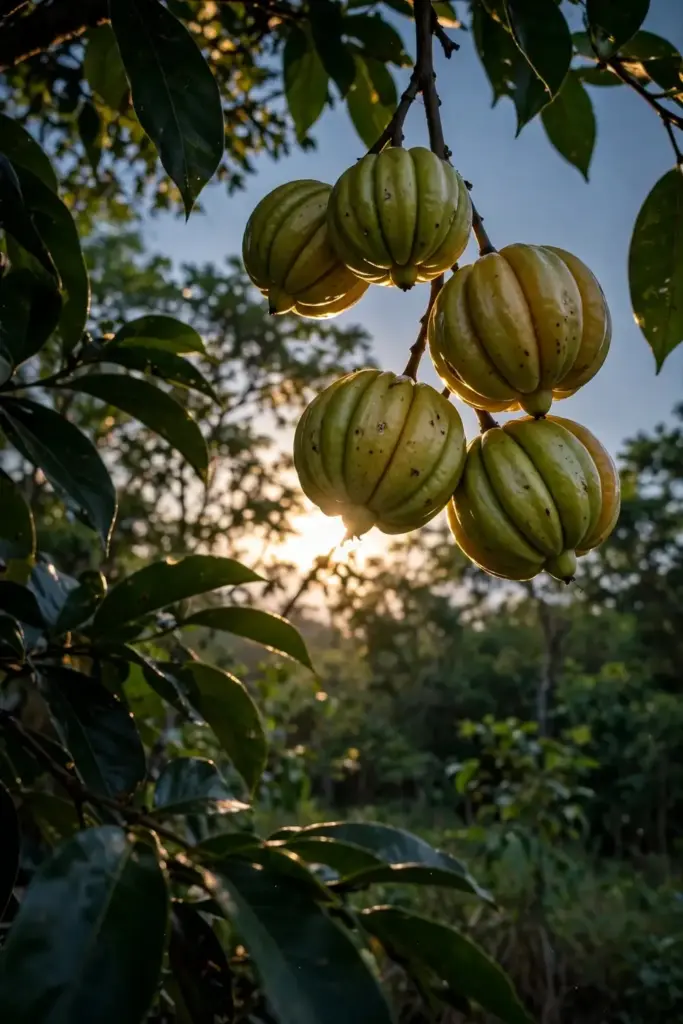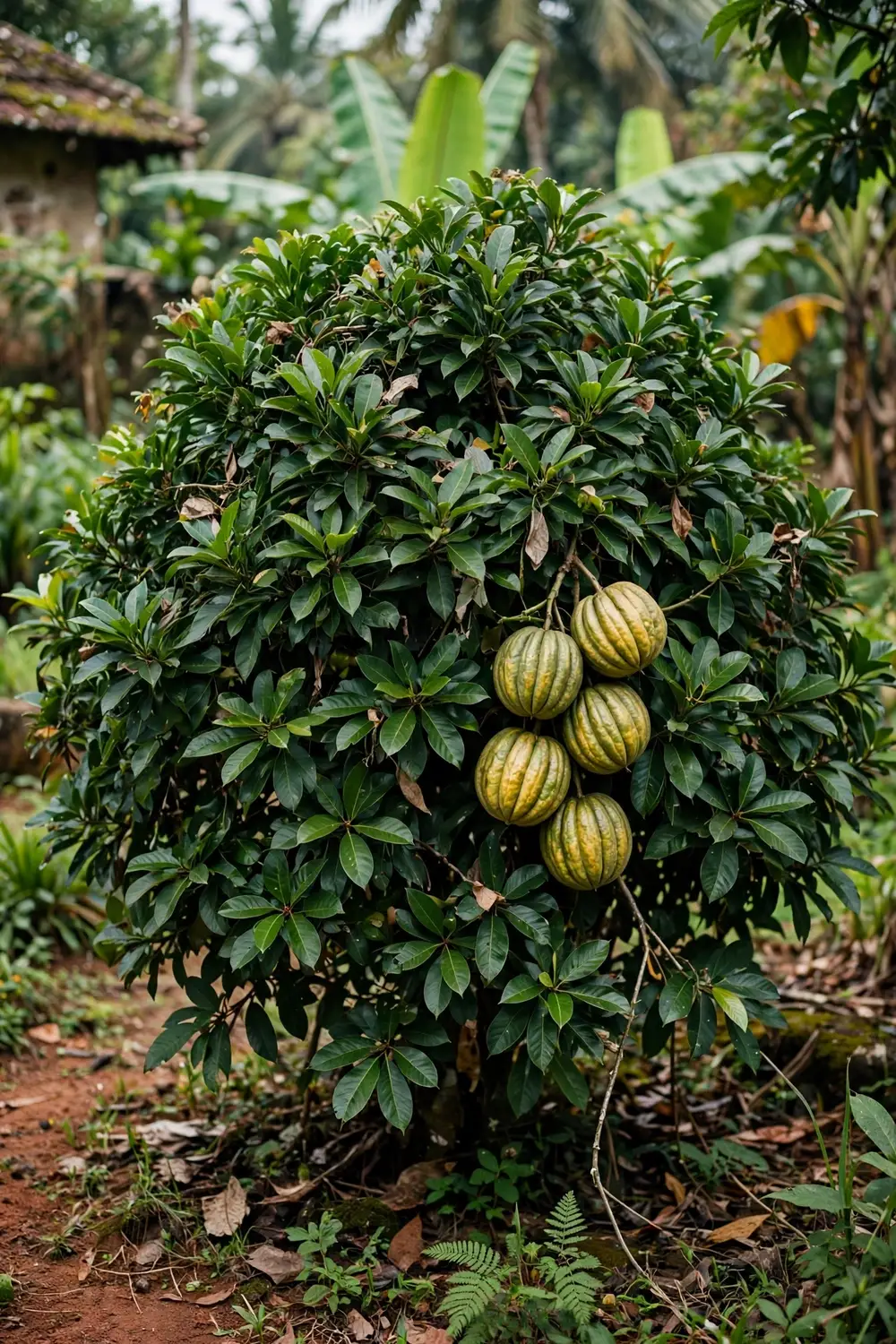

Kudampuli takes 10 to 12 years to fruit from seed, and that single fact should shape every decision you make about this tree. Grafted trees start bearing from the third year, which is why most home growers in Kerala buy grafts, not seeds. The rind of the ripe fruit is the spice you are growing for, and every step below works backward from that one product. I have learned that with this tree, the rind is the product and the fruit is only the delivery vehicle, because the rind is separated for processing immediately after harvest.
This is a slow tropical evergreen tree, native to the forests of southern India, and it refuses to be rushed. It also refuses to be confused with regular tamarind, which happens constantly online, including inside AI summaries that have stated the wrong species outright. The tree is Garcinia gummi-gutta, and keeping that name straight is the most valuable thing a beginner can do. Below is the honest way to grow kudampuli from India, whether you plant in the ground or in a large pot on a terrace.
1. Accept the 10 to 12 Year Seed Timeline First
A seed-grown kudampuli tree starts bearing after 10 to 12 years, while grafted trees start from the third year and reach full bearing at 12 to 15 years, according to the Useful Tropical Plants profile. Seedlings also need a nursery year before they are even planted out, so a seed sown today is a tree for the next decade, not for next summer. There is no fertilizer, pruning trick, or seed treatment that changes this calendar. A nursery trade listing for a Kerala kudampuli graft repeats the same bearing ages, which gives you two independent confirmations before you spend a rupee or a dollar.
This timeline is the real fork in the road for anyone learning how to grow kudampuli from India. If you want the tree as a long-term garden investment and you enjoy raising plants from seed, the seed lane below is for you. If you want fruit within a few years, buy a grafted plant and skip straight to the planting and care sections. Many gardeners do both: raise seedlings for the pleasure of it while a graft does the fruiting work.
The multi-year honesty extends to size. A kudampuli tree grows 5 to 20 metres tall in the ground with a rounded crown, per the botanical profile. In a home garden you will prune it hard to keep it manageable, and in a pot you will keep it at 3 to 5 metres. Plan the space for the tree you will actually keep, not the tree in the photographs.
2. Learn Why Kudampuli Is Not Tamarind, Kokum, or “Amalaki”
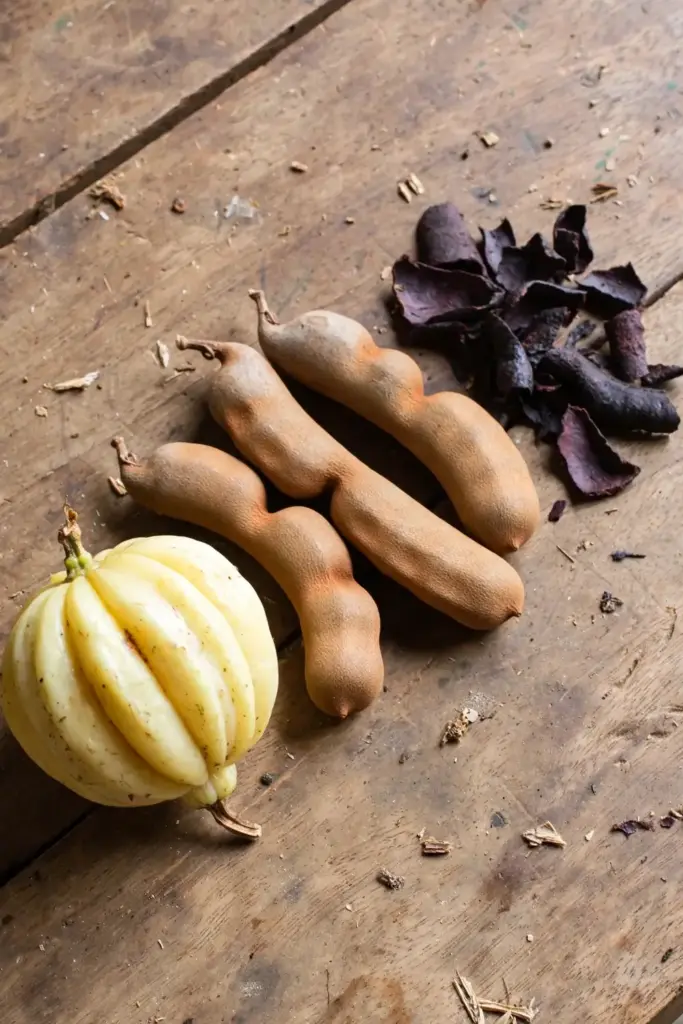
Kudampuli is Garcinia gummi-gutta, also sold under the synonym Garcinia cambogia. It is not regular tamarind (Tamarindus indica), which belongs to a different plant family entirely and produces the familiar pods. Kokum (Garcinia indica) is a different species with a gentler sour used in the Konkan region. The naming confusion is so chronic that one AI search summarizer listed “amalaki” as a kudampuli synonym, and amalaki is amla (Phyllanthus emblica), a completely unrelated tree. This is the single biggest reason a careful grower reads this article instead of trusting a generic search result.
| Plant | Scientific name | Relationship to kudampuli | Used for |
|---|---|---|---|
| Kudampuli / Malabar tamarind | Garcinia gummi-gutta | This article | Smoked black rind, strong souring, Kerala fish curry |
| Regular tamarind / imli | Tamarindus indica | Different family, no relation | Pulp of the pod |
| Kokum | Garcinia indica | Same genus, different species | Sun-dried purple rind, gentler sour, Konkan cooking |
| Amalaki / amla | Phyllanthus emblica | Unrelated tree | Vitamin-C fruit, never a kudampuli synonym |
When you buy seed or a graft, read the Latin name on the tag, not the common name. “Malabar tamarind” is the common name most often confused, because the word tamarind makes buyers expect Tamarindus indica seeds. A Garcinia seed looks nothing like a tamarind seed, and if the seeds you receive are flat brown discs in a pod, you have been sent the wrong plant.
3. Understand That the Rind Is the Spice, Not the Fruit
The commercial product called kudampuli is the dried rind of the ripe fruit, not the fresh fruit. The orange-yellow mature fruits either drop from the tree or are harvested manually, and the rind is separated immediately after harvest, per the botanical profile. The pulp inside is very sour and plays little role in the spice trade; the rind is what gets dried, smoked, and sold. A Kerala cultivation guide confirms the home process: remove the seeds, dry the pod, and the rind turns black, which is the market-ready kudampuli.
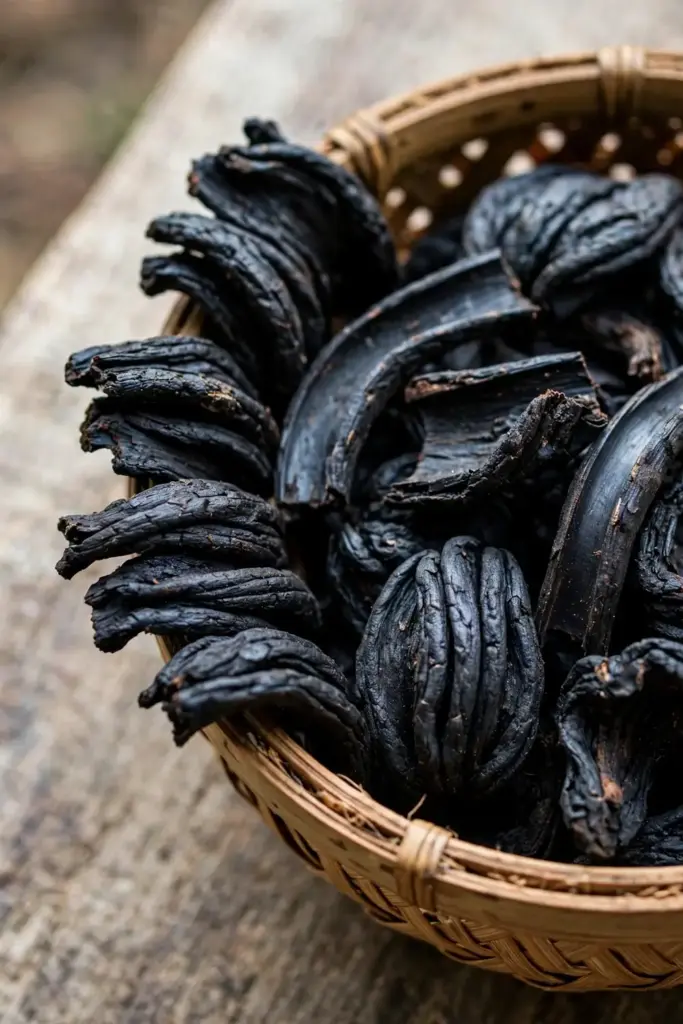
This matters for harvest decisions. You are not waiting for dessert fruit sweetness, because there is none. You are waiting for full ripeness, when the fruit turns from green to yellow and the rind has reached its full thickness and sourness. Picking early gives you thin, weak rind. Letting fully ripe fruit drop is the traditional harvest signal, though hand-picking just before the drop keeps the fruit clean.
4. Choose Seed or Graft With the Honest Math
The choice between seed and graft is the most consequential decision in this whole project, and the numbers make it simple.
| Option | Years to first fruit | Full bearing | Cost and effort |
|---|---|---|---|
| Seed-grown tree | 10 to 12 years | 12 to 15 years | Free seed, slow germination, nursery year first |
| Grafted tree | From the 3rd year | 12 to 15 years | Buy a graft, plant and care for it |
Both figures come from the Useful Tropical Plants profile and are confirmed by the Greens of Kerala graft listing, which uses identical bearing ages. Seed-grown trees also carry the dioecious lottery: kudampuli trees are male or female, the species is not self-fertile, and roughly half of seedlings will be male trees that never fruit. A grafted plant is a known female and sidesteps that gamble entirely. For a deeper comparison of the seed-vs-grafted tradeoff in tropical fruit trees, the logic in our mango guide applies word for word.
If you grow from seed anyway, treat the long timeline as the point. A seedling kudampuli is a handsome evergreen for a large garden, and the wait is honest work, not wasted time. Just do not plant one seedling in a small yard expecting fruit in five years, because the botany disagrees with the plan.
5. Source Fresh Seed, Because Stored Seed Dies Fast
Kudampuli seeds are recalcitrant, which means they lose viability quickly in storage and cannot be kept dry for months like bean or tomato seed. A seed-biology study on Garcinia gummi-gutta found rapid loss of viability during storage, with a substantial decline after three months, and concluded that freshly extracted seeds are the only reliable sowing material, as documented in the seed germination research. The botanical profile agrees: seed is best sown as soon as it is ripe, though viability can be held for 1 to 2 months in moist storage at 20°C, per the Useful Tropical Plants profile.
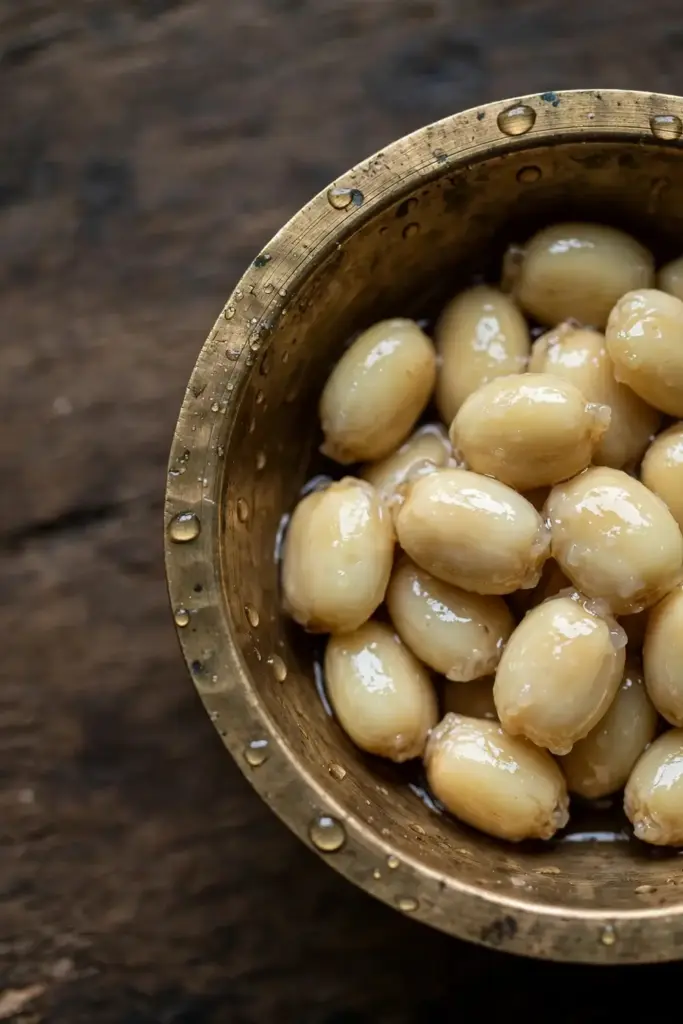
Buy seed only from a seller who states the extraction date, and sow within weeks of receiving it. Seeds extracted from fresh ripe fruit in July, the natural fruiting month, are the gold standard. If the seller cannot say when the seed was extracted, assume it is too old. Vacuum-packed or dried kudampuli seed sold for cooking is not sowing material.
6. Break the Seed Coat Before Sowing
The hard seed coat acts as a mechanical barrier to water uptake, and removing it significantly improves germination. The seed-biology study tested pretreatments and found that removing the seed coat enhanced germination performance compared with intact seed. In practice, home growers have three honest options: nick the coat with a file at the end opposite the embryo, rub it lightly with sandpaper, or remove the coat entirely with a sharp knife.
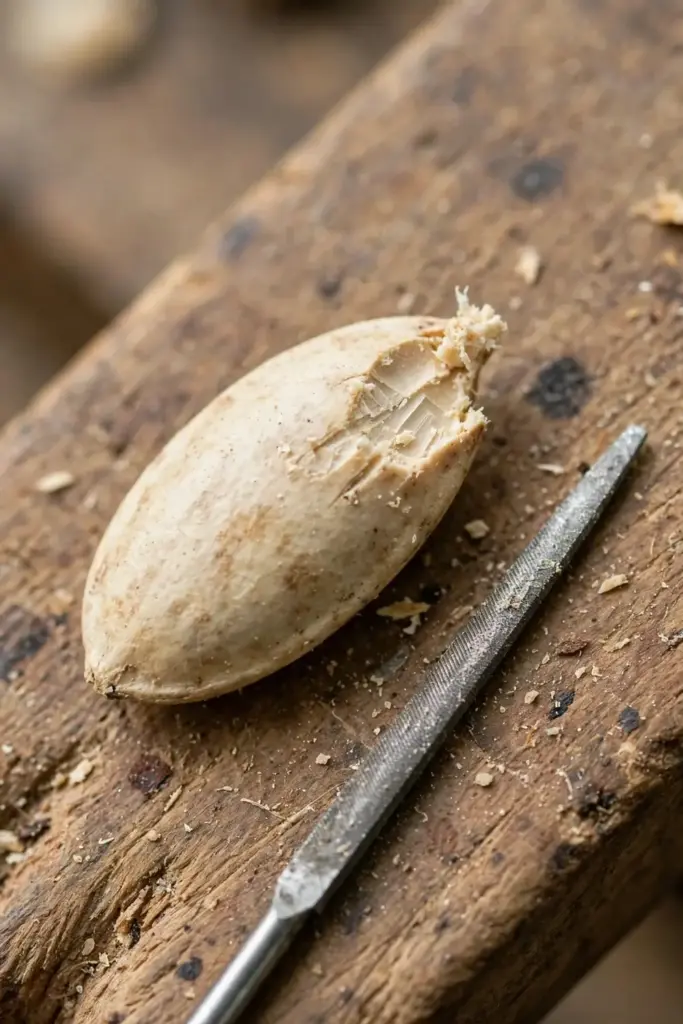
Soak the prepared seed in clean water for 24 hours first. Seeds that float after the soak are usually empty and can be discarded. This simple float test saves tray space for the viable ones. Sow the coat-treated seed immediately after soaking, because a treated seed kept in air starts losing moisture and viability fast.
7. Expect Germination to Take Months, Not Days
Kudampuli germination is slow even when the seed is fresh. The botanical profile warns that seed of this genus can be slow to germinate even when sown fresh, often taking 6 months or more, according to the Useful Tropical Plants profile. Other sources report 2 weeks to 3 months, and one seed listing claims 50 to 80 days. The honest range is wide because freshness, coat treatment, and temperature all change the result. Treat 6 months as normal and anything faster as a bonus.
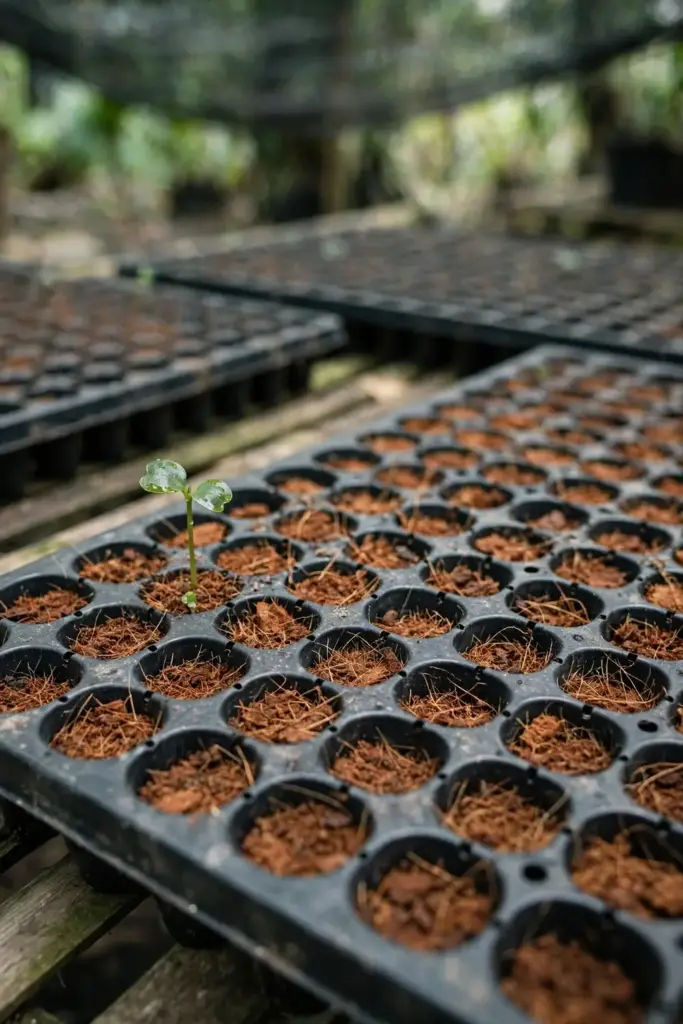
| Step | Action | Time |
|---|---|---|
| 1. Extract or receive seed | Use freshly extracted seed; sow within weeks | Day 0 |
| 2. Soak | 24 hours in clean water; discard floaters | Day 1 |
| 3. Treat the coat | Nick, sand, or remove the seed coat | Day 1 |
| 4. Sow in root trainers | 2 to 3 cm deep in moist, free-draining mix | Day 1 |
| 5. Keep warm and humid | 25 to 30°C, shaded, never waterlogged | Weeks 1 to 24 |
| 6. Wait | Check weekly for the root tip; do not dig the seed up | 2 weeks to 6+ months |
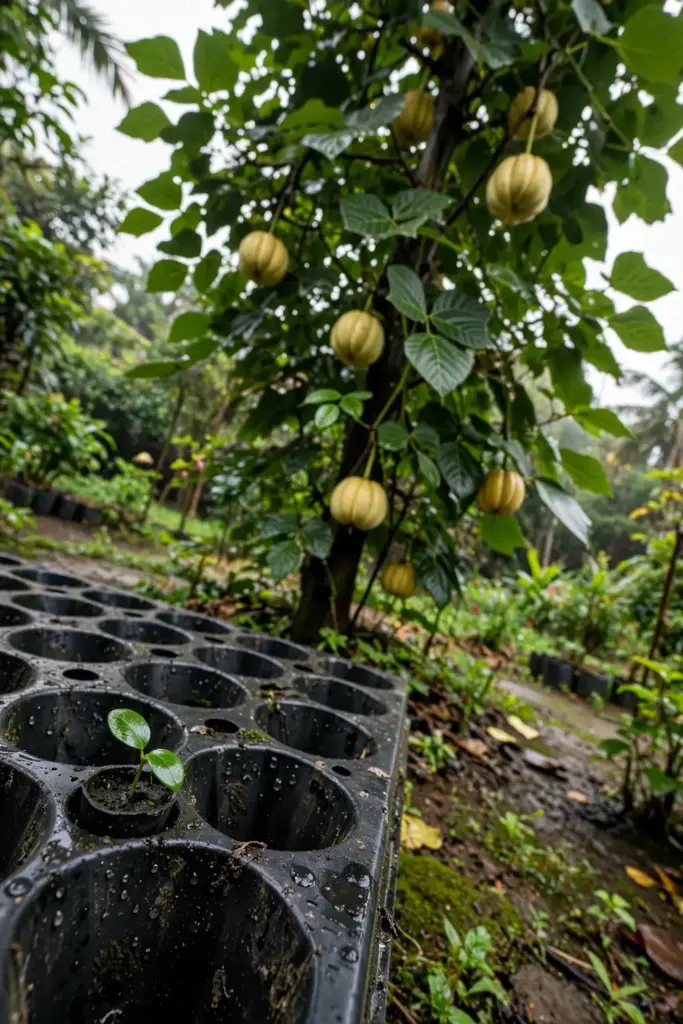
The research found root trainers more suitable than ordinary pots for raising seedlings, because of improved germination dynamics and seedling vigour, per the seed-biology study. Root trainers are tall narrow cells that let the taproot grow straight down instead of circling. For the actual sowing setup, the tray and mix principles in our seed-starting guide transfer directly.
Patience is the method here. Do not dig the seed up to check.
8. Nurse the Seedling for a Full Year
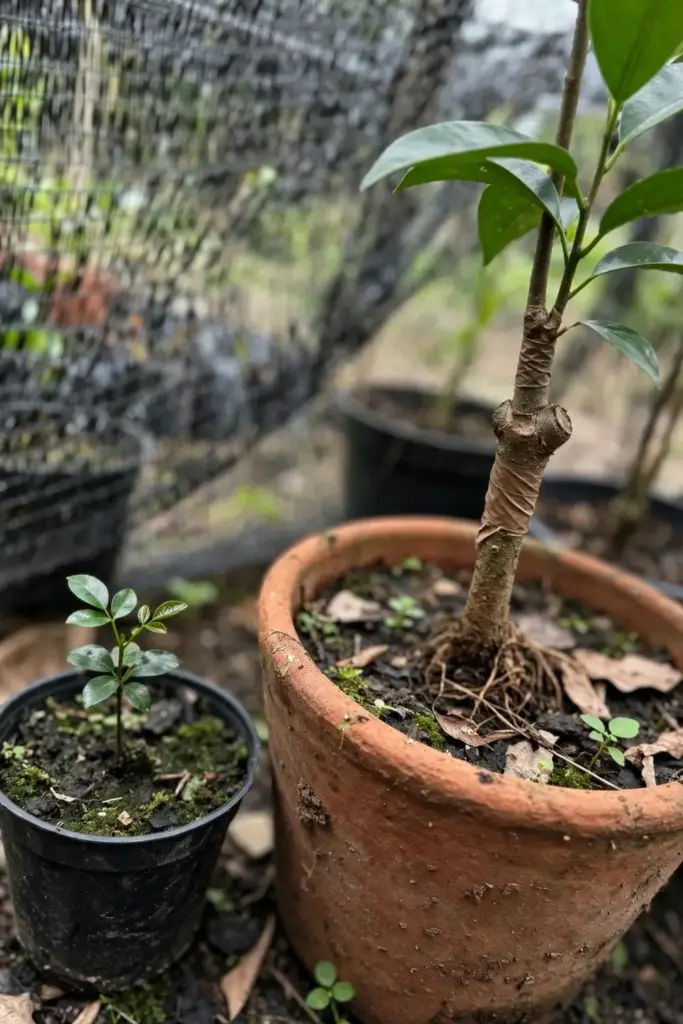
A germinated kudampuli seedling grows slowly and wants the conditions of its native understorey: bright shade, high humidity, and evenly moist soil. Keep young seedlings out of direct afternoon sun for the first year, because scorched leaves set a slow plant back by months. Water when the top of the mix dries, and never let the trainer sit in a saucer of water, because root rot kills more seedlings than drought.
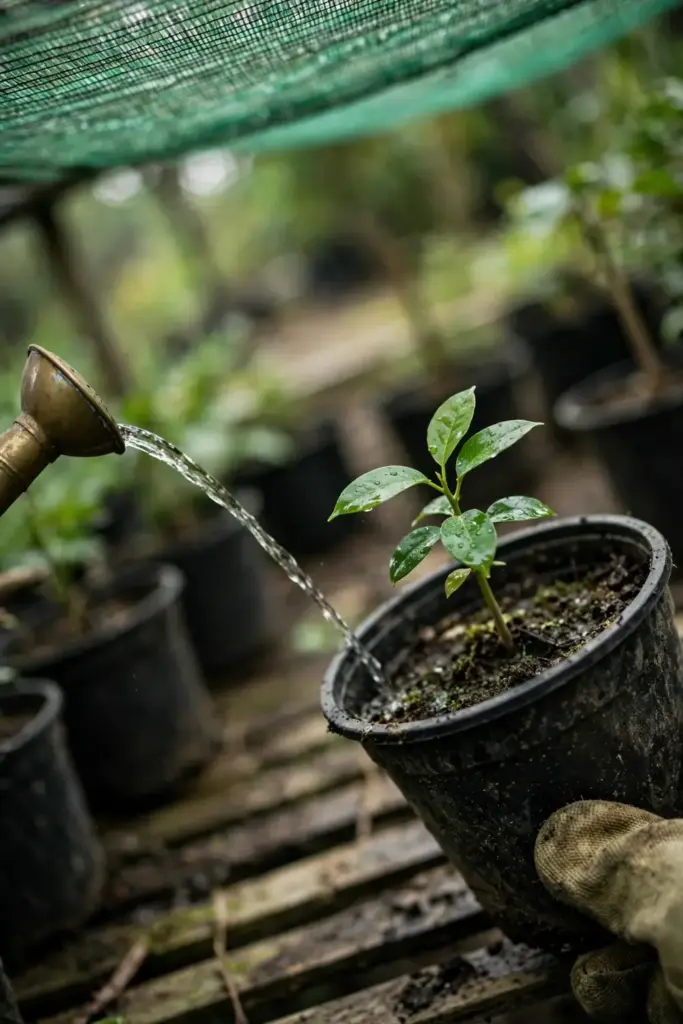
Feed lightly once the seedling has four true leaves. A half-strength balanced liquid feed every 4 to 6 weeks through the growing season is enough. Heavy feeding pushes soft growth that the next dry spell damages. Keep the seedling in its trainer until roots fill the cell, then move it up one pot size at a time rather than jumping straight to a large pot, which keeps the mix from staying soggy around a small root system.
9. Plant in June to July With the Monsoon
The traditional planting window is June to July, with the arrival of the monsoon. A Kerala cultivation guide describes the standard method: prepare pits 20 cm across, fill them with manure or compost, and plant the seedlings, spacing trees 7 m apart, per the Krishi Jagran cultivation guide. Seedlings raised from seed can be transplanted at three months of age. Dig the pit a few weeks before planting so the soil settles, and mix the excavated soil with well-rotted farmyard manure before backfilling.
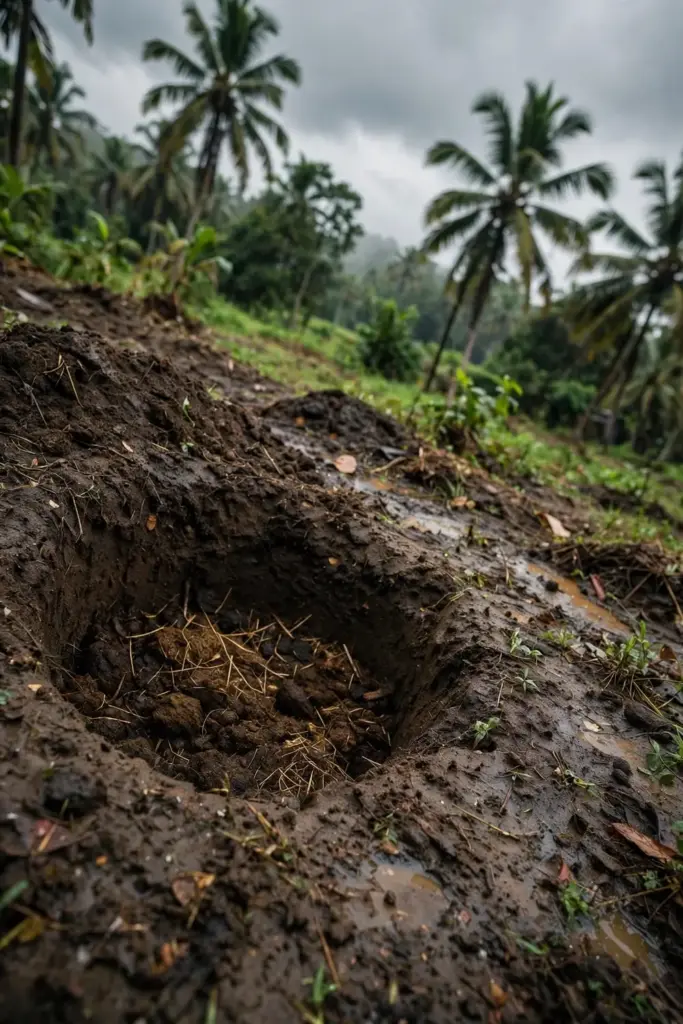
Site selection decides the tree’s future for everyone who commits to how to grow kudampuli from India in the ground. Kudampuli grows best where the mean annual temperature sits between 15 and 30°C and rainfall runs 1,500 to 4,000 mm, according to the botanical profile. It is an understorey tree of semi-evergreen to evergreen forest, happiest along riverbanks and in valleys at 50 to 1,800 metres. Translate that to a garden: shelter from harsh afternoon sun in the first years, deep soil that never waterlogs, and protection from frost, which the tree does not tolerate. If your monsoon timing runs differently, the season logic in our planting calendar shows how to anchor planting to rainfall instead of calendar months.
10. Grow It in a Pot: The 40 to 60 cm Method
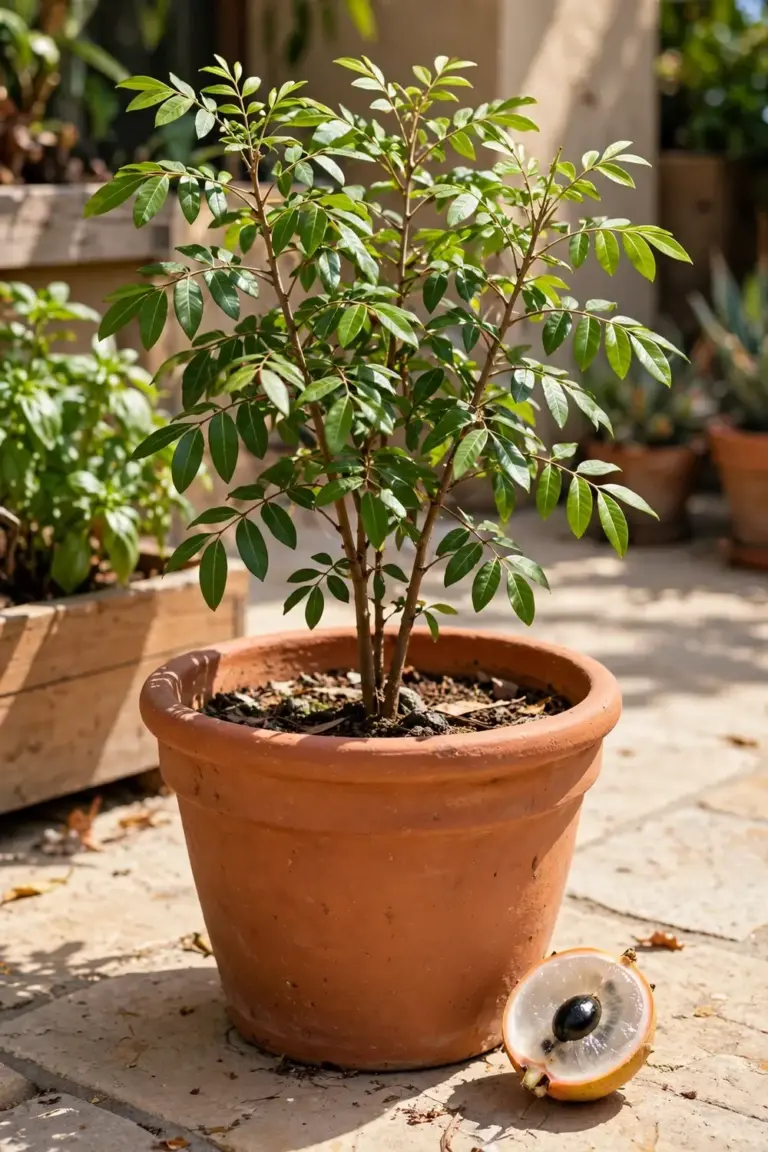
A kudampuli tree can be grown in a large container, but only with honest expectations. Container guides put the pot at 40 to 60 cm, with the tree pruned to 3 to 5 metres and a potting mix enriched with farmyard manure. In a pot the tree fruits later and less than in the ground, and a seed-grown tree in a pot may never fruit at all within a reasonable time. The pot lane makes sense for a grafted plant on a terrace or for a young tree waiting for a permanent home.
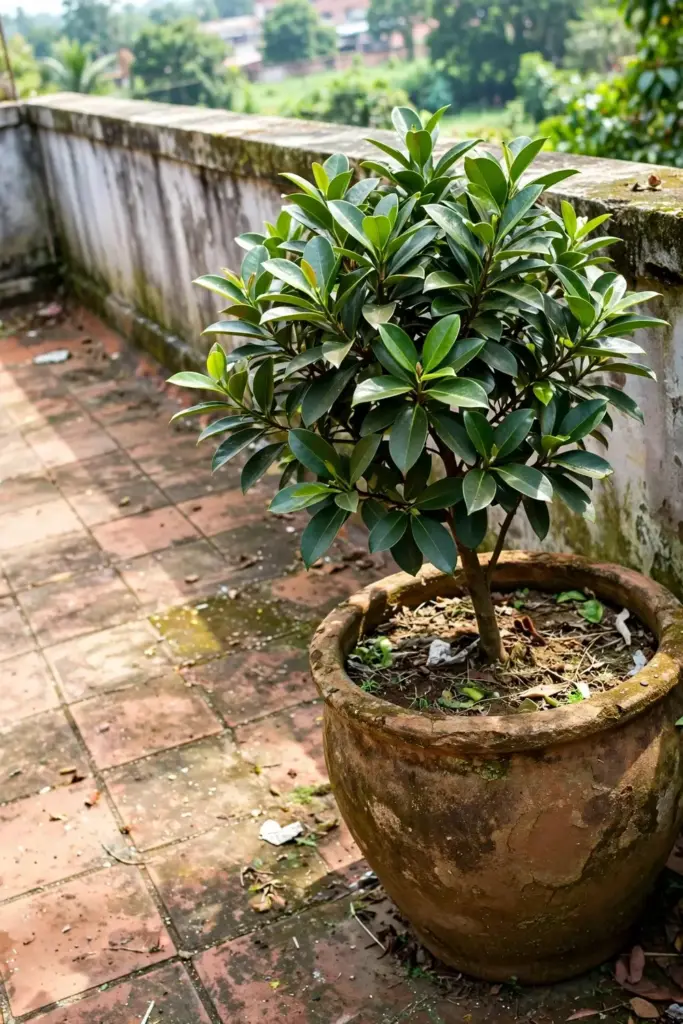
Use the largest pot you can move, starting no smaller than 40 cm wide and deep. The mix should be one part garden soil, one part coarse sand or perlite, and one part well-rotted compost or farmyard manure. Kudampuli is an understorey plant, so give the pot bright shade rather than blazing all-day sun, and water deeply whenever the top 3 cm of mix dries. Repot every 2 to 3 years, root-pruning lightly at each move to keep the tree vigorous in a confined volume.
11. Feed and Water for a Tree That Lives 60 Years
A field kudampuli tree is a long-lived giant: the Kerala cultivation guide credits field trees with a 60-year lifespan and 20-metre height, so the feeding program below is a marathon, not a sprint. The Greens of Kerala nursery guide gives concrete rates: apply 10 kg of cattle manure or compost per seedling or graft in the first year, increasing gradually so a well-grown tree of 15 years and above receives 50 kg of organic manure per year, with NPK at 20:18:50 g per plant in the first year rising to 500:250:1000 g per plant per year by the 15th year, as listed on the nursery cultivation page.
| Year | Organic manure per tree | NPK per tree per year |
|---|---|---|
| 1 | 10 kg | 20:18:50 g |
| 2 | Increase gradually | Double the first-year dose |
| 5 | Increase gradually | Increase proportionally |
| 15+ | 50 kg | 500:250:1000 g |
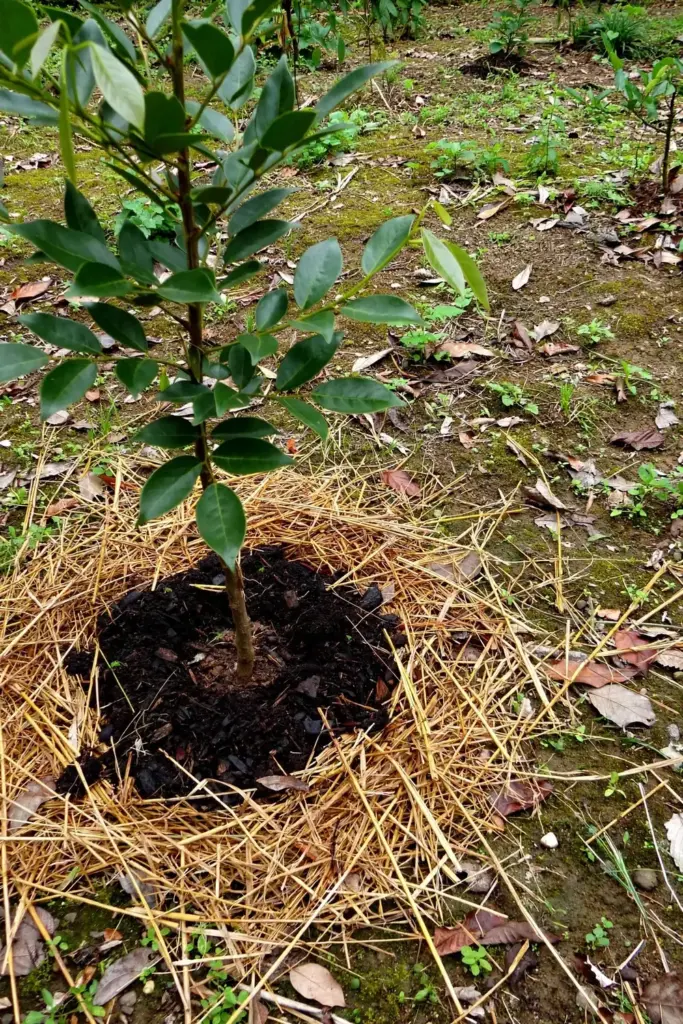
Water young trees through the first two dry seasons. Once established, kudampuli handles dry spells but fruits best with even moisture through flowering and fruit development. Mulch the root zone with 8 to 10 cm of leaf litter or straw, keeping the mulch a hand’s width from the trunk. The soil biology principles behind this program are covered in our soil health guide.
12. Prune for Size and Plan for Male and Female Trees
Kudampuli is dioecious, which means individual trees are male or female, and the species is not self-fertile, per the botanical profile. Only female trees bear fruit, and female flowers appear in clusters of three or four before the monsoon, according to the Kerala cultivation guide. If you raise seedlings, you will not know the sex until flowering, which is years away, so plant several seedlings and keep the females, or top-work a male tree by grafting female scions onto it once it is large enough.
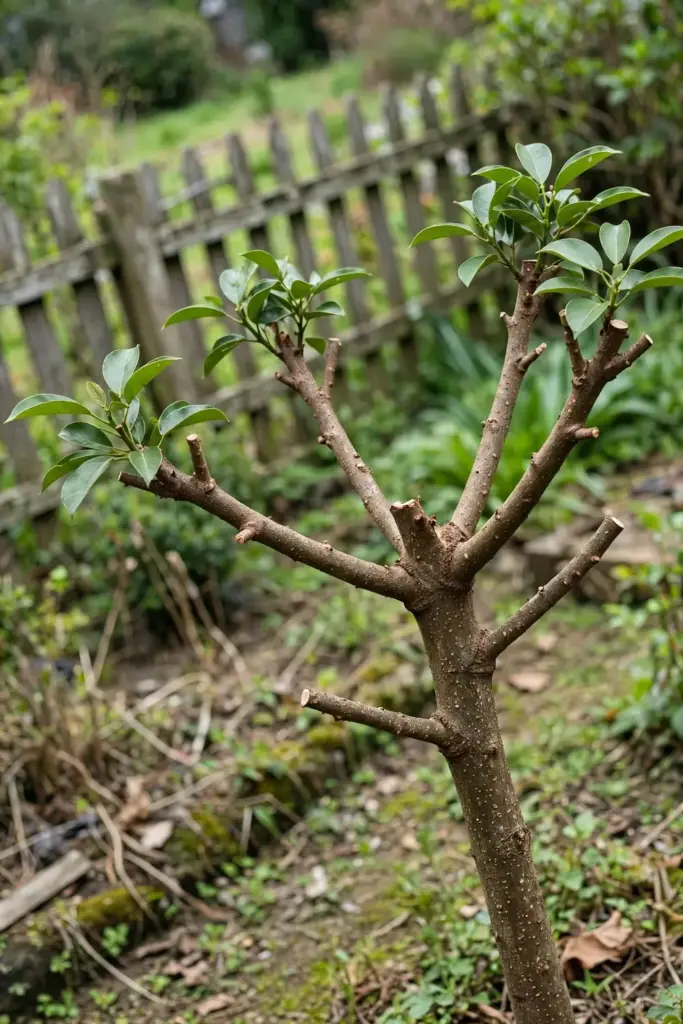
Prune young trees to a single straight trunk with three to four well-spaced scaffold branches, which builds the strong framework a 60-year tree needs. In home gardens, head the tree back each year after harvest to hold it at a pickable height. Remove crossing branches and open the center so air moves through the canopy, because stagnant humid air invites the leaf diseases below. Never remove more than a quarter of the canopy in one year.
13. Protect the Tree From Cold Outside the Tropics
Kudampuli is a hot, wet tropical plant and has no frost tolerance worth relying on. Outside USDA zone 10 and equivalent climates, treat it as a container or greenhouse project. Move potted trees under cover before the first cold nights, and keep them above 10°C through winter. A bright greenhouse, a heated sunroom, or a large conservatory all work.
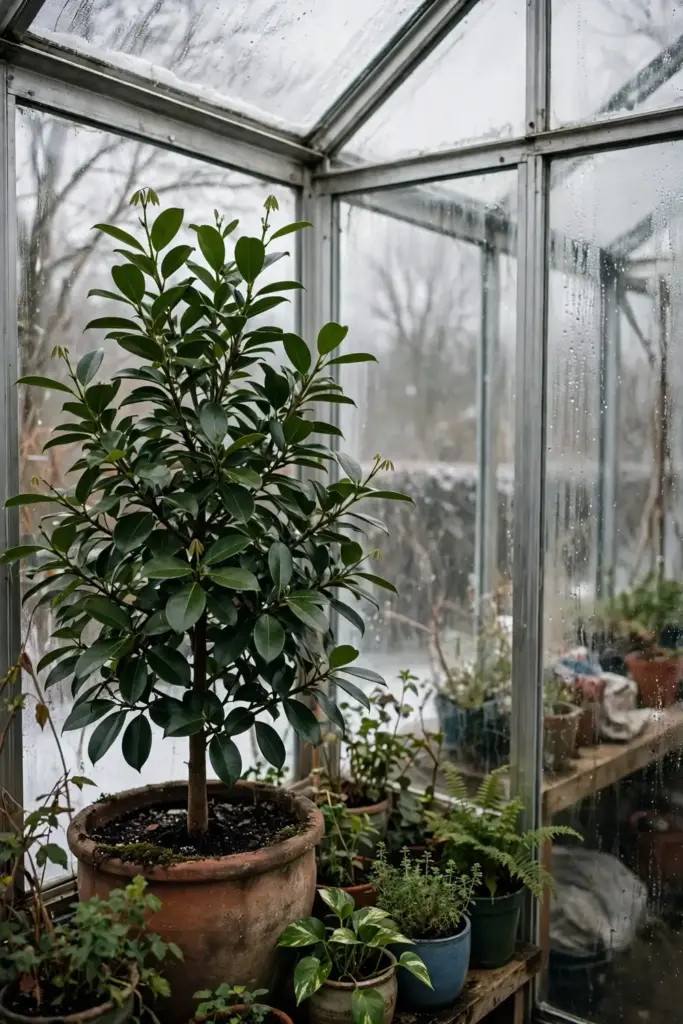
Winter care is mostly about restraint. Cut watering back by half, stop feeding entirely, and keep the air moving to discourage fungal leaf spots. Leaf drop in a cold winter is stress, not dormancy, so do not prune the bare branches until new growth shows what is actually dead in spring. If your winters are long and dark, a modest grow light on a 10-hour timer keeps the canopy alive without forcing weak growth.
14. Watch for Pests and Diseases in the First Years
Young kudampuli trees are relatively resistant once established, but the nursery and early field years have the usual tropical vulnerabilities. Aphids and scale insects cluster on new flush growth, and fungal leaf spots appear in prolonged wet weather. The Kerala cultivation guide recommends neem-based insecticides for the fungal and pest problems seen in the early stages, per the Krishi Jagran guide.
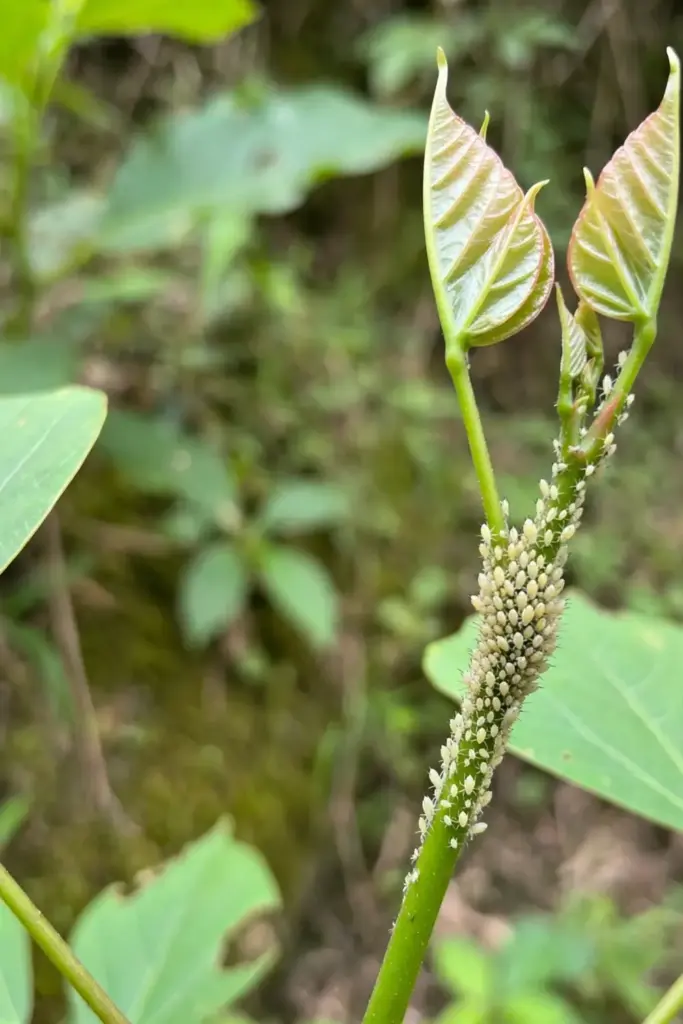
The disease triangle explains most young-tree failures: a susceptible seedling, a pathogen, and long leaf wetness. You cannot change the weather, so manage the other two corners. Space trees for airflow, prune for an open canopy, water at the base rather than overhead, and clear fallen fruit and leaves where fungi overwinter. Avoid spraying broad-spectrum insecticides that kill the bees and small weevils that pollinate the flowers, since the botanical profile lists wind, bees, and weevils as the pollinators. A tree that flowers but sets no fruit may be a male tree, not a pest problem, so check the flower clusters before reaching for the sprayer.
15. Harvest at Full Yellow When the Fruit Ripens
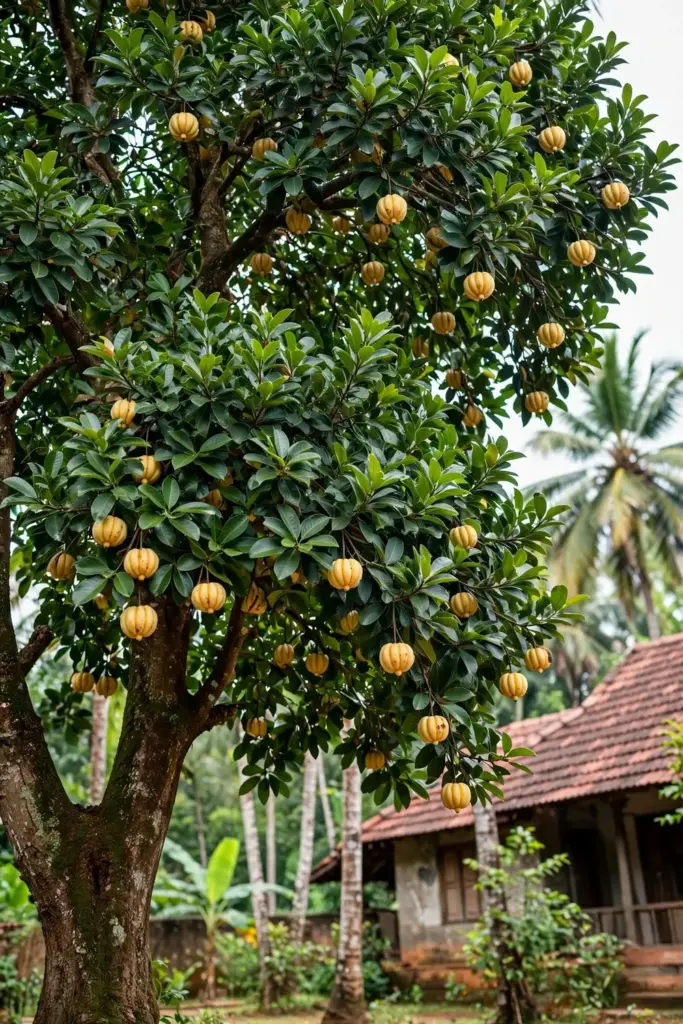
Flowering happens in January to March and the fruits mature in July, according to the Greens of Kerala cultivation notes. Mature fruits are orange-yellow and either drop from the tree or are harvested manually just before the drop. The Kerala guide describes the same color arc: fruits are green at the beginning and turn yellow when mature, with six seeds inside each pod, per the Krishi Jagran guide.
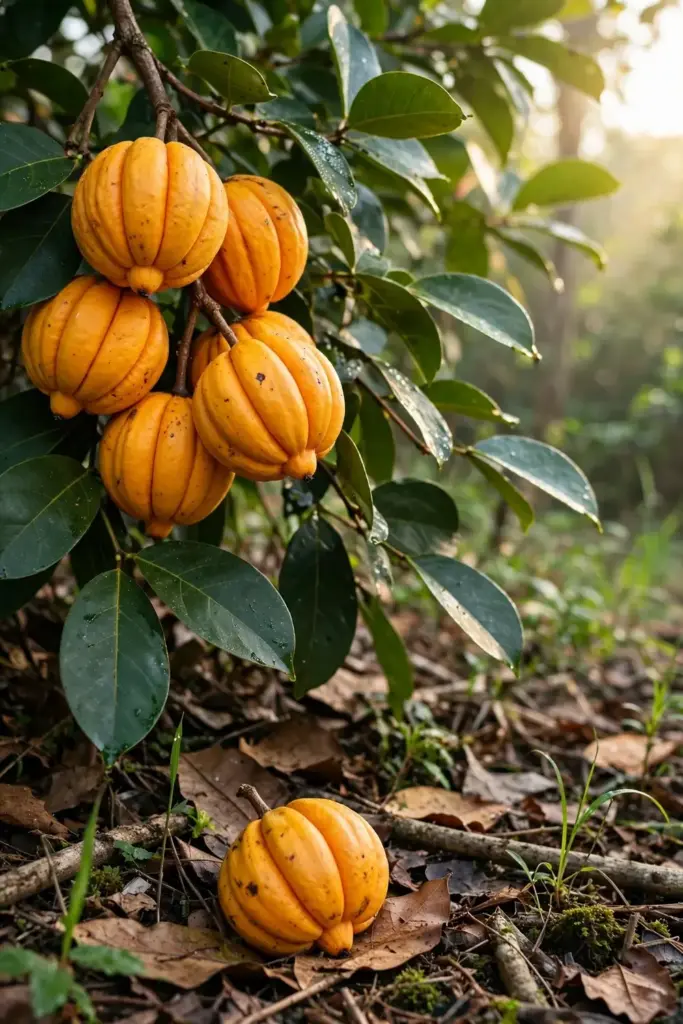
Harvest in the cool of the morning and handle the fruit gently, because bruised rind dries unevenly. Collect fallen fruit the same day it drops, since fruit left on wet ground picks up soil fungi that spoil the rind. A mature tree in full bearing drops fruit over several weeks, so plan on repeated picking passes rather than a single harvest day.
16. Separate the Rind and Smoke It Black
Processing starts immediately after harvest. Wash the fruits in running water, cut them open, and separate the rind from the pulp and seeds right away, because the botanical profile specifies rind separation immediately after harvest. The Kerala method then removes the seeds and dries the pod, and the drying rind turns black, which is the familiar market kudampuli, per the Krishi Jagran guide.
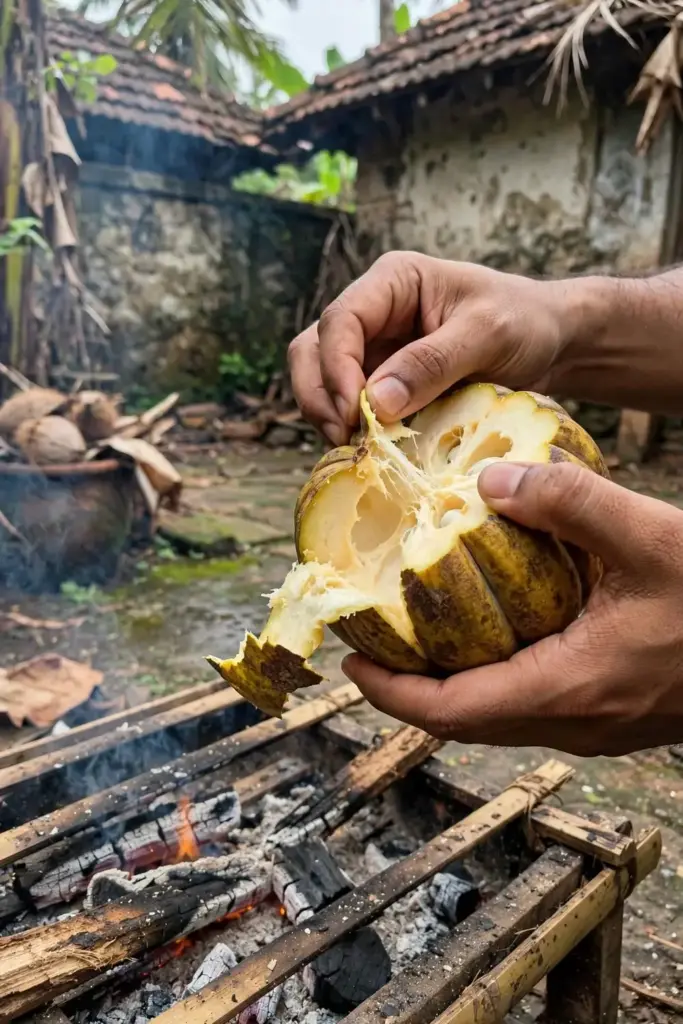
Traditional Kerala processing smokes the rind over a low fire for several days, which deepens the black color and adds the characteristic smoky note that distinguishes kudampuli from kokum. Dry the rind until it is hard and brittle with no soft spots, because any remaining moisture invites mold in storage. Store the finished rind in airtight jars in a cool dark place, where it keeps for a year or more and its sourness stays strong.
17. Use Kudampuli Where Kerala Uses It: Fish Curry
Kudampuli is the souring agent of Kerala fish curry, and that single dish explains why the spice exists. A small piece of the dried rind goes into the curry pot early so its sourness has time to bloom into the gravy. The flavor is a strong, clean sour with a smoky edge, sharper than kokum and deeper than regular tamarind. Use it anywhere you want sourness without sweetness: fish and seafood curries, lentil dishes, and vegetable stews.
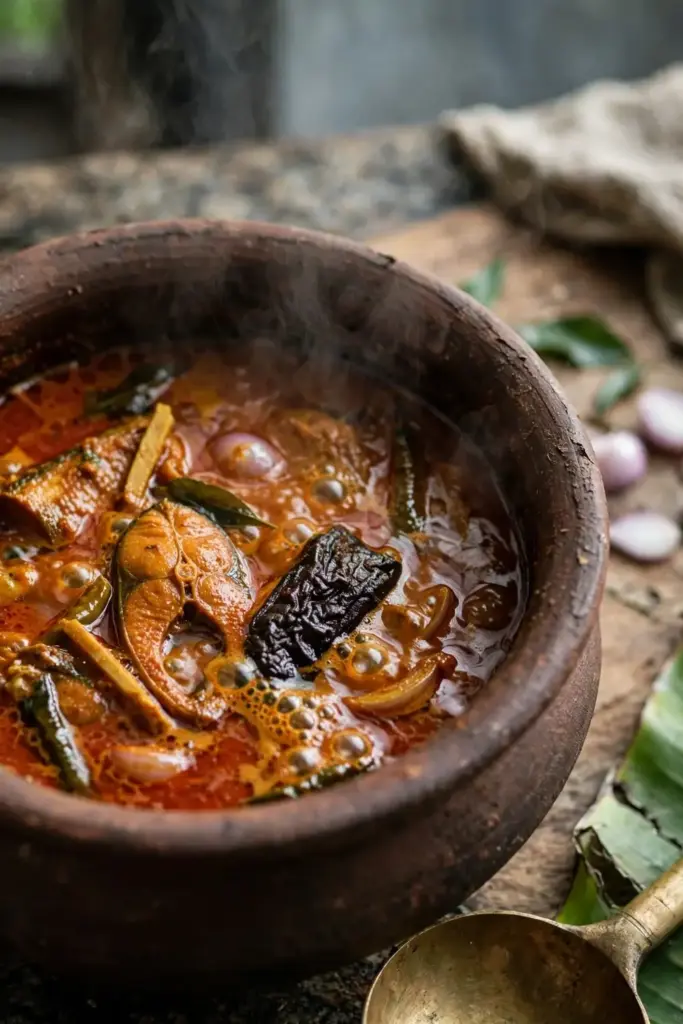
Start with a small piece, about the size of a coin, per pot, because the sourness is concentrated and you can always add more. Rinse the rind before use to remove surface dust from smoking and storage. Keep kudampuli out of the weight-loss supplement conversation when you cook with it; the kitchen use is culinary tradition, not a health program, and no home harvest should be presented as medicine.
18. Avoid the Mistakes That Cost Growers Years
Buying old seed is the most expensive mistake, because three dead months of waiting for germination that never comes cannot be refunded. Sow fresh seed within weeks of extraction and treat the coat, or skip seed entirely and buy a graft.
Planting a single seedling and hoping it is female wastes a decade. Either buy a known graft or plant several seedlings so the odds favor at least one female tree.
Letting the nursery seedling bake in full sun slows everything. Kudampuli evolved as an understorey tree, and its first year wants bright shade and humidity, not a scorching terrace.
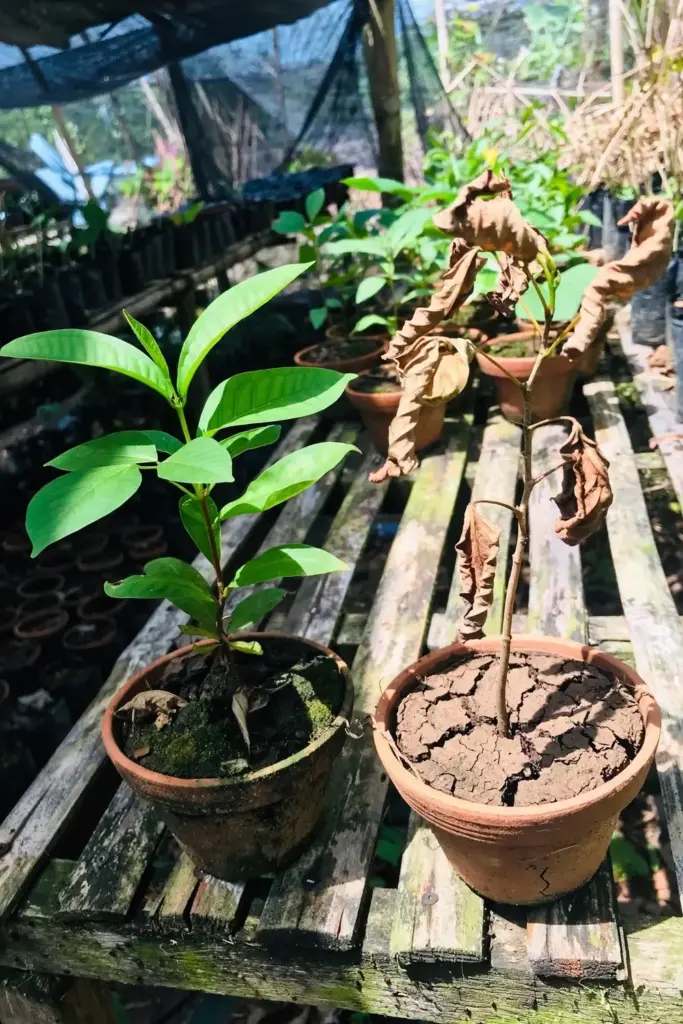
Overwatering the pot kills faster than underwatering. The mix should dry at the surface between waterings, and the pot must drain freely every single time.
Harvesting underripe green fruit gives thin weak rind. Wait for the yellow turn and the natural drop, which is the tree telling you the rind is ready.
19. Troubleshoot a Kudampuli That Stalls
Seed not germinating after two months is normal, not failure. Keep the medium warm and evenly moist and wait the full six months before declaring the batch dead, provided the seed was fresh and the coat was treated.
A seedling that stops growing usually needs less water, not more. Check that the trainer or pot drains, ease off the watering, and make sure the plant is not sitting in cold air.
A tree that flowers but never sets fruit may be male, may lack pollinators, or may be too young. Watch the flower clusters: female flowers sit in groups of three or four. If every tree in the neighborhood flowers male, your seedling batch drew the short straw and top-working is the fix.
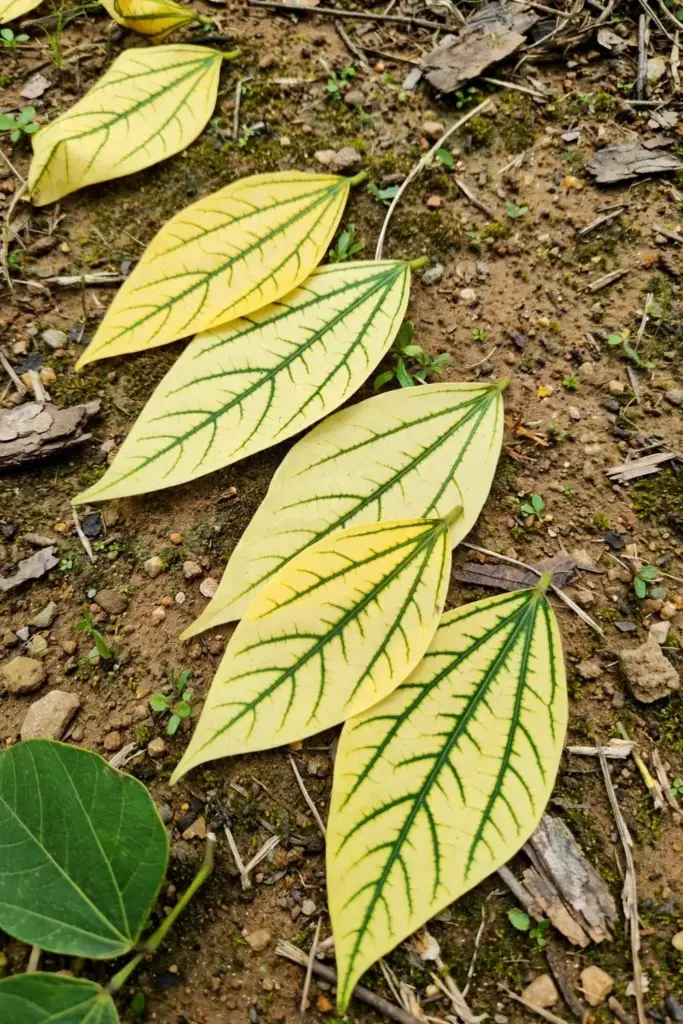
Yellow leaves with green veins point to iron chlorosis in alkaline soil. Kudampuli prefers slightly acidic soil, so test the pH and amend with organic matter and, if needed, a chelated iron drench, not a random extra dose of nitrogen.
Fruit dropping while still green is usually water stress during fruit development. Deep mulch and even watering through the dry weeks before the July harvest steadies the tree.
Frequently Asked Questions
A seed-grown kudampuli tree starts bearing after 10 to 12 years, while a grafted tree starts from the third year and reaches full bearing at 12 to 15 years. Add a nursery year before a seedling even goes into the ground. If you want fruit within a few years, buy a grafted female plant rather than sowing seed.
Yes, in a 40 to 60 cm pot with a rich free-draining mix, pruning the tree to 3 to 5 metres. Treat it as a container project with honest limits: a potted tree fruits later and less than a ground-planted one, and a seed-grown tree in a pot may never fruit. A grafted plant is the sensible choice for containers.
No. Kudampuli is Garcinia gummi-gutta. Regular tamarind is Tamarindus indica, a different plant family. Kokum is Garcinia indica, the same genus but a different species with gentler sourness. The products differ too: kudampuli rind is smoked black and strongly sour, while kokum rind is sun-dried purple.
Sow fresh seed within weeks of extraction, soak it 24 hours, nick or remove the hard seed coat, and sow 2 to 3 cm deep in root trainers kept at 25 to 30°C in shade. Expect germination anywhere from 2 weeks to 6 months. Old or dried-out seed is the usual reason for total failure.
Kudampuli is dioecious and not self-fertile, so only female trees bear fruit. Seedlings are a coin toss, roughly half male. For a home garden, the practical answers are a grafted female plant or several seedlings so the odds favor a female, with top-working as the fix for a male tree.
The dried smoked rind is the spice. A coin-sized piece goes into Kerala fish curry early in cooking so its strong clean sourness blooms into the gravy. It suits fish, seafood, lentils, and vegetable stews anywhere you want sourness without sweetness. Rinse the rind before use.
Growing Kudampuli Is a Decade-Long Bet Worth Taking
Kudampuli rewards the grower who plans in decades, not seasons. Get the species right, sow fresh seed or buy a graft, give the tree the hot wet climate it evolved for, and harvest the rind at full yellow. That is how to grow kudampuli from India the honest way: the black smoked rind in your curry pot will taste like patience, and ten years from now you will be glad the tree is there.