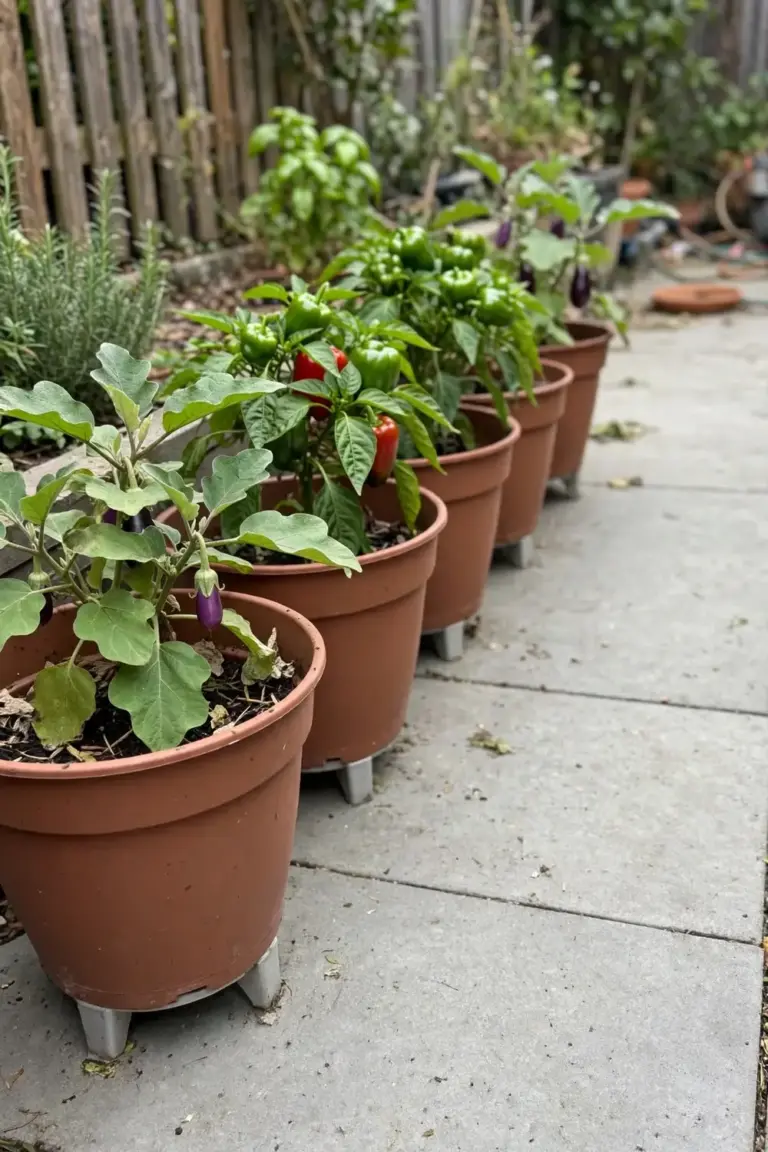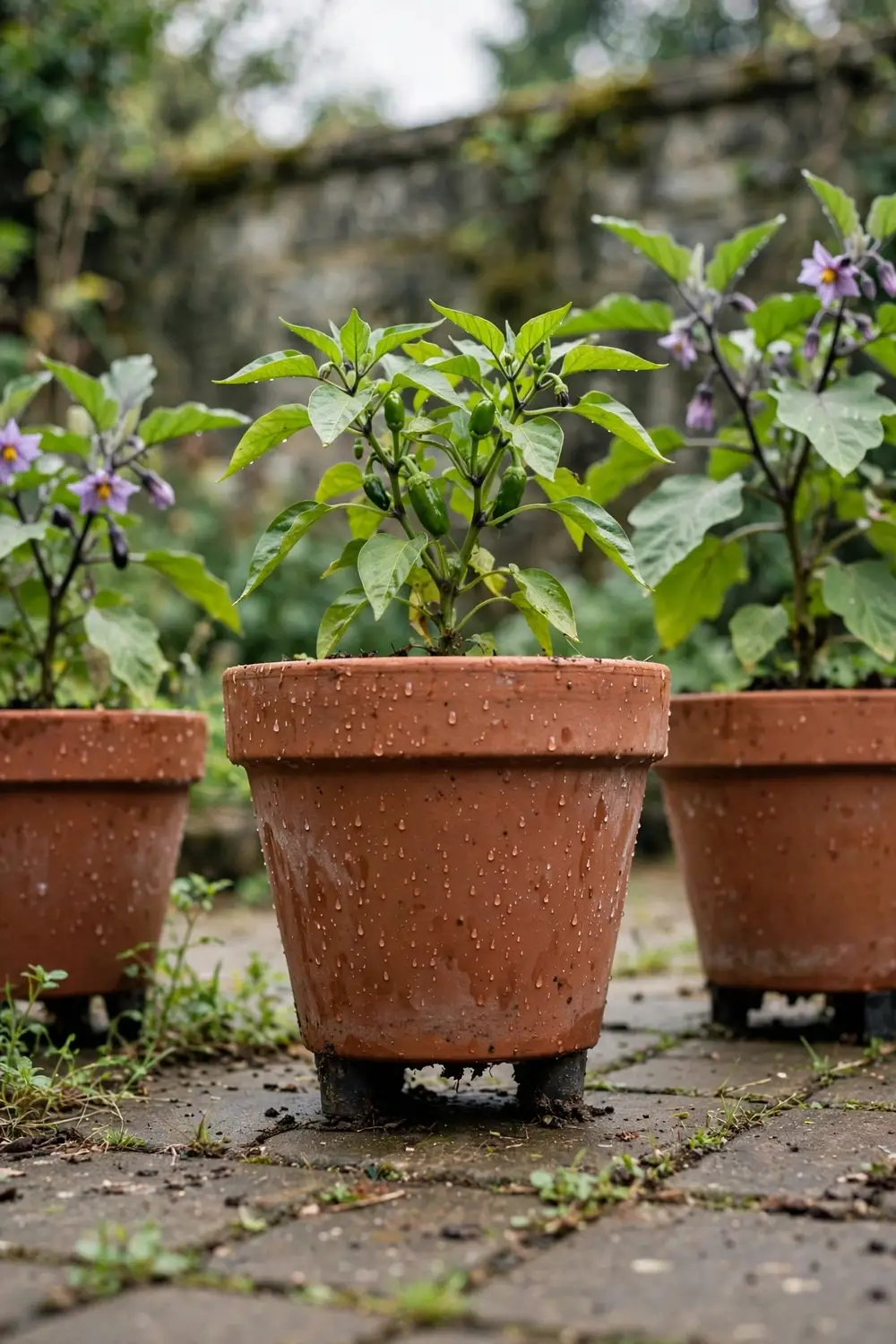

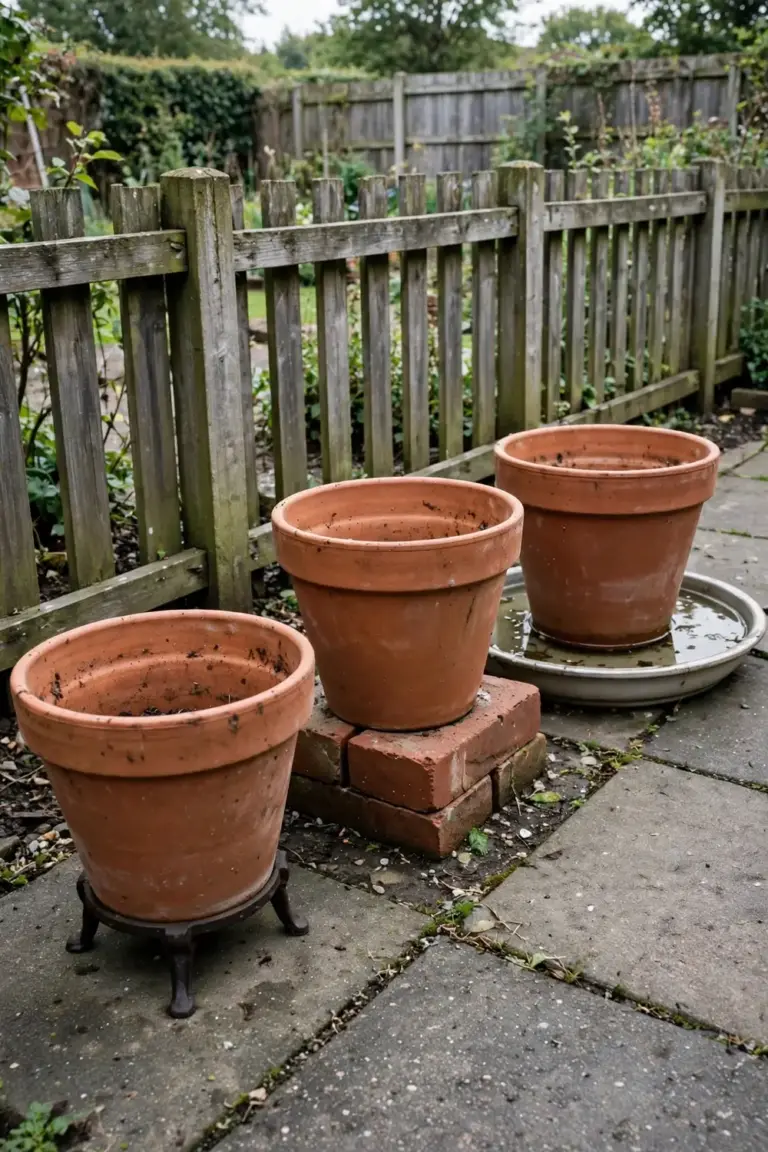
Put three small feet under each pot, lift it 3 to 5 cm off the ground, and you solve four problems at once: blocked drainage, still air, stained paving, and cold seeping up from the ground. That is what pot feet do for capsicum and eggplant pots. The rest of this page tells the story of a drowning pot, then walks through the four jobs one by one, so you can decide if your pots need the lift.
Pot feet are small supports, also called pot risers, that sit under the base of a container and hold it a few centimetres off the ground. Capsicum means the sweet and hot peppers grown as warm-season vegetables. Eggplant means Solanum melongena, the purple fruit vegetable. This article is a story about a decision, not a growing guide. For planting and care instructions, the site’s soil health guide covers the ground your pots sit on.
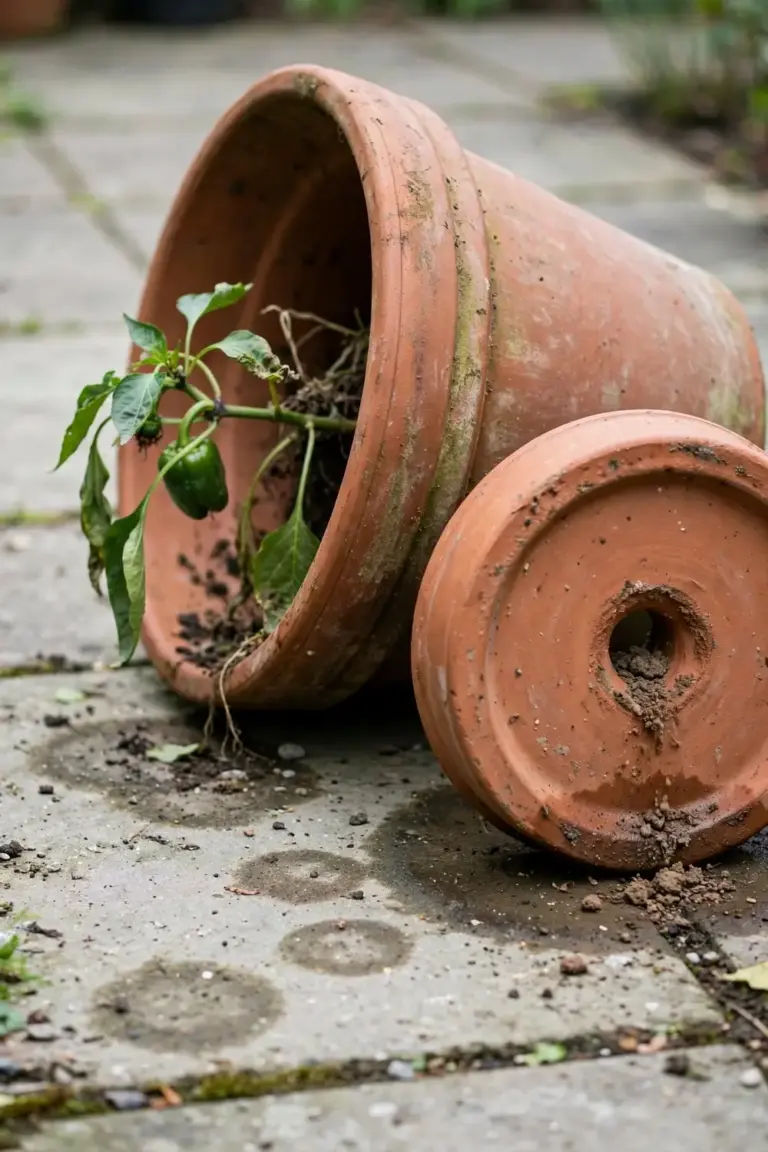
A capsicum in a pot on a Sydney patio looked fine in November. By January the lower leaves yellowed, growth stalled, and the fruit stayed small. The grower watered carefully, fed on schedule, and saw no pests. The pot had a drainage hole. The problem was underneath: the pot sat flat on the pavers, the drainage hole pressed against the stone, and every watering left the bottom centimetres of mix sitting in water. The roots drowned slowly. Three terracotta feet, set in a triangle under the pot, would have prevented the whole decline. That is the story this article keeps returning to, because it is the most common way container capsicum and eggplant fail.
The yellowing started at the bottom and climbed. That pattern matters. Nutrient deficiency usually shows in new growth first or in a specific pattern, but drowning shows in the oldest leaves first because the lowest roots die first. The grower added fertilizer, which is the natural response to yellow leaves. The fertilizer did nothing because the roots could not take it up. Drowned roots do not absorb nutrients. By the time the grower tipped the pot and saw the sodden black mix at the bottom, the plant had lost half its root system. It never recovered that season.
1. Watch What Happens Under a Flat-Sitting Pot
Set a pot flat on paving and the drainage hole stops working. Water cannot fall freely through a hole that is pressed against stone. It backs up into the mix, and the bottom of the pot stays wet for days after each watering.
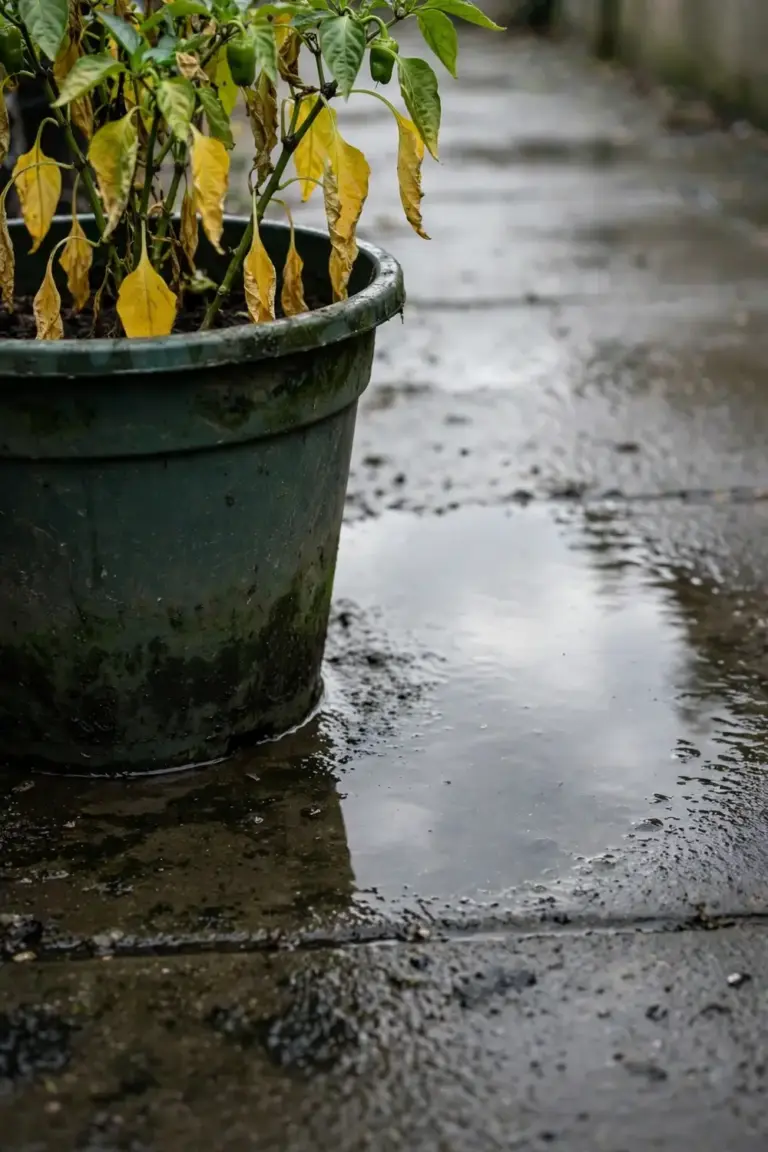
Roots need air as much as water. When the bottom of the mix stays saturated, air cannot reach the lowest roots. Those roots rot first, then the rot climbs. The plant shows yellow lower leaves and stalled growth, which looks like a feeding problem. Feeding a drowning plant does not help it.
The physics is simple. Water moves down through potting mix by gravity, but it only exits the pot if air can replace it from below. A hole pressed flat against paving creates a seal. Surface tension holds a film of water across the opening, and the water column above cannot push through it. Lift the pot even 2 cm and the seal breaks. Air enters from below, water falls out, and the mix drains the way the bag said it would.
The fix is embarrassingly small. Lift the pot a few centimetres and gravity does the rest. Water falls out of the drainage hole, air moves in underneath, and the bottom of the mix dries between waterings. University of Maryland Extension puts it plainly: use pot feet to raise containers to allow for better drainage.
2. Free the Drainage Holes First
Every pot needs a working drainage hole. That sounds obvious, but a hole blocked by paving is the same as no hole at all. Pot feet keep the hole clear by holding the base off the surface.
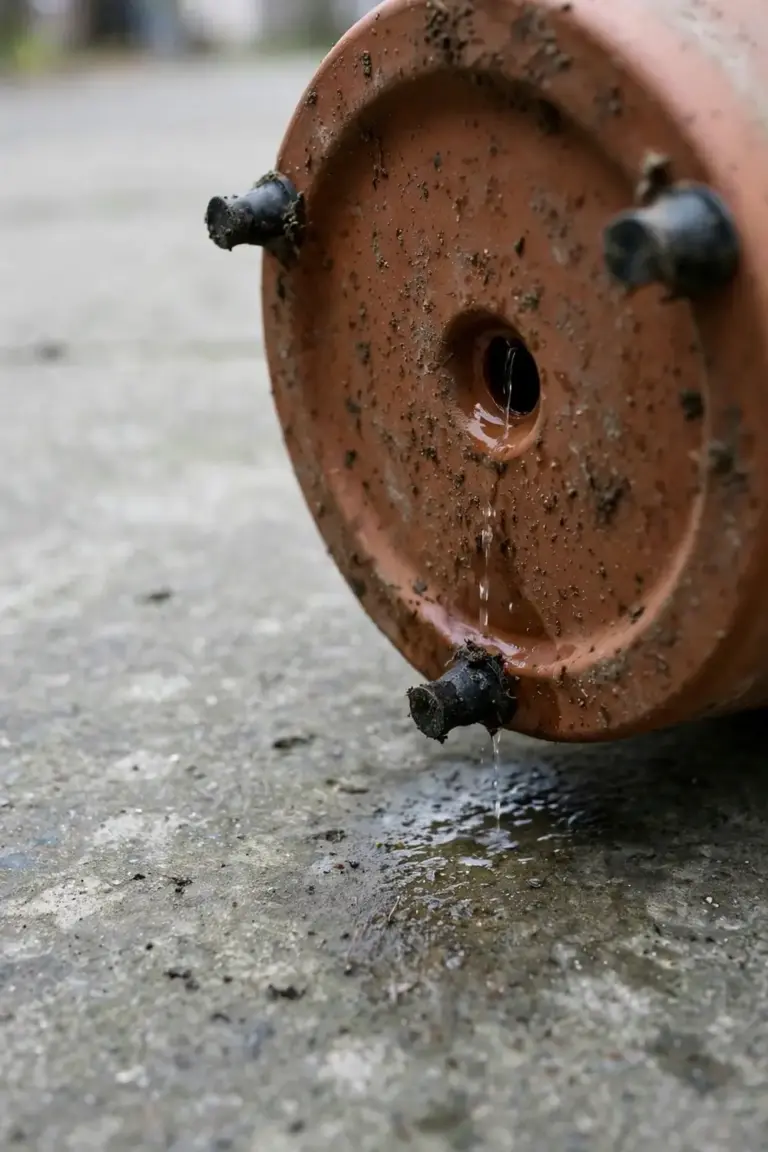
Check your pots now. Tip one and look at the base. If the drainage hole sits flush against the ground, water has nowhere to go. Look for the tell-tale signs: a dark damp ring on the paving exactly the size of the pot base, algae growing on the underside of the pot, or a sour smell when you tip it. All three mean the base never dries.
Three feet, one under each third of the rim, lift the base enough for water to fall clear. The New York Botanical Garden recommends exactly this: to increase drainage and air circulation, standing containers on bricks or some kind of feet is always a good idea.
Do not trust a saucer to solve it. A saucer catches runoff, which protects paving, but water sitting in the saucer wicks back up into the mix. Maryland Extension warns to empty saucers under the container after watering or after a rainfall event. Pot feet plus an emptied saucer beats a saucer alone every time. The saucer is a floor protector. The feet are the drainage. Give each job its own tool.
3. Let Air Move Under the Pot
Drainage is only half the story. The gap under a raised pot lets air circulate beneath the container, and that airflow dries the base of the pot between waterings. A pot sitting flat stays damp underneath for days.
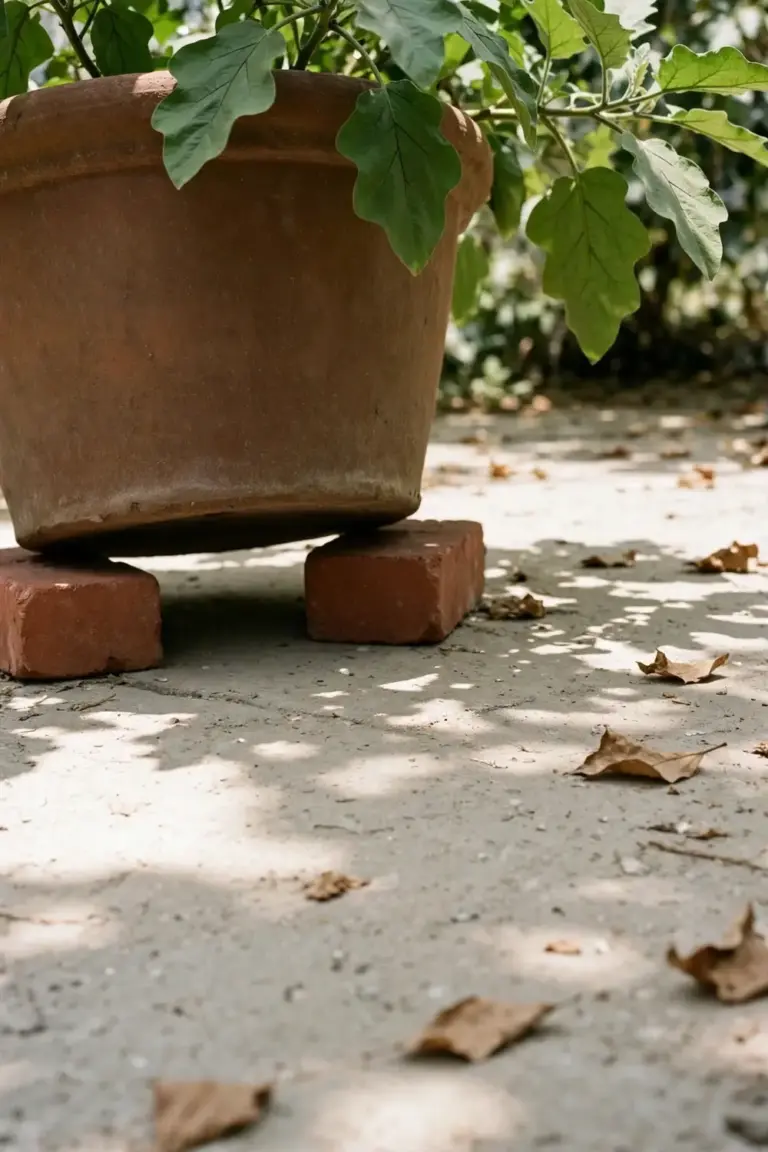
Airflow matters because roots breathe. The lowest roots sit closest to the drainage hole, which is exactly where water collects. When air moves under the pot, the base of the mix dries from below as well as from above. The root zone gets the wet-dry cycle that container vegetables need. Without that cycle, the mix stays in the wet phase permanently, and roots suffocate slowly.
This is why pot feet beat a saucer for outdoor pots. A saucer holds water against the base. Feet hold air against the base. For capsicum and eggplant, which hate wet feet, the difference shows up as darker green leaves and steadier growth within a few weeks of lifting the pot. The change is not subtle once you know what to look for: the plant stops dropping its lower leaves, new growth comes through a deeper green, and fruit that stalled starts sizing up again.
4. Save Your Paving From Stains and Rot
Water draining from pots carries dissolved minerals and fine soil. Left to pool under a flat-sitting pot, it stains concrete, marks pavers, and rots timber decking. The stain appears as a dark ring exactly the size of the pot base, and it does not wash off easily.
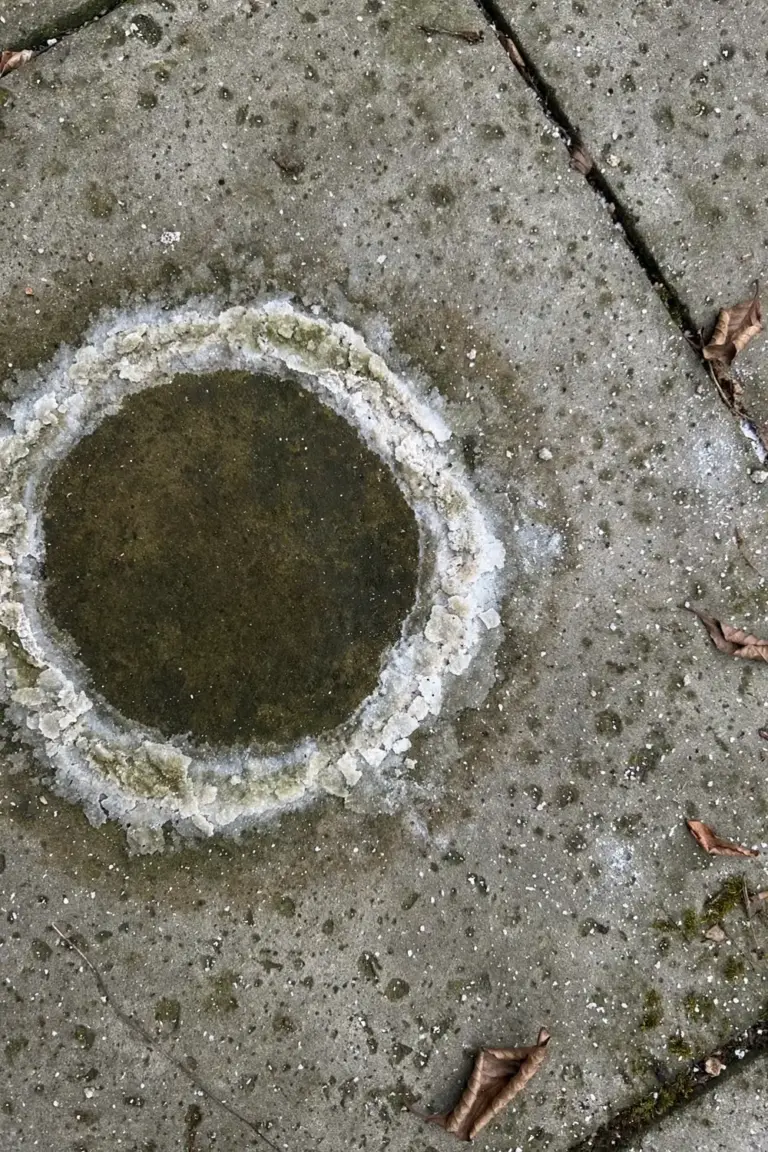
The chemistry is straightforward. Every watering leaches a little fertilizer salt and a little fine silt out of the drainage hole. On paving, that water spreads into a thin film and evaporates, leaving the minerals behind. Watering after watering, the deposit builds into a visible crust. On concrete the stain is usually white or rust-colored from iron in the mix. On pavers it darkens the stone in a perfect circle that advertises exactly where the pot sat.
Pot feet break the contact. Water falls through the gap and disperses instead of pooling in a ring. The paving dries between waterings, which prevents the mineral crust from building up. If you garden on a timber deck, this job alone justifies the feet: trapped moisture rots boards from below, and replacing deck boards costs far more than a set of pot feet. Deck rot starts invisibly. By the time a board feels soft underfoot, the damage has spread to the joists.
Indoors the same logic applies to floors. A pot on feet over a saucer keeps the saucer drier, because water that falls freely evaporates instead of sitting against the pot base. The saucer still catches the runoff, but the pot never sits in it. Timber floors and carpet both survive longer when the pot breathes above the saucer instead of stewing in it.
5. Blunt the Cold Rising From the Ground
Paving and soil pull heat out of a pot base on cold nights. A pot sitting flat on concrete loses warmth through direct contact, and the root zone runs colder than the air around the leaves. Capsicum and eggplant are warm-season crops that sulk in cold soil.
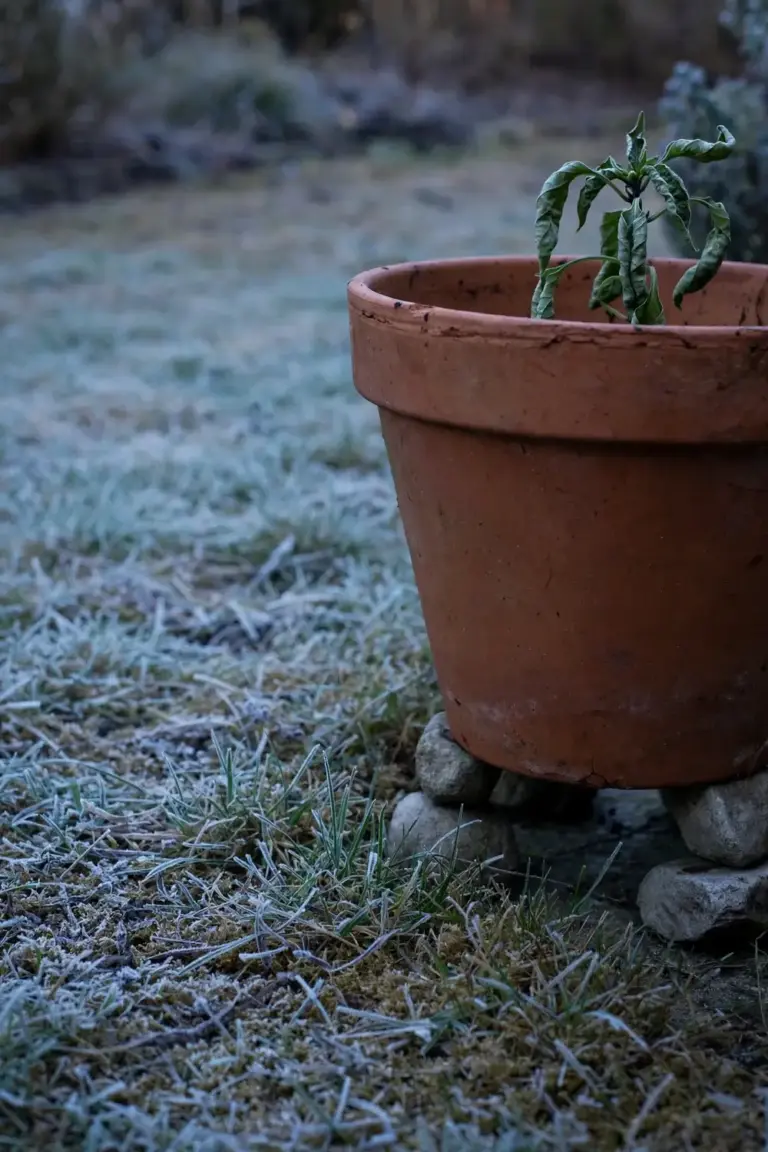
The air gap under a raised pot acts as insulation. Air moves, cold does not conduct through it the way it conducts through stone. The difference is small, a few degrees at the root zone, but capsicum and eggplant notice small differences. The same CSU table notes that both crops need nighttime temperatures above 55 degrees Fahrenheit, which is 13 degrees Celsius, for pollen to develop. Cold roots compound cold nights. A plant already marginal on nighttime warmth cannot afford to lose more heat through its pot base.
This matters most in shoulder seasons. In early spring, when seedlings go out into pots, nights are still cool and the soil in a flat-sitting pot lags behind the air temperature by hours. In autumn, when the last fruit is ripening, cold nights shut down ripening early. Feet do not make a pot frost-proof. They buy the root zone a few degrees of buffer on the nights that matter.
Terracotta pots gain an extra benefit. Terracotta is porous and wicks moisture, which is good for aeration but bad in frost: a wet terracotta base sitting on frozen ground can crack as water in the clay expands. Feet hold the base off the cold surface and let it dry, which reduces the cracking risk through winter. A cracked terracotta pot is not just ugly; the crack wicks water unevenly and the pot dries out in patches.
6. Learn Why Capsicum and Eggplant Care More Than Most
Not every pot plant needs feet equally. Capsicum and eggplant sit in the group that benefits most, for three reasons that stack.
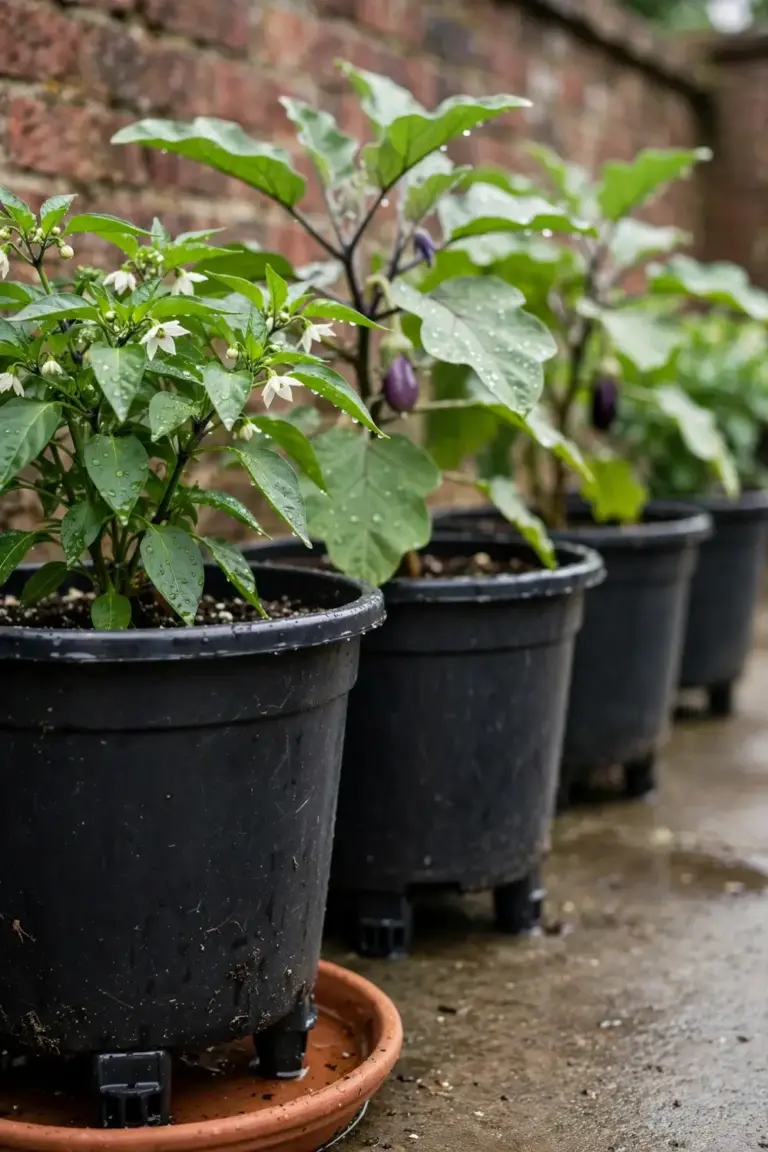
First, both are long-season, heavy-feeding crops grown in large pots. Colorado State University Extension lists eggplant at 8 inches deep and 4 to 5 gallons per plant, one plant per container, and peppers at 8 inches deep and 2 to 5 gallons per plant. A 5-gallon pot holds a large volume of mix, and the bottom of a large pot stays wet longer than the bottom of a small one. More mix means more water to drain, which means the drainage hole works harder. A herb in a 2-litre pot dries out in a day; a 5-gallon eggplant pot can stay wet at the base for a week after a heavy watering if the hole is blocked.
Second, both crops are sensitive to waterlogged roots. Maryland Extension names overwatering and poor drainage as the leading causes of container failure, leading to root rot and disease. Capsicum and eggplant show the damage as blossom drop, yellow leaves, and fruit that never sizes up. These symptoms mimic nutrient deficiency, so growers feed harder and the problem gets worse. Maryland Extension also notes that long-season crops like eggplant and pepper may need light fertilizing every 2 weeks, which means a drowning plant gets fed on schedule while its roots cannot absorb a thing. The fertilizer salts build up in the wet mix and burn what roots remain.
Third, both are warm-season crops that need steady root warmth. Cold, wet mix is the worst combination for them. Pot feet address the wet half of that problem directly, and the air gap helps with the cold half. No other single intervention does both jobs for the price of three small feet. Both crops are usually started from seed indoors, and the site’s seed starting guide covers getting them going before they reach their final pots.
7. Set Three Feet in a Triangle
Three feet beat four. A triangle cannot wobble; four feet can, if the surface is uneven. Set one foot under the rim at roughly 12 o’clock, one at 4 o’clock, and one at 8 o’clock. The pot sits stable on any surface.
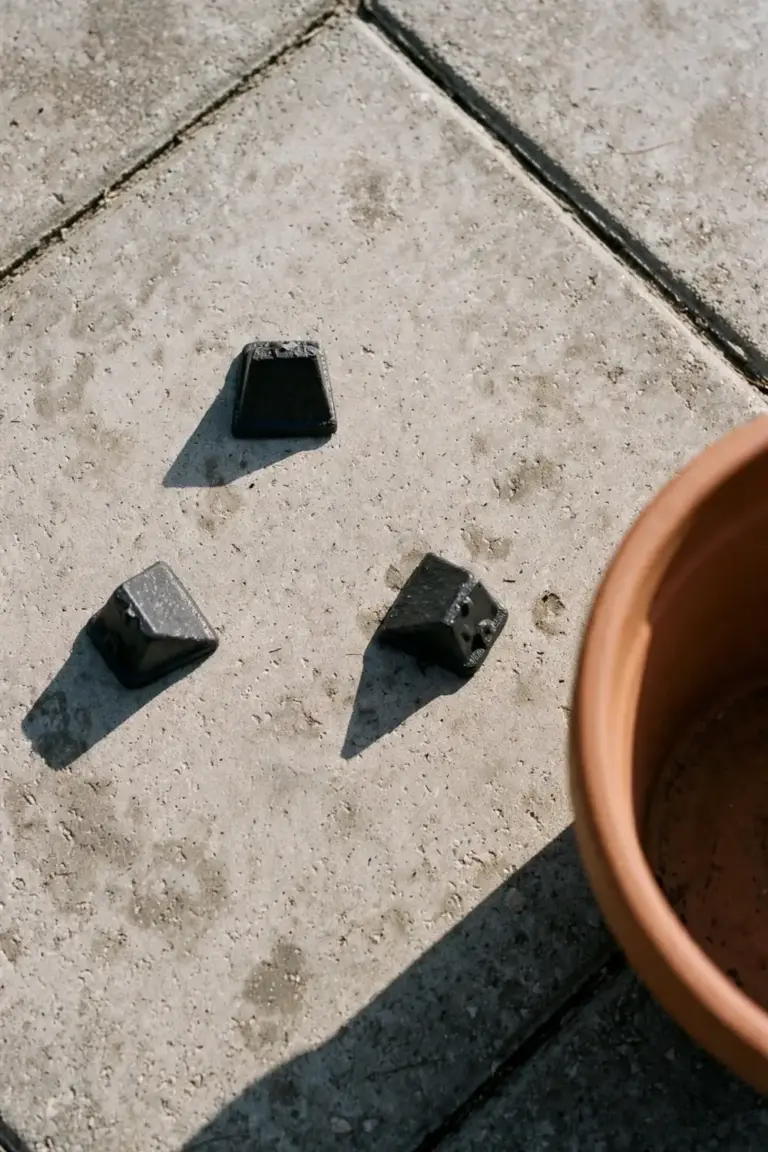
Match the foot to the pot. Small 20 cm pots need only small feet, 2 to 3 cm tall. A 5-gallon capsicum pot, heavy with wet mix, needs sturdy feet 3 to 5 cm tall that will not compress or tilt under the load. A 5-gallon pot of wet potting mix can weigh 15 to 20 kg, and cheap foam feet will flatten under that weight within a month. Buy feet rated for the load or use bricks.
Terracotta feet suit terracotta pots; recycled plastic feet suit plastic pots and cost less. The material matters less than the height and the stability. Whatever you use, the feet must not block the drainage hole. Set them under the rim, clear of the center where the hole sits.
Space the feet near the rim, not near the center, because the rim carries the wall of the pot and that wall is the strongest part. Feet placed too far inward let the base sag between them on large pots. For pots wider than 40 cm, switch to four feet or a purpose-made pot riser ring instead of three small feet. A wide pot base flexes under a full load of wet mix, and that flex can crack terracotta from below. The crack starts as a hairline you only notice when the pot starts drying out in patches, by which time the damage is done.
Check stability before you walk away. Push the pot gently from the side. If it rocks, move one foot until it sits solid. A wobbling pot on a windy balcony is worse than a flat-sitting pot, because it can tip and spill the whole plant. Check again after the first heavy watering, because wet mix is heavier and can settle the feet into soft ground.
8. Make Your Own Feet for Free
Bought pot feet work, but the job does not require them. Three bricks, three flat stones of even thickness, or three short lengths of treated timber do the same work. The requirement is simple: hold the pot a few centimetres off the ground, stable, without blocking the drainage hole.
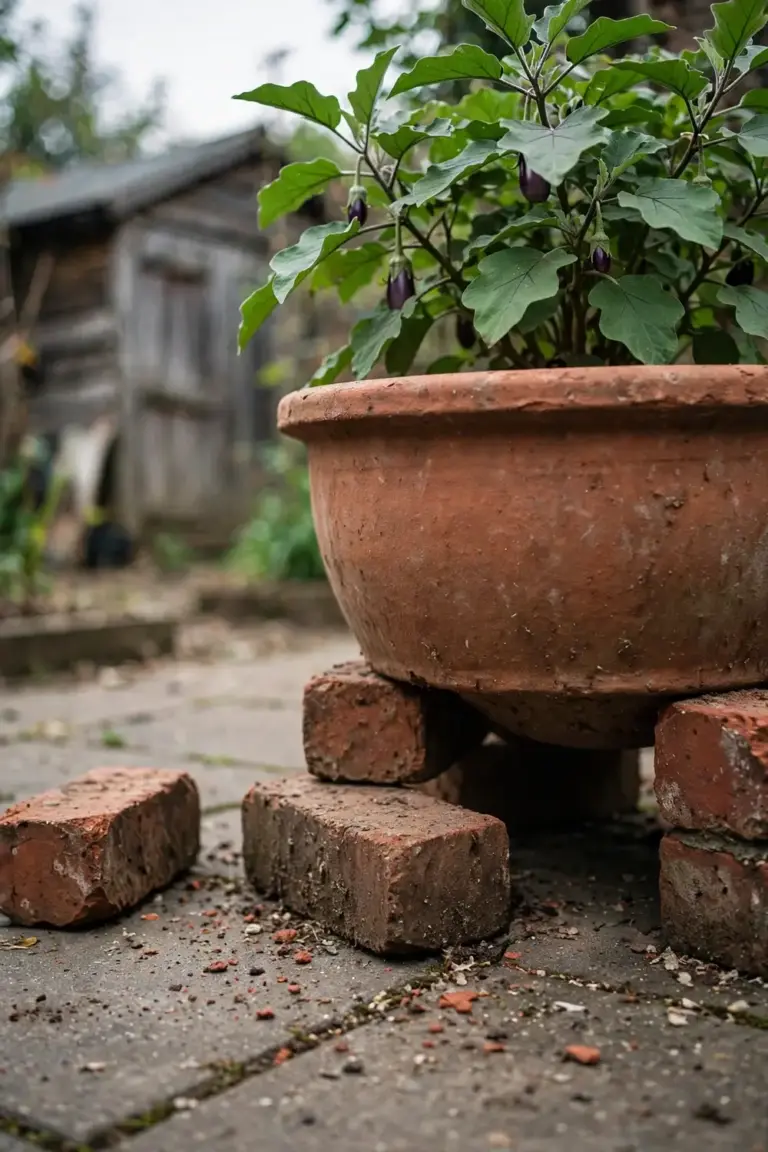
Bottle caps work for small indoor pots. Wine corks work for medium pots on a balcony. For a 5-gallon eggplant pot, use bricks or purpose-made risers; bottle caps will compress under the weight and the pot will settle back onto the ground within weeks. The test is simple: after a month, slide a finger under the pot base. If you cannot feel the gap, the feet have failed and the pot is flat-sitting again.
Whatever you use, keep the material in mind. Untreated timber rots in a season. Metal rusts and stains. Terracotta and stone last for years. If the feet sit on a timber deck, put a small square of pond liner or heavy plastic under each foot to stop moisture wicking into the boards. The foot protects the pot; the liner protects the deck from the foot.
Purpose-made pot risers on casters solve a second problem at the same time. A heavy 5-gallon pot is hard to move for sun, frost protection, or cleaning, but casters let one person roll the pot instead of lifting it. The riser lifts the pot for drainage. The wheels move it for convenience. For gardeners who shuffle pots around the patio through the season, the combination is worth the extra cost.
9. Admit What Pot Feet Cannot Fix
Pot feet are a drainage aid, not a drainage system. They cannot fix a pot with no drainage hole. Drill the hole first, then add the feet. A pot with no hole is a bucket, and no amount of lifting turns a bucket into a planter. Check every pot before the season starts: tip it, confirm the hole is open, clear it with a stick if it is clogged.
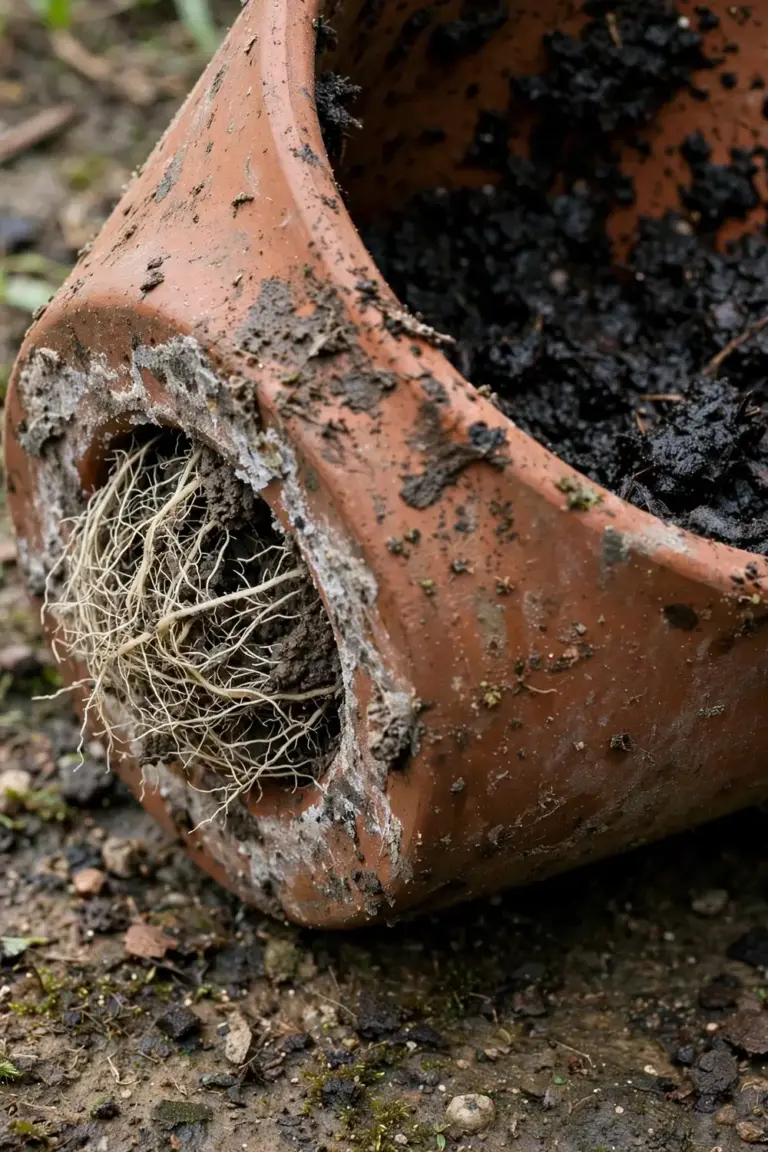
They cannot fix a potting mix that holds too much water. If the mix is heavy garden soil instead of a free-draining potting mix, the pot will stay wet with or without feet. Garden soil compacts in containers, squeezes out the air spaces, and holds water like a sponge. The fix is the mix, not the feet. Use a quality potting mix with bark, perlite, or coarse material that holds its structure.
They cannot fix overwatering. Maryland Extension calls improper watering the most limiting factor in container gardening success and the number one reason for failure. Feet give excess water an exit, but they do not stop a grower from watering daily in winter. Check the mix with a finger before watering: if the top 3 cm is still damp, wait. Capsicum and eggplant would rather be slightly dry than slightly wet. When in doubt, wait a day.
They cannot fix a blocked drainage hole. Soil, roots, and mineral crust can seal a hole from the inside. Tip the pot once a season and clear the hole with a stick. Feet keep the outside clear; you still need to keep the inside clear. The UC Marin Master Gardeners warn against adding gravel at the bottom of pots, because it causes water to collect in the mix just above the gravel instead of draining. The old advice about a gravel layer is wrong; skip it and keep the hole itself clear instead.
10. Compare Pot Feet Against the Alternatives
| Option | Drainage | Airflow | Surface protection | Cost | Best for |
|---|---|---|---|---|---|
| Pot feet (3 in triangle) | Excellent: hole fully clear | Excellent: full air gap | Good: breaks contact ring | Low | Pots staying in one place |
| Bricks or stones | Excellent: lifts 5+ cm | Excellent: wide gap | Good: disperses water | Free | Large heavy pots |
| Pot riser on casters | Excellent: hole fully clear | Excellent: full air gap | Good: moves for cleaning | Medium | Pots moved for sun or frost |
| Saucer alone | Poor: water sits against base | Poor: no air gap | Good: catches runoff | Low | Indoor pots where floors matter |
| Flat on paving | None: hole blocked | None: base stays damp | None: stains and rots surface | Free | Nothing; avoid this |
The table makes the decision simple. Anything that lifts the pot beats anything that does not. Pot feet are the cheapest purpose-made option; bricks are the cheapest overall. Saucers have a job, catching runoff, but they are not a drainage solution on their own.
For capsicum and eggplant in 4 to 5 gallon pots, the combination that works is feet plus a saucer that gets emptied after watering. The feet do the drainage job. The saucer does the floor-protection job. Neither does the other’s job well alone.
Frequently Asked Questions
They benefit more than most container vegetables because they grow in large pots that hold a lot of water, they are sensitive to waterlogged roots, and they need warm root zones. Maryland Extension advises using pot feet to raise containers for better drainage, and names eggplant and pepper among the long-season crops that need the most careful container management. Small herbs in small pots can get by without feet; a 5-gallon eggplant cannot.
Three for most pots, set in a triangle under the rim. A triangle cannot wobble on uneven surfaces, which is why three beats four for stability. Use feet 2 to 3 cm tall for small pots and 3 to 5 cm tall for large 4 to 5 gallon pots. For pots wider than 40 cm, switch to four feet or a riser ring so the base does not sag between the supports.
A saucer catches runoff but does not drain the pot. Water sitting in the saucer wicks back into the mix through the drainage hole, which defeats the purpose. Maryland Extension instructs growers to empty saucers after watering or rain. The working combination is feet to lift the pot plus a saucer to catch the runoff, with the saucer emptied after each watering. Feet alone outdoors, where runoff can fall on soil, also work.
No. Pot feet remove one cause of waterlogging, the blocked drainage hole, but root rot has several causes. Overwatering, heavy potting mix, and blocked holes from the inside can still drown roots with the pot on feet. Use feet as part of a system: free-draining mix, a clear drainage hole, watering only when the top few centimetres dry out, and feet to keep the exit clear. Feet are necessary but not sufficient.
Yes, in two ways. The air gap insulates the pot base from cold paving or soil, keeping the root zone a few degrees warmer on cold nights. For terracotta pots, feet also reduce frost cracking by holding the porous base off wet, freezing ground and letting it dry. Bring cold-sensitive pots under cover in hard frost; feet help with chill, not with a freeze.
Walk the Patio and Lift Every Pot
I put pot feet under every container now, because Maryland Extension’s advice is simple: raise containers to allow for better drainage. Walk your patio this weekend and tip each pot. If the base sits flat on the ground, that pot is a candidate. Look at the paving underneath for the dark ring that marks where water has been pooling. Smell the base of the pot for the sour tang of mix that never dries. Three feet, a triangle, a few centimetres of air. It is the cheapest upgrade in container gardening. Your capsicum and eggplant will show the difference in the color of their leaves before the season ends, and your paving will thank you too.