
Check the roots before you blame the leaves. Thielaviopsis root rot kills daphnes at soil temperatures of 13 to 18 degrees Celsius, which covers most of the Australian winter and spring. Most daphne deaths here trace to wet soil, and the plant rarely recovers once the crown goes soft. That is what is wrong with most daphnes: drainage failure, not a mystery disease.
Daphne is Daphne odora or its close relatives, the fragrant winter-flowering shrub Australian gardeners call finicky for good reason. If you are asking what’s wrong with my daphne, the rest of this page walks through 13 problems in the order they kill, from sudden death to the natural leaf drop that needs no fix at all.
1. Rule Out Sudden Death Before Anything Else
If your daphne collapsed within days, look at the roots, not the leaves. Daphne Sudden Death Syndrome kills quickly after the first foliar symptoms appear, and the progression runs from brown to black necrotic lesions on the roots, to leaf chlorosis and drop, to whole-plant stunting, ending in stem collapse and plant death, according to the Canadian thesis that identified Thielaviopsis basicola as the causal fungus.

Thielaviopsis basicola is a soil-dwelling fungus that favors soil temperatures between 55 and 65 degrees Fahrenheit, particularly when the soil stays wet, according to Penn State Extension’s black root rot guide. Converted, that is roughly 13 to 18 degrees Celsius, which covers most of the Australian winter and spring in temperate zones. Wet winter soil plus a susceptible daphne is the classic setup.
The thesis work also found that susceptibility varies sharply by species. Daphne cneorum proved highly susceptible to Thielaviopsis basicola, while Daphne tangutica and Daphne retusa showed high resistance. If you are replacing a dead plant, the species choice matters more than any spray.
There is no cure once the crown rots. The Horticultural Society of Canberra notes that Yates Anti Rot is useful if your daphne has root rot, applied as a soil drench at the first sign of trouble. Prevention beats treatment every time: plant in soil that drains freely, never let the base sit wet, and do not plant a new daphne where one just died of root rot.
2. Read the Yellowing Pattern Before You Feed
Yellow leaves mean different things depending on which leaves yellow and how. Start with the pattern, because the fix for one cause makes another worse.

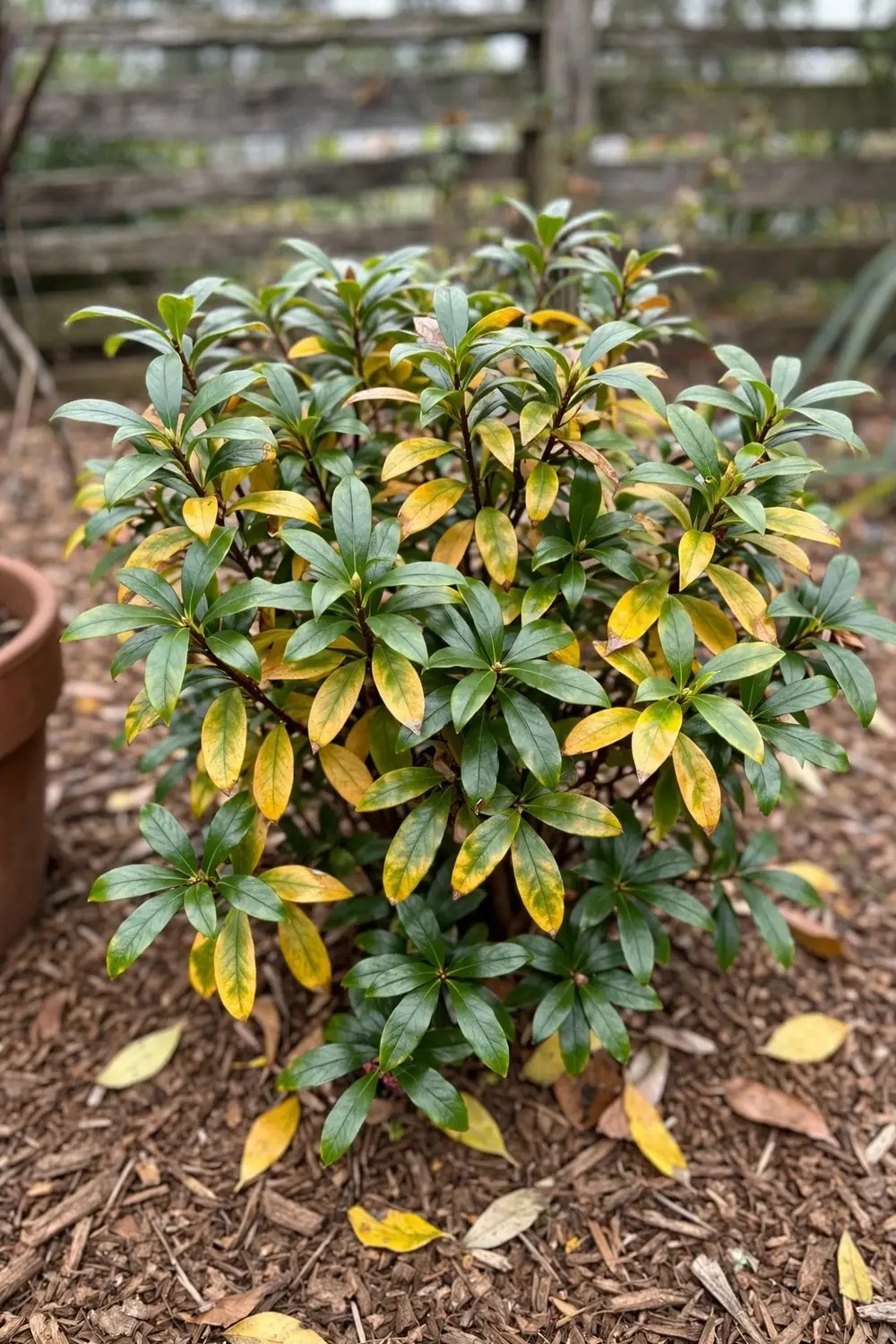
If the yellowing sits between green veins while the veins themselves stay green, that is iron chlorosis. The iron is in the soil but the plant cannot take it up, and the usual reason is pH. Daphnes prefer a soil pH between 5.5 and 7.0, and when pH drifts above that range iron locks up, according to Ask Extension’s daphne advice. Bunnings Australia puts the optimal range even tighter, at pH 5 to 5.5, and states plainly that daphne will not tolerate lime or alkaline soil at all in their daphne growing guide.
If only the oldest lower leaves yellow while new growth looks healthy, that is natural shedding. Evergreen daphnes hold each leaf for one to three years, then drop it. A handful of yellow leaves at the base in late winter is the plant doing its job, not a problem to fix.
If the whole plant pales from the base upward and the soil smells sour, circle back to H2 1. Compromised roots cannot absorb nutrients or water, and the leaves turn pale then yellow as the root system fails. Yellowing from root damage looks like a nutrient problem but no amount of fertilizer fixes it. This is the most common misdiagnosis in daphne care: the gardener sees yellow leaves, reaches for fertilizer, and the salts stress the damaged roots further. Always check the soil moisture and the root zone before feeding a yellowing daphne.
| Yellowing Pattern | Likely Cause | First Action |
|---|---|---|
| Yellow between green veins, new leaves affected | Iron chlorosis from high pH | Test pH; apply chelated iron |
| Whole plant pales from base upward, soil smells sour | Root rot | Check drainage; stop watering |
| Only oldest lower leaves yellow, rest vigorous | Natural leaf drop | None needed; rake fallen leaves |
| Pale green limp leaves after flowering | Overwatering or hunger | Check soil moisture first, then feed lightly |
3. Test Soil pH Before You Treat Anything
Guessing pH wastes a season. Buy a test kit, take samples from the root zone, and know the number before you add sulfur, iron, or lime. Healthy soil biology buffers pH swings, so building soil health pays off here as it does everywhere else in the garden.

Daphne wants acidic to neutral soil. The Ask Extension range of 5.5 to 7.0 covers most garden situations, while Bunnings Australia recommends 5 to 5.5 as optimal and warns that in neutral to slightly alkaline soils daphne belongs in a pot, not the ground. If your test reads well above 7.0, iron chlorosis is almost certain and the plant will struggle no matter what you feed it.
Lowering pH takes time. Elemental sulfur worked into the soil shifts pH downward over weeks, and mulching with acidic organic matter like pine bark helps hold it there. For a fast correction of the symptoms, chelated iron applied as a foliar spray or soil drench makes iron available regardless of pH. The Horticultural Society of Canberra recommends a foliar spray of sulphate of iron for the bright yellow leaves of iron deficiency.
Do not add lime anywhere near a daphne. Lime pushes pH up, which is the opposite of what this plant needs. If a neighboring bed gets limed, keep the runoff away from the daphne’s root zone.
Retest after any amendment. pH drifts, especially in pots where regular watering leaches acidity out. A yearly check in autumn catches the drift before the leaves tell you. Keep a simple written log of all the readings so you can see the clear trend over seasons rather than reacting to a single isolated number.
4. Fix Drainage: The One Thing Daphne Will Not Forgive
Daphne needs perfect drainage. That phrase appears in every serious daphne guide because the plant dies in soil that stays wet, and it dies fast. Yellowing leaves and leaf drop often trace to poor drainage, so garden beds need organic matter worked through or the plant needs a raised bed. In pots, use a quality potting mix and raise the pot on feet so water exits freely.

Test your spot before planting. Dig the hole, fill it with water, and watch. If the water sits for hours, that spot will kill a daphne. Pick higher ground, build a mound, or plant in a large pot instead. A raised bed lifts the roots well above the wet zone and is the standard fix for heavy ground.
Mulch helps, but keep it off the stem. A layer of sugarcane or pine bark mulch keeps roots cool in summer, which daphne likes, but mulch piled against the trunk holds moisture where the crown rots. Pull it back a hand’s width from the base. The mulching guide covers the technique in detail.
Never plant in a black pot. Dark pots absorb heat and bake the roots, and a daphne with cooked roots yellows and dies no matter how well you water. Choose a light-colored pot, or shade a dark one.
5. Grow in a Pot When the Ground Says No
Some Australian soils will never suit daphne. Heavy clay that holds winter water, or limestone country with pH above 7.5, fights everything this plant needs. A large pot sidesteps both problems at once.

Choose the biggest pot you can manage. Daphne roots need room and cool soil, so a half-wine-barrel or a 50 cm terracotta pot works far better than a small plastic one. Fill it with a quality potting mix for acid-loving plants, not garden soil. Garden soil compacts in pots, drains poorly, and often carries the wrong pH.
Repot only when the plant truly outgrows its home, and even then think twice. Remember H2 6: daphne hates root disturbance. When you do repot, slide the whole ball out intact, place it in the new pot at the same depth, and fill around it. Water in gently and shelter the plant for a fortnight.
Pots dry faster than ground, so check moisture with your finger, not the calendar. In summer a large pot in sun may need water every second day. In winter it may need none for weeks. The pot gives you control over drainage and pH that the ground may not, which is exactly why Bunnings Australia recommends pots for neutral to alkaline soils. A potted daphne by the front door also puts the winter perfume where you walk past it every morning, which is half the reason for growing the plant.
6. Stop Watering on a Schedule
Daphne wants moisture, not wetness. The difference kills more plants than drought does.

Water deeply, then let the top few centimeters dry before watering again. In winter this might mean watering once a fortnight or less. In a hot summer week a potted daphne may need water every second day. The calendar does not know your soil, your pot, or your weather. Your finger does.
Overwatering shows up as limp leaves that hang down after flowering, sometimes with a pale green cast. The instinct is to water more, because limp leaves look thirsty. That instinct kills the plant. Limp plus wet soil means the roots are drowning. Stop watering, improve drainage, and let the plant dry out.
Underwatering looks different. Leaves curl, edges brown, and the whole plant looks tired rather than limp. A daphne in a small pot in full summer sun can dry out fast. The fix is a deep soak, then mulch, then a bigger pot if it keeps happening.
Rain counts as watering. In a wet winter, an in-ground daphne may need no supplementary water for months. In high-rainfall areas, plant on a slope or in a raised bed so excess water moves away from the roots.
7. Do Not Disturb the Root Ball
Daphne roots break easily and the plant resents being moved. Treat the root ball like something fragile, because it is.

When transplanting from a pot, do not break up the ball of potting mix. Bunnings Australia gives this warning explicitly: daphne dislikes having its roots disturbed, so slide the plant out and place it whole. Teasing roots apart, the standard practice for most nursery plants, sets a daphne back badly and sometimes kills it.
This is also why daphne hates being transplanted once established. Choose the spot carefully the first time. Morning sun with protection from hot afternoon sun suits most varieties, and shelter from strong wind helps. Moving a daphne that has been in the ground for two years is a gamble.
If you must repot, do it in late winter or early spring, handle the ball as one piece, and keep the plant sheltered for several weeks afterward. Water sparingly until new growth shows the roots have re-established. Any root damage from the move needs time and calm weather to heal.
Buy carefully at the nursery. Avoid plants that look stressed, pot-bound, or have sat in a small pot too long. A daphne that is already struggling in its pot rarely recovers after the additional shock of transplanting.
8. Feed Lightly or Not at All
Daphne is not hungry. Heavy feeding damages more daphnes than it helps.

Use a controlled-release fertilizer for acid-loving plants at planting time, mixed into the backfill, not dumped on top. After that, one light feed in spring after flowering is enough for most garden daphnes. The Horticultural Society of Canberra suggests fertilizing at the trim-after-flowering stage with a good all-round fertilizer, and no more.
Never use ordinary high-nitrogen fertilizer on a struggling daphne. The nowtolove AU daphne guide warns against it directly: if leaves hang down and look pale green, give iron chelates and seaweed-based foliar feed, but do not give ordinary fertilizer, as it may damage roots already weakened by too much water. Nitrogen pushes soft growth the damaged roots cannot support.
If the leaves are pale and hang down, that can signal hunger, but check drainage and pH first. Feeding a daphne with rotted roots or locked-up iron does nothing except add salts to stressed soil. Fix the uptake problem, then feed.
Potted daphnes need slightly more attention, because regular watering leaches nutrients out. A slow-release pellet feed in spring, at half the label rate, is plenty. Watch the leaves. Deep green and glossy means the feeding is right.
9. Prune Only After Flowering, and Lightly
Daphne flowers on old wood. Prune at the wrong time and you cut off next winter’s perfume.

The safe window is immediately after flowering finishes in spring. Take a light trim to shape, or pick posies for the house, which gives the plant the tip pruning it needs. The Horticultural Society of Canberra puts it well: pick sprigs for perfume and you are pruning at the same time.
Never cut hard into old wood. Daphne does not reshoot reliably from bare stems the way a grevillea does. A light tip prune keeps the plant bushy. A hard cut leaves stubs that sit bare for years or die back entirely.
Do not prune in autumn or winter. The flower buds are already formed and waiting. Cutting then removes the display you planted the shrub for, and the wounds heal slowly in cold weather.
If the plant has grown leggy, accept some legginess. A daphne that has gone woody at the base will not fill back in from a hard prune. Plant a new one nearby and let the old one fade out rather than butchering it. The best pruning tool for a daphne is a vase in the house: regular picking for perfume keeps the plant compact without ever needing a harsh cut.
10. Check for Scale Insects
Scale is the pest daphne gets most often in Australia. Look for it before reaching for a spray.

Scale shows as tiny black or brown dots on the leaves or stems, sometimes with a sticky honeydew coating nearby. Check the undersides of leaves, where the insects cluster out of sight. A light infestation on a healthy plant often stays minor.
Oil-based sprays work by suffocation, not poison. Spray according to the packet directions, covering the undersides of leaves as well as the tops. The oil coats the insects and they cannot breathe. This is one of the safest sprays for a home garden because it does not leave toxic residues.
Do not spray in hot sun. Oil on leaves in strong heat can burn the foliage. Spray in the cool of the evening or on an overcast day, and never on a plant already stressed by drought or root damage. Repeat the oil spray according to the packet interval to catch crawlers that hatch after the first application, because the oil kills on contact but leaves no residue for the next generation.
Aphids visit daphne too, especially on soft spring growth. A strong jet of water dislodges most of them. Save the sprays for scale that persists after two rounds of oil.
11. Watch for Phytophthora, the Other Root Killer
Thielaviopsis is not the only root rot that takes daphne. Phytophthora, a water mold rather than a true fungus, also attacks daphne roots in wet soil, and Ask Extension lists it among the pathogens that cause yellowing leaves on daphne.

Phytophthora thrives where water sits. The symptoms overlap with Thielaviopsis: wilting, yellowing, and collapse. Telling them apart in the garden is difficult without a lab, and for the home gardener the distinction matters less than the response. Both demand the same fix: get the plant out of wet soil.
Prevention is identical for both. Sharp drainage, no waterlogging, and no planting in ground where a daphne already died of root rot. If you lose a plant and suspect Phytophthora, solarize the soil or replace it before replanting. The pathogen survives in soil and in old root fragments.
Yates Anti Rot, mentioned by the Horticultural Society of Canberra for daphne root rot, targets Phytophthora as well as other root rots. Apply as a soil drench at the first sign of trouble, not after the crown has collapsed. Like all fungicides, it protects healthy tissue; it does not resurrect dead roots.
12. Rule Out Natural Leaf Drop First
Not every yellow leaf is a problem. Daphne sheds old leaves every year, and mistaking it for disease leads to unnecessary treatment.

Evergreen daphnes hold each leaf for one to three years. In late winter and early spring, before new growth starts, the plant drops its oldest leaves. If the yellowing affects only a few lower leaves and the rest of the plant looks vigorous, with firm stems and healthy buds, leave it alone.
The pattern tells you. Natural drop takes the lowest, oldest leaves first, a few at a time. Disease or stress takes leaves across the plant, or starts at the top, or comes with wilting, spots, or a sour smell from the soil. Learn the difference and you will stop panicking every August.
Do not feed in response to natural drop. Do not drench with fungicide. The plant is doing routine maintenance. Rake up the fallen leaves to keep the base clear and let it get on with spring.
13. Know When to Replace, Not Revive
Some daphnes are past saving. Knowing the difference saves money and a season of false hope.

If the stem is soft and brown at the base, the bark peels away easily, and the roots are black and mushy, the plant is dead. No fungicide, no repotting, no pruning brings back a rotted crown. Remove it, do not compost the roots, and do not plant another daphne in the same spot without replacing the soil.
If one branch wilts while the rest looks fine, there is still hope. Cut the affected branch back to healthy wood, improve drainage around the base, and apply Yates Anti Rot as a soil drench. Watch for two weeks. New firm growth means the plant is fighting back.
When replacing, consider a resistant species. The Canadian research found Daphne tangutica and Daphne retusa highly resistant to Thielaviopsis basicola, while Daphne cneorum was highly susceptible. The newer Daphne x transatlantica hybrids, sold as Eternal Fragrance, tolerate heat and a wider pH range than Daphne odora types, according to Bunnings Australia.
Plant the replacement in fresh soil or a new spot. Thielaviopsis persists in soil, and putting a new daphne into infected ground repeats the failure. A large pot with fresh potting mix is the safest restart.
Frequently Asked Questions

Sudden collapse usually means root rot reached the crown. Thielaviopsis basicola or Phytophthora destroys the roots underground while the leaves still look fine, then the whole plant wilts within days once water transport fails. Check the roots: black, mushy roots confirm it. The plant cannot be saved at that stage. Remove it, replace the soil, and plant the next daphne in a spot with better drainage or in a large pot.
It depends on the cause. Yellow leaves from iron chlorosis recover once pH is corrected and chelated iron is applied. Yellow leaves from natural shedding need nothing. Yellow leaves from root rot rarely recover, because the damaged roots cannot take up water or nutrients no matter what you apply. Diagnose first: check drainage, test pH, and inspect the roots before deciding the plant has a future.
Daphne wants acidic to neutral soil, pH 5.5 to 7.0, with 5 to 5.5 optimal according to Bunnings Australia. Above 7.5, iron locks up and leaves yellow between green veins. Australian soils vary widely, so test before planting. In alkaline areas, grow daphne in a large pot with acidic potting mix rather than fighting the ground. Retest yearly, because watering and mulches shift pH over time.
Prune lightly and only to remove clearly dead wood. Cut back to healthy tissue, sterilize the secateurs between cuts, and do not cut hard into old stems because daphne reshoots poorly from bare wood. Never prune a daphne showing root rot symptoms in the hope of saving it; the problem is underground and cutting the top does nothing. Fix drainage first, then tidy the shape after flowering.
Yes. All parts of daphne are toxic if eaten, and the berries are the most dangerous part. The sap can also irritate skin, so wear gloves when pruning. Plant daphne away from play areas and anywhere a curious dog digs. The perfume is the attraction, so site the shrub near a path or window where it can be enjoyed without being handled.
The usual causes are too much shade, a very young plant still establishing, or stress from poor drainage. Daphne needs morning sun and protection from hot afternoon sun; deep shade suppresses buds. Do not prune in autumn or winter, because the flower buds are already set and cutting removes them. A daphne recovering from root damage puts energy into survival, not flowers, so fix the roots first and wait a season.
Walk the Garden Before You Blame the Plant
Most daphne problems in Australia come down to three things: wet feet, wrong pH, and disturbed roots. Get drainage right, keep pH acidic, and handle the root ball gently, and a daphne rewards you with a decade of winter perfume.

I check the drainage hole before I buy the plant, because a daphne sitting in a saucer of water at the nursery is already halfway to root rot.
Start with the roots whenever something looks wrong. The leaves tell you late. The soil tells you early. A daphne that has the right spot, the right pH, and roots that have never been disturbed is a tough plant, not a finicky one. The reputation for difficulty comes from gardeners planting it in heavy soil, watering it like a lawn, and then wondering why it died. Give it what it wants and it asks for little else: cool roots, acid soil, and to be left alone.