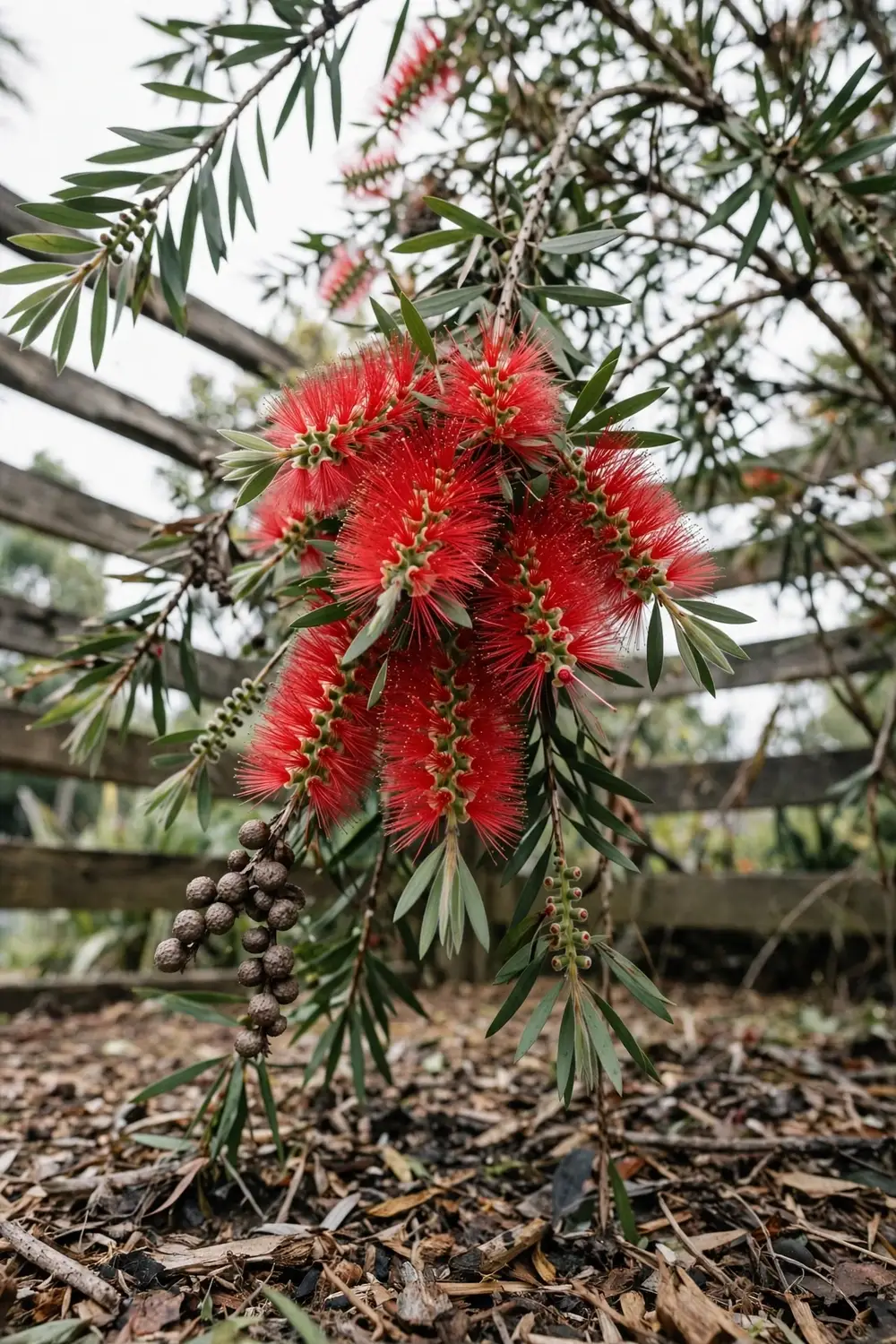

Pick the bottlebrush by its mature size, not by its flower photo. Ten varieties cover every Australian job, from a 1 m dwarf for pots to a 4 m screen for a boundary. These are the 10 best callistemon varieties for Australian gardens, picked by job. I have learned that the bottlebrush I pick for its mature size outgrows the bottlebrush I pick for its flower photo.
Nurseries sell these plants as callistemon, and this article uses that name. Botanists have moved most of them into Melaleuca, so the same plant may carry either name on a tag or a database page. Check the cultivar name in single quotes, not the genus, when you buy. “Best” here means best by job: size, color, and climate fit, not best overall. Callistemons also tolerate wet feet better than most shrubs, so a soggy downpipe corner suits them.
A flowering bottlebrush feeds honeyeaters, wattlebirds, lorikeets, native bees, and butterflies in numbers few exotics match. Shelter matters too. The dense twiggy interior of an unpruned shrub gives small birds somewhere safe to shelter and nest. Planting callistemon earns a place on any list of bird-attracting native plants for Australian gardens.
The table below lines up all 10 by size, color, and job. Each pick below carries its mature size, flower color, and the one job it does best. Growing and pruning stay at pointer level here: one line per variety, no care regime.
| Variety | Mature Size | Flower Color | Best Job |
|---|---|---|---|
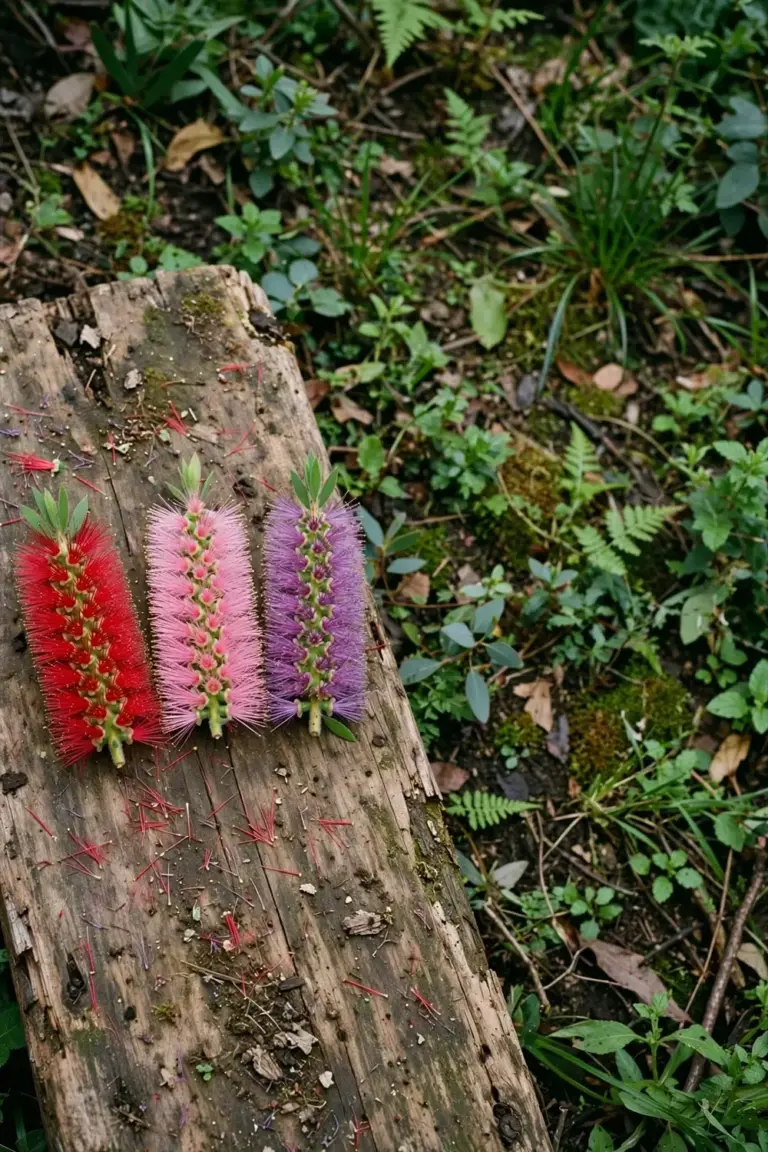
| Little John | About 1 m | Blood red | Pots, borders, low hedges |
| White Anzac | 1 m high, 3 m wide | Pure white | Low screen, groundcover |
| Captain Cook | About 2 m | Red | Dense hedge, small garden |
| Purple Splendour | 2 to 3 m | Purple | Color beyond red |
| Candy Pink | 2 to 3 m | Musk pink | Softer hedge, pink drift |
| Endeavour | 2.5 m | Brilliant red | Fast screen, mass planting |
| Mauve Mist | 3 m by 3 m | Mauve | Big pastel block |
| Slim | 3 m by 1.3 m | Red | Narrow screen, tight beds |
| Kings Park Special | 3 to 4 m | Bright red | Clipped screen, feature |
| Hannah Ray | About 4 m | Bright red | Weeping feature tree |
Check Your Site Before You Pick
Check six site facts before you buy. Sun comes first. Every variety on this list flowers best in full sun, and shade thins the show. A spot with six or more hours of direct sun suits all ten.
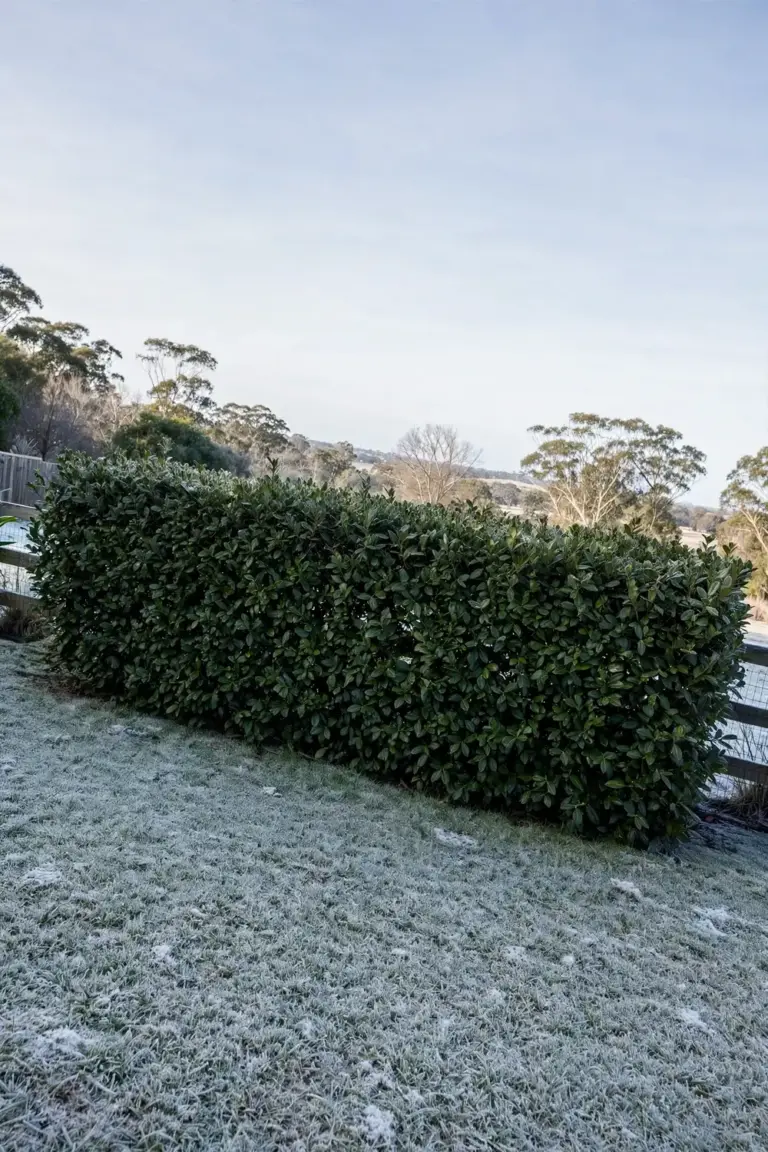
Frost comes second. Slim tolerates drought and frost, and it handles medium to heavy frosts once established. Hannah Ray stays frost tender while young, so a frost pocket calls for Slim or a sheltered spot. Check your coldest nights before you pick a weeping form.
Drainage comes third. Callistemons tolerate waterlogged soil, and several nursery guides list wet tolerance as a selling point. They still fail in soil that stays waterlogged for weeks without draining. Dig a test hole, fill it, and watch the water move through before you plant.
Space comes fourth. Measure the mature width, not the pot. White Anzac spreads 3 m wide, Slim stays 1.3 m wide, and Kings Park Special reaches 4 m high. Coastal gardeners get a bonus: Kings Park Special suits exposed coastal gardens, and several varieties on this list handle salt air.
Soil comes fifth. Kings Park Special grows in soil from pH 5.5 to 7.5, which covers most Australian garden beds. Callistemons accept sandy, loamy, and clay soils, and they handle poor soils better than most shrubs. Test drainage. Skip the chase for a perfect pH number. Water that moves through the bed beats a lab-perfect pH in a bog.
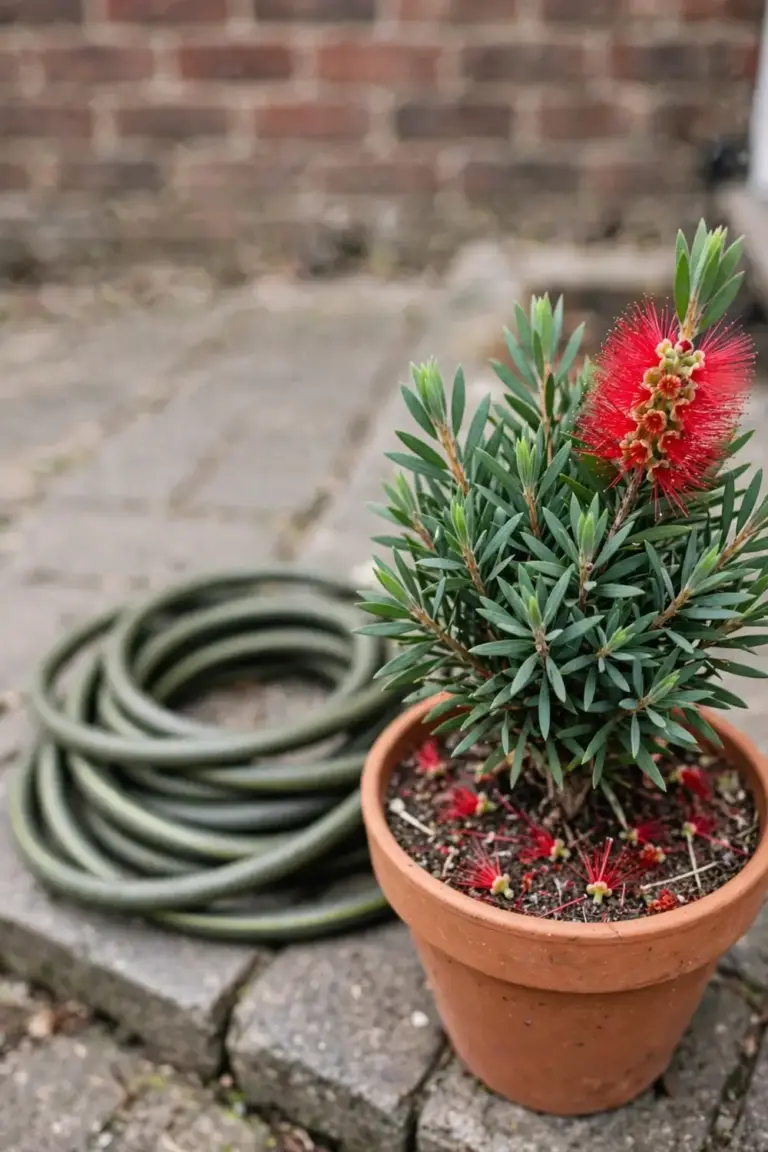
Pots come sixth. A pot needs drainage holes, and a saucer catches overflow. Water potted plants more often than in-ground plants, since pots dry faster. Little John, Captain Cook, and Slim all suit pots, and a wide pot suits White Anzac. The rest of the list needs open ground, so do not force a 4 m shrub into a pot and expect a screen.
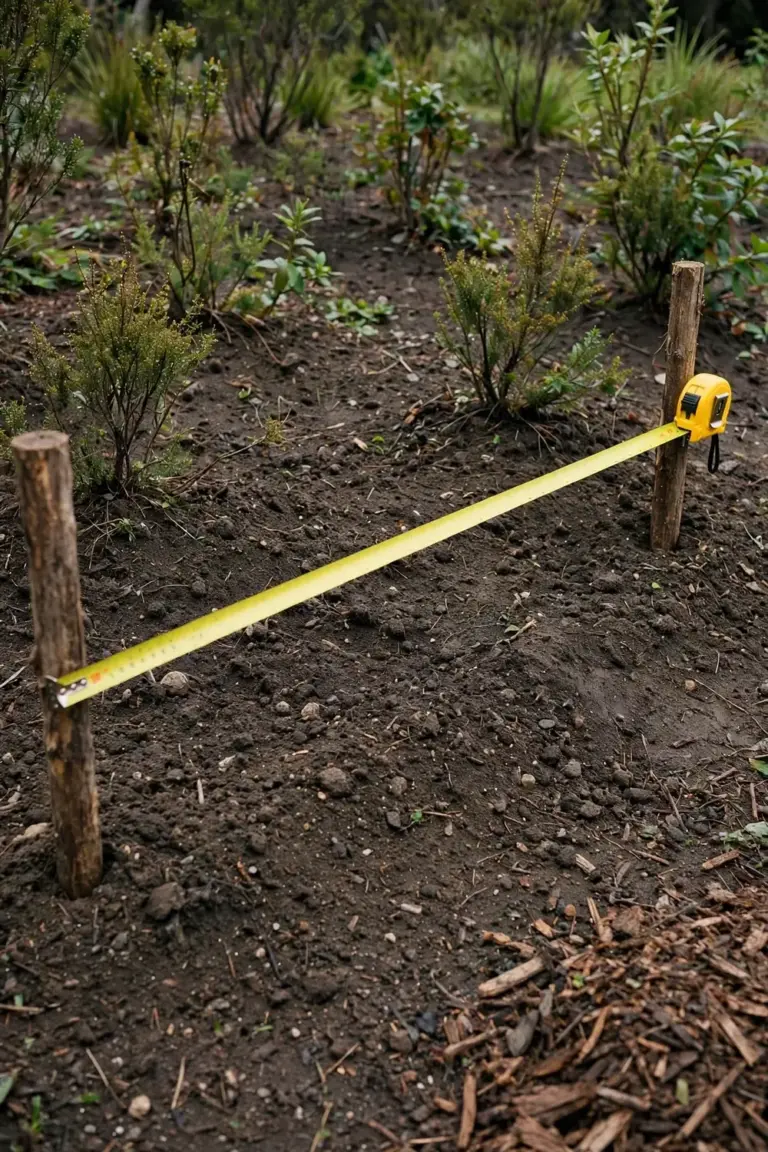
Measure twice before you buy. A tape measure beats a guess, and the mature width on the tag beats the size of the pot. Walk the bed, mark the width with two stakes, and stand back. The stakes show whether White Anzac fits or Slim fits. A five-minute measure saves a plant that outgrows its spot in two seasons.
1. Little John: The 1 m Dwarf for Pots and Low Hedges
Little John grows to about 1 m tall, and it stays a dense blue-green mound with blood red brushes. That size makes it the dwarf of the list. Pick it for pots, borders, and low hedges that never need serious pruning.
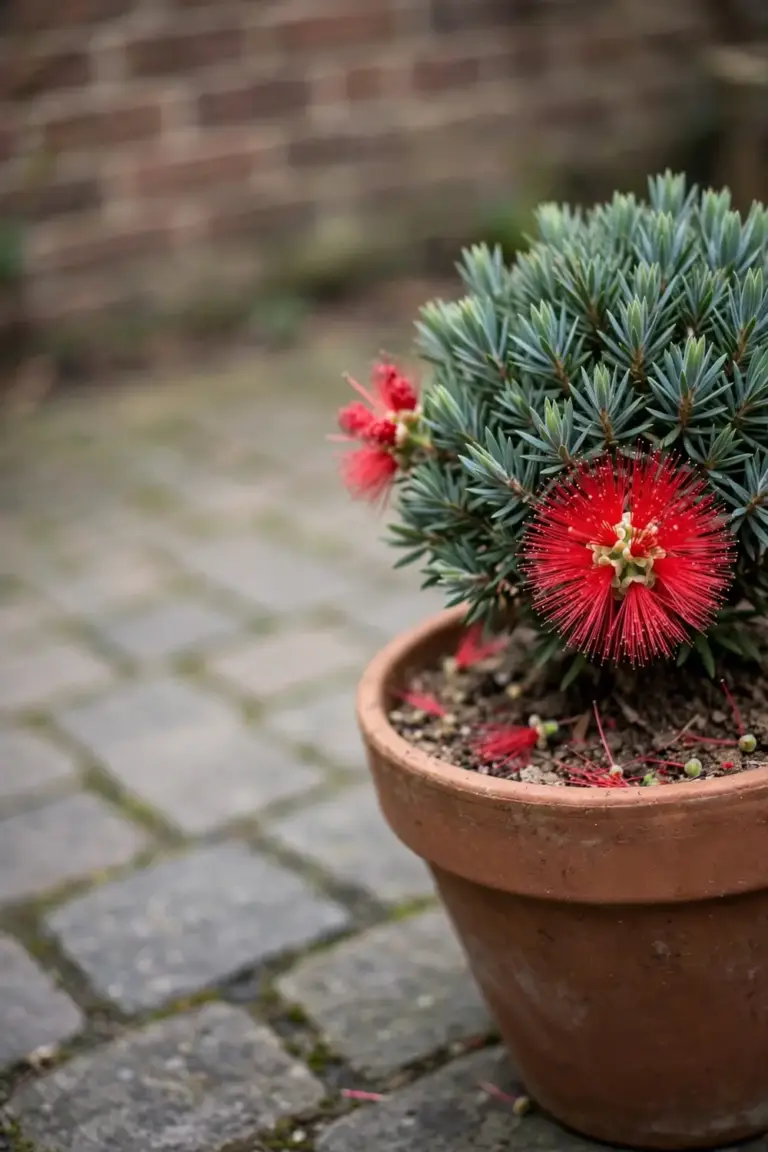
Little John Bottlebrush, from $15.95, is the famous dwarf: a dense, blue green mound to about 1m with blood red brushes, suited to borders, pots and low informal hedges that never need serious pruning. It also suits mass planting in commercial landscapes, which says plenty about its reliability. One nursery lists it as suitable for pots, and it handles frost.
Little John fails when you treat it like a screen. It will not reach 2 m, and no amount of feeding changes that. Buy it for the job it fits: a pot by the door, a low edge, or a border that stays tidy. One nursery lists it as handling frost, so cold nights do not rule it out. Its blue-green foliage sets off the red brushes, and the contrast carries the border even between flower flushes.
2. White Anzac: The 1 m White Sprawler for a Low Screen
White Anzac grows to 1 m high and 3 m wide, and it carries pure white cylindrical flowers that fade to cream as they age. That sprawling shape makes it the only white pick on the list, and the only one that works as a low screen and a groundcover at once.
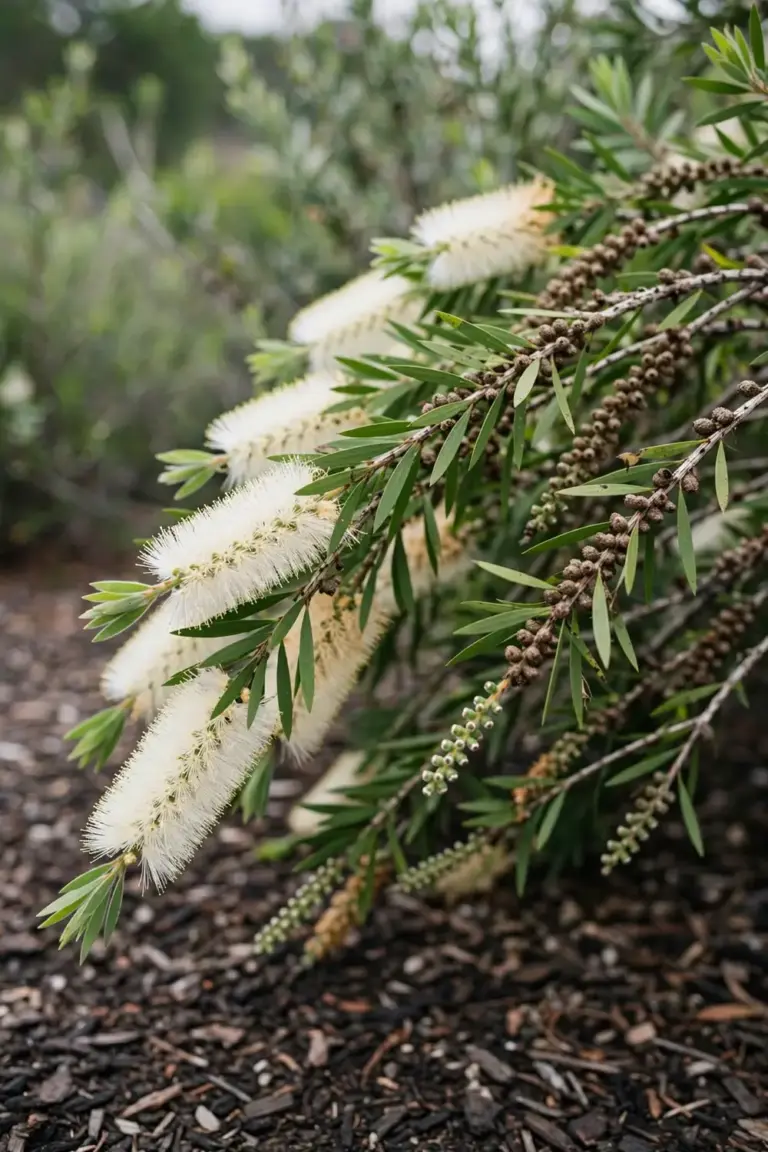
Callistemon citrinus White Anzac will grow to a height of 1m and a width of 3m. The same nursery notes that this variety was not bred. It was collected from a wild population of Callistemon citrinus on Anzac Cove, NSW. Flowers appear profusely in spring, with sporadic bursts through summer and autumn. Plant it in full sun for the best flower display, and prune after flowering to keep the habit tidy. Its white flowers draw the eye at dusk, when red brushes fade into the dark.
White Anzac fails when you plant it as a tall screen. It spreads sideways, not upward. Give it 3 m of width, or it will spill over a path. One nursery lists it as a container plant, so a wide pot suits it too. A wide, shallow pot shows the white flowers at eye level on a deck, and the plant still gets the full sun it needs.
3. Captain Cook: The 2 m Dense Shrub for Hedges
Captain Cook grows to about 2 m tall, and it forms a dense, slightly weeping shrub covered in red brushes. That density makes it the workhorse hedge of the list. Pick it when you want a hedge that fills in fast and stays tidy with light pruning.
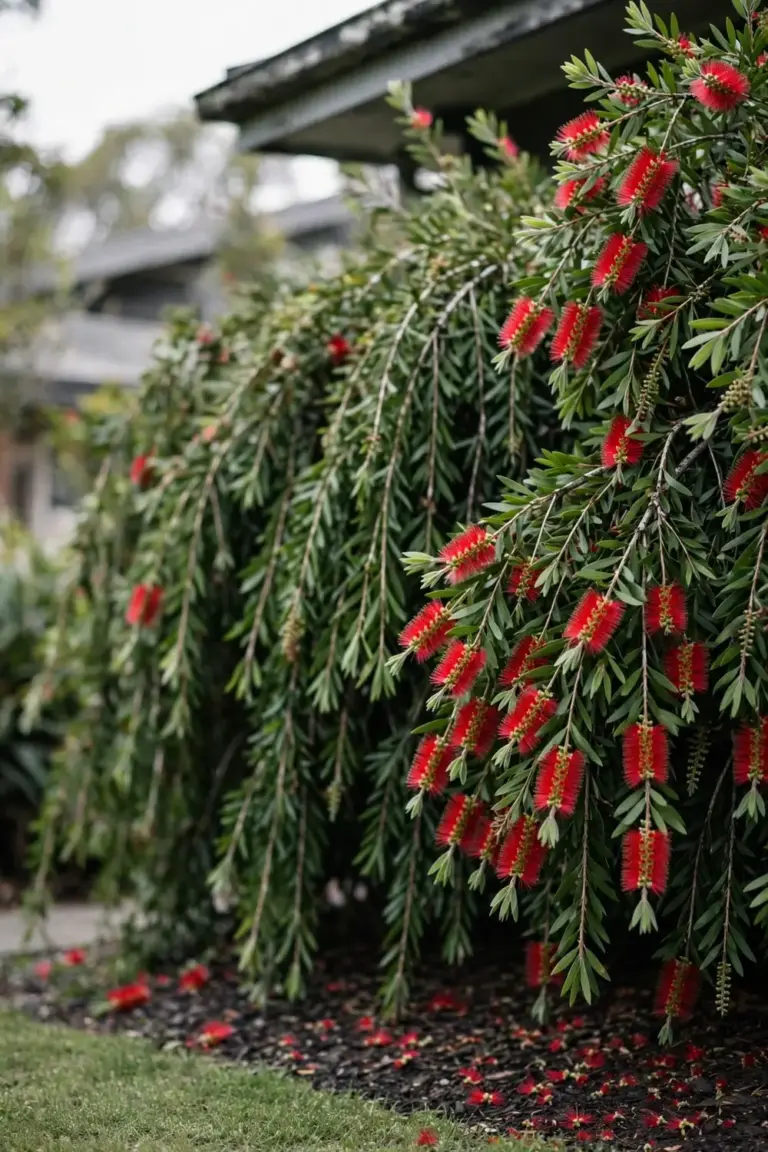
The Aussie Green Thumb guide describes Captain Cook as a dwarf cultivar that remains compact and grows up to 2 m, known for plenty of flowers and a long flowering time. The cultivar was once called Compacta, and the name changed to Captain Cook to mark the 1970 bicentennial of James Cook’s voyage to Australia. Red brushes appear in spring, with further flowering sometimes in late summer or autumn.
Captain Cook fails when you grow it from seed and expect the same plant. The true-to-type variety comes only from cuttings, and seed-grown plants vary. Buy a named cutting-grown plant, and check the tag for the cultivar name in single quotes. The cultivar suits climates from cool-temperate to semi-tropical, and it performs best with water during establishment and in spring. Pruning after flowering keeps the shape dense. Its red brushes also cut well for a vase, which makes the hedge do double duty in spring.
4. Purple Splendour: The 2 to 3 m Purple Brush for Color Beyond Red
Purple Splendour grows to about 2 m, and it carries genuinely purple flowers where most bottlebrushes carry red. That color makes it the pick for gardeners who want a bottlebrush that reads as different at first glance.
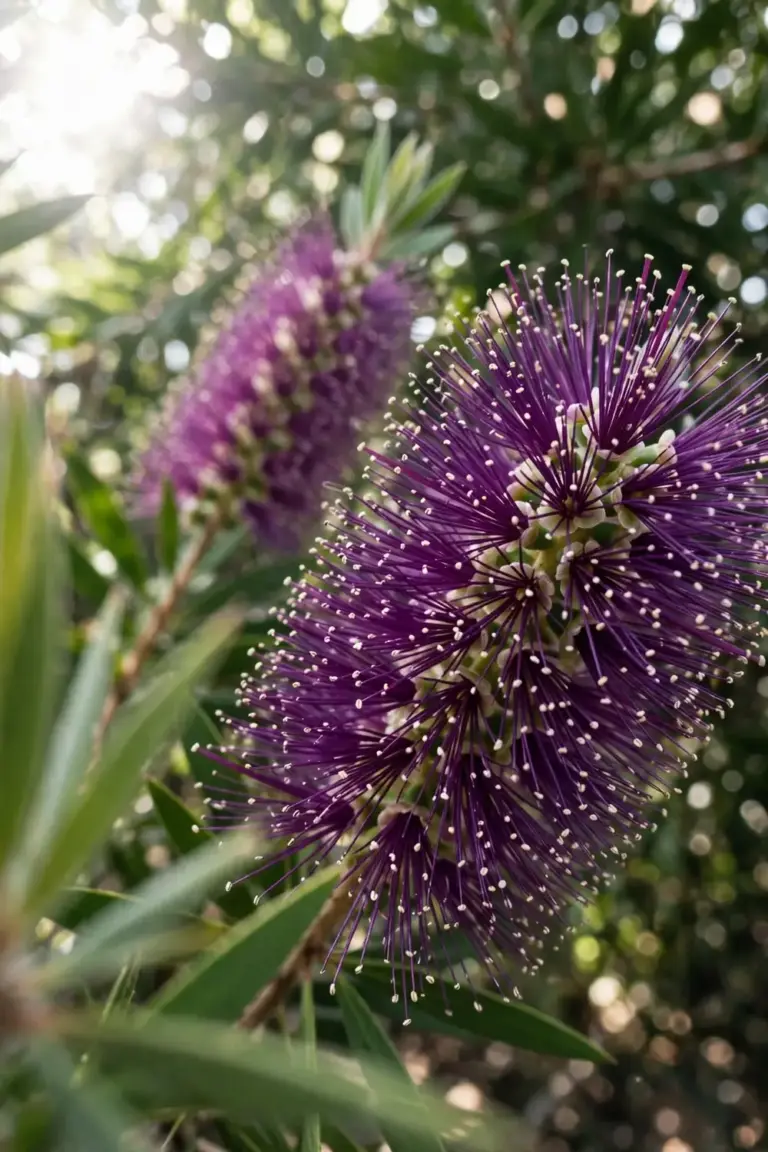
Purple Splendour Bottlebrush brings genuinely purple flowers to a compact 2m frame. Garden Clinic lists Purple Splendour as a spreading shrub with brilliant purple flowers in spring, repeating in autumn, at 2 m by 1.5 m. One nursery lists it at 3 m, so treat 2 to 3 m as the working range and prune to hold the size you want. The flowers read pink to mauve in some light, so buy in flower when you can.
Purple Splendour fails when you plant it for a red screen. Its color is the point, and a row of it reads purple, not red. Plant it as a color accent, not as a boundary hedge. Pair it with one red variety nearby, and the purple reads deeper against the red. Buy in flower when you can, since the shade of purple varies between plants. Plant it in full sun, and prune after flowering to hold the shape. Afternoon sun shows the purple at its best, and morning shade dulls it.
5. Candy Pink: The 2 to 3 m Pink Brush for a Softer Hedge
Candy Pink grows to 2 to 3 m, and it carries clear musk pink brushes on a mid-size shrub. That pink makes it the pick for a softer hedge or a pink drift beside red varieties.
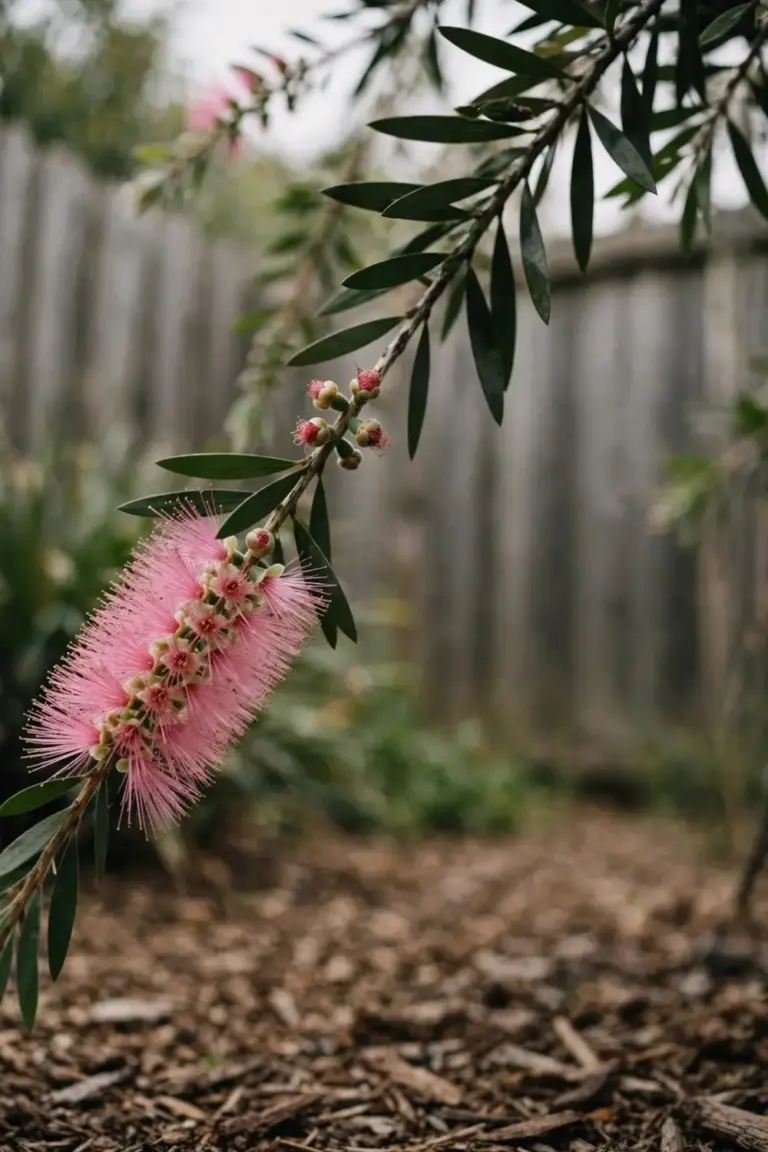
Candy Pink Bottlebrush carries clear musk pink brushes on a 2m to 3m shrub. Burke’s Backyard lists it as a medium shrub to 4 m with large dark pink brushes that flowers all year. The gap between the two figures is pruning: unpruned plants reach the top of the range, and a light prune after flowering holds the size in the table. The flowers sit well against dark green leaves.
Candy Pink fails in deep shade. Flowering drops. The pink fades to a thin show. Give it full sun, and it flowers through the year in warm areas. A light prune after flowering holds the size in the table and sets the next flush, and skipping that prune lets the plant drift toward the 4 m top of its range. Plant it beside one red variety, and the pink reads softer against the red. A drift of pink and red carries color longer than either alone, since the two rarely peak in the same week.
6. Endeavour: The 2.5 m Dense Red Shrub for a Fast Screen
Endeavour grows to 2.5 m tall and wide, and it carries long, brilliant red flowers on a hardy, dense shrub. That density makes it the pick for a fast screen or a mass planting that needs to look finished in a season or two.
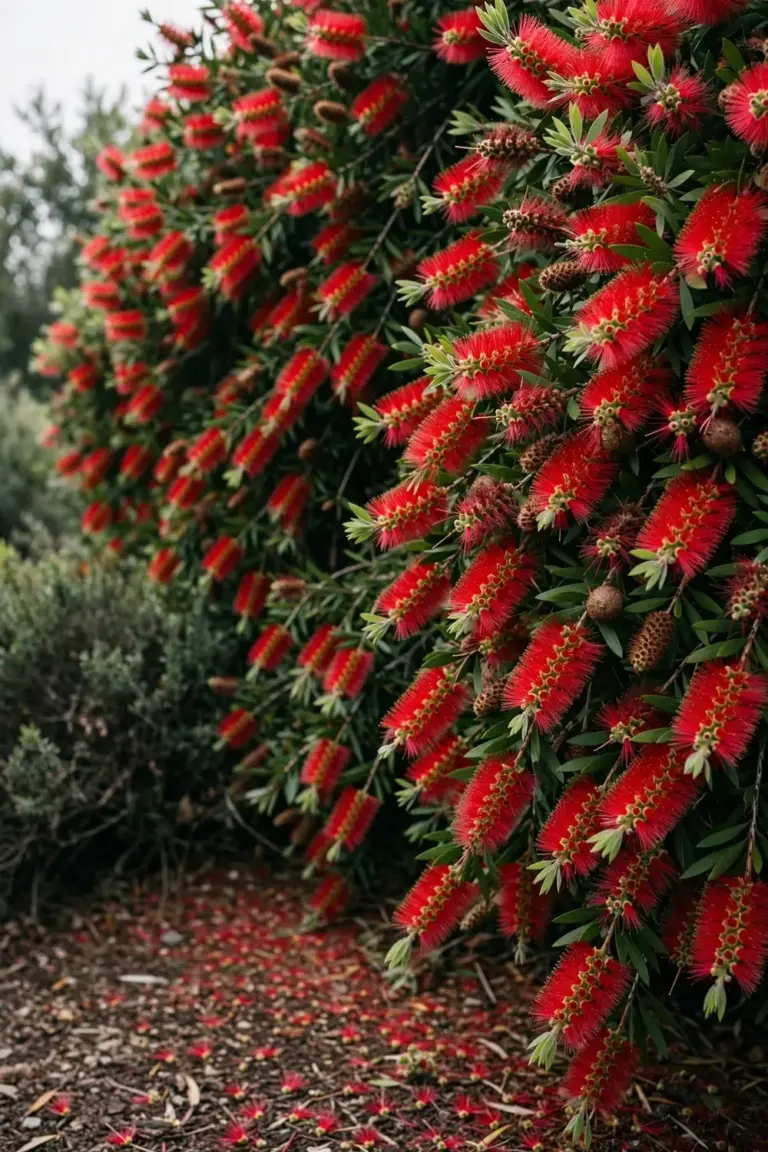
Burke’s Backyard lists Endeavour as a hardy dense shrub 2.5 m by 2.5 m with long brilliant red flowers. Daleys lists it at 2 to 3 m, with bright red brush flowers in autumn and spring, and notes that it responds well to pruning. The cultivar is also sold as Splendour, and it was promoted under the name Endeavour to mark the same 1970 bicentennial as Captain Cook. The two names mark one plant, so check the tag before you buy a second one.
Endeavour fails when you plant it and walk away. It grows fast, and fast growth goes leggy without a prune after flowering. Cut behind the spent flower head, and the shrub stays dense. One nursery lists it as a hedge and screening plant for a waterwise native garden, with crimson flowers from spring to summer that birds and insect pollinators love. It grows close to the coast, in well drained soil, and in full sun. That combination of speed, density, and wildlife value makes it the pick for a new garden that needs to look finished fast.
7. Mauve Mist: The 3 m Mauve Shrub for a Big Pastel Block
Mauve Mist grows to 3 m by 3 m, and it carries soft mauve pink brushes that age to lavender gray. That pastel color on a big frame makes it the pick for a large block where a red bottlebrush would dominate.
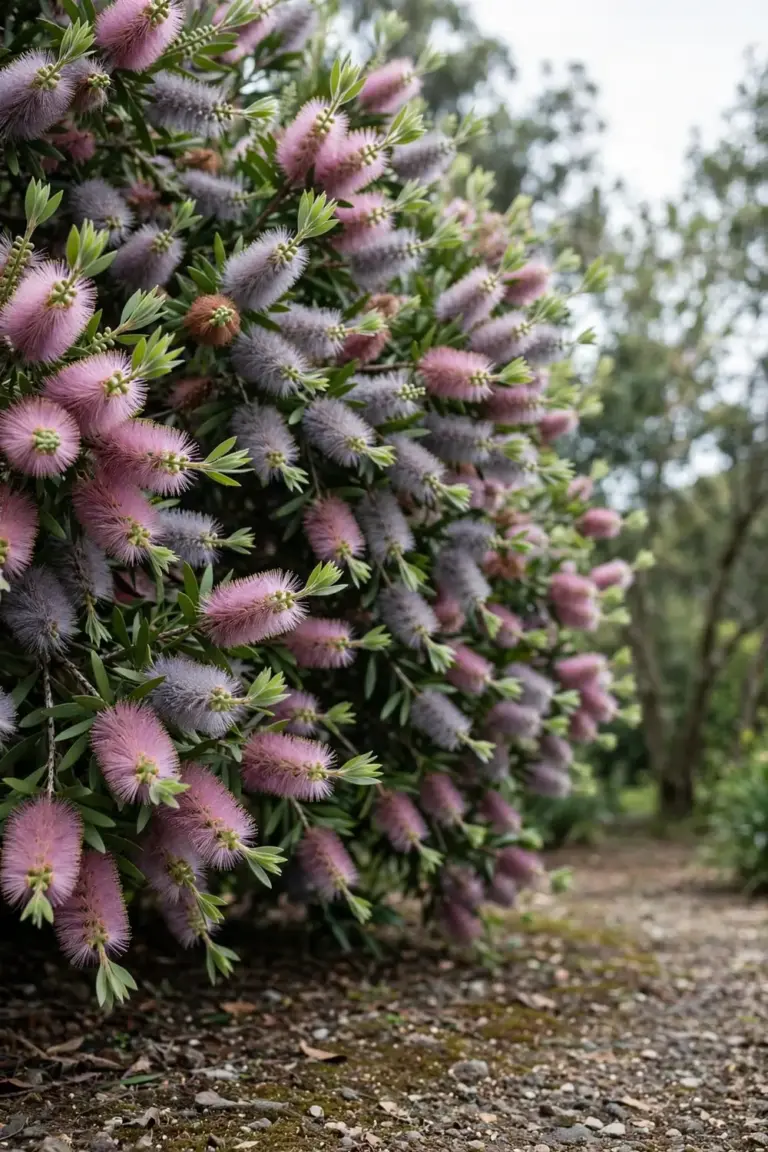
Garden Clinic lists Mauve Mist as a large dense shrub with silky green new foliage and mauve flowers in spring, at 3 m by 3 m. Nursery Near Me describes Mauve Mist Bottlebrush as rounding out the pastel end with soft mauve pink brushes that age to lavender gray. Plant two or three pastel varieties in a loose drift, and you get a staggered show, since the hybrids rarely peak in the same week.
Mauve Mist fails when you plant it in a small courtyard. It fills 3 m in each direction, and it crowds a path fast. Give it room, or pick Purple Splendour for the same color family at half the size. In a big block, plant two or three pastel varieties in a loose drift. The hybrids rarely peak in the same week, so the drift carries color longer than one variety alone. Its dense habit suits the same sheltering role the genus plays for small birds. Buy it where you can see the mauve flowers open, since the pastel shades vary between plants.
8. Slim: The 3 m Narrow Screen for Tight Beds
Slim grows to 3 m high and 1.3 m wide, and it keeps a narrow, upright habit that fits thin beds, fence lines, and driveways. That shape makes it the pick for a screen where a wide shrub will not fit. It also carries strong myrtle rust resistance, which matters for any Myrtaceae planting.
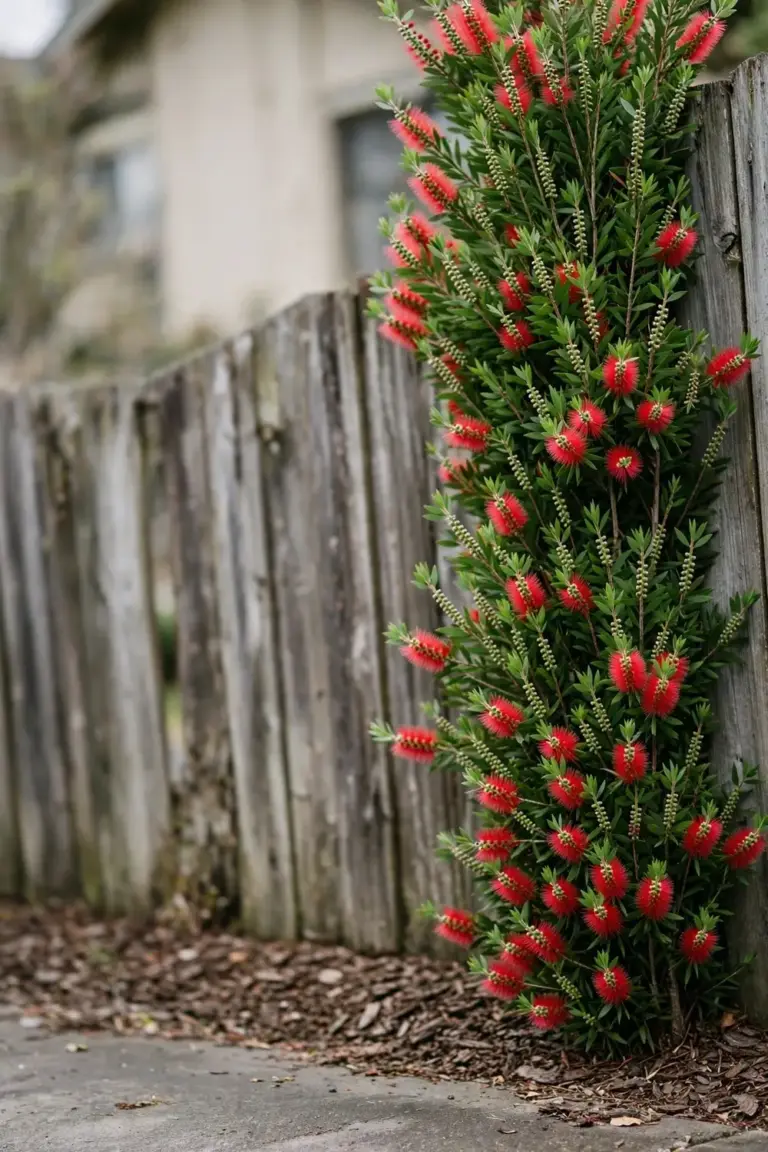
Height & Width: 3m high x 1.3m wide (unpruned), 1.5m high x 60cm wide (minimum pruning height and width, can be pruned wider and taller). Flowers: Red bottle brush flowers from September to November. Position & Tolerances: Full sun to part shade. Drought and frost tolerant. Tolerates radiated heat, so can be planted near tin sheds and fences. Highly Myrtle Rust Resistant. Planting Density: 1-1.5 plants per linear metre (1-3 plants per m²). Prune 1 to 3 times per year after flowering for a tidy hedge. Mulch holds moisture while the hedge settles, and the site’s guide to what is mulching covers depth and materials.
Slim fails when you plant it as a lone feature. Its narrow shape reads as a hedge plant, and one plant alone looks thin. Plant a run of them at the spacing above, and the screen reads as one wall of red flowers. Slim also tolerates radiated heat, so it suits a bed beside a tin shed or a fence where other shrubs scorch. It thrives across Queensland, New South Wales, the ACT, Victoria, Tasmania, South Australia, and Western Australia. Water as required for 8 to 13 weeks until established, then let rainfall carry it.
9. Kings Park Special: The 4 m Vigorous Shrub for a Clipped Screen
Kings Park Special grows to 3 to 4 m, and it clips into a dense informal hedge loaded with red flowers. That vigor makes it the pick for a flowering boundary you shape with secateurs.
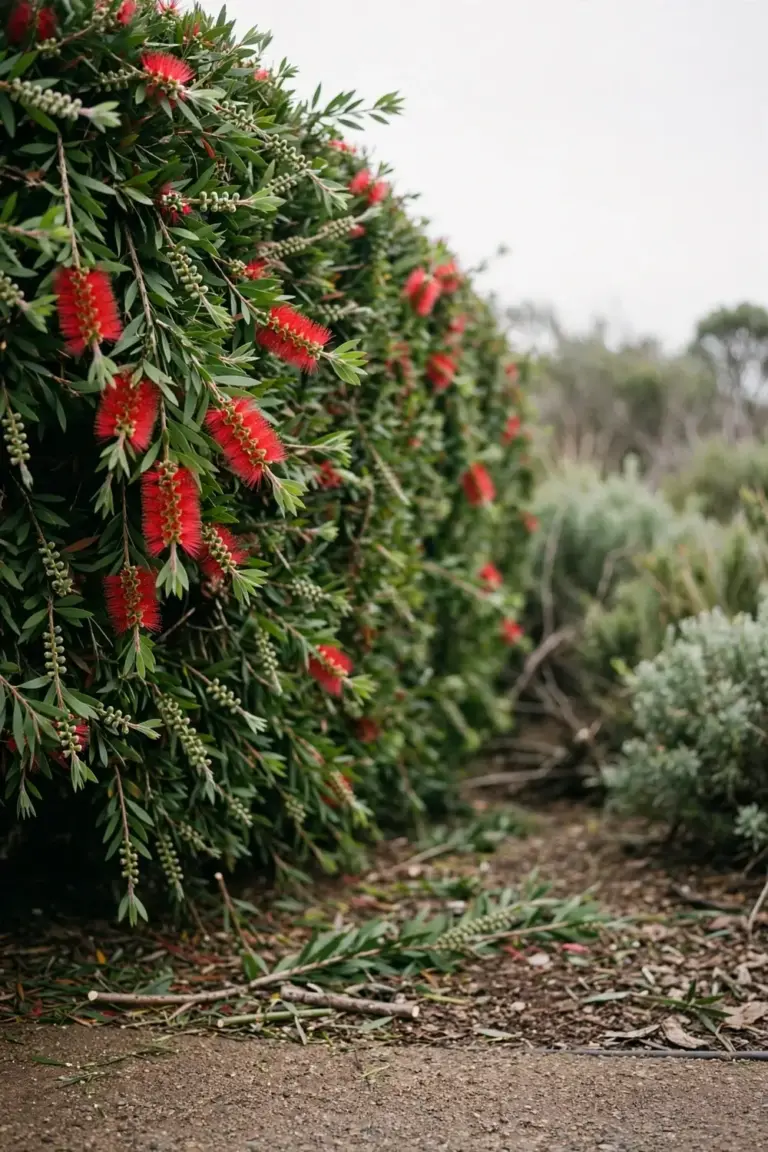
Kings Park Special Bottlebrush, from $17.95, is arguably the best screening bottlebrush in the country, a vigorous 3m to 4m shrub that clips into a dense informal hedge loaded with red flowers. The cultivar was raised as a seedling at Kings Park and Botanic Garden in Perth in the 1970s, and it suits exposed coastal gardens. It tolerates most soils, including very poor ones, and it prefers full sun. The site’s guide to building soil health covers how to lift a poor bed before planting.
Kings Park Special fails in a pot. Its open, spreading habit suits open ground. A pot constrains it. Plant it in the ground and give it room to reach its size, since a cramped plant never shows the crimson spikes that make it worth growing. One nursery guide calls it a great feature tree for small to medium gardens, with crimson spikes in spring and summer and slender green foliage in a neat, rounded shape. It needs little to no maintenance, and an occasional prune keeps leggy branches in check. Prune lightly after flowering to hold a clipped hedge, and the shrub answers with denser growth and a heavier flower show.
10. Hannah Ray: The 4 m Weeping Shrub for a Feature Tree
Hannah Ray grows to about 4 m, and it carries bright red flowers on long, weeping branches that arch and trail. That weeping habit makes it the pick for a feature tree or a soft screen, not a clipped hedge.
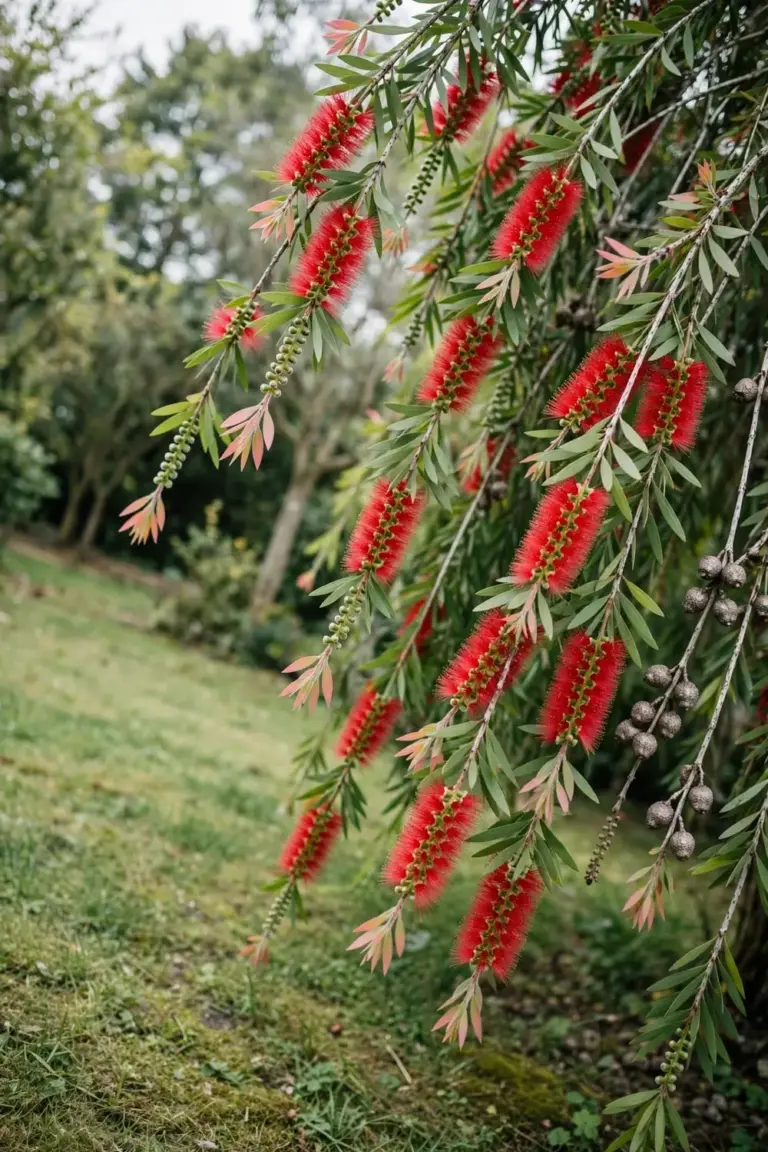
Bottlebrush sit alongside the other alternative hedging plants we recommend for a flowering boundary. For a softer look, Hannah Ray Bottlebrush is a graceful weeping form to around 4m that doubles as a small feature tree. The Aussie Green Thumb guide lists it at about 4 m tall and 2 m wide, with bright red flowers and long weeping branches. Burke’s Backyard lists it as a weeping 4 to 5 m shrub that flowers in spring and again in autumn. Prune after flowering to hold the shape, and the site’s spring pruning techniques cover the cut behind the spent flower head.
Hannah Ray fails when you clip it like a hedge. Hard clipping kills the weeping lines that make it worth planting. Prune lightly, keep the arching branches, and let the shape do the work. A large container can hold it at 1.5 to 2.5 m with light pruning just after flowering, which suits a courtyard that cannot take a 4 m tree. Young plants stay frost tender, so shelter them in their first winters. New leaf growth appears with pink tips, which adds a second season of color after the flowers fade. The type species colonises riverbanks and sandy riverbeds in Queensland and New South Wales, and the name viminalis points at its trailing, flexible branches. That riverbank habit explains why it loves a moist, well drained soil.
Frequently Asked Questions
Yes, if you pick a dwarf. Little John grows to about 1 m and suits pots, and Captain Cook at about 2 m suits a large pot. Slim also works in pots where space is tight. Kings Park Special and Hannah Ray need open ground, since their spreading habit fights a pot. Use a large pot with drainage holes, and water more often than in-ground plants.
Slim is the pick for a narrow hedge, at 1 to 1.5 plants per linear metre. Kings Park Special is the pick for a tall, clipped hedge at 3 to 4 m. Captain Cook is the pick for a dense hedge at 2 m. Prune after flowering, just behind the spent flower head, to keep the hedge dense and to set the next round of flowers.
Yes, better than most shrubs. Callistemons tolerate waterlogged soil, and several nursery guides list wet tolerance as a selling point. A soggy downpipe corner suits them, and they also handle coastal exposure and poor soils. They still fail in soil that stays waterlogged for weeks without draining, so check that water moves through the bed. Mulch helps too, since it holds moisture and keeps the soil cool between waterings.
Myrtle rust is a fungal disease that attacks Myrtaceae plants, and it has spread through eastern Australia. Slim carries high myrtle rust resistance in breeder trials, which makes it the safest pick where the disease is active. Other varieties vary, so check the breeder’s resistance rating before you buy. The site’s guide to attracting beneficial insects covers the pollinators that visit bottlebrush flowers.
Both names point at the same plants. Nurseries sell them as callistemon, and that is the name on the tag. Botanists moved most of them into Melaleuca, so databases and botanical references may list the Melaleuca name. Use the cultivar name in single quotes to match the plant, since the genus on the tag may differ between sellers.
Start With the Job, Then Pick the Best Callistemon Varieties
Start with the job, not the flower. Measure the space, name the job, and pick from the table. A pot gets Little John, because a 1 m dwarf stays in bounds. A narrow bed gets Slim, because 1.3 m of width fits where a wide shrub will not. A tall screen gets Kings Park Special, because 3 to 4 m of vigor fills a boundary fast. A feature tree gets Hannah Ray, because the weeping branches carry the garden. A pastel block gets Mauve Mist or Purple Splendour, because their color reads as different at first glance.
Check the tag before you pay. The cultivar name sits in single quotes, and the true-to-type plant comes from cuttings. Seed-grown plants vary, and a seed-grown Captain Cook may not match the plant you picked. The flower color follows the job, and the plant fits the space it was picked for.
Buy in flower when you can. The tag promises a color, and the open brush proves it. Purple Splendour reads pink to mauve in some light, and Candy Pink varies between plants. A flowering plant in the nursery row settles the question before the plant reaches your garden.
Skip the seed packet. Bottlebrush cultivars come true only from cuttings, and a seed-grown plant may not match the name on the packet. Buy a named plant, check the cultivar name in single quotes, and keep the tag until the plant flowers.