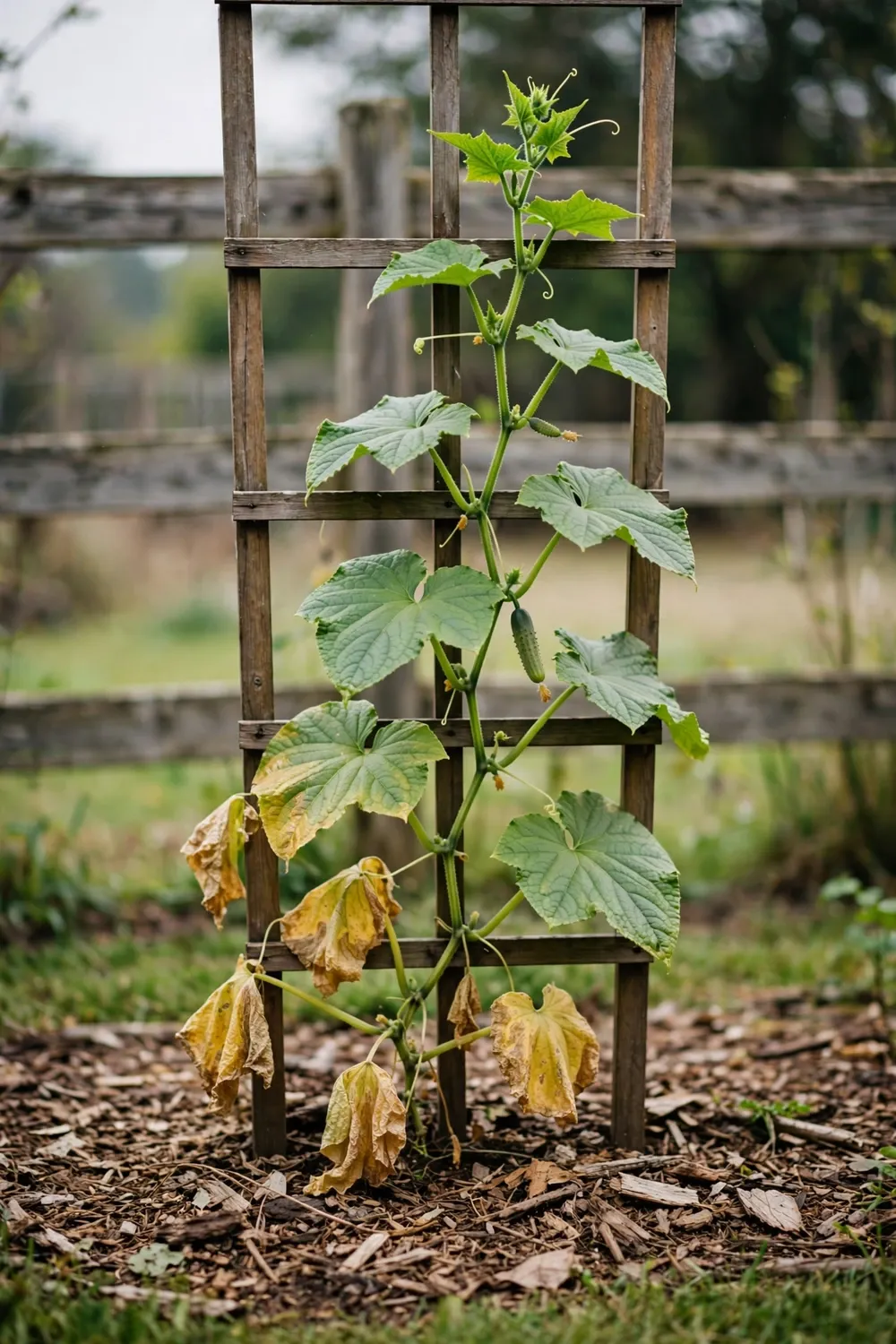

Why are my cucumber leaves turning yellow? 9 causes sit behind that question, and the pattern on the leaf names the one you face. Match the pattern first. Treat second.
I have learned that a vine with wet feet yellows from the base up, and a hungry vine yellows from the bottom leaves first. The rest of this page runs a pattern key, then one cause at a time, then the habits that keep the next vine green.
Yellow leaves do not turn green again. New growth shows whether the fix worked. Work through the key before you reach for fertilizer.
Read the Pattern Before You Reach for Fertilizer
The pattern tells you where to start. Find the row that matches your vine, then read that cause in full.

| Pattern | Likely Cause | First Move |
|---|---|---|
| Whole vine pale, older leaves first, soil wet | Overwatering | Stop watering and let the top soil dry |
| Whole vine pale, older leaves first, soil dry | Underwatering | Water deep at the base |
| Uniform yellow on older leaves, pale vine | Nitrogen shortage | Feed a balanced fertilizer at label strength |
| Yellow scorched edges on older leaves | Potassium shortage | Feed a balanced fertilizer at label strength |
| Yellow between green veins on older leaves | Magnesium shortage | Feed a balanced fertilizer with magnesium |
| Yellow between green veins on young leaves | Iron shortage | Check soil pH and test the soil |
| Fine stippling, insects on leaf undersides | Pests | Hose off the insects and check weekly |
| Angular yellow patches, gray fuzz under the leaf | Downy mildew | Improve airflow and remove the worst leaves |
| Irregular mosaic, twisted leaves and fruit | Mosaic virus | Remove and bag the plant |
| White powder on the upper leaf surface | Powdery mildew | Treat it as its own disease |
| A few old lower leaves only, vine fruits well | Normal ageing | Leave them alone |
Three checks settle most cases. First, push a finger into the soil beside the vine and feel for moisture. Second, turn a few leaves over and look at the undersides for insects, webbing, or mold. Third, note which leaves yellowed first: old leaves point to water, nitrogen, potassium, or magnesium, while young leaves point to iron.
Two causes can overlap. A bed that stays wet for days can starve the roots and lock out nutrients at the same time, so the vine shows wet soil and pale leaves together. Fix the water first. A vine that drains well and still yellows needs the nutrient checks that follow.
Check the fruit too, because fruit shape confirms what the leaf pattern suggests. Slender, pinched fruit points to nitrogen shortage. Malformed fruit points to potassium shortage or mosaic virus. Spotted or streaked fruit points to virus, and a vine with virus fruit needs the mosaic section next.
A vine that wilts though the soil is moist, with yellow leaves and no recovery overnight, may carry bacterial wilt. Cut a stem and look for sticky sap. No cure exists for bacterial wilt. Pull the vine and bin it.
Timing adds one more clue. Yellowing that appears in the first weeks after transplant points to water or transplant shock, because the roots have not settled yet. Yellowing that appears late in the season, after weeks of heavy fruiting, points to a nutrient shortage, because the vine has spent what the bed held. A vine that yellows all at once after a storm points to waterlogging or a disease that rode in on the rain. A vine that yellows from the top down, with young leaves first, needs the iron section.
1. Overwatering: Yellow From the Base Up in Wet Soil
Overwatering yellows a cucumber vine from the base up, in soil that stays wet. Roots in soggy soil run short of oxygen. The vine wilts though the soil feels wet.
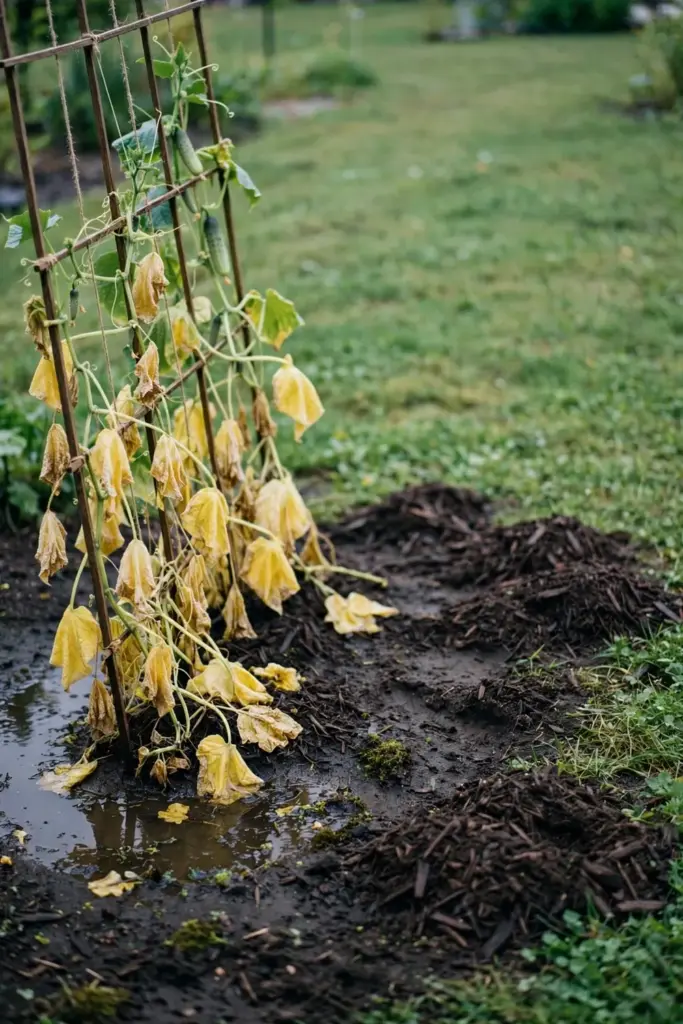
Push a finger 5 cm into the soil beside the vine. Wet soil at that depth means the vine has enough water. Soft yellow leaves low on the vine, plus a sour smell from the soil, point the same way. The vine may wilt in the afternoon and stay wilted after dark, which separates overwatering from a hot day.
Stop watering until the top soil dries. Water at the base in the morning, so the leaves dry fast. A drip line or a soaker hose keeps water on the roots and off the leaves. Mulch holds moisture steady between waterings. Building soil health keeps the bed draining instead of sealing into a pan.
A bed that stays wet after rain needs drainage work. Raise the bed with extra compost and soil. Loosen compacted soil before planting. Pots need drainage holes, and saucers need emptying after watering. Cucumbers drink a lot in fruiting season, yet they still hate wet feet.
Pots punish overwatering faster than beds. A pot holds a small soil volume, so a saucer of standing water keeps the whole root zone wet. Tip the pot after watering and empty the saucer. A bed forgives one heavy watering, but a pot does not. If the potting mix smells sour, repot into fresh mix and hold off water until the top dries.
Overwatering and underwatering look alike at first, because both wilt the vine. The soil test separates them in seconds. Wet soil means too much water, so let the bed dry. Dry soil means too little, so water deep at the base.
2. Underwatering: Dry Edges and Wilting in Dry Soil
Underwatering yellows the oldest leaves first, and the leaf edges turn dry and crisp. The vine drops its oldest leaves to save water for the growing tip.
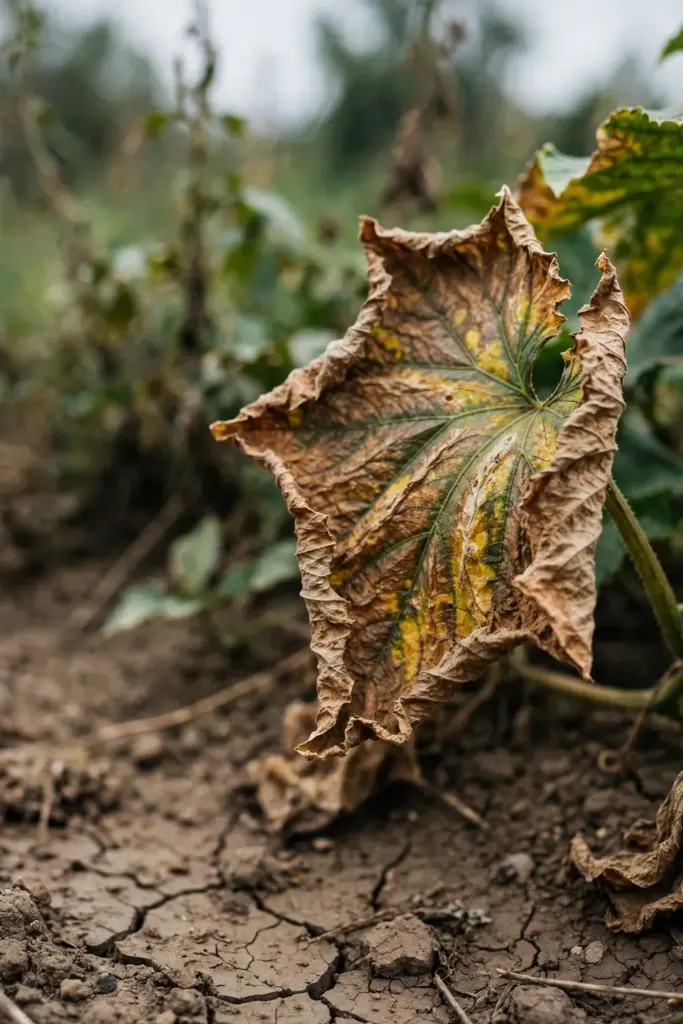
Check the soil the same way. Dry soil at 5 cm means the vine needs water now. Leaves wilt in the afternoon heat and recover after watering. Leaf edges crisp and brown, while the veins stay green longer. Fruit stops sizing, and new flowers drop.
Water deep at the base until the soil feels damp 15 cm down. A shallow sprinkle wets the surface and leaves the roots dry. What is mulching shows how a mulch layer slows surface drying between waterings. Water in the morning. Evening watering leaves leaves wet overnight, and wet leaves invite mildew.
Afternoon wilt on a hot day does not always mean thirst. Check the soil first. A vine that perks up after dark had heat wilt, not drought. A vine that stays wilted into the morning needs water. Pots dry faster than beds, so check pots daily in summer.
Underwatering and potassium shortage both crisp the leaf edges. Dry soil points to water. Moist soil with scorched edges points to potassium.
A vine in a dark pot in full sun dries faster than a vine in a bed. Move pots to afternoon shade in a heatwave. A bed vine in full sun still needs deep water, but the bed holds moisture longer than any pot.
3. Nitrogen Deficiency: Uniform Yellow on Older Leaves
Nitrogen shortage turns a cucumber vine pale from the oldest leaves upward. Nitrogen moves inside the plant, so the vine pulls it from old leaves to feed new growth. The whole vine looks pale, and growth slows.
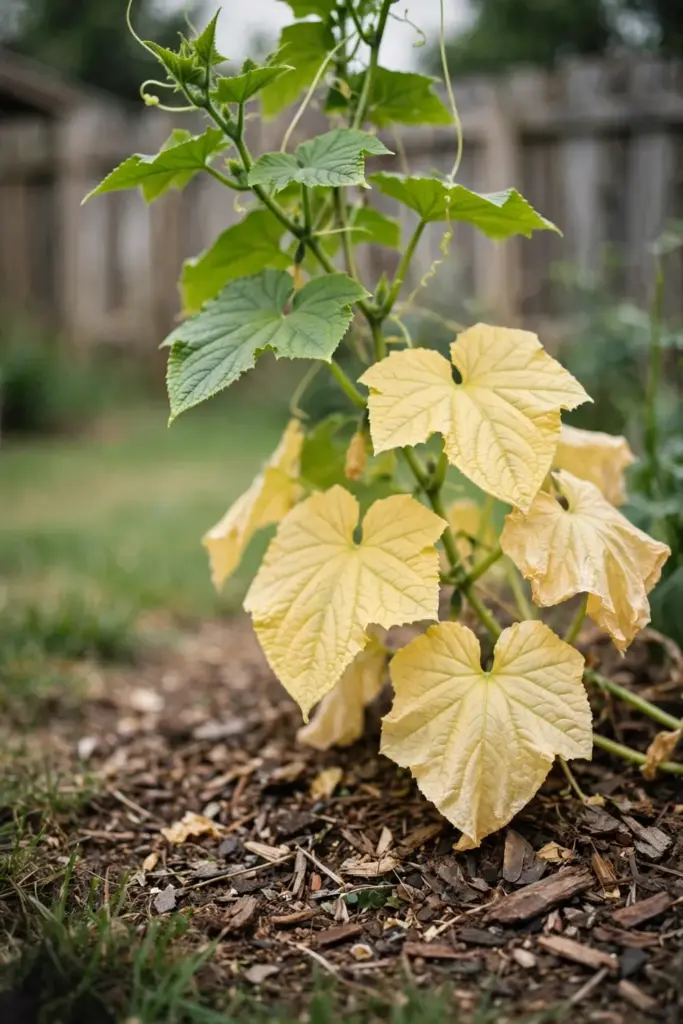
Old leaves yellow evenly, then die early. The vine stays small, with few flowers and poor fruit set. Fruit grows slender and pinched at the blossom end. Fresh straw mulch can make the shortage worse, because soil microbes lock up nitrogen while they break the straw down, according to the Australian cucurbit field guide.
Feed a balanced fertilizer at label strength. Compost worked into the bed before planting carries the vine through the early weeks. A liquid feed reaches a hungry vine faster than a dry one. Feed through the fruiting season, because cucumbers fruit hard and eat hard.
A soil test tells you what the bed holds before you feed blind. Many beds carry enough phosphorus and potassium, and run short of nitrogen alone, so a blind feed can push the wrong nutrient over the top. Side-dress with compost mid-season. Compost tops up nitrogen gently, without flooding the bed with the nutrients it already holds.
Nitrogen shortage and overwatering both pale the whole vine. Wet soil points to water. Dry soil with uniform yellowing on old leaves points to nitrogen.
4. Potassium Deficiency: Scorched Edges on Older Leaves
Potassium shortage scorches the edges of older leaves and curls the leaf tips. Yellowed, scorched areas form around the leaf margins and between the veins. Brown, dead areas follow, mainly on the older leaves.
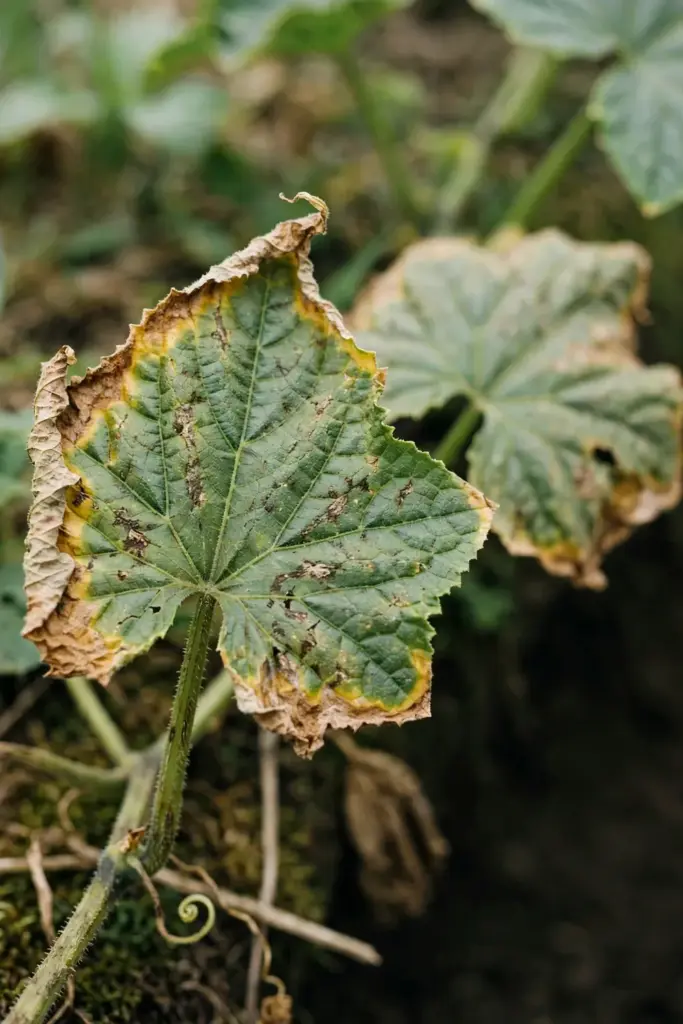
The vine stays short and stunted while fruit grows malformed, and leaf tips curl as the damage spreads inward from the margins over days. The curl starts at the tip and runs down the edge. By the time the margin browns, the shortage has run for a while.
The pattern looks like sun scorch at first. Sun scorch hits the leaves that face the sun. Potassium shortage hits the older leaves all over the vine, in sun and shade alike.
Feed a balanced fertilizer at label strength. Compost adds potassium slowly through the season. Avoid heavy potassium doses on their own, because excess potassium cuts the uptake of calcium and magnesium. A soil test settles the question when two shortages look alike.
Potassium shortage and sun scorch both burn leaf edges. Sun scorch hits sun-facing leaves. Potassium shortage hits older leaves across the vine.
5. Magnesium Deficiency: Yellow Between Veins on Older Leaves
Magnesium shortage yellows the tissue between the veins on older leaves, starting at the leaf margins and moving inward. The veins stay green while the tissue between them fades. The pattern shows late in the season, on the older leaves first.
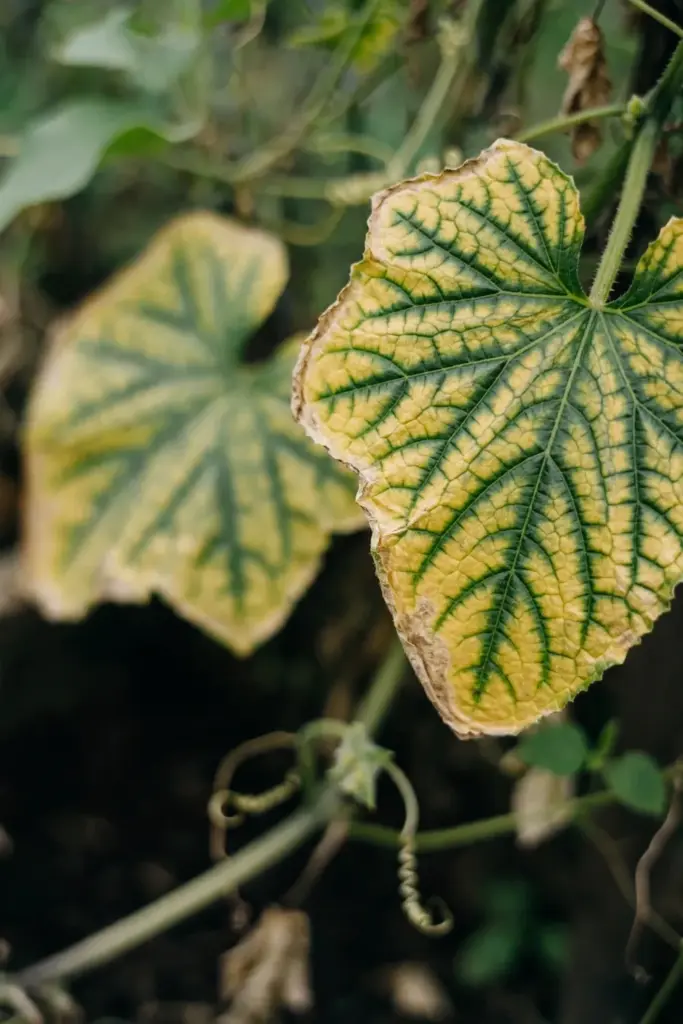
Leaves can turn fully yellow and die if the shortage runs on. Fruit yield usually holds, because the shortage arrives after the vine has set most of its fruit. The margin-inward pattern separates magnesium shortage from iron shortage, which shows on young leaves.
Feed a balanced fertilizer that carries magnesium. A soil test confirms the shortage before you add anything. Dolomite lime lifts both magnesium and soil pH, so use it only when a test shows the soil needs both. Epsom salts supply magnesium fast, at label strength, as a short fix while the soil test comes back.
Magnesium shortage often arrives late in the season, when the vine has already set most of its fruit. A mid-season soil test catches it before the leaves fade. Compost in the bed before planting keeps magnesium available through the season.
Magnesium and iron shortage both yellow the tissue between the veins. Old leaves point to magnesium. Young leaves point to iron.
6. Iron Deficiency: Yellow Between Green Veins on Young Leaves
Iron shortage yellows the tissue between green veins on young leaves, while older leaves stay green. Iron does not move inside the plant, so the vine cannot pull it from old leaves to feed new growth. New leaves show the shortage first.
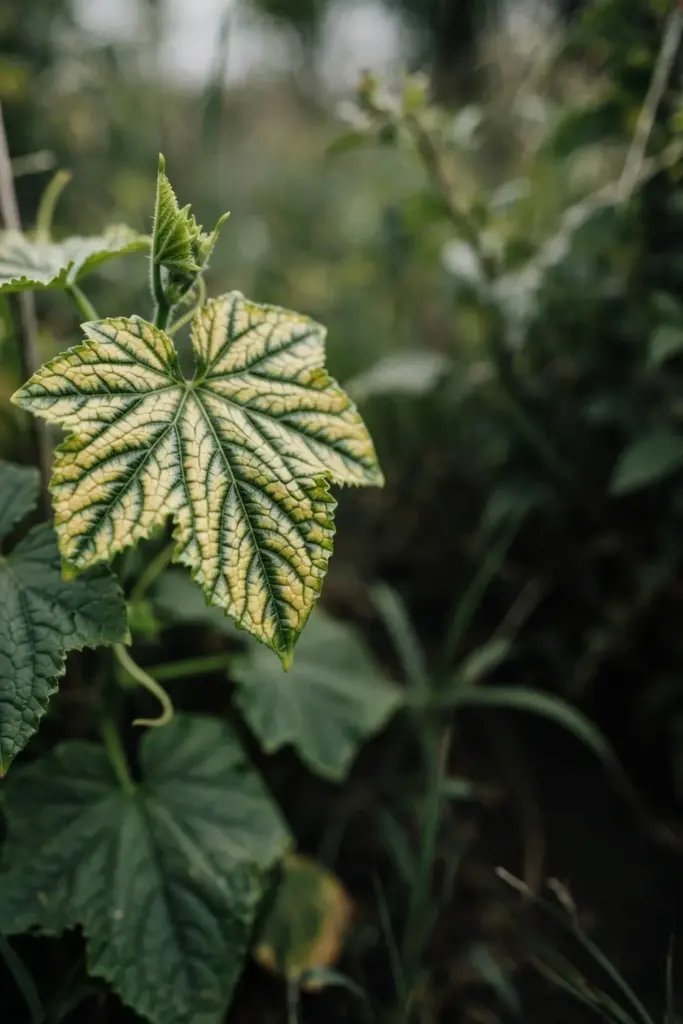
Young leaves turn pale yellow-green between veins that stay sharply green. The pattern can look dramatic while the rest of the vine still looks healthy. Alkaline soil locks iron away even when the soil holds plenty of it, so the fix starts with the soil, not the leaf.
Test the soil pH and the soil nutrients. Chelated iron, applied at label strength, greens new growth when iron is the true shortage. Fixing the soil pH gives a lasting answer, while a foliar spray gives a fast one. A manganese shortage shows a similar pattern on young leaves, and a soil test separates the two.
Watering with very alkaline water can push soil pH up over a season. Test the water source too when iron shortage keeps returning. Compost in the bed buffers pH and keeps iron available to the roots.
Iron and manganese shortage both yellow young leaves between green veins. A soil test separates them. Fix the soil pH first, because pH locks both nutrients away.
7. Pests: Stippling, Honeydew, and Chewing on the Vine
Sap-sucking pests stipple cucumber leaves yellow and leave honeydew, webbing, or insects on the leaf undersides. Aphids cluster on growing tips and under leaves. Two-spotted mites spin fine webbing and stipple the leaf surface. Whitefly clouds lift off the leaf when you brush it. Cucumber beetles chew leaves and flowers, and they spread bacterial wilt, which wilts a vine and has no cure.
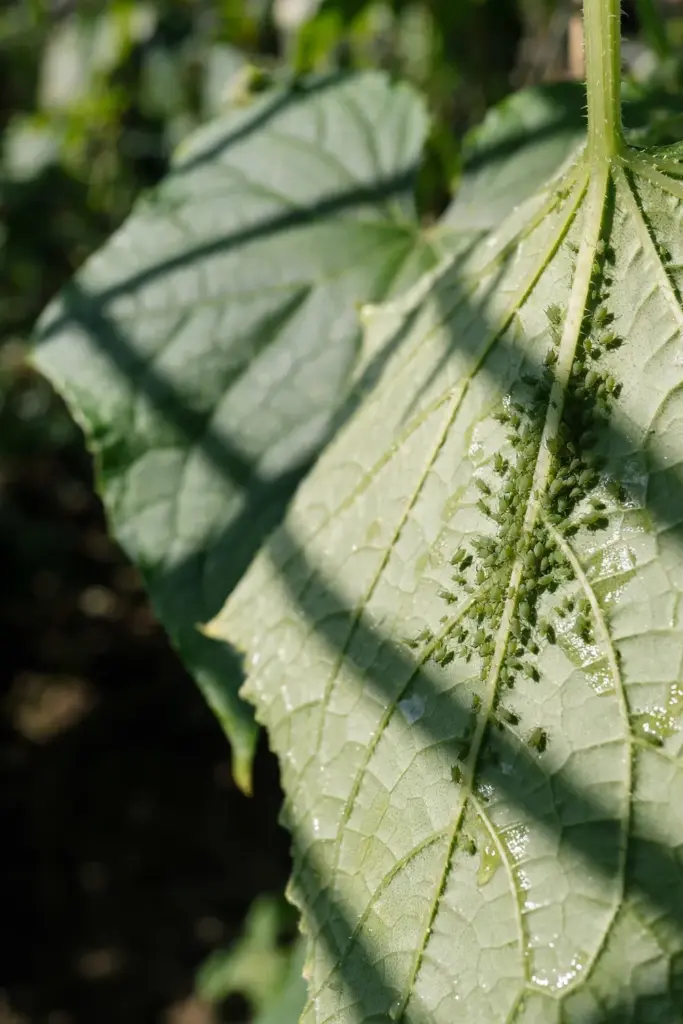
Turn every leaf over. The underside carries the evidence: aphid clusters, mite webbing, whitefly nymphs, or beetle feeding marks. Honeydew on the leaves means sap-suckers feed above it. Stippling without insects points back to a nutrient cause, so check the undersides before you spray anything.
Hose the insects off with a strong jet of water. Soap spray or neem oil, applied at label strength, handles a heavy infestation. Spray in the cool hours, never in full sun, and keep the spray off open flowers so bees stay safe. Companion planting for pest control and organic pest control cover the predator and barrier options that keep pest numbers down without sprays.
Check the undersides once a week through the season. A weekly check catches aphids, mites, and whitefly while the numbers stay small. Pick off the worst leaves and bin them. A clean vine with good airflow keeps pest numbers lower than a crowded vine in still air.
Pest stippling and nutrient yellowing both speckle the leaf. Insects, webbing, or honeydew on the underside point to pests. A clean underside points back to nutrients or water.
Ladybirds and hoverflies eat aphids. Leave a few flowering herbs near the bed to feed them. A spray that kills aphids also kills the predators that eat them, so use water first and spray last.
8. Downy Mildew: Angular Yellow Patches With Gray Undersides
Downy mildew paints angular yellow patches on cucumber leaves, bounded by the veins, with soft gray mold on the undersides. The patches start on older leaves. They enlarge, dry out, and turn brown. The vine loses leaves fast in wet weather.
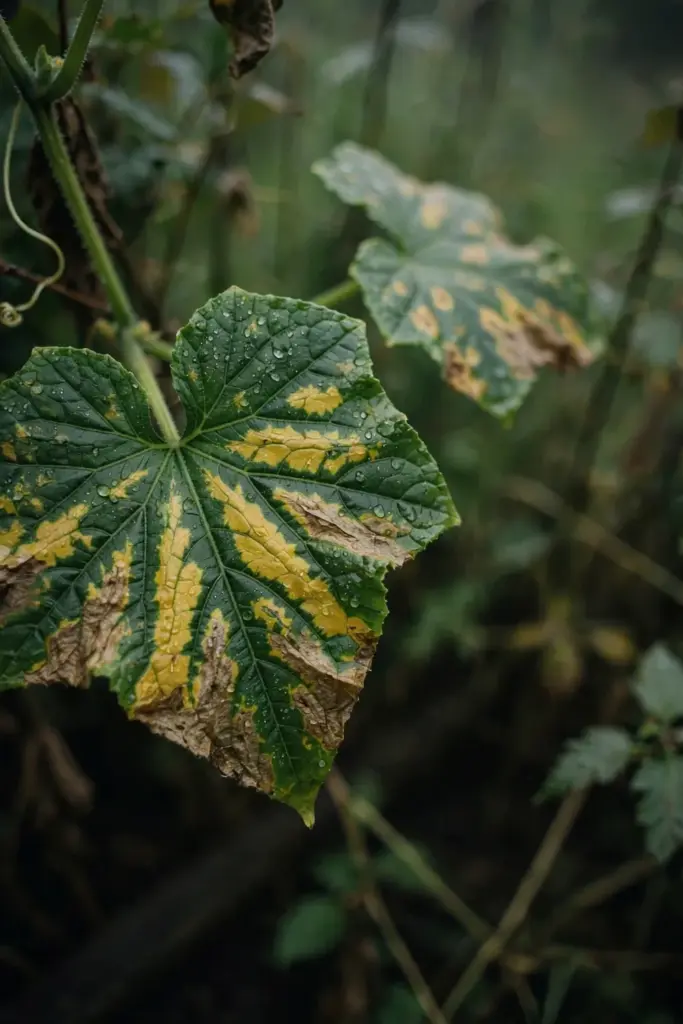
Flip a suspect leaf in the morning, while dew still sits on it. A soft whitish or gray mold on the underside confirms downy mildew. The disease favours cool, moist conditions and spreads on wind and splashing water, according to the NSW DPI cucurbit disease guide. Angular leaf spot looks similar, and a lab test separates the two.
Improve airflow first. Trellis the vine so leaves dry fast after rain. Water at the base with drip or a soaker hose, never overhead. Remove the worst leaves and bin them, never compost them. A fungicide, applied at label strength, protects healthy leaves when the weather stays wet. Spray early, before the disease covers the vine, because fungicide protects clean leaves and does not cure dead ones.
Choose resistant varieties next season when downy mildew hits hard. Clear old vines at the end of the crop, and rotate cucurbits to a fresh bed. The spores ride on wind and crop debris, so a clean bed and a trellised vine give the next crop a clear start.
Downy mildew and angular leaf spot both mark the leaf with angular patches. Gray mold on the underside points to downy mildew. A lab test settles the case when the underside stays clean.
Downy mildew moves fast in a run of cool, damp nights. One infected leaf can seed the whole vine in days, because spores ride on wind and splashing water. Check the vine after every rainy spell. Early removal of the first spotted leaves slows the spread more than any spray applied after the vine is covered.
9. Mosaic Virus: Mottled Leaves and Twisted Growth With No Cure
Mosaic virus mottles cucumber leaves yellow and green, twists the growth, and has no cure. Leaves pucker and distort. The vine stunts. Fruit grows misshapen, spotted, or streaked. The pattern spreads leaf by leaf, and no spray reverses it.
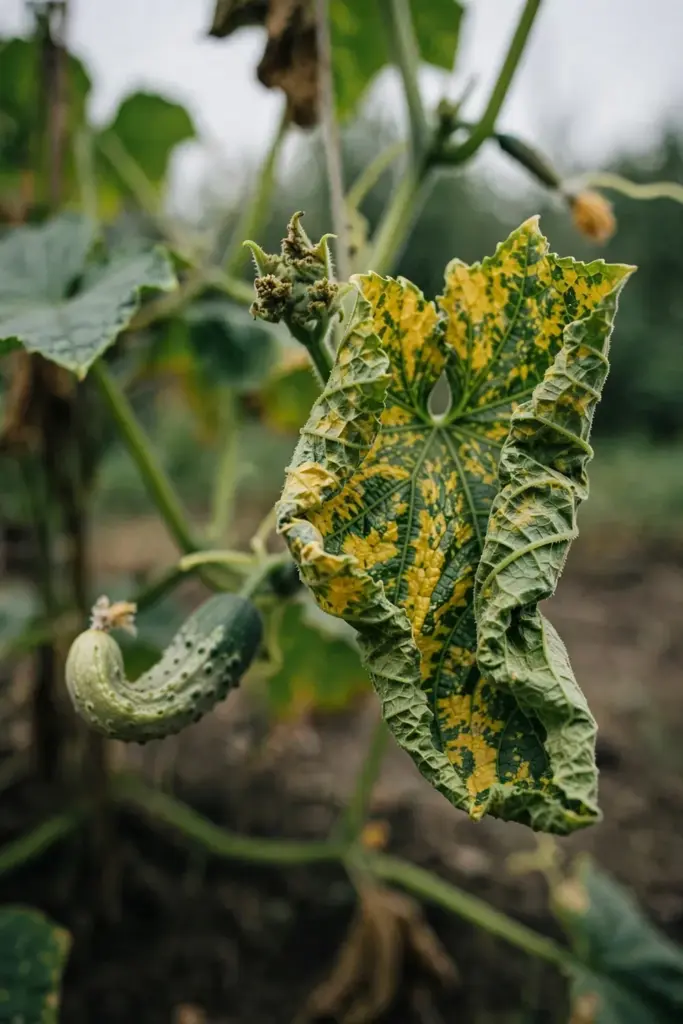
Aphids carry cucumber mosaic virus from plant to plant as they feed, and an infected plant has no effective treatment, according to Utah State University Extension. Cucumber green mottle mosaic virus shows vein clearing, mottled yellowish crumpled leaves, and spotted or distorted fruit, and it spreads through infected seed and contact. The same Australian guide notes that Kyuri green mottle mosaic virus and zucchini green mottle mosaic virus are not present in Australia.
Pull the infected plant and bag it. Clean tools after handling it. Control aphids on the remaining vines. Buy certified disease-free seed and choose resistant varieties next season. Report anything that looks unusual to the Exotic Plant Pest Hotline on 1800 084 881.
Never save seed from an infected vine. Seed carries CGMMV into the next season. Weeds around the bed can carry viruses too, so keep the bed edges clean. A virus in one vine becomes a virus in the whole bed when aphids move through, so act on the first mottled leaf.
Mosaic virus and nutrient shortage both mottle the leaf. Twisted growth and misshapen fruit point to virus. A vine that keeps pushing straight new growth points to nutrients.
Aphid control is the only lever against cucumber mosaic virus, because no treatment cures an infected plant. A jet of water knocks aphids off the growing tips. Soap spray handles a heavy colony. Keep weeds down around the bed, because weeds carry viruses and feed the aphids that move them. A clean bed edge, a weekly leaf check, and a quick hose-down at the first aphid colony keep the virus pressure low through the season.
Keep the Next Vine Green: Water, Feed, and Airflow
Prevention runs on three habits: water at the base, feed through the season, and give the vine air. Water in the morning with drip or a soaker hose. Mulch holds moisture steady and keeps soil off the lower leaves. Trellis the vine so leaves dry fast and pests show early.
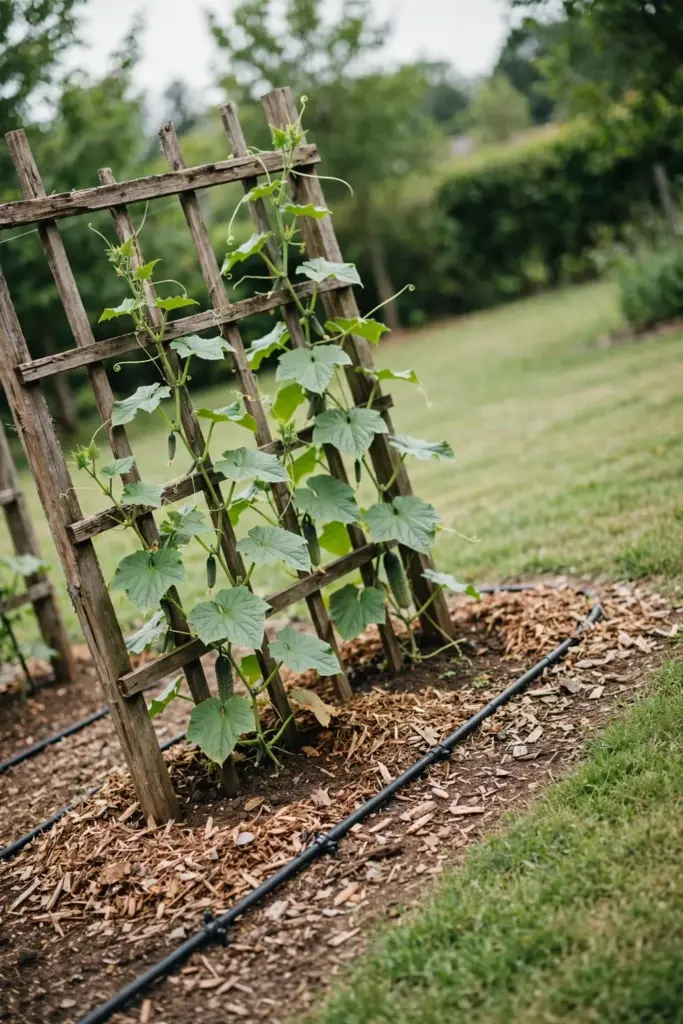
Feed the vine through the fruiting season with a balanced fertilizer at label strength. Compost in the bed before planting carries the early weeks. Rotate cucurbits to a fresh bed each season, and clear old vines at the end of the crop. Check leaf undersides once a week. A weekly check catches aphids, mites, and mildew while the fix stays small.
Start the bed right. A raised bed with compost drains well and feeds steady. A trellis lifts the vine off the soil, where leaves dry fast and mildew struggles to settle. Space the vines so air moves between them. Crowded vines stay wet longer, and wet leaves invite disease.
Plant the next crop in a fresh bed, with certified seed and a trellis ready before the vine runs. A clean start beats a rescue. The vine that starts clean, watered at the base and fed through the season, rarely needs the diagnosis key at all.
End-of-season cleanup matters as much as the start. Pull spent vines and bin them. Spores and virus survive in crop debris over winter. Rest the bed or plant a different family next season. A fresh bed with compost, a trellis, and certified seed gives the next vine the clean start it needs.
Frequently Asked Questions About Cucumber Leaves Turning Yellow

Nine causes sit behind yellow cucumber leaves: too much water, too little water, nitrogen, potassium, magnesium, or iron shortage, pests, downy mildew, and mosaic virus. The pattern names the cause. Whole-vine yellowing points to water or nitrogen. Yellow between green veins points to magnesium on old leaves or iron on young leaves. Angular patches point to downy mildew. Mosaic and twisted growth point to virus.
Yellow leaves do not turn green again. The damage stays on the leaf even after the fix works. Watch the new growth instead. Fresh leaves that open green and stay green show the vine has recovered. Old yellow leaves can stay on the vine until they drop, or you can pick them off to let light reach the healthy leaves.
Fruit that looks normal is fine to eat. Wash every cucumber before eating. Fruit from a virus-hit vine may grow misshapen or taste bitter, so compost it. Fruit from a mildew-hit vine stays safe when it looks normal, because mildew attacks leaves, not fruit. When in doubt, compost the fruit and keep the healthy vines fruiting.
Powdery mildew and downy mildew are two different diseases. Powdery mildew shows as white, diffuse powder on the upper leaf surface. Downy mildew shows as angular yellow patches bounded by veins, with dark gray fuzz on the underside in humid weather, according to University of Minnesota Extension. The two need different treatments, so name the disease before you treat it.
Pull the plant when mosaic virus is confirmed, because no treatment cures a virus and aphids spread it to healthy vines. Pull the plant when the vine has collapsed and no healthy leaves remain. Keep a vine that still pushes green new growth, and fix the cause behind the yellowing. A vine that keeps fruiting after the fix earns its place.
Start With the Pattern, Then Fix the Cause
Yellow cucumber leaves ask for a diagnosis, not a guess. Read the pattern. Name the cause. Apply the fix that matches it. The vine answers in new growth, and new green leaves mean the fix worked.
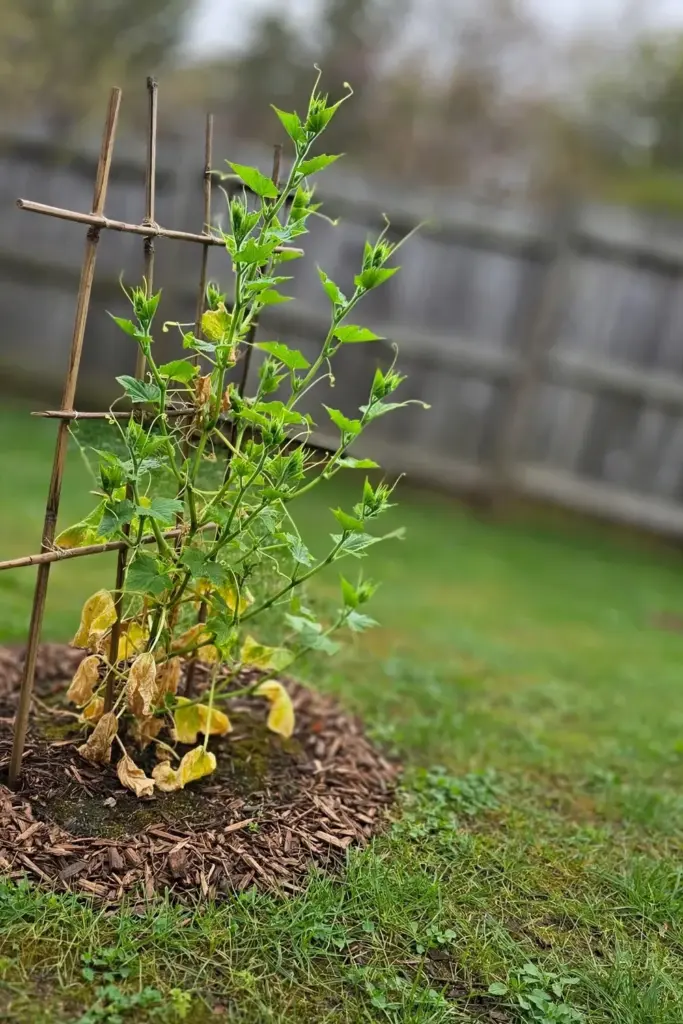
Keep the key handy through the season. A quick check of soil, undersides, and leaf age settles most yellowing in a few minutes. A few minutes with the key beats a season of guessing. The vine that keeps pushing green new growth earns its place, and the vine that shows mosaic earns the bin.