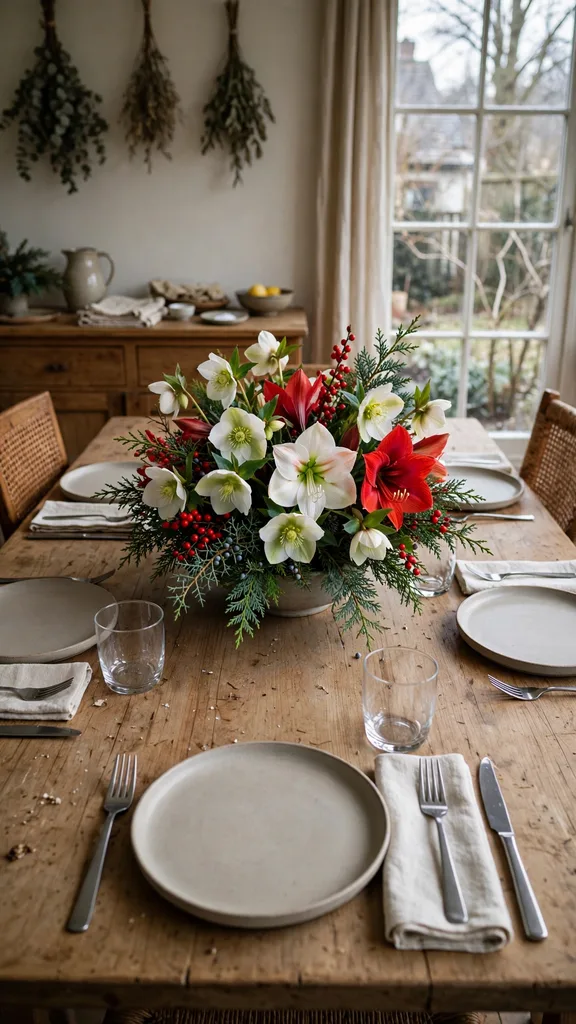
Christmas floral arrangements from the garden work with what December actually offers: a short list of true winter blooms, a long list of evergreen cuts, and the whole dried harvest from summer standing in jars. These 45 arrangements are organized by that material, fresh blooms first, then evergreen cuts, dried flowers, color-led mixes, and finally the vessels and places that show them best. Every arrangement here can be built from a garden, a hedgerow you have permission to cut, and a vase you already own.
The method underneath all 45 is the same. Cut in the morning, condition stems in water for a few hours before arranging, keep finished arrangements cool and out of direct sun, and top up or change the water every two days. Fresh arrangements built this way hold a week or more; evergreen and dried arrangements hold the whole season. I build the Christmas table arrangement on the twenty-third from a list I write in November, and the garden has never once failed to fill it. Work through the groups in order and you will find the December garden is a florist’s shop with muddy opening hours.
| Arrangement | Main Material | Vase Life | Build Time |
|---|---|---|---|
| Christmas Roses in a Low Bowl | Hellebore blooms | 7 to 10 days | 15 minutes |
| Paperwhites in a Tall Glass Vase | Forced paperwhites | 2 to 3 weeks | 10 minutes |
| Cedar and Pine in a Heavy Vase | Evergreen cuts | 3 to 4 weeks | 20 minutes |
| Dried Hydrangea in Stoneware | Dried flowers | All season | 15 minutes |
| Holly and Winterberry Statement | Berry cuts | 2 to 3 weeks | 15 minutes |
| All-White Winter Arrangement | Mixed white blooms and silver foliage | 7 to 10 days | 30 minutes |
| Forced Quince in a Floor Vase | Forced branches | 2 to 3 weeks | 10 minutes |
| The Finished Table Arrangement | Everything in season | 7 to 14 days | 45 minutes |
1. Christmas Roses in a Low Bowl
Christmas roses, the white hellebores that flower through the darkest weeks, make the season’s most elegant low arrangement: a dozen blooms cut short and floated or stood in a shallow bowl where their green-white faces look up at the table. The NC State Extension Plant Toolbox entry for Helleborus niger covers the plant behind them, a winter bloomer for shade that flowers when almost nothing else does. Cut the stems under water and sear or condition them well, because hellebores wilt sulkily if they go dry for even an hour.
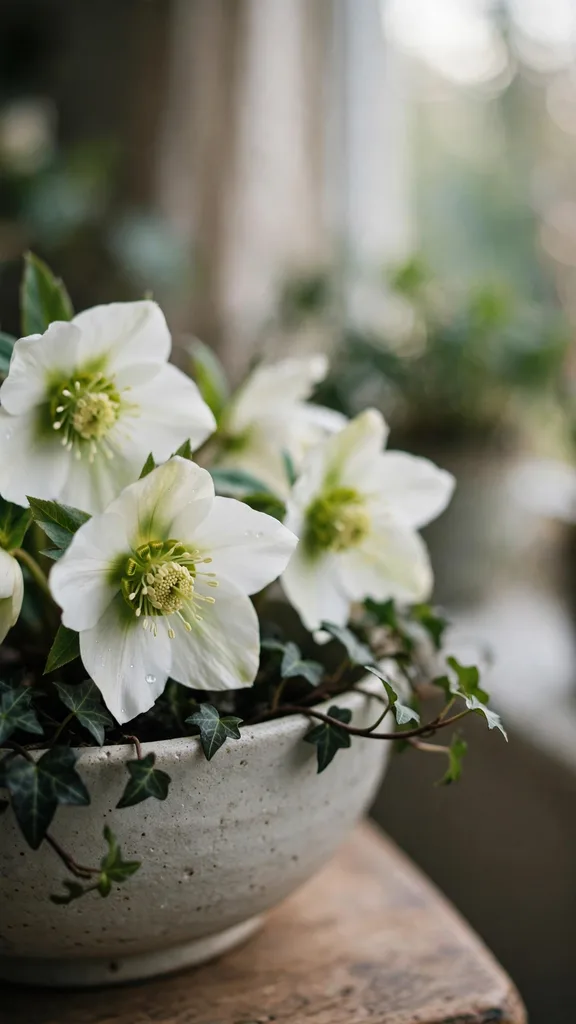
In a low bowl the blooms last a week or more, opening their seed pods as they age into green. Add three sprigs of dark ivy or fern at the rim for contrast and nothing else; this arrangement is about restraint. It suits the Christmas table precisely because it stays below eye level and never argues with the food. Grow one extra hellebore in a pot by the door and you will never buy a December flower again.
2. Paperwhites in a Tall Glass Vase
A bunch of forced paperwhites gathered into a tall glass vase is the fastest arrangement in this list and the most fragrant: white trumpets in a cloud, stems visible through the glass, tied once with twine at the neck of the vase to stop the famous paperwhite flop. Cut them from the forcing bowl at the moment the buds open, or lift the whole cluster, roots and all, and set it in the vase with pebbles for a living arrangement that lasts weeks.
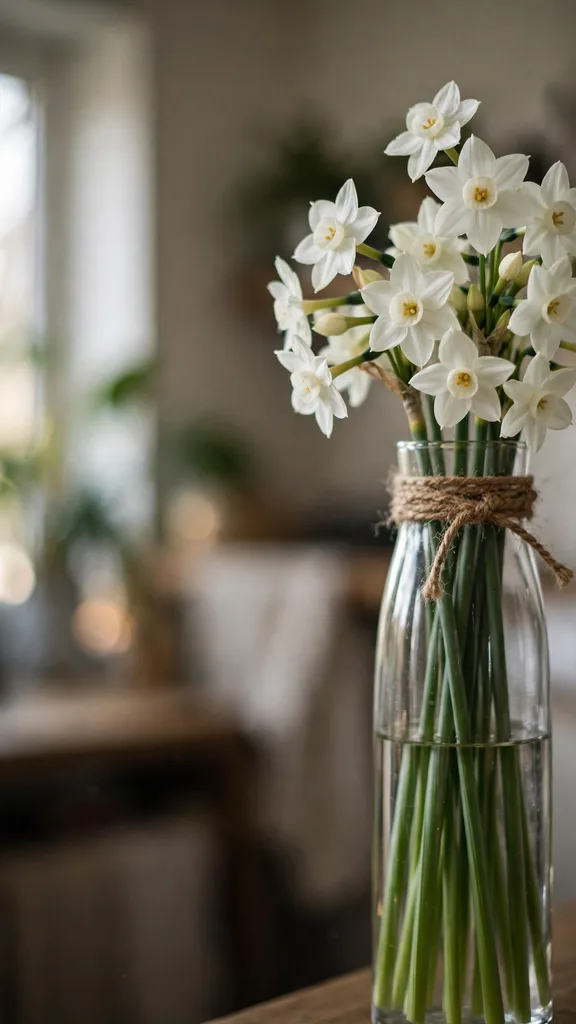
Our guide to growing paperwhites for Christmas covers the forcing that produces these stems, including the trick of stunting them slightly so they stand straighter in arrangements. In a vase, change the water every two days and keep the arrangement away from the fruit bowl; ripening fruit gives off gas that ages flowers early. One vase of paperwhites scents a whole room, so put it where scent is welcome and keep a second, unscented arrangement for the dining table if your household is divided.
3. Amaryllis Stems Standing Tall
A cut amaryllis stem carries two to four huge trumpets and needs almost nothing with it: three stems in a heavy vase, each at a slightly different height, make the tall arrangement that anchors a sideboard or a hall table. Cut stems from your own forced bulbs as the first bud shows color, condition them in deep water, and plug the hollow stem end with a little cotton or tape so the stem does not split and curl in the vase.
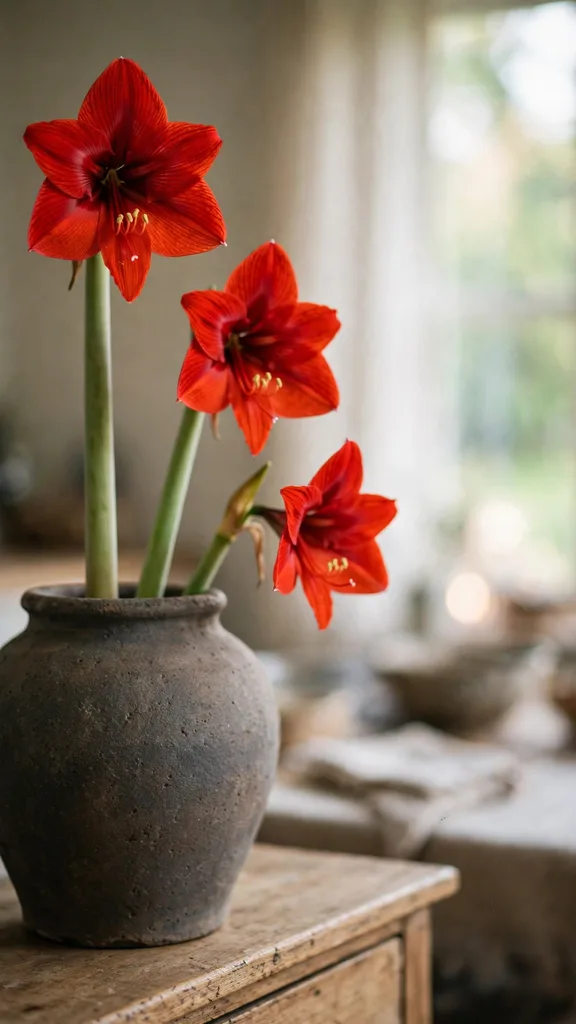
The full care cycle that produces stems worth cutting is in our amaryllis care guide, and a bulb that has flowered in its pot can still give a second stem for the vase. Amaryllis stems last one to two weeks cut, opening bud by bud. Support tall vases against tipping, because an amaryllis arrangement is top-heavy by design, and keep it out of the reach of cats, who find the swaying trumpets irresistible.
4. Forced Hyacinths in Blue Glass
Hyacinths forced in water or pots cut beautifully for small arrangements, and their blue, white, and pink spikes in a blue glass vase double the color note. Cut the spike with its short stem, condition it in cool water, and group three to five spikes with nothing but a few of their own leaves. Hyacinth scent is the strongest of the winter bulbs, richer than paperwhite, so these arrangements belong in halls and bathrooms rather than at the table.
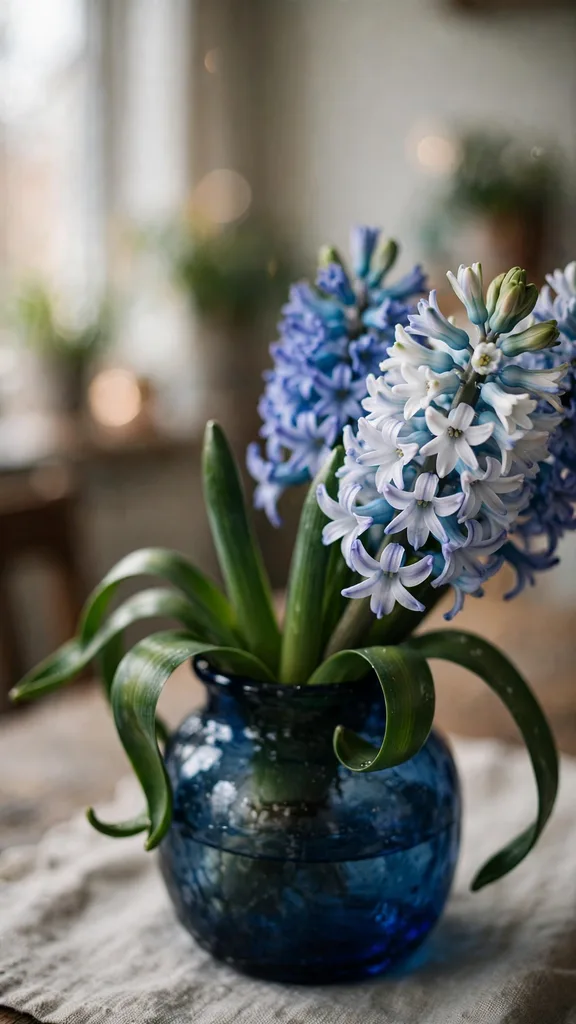
A hyacinth spike lasts about a week in water. If your forced bulbs flower at different times, cut each spike as it peaks and the vase refills itself across two weeks. The bulbs that gave cut spikes still grow on in their pots afterward, though they will need a full season in the garden to flower again. Small, saturated, and scented, this is the arrangement that makes a guest room feel prepared.
5. Cyclamen as a Living Arrangement
Some arrangements are not cut at all. A florist’s cyclamen in full flower, set into a cache pot with moss around the rim and two or three pinecones tucked in, is a living arrangement that runs from December to February with nothing but watering. The flowers, white, pink, or red, hover over marbled leaves that need no help from any other plant. Group three pots at different heights for the full display.
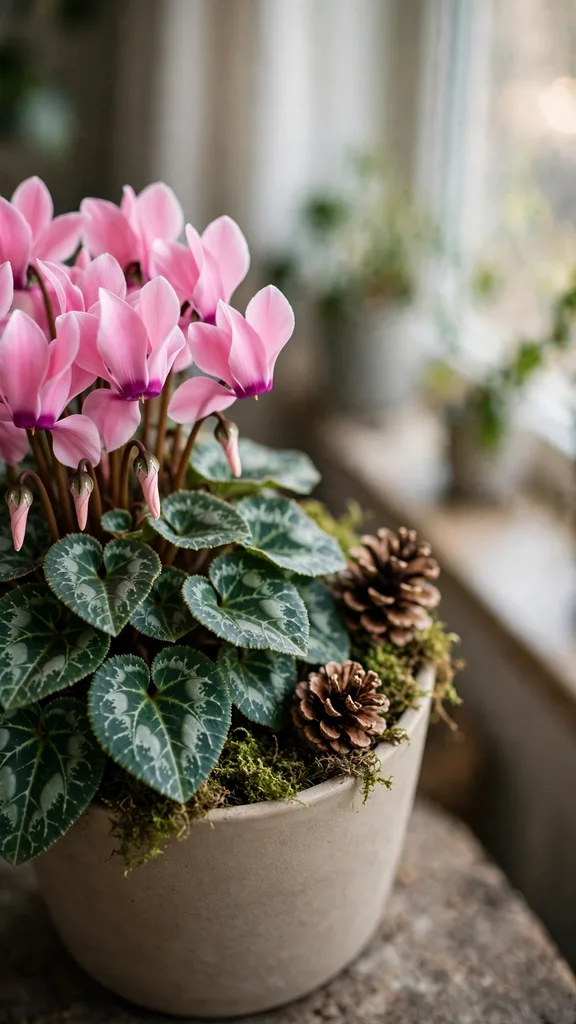
Cyclamen like cool rooms and indirect light, which December houses provide near windows. Water from below and keep the crown dry. Because nothing is cut, there is no vase life to manage and no water to change; the arrangement goes on living. When it finishes, the plant rests for summer and returns next winter, making this the only arrangement on the list that can appear in next year’s version of itself.
6. Winter Jasmine Trails in a Tall Vase
Winter jasmine throws long green trails studded with yellow stars from November onward, and cut trails in a tall vase arch and spill like a small fountain. Cut lengths of a yard or more, strip the leaves that would sit below the waterline, and let three or four trails arrange themselves; jasmine resists formal handling and looks best left to its own lines. A few trails also wind through other arrangements as the yellow thread that ties them together.
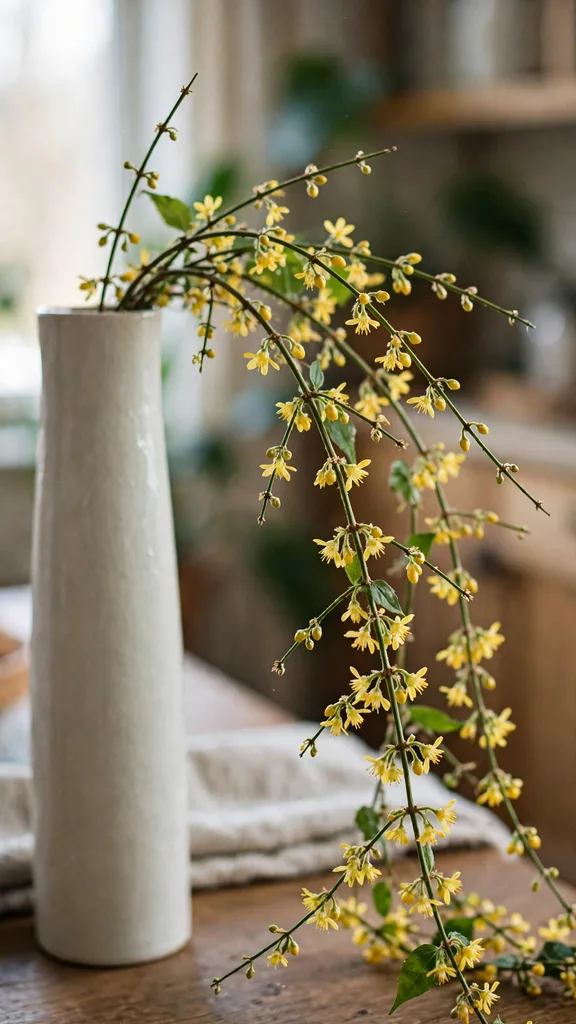
The flowers open in sequence along the trail, so a vase cut in mid-December is still opening fresh stars at New Year. Jasmine trails last two weeks in water and root in it if left, which is either a bonus plant or a reason to change the water. Against dark evergreen in the same vase, the yellow reads as lamplight. This is the arrangement for the darkest corner of the house.
7. Witch Hazel Branches in Water
Witch hazel’s spidery yellow, orange, or red ribbons open on bare branches in the coldest weeks, and a few branches in a heavy vase make the arrangement visitors ask about. Cut branches as the first flowers unfurl and condition them in deep water; the buds continue opening indoors for two to three weeks. The bare structure suits a plain, tall vessel and a bare table; add nothing but perhaps one stone at the base.
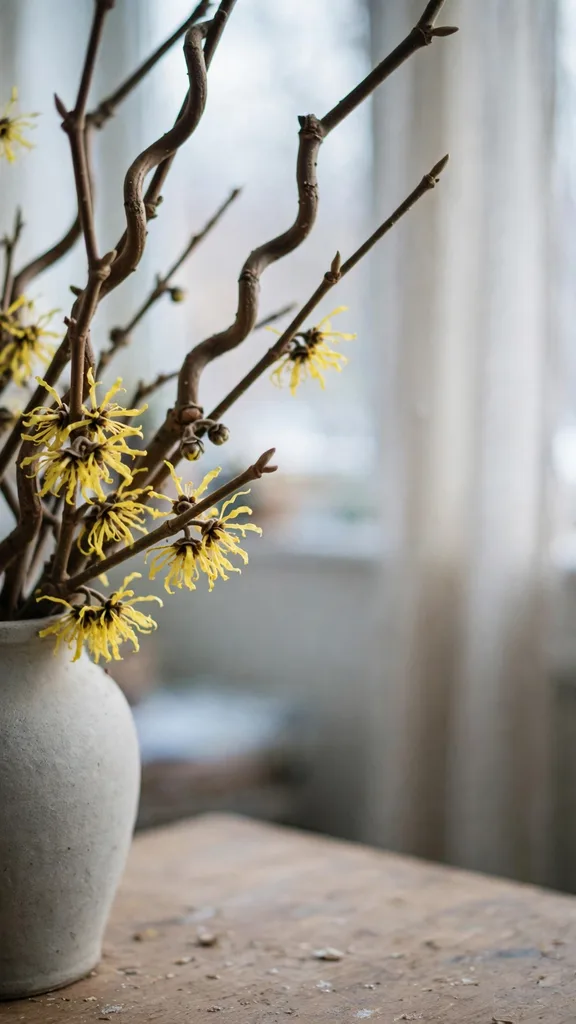
Branches cut too early still force open in the warmth, which makes witch hazel forgiving of timing. The flowers carry a light, spicy scent up close. A witch hazel arrangement marks the turn of the year better than any other here, since the shrub flowers at the solstice in many gardens. When the ribbons fade, the branches themselves, twisted and gray, stay handsome in the vase for weeks more.
8. Camellia Blooms Floated in a Shallow Bowl
Winter camellias drop and bruise too easily for stem arrangements, so float them: single blooms cut with almost no stem, floated face up in a shallow bowl of water with two or three camellia leaves. The waxy petals hold for three to five days on the water, opening flat like water lilies, and the bowl can be refreshed bloom by bloom as the shrub offers more. Pink, white, and red blooms mixed in one bowl look like a confection.
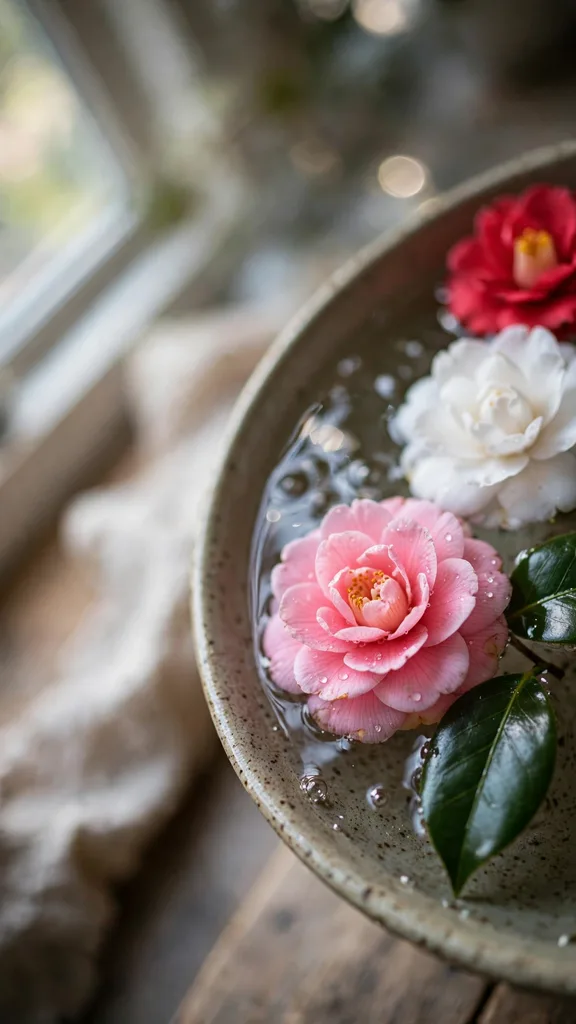
Float the bowl where it will be seen from above: a low table, a hall bench, the middle of the dining table on a stand. Keep the water clean and the bowl out of sun. Camellia floating is the arrangement that uses the blooms the weather knocks down, gathered each morning from under the shrub, so it costs the plant nothing and rescues the garden’s most luxurious flower from the mulch.
9. Snowdrops in a Small Jug
Snowdrops are too small for statements and made for intimacy: a jam jar or small jug of them, cut with their leaves, stands by a bedside, a desk, or a bathroom shelf and rewards whoever gets close. Cut them in bud in the morning and they open indoors over two days, lasting a week in cool water. Thirty stems make a jug look generous; snowdrops grow in clumps that forgive the cutting.
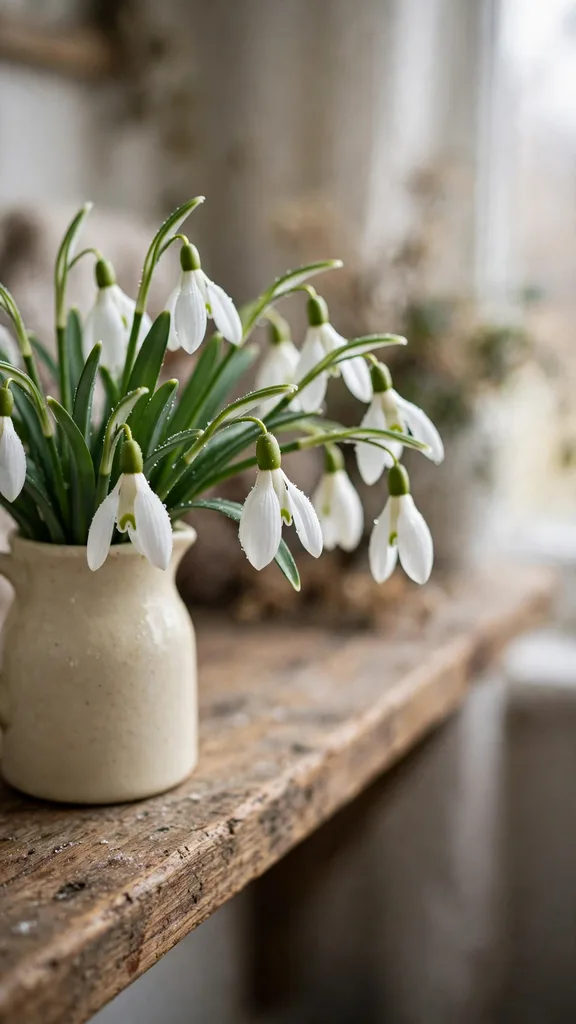
Mix a few winter aconites or the first crocus if your garden offers them, keeping the scale tiny. This arrangement is the argument for walking the garden with scissors every December morning: the smallest flowers of the year are flowering, and only small vases do them justice. Change the water once midweek and keep the jug away from radiators, which end snowdrops in a day.
10. Cedar and Pine in a Heavy Vase
The evergreen arrangement in its purest form: long cuts of cedar and pine in a heavy vase, arranged by length into a loose fan, nothing else added. Cedar’s flat sprays give the structure, pine’s needles give the softness, and the two together scent the room for three to four weeks in water. Recut stems under water, split thick stems an inch up the base so they drink, and strip everything below the waterline so the water stays clean.
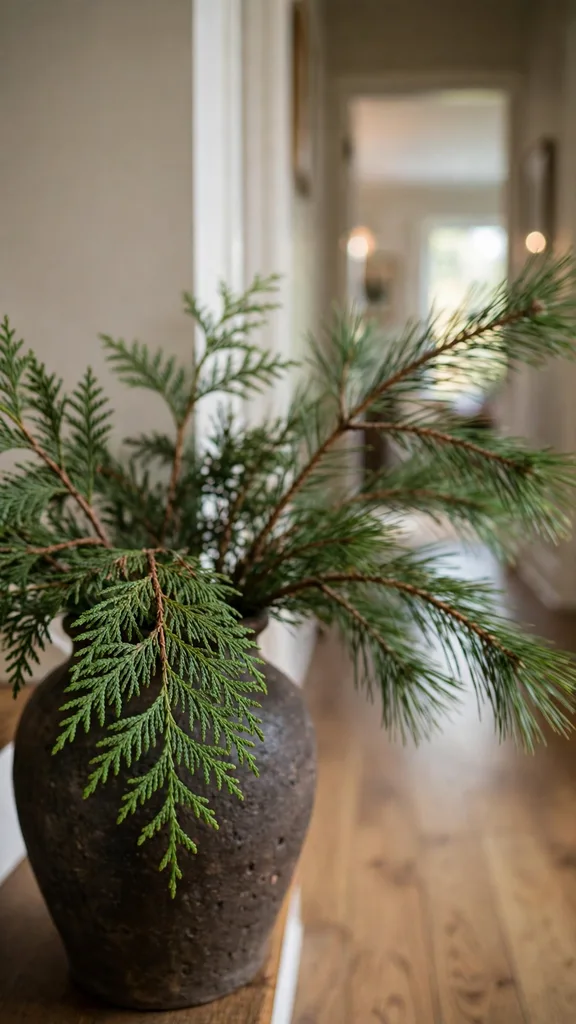
This is the arrangement to build first and refresh last: it stands behind the fresh flower arrangements and makes them look richer. A tall evergreen vase in a hall or stairwell carries the whole house’s Christmas smell. When a spray browns, pull it and push a fresh one into the gap; the fan never needs rebuilding. If you cut only one arrangement this year, cut this one.
11. Holly and Winterberry Statement Vase
Bare winterberry stems loaded with red berries and glossy holly cuts make the boldest vase of the season, all structure and red. The NC State Extension Plant Toolbox entry for Ilex verticillata describes the winterberry behind the best stems, a deciduous holly whose berries hold on leafless branches through winter. Build the vase tall, berries high, holly at the base, and let the red do the work against a pale wall.
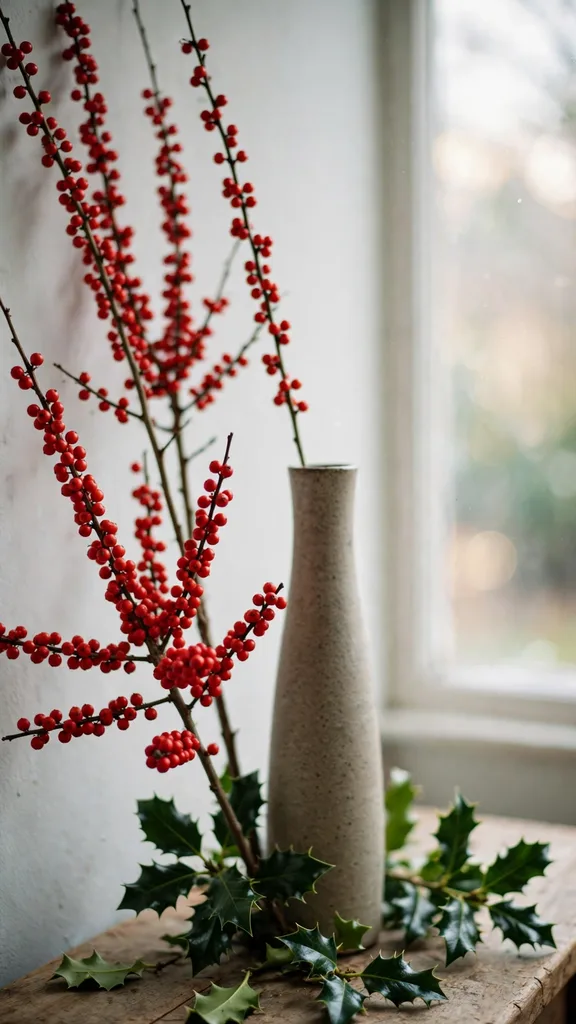
Berries hold two to three weeks in water before they shrivel, and the stems themselves stay handsome after. Keep berry arrangements where toddlers and pets cannot graze, since holly family berries are not food. A single winterberry stem in a bottle is the minimal version and nearly as strong. This is the arrangement that photographs like a magazine cover from any angle, because red on green on white cannot miss.
12. Silver Eucalyptus and Conifer Arrangement
Silver foliage cools the Christmas palette: eucalyptus rounds, blue spruce tips, and juniper with its own blue berries arranged in a pale vase give the frost arrangement, the one that suits white and gray rooms. Eucalyptus from a sheltered garden or a pot, cut and conditioned, lasts two to three weeks in water and dries in place afterward without collapsing, so this arrangement can be left to become a dried one.
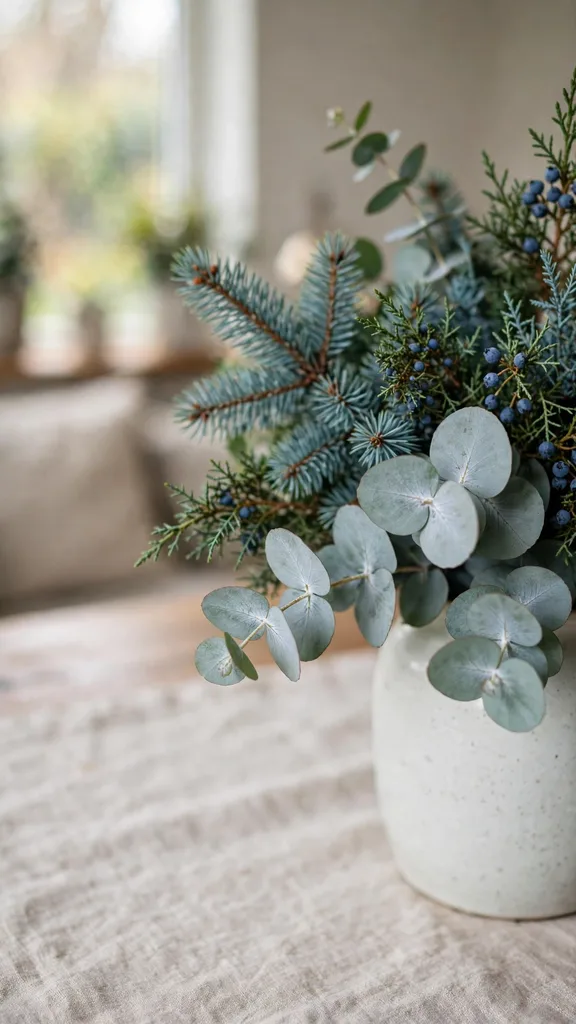
Work the silvers in layers, round leaf against needle against berry, and add one white hellebore or paperwhite stem if you want a single flower note. The scent is medicinal and clean, a change from pine. Silver arrangements suit New Year even better than Christmas, so build this one late in December and it carries the house into January without a hint of the stale.
13. Magnolia Leaves and Cones in a Crock
Magnolia’s great glossy leaves, green over copper, arrange themselves: a crock or heavy jug of leafy stems with a handful of magnolia cones and pinecones at the rim makes a arrangement with the weight and shine of leather goods. The leaves last three weeks in water and dry without curling if left, copper side turning richer. Mix the leaves deliberately, half green up, half copper up, for the two-tone effect that is the whole point.
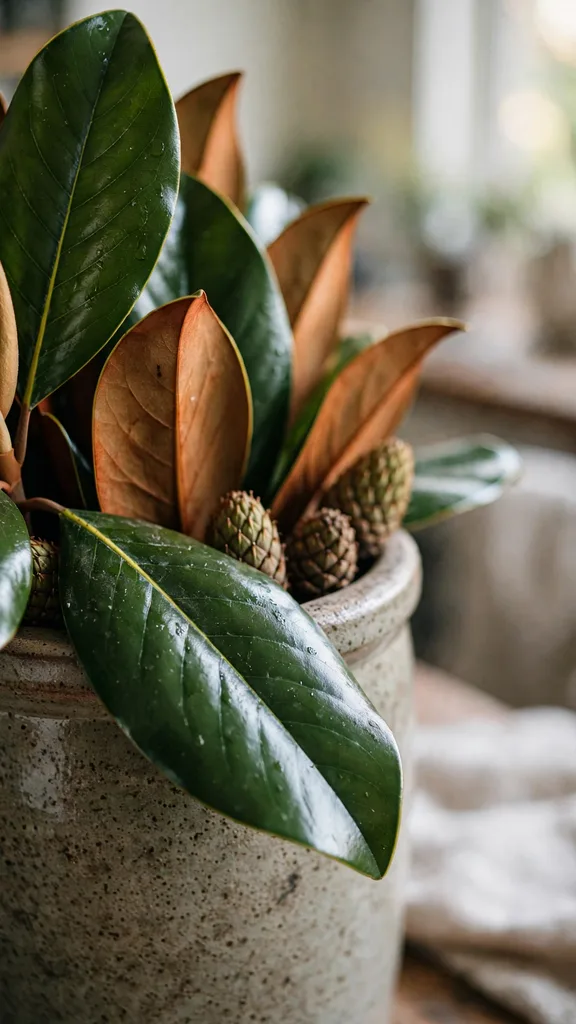
This arrangement suits fireplaces, halls, and anywhere a big dark corner wants filling. The cones of southern magnolia are ornaments in themselves, scaled and upright. A magnolia arrangement asks for no flowers and no berries; adding red to it is the classic mistake. Build it big and plain and let the leaf size set the scale of everything near it.
14. Juniper and Blue Spruce with Berries
Juniper brings its own decoration: blue-gray berries on feathery sprays that arrange into soft, aromatic vases with blue spruce tips for structure. The two blues together, berry and needle, make the cool-toned evergreen arrangement, lighter in feeling than cedar and pine. Juniper lasts three weeks in water and scents the room with gin’s raw material, which divides households; test one spray indoors before committing a vase to the hall.
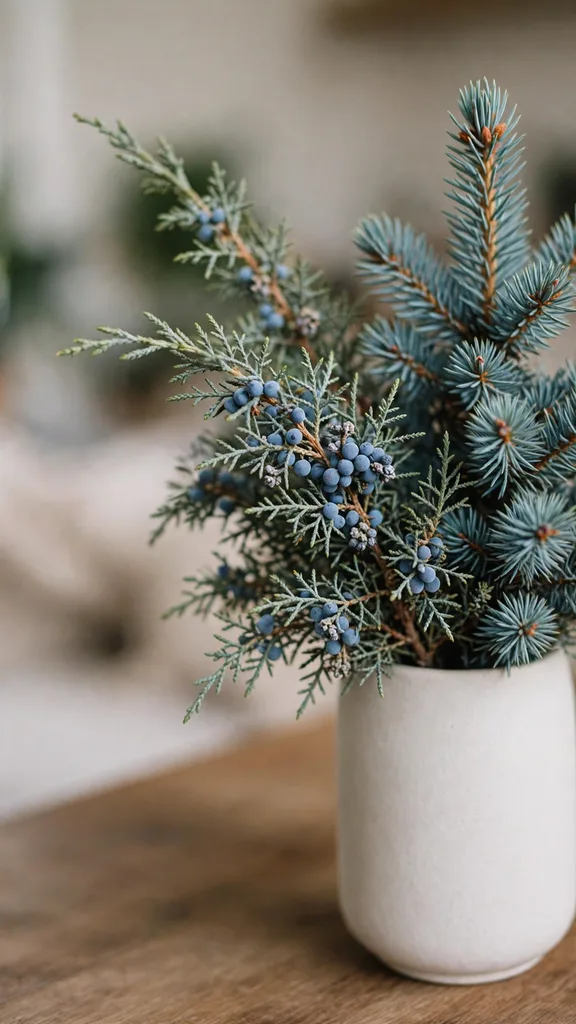
Prune juniper lightly from the back of the shrub so the garden shape survives the cutting. The berries are the detail visitors touch, dusty blue and perfectly round. Add white candles nearby and the blue-gray foliage turns silvery by candlelight. This arrangement belongs to the quiet rooms, bedrooms and studies, where its color rests the eye after the red and gold of the main rooms.
15. Ivy Trails and Fern in a Woodland Jug
For the green-on-green arrangement, wind long ivy trails around a jug’s neck and let them spill, then push in fern fronds, hellebore leaves, and any dark glossy foliage the shade garden offers. Nothing flowers in it and nothing needs to: the arrangement is texture, leaf shape over leaf shape, and it lasts three weeks because foliage in water outlasts almost every bloom. A few trails of ivy berries, black and sculptural, count as the ornament.
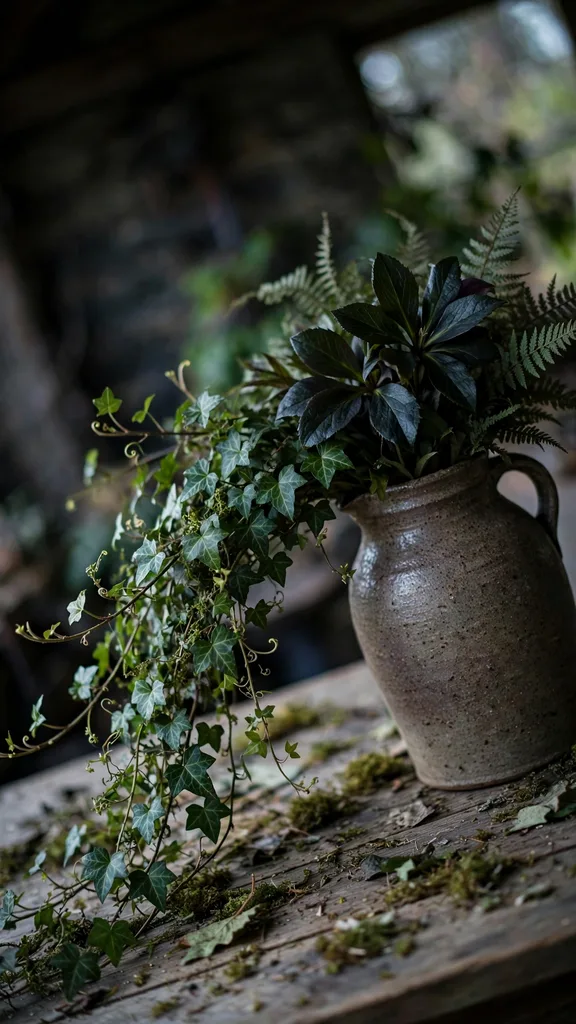
Woodland jugs suit bathrooms, kitchens, and the north-facing rooms where flowers sulk. Build it loose and a little wild; neatness fights the idea. Mist it when you pass and the ferns stay fresh. This is also the arrangement to build from a garden with no winter flowers at all, which is most gardens, proving the December garden’s real wealth is leaves.
16. Bay, Rosemary and Sage Kitchen Bunch
The kitchen arrangement is a bunch, not a vase piece: bay branches, long rosemary, and sage tied with twine and stood in a jug of water by the cooker, where it scents the room and seasons the cooking. Cut it generously, because handfuls will leave it for pots all month, and rebuild it at New Year from the same bushes. The gray-green palette rests a busy kitchen, and the bunch earns its counter space daily.
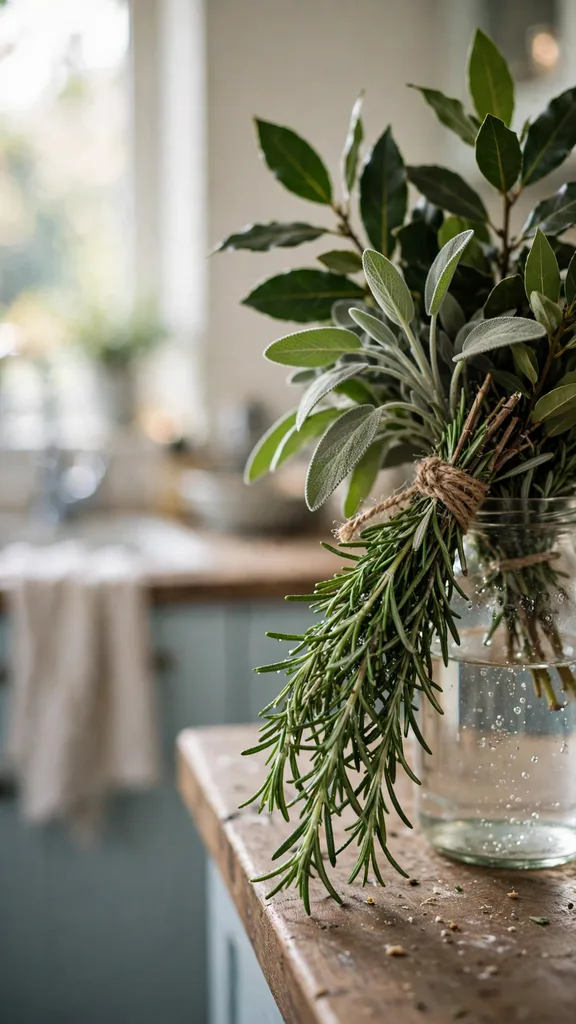
Herb bunches last two weeks in water before the sage tires. Keep the jug topped up; herbs drink fast in a warm kitchen. When guests admire it, cut them a bunch to take home, tied the same way, and the arrangement has produced presents. A kitchen without a herb bunch in December is missing the easiest arrangement in this list, since the materials grow by the back door of half the gardens in the country.
17. Boxwood Clippings in a Row of Bottles
Boxwood’s small dark leaves clip into neat sprigs that stand in a row of small bottles like a miniature hedge, each bottle holding two or three sprigs in water. The row runs down a windowsill, a mantel, or the middle of a sideboard, and its regularity is the decoration. Boxwood lasts a month in water, longer than any other cut here, and keeps its gloss the whole time.
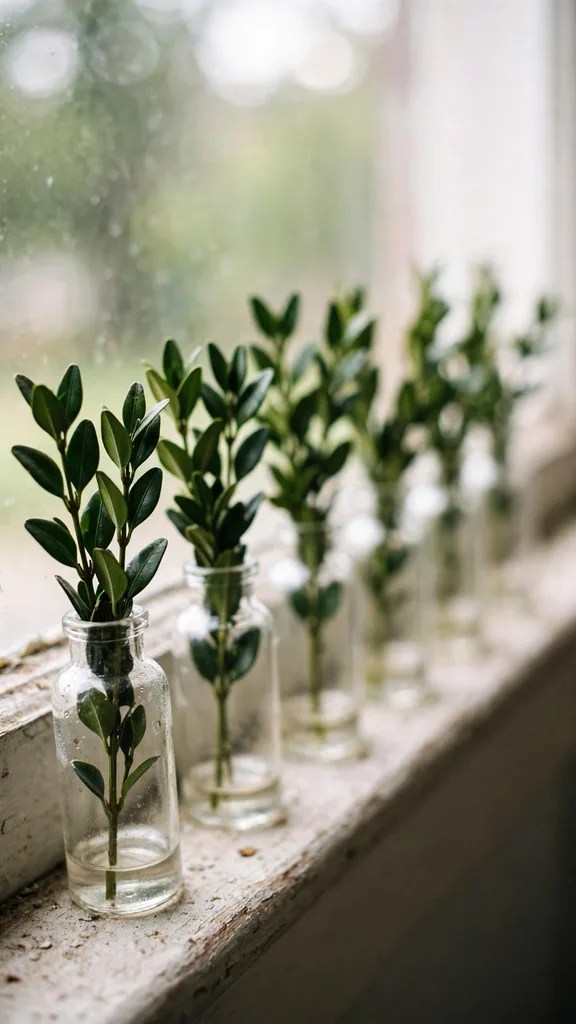
This arrangement suits the minimalist and the beginner equally: no arranging skill is involved beyond spacing the bottles evenly. Add one red berry sprig to the middle bottle if the row needs a pulse. Bottles of different heights in the same glass color look collected rather than matched, which is better. In January the sprigs can be potted as cuttings, and the arrangement becomes next year’s hedge.
18. Conifer Ring Arrangement Around a Hurricane Lamp
A low ring of short conifer clippings built in soaked floral foam on a tray, with a glass hurricane lamp at its center, is the table arrangement that lights itself. The clippings radiate flat, cedar, juniper, and boxwood mixed, with cones and a few berries pushed in, and the lamp’s candle or LED pillar glows through glass safely above the greenery. Keep the foam watered and the ring lasts three weeks.
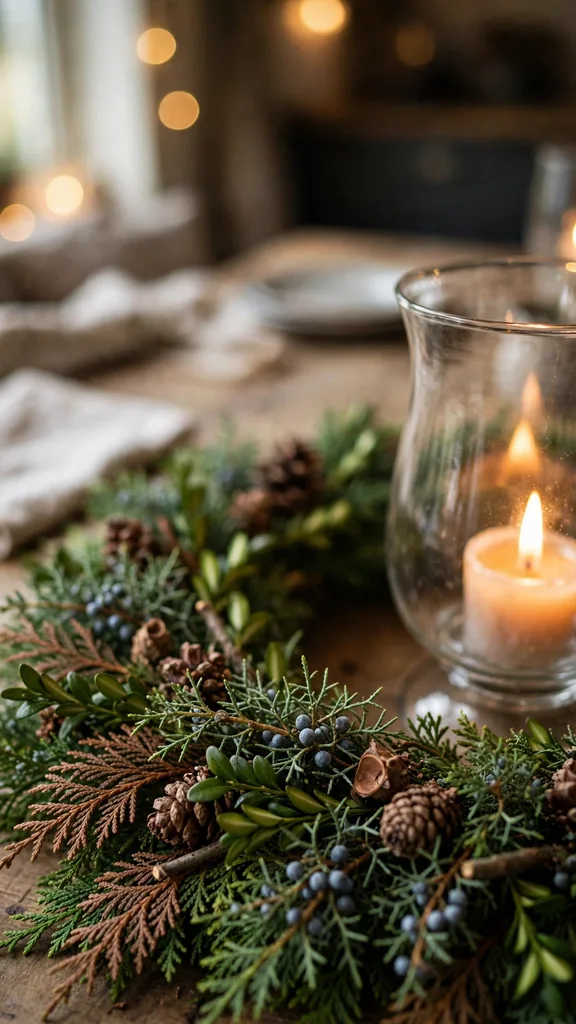
Build the ring wide and low so diners see over it, and keep any real flame inside the glass, never as a bare candle among dry clippings. The arrangement doubles as the table’s light source, so it works hardest at evening meals. Scatter three small matching rings down a long table rather than one giant one. This is the evergreen arrangement guests copy, so expect to explain the foam tray trick twice per dinner.
19. Dried Hydrangea Heads in a Stoneware Vase
Dried hydrangea heads, harvested in autumn at the papery stage, fill a stoneware vase with soft mounds of faded blue, green, and parchment that suit December’s light. They need no water, no conditioning, and no attention for the whole season, and their scale lets three heads fill a vase that would take a dozen fresh stems. Dust them with a hairdryer on cool before arranging, outdoors, to evict the autumn dust.
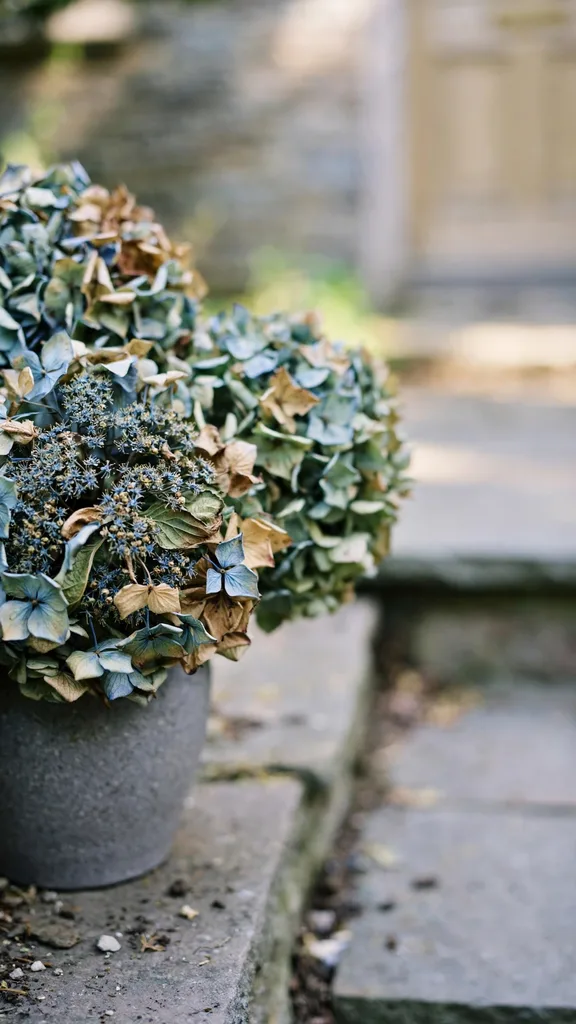
Keep dried hydrangea out of steamy rooms, where the heads drink moisture and slump. Their colors deepen near candles and lamplight. A vase of hydrangea on the landing or in a spare room carries the summer garden through the house in winter, which is the emotional point of every dried arrangement in this section. When January ends they go back in the box, ready for next year, slightly more fragile and entirely forgiven.
20. Strawflowers and Statice in Christmas Colors
Strawflowers hold their shape and color for years because they are dry on the plant, and a vase of red, white, and gold strawflowers with purple or white statice is the dried arrangement that actually reads as Christmas. The papery blooms catch light like baubles. Mix the colors deliberately in bands or confetti them together; both work because the flowers are small and the colors are clean.
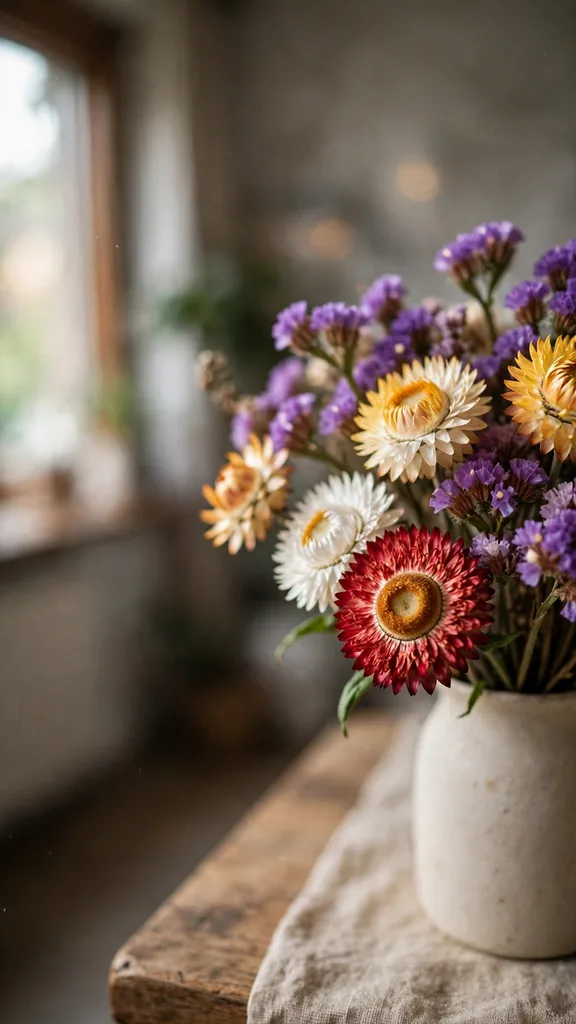
Statice’s tiny clustered blooms fill the gaps the strawflowers leave, the filler flower doing its job dried as faithfully as fresh. These arrangements last indefinitely and store in the vase, covered with a cloth against dust. Build one for a room you do not want to think about again until January. Children can arrange strawflowers without supervision or breakage, since the blooms are nearly indestructible.
21. Dried Lavender and Roses
A bunch of dried lavender with dried rose heads and buds is the scented dried arrangement, the one for a bedroom or a dressing table where its calm belongs. The lavender keeps a ghost of its scent for a year, revived by a squeeze, and the roses, dried dark red and rust, give the bunch its Christmas depth. Tie the bunch with ribbon and stand it in a narrow vase that holds the stems tight and upright.
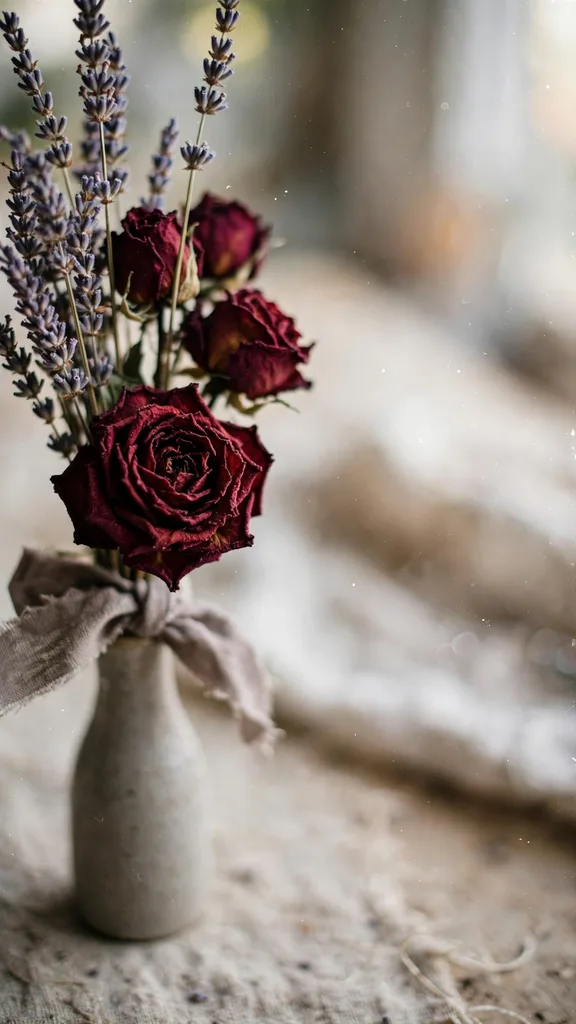
Dry roses upside down in small bunches through summer so December finds them ready. Lavender cut at bud stage holds color best. This arrangement asks for no water and no light and gives back scent, which makes it the best value per stem in the dried section. A lavender and rose bunch tied to a parcel or a chair back stretches one vase’s worth across the whole house.
22. Honesty Stems for Silver Light
Honesty’s silver discs, peeled from their pods in autumn, stand in a vase as stems of small moons that gather whatever light the room has and give it back doubled. They are the brightest dried material in the garden, brighter than any fresh white flower in a dim December room. Arrange them tall and alone, or behind dark dried grasses where the contrast sets them glowing.
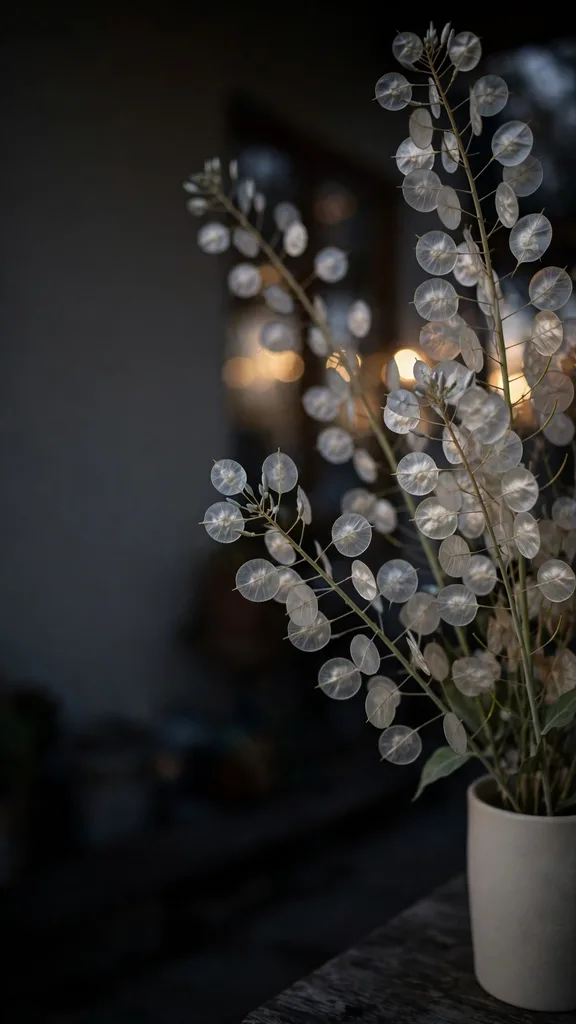
The discs are fragile and shed their seeds if knocked, so place the vase out of traffic. Honesty is biennial; the stems you arrange this year grew from seed sown the summer before last, which makes this arrangement the longest-planned in the list. A few discs wired onto the tree or the wreath spread the silver further. Nothing else in the winter house shines like honesty at dusk.
23. Allium and Seed Head Firework Vase
Dried allium heads, echinacea cones, teasels, and poppy heads on their long stems make the firework vase: spheres, spikes, and crowns bursting at different heights from one vessel. Spray them gold, silver, or leave them in their natural tans; all three versions work because the shapes carry the show. This is the arrangement for a tall corner, a fireplace side, or a hall that needs height without weight.
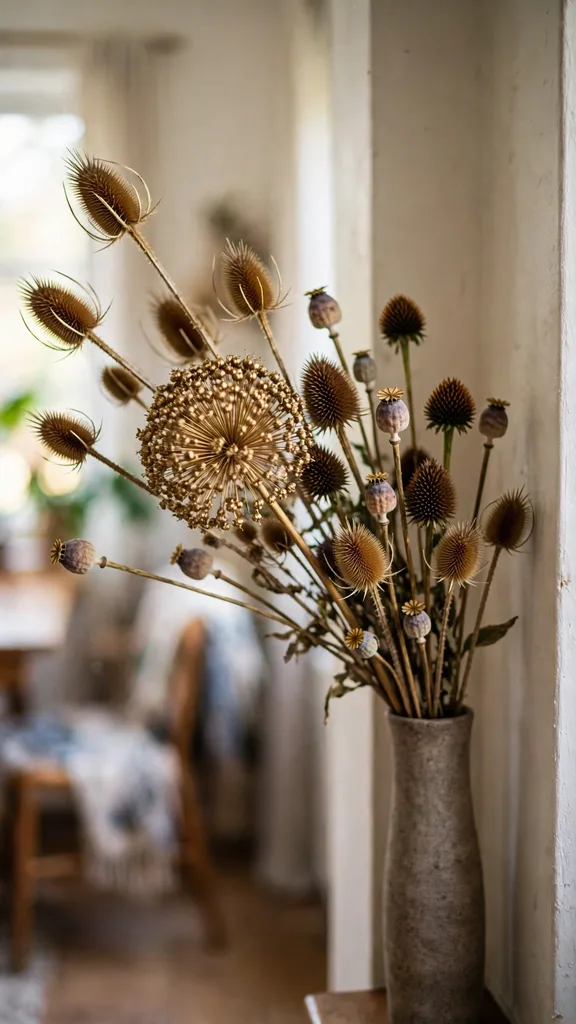
Seed heads cost nothing, having been left standing for the birds all autumn, so cut them late and thank the garden twice. The arrangement lasts the season and stores standing in its vase under a dust cloth. Allium heads shed a few seeds as they age, a small toll. Against a dark wall, a gold firework vase is the most dramatic dried arrangement you can build from a flower border.
24. Globe Thistle and Sea Holly Blues
Dried globe thistles and sea holly keep their steel blue through winter, the only true blue in the dried palette, and a vase of them with silver honesty and gray lavender is the cool arrangement that suits blue and white rooms. Their thistle heads are architectural, perfect spheres on branching stems, and they mix with evergreens as happily as with dried company. Handle with gloves; the prickles survive drying intact.
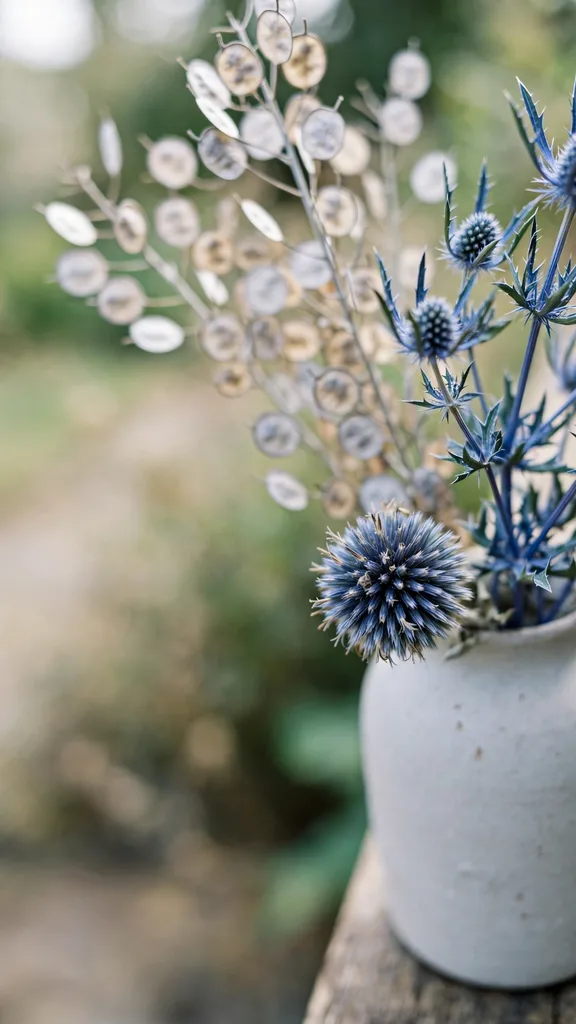
Blue dried flowers fade toward gray over years, so this year’s vase is next year’s silver arrangement, a natural succession. The blues also rescue an all-red room, one cool vase restoring the balance. Collect sea holly stems as they color in summer and dry them upright so the stems stay straight. A small vase of blues on a desk is the arrangement office workers steal glances at all December.
25. Dried Grasses and Grain in a Tall Crock
Ornamental grass plumes, wheat, oats, and barley ears dried from summer stand in a tall crock as the harvest arrangement, all gold and movement. The plumes soften every line in the room and sway when the door opens. Build it tall and loose, tallest stems at the back, and let the crock’s weight anchor stems that weigh nothing. A light spray of hairspray or fixative over the plumes, done outdoors, slows the shedding that is this arrangement’s only vice.
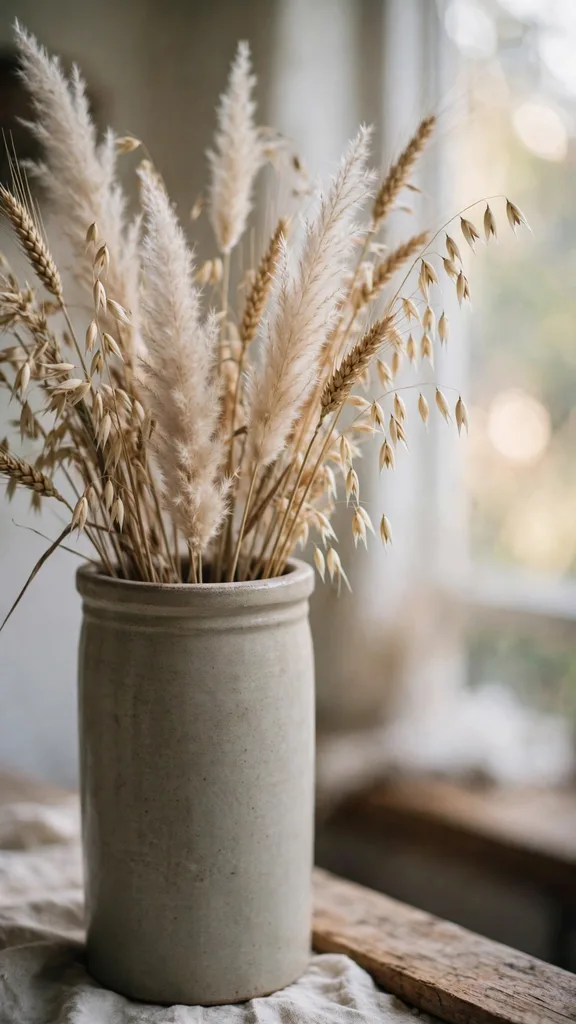
Grasses pair with the seed head vase and the honesty to make the dried trio that can furnish a whole house’s quiet rooms. Keep them away from open flames; dry grass is tinder and belongs nowhere near candles or the fire. In January the crock empties to the compost and the cycle restarts with spring’s first sowings. No arrangement here connects Christmas more plainly to the growing year it ends.
26. Dried Flower Table Wreath
A ring of dried flowers, strawflowers, statice, lavender, and small seed heads wired or glued onto a flat base, laid on the table with a candle or a bowl at its center, is the dried centerpiece that never wilts, spills, or needs its water changed. Build it in November and it works every meal of the season, including the ones you forgot to plan for. The flat ring stores in a box between two sheets of card, taking almost no space.
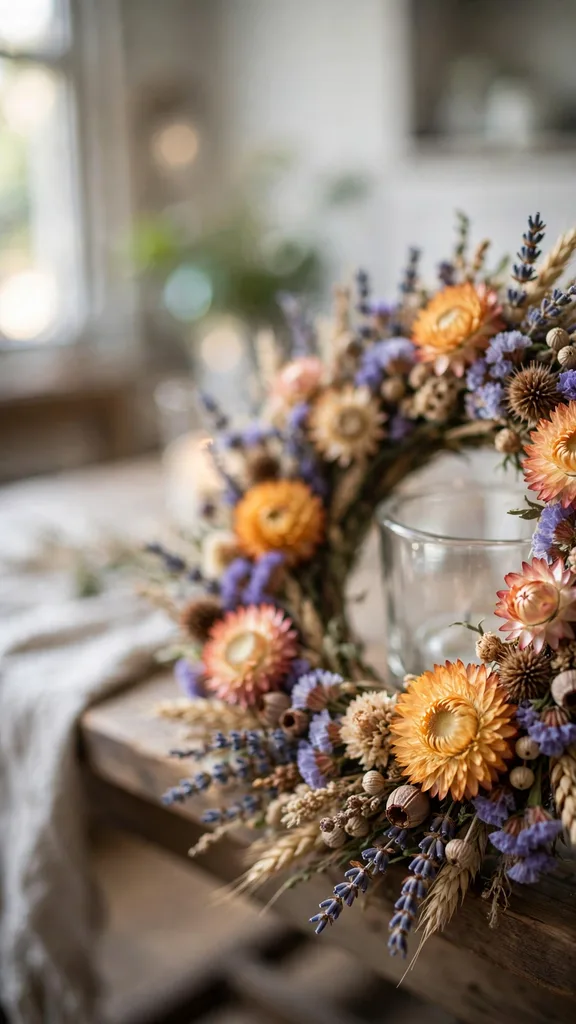
Keep the ring’s inner edge clear of the candle glass and never set a bare flame inside any dried arrangement. Colors stay true for two or three seasons before dust and fading retire it. A dried wreath on the table also frees the fresh flowers for the rooms where people linger longest. This is the arrangement that makes a household look effortlessly organized, and it is mostly a November afternoon.
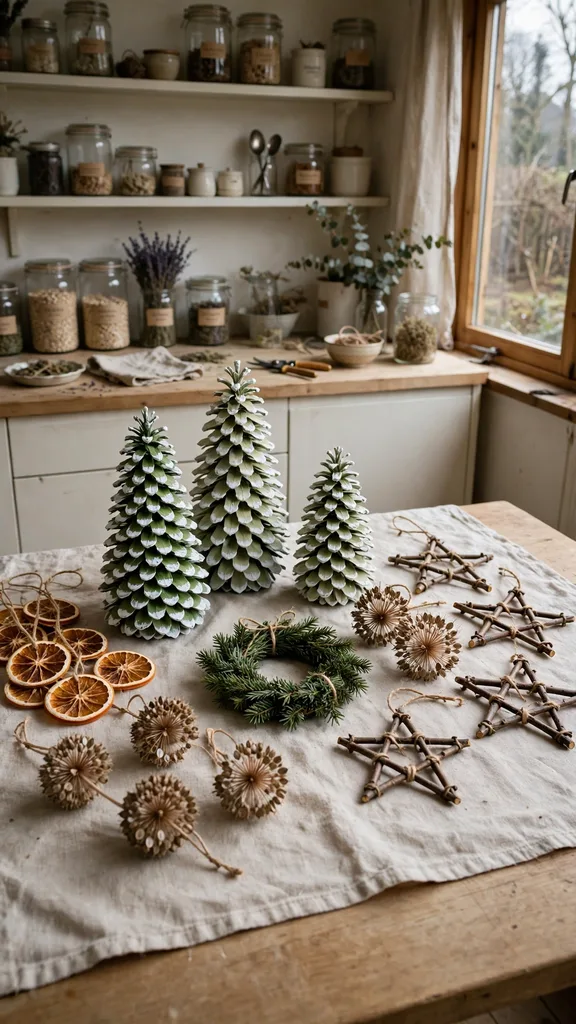
27. Dried Citrus with Dried Flowers
Dried orange slices and whole dried citrus threaded or wired among dried flowers marry the kitchen’s December work to the garden’s summer harvest: amber discs glowing between strawflowers and grasses, cinnamon sticks tied in as the scent. The mix suits a jug on a kitchen dresser or a bowl on the hall table, anywhere the warm palette gathers. The citrus brings the light, the flowers bring the texture, and the cinnamon brings the smell.
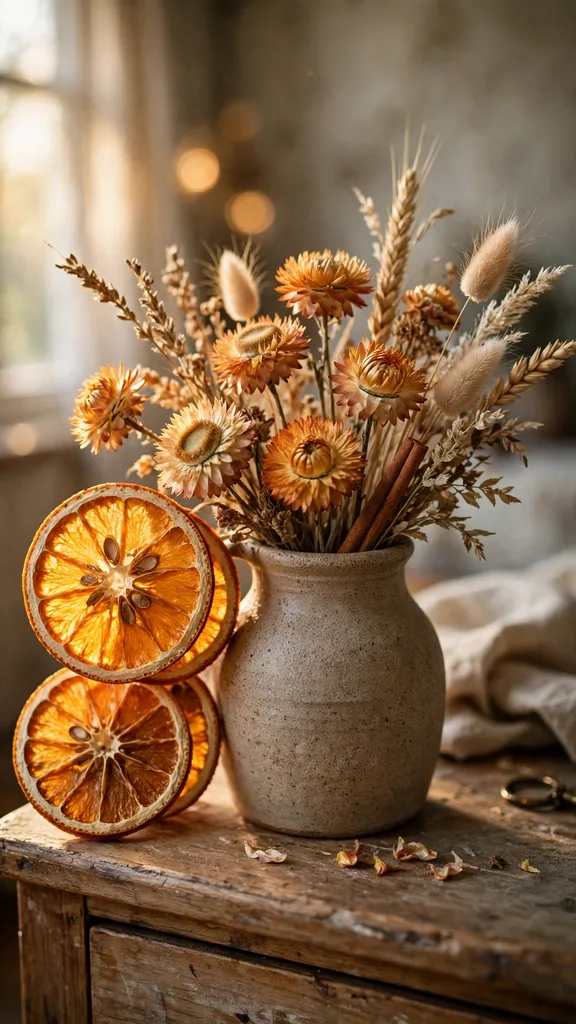
Build it as you dry the citrus, adding slices to the dried vase a few at a time until the balance looks right. The arrangement lasts the season; the citrus may darken by January, which reads as richness rather than decay. This is the arrangement that uses the slices too thick or too dark for the tree, so nothing from the drying trays is wasted. Waste nothing is the dried section’s whole philosophy in one vase.
28. Amaryllis with Evergreen Cuts
The mixed arrangement at its most classic: two amaryllis stems rising from a bed of cedar and juniper cuts in a low, heavy bowl, the evergreen holding the hollow stems upright and hiding the mechanics. The timing that lands home-grown amaryllis in flower for Christmas week is covered in our guide to growing amaryllis bulbs for Christmas blooms, and this arrangement is what those stems are for. Red amaryllis over dark cedar is the season’s strongest color chord.
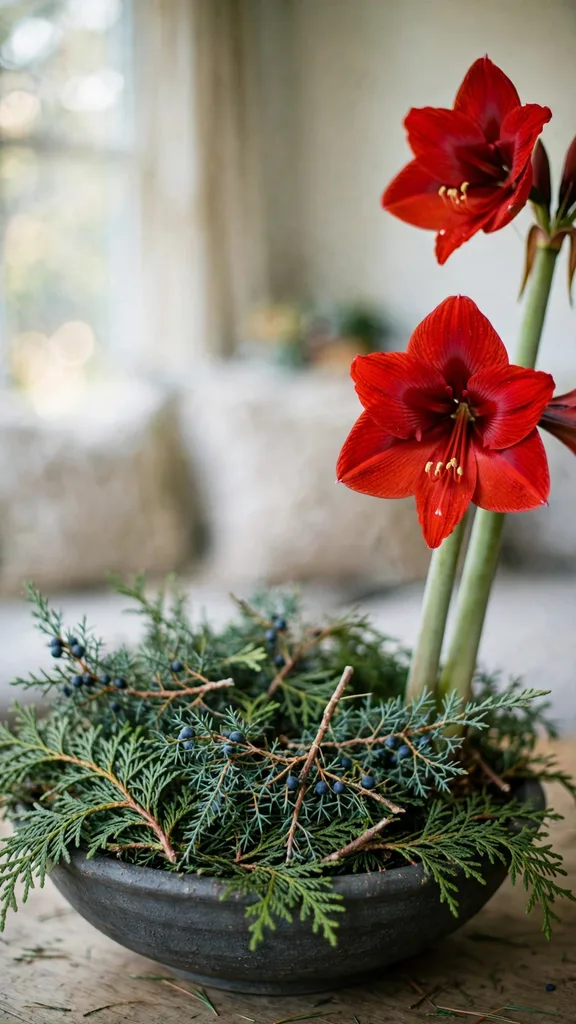
Build the evergreen bed first, in water or soaked foam, then push the amaryllis stems through it at two heights. A white amaryllis over blue spruce is the cooler version. The arrangement lasts ten days, the evergreens longer; when the trumpets fade, pull the stems and the green bed carries on with berries tucked in. This is the Christmas table arrangement for households that grow exactly one festive flower.
29. The Classic Red and White Table Arrangement
Red amaryllis or red roses from the greenhouse, white hellebores or paperwhites, holly and winterberry, and dark evergreen cuts: the red and white arrangement is the formal center of the Christmas table and the one worth building slowly. Work in a low bowl with foam or a pin holder, greens first as the base, red flowers as the peaks, white flowers as the light between them, berries last as the punctuation. Keep the height under a foot so guests see each other over it.
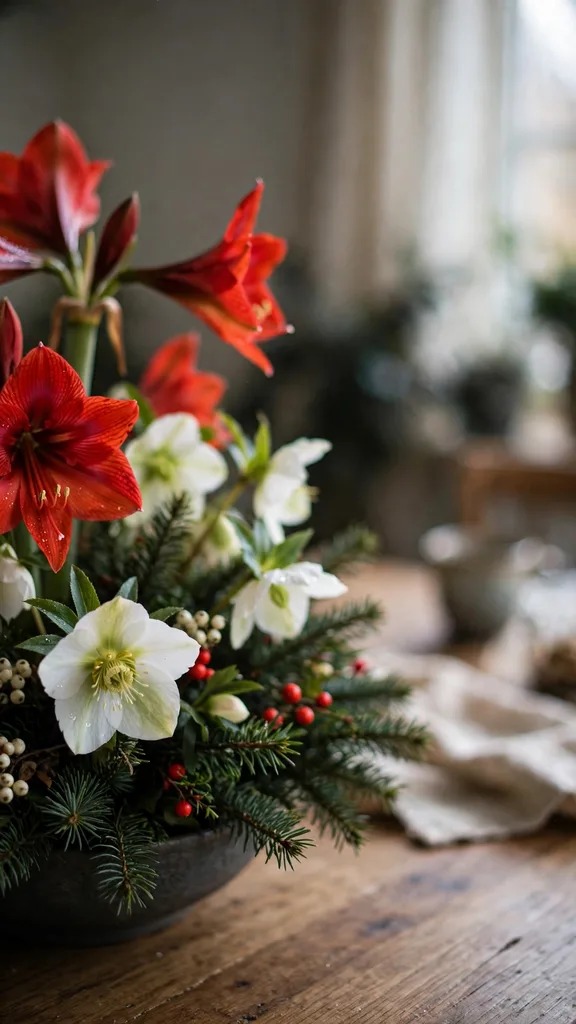
The arrangement holds a week with water topped up, and rebuilding just the flower layer refreshes it for a second week. Red and white forgives no muddiness, so keep every other color out, including gold ribbon and colored candles. This is the arrangement that makes the whole table look catered. Build it on the morning of the day it is needed; its peak is the first forty-eight hours.
30. All-White Winter Arrangement
An all-white arrangement, hellebores, paperwhites, white amaryllis, white cyclamen blooms, silver honesty, and pale evergreen like variegated holly, glows in a dim room like snow at dusk. The discipline is total: no red berry, no gold, green allowed only as the palest foliage and the stems. In a white or silver vase it becomes the arrangement guests describe afterward as the beautiful one, without remembering a single flower in it.
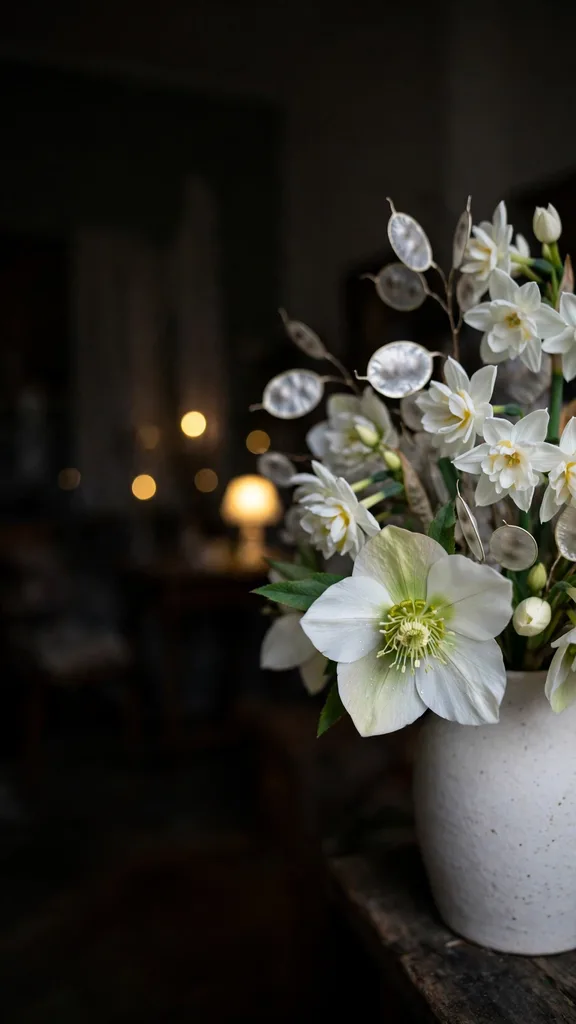
White arrangements show wilting fastest, so condition everything carefully and keep the vase cool. They suit evening rooms, where lamplight warms the whites to cream. A single white arrangement in a house of red and green elsewhere gives the eye a resting room, which is a sophisticated trick worth stealing. Build it for New Year if Christmas is spoken for; white belongs to January even more.
31. All-Green Foliage Arrangement
The all-green arrangement takes the woodland jug’s idea to full scale: every foliage the winter garden offers, cedar, pine, juniper, boxwood, ivy, fern, hellebore leaves, mahonia, arranged by texture in a big vessel with not one flower or berry. It is the longest-lasting fresh arrangement here, three to four weeks with water changes, and the one that smells most like the garden itself. Layer the textures from coarse to fine, dark to light, and let a few ivy trails break the rim.
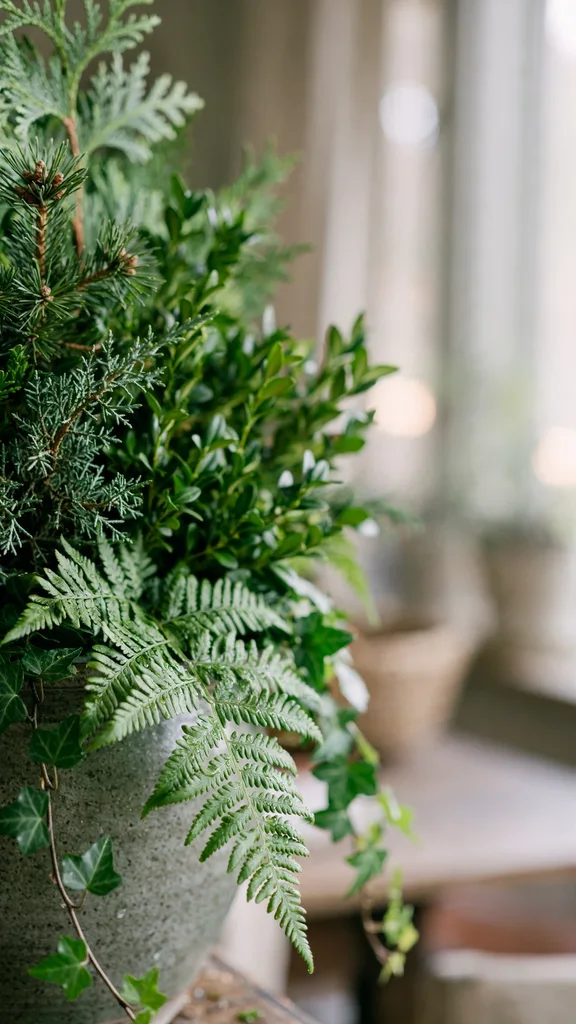
All-green suits modern rooms and overwhelmed ones; after a month of red and glitter, a green vase in the hall is a deep breath. It also costs nothing but cutting, since no flowers are spent. Gardeners who claim they cannot arrange flowers can arrange foliage, because the material does the work. This is the arrangement to teach a beginner on, with the highest success rate in the list.
32. Berry-Heavy Arrangement with Bare Branches
Turn the proportions around: mostly berries and bare branches, winterberry, holly, rose hips, and crab apples on the stem, with contorted hazel or willow branches for line and only a whisper of evergreen at the base. The arrangement is red, black, and architectural, a drawing in stems. It lasts three weeks, since berries and branches ask little, and it suits a tall vase in a bright room where its structure shows against the light.
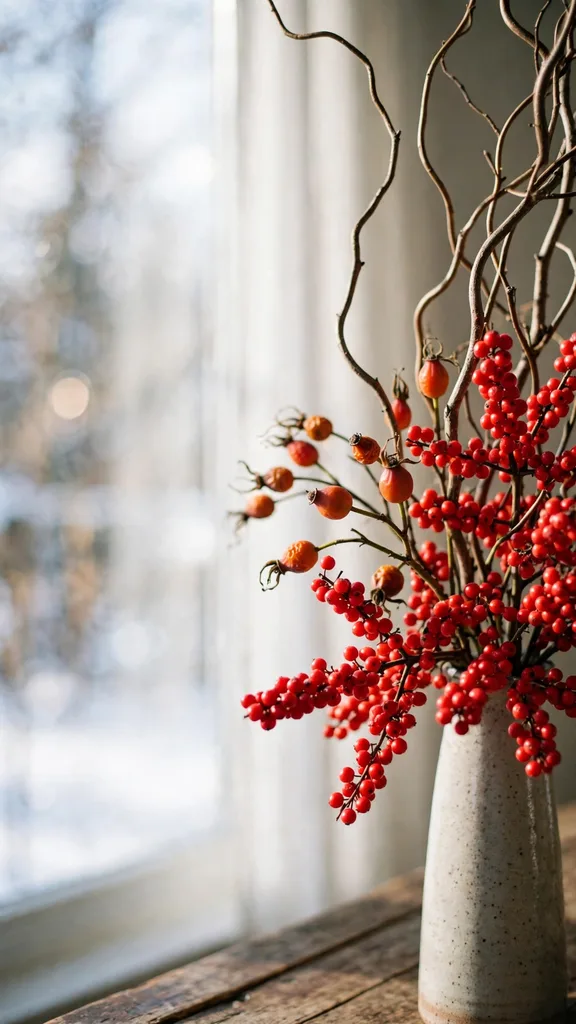
Berry-heavy arrangements carry the twig-and-fruit look of a hedgerow in winter, which is the garden’s own December style copied indoors. Keep the berries out of reach of small children and pets, as with all holly family material. When the berries shrivel, the branches stay for January with honesty stems added. No arrangement here is cheaper per week of display.
33. Single-Stem Bottles Down the Table
The easiest table arrangement ever devised: a line of bottles and small jars down the table’s center, each holding one stem, a hellebore, a paperwhite, a berry sprig, a cone on a stick, alternating down the row. Guests see over and between them, the arrangement never blocks conversation, and each bottle takes thirty seconds to fill. Use odd numbers of bottles and vary the heights slightly for the collected look.
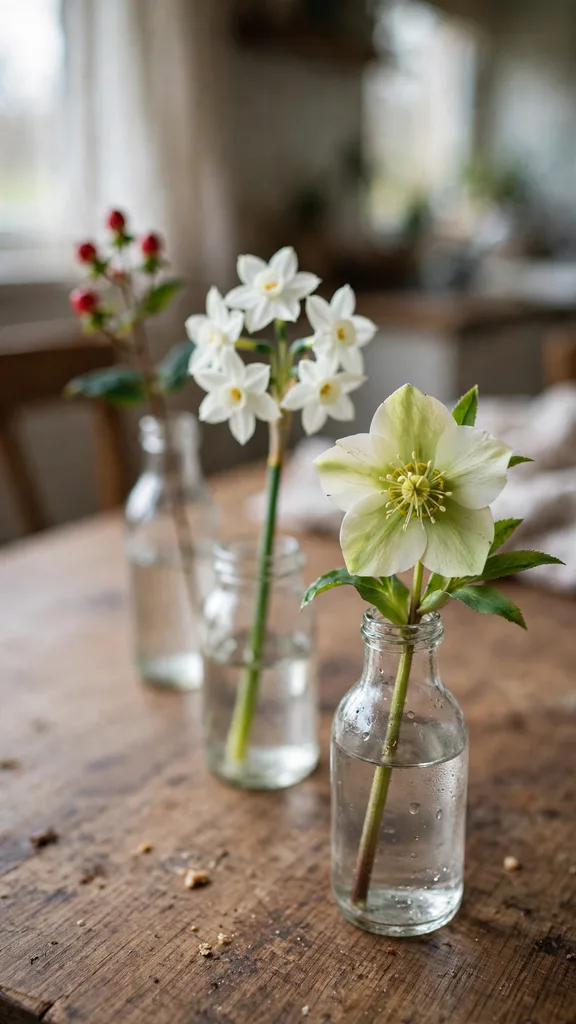
Single stems let you use flowers you have in ones and twos, the first hellebore, the last rose, which no bouquet could absorb. If a stem fades midweek, one bottle refreshes without touching the rest. Children can fill the bottles and own a section each. At the meal’s end, a guest can be handed their nearest bottle as a present, and the arrangement distributes itself.
34. A Row of Jugs Along the Mantel
Instead of one mantel arrangement, run three or five jugs along the mantel, each with a different December material: evergreen in one, berries in the next, dried grasses in the third, honesty in the fourth, one white flower in the last. The row reads as a still life of the whole garden, and each jug is a five-minute build. Keep the jugs in one family, all stoneware or all glass, so the row coheres.
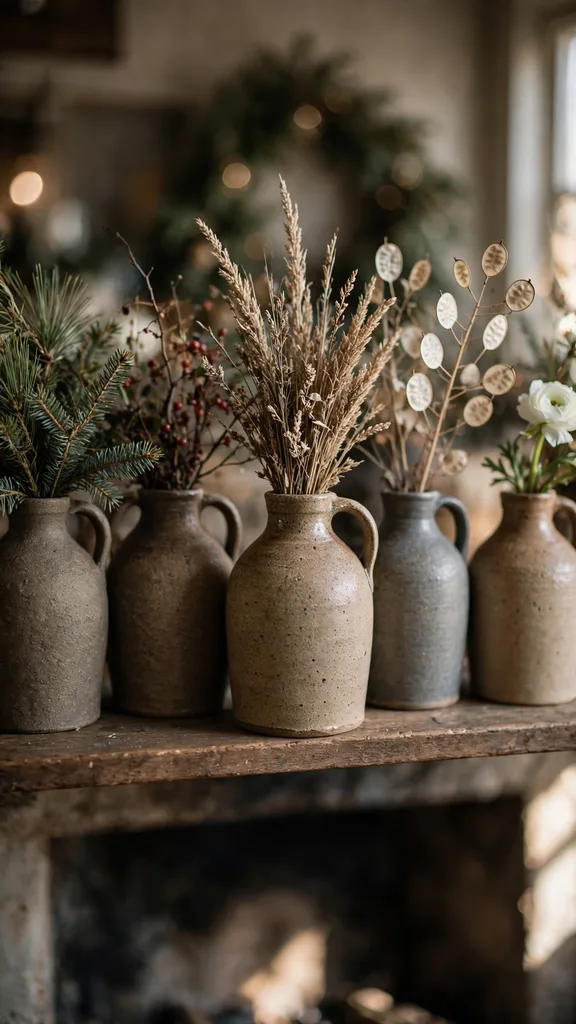
Mantel jugs sit above the fire’s heat, so favor evergreen, berry, and dried materials over fresh flowers, which cook at mantel height in a heated room. The row also leaves the mantel’s middle free for cards or candles. Photograph it once and you have next year’s plan. This arrangement rewards collectors of jugs, who finally have a December use for the whole shelf.
35. Newel Post Bunch Tied with Ribbon
A bunch of evergreen, berries, and one dried flower head tied with a wide ribbon to the newel post at the stair’s foot greets everyone who enters and everyone who goes up to bed. Build the bunch in your hand, longest stems at the back, tie it once, then tie it to the post with the ribbon’s tails flying. It takes ten minutes and no water if you build it from evergreen and dried material, lasting the season dry.
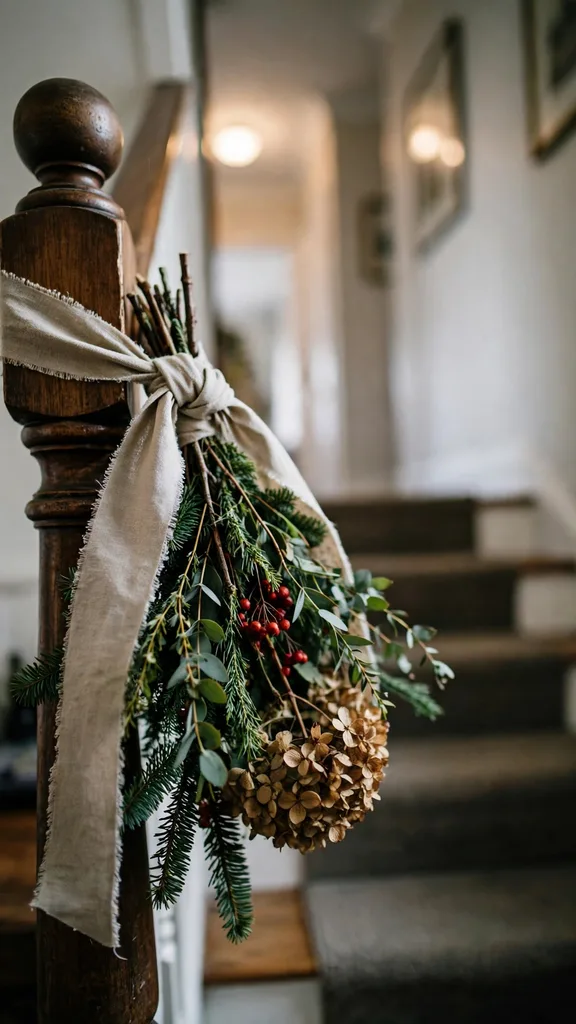
The newel bunch is the arrangement for houses without a hall table, proof that every house has one good spot. Keep it clear of the handrail’s grip zone so hands pass safely. A matching smaller bunch on the top newel finishes the staircase. In January the ribbon goes back in its box and the bunch goes to the compost, having been greeted four hundred times.
36. Hanging Dried Bunch from a Beam
A bunch of dried grasses, lavender, seed heads, and one or two strawflowers tied upside down from a beam, a hook, or the top of a bookcase hangs the harvest in the air where floor and table arrangements cannot go. Hanging bunches scent the air faintly, move in the room’s currents, and stay out of every reach, including the cat’s. Build them in autumn when the drying finishes and hang them as December starts.
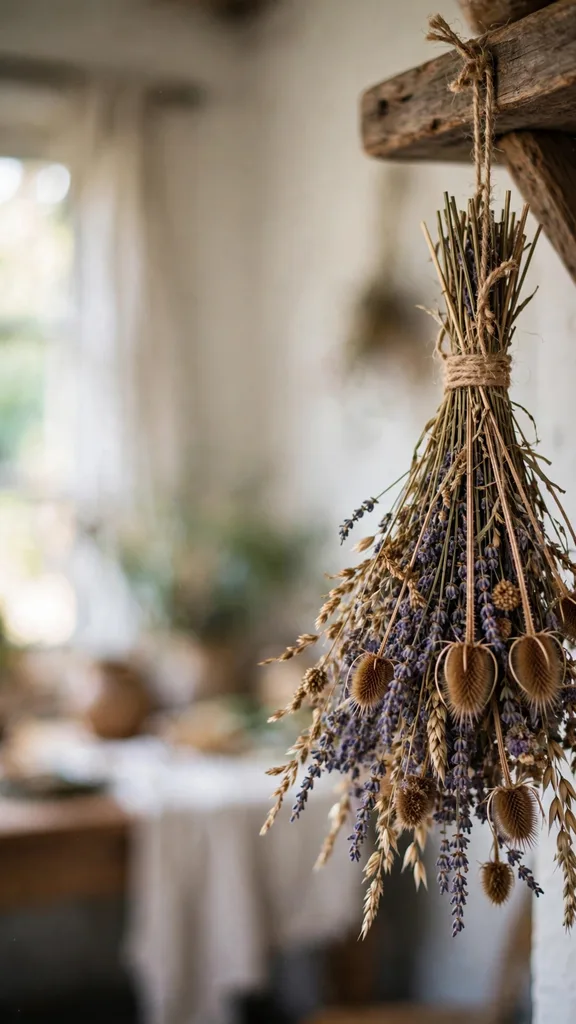
Keep hanging bunches away from open flames and the wood stove’s rising heat. Their undersides are their best side, so hang them where people sit and look up: over a reading chair, a kitchen table, a bed. One bunch is an accent; three along a beam are an installation. They store hanging in a spare room all year if December never quite takes them down, which happens.
37. Teapot Arrangement for the Kitchen Table
A teapot, especially one whose lid is lost, makes a low, round vase that suits a kitchen table: evergreen sprigs and a few short flowers arranged in it look like the pot is brewing the season. The spout and handle give the arrangement its charm and its balance, and the small scale suits the room where the family actually lives. Short stems only; a teapot arrangement that towers has misunderstood the teapot.
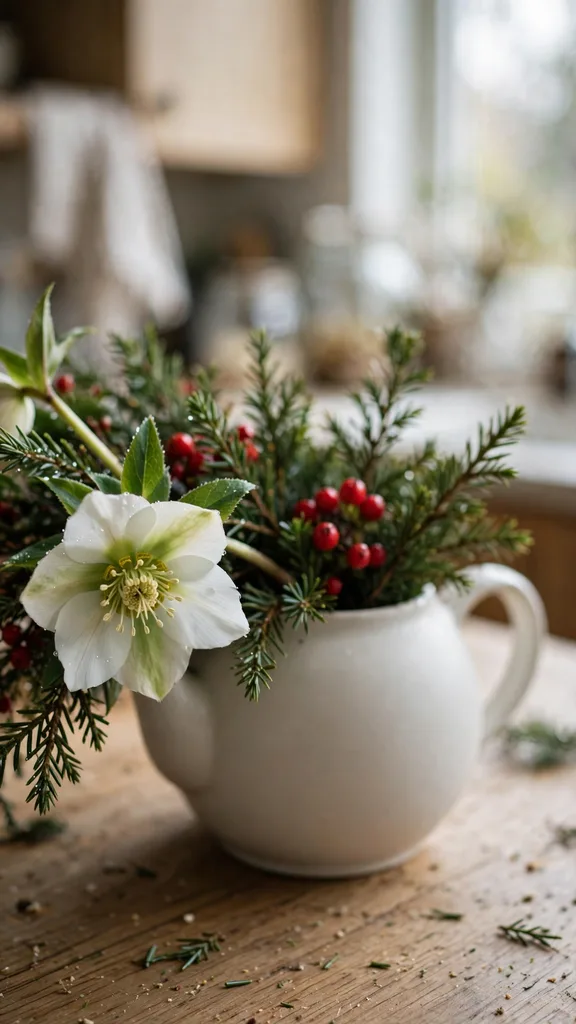
Use the teapot for the week’s best small things: the first hellebores, a cyclamen bloom, berries, herbs. It refills in minutes and moves aside for meals without ceremony. A teapot of herbs by the sink doubles as the cook’s garnish supply. This arrangement charms children, who regard flowers in a teapot as a joke the house is playing, correctly.
38. Forced Quince Branches in a Floor Vase
Flowering quince branches cut in December and brought into the warmth open their coral, pink, or white blossoms along bare thorned branches over two to three weeks, a tall arrangement that behaves like spring arriving early in one corner. Cut long branches, smash or split the stem ends so they drink, and stand them in a floor vase with nothing else; the blossom is the whole event. Cherry and forsythia branches force the same way for variety.
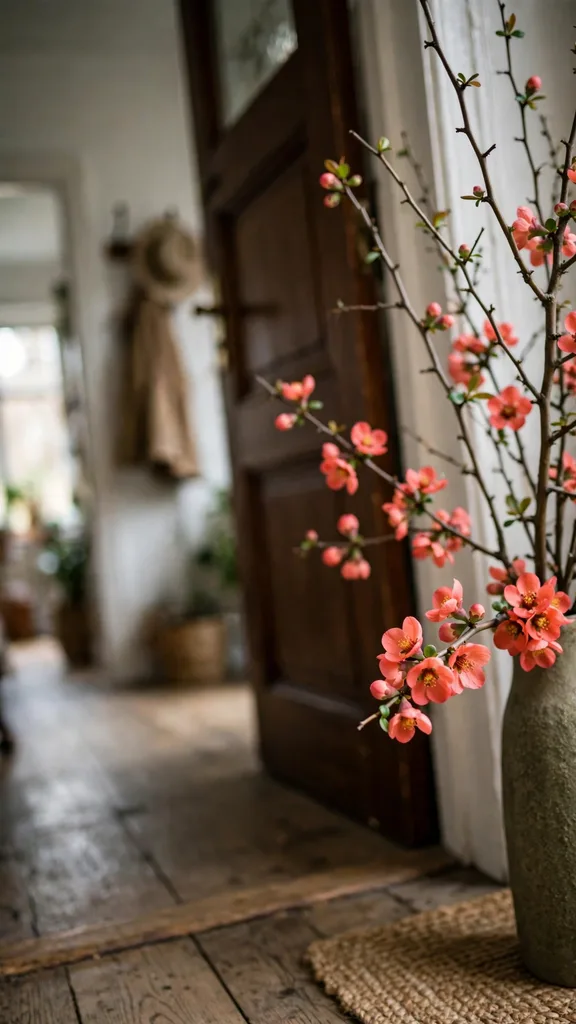
Forced branches are the arrangement to start earliest, since the buds need their weeks, and to photograph most, since the opening is a daily change. The vase needs weight; quince branches are long and the vase will be top-heavy in a narrow base. When the blossom falls, the bare branches with their thorns stay sculptural for the rest of winter. A floor vase of quince by the door is the arrangement that makes visitors ask if spring has come early to your house alone.
39. Arrangement in a Copper Jug
Copper warms every December color: evergreen, berries, white flowers, and dried golds all deepen against a copper jug’s glow, and the metal suits fireside rooms like no glass can. Polish the jug or leave it tarnished; both work, tarnish reading as age and polish as lamplight doubled. Copper is heavy, stable, and unbreakable, which makes the jug the vase for the hall floor and other traffic zones.
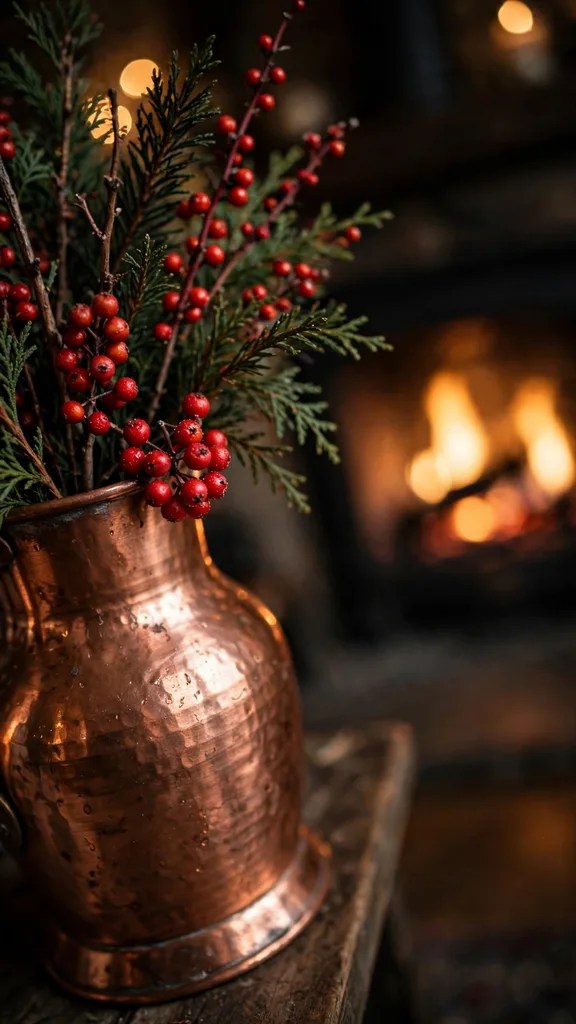
Water in copper stays clean a long time, and stems last well in it. Keep the arrangement simple in a copper jug, since the vessel is half the show: one material per jug, berries or greens or whites, never all three. A pair of copper jugs flanking a fireplace, one green and one berried, is the formal hall arrangement of this list, and it builds in twenty minutes from two walks around the garden.
40. A Small Vase for the Bathroom Shelf
The bathroom arrangement is small, scented, and steam-tolerant: a tumbler of eucalyptus sprigs, a hyacinth spike, or evergreen tips with one white flower, refreshed weekly. Steam suits eucalyptus, whose scent releases in the warm damp air of a shower like a treatment. Keep the vase small enough for the shelf and sturdy enough for elbows, and favor materials that drop nothing into the sink.
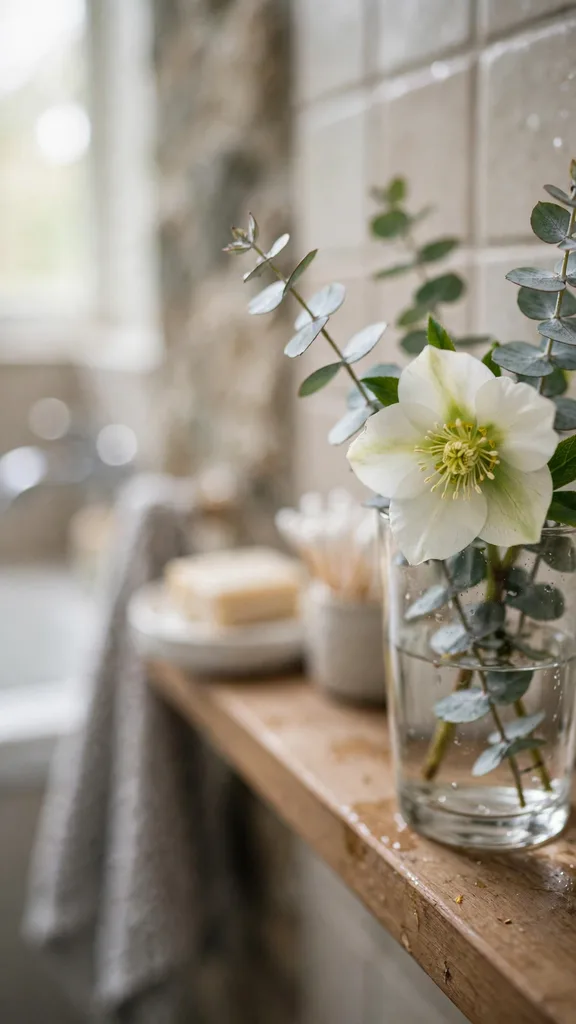
Guests judge a house by its bathroom flowers more than its hall ones, because the bathroom arrangement is the one they have time alone with. This is where the single perfect stem belongs. Change the water when you clean the room and the arrangement never embarrasses. A bathroom with a living stem in December feels like a hotel; that is the entire secret of hotels.
41. Bedside Arrangement in a Tumbler
A bedside arrangement should be small, unscented or faintly scented, and stable: a tumbler with three hellebores, a snowdrop bunch, or evergreen tips and one berry sprig. Strong scent at a pillow, especially hyacinth and paperwhite, keeps some sleepers awake, so the bedside is where the quiet flowers go. The arrangement’s job is to be the first and last green thing seen in the day, and size has nothing to do with it.
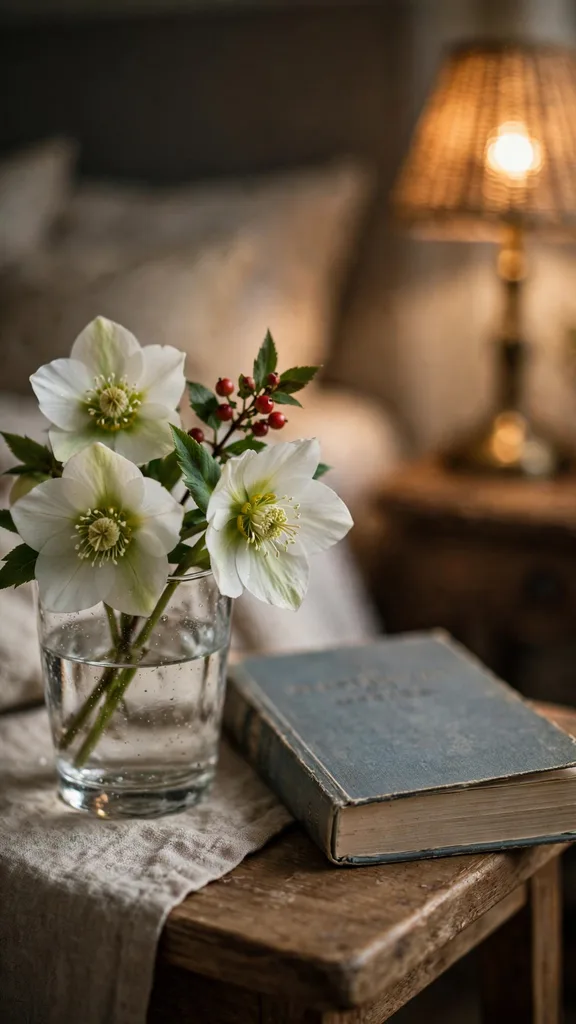
Refresh it on the day the bed linen changes and it never looks tired. A guest room bedside arrangement, with a small card, is the detail that makes visitors feel expected rather than accommodated. Keep water levels low in a tumbler by a bed, where a knock at night is a matter of when, not if. Small, fresh, and deliberate beats large and fading in the bedroom every time.
42. Hallway Console Arrangement with Mirror Light
A console table against a mirror doubles any arrangement placed before it: the mirror shows the arrangement’s back, reflects its colors into the hall, and makes a modest vase look like a pair. Build the console arrangement taller than table pieces, since halls are seen standing and moving: branches, berries, tall evergreen, with the mirror supplying the depth. Candlelight or a lamp beside it multiplies again in the glass.
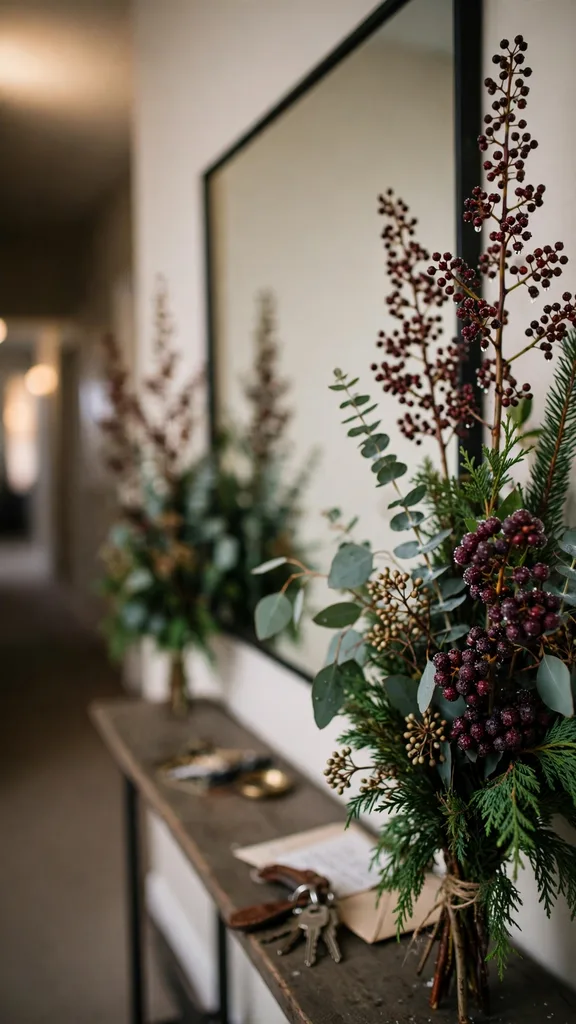
This is the arrangement to build where the house is darkest, because the mirror borrows light from anywhere. Keep the back of the arrangement tidy, since the mirror displays it; this is the one arrangement with no back side. A console arrangement changed weekly, greens, then berries, then whites, then dried, makes the hall a gallery of the garden’s December in four acts.
43. A Gift Arrangement in a Jam Jar
The gift arrangement is built to leave: a jam jar of evergreen, berries, one flower, and a cinnamon stick, tied with twine, that travels to a neighbor, a teacher, a host. Jam jars are free, sturdy, and the right size for a doorstep, and nobody has to return one, which is the flaw in every vase gift. Build a batch of six in an hour and the week’s obligations become the week’s pleasures.
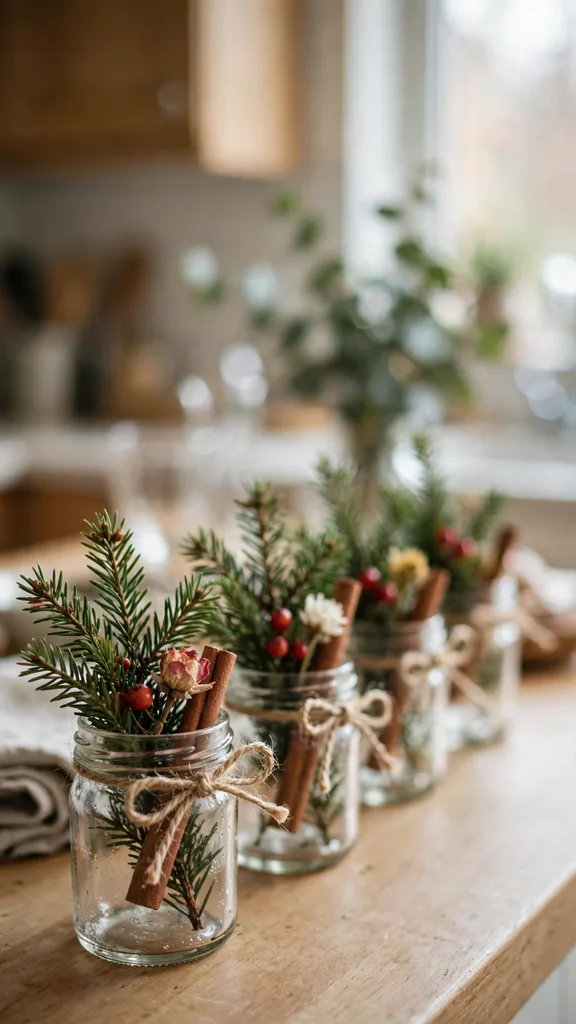
Jar arrangements use the good trimmings, the berry sprig too short for the statement vase, the flower too single for the table, so they cost the other arrangements nothing. A jar on every doorstep on the street by Christmas Eve is a reputation worth having. Write the date on the lid’s underside and regular recipients start keeping the lids, which is how traditions announce themselves.
44. The New Year Refresh Arrangement
By New Year, the Christmas arrangements divide into the dead, the dried, and the evergreens still going. The refresh arrangement gathers the survivors, recut and rewatered, adds forced branches and the first snowdrops, and drops every red berry and ribbon: the palette turns to green, white, and silver, and the house exhales. Build it on the day the tree comes down and the rooms stop looking bare at exactly the moment they usually do.
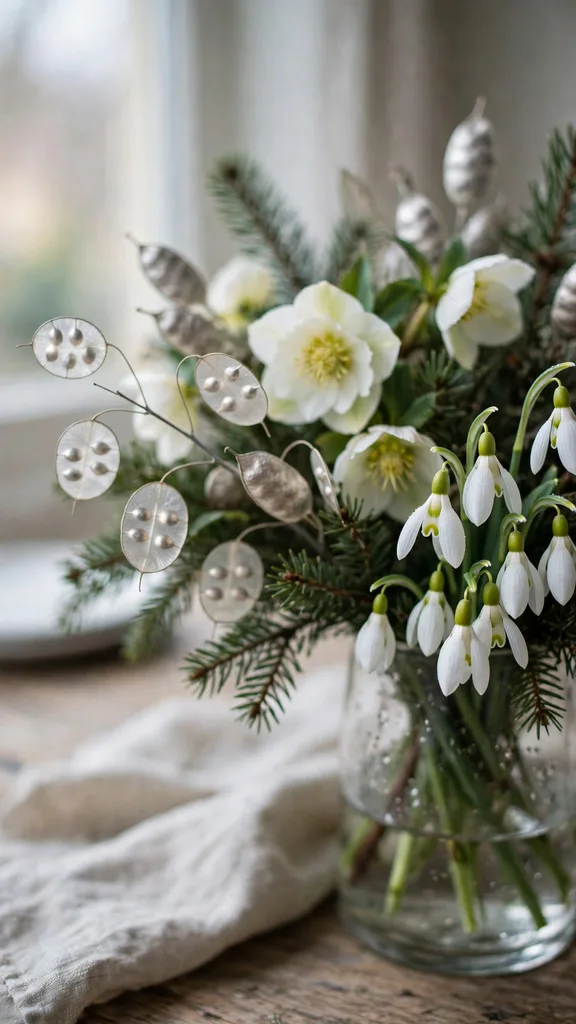
The refresh is the arrangement that proves the garden’s December was a season, not a day. Honesty and silver foliage move to the front; amaryllis second stems often arrive now as a bonus. Keep this arrangement somewhere central, because its job is morale. It lasts into mid-January, when the seed catalogs arrive and the gardening year turns over for real.
45. The Finished Christmas Table Arrangement
The finished table arrangement gathers everything the season taught: a low bowl built on the morning of the meal, evergreen bed first, the best flowers of the week as peaks, berries and citrus as punctuation, candles in glass at its shoulders, and not one element tall enough to hide a face across the table. Build it where it will stand, since a finished low arrangement travels badly, and photograph it before the first dish lands, because its perfection lasts exactly until lunch.
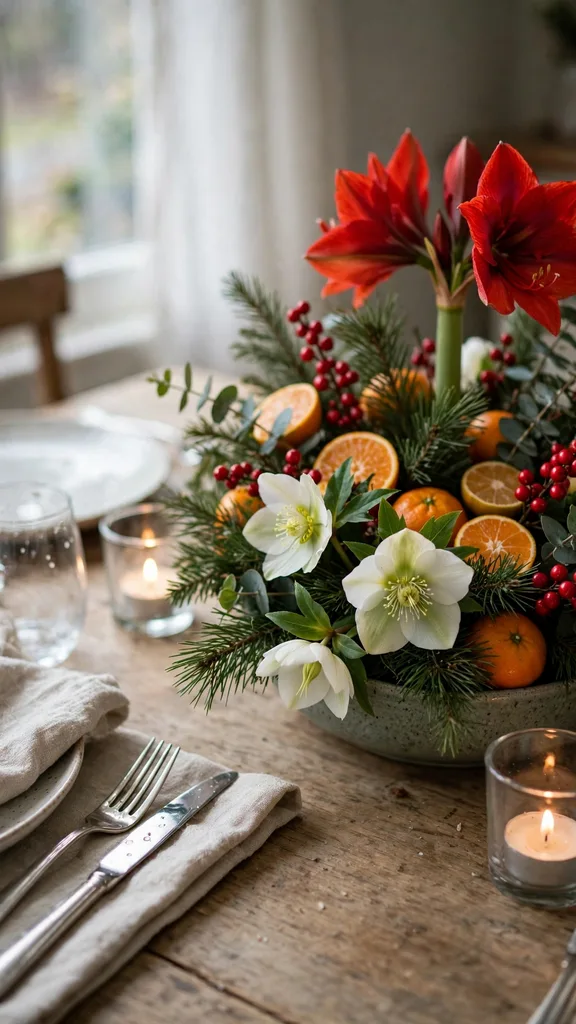
This is the arrangement the other 44 rehearse. Its rules are the list’s rules: garden material, conditioned stems, water kept fresh, scale kept low, and nothing on the table that the garden did not provide or the cupboard already held. When it is done, the table looks like the garden came in for Christmas and behaved beautifully. For the remaining ideas in the full set of 100, the Christmas garden ideas pillar holds the complete collection.
Frequently Asked Questions
Fresh flower arrangements last about a week with conditioned stems, clean water, and a cool spot, and amaryllis and paperwhites run to two weeks. Evergreen arrangements in water last three to four weeks, the longest of the fresh materials. Dried arrangements last the whole season and beyond. The two habits that decide everything are cutting stems under water or recutting them as you arrange, and changing vase water every two days.
The true December bloomers are hellebores, especially Christmas roses, winter jasmine, witch hazel, winter camellias, and snowdrops in mild spells, plus everything forced indoors: paperwhites, amaryllis, and hyacinths. Beyond flowers, December’s real wealth is material: evergreen cuts, berries, bare branches for forcing, and the dried flowers and seed heads saved from summer. Most arrangements in this list mix at least two of those four groups.
Cut in the morning, recut each stem under water, and split thick woody stems an inch up from the base so they can drink. Strip every leaf and needle that would sit below the waterline, since submerged foliage rots and fouls the water. Stand the cuts in deep water in a cool place for several hours or overnight before arranging. Conditioned evergreens last three to four weeks in a vase; unconditioned ones can tire in ten days.
Plain water in a vase or bowl suits most arrangements here and lets you recut stems and refresh the arrangement over its life. Soaked floral foam earns its place in low table arrangements that must hold a shape, rings around lamps, and the evergreen beds that support hollow amaryllis stems. If you use foam, soak it fully, keep it watered daily, and never let it dry out, because a dried foam block will not rewet evenly.
Build evergreen and dried arrangements up to a week ahead and keep them cool; they improve as they settle. Build fresh flower arrangements one or two days ahead at most, and hold them somewhere cold, bringing them into the warm room on the day. Berry arrangements sit happily for three or four days. The table centerpiece itself is best built on the morning it is needed, from material cut and conditioned the day before.