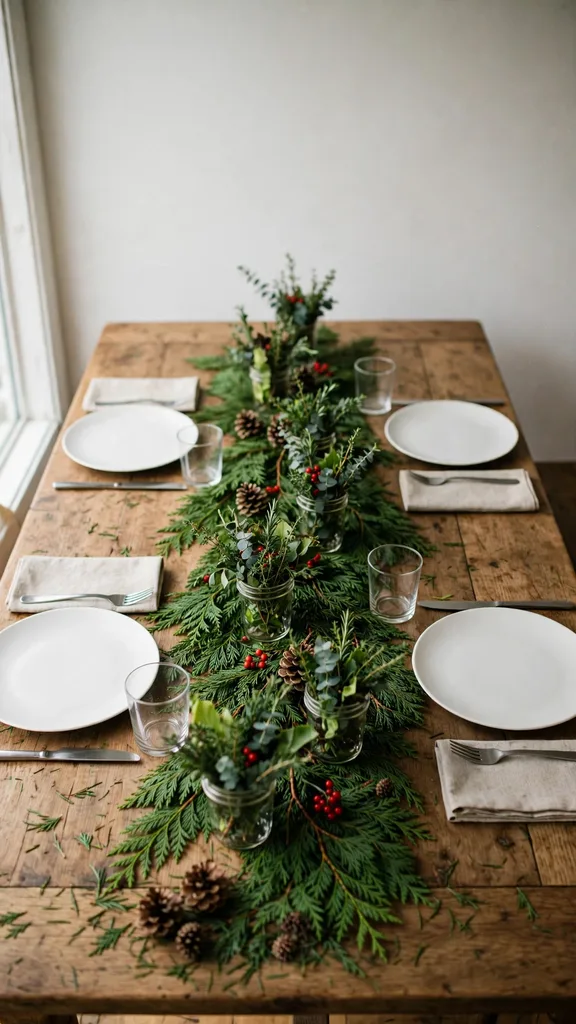
A Christmas centerpiece does not need a florist. It needs a pair of pruners, ten minutes in the garden, and material that was growing that morning: cedar and pine clippings, magnolia leaves, cones, berries, dried hydrangea heads, herbs, and fruit. The 45 centerpieces in this list are all built from garden material, most of them in under fifteen minutes, and every one of them can be composted in January instead of stored in a box.
The list groups into five jobs: greenery runners that run the length of the table, cones, berries, and branches, dried flowers and seed heads saved from summer, fruit, vegetables, and herbs from the garden and kitchen beds, and candles, jars, and living pots. Start with one runner and one bowl and the table already works.
I build the table the day before Christmas from whatever the garden gives up in December, and the cutting is half the pleasure of it.
At a Glance: Pick Your Centerpiece by Material
| Material Group | Item Numbers | Best First Pick | Build Time |
|---|---|---|---|
| Greenery runners | 1 to 9 | Cedar garland runner | 15 minutes |
| Cones, berries, and branches | 10 to 18 | Pinecone row on a board | 10 minutes |
| Dried flowers and seed heads | 19 to 27 | Dried hydrangea cluster | 10 minutes |
| Fruit, vegetables, and herbs | 28 to 36 | Herb pot trio | 5 minutes |
| Candles, jars, and living pots | 37 to 45 | Mason jar greenery row | 10 minutes |
Cut greenery keeps longest when it is cut in the morning, stood in water for an hour, and built the same day; the full harvest and keeping rules sit with the Christmas garden ideas pillar. Everything below assumes material from your own garden, a neighbor’s hedge with permission, or prunings that were coming off anyway.
1. Cedar Garland Runner With Loose Clippings
Lay two lines of western red cedar or arborvitae clippings down the center of the table, stems overlapping toward the middle so the flat sprays fan out on both sides. Cedar lies flat by nature, which makes it the easiest runner of all: no wire, no foam, just cut lengths of 30 to 45 cm (12 to 18 in) arranged in ten minutes.
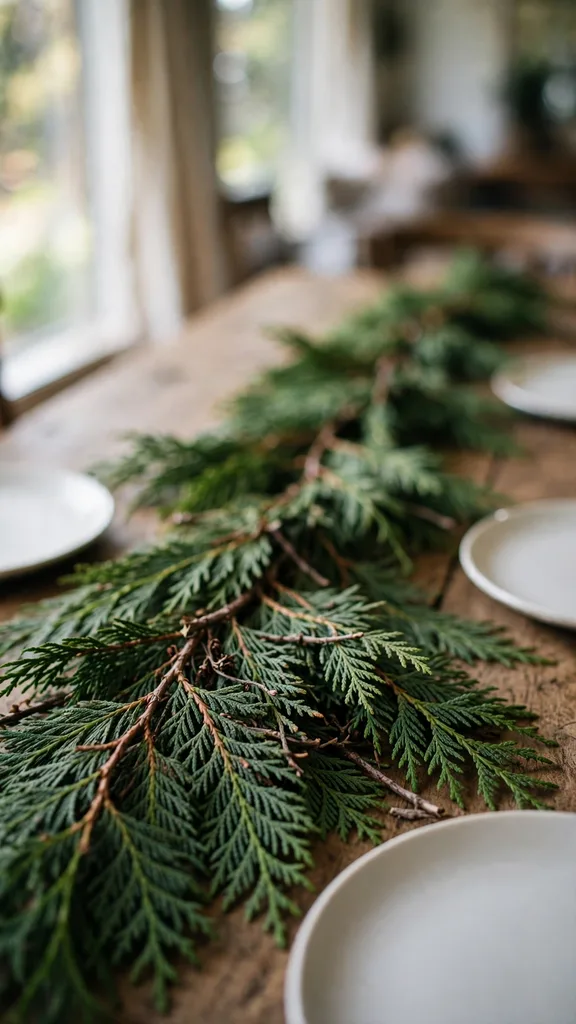
Cedar holds its color and scent for two to three weeks indoors and drops very little, so this is the runner to build early in December and leave in place. Mist it lightly every few days, keep it away from candle flames, and tuck any browning tips under fresh clippings as the month goes on.
2. Pine and Fir Mixed Greenery Runner
Mix two or three conifers for texture: long-needled pine for softness, fir for structure, and spruce tips for a blue-gray note. Build the runner in sections on the kitchen counter, each section a bundle of mixed stems wired or tied at the base, then overlap the sections down the table so the joins disappear.
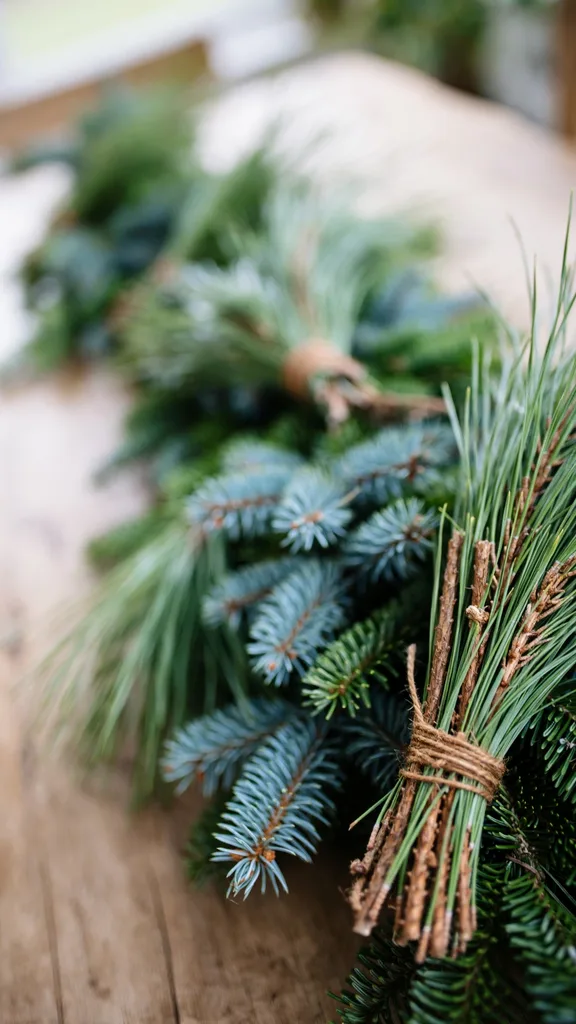
Pine scents the room more strongly than any other cutting green, and fir holds its needles the longest of the three. Cut more than you think you need, because a mixed runner looks thin until it is about half again as full as you planned. Offcuts go into the jar arrangements at item 37.
3. Magnolia Leaf Runner
Lay southern magnolia leaves in overlapping rows down a strip of burlap or a plain runner cloth, glossy green side up with every third leaf turned to show the copper-brown underside. The NC State Extension entry for Magnolia grandiflora describes the leathery evergreen leaves that make this work: they are stiff enough to hold a plate’s edge and slow to wilt.
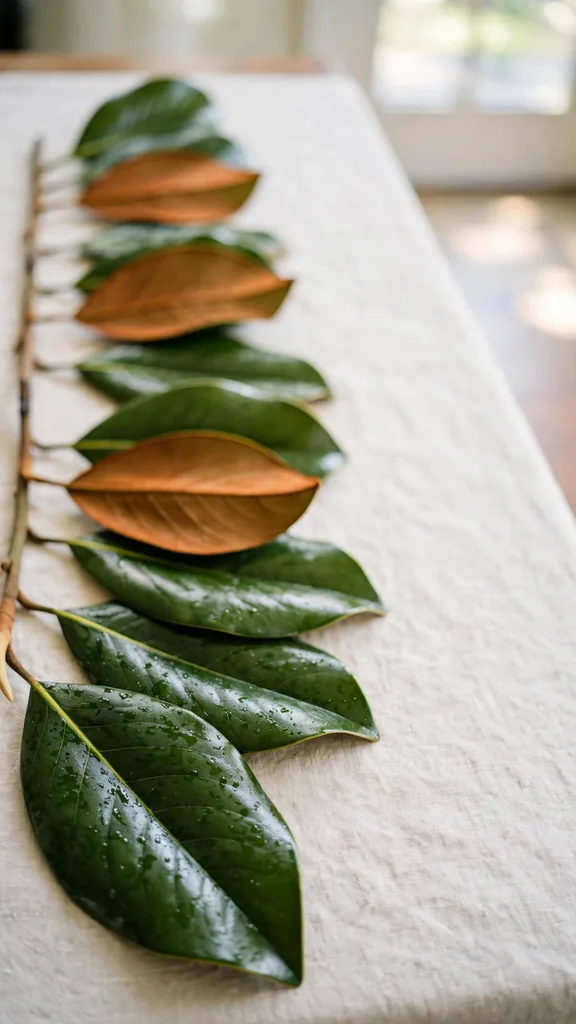
Magnolia is the longest-lasting cut leaf on this list. A runner built in mid-December still looks fresh at New Year, and the leaves dry in place to a handsome bronze if you leave them longer. Cut leaves with a short stem so they sit flat, and wipe dusty leaves with a damp cloth before you lay them.
4. Boxwood Garland Strip
Boxwood clippings wired into a slim garland make the neatest runner for a narrow table or a formal setting. Wire short sprigs of 10 to 15 cm (4 to 6 in) onto a length of twine, overlapping as you go, and lay the finished strip straight down the table or in a shallow S-curve between the place settings.
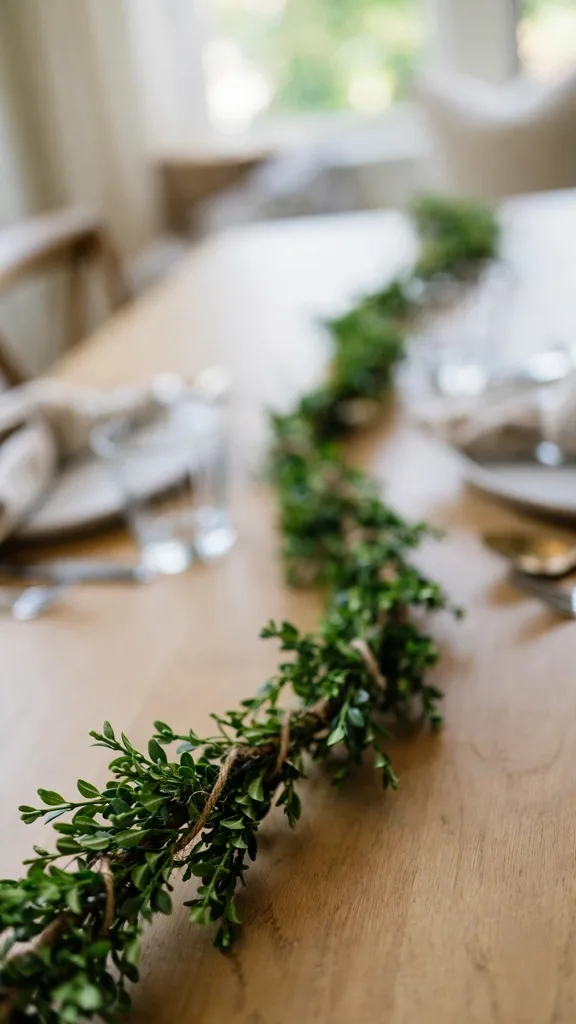
Boxwood is the slowest of the cutting greens to dry out and holds its small, dense leaves for a month indoors. It also carries a faint sharp scent some people love and some do not, so test a sprig in the room before you commit the whole table to it. Prunings from a spring-shaped hedge give the most uniform sprigs.
5. Eucalyptus and Olive Branch Runner
In warm-climate gardens, eucalyptus and olive prunings make a runner in silver and gray-green that suits a pale, modern table. Lay the long stems loosely, let them arc where they want, and add nothing else: the two leaf shapes carry the whole arrangement. A few stems go a long way because both plants branch generously.
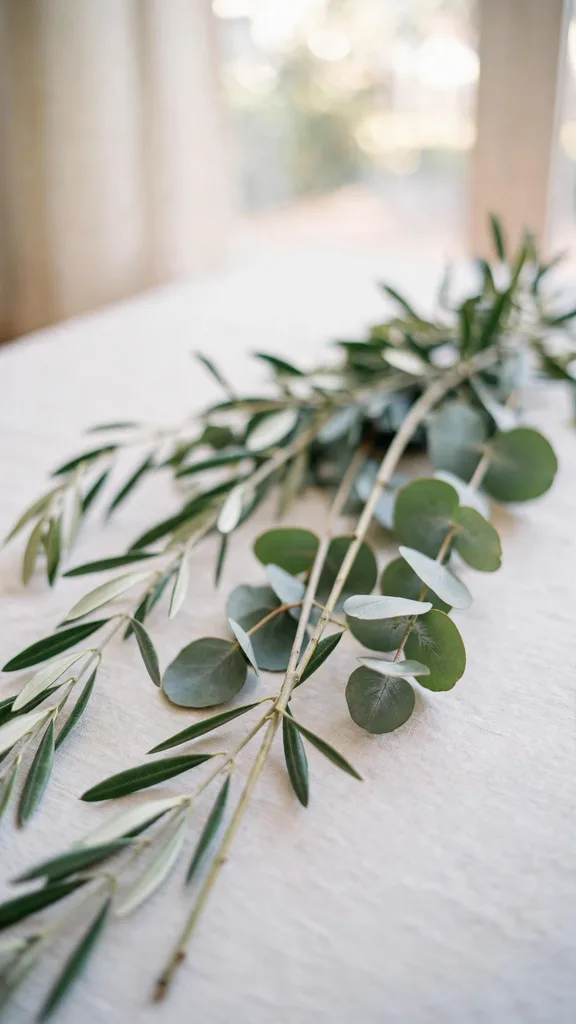
Both dry where they lie without wilting, so this runner improves over the first week as the leaves stiffen. Eucalyptus scents the room when the sun or a radiator warms it. In cold climates, substitute bay or the gray foliage of lavender prunings for the same effect from hardier plants.
6. Holly and Ivy Classic Runner
The oldest pairing on the list: glossy holly leaves with red berries, trailed through with ivy cut from a wall or a groundcover bed. Lay the holly in short sections and weave the ivy over it in loose loops, letting the trails spill a little over the table edge at the ends.
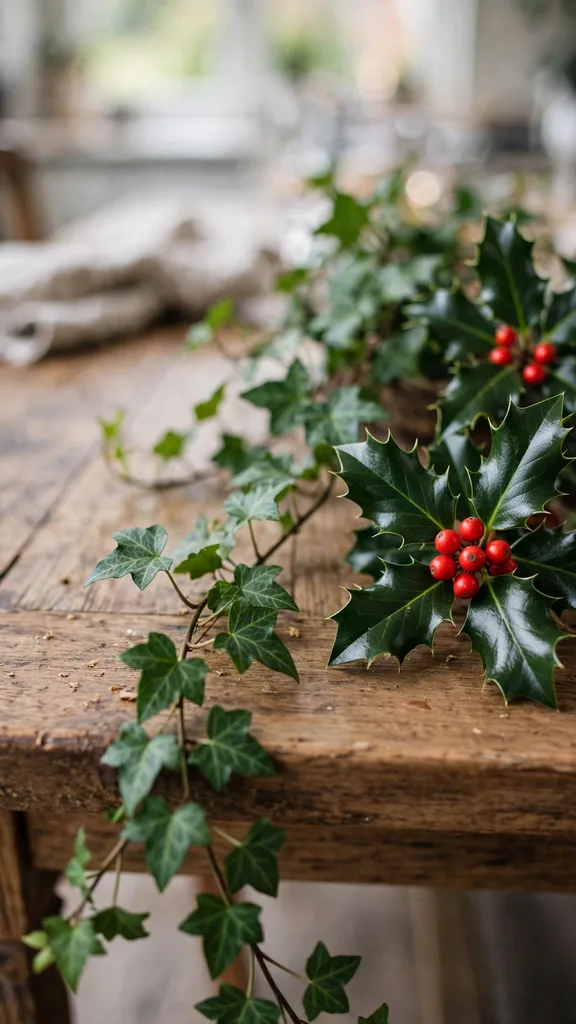
Holly berries are toxic, so keep this runner on an adult table and clear fallen berries before children or pets reach them. Cut holly after the berries color fully, and take ivy trails of 60 to 90 cm (24 to 36 in) so they weave without forcing. Both keep for two weeks with misting.
7. Rosemary Garland Runner
Wire or tie rosemary stems into a slim garland for a table that is also a meal, and guests brushing the leaves as they reach send the scent up through dinner. Stems of 20 to 30 cm (8 to 12 in) from a mature bush give a garland with real presence, and the whole thing can go into the compost or the stockpot in January.
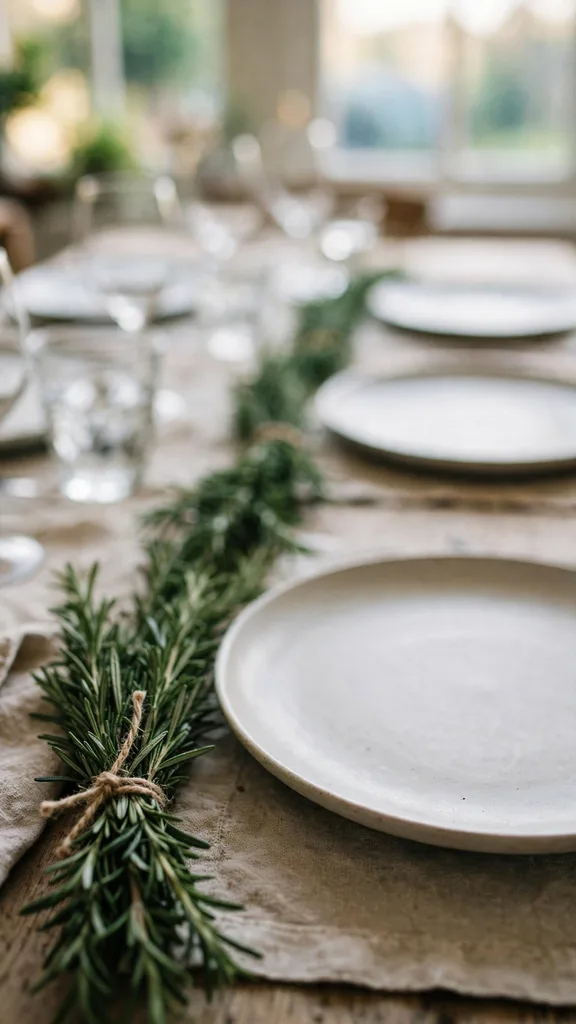
Rosemary dries rather than wilts, so a runner built a week ahead still looks deliberate on the day. Cut from the back and underside of the bush so the plant keeps its shape for winter. In cold districts where rosemary winters in a pot, that pot does more work at item 34 and the garland can come from sage instead.
8. Bay Leaf Runner
Bay leaves on the stem, laid in overlapping fans, make a runner with a cook’s logic: handsome on the table, and the leaves dry for the kitchen afterward. Cut whole small branches of 25 to 40 cm (10 to 16 in) and lay them flat, or strip the leaves and overlap them in rows on a cloth for a tighter, formal pattern.
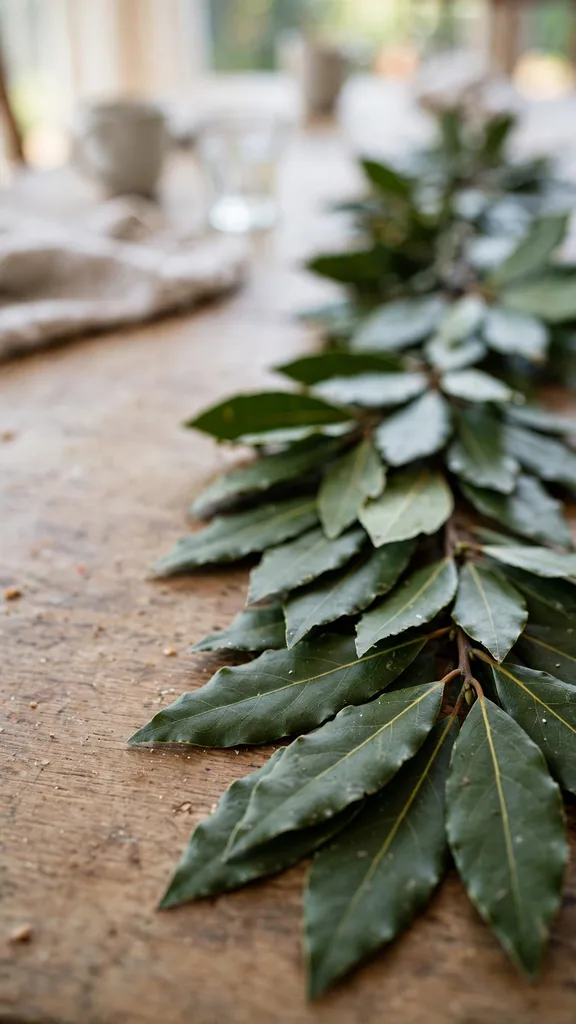
Bay is evergreen, leathery, and slow to fade, and it holds for the whole season. The scent is subtle until a warm plate sits on it. Gardeners in cold zones grow bay in pots that come indoors for winter, and a potted bay pruned lightly at Christmas gives exactly the clippings this runner needs.
9. Juniper and Blue Spruce Tip Runner
Prune the blue tips of spruce and the berry-carrying sprays of juniper into a runner with a frosted, blue-gray cast that suits red berries and white candles. Both plants hold their color and their needles well indoors, and juniper berries add the detail work without anything being bought.
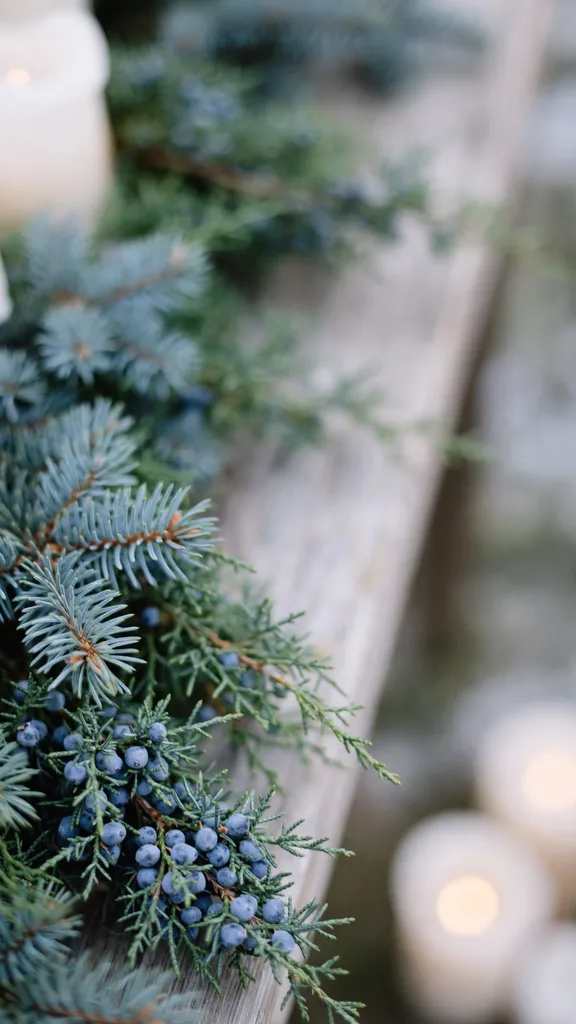
Wear gloves: spruce tips are sharp and juniper is prickly, and both leave resin on your fingers that soap struggles with. Cut spruce tips from the lower branches where the tree will not miss them, and never take the leader. This runner keeps three weeks and improves as the juniper berries darken.
10. Pinecone Row on a Wooden Board
The ten-minute centerpiece. Stand a row of large open pinecones down a wooden board or a bread platter, alternating sizes, with a few small cones filling the gaps at the base. Add nothing else, or tuck short cedar clippings between the cones if the board looks bare.
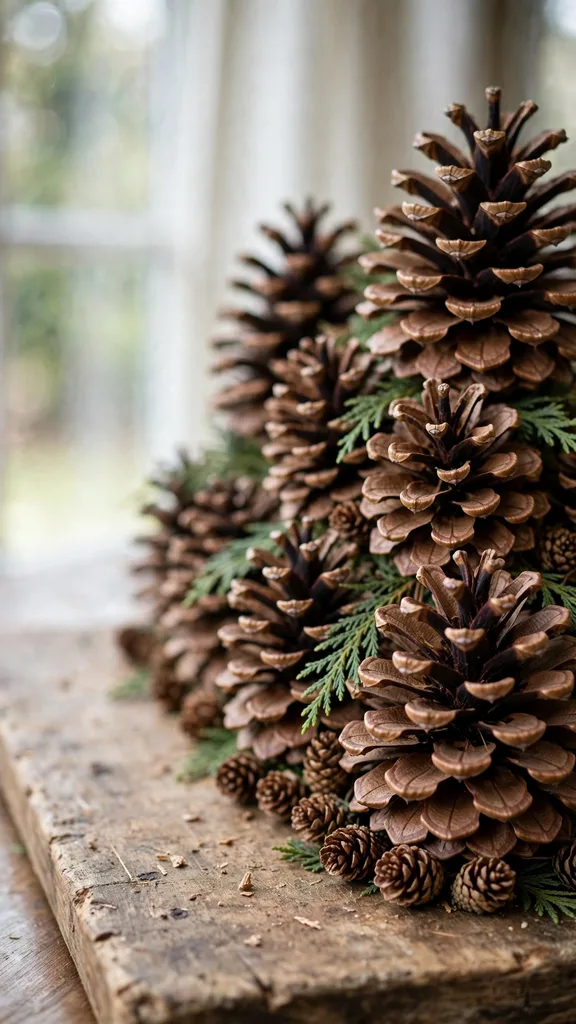
Collect cones in autumn and dry them indoors for a few weeks so they open fully and shed any residents. A cone row built this year stores in a bag and comes out identical next year, which makes it the only centerpiece on this list that is also a keepsake. Keep it away from open flames, as dry cones catch readily.
11. Berry Branch Vase Centerpiece
Cut three to five stems of winterberry, holly, or rose hips and stand them in a heavy vase or a stoneware jug with nothing else. The NC State Extension entry for Ilex verticillata notes winterberry loses its leaves in autumn and carries its red berries on bare stems through winter, which is exactly the clean, graphic look this arrangement uses.
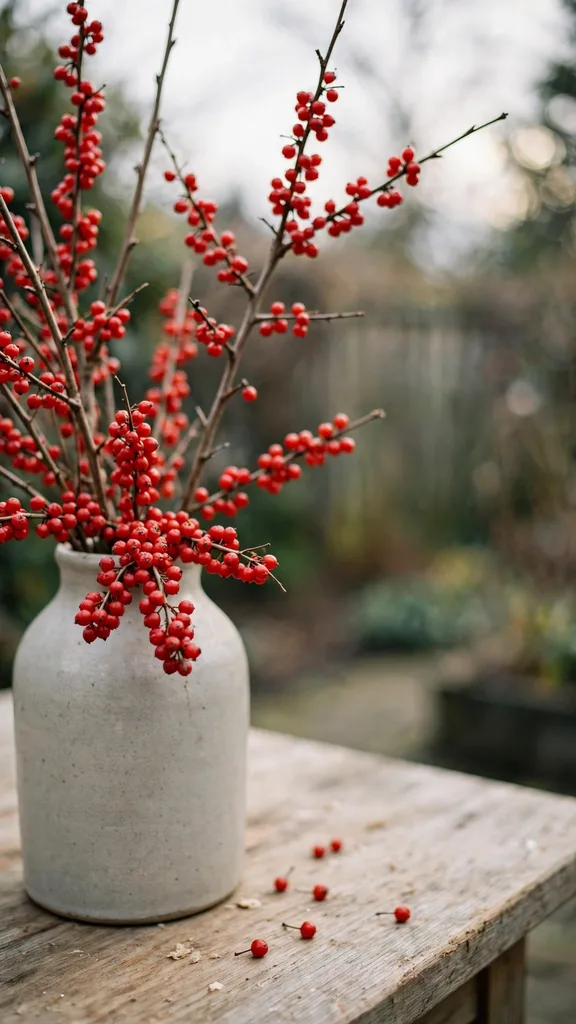
Berry branches last for weeks in water and longer out of it, drying slowly where they stand. Strip any leaves, cut the stems long, and let the vase be plain: the berries are the color and the shape at once. Keep berries away from children and pets, as most winter berries are not safe to eat.
12. Red Dogwood Twig Arrangement
Cut a bundle of red-stemmed dogwood prunings, the younger the stems the brighter the color, and stand them tall in a narrow vase with a few white or cream dried flowers at the base. The red stems do the work that flowers do in summer, and the arrangement stands 60 to 90 cm (24 to 36 in) tall without blocking sight lines, because the stems are bare.
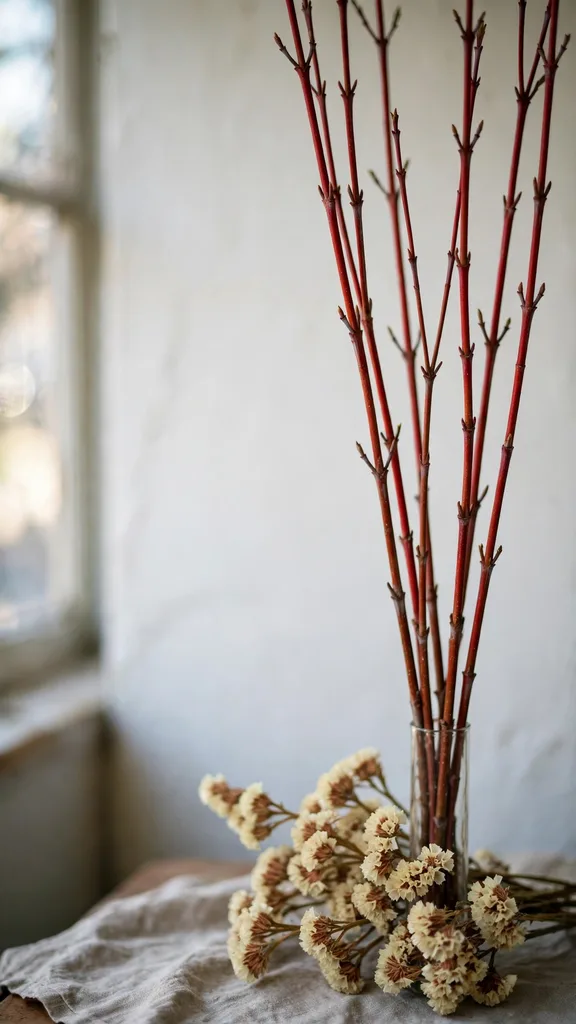
Dogwood stems last all winter in or out of water and can be planted out as cuttings in spring if they root in the vase, which sometimes happens. Prune them from the oldest part of the shrub in rotation, because hard pruning every year gives the brightest young stems the following winter.
13. Birch Log and Greenery Slice Runner
Saw a fallen birch or pale-barked branch into discs of 2 to 5 cm (1 to 2 in) thick and lay them down the table as a base, then build short greenery clippings, cones, and berries on top of the discs. The pale bark lifts the dark greens and gives every place setting the same foundation down the line.
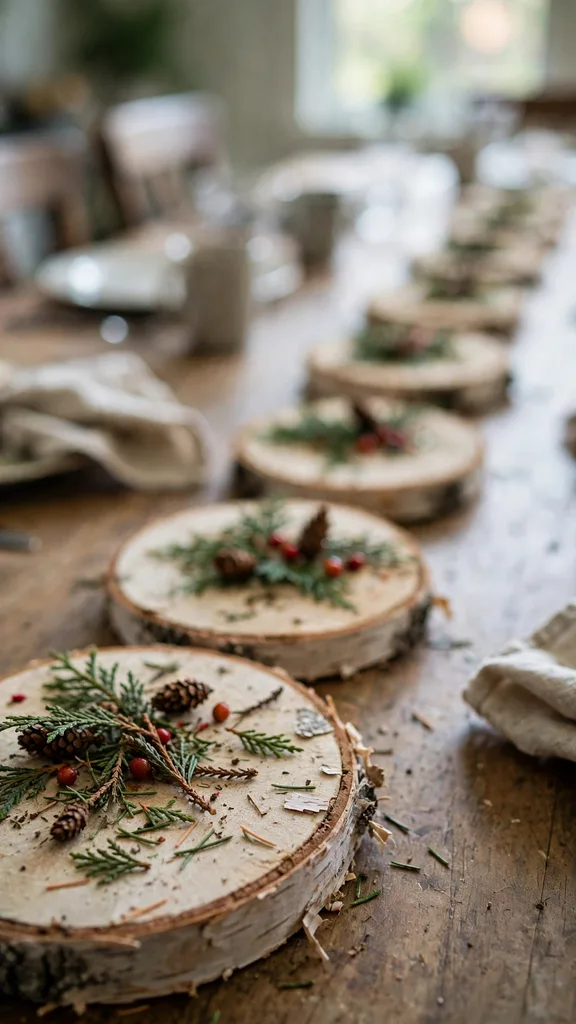
Use only fallen or pruned wood, and dry the discs indoors for a week so they sit flat and do not weep sap onto the cloth. A slice runner suits a long table better than a wide one, and it breaks down into individual place mats for a small table by using one disc per setting.
14. Pinecone and Dried Flower Platter
Fill a shallow platter or a low wooden bowl with large cones and dried flower heads from the summer garden: hydrangea, allium, and strawflower hold their shape and take the place of fresh flowers. Tuck a few evergreen clippings around the rim to tie the platter to the season.
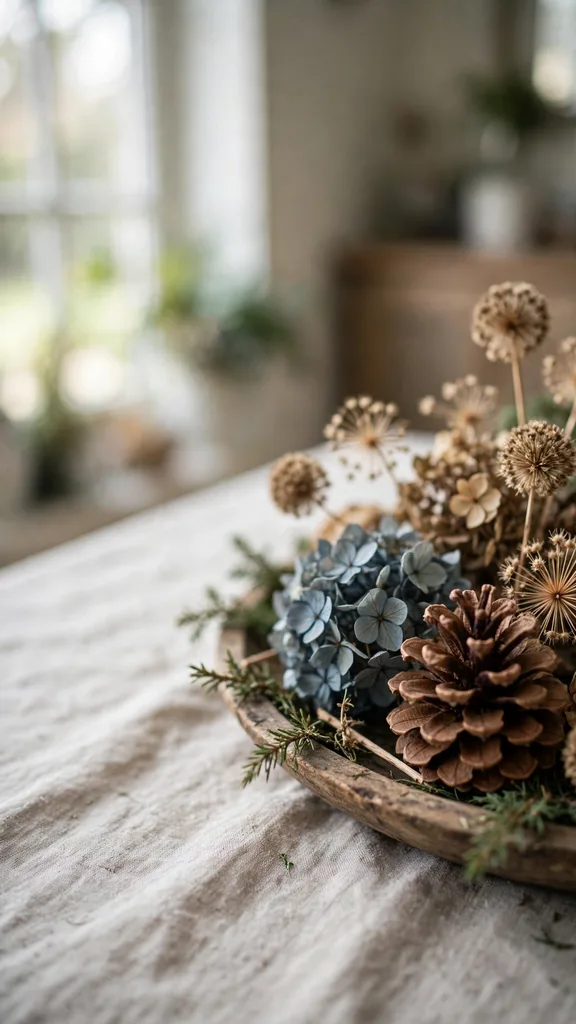
This is the centerpiece to build from a mixed autumn harvest basket, and it asks for no cutting at all in December. Dried material lasts the whole season without water or misting. Keep it out of direct sun, which bleaches dried flowers, and away from candle flames, which dry cones and petals make genuinely risky.
15. Rose Hip and Hawthorn Branch Bowl
Fill a wide bowl with short branches of rose hips and hawthorn berries, cut to 20 to 30 cm (8 to 12 in) and arranged so the hips spill over the rim. The orange-red hips carry the color of the arrangement, and a bowl of them looks gathered rather than arranged, which suits a country table.
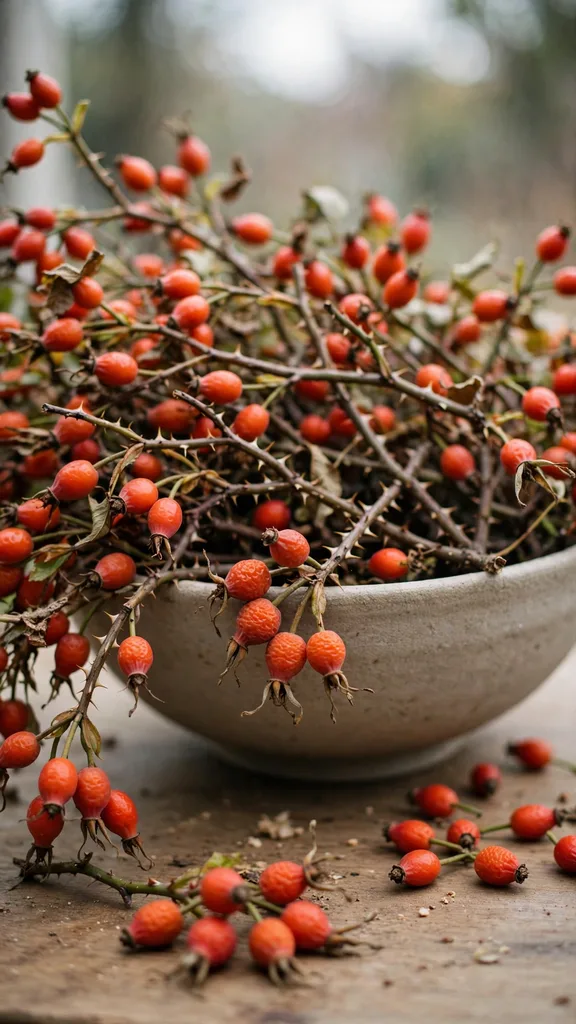
Cut hips after the first frosts, when they color fully and soften slightly. Both plants are thorny, so cut with gloves and strip the thorns from the parts that will be handled. Hips dry slowly in place and hold their color for weeks, and birds get whatever the table does not use.
16. Lichen Branch and Moss Runner
Lay a bed of fresh moss down the center of the table on a strip of waxed paper or a tray, and rest lichen-covered fallen branches across it with a few stones and cones. It reads as a piece of the woodland floor moved indoors, and it suits a plain table with no other color on it.
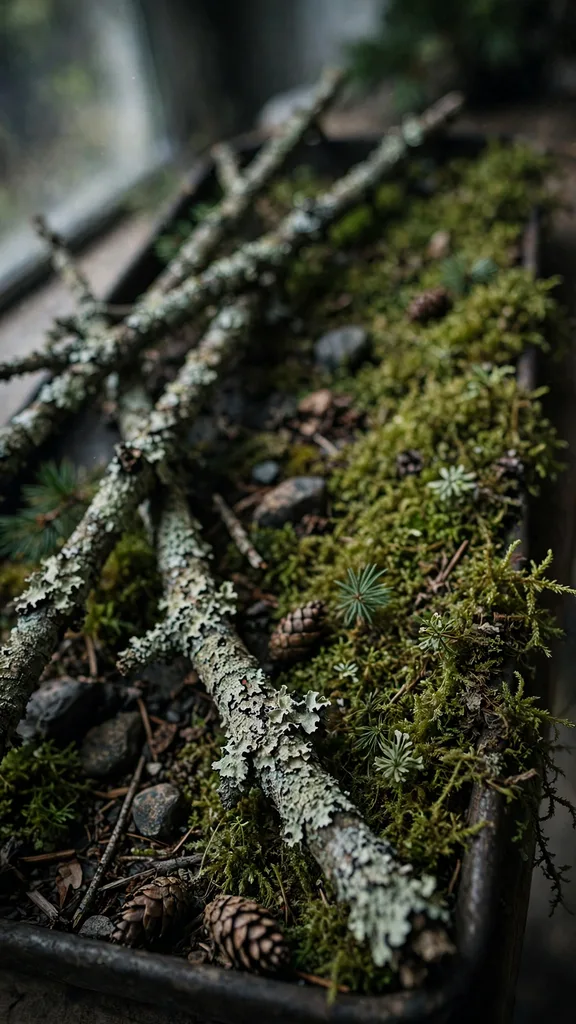
Gather moss from your own garden where it grows thick, never stripped from wild woodland, and keep it misted so it stays green and soft. The whole runner goes back outside in January, moss and branches together, which makes it the lowest-waste centerpiece on the list. Build it the day before, because moss dries fast in a heated room.
17. Seed Head and Cone Mixed Platter
Combine the garden’s dry harvest on one platter: poppy heads, teasels, honesty pods, allium heads, and cones in mixed sizes, heaped loosely so the shapes read against each other. Add a single short evergreen clipping per place setting on the plates themselves to tie the platter to the table.
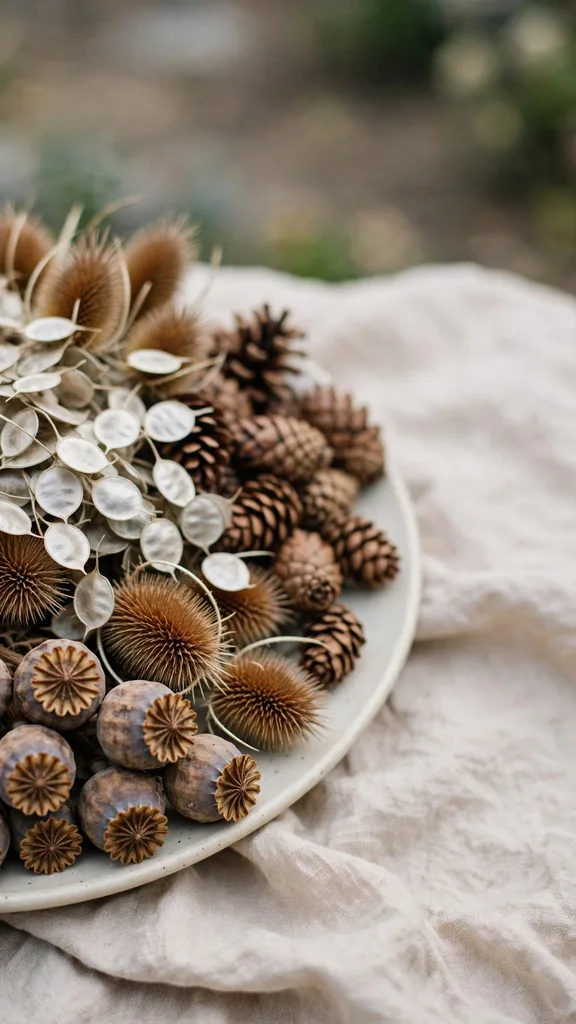
Everything here was cut in autumn and stored dry, so this centerpiece can be built weeks ahead and stored in its platter. The shapes are the decoration, which means it suits a table with plain linen and no other pattern. A platter heaped too high blocks the view across the table, so keep the pile below 15 cm (6 in).
18. Bare Branch With Hanging Cones
Set one sculptural bare branch, from a pruned fruit tree or a fallen limb, in a heavy pot or a bucket of gravel at the center of the table or on a sideboard behind it, and hang small cones from its twigs on loops of twine or thread. The branch carries the decorations the way a tree does, at table scale.
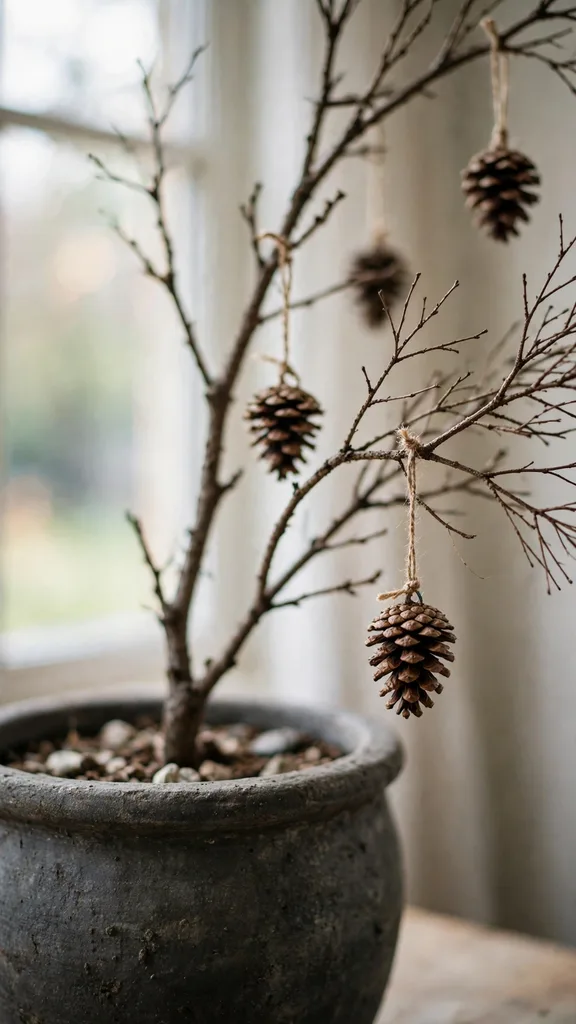
Choose a branch with fine, spreading twigs so the cones hang at different heights. Cones wired or glued at the stem end hang straightest. This is the centerpiece for a table that also carries serving dishes, because its footprint is one pot and everything else is in the air above the food.
19. Dried Hydrangea Head Centerpiece
Cut dried hydrangea heads in late autumn, when they have turned parchment, sage, and dusty pink on the shrub, and cluster five to seven heads in a low bowl or a basket with nothing else. The heads are large enough that a small number fills a centerpiece, and their faded colors suit linen and wood better than fresh flowers do.
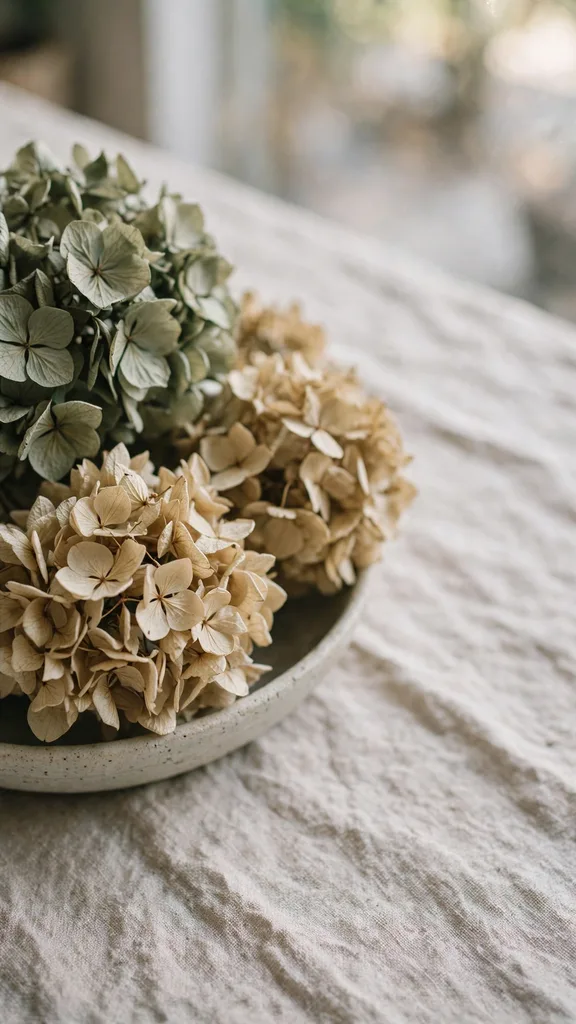
Dry any heads that are still soft by standing them in a vase with 2 cm (1 in) of water and letting it evaporate. Dried hydrangea shatters if it is handled roughly, so build the arrangement where it will sit and move the bowl, not the flowers. It lasts the whole season and stores for a second year if kept dry.
20. Strawflower and Everlasting Bowl
Strawflowers, helichrysum, and other everlastings picked in summer and dried hold their full color, red, orange, gold, and white, into December. Fill a bowl with the heads on short stems, packed close so the bowl reads as a mound of color, and set it where a fresh arrangement would go.
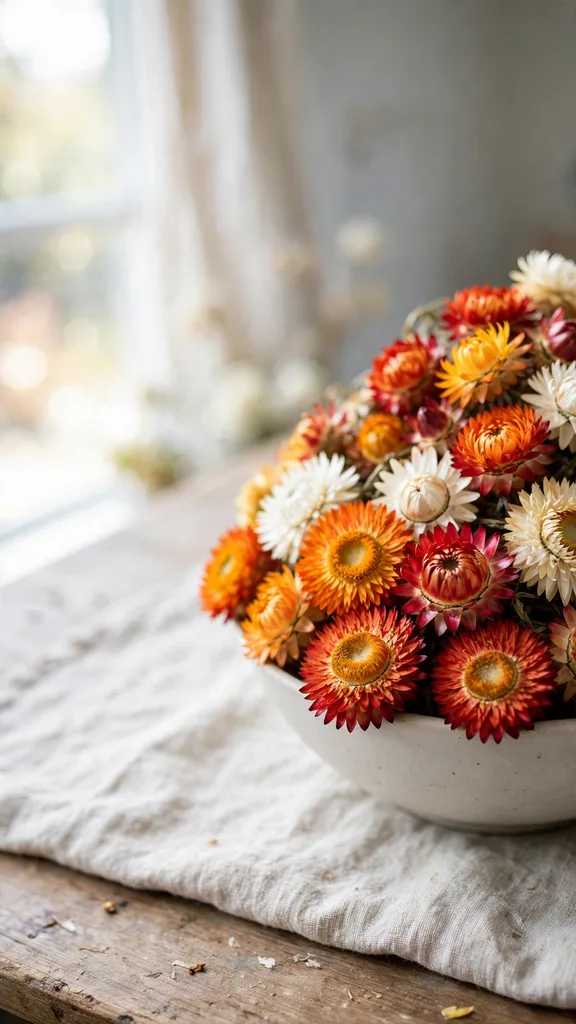
These are the brightest dried flowers a garden produces, and they need no water, no misting, and no light management. Pick summer flowers for drying at midday when they are fully dry of dew, and hang them upside down in a dark, airy place for two weeks. A bowl of them is the strongest argument for a cutting patch of everlastings next summer.
21. Poppy Seed Head Cluster in a Jug
Stand a bundle of dried poppy seed heads in a stoneware jug: the gray-green pods on long stems have the cleanest shape of any seed head, and a dozen of them make an arrangement with real height. Mix two sizes, the big opium poppy heads and the smaller field poppy, for a cluster that looks gathered from a meadow.
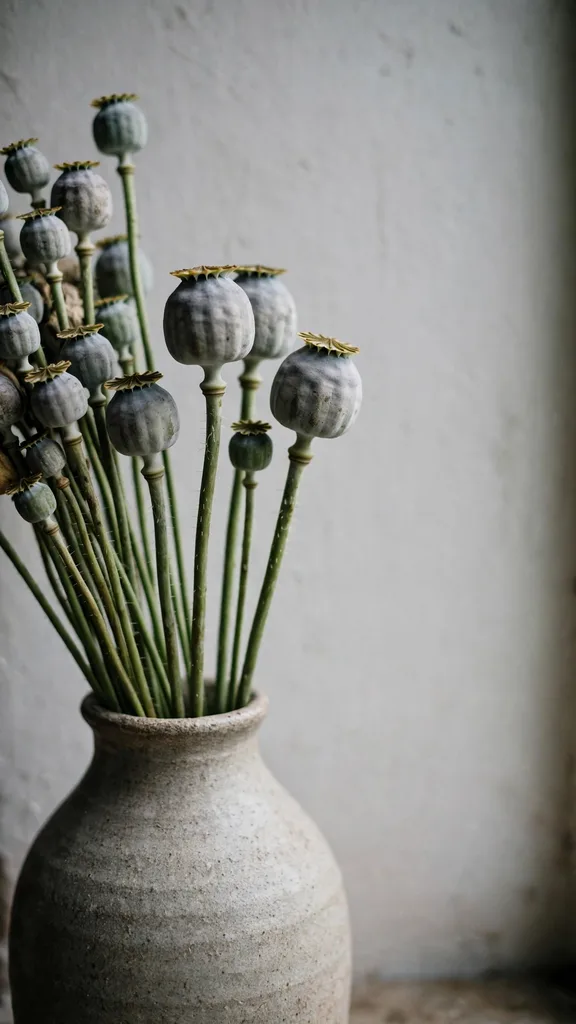
Poppy heads rattle with ripe seed, so stand the jug where it will not be knocked, or empty the heads first and save the seed for the kitchen and for sowing. The pods hold for months and gray further with age. One jug suits a small table alone; a pair flanks a larger arrangement well.
22. Ornamental Grass Plume Vase
Cut the plumes of miscanthus, pampas, or fountain grass before winter weather flattens them, and stand a generous bundle in a tall vase. The plumes catch light and move in warm air from a radiator, which gives a still table a little life. Their cream and silver tones go with every other material on this list.
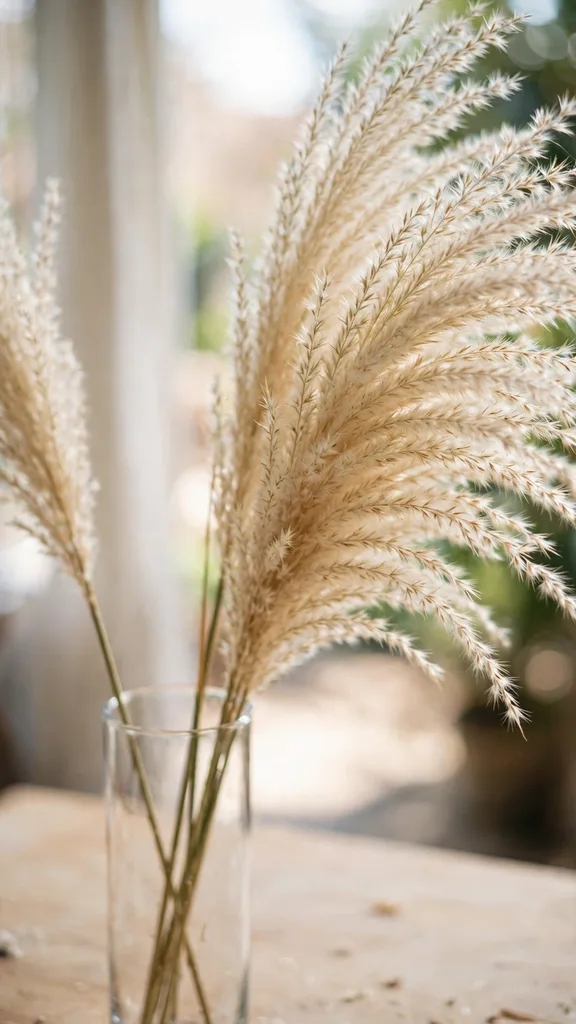
Grass plumes shed if they are cut too ripe, so cut them as they open in autumn and store them upright in a dry room. A light mist of hairspray is the florist’s fix for shedding, but a plume cut at the right moment holds without it. Keep the vase weighted, because a tall grass arrangement is top-heavy and light at once.
23. Dried Lavender Bundle Runner
Lay small bundles of dried lavender, tied with twine, at intervals down the center of the table, alternating direction so the flower ends point outward. Between the bundles, scatter a few cones or short greenery clippings. The arrangement scents the room gently every time a bundle is brushed.
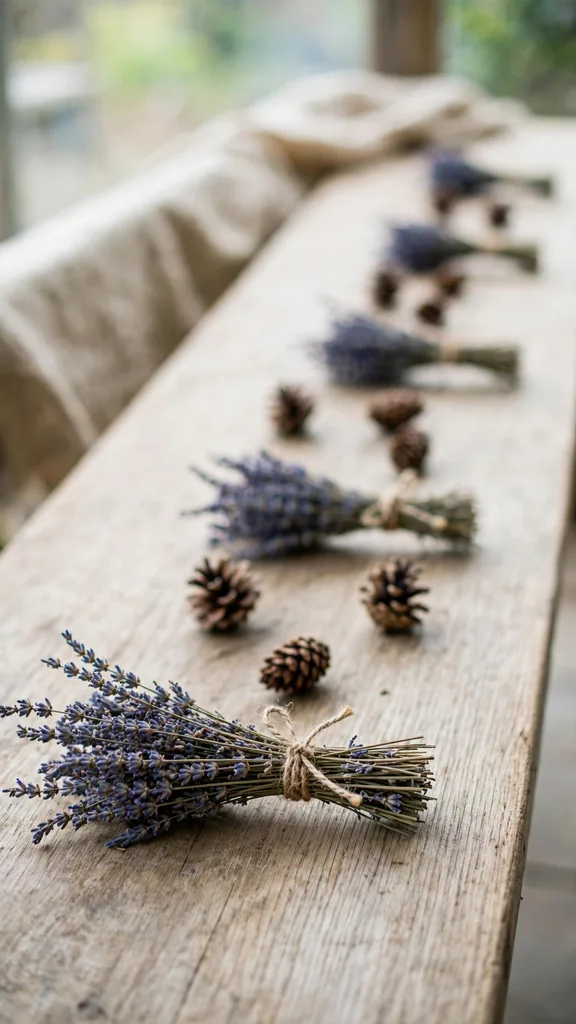
Lavender picked in summer and dried keeps its scent for a year or more, and a bundle at each setting can go home with a guest. Cut lavender for drying just as the flowers open, in the morning after the dew dries. English lavender holds its buds best; the softer lavandins give longer stems and stronger scent.
24. Honesty Stem Vase
Strip the outer pods from honesty (silver dollar plant) stems to reveal the translucent silver discs, and stand a few stems in a clear or white vase where light comes through them. Against a window or near candles the discs glow, and no other dried material gives light back the way honesty does.
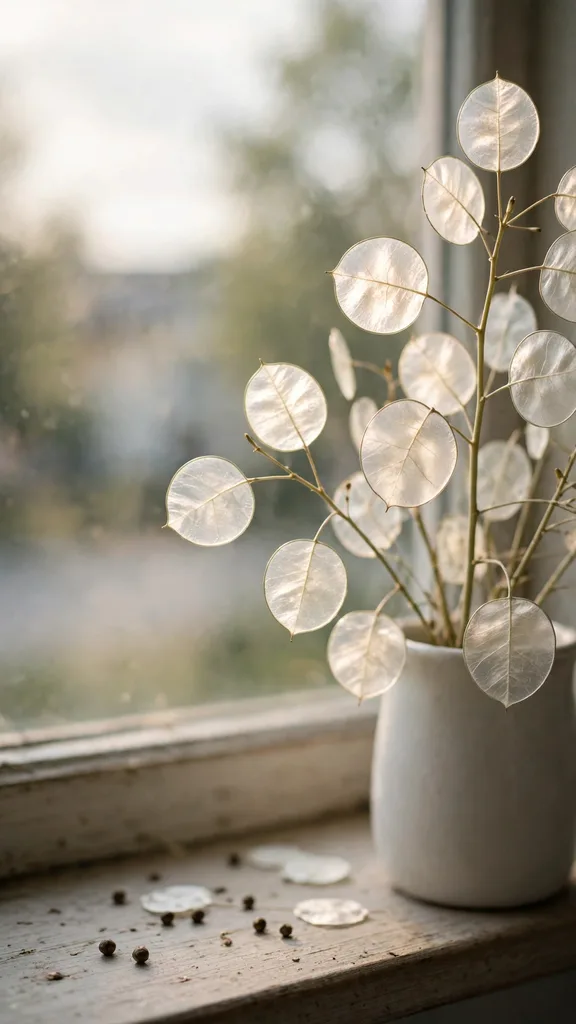
The pods strip most easily when fully dry in autumn, rubbed gently between the fingers. The stems are brittle, so arrange them once and leave them. Save the black seeds that fall as you strip: honesty is a biennial, and sowing them in summer gives flowering stems the year after next.
25. Teasel and Thistle Arrangement
Stand dried teasels, globe thistle, and sea holly in a heavy crock for a centerpiece with a spiky, architectural outline. The blue-gray of the thistles against the brown teasels is a winter palette that suits stone, slate, and plain pottery, and the whole arrangement is dry enough to store for years.
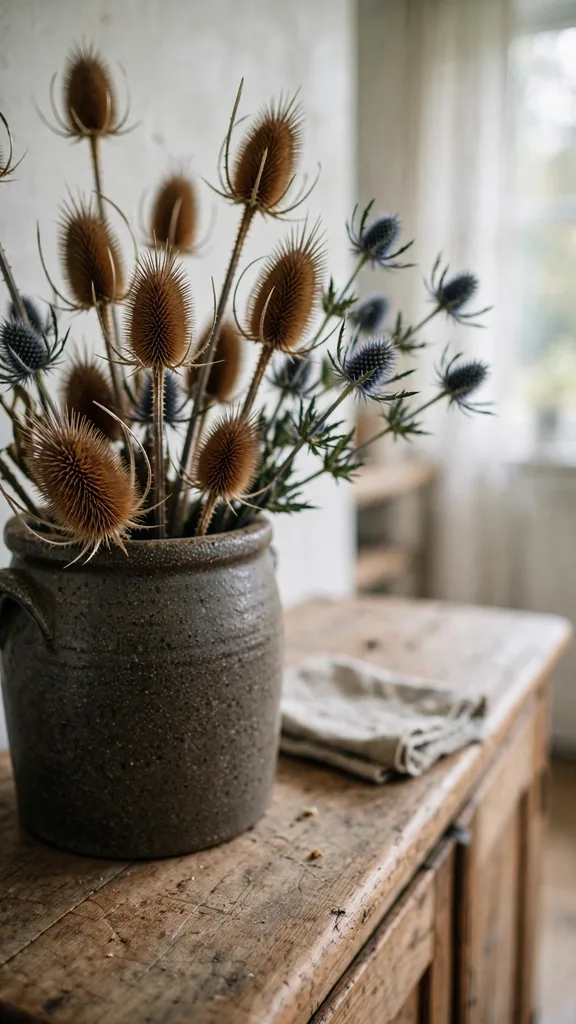
Wear gloves for teasels, which are armed like their name suggests. Cut all three in summer and dry them upright. Because the arrangement is tall, it suits a sideboard or the center of a round table where height does not block conversation. Keep it away from sleeves and table linen, which the hooks catch.
26. Dried Flower Wreath Laid Flat
Take a dried flower wreath made in autumn, from strawflowers, statice, lavender, and grasses on a straw base, and lay it flat at the center of the table with a pillar candle or a small potted plant in its middle. A wreath built for a door does double duty on the table, and the flat arrangement is low enough for any sight line.
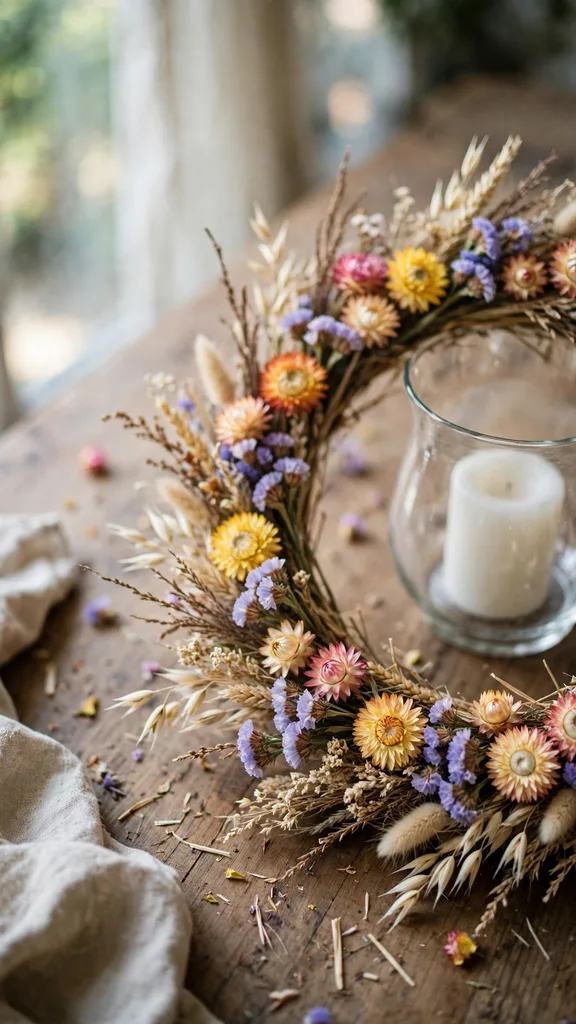
Build the wreath in autumn when the dried material is at its best, and store it in a box with tissue between uses. Keep the candle in a glass hurricane if it will be lit, and never leave a flame standing in dried material unattended: the safer version uses the potted plant or a lantern with a battery candle.
27. Wheat and Oat Sheaf Centerpiece
Tie a sheaf of dried wheat, oats, or barley stems, cut from a garden patch or a field edge with permission, and stand it in a jug or lay it along the table with the heads fanned. Grain sheaves are harvest symbols that predate Christmas greenery by centuries, and their gold color warms a plain table.
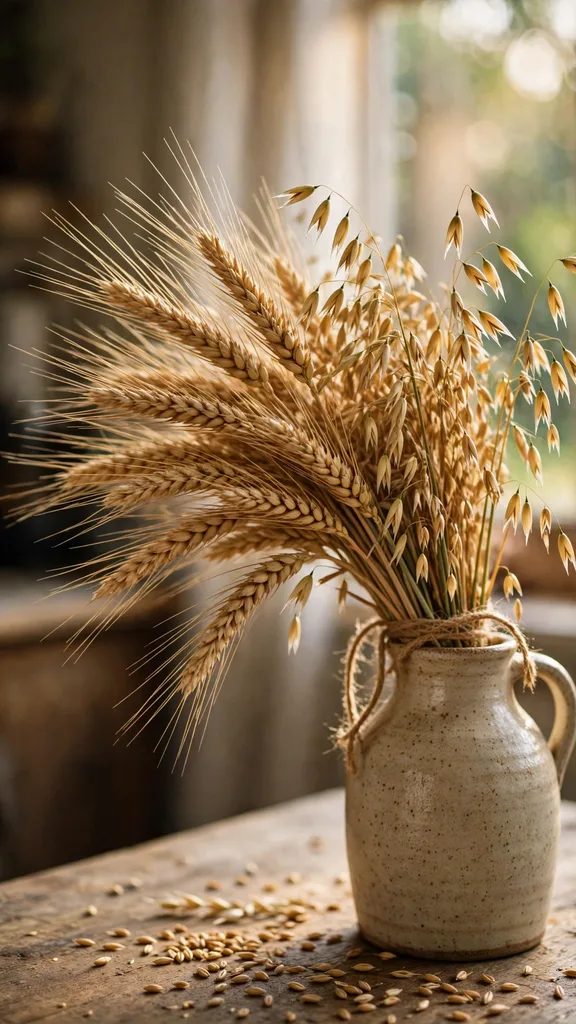
Cut grain stems while they are still slightly green at the base and dry them standing upright so the heads stay straight. A sheaf keeps for years in a dry room. In the garden, a small patch of wheat sown in spring is an ornamental crop by summer and a centerpiece by December, with the straw left for mulch.
28. Pomegranate and Greenery Bowl
Heap whole pomegranates in a bowl over a bed of evergreen clippings. In warm districts the fruit comes off the garden tree; elsewhere it is the one bought element on this list that still belongs, because the bowl’s structure is garden greenery and the fruit is food that gets eaten in January rather than decoration that gets stored.
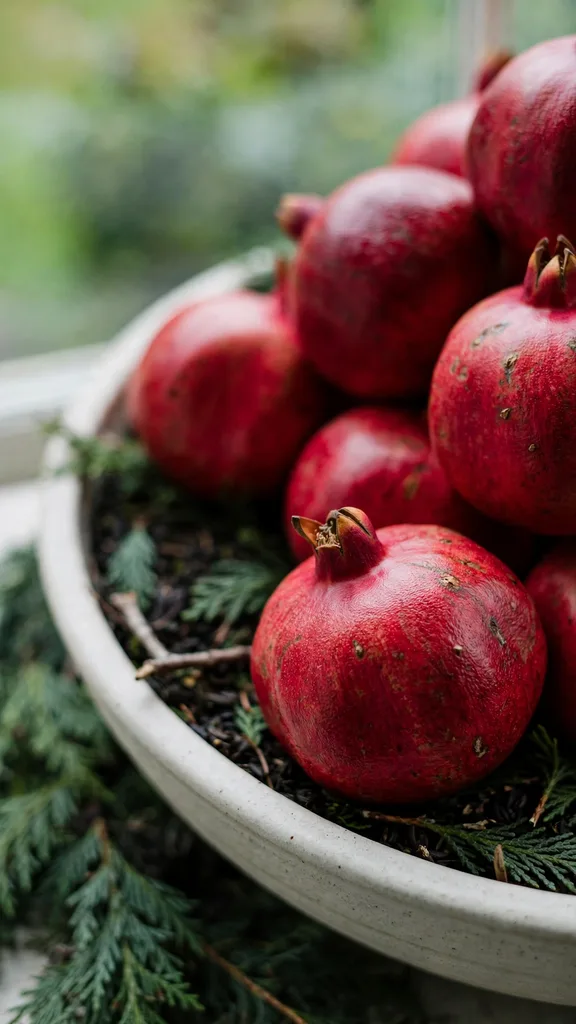
Whole pomegranates keep for weeks at room temperature and longer in a cool room, so the bowl can be built early and topped up. The deep red fruit against dark green is the strongest color pairing of the season. Crack any split fruit for the table instead, since a split pomegranate bleeds juice into the greenery.
29. Orange and Bay Leaf Bowl
Stud a few oranges lightly with bay leaves from the garden, pushing the leaf stems into the peel in rows or rings, and heap them in a bowl with loose bay branches. The oranges scent the room as the peel warms, and the arrangement is food, decoration, and air freshener in one bowl.
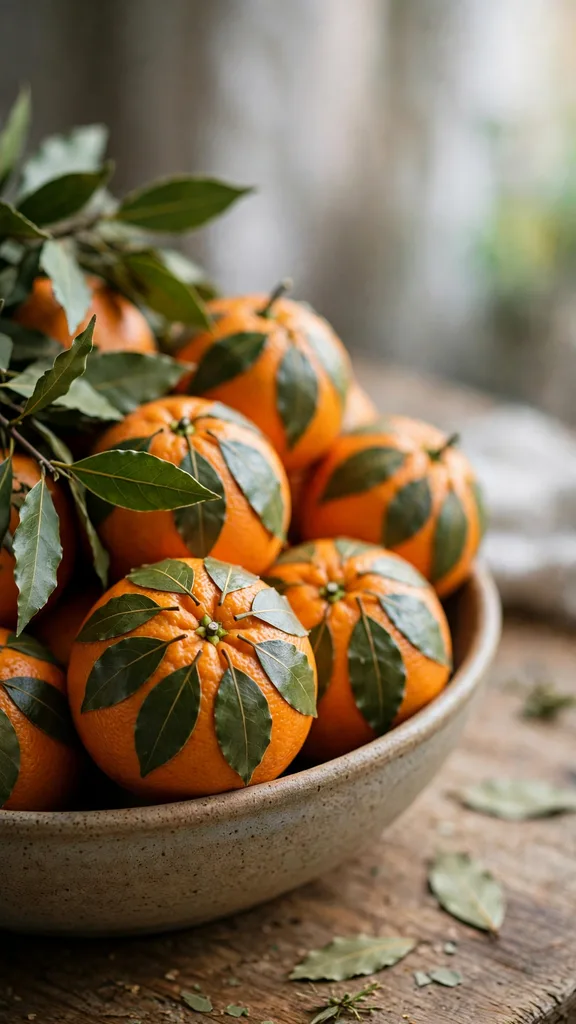
Bay from a garden tree or a pot gives this its garden claim; in cold zones the potted bay that winters indoors provides the leaves. The oranges last two to three weeks before the peel hardens, and the leaves dry in place and go to the kitchen afterward. A bowl of these suits a small table where a runner would crowd the settings.
30. Apple and Evergreen Platter
Arrange stored apples, the reddest keepers from the autumn harvest, in a single layer on a platter over short fir or cedar clippings. A platter of fruit the garden grew, still sound in December, is a centerpiece with an argument: storage varieties picked in October are at their best eating in December and January.
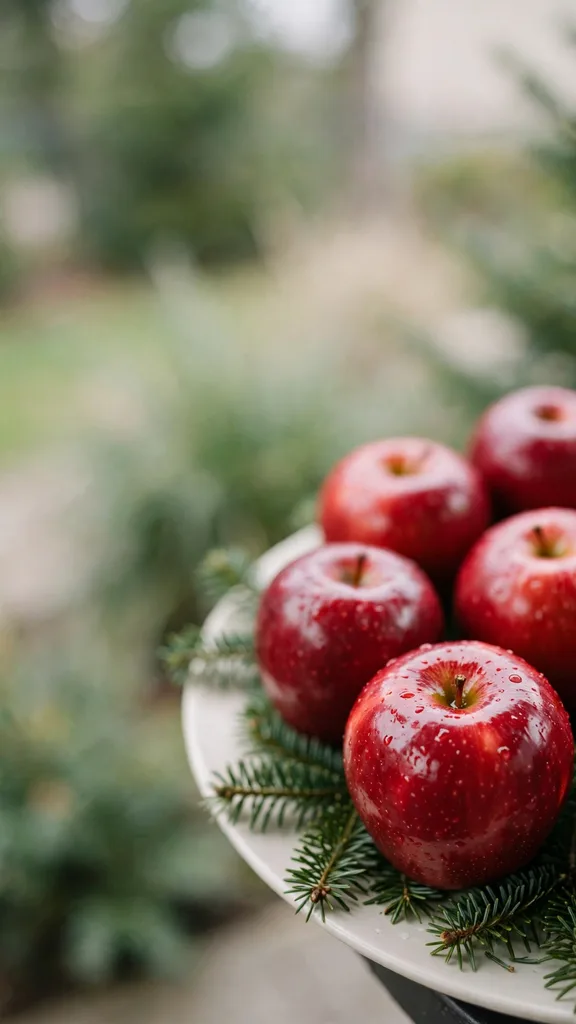
Polish the apples with a dry cloth to bring up the shine, and check them weekly, because one rotting apple softens its neighbors. Late-keeping varieties hold their texture for months in a cool store. After the meal the platter goes to the kitchen and the greenery to the compost, and nothing goes back into a box.
31. Pear and Ivy Runner
Lay firm winter pears in a loose line down the center of the table, trailed through with ivy cut from the garden. The pears sit where a runner would go, spaced a hand’s width apart, and the ivy does the joining work. Green-gold fruit and dark ivy is a quieter pairing than red and green, and it suits a table set with cream linen.
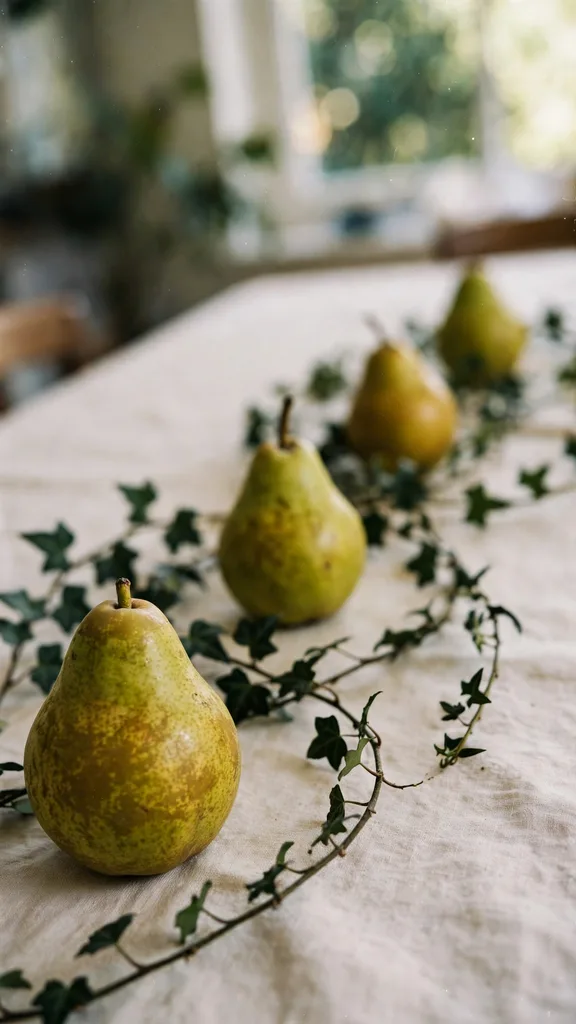
Use pears that are still hard. Conference and other late varieties, picked in autumn and stored cool, ripen slowly through December, which is exactly the pace a decoration needs. Handle them gently: one bruise browns within a day on the table. The ivy lasts a week laid flat if it is misted. And the pears go to the fruit bowl as they ripen, one by one, so the runner thins as the fruit peaks.
32. Ornamental Cabbage and Artichoke Bowl
Fill a wide, low bowl with ornamental cabbages and globe artichoke heads, fresh or dried, tucked among kale leaves. The cabbage rosettes carry pink, cream, and purple centers that deepen in cold weather, and a bowl of them reads as a bouquet that nobody has to water.
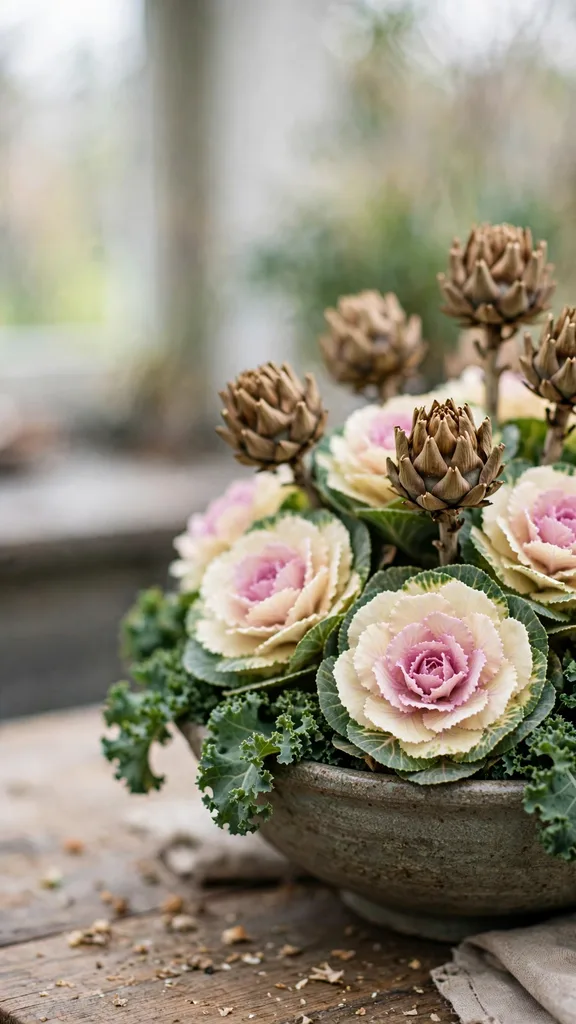
Ornamental cabbage is at its best color after frost, which makes December its peak. Grow it in the vegetable beds from a summer sowing, or lift plants from the garden into the bowl with their roots in damp compost for a display that lasts weeks. Dried artichoke heads keep indefinitely and give the bowl its height.
33. Chili Pepper String and Greenery
String dried chili peppers from the summer harvest on twine and drape the string along a greenery runner or around a bowl. The red peppers are the garden’s own tinsel: glossy, light, and already dried for the kitchen. A string of them over dark cedar is as festive as anything bought.
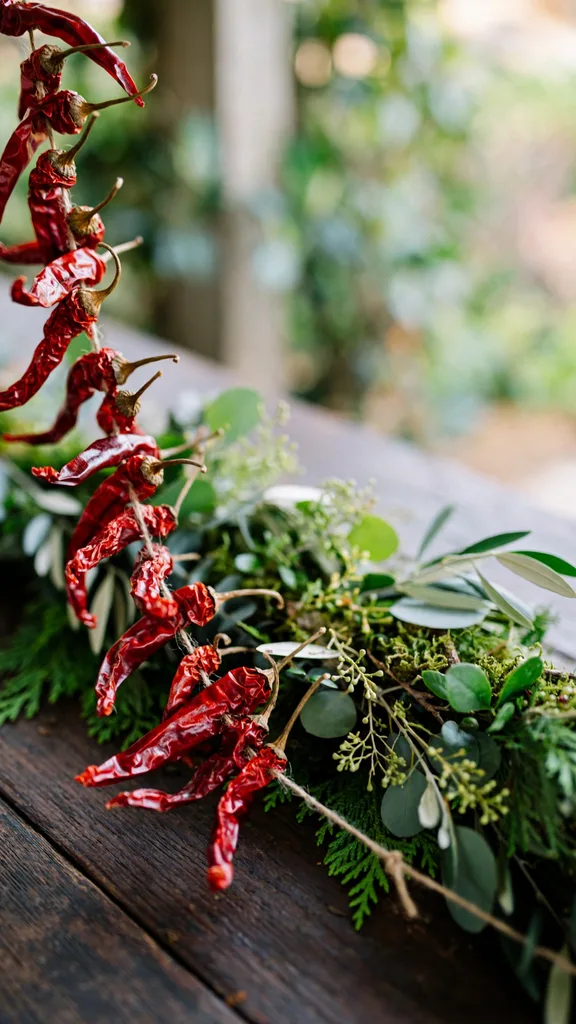
Dry chilies on the plant or on a tray in a warm room until they rattle, then string them through the stems, not the pods. The string goes back to the kitchen in January and gets used pepper by pepper. Keep it where cooks can reach it and small children cannot, because the heat is real.
34. Herb Pot Trio Centerpiece
Line three small pots of rosemary, thyme, and sage down the middle of the table. The pots come straight from the garden or the cold frame, get a wiped rim and a saucer, and go back out after the meal. Guests pinch the herbs as they sit, and the table scents itself.
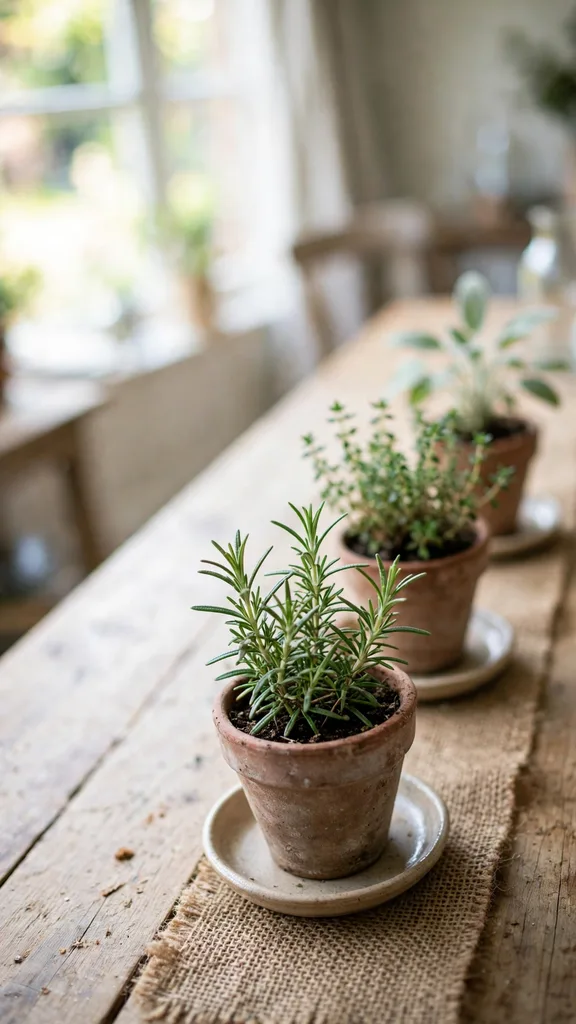
A living centerpiece needs light and water like any plant, so give the pots a bright table or return them to a sill between meals. In cold districts the rosemary pot winters indoors anyway and earns its place twice. Small clay pots look best in odd numbers and mixed sizes, and a strip of burlap under them catches the crumbs of soil.
35. Kale Leaf Liner Platter
Line a platter or a shallow basket with large kale or cabbage leaves, green side up, and heap cones, fruit, or a small arrangement on top. The leaves are the liner a florist would use foam for: they hold the arrangement, hide the base, and add a ruffled green edge that reads as part of the display.
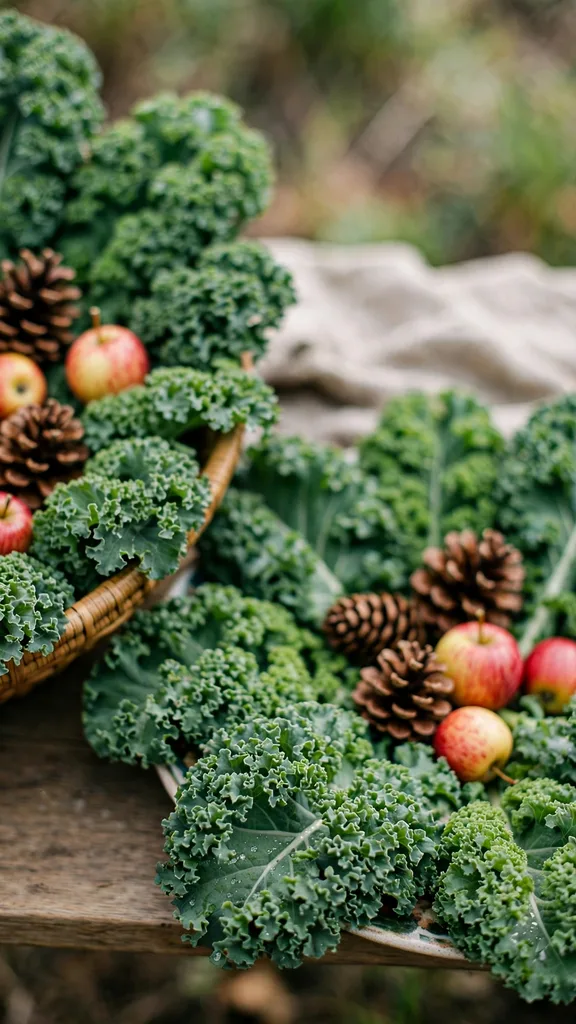
Curly kale gives the fullest ruffle and holds its shape for days without water if the room is cool. Cut the leaves in the morning and keep them in a damp cloth until you build. After the event the leaves go to the compost or the chickens, and the platter is empty, which is the right ending for a garden centerpiece.
36. Quince and Chestnut Bowl
Heap quinces and sweet chestnuts, both from the autumn garden, in a bowl with a few chestnut leaves or a bed of moss. Quinces are the most fragrant fruit a temperate garden grows: two or three in a bowl perfume a room for weeks without being cut, and their gold color deepens as they ripen indoors.
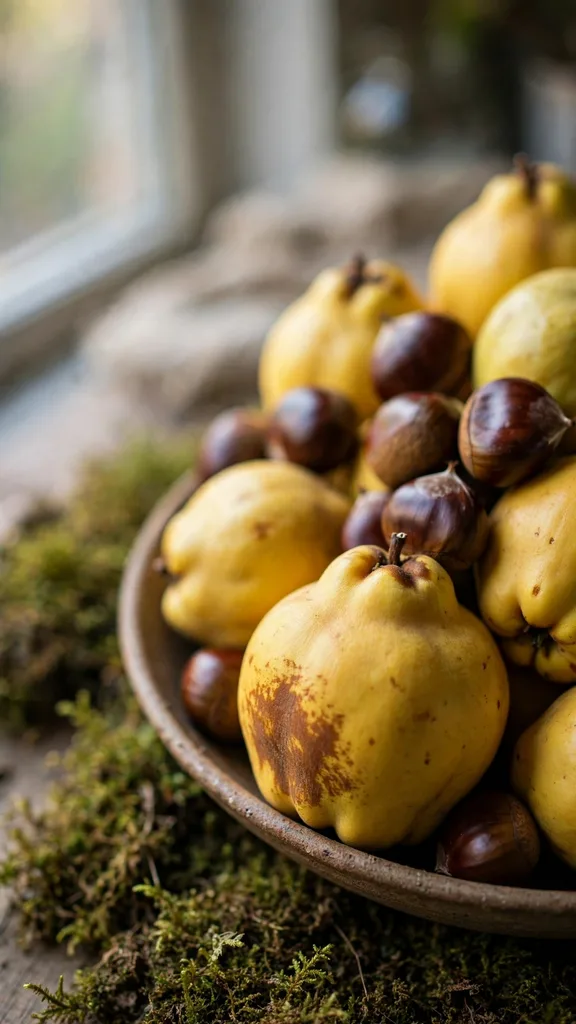
Pick quinces when they turn yellow and smell sweet, and store them away from other fruit, because their scent transfers. Chestnuts for the bowl should be sound and polished; any with holes go to the birds. The bowl lasts from late autumn to Christmas with nothing done to it at all, which makes it the earliest centerpiece you can build.
37. Mason Jar Greenery and Candle Row
Set a row of jars down the table, each holding a short bunch of mixed greenery clippings in water, with one jar in three carrying a candle in a taller jar or a lantern. The jars are the recycled version of a florist’s bud vases, and the greenery stays fresh in water for the whole season with a weekly top-up.
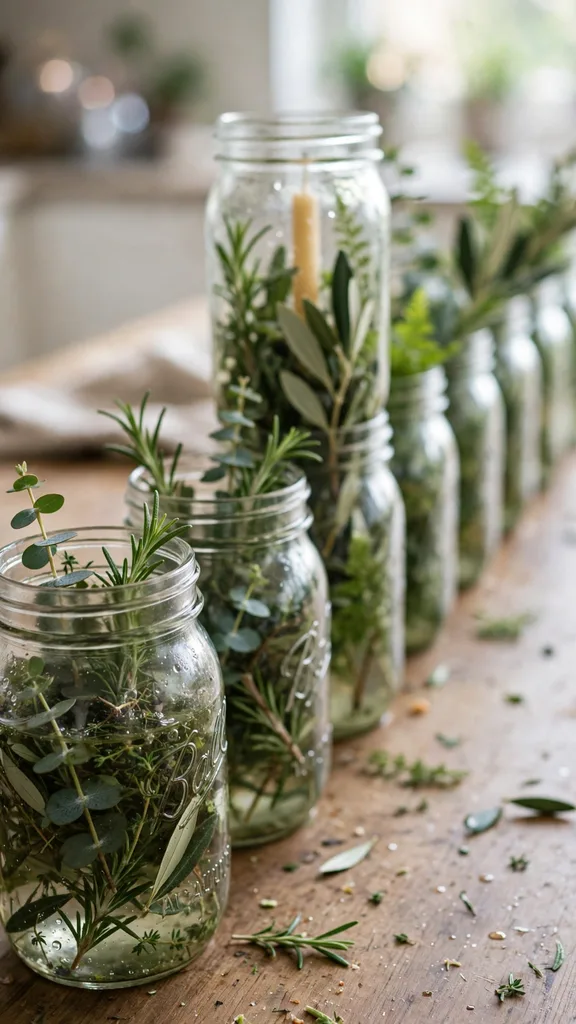
Use the offcuts from building a runner: the short sprigs too small for a garland are exactly jar size. Mixed greens in jars look best when each jar holds one or two kinds rather than a bit of everything. Keep candle jars taller than the greenery around them, and never leave lit candles in jars among clippings unattended.
38. Hurricane Vase With Cones and Greens
Fill a large hurricane vase or a glass lantern a third full with cones, tuck short evergreen clippings around the inside glass, and stand a pillar candle in the center on a bed of the cones. The glass keeps the arrangement contained, protects the flame, and makes a small amount of material look generous.
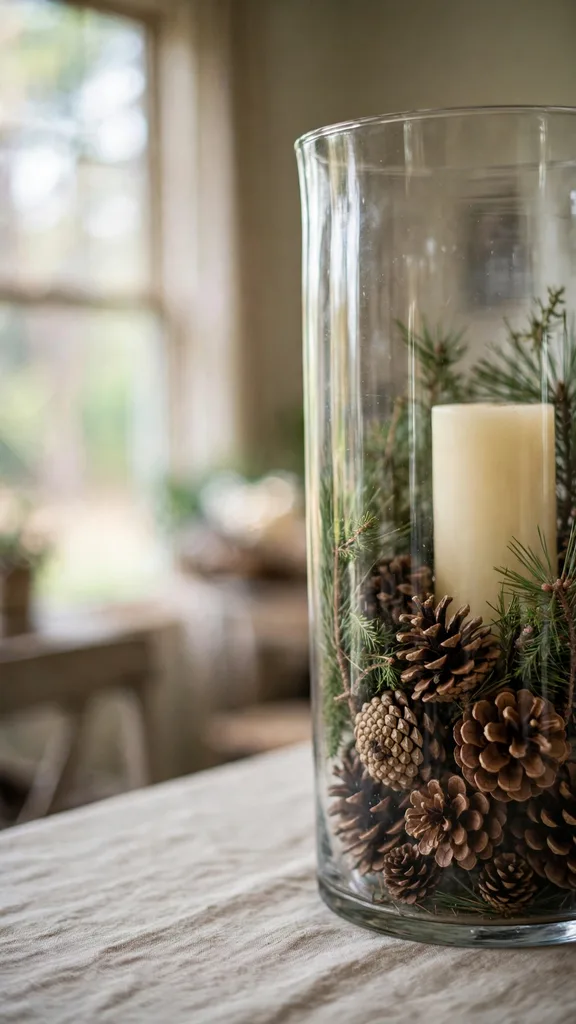
Build it on a tray so it can move as one piece. The cones at the base hold the candle steady, and the greenery against the glass reads from across the room. This is the safest candle centerpiece on the list because the flame is enclosed, but the rule stands: lit candles are watched candles, especially over dry cones.
39. Living Succulent Bowl Centerpiece
Plant a shallow bowl with succulents from the garden collection, hens and chicks, sedums, and echeverias lifted from pots or a gravel bed, and tuck moss or fine gravel between them. The bowl is a living centerpiece that needs no water for the season and goes back to its pots in January, or stays as a houseplant bowl by a window.
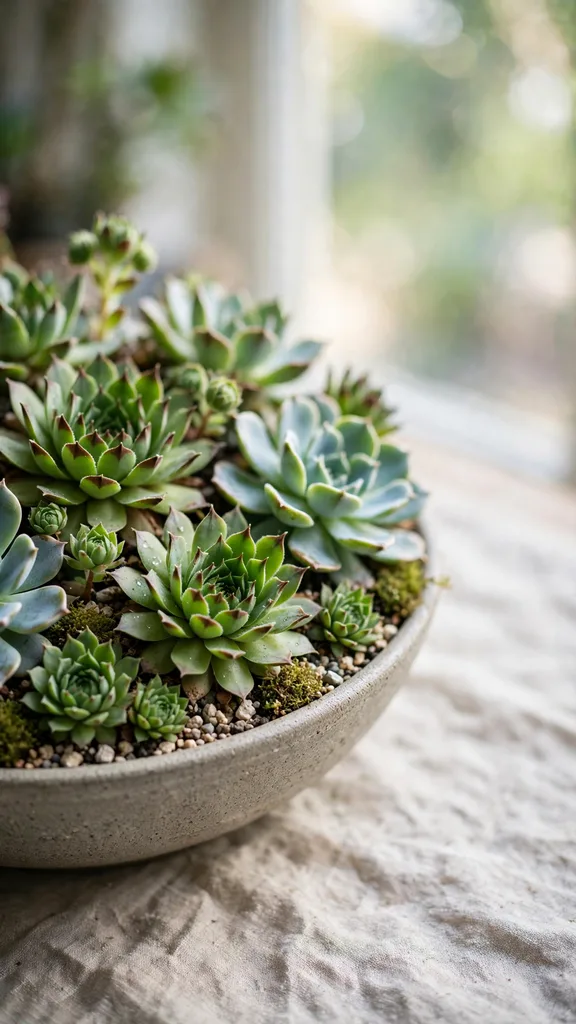
Succulents suit the dry air of a heated room better than any other living material here. Lift plants with their roots, settle them in gritty compost, and water once lightly when you plant. In cold districts these plants winter indoors anyway, so the bowl is a use for them rather than an extra job.
40. Potted Paperwhite Bowl Centerpiece
A bowl of paperwhites in flower is the living centerpiece that perfumes the table. The bulbs are forced indoors on pebbles through November, following the paperwhites for Christmas method, and the bowl comes to the table when the first flowers open, standing in a cachepot or on a platter to catch the water line.
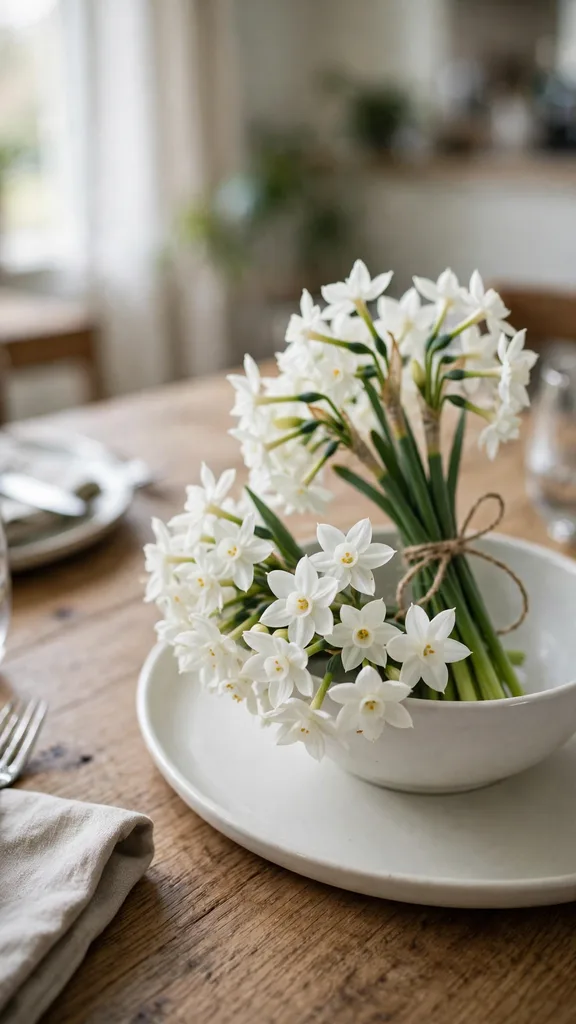
Paperwhites grow tall, so stake the bowl early or grow it on the dilute alcohol mix that keeps the stems short. The scent is strong: one bowl perfumes a dining room, which most guests love and a few do not, so a table that seats the second group gets the greenery instead. After the holiday the bowl is spent, and its place in this list is the season’s one deliberate extravagance.
41. Potted Amaryllis Centerpiece
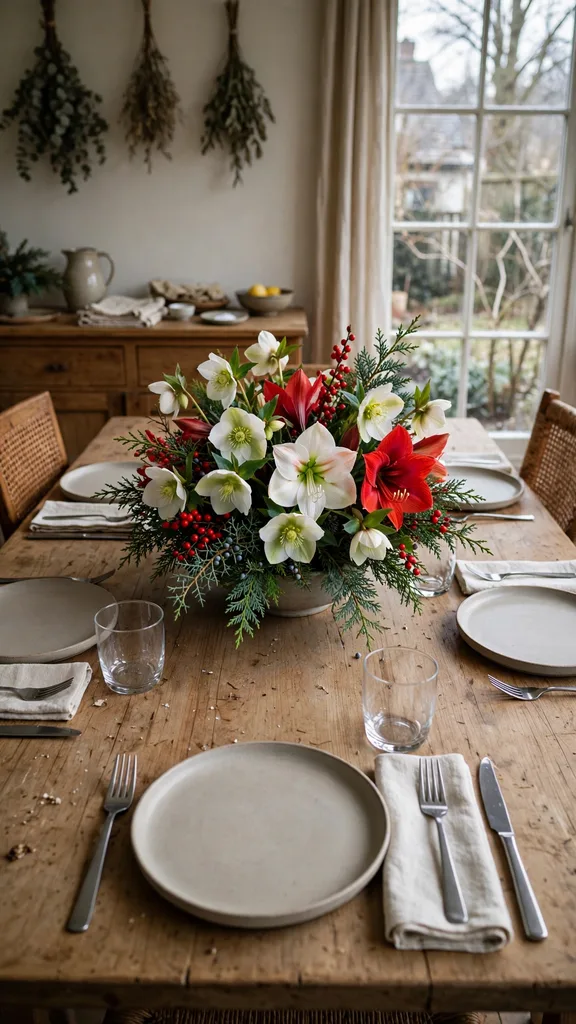
One amaryllis in full bloom in a clay pot is a centerpiece that needs nothing built around it. The bulb is potted in November on the countdown in the growing amaryllis bulbs guide, and by Christmas week it carries four to eight trumpets on a stalk that stands clear of the plates.
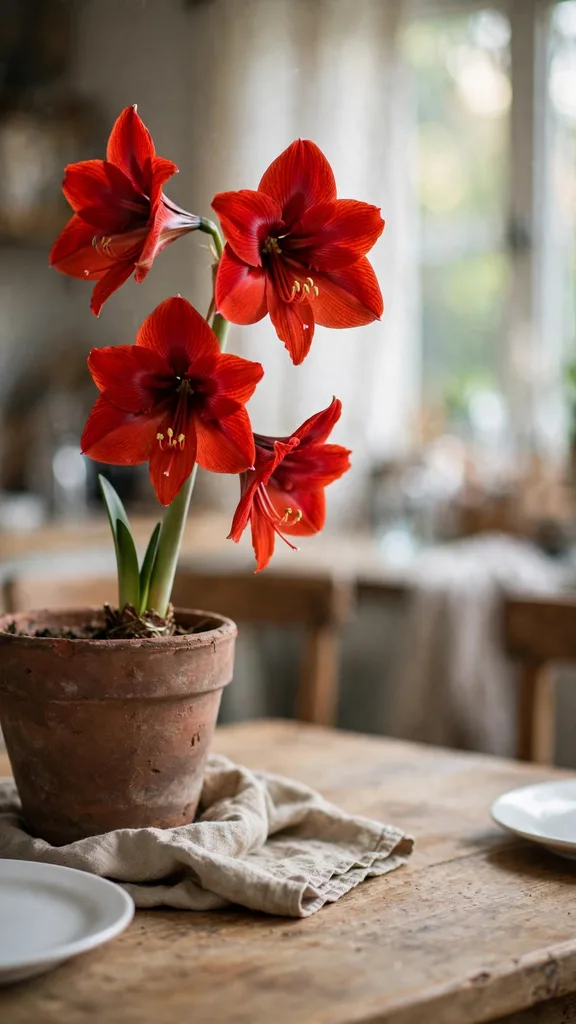
Set the pot on a platter or a folded cloth to protect the table, and stake the stalk before it leans. A red amaryllis is the classic; a white one suits a pale table and photographs better in candlelight. After the meal the plant goes to a bright sill and into its year-round cycle, which makes it the only centerpiece here that is also next year’s.
42. Mini Evergreen Pot Row
Line small potted evergreens down the table: young box, dwarf conifers, small hollies, and ivy in 9 to 11 cm (3.5 to 4.5 in) pots, each pot wrapped in burlap, paper, or a scrap of linen tied with twine. The row reads as a miniature hedge, and after Christmas every plant goes into the garden or a bigger pot.
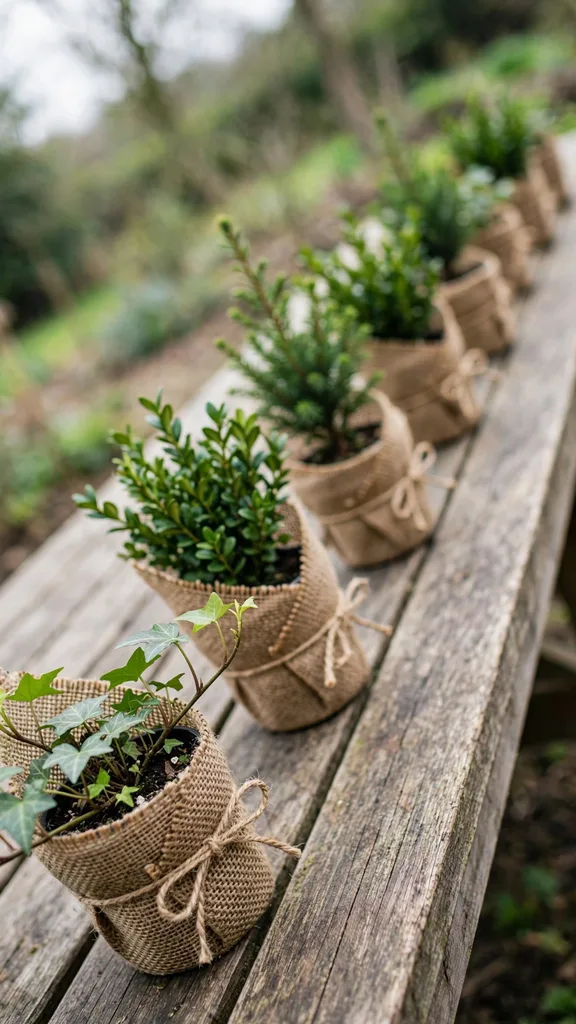
Nursery-grown liners are cheap in autumn, and garden-raised cuttings are cheaper. Pot them up in October so they settle before December. The row suits a long table better than any single arrangement, and one pot at each setting, taken home by the guest, turns the centerpiece into the favor.
43. Glass Bowl Terrarium With Moss and Cones
Build a small woodland scene in a wide glass bowl: a bed of moss, two or three small cones, a tiny potted fern or a sprig of ivy in a thimble of soil, and one or two stones. The glass magnifies the detail, and children lean in to look at it the way they look at an aquarium.
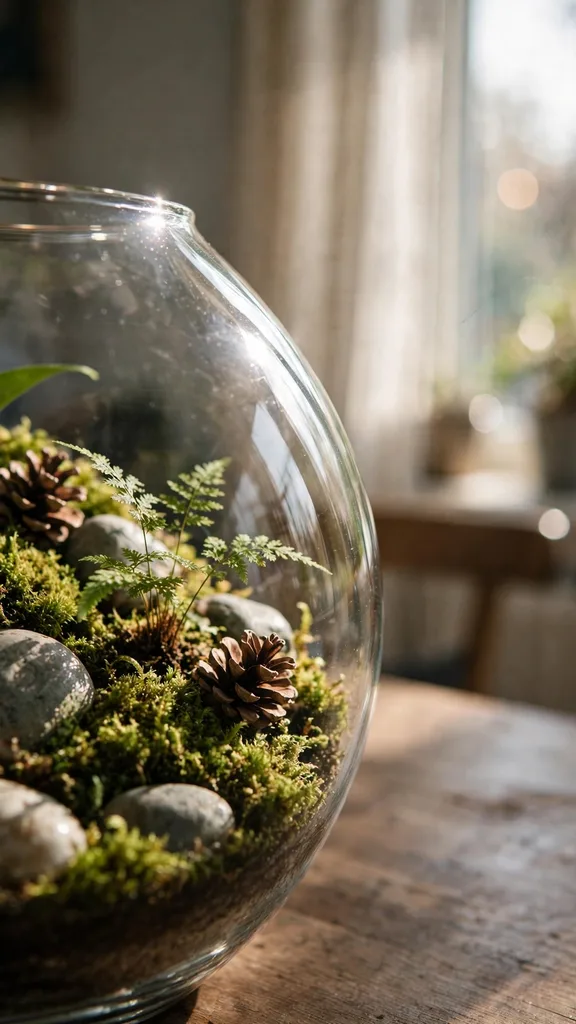
Keep the bowl out of direct sun, which cooks a closed planting, and mist the moss weekly. Everything in it is alive or gathered, and in January it comes apart in five minutes. This is the centerpiece for a small table where height and spread are both limited and the detail has to do the work.
44. Floating Greenery and Candle Bowl
Fill a wide, shallow bowl with water and float short evergreen tips, a few cranberries or rose hips, and two or three floating candles on the surface. The arrangement reflects the candlelight in the water and sits almost flat, so it suits a crowded table where guests pass dishes over the centerpiece.
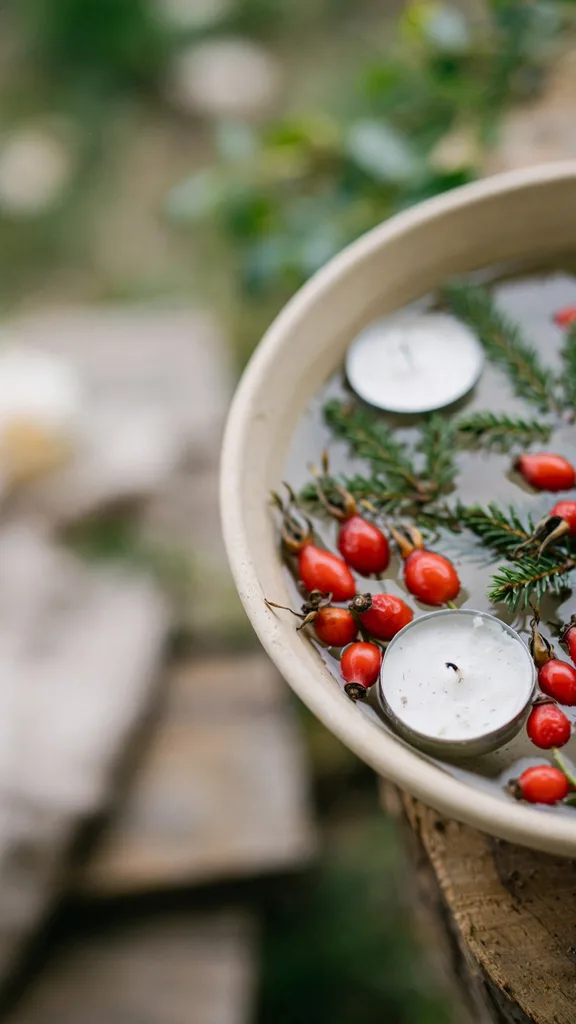
Change the water every few days or it clouds, and keep the greenery tips short so they float flat rather than tipping. Rose hips float for a day or two before they sink, so add them on the day. Floating candles burn for a few hours each, so keep spares and light them as guests sit down.
45. The Finished Garden Table, End to End
The finale is the whole method on one table: a cedar runner down the middle, jars of mixed greens between the settings, a bowl of quince and chestnuts at one end and dried hydrangea at the other, cones scattered where the runner thins, and one potted amaryllis standing at the center. Built in an hour from a single December cutting session, it is the table that proves the garden was the decoration shop all along.
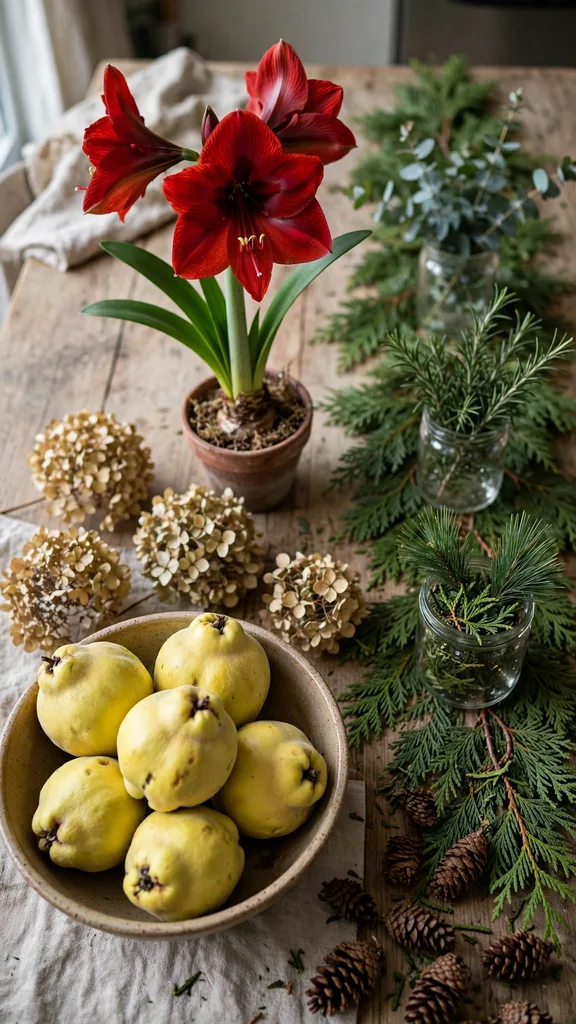
Build it in layers, runner first and bowls last, and step back after each layer rather than filling every gap: a garden table should look gathered, not upholstered. Photograph it before the guests arrive if you want the record, because by the meal’s end it will be rearranged by serving dishes, and that is the sign it worked.
Frequently Asked Questions About Christmas Centerpieces From the Garden
Most cut greenery centerpieces hold one to three weeks indoors: boxwood and magnolia last longest, pine and cedar two to three weeks, and soft clippings about a week before they tire. Build the base runner up to a week ahead, mist it every few days, and add the perishable parts, berries, fruit, and flowers, in the last two days. Dried arrangements can be built in autumn and stored.
Cut in the morning, stand the stems in water for an hour before arranging, and keep finished arrangements away from radiators, fires, and direct sun. Misting every few days slows drying, and a cool room overnight doubles the life of a runner. Greenery arranged in water, like the jar row, outlasts greenery laid dry on a cloth, so choose water-based designs for anything built early.
Holly and most winter berries are toxic, yew clippings are poisonous in all parts, and mistletoe berries are unsafe around children and pets. Keep berry material on adult tables, clear fallen berries promptly, and never lay yew or unknown greenery where food is served directly on the table surface. Fruit, herbs, kale, and cabbage from the vegetable garden are the safe materials for a table where children eat.
Yes. Dried flowers and seed heads, cones, moss, fruit, herbs in pots, and branches of berries and colored stems all build a centerpiece without a single conifer clipping. Gardens with deciduous shrubs only can cut dogwood stems, rose hips, and hydrangea heads, and a herb garden alone provides rosemary, bay, sage, and lavender enough for half this list.
Compost everything that grew: greenery, moss, fruit, and dried flowers all go to the compost or the garden as mulch, and cones can be stored dry for next year or used as firelighters. Living pots go back to the garden, the cold frame, or a bright sill. Jars, bowls, and boards wash and store, which is the whole storage footprint of a garden centerpiece season.