
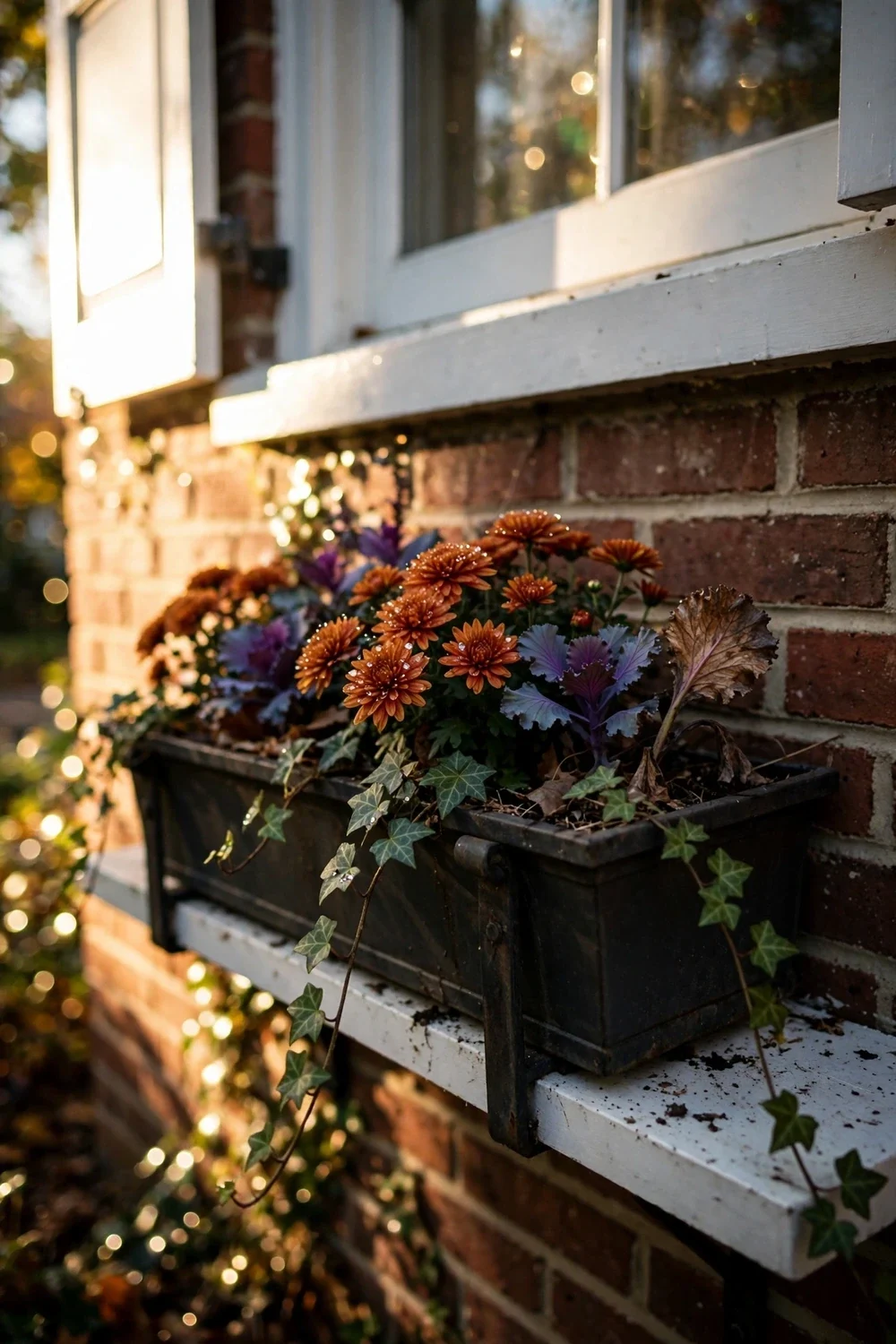

Fill two 90 cm window boxes this weekend and the whole street notices by October. That is window boxes for fall: small plantings at eye level on the facade that read ten times bigger than the same plants in a bed. The rest of this page is 21 recipes, from the first sun box to the last winter swap.
Plant when nights fall below 18C. Water at the soil line. Swap the box after the first hard freeze.
A window box is not a porch pot. It is shallow, it hangs above ground, it faces one direction, and the wind hits it harder than any container on the patio. The recipes below are built for those constraints: shallow-rooted plants, trailing spillers that read from the street, and frost ratings honest enough to last until the winter swap.
What follows is 21 box recipes: full-sun street views, north-window shade boxes, shallow sills, herb boxes, and the fall-to-winter transition. When November arrives and the holiday look takes over, Thanksgiving planter ideas covers the harvest decor.
Full-Sun Boxes That Read From the Street
Sun boxes sit on south and west walls where the light is harsh and the wind is worse. Pick plants with thick leaves, trailing habits, and bloom color that does not wash out in bright light.
1. Mum, Kale, and Ivy Classic
The mums bring the billboard color, the ornamental kale brings the texture that survives the first frosts, and English ivy spills over the front edge so the box looks planted rather than arranged. Plant the kale in back, mums in the middle, ivy at the front lip. Sun: full sun. Frost: kale to -9C; mums fade after hard freeze. Window view: street-facing, pairs with brick.
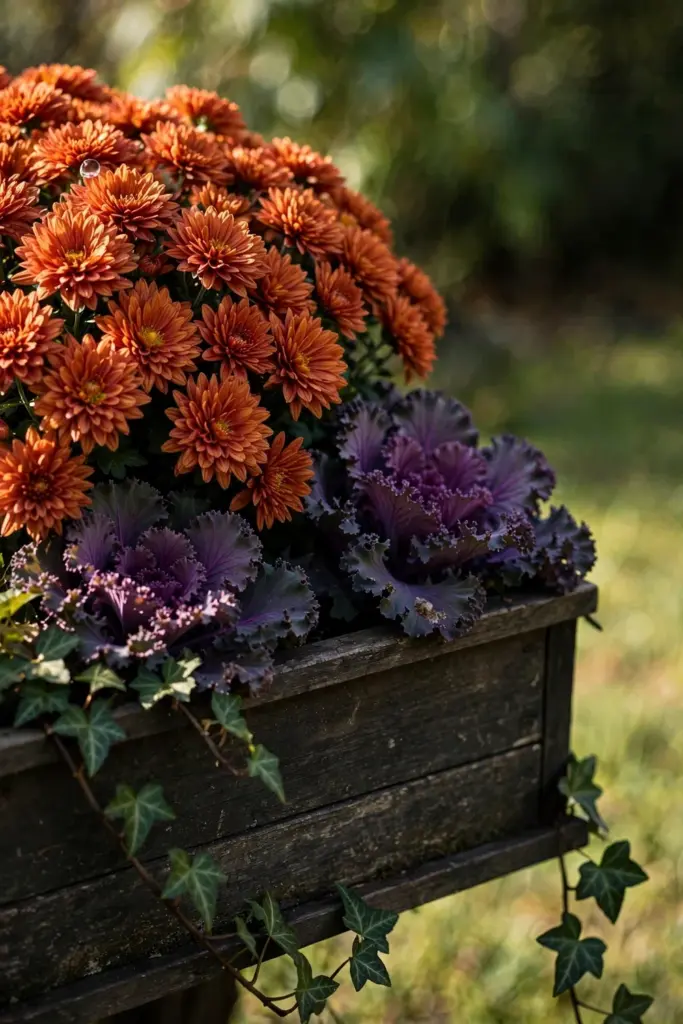
A box this full drinks fast. Water until it runs from the drainage holes, then lift one corner. A box that still feels heavy is fine. A light one needs water today, not tomorrow. That corner-lift test beats any schedule, because a south wall in October wind can dry a box in a day while a sheltered east window takes three.
The failure here is planting the mums too deep. Keep the root ball level with the old soil line. A buried crown rots in the first wet week.
2. Copper Coleus and Sweet Potato Vine
Coleus in copper and rust tones carries fall color without a single flower, and sweet potato vine trails 60 cm or more over the edge, giving the box movement. Both fill fast in warm soil, which matters when October nights start cool. Sun: full sun to part shade. Frost: both die at first frost; this is a peak-season box. Window view: pairs with dark shutters or trim.
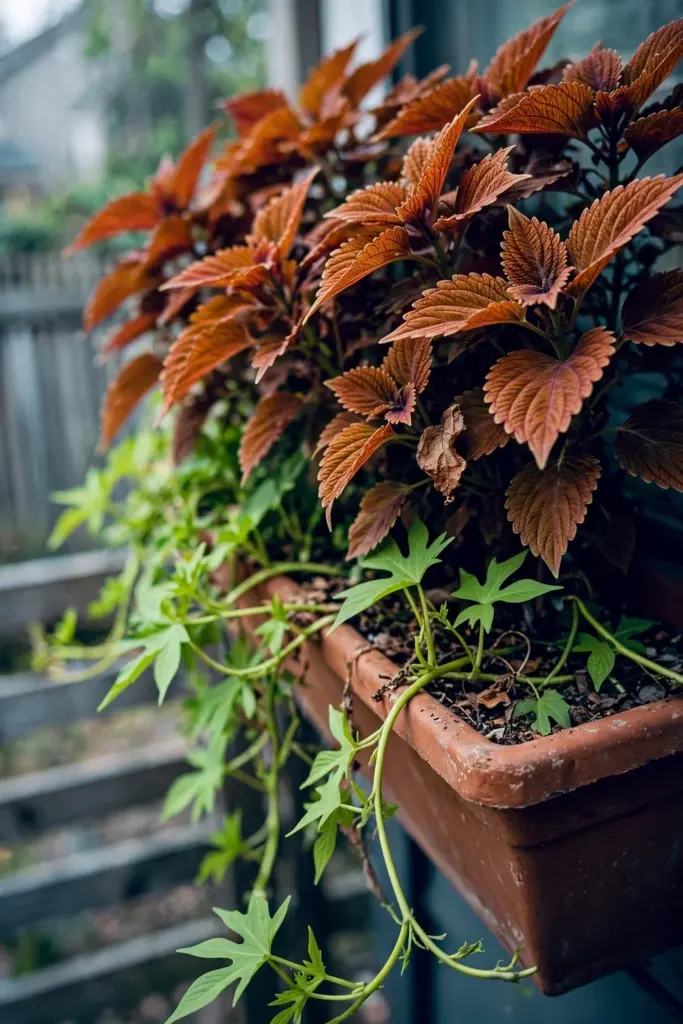
Coleus cuttings root in water in about a week, so snip stems before the frost and keep the color alive indoors all winter. That free insurance beats buying new plants every spring. The University of Illinois Extension window-box design guide builds its own box on the same layered recipe: bold plants behind, mounding plants mid, trailers at the lip. Layering is not decoration. It is how a shallow box reads full from the street.
Failure: letting the coleus flower. Pinch the flower spikes the day they appear. Blooming coleus goes leggy within two weeks and the foliage loses its color intensity.
3. Marigold, Celosia, and Dusty Miller
Marigolds bloom until frost, celosia adds vertical spikes, and dusty miller gives silver foliage that stays put when the flowers tire. This is the highest-impact sun recipe for the money, and it all comes as cheap bedding plants. Sun: full sun. Frost: marigold and celosia to light frost; dusty miller harder. Window view: high-contrast, reads at distance.
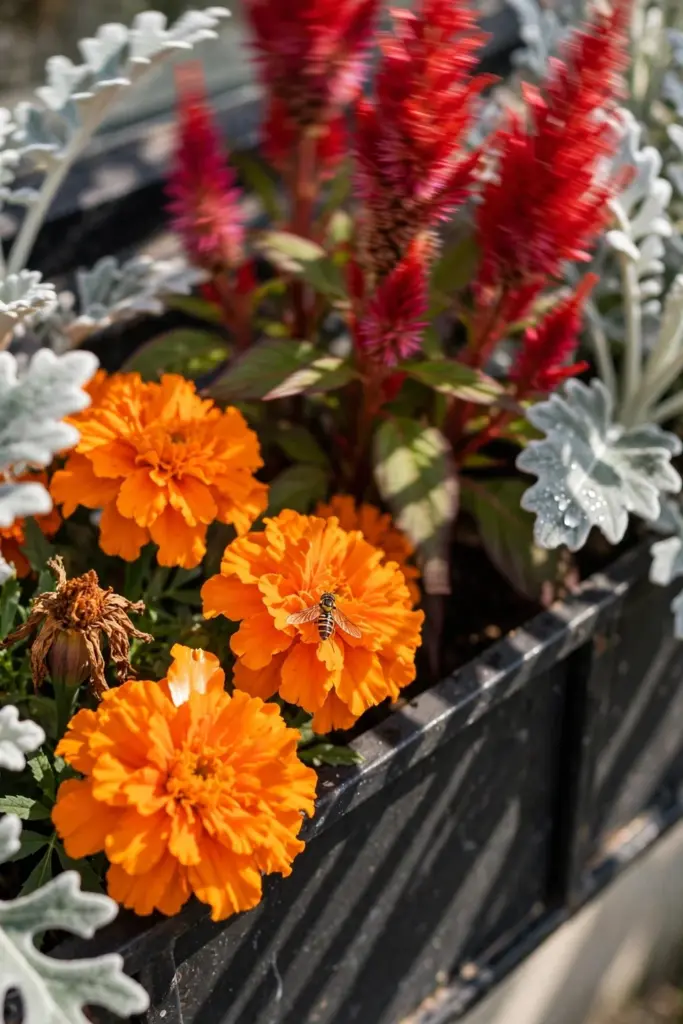
Deadhead marigolds weekly. A spent bloom left on the stem signals the plant to stop flowering, and in a box with no room to spare, one lazy week of deadheading costs a month of color. Celosia needs no deadheading, which is why it earns its place. The silver dusty miller tolerates dry spells better than most fall foliage, so put it at the windy end of the box where watering misses.
Failure: crowding. Three marigolds in a 90 cm box is right. Five is a disease nursery by November.
4. Ornamental Peppers and Purple Fountain Grass
Ornamental peppers give jewel-tone fruit that lasts months, and purple fountain grass gives height and motion at the back. Neither cares about the first light frosts, and the grass keeps its plume color into December. Sun: full sun. Frost: peppers to light frost; grass foliage dies back in hard freeze. Window view: modern facades, pairs with gray siding.
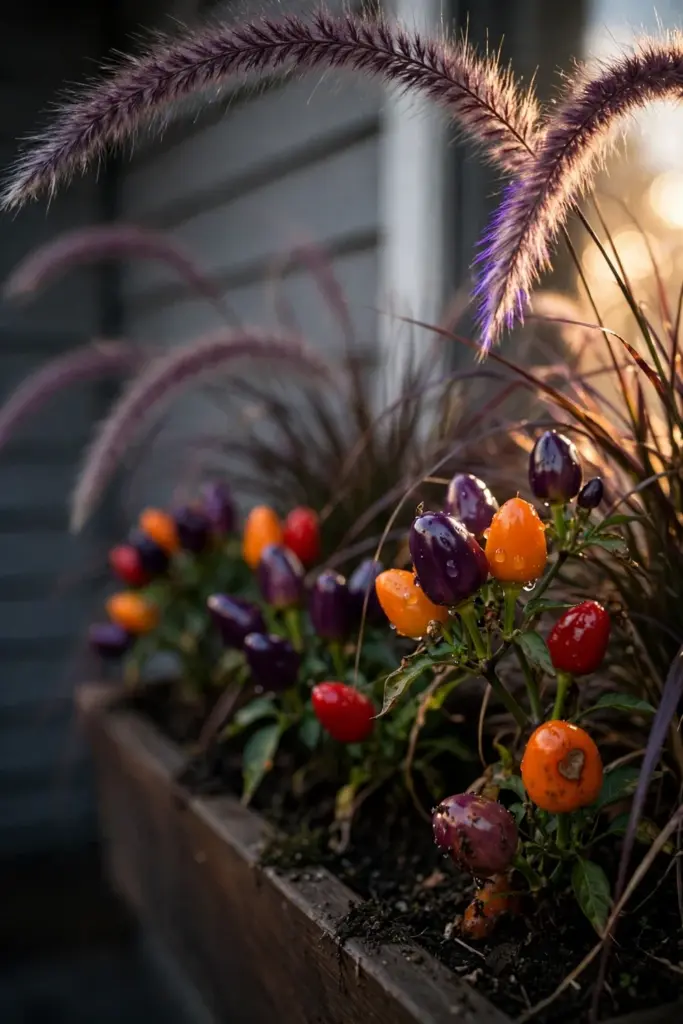
Peppers are the longest-lived color in this group because fruit outlasts flowers. One plant carries twenty peppers, and each holds for weeks. The grass needs the back row because it will reach 60 to 90 cm and block the window if centered. Cut the grass back hard in spring and it returns. In a box, treat it as an annual and replace it. Root-bound grass starves everything around it by the second season.
Failure: skipping drainage. Peppers hate wet feet. One clogged hole in October rain turns the whole box to mush within days.
5. White Pumpkins, Eucalyptus, and Ivy
No flowers at all. A base of trailing ivy, seeded eucalyptus stems tucked upright, and two or three mini white pumpkins resting on the soil. This is the neutral scheme that matches a gray or white house and survives neglect. Sun: any exposure. Frost: the greenery handles light frosts; pumpkins are props, not plants. Window view: refined, pairs with neutral exteriors.
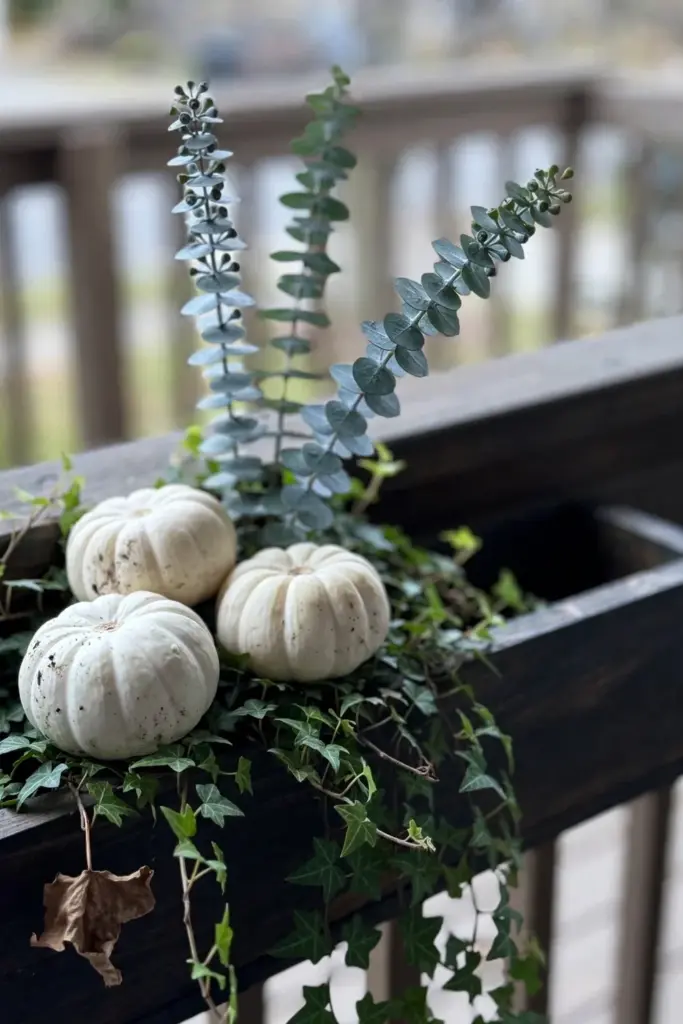
Mini pumpkins weigh far less than full-size ones, which matters because a planted box with wet soil is heavier than it looks. Check the bracket screws before you plant, not after the box sags. Eucalyptus dries in place and still looks good, so this box transitions to winter with zero replanting.
Failure: using full-size pumpkins. They rot from the bottom where they sit on damp soil, and the weight pulls the box off level.
6. Pansy Drift With Creeping Jenny
Pansies bloom through light frosts and often flower again in warm spells, and creeping jenny trails chartreuse over the edge for contrast. This is the box for gardeners who plant early and want color before the mums peak. Sun: full sun to part shade. Frost: pansies to -7C with mulch. Window view: kitchen window, close-up color.
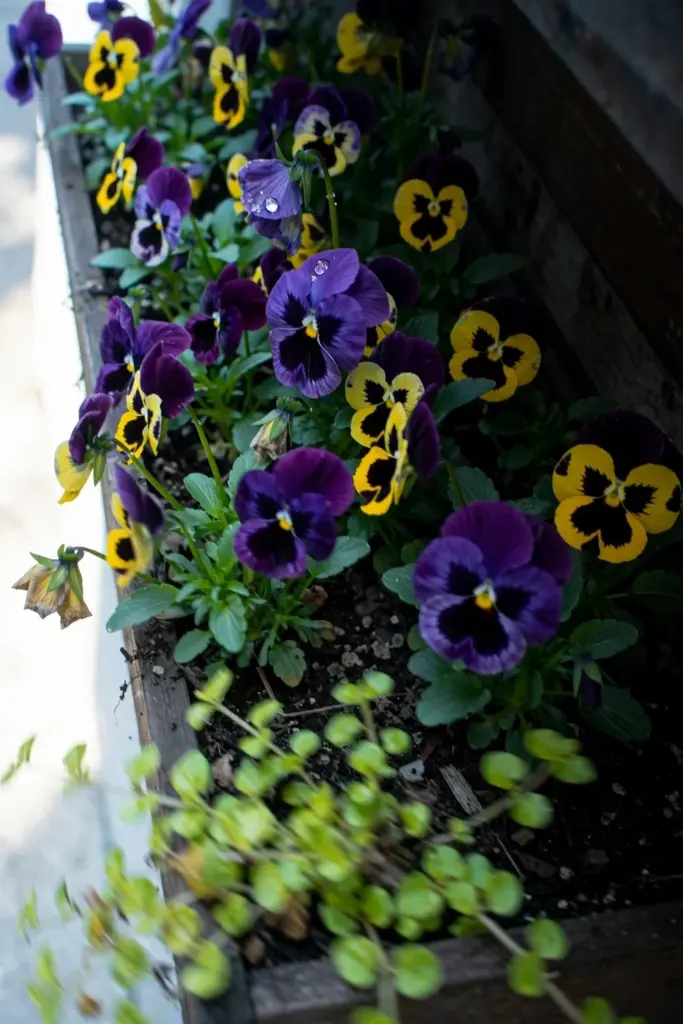
Pansies establish best when soil temperatures sit between 7 and 18C, which is exactly October in most regions. That timing note comes from the University of Georgia pansy guide, which also recommends planting stocky transplants rather than tall leggy ones. Short plants root faster and bloom longer. Space pansies 15 to 20 cm apart. They fill in, and air flow between plants prevents the gray mold that kills crowded boxes in wet Novembers.
Failure: planting pansies in September heat. Wait for the soil to cool. Hot-planted pansies stall and never catch up.
Shade and North-Window Boxes
North and east windows get little direct sun, and the boxes there stay wet longer. Pick plants that tolerate damp shade and bloom without full sun.
7. Begonia, Fern, and Ivy Shade Box
Fibrous begonias bloom in shade all fall, Boston fern gives the arching texture, and ivy trails. This trio asks for almost nothing: water when the top 3 cm of soil is dry, and it carries into December. Sun: shade to part shade. Frost: begonias die at frost; fern must come indoors. Window view: shaded porch windows, close viewing.
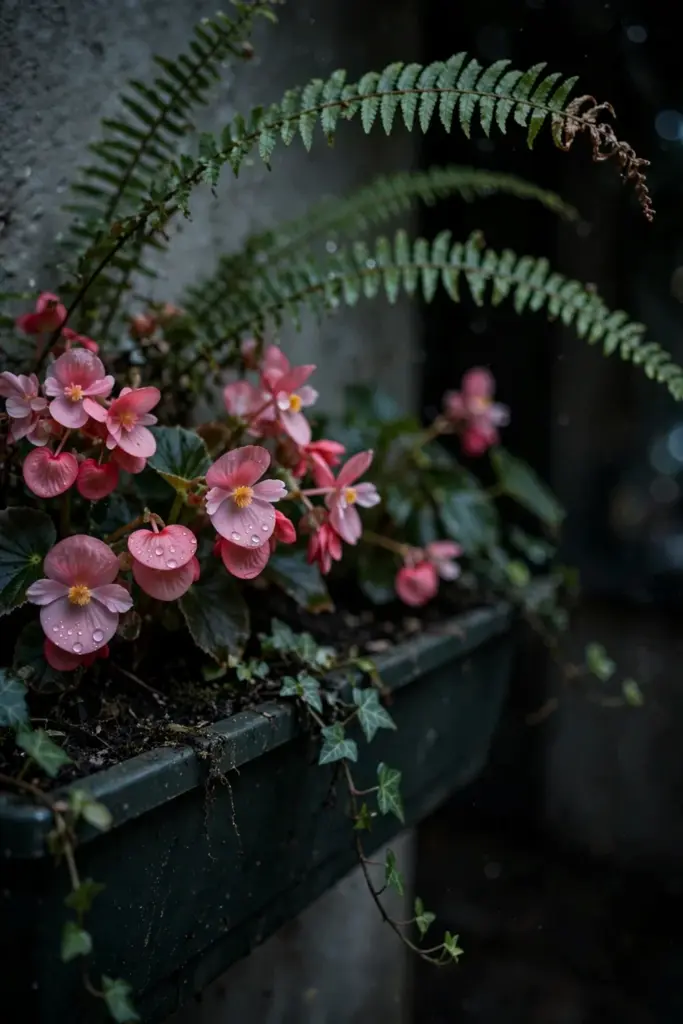
The trick with shade boxes is resisting the urge to overwater. A north box in October may need water only twice a week. Stick a finger 3 cm into the soil. If it feels cool and damp, walk away. Overwatered shade boxes grow algae on the soil surface within two weeks, and algae means the roots are sitting wet.
Failure: treating a shade box like a sun box. Same watering schedule, twice the rot.
8. Heuchera, Carex, and Lamium
All foliage, no flowers, and it looks expensive. Heuchera gives burgundy or lime leaves, Japanese sedge gives fine texture, and lamium trails silver. This box peaks in October light and holds through winter in mild zones. Sun: part shade to shade. Frost: heuchera and carex hardy; lamium trails may brown in hard freeze. Window view: pairs with stone or wood siding.
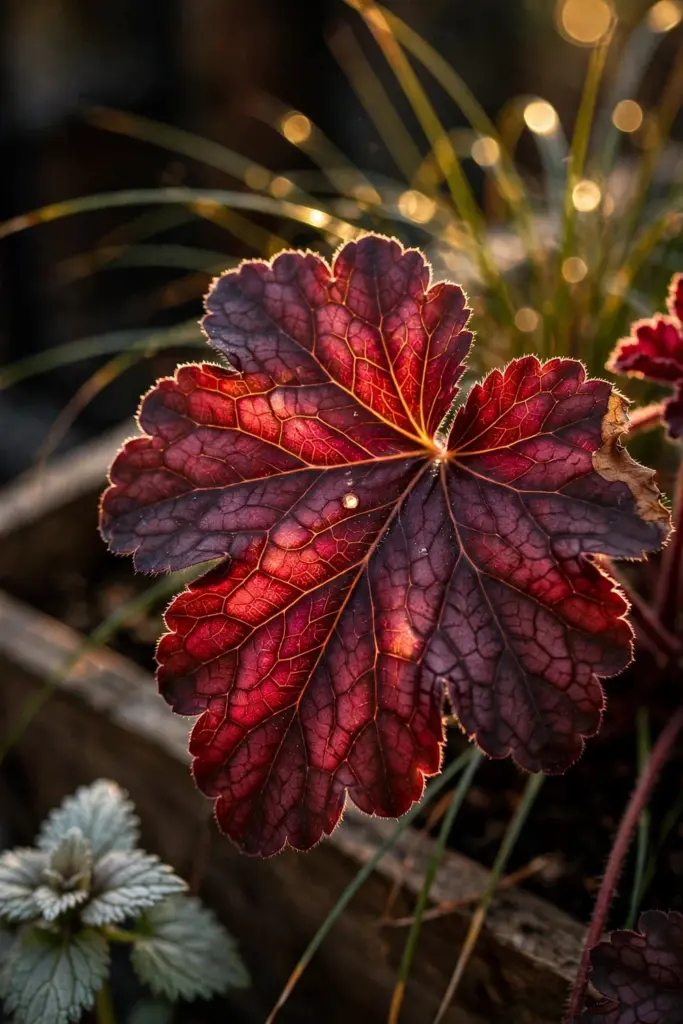
Foliage boxes outlast flower boxes by months because there is nothing to deadhead and nothing to fade. The color comes from leaves, and leaves do not care about frost the way petals do. In zones 7 and warmer, this box overwinters as planted. In colder zones, it still looks good until January, which is two months longer than any mum box.
Failure: planting heuchera crowns too deep. The crown must sit at soil level. Buried crowns rot, and heuchera does not forgive.
9. Asters and Goldenrod Dwarf Pairing
Asters bloom late and feed pollinators into November, and dwarf goldenrod gives the yellow contrast. Both are perennials, so this box can be planted out into the garden in spring. Sun: full sun to part shade. Frost: both hardy; blooms fade after hard freeze. Window view: pollinator-friendly, cottage style.
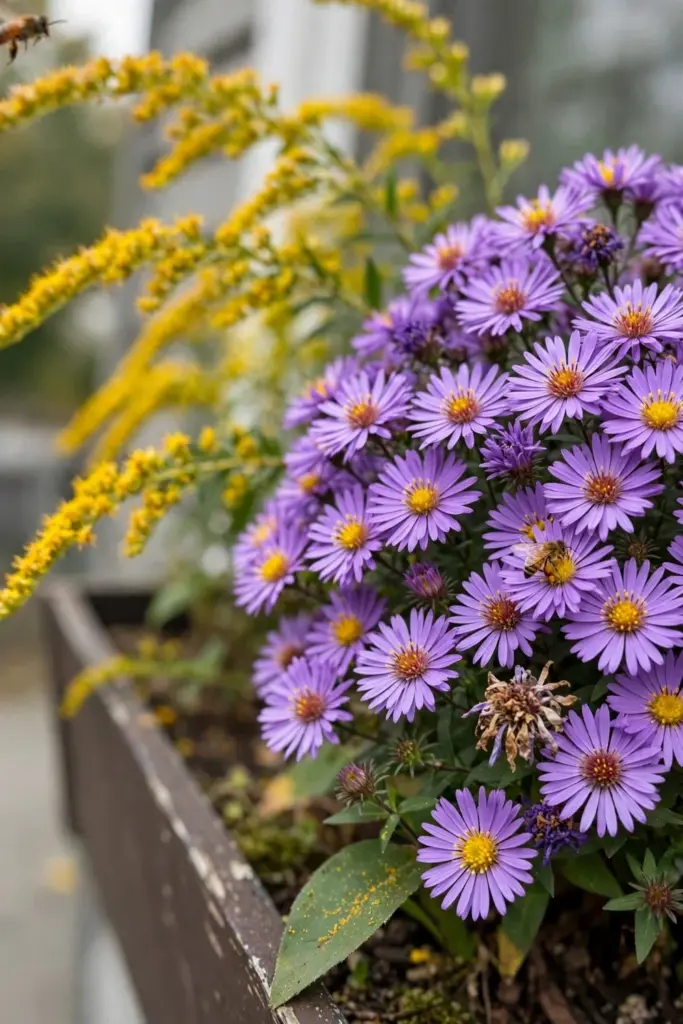
Buy the dwarf forms. Full-size asters reach a meter and turn a window box into a hedge. The dwarf cultivars stay under 40 cm and bloom just as long. Asters want deadheading to extend bloom, but in a box the spent flowers are at eye level, so the chore takes two minutes with scissors. Goldenrod needs nothing. It blooms, it seeds, it is done.
Failure: letting goldenrod seed into the box. Cut the seed heads before they fluff, or next spring the box is a goldenrod monoculture.
10. Caladium Holdover With Ivy
Caladiums are summer plants, but in warm zones they carry into October, and their patterned leaves outshine any fall flower. Pair with ivy and let the box ride the last warm weeks. Sun: part shade to shade. Frost: caladiums die below 10C; this is a short-season box. Window view: bold pattern, close viewing.
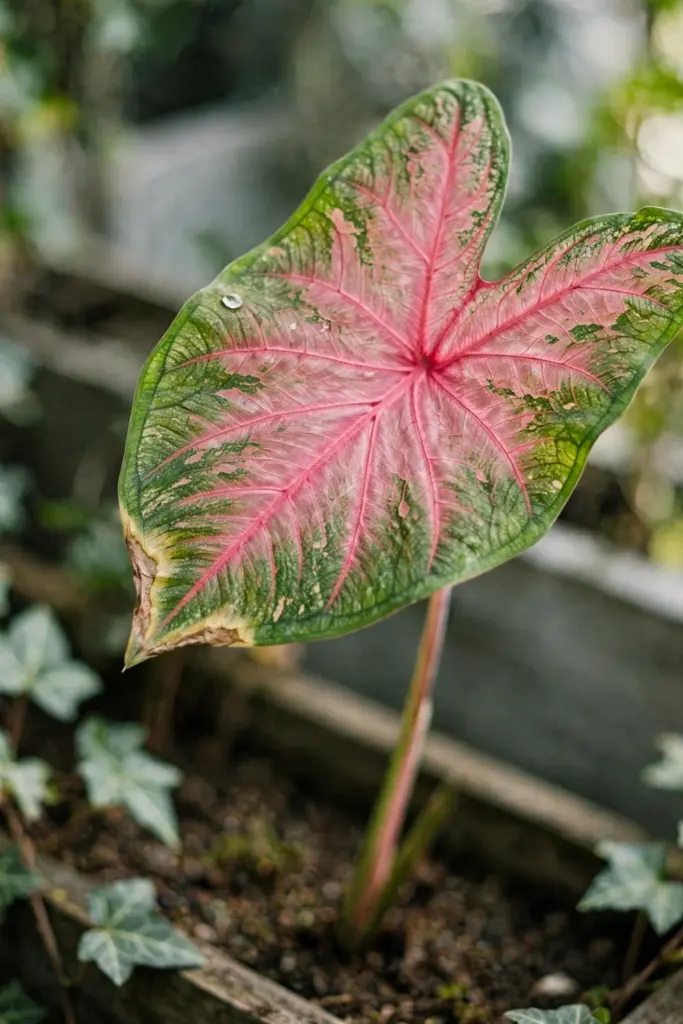
This is a timing play, not a season-long box. Plant caladiums in spring, enjoy them through October, then swap the box for winter greens. The Clemson Extension caladium guide notes they thrive in heat and humidity and work well in window boxes and hayracks. In zones 9 and 10 they overwinter; everywhere else they are annuals. Know which zone you are in before you commit a box to them in October.
Failure: planting caladiums in October in zone 6. They will not establish before the cold kills them.
11. Cyclamen and Moss Winter Primer
Hardy cyclamen blooms in cool weather with swept-back pink or white flowers, and sheet moss fills the gaps and holds moisture. This box looks like a woodland floor and peaks exactly when everything else is fading. Sun: part shade. Frost: hardy cyclamen to -18C with mulch. Window view: woodland, pairs with brick or stone.
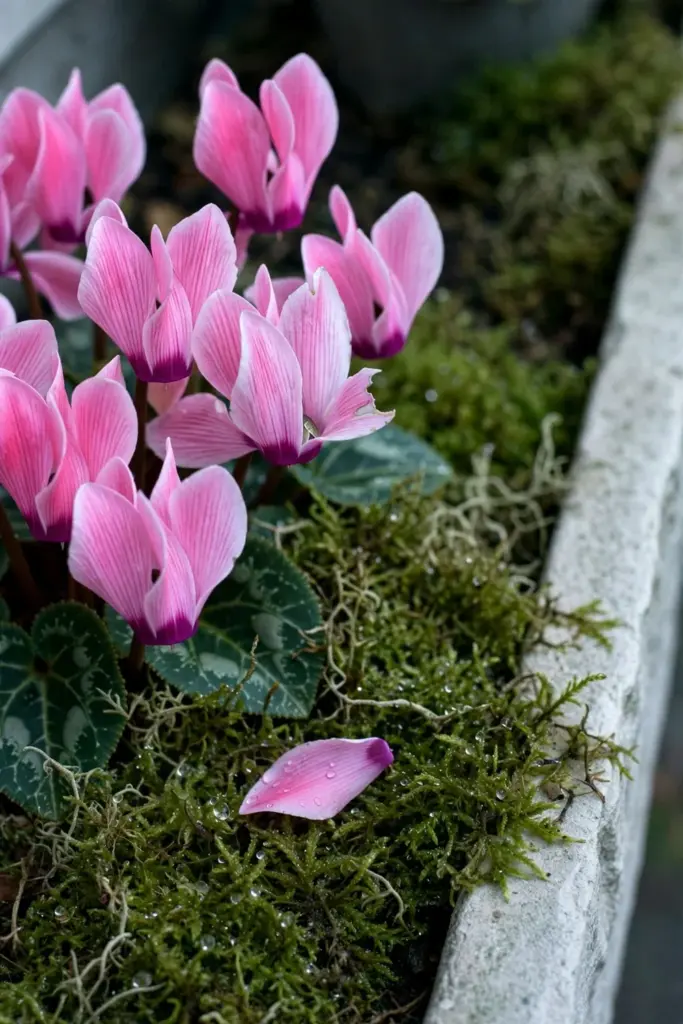
Cyclamen tubers must sit just below the soil surface, not deep. Deep-planted tubers rot. The moss is functional, not decorative: it slows evaporation from the shallow soil, which matters because a window box has so little soil volume that every centimeter of moisture retention counts. Water from below or at soil level. Wet cyclamen crowns rot fast.
Failure: overhead watering. Always water cyclamen at the soil, never over the crown.
Shallow and Small Boxes
Short sills and narrow boxes need plants with compact roots. Deep-rooted plants starve in 15 cm of soil.
12. Succulent and Sedum Shallow Box
Sedums, echeveria, and hens-and-chicks thrive in 12 to 15 cm of gritty soil and ask for water twice a month. This is the box for the gardener who forgets to water. Sun: full sun. Frost: hardy sedums survive; tender echeveria must come in. Window view: modern, sculptural.
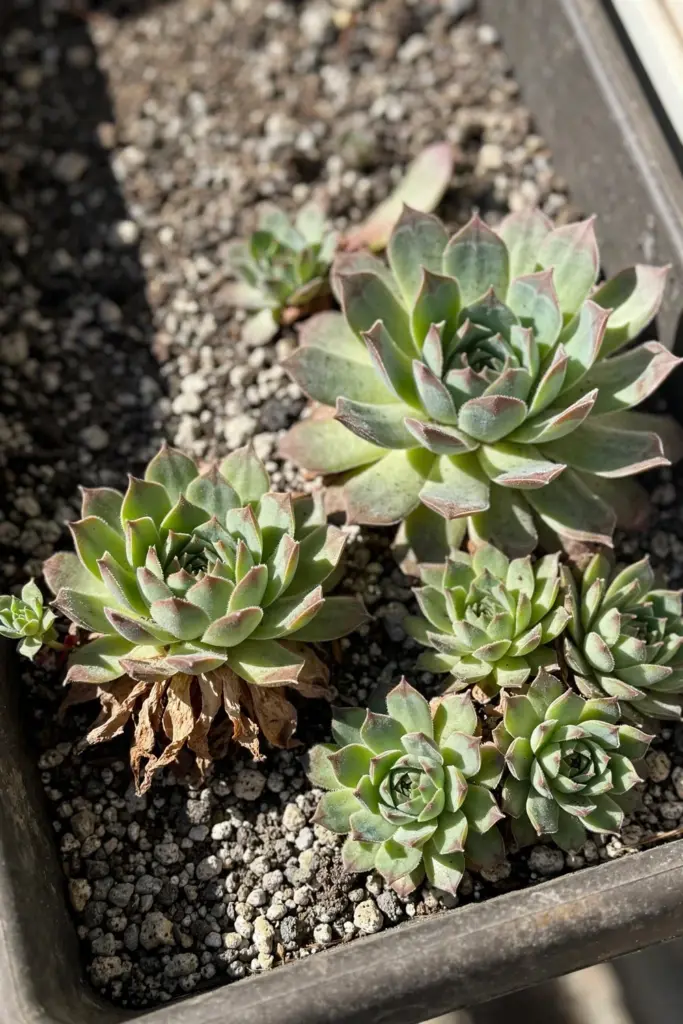
Use cactus mix, not potting soil. Regular potting mix holds too much water for succulents in a shallow box, and October rain will rot them. A 50-50 mix of potting soil and perlite or coarse sand drains fast enough. Top-dress with gravel. The gravel keeps the leaves off wet soil, which is the main rot vector.
Failure: rich soil. Succulents in peat-heavy mix rot within a month of autumn rain.
13. Thyme, Sage, and Parsley Herb Trio
Culinary herbs fit shallow boxes perfectly, and thyme, sage, and parsley all tolerate fall cold. This box feeds the kitchen from October to December. Sun: full sun. Frost: thyme and sage hardy; parsley biennial, survives light frosts. Window view: kitchen window, the most useful box on this list.
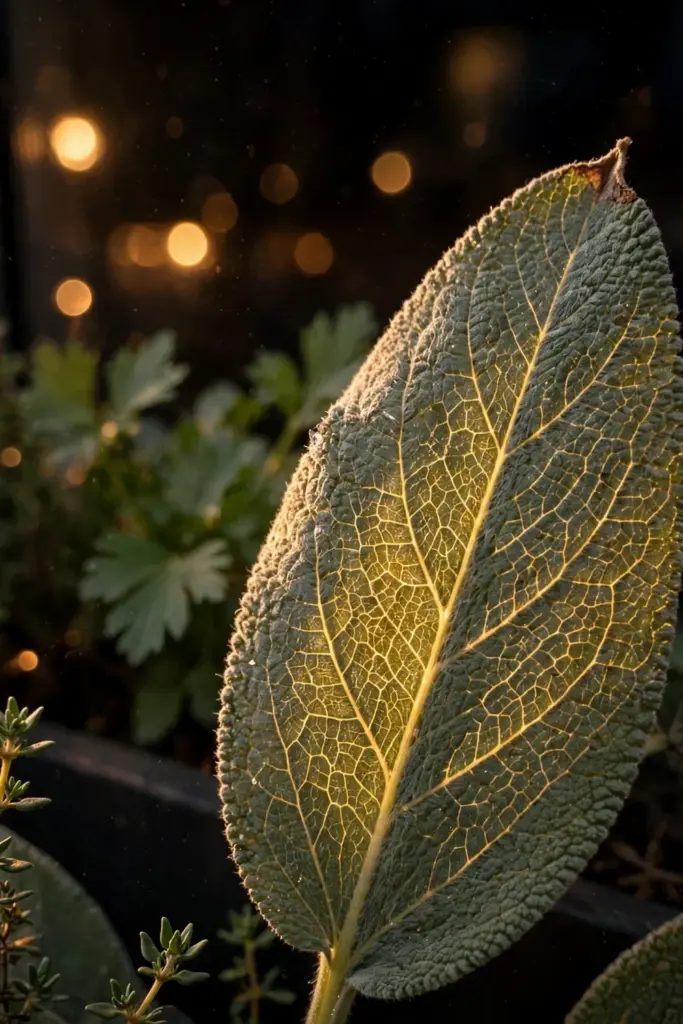
Herbs want lean soil and sharp drainage, the opposite of flower boxes. Skip the fertilizer. Fed herbs grow soft and lose flavor. For the full herb list beyond this box, see fall herbs to plant. What matters in a window box: shallow roots, kitchen proximity, cold tolerance. Harvest by snipping, never stripping more than a third of the plant at once.
Failure: overfeeding. Fertilized herbs in fall grow soft tissue that frost kills overnight.
14. Lettuce and Arugula Salad Box
Cut-and-come-again lettuce and arugula grow fast in cool weather and fit a shallow box. Sow thick, cut the outer leaves, and the box produces for two months. Sun: full sun to part shade. Frost: lettuce to -4C; arugula harder. Window view: kitchen window, edible.
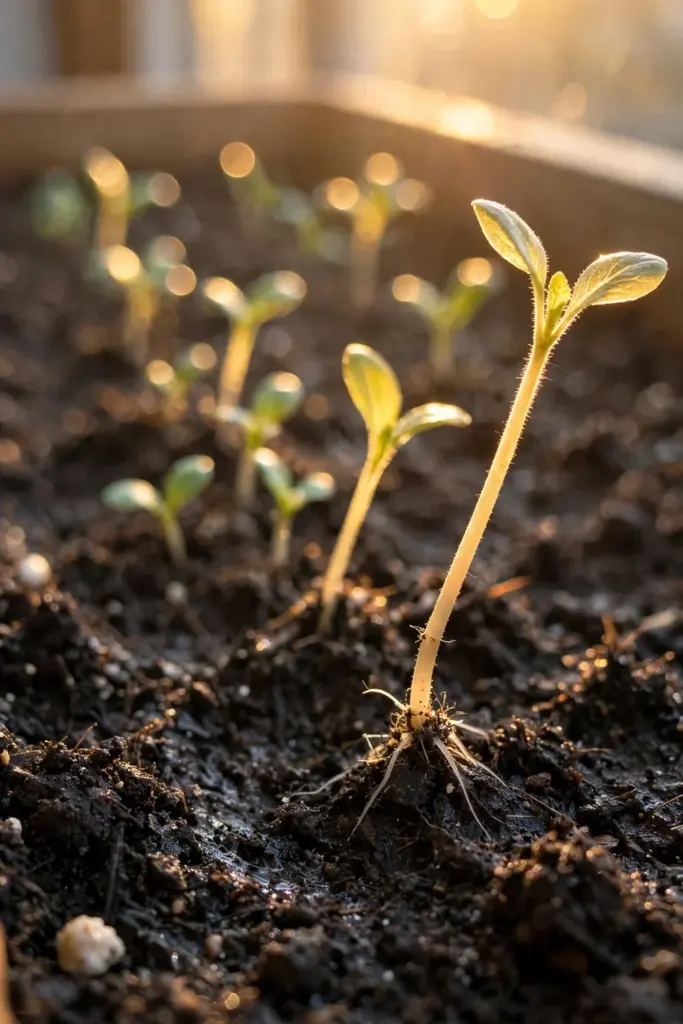
This is the fastest payoff on the list: seed to first cut in 30 days. Sow in early October, cut in November. A floating row cover draped over the box adds 3 to 5 degrees of frost protection and extends harvest by weeks. The Mississippi State Extension fall container guide recommends lightweight, weed-free mixes, often with slow-release fertilizer included, and warns that containers dry out faster than garden beds, so check salad boxes daily.
Failure: sowing too thick without thinning. Unthinned lettuce rots at the base in damp October air.
Herb and Edible Boxes
15. Kale, Chard, and Viola Edible Color
Ornamental kale, rainbow chard, and violas give a box that is both dinner and decoration. Kale sweetens after frost, chard stems glow red and yellow, and violas bloom through light freezes. Sun: full sun. Frost: kale to -9C; violas to -7C. Window view: cottage kitchen, edible and pretty.
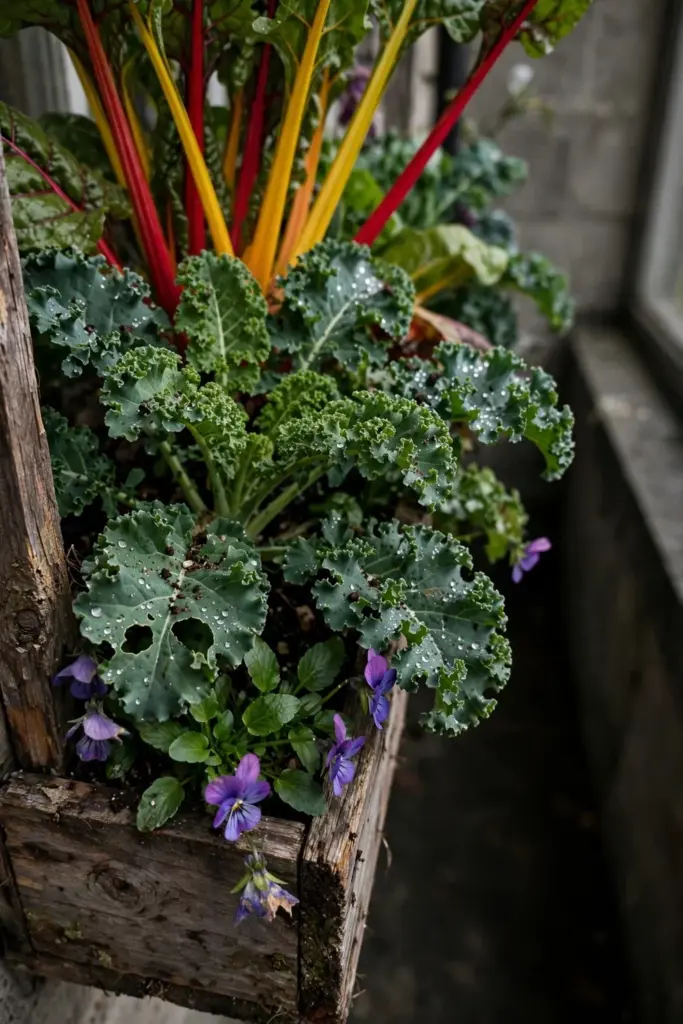
Kale is the backbone because it looks better in December than in October. The cold deepens its color. Chard gives the vertical element at the back. Violas fill the front and bloom whenever temperatures rise above freezing. This box feeds a household of two with weekly cuttings and still looks like a flower box from the street.
Failure: planting kale starts too close together. Give each plant 20 cm. Crowded kale stays small and never develops its color.
16. Rosemary Standard With Winter Savory
A rosemary trained as a small standard gives the box architecture, and winter savory fills the base with evergreen herb foliage. Both are perennial in mild zones and both cook well. Sun: full sun. Frost: rosemary hardy to -9C in sheltered spots; savory harder. Window view: formal, pairs with symmetrical facades.
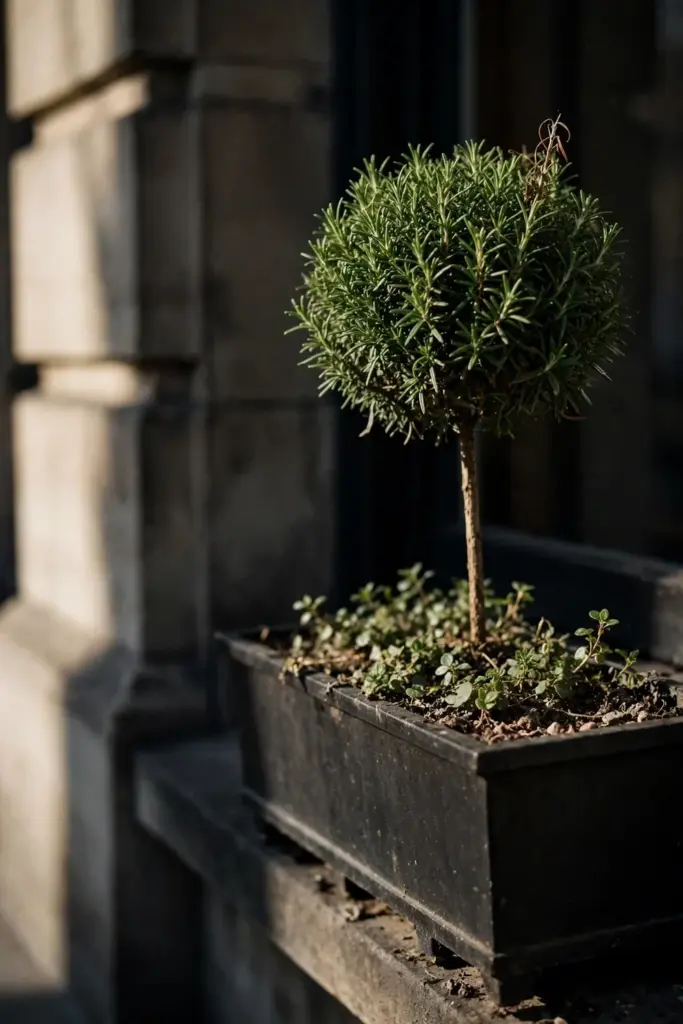
Rosemary hates wet winter soil more than cold. In a window box, drainage is the whole game: drill extra holes if the box has fewer than four, and raise the box 1 cm on pot feet so water escapes freely. A rosemary that survives December in a box is a rosemary that drains. In zones colder than 7, bring the box into an unheated garage for the coldest weeks.
Failure: saucers under window boxes. A saucer in October rain is a bathtub. Remove it or drill it.
17. Garlic Chives and Flat Parsley
Garlic chives give white late-season blooms and grass-like texture, and flat parsley fills with green that survives into winter. Both are cut-and-come-again, and the chive flowers feed late pollinators. Sun: full sun to part shade. Frost: chives hardy; parsley biennial. Window view: simple green, kitchen-adjacent.
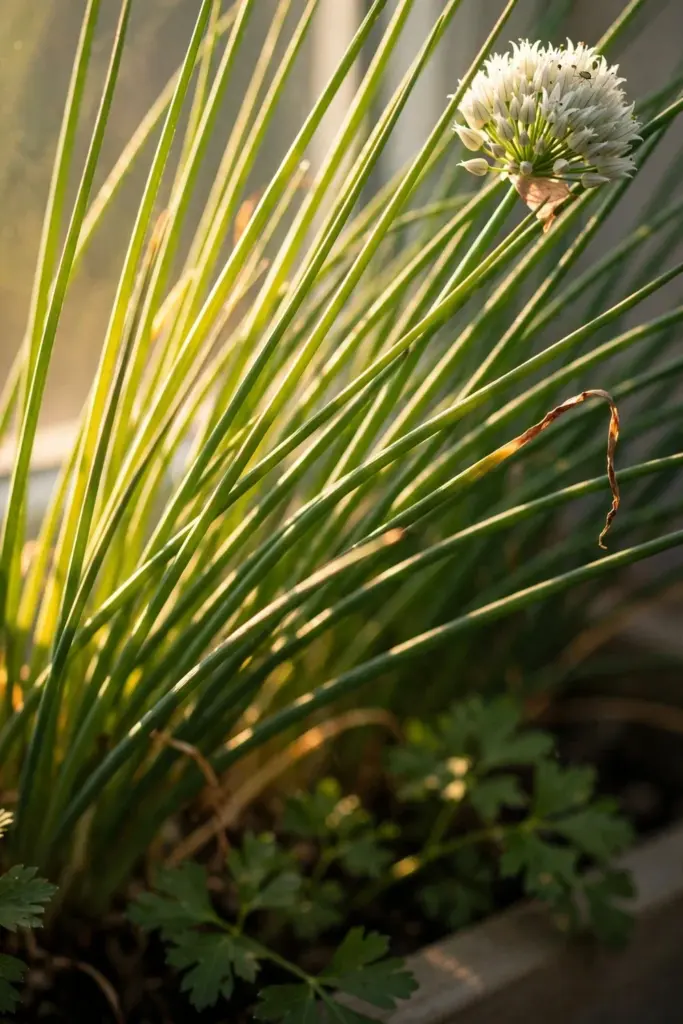
Garlic chives self-seed aggressively. Cut the flower heads before they set seed unless you want chives in every box next year. Parsley is biennial: it grows leaves the first year, flowers the second. Plant it for leaves and pull it when it bolts. In a window box, parsley rarely survives a hard winter, so treat it as a fall annual and replant in spring.
Failure: letting chives go to seed. One missed deadheading means a hundred seedlings.
Winter-Transition and Faux Boxes
18. Evergreen Cuttings and Pinecone Box
When the flowers are done, pull them and stick evergreen cuttings: boxwood, cedar, pine, and fir branches pushed into the soil, with pinecones tucked in. This box costs nothing if you prune your own shrubs, and it looks intentional from November to March. Sun: any. Frost: irrelevant; it is already winter-dressed. Window view: winter structure, pairs with any facade.
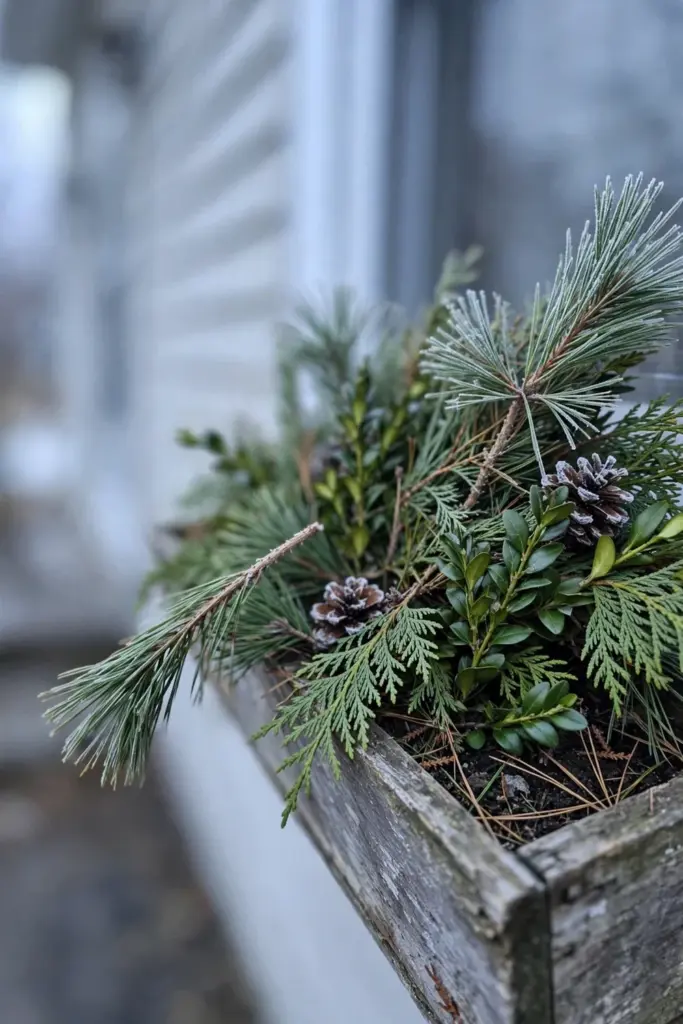
Cut stems 30 to 45 cm long and push them 8 to 10 cm into the soil. They will not root. The cold preserves them green for months because they never wake up. Mist them occasionally in dry spells. This is the cheapest winter window box there is, and it outperforms any store-bought arrangement because the scale matches the box exactly.
Failure: using deciduous branches. Bare twigs in a box read as dead, not dormant. Evergreen or nothing.
19. Faux Fall Stems, Honest Version
High-quality faux stems have their place: a north-facing box under a deep eave where nothing grows, or a second-story box nobody waters. If you go faux, commit fully. Mix faux stems with real moss and real pinecones so the eye reads texture, not plastic. Sun: any; faux does not care. Frost: irrelevant. Window view: anywhere real plants fail.
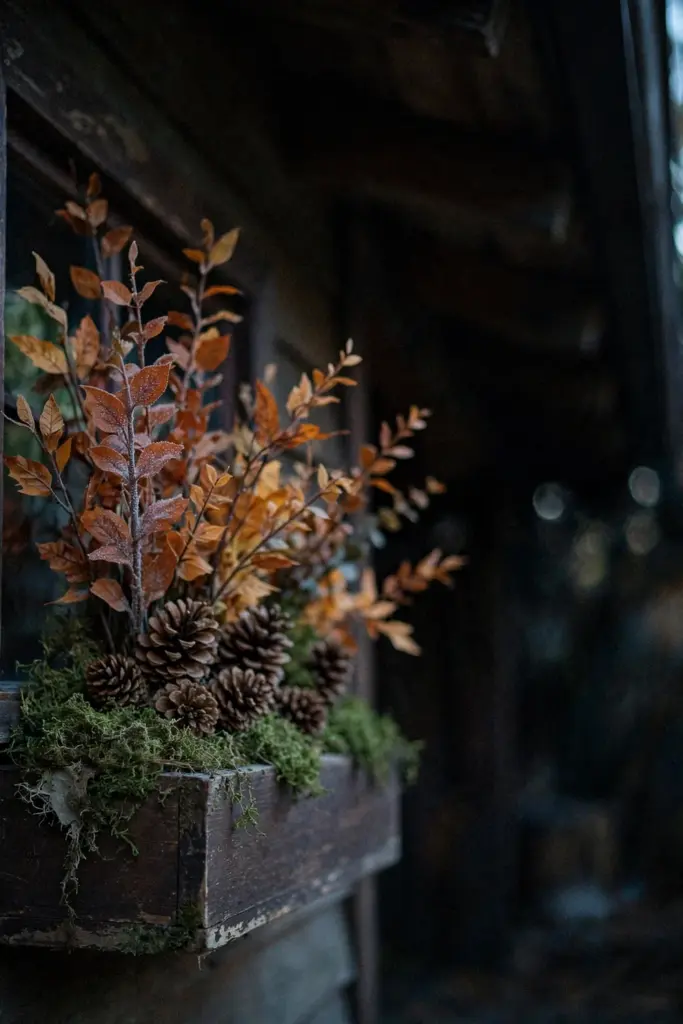
The honest rule: faux belongs where real plants cannot grow, not where the gardener is lazy. A watered real box always beats a faux box. But a faux box beats an empty dead box, and a dead box on the facade is worse than no box at all. Dust the stems monthly. Dusty faux reads fake from twenty meters.
Failure: half measures. Three wilted real mums plus faux ivy looks like neglect, not design.
20. Bulb Lasagna for Spring
Plant daffodil, tulip, and crocus bulbs in layers in the box in October, top with pansies for fall color, and the box blooms twice: pansies now, bulbs in spring. This is the longest-playing box on the list. Sun: full sun to part shade. Frost: bulbs need winter chill; pansies handle light frosts. Window view: spring payoff, plan ahead.
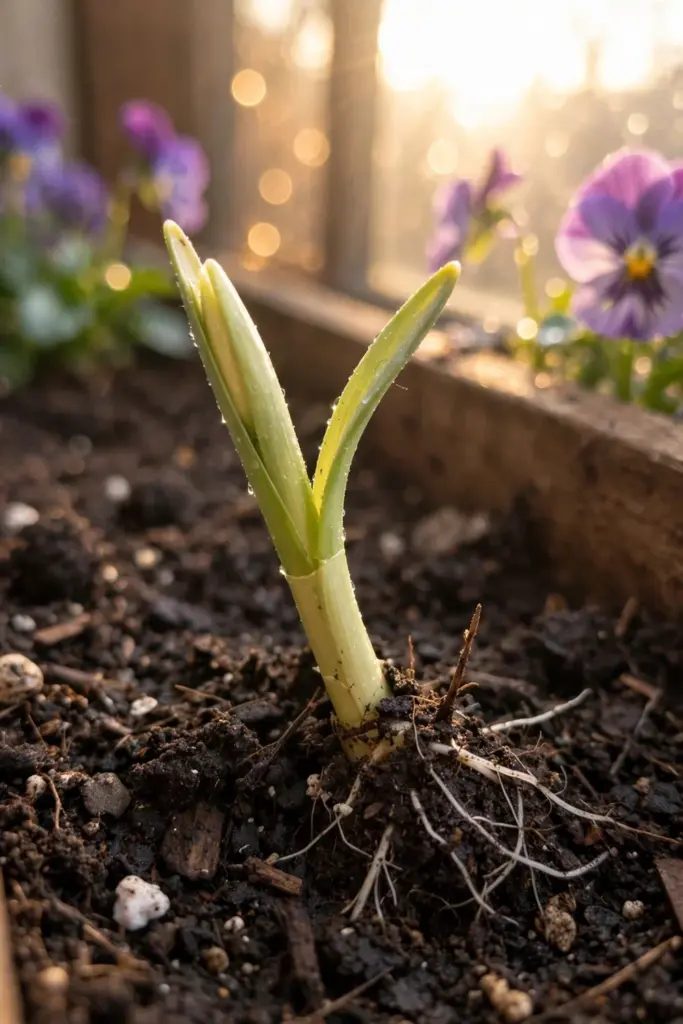
Layer large bulbs 15 cm deep, medium bulbs 10 cm, small bulbs 7 cm, then pansies on top. The bulbs need 12 to 16 weeks of cold below 9C, which a window box provides naturally in most zones. In zones 8 and warmer, chill the bulbs in the refrigerator for 8 weeks before planting. For depths and spacing on every bulb, see bulbs to plant in fall.
Failure: planting bulbs too shallow. Shallow bulbs in a box freeze-dry in winter wind. Depth is insulation.
21. Budget Refresh: Swap Just the Spillers
Do not replant the whole box. Pull the tired spillers, keep the structural plants, and tuck in fresh ivy, creeping jenny, or pansy starts at the front edge. A 15-minute refresh makes an October box look new for the cost of three small plants. Sun: matches the existing box. Frost: match the existing plants. Window view: any; this is maintenance, not design.
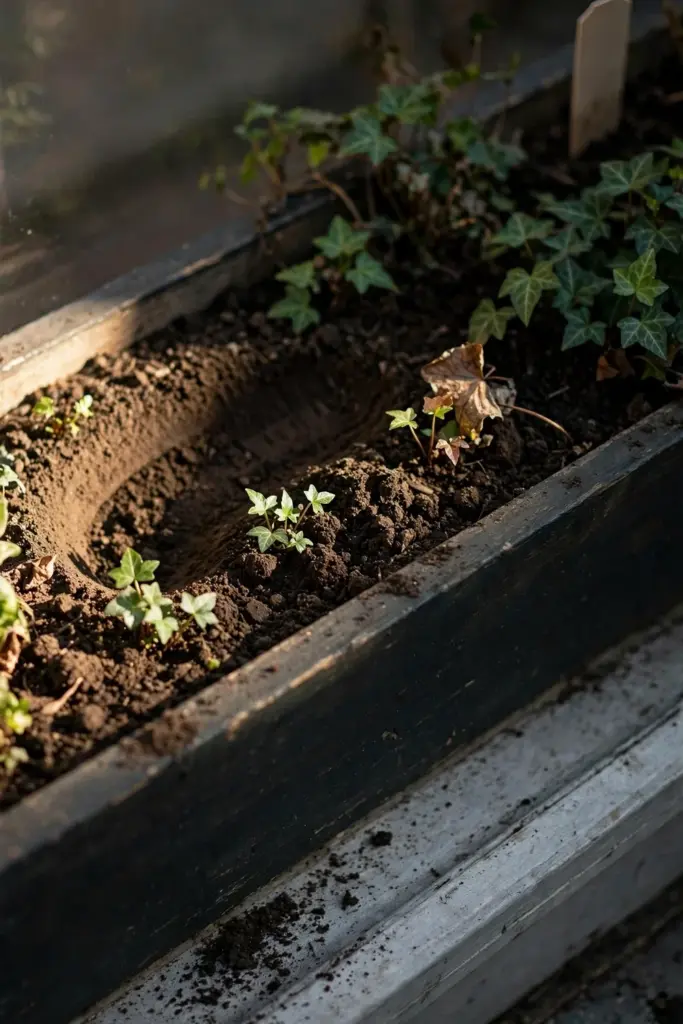
The front edge is what the street sees. Refresh it and the whole box reads renewed, even if the back row is unchanged. This is the thriftiest move on the list and the one most gardeners skip, replanting entire boxes instead. Keep a flat of ivy starts through fall for exactly this purpose.
Failure: refreshing with summer annuals in late October. They die in two weeks. Use fall plants for fall refreshes.
Box Mechanics: Drainage, Soil, and Watering
A window box fails at the hardware level more often than at the plant level. That is the recurring lesson of the fall gardening tips checklist too: the unglamorous prep decides the season. Drill or confirm at least four drainage holes per 90 cm box. Fewer holes clog with soil in one rainy week. Lay landscape fabric or a coffee filter over the holes to keep soil in while water escapes.
Use a lightweight soilless mix, not garden soil. Garden soil compacts in a shallow box within weeks, and compacted soil drowns roots. The Mississippi State Extension fall container guide recommends lightweight, weed-free mixes, often with slow-release fertilizer included, and warns that containers dry out faster than garden beds. A window box is the fastest-drying container of all: shallow, hung high, wind-exposed. Check daily in October, even after rain, because a box under an eave can miss the rain entirely.
Feed lightly. A slow-release granular fertilizer mixed into the soil at planting carries a fall box without further feeding. Liquid feed every two weeks only if growth stalls. Overfed fall plants grow soft and frost-tender.
Brackets matter. A planted box with wet soil is heavy enough to pull weak brackets out of the wall in a windstorm. Use brackets screwed into studs or masonry, not just siding. Check them every fall before planting.
Winter Protection for Exposed Boxes
Window boxes face winter harder than any other container because cold hits from all sides, including below. In zones 7 and warmer, most fall boxes overwinter with a mulch tuck around the crowns. In colder zones, take one of three paths.
First, the swap: pull the fall plants after hard freeze and replant with evergreen cuttings as in entry 18. Zero risk, full winter interest. Second, the move: small boxes unhook and spend the coldest weeks in an unheated garage or against the house foundation, where temperatures run 5 to 10 degrees warmer. Third, the wrap: line the inside of the box with burlap or bubble wrap before planting, which insulates the root zone by several degrees.
Water sparingly through winter. Dormant plants in a frozen box need almost nothing, but a midwinter thaw followed by dry wind can desiccate evergreens. Check on warm days. The Illinois Extension window-box guide builds its design on layered planting, and the same layering logic applies to winter protection: insulate the roots, shield the crowns, and let the cold do the rest.
The 21 Recipes at a Glance
| # | Recipe | Sun | Frost tolerance | Window view |
|---|---|---|---|---|
| 1 | Mum, kale, and ivy classic | Full sun | Kale to -9C | Street-facing, brick |
| 2 | Copper coleus and sweet potato vine | Full sun to part shade | Dies at frost | Dark shutters |
| 3 | Marigold, celosia, dusty miller | Full sun | Light frost | High-contrast distance |
| 4 | Ornamental peppers, fountain grass | Full sun | Light frost | Modern, gray siding |
| 5 | White pumpkins, eucalyptus, ivy | Any | Props; greenery light frost | Neutral exteriors |
| 6 | Pansy drift, creeping jenny | Full sun to part shade | Pansies to -7C | Kitchen window |
| 7 | Begonia, fern, ivy shade box | Shade to part shade | Dies at frost | Shaded porch |
| 8 | Heuchera, carex, lamium | Part shade to shade | Hardy | Stone or wood siding |
| 9 | Asters, dwarf goldenrod | Full sun to part shade | Hardy | Cottage, pollinator |
| 10 | Caladium holdover, ivy | Part shade to shade | Below 10C dies | Close viewing |
| 11 | Cyclamen and moss | Part shade | To -18C mulched | Woodland, brick |
| 12 | Succulent and sedum | Full sun | Hardy sedums | Modern sculptural |
| 13 | Thyme, sage, parsley | Full sun | Thyme/sage hardy | Kitchen window |
| 14 | Lettuce and arugula | Full sun to part shade | To -4C | Kitchen window |
| 15 | Kale, chard, viola | Full sun | Kale to -9C | Cottage kitchen |
| 16 | Rosemary standard, savory | Full sun | To -9C sheltered | Formal symmetrical |
| 17 | Garlic chives, flat parsley | Full sun to part shade | Chives hardy | Kitchen-adjacent |
| 18 | Evergreen cuttings, pinecone | Any | Winter-dressed | Any facade |
| 19 | Faux stems, honest version | Any | Irrelevant | Where plants fail |
| 20 | Bulb lasagna for spring | Full sun to part shade | Needs chill | Spring payoff |
| 21 | Budget refresh, spillers only | Matches box | Matches plants | Any |
Mistakes That Kill Window Boxes
The most common killer is no drainage. Drill the holes before you plant, not after the box floods. The second is garden soil in a shallow box. It compacts, it drowns roots, and it weighs twice what a soilless mix weighs. The third is wrong plant, wrong window: sun plants in a north box stretch and sulk, shade plants in a south box scorch.
Watering mistakes run both directions. Daily drowning rots crowns; weekly neglect in October wind crisps the edges. The finger test never lies: 3 cm down, cool and damp means wait, dry means water now.
The last mistake is timing. Planting summer annuals in late October wastes money. Planting pansies in September heat wastes the season. Match the plant to the month, and the box takes care of itself.
Frequently Asked Questions
What Should I Put in Window Boxes for Fall?
Start with the exposure. Full-sun boxes take mums, kale, marigolds, and trailing spillers like sweet potato vine. Shade boxes take begonias, heuchera, ferns, and ivy. Every box on this list is tagged by sun and frost tolerance in the table above, so match the recipe to the window before you buy a single plant.
When Should I Plant Fall Window Boxes?
Plant when night temperatures settle below 18C and soil temperatures sit between 7 and 18C, which is early to mid-October in most regions. Planting earlier in September heat stalls cool-season plants like pansies. The box in entry 20, the bulb lasagna, also goes in during October so bulbs get their required chill.
How Often Do I Water a Fall Window Box?
Check daily. Window boxes are the fastest-drying container because they are shallow, hung high, and wind-exposed, and a box under an eave can miss rain entirely. Water when the top 3 cm of soil feels dry, until water runs from the drainage holes. A north-facing box in cool weather may need water only twice a week.
Can Window Boxes Survive Winter?
In zones 7 and warmer, hardy plantings overwinter with mulch tucked around the crowns. In colder zones, swap to evergreen cuttings after hard freeze, move small boxes to an unheated garage for the coldest weeks, or line the box with burlap before planting. Dormant boxes need almost no water through winter.
What Is the Best Soil for Window Boxes?
A lightweight soilless mix, never garden soil. Garden soil compacts in a shallow box within weeks and drowns roots. Look for mixes of peat moss or coir with perlite or pine bark, often with slow-release fertilizer included. For succulent boxes, use cactus mix or add perlite until the mix drains almost instantly.
Should I Fertilize Fall Window Boxes?
Mix a slow-release granular fertilizer into the soil at planting and stop there. That carries a fall box through the season. Liquid feed every two weeks only if growth visibly stalls. Overfed fall plants grow soft tissue that the first frost kills, which is the opposite of what a window box needs.








