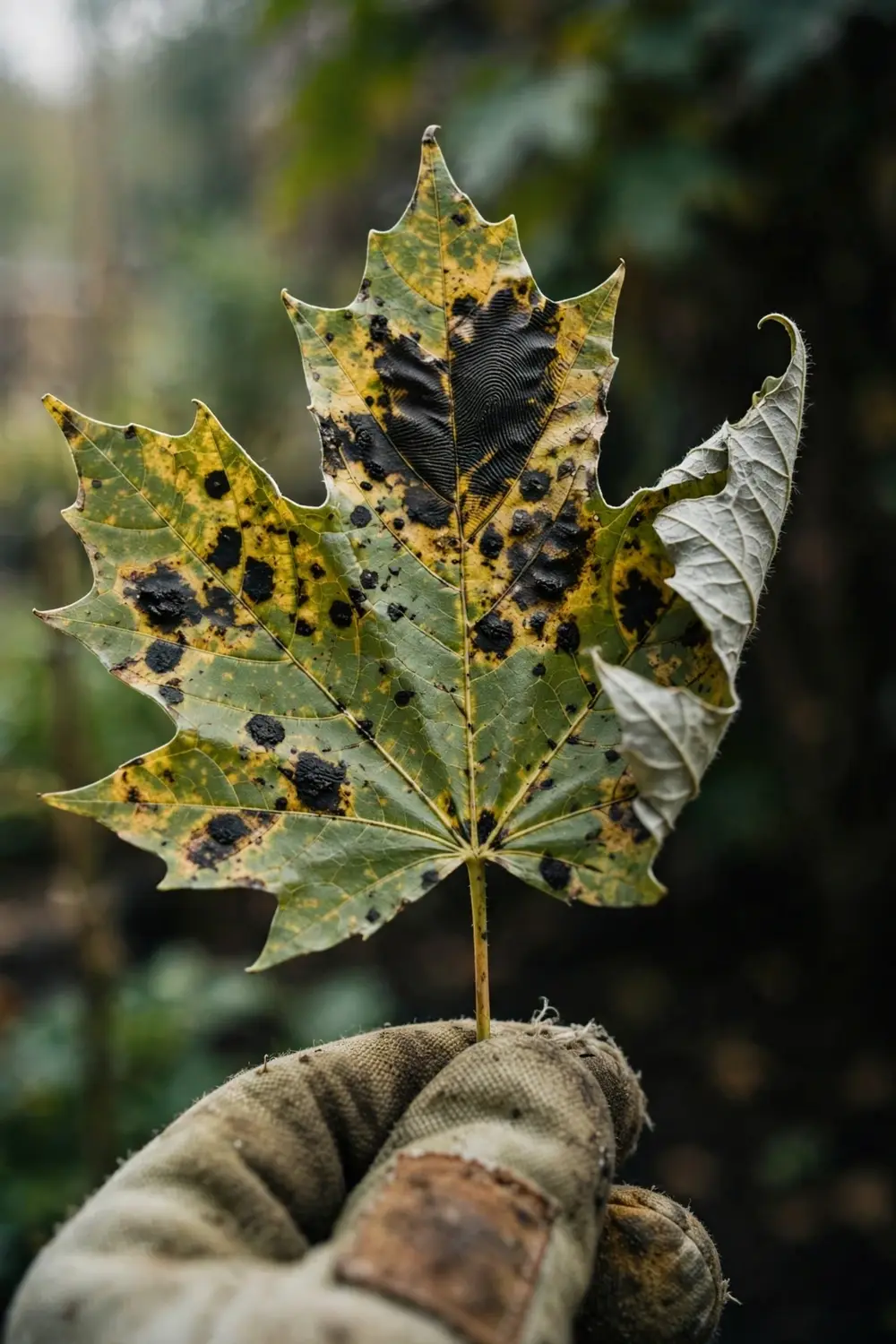

Tar spot on maple looks alarming and does almost no harm. The black spots are a fungal leaf disease, and the tree keeps growing through it. The 8 strategies below start with the one action that actually cuts next year spots, then show how to tell this cosmetic disease from the leaf problems that deserve real worry.
The spots turn up in late summer as raised black patches on green leaves. A heavy year can drop leaves early and make a lawn look messy. The tree leafs out normally the next spring. I have learned that the rake does more than any spray for this disease.
The rest of this page runs in the order a gardener should follow. Identify the disease first, then sort it from its lookalikes, then work the 8 steps from fall cleanup to next-season scouting.
What Tar Spot on Maple Actually Is
Tar spot on maple is a fungal leaf disease of maple trees. Three fungi in the genus Rhytisma cause it.
Clemson Extension names the three as Rhytisma acerinum, Rhytisma americanum, and Rhytisma punctatum. Each one infects maple leaves only. Tar spot on maple stays on leaves. Tar spot on maple never invades wood, roots, or fruit the way a canker or a wilt does.
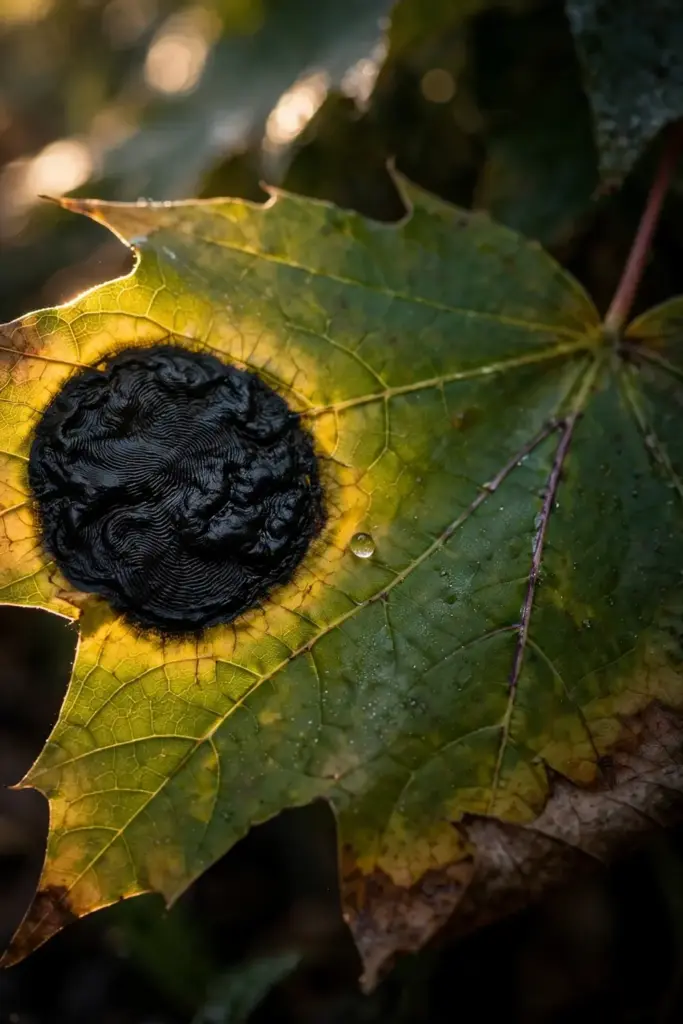
The black patch itself is a stroma. A stroma is a dense mat of fungal tissue that sits on the leaf surface and looks like a drop of tar. The stroma holds the fungal structures that release spores the following spring. One infection cycle runs across one season. Spring spores infect new leaves. Summer spots grow. Fallen leaves carry the fungus through winter. Spring spores start the cycle again.
The shared common name causes the main confusion. Corn tar spot is a different disease caused by the fungus Phyllachora maydis. Maple tar spot is caused by Rhytisma species. The two diseases share a name and nothing else. Lima bean tar spot and soybean tar spot are also different organisms with the same common name. Check the botanical name before following any advice written for another crop.
How to Identify Tar Spot on Maple Leaves
Look for raised black patches on the upper surface of maple leaves in late summer. A raised black patch inside a yellow area on a maple leaf is tar spot on maple.
The season runs on a fixed schedule. The University of Wisconsin Plant Disease Diagnostics Clinic describes the first symptoms as yellowish spots about 1/8 inch across. Those spots may stay small or enlarge across the growing season to about 3/4 inch in diameter. Black structures that look like blobs of tar form as the disease develops. The yellow area around the black patch stays visible through the season.
The black patch feels raised. Run a fingertip across the leaf and the patch stands up from the surface. The patch will not rub off. A speck of dirt or insect waste rubs off. A tar spot stays put. On silver maple the larger tar-like areas show convoluted line patterns that resemble fingerprints. That fingerprint ripple is a reliable field mark for this disease.
The three Rhytisma species leave different signatures. Rhytisma americanum makes the classic single large raised spot on native maples such as silver maple and red maple. Rhytisma acerinum makes many small spots on Norway maple that grow together into one large irregular patch. Cornell Cooperative Extension describes that coalescing patch reaching up to 1 and 1/2 inches across on Norway maple. Rhytisma punctatum makes speckled tar spot, many pinhead-sized spots about 1 millimeter across that stay separate instead of merging. The University of Arkansas diagnostic fact sheet gives that 1 millimeter figure for Rhytisma punctatum and 0.5 to 2 centimeters for the large-spot form from Rhytisma acerinum.
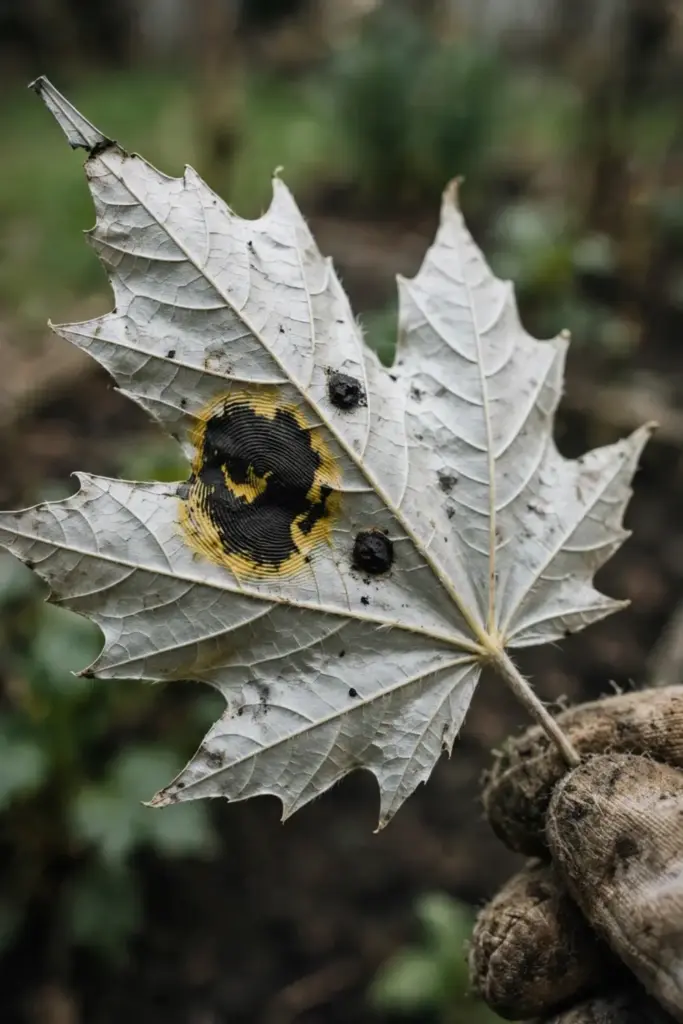
Check the underside too. The leaf tissue opposite a stroma often turns brown while the upper surface stays yellow around the black patch. That brown underside matches the spot above it, so the two sides tell one story. A spot that looks different on each side without matching still deserves a second look against the lookalike table below.
How to Identify Tar Spot on Maple Seeds and Fallen Leaves
Check fallen leaves and maple seeds after leaf drop. Fallen leaves carry the fungus into winter.
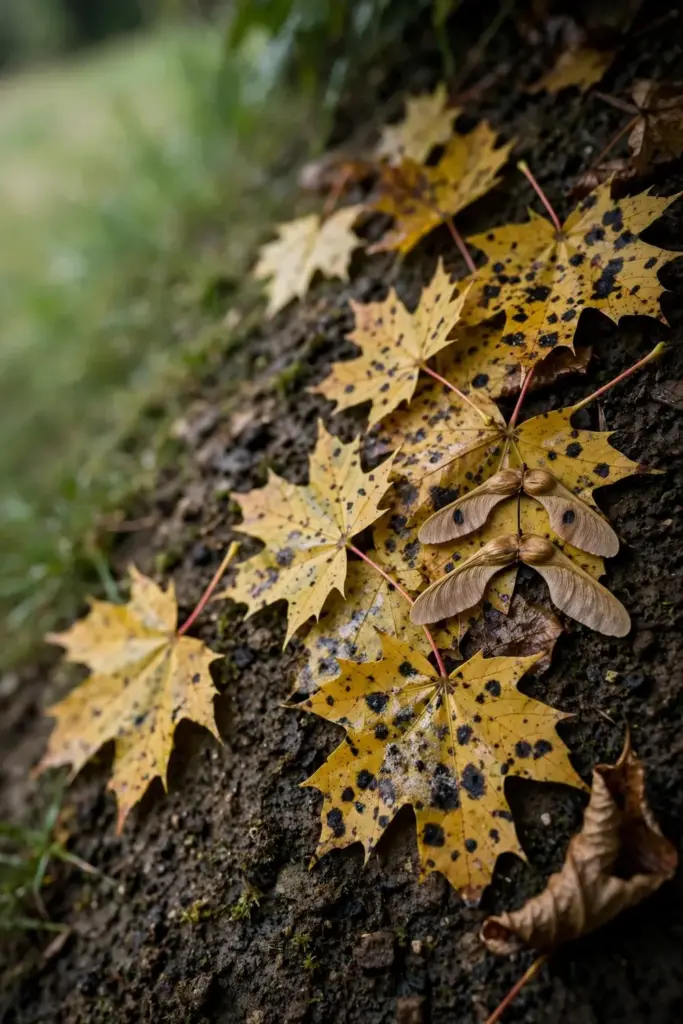
Maple seeds, the paired winged samaras, can carry tar spots as well. Cornell Cooperative Extension notes that the tar spot fungus may attack maple seeds. A spotted samara looks like a spotted leaf in miniature, with the same raised black patch on a yellowed wing. Spotted seeds cause no extra problem. The seeds fall with the leaves and join the same litter layer.
Fallen leaves are where the disease waits out winter. The black stromata sit on dead leaves on the ground through the cold months. In spring the fungal tissue in those spots ripens, splits open, and releases spores. Wind carries the spores to unfolding maple leaves. A thick leaf layer under a maple holds more fungus than a raked lawn. A single unraked drift under one tree can seed that tree again the next spring.
The timing gives the gardener one clear window. Leaves fall in autumn. Spores release in spring as new leaves unfold. Cleanup between those two events breaks the cycle. Cleanup after spore release does not, since the new leaves already carry the infection.
Which Maples Get Hit Hardest by Tar Spot
Silver maple, sugar maple, and Norway maple show tar spot most often in the home landscape. Red maple follows close behind.
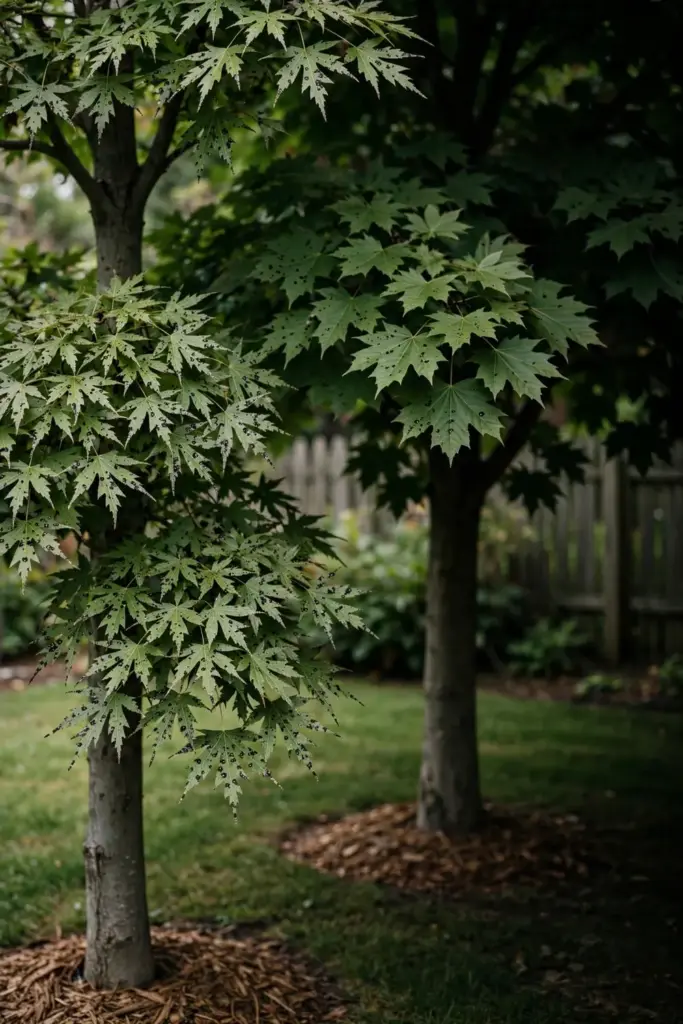
The University of Wisconsin clinic lists silver maple, sugar maple, and Norway maple as the maples it sees most, with red maple also affected. The University of Arkansas diagnostic fact sheet adds bigleaf, mountain, Rocky Mountain, and sycamore maple to the susceptible list. The pattern is broad. Nearly every maple a home gardener plants can carry tar spot.
Norway maple and silver maple show the disease differently. On Norway maple the black structures are typically numerous, small, and clustered together, and they merge into a large patch as the season goes on. On silver maple the black structures are often single, large, and visibly raised, with the fingerprint ripple on close inspection. A Norway maple with dozens of small spots and a silver maple with one big spot can carry the same disease from different Rhytisma species.
Other trees and shrubs can carry tar spot as well. The Wisconsin clinic names boxelder, also called ash-leaved maple, along with willow, holly, and tuliptree. Boxelder is a maple by botany, so its place on the list makes sense. Willow, holly, and tuliptree show the same raised black spots from related Rhytisma fungi. A spotted holly leaf under a spotted maple does not mean the disease jumped hosts in a new way. Each host carries its own Rhytisma form.
Seedlings and young transplants look worse than they are. A small tree with a large share of spotted leaves loses more of its food-making surface than a big tree with the same share. The small tree still recovers. The small tree still leafs out normally the next spring when the fallen leaves are cleaned up. Size changes the look of the disease. Size does not change the mild outcome.
Tar Spot on Maple vs Corn Tar Spot vs Phyllosticta Leaf Spot vs Anthracnose
Check the spot first. A raised black patch that will not rub off means tar spot on maple. A flat spot with a purple border means something else.

The table below lines up the four leaf problems that confuse maple owners most. Read the pathogen row first, then the spot row, then the first-move row.
| Sign | Tar Spot on Maple | Corn Tar Spot | Phyllosticta Leaf Spot | Maple Anthracnose |
|---|---|---|---|---|
| Pathogen | Fungus. Rhytisma acerinum, Rhytisma americanum, or Rhytisma punctatum | Fungus. Phyllachora maydis | Fungus. Phyllosticta minima | Fungus. Aureobasidium apocryptum |
| Spot look | Raised black patch like a drop of tar, inside a yellow area, on the upper leaf surface | Raised black stromata, often with a tan halo, on corn leaves | Pale yellow center with a purple border, black fruiting bodies in the center | Irregular brown dead areas, often along veins, with deformed or crooked growth |
| Spot size | Yellow spots start about 1/8 inch and reach about 3/4 inch. Norway maple patches merge up to 1 and 1/2 inches. Speckled form stays about 1 millimeter per spot | Small raised black spots scattered across corn leaves | Irregularly round spots about 1/4 inch across | Blotches that merge across the leaf, with no fixed spot size |
| Rub test | Raised patch stays put and will not rub off | Raised lesion stays put and will not scratch off | Flat spot with tiny black dots in the center | Flat dead tissue, nothing raised to rub off |
| Defoliation risk | Early leaf drop in heavy years, rarely serious | Yield loss on corn in severe years, a commercial problem | Partial defoliation in severe infection | Twig and branch dieback in wet springs, worse than tar spot |
| First move | Rake and destroy fallen leaves in fall | A corn field problem, not a home maple problem | Rake fallen leaves, same cleanup as tar spot | Rake fallen leaves, plant resistant trees, and watch twigs in spring |
FarmProgress answers the corn question directly. Corn tar spot cannot spread to become tar spot on maple trees. The two diseases are not the same thing. Corn tar spot keeps spreading across the Corn Belt and can cause considerable yield loss in corn. Maple tar spot stays cosmetic. A corn program built on fungicide timing and hybrid tolerance has no place on a backyard maple.
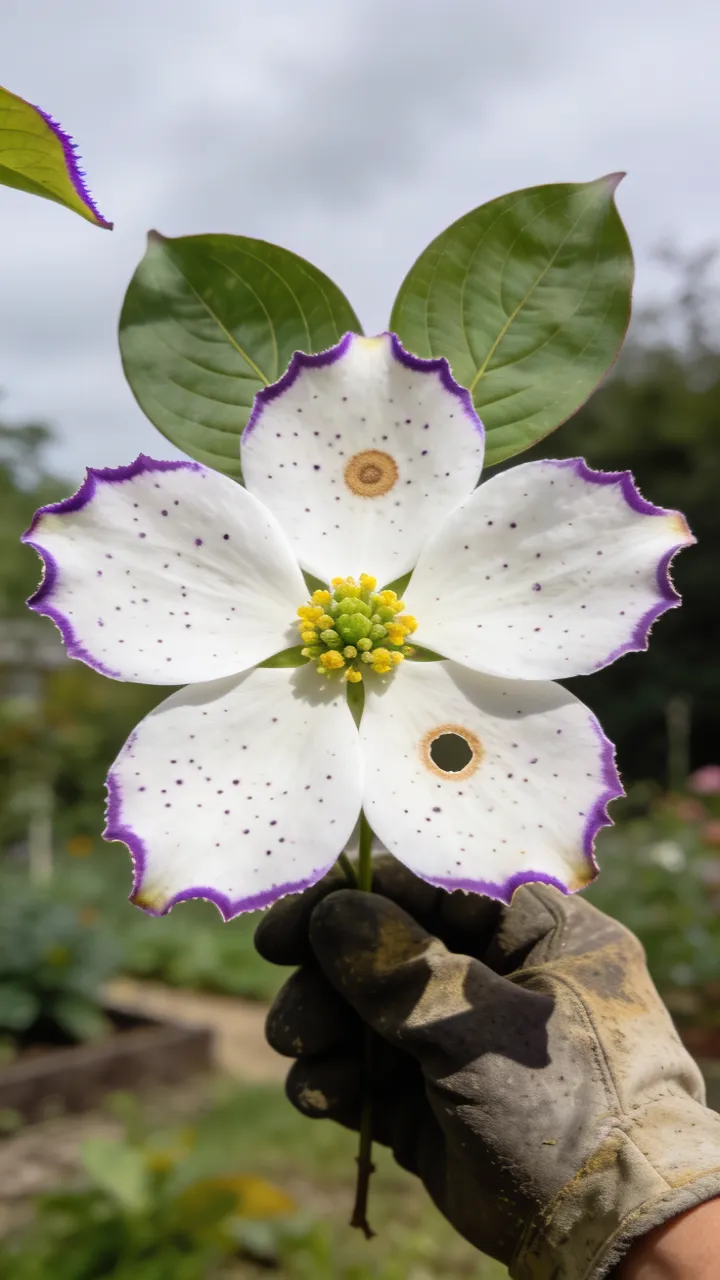
Phyllosticta leaf spot sits closest to tar spot on maple. Clemson Extension describes Phyllosticta leaf spot as pale yellow centers with purple-bordered spots about 1/4 inch across, with black fruiting bodies spotting the centers on the upper leaf surface. The purple border is the field mark. Tar spot on maple has a yellow area around a black patch and no purple border. The same cleanup handles both diseases, since both fungi survive winter in fallen leaves.
Anthracnose runs a different pattern. Clemson Extension describes anthracnose as leaves and buds turning brown and dying, with twig and branch dieback and deformed, crooked, angular branches. The damage reaches twigs and buds. Tar spot on maple never reaches twigs. A maple with dead twig tips and crooked shoots points at anthracnose, and the guide to anthracnose plant disease separates the anthracnose group from the leaf-spot group. The live Actinopelte leaf spot article carries its own comparison table with tar spot as a column, and Actinopelte leaf spot stays a companion article, never merged into this page.
Galls add one more confusion. Gall makers cause raised bumps on maple leaves, and a gall can look like a tar spot at a glance. A gall is a swelling of leaf tissue caused by mites or insects, not a fungal patch. A gall keeps the leaf color or turns reddish, and it feels like a solid bump of leaf tissue. A tar spot is black, flat-topped, and sits inside a yellow area. Cut a gall open and it shows leaf tissue inside. A tar spot shows fungal tissue on the surface.
Why Overwintering Leaves Drive Tar Spot Every Spring
Tar spot on maple comes back because fallen leaves carry it through winter. The leaf litter is the whole reservoir.
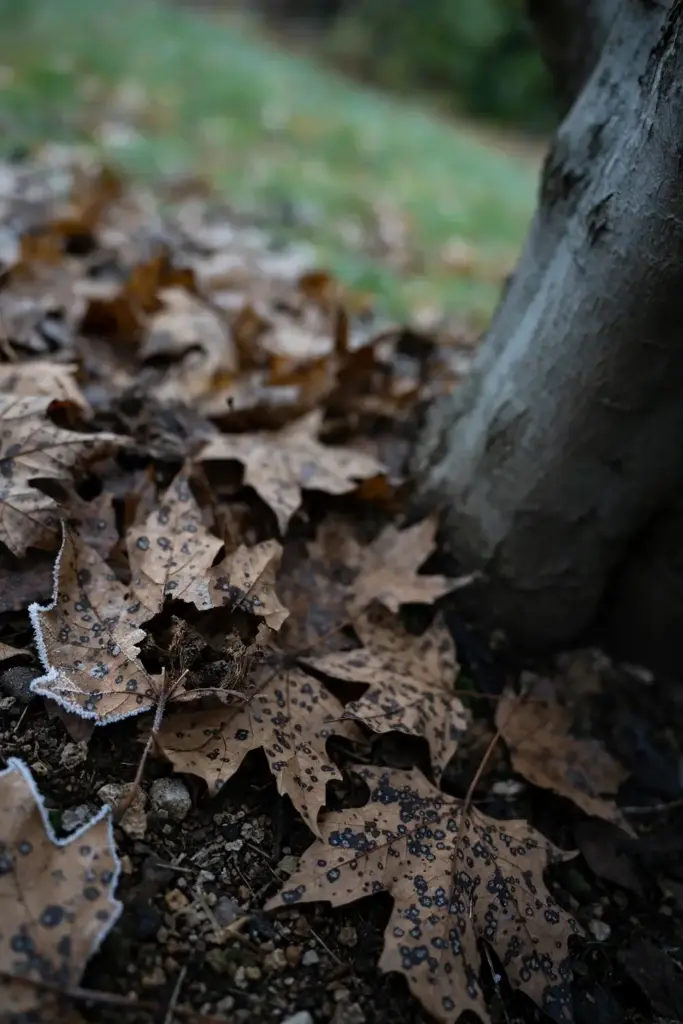
The cycle starts in spring. Spores release from stromata on dead leaves on the ground. Wind carries the spores to unfolding maple leaves. The spores germinate in moist conditions and enter young leaves through the natural openings where gas exchange happens. A few weeks later small yellow spots appear where the fungus colonizes the leaf. The black stroma forms on the upper leaf surface later in summer. The spotted leaf falls in autumn. The stroma overwinters on that fallen leaf. Spring spores start the cycle again.
Moisture sets the pace. Researchers tracking spore release in Ontario found that release follows extended rainfall or prolonged wetting, with the release period lining up with full leaf expansion on Norway maple. A wet spring with slow leaf drying gives spores more chances to land and germinate. A dry spring gives fewer chances. The gardener cannot change spring rain. The gardener can change the amount of fungus waiting in the litter.
Distance matters less than most gardeners expect. Spores travel on wind, so a raked yard next to an unraked woodlot still gets some spores. The heaviest dose lands right under the tree that dropped the leaves. Raking under the tree itself cuts the heaviest dose. Raking the whole yard cuts more. A neighbor who never rakes still sends some spores across the fence, and that fact explains why a careful gardener still sees spots in a bad year. The goal is fewer spots, not zero spots.
One infection cycle per season means one cleanup window per year carries the whole strategy. The fungus gets one shot at new leaves each spring. Leaves cleaned up before that shot cut the shot short. Leaves left on the ground through spring feed the shot at full strength. Fall cleanup is the strategy because the fungus has no other reservoir.
What Makes Tar Spot Worse in a Home Garden
Leaves left on the ground make tar spot worse than any other single habit in a home garden, because the litter holds the whole reservoir.
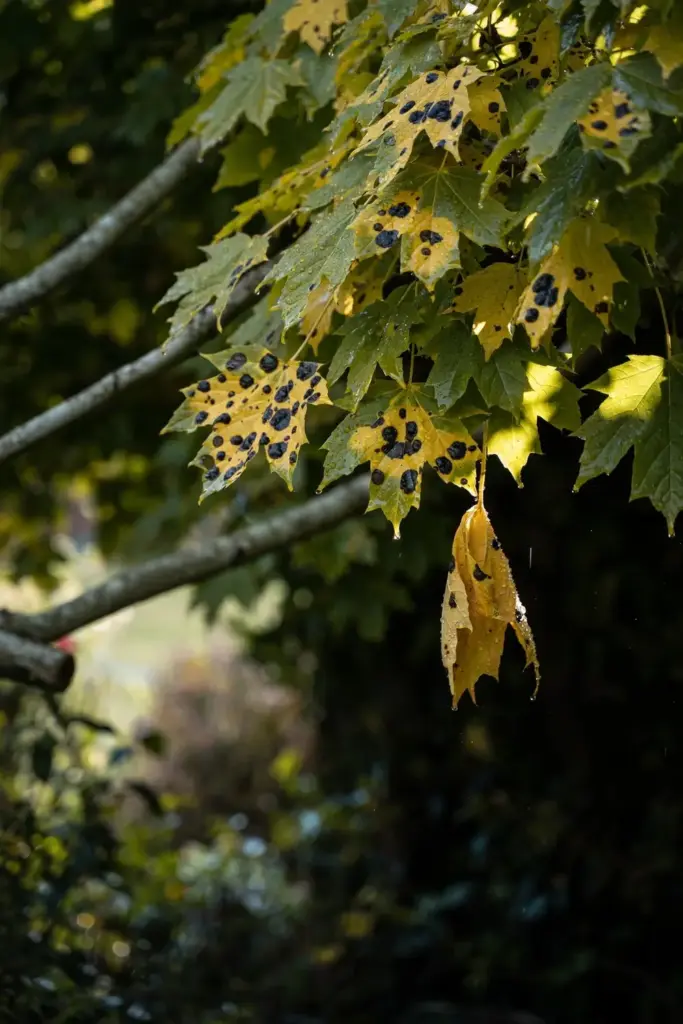
Unraked leaf litter tops the list. Every spotted leaf left on the ground holds stromata that release spores in spring. A thick drift under a maple holds more fungus than a thin scattering. Leaves blown into a fence corner or a shrub bed still count. Leaves mowed into the lawn still count, since mowing shreds the leaves without killing the fungus. Cleanup has to remove the leaves from the site, not just cut them smaller.
Wet springs raise the infection rate. Spores need moisture to germinate and enter young leaves. A spring with long wet spells and slow drying keeps leaves wet longer and gives spores more time. A dense canopy holds moisture on leaves after rain and slows drying. A tree with a tight inner canopy stays wet longer than an open tree. Thinning for light and air helps the tree dry faster, and a faster-drying leaf gives spores less time.
Prior-year pressure predicts this year. A tree that carried heavy spots last year dropped a heavy load of fungus into its own litter. That litter releases a heavy dose of spores this spring. A tree that carried light spots last year drops a light load. The first year after a heavy year is the year cleanup matters most. Skip cleanup after a heavy year and the disease compounds, since that heavy litter releases a heavier spore dose the following spring.
Stress makes the look worse without making the disease dangerous. A drought-stressed maple drops spotted leaves earlier than a watered maple. A transplant still building roots drops leaves earlier too. The early drop looks like serious damage, though the tree still holds its buds for next spring.
Step 1: Decide Whether Tar Spot Deserves Any Treatment
Tar spot on maple deserves cleanup and almost never deserves a spray. Make that call first, before buying anything.
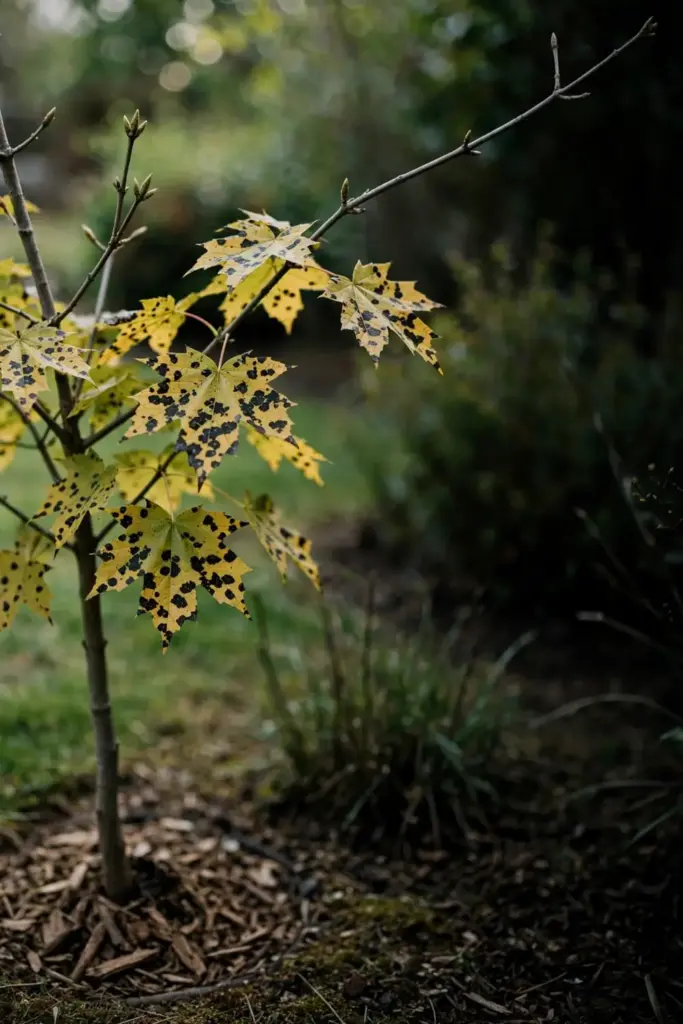
The Wisconsin clinic puts it plainly. Tar spot is not a serious disease for most maples. Tar spot is a cosmetic disease that makes trees look unsightly. Tar spot does not kill trees, and it does not typically cause serious defoliation. A tree with spotted leaves and full twigs needs no rescue. A tree with spotted leaves and dead twigs has a different problem, and the differential table above points at the real one.
The honest cost and benefit run one way. Raking costs an afternoon. Spraying a mature maple costs money, equipment, and repeated applications across a canopy no home sprayer can cover fully. FarmProgress notes that fungicide control on maple tar spot fails because complete coverage of the leaf surfaces is necessary and rarely a viable option, especially for mature trees. The spray cannot reach every leaf on a big tree. The leaves it misses still carry spots. The money goes out. The spots stay.
Treat the exceptions as exceptions, narrow and rare, and spend the main effort on cleanup. A small nursery tree with a heavy infection and a thin canopy might earn a spray in a year when the grower needs clean leaves for sale. A specimen tree in a show garden might earn one. A backyard shade tree earns none, and the rest of this page spends the effort where it pays: cleanup and watching.
Step 2: Rake and Destroy Fallen Maple Leaves
Rake fallen maple leaves in fall. Remove them from under the tree.
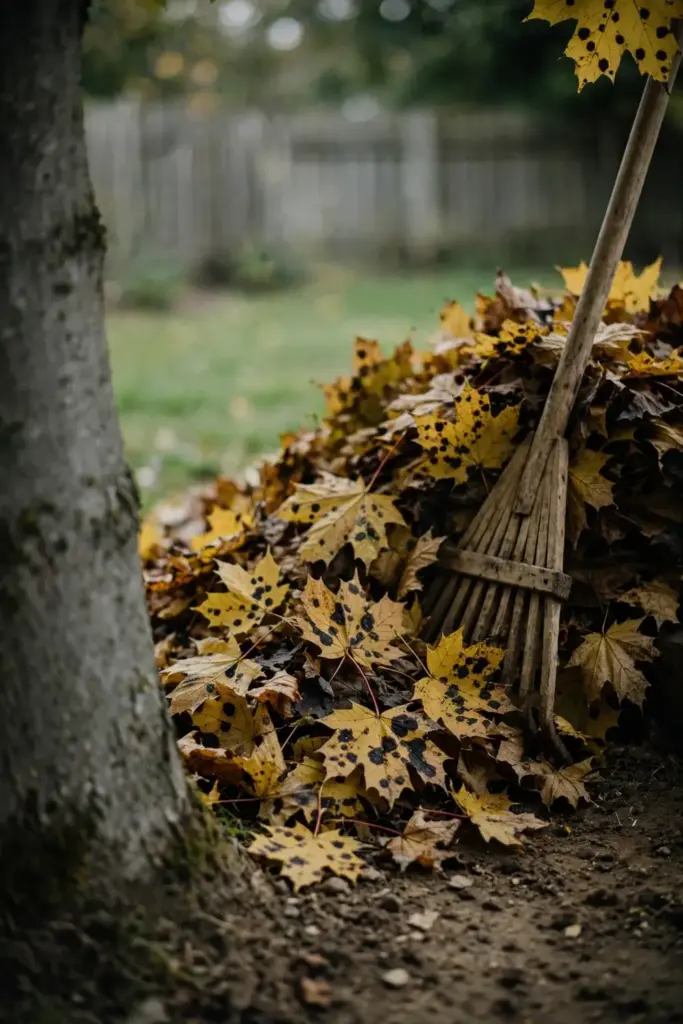
Clemson Extension gives the cultural control in one line. Rake up and discard fallen leaves in the fall, as the fungus survives in fallen leaves. The Wisconsin clinic gives the same instruction with the same reason. Collect leaves from affected trees each fall and dispose of them properly. Fall cleanup is the single most effective action a home gardener has against tar spot on maple.
Work the whole drip zone, not just the lawn. Rake leaves out of shrub beds, fence corners, and mulch rings under the tree. Leaves caught in groundcover still hold fungus. Leaves drifted against the house still hold fungus. A leaf blower moves leaves fast, and a rake finishes the corners a blower misses. Either tool works. The removal matters, not the tool.
Time the job to leaf fall, not to the calendar. Maples drop leaves over weeks, and a single early raking leaves the late drop behind. Rake twice in a heavy year, once at peak drop and once after the last leaves fall. The second pass catches the late leaves that carry the most fungus, since late leaves include the most heavily spotted ones. A clean floor under the tree in late fall is the goal.
Step 3: Burn, Bury, or Hot Compost the Leaves
Disposal decides whether cleanup works. Bagged leaves left beside the tree still release spores.
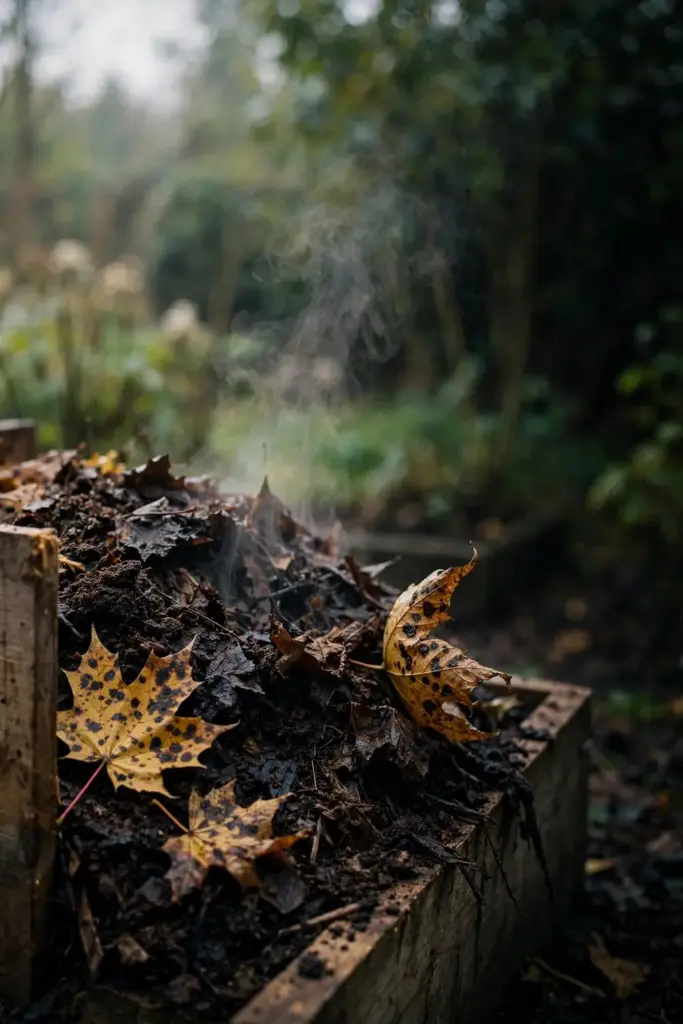
The Wisconsin clinic lists three disposal routes that kill the fungus. Burn the leaves where burning is allowed. Bury the leaves. Hot compost the leaves. Each route works because each route destroys the stromata or buries them where spores cannot reach new leaves. Municipal yard-waste pickup counts as disposal, since the leaves leave the site. Curbside bags stacked under the tree do not count until the truck takes them.
Hot composting has one firm number. The compost pile must reach 140 degrees Fahrenheit. The Wisconsin clinic adds that the pile needs routine turning, so leaves on the outside of the pile eventually end up in the center. Heat plus decay kills the fungus. A cold pile that never heats up keeps the fungus alive and returns it to the garden with the finished compost. A pile that heats but never turns keeps cool pockets on the outside where the fungus survives.
Cold composting and leaf mold piles fail this test. A leaf mold pile built for slow decay stays cool, and the stromata in it survive to release spores next spring. Keep spotted maple leaves out of a cold pile. Send spotted leaves to the hot pile, the burn pile, or the municipal truck. The guide to fall garden bed prep covers the autumn cleanup routine that keeps spotted leaves out of the wrong pile.
Step 4: Clear Leftover Litter Before Bud Break
Check under the tree again in early spring. Clear any leftover litter before leaves expand.
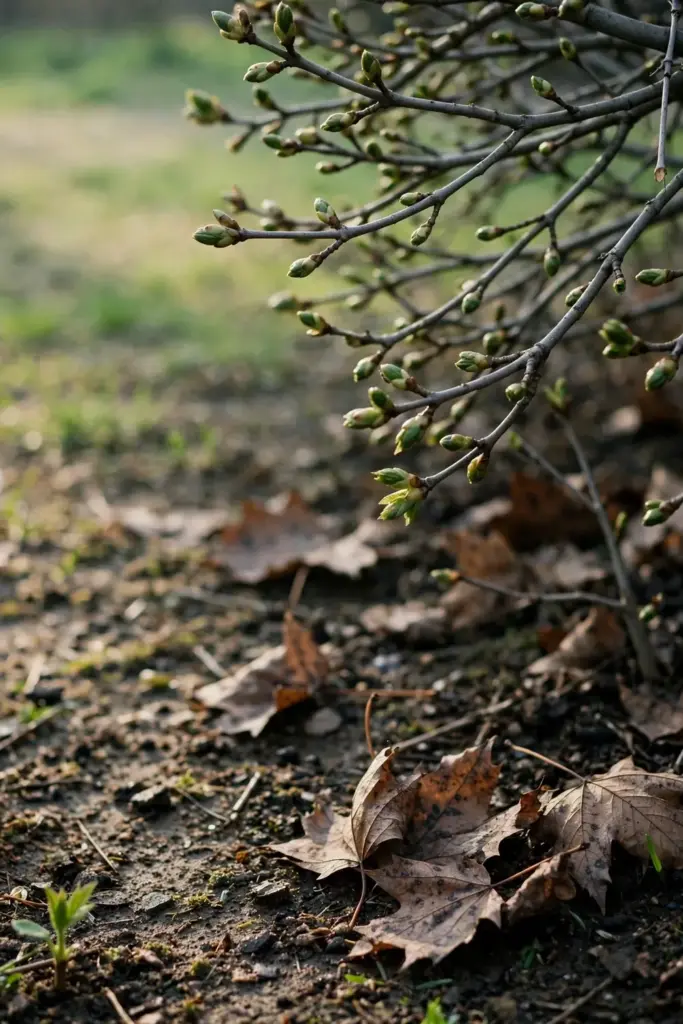
Wind moves leaves all winter. A clean floor in November can hold a fresh drift by March. Spores release in spring as new leaves unfold, so a spring pass catches the drift that winter moved in. Rake the drip zone once more before bud break. Pick up leaves caught in shrubs and groundcover. The spring pass costs less time than the fall pass and closes the gap winter opened.
Watch bud break as the deadline. The Wisconsin clinic times any fungicide program to bud break, half-expanded leaves, and fully expanded leaves, which shows how tight the spring window runs. Cleanup works on the same clock. Leaves on the ground at bud break feed spores onto new leaves. Leaves off the ground at bud break starve the cycle. A spring pass a week before bud break beats a spring pass a week after.
Mow low once after raking if the lawn allows it. A short cut after raking lifts the last shredded leaf bits and exposes the soil to air. Do not mow spotted leaves into the lawn as a substitute for raking. Mowing shreds leaves and spreads fungus across the lawn without removing it. Rake first, then mow.
Step 5: Keep the Tree Vigorous So It Carries Spots Better
A vigorous maple carries tar spot better than a stressed maple. Water and feed for vigor, and the tree answers with a fuller canopy.
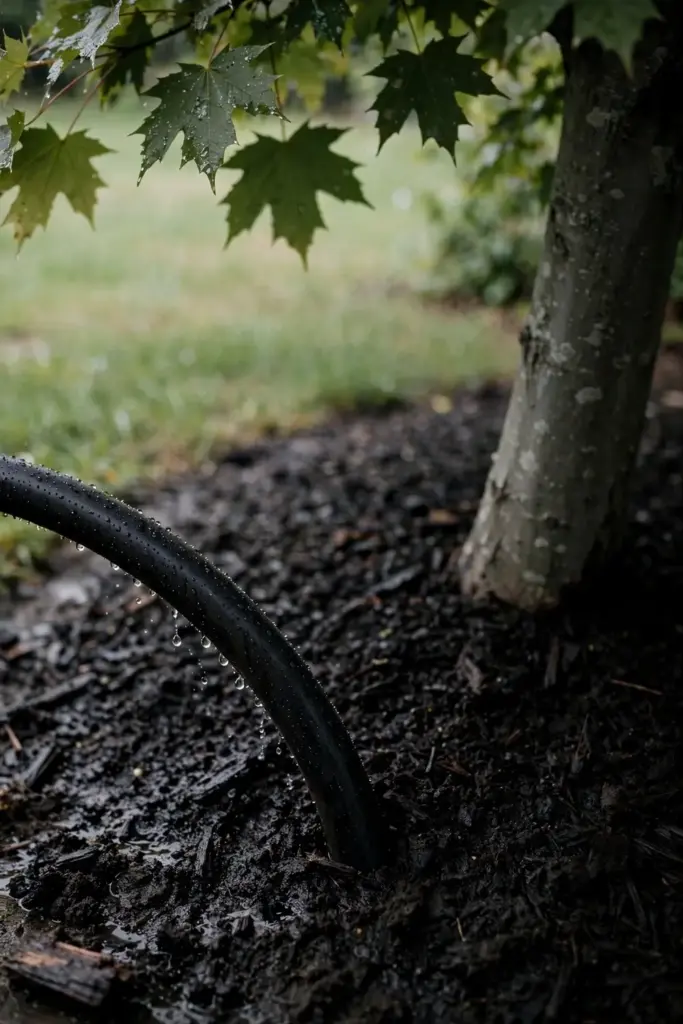
Clemson Extension lists fertilizing and watering to maintain tree vigor among the cultural controls for maple leaf diseases. A tree with steady water through dry spells holds its leaves longer, and held leaves hide spots longer. A tree that goes thirsty through summer drops spotted leaves early and looks worse sooner. Water in dry spells. A deep soak at the drip line beats a daily sprinkle at the trunk, every time.
Feed only on evidence. A tree with pale leaves and short shoots may need feeding. A tree that already grows well needs none. Extra nitrogen pushes soft growth that wounds easily and feeds other problems. The notes on building soil health cover the soil basics that grow vigor without forcing soft growth. A soil test settles the question when the tree looks hungry and the gardener is unsure.
Vigor never replaces cleanup. Vigor hides the disease and buys the tree time. Cleanup cuts the fungus. A vigorous tree with unraked litter still gets spots next year. A stressed tree with raked litter gets fewer spots. Do both, and the tree looks better while the fungus load falls.
Step 6: Leave Fungicide Alone Except in the Rare Exception
Skip fungicide for tar spot on maple in almost every home garden. The spray rarely earns its cost.
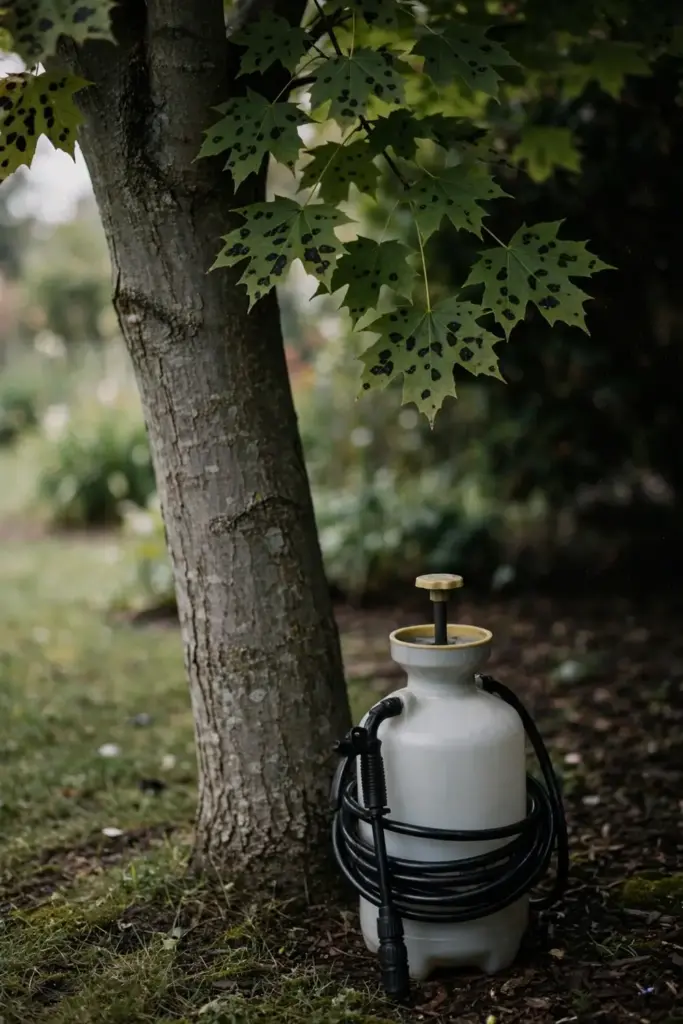
The Wisconsin clinic states the position clearly. Fungicide treatments for this disease are rarely, if ever, warranted. Copper fungicides, alone or combined with mancozeb, carry a label for tar spot control in Wisconsin. A label means the product may be sold for the disease. A label does not mean the home gardener needs it. The clinic advises checking with a county Extension agent before treating, to find out whether the tree warrants preventive treatment at all.
Clemson Extension lists the schedule for gardeners who do spray. Spray three times at two-week intervals in spring, beginning at leaf unfurling, with a copper-based fungicide, mancozeb, or triadimefon. The Wisconsin clinic times the same three applications to bud break, half-expanded leaves, and fully expanded leaves. Three sprays across a whole canopy take equipment a home gardener rarely owns. A tall maple needs a professional applicator. A small tree needs three trips with a sprayer across three weeks. Miss one timing and the program weakens.
Read the label and follow it when a spray truly fits. Never spray a canopy that cannot be reached safely from the ground. Never spray in wind that carries the product off target. Never spray a tree near a vegetable bed without checking the label for that use. A rare exception stays rare. One sprayed year does not remove the need for fall cleanup, since cleanup carries the control in every other year.
Step 7: Confirm the ID Before Acting on Spots
Check the lookalikes before acting on any black spot. A wrong ID sends effort to the wrong disease.

Run the rub test first. A raised black patch that will not rub off points at tar spot on maple. A flat spot with a purple border points at Phyllosticta leaf spot. Irregular brown dead areas with dead twig tips point at anthracnose. Raised bumps that keep leaf color point at galls. Each ID leads to a different next move, and the table above holds the full comparison.
Send a sample when the signs stay unclear. A county Extension diagnostic clinic identifies leaf samples for a small fee or free, depending on the state. A fresh sample with several spotted leaves in a sealed bag beats a phone photo for a firm ID. A firm ID beats a guessed spray. The gardener who sprays anthracnose medicine on tar spot wastes the spray. The gardener who sprays tar spot medicine on anthracnose wastes the season.
Watch for a second disease on the same tree. Tar spot on maple does not protect a tree from anthracnose, Phyllosticta leaf spot, or any other leaf problem. A maple can carry tar spot and anthracnose in the same season. Treat the tree for the disease the table identifies, not for the first spot noticed. A tree with two diseases needs two notes in the garden record, and the record in Step 8 holds them.
Step 8: Scout Again Next Spring and Keep a One-Line Record
Scout the tree again next spring. A short record turns one year of spots into a pattern.
Check new leaves as they expand. Look for the first pale yellow spots in mid-June. Note the date, the share of spotted leaves, and whether the spots sit on one branch or across the canopy. A one-line record per year reads like this in plain words. Spots appeared mid-June, light on the lower branches, heavy on the north side. That line tells next year gardener more than a memory does.
Compare years. A falling share of spotted leaves after two years of cleanup means the cleanup works. A steady share means spores still arrive from nearby unraked trees, and the cleanup still helps, since the load would run higher without it. A rising share after a skipped cleanup points straight at the skipped cleanup. The record makes the cause visible.
Keep scouting through summer. A tree that drops leaves early in a heavy year still leafs out normally next spring. A tree that shows dead twig tips, cankers, or branch dieback has a second problem, and that problem needs its own diagnosis. Tar spot on maple explains spots. Tar spot on maple never explains dead wood. Dead wood means a new search, not a new spray for tar spot.
Living With Tar Spot Damage You Cannot Undo
Spotted leaves stay spotted. No spray, feed, or wash removes spots from a leaf that already carries them.
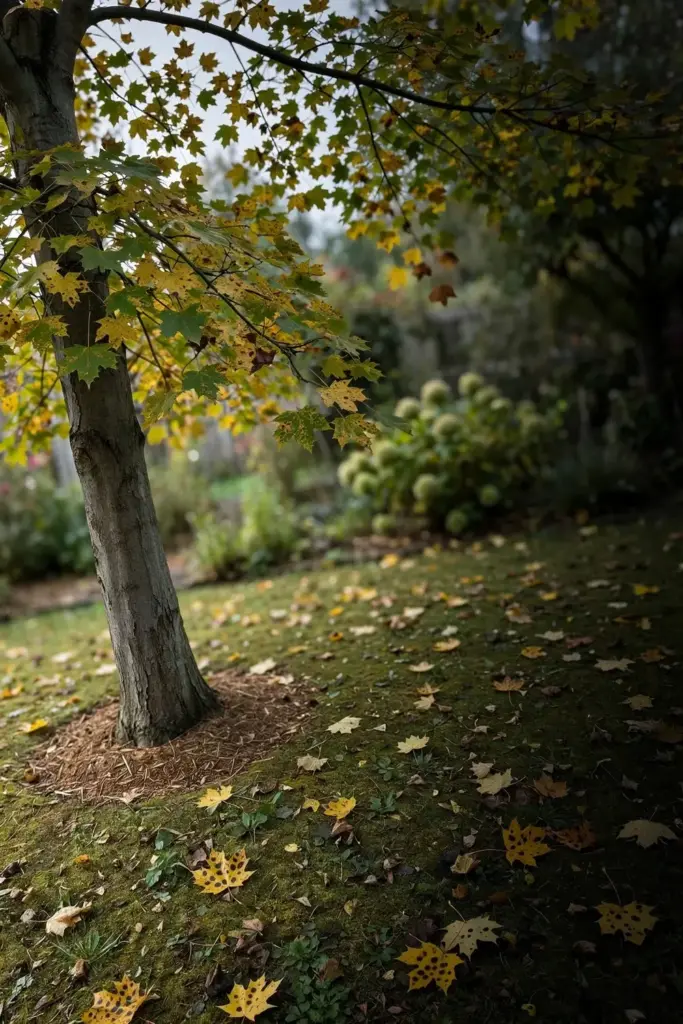
The fungus colonizes the leaf and builds the stroma inside leaf tissue. The black patch is part of the leaf now. Picking spotted leaves off the tree in summer does not cure the tree. Stripping leaves costs the tree food-making surface and weakens the tree for no gain. Leave the spotted leaves on the tree. Let them fall on their own schedule. Rake them when they fall, once the last leaves drop and the floor under the tree sits bare.
Early leaf drop looks worse than it is. A heavy year can drop leaves weeks before normal fall color. The lawn fills with spotted leaves. The tree looks bare while neighbors still hold green canopies. The buds for next spring already sit on the twigs, set before the spots arrived, so next spring brings a normal flush of clean leaves.
Fall color still shows through the spots. Yellow and red pigments develop around the black patches, and a spotted maple can still color well in a mild year. A heavy year dulls the show. The show returns when the cleanup cuts the load. One season of clean floor under the tree rarely erases spots fully. Two seasons of clean floor cut them visibly. Patience is the real treatment for a disease that runs on last year leaves.
Frequently Asked Questions
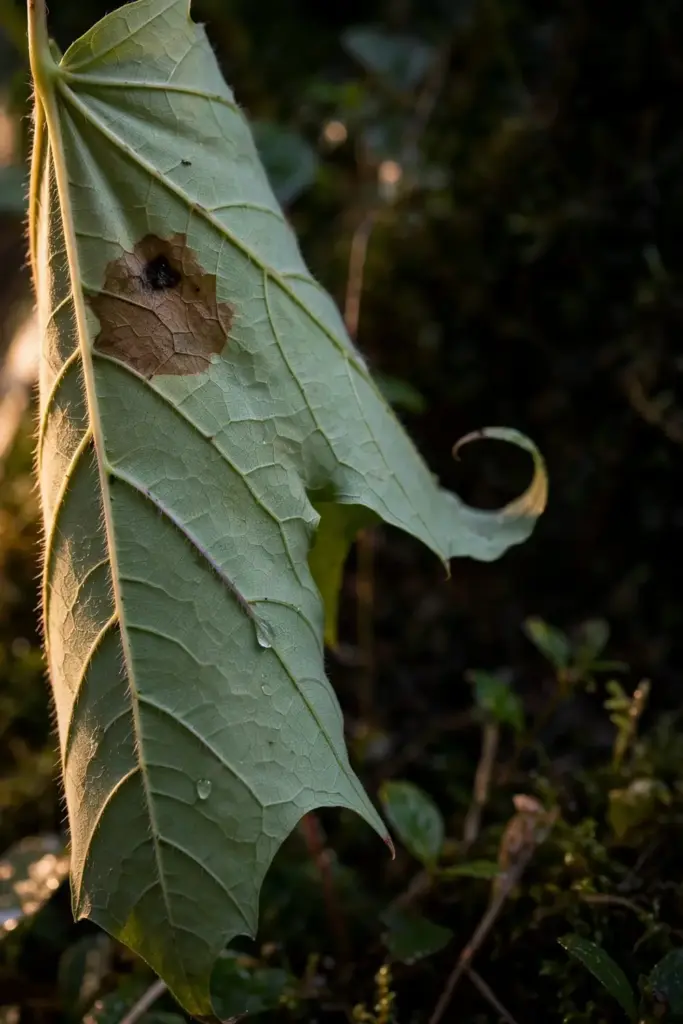
Tar spot on maple almost never kills a tree. The disease stays on leaves and costs the tree some food-making surface for one season. The tree leafs out normally the next spring. Heavy infections can cause early leaf drop, and the early drop looks serious. The Wisconsin clinic states that tar spot does not kill trees and does not typically cause serious defoliation. Keep up fall cleanup and let the tree recover on its own schedule.
Tar spot on maple cannot spread to corn, and corn tar spot cannot spread to maple. The two diseases share a common name and use different fungi. Maple tar spot comes from Rhytisma species. Corn tar spot comes from Phyllachora maydis. FarmProgress answers the question directly: corn tar spot cannot become maple tar spot. Treat each disease on its own host. Never run a corn fungicide program on a backyard maple.
Skip fungicide in almost every home garden. The Wisconsin clinic states that fungicide treatments for tar spot are rarely, if ever, warranted. Spraying a mature maple needs full canopy coverage across three applications, and a home sprayer rarely reaches every leaf. Clemson Extension lists a three-spray schedule for gardeners who do spray, starting at leaf unfurling. Raking fallen leaves in fall does more than any spray for a home maple.
Compost spotted maple leaves only in a hot pile. The pile must reach 140 degrees Fahrenheit, and routine turning must move outside leaves into the center. Heat plus decay kills the fungus. A cold pile or a slow leaf mold pile keeps the fungus alive and returns it to the garden with the finished compost. Send spotted leaves to the hot pile, the burn pile, or municipal yard-waste pickup. Never add them to a cold pile.
Tar spot came back because spores still arrived from somewhere. Wind carries spores from nearby unraked trees, and one missed drift under the tree holds enough fungus to reseed it. A single year of cleanup cuts the load without erasing it. Two or three years of steady fall and spring cleanup cut the load further. A skipped year after a heavy year restores the load fast. Steady cleanup across years is the fix, not one perfect raking.
Young maples need the same care with closer watching, and the gardener watches a small canopy more closely than a big one. A small tree loses a larger share of its food-making surface to the same share of spotted leaves. Water a young tree through dry spells. Rake under a young tree as carefully as under a big tree. Skip fungicide on a young tree too. Cleanup, water, and patience carry a young maple through tar spot.
Where to Go From Here
Walk out with a rake this fall. Clean the floor under the maple before winter closes the window.
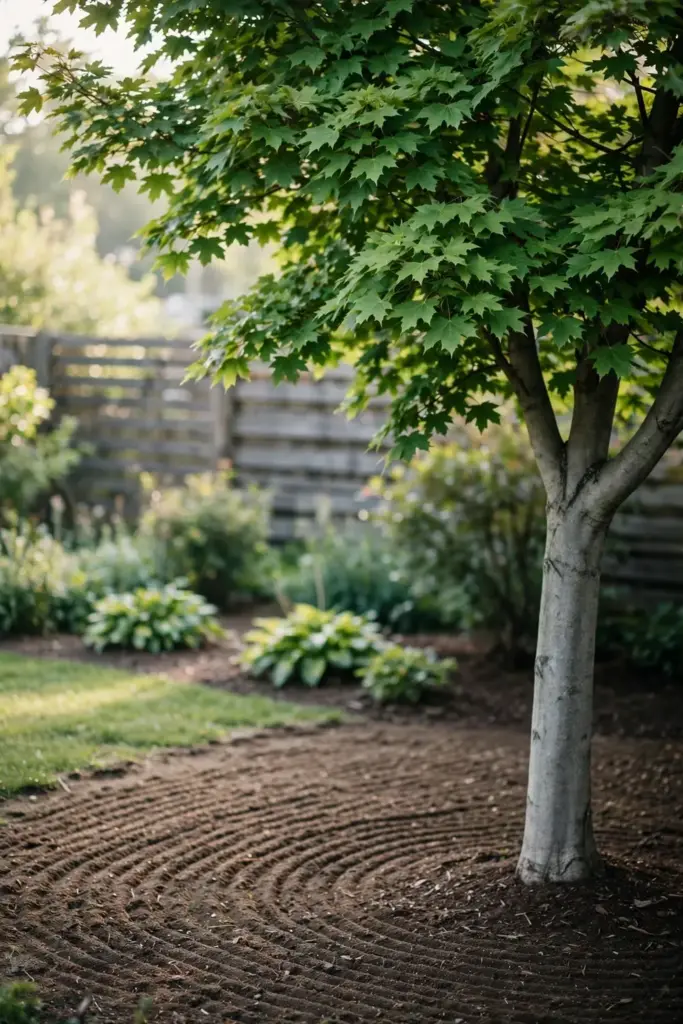
Identify first, then sort the lookalikes, then clean up. Rake fallen leaves in fall, dispose of them by burning, burying, or hot composting, and clear the leftover drift before bud break. Skip the spray. Scout next spring and write the one-line record.
The tree that carries fewer spots next year is the tree with fewer spotted leaves under it this fall. One clean floor under the maple does more than any bottle. Start with the rake, and let next spring leaves show the result.