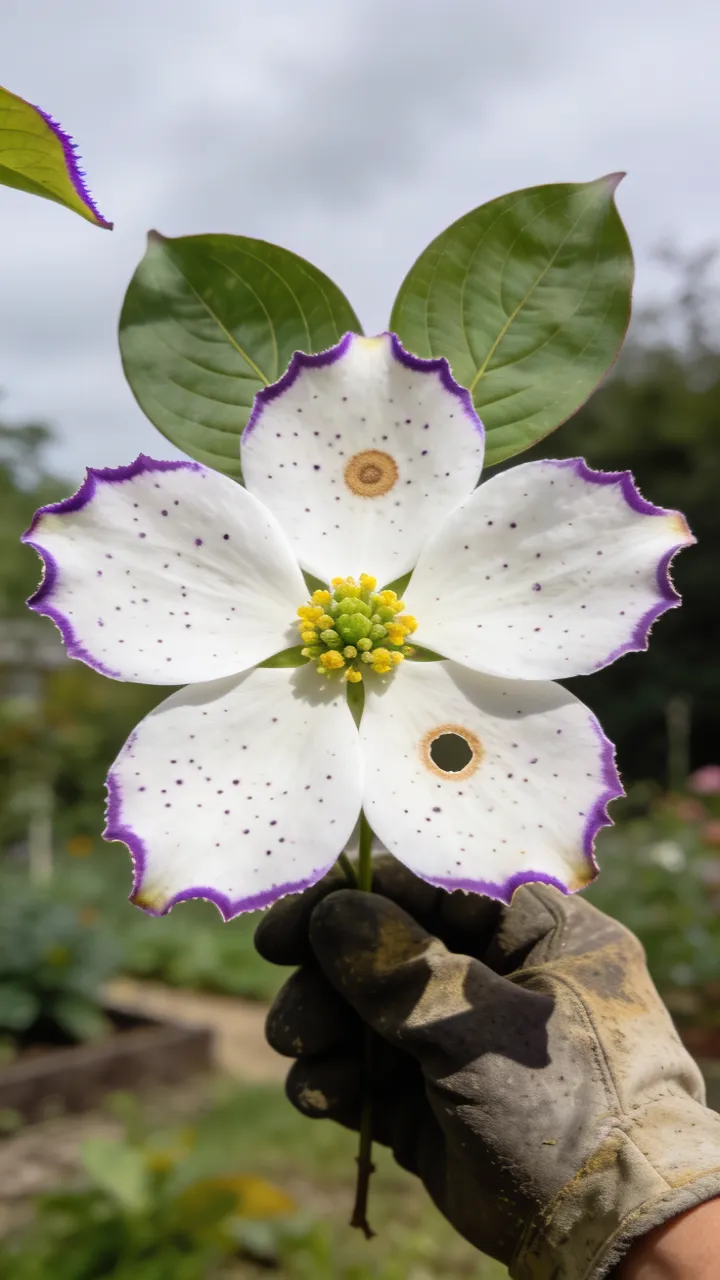

Spot anthracnose on dogwood looks like a disaster in May. Hundreds of tiny purple-rimmed spots freckle every bract and leaf, and the white bracts turn tan and ragged. The 9 strategies below start with the one move that saves the most money: doing nothing, because spot anthracnose is cosmetic on most trees.
I have learned that the ugliest spring is usually the safest one to leave alone, since the spots fade from memory long before they hurt the tree. The fungus behind the spots is Elsinoe corni. Spot anthracnose attacks the bracts first, then the leaves, then the young fruit, and it stops there. It does not kill branches. It does not girdle trunks. It does not shorten the life of the tree.
The rest of this page runs the order a gardener should follow. Identify the spots by plant part, then run the differential check against the killer disease, then work the 9 steps from raking leaves to next-spring scouting.
What Spot Anthracnose Actually Is
Spot anthracnose is a fungal leaf and bract disease of dogwood. Elsinoe corni causes spot anthracnose. The disease is cosmetic. Spot anthracnose does not kill branches or trees.
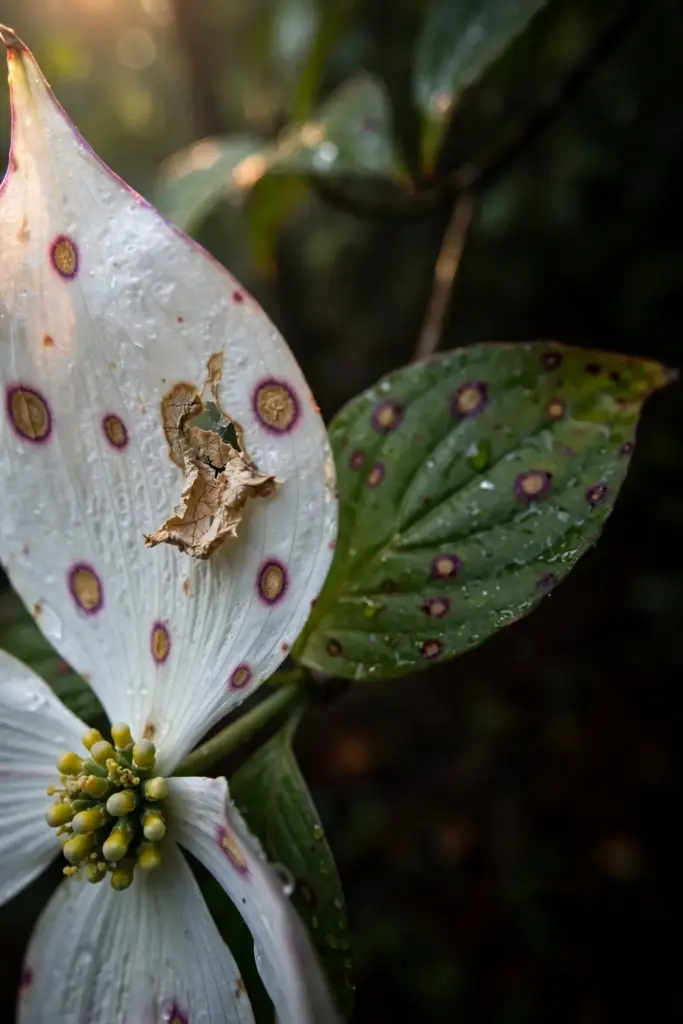
The Arkansas Extension fact sheet on anthracnose diseases of dogwood describes small 1 to 2 mm rounded purple-bordered spots on the bracts, leaves, and fruit, with the bracts infected first, and calls spot anthracnose a cosmetic disease with no adverse impact on the overall health of the tree. Arkansas Extension states the key warning in plain terms. Spot anthracnose and dogwood anthracnose are two distinct infectious plant diseases that should not be confused with each other.
The fungus overwinters in buds and stem lesions. Dormant mycelia wait out winter in leaf buds, flower buds, and small stem spots. Spring rain wakes the fungus. Spores splash onto the bracts and young leaves as the tree blooms. The infection window is short. Once the bracts fall and the leaves harden, the season is mostly decided.
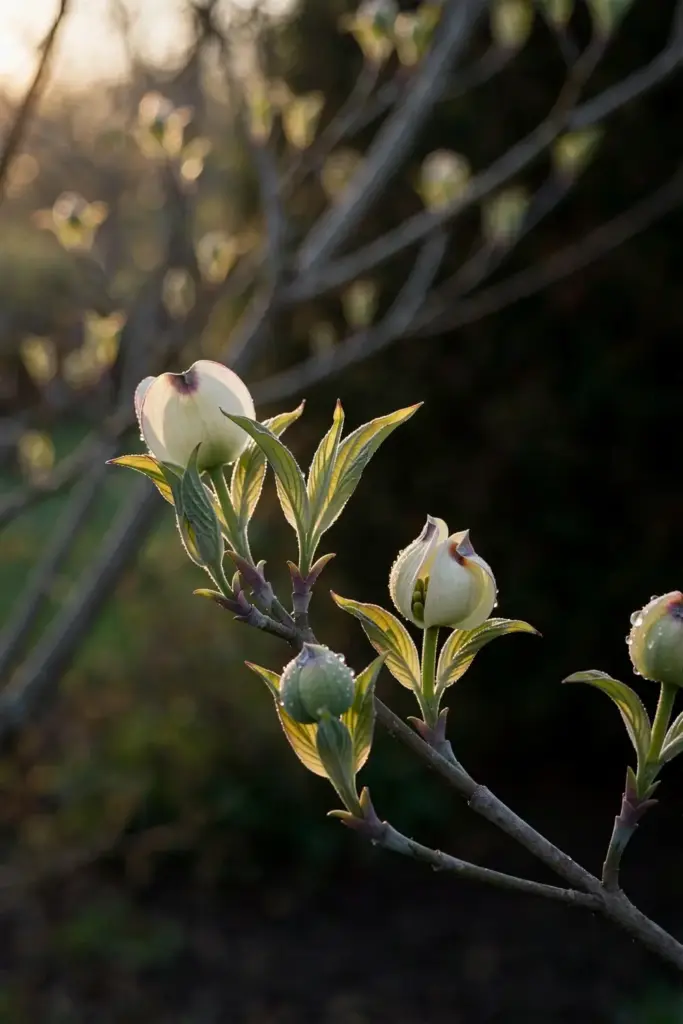
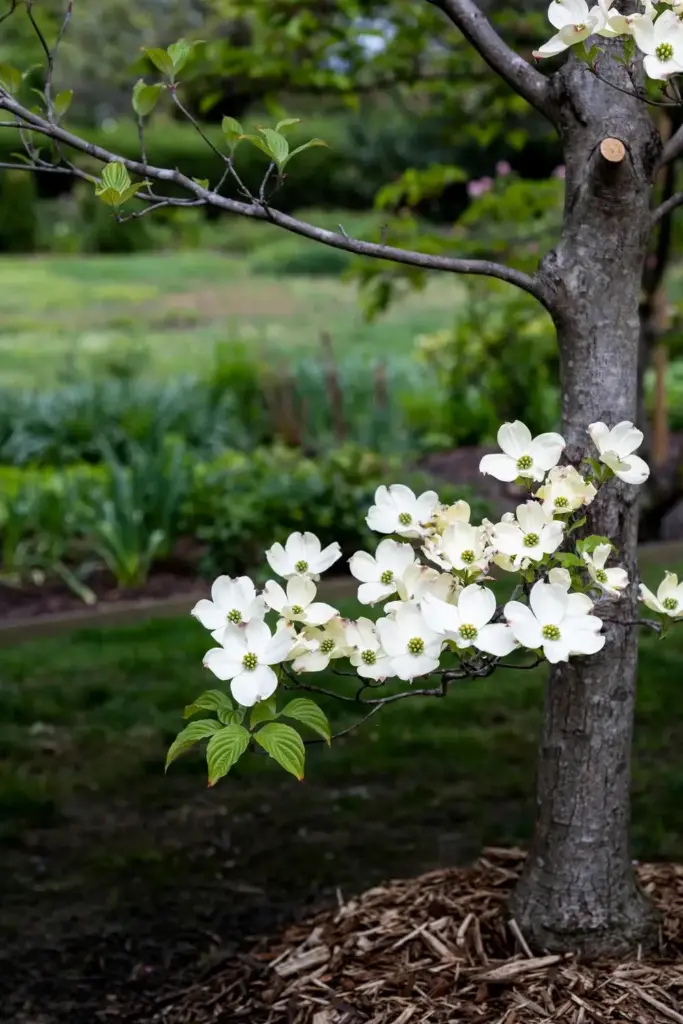
The showy white or pink parts of a dogwood bloom are not petals. They are bracts, modified leaves that surround the true flowers. The true flowers sit in a tight cluster at the center, small and yellow-green. Spot anthracnose hits the bracts first because the bracts open first and catch the spring rain. That order matters for identification. A tree with spotted bracts and clean leaves is still early in the same infection.
This page covers dogwood only. Rose black spot comes from a different fungus, Diplocarpon rosae. Grape anthracnose comes from Elsinoe ampelina, the same genus and a different species on a different host. Shade-tree anthracnose on maple, ash, and sycamore comes from Discula species. Each of those diseases gets its own page. None of them changes what to do about spots on a dogwood.
How to Identify Spot Anthracnose on Bracts and Flowers
Check the bracts first. Bracts carry the earliest and clearest signs of spot anthracnose.
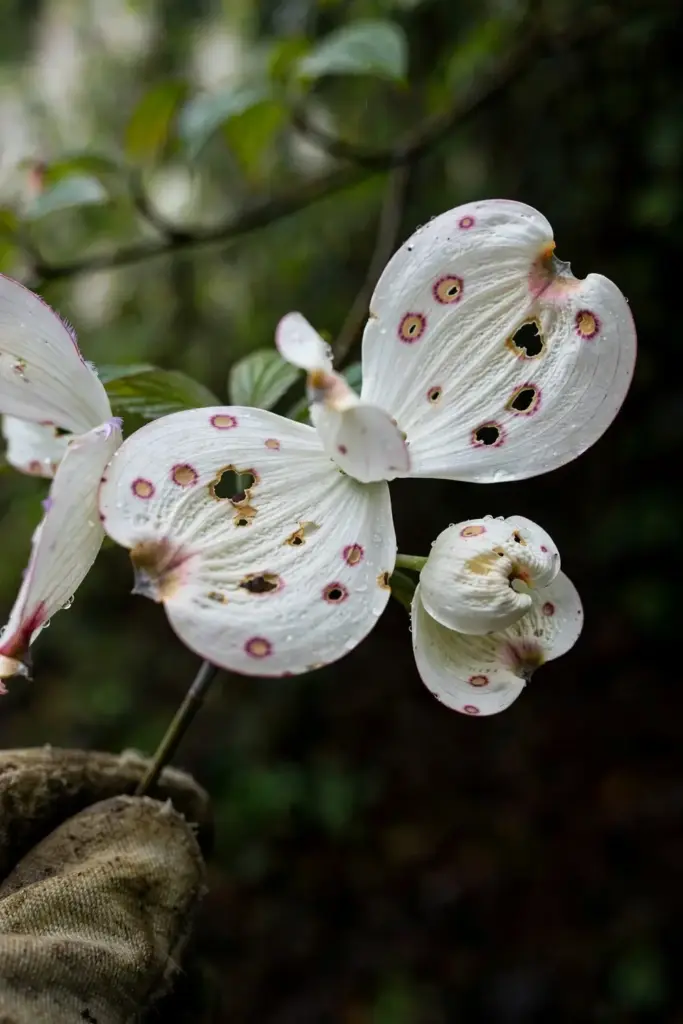
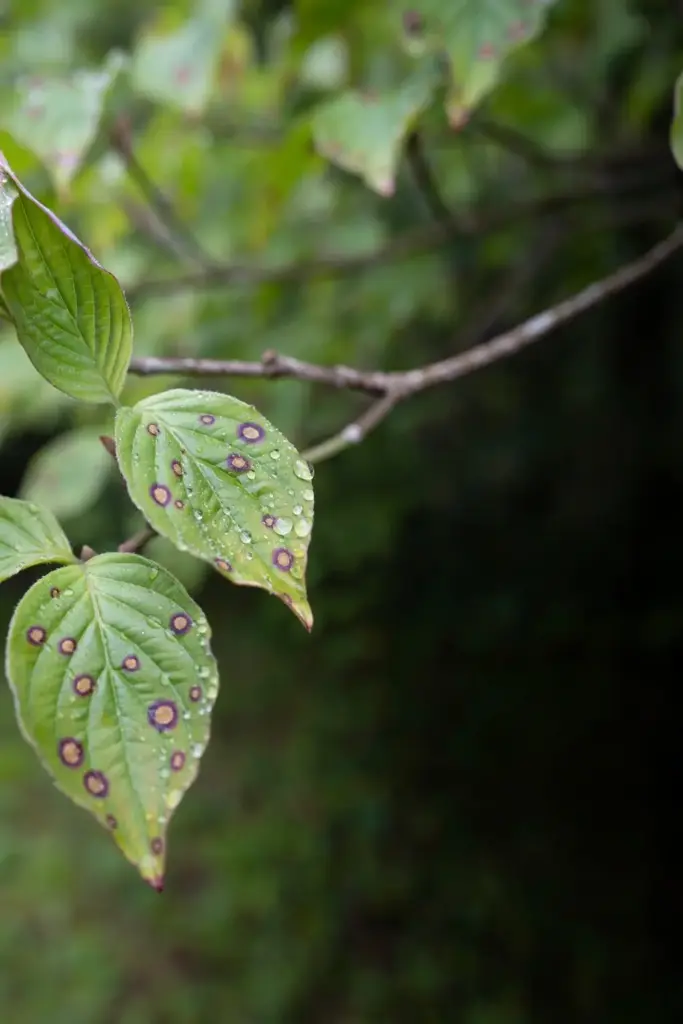
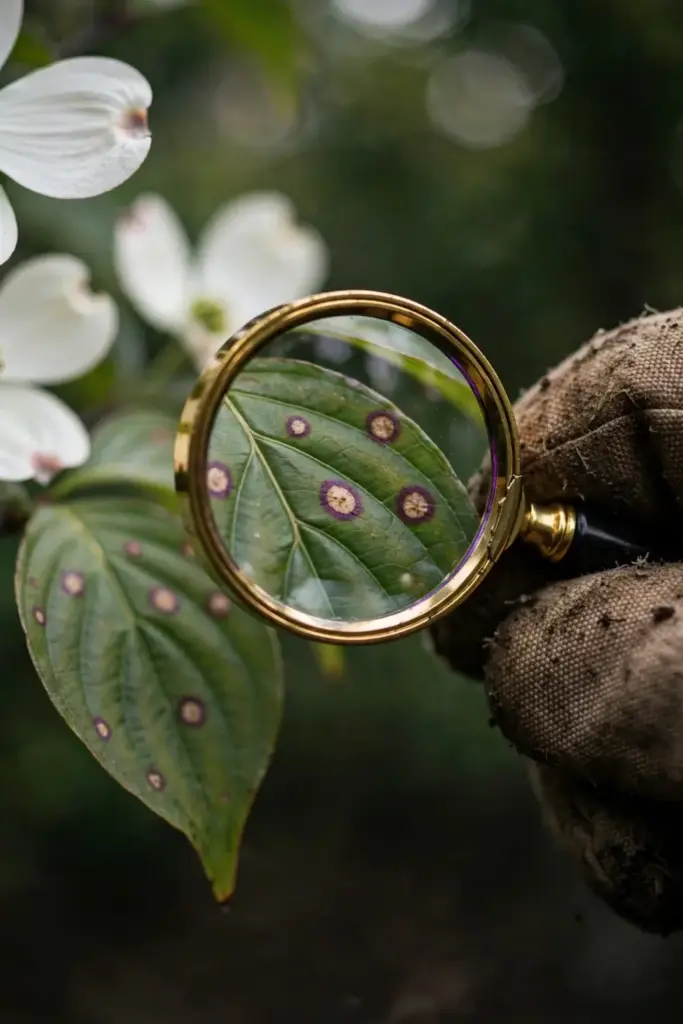
Look for small round spots with purple borders and tan centers on the white or pink bracts. The spots start at 1 to 2 mm across. A single bract can carry dozens of them. Arkansas Extension notes that the centers of the spots on bracts turn light-colored and then drop out, leaving a shothole look. A bract full of holes still hangs on the tree. It looks torn. It is not torn by insects.
Heavy infections distort the bracts, which turn puckered, smaller, or aborted, and buds under heavy attack may fail to open at all. Gardeners describe the worst cases as beige blooms. That brownish cast over a display that should read white or pink is the spots merging as the tan centers dry. The tree still sets leaves. The display is the casualty.
Timing separates spot anthracnose from most other dogwood trouble. Symptoms appear at bloom in spring, when the bracts open and the rain starts. Spots that show up for the first time in midsummer on a tree that bloomed clean point elsewhere. Note the date when the spots first appear. That date anchors every later decision, from whether to spray to whether the diagnosis still fits.
A hand lens settles borderline cases. Hold a lens over a fresh spot and look for the purple rim and the pale center. The rim stays sharp and round. The center looks papery before it falls out. Blotches with ragged edges, scorched margins, or a spreading tan wash belong to the differential section below. Keep the lens in a pocket at bloom time. It is the cheapest diagnostic tool a dogwood owner can carry.
How to Identify Spot Anthracnose on Leaves, Fruit, and Stems
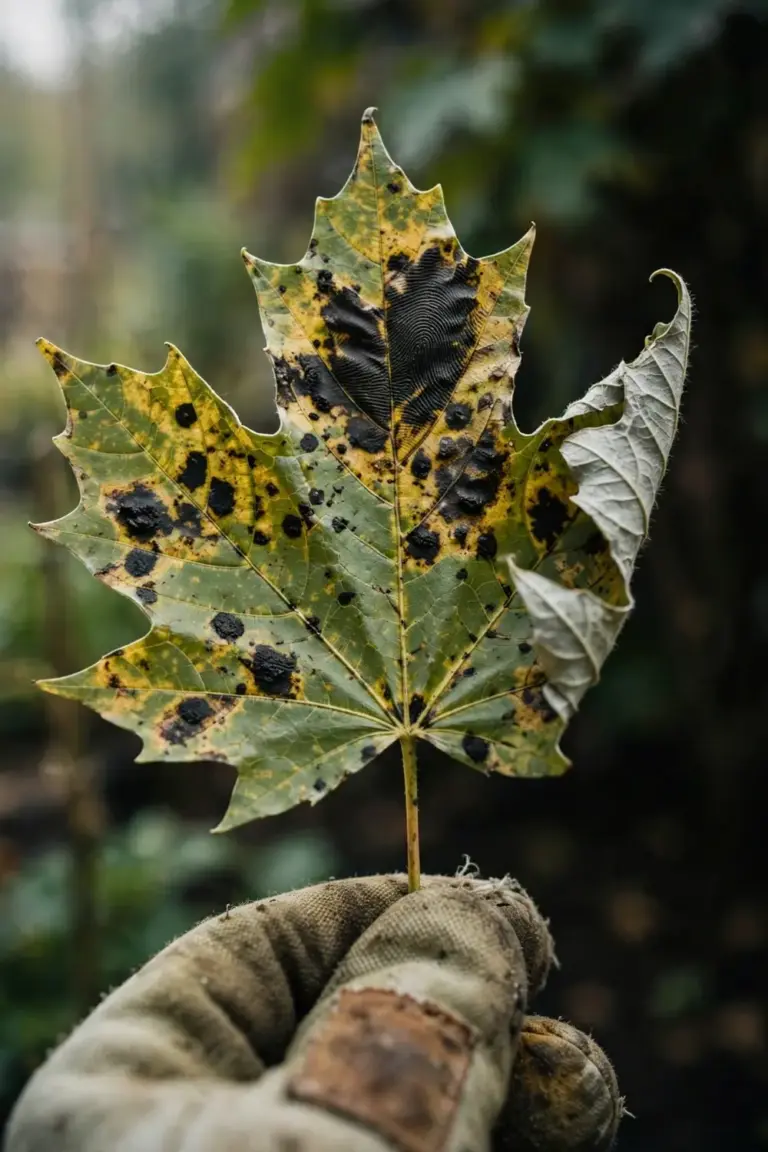
Leaves show the same spots as the bracts. Leaf spots start small and round, with purple borders and tan centers. The centers die and fall out. The leaf turns ragged.
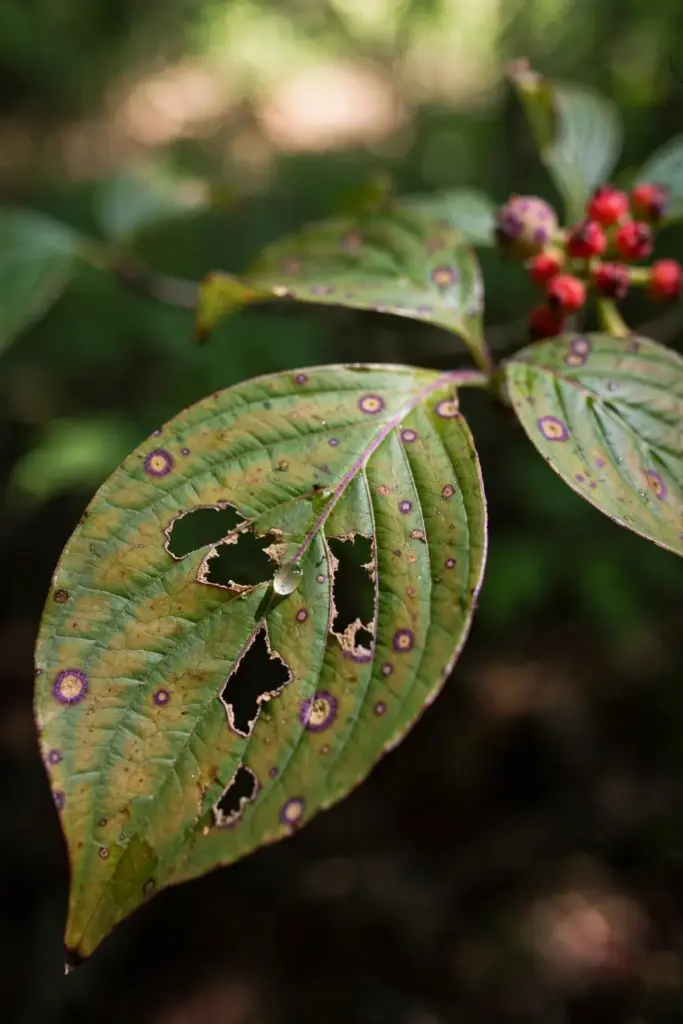
Leaves under heavy attack distort as they expand. Healthy tissue grows around the dead spots, and the leaf puckers or twists. Arkansas Extension notes that spots cluster in leaf crevices where water collects. The crease along the midrib holds water longest after rain, and the spots follow the water. Check the crevices first when scouting a tree with light symptoms.
Fruit spots matter little. Young dogwood fruit can carry the same small spots. The fruit is ornamental on a flowering dogwood, and the spots do not change the health of the tree. Leave the fruit alone. Birds eat the red drupes in fall, and spotted fruit feeds them the same way clean fruit does.
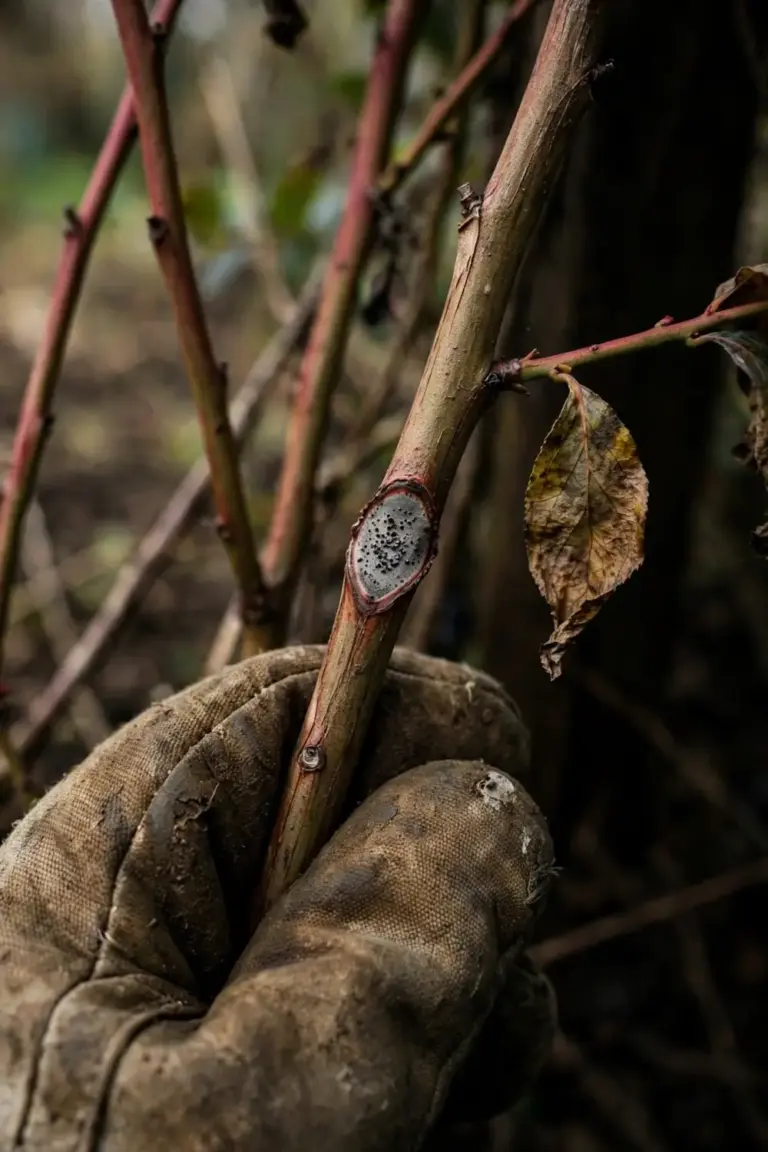
Stem spots are small and rarely seen. Purdue Plant Doctor notes that stem spots stay small and rarely draw attention. A stem spot does not girdle the stem. A stem spot does not kill the twig beyond it. If a twig dies back from a stem lesion, the cause is something else, and the differential section below carries that call.
One pattern rules out spot anthracnose on leaves. Spot anthracnose rarely causes whole leaves to turn brown, defoliation, or branch dieback. Purdue Plant Doctor states that pattern directly. If whole leaves brown, if the tree drops leaves in summer, or if branches die back, stop calling it spot anthracnose. The tree has a different problem, and the next section names the candidates.
Which Dogwoods Get Hit Hardest
Flowering dogwood takes spot anthracnose hardest. Cornus florida carries the heaviest infections. Pacific dogwood and Kousa dogwood take lighter hits.
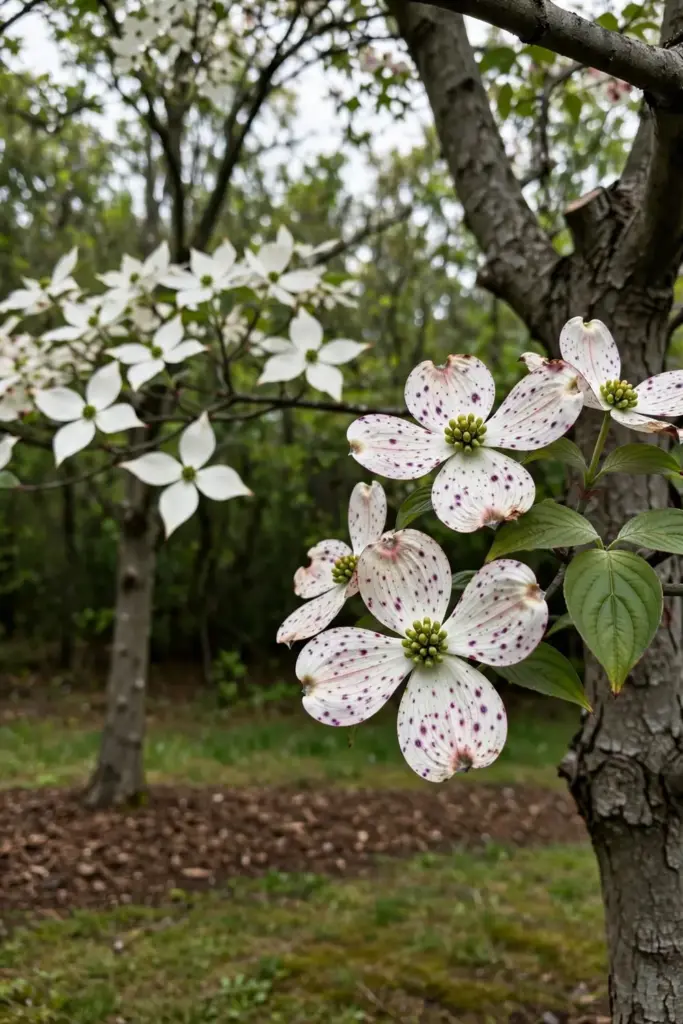
Cornus florida is the eastern flowering dogwood, the tree behind the classic spring display. Arkansas Extension lists flowering dogwood as the primary host, with Pacific dogwood, Cornus nuttallii, and Kousa dogwood, Cornus kousa, affected to a lesser extent. A yard with all three species in one wet spring shows the ranking in real time. The flowering dogwood freckles first and worst. The Kousa dogwood stays cleaner, longer.
White cultivars suffer worst. Ohio State Extension notes that white cultivars appear more susceptible than pink ones. A white-bracted cultivar in full sun in a wet April shows the heaviest spotting a gardener is likely to see. The same cultivar in a shaded spot with morning sun shows fewer spots. Color is not the whole story, and site still matters, but the white cultivars sit at the top of the risk list.
Young trees show damage more plainly than established trees. A young tree carries fewer leaves, so the same spot count covers more of the canopy. A young tree also has less stored energy to push past a bad spring. Established trees absorb a spotted spring and bloom again the next year. The triage in Step 1 weighs tree age for exactly this reason.
Stress lengthens the damage. A dogwood short of water in summer, or a dogwood planted in compacted soil, holds spotted leaves longer and pushes weaker growth behind them. Arkansas Extension notes that drought stress can predispose a tree to many problems. Spot anthracnose does not need drought to start. Drought does not cause it. A stressed tree recovers from it more slowly. Water and mulch do more for a stressed dogwood than any spray.
Spot Anthracnose vs Dogwood Anthracnose vs Septoria Leaf Spot
Check three things before naming the disease. Spot size, dieback, and cankers split the three diseases apart.
| Sign | Spot Anthracnose | Dogwood Anthracnose | Septoria Leaf Spot |
|---|---|---|---|
| Pathogen | Fungus. Elsinoe corni | Fungus. Discula destructiva | Fungus. Septoria species |
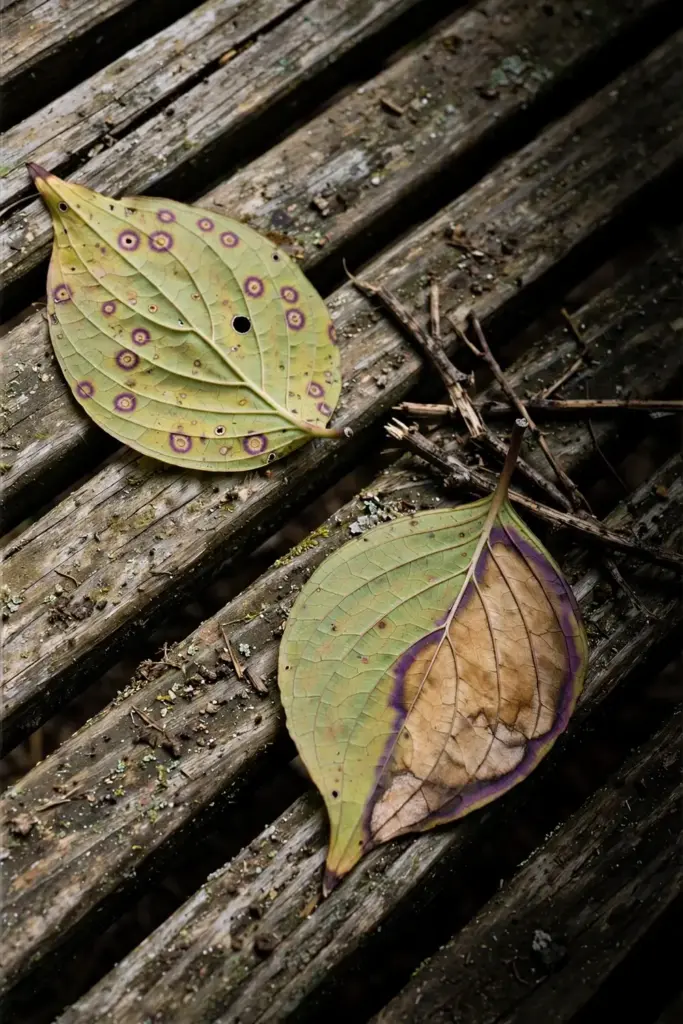
| Spot size and look | Small 1 to 2 mm round spots, purple borders, tan centers, centers drop out and leave shotholes | Medium to large blotches, scorched tan patches with purple borders, whole leaves can die | Leaf spots that resemble spot anthracnose, spreading later in the season |
| Dieback | None. No branch dieback | Lower-branch dieback, twig blight, trunk sprouts | Defoliation and branch dieback later in the season |
| Cankers | None | Limb and trunk cankers, dark brown discoloration under the bark | None typical |
| Timing | Spring, at bloom, bracts first | Whole growing season, starting in the lower crown | Later in the season, after spot anthracnose season |
| First move | Usually nothing. Rake and destroy fallen leaves | Prune dead wood. Protect new growth. Get an arborist for a large tree | Sanitation. Reassess the diagnosis |
The middle column is the killer. Dogwood anthracnose, caused by Discula destructiva, starts with tan spots with purple rims that enlarge into large leaf blotches. Infected petioles and branches die back, starting on the lower branches. Cankers with dark brown discoloration under the bark develop on limbs, and trunk sprouts increase. Arkansas Extension describes that progression in the same fact sheet that covers spot anthracnose. The University of New Hampshire Extension notes that a tree left unchecked, with conditions favoring spread, can die in 2 to 3 years. That timeline is the reason the differential matters.
The right column is the late-season lookalike. Purdue Plant Doctor warns that defoliation or branch dieback observed later in the season is likely Septoria leaf spot, which resembles spot anthracnose. A tree that blooms clean, spots lightly in spring, then drops leaves in summer fits Septoria, not Elsinoe. Septoria leaf spot gets its own page, and it stays a companion here, never merged into the spot anthracnose account.
The killer disease gets its own page. Dogwood anthracnose covers Discula destructiva, the fungus that kills branches and trees. Anthracnose as a group covers many fungi on many hosts, and the general anthracnose plant disease page carries that group overview. This page stays on Elsinoe corni on dogwood.
When the table leaves doubt, watch the tree for two weeks. Spot anthracnose holds steady. The spots stay small. Dogwood anthracnose advances. Blotches grow, twigs die back, and the lower crown thins. A tree that is getting worse week by week needs the Discula response, not the spot anthracnose response. A tree that looks the same week by week needs nothing.
Why Spring Rain Decides How Bad Spot Anthracnose Gets
Spring rain decides the severity of spot anthracnose. The fungus needs water to move, and spring supplies it.
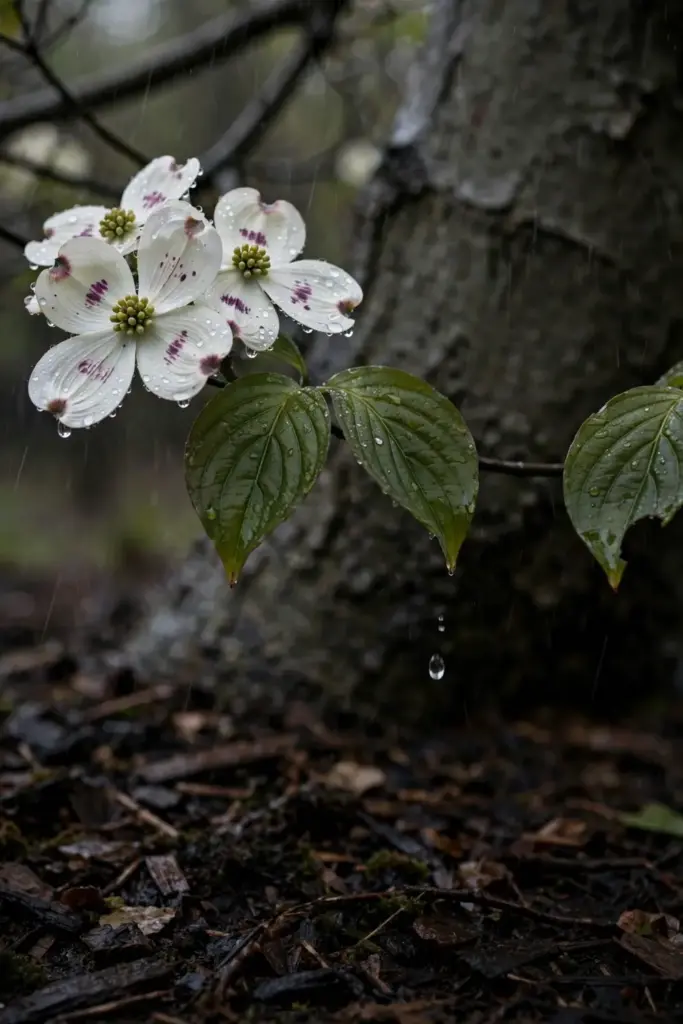
The Purdue Plant Doctor fact sheet on dogwood spot anthracnose states that the fungus overwinters as dormant mycelia in leaf and flower buds and stem spots, that spores are produced in the spring shortly after buds open, that spring rain showers splash the spores to bracts and young susceptible leaves and stems, and that small red-brown pinpoint spots grow to about 3 mm across before the center dies and the dead tissue cracks and falls out. That chain is the whole disease. No rain, no splash. No splash, no spots.
Splash is a short-range delivery system. Spores ride water droplets from bud to bract, from bract to leaf, from leaf to leaf. A hard rain at bloom moves more spores than a drizzle. A rain that falls after the bracts drop moves spores onto leaves that are already hardening. The worst springs are the ones with frequent rainfall and cool temperatures in April and May, the pattern Arkansas Extension names for heavy spot anthracnose years.
Severity varies year to year. Purdue Plant Doctor notes that dogwood spot anthracnose is likely to occur every year, with severity varying dramatically from year to year. A wet spring brings a freckled tree. A dry spring brings a clean one. The fungus does not vanish in the dry year. It waits in the buds. The next wet spring brings the spots back.
Temperature sets the pace. Cool spring weather suits the fungus. Warm dry weather after bloom shuts the window. A spring that turns warm and dry early in bloom can save a display that looked doomed at bud break. A spring that stays cool and wet through bloom can ruin a display that looked clean at bud break. The gardener controls none of this. The gardener controls the response, and the response is mostly patience.
That mechanism explains the central honesty of this disease. Fungicide sprayed after the spots appear cannot undo the infection. The spores already landed. The fungus already entered the tissue. The spots are the record of an infection that finished days earlier. Spraying the record changes nothing. The steps below work with that timing, not against it.
What Makes Spot Anthracnose Worse in a Home Garden
Wet springs top the list. Full sun comes next. Overhead water, a dense canopy, and fallen leaves left on the ground add to the load.
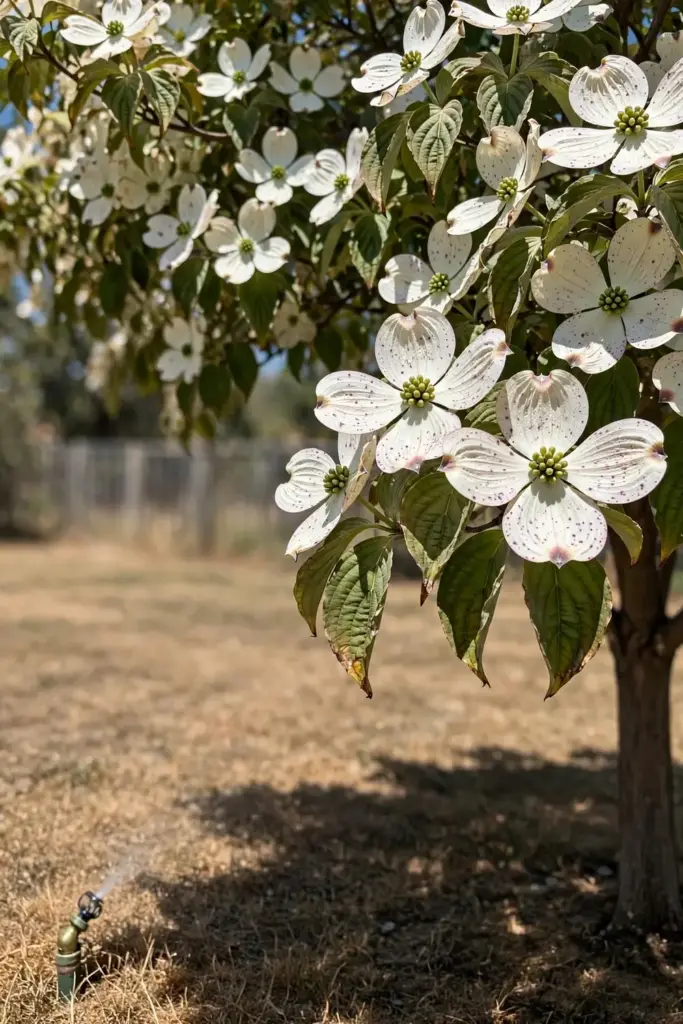
Full sun hits harder than shade for spot anthracnose. Ohio State Extension notes that spot anthracnose is worse in full sun than in shade. A dogwood in open sun takes the full force of spring rain on its bracts, and the bracts stay wet longer under direct exposure to wind-driven rain. A dogwood with afternoon shade dries more gently and shows fewer spots. The siting advice in Step 7 follows this pattern.
Overhead water repeats the rain problem on a schedule. A sprinkler that wets the canopy every evening gives the fungus a fresh splash every night. An irrigation head aimed at the bracts at bloom is a disease delivery system. Move the head. Water the root zone. The tree needs water at the roots, not on the leaves.
A dense canopy holds moisture on the foliage. Leaves that touch each other stay wet after rain. Air cannot move between them. The spots follow the wettest leaves, which are the inner leaves in a crowded crown. Pruning for airflow, covered in Step 4, is disease control with shears.
Fallen leaves hold the fungus through the season. Spotted leaves that drop in spring or fall carry the fungus to the ground. The fungus waits there. The next rain splashes it back up. A clean floor under the tree breaks that loop. Step 2 covers the raking routine.
Extra fertilizer does not cure spot anthracnose, because a garden column from ND Insider warns against trying to cure the disease with an extra dose of fertilizer. Nitrogen pushes soft growth that stays tender longer and stays open to infection longer. Feed a dogwood that needs feeding for vigor. Never feed to chase spots away.
Step 1: Decide Whether Treatment Is Worth It
Do nothing first. Treatment earns its place only on young trees and repeat severe cases.
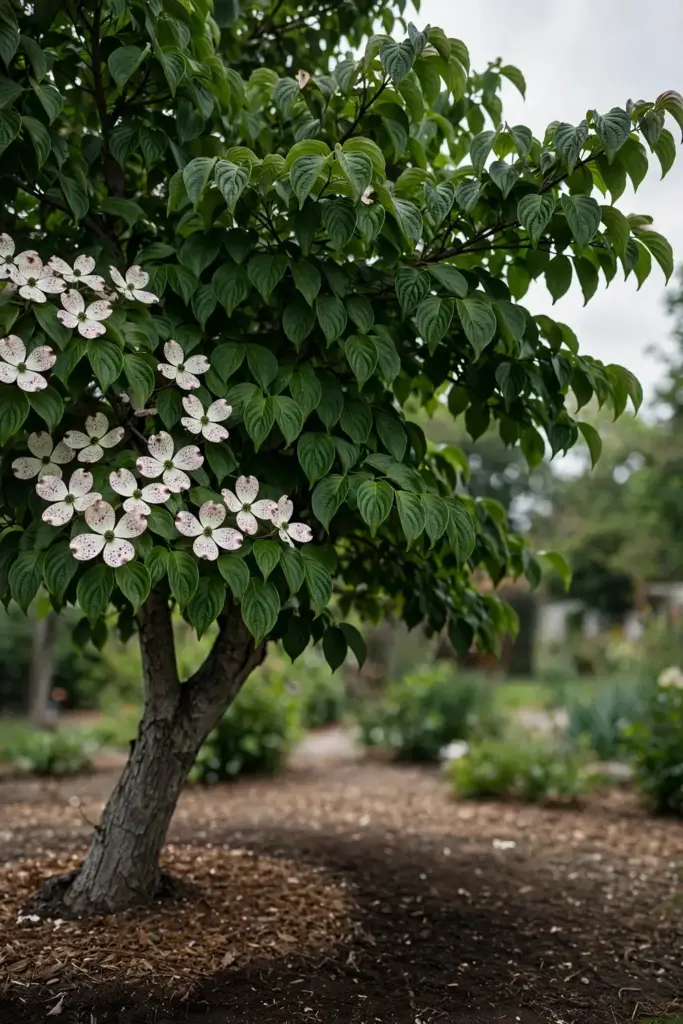
Start with the triage call, before any spray or cut. A mature dogwood with spotted bracts and healthy growth is a do-nothing case. The spots are cosmetic. The tree will bloom again next spring. The money stays in the pocket. Most infected trees fall in this group.
A young tree with a history of repeat severe infections is a treatment candidate. Purdue Plant Doctor notes that most infected trees do not require control unless there is a history of repeat severe infections or defoliation from Elsinoe corni. A young tree that defoliates two springs in a row has crossed that line. A young tree with spots alone has not.
Dieback changes the diagnosis, not the dose. A tree with branch dieback, twig blight, or cankers is not a spot anthracnose case. It is a dogwood anthracnose case, or a Septoria case, and the response belongs to those diseases. Spraying Elsinoe rates at a Discula problem wastes the spray and loses the tree. Run the differential table again before spending anything.
Cost settles most cases. Spraying a mature dogwood means repeated applications through the whole bloom cycle, with coverage over the entire canopy. A garden column from ND Insider calls it a job for a pro, and notes that most people let the disease run its course. A homeowner with a ladder and a hand sprayer cannot cover a 6 m canopy evenly. A pro with high-pressure equipment can, and the bill reflects it. For a cosmetic disease, that bill rarely pays.
Step 2: Rake Up and Destroy Fallen Leaves
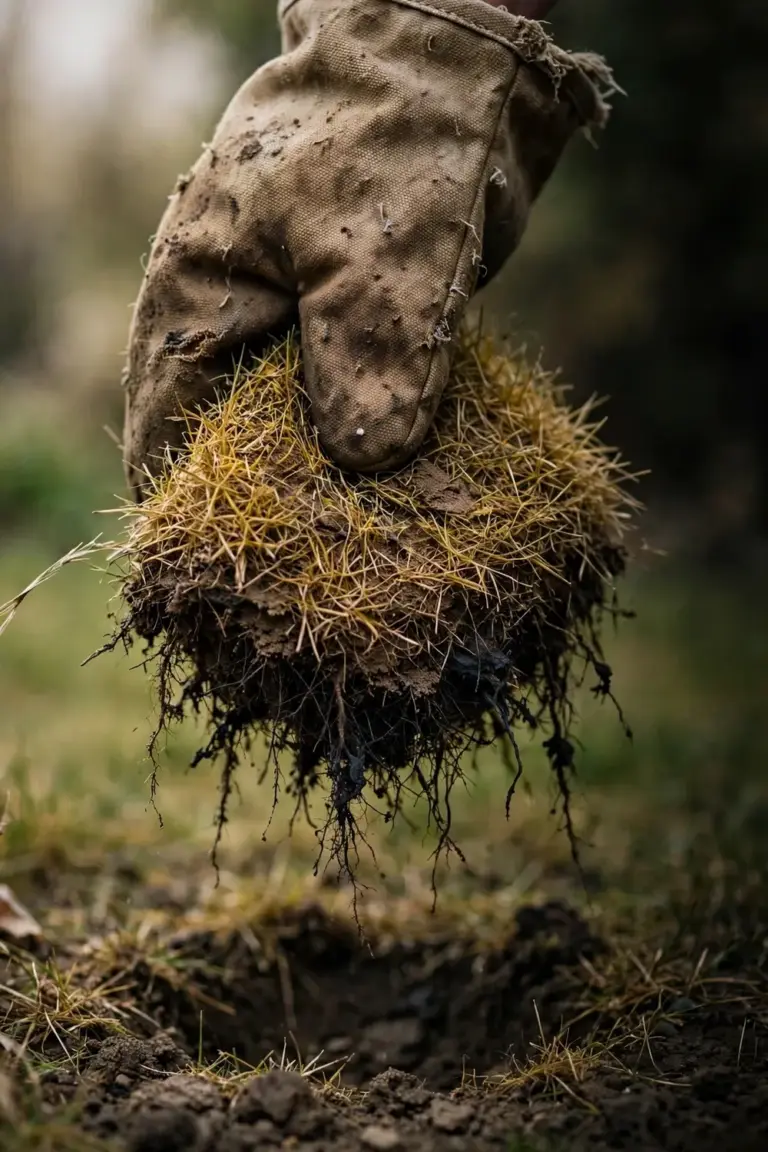
Rake up fallen leaves in spring and fall. Destroy them the day they are raked.
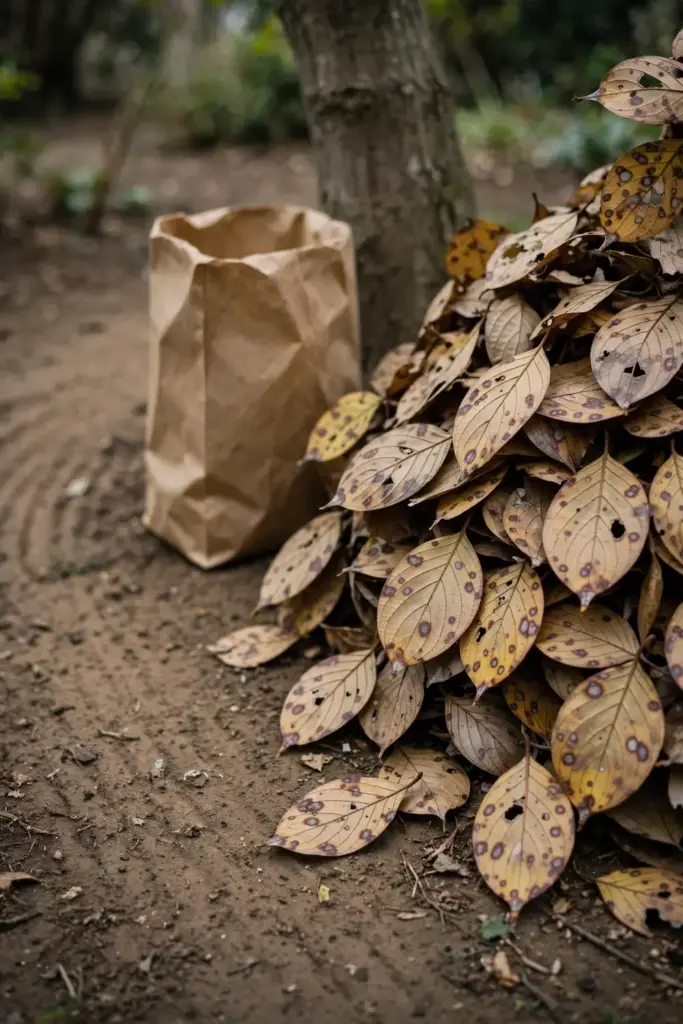
University of Maryland Extension advises raking and discarding symptomatic foliage, since spotted leaves on the ground carry the fungus, and the fungus waits in the fallen leaves until the next rain splashes spores back onto the tree. Removing the leaves removes the waiting fungus. The routine is simple. It is the single most effective home move against spot anthracnose.
Bag the leaves and send them out with household trash. Burn them where burning is legal and safe. Do not compost infected leaves. A home compost pile does not heat evenly, and the cool edges keep the fungus alive. Do not chip spotted prunings into mulch for the same garden. Mulch made from infected wood spreads the fungus back under the tree it came from.
Rake twice. Fall cleanup removes the leaves that carry the fungus into winter. Spring cleanup removes the spotted leaves that fell early and any leaves the fall raking missed. Rake under the full canopy, out to the drip line. The drip line marks where the rain lands hardest, and it marks where the spotted leaves land too.
Clean the ground after any heavy prune. Pruned twigs with spots carry the same fungus as fallen leaves. Pick them up in the same session. A clean floor under the tree gives spores nowhere to wait. A floor covered in spotted leaves gives them a nursery.
Step 3: Water at the Base and Keep Foliage Dry
Water at the base. Overhead water splashes spores from leaf to leaf.
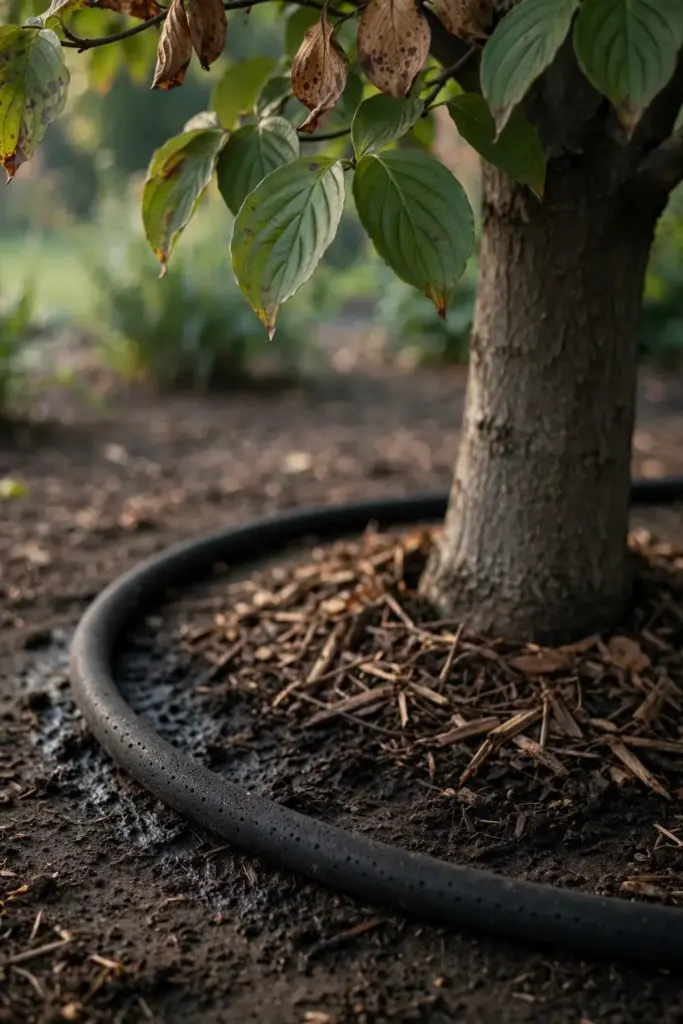
Drip lines and soaker hoses put water on the root zone without wetting the canopy. When overhead water is the only option, water early in the morning so the foliage dries fast. Arkansas Extension advises gardeners to avoid wetting the leaves, and to water in the early morning when overhead irrigation must be used, so that leaves dry out during the daytime. Evening overhead watering leaves the canopy wet overnight, and wet leaves stay open to infection through the night.
Aim irrigation heads away from the tree. A head that sprays the bracts at bloom does the fungus a favor every cycle. Turn the head. Move the head. Cap the head. The tree needs water at the roots, and the bracts need dry air.
Mulch helps the root zone hold moisture. Lay mulch in a wide ring under the canopy. Keep the mulch off the trunk. Mulch piled against the trunk holds moisture on bark and rots it. A mulch ring that stops short of the trunk keeps the roots cool and the bark dry.
Water in drought. A dogwood short of water in summer drops leaves early and pushes weak growth. Weak growth recovers slowly from a spotted spring. Deep watering at the base during a dry spell keeps the tree vigorous without wetting a single leaf. Vigor does not cure spots, and it does not need to. Vigor carries the tree past them.
Step 4: Prune Dead Wood in Dry Weather
Prune dead wood in dry weather. Pruning does not cure spot anthracnose, and it still pays.
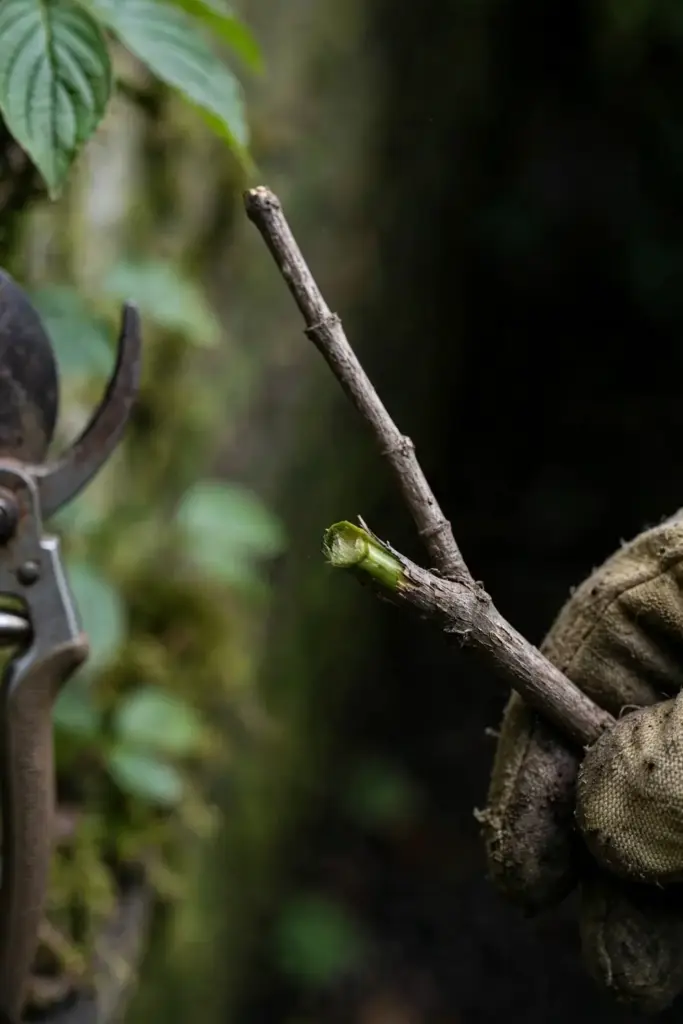
Ohio State Extension advises pruning dead branches promptly from the plant. Dead branches hold fungus and shade the canopy. A dead twig in the crown blocks air and holds moisture on the leaves around it. Cutting it out opens the crown and lets the foliage dry faster after rain.
Work on a dry day. Wet bark spreads spores from cut to cut. Dry bark keeps the spores where they are. Stop when rain starts. The cut can wait. A cut made in rain trades one problem for another.
Cut dead wood back to living tissue. Look for green cambium under the bark at the cut. Brown wood inside a twig means the twig is dead further down. Cut lower, into green wood. Carry the cuttings out of the garden as you go. Do not leave spotted prunings under the tree. Step 2 covers what to do with them.
Thin for airflow. Remove crossing branches, low branches that drag on mulch, and weak shoots that shade the center. An open crown dries in hours. A dense crown stays damp past noon. The guide to spring pruning techniques covers clean cuts for healthy trees, and the same cut discipline applies here. Cut to living wood, never leave a stub, and keep the blade clean between cuts.
Step 5: Hold Fungicide for Severe Cases Only
Hold the sprayer. Routine fungicide is not recommended for spot anthracnose.
The University of Maryland Extension page on Elsinoe leaf spot of dogwood states that routine fungicide applications are not recommended because disease severity is sporadic depending on how wet the spring season is, that fungicides will not cure visible symptoms, and that young trees with severe infections can be protected with a registered fungicide applied in the spring at bud break followed by additional sprays every 7 to 14 days until leaves are fully expanded. That paragraph is the whole spray policy. Routine spraying wastes money. Spraying after spots appear wastes effort. Spraying a young tree with a severe history, timed right, can help.
The timing trap catches most sprayers. Spots visible today came from an infection days earlier. A spray applied today cannot reach fungus already inside the tissue. University of Georgia Extension notes that once spots are seen, it is too late to manage the disease with fungicides. The spray window opens at bud break and closes as the leaves expand. A sprayer who waits for spots has already missed the window.
The coverage trap catches the rest. Protecting a dogwood means covering the entire canopy, bracts and leaves, top and underside, on every application. A hand sprayer on a ladder misses the top of a mature tree. A missed patch is an unprotected patch. The fungus finds it. Arkansas Extension notes that homeowners may need a professional tree care company with commercial sprayers for larger trees. That sentence is a cost warning dressed as advice.
Skip the spray on a mature tree with spots alone. The tree does not need it. The wallet does not need the bill. The spray rig does not need the workout. Save the spray budget for the young tree with a severe history, and time it by the calendar in Step 6.
Step 6: Time Any Spray From Bud Break to Leaf Expansion
Spray only when the threshold is met, and only inside the window. Bud break opens it. Leaf expansion closes it.
The threshold comes from Purdue Plant Doctor. Most infected trees do not require control. The exceptions are a history of repeat severe infections or defoliation from Elsinoe corni. A young tree that lost leaves two springs running meets the threshold. A mature tree with spots alone does not. A tree with dieback fails the diagnosis entirely, and the differential section decides its treatment.
Start at bud break. The first spray goes on as the buds open, before the bracts unfold. Purdue Plant Doctor lists propiconazole, chlorothalonil, and thiophanate-methyl as the active ingredients that protect trees when applied from bud break until most bracts have fallen. Read the product label and follow it. The label is the law for that product. No article overrides it.
Repeat every 7 to 14 days until the leaves are fully expanded. University of Maryland Extension sets that interval for young trees with severe infections. The interval covers new growth as it emerges. New leaves that emerge after a spray sit unprotected until the next one. A gap longer than 14 days in wet weather leaves a whole flush of leaves exposed.
Stop when the leaves reach full size. Further sprays protect nothing, because the susceptible tissue is gone. A spray program that runs all summer for spot anthracnose runs on habit, not on biology. End it at full leaf expansion. Spend the rest of the season on raking, watering, and watching.
Step 7: Site New Dogwoods in Morning Sun and Afternoon Shade
Site a new dogwood where the morning sun dries the dew and the afternoon shade cuts the heat.
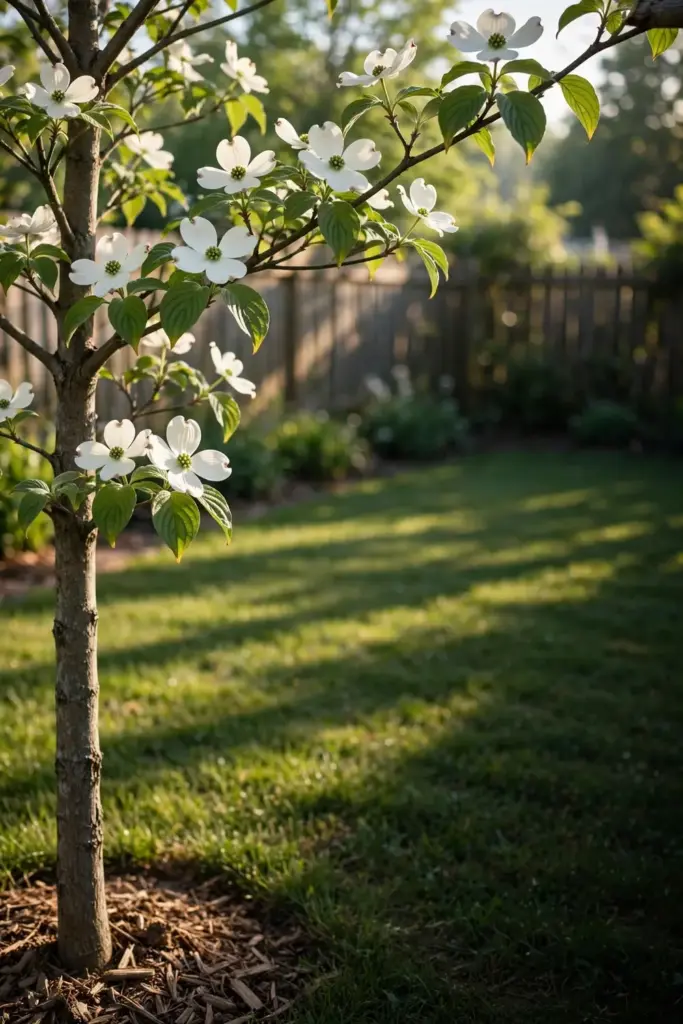
The Ohio State Extension anthracnose fact sheet recommends planting flowering dogwood in sites with good soil drainage and adequate organic matter, in partially shaded sites such as those with just morning sun, with mulch to moderate fluctuations in soil temperature, and with dead branches pruned promptly from the plant. That sentence carries the whole siting policy. Morning sun dries the foliage early. Afternoon shade cuts heat stress. Good drainage keeps the roots out of standing water.
Full sun punishes a new dogwood twice. Ohio State Extension notes that spot anthracnose is worse in full sun than in shade. Heat stress in full sun also weakens the tree, and a weakened tree recovers slowly from any disease. A site with morning sun and afternoon shade avoids both penalties at once.
Air movement matters as much as light. A site open to a breeze dries the foliage after rain. A site walled in by fences and dense shrubs holds damp air around the canopy. Leave room around the tree. Do not plant a dogwood tight against a building where the air stalls and the rain drips off the eaves onto the crown.
Drainage decides the root half of the story. Dogwoods in standing water lose roots. Root loss shows up as thin canopy, weak growth, and early leaf drop, all of which look like disease and none of which is. Dig a test hole before planting. Fill it with water. If the water still stands the next morning, pick a higher spot or fix the drainage first.
Step 8: Choose Resistant Dogwoods for New Plantings
Buy resistance at the nursery. Resistance cannot be added after planting.
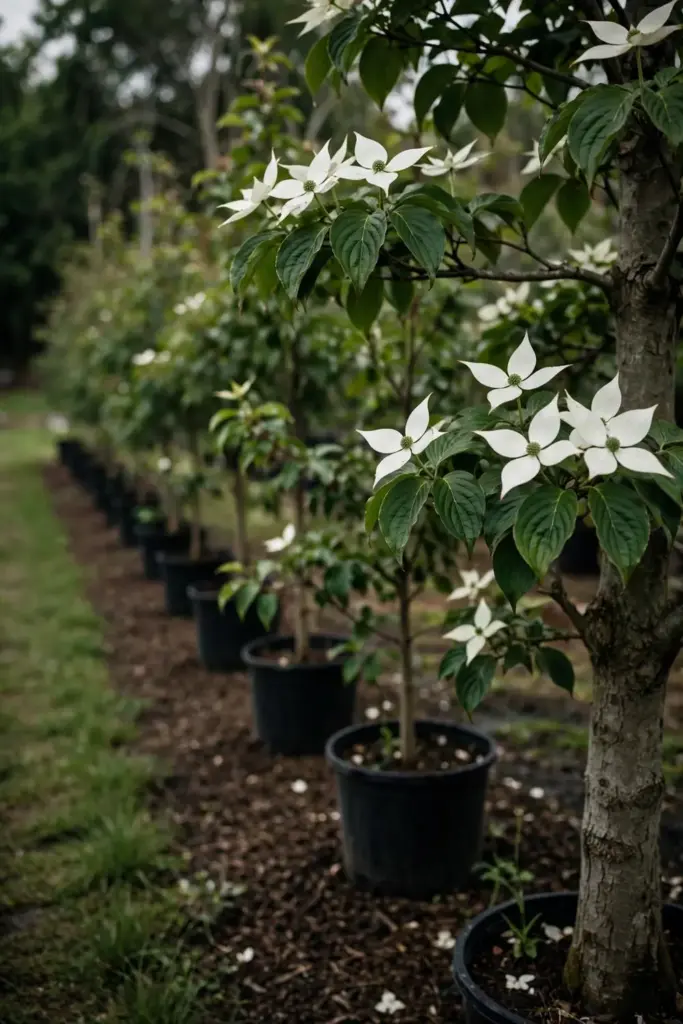
University of Maryland Extension advises planting cultivars resistant to spot anthracnose. Ask the nursery which selections showed the fewest spots in local trials. A nursery that grows dogwoods in the same county knows which selections spot heavily in a wet spring and which ones stay clean. That local knowledge beats a catalog claim.
Kousa dogwood tolerates dogwood anthracnose better than flowering dogwood. University of New Hampshire Extension notes that Kousa dogwood appears resistant to dogwood anthracnose, and that the Stellar hybrid crosses between Cornus florida and Cornus kousa carry resistance to the disease. Names in that hybrid group include Aurora, Constellation, Celestial, Stellar Pink, and Stardust. Those selections resist the killer disease. They still face Elsinoe in a wet spring, and a buyer who expects a spot-free Kousa will be disappointed in a wet April.
Inspect every tree before purchase, and reject trees with spotted bracts, dead twigs, or cankers. A tree that arrives infected brings the fungus into the garden on day one. Check the buds, the bark, and the lower branches, where dogwood anthracnose starts. A clean tree at the nursery stays clean longer at home.
Do not plant a forest dogwood dug from the woods, since a wild tree may carry disease that shows no symptoms at digging time. A nursery tree with a known history costs more and carries less risk, and the price difference buys the clean start.
Step 9: Scout Again Next Spring and Track Severity
Scout again next spring. Severity varies year to year, and one clean spring proves nothing.
Purdue Plant Doctor notes that severity can vary dramatically from year to year. A dry spring can leave a tree spotless. The fungus still waits in the buds. The next wet spring brings the spots back. A gardener who declares victory after one dry spring stops watching, and the wet spring after that catches the tree unraked and unpruned.
Check at bloom. Walk the tree when the bracts open. Count the spots on ten bracts. Note whether the spots stay small or grow into blotches. Note whether any branch dies back. Ten bracts take two minutes. Two minutes at bloom beats two hours of guessing in July.
Keep notes. Write the date, the weather, the spot count, and the tree’s response. A notebook with three springs of notes shows the pattern. A memory of three springs shows the worst one. Notes turn a vague worry into a record, and the record drives the Step 1 triage call.
Watch for the diagnosis changing. A tree that spots lightly in spring and then drops leaves in summer fits Septoria, not Elsinoe. A tree that grows blotches, dies back from the lower branches, and grows cankers fits Discula, not Elsinoe. The differential table still applies in year two and year three. A disease can change its face across seasons. The gardener who keeps watching catches the change.
Living With Spot Anthracnose Damage You Cannot Undo
Spotted leaves do not heal, and the spots stay until the leaves fall.
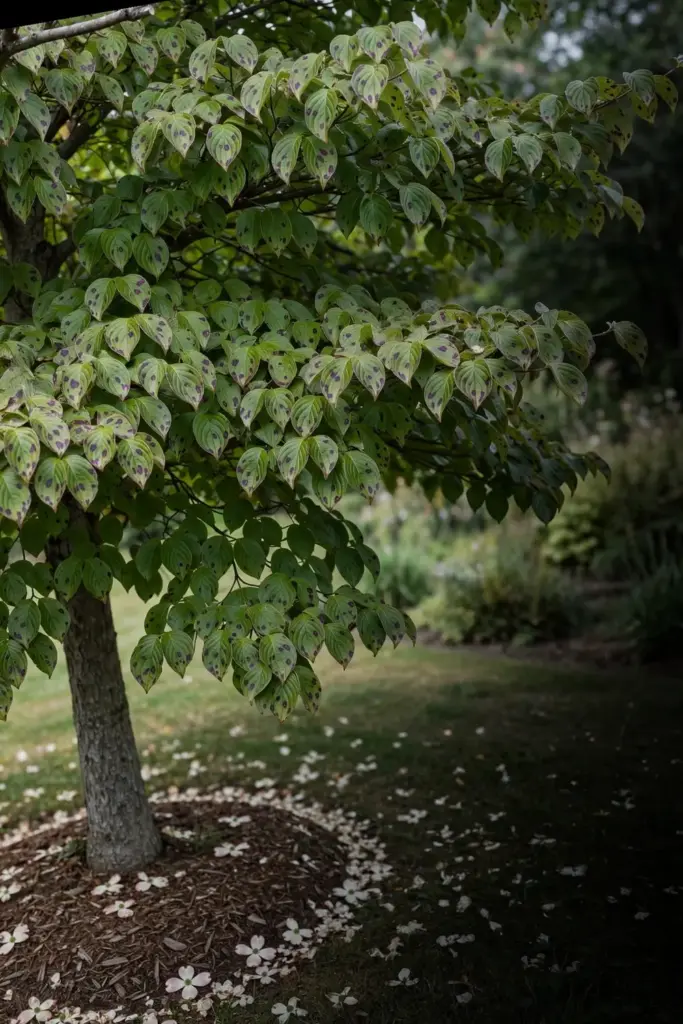
The dead centers do not fill back in. The shotholes do not close. A leaf that spotted in May carries the holes in September, and that permanence bothers gardeners more than it bothers the tree. The leaf still photosynthesizes around the holes. The tree still stores energy for next spring. The damage is cosmetic. Cosmetic damage does not need undoing.
Do not strip spotted leaves. Stripping leaves removes the foliage the tree needs. A tree stripped of its spotted leaves has fewer leaves than a tree left spotted, and fewer leaves means less energy for next spring. The cure would cost more than the disease. Leave the leaves on the tree. Rake them when they fall on their own.
Let the bracts drop naturally, since spotted bracts fall when their time comes. Pulling them off by hand wounds the twig tips and opens new entry points. The bracts are spent tissue. They did their job, and they can go.
Feed the tree for vigor, not for spots. Water in drought. Keep the mulch ring in place. The notes on building soil health cover the soil basics that grow vigor without forcing soft growth. A vigorous tree pushes a full canopy next spring, and a full canopy absorbs a spotted spring without a visible setback.
Replace the tree only when the diagnosis changes. A tree with spot anthracnose alone never earns removal. A tree with Discula cankers, spreading dieback, and a thinning crown may earn it. That call belongs to the Discula page and to an arborist with eyes on the tree. Do not remove a dogwood for spots alone. The spots never justified it.
Frequently Asked Questions
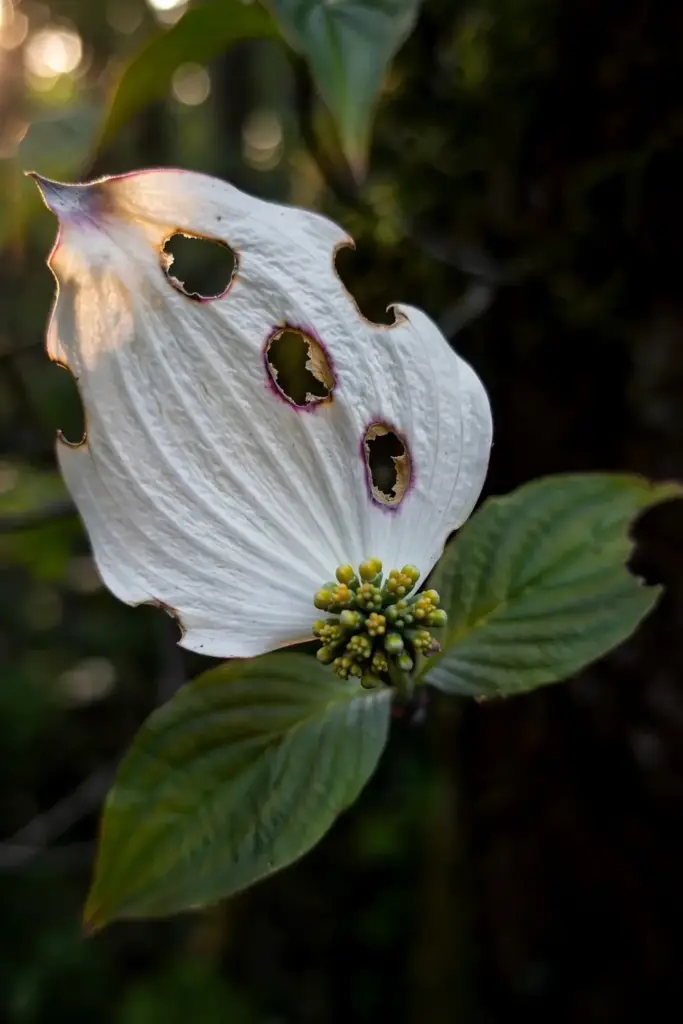
No. Spot anthracnose is cosmetic. Elsinoe corni spots the bracts and leaves, and the centers of the spots fall out and leave shotholes. The fungus does not kill branches, does not girdle trunks, and does not shorten the life of the tree. A spotted tree blooms again next spring. Dieback or cankers mean a different disease, and the differential table in this page names it.
Check spot size, dieback, and cankers. Spot anthracnose makes small 1 to 2 mm round spots with purple borders and tan centers, and it causes no dieback and no cankers. Dogwood anthracnose makes medium to large blotches, kills branches from the lower crown upward, and grows limb and trunk cankers. A tree getting worse week by week fits the killer disease, not the cosmetic one.
Usually no. Routine fungicide is not recommended, because severity swings with spring rain and sprays will not cure spots that already show. Spraying fits only a young tree with a history of repeat severe infections or defoliation. That spray starts at bud break and repeats every 7 to 14 days until leaves reach full size. Read the product label and follow it.
Yes. Rake fallen leaves in spring and fall, and destroy them the same day. Fallen spotted leaves carry the fungus through winter, and spring rain splashes spores back onto the tree. Bag the leaves with household trash, or burn them where burning is legal and safe. Do not compost infected leaves, and do not chip them into mulch for the same garden.
Spot anthracnose on dogwood stays on dogwood. Elsinoe corni infects dogwood species, and it does not jump to maple, ash, sycamore, roses, or grape. Those plants carry their own anthracnose diseases from different fungi. A spotted dogwood beside a clean maple is normal, not a warning. Sanitation under the dogwood still matters, since fallen leaves seed the next spring on the same tree.
They may. The fungus overwinters in buds and stem lesions, and severity varies dramatically from year to year with spring rain. A wet spring brings a freckled tree, and a dry spring brings a clean one. Fall raking cuts the fungus that waits under the tree. No home routine clears it from the buds, so a wet spring after a clean one can still bring spots back.
Where to Go From Here
Start with one walk around the tree at bloom. Count the spots on ten bracts, then check for dieback and cankers.
Spots alone mean patience. Rake the fallen leaves in spring and fall, water at the base, prune dead wood in dry weather, and skip the sprayer. Spots with dieback or cankers mean a different disease, and the dogwood anthracnose page carries that response. The tree that survives spot anthracnose is the tree with a clean floor, dry foliage, and a gardener who waits out the wet spring.