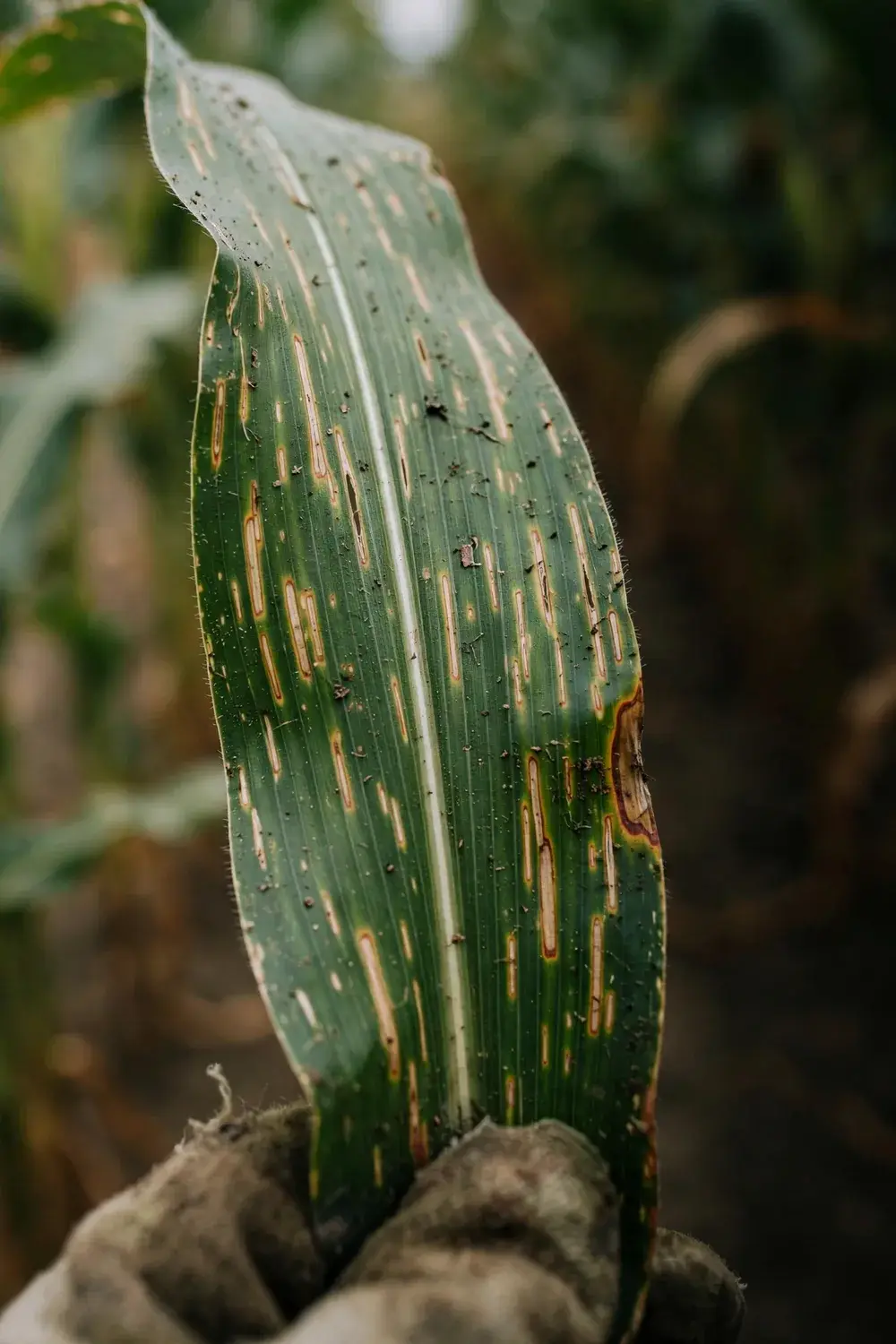

Walk your sweet corn rows from the lowest leaves up. Southern corn leaf blight starts low as small tan spots, and the 9 strategies below keep it from climbing the plant and cutting into the harvest.
Southern corn leaf blight is a fungal leaf disease of corn. The pathogen is Bipolaris maydis, and it survives winter in corn debris, then spreads by wind and splashing rain in warm, wet weather. There is no spray that cures infected leaves. Every strategy below prevents infection or breaks the cycle for next season.
The rest of this page runs the order a gardener should follow. Identify the disease first, then separate it from northern corn leaf blight, then work the 9 steps from the triage call to fungicide as a last resort. I have learned that the fall afternoon spent clearing corn stalks pays back more than any spray the next summer.
What Southern Corn Leaf Blight Actually Is
Southern corn leaf blight is a fungal disease of corn caused by Bipolaris maydis. The sexual stage carries the name Cochliobolus heterostrophus, and older guides call the same fungus Helminthosporium maydis. That old name is retired. The same old genus name shows up on lawn diseases too, and those lawn problems are separate diagnoses with their own fixes.
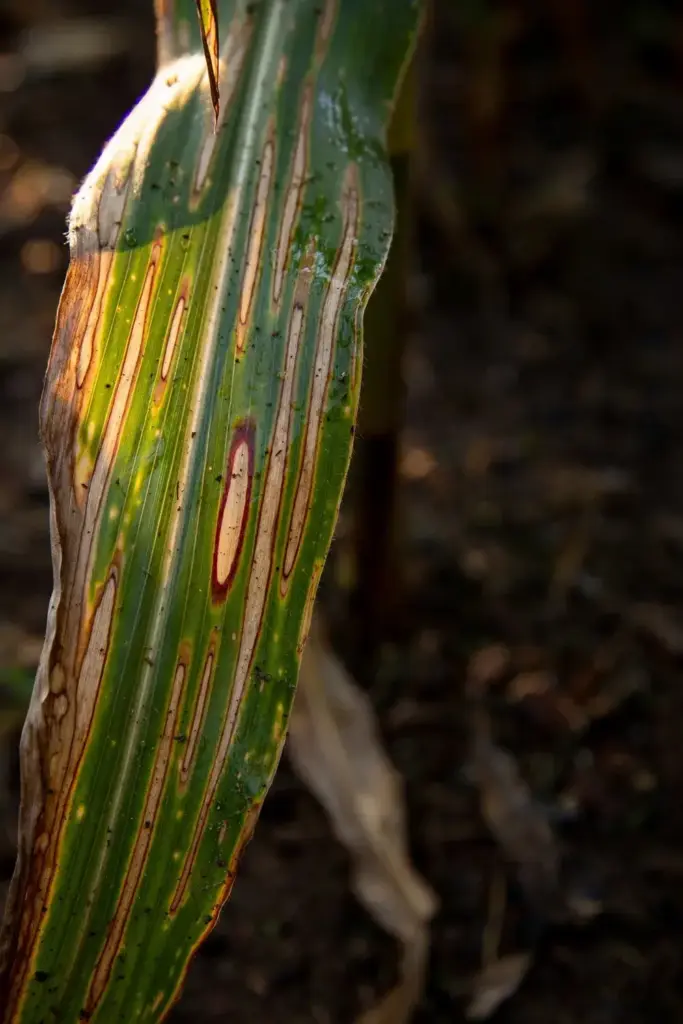
The Cornell sweet corn disease notes list Bipolaris maydis as the cause of southern leaf blight, with foliage, stalks, ears, and cobs as the parts the disease can reach. In home gardens, the race that matters attacks leaves only. The stalk and ear damage belongs to a race that no longer threatens the corn gardeners grow.
Bipolaris maydis comes in three races. The race decides which corn it can attack and which plant parts it reaches. The table below lines up the three races so the 1970 history stops sounding like a current threat.
| Race | Corn It Attacks | Parts Attacked | Standing Today |
|---|---|---|---|
| Race O | Normal-cytoplasm corn, the corn home gardeners grow | Leaves only | The race in home gardens today |
| Race T | T-cytoplasm male-sterile corn | Leaves, stalks, husks, ears, cobs | Ended as a threat when growers switched to normal-cytoplasm corn |
| Race C | C-cytoplasm male-sterile corn | Leaves | Attacks only C-cytoplasm corn |
Race T caused a major United States epidemic in 1970, when American corn widely carried T-cytoplasm. Growers switched to normal-cytoplasm corn after that epidemic. The Illinois Extension fact sheet on southern corn leaf blight states that since the switch from cytoplasm male-sterile T to normal-cytoplasm corn, Race T is not considered to be a threat. Race O is the race a home gardener meets. Race O causes leaf lesions only, and it never turns into Race T.
Sorghum and teosinte can host Bipolaris maydis too. This page stays on sweet corn, since sweet corn is the crop in the bed and the crop the strategies protect.
How to Identify Southern Corn Leaf Blight on Leaves
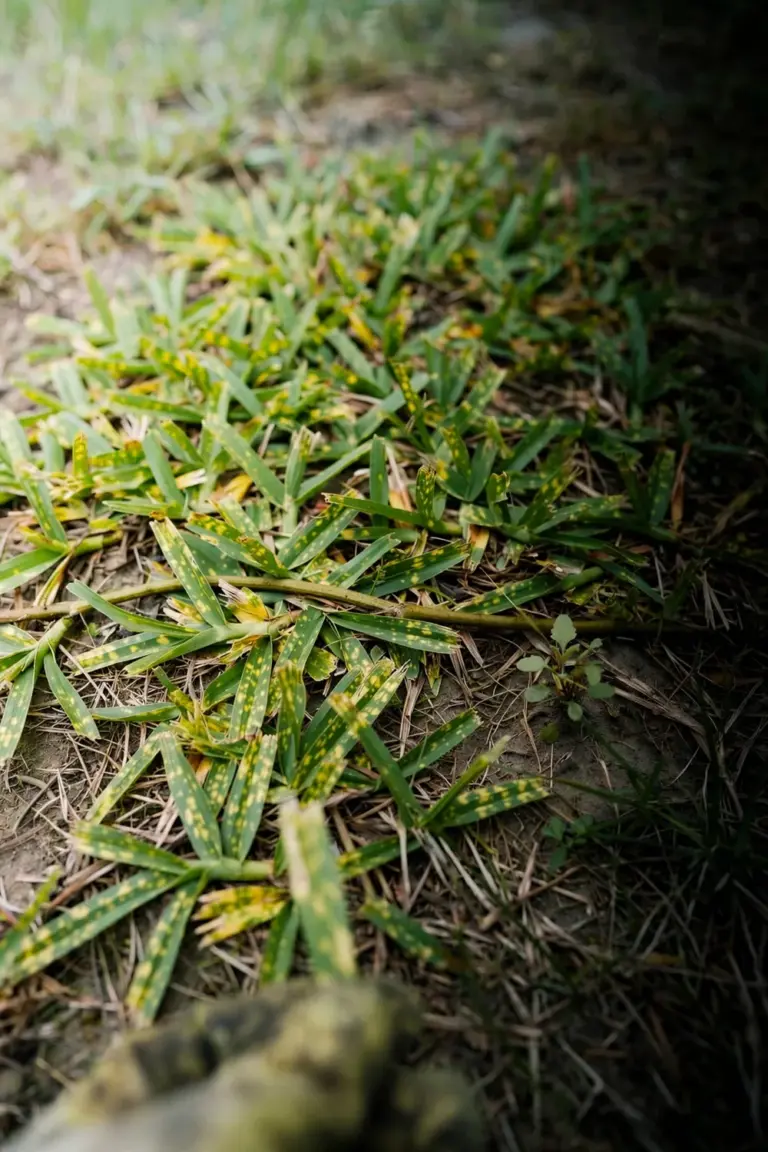
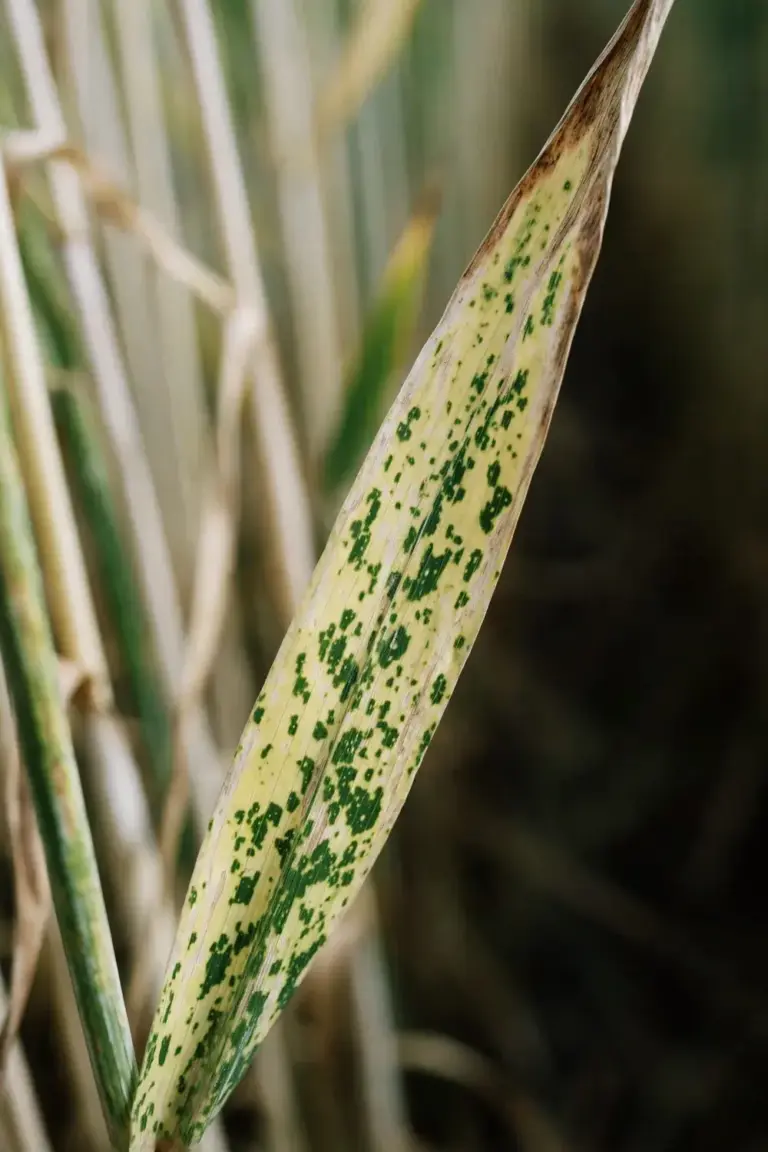
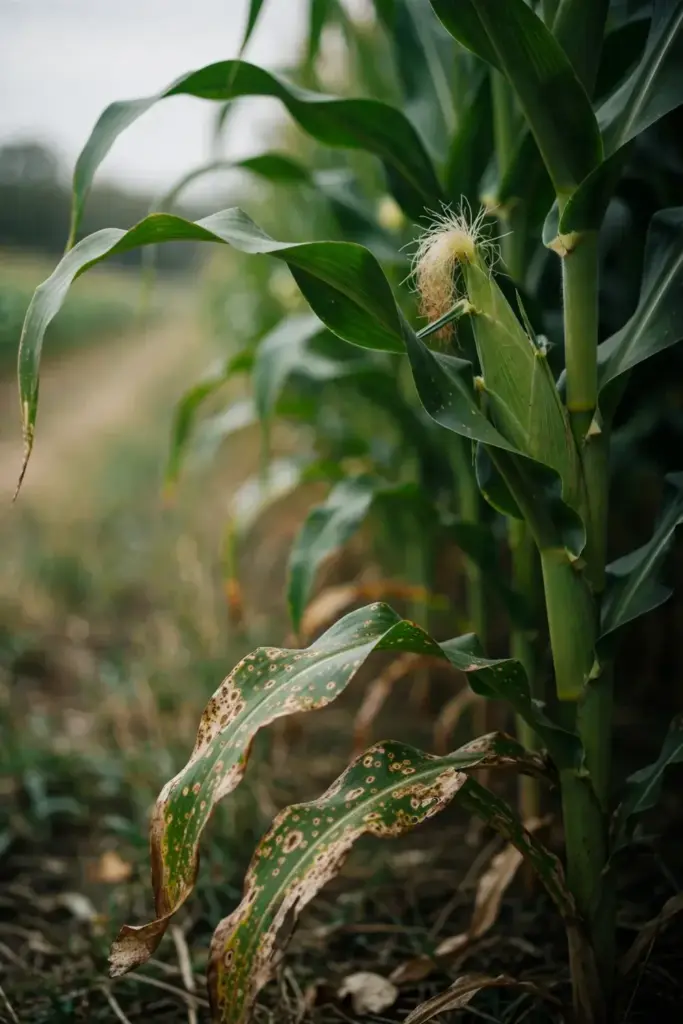
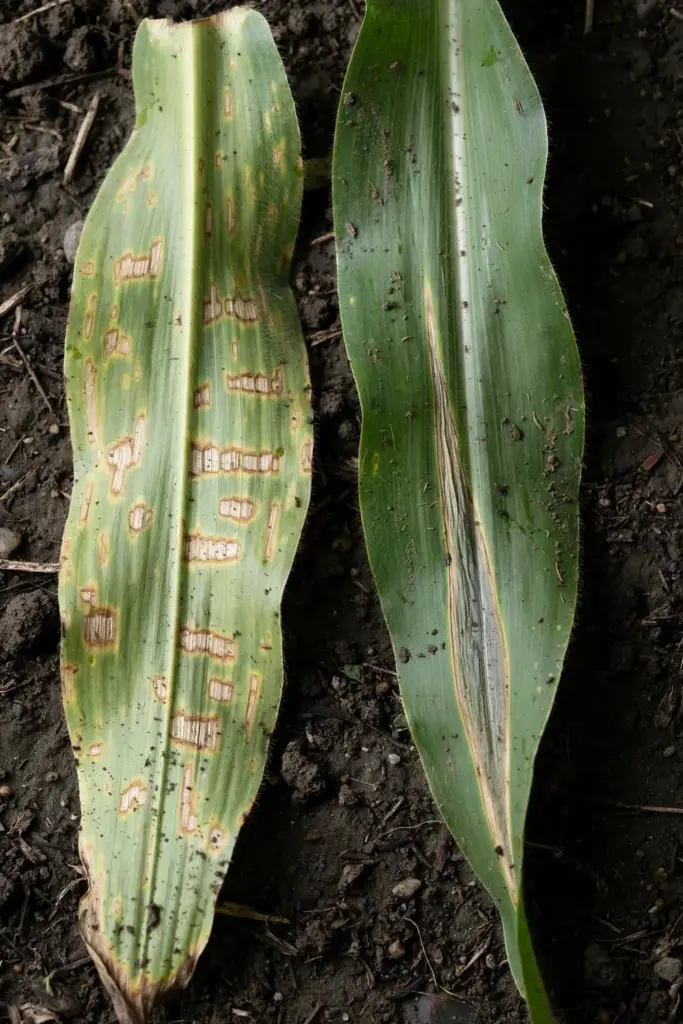
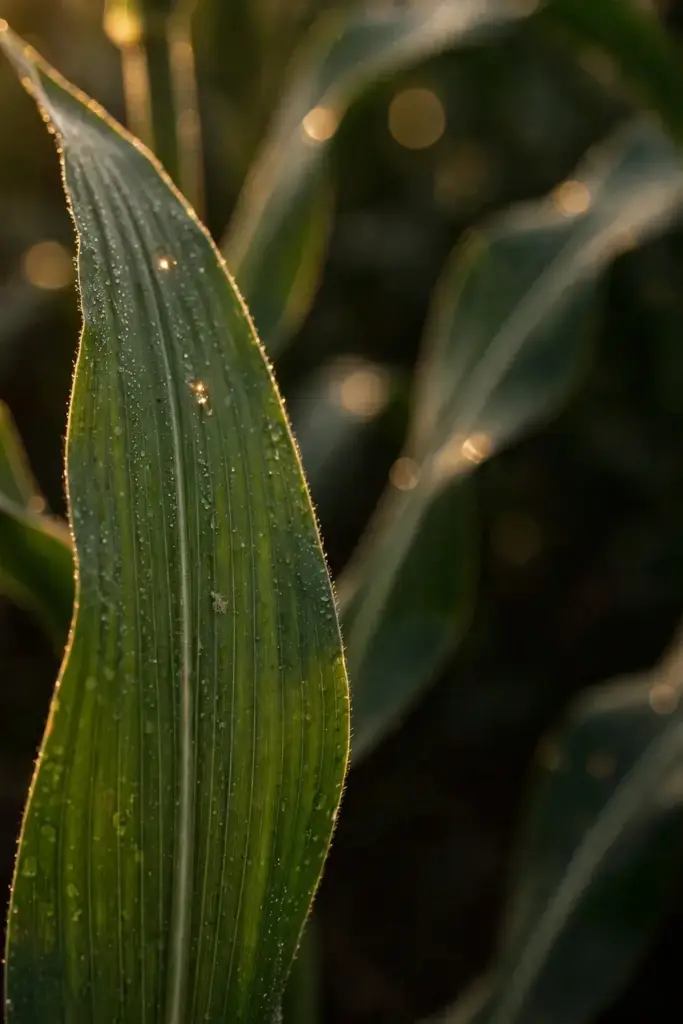
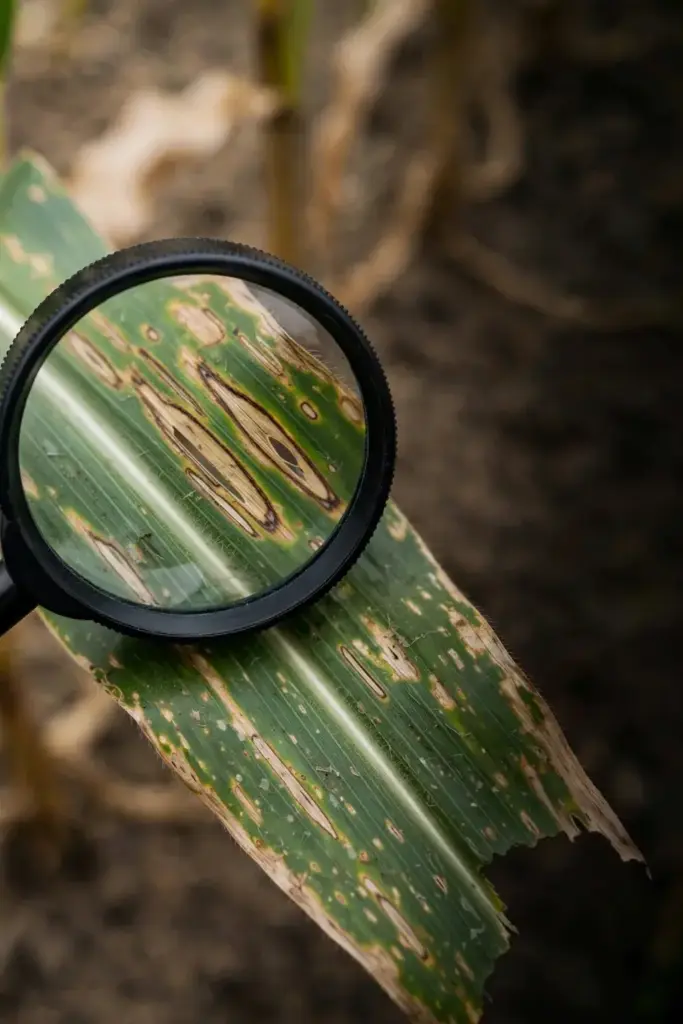
Look for small tan spots between the veins on the lowest leaves. A leaf with elongated tan lesions that run between the veins, with buff-to-brown borders, carries southern corn leaf blight until proven otherwise.
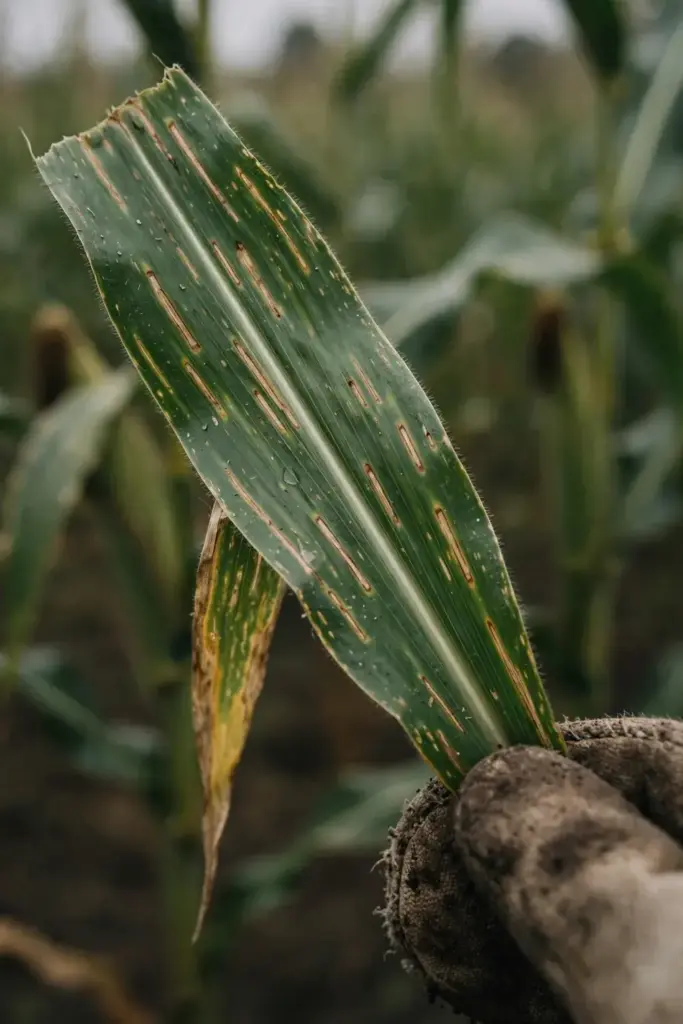
Purdue Extension puts Race O lesions at 0.25 to 1 inch long and 0.25 inch wide, tan, oval or parallel-sided. Lesion borders may turn reddish brown on some hybrids and stay plain tan on others. Lesion size and border color vary by hybrid, so the shape and the placement matter more than any single measurement. Parallel sides between the veins are the field mark to trust.
The disease starts on the lower leaves and climbs. Lesions appear first on the lowest foliage, then spread upward as spores splash from leaf to leaf. Purdue Extension notes that symptoms may occur as early as silking, and they grow more prevalent during later growth stages. A plant with spots only on the top leaves while the lower leaves stay clean points at a different problem.
Check the pattern across the plant, not one leaf. Southern corn leaf blight spreads across many leaves at once, with lesions of similar age on neighboring plants. A single spotted leaf on one plant, with clean plants around it, points at mechanical damage or a passing stress. A whole row showing tan lesions from the bottom up fits the disease.
How to Identify Southern Corn Leaf Blight on Stalks, Husks, and Ears
Check the stalks and husks after the leaves. Race O stays on the leaves, so stalks and ears that look clean while the leaves spot fit Race O. Damage on stalks, husks, or ears points at Race T, and Race T does not threaten normal-cytoplasm corn.
Race T lesions look different from Race O lesions. The Crop Protection Network page on southern corn leaf blight describes Race T lesions as rectangular to elliptical, 0.25 to 0.5 inch wide by 0.25 to 0.75 inch long, with a reddish-brown border that may carry a chlorotic zone. The same page describes stalk and leaf infections starting as purple spots that develop tan-gray centers. Ear infections leave a gray-black lesion on the husk that extends into the kernels, appearing as a black felt-like mold.
Seedlings from infected kernels may come up blighted. The same Crop Protection Network page notes that seedlings from infected kernels are often blighted. A seedling that wilts and dies within weeks of planting, with no cutworm or damping-off sign, may have carried the fungus from the kernel. Saved seed from a badly infected planting stays suspect. Buy fresh seed for the next planting.
Ears tell the story late. A Race O planting can still fill ears while the lower leaves die back. A planting with black felt-like mold across the kernels has ear rot, and those ears go to the trash. Do not save seed from moldy ears, and do not compost them.
Which Sweet Corn Gets Hit Hardest by Southern Corn Leaf Blight
Every sweet corn type can catch southern corn leaf blight. No sugar type, se, sh2, or synergistic, escapes it on its own. Resistance comes from named varieties bred to resist it, not from the sugar class on the packet.
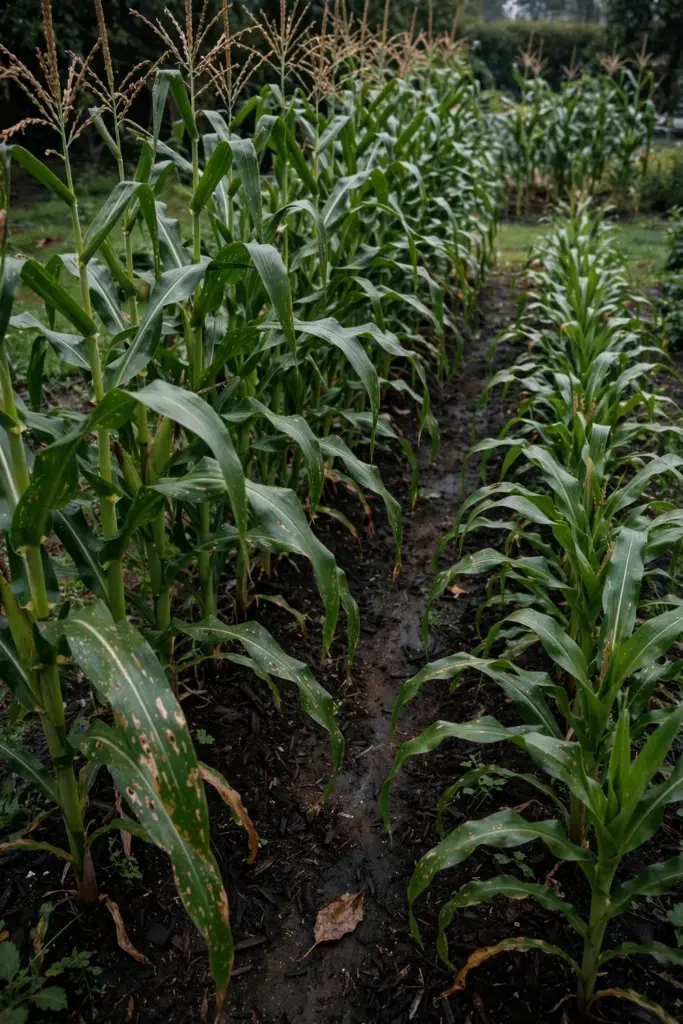
Warm, humid climates take the worst damage. Southern corn leaf blight does the most damage in warm, humid climates such as the southeastern United States. The same Illinois page notes that the disease is especially prevalent in areas with a warm, humid climate. A gardener in a cool, dry climate still scouts, and a gardener in a warm, wet climate scouts twice as hard.
Late plantings in warm weather face the heaviest pressure. The fungus builds through the season as spores multiply on infected leaves. A second planting that silks in late summer meets more spores than a first planting that silked in early summer. Stagger plantings with that in mind, and give the late planting the resistant variety.
If you are planting sweet corn for the first time, the beginner’s sweet corn guide covers spacing and harvest for a clean crop. The disease sections below build on that base, and they apply to any sweet corn planting, new or established.
Southern Corn Leaf Blight vs Northern Corn Leaf Blight
Check lesion size and shape first. Southern corn leaf blight gives small, parallel-sided tan lesions. Northern corn leaf blight gives long, tapered, cigar-shaped lesions. The table below lines up the two diseases side by side.
| Sign | Southern Corn Leaf Blight | Northern Corn Leaf Blight |
|---|---|---|
| Pathogen | Bipolaris maydis | Exserohilum turcicum |
| Leaf lesions | Tan, parallel-sided, 0.25 to 1 inch long, between the veins | Long elliptical, cigar-shaped, grayish-green turning tan, 2.5 to 15 cm long |
| Where it starts | Lower leaves, then upward | Lower leaves, then upward |
| Parts attacked | Race O: leaves only | Foliage, occasionally ears |
| Weather it favors | Warm and wet, 70 to 90 degrees F | Moderate temperatures, 18 to 27 degrees C, and heavy dews |
| First move | Clean up debris, plant resistant varieties | Clean up debris, plant resistant varieties |
The same Cornell notes give northern corn leaf blight lesions as long elliptical, cigar-shaped, grayish-green or tan lesions 2.5 to 15 cm long. Severe northern corn leaf blight causes lesions to coalesce, and the leaf takes on a gray appearance like frost or drought injury. Southern corn leaf blight lesions stay small and separate longer, and they never reach that cigar length.
Field identification stays presumptive. Lesions vary by hybrid, and the Cornelius Seed corn-leaf-diseases guide warns that confirmation often requires microscopic examination of the fungal structures. A home gardener who needs a certain answer sends a sample to a diagnostic lab. The lab result settles what the eye cannot.
Other corn leaf problems stay separate diagnoses. Gray leaf spot gives rectangular lesions with sharp parallel edges that turn gray, while common rust gives cinnamon-brown powdery pustules on both leaf surfaces. Eyespot gives small translucent round spots with yellow halos. Stewart’s wilt gives long linear streaks with wavy margins, and tar spot gives black tar-like spots that look painted on. Northern corn leaf blight is the differential partner above. Each problem keeps its own diagnosis, and none of them merges into southern corn leaf blight.
Why Debris-Borne Spores Decide Everything
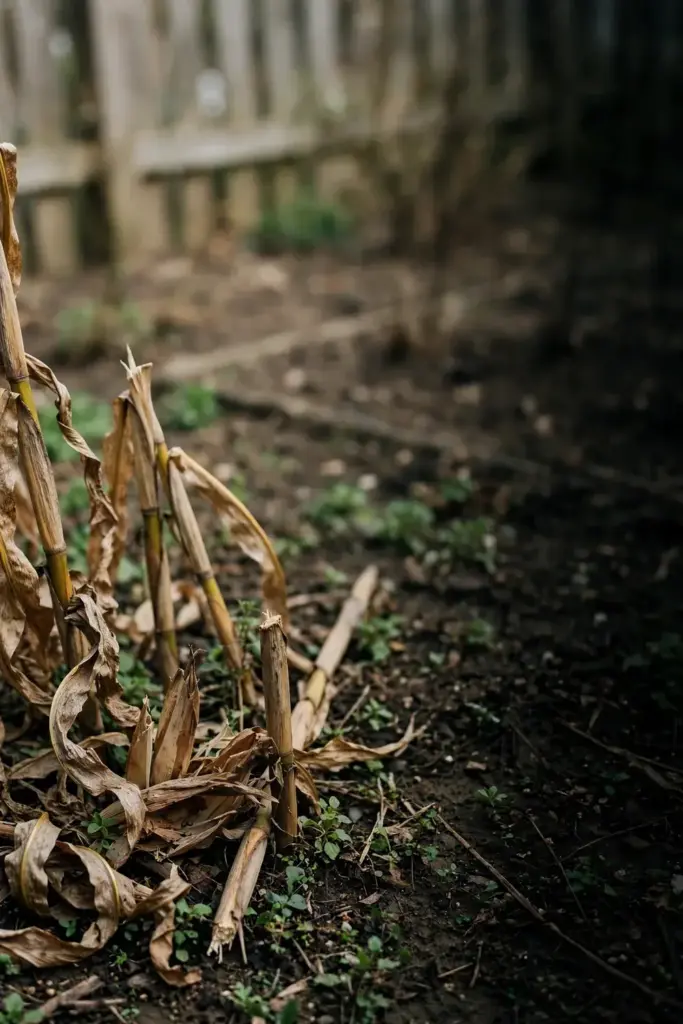
Bipolaris maydis overwinters in corn debris. The fungus survives winter in infected stalks, leaves, and husks left on the soil surface. Spring spores rise from that debris, and the new planting starts the season inside last season’s inoculum.
Wind and splashing rain move the spores. The same Cornell notes list dispersal by wind and splashing rain. A spore that lands on a wet leaf germinates and enters the tissue. Dry leaves break the chain. Wet leaves keep it going.
Warm, wet weather drives the disease. The same Cornell notes list warm, 20 to 32 degrees C, and damp conditions as favorable. The same Illinois page lists warm temperatures, 70 to 90 degrees F, and wet conditions. The two ranges match. Heat without wetness does not drive an epidemic. Wetness without warmth slows it. Warm plus wet together is the combination to watch.
The fungus attacks from mid-whorl to maturity. The same Illinois page puts the time of occurrence from mid-whorl up to maturity. Early-season plants carry little disease. The risk climbs as the canopy closes, humidity rises inside the rows, and the lower leaves stay wet longer after rain or watering.
No spray cures infected leaves. The fungus lives inside the leaf tissue, so a chemical that kills the fungus inside the leaf would damage the leaf. Fungicides protect healthy tissue at best. The whole management approach follows from that one fact. Prevention and debris control decide the season, and cleanup decides the next one.
What Makes Southern Corn Leaf Blight Worse in a Home Garden
Corn after corn feeds the fungus. Monoculture keeps fresh debris in the same ground every year, and the spore load climbs with each season. The same Illinois page lists monoculture among the conditions favoring disease. A bed that grew corn last year starts this year with inoculum already in place.
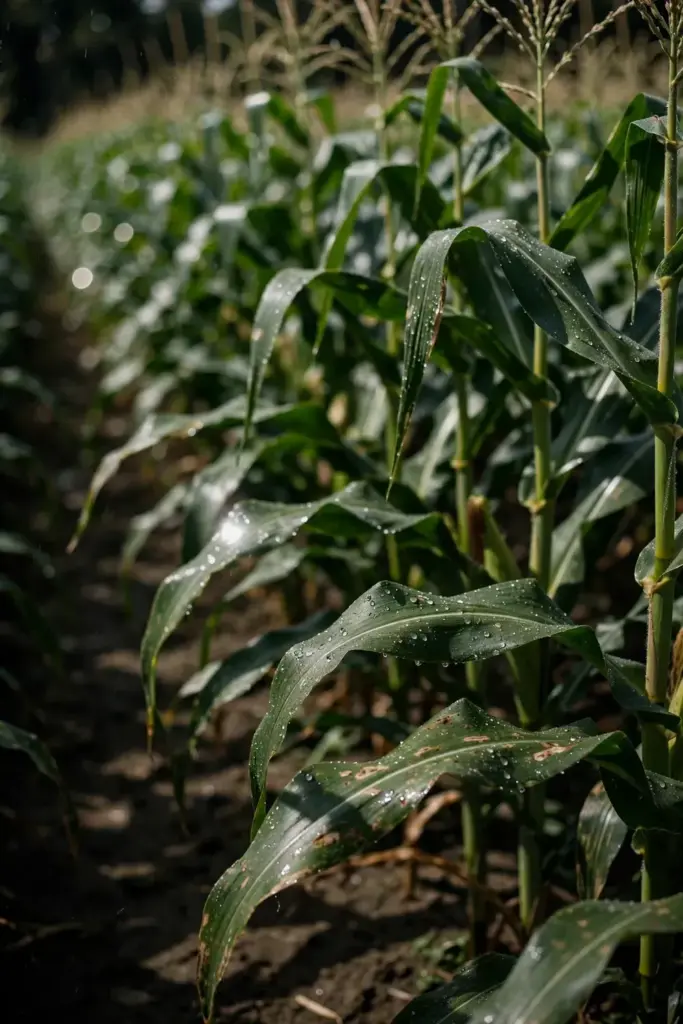
Reduced tillage leaves debris on the surface. The same Illinois page lists reduced tillage among the conditions favoring disease. Debris on the surface keeps spores at leaf level. Buried debris breaks down faster and keeps spores away from the new leaves.
Tight spacing holds wet leaves. Rows packed close together shade the lower leaves and slow drying after rain or watering. Wet lower leaves sit inside the spore zone for hours. Airflow dries leaves, and dry leaves break the infection chain.
Overhead watering wets the canopy. A sprinkler soaks the leaves and splashes spores upward from the soil and the lower leaves. Water at the base keeps the foliage dry and starves the fungus of the wet leaf it needs.
Volunteer corn carries the cycle forward. Volunteer corn sprouts from kernels dropped at harvest, and it grows inside last season’s debris. It hosts the fungus between plantings and hands spores to the new crop. Pull volunteers as soon as they appear.
Late scouting loses the window. The disease moves from the lower leaves up, and a gardener who checks only at harvest finds a fully spotted canopy. Weekly checks from silking on catch the climb early, and early detection sets the harvest and cleanup calls while they still matter.
Step 1: Decide Whether Treatment Is Worth It This Season
Weigh the infection against the calendar. A light infection on the lower leaves of plants nearing harvest needs no treatment. The ears will finish, and cleanup handles the rest. A heavy infection early in the season, with lesions climbing fast while the ears are still filling, needs the full prevention plan below, and it still may not save the crop.
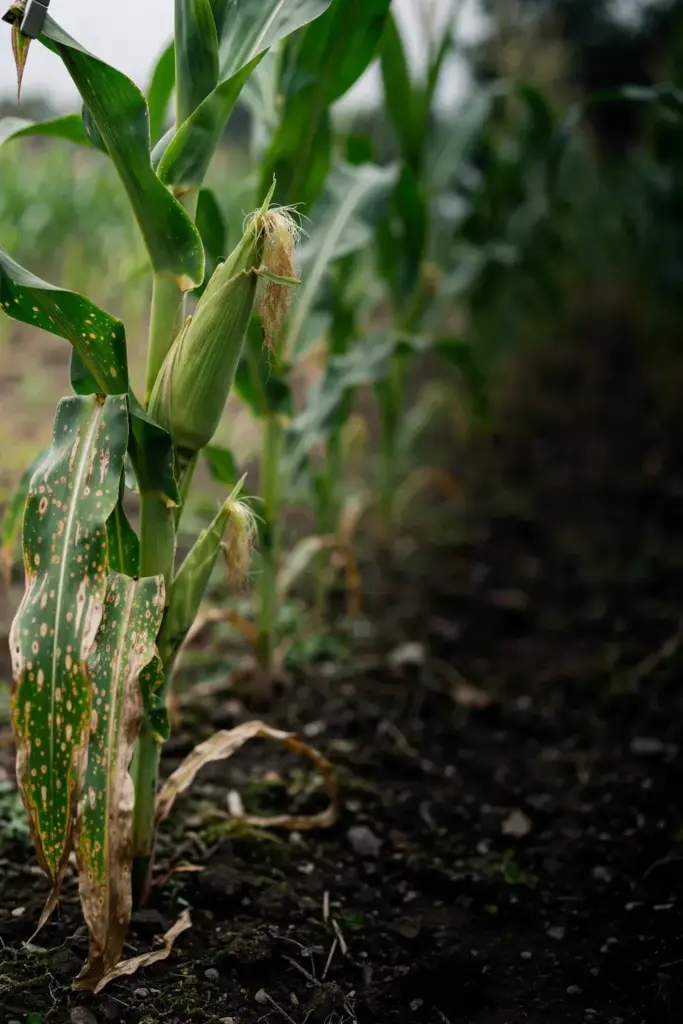
Accept that no spray reverses leaf damage. Lesions that already show stay on the leaf. The goal shifts to protecting the healthy tissue that remains and to stopping spores from reaching next season’s planting. Any product that promises to erase existing spots promises something it cannot deliver.
Harvest timing becomes the main lever. Ears on a heavily spotted plant still fill if the upper leaves hold. Pick ears at peak ripeness and do not wait for a plant to recover. A plant with a dying canopy will not improve, and waiting only gives the fungus more time to reach the ears.
Spend the effort where it pays. Resistant varieties, debris cleanup, rotation, and airflow protect next season. A fungicide application on a nearly finished planting buys little. Put the money and the labor into the steps that break the cycle.
Step 2: Plant Resistant Sweet Corn Varieties
Resistant varieties are the strongest single defense. A variety bred to resist southern corn leaf blight shrugs off spores that would spot a susceptible variety. No other step matches that protection for the effort it takes.
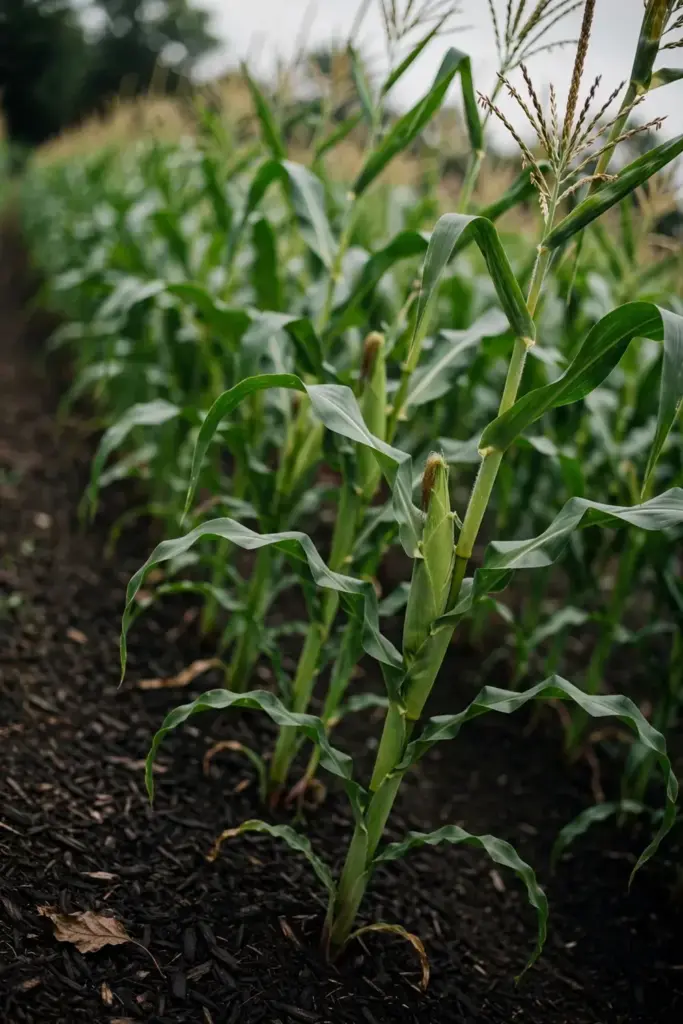
The Cornell disease-resistant sweet corn list names varieties carrying resistance to southern corn leaf blight, including Silver King F1, Silver Queen F1, Serendipity F1, and Summer Sweet 7900R. The list changes as seed companies release new varieties and retire old ones. Check the current list and the current seed catalogs before ordering.
Read the catalog claim with care. A variety listed as resistant to southern corn leaf blight resists this disease. A variety listed as resistant to northern corn leaf blight does not automatically resist southern corn leaf blight. The two diseases have different pathogens, and resistance to one never guarantees resistance to the other.
Availability shifts every year. A variety on an older list may be gone from catalogs, and a new variety may carry resistance the list does not yet show. Ask the seed seller for the current resistance claim, and favor varieties with southern corn leaf blight named on the packet or the catalog page.
Plant the resistant variety in the worst spot. If one bed has a history of leaf blight and another does not, the resistant variety goes in the bad bed. The susceptible favorite, if you still grow it, goes in the clean bed with full cleanup behind it.
Step 3: Clean Up Every Scrap of Corn Debris
Remove every stalk, leaf, and husk after harvest. The fungus overwinters in that debris, so debris left on the bed is next season’s inoculum. Pull the stalks, rake the fallen leaves, and strip the husks from the bed.
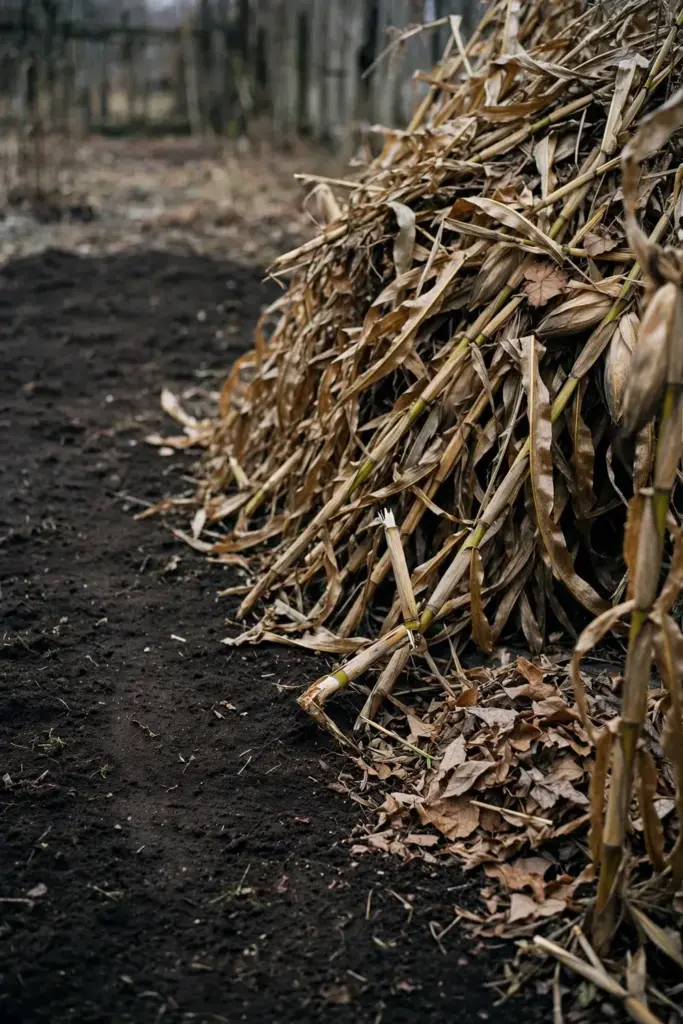
Destroy the debris. Do not compost it. Home compost piles rarely reach the sustained heat that kills fungal spores, and composted debris spreads the fungus with the compost. Bag the debris for municipal green waste, or burn it where local rules allow burning. Check local rules before burning, and bag when burning is not allowed.
Clean the tools too. A rake or mower that drags debris across the bed spreads spores with it. Shake debris off tools at the bed, and wash blades before they touch a clean bed. The same habit pays off across the whole garden.
Fold the cleanup into fall garden bed prep so the bed closes clean. A bed that ends the season bare and tidy starts the next season with the lowest spore load the gardener can arrange.
Step 4: Rotate Corn Out of the Plot
Do not plant corn in the same plot two years running. Rotation starves the debris-borne fungus by removing its host while the old debris breaks down. A plot that grew corn last year grows something else this year.
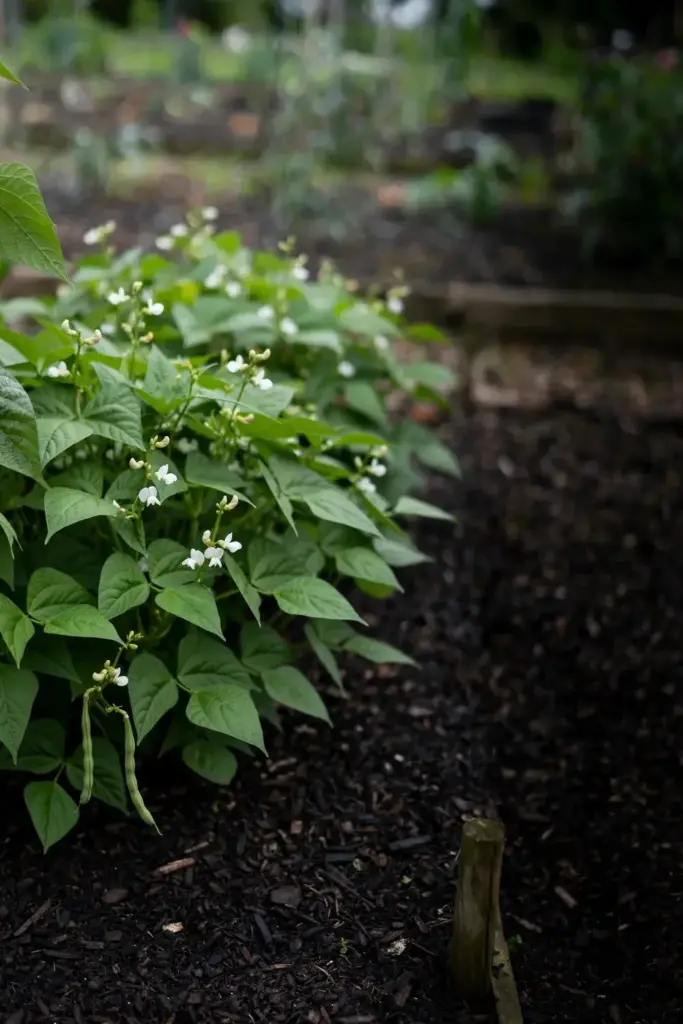
Gardening Know How suggests waiting four years before corn returns to the same ground. Four years is the strictest guidance in garden literature, and it is hard to follow in a small garden. Treat it as the target, not the pass mark. Rotate as far as the plot allows, and lean on cleanup and resistant varieties for the gap.
Plan the rotation at planting time, not at harvest. Sketch the beds before ordering seed, and place corn in the bed that grew beans, squash, or brassicas last year. A rotation decided at harvest arrives a year too late.
Corn follows corn only when no other bed exists. A gardener with one bed still rotates in time rather than space: grow corn one year, skip corn the next, and fill the gap with a non-host crop. A single skipped year beats no rotation at all.
Step 5: Space Plants and Water for Fast-Drying Leaves
Give the rows room to breathe. Follow the spacing on the seed packet, and resist the urge to pack extra plants into the row. Airflow between plants dries the lower leaves after rain, and dry leaves break the infection chain.
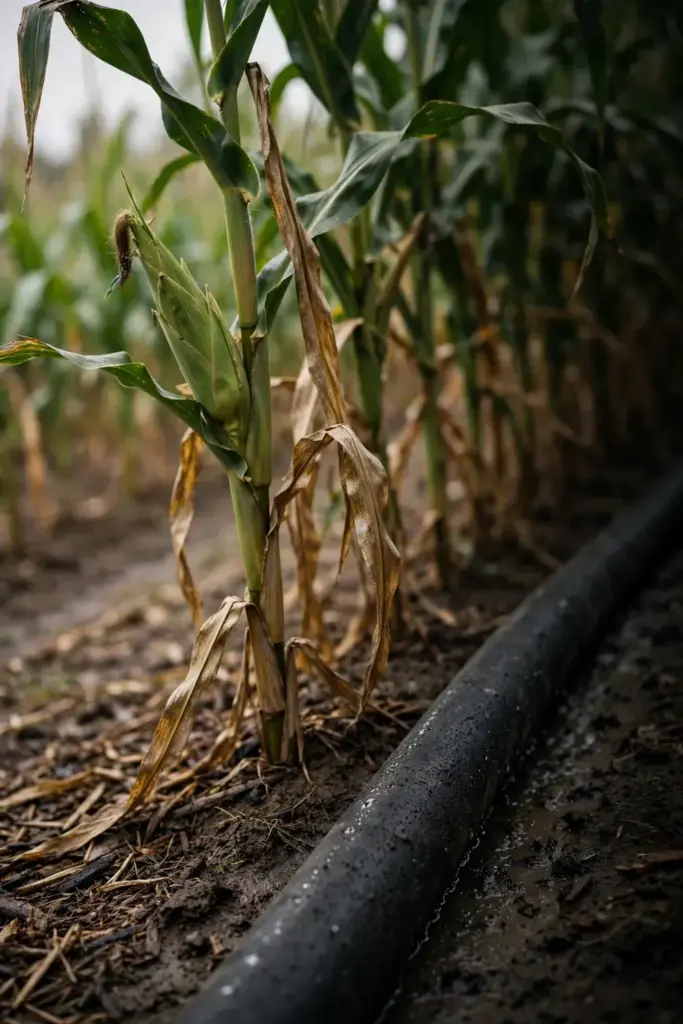
Water at the base. A soaker hose or a watering can at soil level wets the roots without wetting the canopy. Overhead sprinklers soak the leaves and splash spores upward from the soil and the lower leaves. Base watering keeps the foliage dry through the wettest part of the season.
Water in the morning. Morning water gives the leaves the full day to dry if any spray does reach them. Evening water leaves the foliage wet overnight, and a wet night is an infection night. A morning routine beats an evening routine for leaf disease in every warm climate.
Feed the soil while you manage the canopy. Strong plants with steady nutrition hold their leaves longer under disease pressure. The soil health guide covers the soil-building habits that keep a bed productive across rotations. Soil care never replaces debris cleanup, and debris cleanup never replaces soil care.
Step 6: Scout Lower Leaves From Silking On
Start weekly checks at silking. Walk the rows once a week from silking through harvest, and look at the lowest three leaves on each plant first. The disease starts low, so the lowest leaves give the earliest warning.
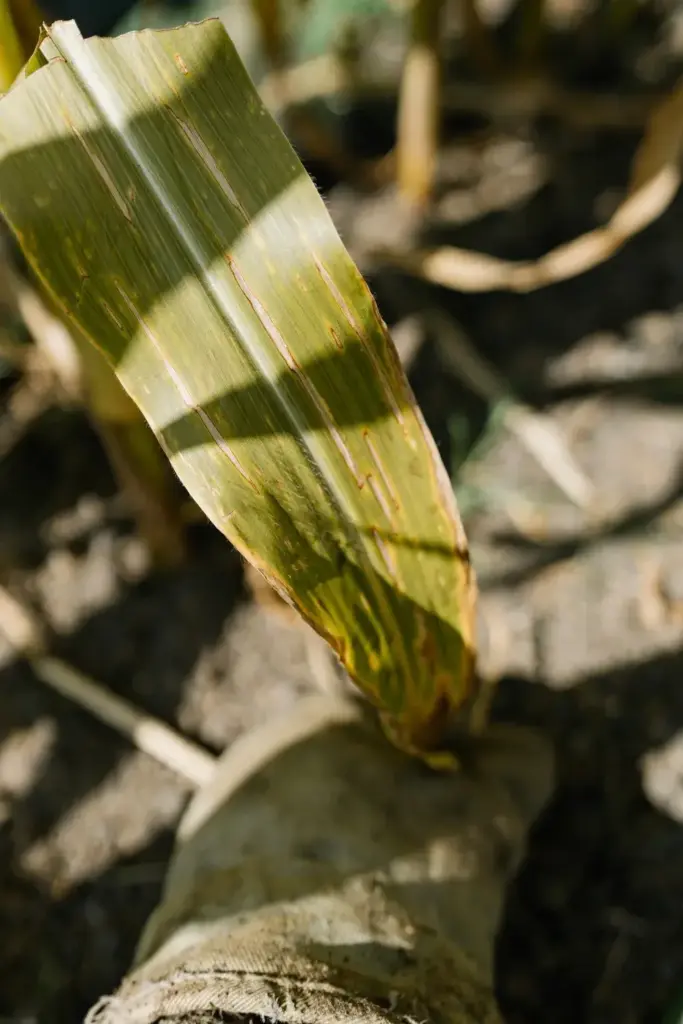
Know what you are looking for. Tan, parallel-sided lesions between the veins, on the lower leaves, climbing upward. Compare the size against the differential table above. A lesion that runs 2.5 cm or longer with a tapered cigar shape points at northern corn leaf blight, not southern.
Record what you find. Note the date, the bed, and how far up the plant the lesions have climbed. A notebook entry takes a minute, and it turns a vague worry into a record that guides next season’s variety choice and rotation plan.
Scouting sets the harvest call. Lesions climbing fast while ears still fill mean an early harvest. Lesions holding low while ears fill mean a normal harvest. The weekly check keeps that call honest, and it keeps the gardener from discovering the disease at harvest.
Step 7: Pull Volunteer Corn and Nearby Grass Hosts
Pull volunteer corn on sight. Volunteers sprout from kernels dropped at harvest, and they grow inside last season’s debris. They host the fungus between plantings and hand spores to the new crop. A volunteer pulled in spring is a season of spores removed.
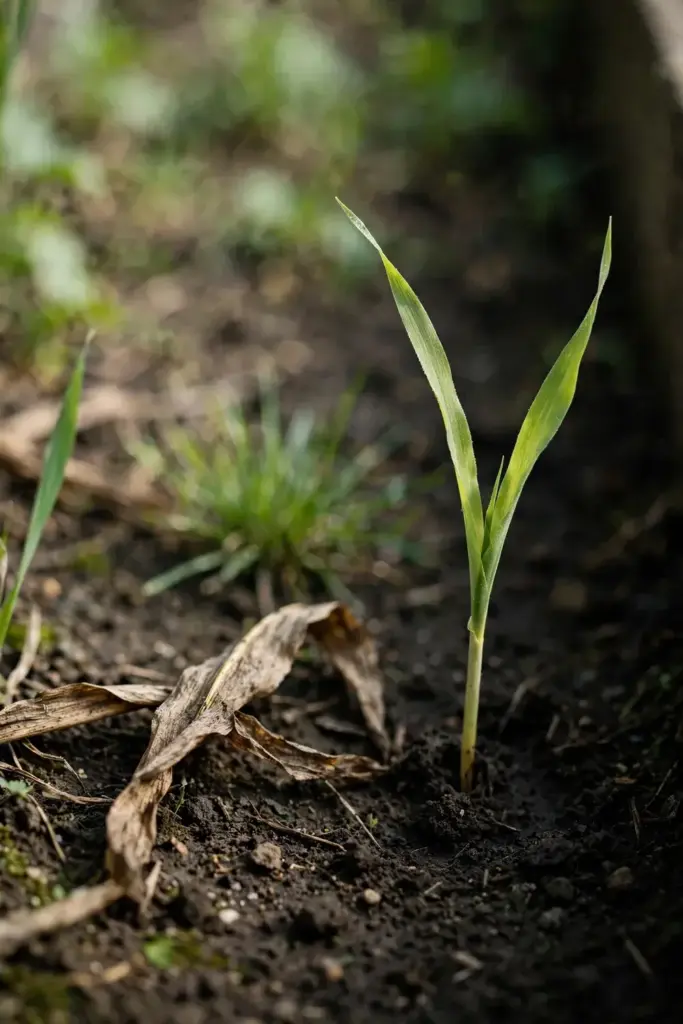
Clear grassy weeds at the bed edges. The same Cornell notes list Johnsongrass and sudangrass as hosts that harbor northern corn leaf blight inoculum. Keep the same grassy edge clear around sweet corn, since grassy weeds shelter leaf-blight fungi and the insects that move between grass and corn.
Mow the paths and the fence lines. Tall grass at the bed edge holds dew and shades the lowest corn leaves. A mowed edge dries faster and gives the fungus less shelter. The mower stays outside the bed, so it never drags infected debris across clean soil.
Check the compost pile for corn seedlings. Kernels tossed in with husks sprout in the pile, and a compost pile full of volunteer corn becomes a nursery for the fungus. Pull those seedlings and keep corn debris out of the pile entirely.
Step 8: Till Residue Under After Harvest
Till the bed after cleanup. Tillage buries the small debris that raking misses, and buried debris breaks down faster than debris on the surface. The same Illinois page notes that tillage may be helpful. Tillage is a helper, not a substitute for cleanup.
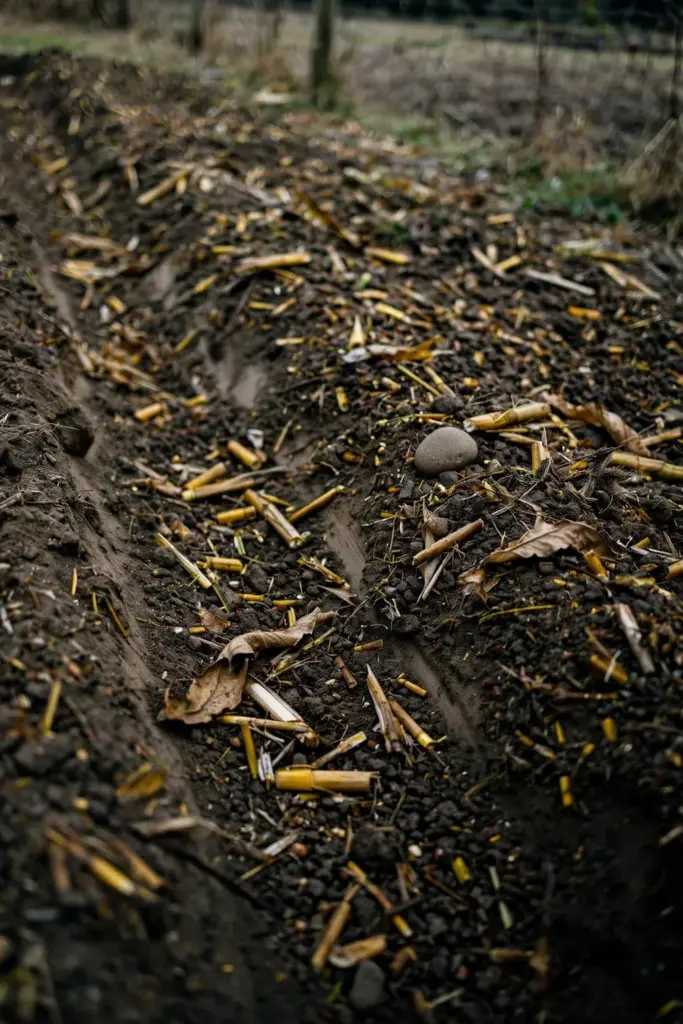
Till shallow and once. A single shallow pass buries residue without flipping the whole soil profile. Deep or repeated tillage harms soil structure and brings buried weed seed to the surface. One pass does the job.
Time the tillage for dry soil. Wet soil clumps under the tiller and seals into a crust. Dry soil crumbles, and the residue mixes in evenly. A dry afternoon after harvest beats a wet morning.
Pair tillage with rotation. Tilled ground that grows beans or squash next year breaks the corn disease cycle twice: once by burying the debris, and once by removing the host. Tillage plus rotation is the combination that clears a bed.
Step 9: Use Fungicides Only as a Label-Verified Last Resort
Treat fungicides as the last resort, not the first move. The same Cornell notes list fungicides labeled for northern corn leaf blight among the control options for southern leaf blight. The same Crop Protection Network page notes that foliar fungicides labeled for southern corn leaf blight are available. Availability is not a recommendation. The first eight steps carry the season.
Read the label before buying. The label must name southern corn leaf blight or corn leaf blights on a home-garden product, and it must list sweet corn as an allowed crop. A product labeled for field corn alone does not belong in a backyard bed. A product that names only northern corn leaf blight needs the Cornell cross-reference above before it earns a place in the plan.
Apply early or not at all. A protectant fungicide guards healthy tissue, and it cannot cure lesions that already show. An application after the canopy is fully spotted wastes money and adds chemical load for no gain. If the season calls for a spray, the window is early infection on the lower leaves, before the disease climbs.
Follow the label exactly. The label sets the rate, the interval, the pre-harvest interval, and the safety gear. Home-garden rates differ from field rates, and the label is the law for that product. Never mix products, never shorten the pre-harvest interval, and never spray on a windy day when drift can reach the neighbor’s bed.
Living With Southern Corn Leaf Blight Damage You Cannot Undo
Keep the plants standing while the ears fill. A spotted canopy still feeds the ears through the upper leaves. Pulling spotted plants early costs ears for no gain, since the spores are already in the bed and cleanup handles them after harvest.
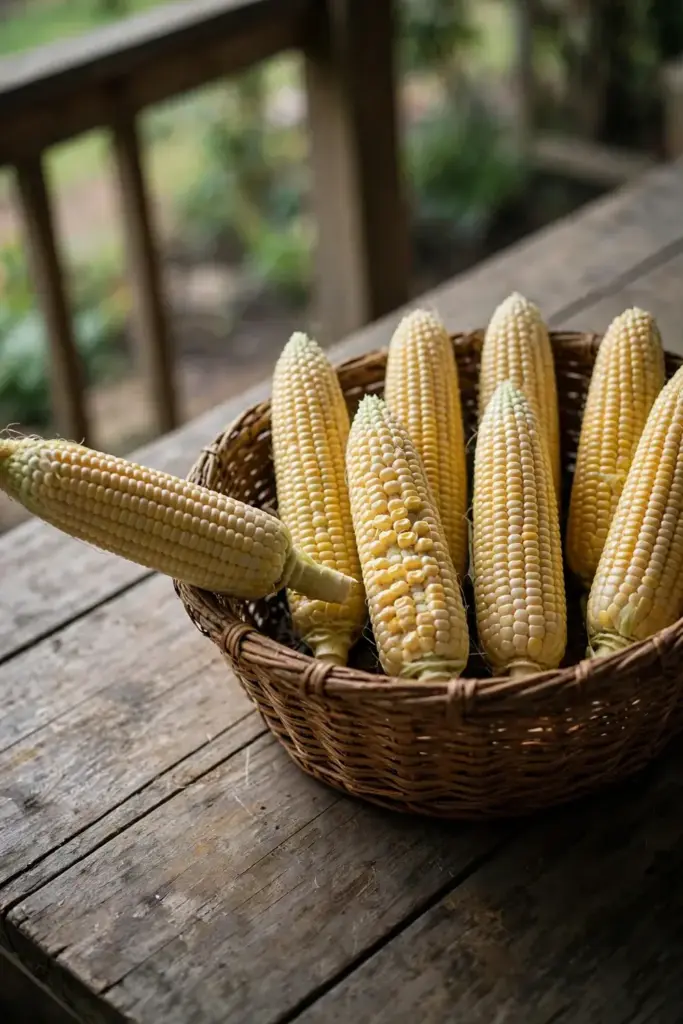
Pick ears at peak ripeness. Ears from a Race O planting stay usable while the leaves spot. Husk each ear, check the kernels, and cook the clean ones as usual. An ear with black felt-like mold across the kernels goes to the trash, and it never goes into the compost pile.
Strip the bed clean after the last picking. Pull every stalk, rake every fallen leaf, and destroy the lot. The cleanup step above is the recovery step too. A bed cleaned this fall starts next spring with the lowest spore load the gardener can arrange.
Plan the next planting from the record. The scouting notes from this season pick the variety and the bed for next season. A bed that showed heavy disease gets a resistant variety and a non-corn crop first. A bed that stayed clean keeps the susceptible favorite for one more year.
Frequently Asked Questions
Yes, when the damage stays on the leaves. Race O attacks leaves only, so ears from a leaf-spotted planting stay usable. Husk each ear, check the kernels, and cook the clean ears as usual. Discard any ear with black felt-like mold across the kernels. Never save seed from moldy ears, and never compost moldy ears or husks.
Typical Race O damage defoliates the plant and shrinks the harvest, and it rarely kills the plant outright. Lesions cut photosynthetic area, ears fill smaller, and the canopy dies back early. Severe early infection weakens the plant badly and can cost the whole crop. The honest gradient runs from light leaf spotting to heavy defoliation, not from healthy to dead.
Compare lesion size and shape. Southern corn leaf blight gives small, parallel-sided tan lesions, 0.25 to 1 inch long, between the veins. Northern corn leaf blight gives long, tapered, cigar-shaped lesions, 2.5 to 15 cm long. Both start on the lower leaves and climb. Field identification stays presumptive, and a diagnostic lab confirms the answer when certainty matters.
Yes, unless the debris leaves the bed. The fungus overwinters in corn stalks, leaves, and husks on the soil surface, and spring spores rise from that debris. Remove and destroy every scrap after harvest, rotate corn out of the plot, and till the residue under. Those three moves together break the cycle, and skipping any one of them leaves the door open.
No. Home compost piles rarely reach the sustained heat that kills fungal spores, and composted debris spreads the fungus with the compost. Bag the debris for municipal green waste, or burn it where local rules allow burning. Keep corn debris out of the pile entirely, and pull any volunteer corn that sprouts in the pile.
No. No spray cures lesions that already show, since the fungus lives inside the leaf tissue. Fungicides protect healthy tissue at best, and they belong at the end of the plan, not the start. Use a product only when the label names southern corn leaf blight and lists sweet corn as an allowed crop. Resistant varieties, cleanup, rotation, and airflow carry the season.
Where to Go From Here
Start with the lowest leaves. Walk the rows this week, check the bottom foliage, and compare what you find against the differential table. A clean lower canopy means the season is on track. Tan parallel-sided lesions mean the plan above starts now.
Order the resistant variety first. Seed catalogs turn over every year, and the resistant variety on this season’s list may be gone by spring. Buy the resistant seed while the choice is open, then set the rotation and the cleanup plan around it.
Close the bed clean in fall. Pull every stalk, destroy the debris, till the residue under, and rotate corn out of the plot. The fall cleanup is the single move that decides next season, and it costs an afternoon, not a spray program.